
Last Updated May 4, 2026
Yiddish Thought explores the literary, ethical, religious, cultural, social, political, theatrical, journalistic, diasporic, and memorial traditions through which Yiddish-speaking Jewish communities reflected on exile, memory, suffering, humor, justice, spiritual life, modernity, language, class, gender, labor, migration, catastrophe, and the meaning of human dignity under conditions of displacement and change. As a major category within the Philosophy knowledge series, this pillar studies Yiddish thought not as a narrow history of formal philosophy alone, but as a vernacular intellectual world in which moral reflection often appears through stories, jokes, songs, sermons, editorials, theater, memoir, reportage, folklore, political speech, family memory, archival rescue, and the stubborn ethical intelligence of everyday life.
This field includes several overlapping layers of thought: rabbinic and post-rabbinic ethical worlds translated into vernacular life; Hasidic, Musar, and mystical reflection on divine presence, inwardness, joy, discipline, and spiritual struggle; Haskalah critique and the encounter with secular knowledge; Yiddishism, philology, and the defense of vernacular civilization; socialist, Bundist, labor, diasporist, and anti-poverty political traditions; literary and theatrical cultures of moral realism, satire, and historical consciousness; women’s writing and gendered critique; immigrant public spheres; and postwar traditions of mourning, witness, archival preservation, cultural survival, and responsibility to a destroyed world.
The series proceeds from a central methodological claim: Yiddish thought cannot be understood only through systematic philosophy, elite theology, or nostalgic cultural memory. Its deepest arguments often appear in vernacular forms: the joke that exposes false dignity, the story that preserves moral ambiguity, the newspaper column that argues over labor and education, the play that stages generational conflict, the memoir that records migration, the Hasidic tale that searches for divine nearness, the Bundist slogan that defends worker dignity, the women’s text that reveals domestic constraint, and the postwar archive that turns preservation into ethical duty. The field therefore requires a broad understanding of philosophy, one capable of reading language, laughter, poverty, prayer, work, memory, and survival as serious modes of thought.
The goal of this pillar is not to reduce Yiddish culture to folklore, tragedy, secular politics, religious nostalgia, or Holocaust memory alone. It is to show why Yiddish thought remains philosophically indispensable precisely because it joins sacred inheritance, vernacular intelligence, humor, social justice, diaspora, labor, modernity, gender, public argument, literary realism, historical catastrophe, and cultural endurance into one of the great archives of human dignity under pressure.
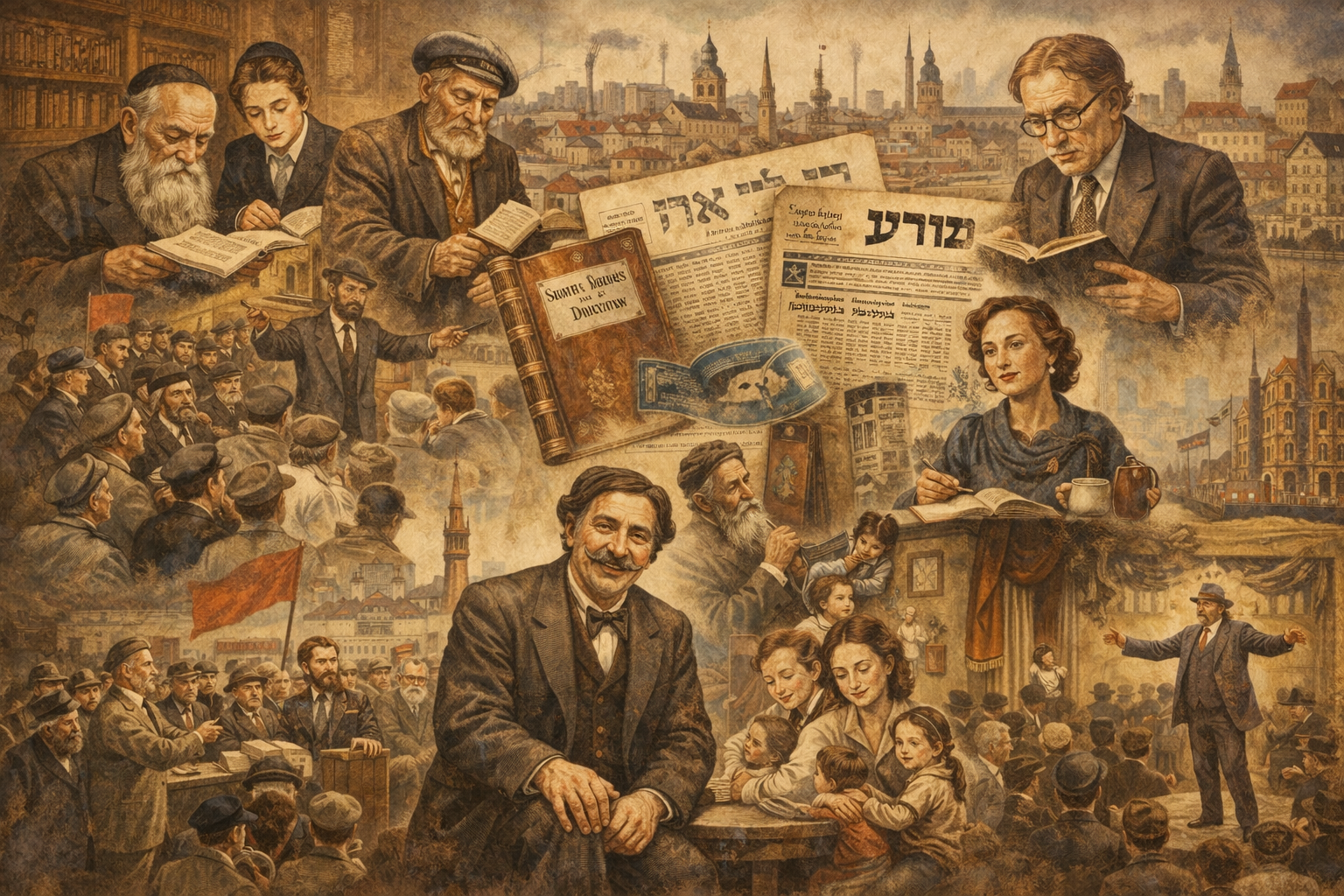
Yiddish thought is especially important to a broader philosophy architecture because it shows how serious reflection can emerge from vernacular life rather than from state power, academic system, or territorial sovereignty. In this respect, the category links not only to Religion and Society, Socialism and Socialist Thought, and Poetry, Memory, and Imagination, but also to Ethics and Moral Philosophy, Yiddish Legend, Folklore, and Sacred Imagination, Literature and Cultural Memory, Culture, Meaning, and Symbolism, and Political Philosophy and Justice. Questions of exile, poverty, labor, humor, faith, doubt, family obligation, public speech, women’s agency, minority vulnerability, memory, mourning, and cultural survival become sharper when Yiddish thought is treated as a major intellectual tradition rather than as a marginal language-world or nostalgic remnant.
A fullest account must also recognize that “Yiddish” is neither merely a language nor merely a folklore archive. It names a diasporic civilizational world in which language, everyday life, sacred inheritance, humor, social vulnerability, and historical memory became inseparable. Yiddish thought emerged in study houses, kitchens, workshops, print shops, marketplaces, political meetings, theaters, cafés, schools, newspapers, unions, publishing houses, immigrant neighborhoods, research institutes, and postwar institutions of remembrance. It was shaped by poverty and aspiration, piety and skepticism, domestic continuity and public upheaval, communal obligation and ideological contest. The result is not one unified doctrine but a dense field of reflections on justice, exile, dignity, work, faith, longing, class, language, and the terms of living humanly under unstable conditions.
Why This Series Matters
Yiddish thought deserves serious study for several reasons. First, it preserves one of the most humanly rich vernacular traditions of reflection in modern Jewish history, joining theology, ethics, literature, humor, politics, labor, theater, journalism, and communal memory into a single expressive field. Second, it reveals how philosophy may emerge not only in formal treatises but in stories, jokes, editorials, memoirs, sermons, songs, theater, reportage, and the moral pressure of everyday life. Third, it makes visible a diasporic intellectual world shaped not by territorial sovereignty but by language, migration, precarity, multilingualism, and communal endurance.
This field is indispensable for understanding how Jewish communities reflected on dignity under poverty, labor exploitation, discrimination, modernization, migration, and catastrophic loss. It preserves major traditions of moral seriousness that do not separate humor from suffering, critique from affection, memory from responsibility, or vernacular speech from intellectual depth. It broadens philosophy itself by showing that ordinary language, public argument, family life, artistic expression, and collective memory can sustain reflection on justice, faith, class, doubt, modernity, and human worth every bit as serious as that found in more canonical philosophical forms.
Yiddish thought also helps correct the narrowness of standard philosophical canons. It is not adequately understood if treated only as an appendix to Hebrew literature, only as a byproduct of East European Jewish folklore, only as a prelude to other national formations, only as a language of comic nostalgia, or only as postwar memorial culture. It is a layered intellectual world in its own right, shaped by rabbinic ethics, Hasidic spirituality, Musar discipline, the Haskalah, Yiddishism, labor politics, journalism, theater, secular critique, women’s writing, diaspora memory, and postwar witness.
The field matters most because it shows how thought can flourish under vulnerability. Yiddish-speaking worlds repeatedly confronted poverty, ridicule, exile, class injury, linguistic hierarchy, political exposure, migration, and destruction. Yet they generated extraordinary moral, literary, religious, comic, and political intelligence. Yiddish thought therefore belongs at the level of civilizational interpretation, not as a marginal supplement to philosophy or Jewish history.
The Civilizational Frame of Yiddish Thought
The phrase “Yiddish thought” is useful because it names a field broader than literature alone and more historically lived than theology alone. It points to a world formed among Ashkenazi Jews in Central and Eastern Europe and later reshaped in migratory, immigrant, and postwar settings, especially in the Americas, Israel, and other diaspora centers. This is not a claim of uniformity. It is a claim that Yiddish-speaking communities participated in overlapping concerns with exile, justice, work, sanctity, survival, memory, language, and human dignity.
At its deepest layers, Yiddish thought draws on the Bible, Talmud, Midrash, ethical literature, mysticism, liturgical rhythm, and the moral imagination of Ashkenazi communal life. Yet these inherited worlds became specifically Yiddish not merely through translation but through vernacular inhabitation. They were lived in kitchens, workshops, streets, schools, synagogues, newspapers, political clubs, theaters, literary circles, unions, and immigrant neighborhoods. In this sense, Yiddish thought is the vernacular habitation of Jewish moral and spiritual life under diasporic conditions.
Over time, these worlds were transformed by the Haskalah, modern print culture, industrialization, urbanization, socialist politics, labor organization, mass migration, linguistic self-consciousness, modern theater, literary realism, gendered reform, and the destruction and postwar reconstitution of Yiddish cultural life. The result was not a single philosophical school but a layered and often conflictual field in which piety, skepticism, satire, social critique, nostalgia, cosmopolitanism, and memorial urgency all coexist.
Yiddish thought is therefore best understood as a diasporic intellectual formation whose modes of reflection are historical, collective, vernacular, and public. Its philosophical depth lies precisely in the fact that it does not emerge from secure sovereignty or abstract universality. It emerges from the pressure of living, speaking, arguing, mourning, joking, remembering, and organizing under unstable conditions.
Plurality, Layering, and Intellectual Formation
No fullest account of Yiddish thought can proceed as though these traditions belonged to one homogeneous worldview. The field is internally plural. Hasidic worlds differ from non-Hasidic rabbinic worlds; Musar ethics differs from Hasidic inwardness; Haskalah critique differs from traditional pedagogy; Bundist and socialist traditions differ from liberal, diasporist, assimilationist, religious, Zionist, and anti-Zionist positions; immigrant Yiddish culture differs from East European small-town life; and postwar writing transforms inherited symbolic worlds under the pressure of devastation, survival, and the difficulty of continuity after destruction.
Literary modernists, memoirists, playwrights, journalists, philologists, folklore collectors, teachers, activists, and public intellectuals often engage the same problems of exile, poverty, faith, class, language, and dignity from sharply different vantage points. This is part of the field’s strength. Yiddish thought is not one doctrine. It is a crowded public space of argument, grief, laughter, critique, longing, and moral imagination.
This layered condition is especially important for avoiding reduction. To describe Yiddish thought only as religious tradition misses the central role of secularization, labor politics, satire, urban modernity, theater, and literary realism. To describe it only as secular modernity misses the persistence of rabbinic moral grammar, Hasidic inwardness, mystical symbolism, liturgical time, and ethical self-scrutiny. To describe it only as culture misses its jurisprudential, ethical, political, and theological seriousness. To describe it only as nostalgia misses the sharpness of its critique of poverty, patriarchy, hypocrisy, class domination, communal injustice, and the fragility of minority life.
The result is an intellectual archive best understood as a contact zone of sacred inheritance and modern upheaval: rabbinic learning, Hasidic spirituality, Musar discipline, Yiddishism, Haskalah rationalism, socialist and labor movements, theatrical and journalistic public spheres, migration, mourning, and survival. Yiddish thought is therefore not merely a collection of texts written in one language. It is a major field through which a diasporic people made exile, justice, faith, humor, class, memory, labor, language, and human vulnerability intelligible.
Method, Scope, and the Ethics of Reading
A serious pillar on Yiddish thought must read across genres and institutions. Its archive includes religious teaching, ethical literature, Hasidic tales, Musar texts, memoirs, fiction, poetry, plays, newspapers, jokes, political pamphlets, labor speeches, women’s writing, autobiographies, folklore collections, schoolbooks, union materials, archival records, survivor testimony, and postwar cultural preservation. The field cannot be understood by separating “high thought” from “popular culture,” because Yiddish intellectual life often appears precisely in the movement between them.
The first methodological principle is vernacular seriousness. Yiddish thought frequently uses ordinary speech, humor, complaint, anecdote, satire, and domestic realism to address major philosophical questions. These forms should not be treated as lesser because they are intimate, funny, popular, or non-systematic.
The second principle is historical attention. Yiddish culture was shaped by concrete social conditions: poverty, migration, antisemitism, religious authority, secularization, labor exploitation, urbanization, political radicalism, linguistic hierarchy, and catastrophic violence. Its thought cannot be detached from those conditions without losing its moral force.
The third principle is plurality. Yiddish thought includes pious and secular, socialist and religious, traditional and modernist, domestic and public, immigrant and postwar, comic and tragic, literary and political forms. A serious account should preserve these tensions rather than smoothing them into one heritage story.
The fourth principle is ethical care. Postwar Yiddish thought and archival rescue are bound to destroyed communities and murdered speakers. Memory must be handled without sentimental reduction. The task is not to turn loss into aesthetic atmosphere, but to understand how language, archive, literature, and witness became responsibilities after catastrophe.
Major Lines of Inquiry
One major line of inquiry is diaspora as a mode of collective life. Yiddish thought repeatedly asks what it means to build meaningful communal continuity without secure sovereignty, under conditions of migration, precarity, multilingualism, and political exposure. Diaspora here is not merely deficiency. It becomes a structure of memory, portability, attachment, improvisation, and moral responsibility.
A second line is faith, doubt, and divine hiddenness. The tradition includes sustained reflection on prayer, providence, skepticism, messianic longing, catastrophe, and the difficulty of belief in a wounded world.
A third line is humor, irony, and moral critique. Yiddish culture treats humor as an ethical and intellectual form through which pretension, cruelty, absurdity, false piety, class hierarchy, and communal contradiction are exposed.
A fourth line is poverty, labor, and justice. Work, exploitation, sweatshop life, dignity, mutual aid, socialist politics, and the rights of ordinary people are central to Yiddish journalism, fiction, theater, and political thought.
A fifth line is community, obligation, and social shame. Gossip, charity, family duty, marriage, education, honor, hypocrisy, and responsibility to the poor become sites of moral and social reflection.
A sixth line is language and cultural selfhood. Yiddish thought repeatedly confronts the meaning of speaking, writing, preserving, and defending a vernacular language historically marked by intimacy, subordination, mobility, and resilience.
A seventh line is memory, catastrophe, and ethical witness. The tradition preserves a powerful philosophy of memory in which historical suffering is not merely recorded but morally claimed as a demand upon the living.
An eighth line is modernity, secularization, and transformation. Urbanization, the Haskalah, socialism, migration, theater, journalism, assimilationist pressure, and literary modernism all reshape the terms in which Jewish life is interpreted and contested.
A ninth line is gender, family, and everyday moral life. Women’s writing, domestic labor, motherhood, marriage, generational conflict, education, sexuality, and feminist critique all belong to the ethical architecture of Yiddish reflection.
A tenth line is public sphere, institution, and cultural continuity. Newspapers, schools, theaters, unions, research institutes, archives, and publishing networks all shaped the forms in which Yiddish thought could become collective and self-aware.
Rabbinic and Ethical Inheritances in the Vernacular
Yiddish thought begins with the vernacular life of older Jewish ethical and interpretive traditions. Biblical narrative, rabbinic argument, Midrash, Musar, ethical teaching, liturgical memory, and communal law are not simply background materials. They shape the moral grammar through which Yiddish-speaking communities understand suffering, obligation, repentance, justice, poverty, neighborly duty, family life, and communal responsibility.
This inheritance becomes specifically Yiddish when it enters everyday speech and domestic life. Sacred learning does not remain confined to elite textual study. It is translated, paraphrased, dramatized, joked about, argued over, and carried through stories, proverbs, sermons, songs, and family teaching. That vernacular transformation matters philosophically because it shows how a learned tradition becomes lived moral common sense.
The rabbinic and ethical layer also gives Yiddish thought its deep concern with obligation. The self is not an isolated individual but a person embedded in duties toward God, family, community, the poor, the dead, and the vulnerable. Even when modern Yiddish writers become skeptical or secular, they often continue to think in the shadow of this moral grammar.
A strong pillar should therefore treat rabbinic inheritance not as a separate religious preface, but as one of the living structures beneath Yiddish literary, political, comic, and ethical imagination.
Hasidic, Musar, and Mystical Reflection
Hasidic storytelling and mystical tradition contribute a major layer of reflection on joy, inwardness, charisma, concealment, prayer, divine nearness, ordinary holiness, and the presence of meaning in broken life. Hasidic tales often carry philosophy by narrative means. They do not always argue abstractly; they dramatize the relation between teacher and disciple, soul and God, humility and pride, suffering and joy, hiddenness and revelation.
Musar contributes a different but equally important mode of ethical self-scrutiny, discipline, moral interiority, and the correction of character. Where Hasidic thought often emphasizes joy, devotion, story, and charismatic relation, Musar frequently emphasizes discipline, self-examination, moral accounting, and ethical seriousness. Together, these traditions deepen the inward dimension of Yiddish thought.
Even where later Yiddish thought becomes secular or critical, it often remains marked by the symbolic and existential intensity of these traditions. The language of hiddenness, longing, moral failure, humility, divine absence, and inner struggle continues to shape Yiddish literature and memoir long after formal religious certainty has weakened.
This spiritual layer matters because it prevents Yiddish thought from being reduced to social realism or political critique alone. Its archive includes interiority, prayer, broken faith, moral discipline, ecstatic joy, and the search for divine presence in a world that often appears wounded or abandoned.
Haskalah and the Critique of Traditional Jewish Life
The Haskalah introduced a major turning point by bringing rational critique, secular learning, reformist aspiration, linguistic self-consciousness, satire, and cultural self-examination into Jewish life. In Yiddish culture, the encounter with Enlightenment and modernity created both creative possibility and deep conflict. It forced inherited communities to confront education, science, language hierarchy, gender expectations, economic change, political emancipation, and the limits of traditional authority.
This critique did not simply abolish tradition. It placed tradition under argument. Yiddish writers and intellectuals used satire, fiction, journalism, pamphlet writing, and public debate to expose ignorance, poverty, hypocrisy, authoritarianism, superstition, and social stagnation. At the same time, Haskalah critique often produced its own tensions: elitism, distance from ordinary people, linguistic ambivalence, and pressure toward assimilation.
The Haskalah matters because it makes Yiddish thought self-conscious. It turns language, education, class, gender, religion, and cultural future into explicit topics of public reflection. The vernacular becomes not only a medium of everyday life but a site of struggle over what Jewish modernity should become.
A serious pillar should therefore treat the Haskalah not as a simple “progress” narrative, but as a contested reorganization of Jewish intellectual life under the pressures of modernity.
Yiddishism, Philology, and Vernacular National-Cultural Thought
The rise of Yiddish scholarship, cultural self-awareness, philology, publishing, education, and institutional preservation transformed Yiddish from a lived vernacular into a consciously defended intellectual medium. Yiddishism is therefore not merely a literary preference. It is a philosophy of collective existence without territorial closure.
Debates over Yiddish were debates over peoplehood, legitimacy, class, history, education, modernity, and the future of diasporic Jewish life. To defend Yiddish was to defend the dignity of ordinary speakers, the cultural authority of diaspora, and the claim that a vernacular language could carry serious literature, scholarship, journalism, politics, and moral thought. Yiddishism challenged both assimilationist contempt for the language and elite hierarchies that treated other languages as inherently superior.
Philology and scholarship also became forms of cultural rescue. To collect, classify, edit, teach, and preserve Yiddish materials was to argue that vernacular life had intellectual value. This made institutions such as research institutes, libraries, archives, schools, and presses central to the life of Yiddish thought.
Yiddishism therefore belongs within philosophy because it asks what makes a language worthy of preservation, what a people can be without sovereignty, and how culture survives through institutions of memory rather than through state power alone.
Literature as Philosophy
A fullest account must treat modern Yiddish literature not merely as aesthetic production but as philosophical reflection. In prose, poetry, and drama, writers explore faith and doubt, social cruelty, migration, family burden, erotic longing, the absurdity of modern life, class humiliation, the instability of tradition, and the tension between communal inheritance and individual freedom. Modern Yiddish literature is one of the tradition’s central vehicles of thought.
Mendele Moykher-Sforim, I. L. Peretz, Sholem Aleichem, S. An-sky, Avrom Sutzkever, Chava Rosenfarb, and many others show how story becomes moral inquiry. Fiction can reveal the comedy of survival, the shame of poverty, the burden of tradition, the fragility of human dignity, the brutality of history, and the difficulty of remaining decent within flawed social worlds.
Yiddish literature is especially powerful because it rarely treats human beings as pure examples of doctrine. Its characters are funny, weak, pious, ridiculous, noble, compromised, loving, self-deceived, and wounded. This realism is philosophical. It asks what dignity means when people are not heroic, when communities are not ideal, and when history is not merciful.
A serious pillar should therefore place literature at the center of Yiddish thought. It is through narrative, character, voice, irony, and memory that many of the field’s deepest questions become visible.
Humor, Irony, and Moral Intelligence
No serious treatment of Yiddish thought can treat humor as mere entertainment. Humor is one of the tradition’s major intellectual forms. It exposes false grandeur, punctures pretension, reveals the absurdity of power, and allows the vulnerable to speak under conditions where direct confrontation may be dangerous or impossible.
Yiddish humor often carries moral intelligence because it refuses abstraction. It knows hunger, family tension, debt, communal hypocrisy, religious anxiety, class shame, and the small humiliations of ordinary life. It does not solve suffering, but it prevents suffering from becoming mute. It gives language to contradiction.
Irony also protects against false purity. Yiddish thought often distrusts the grand moral pose. It sees the foolishness of the righteous, the pride of the pious, the vanity of the intellectual, the cruelty of respectability, and the fragility of all human certainty. This gives Yiddish humor a philosophical edge: it teaches humility through laughter.
A strong pillar should therefore treat humor as critique, survival, and ethical realism. It is not escape from seriousness. It is one of the ways seriousness becomes humanly bearable.
Journalism, Public Argument, and the Vernacular Public Sphere
Yiddish newspapers, editorials, feuilletons, reportage, letters, serialized fiction, advice columns, polemics, and public debates created a major arena in which working-class life, politics, religion, gender, education, language, migration, and cultural future could be argued in real time. Journalism in this tradition is not secondary to thought; it is one of its most public and democratic forms.
The Yiddish press made intellectual life collective. It allowed workers, immigrants, activists, teachers, writers, religious figures, secularists, women, and political organizers to participate in a shared public sphere. Through newspapers and journals, questions that might otherwise remain private or local became matters of public argument: wages, schooling, marriage, language, religion, antisemitism, socialism, Zionism, assimilation, women’s rights, and the future of Jewish culture.
This public sphere also democratized style. Thought appeared in ordinary language, in urgency, in serialized argument, in public controversy, and in the rhythms of daily life. The newspaper became a school, meeting hall, literary platform, political organ, and archive of community.
A serious pillar should therefore treat journalism as one of the core institutions of Yiddish thought. It shows how philosophy becomes vernacular, public, contentious, and socially embedded.
Labor, Bundism, Socialism, and Class Thought
Yiddish intellectual life includes major reflection on labor, class, dignity, anti-poverty politics, socialist organization, and the rights of Jewish workers. Bundist and broader left traditions are indispensable to the category because they transform Yiddish into a language not only of memory and religion but of collective political action, social theory, and anti-humiliation ethics.
Labor thought in Yiddish culture is deeply connected to lived experience: sweatshops, migration, poverty, crowded housing, workplace exploitation, union organizing, mutual aid, and the moral demand that ordinary people be treated with dignity. Political philosophy here emerges from the conditions of workers and the poor rather than from abstract state theory alone.
Bundism is especially important because it articulated a diasporic politics of cultural autonomy, worker dignity, secular Jewish identity, language defense, and social justice. It asked whether Jewish collective life could be organized around class solidarity, cultural rights, and local autonomy rather than state sovereignty or assimilation.
This socialist and labor layer matters because it makes justice concrete. It asks what dignity means when people work too long, earn too little, live precariously, and speak a language mocked by elites. In Yiddish thought, class is not a secondary issue. It is one of the central places where ethics becomes political.
Theater, Performance, and Public Moral Imagination
Yiddish theater provided a powerful medium for reflecting on generational conflict, modernity, migration, family authority, class aspiration, piety, ridicule, longing, and communal breakdown. Performance in this tradition is not merely entertainment but a public mode of ethical and social thought.
The stage made conflict visible. It dramatized the tensions between old and new, parents and children, tradition and freedom, religious authority and secular aspiration, poverty and ambition, sincerity and hypocrisy, homeland and migration. In performance, communities could watch themselves argue, suffer, laugh, adapt, and fail.
Theater also created a public moral imagination. It brought together language, gesture, music, satire, melodrama, realism, comedy, and communal recognition. Audiences did not simply consume stories; they encountered versions of their own conflicts staged before them.
A strongest account should therefore treat Yiddish theater as a philosophical space. It asks what a community looks like when it sees itself from outside, when domestic life becomes public, and when historical change becomes drama.
Women’s Writing and Gendered Social Critique
A strongest-sense account must include women not only as subjects of Yiddish ethics but as intellectual agents. Women writers, memoirists, activists, workers, educators, journalists, and cultural participants reshape Yiddish reflection on domestic life, labor, sexuality, motherhood, marriage, education, vulnerability, and dignity. Gender is not a secondary issue in Yiddish thought. It is one of the places where community, modernity, and moral expectation collide most sharply.
Women’s writing often reveals the hidden labor of continuity. It shows how language, memory, piety, food, family, education, care, and survival are transmitted through domestic and social worlds that formal intellectual history often overlooks. It also exposes the burdens placed on women by poverty, patriarchy, migration, religious expectation, and modern reform.
In Yiddish modernity, women’s education and public speech become major issues. The woman reader, writer, worker, activist, actress, mother, immigrant, and survivor all become figures through which Yiddish thought reinterprets dignity and social change.
A serious pillar should therefore integrate gender structurally. The ethical life of Yiddish culture cannot be understood without women’s labor, women’s speech, women’s memory, and women’s critique of the communities that both sustained and constrained them.
Urban Modernity and the City as Intellectual Environment
Warsaw, Vilna, Odessa, New York, Buenos Aires, and other urban centers are not incidental settings. They are intellectual environments in which Yiddish thought changes form. Urban modernity intensifies class visibility, anonymity, migration, publishing, theater, political organization, education, ideological conflict, and public argument. The city becomes one of the main laboratories of Yiddish reflection.
In cities, old forms of communal life were transformed by factories, tenements, cafés, schools, newspapers, theaters, unions, and political meetings. The city generated new possibilities: cultural production, organized labor, secular education, literary experimentation, women’s public participation, and ideological debate. It also generated new injuries: poverty, isolation, exploitation, assimilationist pressure, crime, shame, and generational rupture.
Urban Yiddish thought is therefore a philosophy of transition. It asks how people preserve dignity when old structures weaken and new structures are unstable. It asks how language survives in migration, how family adapts under economic pressure, and how solidarity can be built among strangers.
A full pillar should treat cities not as backdrops but as engines of thought. Yiddish modernity is inseparable from urban public life.
Faith, Doubt, and Secularization
Yiddish thought develops at the intersection of sacred inheritance and modern disruption. Rabbinic authority, Hasidic spirituality, ethical self-discipline, communal obligation, and ritual life continue to shape moral imagination even where writers, activists, or intellectuals become secular, socialist, skeptical, anti-clerical, or estranged. Modern Yiddish thought therefore often takes the form of argument with inherited Judaism rather than simple departure from it.
Faith in Yiddish thought is rarely uncomplicated. It is tested by poverty, ridicule, injustice, migration, modern knowledge, political radicalism, and catastrophe. Doubt is not merely intellectual disbelief; it is often grief, protest, disappointment, and moral bewilderment. Secularization does not simply remove religion. It reworks religious categories into literature, politics, ethics, memory, and cultural identity.
This makes Yiddish thought especially rich for studying divine hiddenness, broken faith, messianic longing, and the ethical residue of religion in secular worlds. A person may reject belief and still inherit its moral grammar. A writer may mock piety and still preserve its rhythms. A political movement may be secular and still carry prophetic intensity.
A serious pillar should therefore avoid simplistic categories of religious versus secular. Yiddish thought lives in the argument between them.
Ethics, Community, and Human Dignity
The ethical core of Yiddish thought lies in its persistent concern with how one lives humanly under conditions of dependency, judgment, hardship, class vulnerability, and historical exposure. What is owed to parents, children, neighbors, the poor, workers, strangers, the dead, and one’s own language-community? How does one preserve self-respect without cruelty, fidelity without rigidity, humor without indifference, and memory without paralysis? These questions recur across sacred writing, fiction, journalism, memoir, theater, and political speech.
Yiddish thought is also marked by tension between communal belonging and individual suffering. Community can be a source of warmth, duty, mutual aid, memory, and education, but also of gossip, constraint, shame, patriarchy, and hypocrisy. This ambivalence is one of the tradition’s deepest forms of realism. It refuses to romanticize either the individual or the collective and instead asks how dignity may survive within flawed social worlds.
Human dignity here is not abstract. It is tested in hunger, work, migration, ridicule, domestic strain, historical violence, and the demand to remain morally responsive under pressure. Dignity is sustained through speech, humor, memory, responsibility, labor, care, and ethical stubbornness.
That is why Yiddish thought remains philosophically vital. It treats dignity not as a slogan but as a fragile practice.
Postwar Witness, Survival, and Cultural Continuity
After the destruction of Eastern European Yiddish civilization, the language remained a medium of testimony, mourning, memorialization, literary continuation, and cultural rescue. Postwar Yiddish thought is therefore one of the major sites where memory becomes ethical witness, language becomes survival without normal continuity, and archival preservation becomes a form of moral obligation.
Postwar writing confronts the difficulty of speaking after catastrophe. It asks how language can bear witness to destruction, how memory can resist erasure, how literature can continue without pretending that continuity is intact, and how the dead remain a moral presence among the living. Writers such as Avrom Sutzkever and Chava Rosenfarb become central because they show literary survival under the pressure of historical devastation.
The postwar archive also changes the meaning of preservation. To collect manuscripts, newspapers, testimonies, songs, theater materials, books, and oral histories is not merely to preserve culture. It is to resist the destruction of memory itself. Archive becomes responsibility.
A serious pillar should therefore treat postwar Yiddish thought not only as mourning but as intellectual continuation under impossible conditions. Its central question is how a language continues when the world that sustained it has been shattered.
Institutions, Archives, and the Hardware of Yiddish Thought
No serious treatment of Yiddish thought is complete without the institutions and infrastructures through which it moved. Schools, newspapers, theaters, unions, publishing houses, libraries, research institutes, archives, immigrant associations, political organizations, folklore projects, and postwar memorial institutions all shaped the life of ideas. Yiddish thought was not only produced by individual writers. It was built through institutions of circulation, debate, preservation, and education.
The press made thought public. Theater made it embodied. Schools transmitted it to children. Unions made it political. Archives made it durable. Research institutes made it scholarly. Publishing houses made it portable. Immigrant neighborhoods made it urban and transnational.
YIVO is especially important as an institution of modern Yiddish self-consciousness. It helped turn vernacular life into an object of research, preservation, and cultural seriousness. The National Library of Israel’s Yiddish press collections and other archival projects similarly show how Yiddish public life can be studied through newspapers, journals, and printed debate.
A strongest pillar should therefore treat institutions as part of the philosophy of Yiddish culture. The survival of thought depends on the material systems that teach, print, perform, preserve, and remember it.
Expanded Article Architecture
The following structure gathers the Yiddish Thought pillar into a long-range article architecture. It preserves the planned article list from the source draft while adding short descriptions under every planned article.
Foundations of Yiddish Thought
- What Is Yiddish Thought? (planned)
Introduces Yiddish thought as a vernacular intellectual tradition shaped by diaspora, sacred inheritance, humor, labor, language, literature, memory, and human dignity under pressure. - Ashkenazi Ethical Inheritance and the Vernacular Moral World of Yiddish (planned)
Studies how biblical, rabbinic, ethical, liturgical, and communal traditions became lived moral language within Yiddish-speaking worlds. - Rabbinic Tradition, Midrash, and the Moral Grammar of Yiddish Culture (planned)
Examines how rabbinic reasoning, Midrashic imagination, obligation, justice, and interpretive habit shaped Yiddish ethical and narrative thought.
Hasidic, Musar, Mystical, and Religious Worlds
- Hasidic Spirituality and the Inner Life of Yiddish Thought (planned)
Explores Hasidic storytelling, joy, inwardness, divine nearness, charisma, prayer, and ordinary holiness as major forms of vernacular religious reflection. - Musar, Discipline, and the Ethics of the Self in Yiddish Culture (planned)
Studies Musar ethics through self-scrutiny, moral discipline, character formation, humility, repentance, and the inward labor of ethical life. - Joy, Suffering, and Divine Hiddenness in Hasidic and Post-Hasidic Reflection (planned)
Examines the tension between joy and suffering, faith and concealment, religious longing and historical pain in Hasidic and later Yiddish thought. - Faith, Doubt, and Secularization in Yiddish Intellectual Life (planned)
Studies how Yiddish writers and thinkers argued with inherited Judaism through belief, doubt, satire, secularization, socialism, and broken faith.
Haskalah, Yiddishism, Language, and Diasporic Cultural Theory
- The Haskalah and the Critique of Traditional Jewish Life in Yiddish Culture (planned)
Examines Haskalah critique through satire, education, secular knowledge, reform, language hierarchy, communal conflict, and the transformation of Jewish modernity. - Yiddishism, Language Politics, and the Idea of Vernacular Civilization (planned)
Studies Yiddishism as a defense of vernacular dignity, diasporic peoplehood, language preservation, cultural autonomy, and non-territorial collective life. - Diaspora as a Way of Thinking: Language Without Sovereignty in Yiddish Thought (planned)
Explores diaspora not merely as loss but as a structure of memory, portability, cultural creativity, vulnerability, and ethical interdependence. - Why Language Matters: Yiddish and the Philosophy of Cultural Belonging (planned)
Examines Yiddish as a language of intimacy, public argument, humor, labor, literature, memory, and cultural belonging under historical pressure.
Poverty, Labor, Bundism, Socialism, and Class Thought
- Poverty, Charity, and Human Dignity in Yiddish Moral Imagination (planned)
Studies poverty, mutual aid, charity, shame, dependence, and the moral demand to preserve dignity under economic hardship. - Labor, Bundism, and Socialist Thought in the Yiddish World (planned)
Examines Bundism and socialist traditions through worker dignity, cultural autonomy, class politics, secular Jewish identity, and diasporic social justice. - Class, Work, and Social Justice in Yiddish Journalism and Political Culture (planned)
Studies sweatshop life, worker organizing, labor journalism, public debate, poverty, exploitation, and the ethics of collective struggle.
Humor, Satire, Narrative, and Literary Philosophy
- Humor, Irony, and the Ethics of Survival in Yiddish Thought (planned)
Examines humor as a serious intellectual form that exposes pretension, protects dignity, and makes suffering speakable without sentimentalizing it. - Wise Fools, Satire, and the Critique of Pretension in Yiddish Culture (planned)
Studies comic figures, fools, satirical voices, and anti-pretension as forms of moral and social critique. - Stories as Philosophy: Narrative Thought in Yiddish Literature (planned)
Explores how stories, character, voice, irony, and plot carry philosophical reflection on dignity, hypocrisy, migration, faith, and human frailty. - Mendele Moykher-Sforim and the Satirical Intellect of Modern Yiddish (planned)
Studies Mendele as a foundational modern Yiddish writer whose satire exposes poverty, communal dysfunction, social absurdity, and moral contradiction. - I. L. Peretz and the Ethical Imagination of Modern Jewish Life (planned)
Examines Peretz’s literary and ethical imagination through modernity, tradition, social responsibility, spiritual longing, and cultural transformation. - Sholem Aleichem and the Human Comedy of Historical Vulnerability (planned)
Studies Sholem Aleichem through humor, family, migration, poverty, tenderness, historical instability, and the comic dignity of ordinary life.
Historical Consciousness, Cultural Autonomy, Ethnography, and Institutions
- Simon Dubnow, Diaspora Nationalism, and Historical Consciousness (planned)
Examines Dubnow’s theory of diaspora nationalism, Jewish historical continuity, cultural autonomy, minority life, and collective memory without sovereignty. - Chaim Zhitlowsky and the Politics of Yiddish Cultural Autonomy (planned)
Studies Zhitlowsky’s vision of secular Yiddish culture, language politics, diasporic autonomy, socialism, and cultural national thought. - S. An-sky, Ethnography, Memory, and the Thought of a Vanishing World (planned)
Examines An-sky’s ethnographic, literary, and theatrical work as a response to disappearing communal worlds and the urgency of cultural preservation. - YIVO, the Press, and the Institutions of Yiddish Intellectual Life (planned)
Studies the institutions that preserved, researched, printed, circulated, and legitimized Yiddish thought, including archives, newspapers, and scholarly networks. - Archives, Preservation, and the Responsibility to a Destroyed World (planned)
Examines archival rescue as an ethical responsibility to destroyed communities, lost voices, and cultural worlds that require active remembrance.
Theater, Journalism, Cities, and the Vernacular Public Sphere
- Theater, Performance, and the Public Life of Yiddish Reflection (planned)
Studies Yiddish theater as a public form of moral imagination, staging family conflict, migration, modernity, piety, class aspiration, and communal change. - Journalism, Debate, and the Vernacular Public Sphere (planned)
Examines Yiddish newspapers and journals as democratic arenas of public argument over politics, labor, religion, education, gender, and cultural future. - Warsaw, Vilna, Odessa, and New York as Intellectual Worlds of Yiddish Modernity (planned)
Studies major Yiddish urban centers as environments of publishing, theater, politics, migration, class conflict, secularization, and literary experimentation. - Migration, Urban Modernity, and the Remaking of Yiddish Thought (planned)
Examines how migration, immigrant neighborhoods, industrial work, city life, assimilation pressure, and transnational networks transformed Yiddish intellectual life.
Women, Family, Gendered Critique, and Everyday Moral Life
- Women, Family, and the Ethics of Everyday Life in Yiddish Culture (planned)
Studies domestic life, marriage, motherhood, care, education, family obligation, and women’s role in transmitting language, memory, and ethical practice. - Women Writers, Labor, and Gendered Critique in Yiddish Modernity (planned)
Examines women writers, workers, activists, journalists, and memoirists as critics of poverty, patriarchy, labor exploitation, education limits, and communal constraint.
Catastrophe, Witness, Survival, and Cultural Responsibility
- Memory, Catastrophe, and Ethical Witness in Postwar Yiddish Writing (planned)
Studies postwar Yiddish writing as a medium of testimony, mourning, responsibility, historical witness, and cultural survival after destruction. - Avrom Sutzkever, Chava Rosenfarb, and Literary Survival After Destruction (planned)
Examines Sutzkever and Rosenfarb as major figures of postwar Yiddish literary survival, memory, testimony, and moral imagination after catastrophe. - Yiddish After Catastrophe: Survival, Continuity, and Cultural Responsibility (planned)
Studies how Yiddish language and culture continued after destruction through literature, archives, teaching, memory work, and responsibility to the dead. - Why Yiddish Thought Still Matters (planned)
Concludes the series by explaining why Yiddish thought remains vital for philosophy, Jewish studies, labor history, diaspora studies, humor studies, literary history, and memory ethics.
The Wider Significance of the Series
This series treats Yiddish thought as a major archive whose significance extends far beyond Jewish literary history. It helps explain how communities reflect on sacred inheritance, social injustice, language, labor, exile, humor, memory, and human dignity under unstable historical conditions. It also contributes to comparative work in philosophy, religious studies, political thought, literary history, diaspora studies, labor history, humor studies, gender studies, and memory studies by presenting a field in which theology, vernacular literature, journalism, theater, socialism, women’s writing, and postwar witness all meet.
More broadly, the series argues that Yiddish thought is indispensable for understanding how an intellectual tradition can flourish without state power, and how a language of ordinary life can become a language of extraordinary moral seriousness. It reveals how communities imagine justice without sovereignty, how they preserve humor without triviality, how they honor memory without surrendering thought, and how they sustain dignity under pressure.
The strongest reason to study this field is that its central questions remain alive. How does a vulnerable community preserve moral intelligence? How does a language carry memory when its world is scattered or destroyed? How can humor expose cruelty without becoming cynical? How can ordinary people remain dignified under poverty, migration, ridicule, and violence? How does an archive become an ethical obligation? These are not only Yiddish questions. They are enduring human questions, and Yiddish thought is one of the major ways they can be studied with depth.
Related Reading
- Religion and Society — for communal life, religious authority, secularization, minority experience, public culture, and social transformation.
- Socialism and Socialist Thought — for labor, class, exploitation, solidarity, worker dignity, mutual aid, and political organization.
- Ethics and Moral Philosophy — for dignity, obligation, care, responsibility, virtue, suffering, and the moral life of ordinary communities.
- Poetry, Memory, and Imagination — for lyric memory, grief, witness, imagination, and language as a carrier of cultural survival.
- Literature and Cultural Memory — for narrative, testimony, archive, canon formation, literary memory, and the afterlife of destroyed worlds.
- Yiddish Legend, Folklore, and Sacred Imagination — for folklore, sacred story, humor, spirits, folk memory, and vernacular imagination.
- Political Philosophy and Justice — for diaspora politics, minority rights, cultural autonomy, socialism, dignity, and public responsibility.
- Culture, Meaning, and Symbolism — for language, ritual, humor, domestic life, theater, folklore, and symbolic worlds of ordinary meaning.
Primary Sources and Archives
- YIVO Encyclopedia of Jews in Eastern Europe (n.d.) YIVO Encyclopedia. Available at: https://www.yivoencyclopedia.org/.
- YIVO Institute for Jewish Research (n.d.) Archives and Library Collections. Available at: https://www.yivo.org/Archives-and-Library.
- National Library of Israel (n.d.) Yiddish Press Collection. Available at: https://www.nli.org.il/en/discover/newspapers/jpress/all-sections/yiddish-press.
- Yiddish Book Center (n.d.) Digital Library and Yiddish Cultural Resources. Available at: https://www.yiddishbookcenter.org/.
- Internet Archive (n.d.) Yiddish Books and Periodicals. Available at: https://archive.org/search?query=subject%3A%22Yiddish%22.
Further Reading
- Hasan-Rokem, G. (2004) ‘Jewish Folklore and Ethnography’, in The Oxford Handbook of Jewish Studies. Oxford: Oxford University Press. Available at: https://academic.oup.com/edited-volume/38625/chapter/335233836.
- Roskies, D.G. (1995) A Bridge of Longing: The Lost Art of Yiddish Storytelling. Cambridge, MA: Harvard University Press.
- Wisse, R. (2013) No Joke: Making Jewish Humor. Princeton, NJ: Princeton University Press.
- YIVO and the Making of Modern Jewish Culture (2014). Cambridge: Cambridge University Press. Available at: https://www.cambridge.org/core/books/yivo-and-the-making-of-modern-jewish-culture/A2551D89B115CEBA2F2FE58E4A02DF39.
- The Cambridge History of Judaism, chapter on ‘Yiddish Literature’. Cambridge: Cambridge University Press. Available at: https://www.cambridge.org/core/books/cambridge-history-of-judaism/yiddish-literature/3B5479F6861170FFCC874647DF6E2293.
- The Cambridge History of Judaism, chapter on ‘Jews and the Left’. Cambridge: Cambridge University Press. Available at: https://www.cambridge.org/core/books/cambridge-history-of-judaism/jews-and-the-left/38EE87CF1AC54CBCB3C56256E712B71B.
- Oxford Research Encyclopedia of Literature entry on Jewish Theater. Oxford: Oxford University Press. Available at: https://academic.oup.com/edited-volume/61883/chapter/552812679?searchresult=1.
- Sherman, J. (ed.) (2004) Yiddish after the Holocaust. Oxford: Boulevard Books.
- YIVO Encyclopedia of Jews in Eastern Europe (n.d.) YIVO Encyclopedia. Available at: https://www.yivoencyclopedia.org/.
- National Library of Israel (n.d.) Yiddish Press Collection. Available at: https://www.nli.org.il/en/discover/newspapers/jpress/all-sections/yiddish-press.
References
- Hasan-Rokem, G. (2004) ‘Jewish Folklore and Ethnography’, in The Oxford Handbook of Jewish Studies. Oxford: Oxford University Press. Available at: https://academic.oup.com/edited-volume/38625/chapter/335233836.
- The Oxford Handbook of Jewish Studies (2004). Oxford: Oxford University Press. Available at: https://academic.oup.com/edited-volume/38625.
- ‘Yiddish Literature’, in The Cambridge History of Judaism. Cambridge: Cambridge University Press. Available at: https://www.cambridge.org/core/books/cambridge-history-of-judaism/yiddish-literature/3B5479F6861170FFCC874647DF6E2293.
- YIVO and the Making of Modern Jewish Culture (2014). Cambridge: Cambridge University Press. Available at: https://www.cambridge.org/core/books/yivo-and-the-making-of-modern-jewish-culture/A2551D89B115CEBA2F2FE58E4A02DF39.
- ‘Jews and the Left’, in The Cambridge History of Judaism. Cambridge: Cambridge University Press. Available at: https://www.cambridge.org/core/books/cambridge-history-of-judaism/jews-and-the-left/38EE87CF1AC54CBCB3C56256E712B71B.
- ‘Jewish Theater’, Oxford Research Encyclopedia of Literature. Oxford: Oxford University Press. Available at: https://academic.oup.com/edited-volume/61883/chapter/552812679?searchresult=1.
- Roskies, D.G. (1995) A Bridge of Longing: The Lost Art of Yiddish Storytelling. Cambridge, MA: Harvard University Press.
- Wisse, R. (2013) No Joke: Making Jewish Humor. Princeton, NJ: Princeton University Press.
- Sherman, J. (ed.) (2004) Yiddish after the Holocaust. Oxford: Boulevard Books. Available at: https://www.nli.org.il/en/books/NNL_ALEPH990025311780205171/NLI.
- YIVO Encyclopedia (n.d.) ‘Haskalah’. New York: YIVO Institute for Jewish Research. Available at: https://yivoencyclopedia.org/article.aspx/Haskalah.
- YIVO Encyclopedia (n.d.) ‘Abramovitsh, Sholem Yankev’. New York: YIVO Institute for Jewish Research. Available at: https://www.yivoencyclopedia.org/article.aspx/Abramovitsh_Sholem_Yankev.
- YIVO Encyclopedia (n.d.) ‘Vilnius’. New York: YIVO Institute for Jewish Research. Available at: https://yivoencyclopedia.org/article.aspx/Vilnius.
- National Library of Israel (n.d.) ‘Yiddish Press’. Jerusalem: National Library of Israel. Available at: https://www.nli.org.il/en/discover/newspapers/jpress/all-sections/yiddish-press.