Philosophy

Philosophy examines fundamental questions about reality, knowledge, ethics, justice, meaning, selfhood, and the good life. In interdisciplinary fields such as sustainability, governance, psychology, technology, and civilizational analysis, philosophical inquiry provides the deeper conceptual foundations through which human beings interpret truth, obligation, purpose, and order.

This field brings together traditions of reasoning that ask not only what works, but what ought to be valued, how human beings should live, what can be known, and how societies should be organized. It includes moral and political thought, metaphysical reflection, wisdom traditions, and competing accounts of freedom, virtue, reason, and human flourishing across cultures and historical periods.

Philosophy plays a central role in shaping intellectual life, public argument, institutional design, and ethical judgment. By clarifying first principles and exposing deeper assumptions, it helps individuals and societies reason more carefully about justice, responsibility, knowledge, and the long-term purposes that guide collective life.

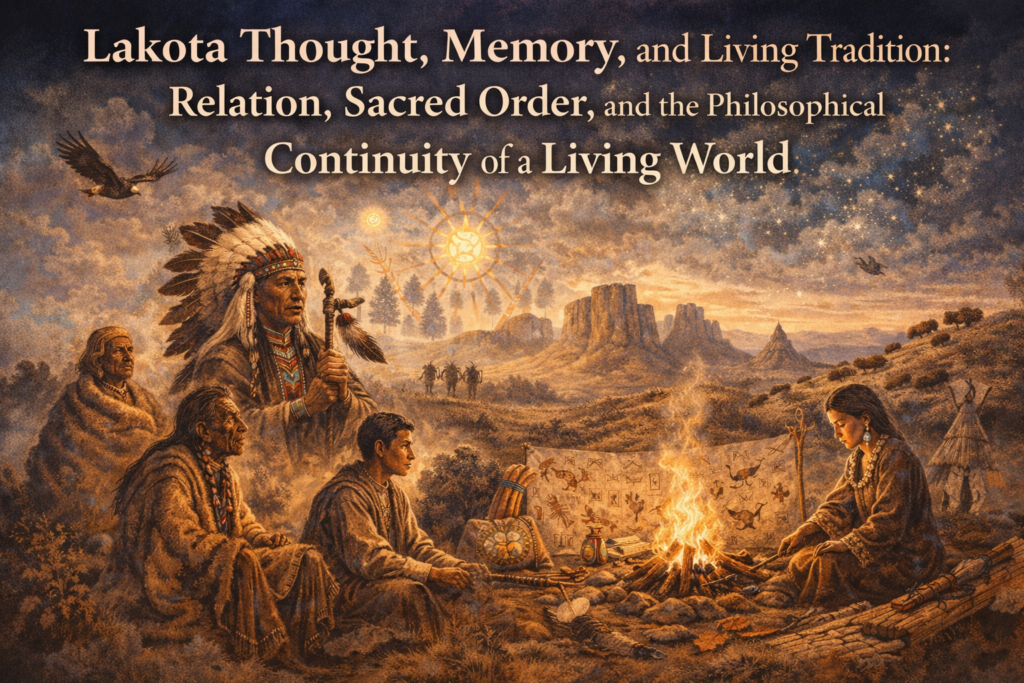
A composite illustration of Lakota cultural continuity showing elders and younger community members gathered around a fire beneath a star-filled sky, with plains landscape, bison, tipi, winter count imagery, and ceremonial symbolism.

Lakota Thought, Memory, and Living Tradition: Relation, Sacred Order, and the Philosophical Continuity of a Living World

Lakota Thought, Memory, and Living Tradition examines the intellectual, moral, spiritual, and historical worlds through which Lakota communities have understood existence, sacred order, land, kinship, and collective continuity across generations. Through oral teaching, language, ceremony, winter counts, sacred geography, governance, treaty memory, and intergenerational transmission, this category approaches Lakota tradition as a serious and enduring field of thought rather than as folklore or anthropological residue. It studies how memory functions as active continuity, how land bears relation and obligation, and how survival itself becomes an archive of knowledge within one of North America’s great living philosophical traditions.
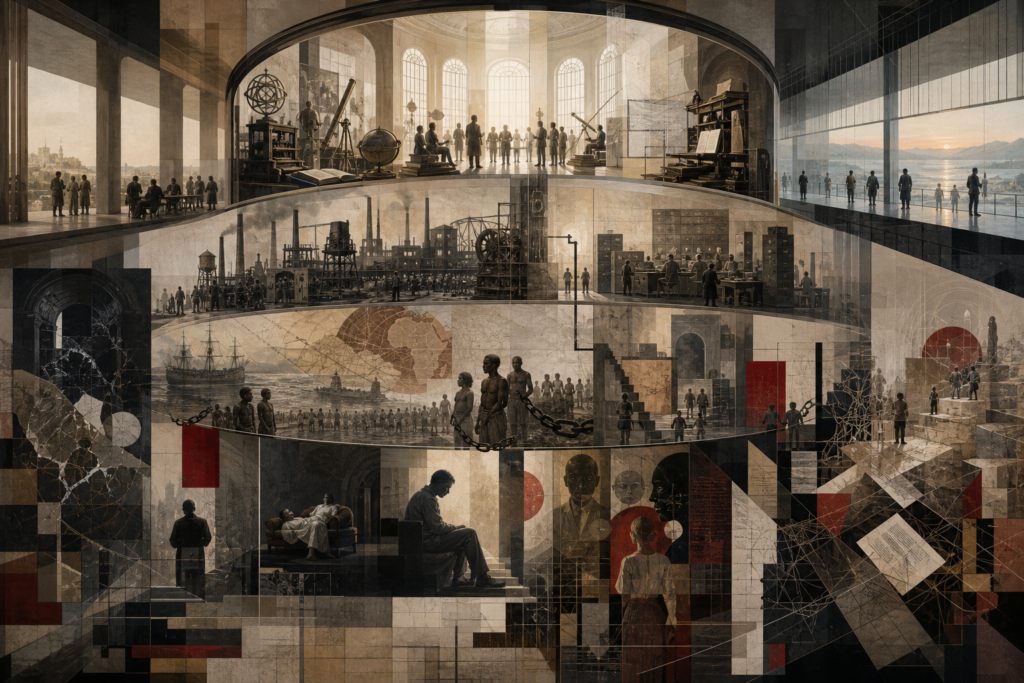
Layered editorial illustration of Enlightenment, modernity, and postmodern thought, showing reason, science, public debate, industrial modernity, colonial power, slavery, bureaucracy, fractured subjectivity, language, structure, and historical critique within a complex architectural chamber.

Enlightenment, Modernity, and Postmodern Thought: Reason, Freedom, and the Crisis of Modernity

Enlightenment, modernity, and postmodern thought trace the great arguments through which the modern world tried to understand reason, freedom, knowledge, history, subjectivity, and power. This category follows the rise of modern philosophy through the Scientific Revolution, Enlightenment critique, liberal and revolutionary politics, German idealism, romanticism, Marxism, phenomenology, existentialism, feminism, critical theory, structuralism, post-structuralism, and postmodern philosophy, while also examining the deeper genealogies and hidden contradictions of modernity, including Hellenistic, Latin, and Arabic-Islamic inheritances, colonial violence, slavery, and the buried Afro-Islamic archive within Atlantic modernity.

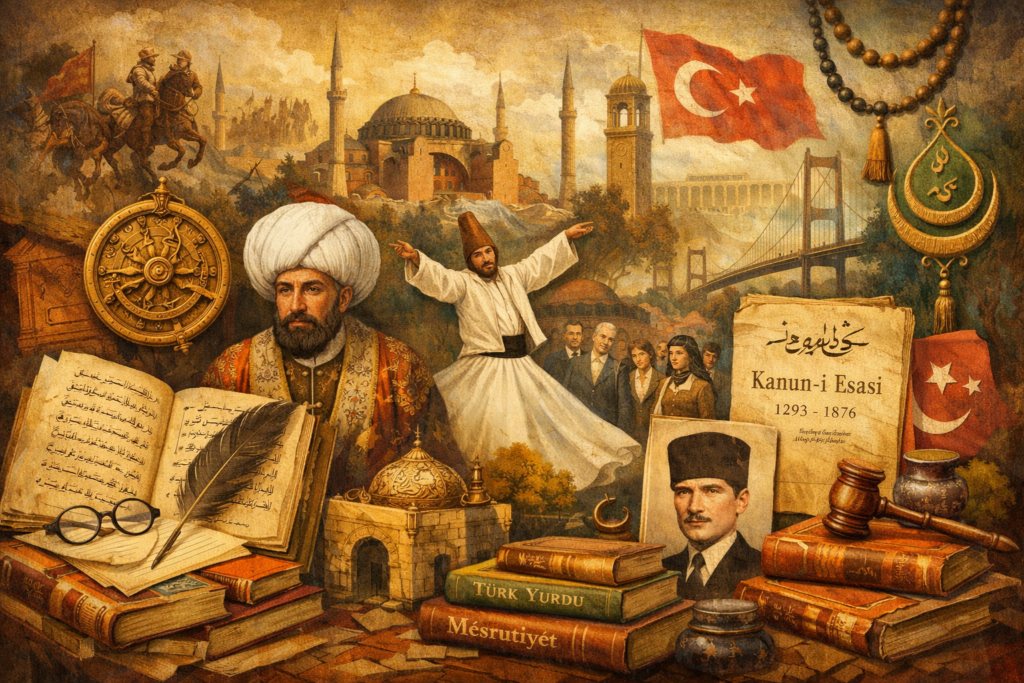
Editorial illustration of Ottoman and Turkish thought featuring imperial architecture, manuscripts, legal texts, Sufi symbolism, literary culture, reform-era documents, and layered memories of empire and republic across Anatolia and the Ottoman world

Ottoman and Turkish Thought: Law, Memory, and the Search for Order

Ottoman and Turkish thought preserves one of the great intellectual archives for understanding how civilizations negotiate sovereignty, law, religion, literature, reform, and historical transformation across long stretches of time. Shaped by Turkic, Islamic, Persianate, Byzantine, Mediterranean, and Balkan inheritances, this tradition developed across Anatolia and the wider Ottoman world through dynastic legitimacy, jurisprudence, theology, Sufi devotion, poetic culture, historical writing, administrative reason, educational institutions, and later struggles over constitutionalism, nationalism, secularism, and republican identity. It is not a narrow national canon or a simple imperial ideology, but a layered and contested field in which legal order, spiritual authority, political memory, and civilizational self-understanding were repeatedly reworked under conditions of expansion, crisis, reform, and rupture.

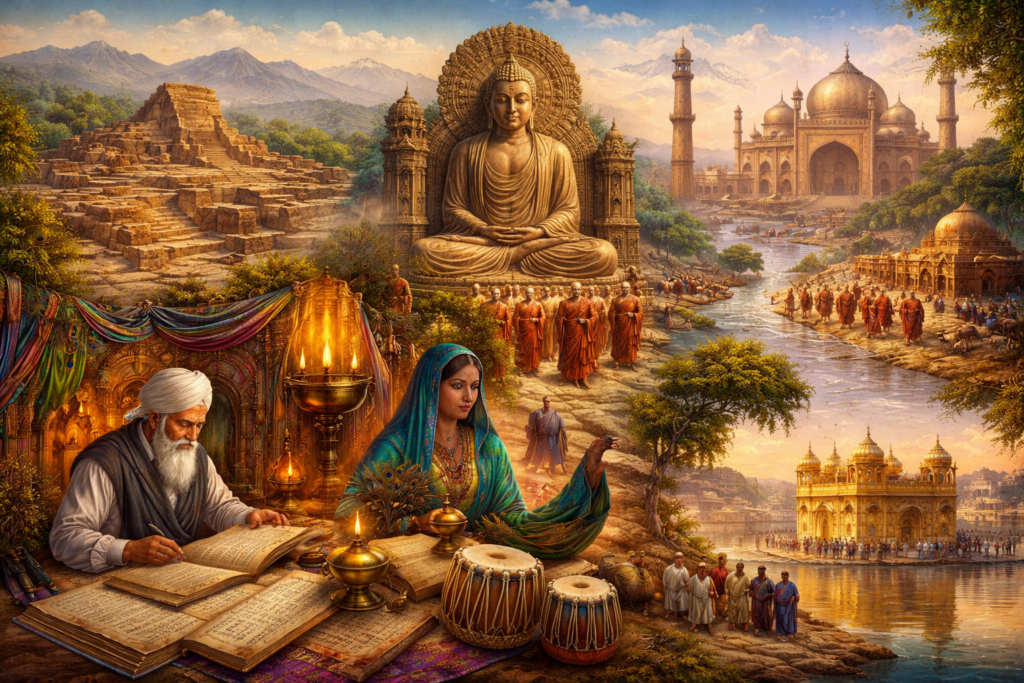
Editorial illustration of Indus Region intellectual life featuring Harappan ruins, Gandharan Buddhist imagery, Sindhi and Punjabi devotional culture, manuscripts, river landscapes, shrines, and Sikh sacred architecture across northwest South Asia

Indus Region Thought: Civilizational Memory, Sacred Exchange, and the Intellectual Worlds of the Northwest

Indus Region thought preserves one of the great connective intellectual zones of world history: a layered regional tradition shaped by Harappan urban symbolism, Vedic and Brahmanical encounter, Gandharan Buddhism, Sindhi Sufi devotion, Punjabi ethical and poetic worlds, Sikh theology, Persianate political culture, and the long afterlives of colonial archaeology and partition. Stretching across the Indus basin and its surrounding corridors, this civilizational world shows how thought develops not only through formal doctrine, but through cities, shrines, sculpture, song, scripture, legal practice, pilgrimage, frontier exchange, and regional memory. By treating Sindh, Punjab, Gandhara, and the wider northwest as a polycentric zone of sacred geography, multilingual transmission, artistic form, and historical fracture, this article presents the Indus region as a major archive of coexistence, continuity, devotion, sovereignty, and loss.

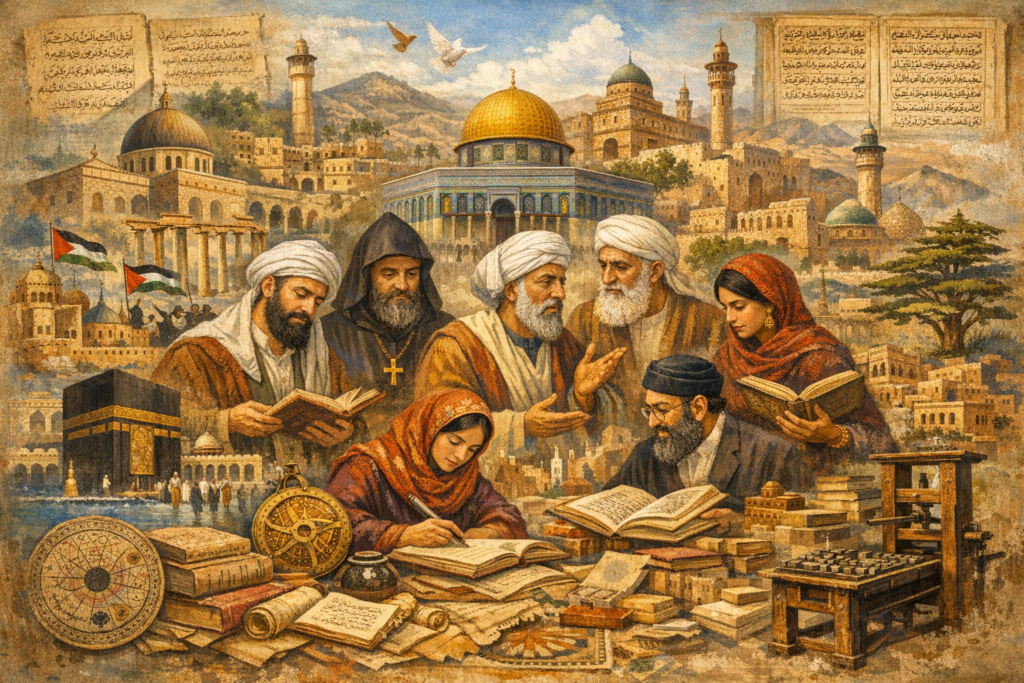
Editorial collage of Arabian and Levantine intellectual life showing scholars, manuscripts, books, sacred architecture, printing technology, and symbolic cityscapes associated with Palestine, Lebanon, Syria, Iraq, and the wider Arab East

Arabian and Levantine Thought: Revelation, Language, Memory, and Renewal

Arabian and Levantine thought preserves one of the world’s great intellectual traditions: a vast and internally diverse field in which revelation, grammar, law, theology, poetry, philosophy, reform, memory, and exile have shaped reflection across the Arabian Peninsula, the Levant, and Iraq. From pre-Islamic poetry and Qur’anic revelation to Arabic grammar, jurisprudence, kalām, adab, Christian and Jewish Arabic thought, Nahda reformism, Palestinian intellectual life, Lebanese and Syrian public culture, Iraqi philosophical and literary worlds, Yemeni scholarship, and Omani Ibāḍī traditions, this article explores how language, faith, historical vulnerability, and the struggle for dignity formed a dense and enduring civilizational web. By treating Palestine, Lebanon, Syria, Iraq, Yemen, Oman, the Hijaz, and Najd as constitutive rather than peripheral, it presents the Arab East as a polycentric zone of thought in which scripture, literary form, political conflict, and cultural renewal remain inseparably linked.

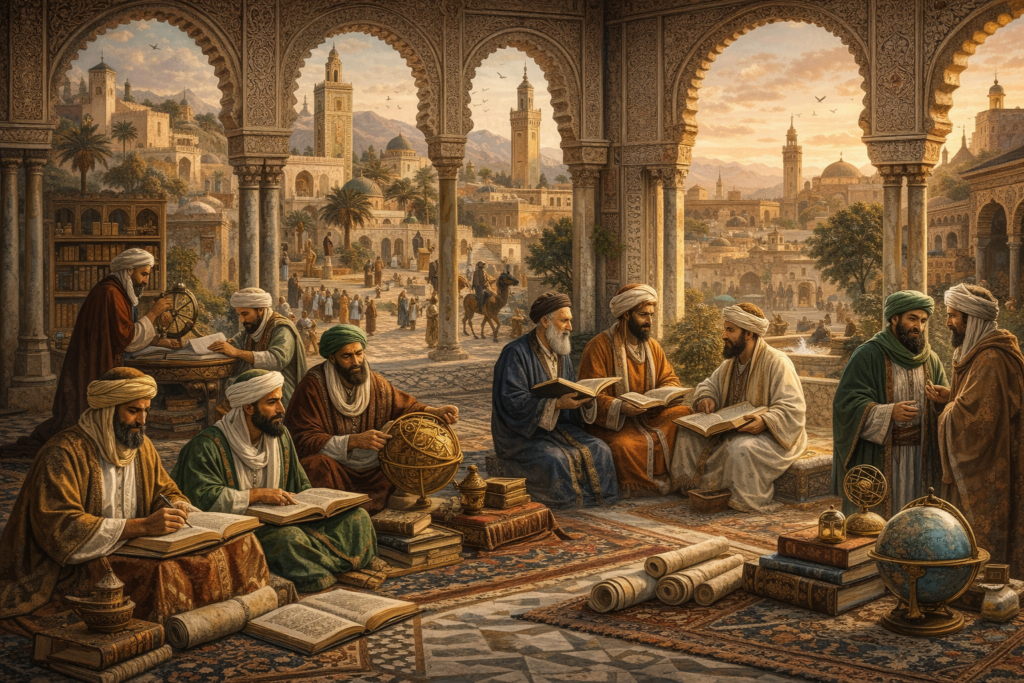
Editorial illustration of Maghrebi and Andalusi intellectual life featuring scholars in a North African and Andalusi courtyard, manuscripts, astronomical instruments, books, arches, and a layered urban landscape of domes, towers, and gardens

Maghrebi and Andalusi Thought: Law, Reason, Mysticism, and Civilization in the Western Islamic World

Maghrebi and Andalusi thought preserves one of the great intellectual traditions of the western Islamic world: a world in which law, theology, philosophy, mysticism, literature, science, and history developed together across North Africa and al-Andalus. Shaped by Amazigh, Arab, Islamic, Jewish, African, and Mediterranean inheritances, this tradition reveals how thinkers in cities such as Kairouan, Fez, Marrakesh, Cordoba, Seville, and Granada reflected on reason and revelation, legal authority, political legitimacy, spiritual discipline, social order, and the rise and fall of civilization. This article explores Maghrebi and Andalusi thought in its full civilizational range, from Maliki jurisprudence, Ashʿari theology, falsafa, and Sufism to Jewish-Arabic philosophy, scientific inquiry, dynastic statecraft, post-Andalusi exile, and historical reflection on urban life, decline, and collective memory, showing how the western Islamic world became a major center of philosophical, legal, and civilizational thought.

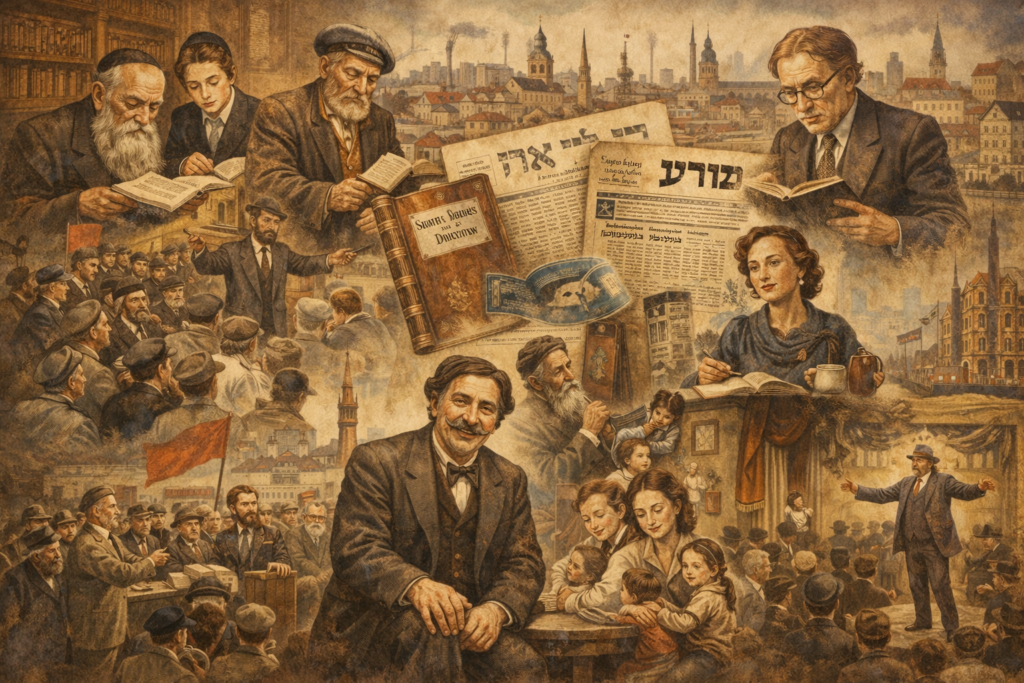
Editorial illustration of Yiddish intellectual worlds featuring scholars reading, Yiddish newspapers, labor meetings, theater and public speaking, women writing and reading, family life, and layered urban diasporic cityscapes

Yiddish Thought: Exile, Memory, Humor, and Human Dignity in a Vernacular Intellectual Tradition

Yiddish thought preserves one of the most distinctive vernacular traditions of reflection in modern intellectual history: a world in which exile, faith, humor, labor, language, memory, and human dignity are thought through not only in theology or formal philosophy, but in stories, journalism, theater, political argument, memoir, and everyday speech. Shaped by rabbinic ethics, Hasidic spirituality, Musar discipline, the Haskalah, urban modernity, socialism, migration, and postwar witness, this tradition reveals how Yiddish-speaking communities reflected on justice, suffering, class, doubt, communal obligation, and the struggle to remain human under unstable historical conditions. This article explores Yiddish thought in its full civilizational range, from sacred inheritance and vernacular moral worlds to literature, labor politics, public debate, postwar memory, and the philosophy of diaspora itself, showing how a language of ordinary life became a language of extraordinary moral seriousness.

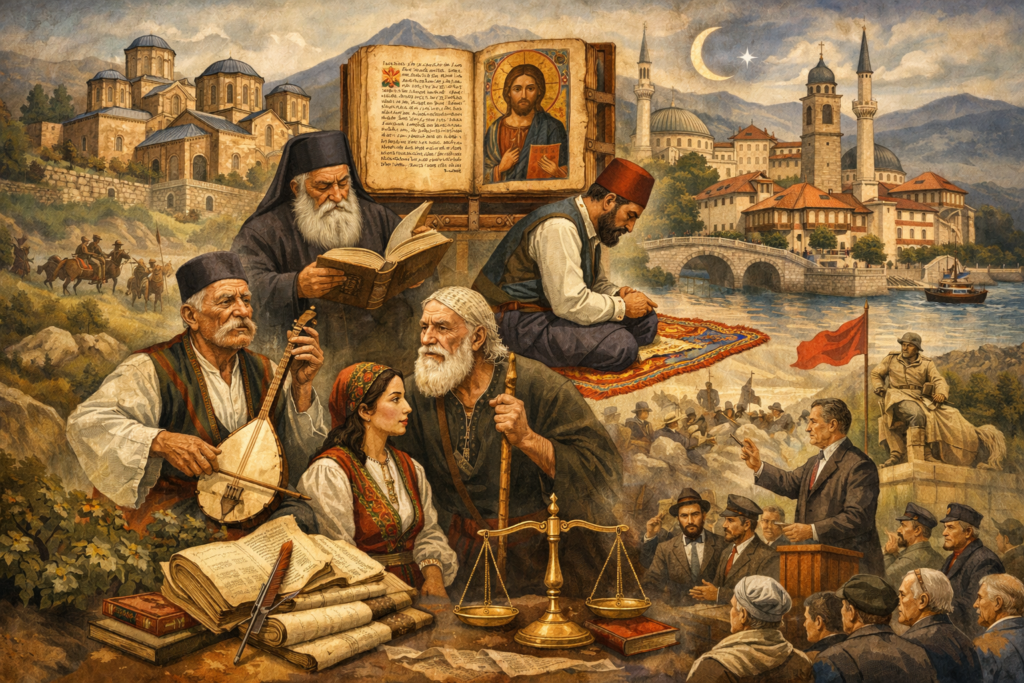
Editorial illustration of South Slavic intellectual worlds featuring monasteries, manuscripts, an icon, a Muslim scholar at prayer, an epic singer, village and urban Balkan architecture, a political assembly, scales of justice, and layered mountain and Adriatic landscapes

South Slavic Thought: Memory, Faith, Empire, and Identity

South Slavic thought preserves one of Europe’s most historically layered traditions of reflection on faith, empire, memory, justice, and collective identity. Shaped by pre-Christian Slavic inheritances, Orthodox and Catholic Christianity, Islamic and Ottoman influence, oral epic culture, monastic writing, vernacular literature, legal and political struggle, and the long contact histories of the Balkans, this tradition reveals how communities in southeastern Europe thought through sovereignty, suffering, plural coexistence, language, law, and the burdens of historical memory. This article explores South Slavic thought in its full civilizational range, from sacred and customary worlds to theological writing, epic memory, national awakening, Yugoslavism, socialism, and post-socialist reflection, showing how philosophy in the Balkan world has often been carried through poetry, history, religion, law, and political imagination as much as through formal philosophical systems.

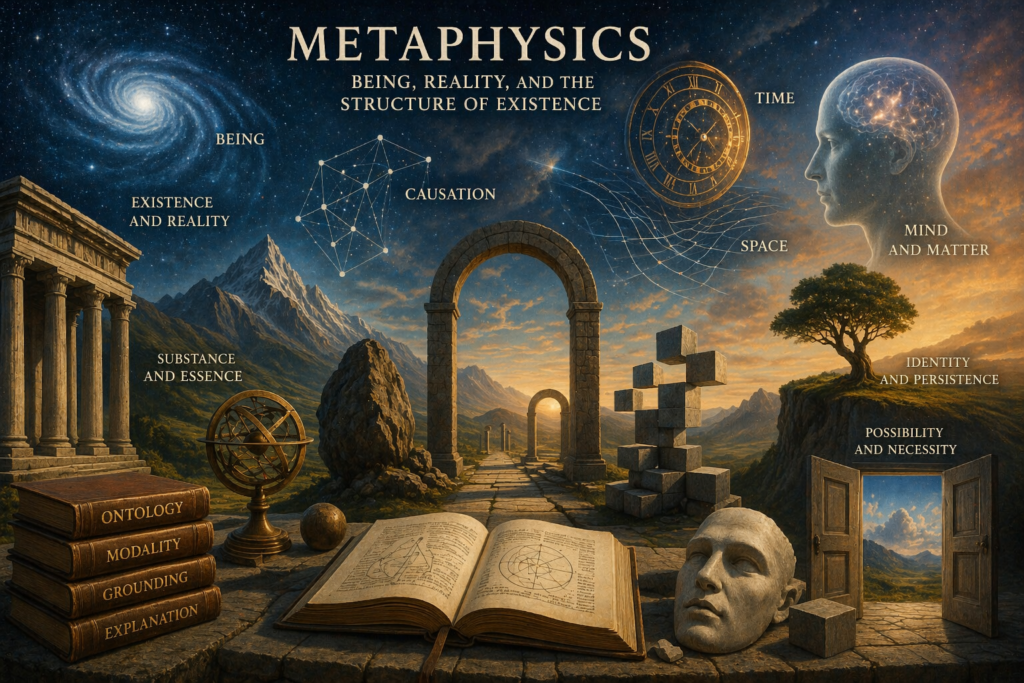
Surreal editorial image representing metaphysics through cosmic space, ancient architecture, books, geometric forms, a human head, and symbolic scenes of being, causation, time, possibility, and reality

Metaphysics: Being, Reality, and the Structure of Existence

Metaphysics examines the most fundamental questions about reality, being, existence, identity, change, causation, possibility, time, space, mind, matter, and the basic structure of what there is. This field is not speculative excess detached from the world, but a disciplined inquiry into the deepest conditions of intelligibility: what kinds of things exist, what it means for something to be real, how things persist or change, what causes and grounds phenomena, and how reality is structured at its most basic level. At its core lies a defining philosophical question: what is the world ultimately made of, and how does what exists hang together? This content pillar explores ontology, substance, essence, identity, persistence, modality, grounding, time, space, mind, personhood, realism, and metaphysical explanation, showing why metaphysics remains indispensable wherever inquiry presupposes some account of what exists and how reality is ordered.

Scroll to Top