
Last Updated June 1, 2026
Climate is not a single variable, a simple warming trend, or a linear response to emissions. It is a coupled Earth system shaped by energy balance, atmospheric chemistry, ocean circulation, land cover, ice, clouds, water vapor, vegetation, soil carbon, human activity, infrastructure, policy, economics, and public behavior. Climate systems thinking asks how these parts interact through feedback loops, delays, thresholds, accumulations, and uneven vulnerability across people and places.
Climate Systems and Feedback Dynamics examines climate change as a systems problem. It explains why greenhouse gases behave as stocks, why emissions are flows, why warming continues after policy delay, why some feedback loops amplify change, why others buffer it, and why social systems matter as much as physical systems in shaping future trajectories. Climate risk is not only a scientific issue. It is a systems issue involving infrastructure, governance, public trust, energy systems, land use, adaptation, justice, and intergenerational responsibility.
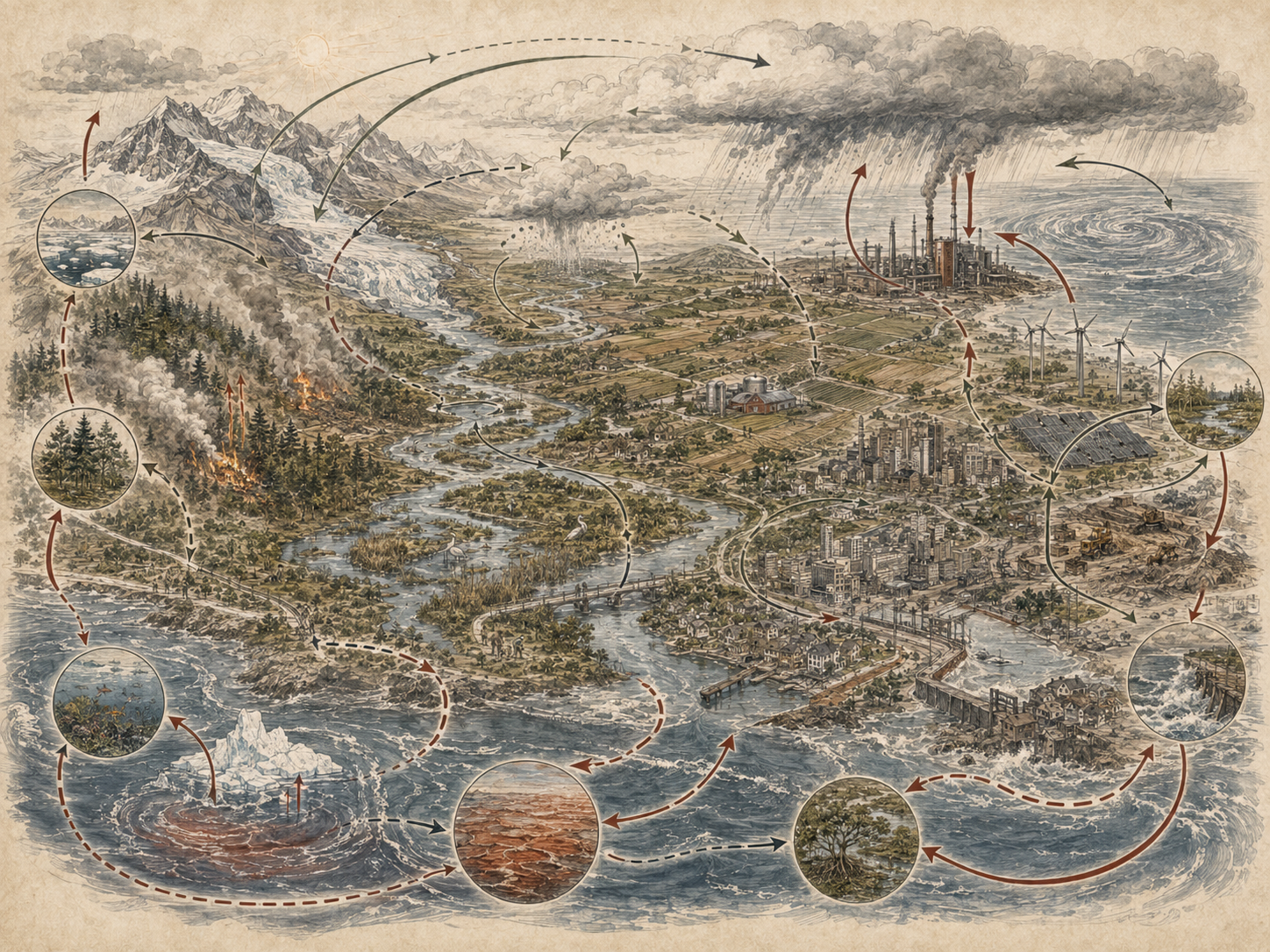
This article explains climate systems through feedback dynamics. It examines greenhouse gas accumulation, radiative forcing, ocean heat uptake, water vapor feedback, ice-albedo feedback, carbon-cycle feedbacks, cloud uncertainty, land-use change, tipping elements, climate inertia, adaptation, mitigation, and public policy feedback. It also examines the ethical stakes of climate systems thinking: who created the most emissions, who faces the greatest exposure, who has adaptive capacity, who is asked to absorb loss, and why climate governance must connect physical science to justice, infrastructure, and long-term public responsibility.
Why Climate Systems Thinking Matters
Climate systems thinking matters because climate change is not a single-cause, single-effect problem. Human emissions alter atmospheric composition. Atmospheric change affects radiative forcing. Radiative forcing changes temperature, precipitation, ocean heat, ice cover, vegetation, wildfire risk, water cycles, sea level, and extreme events. These physical changes then affect food systems, infrastructure, migration, public health, insurance, energy demand, labor, political stability, and public finance. The system is coupled: physical and social processes shape each other.
Linear thinking often misunderstands climate risk. It may assume that warming rises smoothly with annual emissions, that mitigation produces immediate cooling, that adaptation can be added after damage appears, or that climate impacts are evenly distributed. Systems thinking shows why these assumptions are dangerous. Greenhouse gases accumulate. Oceans store heat. Ice responds with delay. Ecosystems can cross thresholds. Infrastructure locks in emissions. Public trust affects policy. Inequality shapes vulnerability. The consequences of today’s decisions unfold over decades and centuries.
Climate systems thinking also helps explain why small delays matter. Because carbon dioxide accumulates, emissions reductions postponed now require steeper reductions later. Because infrastructure lasts for decades, energy and transport choices can lock societies into future emissions. Because climate impacts grow through feedback, waiting for full certainty can move the system closer to thresholds. Because adaptation capacity is unequal, delay harms vulnerable communities first and hardest.
| Climate issue | Linear interpretation | Systems-thinking interpretation |
|---|---|---|
| Annual emissions | Emissions matter mainly in the year they occur. | Emissions accumulate into atmospheric stocks that affect future warming. |
| Temperature rise | Temperature responds immediately to policy. | Temperature reflects cumulative forcing, ocean heat uptake, feedback, and delay. |
| Extreme events | Events are isolated hazards. | Hazards interact with exposure, vulnerability, infrastructure, land use, and governance. |
| Clean technology | Technology substitution solves the problem. | Technology interacts with infrastructure, demand, finance, mining, labor, policy, and justice. |
| Adaptation | Adaptation can be added after impacts become severe. | Adaptation requires early capacity-building, land-use decisions, trust, funding, and institutional memory. |
| Climate justice | Distribution is a secondary concern. | Responsibility, exposure, adaptive capacity, and loss are central to system behavior and legitimacy. |
Systems thinking does not replace climate science. It strengthens the interpretation of climate science by connecting physical dynamics to governance, infrastructure, economics, and ethics. Climate is a scientific system and a social system at the same time. The atmosphere responds to physics. Emissions respond to human systems. Impacts are shaped by inequality and institutions. A serious climate response must understand all of these relationships.
Climate as a Coupled Earth System
The climate system includes the atmosphere, oceans, cryosphere, land surface, biosphere, and human systems. The atmosphere contains greenhouse gases, aerosols, water vapor, clouds, winds, and heat transport. Oceans store heat, exchange carbon dioxide, drive circulation, influence weather patterns, and affect sea level. The cryosphere includes ice sheets, glaciers, snow cover, sea ice, and permafrost. Land systems include forests, soils, wetlands, agriculture, cities, deserts, and surface albedo. The biosphere includes ecosystems that store carbon, regulate water, support biodiversity, and mediate energy exchange. Human systems include emissions, land use, infrastructure, energy, industry, transport, governance, and adaptation.
These subsystems are not independent. Atmosphere and ocean exchange heat and carbon. Ice changes albedo and sea level. Forests store carbon but can become sources under drought, fire, or deforestation. Permafrost stores carbon that can be released under warming. Cities modify heat, runoff, energy use, and vulnerability. Agriculture affects land cover, methane, nitrous oxide, water, and soil carbon. Energy systems drive emissions, but they are also affected by climate extremes.
Climate behavior emerges from these interactions. No single component determines the whole. The system’s response depends on feedback loops, delays, spatial patterns, thresholds, and external forcing. This is why climate science uses models, observations, paleoclimate evidence, monitoring networks, and scenario analysis. The system is too interconnected to understand through isolated variables alone.
\text{Climate Behavior} = f(\text{Atmosphere}, \text{Oceans}, \text{Ice}, \text{Land}, \text{Biosphere}, \text{Human Systems})
\]
Interpretation: Climate behavior emerges from interacting physical, ecological, and human systems rather than from one isolated component.
Coupling also means that climate impacts cascade. A drought can reduce crop yields, raise food prices, increase water conflict, stress energy systems, increase wildfire risk, affect public health, and pressure public budgets. A flood can damage housing, contaminate water, disrupt transport, displace households, strain insurance systems, and erode trust if recovery is unequal. A heat wave can increase mortality, reduce labor productivity, raise electricity demand, stress grids, worsen air pollution, and expose housing inequality.
Systems thinking therefore treats climate impacts as networked. The physical hazard is only part of the outcome. Risk depends on exposure, vulnerability, capacity, governance, infrastructure, and response. A climate event becomes a social disaster when human systems are unprepared, unequal, poorly maintained, or unable to learn.
Stocks, Flows, and Greenhouse Gas Accumulation
Greenhouse gas accumulation is one of the clearest stock-flow problems in public life. Emissions are flows. Atmospheric concentrations are stocks. The climate system responds not only to the emissions released this year, but to the accumulated greenhouse gases already present in the atmosphere and the heat already stored in the oceans. This is why cumulative emissions matter so much.
Carbon dioxide is especially important because a substantial portion remains in the atmosphere for long periods. Methane has a shorter atmospheric lifetime but stronger near-term warming influence. Nitrous oxide and fluorinated gases also contribute to warming. Different gases have different lifetimes and radiative properties, but the systems principle remains: emissions flows change atmospheric stocks, and stocks shape future forcing.
C_{t+1} = C_t + E_t – S_t
\]
Interpretation: Atmospheric concentration \(C\) increases through emissions \(E_t\) and decreases through sinks \(S_t\). If emissions exceed sinks, the atmospheric stock grows.
The stock-flow structure explains why stabilizing emissions is not the same as stabilizing climate. If emissions remain above removal by sinks, the atmospheric stock continues to rise. Stabilization requires bringing net emissions close to zero for long-lived greenhouse gases. Reducing annual emissions slows accumulation; it does not immediately reverse accumulated forcing. This distinction is essential for policy.
| Climate quantity | Systems category | Why it matters |
|---|---|---|
| Annual emissions | Flow | Determines how quickly atmospheric greenhouse gas stocks change. |
| Atmospheric concentration | Stock | Determines radiative forcing and long-term warming pressure. |
| Ocean heat content | Stock | Stores much of the excess heat and delays surface response. |
| Ice mass | Stock | Changes sea level, albedo, freshwater flows, and feedback dynamics. |
| Forest carbon | Stock | Can store carbon or become a source under disturbance and land-use change. |
| Infrastructure | Stock | Locks in energy demand, transport behavior, emissions, and exposure. |
Stock-flow thinking also changes how climate progress is evaluated. A country, city, company, or sector may reduce emissions intensity while total emissions remain too high. A technology may reduce emissions per unit but increase total activity. A policy may lower growth in emissions without lowering cumulative emissions fast enough. Systems thinking asks whether the flow is changing at the speed required to stabilize the stock.
Climate mitigation is therefore not only about doing less harm per unit of activity. It is about changing the total flow into the atmospheric stock while building systems capable of sustaining that change.
Radiative Forcing and Energy Imbalance
Radiative forcing refers to the change in Earth’s energy balance caused by factors such as greenhouse gases, aerosols, land surface change, solar variation, and volcanic activity. When greenhouse gas concentrations increase, more outgoing longwave radiation is retained within the Earth system. This creates an energy imbalance: more energy enters than leaves. The system warms until outgoing energy increases enough to restore balance, but feedbacks and heat storage shape the path.
Energy imbalance is central because temperature is not the only climate indicator. Much of the excess energy is absorbed by oceans. Some affects ice melt. Some affects land and atmosphere. Surface temperature is therefore one visible expression of a broader planetary energy imbalance. A system can continue accumulating heat even when surface temperature varies from year to year because of natural variability.
\Delta E = E_{\text{in}} – E_{\text{out}}
\]
Interpretation: Climate warming occurs when incoming energy exceeds outgoing energy. Greenhouse gases reduce outgoing longwave radiation, contributing to positive energy imbalance.
Radiative forcing connects human emissions to physical response. Carbon dioxide, methane, nitrous oxide, and other greenhouse gases add warming influence. Aerosols can have cooling or warming effects depending on type and interaction with clouds and radiation. Land-use changes can alter albedo, evapotranspiration, carbon storage, and regional climate. The net result is a changing energy balance.
Systems thinking helps because forcing is not the final outcome. It is an input into an adaptive, feedback-rich system. The climate system responds through warming, water vapor changes, cloud changes, ice loss, circulation changes, carbon-cycle shifts, and ocean heat uptake. Human systems respond through mitigation, adaptation, resistance, delay, innovation, and political conflict.
Energy imbalance also shows why climate action cannot be judged only by short-term temperature fluctuations. Natural variability can temporarily mask or amplify surface warming. Ocean cycles, volcanic eruptions, aerosols, and internal variability can affect year-to-year conditions. But the long-term system is governed by energy balance, greenhouse gas stocks, feedback, and accumulated heat.
Feedback Loops in the Climate System
Feedback loops are central to climate dynamics. A feedback occurs when a change in one part of the system affects another part, which then influences the original change. Positive feedback amplifies change. Negative feedback dampens change. In climate systems, feedbacks can operate through water vapor, clouds, ice, vegetation, carbon sinks, permafrost, ocean circulation, fire, and human response.
Positive feedback does not mean good. It means reinforcing. For example, warming can reduce snow and ice cover. Less ice means lower albedo, so less sunlight is reflected. More solar energy is absorbed, which increases warming. This is a positive feedback because the initial warming is amplified. Negative feedback dampens change. For example, warmer Earth emits more longwave radiation to space, which acts as a stabilizing feedback.
\text{Positive Feedback}: X \uparrow \Rightarrow Y \uparrow \Rightarrow X \uparrow
\]
\[
\text{Negative Feedback}: X \uparrow \Rightarrow Y \uparrow \Rightarrow X \downarrow
\]
Interpretation: Positive feedback amplifies change, while negative feedback dampens or stabilizes change.
Climate feedbacks interact. Water vapor feedback amplifies warming because warmer air can hold more water vapor, and water vapor is itself a greenhouse gas. Ice-albedo feedback amplifies warming in snow and ice regions. Some cloud feedbacks may amplify warming, while other cloud effects can cool, depending on cloud type, altitude, location, and optical properties. Carbon-cycle feedbacks can reduce the ability of land and ocean sinks to absorb carbon under stress. Permafrost thaw can release carbon dioxide and methane, adding further forcing.
| Feedback | Direction | Basic mechanism | Systems significance |
|---|---|---|---|
| Water vapor feedback | Amplifying | Warming increases atmospheric water vapor, strengthening greenhouse effect. | Amplifies warming from greenhouse gas forcing. |
| Ice-albedo feedback | Amplifying | Ice loss reduces reflectivity, increasing absorbed solar energy. | Accelerates warming in snow and ice regions. |
| Planck response | Stabilizing | Warmer Earth emits more longwave radiation to space. | Core negative feedback that limits runaway warming. |
| Carbon-cycle feedback | Often amplifying | Warming and disturbance can weaken carbon sinks or release stored carbon. | Can increase atmospheric greenhouse gas concentrations. |
| Cloud feedback | Complex | Cloud changes affect both reflected sunlight and trapped longwave radiation. | Major source of climate sensitivity uncertainty. |
| Human policy feedback | Variable | Climate impacts can increase action, resistance, adaptation, or denial. | Social response affects future emissions and vulnerability. |
Feedback loops make climate systems dynamic. They explain why warming can accelerate in some regions, why thresholds matter, why delayed policy increases risk, and why mitigation must reduce forcing before amplifying feedbacks make adaptation more difficult. Climate systems thinking asks which feedbacks are active, which are strengthening, and which human interventions can dampen harmful loops or reinforce beneficial ones.
Water Vapor, Cloud, and Lapse Rate Feedbacks
Water vapor feedback is one of the strongest amplifying feedbacks in the climate system. Warmer air can hold more water vapor. Because water vapor is a greenhouse gas, increased atmospheric moisture amplifies warming caused by other greenhouse gases. Water vapor is not the primary human forcing because it responds quickly to temperature and precipitation dynamics. But once warming begins, water vapor feedback strengthens it.
The lapse rate feedback concerns how temperature changes with altitude. Changes in the vertical temperature structure of the atmosphere affect outgoing radiation. This feedback interacts with water vapor and differs between tropical and polar regions. The combination of water vapor and lapse rate feedback is central to climate sensitivity.
Cloud feedback is more complex. Clouds can cool by reflecting sunlight back to space. They can warm by trapping outgoing longwave radiation. The net effect depends on cloud height, thickness, phase, location, time of day, and regional circulation. Low clouds often have strong reflective effects. High clouds can have stronger greenhouse effects. As climate changes, cloud patterns can shift, affecting both warming and uncertainty.
\Delta T = \frac{\Delta F}{\lambda}
\]
Interpretation: Temperature response \(\Delta T\) depends on forcing \(\Delta F\) and the climate feedback parameter \(\lambda\), which represents the net effect of stabilizing and amplifying feedbacks.
These feedbacks show why climate sensitivity is a systems property. Sensitivity is not only about carbon dioxide by itself. It depends on how the atmosphere, water vapor, clouds, lapse rate, ice, oceans, and carbon cycle respond to forcing. Different feedbacks operate at different timescales and spatial scales. Some are relatively well understood. Others remain more uncertain.
Uncertainty does not mean ignorance. In systems thinking, uncertainty is information about range, risk, and decision-making under incomplete knowledge. Cloud uncertainty, for example, does not justify inaction. It means climate planning must consider a range of possible warming responses and avoid high-risk pathways where feedbacks could amplify harm.
Ice-Albedo and Cryosphere Feedbacks
The cryosphere includes snow, sea ice, glaciers, ice sheets, permafrost, and frozen ground. It is central to climate feedback because ice and snow are highly reflective. They return a significant portion of incoming solar radiation to space. When warming reduces snow and ice cover, darker ocean, land, or vegetation surfaces absorb more solar energy. This amplifies warming, especially in high-latitude regions.
Ice-albedo feedback helps explain Arctic amplification: the Arctic warms faster than the global average. As sea ice retreats, more open ocean absorbs heat. Warmer ocean conditions can delay ice formation, reduce ice thickness, and reinforce further loss. Snow-cover decline over land can similarly increase absorption and alter regional climate.
\text{Warming} \uparrow \Rightarrow \text{Ice Cover} \downarrow \Rightarrow \text{Albedo} \downarrow \Rightarrow \text{Absorbed Energy} \uparrow \Rightarrow \text{Warming} \uparrow
\]
Interpretation: Ice-albedo feedback is a reinforcing loop in which warming reduces reflective ice cover, increasing absorbed energy and amplifying warming.
Ice sheets and glaciers also matter for sea-level rise. They respond with delay, but their long-term dynamics can commit future change. Ice-sheet instability, marine ice-sheet processes, meltwater effects, and glacier retreat are important because sea-level impacts unfold over long timescales. Coastal infrastructure and communities are exposed not only to present sea level, but to future committed change.
Permafrost is another cryosphere concern. Permafrost soils store large amounts of organic carbon. As permafrost thaws, microbial decomposition can release carbon dioxide and methane. This creates potential amplifying feedback because warming releases additional greenhouse gases that can contribute to further warming. The timing, magnitude, and form of release vary, but the systems principle is clear: frozen carbon stores can become active flows under warming.
Cryosphere feedbacks show why regional changes can have global implications. Ice loss changes energy balance. Glacier melt affects water systems. Ice-sheet change affects sea level. Permafrost thaw affects carbon-cycle feedback. The cryosphere is not a passive indicator of climate change. It is an active part of climate-system dynamics.
Carbon-Cycle Feedbacks and Land Systems
The carbon cycle connects atmosphere, oceans, vegetation, soils, sediments, fossil carbon, and human activity. Human systems add carbon to the atmosphere by burning fossil fuels, producing cement, changing land use, and altering ecosystems. Natural sinks absorb some of that carbon through ocean uptake and land uptake, but sink strength is not fixed. It can change with warming, drought, disturbance, ocean chemistry, land management, and ecosystem health.
Carbon-cycle feedbacks matter because the land and ocean systems that currently absorb carbon can weaken under stress. Warming can increase respiration from soils. Drought and heat can reduce forest growth. Wildfire can release stored carbon. Deforestation removes carbon storage and changes surface energy balance. Ocean warming and acidification can affect marine carbon uptake. These changes can increase the fraction of emissions remaining in the atmosphere.
C_{t+1} = C_t + E_{\text{fossil},t} + E_{\text{land},t} – S_{\text{ocean},t} – S_{\text{land},t}
\]
Interpretation: Atmospheric carbon changes through fossil emissions, land-use emissions, and uptake by ocean and land sinks.
Land systems are especially important because they connect climate mitigation, biodiversity, food, water, livelihoods, and justice. Forest restoration, soil carbon, wetlands, peatlands, agroecology, and land stewardship can support mitigation and resilience. But land-based climate strategies can also create conflict if they ignore food security, Indigenous rights, local livelihoods, biodiversity, and land tenure. Climate systems thinking keeps carbon accounting connected to social and ecological realities.
| Land-system process | Climate role | Systems concern |
|---|---|---|
| Deforestation | Releases carbon and reduces future carbon uptake. | Also affects biodiversity, rainfall, livelihoods, rights, and regional climate. |
| Wildfire | Releases stored carbon and alters ecosystem recovery. | Interacts with heat, drought, land management, housing, and public health. |
| Soil carbon loss | Transfers carbon from soils to atmosphere. | Linked to agriculture, erosion, water retention, and food-system resilience. |
| Wetland degradation | Can release stored carbon and methane. | Also affects flood protection, biodiversity, water quality, and community resilience. |
| Reforestation and restoration | Can increase carbon uptake and ecosystem function. | Must respect biodiversity, local governance, land rights, and food systems. |
Carbon-cycle feedbacks remind us that climate mitigation is not only a matter of replacing fuels. It also involves protecting and regenerating the living systems that store carbon, regulate water, buffer heat, support biodiversity, and sustain human communities. Land is not just a carbon surface. It is a social-ecological system.
Oceans, Heat Uptake, and Climate Inertia
Oceans are central to climate dynamics because they absorb most of the excess heat trapped by the Earth system. This heat uptake slows surface warming in the short term, but it also creates climate inertia. The system continues adjusting over time because heat is stored and redistributed through ocean circulation. Oceans also absorb carbon dioxide, affecting both atmospheric carbon and ocean chemistry.
Climate inertia means the consequences of emissions unfold slowly. Even if emissions stop rising, accumulated greenhouse gases and ocean heat continue shaping future conditions. Surface warming, sea-level rise, ice melt, and ecosystem responses can continue because the system has not fully equilibrated. This creates a responsibility problem: present emissions impose future effects.
H_{t+1} = H_t + \Delta E_t – Q_t
\]
Interpretation: Ocean heat content \(H\) changes as the ocean absorbs excess energy \(\Delta E_t\) and redistributes or releases heat \(Q_t\).
Oceans also shape regional climate through circulation patterns. Changes in sea-surface temperature, heat content, salinity, currents, and air-sea exchange affect storms, rainfall, marine ecosystems, coastal risk, and fisheries. Ocean warming contributes to marine heatwaves, coral bleaching, sea-level rise through thermal expansion, and changes in oxygen and chemistry.
Ocean inertia creates a policy challenge. The ocean’s buffering capacity can delay visible consequences, making climate risk easier to underestimate. But delayed response does not mean low risk. It means the system is storing change. Once stored, some changes are difficult to reverse on human timescales.
Systems thinking helps clarify the difference between short-term variability and long-term accumulation. A cooler year does not mean the energy imbalance has disappeared. A temporary slowdown in surface warming does not mean ocean heat stopped increasing. Climate diagnosis must track multiple stocks: atmospheric greenhouse gases, ocean heat, ice mass, sea level, ecosystem condition, and infrastructure exposure.
Thresholds, Tipping Elements, and Regime Risk
Climate thresholds are points where gradual pressure can produce nonlinear change. Some thresholds involve physical systems, such as ice-sheet instability, permafrost thaw, forest dieback, coral reef collapse, or ocean circulation changes. Others involve social systems, such as insurance retreat, infrastructure failure, agricultural disruption, migration pressure, public distrust, or political instability. Thresholds matter because crossing them can produce persistent change that is difficult to reverse.
Tipping elements are parts of the Earth system that may shift into substantially different states if warming or other pressures exceed critical thresholds. These elements are not isolated. They interact. Ice loss affects albedo and sea level. Forest dieback affects carbon, rainfall, biodiversity, and livelihoods. Coral reef loss affects fisheries, coastal protection, tourism, and marine biodiversity. Permafrost thaw affects greenhouse gas flows and Arctic infrastructure.
\text{Tipping Risk} = f(\text{Warming}, \text{Feedback Strength}, \text{Exposure Time}, \text{System Resilience})
\]
Interpretation: Tipping risk depends on warming level, feedback strength, duration of exposure, and the resilience of the system under stress.
Thresholds are not always precise points known with certainty. They can be ranges. They can depend on interacting pressures. They can vary by region. Uncertainty about thresholds is not a reason to ignore them. It is a reason to avoid high-risk pathways. Systems thinking treats thresholds as risk structures: when consequences are large and recovery is difficult, precaution and early action become more important.
Social thresholds are equally important. A public system can reach a threshold where repeated disaster response overwhelms fiscal capacity. A coastal insurance market can reach a threshold where coverage becomes unavailable or unaffordable. A city can reach a threshold where heat, housing cost, and infrastructure stress deepen inequality. A community can reach a threshold where repeated loss leads to displacement. Climate systems thinking connects physical tipping risk to social vulnerability and governance capacity.
Threshold analysis asks not only what might tip, but who will feel it first, who has capacity to adapt, and who has authority to prevent the shift. Climate thresholds are physical, social, political, and ethical at once.
Human Systems, Policy, and Emissions Feedbacks
Human systems are part of climate feedback dynamics. Energy demand, economic growth, technology, infrastructure, behavior, policy, finance, social movements, litigation, public trust, misinformation, and geopolitical conflict all shape emissions trajectories. Climate is affected by human choices, but those choices are structured by systems. People do not emit in a vacuum. They live inside energy systems, transport systems, housing systems, food systems, labor systems, markets, institutions, and political systems.
Policy feedback can accelerate or slow transition. Clean-energy deployment can reduce costs through learning curves, which can increase adoption, which further reduces costs. Public investment can build infrastructure that makes lower-carbon behavior easier. Standards can shift markets. Carbon pricing can change incentives. Public procurement can create demand. Social movements can change political feasibility. Conversely, fossil-fuel lock-in, lobbying, misinformation, infrastructure dependence, and energy insecurity can reinforce delay.
\text{Clean Deployment} \uparrow \Rightarrow \text{Cost} \downarrow \Rightarrow \text{Adoption} \uparrow \Rightarrow \text{Clean Deployment} \uparrow
\]
Interpretation: Clean-technology learning curves can create reinforcing feedback that accelerates transition once deployment reaches scale.
Human feedbacks can also create rebound. Efficiency improvements reduce the energy required for a service, but lower operating cost can increase use. Rebound does not eliminate the value of efficiency, but it means efficiency should be paired with absolute emissions goals, clean supply, demand management, and policy design. Systems thinking asks whether total emissions decline, not only whether emissions per unit improve.
Infrastructure lock-in is another human-system feedback. Existing roads, buildings, grids, industrial facilities, and land-use patterns shape behavior. That behavior justifies further investment in the same systems. This can reinforce high-emissions pathways. Breaking lock-in requires changing infrastructure, incentives, regulations, financing, cultural expectations, and public alternatives.
| Human-system feedback | How it works | Climate implication |
|---|---|---|
| Learning curve | Deployment lowers cost, lower cost increases deployment. | Can accelerate clean-energy transition. |
| Infrastructure lock-in | Existing systems shape behavior and justify further investment. | Can preserve high-emissions pathways unless investment shifts. |
| Rebound effect | Efficiency lowers cost, which can increase use. | Efficiency needs absolute emissions and demand safeguards. |
| Public trust loop | Fair policy builds trust, trust supports cooperation, cooperation improves outcomes. | Just transition can strengthen policy durability. |
| Delay politics | Incumbent interests, fear, and misinformation slow transition. | Delay increases cumulative emissions and future adaptation burden. |
Climate systems thinking recognizes that emissions reductions require system redesign. Individual behavior matters, but behavior is shaped by available options. A person cannot choose low-carbon transport if land use, transit, affordability, and safety make that option unavailable. A household cannot electrify if housing quality, landlord incentives, grid capacity, and financing block the transition. Policy must redesign the systems that make high-emissions behavior normal.
Adaptation, Resilience, and Vulnerability
Adaptation is the process of adjusting to actual or expected climate impacts. It includes infrastructure design, land-use planning, public health, water management, disaster preparedness, cooling systems, ecosystem restoration, housing policy, insurance reform, early warning systems, migration planning, and community capacity-building. Adaptation is not optional because some climate change is already occurring and additional impacts are locked in by past emissions and system inertia.
Resilience is closely related to adaptation but broader. Adaptation asks how systems adjust to climate impacts. Resilience asks whether systems can absorb, recover, adapt, and transform under stress while preserving essential functions. A climate-resilient system reduces exposure, protects vulnerable people, maintains critical services, learns from feedback, and transforms when existing patterns are no longer viable.
Vulnerability is not only physical exposure to hazard. It is shaped by income, race, age, disability, housing, health, legal status, infrastructure, insurance, social networks, political power, and institutional trust. Two communities can experience the same heat wave or flood and suffer very different outcomes because their vulnerability differs. Climate risk is therefore produced by the interaction of hazard, exposure, and vulnerability.
\text{Climate Risk} = \text{Hazard} \times \text{Exposure} \times \text{Vulnerability}
\]
Interpretation: Climate risk depends on the physical hazard, who or what is exposed, and the vulnerability or adaptive capacity of the exposed system.
Adaptation can be maladaptive if it reduces risk for some while increasing risk for others or creating future vulnerability. A seawall may protect one neighborhood while increasing erosion elsewhere. Air conditioning can reduce heat mortality while increasing electricity demand if powered by fossil fuels and leaving low-income households behind. Insurance retreat can reduce financial exposure for firms while increasing household vulnerability. Relocation can reduce hazard exposure but cause cultural loss, displacement, and social harm if not governed justly.
Good adaptation is systems-oriented. It reduces vulnerability, protects dignity, strengthens public services, preserves ecological buffers, includes affected communities, avoids burden shifting, and accounts for future climate conditions rather than past averages. It asks whether adaptation builds long-term capacity or merely moves risk elsewhere.
Ethics: Responsibility, Loss, and Climate Justice
Climate systems have ethical stakes because responsibility and vulnerability are unequal. Those who have contributed most to greenhouse gas accumulation are often not the same people who face the earliest or greatest harms. Wealthier households, industries, and countries have generally had greater access to high-emissions development and greater capacity to adapt. Lower-income communities, Indigenous peoples, small island states, outdoor workers, children, older adults, disabled people, and communities facing historical environmental injustice often experience higher exposure and lower adaptive capacity.
Climate justice is not separate from climate systems analysis. It is part of the system. Unequal vulnerability affects public health, migration, food security, political legitimacy, adaptation capacity, conflict risk, and trust. Policies that ignore justice can produce backlash, deepen inequality, or shift burdens onto those least responsible. Policies that foreground justice can build legitimacy, cooperation, and resilience.
Ethical climate systems thinking asks:
- Who contributed most to cumulative emissions?
- Who faces the greatest exposure to climate hazards?
- Who has the least adaptive capacity?
- Who benefits from fossil-fuel lock-in?
- Who pays transition costs?
- Who controls land, infrastructure, energy, and adaptation decisions?
- Whose knowledge is included in climate planning?
- What losses cannot be fully compensated?
- What responsibilities extend to future generations?
- When does adaptation become an unjust demand to endure preventable harm?
Loss and damage raise particularly difficult ethical questions. Some climate impacts can be adapted to. Some can be reduced through mitigation. Some involve irreversible loss: lives, species, cultural heritage, land, homes, sacred places, livelihoods, languages, and ecological relationships. Systems thinking helps identify where prevention, adaptation, repair, compensation, and transformation are all part of climate responsibility.
Climate ethics is therefore not only about individual virtue. It is about systems of responsibility: energy systems, finance, infrastructure, trade, law, public policy, historical emissions, and institutional capacity. A just climate response changes the structures that created risk and protects those most exposed to its consequences.
Examples Across Climate-System Dynamics
Climate feedback dynamics appear across physical, ecological, technological, and social systems. The examples below show how climate systems thinking changes interpretation.
Arctic amplification
The Arctic warms faster than the global average because feedbacks such as ice-albedo change amplify warming. Sea ice decline exposes darker ocean surfaces, increasing heat absorption. Snow-cover changes, atmospheric transport, ocean heat, and cloud interactions also contribute. The result is not just regional change; Arctic warming affects ecosystems, Indigenous communities, permafrost, infrastructure, geopolitics, and global feedbacks.
Coral reef bleaching
Coral reefs are vulnerable to marine heatwaves, ocean warming, acidification, pollution, and local stressors. When heat stress exceeds coral tolerance, bleaching can occur. Repeated bleaching reduces recovery capacity. Reef loss affects biodiversity, fisheries, coastal protection, tourism, culture, and food security. This is a social-ecological regime-risk problem, not only a marine biology problem.
Permafrost thaw
Permafrost stores carbon in frozen soils. Warming can thaw permafrost, allowing decomposition that releases carbon dioxide and methane. Thaw can also destabilize infrastructure, alter hydrology, affect ecosystems, and disrupt communities. Permafrost feedback illustrates how a climate impact can become a new emissions flow.
Urban heat
Cities experience heat through climate warming, land cover, building materials, waste heat, tree cover, housing quality, energy access, and social vulnerability. Urban heat is not evenly distributed. Low-income neighborhoods and historically marginalized communities often face higher heat exposure because of less tree canopy, more pavement, poorer housing, and fewer cooling resources. Climate adaptation must address land use, housing, public health, energy, and equity together.
Wildfire regimes
Wildfire risk is shaped by heat, drought, vegetation, ignition, land management, housing development, suppression history, wind, and climate change. Fire suppression can increase fuel loads in some ecosystems, while warming can intensify fire weather. Wildfire affects air quality, health, insurance, housing, infrastructure, ecosystems, and public budgets. Systems thinking connects hazard, exposure, land use, ecology, and governance.
Climate migration
Migration can result from interacting pressures: drought, sea-level rise, heat, crop failure, conflict, labor markets, housing, governance, and social networks. Climate is rarely the only cause, but it can intensify existing vulnerabilities. A systems view avoids simplistic narratives and examines how environmental pressure interacts with political, economic, and institutional conditions.
Energy transition
Decarbonizing energy systems involves technology, grids, storage, mining, land use, labor, regulation, finance, public trust, affordability, and geopolitics. Clean technologies can create reinforcing adoption loops as costs fall, but transition can also create new dependencies and justice questions. Systems thinking asks how to reduce emissions while building resilient and fair energy systems.
Insurance and financial risk
Climate risk can affect insurance markets, mortgages, public finance, infrastructure bonds, disaster recovery, and household wealth. If insurers withdraw from high-risk areas, vulnerability may shift to households and governments. Financial systems can become feedback loops: rising risk increases costs, higher costs reduce affordability, reduced affordability changes housing markets, and public systems absorb more disaster burden.
Across these examples, climate change is not simply an environmental issue. It is a systems issue involving physical dynamics, social vulnerability, infrastructure, governance, economics, public trust, and ethical responsibility.
Mathematics, Computation, and Modeling
Climate systems can be modeled through stock-flow equations, energy-balance models, feedback parameters, carbon-cycle models, ocean heat uptake, scenario analysis, integrated assessment, Earth system models, and regional impact models. Simple models cannot capture the full complexity of Earth system science, but they are valuable for systems reasoning. They show accumulation, delay, feedback, policy timing, and the difference between emissions flows and greenhouse gas stocks.
A simple greenhouse gas stock model can be represented as:
C_{t+1} = C_t + E_t – S_t
\]
Interpretation: Atmospheric greenhouse gas concentration grows when emissions exceed sinks.
A simplified temperature response can be represented as:
T_{t+1} = T_t + \alpha F_t – \beta H_t
\]
Interpretation: Temperature changes with radiative forcing \(F_t\), moderated by heat uptake \(H_t\) and other system responses.
A forcing relationship for carbon dioxide can be approximated conceptually as:
F = 5.35 \ln \left(\frac{C}{C_0}\right)
\]
Interpretation: Carbon dioxide radiative forcing can be approximated using a logarithmic relationship between current concentration \(C\) and reference concentration \(C_0\).
A feedback-amplified temperature response can be represented as:
T_{\text{effective}} = T_{\text{base}}(1 + f_{\text{water}} + f_{\text{ice}} + f_{\text{carbon}} + f_{\text{cloud}})
\]
Interpretation: Feedbacks can amplify or dampen a base warming response, depending on feedback strength and direction.
Climate risk can be represented as:
R = H \times E \times V
\]
Interpretation: Climate risk \(R\) depends on hazard \(H\), exposure \(E\), and vulnerability \(V\).
| Modeling task | Climate systems question | Example output |
|---|---|---|
| Carbon stock-flow modeling | Are emissions declining fast enough to stabilize atmospheric stocks? | Concentration trajectories under different emissions pathways. |
| Energy-balance modeling | How does forcing translate into temperature response? | Simplified temperature and energy imbalance trajectories. |
| Feedback scenario modeling | How do feedback assumptions alter warming pathways? | Water vapor, ice-albedo, carbon-cycle, and cloud feedback sensitivity scenarios. |
| Ocean heat modeling | How does heat uptake delay surface response? | Ocean heat content and surface temperature lag indicators. |
| Risk and vulnerability modeling | Who is exposed and who has adaptive capacity? | Hazard, exposure, vulnerability, and adaptation-capacity indices. |
| Policy scenario analysis | How does delay change future emissions and adaptation burden? | Baseline, delayed transition, rapid mitigation, and justice-centered transition scenarios. |
Climate modeling should be interpreted with humility and rigor. Simple models are useful for teaching and scenario exploration, but not substitutes for full Earth system models, observational data, or domain expertise. Still, even simple models can reveal the essential systems lesson: climate risk is shaped by accumulation, feedback, delay, thresholds, and unequal vulnerability.
Python Workflow: Carbon Stocks, Temperature Response, and Feedback Scenario Modeling
The Python workflow below turns climate systems analysis into a small reproducible stock-flow and feedback model. It compares four scenarios: baseline high emissions, delayed transition, rapid mitigation, and justice-centered transition. It also includes one-at-a-time sensitivity analysis for the justice-centered transition scenario. The script uses only the Python standard library, writes CSV outputs relative to the article folder, and is designed as a clear starting point for companion repository work.
# climate_systems_feedback_dynamics_workflow.py
# Dependency-light workflow for climate systems diagnostics:
# carbon stocks, emissions flows, radiative forcing, simplified temperature response,
# ocean heat uptake, sink stress, feedback amplification, vulnerability, adaptation,
# policy delay, and transition scenarios.
# Writes outputs relative to the article root.

from __future__ import annotations

from dataclasses import dataclass, replace
from pathlib import Path
import csv
import math
from statistics import mean

ARTICLE_ROOT = Path(__file__).resolve().parents[1]
TABLES = ARTICLE_ROOT / "outputs" / "tables"


@dataclass
class ClimateScenario:
    name: str
    initial_co2_ppm: float
    annual_emissions_gtco2: float
    emissions_decline_rate: float
    natural_sink_fraction: float
    policy_delay: float
    water_vapor_feedback: float
    ice_albedo_feedback: float
    carbon_cycle_feedback: float
    cloud_feedback_uncertainty: float
    ocean_heat_uptake_strength: float
    clean_transition_learning: float
    infrastructure_lock_in: float
    adaptation_capacity: float
    equity_capacity: float
    vulnerability_index: float
    public_trust_policy_capacity: float


def clamp(value: float, low: float = 0.0, high: float = 140.0) -> float:
    return max(low, min(high, value))


def co2_forcing(co2_ppm: float, reference_ppm: float = 280.0) -> float:
    return 5.35 * math.log(max(co2_ppm, 1.0) / reference_ppm)


def run_scenario(scenario: ClimateScenario, years: int = 80) -> list[dict[str, object]]:
    co2_ppm = scenario.initial_co2_ppm
    annual_emissions = scenario.annual_emissions_gtco2
    temperature_anomaly = 1.2
    ocean_heat_stock = 28.0
    adaptation_stock = 32.0 + scenario.adaptation_capacity * 18.0
    policy_capacity_stock = 32.0 + scenario.public_trust_policy_capacity * 18.0
    vulnerability_stock = 42.0 + scenario.vulnerability_index * 0.40 - scenario.equity_capacity * 10.0
    lock_in_stock = 42.0 + scenario.infrastructure_lock_in * 18.0
    cumulative_emissions = 0.0
    cumulative_forcing = 0.0
    rows: list[dict[str, object]] = []

    delay_years = int(round(scenario.policy_delay * 20.0))

    for year in range(years + 1):
        policy_active = year >= delay_years

        if policy_active:
            transition_effect = clamp(
                scenario.emissions_decline_rate
                + scenario.clean_transition_learning * 0.030
                + policy_capacity_stock * 0.00045
                - lock_in_stock * 0.00030,
                0.0,
                0.18,
            )
            annual_emissions = annual_emissions * (1.0 - transition_effect)
        else:
            annual_emissions = annual_emissions * (1.0 + 0.004 + scenario.infrastructure_lock_in * 0.004)

        cumulative_emissions += annual_emissions

        gross_ppm_addition = annual_emissions / 7.8

        sink_stress = clamp(
            max(0.0, temperature_anomaly - 1.4) * 0.035
            + scenario.carbon_cycle_feedback * 0.05
            + max(0.0, ocean_heat_stock - 55.0) * 0.0015,
            0.0,
            0.28,
        )
        effective_sink_fraction = clamp(scenario.natural_sink_fraction - sink_stress, 0.10, 0.60)

        carbon_feedback_ppm = clamp(
            max(0.0, temperature_anomaly - 1.0) * scenario.carbon_cycle_feedback * 0.10
            + max(0.0, temperature_anomaly - 2.0) * scenario.carbon_cycle_feedback * 0.18,
            0.0,
            2.5,
        )

        net_ppm_addition = gross_ppm_addition * (1.0 - effective_sink_fraction) + carbon_feedback_ppm
        co2_ppm += net_ppm_addition

        forcing = co2_forcing(co2_ppm)
        cumulative_forcing += forcing

        feedback_multiplier = clamp(
            1.0
            + scenario.water_vapor_feedback
            + scenario.ice_albedo_feedback
            + scenario.carbon_cycle_feedback
            + scenario.cloud_feedback_uncertainty
            + max(0.0, temperature_anomaly - 2.0) * 0.03,
            0.85,
            1.85,
        )

        energy_imbalance = clamp(
            forcing * feedback_multiplier
            - temperature_anomaly * 1.15
            + ocean_heat_stock * 0.008,
            -2.0,
            8.0,
        )

        ocean_heat_uptake = clamp(
            energy_imbalance * scenario.ocean_heat_uptake_strength * 2.4
            + forcing * 0.12,
            0.0,
            16.0,
        )

        ocean_release_term = ocean_heat_stock * 0.003
        ocean_heat_stock = clamp(ocean_heat_stock + ocean_heat_uptake - ocean_release_term, 0.0, 140.0)

        target_temperature = 0.74 * forcing * feedback_multiplier + ocean_release_term
        temperature_anomaly = clamp(
            temperature_anomaly + 0.10 * (target_temperature - temperature_anomaly) + ocean_heat_stock * 0.0014,
            0.0,
            8.0,
        )

        hazard_index = clamp(temperature_anomaly * 23.0 + ocean_heat_stock * 0.08, 0.0, 100.0)
        exposure_index = 55.0

        adaptation_flow = clamp(
            scenario.adaptation_capacity * 12.0
            + scenario.equity_capacity * 8.0
            + policy_capacity_stock * 0.05
            - hazard_index * 0.05
            - lock_in_stock * 0.035,
            0.0,
            100.0,
        )

        policy_learning_flow = clamp(
            scenario.public_trust_policy_capacity * 12.0
            + scenario.clean_transition_learning * 9.0
            + scenario.equity_capacity * 7.0
            + max(0.0, hazard_index - 35.0) * 0.05
            - scenario.policy_delay * 4.0
            - scenario.infrastructure_lock_in * 4.0,
            0.0,
            100.0,
        )

        adaptation_stock = clamp(
            adaptation_stock
            + adaptation_flow * 0.08
            - hazard_index * 0.035
            - vulnerability_stock * 0.02,
            0.0,
            120.0,
        )

        policy_capacity_stock = clamp(
            policy_capacity_stock
            + policy_learning_flow * 0.08
            - scenario.policy_delay * 0.4
            - lock_in_stock * 0.02,
            0.0,
            120.0,
        )

        vulnerability_stock = clamp(
            vulnerability_stock
            + hazard_index * 0.05
            + scenario.vulnerability_index * 0.08
            - scenario.equity_capacity * 1.0
            - adaptation_stock * 0.04
            - policy_capacity_stock * 0.02,
            0.0,
            120.0,
        )

        lock_in_stock = clamp(
            lock_in_stock
            + scenario.infrastructure_lock_in * 0.8
            - scenario.clean_transition_learning * 1.1
            - policy_capacity_stock * 0.03,
            0.0,
            120.0,
        )

        residual_vulnerability = clamp(vulnerability_stock - adaptation_stock * 0.30 - scenario.equity_capacity * 10.0, 0.0, 100.0)
        risk_index = clamp(hazard_index * exposure_index * max(1.0, residual_vulnerability) / 10000.0, 0.0, 100.0)

        tipping_risk = clamp(
            max(0.0, temperature_anomaly - 1.5) * 18.0
            + scenario.ice_albedo_feedback * 15.0
            + scenario.carbon_cycle_feedback * 12.0
            + ocean_heat_stock * 0.08
            - policy_capacity_stock * 0.05
            - adaptation_stock * 0.04,
            0.0,
            100.0,
        )

        climate_system_score = clamp(
            policy_capacity_stock * 0.15
            + adaptation_stock * 0.15
            + scenario.equity_capacity * 10.0
            + scenario.clean_transition_learning * 8.0
            + effective_sink_fraction * 30.0
            - temperature_anomaly * 7.0
            - risk_index * 0.35
            - tipping_risk * 0.20
            - lock_in_stock * 0.10
            - annual_emissions * 0.20,
            0.0,
            100.0,
        )

        rows.append({
            "year": year,
            "scenario": scenario.name,
            "policy_active": policy_active,
            "annual_emissions_gtco2": round(annual_emissions, 3),
            "cumulative_emissions_gtco2": round(cumulative_emissions, 3),
            "co2_ppm": round(co2_ppm, 3),
            "forcing_wm2": round(forcing, 3),
            "feedback_multiplier": round(feedback_multiplier, 3),
            "energy_imbalance_index": round(energy_imbalance, 3),
            "temperature_anomaly_c": round(temperature_anomaly, 3),
            "ocean_heat_stock": round(ocean_heat_stock, 3),
            "effective_sink_fraction": round(effective_sink_fraction, 3),
            "adaptation_stock": round(adaptation_stock, 3),
            "policy_capacity_stock": round(policy_capacity_stock, 3),
            "vulnerability_stock": round(vulnerability_stock, 3),
            "residual_vulnerability": round(residual_vulnerability, 3),
            "lock_in_stock": round(lock_in_stock, 3),
            "risk_index": round(risk_index, 3),
            "tipping_risk": round(tipping_risk, 3),
            "climate_system_score": round(climate_system_score, 3),
        })

    return rows


def summarize(rows: list[dict[str, object]]) -> list[dict[str, object]]:
    output: list[dict[str, object]] = []
    for scenario_name in sorted({row["scenario"] for row in rows}):
        subset = [row for row in rows if row["scenario"] == scenario_name]
        final = subset[-1]
        max_temp = max(float(row["temperature_anomaly_c"]) for row in subset)
        avg_risk = mean(float(row["risk_index"]) for row in subset)
        avg_tipping = mean(float(row["tipping_risk"]) for row in subset)
        avg_score = mean(float(row["climate_system_score"]) for row in subset)
        avg_emissions = mean(float(row["annual_emissions_gtco2"]) for row in subset)
        first_year_above_2c = next((row["year"] for row in subset if float(row["temperature_anomaly_c"]) >= 2.0), "")

        if max_temp >= 2.5 or avg_tipping >= 65:
            diagnostic = "high warming and feedback-amplified risk"
        elif first_year_above_2c != "":
            diagnostic = "temperature threshold warning with adaptation risk"
        elif avg_risk >= 45:
            diagnostic = "risk remains high because vulnerability and exposure exceed adaptive capacity"
        elif float(final["annual_emissions_gtco2"]) <= 5 and float(final["climate_system_score"]) >= 60:
            diagnostic = "lower-risk transition pathway with improving adaptive capacity"
        elif avg_score >= 55:
            diagnostic = "partial climate-system improvement with remaining lock-in and vulnerability risk"
        else:
            diagnostic = "weak evidence of durable climate-system transition"

        output.append({
            "scenario": scenario_name,
            "final_co2_ppm": final["co2_ppm"],
            "final_temperature_anomaly_c": final["temperature_anomaly_c"],
            "maximum_temperature_anomaly_c": round(max_temp, 3),
            "final_annual_emissions_gtco2": final["annual_emissions_gtco2"],
            "cumulative_emissions_gtco2": final["cumulative_emissions_gtco2"],
            "final_ocean_heat_stock": final["ocean_heat_stock"],
            "final_risk_index": final["risk_index"],
            "final_tipping_risk": final["tipping_risk"],
            "final_climate_system_score": final["climate_system_score"],
            "average_annual_emissions_gtco2": round(avg_emissions, 3),
            "average_risk_index": round(avg_risk, 3),
            "average_tipping_risk": round(avg_tipping, 3),
            "average_climate_system_score": round(avg_score, 3),
            "first_year_above_2c": first_year_above_2c,
            "diagnostic": diagnostic,
        })

    return output


def one_at_a_time(base: ClimateScenario, delta: float = 0.10) -> list[dict[str, object]]:
    base_score = float(run_scenario(base)[-1]["climate_system_score"])
    parameters = [
        "emissions_decline_rate",
        "natural_sink_fraction",
        "policy_delay",
        "water_vapor_feedback",
        "ice_albedo_feedback",
        "carbon_cycle_feedback",
        "cloud_feedback_uncertainty",
        "ocean_heat_uptake_strength",
        "clean_transition_learning",
        "infrastructure_lock_in",
        "adaptation_capacity",
        "equity_capacity",
        "vulnerability_index",
        "public_trust_policy_capacity",
    ]

    rows: list[dict[str, object]] = []
    for parameter in parameters:
        for direction in (-1, 1):
            current = getattr(base, parameter)
            if parameter == "annual_emissions_gtco2":
                continue
            if parameter == "initial_co2_ppm":
                continue
            revised_value = max(0.0, min(1.0, current + direction * delta)) if current <= 1.0 else max(0.0, current + direction * delta)
            revised = replace(base, name=f"{base.name} {parameter} {direction * delta:+.2f}", **{parameter: revised_value})
            revised_score = float(run_scenario(revised)[-1]["climate_system_score"])
            rows.append({
                "parameter": parameter,
                "delta": direction * delta,
                "base_value": current,
                "revised_value": revised_value,
                "base_final_climate_system_score": round(base_score, 3),
                "revised_final_climate_system_score": round(revised_score, 3),
                "score_change": round(revised_score - base_score, 3),
                "absolute_score_change": round(abs(revised_score - base_score), 3),
            })

    return sorted(rows, key=lambda row: float(row["absolute_score_change"]), reverse=True)


def write_csv(path: Path, rows: list[dict[str, object]]) -> None:
    path.parent.mkdir(parents=True, exist_ok=True)
    if not rows:
        raise ValueError(f"No rows to write: {path}")
    with path.open("w", newline="", encoding="utf-8") as handle:
        writer = csv.DictWriter(handle, fieldnames=list(rows[0].keys()))
        writer.writeheader()
        writer.writerows(rows)


def main() -> None:
    scenarios = [
        ClimateScenario("Baseline high emissions", 420.0, 40.0, 0.000, 0.45, 1.00, 0.18, 0.07, 0.06, 0.04, 0.72, 0.18, 0.82, 0.22, 0.22, 62.0, 0.20),
        ClimateScenario("Delayed transition", 420.0, 40.0, 0.025, 0.45, 0.65, 0.18, 0.07, 0.06, 0.035, 0.72, 0.44, 0.60, 0.40, 0.38, 58.0, 0.38),
        ClimateScenario("Rapid mitigation", 420.0, 40.0, 0.060, 0.47, 0.22, 0.16, 0.05, 0.04, 0.025, 0.70, 0.70, 0.34, 0.58, 0.62, 48.0, 0.64),
        ClimateScenario("Justice-centered transition", 420.0, 40.0, 0.068, 0.48, 0.12, 0.16, 0.05, 0.035, 0.020, 0.68, 0.82, 0.24, 0.76, 0.84, 38.0, 0.82),
    ]

    rows: list[dict[str, object]] = []
    for scenario in scenarios:
        rows.extend(run_scenario(scenario))

    write_csv(TABLES / "climate_feedback_timeseries.csv", rows)
    write_csv(TABLES / "climate_feedback_summary.csv", summarize(rows))
    write_csv(TABLES / "climate_feedback_sensitivity_analysis.csv", one_at_a_time(scenarios[-1]))

    print("Climate feedback workflow complete.")
    print(TABLES / "climate_feedback_timeseries.csv")


if __name__ == "__main__":
    main()
The workflow is intentionally simple enough to inspect. It shows how annual emissions, cumulative emissions, atmospheric carbon concentration, radiative forcing, feedback amplification, ocean heat uptake, sink stress, policy delay, infrastructure lock-in, adaptation capacity, equity, vulnerability, public trust, and tipping risk interact over time. It also shows why climate systems cannot be judged from one-year emissions or endpoint temperature alone: accumulated stocks, delayed response, feedback strength, and social vulnerability shape the trajectory. The model is synthetic and illustrative; it supports disciplined inquiry rather than replacing Earth system models, observational science, climate justice analysis, or public decision-making.
R Workflow: Climate Feedback Indicators, Scenario Diagnostics, and Trajectory Visualization
The R workflow reads the Python-generated time-series and sensitivity outputs, creates climate-system summaries, and exports base R plots for annual emissions, atmospheric carbon concentration, temperature anomaly, ocean heat stock, climate risk, tipping risk, and climate system score. It uses only base R so it remains portable across simple local environments.
# climate_systems_feedback_dynamics_diagnostics.R
# Base R workflow for climate feedback summary and trajectory visualization.

args <- commandArgs(trailingOnly = FALSE)
file_arg <- grep("^--file=", args, value = TRUE)

if (length(file_arg) > 0) {
  script_path <- normalizePath(sub("^--file=", "", file_arg[1]), mustWork = TRUE)
  article_root <- normalizePath(file.path(dirname(script_path), ".."), mustWork = TRUE)
} else {
  article_root <- getwd()
}

setwd(article_root)

tables_dir <- file.path(article_root, "outputs", "tables")
figures_dir <- file.path(article_root, "outputs", "figures")

if (!dir.exists(tables_dir)) {
  dir.create(tables_dir, recursive = TRUE)
}

if (!dir.exists(figures_dir)) {
  dir.create(figures_dir, recursive = TRUE)
}

timeseries_path <- file.path(tables_dir, "climate_feedback_timeseries.csv")
sensitivity_path <- file.path(tables_dir, "climate_feedback_sensitivity_analysis.csv")

if (!file.exists(timeseries_path)) {
  stop(paste("Missing", timeseries_path, "Run the Python workflow first."))
}

data <- read.csv(timeseries_path, stringsAsFactors = FALSE)

last_by_scenario <- do.call(
  rbind,
  lapply(split(data, data$scenario), function(df) df[nrow(df), ])
)

max_temp <- aggregate(temperature_anomaly_c ~ scenario, data = data, FUN = max)
avg_risk <- aggregate(risk_index ~ scenario, data = data, FUN = mean)
avg_tipping <- aggregate(tipping_risk ~ scenario, data = data, FUN = mean)
avg_score <- aggregate(climate_system_score ~ scenario, data = data, FUN = mean)
avg_emissions <- aggregate(annual_emissions_gtco2 ~ scenario, data = data, FUN = mean)

names(max_temp)[2] <- "maximum_temperature_anomaly_c"
names(avg_risk)[2] <- "average_risk_index"
names(avg_tipping)[2] <- "average_tipping_risk"
names(avg_score)[2] <- "average_climate_system_score"
names(avg_emissions)[2] <- "average_annual_emissions_gtco2"

threshold_years <- do.call(
  rbind,
  lapply(split(data, data$scenario), function(df) {
    above <- df[df$temperature_anomaly_c >= 2.0, ]
    data.frame(
      scenario = df$scenario[1],
      first_year_above_2c = if (nrow(above) == 0) NA else min(above$year)
    )
  })
)

final_fields <- last_by_scenario[, c(
  "scenario",
  "co2_ppm",
  "temperature_anomaly_c",
  "annual_emissions_gtco2",
  "cumulative_emissions_gtco2",
  "ocean_heat_stock",
  "risk_index",
  "tipping_risk",
  "climate_system_score"
)]

names(final_fields) <- c(
  "scenario",
  "final_co2_ppm",
  "final_temperature_anomaly_c",
  "final_annual_emissions_gtco2",
  "cumulative_emissions_gtco2",
  "final_ocean_heat_stock",
  "final_risk_index",
  "final_tipping_risk",
  "final_climate_system_score"
)

summary_table <- Reduce(
  function(x, y) merge(x, y, by = "scenario"),
  list(max_temp, avg_risk, avg_tipping, avg_score, avg_emissions, threshold_years, final_fields)
)

summary_table$diagnostic <- ifelse(
  summary_table$maximum_temperature_anomaly_c >= 2.5 |
    summary_table$average_tipping_risk >= 65,
  "high warming and feedback-amplified risk",
  ifelse(
    !is.na(summary_table$first_year_above_2c),
    "temperature threshold warning with adaptation risk",
    ifelse(
      summary_table$average_risk_index >= 45,
      "risk remains high because vulnerability and exposure exceed adaptive capacity",
      ifelse(
        summary_table$final_annual_emissions_gtco2 <= 5 &
          summary_table$final_climate_system_score >= 60,
        "lower-risk transition pathway with improving adaptive capacity",
        ifelse(
          summary_table$average_climate_system_score >= 55,
          "partial climate-system improvement with remaining lock-in and vulnerability risk",
          "weak evidence of durable climate-system transition"
        )
      )
    )
  )
)

summary_table <- summary_table[order(summary_table$final_climate_system_score, decreasing = TRUE), ]

write.csv(
  summary_table,
  file.path(tables_dir, "climate_feedback_r_summary.csv"),
  row.names = FALSE
)

if (file.exists(sensitivity_path)) {
  sensitivity <- read.csv(sensitivity_path, stringsAsFactors = FALSE)
  sensitivity_ranked <- sensitivity[order(sensitivity$absolute_score_change, decreasing = TRUE), ]
  write.csv(
    sensitivity_ranked,
    file.path(tables_dir, "climate_feedback_sensitivity_ranked_r.csv"),
    row.names = FALSE
  )
}

plot_metric <- function(metric, label, file_name) {
  png(file.path(figures_dir, file_name), width = 1200, height = 700)
  scenarios <- unique(data$scenario)
  plot(
    NA,
    xlim = range(data$year),
    ylim = range(data[[metric]], na.rm = TRUE),
    xlab = "Year",
    ylab = label,
    main = paste(label, "by Climate Scenario")
  )
  for (scenario_name in scenarios) {
    subset_data <- data[data$scenario == scenario_name, ]
    lines(subset_data$year, subset_data[[metric]], lwd = 2)
  }
  legend("topleft", legend = scenarios, lwd = 2, cex = 0.75, bty = "n")
  grid()
  dev.off()
}

plot_metric("annual_emissions_gtco2", "Annual emissions (GtCO2)", "annual_emissions_trajectories.png")
plot_metric("co2_ppm", "Atmospheric CO2 concentration (ppm)", "co2_stock_trajectories.png")
plot_metric("temperature_anomaly_c", "Temperature anomaly (C)", "temperature_anomaly_trajectories.png")
plot_metric("ocean_heat_stock", "Ocean heat stock", "ocean_heat_stock_trajectories.png")
plot_metric("risk_index", "Climate risk index", "climate_risk_trajectories.png")
plot_metric("tipping_risk", "Tipping risk", "tipping_risk_trajectories.png")
plot_metric("climate_system_score", "Climate system score", "climate_system_score_trajectories.png")

png(file.path(figures_dir, "final_climate_system_scores.png"), width = 1200, height = 700)
barplot(
  summary_table$final_climate_system_score,
  names.arg = summary_table$scenario,
  las = 2,
  ylab = "Final climate system score",
  main = "Final Climate System Score by Scenario"
)
grid()
dev.off()

print(summary_table)
This workflow supports the article’s central methodological claim: climate systems should be evaluated through accumulation, feedback, delay, sink stress, vulnerability, adaptation capacity, and public responsibility, not only through isolated annual emissions or simplified endpoint targets. The R outputs help readers compare high-emissions lock-in with delayed, rapid, and justice-centered transition pathways.
GitHub Repository
The companion repository for this article should help readers model climate systems through carbon stocks, emissions flows, feedback assumptions, ocean heat uptake, temperature response, climate risk, vulnerability, mitigation timing, adaptation capacity, and scenario comparison using synthetic datasets and reproducible workflows.
Complete Code Repository
Companion repository for the article, including climate feedback simulations, carbon stock-flow models, simplified temperature response workflows, ocean heat and sink-stress diagnostics, policy delay scenarios, vulnerability and adaptation indicators, Python and R workflow scripts, synthetic datasets, documentation assets, and multi-language scaffolds for systems analysis.
articles/climate-systems-and-feedback-dynamics/
├── python/
│   ├── climate_systems_feedback_dynamics_workflow.py
│   ├── climate_feedback_dynamics_model.py
│   ├── carbon_stock_flow_scenarios.py
│   ├── ocean_heat_uptake_diagnostics.py
│   ├── climate_feedback_sensitivity.py
│   ├── policy_delay_emissions_model.py
│   ├── climate_vulnerability_risk_index.py
│   ├── validation_checks.py
│   └── run_all_climate_feedback_workflows.py
├── r/
│   ├── climate_systems_feedback_dynamics_diagnostics.R
│   ├── climate_feedback_diagnostics.R
│   ├── climate_trajectory_visualization.R
│   ├── emissions_stock_flow_tables.R
│   ├── climate_threshold_diagnostics.R
│   ├── vulnerability_risk_summary.R
│   ├── climate_feedback_sensitivity_tables.R
│   └── run_all_climate_feedback_workflows.R
├── julia/
│   ├── nonlinear_climate_feedback_dynamics.jl
│   ├── carbon_temperature_response_model.jl
│   └── tipping_risk_sensitivity.jl
├── sql/
│   ├── schema_emissions_scenarios.sql
│   ├── schema_carbon_stocks.sql
│   ├── schema_feedback_parameters.sql
│   ├── schema_temperature_response.sql
│   ├── schema_ocean_heat_indicators.sql
│   ├── schema_vulnerability_indices.sql
│   ├── schema_policy_scenarios.sql
│   ├── schema_model_runs.sql
│   └── schema_outputs.sql
├── rust/
│   └── climate_scenario_validator.rs
├── go/
│   └── climate_scenario_runner.go
├── cpp/
│   ├── efficient_carbon_stock_scan.cpp
│   └── temperature_response_solver.cpp
├── fortran/
│   └── recurrence_climate_feedback_model.f90
├── c/
│   └── low_level_climate_feedback_kernel.c
├── docs/
│   ├── modeling_principles.md
│   ├── article_notes.md
│   ├── climate_systems_framework.md
│   ├── feedback_dynamics_guide.md
│   ├── carbon_stock_flow_notes.md
│   ├── ocean_heat_and_sink_stress.md
│   ├── python_workflow.md
│   ├── r_workflow.md
│   ├── diagnostic_questions.md
│   ├── ethics_and_climate_justice.md
│   ├── assumptions_and_limitations.md
│   └── responsible_use.md
├── data/
│   ├── synthetic_emissions_scenarios.csv
│   ├── synthetic_carbon_stocks.csv
│   ├── synthetic_feedback_parameters.csv
│   ├── synthetic_temperature_response.csv
│   ├── synthetic_ocean_heat_indicators.csv
│   ├── synthetic_vulnerability_indices.csv
│   ├── synthetic_policy_scenarios.csv
│   ├── synthetic_model_runs.csv
│   └── synthetic_outputs.csv
├── outputs/
│   ├── README.md
│   ├── figures/
│   └── tables/
└── notebooks/
    ├── python_climate_feedback_walkthrough.ipynb
    └── r_climate_trajectory_visualization_placeholder.ipynb
This repository structure supports the article’s central argument: climate must be analyzed dynamically, with attention to emissions flows, atmospheric stocks, feedbacks, ocean heat uptake, policy delay, vulnerability, adaptation capacity, and justice. The python/ folder supports stock-flow simulation and scenario diagnostics. The r/ folder supports trajectory visualization and interpretive summaries. The julia folder supports nonlinear feedback sensitivity. The sql folder defines schemas for climate-system data. The lower-level language folders provide scaffolds for carbon-stock scanning, temperature-response solving, recurrence modeling, and low-level feedback simulation.
A Practical Method for Climate Systems Diagnosis
Climate systems diagnosis requires connecting physical dynamics, social systems, infrastructure, policy, and justice. The goal is not only to understand warming, but to understand the system structures that produce emissions, vulnerability, delayed response, and unequal risk.
1. Identify the climate system boundary
Specify the physical, ecological, economic, infrastructural, and institutional systems included in the analysis: atmosphere, oceans, land, energy, transport, housing, food, health, finance, governance, and communities.
2. Map greenhouse gas stocks and flows
Identify emissions flows, atmospheric concentration stocks, carbon sinks, land-use emissions, removal pathways, and cumulative emissions.
3. Identify feedback loops
Map water vapor, ice-albedo, carbon-cycle, cloud, land-use, infrastructure, policy, market, and public-trust feedbacks.
4. Examine delays and inertia
Trace ocean heat uptake, infrastructure lock-in, policy delay, ecosystem response, sea-level commitment, and institutional learning delay.
5. Assess thresholds and tipping risks
Identify physical and social thresholds: ice loss, ecosystem regime shifts, permafrost thaw, insurance withdrawal, infrastructure failure, public-health capacity, and migration pressure.
6. Analyze exposure and vulnerability
Ask who is exposed, who has adaptive capacity, who faces compounded risk, and who is least responsible for emissions.
7. Compare mitigation pathways
Evaluate whether emissions reductions are fast enough to change cumulative stocks and whether transition designs reduce or shift burdens.
8. Compare adaptation pathways
Ask whether adaptation reduces vulnerability, protects dignity, preserves ecosystems, and avoids maladaptation or risk transfer.
9. Include justice and responsibility
Examine historical emissions, loss and damage, intergenerational responsibility, affected communities, Indigenous rights, labor transitions, and decision authority.
10. Build learning into governance
Create monitoring, public feedback, scenario review, early warning indicators, adaptive policy triggers, institutional memory, and authority to revise course.
This method treats climate change as a coupled systems problem. It asks how physical dynamics and human systems interact, and what forms of governance can reduce emissions, vulnerability, and injustice before feedbacks amplify harm.
Common Pitfalls
Climate systems thinking can fail when analysis becomes too linear, too technocratic, too narrow, or too detached from justice. Several pitfalls are common.
- Confusing annual emissions with atmospheric stocks: Lower annual emissions slow accumulation, but long-lived greenhouse gases keep affecting the climate until net emissions fall near zero and accumulated stocks stabilize.
- Ignoring delay and inertia: Ocean heat uptake, infrastructure lock-in, ice dynamics, ecosystem response, and policy delay mean that consequences unfold long after decisions are made.
- Treating technology substitution as sufficient: Clean technology matters, but energy systems also involve infrastructure, demand, land use, mining, labor, finance, justice, and governance.
- Using uncertainty as an excuse for inaction: Uncertainty about feedback strength or thresholds often increases the case for precaution because the consequences of delay can be large and difficult to reverse.
- Ignoring rebound and lock-in: Efficiency gains can be weakened by increased use, and existing infrastructure can reinforce high-emissions behavior unless systems are redesigned.
- Separating mitigation from adaptation: Mitigation reduces future forcing, while adaptation reduces vulnerability to impacts. The two are connected by time, capacity, justice, and public legitimacy.
- Treating climate justice as secondary: Responsibility, exposure, adaptive capacity, and loss are central to climate-system behavior and policy legitimacy.
- Reducing climate risk to physical hazard: Climate risk depends on hazard, exposure, vulnerability, infrastructure, governance, public health, finance, and institutional trust.
The central pitfall is treating climate change as a single environmental variable rather than a coupled Earth-social system shaped by feedback, delay, accumulation, infrastructure, power, and responsibility.
Why Climate Systems Require Systems Thinking
Climate systems require systems thinking because climate change is produced by interacting stocks, flows, feedbacks, delays, thresholds, infrastructures, economies, institutions, and human choices. Annual emissions become atmospheric stocks. Atmospheric stocks alter energy balance. Energy imbalance changes oceans, ice, land, weather, ecosystems, and sea level. Those changes affect public health, food systems, migration, infrastructure, insurance, governance, and inequality. The physical system and social system are coupled.
Systems thinking helps explain why climate action must be early, structural, and just. Early action matters because delay increases cumulative emissions and adaptation burden. Structural action matters because emissions are embedded in energy, transport, housing, food, industry, finance, and land systems. Justice matters because responsibility and vulnerability are unequal, and because public legitimacy is necessary for durable transition.
Climate systems thinking also changes what counts as intelligence. It is not enough to know that the climate is warming. We must understand what feedbacks amplify warming, what stocks are being depleted, what thresholds are approaching, what policies change the trajectory, who is exposed, who has adaptive capacity, and what institutions can learn from warning signals. Climate knowledge becomes actionable when it is connected to system redesign.
A climate system cannot be negotiated with. It responds to physics, chemistry, biology, and feedback. But human systems can change. Energy systems can transition. Land systems can be restored. Infrastructure can be redesigned. Public policy can reduce vulnerability. Institutions can learn. Climate systems thinking gives us a way to connect the reality of Earth system dynamics to the responsibility of human systems transformation.
Related Articles
- Resilience, Thresholds, and Regime Shifts
- Systems Thinking and Sustainability
- Food-Water-Energy Systems Thinking
- Urban Systems: Congestion, Housing, and Infrastructure
- Public Health as a System
- Stocks, Flows, and the Architecture of Change
- Delayed Feedback and Policy Timing
- Leverage Points and Places to Intervene in a System
Further Reading
- IPCC. Climate Change 2023: Synthesis Report. Intergovernmental Panel on Climate Change.
- IPCC. Climate Change 2021: The Physical Science Basis. Working Group I contribution to the Sixth Assessment Report.
- National Academies of Sciences, Engineering, and Medicine. Climate Intervention: Reflecting Sunlight to Cool Earth.
- National Research Council. Climate Stabilization Targets: Emissions, Concentrations, and Impacts over Decades to Millennia.
- Hansen, James et al. “Earth’s Energy Imbalance and Implications.” Atmospheric Chemistry and Physics.
- Armstrong McKay, David I. et al. “Exceeding 1.5°C Global Warming Could Trigger Multiple Climate Tipping Points.” Science.
- Lenton, Timothy M. et al. “Tipping Elements in the Earth’s Climate System.” Proceedings of the National Academy of Sciences.
- Meadows, Donella H. Thinking in Systems: A Primer. Chelsea Green Publishing.
- Sterman, John D. Business Dynamics: Systems Thinking and Modeling for a Complex World. Irwin/McGraw-Hill.
- Ostrom, Elinor. Governing the Commons: The Evolution of Institutions for Collective Action. Cambridge University Press.
References
- Armstrong McKay, D.I. et al. (2022) “Exceeding 1.5°C Global Warming Could Trigger Multiple Climate Tipping Points.” Science, 377(6611). Available at: https://doi.org/10.1126/science.abn7950
- Hansen, J. et al. (2011) “Earth’s Energy Imbalance and Implications.” Atmospheric Chemistry and Physics, 11, pp. 13421–13449. Available at: https://doi.org/10.5194/acp-11-13421-2011
- IPCC (2021) Climate Change 2021: The Physical Science Basis. Cambridge: Cambridge University Press. Available at: https://www.ipcc.ch/report/ar6/wg1/
- IPCC (2022) Climate Change 2022: Impacts, Adaptation and Vulnerability. Cambridge: Cambridge University Press. Available at: https://www.ipcc.ch/report/ar6/wg2/
- IPCC (2022) Climate Change 2022: Mitigation of Climate Change. Cambridge: Cambridge University Press. Available at: https://www.ipcc.ch/report/ar6/wg3/
- IPCC (2023) Climate Change 2023: Synthesis Report. Geneva: Intergovernmental Panel on Climate Change. Available at: https://www.ipcc.ch/report/ar6/syr/
- Lenton, T.M. et al. (2008) “Tipping Elements in the Earth’s Climate System.” Proceedings of the National Academy of Sciences, 105(6), pp. 1786–1793. Available at: https://doi.org/10.1073/pnas.0705414105
- Meadows, D.H. (2008) Thinking in Systems: A Primer. White River Junction, VT: Chelsea Green Publishing. Available at: https://www.chelseagreen.com/product/thinking-in-systems/
- National Research Council (2011) Climate Stabilization Targets: Emissions, Concentrations, and Impacts over Decades to Millennia. Washington, DC: National Academies Press. Available at: https://doi.org/10.17226/12877
- Ostrom, E. (1990) Governing the Commons: The Evolution of Institutions for Collective Action. Cambridge: Cambridge University Press.
- Sterman, J.D. (2000) Business Dynamics: Systems Thinking and Modeling for a Complex World. Boston: Irwin/McGraw-Hill.