
Last Updated June 18, 2026
Music Theory, Form, and Meaning examines how sound organizes time, feeling, memory, expectation, performance, and human understanding. This article map explores music as a structured form of meaning that does not depend on ordinary language, but still communicates through rhythm, melody, harmony, timbre, texture, silence, gesture, repetition, and form.
Music is not only entertainment, ornament, or emotional atmosphere. It is a way of shaping experience. A melody can carry memory. A rhythm can organize the body. A harmony can create tension or release. A performance can interpret a score. A genre can carry identity. A musical tradition can preserve collective memory, ritual feeling, protest, belonging, and cultural meaning.
This article map sits within the broader Meaning category. Its focus is both analytical and interpretive: how musical forms work, how listeners experience them, how performance changes meaning, how music becomes cultural, and how responsible listening attends to history, identity, technology, authorship, and shared emotional life.
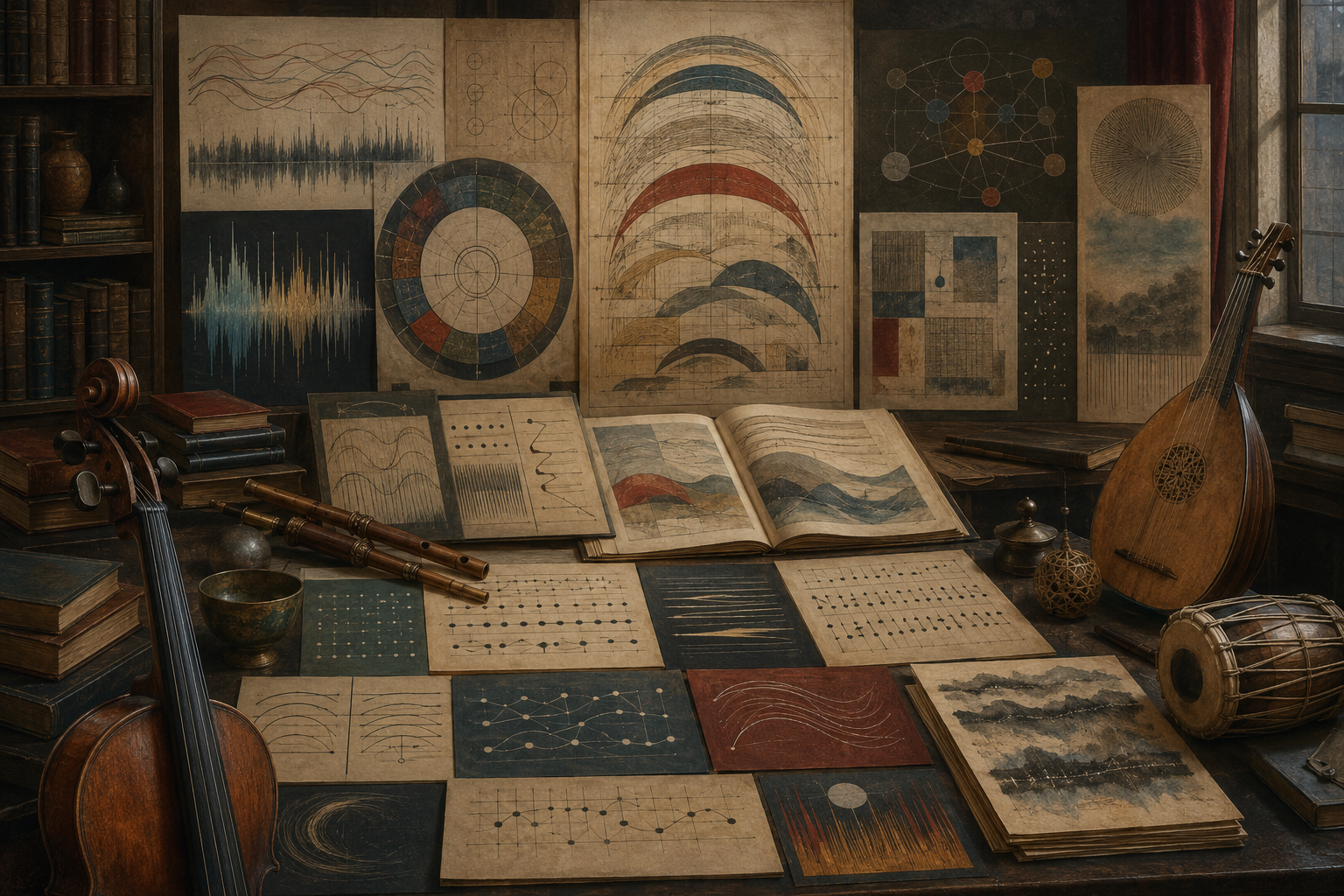
Music Theory, Form, and Meaning provides the sound-and-time layer of the Meaning category. It asks how music becomes meaningful without needing to translate itself into ordinary speech. Musical meaning often arises through expectation, delay, return, repetition, variation, tension, release, gesture, silence, and embodied listening.
This map treats music as both structure and experience. Music theory helps describe intervals, scales, harmony, rhythm, meter, phrase, cadence, texture, timbre, and form. But musical meaning is not exhausted by analysis. It also depends on performance, listening context, memory, culture, ritual, technology, genre, identity, and emotional life.
The articles in this map move from foundations of music theory and musical meaning into melody, harmony, rhythm, form, expression, performance, notation, tuning systems, genre, ritual, technology, ethics, culture, platforms, and algorithmic music. Together, they provide a framework for understanding music as organized sound, embodied time, cultural practice, and meaningful form.
GitHub Repository
This article map is supported by companion studio-lab scaffolding for musical structures, interval studies, rhythm grids, form maps, tuning systems, listening notes, performance records, cultural context tables, and reproducible research workflows.
Complete Code Repository
The Music Theory, Form, and Meaning companion repository includes article-level folders, musical concept maps, rhythm and meter examples, interval and tuning datasets, form-analysis notes, performance and interpretation records, documentation, Python workflows, R summaries, SQL catalogs, notebooks, calculators, Canvas cards, and reproducible studio-lab scaffolding for studying sound, structure, performance, and musical meaning.
Music Theory, Form, and Meaning as a Field of Inquiry
Music Theory, Form, and Meaning studies how organized sound becomes intelligible and meaningful. It asks how tones become melodies, how chords create tension, how rhythm organizes bodies, how form structures expectation, how performance interprets works, and how listening turns sound into experience.
Music theory provides a language for musical relationships. It can describe intervals, scales, keys, modes, chords, progressions, counterpoint, rhythm, meter, phrase, cadence, texture, timbre, form, tuning, and notation. These tools make musical structure easier to hear, compare, teach, and interpret.
But music is not only structure. Music is also felt time. It happens through listening, memory, motion, anticipation, surprise, return, embodiment, and social context. A repeated rhythm can become communal. A melody can become personal memory. A harmonic shift can transform emotional atmosphere. A performance can make an old work newly present.
This field therefore belongs at the intersection of analysis and interpretation. It asks how musical forms work, but also why they matter: emotionally, culturally, historically, spiritually, politically, and aesthetically.
Why Music Belongs Under Meaning
Music belongs under Meaning because it shows that human understanding is not limited to words. Music can organize feeling, memory, attention, movement, ritual, identity, and belonging without stating a proposition. It can make experiences shareable that might otherwise remain private or difficult to express.
Musical meaning often arises through relationships: repetition and variation, tension and release, expectation and surprise, consonance and dissonance, pulse and syncopation, silence and sound, return and transformation. These relationships create intelligible forms of time. Listeners may not name the theory, but they can feel the movement.
Music also belongs under Meaning because it is cultural. Genres, instruments, tunings, performance traditions, recording technologies, listening environments, rituals, protests, platforms, and institutions all shape how music is heard. The same musical sound can mean differently across communities, contexts, and histories.
Under Meaning, music becomes more than entertainment or technique. It becomes a way of studying how human beings create shared emotional worlds, organize time, embody pattern, and carry memory through sound.
What This Article Map Studies
This article map studies music theory, musical form, nonverbal meaning, listening, expectation, melody, motif, musical memory, intervals, scales, tonal worlds, harmony, tension, resolution, consonance, dissonance, rhythm, meter, pulse, syncopation, groove, phrase, cadence, counterpoint, theme, variation, development, texture, timbre, song form, sonata form, repetition, performance, interpretation, improvisation, silence, expressive timing, embodiment, notation, tuning systems, genre, style, ritual, technology, culture, identity, protest, appropriation, algorithmic music, and platform listening.
At the theoretical level, it studies how musical structures are organized. At the experiential level, it studies how people hear, remember, feel, move, and respond. At the performance level, it studies how musicians interpret, embody, vary, and renew musical forms. At the cultural level, it studies how music participates in ritual, identity, politics, technology, and public life.
At the ethical level, the map studies influence, appropriation, authorship, cultural exchange, platform systems, algorithmic recommendation, generative music, and the responsibilities of listening. The goal is to connect musical structure with musical meaning.
Major Themes in Music Theory, Form, and Meaning
One major theme is time. Music unfolds. It creates expectation, delay, fulfillment, memory, return, and transformation. Musical form is therefore a way of organizing lived time.
A second theme is tension and resolution. Harmony, rhythm, melody, phrase, and form often create patterns of instability and release. These patterns shape musical emotion without needing literal description.
A third theme is embodiment. Music is heard by bodies, not only minds. Rhythm, pulse, breath, gesture, phrasing, dance, performance, and movement all participate in musical meaning.
A fourth theme is repetition and variation. Repetition makes music memorable. Variation keeps repetition alive. Together, they organize musical memory, development, ritual, improvisation, and form.
A fifth theme is performance. A score, recording, or musical idea becomes meaningful through interpretation. Timing, tone, articulation, phrasing, silence, presence, and context can change how music is understood.
A sixth theme is culture. Music belongs to communities, traditions, technologies, institutions, histories, and identities. Responsible music theory must therefore listen not only to structure, but also to context.
Music Theory, Form, and Meaning Article Map
The map below organizes the Music Theory, Form, and Meaning series into six parts, moving from foundations of music and meaning into melody, harmony, rhythm, form, expression, performance, notation, tuning, genre, ritual, culture, ethics, technology, and future directions.
Part I — Foundations of Music and Meaning
- What Is Music Theory? (planned) — A foundational article introducing music theory as the study of musical relationships, structure, form, listening, and interpretation.
- Music as Meaning Without Ordinary Language (planned) — An article on how music can be meaningful without making literal statements or translating directly into words.
- Listening, Expectation, and Musical Understanding (planned) — A study of how listeners anticipate, remember, compare, and interpret musical events across time.
- Sound, Time, and Human Experience (planned) — An article on music as organized time, embodied sound, memory, presence, and felt experience.
- Musical Form as Organized Motion (planned) — A study of form as movement, sequence, development, return, contrast, and transformation.
- The Philosophy of Musical Meaning (planned) — An article on major philosophical questions about expression, emotion, representation, autonomy, and musical understanding.
Part II — Melody, Harmony, and Rhythm
- Melody, Motif, and Musical Memory (planned) — An article on melodic shape, recurrence, motif, recognition, recall, and the memory of musical ideas.
- Intervals, Scales, and Tonal Worlds (planned) — A study of pitch relations, scalar systems, modes, tonal centers, and the organization of melodic space.
- Harmony, Tension, and Resolution (planned) — An article on chords, progressions, instability, expectation, release, and harmonic meaning.
- Consonance, Dissonance, and Expectation (planned) — A focused article on how stability, friction, sensory perception, culture, and learned expectation shape musical experience.
- Rhythm, Meter, and Pulse (planned) — An article on duration, beat, meter, accent, periodicity, and the organization of musical time.
- Syncopation, Groove, and Musical Energy (planned) — A study of rhythmic displacement, bodily response, propulsion, dance, repetition, and felt musical force.
Part III — Musical Structure and Form
- Phrase, Cadence, and Musical Syntax (planned) — An article on musical grouping, closure, continuation, punctuation, and the sense of musical grammar.
- Counterpoint and Musical Conversation (planned) — A study of independent lines, imitation, voice leading, interaction, tension, and musical dialogue.
- Theme, Variation, and Development (planned) — An article on how musical ideas are repeated, transformed, expanded, contrasted, and reinterpreted.
- Texture, Timbre, and Musical Space (planned) — A study of density, layering, color, register, instrumentation, resonance, and spatial experience in music.
- Song Form, Sonata Form, and Large-Scale Structure (planned) — An article on recurring formal architectures and how large musical works organize expectation.
- Repetition, Return, and Musical Memory (planned) — A focused article on how repetition and return create recognition, ritual, emotional depth, and structural meaning.
Part IV — Expression, Performance, and Interpretation
- How Music Expresses Emotion (planned) — An article on musical expression, mood, affect, gesture, metaphor, embodiment, and the problem of musical emotion.
- Performance as Musical Interpretation (planned) — A study of performance as an interpretive act shaped by timing, tone, articulation, phrasing, silence, and presence.
- Improvisation and Real-Time Form-Making (planned) — An article on spontaneous musical creation, constraint, risk, listening, response, and emergent structure.
- Silence, Space, and Musical Suggestion (planned) — A focused article on rests, pauses, resonance, absence, expectation, atmosphere, and the expressive force of silence.
- Tempo, Phrasing, and Expressive Timing (planned) — A study of speed, breath, rubato, articulation, pacing, and timing as carriers of musical meaning.
- Embodiment, Movement, and Musical Feeling (planned) — An article on gesture, dance, bodily rhythm, performance, entrainment, and the physical experience of music.
Part V — Systems, Notation, and Traditions
- Notation and the Representation of Sound (planned) — An article on how musical notation preserves, abstracts, limits, and enables musical practice.
- Tuning Systems and Musical Order (planned) — A study of tuning, temperament, interval systems, cultural variation, compromise, and sonic order.
- Genre, Style, and Musical Recognition (planned) — An article on how musical genres and styles create expectations, identities, traditions, and interpretive frames.
- Music, Ritual, and Collective Emotion (planned) — A study of music in ceremony, worship, mourning, celebration, protest, solidarity, and communal memory.
- Music, Technology, and Reproduction (planned) — An article on recording, amplification, streaming, sampling, editing, distribution, and the technological mediation of music.
- Musical Canons, Institutions, and Authority (planned) — A critical article on education, archives, concert culture, criticism, preservation, exclusion, and institutional taste.
Part VI — Culture, Ethics, and Future Music
- Music, Identity, and Cultural Belonging (planned) — An article on how music shapes personal identity, group belonging, memory, place, tradition, and public life.
- Music, Power, and Protest (planned) — A study of music as resistance, solidarity, dissent, mobilization, testimony, and public expression.
- Appropriation, Influence, and Musical Exchange (planned) — An article on borrowing, homage, hybridity, exploitation, credit, cultural authority, and ethical exchange.
- Algorithmic Music and Generative Sound (planned) — A critical article on procedural composition, AI-generated music, automation, authorship, style, and creative agency.
- Listening in the Age of Platforms (planned) — A study of streaming, recommendation systems, attention, taste, discovery, mood playlists, and platform-shaped listening.
- Music Theory, Form, and Meaning: A Capstone (planned) — A capstone article on structure, listening, performance, culture, ethics, technology, and musical meaning.
Python Workflow: Rhythm, Harmony, Form, and Listening Records
A useful Python workflow for this article map is a rhythm, harmony, form, and listening-record workflow. The workflow can begin with structured records for intervals, scales, chords, rhythmic patterns, formal sections, listening notes, performance choices, genre tags, cultural contexts, and interpretive questions. Python can then generate CSV tables, JSON records, Markdown summaries, form maps, rhythm grids, and reproducible examples for teaching and article planning.
This workflow belongs naturally with articles on rhythm, meter, intervals, harmony, counterpoint, form, repetition, tuning systems, and algorithmic music. For example, a Python script can compare interval ratios, generate a rhythm grid, document a formal outline, or organize listening notes across multiple performances of the same work.
The workflow should not suggest that music can be fully explained by code. Its purpose is to make musical relationships visible and research notes more organized. Musical meaning remains interpretive, embodied, cultural, and experiential.
R Workflow: Musical Themes, Form Summaries, and Cultural Context
A useful R workflow for this article map is a musical-theme and form-summary workflow. A structured teaching dataset can include article titles, musical concepts, theoretical domains, performance themes, cultural contexts, ethical questions, listening examples, and research sources. R can summarize recurring themes, compare article domains, generate tables, and support editorial planning.
This workflow belongs naturally with articles on melody, harmony, rhythm, form, expression, performance, notation, genre, ritual, technology, culture, and ethics. For example, R can help summarize which articles focus on theory, which focus on performance, which focus on cultural meaning, which focus on technology, and which focus on ethical interpretation.
As with the Python workflow, the goal is not to reduce music to data. The goal is to make the research architecture clearer. Music remains a lived, sounded, embodied, and culturally situated form of meaning.
Ethics, Culture, and Responsible Listening
Responsible listening begins with the recognition that music belongs to human worlds. A song, rhythm, tuning system, performance practice, instrument, genre, or vocal style may carry histories of community, migration, labor, worship, protest, grief, joy, or survival. Listening only for structure can miss what music does culturally and ethically.
Music also raises questions of power. Institutions decide which music is canonized, taught, archived, funded, reviewed, and preserved. Platforms decide what is recommended, surfaced, monetized, and repeated. Cultural exchange can create new musical life, but it can also become appropriation, erasure, exploitation, or uncredited borrowing.
Responsible listening does not mean abandoning analysis. It means placing analysis inside context. Harmony, rhythm, melody, form, and timbre matter deeply, but so do history, community, performance, authorship, credit, access, and cultural authority.
The ethical goal is to listen with both precision and humility: hearing musical structure while also attending to the people, practices, technologies, and histories through which music becomes meaningful.
Music Theory, Form, and Meaning in a Wider Intellectual Context
Music Theory, Form, and Meaning belongs within a wider knowledge architecture because music connects aesthetics, mathematics, embodiment, culture, ritual, technology, psychology, performance, and public life. It sits under Meaning because music shows how nonverbal form can organize human experience.
This map connects to aesthetics and the philosophy of art through beauty, expression, judgment, form, and interpretation. It connects to mathematics, art, music, and pattern through interval, ratio, tuning, rhythm, symmetry, periodicity, waveform, and structure. It connects to symbolism through ritual, genre, public memory, sacred sound, protest music, and collective emotion. It connects to creative form through performance, improvisation, composition, revision, and embodied practice.
It also connects to modern technology through recording, streaming, recommendation systems, sampling, AI-generated sound, and platform-shaped listening. Musical meaning now circulates through institutions, archives, media systems, devices, and algorithms as well as through live performance and community practice.
By giving music theory and meaning its own article map, the site treats sound as a serious form of knowledge. Music is not merely heard. It is remembered, embodied, interpreted, shared, contested, and lived.
Related Reading
- Meaning
- Beauty, Aesthetics, and Meaning
- Aesthetics and the Philosophy of Art
- Mathematics, Art, Music, and Pattern
- Creative Form, Composition, and Interpretation
- Symbolism, Style, and Cultural Meaning
- Color Theory, Typography, and Design
- Storytelling and Narrative Systems
Further Reading
- Cook, N. (1990). Music, Imagination, and Culture. Oxford: Clarendon Press.
- Cook, N. (2013). Beyond the Score: Music as Performance. Oxford: Oxford University Press.
- Hanslick, E. ([1854] 1986). On the Musically Beautiful. Translated by G. Payzant. Indianapolis: Hackett.
- Kivy, P. (2002). Introduction to a Philosophy of Music. Oxford: Clarendon Press.
- Langer, S.K. (1953). Feeling and Form: A Theory of Art. New York: Charles Scribner’s Sons.
- Levitin, D.J. (2006). This Is Your Brain on Music: The Science of a Human Obsession. New York: Dutton.
- Meyer, L.B. (1956). Emotion and Meaning in Music. Chicago: University of Chicago Press.
- Monson, I. (1996). Saying Something: Jazz Improvisation and Interaction. Chicago: University of Chicago Press.
- Small, C. (1998). Musicking: The Meanings of Performing and Listening. Middletown, CT: Wesleyan University Press.
- Taruskin, R. (2005). The Oxford History of Western Music. Oxford: Oxford University Press.
- Tymoczko, D. (2011). A Geometry of Music: Harmony and Counterpoint in the Extended Common Practice. Oxford: Oxford University Press.
- Zbikowski, L.M. (2002). Conceptualizing Music: Cognitive Structure, Theory, and Analysis. Oxford: Oxford University Press.
References
- Attali, J. (1985). Noise: The Political Economy of Music. Translated by B. Massumi. Minneapolis: University of Minnesota Press.
- Berger, H.M. (1999). Metal, Rock, and Jazz: Perception and the Phenomenology of Musical Experience. Middletown, CT: Wesleyan University Press.
- Cook, N. (1990). Music, Imagination, and Culture. Oxford: Clarendon Press.
- Cook, N. (2013). Beyond the Score: Music as Performance. Oxford: Oxford University Press.
- Hanslick, E. ([1854] 1986). On the Musically Beautiful. Translated by G. Payzant. Indianapolis: Hackett.
- Kerman, J. (1985). Contemplating Music: Challenges to Musicology. Cambridge, MA: Harvard University Press.
- Kivy, P. (2002). Introduction to a Philosophy of Music. Oxford: Clarendon Press.
- Langer, S.K. (1953). Feeling and Form: A Theory of Art. New York: Charles Scribner’s Sons.
- Levitin, D.J. (2006). This Is Your Brain on Music: The Science of a Human Obsession. New York: Dutton.
- Meyer, L.B. (1956). Emotion and Meaning in Music. Chicago: University of Chicago Press.
- Monson, I. (1996). Saying Something: Jazz Improvisation and Interaction. Chicago: University of Chicago Press.
- Nattiez, J.-J. (1990). Music and Discourse: Toward a Semiology of Music. Translated by C. Abbate. Princeton: Princeton University Press.
- Small, C. (1998). Musicking: The Meanings of Performing and Listening. Middletown, CT: Wesleyan University Press.
- Taruskin, R. (2005). The Oxford History of Western Music. Oxford: Oxford University Press.
- Tymoczko, D. (2011). A Geometry of Music: Harmony and Counterpoint in the Extended Common Practice. Oxford: Oxford University Press.
- Zbikowski, L.M. (2002). Conceptualizing Music: Cognitive Structure, Theory, and Analysis. Oxford: Oxford University Press.