
Last Updated May 3, 2026
Turkic and Ottoman myth, epic, and folklore constitute a vast and internally diverse field of cultural, historical, religious, literary, political, and performative inquiry in which origins, sky authority, animal ancestry, heroic memory, sacred lineage, migration, conquest, saintly charisma, bardic performance, folk humor, love, wonder, moral testing, and the unseen converge. This is not a single canon or a neatly bounded mythology. It is a layered civilizational archive stretching across Inner Asia, the Eurasian steppe, Central Asia, Siberia, Anatolia, Azerbaijan, the Caucasus, the Black Sea world, the Balkans, the Volga region, the Ottoman Mediterranean, and post-Ottoman local worlds, where oral epic, tribal legend, courtly romance, saintly narrative, dervish lore, heroic cycle, folk tale, festival custom, and sacred geography together formed one of the great narrative ecologies of the premodern world.
This knowledge series treats Turkic and Ottoman narrative traditions as a layered civilizational archive rather than as a narrow national inheritance. Early Turkic mythic worlds of sky, wolf, horse, mountain, tree, iron, lineage, migration, and steppe destiny do not disappear with Islamization, imperial formation, or migration westward. They are transformed, reframed, translated, and absorbed into new narrative systems shaped by Islamicate cosmology, Persianate literary culture, Mongol imperial structures, Byzantine and Anatolian inheritances, Sufi devotion, Ottoman imperial ideology, local vernacular storytelling, Balkan and Caucasian contact zones, and regional folk practice. The result is a narrative field in which older steppe symbols survive beside saint legends, ghazi epics, wonder tales, heroic singers, trickster figures, sacred lineages, miracle stories, dervish charisma, frontier memory, courtly representations of sovereignty, and popular forms of social criticism.
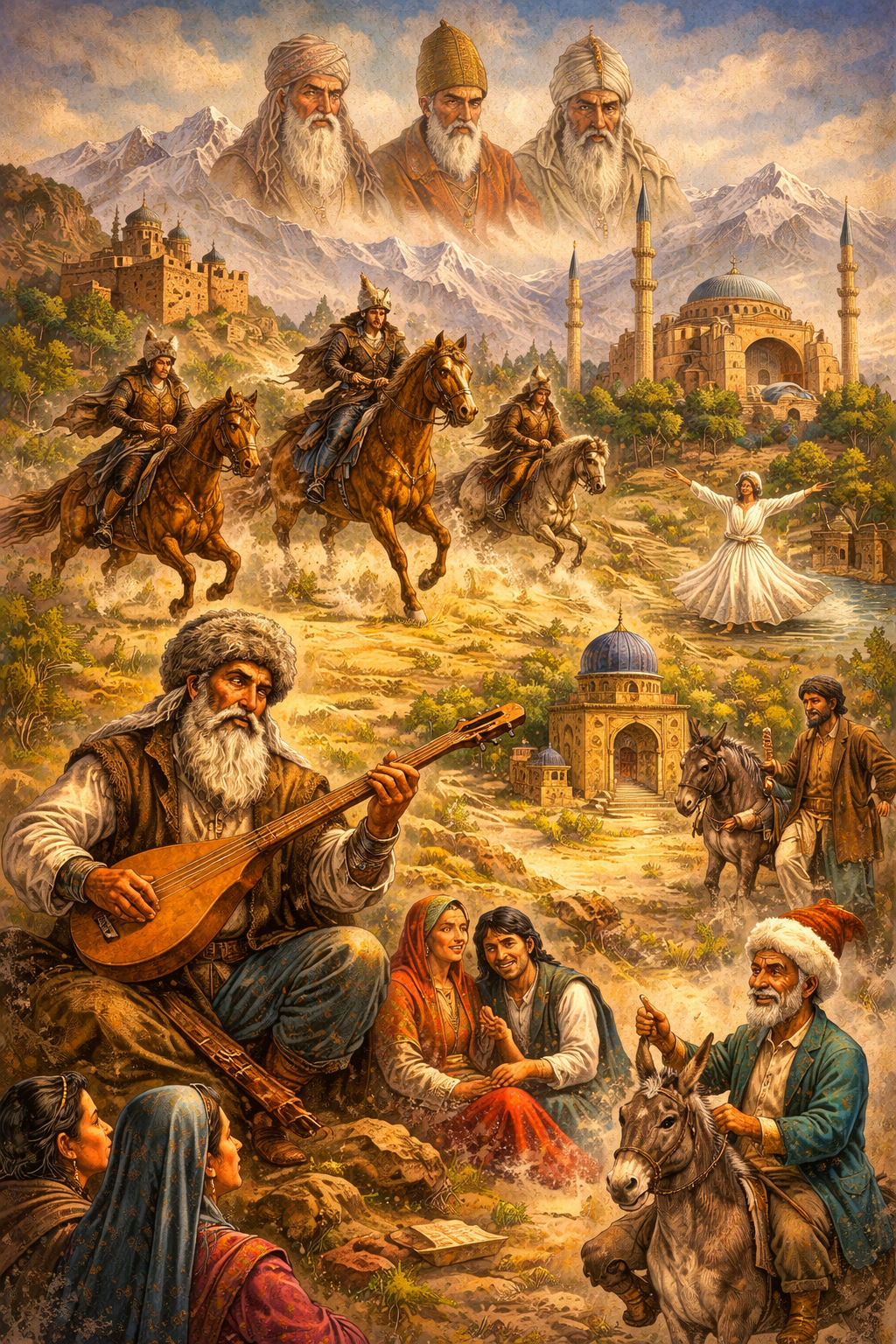
The category includes several overlapping layers of tradition. One layer concerns early Turkic and Inner Asian mythic imagination: creation narratives, animal ancestry, sky and earth symbolism, sacred rulers, heroic ancestors, migration legends, cosmological order, and the relation between steppe ecology and social memory. Another concerns the epic traditions of Oghuz, Kipchak, Central Asian, Anatolian, and other Turkic-speaking worlds, where bardic performance, heroic combat, kinship, oath, fate, and communal endurance were narrated across cycles such as The Book of Dede Korkut, the Manas tradition, Alpamysh, Köroğlu, and related heroic repertoires. A third concerns the Islamicate and Ottoman layers: saintly legends, ghazi narratives, dervish miracles, imperial founding myths, palace culture, vernacular tale cycles, local holy places, urban folklore, shadow theater, trickster traditions, festival worlds, and stories that tied empire to sacred legitimacy, conquest, justice, and memory. A fourth concerns regional synthesis, in which Turkic-speaking communities incorporated and reshaped Byzantine, Greek, Armenian, Persian, Arab, Slavic, Caucasian, Balkan, Mongol, and local Anatolian materials without dissolving the coherence of Turkic narrative forms.
What makes this field so important is the extraordinary range through which it joins mobility and place, empire and village, warrior memory and domestic custom, sacred charisma and comic inversion, steppe animal symbolism and urban imperial ceremony. A wolf may stand for ancestry and guidance. A horse may signify rank, speed, intimacy, perception, and destiny. A mountain may preserve primal origin or saintly retreat. A dervish lodge may become a center of miracle, hospitality, and moral authority. A frontier hero may embody both raiding violence and communal justice. A tale of disguise or reversal may expose the fragile vanity of power. A folk song may preserve grief, longing, exile, and political memory more durably than official chronicle. These traditions are best approached not as curiosities at the edge of history, but as a major archive of cultural intelligence linking cosmology, sovereignty, ethics, performance, and civilizational memory.
The study of Turkic and Ottoman myth, epic, and folklore also matters because it complicates simplistic distinctions between myth and history, oral performance and literary redaction, courtly ideology and popular culture, Islam and older cosmological inheritance, empire and vernacular locality, or steppe mobility and urban settlement. In these worlds, epic and genealogy often function as social memory; saint legend organizes sacred geography; imperial myth absorbs tribal memory; folk humor becomes a medium of social criticism; heroic lament becomes political memory; and popular storytelling becomes one of the chief ways communities negotiate power, displacement, sanctity, and belonging. To read these traditions seriously is therefore to enter a world in which narrative is cosmology, ethical testing, entertainment, legitimation, ritual memory, and cultural survival at once.
Why This Field Matters
Turkic and Ottoman narrative traditions deserve serious study because they preserve one of the world’s great long-duration archives of movement, pastoral memory, heroic ethics, imperial transformation, sacred charisma, and vernacular intelligence. Few narrative fields connect Inner Asian steppe cosmology to Mediterranean imperial culture with such continuity and range. This is a field where horse, wolf, sky, tent, mountain, shrine, court, village, battlefield, caravan road, dervish lodge, coffeehouse, and shadow stage all belong to the same large narrative ecology.
The field also matters because it illuminates how communities imagined sovereignty and legitimacy not only through law, dynastic chronicle, or imperial ceremony, but through stories of ancestral election, sacred lineage, wolf guidance, founding dreams, conquest, justice, holy protection, and moral testing. Turkic and Ottoman traditions repeatedly ask where authority comes from, what makes rule legitimate, when martial power becomes justice, and how sacred charisma can either support or judge worldly sovereignty.
These traditions preserve forms of memory often marginalized by official history: bardic song, women’s laments, saintly local tradition, village tale cycles, trickster humor, oral genealogy, shrine legend, shadow theater, coffeehouse narration, and popular understandings of fate, honor, migration, and power. The official chronicle may record conquest; the epic song remembers oath, grief, horse, mother, companion, and betrayal. The court may stage legitimacy; the joke may puncture it. The saint’s tomb may hold local memory more durably than an imperial archive.
The field also helps correct the narrowness of overly nationalized literary histories. Turkic and Ottoman myth, epic, and folklore cannot be understood adequately if reduced to modern Turkish nationalism, Ottoman state ideology alone, or a generic “Central Asian tradition.” It is a layered world shaped by transregional movement, multilingual exchange, Islamicate and Persianate literary forms, Byzantine and Anatolian contact, Balkan and Caucasian entanglement, local rural custom, and the long persistence of oral performance. It belongs at the level of civilizational interpretation.
The Problem of the Archive
A research-grade account must begin with the archive itself. Turkic and Ottoman myth, epic, and folklore do not survive in one ancient scripture, one official mythology, or one stable literary canon. They are dispersed across inscriptions, origin legends, oral epics, bardic performances, court chronicles, Islamic hagiographies, dervish biographies, Sufi poetry, folk songs, love romances, shadow theater texts, jokes, village legends, travel accounts, manuscript collections, ethnographic records, ritual practices, shrine traditions, and modern nationalist or scholarly editions.
The archive is multilingual and transregional. Old Turkic inscriptions, Oghuz materials, Chaghatay literature, Ottoman Turkish manuscripts, Persianate romance, Arabic sacred vocabulary, Anatolian oral tradition, Central Asian epic performance, Azeri song, Kyrgyz Manas recitation, Kazakh and Uzbek heroic materials, Balkan and Caucasian contact traditions, and modern Turkish folklore all belong to the larger field. Translation is therefore not a secondary problem. It is part of the history of the traditions themselves.
The archive is also mediated. Some early materials survive through inscriptions and later chronicles. Some epics were recorded from oral performers after long histories of transmission. Some Ottoman narratives were shaped by courtly ideology or Sufi hagiographic conventions. Some folk traditions were collected by modern scholars under nationalist, philological, or ethnographic frameworks. These records can be invaluable, but they are never neutral.
Interpretation must therefore ask not only what a story says, but where it was performed, who preserved it, what language carried it, what social world authorized it, what religious framework reframed it, and what political afterlife it acquired. The archive is not a simple storehouse of tales. It is a layered field of performance, manuscript, memory, translation, and power.
Myth Without a Single Canon
Turkic and Ottoman myth, epic, and folklore are best approached as a plural and historically adaptive field rather than as a single mythology. There is no one “Turkic mythological canon” that fully contains the tradition, and Ottoman narrative culture cannot be reduced to imperial ideology or court literature. The field lives across epic, genealogy, shrine legend, oral song, humor, romance, urban performance, saintly memory, household belief, and regional custom.
This absence of a single canon is not a weakness. It is the structure of the archive. Turkic and Ottoman narrative worlds survive through recurring symbolic systems: sky authority, sacred lineage, wolf ancestry, horse intimacy, mountain origin, iron power, migration, heroic oath, bardic memory, saintly charisma, frontier conquest, trickster inversion, love-longing, and the moral ambiguity of imperial rule.
Genre matters. An origin legend does different work from a ghazi narrative. An epic song does different work from a Nasreddin Hodja joke. A dervish miracle does different work from an Ottoman founding dream. A village tale does different work from a courtly romance. A shadow play does different work from a saint’s life. Each form must be read in relation to performance, audience, social setting, and historical transformation.
This pillar therefore treats mythology broadly but carefully: as a field of stories, beings, places, rituals, performances, objects, and symbolic forms through which communities imagine origin, destiny, sovereignty, sacred power, moral order, danger, laughter, longing, and memory.
The Civilizational Frame of Turkic and Ottoman Narrative Worlds
The phrase “Turkic and Ottoman” is useful because it joins related but not identical fields. “Turkic” names a broad linguistic and cultural world extending across Inner Asia, Central Asia, the steppe, Siberia, Xinjiang, the Volga zone, the Caucasus, Anatolia, and beyond. “Ottoman” names an imperial formation centered in Anatolia and southeastern Europe but connected to Arab, Persian, Mediterranean, Balkan, Black Sea, and Caucasian worlds. The Ottoman field is therefore one expression, though a highly important one, of longer Turkic narrative inheritances.
To study them together is not to collapse their differences. It is to trace the transformations through which steppe memory, Islamic sacred imagination, Persianate literature, Anatolian settlement, frontier violence, and imperial institutions produced new symbolic forms. A wolf-guided origin legend and an Ottoman founding dream are not identical, but both participate in the wider problem of sacred legitimacy. A Central Asian epic horse and an Anatolian ashik’s saz are not the same object, but both carry memory through performance.
At the earliest recoverable layers lie the mythic and cosmological traditions of Turkic-speaking and Inner Asian worlds: stories of descent, sacred lineage, wolf ancestry, sky authority, heroic ancestors, migration, animal mediation, mountains, sacred trees, iron, and divine favor. These layers are often fragmentary, preserved through inscriptions, later chronicles, comparative mythology, epic survivals, and ethnographic continuities rather than through one complete canonical scripture.
Over centuries these worlds were reshaped by contact with Buddhism, Manichaeism, Christianity, Islam, Persianate literary culture, Mongol imperial structures, Byzantine frontier life, Anatolian village religiosity, Sufi institutions, and Ottoman court ideology. The result was not a break but a stratified narrative order. Stories of divine sanction, heroic struggle, sacred lineage, moral trickery, miraculous saintliness, and frontier justice persist across nomadic confederation, urban court, dervish lodge, provincial town, imperial palace, caravan route, and village hearth.
Plurality, Layering, and Narrative Transformation
No fullest account can proceed as though these traditions belonged to one homogeneous people, one empire, or one religion. The field is fundamentally plural. Oghuz, Kipchak, Chaghatay, Anatolian, Azeri, Kazakh, Kyrgyz, Uzbek, Turkmen, Tatar, Uyghur, Crimean, Siberian Turkic, and many other Turkic-speaking communities preserve overlapping but distinct narrative worlds.
Ottoman storytelling, meanwhile, emerged in a multilingual imperial environment shaped by Turkish, Arabic, Persian, Greek, Armenian, Kurdish, Slavic, Albanian, Bosnian, Jewish, Roma, Circassian, and other traditions. Stories moved across boundaries of region, class, sect, and language, often changing meaning as they moved. A saint may become local protector in one setting, imperial founder in another, and miracle-worker in a village memory. A comic type may circulate across coffeehouse, shadow theater, and written joke collection.
This layered condition is especially important for avoiding reduction. To describe these traditions only as “pre-Islamic Turkic myth” ignores the immense role of Islamicate literary, devotional, and imperial transformation. To describe them only as “Islamic folklore” erases the persistence of steppe cosmology, animal symbolism, heroic kinship, and older sacred geographies. To describe Ottoman narrative only through court culture misses the power of ashik performance, village storytelling, saint legend, women’s song, comic theater, and popular belief.
The field is most fully grasped when these layers remain distinct yet connected. Turkic and Ottoman narrative worlds are a contact zone of civilizations and lifeworlds: Inner Asian sky cosmology, Turkic epic memory, Islamicate prophecy and sainthood, Persianate romance, Byzantine frontier inheritance, Anatolian village tradition, Balkan folk circulation, Caucasian heroic memory, Ottoman imperial ritual, and urban popular performance.
Early Turkic Myth and Inner Asian Cosmology
The earliest layers of Turkic mythic imagination survive in fragmentary but powerful forms: inscriptions, later chronicles, origin legends, comparative motifs, epic residues, and ethnographic continuities. These layers include sky-centered sovereignty, sacred ancestry, wolves as guides or progenitors, the symbolic force of iron, mountain and tree imagery, divine favor for rulers, and narratives of emergence, migration, defeat, renewal, and restoration.
Early Turkic cosmology links political authority to cosmic order. Rule is not merely military domination. It is imagined through heavenly favor, lineage, charisma, strength, oath, and the capacity to hold a people together across movement and danger. The ruler’s authority is bound to sky, ancestry, and social cohesion.
Migration and restoration are equally important. Origin legends often explain how a people survives catastrophe, receives guidance, emerges from confinement, or moves toward destiny. These stories are not only about where a people came from. They explain why a people continues, what binds it, and what signs mark its sacred legitimacy.
Responsible treatment requires caution because no single comprehensive ancient canon survives. Yet the coherence of the symbolic field is unmistakable and foundational. Sky, wolf, horse, mountain, iron, lineage, and movement form one of the deep grammars of Turkic narrative imagination.
Sky, Wolf, Horse, Mountain, Tree, and Iron
Several symbolic complexes recur across Turkic myth and epic. The sky is associated with order, height, authority, fate, and divine sanction. It gives political power a cosmological horizon. To rule is not only to command people but to stand under a larger order of heaven, destiny, and sacred legitimacy.
The wolf is one of the most powerful ancestral and guiding figures in Turkic mythic memory. In origin legends, the wolf may guide, protect, generate lineage, or lead a people out of catastrophe. It stands at the boundary of wildness and kinship, danger and protection, animal force and social origin.
The horse is central to the moral and practical world of Turkic epic. It is not merely transport. The horse is companion, status, mobility, military force, emotional bond, and often an extension of heroic identity. A hero’s horse may perceive danger, share fate, carry reputation, or become almost a second self.
Mountains, trees, and iron also carry symbolic weight. Mountains may be origins, refuges, sacred elevations, or places of ordeal. Trees may connect life, lineage, fertility, and cosmic structure. Iron may signify craft, strength, emergence, confinement, and civilizational power. Together, these symbols show how Turkic mythic thought binds ecology, mobility, sovereignty, and social memory.
Islamization and Transformation Without Erasure
Islamization transformed Turkic narrative worlds profoundly, but it did not simply erase older symbolic structures. Earlier motifs of sky authority, sacred ancestry, horse-centered heroism, animal guidance, mountain sanctity, and steppe destiny were reframed through Islamicate concepts of prophecy, blessing, sainthood, ghaza, divine favor, miracle, lineage, and moral accountability.
This transformation is visible in epic. The Book of Dede Korkut, for example, preserves Oghuz heroic worlds while also presenting Islamized narrative framing, prayer, honor, hospitality, and sacred legitimacy. Older heroic structures and Islamic moral vocabularies coexist rather than simply replacing one another.
Sufi traditions also played a major role. Dervishes, saints, sheikhs, and holy lineages translated sacred power into new social and geographic forms. The saint could tame wild space, protect travelers, found communities, heal bodies, rebuke rulers, or sanctify frontiers. In such traditions, older patterns of charisma and sacred landscape were absorbed into Islamic devotional life.
To study Islamization carefully is therefore to study transformation, not disappearance. Turkic and Ottoman narrative worlds are strongest when read as layered archives in which older inheritances continue under new theological, poetic, and institutional forms.
Oghuz Epic and The Book of Dede Korkut
Among the most important narrative formations in Turkic tradition is the Oghuz heroic world preserved in The Book of Dede Korkut. This corpus stands at a threshold between oral performance and literary preservation, between older Turkic heroic structures and Islamized narrative framing, between tribal memory and moral instruction.
Its world is structured by heroic struggle, kinship obligation, hospitality, raiding, oath, lament, fosterage, gendered honor, counsel, and social testing. Heroes are measured not only by strength but by loyalty, endurance, generosity, respect for elders, courage before enemies, and the ability to preserve communal identity under pressure.
Dede Korkut himself is crucial because he is not merely a character. He is elder, counselor, naming figure, memory keeper, and moral voice. His presence gives epic life a reflective center. He mediates between action and meaning, youth and age, heroism and wisdom, oral performance and cultural continuity.
The corpus is therefore indispensable for this pillar. It reveals how Turkic epic binds martial action to kinship, speech, music, counsel, naming, piety, and the social reproduction of peoplehood.
Central Asian Epic: Manas, Alpamysh, and Heroic Scale
Central Asian epic traditions preserve enormous repertoires of martial heroism, kinship memory, political struggle, mobility, sacred destiny, and communal endurance. The Kyrgyz Manas tradition is especially monumental, not only because of its scale but because of its performative, genealogical, and national-cultural significance. It is epic as living memory.
Manas gives heroic narrative cosmic and communal scale. The hero is not simply an individual warrior. He becomes a focal point for peoplehood, alliance, struggle, identity, and historical imagination. Performance matters deeply: the manaschi’s recitation is an event of cultural continuity, not just the delivery of a fixed text.
Alpamysh and related Central Asian heroic traditions likewise preserve structures of exile, return, family loyalty, trial, marriage, captivity, and restoration. These narratives connect personal heroism to the survival of household and community. Their emotional force lies in the relation between warrior virtue and social repair.
Central Asian epic traditions therefore broaden the pillar beyond Anatolia and the Ottoman world. They show the depth of Turkic heroic imagination across steppe, oasis, and settled environments, where oral performance remains one of the central vehicles of historical consciousness.
Köroğlu and the Rebel-Hero Tradition
The Köroğlu cycle is one of the great bridges between heroic epic, social banditry, justice tradition, and folk performance across Turkic, Persianate, Caucasian, and Anatolian worlds. Köroğlu stands at the intersection of rebellion, charisma, music, poetic utterance, and communal redress. His story-world reveals how epic heroism can become a language of protest against unjust authority.
The rebel-hero is morally charged because he stands outside official order while claiming a deeper justice. He may be outlaw, warrior, singer, avenger, protector, or charismatic leader. Like other social-bandit figures, he exposes the gap between law and justice, office and legitimacy, power and moral right.
Music and poetic utterance are central to the Köroğlu tradition. The hero is not only fighter but singer. Song gives rebellion memory and form. It turns personal grievance into communal performance and makes injustice narratable.
Köroğlu traditions therefore belong at the center of the pillar’s political imagination. They ask whether justice can survive when official power becomes predatory, and whether song can carry resistance across regions and generations.
Ashik, Ozan, and Bardic Performance
Bardic culture is central to the field. The ashik or ozan is not merely a singer but a carrier of memory, genealogy, ethical reflection, local history, devotion, humor, and communal grief. Through song and performance, epic and folklore remain living rather than archival.
The bard mediates between individual emotion and public memory, between hero story and village life, between the old steppe singer and the later urban or provincial minstrel. His performance may include epic recitation, love song, religious verse, social commentary, satire, lament, and local history. The instrument itself—the saz or related stringed form—becomes a memory-bearing object.
Bardic tradition also gives voice to transition. The ashik may move between rural and urban settings, sacred and secular themes, elite and popular audiences, oral improvisation and written circulation. He carries older narrative patterns into new social worlds.
This makes bardic performance one of the strongest continuities linking early Turkic oral worlds, Anatolian vernacular culture, Sufi-inflected poetry, and modern folk memory.
Ottoman Founding Narratives and Imperial Myth
Ottoman political culture generated powerful narratives of origin, dream, conquest, sacred election, dynastic continuity, and providential expansion. Founding dreams, genealogical claims, ghazi ideology, saintly support, sacred objects, and courtly symbolic ritual all contributed to an imperial mythology through which the dynasty and its mission could be imagined.
These narratives cannot be reduced to propaganda, though they certainly served political purposes. They are part of a larger effort to narrate legitimacy in sacred and historical terms. The Ottoman house had to explain not only how it ruled, but why its rule belonged within a providential and moral order.
Dreams are especially important in founding traditions because they translate destiny into image. A dream may reveal future expansion, sacred sanction, genealogical continuity, or the union of dynastic power and divine favor. Such narratives make sovereignty memorable and morally charged.
Ottoman imperial myth therefore belongs within the mythology series not as fantasy, but as a symbolic system of legitimacy. It shows how empire narrates its own origin, mission, and moral horizon.
Ghaza, Frontier Memory, and the Sacred Politics of Conquest
In Ottoman and related frontier traditions, conquest is narrated not only as expansion but as sacred testing, just war, dynastic legitimacy, and encounter with rival polities. Ghazi narratives, warrior saints, frontier legends, and stories of border struggle link martial action to moral or religious meaning.
The frontier is never only a boundary. It is a narrative zone where identities are made, tested, and transformed. It is a place of conflict, exchange, conversion, raiding, trade, alliance, captivity, and cultural borrowing. Frontier memory therefore produces stories that are martial and hybrid at once.
Ghaza traditions also require careful interpretation because they can be romanticized or politicized. They should be read in relation to frontier society, religious language, dynastic legitimation, and the changing political needs of Ottoman memory. Sacred conquest is a narrative formation, not merely a description of military events.
The sacred politics of conquest therefore reveal one of the central tensions of the field: the effort to reconcile violence, justice, piety, expansion, and communal identity through story.
Saints, Dervishes, and Miracle
From Central Asian holy men to Anatolian saints and Ottoman provincial dervishes, hagiographic traditions preserve miracle, baraka, sacred geography, hospitality, conversion, healing, taming of wild space, and spiritual authority. Saints become builders of roads, protectors of towns, healers of bodies, judges of rulers, and mediators of communal memory.
Dervish lore is especially important because it connects movement and sanctity. The wandering holy figure crosses frontiers, settles dangerous places, founds lodges, feeds strangers, confronts rulers, heals communities, and leaves behind tombs or stories that continue to organize local devotion. Sanctity becomes geography.
Miracle stories do not simply decorate piety. They give narrative form to sacred nearness. A saint’s intervention may explain why a shrine matters, why a community survives, why a ruler should be humble, why a spring heals, or why a frontier becomes habitable.
These traditions are indispensable for understanding the lived sacred imagination of Turkic and Ottoman worlds. They show how Islamicate devotion entered local landscapes through story, ritual, hospitality, and repeated visitation.
Sacred Geography, Shrines, and Frontier Memory
No serious treatment of Turkic and Ottoman sacred narrative can ignore sacred geography. Shrines, tombs, mountains, springs, battle sites, tekkes, caves, passes, trees, caravan stations, city quarters, and old fortresses are not merely places where stories happened. They are narrative institutions in their own right.
Around such places gather miracle accounts, local pride, pilgrimage circuits, healing memory, annual gatherings, vows, offerings, and stories of rescue, justice, or divine favor. Sacred geography binds communities to history through repeated acts of remembrance and visitation. The place is not only remembered; it is approached, touched, prayed at, sung about, and ritually renewed.
This is especially important in Anatolian and Ottoman traditions shaped by Sufi and saintly devotion. A saint may sanctify a frontier zone, transform wilderness into inhabitable place, mediate between ruler and peasant, or continue to protect a town after death. Holy persons often appear at the threshold between movement and settlement, conquest and cultivation, danger and protection.
Sacred geography also preserves older layers of symbolic attachment. Mountains retain resonances of elevation, ordeal, and revelation. Trees and springs remain charged with blessing, fertility, and local memory. Battlefields become moral landscapes of sacrifice. Roads and passes preserve the memory of movement, pilgrimage, exile, and return.
Nasreddin Hodja and Trickster Wisdom
Nasreddin Hodja traditions and related comic repertoires belong to the deepest levels of Ottoman and Turkic popular culture. Their compact narratives expose absurdity through inversion, paradox, literalism, delayed understanding, and comic humility. These stories are philosophically serious precisely because they are funny.
Nasreddin is not simply a fool. He is a figure through whom folk intelligence tests authority, scholarship, greed, false piety, bureaucracy, vanity, and the unstable logic of social life. His jokes often appear absurd, but the absurdity reveals something true about power, language, desire, and human self-deception.
The compactness of the Nasreddin tale is part of its power. A single anecdote can hold a whole philosophy of reversal. The person who appears foolish may expose the foolishness of others. The literal answer may reveal hidden hypocrisy. The joke becomes a small weapon against pretension.
Trickster wisdom therefore belongs centrally to the field. It shows that Turkic and Ottoman narrative intelligence is not only epic and sacred; it is also comic, skeptical, and socially observant.
Shadow Theater, Coffeehouses, and Urban Popular Performance
Ottoman urban worlds generated rich forms of popular narration through shadow theater, coffeehouse storytelling, meddah performance, festival display, marketplace humor, and public improvisation. Characters such as Karagöz and Hacivat belong not merely to entertainment history but to the social imagination of the city.
Shadow theater stages the city as a world of class tension, ethnic encounter, official hypocrisy, sexual innuendo, neighborhood speech, comic misunderstanding, and improvisational critique. The stage becomes a public space where social difference can be exaggerated, mocked, and temporarily rearranged.
Coffeehouses and meddah performance likewise created environments in which stories circulated among urban audiences. Tales of heroes, lovers, saints, rogues, merchants, soldiers, and fools could be adapted to local concerns. Popular performance made narrative socially immediate.
These traditions matter because they show Ottoman folklore as urban as well as rural, comic as well as heroic, performative as well as textual. The empire’s narrative life lived not only in palaces and mosques, but also in coffeehouses, marketplaces, festivals, and shadow screens.
Romance, Wonder, and the Poetics of Longing
Turkic and Ottoman traditions also include wonder tales, romances, local fairy narratives, supernatural encounters, cursed places, enchanted journeys, and story cycles shaped by love, disguise, impossible trials, lost children, spirit intervention, and miraculous reversal. These narrative worlds often move between oral tale, manuscript adaptation, and printed folk book.
Love narratives are especially important because they turn longing into a moral and sometimes mystical force. Lovers may be separated by family, class, exile, fate, geography, or divine testing. Longing becomes a way of thinking fidelity, endurance, suffering, and the transformation of human desire.
Persianate literary culture deeply shaped many romance traditions, but local performance and vernacular retelling transformed them. The same story could become courtly poem, folk song, village tale, ashik performance, or mystical allegory depending on setting.
Wonder is equally important. Enchanted trials, hidden identities, miraculous help, strange journeys, and supernatural reversals make the ordinary world porous. Such stories teach that fate, desire, danger, and divine intervention often exceed human calculation.
Women, Oral Tradition, and Domestic Story Worlds
No full treatment of Turkic and Ottoman folklore is adequate without giving central place to women as singers, mourners, tellers, ritual actors, guardians of domestic custom, and transmitters of emotional and social memory. Wedding songs, lullabies, laments, spinning-room tales, household warnings, ritual sayings, and women’s local legends carry forms of grief, resistance, tenderness, fear, and practical wisdom often absent from heroic or courtly archives.
These materials are not peripheral embellishments. They are among the principal means by which kinship, morality, danger, honor, fertility, and household cosmology were transmitted. The home is one of the great archives of folklore. It holds stories of marriage, childbirth, illness, envy, longing, absence, return, and the vulnerability of ordinary life.
Women also occupy decisive symbolic roles within epic and folktale traditions. Mothers, brides, widows, prophetically gifted women, lovers, female tricksters, and women who preserve lineage memory or foresee disaster often function as moral centers of narrative worlds otherwise dominated by warriors or rulers. Their lament can judge the hero. Their refusal can expose unjust authority. Their endurance can preserve the meaning of communal loss.
In saint traditions and shrine culture, women’s vows, healing practices, petitions, and ritual presence reveal dimensions of lived religion that formal institutional histories often understate. A full mythology of Turkic and Ottoman worlds must therefore include domestic song, household ritual, and women’s memory as central forms of cultural intelligence.
Ritual, Material Culture, and the Embodied Life of Story
Stories in Turkic and Ottoman worlds do not survive only in manuscripts, chronicles, or bardic recitations. They also survive in ritual and material form: horse gear, weapons, talismans, standards, dervish objects, votive offerings, amulets, household protections, festival costumes, shadow puppets, musical instruments, shrine textiles, inscribed objects, coffeehouse props, and ceremonial gestures.
Communities do not merely remember stories intellectually. They inhabit them through sound, movement, seasonal repetition, pilgrimage, bodily practice, costume, and performance. A banner may carry dynastic memory. A saz may embody the bardic transmission of truth and grief. An amulet may condense cosmology into protective practice. A public performance may become a social arena for critiquing power.
A festival procession may reactivate the memory of conquest, saintly blessing, or communal survival. A shrine textile may preserve a vow. A dervish object may carry the memory of spiritual lineage. A shadow puppet may make urban social satire visible. A horse’s ornament may embody rank, care, and martial identity.
This material dimension reveals how epic, sanctity, and folklore enter everyday negotiations with danger, fertility, illness, uncertainty, marriage, travel, warfare, and authority. Story is embodied social life.
Anatolian, Balkan, Black Sea, and Caucasian Folklore
A full account must include the regional folkloric worlds that grew within and around Ottoman society: Anatolian village legends, Balkan saint and spirit traditions, Caucasian heroic memory, Black Sea tale cycles, mountain folklore, harvest customs, local miracle stories, and tales tied to specific ethnic or confessional communities within imperial space. Ottoman folklore was never culturally singular. It was an imperial ecology of intersecting local traditions.
Anatolia is especially important because it became a meeting ground of Turkic, Byzantine, Armenian, Greek, Kurdish, Persianate, Arab, Sufi, and local village traditions. Saints, dervishes, tribal memories, local spirits, sacred springs, epic heroes, and household customs all coexist in the Anatolian narrative landscape.
The Balkans bring another layer: frontier memory, Christian-Muslim contact, Ottoman urban culture, Slavic and Albanian tale traditions, Bosnian Muslim epic, local saints, and post-imperial memory. The Black Sea and Caucasus add maritime, mountain, and heroic traditions shaped by movement, trade, exile, and imperial pressure.
These regional layers matter because they prevent the field from becoming narrow. Turkic and Ottoman narrative culture was not only steppe and palace. It was also village, mountain, port, frontier, shrine, coffeehouse, and household.
Migration, Exile, and Post-Imperial Memory
Migration, displacement, defeat, dynastic fall, provincial abandonment, refugee movement, and post-imperial fragmentation leave deep marks on Turkic and Ottoman narrative worlds. Folk song, lament, memorial tale, family story, local legend, and nostalgic poetry often preserve emotional histories of rupture more powerfully than official narratives do.
The movement of Turkic-speaking peoples across Inner Asia, Anatolia, the Caucasus, the Balkans, and other regions created narrative traditions of origin and settlement. Later imperial contraction and modern nation-state formation created new traditions of loss, exile, return, and memory. Stories carry both expansion and dispossession.
Post-Ottoman memory is especially complex. Communities once connected by imperial structures were separated by borders, nationalism, population exchange, war, exile, and migration. Songs and stories became portable homelands. A village remembered in song may outlive the village itself in family memory.
This makes migration and exile central to the pillar. Turkic and Ottoman narrative worlds repeatedly ask how people remember themselves when movement, conquest, loss, and resettlement alter the conditions of belonging.
Ethics, Symbolism, and the Moral Imagination
The narrative traditions of Turkic and Ottoman worlds repeatedly ask what it means to live honorably under conditions of movement, hierarchy, battle, devotion, uncertainty, temptation, and imperial power. Their symbols are morally dense. The horse may signify loyalty, grace, perception, martial virtue, and social standing. The wolf may signify origin, guidance, and dangerous sacred destiny. The mountain may represent trial, revelation, refuge, or primal elevation. The saint’s tomb may turn vulnerability into shelter. The trickster may expose false wisdom by speaking inside absurdity. The rebel-hero may reveal that justice can survive outside official order. The lament may hold a people together after defeat or dispersal.
These narratives also contain political intelligence, though often in indirect form. They reflect on rightful rule, dynastic fragility, false piety, predatory taxation, communal endurance, frontier violence, class arrogance, betrayal, patronage, and the limits of worldly power. Heroic and comic traditions alike question whether authority deserves obedience, whether rulers possess justice, and whether sanctity stands above empire or lends it legitimacy.
The field repeatedly stages the tension between official authority and deeper moral truth. An emperor may require myth to legitimize power. A saint may rebuke the ruler. A trickster may expose the absurdity of office. A bard may preserve the people’s grief. A rebel may become the memory of justice beyond law. A love story may reveal the cruelty of social constraint.
At their highest level, these traditions show how a vast transregional world thinks through story. They disclose a cosmology of sky and lineage, an ethics of oath and hospitality, a politics of conquest and justice, a poetics of longing and exile, a theology of saintly nearness, and a persistent folk intelligence skeptical of vanity and domination.
Major Questions of Interpretation
This pillar is organized around several major questions. How should Turkic and Ottoman myth, epic, and folklore be studied when the archive includes Old Turkic inscriptions, origin legends, oral epics, saint lives, Sufi poetry, court chronicles, founding dreams, shadow theater, folk humor, women’s laments, village tales, regional customs, and modern nationalist editions? How can the field be read without reducing it to modern Turkish nationalism, Ottoman state ideology, Central Asian epic alone, or a generic Islamic folklore?
The pillar also asks how older steppe symbols survive through transformation. How do sky, wolf, horse, mountain, tree, and iron continue to shape later epic and political imagination? How does Islamization transform earlier motifs without erasing them? How do Dede Korkut, Manas, Alpamysh, Köroğlu, ashiks, saints, dervishes, ghazis, Nasreddin Hodja, Karagöz, and women’s song each carry different kinds of memory? How do shrines, roads, passes, tombs, coffeehouses, palaces, villages, and borderlands become narrative institutions?
These questions keep the category from becoming a simple inventory of tales. They open Turkic and Ottoman myth, epic, and folklore as a field of oral, ritual, religious, political, gendered, imperial, comic, performative, and comparative inquiry. The tradition is not only a collection of stories. It is a major archive through which communities have imagined origin, sovereignty, sanctity, justice, laughter, longing, and survival.
Expanded Article Architecture
The following structure gathers the pillar into a long-range architecture suitable for a major mythology knowledge series. It is designed to support early Turkic cosmology, Oghuz epic, Central Asian heroic traditions, Ottoman founding myth, saintly and dervish lore, ashik and ozan performance, trickster humor, shadow theater, romance, women’s oral tradition, sacred geography, ritual material culture, regional Ottoman folklore, migration memory, and modern afterlives. All entries below should be treated as planned unless already completed elsewhere on the site.
Foundations and Source Problems
- What Is Turkic & Ottoman Myth, Epic, and Folklore? (planned)
- The Problem of Sources in Turkic and Ottoman Mythology (planned)
- Turkic and Ottoman Myth Without a Single Canon (planned)
- How to Read Turkic Narrative Worlds Across Region, Language, and Empire (planned)
- Oral Tradition, Manuscript Culture, and the Survival of Turkic Epic Memory (planned)
- From Steppe Myth to Islamicate Narrative: Transformation Without Erasure (planned)
- Nationalization, Translation, and the Modern Archive of Turkic Folklore (planned)
Early Turkic Myth and Inner Asian Cosmology
- Early Turkic Myth and the Symbolic World of Sky, Wolf, and Horse (planned)
- Origin Legends, Sacred Lineage, and the Making of Turkic Peoplehood (planned)
- Sky Authority, Tengri, and the Cosmological Language of Rule (planned)
- Wolf Ancestry, Animal Guidance, and the Survival of a People (planned)
- Mountain, Tree, Iron, and Steppe Cosmology in Early Turkic Tradition (planned)
- Migration, Emergence, and Restoration in Turkic Origin Traditions (planned)
- Old Turkic Inscriptions and the Narrative Memory of Power (planned)
Horse, Steppe, Mobility, and Pastoral Worlds
- The Horse in Turkic Epic, Memory, and Moral Imagination (planned)
- Steppe Ecology, Mobility, and the Narrative Life of Pastoral Power (planned)
- Camp, Pasture, River Crossing, and the Geography of Movement (planned)
- Hunting, Herding, and the Ethics of Survival in Turkic Story Worlds (planned)
- Companion Animals, Heroic Perception, and the More-Than-Human Epic World (planned)
Oghuz Epic and The Book of Dede Korkut
- What Is The Book of Dede Korkut? (planned)
- Heroism, Kinship, and Counsel in the World of Dede Korkut (planned)
- Hospitality, Raiding, and Honor in Oghuz Epic (planned)
- Dede Korkut as Elder, Singer, Counselor, and Keeper of Memory (planned)
- Women, Mothers, Brides, and Moral Witness in Dede Korkut (planned)
- Naming, Oath, Lament, and the Social Life of Speech in Oghuz Epic (planned)
- Islamized Framing and Older Turkic Heroic Structures in Dede Korkut (planned)
Central Asian Epic Worlds
- Manas and the Monumental Scale of Kyrgyz Epic Memory (planned)
- Manaschi Performance, Genealogy, and the Living Epic Archive (planned)
- Alpamysh and the Heroic Imagination of Central Asia (planned)
- Exile, Return, Marriage, and Restoration in Central Asian Epic (planned)
- Kazakh, Uzbek, Turkmen, Kyrgyz, and Tatar Heroic Traditions in Comparative Perspective (planned)
- Epic Song, Genealogy, and the Performance of Peoplehood (planned)
Köroğlu, Rebel Heroes, and Justice Traditions
- Köroğlu: Rebel Hero, Music, and the Justice of the Outlaw (planned)
- Social Banditry, Charisma, and the Moral Ambiguity of Rebellion (planned)
- Köroğlu Across Turkic, Persianate, Caucasian, and Anatolian Worlds (planned)
- Music, Grievance, and the Making of Communal Memory (planned)
- Outlaw Justice and the Limits of Official Authority (planned)
Ashik, Ozan, and Bardic Performance
- Ashik, Ozan, and the Bardic Transmission of Communal Memory (planned)
- The Saz as Instrument, Archive, and Symbol of Truth (planned)
- Epic, Love, Satire, and Devotion in Ashik Performance (planned)
- Improvisation, Contest, and the Social Life of Song (planned)
- Bardic Memory Between Steppe Singer, Village Poet, and Urban Performer (planned)
- Lament, Exile, and Emotional History in Turkic Song Traditions (planned)
Ottoman Founding, Empire, and Sacred Legitimacy
- Ottoman Founding Dreams, Dynastic Myth, and Sacred Legitimacy (planned)
- Ghaza, Frontier Memory, and the Sacred Politics of Conquest (planned)
- Osman, Dreams, Genealogy, and the Mythic Construction of Dynasty (planned)
- Imperial Ceremony, Sacred Objects, and the Narrative Life of Sovereignty (planned)
- Ottoman Court Culture and the Storytelling of Power (planned)
- Empire, Justice, and the Moral Burden of Rule in Ottoman Narrative (planned)
Saints, Dervishes, and Sufi Sacred Worlds
- Saints, Dervishes, and Miracle in Anatolian and Ottoman Narrative Worlds (planned)
- Tekkes, Tombs, and Sacred Geography in Ottoman Society (planned)
- Hacı Bektaş, Yunus Emre, and the Vernacular Sacred Imagination (planned)
- Ahmed Yesevi and the Central Asian Roots of Turkic Sacred Poetry (planned)
- Wandering Dervishes, Frontier Sanctity, and the Taming of Wild Space (planned)
- Miracle, Hospitality, Healing, and Local Authority in Saint Legends (planned)
- Sufism, Folk Islam, and the Layered Sacred Imagination of Anatolia (planned)
Trickster Wisdom, Humor, and Popular Critique
- Nasreddin Hodja and the Comic Intelligence of Folk Wisdom (planned)
- Trickster Humor, Paradox, and the Critique of False Wisdom (planned)
- Comic Reversal, Literalism, and the Folklore of Social Intelligence (planned)
- Karagöz, Hacivat, and the Social World of Ottoman Shadow Theater (planned)
- Coffeehouse Storytelling, Meddah Performance, and Urban Popular Narrative (planned)
- Humor, Class, Ethnicity, and Public Speech in Ottoman Popular Culture (planned)
Romance, Wonder, and the Poetics of Longing
- Love, Exile, and Wonder in Turkic and Ottoman Romance Traditions (planned)
- Persianate Romance and the Transformation of Turkic Narrative Worlds (planned)
- Lovers, Disguise, Separation, and the Moral Trial of Desire (planned)
- Wonder Tales, Enchanted Journeys, and Supernatural Help (planned)
- Human Love, Mystical Longing, and the Language of Devotion (planned)
- Folk Books, Manuscripts, and the Popular Circulation of Romance (planned)
Women, Domestic Worlds, and Oral Transmission
- Women’s Song, Lullaby, and Lament in Turkic Oral Tradition (planned)
- Mothers, Brides, Widows, and Female Moral Witness in Epic and Folklore (planned)
- Wedding Songs, Household Speech, and the Domestic Transmission of Memory (planned)
- Women’s Vows, Shrine Practice, and the Lived Sacred (planned)
- Female Tricksters, Wise Women, and Prophetic Speech in Folk Narrative (planned)
- Fertility, Childbirth, Protection, and Domestic Cosmology (planned)
The Unseen, Protection, and Ritual Practice
- Talismans, Amulets, Omens, and the Unseen in Popular Belief (planned)
- Jinn, Spirits, Dreams, and Liminal Places in Turkic and Ottoman Folklore (planned)
- Evil Eye, Blessing, Curse, and Protective Practice (planned)
- Healing Rituals, Sufi Practice, and Vernacular Medicine (planned)
- Household Protection, Thresholds, and the Ritual Management of Danger (planned)
- Dreams, Signs, and the Popular Interpretation of Fate (planned)
Sacred Geography and Local Memory
- Sacred Geography, Shrines, and Frontier Memory in Turkic and Ottoman Worlds (planned)
- Mountains, Trees, Springs, Tombs, and the Sacred Life of Place (planned)
- Roads, Passes, Caravan Routes, and the Narrative Geography of Movement (planned)
- Battlefields, Fortresses, and the Memory of Conquest (planned)
- City Quarters, Tekkes, Mosques, and Ottoman Urban Sacred Memory (planned)
- Pilgrimage, Vow, Offering, and the Ritual Renewal of Place (planned)
Anatolian, Balkan, Black Sea, and Caucasian Layers
- Anatolian Folk Narrative Beyond Empire (planned)
- Balkan, Black Sea, and Caucasian Layers in Ottoman Folklore (planned)
- Greek, Armenian, Kurdish, Slavic, and Local Worlds in Ottoman Story Circulation (planned)
- Village Legend, Seasonal Festival, and the Domestic Life of Story (planned)
- Mountain Folklore, Port Cities, and Regional Memory in Ottoman Borderlands (planned)
- Confessional Plurality and Shared Folkloric Environments in Ottoman Society (planned)
Migration, Rupture, and Modern Afterlives
- Migration, Rupture, and Memory After Empire (planned)
- Exile, Population Movement, and the Folk Memory of Lost Homelands (planned)
- Myth, Empire, and the Persistence of Steppe Symbols (planned)
- Turkic and Ottoman Folklore in Modern Literature, Music, and Film (planned)
- Nationalism, Heritage, and the Reframing of Turkic Epic (planned)
- Turkic and Ottoman Myth, Epic, and Folklore in Comparative Perspective (planned)
- Why Turkic & Ottoman Narrative Worlds Still Matter (planned)
Closing Perspective
Turkic and Ottoman myth, epic, and folklore reveal one of the great layered narrative archives of Eurasia and the Mediterranean world. They preserve sky authority, wolf ancestry, horse-centered heroism, sacred mountains, migration legends, Oghuz epic, Central Asian heroic scale, Köroğlu’s rebel justice, ashik and ozan performance, Ottoman founding dreams, ghazi memory, dervish miracles, shrine geographies, Nasreddin Hodja’s comic wisdom, shadow theater, romance, women’s lament, talismanic protection, regional folk practice, and the post-imperial memory of loss and movement.
This is what makes the category so important within Mythology. Turkic and Ottoman traditions show how mythology can survive through epic performance, sacred lineage, imperial ritual, saintly place, household custom, comic inversion, bardic song, and local memory. They also show why mythology must be studied through mobility, religion, empire, performance, humor, gender, regional plurality, and historical transformation, not only through story summary.
The strongest reason to study this field is that it clarifies how communities turn movement into memory and power into moral narrative. The wolf guides; the horse carries destiny; the bard makes grief public; the saint protects the frontier; the dream legitimizes the dynasty; the trickster punctures false wisdom; the lover turns separation into metaphysical longing; the village tale preserves what the court forgets. These traditions do not belong only to the past. They continue to shape how Turkic, Ottoman, and post-Ottoman worlds remember origin, sovereignty, sanctity, justice, laughter, and survival.
Related Reading
- Mythology
- South Slavic Myth, Epic, and Folklore
- Persian Myth, Folklore, and Epic Tradition
- Arabian and Levantine Myth, Folklore, and Sacred Narrative
- Maghrebi and Andalusi Legend, Folklore, and Sacred Imagination
- Russian Myth, Epic, and Folklore
- South Slavic Thought
- Ottoman and Turkish Thought
- Islamic Mystical Thought
- Comparative Sacred Themes
Primary Sources
Early Turkic and Inner Asian Materials
- Old Turkic inscriptions, especially the Orkhon inscriptions, essential for early Turkic political memory, sky authority, rulership, peoplehood, and the narrative presentation of power.
- Origin legends preserved in later Chinese, Persian, Islamic, Mongol, and Turkic historical materials, used with caution because of mediation, translation, and retrospective political framing.
- Comparative Inner Asian materials concerning wolf ancestry, sacred mountains, sky authority, iron, migration, restoration, animal guidance, and steppe sovereignty.
Oghuz, Central Asian, and Turkic Epic Materials
- The Book of Dede Korkut. A central Oghuz epic corpus for kinship, honor, hospitality, naming, lament, heroic struggle, and Islamized epic framing.
- The Manas epic tradition. Essential for Kyrgyz epic performance, genealogy, heroic scale, political memory, and the living role of the manaschi.
- Alpamysh and related Central Asian heroic traditions, especially Uzbek, Kazakh, Karakalpak, and other regional versions preserving exile, return, marriage, captivity, and restoration.
- Köroğlu / Koroghlu traditions across Turkic, Persianate, Caucasian, Anatolian, and regional performance worlds, especially for rebel justice, bardic charisma, and social-bandit memory.
Ottoman, Islamicate, and Sacred Narrative Materials
- Ottoman chronicles and founding narratives preserving dreams, genealogies, ghazi motifs, conquest memory, dynastic legitimacy, and sacred-political symbolism.
- Hagiographies, velayetnames, menakibnames, saint lives, Sufi biographies, and dervish lore connected to Ahmed Yesevi, Hacı Bektaş, Yunus Emre, Anatolian saints, frontier dervishes, and Ottoman sacred geography.
- Tekke, shrine, tomb, and pilgrimage traditions, including local miracle stories, healing accounts, vows, offerings, and sacred place-memory.
Popular Performance, Humor, and Urban Folklore
- Nasreddin Hodja joke cycles and related Turkic comic traditions, especially where they preserve social critique, paradox, folk wisdom, and anti-authoritarian humor.
- Karagöz and Hacivat shadow theater materials, including scripts, performance traditions, puppet collections, and Ottoman urban comic repertoires.
- Meddah storytelling, coffeehouse narratives, festival performances, and urban popular storytelling connected to Ottoman city life.
Women’s Oral Tradition, Domestic Practice, and Local Folklore
- Women’s songs, wedding songs, lullabies, laments, household tales, fertility customs, childbirth protections, and domestic ritual sayings in Anatolian, Central Asian, Balkan, and other Turkic-speaking contexts.
- Village legends, seasonal customs, evil-eye practices, amulets, talismans, dreams, omens, healing practices, and local memorates from Anatolian, Balkan, Black Sea, Caucasian, and Central Asian folklore collections.
- Regional folklore archives documenting local saints, spirits, sacred trees, springs, mountains, household protections, and post-imperial memory.
Further Reading
- Dankoff, R. and Lewis, G. (trans.) (1974) The Book of Dede Korkut. Harmondsworth: Penguin.
- DeWeese, D. (1994) Islamization and Native Religion in the Golden Horde. University Park, PA: Pennsylvania State University Press.
- Ergin, M. (ed.) (1997) Dede Korkut Kitabı. Ankara: Türk Dil Kurumu.
- Faroqhi, S. (2004) The Ottoman Empire and the World Around It. London: I.B. Tauris.
- Findley, C.V. (2005) The Turks in World History. Oxford: Oxford University Press.
- Inalcik, H. (1998) The Ottoman Empire: The Classical Age 1300–1600. London: Phoenix Press.
- Kafadar, C. (1995) Between Two Worlds: The Construction of the Ottoman State. Berkeley: University of California Press.
- Köprülü, M.F. (2006) Early Mystics in Turkish Literature. London: Routledge.
- Lord, A.B. (1960) The Singer of Tales. Cambridge, MA: Harvard University Press.
- Reichl, K. (2000) Singing the Past: Turkic and Medieval Heroic Poetry. Ithaca, NY: Cornell University Press.
- Shaw, S.J. (1976) History of the Ottoman Empire and Modern Turkey. Vol. 1. Cambridge: Cambridge University Press.
- Silay, K. (1996) An Introduction to the History of Turkish Literature. Bloomington, IN: Indiana University Turkish Studies.
- Tezcan, S. and Boeschoten, H. (eds.) (2001) Dede Korkut Oğuznameleri Üzerine Notlar. Istanbul: Yapı Kredi Yayınları.
- Zarcone, T. and Hobart, A. (2013) Shamanism and Islam: Sufism, Healing Rituals and Spirits in the Muslim World. London: I.B. Tauris.
- Golden, P.B. (1992) An Introduction to the History of the Turkic Peoples. Wiesbaden: Harrassowitz.
- Roux, J.-P. (1984) La religion des Turcs et des Mongols. Paris: Payot.
- Boratav, P.N. (2016) Turkish Folklore and Oral Literature. Bloomington, IN: Indiana University Turkish Studies.
- Başgöz, İ. (1998) Turkish Folklore and Oral Literature: Selected Essays. Bloomington, IN: Indiana University Turkish Studies.
- And, M. (1987) Culture, Performance and Communication in Turkey. Tokyo: Institute for the Study of Languages and Cultures of Asia and Africa.
- Andrews, W.G. and Kalpaklı, M. (2005) The Age of Beloveds: Love and the Beloved in Early-Modern Ottoman and European Culture and Society. Durham, NC: Duke University Press.
References
- And, M. (1987) Culture, Performance and Communication in Turkey. Tokyo: Institute for the Study of Languages and Cultures of Asia and Africa.
- Andrews, W.G. and Kalpaklı, M. (2005) The Age of Beloveds: Love and the Beloved in Early-Modern Ottoman and European Culture and Society. Durham, NC: Duke University Press.
- Başgöz, İ. (1998) Turkish Folklore and Oral Literature: Selected Essays. Bloomington, IN: Indiana University Turkish Studies.
- Boratav, P.N. (2016) Turkish Folklore and Oral Literature. Bloomington, IN: Indiana University Turkish Studies.
- Dankoff, R. and Lewis, G. (trans.) (1974) The Book of Dede Korkut. Harmondsworth: Penguin.
- DeWeese, D. (1994) Islamization and Native Religion in the Golden Horde. University Park, PA: Pennsylvania State University Press.
- Ergin, M. (ed.) (1997) Dede Korkut Kitabı. Ankara: Türk Dil Kurumu.
- Faroqhi, S. (2004) The Ottoman Empire and the World Around It. London: I.B. Tauris.
- Findley, C.V. (2005) The Turks in World History. Oxford: Oxford University Press.
- Golden, P.B. (1992) An Introduction to the History of the Turkic Peoples. Wiesbaden: Harrassowitz.
- Inalcik, H. (1998) The Ottoman Empire: The Classical Age 1300–1600. London: Phoenix Press.
- Kafadar, C. (1995) Between Two Worlds: The Construction of the Ottoman State. Berkeley: University of California Press.
- Köprülü, M.F. (2006) Early Mystics in Turkish Literature. London: Routledge.
- Lord, A.B. (1960) The Singer of Tales. Cambridge, MA: Harvard University Press.
- Reichl, K. (2000) Singing the Past: Turkic and Medieval Heroic Poetry. Ithaca, NY: Cornell University Press.
- Roux, J.-P. (1984) La religion des Turcs et des Mongols. Paris: Payot.
- Shaw, S.J. (1976) History of the Ottoman Empire and Modern Turkey. Vol. 1. Cambridge: Cambridge University Press.
- Silay, K. (1996) An Introduction to the History of Turkish Literature. Bloomington, IN: Indiana University Turkish Studies.
- Tezcan, S. and Boeschoten, H. (eds.) (2001) Dede Korkut Oğuznameleri Üzerine Notlar. Istanbul: Yapı Kredi Yayınları.
- Zarcone, T. and Hobart, A. (2013) Shamanism and Islam: Sufism, Healing Rituals and Spirits in the Muslim World. London: I.B. Tauris.