
Last Updated May 3, 2026
Environmental Science examines the interactions between natural systems, living organisms, and human activity. It seeks to explain how ecosystems function, how environmental conditions change, and how human societies alter the material, chemical, biological, climatic, hydrological, and infrastructural processes that sustain life and habitability. As a foundational natural science, environmental science provides one of the principal frameworks through which human beings understand ecological interdependence, environmental risk, planetary change, pollution, resilience, sustainability, and the conditions under which both human and nonhuman life can endure.
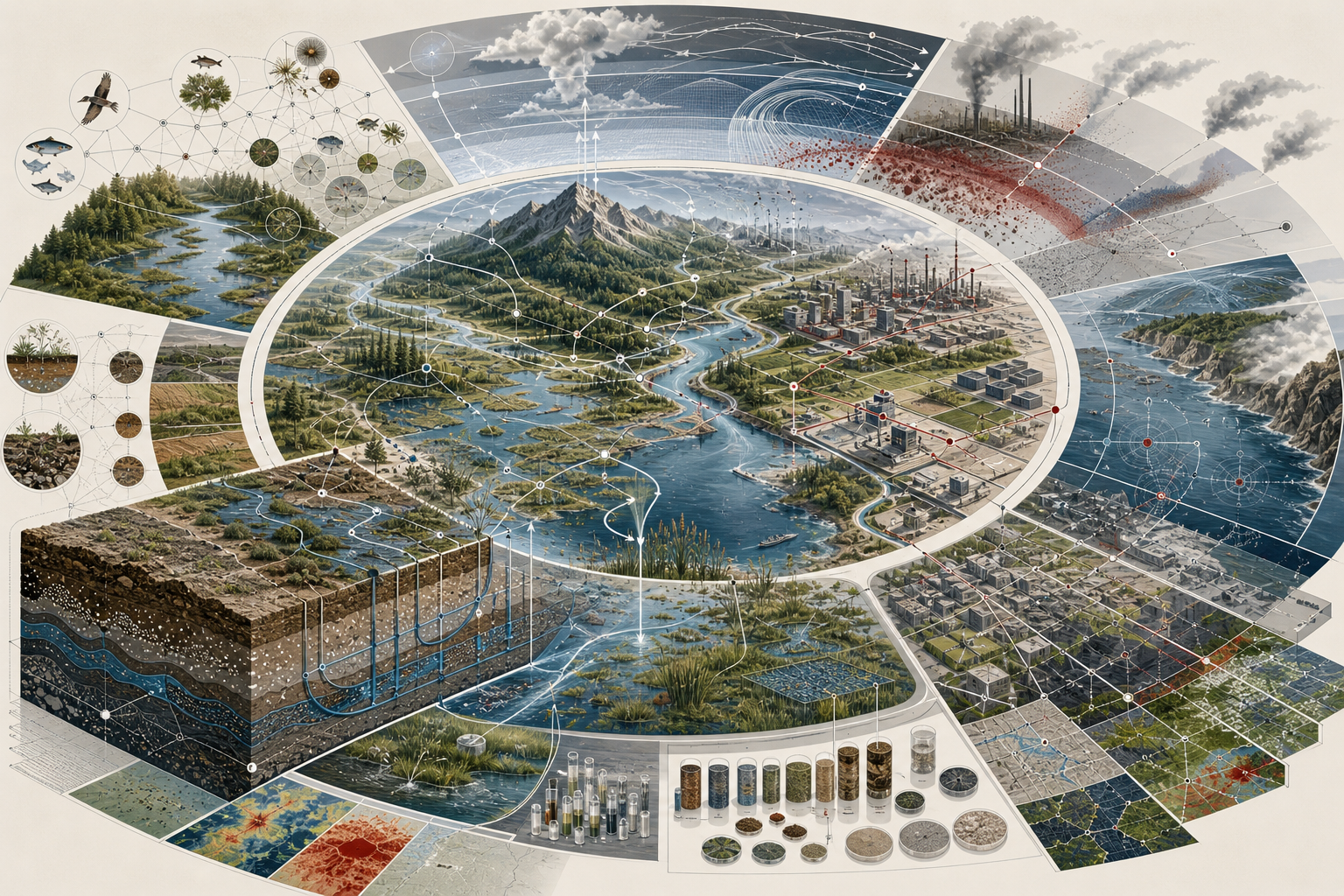
This content pillar brings together the major domains through which environmental science interprets the relationship between nature and society. It treats environmental science not merely as the study of pollution, conservation, climate change, or resource use in isolation, but as a disciplined framework for understanding ecosystems, biodiversity, water, soils, atmosphere, contaminants, exposure pathways, environmental health, climate systems, resource pressure, restoration, monitoring, governance, and the feedbacks that connect environmental change to public health, infrastructure, agriculture, economic life, and long-term habitability. Across ecology, chemistry, Earth Science, biology, public health, climate science, geography, engineering, and sustainability, environmental science provides an indispensable language for explaining degradation, adaptation, stewardship, risk, responsibility, and the long-term viability of environmental systems.
This series also approaches environmental science as a field that increasingly depends on quantitative reasoning, environmental monitoring, statistical inference, geospatial analysis, chemical measurement, ecological modeling, risk assessment, reproducible data systems, and open scientific workflows. Many of the most important environmental questions now require not only observation, fieldwork, laboratory testing, and policy interpretation, but programmable environments capable of tracing environmental change across time, space, exposure pathways, uncertainty, and scale. For that reason, this pillar integrates environmental science with mathematics, statistics, GIS, R, Python, SQL, Julia, notebooks, reproducible data practices, environmental sensor data, contaminant transport models, exposure analysis, ecological indicators, climate datasets, and open scientific code. Mathematics clarifies rates, thresholds, concentrations, fluxes, dose-response relationships, uncertainty, trends, feedbacks, resilience, and risk. R supports environmental statistics, time-series analysis, exposure summaries, climate and air-quality trends, biodiversity indicators, ecological modeling, and reproducible reporting. Python supports geospatial workflows, water-quality analysis, contaminant transport examples, environmental monitoring pipelines, sensor-data processing, automation, simulation, visualization, and machine learning. SQL supports environmental observation records, station metadata, sample tracking, contaminant measurements, monitoring logs, quality flags, and reproducible research provenance. Julia supports high-performance environmental systems modeling, differential equations, hydrology, contaminant diffusion, ecosystem simulation, and climate-adjacent numerical work. Rust and Go support safe validation utilities, command-line tools, lightweight data services, and environmental monitoring infrastructure. C, C++, and Fortran support embedded sensing, numerical kernels, legacy environmental models, and performance-critical simulation when appropriate. Together, these tools make it possible not only to describe environmental systems, but to measure, model, simulate, test, reproduce, and interrogate them with greater rigor.
Environmental Science therefore appears here not only as an observational and applied science, but also as a historical, theoretical, quantitative, computational, ecological, chemical, public-health, ethical, technological, and civilizational one. The aim of the series is to preserve the conceptual richness of environmental thought while showing how contemporary environmental science increasingly relies on mathematical structure, statistical reasoning, monitoring networks, geospatial analysis, modeling, simulation, and computation in order to understand environmental systems under real conditions of uncertainty, heterogeneity, interdependence, inequality, nonlinearity, and change. In that sense, this series treats environmental science not simply as the study of environmental problems, but as one of the deepest and most demanding ways human beings have developed for thinking about the conditions of life, the consequences of human activity, and the responsibilities that follow from shared dependence on air, water, soil, climate, ecosystems, and planetary stability.
Environmental Science Code Repository
The Environmental Science knowledge series is supported by an open computational repository with article-level folders, reproducible examples, synthetic datasets, documentation, environmental monitoring workflows, exposure-pathway examples, water-quality and air-quality analysis, geospatial scaffolding, SQL metadata structures, and scientific-computing support across Python, R, SQL, Julia, Rust, Go, C, C++, Fortran, and notebooks where appropriate.
Environmental Science as a Foundational Science
Environmental Science occupies a distinctive place within the natural sciences because it explains environmental conditions as the product of interacting physical, chemical, biological, climatic, hydrological, geological, and human processes. Biology helps clarify ecosystems, populations, biodiversity, ecological resilience, disease ecology, food webs, and organism-environment relations. Chemistry helps explain contaminants, nutrients, toxicity, atmospheric composition, water quality, soil chemistry, and chemical transformation. Earth Science helps interpret hydrology, soils, climate systems, landforms, oceans, hazards, and planetary processes. Physics helps clarify energy, radiation, heat, transport, atmospheric movement, fluid dynamics, and the physical basis of environmental systems. Environmental Science is distinctive because it brings these dimensions together in order to understand how environments function, how they change, how risks accumulate, and how human action reshapes the conditions of life.
This foundational role does not mean that environmental science is simply an aggregate of neighboring fields. Rather, it is uniquely concerned with the interactions and feedbacks through which environmental systems sustain or undermine habitability. It investigates how air, water, soil, organisms, climate, contaminants, land use, energy systems, infrastructure, and institutions interact across scales, and how these interactions shape both ecological integrity and human wellbeing. Environmental Science is therefore a science of relation: between organisms and environments, between human systems and ecological processes, between contaminants and exposure pathways, between climate change and public health, and between environmental knowledge and collective responsibility.
Environmental Science is also foundational because modern life is inseparable from environmental conditions. Food systems depend on soil, water, climate, pollination, nutrient cycling, and land management. Public health depends on air quality, water safety, sanitation, housing, temperature, toxic exposure, and ecosystem stability. Infrastructure depends on land, hydrology, climate, geology, materials, and hazard planning. Economies depend on energy, resources, waste absorption, environmental regulation, and the continuing function of natural systems. Environmental Science provides the language through which these dependencies become visible.
Environmental Science as a Science of Interdependent Systems
Environmental Science may be understood as one of the great sciences of interdependence. Ecosystems are not collections of isolated species, but dynamic systems of energy flow, nutrient cycling, population interaction, disturbance, adaptation, and resilience. Water systems are not merely physical channels, but linked networks of precipitation, infiltration, runoff, groundwater, rivers, wetlands, lakes, oceans, infrastructure, contamination, and human use. Air quality is not merely a local atmospheric condition, but the outcome of emissions, chemistry, weather, land use, combustion, regulation, exposure, and vulnerability. Environmental health is not merely individual health in an environmental setting, but a layered interaction among bodies, places, pollutants, ecosystems, infrastructure, institutions, and histories of unequal exposure.
For that reason, environmental science has always demanded forms of thinking capable of moving between levels of scale. It must explain how local contamination becomes regional exposure, how land-use decisions alter watershed function, how habitat fragmentation affects biodiversity, how climate change shifts environmental baselines, how chemicals move through air, water, soil, and food systems, how human vulnerability shapes environmental risk, and how delayed consequences complicate responsibility. In the contemporary world, these problems increasingly require quantitative and computational tools, but they remain environmental in the deepest sense because they concern the conditions under which life systems remain viable.
This makes environmental science especially important within a broader intellectual project concerned with systems, sustainability, justice, infrastructure, and long-horizon responsibility. The environment is not a scenic backdrop to human activity. It is the material, biological, chemical, and climatic condition of human and nonhuman flourishing. To study environmental science seriously is therefore to study the interactions through which life is supported, degraded, repaired, or placed at risk.
Environmental Science as a Quantitative and Computational Science
Modern environmental science is increasingly quantitative. Environmental systems are not only observed and described; they are measured, monitored, mapped, modeled, compared, visualized, simulated, and analyzed using formal methods. Air-pollution trends can be measured through time-series data. Water quality can be represented through concentrations, loads, flow, and thresholds. Contaminant transport can be modeled through movement across air, soil, water, sediment, food webs, and human exposure pathways. Biodiversity change can be measured through richness, abundance, evenness, functional diversity, and habitat connectivity. Climate impacts can be analyzed through anomalies, extremes, vulnerability, adaptation capacity, and risk. Environmental knowledge therefore increasingly emerges through the combination of empirical observation, field measurement, laboratory analysis, mathematics, statistics, geospatial reasoning, computation, and reproducible workflows.
This does not mean that environmental science ceases to be field-based, interpretive, ethical, or policy-relevant. Rather, it means that modern environmental understanding often depends on moving across modes of inquiry. A researcher may collect water samples, analyze contaminants in a laboratory, map land use in GIS, process monitoring data in Python, model exposure pathways, summarize trends in R, store sample metadata in SQL, document the workflow in a computational notebook, and interpret the results in relation to ecology, public health, regulation, community vulnerability, or sustainability. Environmental Science has become one of the clearest examples of a science in which conceptual understanding, measurement, justice, governance, and computation must work together.
For that reason, this series treats mathematics, statistics, GIS, R, Python, SQL, Julia, scientific computing, environmental monitoring, geospatial workflows, and reproducible notebooks as increasingly important parts of environmental literacy. Some articles in the series remain primarily conceptual, ecological, historical, ethical, public-health-oriented, or governance-focused. Others lend themselves naturally to rates of change, exposure modeling, uncertainty, statistical inference, spatial analysis, remote sensing, contaminant transport, risk screening, climate trends, ecological indicators, or machine learning. The aim is not to force code into every article, but to build an Environmental Science pillar that reflects how environmental knowledge is actually produced and applied.
What Environmental Science Studies
Environmental Science studies the interaction between natural systems and human activity across multiple levels of organization. At the ecological level, it examines ecosystems, populations, communities, biodiversity, food webs, habitats, disturbance, resilience, restoration, and the living systems through which environmental conditions are maintained or transformed. At the chemical level, it studies nutrients, pollutants, contaminants, toxicity, exposure pathways, atmospheric chemistry, water chemistry, soil chemistry, and the chemical burdens produced by industrial, agricultural, urban, and extractive systems. At the Earth-system level, it studies climate, hydrology, soils, land use, oceans, coasts, atmosphere, and the physical systems that regulate environmental conditions.
At broader scales, Environmental Science studies the relationships among environmental change, human health, infrastructure, governance, economy, and justice. It asks how pollutants move through air, water, soil, organisms, and food systems; how ecosystems respond to stress; how climate change alters baselines; how biodiversity loss affects ecological function; how land use fragments habitats; how waste accumulates; how resource extraction reshapes landscapes; how environmental harms are distributed unevenly; and how societies can monitor, prevent, reduce, or repair environmental damage.
Environmental Science further studies the environment as a historical and political phenomenon. Present conditions reflect earlier decisions about industry, land use, settlement, energy, agriculture, waste, regulation, infrastructure, extraction, and environmental protection. Environmental Science is therefore not only concerned with how environmental systems function now, but with how they came to be, how they have been altered, and how they may respond to future pressures.
What This Pillar Covers
This pillar brings together the major domains through which Environmental Science interprets the relationship between natural systems and human activity. It begins with the scope of environmental science and the rise of modern environmental thought, then moves through ecological systems, biodiversity, food webs, biogeochemical cycles, air quality, water systems, soils, oceans, coasts, pollution, contaminants, toxicology, climate change, resource use, land-use change, environmental health, One Health, public health, environmental justice, monitoring, restoration, conservation, sustainability, policy, governance, and the wider scientific and civilizational significance of understanding environmental change.
The pillar also incorporates quantitative and computational environmental reasoning where appropriate. Some topics naturally involve mathematical structure, including contaminant concentration, exposure dose, pollutant transport, air-quality trends, water-quality thresholds, climate anomalies, population change, ecosystem resilience, waste accumulation, and risk estimation. Others lend themselves especially well to statistical inference, geospatial visualization, reproducible notebooks, environmental monitoring, sensor data, remote sensing, exposure screening, simulation, machine learning, or data pipelines. In those cases, articles may incorporate mathematical interpretation, Python-based modeling, R-based statistical analysis, SQL metadata, Julia-based simulation, GitHub-based code examples, or full-stack computational scaffolding. This allows the series to remain conceptually rich while also becoming methodologically stronger.
Taken together, these domains form a coherent intellectual architecture. Environmental Science is not simply a catalog of environmental problems. It is a far-reaching mode of explanation that connects ecological process to chemical change, land and water systems to biological response, environmental degradation to public health, and environmental risk to institutional responsibility. It shows that environmental conditions are dynamic, interconnected, historically shaped, and unevenly experienced, and that societies are never outside the systems they alter.
The series also treats environmental science as a field that links the descriptive and the applied. Environmental knowledge informs public health, climate adaptation, conservation, restoration, pollution control, waste management, water protection, air-quality regulation, agricultural resilience, infrastructure planning, resource governance, environmental justice, and sustainability. For that reason, the pillar is designed not only to introduce environmental science concepts, but to clarify why environmental thinking remains indispensable for understanding the contemporary world.
Mathematics, Computation, and Simulation in Environmental Science
Mathematics provides part of the formal language through which environmental science understands concentration, exposure, transport, accumulation, risk, uncertainty, feedback, and change. Pollutant concentration, dose-response relationships, contaminant loads, water discharge, atmospheric dispersion, population dynamics, biodiversity metrics, greenhouse gas emissions, waste flows, and climate anomalies can all be clarified through mathematical reasoning. Environmental Science often depends on probability, statistics, calculus, linear models, differential equations, geospatial analysis, network reasoning, mass balance, systems modeling, and uncertainty analysis.
Computation is especially valuable where environmental systems are too complex, heterogeneous, spatially distributed, data-rich, or politically consequential for direct intuition alone. R supports environmental statistics, air-quality trends, water-quality analysis, climate summaries, ecological indicators, biodiversity metrics, uncertainty visualization, and reproducible reports. Python supports geospatial processing, sensor-data pipelines, contaminant transport examples, exposure screening, water-quality workflows, climate-data analysis, automation, machine learning, and scientific notebooks. SQL supports station metadata, environmental observations, laboratory samples, contaminant records, inspection logs, quality flags, and data provenance. Julia supports high-performance simulation, differential equations, ecosystem dynamics, contaminant diffusion, hydrology, and environmental systems modeling. Rust, Go, C, C++, and Fortran support validation utilities, lightweight data services, embedded monitoring, numerical kernels, legacy modeling patterns, and performance-critical simulation where appropriate.
Used together, mathematics, computation, GIS, notebooks, SQL metadata, and open code repositories help make environmental science more explicit, testable, reproducible, and accountable. They allow environmental patterns to be measured rather than merely asserted, uncertainty to be quantified rather than hidden, and complex systems to be explored through models as well as through observation. In this series, those tools are integrated where they deepen explanation rather than distract from it. The result is an Environmental Science pillar that remains faithful to ecological, chemical, and public-health realities while also acknowledging that modern environmental literacy increasingly includes quantitative and computational competence.
Major Domains of Environmental Science
Environmental Science includes a wide range of major domains, each of which illuminates a different dimension of environmental organization and risk. Ecology examines ecosystems, populations, communities, biodiversity, food webs, habitat, disturbance, succession, resilience, restoration, and ecological function. Environmental chemistry studies contaminants, nutrients, pollutants, atmospheric chemistry, water chemistry, soil chemistry, toxicity, persistence, bioaccumulation, and chemical transformation. Hydrology and aquatic science study water movement, watersheds, wetlands, groundwater, rivers, lakes, water quality, aquatic ecosystems, and the environmental consequences of water use and contamination.
Atmospheric and climate science examine air quality, greenhouse gases, weather, climate change, climate variability, extreme events, atmospheric transport, aerosols, and the interaction between environmental systems and human emissions. Soil and land science examine soil formation, erosion, contamination, fertility, land degradation, agriculture, land-use change, and the material foundations of ecosystems and food systems. Environmental health studies the relationship between environmental exposures and human wellbeing, including air pollution, water contamination, toxic substances, heat, disease ecology, sanitation, housing, and environmental determinants of health. Environmental toxicology examines how chemical, physical, and biological stressors affect organisms, tissues, ecosystems, and human health.
Other major domains extend and deepen this framework. Conservation science studies biodiversity protection, habitat connectivity, extinction risk, protected areas, species recovery, and ecological integrity. Restoration ecology studies the repair of damaged systems through ecological recovery, monitoring, adaptive management, and long-term stewardship. Environmental justice studies the unequal distribution of environmental harms, benefits, vulnerability, exposure, and institutional protection. Environmental monitoring and data science study the measurement systems through which environmental change becomes visible and actionable. Sustainability science studies the long-term conditions under which human societies can meet needs without degrading the ecological and planetary systems on which they depend.
Many of these domains are now inseparable from quantitative and computational methods. Pollution science depends on monitoring, concentration data, exposure modeling, and chemical analysis. Climate adaptation depends on time-series data, scenarios, spatial vulnerability, and risk assessment. Conservation planning depends on geospatial analysis, biodiversity indicators, habitat models, and population data. Environmental justice depends on the careful mapping of exposure, vulnerability, demographic patterns, infrastructure, and institutional response. Environmental Science therefore continues to broaden not only in subject matter but also in formal, technical, and ethical depth.
Why Environmental Science Matters
Environmental Science matters because it explains the conditions under which life remains possible, healthy, and resilient. It clarifies how pollutants move through water, air, soil, and food systems; how ecosystems respond to stress and fragmentation; how climate change alters environmental baselines; how biodiversity loss affects stability and function; how resource extraction reshapes landscapes; how waste persists; and how land use, energy systems, infrastructure, and consumption patterns shape long-term environmental risk.
Environmental Science also matters because the contemporary world is increasingly shaped by environmental disruption and environmental inequality. Climate change, air pollution, water contamination, biodiversity loss, soil degradation, toxic exposure, waste accumulation, ocean stress, habitat fragmentation, heat risk, resource extraction, and infrastructure vulnerability all require environmental understanding. Environmental harm is rarely isolated. It moves through pathways, accumulates over time, and often falls most heavily on communities with less power to avoid exposure or demand protection.
At the same time, environmental science matters because it reveals the depth of interdependence that structures human and nonhuman life. No society exists outside air, water, soil, climate, biodiversity, energy, food, waste, and ecological relations. Every environmental decision distributes risk, benefit, burden, and responsibility. Environmental Science therefore helps clarify not only the mechanisms of environmental change, but the ethical and institutional conditions under which environmental protection becomes meaningful.
Environmental Science also matters because modern decisions increasingly depend on data, models, and statistical interpretation. Questions of air quality, drinking water safety, chemical exposure, climate adaptation, habitat loss, restoration success, heat vulnerability, waste management, and environmental justice now rely not only on observation but on monitoring, modeling, inference, mapping, and computation. An environmentally literate society must therefore be able to move between the environment as experienced, the environment as measured, and the environment as governed.
Environmental Science and Human Self-Understanding
Environmental Science changes how human beings understand themselves. It places human life within a larger web of ecological, chemical, climatic, hydrological, and material dependence. It reveals that human wellbeing is not separate from air quality, water safety, soil function, biodiversity, climate stability, waste systems, energy choices, and the integrity of ecosystems. It shows that human societies are environmental systems as well as political, economic, and cultural systems.
Yet environmental science also complicates self-understanding. It shows that harm can be delayed, distributed, invisible, cumulative, and difficult to attribute. A pollutant may move through air, settle into soil, enter water, accumulate in organisms, and affect communities far from its source. A climate signal may emerge through changing baselines rather than single events. A land-use decision may alter flood risk, habitat connectivity, heat exposure, and water quality at the same time. Environmental Science asks human beings to understand themselves as actors whose choices shape the conditions of life beyond immediate intention.
For that reason, Environmental Science has philosophical as well as scientific significance. It raises enduring questions about stewardship, justice, public health, extraction, responsibility, precaution, repair, intergenerational obligation, and the boundaries of human use. As environmental science becomes increasingly data-rich, computational, and policy-relevant, those questions become even more pressing. A serious Environmental Science pillar should therefore not end with facts alone. It should also clarify the wider implications of environmental knowledge for ethics, governance, resilience, and civilization.
Environmental Science Pillar Map
The map below organizes the Environmental Science knowledge series into conceptual domains, moving from foundations and first principles toward ecosystems, environmental media, pollution, climate, health, justice, monitoring, restoration, governance, computation, and the wider human significance of environmental knowledge.
The Environmental Science pillar is organized to move from foundations and first principles into ecological systems, environmental chemistry, air, water, soil, oceans, pollution, contaminants, toxicology, climate change, resource use, land-use change, environmental health, One Health, public health, environmental justice, monitoring, restoration, conservation, sustainability, governance, and the wider intellectual significance of environmental knowledge. Mathematics, R, Python, SQL, Julia, GIS, Rust, Go, C, C++, Fortran, and computational notebooks are integrated within the series where they deepen environmental understanding, especially in areas such as contaminant transport, exposure pathways, air-quality analysis, water-quality analysis, ecological indicators, climate trends, environmental monitoring, geospatial workflows, environmental justice mapping, risk screening, reproducibility, and scientific simulation. The goal is a pillar that remains clearly and fully environmental while also reflecting the quantitative and computational depth of contemporary environmental science.
Foundations of Environmental Science
- What Is Environmental Science? (planned) — An opening article defining environmental science as the study of interactions among natural systems, living organisms, human activity, environmental media, ecological processes, and the conditions of habitability.
- The Rise of Modern Environmental Thought (planned) — An account of how environmental science emerged through natural history, ecology, public health, conservation, pollution control, Earth-system science, climate science, environmental justice, and sustainability.
- Observation, Monitoring, and the Methods of Environmental Inquiry (planned) — A methodological article on field observation, sampling, sensors, laboratory analysis, ecological surveys, environmental monitoring, GIS, statistical inference, modeling, and reproducible environmental practice.
- Environmental Systems Thinking and Interdependence (planned) — A conceptual article on feedbacks, thresholds, flows, stocks, exposure pathways, resilience, vulnerability, and the systems logic that makes environmental science distinct.
- Environmental Baselines, Change, and Historical Memory (planned) — An article on baselines, shifting baselines, long-term records, environmental archives, historical land use, monitoring records, and the difficulty of interpreting change without memory.
- Scale, Uncertainty, and Evidence in Environmental Science (planned) — A methodological article on spatial scale, temporal scale, uncertainty, causation, risk, measurement limits, model assumptions, and evidence in complex environmental systems.
Ecosystems, Biodiversity, and Living Systems
- Ecosystems and the Organization of Environmental Life (planned) — A foundational article on ecosystems as organized systems of energy flow, nutrient cycling, species interaction, disturbance, resilience, and environmental function.
- Biodiversity and the Stability of Ecological Systems (planned) — An article on genetic, species, functional, and ecosystem diversity, explaining why biodiversity matters for resilience, productivity, adaptation, food systems, and ecological integrity.
- Food Webs, Trophic Relations, and Ecological Interdependence (planned) — A study of producers, consumers, decomposers, trophic cascades, predator-prey relations, energy transfer, ecological networks, and the relational structure of environmental systems.
- Biogeochemical Cycles and the Movement of Matter Through Living Systems (planned) — A bridge article on carbon, nitrogen, phosphorus, sulfur, water, oxygen, microbes, soils, oceans, atmosphere, and the cycling processes that connect life and environment.
- Population Ecology, Carrying Capacity, and Environmental Pressure (planned) — A quantitative article on population growth, resource limits, density dependence, carrying capacity, ecological pressure, and human-environment interactions.
- Habitat, Connectivity, and Fragmentation (planned) — An article on habitat loss, fragmentation, corridors, edge effects, metapopulations, land-use change, conservation planning, and the environmental consequences of spatial disruption.
- Invasive Species and Ecological Disruption (planned) — A focused article on biological invasions, disturbance, transport pathways, ecological impacts, management, and the ways human activity redistributes species across environments.
- Ecosystem Services, Ecological Function, and Human Dependence (planned) — A systems article on provisioning, regulating, cultural, and supporting functions, while carefully distinguishing ecological value from purely economic valuation.
Air, Water, Soil, and Environmental Media
- Atmosphere, Air Quality, and Environmental Change (planned) — A major article on air pollutants, atmospheric chemistry, particulate matter, ozone, nitrogen oxides, sulfur compounds, greenhouse gases, transport, exposure, and public health.
- Water Systems, Watersheds, and Aquatic Environments (planned) — A foundational article on watersheds, rivers, lakes, wetlands, groundwater, runoff, water quality, aquatic ecosystems, and the environmental science of water protection.
- Soils, Land, and the Material Foundations of Ecosystems (planned) — An article on soil formation, soil organisms, nutrients, erosion, contamination, land degradation, agriculture, carbon storage, and the soil basis of ecosystem function.
- Oceans, Coasts, and Marine Environmental Systems (planned) — A marine environmental article on oceans, coasts, estuaries, fisheries, coral reefs, acidification, warming, pollution, plastics, and coastal vulnerability.
- Wetlands, Floodplains, and Environmental Buffer Systems (planned) — An article on wetlands as ecological and hydrological systems that filter water, store floodwaters, support biodiversity, and buffer environmental extremes.
- Urban Environments, Heat, and Built-Ecological Systems (planned) — A study of cities as environmental systems, including heat islands, impervious surfaces, stormwater, air quality, green infrastructure, exposure, and unequal environmental burden.
- Agricultural Landscapes, Nutrients, and Environmental Stress (planned) — An article on fertilizer, runoff, soil health, pesticides, irrigation, erosion, nutrient loading, biodiversity loss, and the environmental science of food production.
Pollution, Contaminants, and Toxicity
- Pollution and the Transformation of Environmental Quality (planned) — A foundational article on pollution as a transformation of air, water, soil, ecosystems, and bodies through substances, energy, waste, and cumulative environmental burden.
- Contaminants, Exposure Pathways, and Environmental Transport (planned) — A systems article on how contaminants move through air, water, soil, sediment, organisms, food webs, infrastructure, and human exposure pathways.
- Toxicology and the Biological Effects of Environmental Stressors (planned) — An article on dose, response, toxicity, endocrine disruption, carcinogenicity, developmental effects, ecological toxicity, and the biological interpretation of environmental exposure.
- Chemicals, Waste, and the Long-Term Burden of Modern Production (planned) — A major article on industrial chemicals, waste streams, persistence, bioaccumulation, plastics, hazardous waste, lifecycle burden, and environmental responsibility.
- Plastic Pollution, Microplastics, and Material Persistence (planned) — A focused article on plastic waste, microplastics, transport, ecological effects, uncertainty, monitoring, and the long-term environmental consequences of persistent materials.
- Heavy Metals, Industrial Contamination, and Environmental Legacy (planned) — An article on lead, mercury, arsenic, cadmium, mining, industrial sites, sediments, soils, exposure, health effects, and the persistence of contamination over time.
- PFAS, Persistent Chemicals, and Environmental Governance (planned) — A contemporary article on persistent synthetic chemicals, water contamination, exposure pathways, regulatory challenges, uncertainty, and long-term environmental accountability.
- Eutrophication, Nutrient Pollution, and Aquatic Degradation (planned) — An article on nitrogen and phosphorus loading, algal blooms, oxygen depletion, dead zones, agriculture, wastewater, and aquatic ecosystem stress.
Climate, Energy, Resources, and Planetary Change
- Climate Change and Environmental Systems (planned) — A flagship article on climate change as an environmental systems problem linking atmosphere, oceans, ecosystems, water, health, infrastructure, agriculture, risk, and adaptation.
- Resource Use, Extraction, and Environmental Limits (planned) — A systems article on mining, energy, water, timber, fisheries, land, material throughput, ecological limits, and the environmental consequences of extraction.
- Land Use, Habitat Fragmentation, and Ecological Disruption (planned) — An article on agriculture, urbanization, roads, deforestation, development, habitat loss, fragmentation, and the environmental consequences of land transformation.
- Resilience, Thresholds, and Environmental Risk (planned) — A conceptual article on environmental resilience, tipping points, thresholds, regime shifts, vulnerability, adaptive capacity, and risk under changing conditions.
- Energy Systems, Emissions, and Environmental Burden (planned) — An article on fossil fuels, renewable energy, emissions, extraction, land use, pollution, material demand, and the environmental tradeoffs of energy systems.
- Waste Systems, Circularity, and Material Flows (planned) — An article on waste generation, disposal, recycling, circular economy claims, material flow analysis, environmental burden, and the limits of waste management as a substitute for prevention.
- Food Systems, Agriculture, and Environmental Change (planned) — A systems article on food production, soil, water, biodiversity, fertilizer, livestock, land use, climate, waste, and the environmental foundations of food security.
- Freshwater Scarcity, Drought, and Environmental Stress (planned) — A water-focused article on scarcity, drought, groundwater depletion, water quality, ecosystem stress, agriculture, urban demand, and climate-related water risk.
Environmental Health, Public Health, and Human Systems
- Environmental Health and the Conditions of Human Wellbeing (planned) — A foundational article on how air, water, soil, housing, heat, chemicals, ecosystems, sanitation, and infrastructure shape human health.
- One Health, Ecosystem Health, and Interdependence (planned) — A bridge article connecting human health, animal health, ecosystem health, zoonotic disease, land use, biodiversity, agriculture, and environmental change.
- Environmental Justice and Unequal Environmental Burden (planned) — A major article on unequal exposure, cumulative burden, race, class, infrastructure, industrial siting, pollution, climate vulnerability, and environmental protection as a justice issue.
- Public Health, Infrastructure, and Environmental Protection (planned) — An article on drinking water systems, sanitation, housing, ventilation, heat protection, flood control, waste management, monitoring, and the infrastructure of environmental health.
- Heat, Climate Stress, and Human Vulnerability (planned) — A focused article on extreme heat, urban heat islands, occupational exposure, housing, health risk, age, disability, inequality, and climate adaptation.
- Air Pollution, Respiratory Health, and Environmental Exposure (planned) — An article on particulate matter, ozone, nitrogen oxides, combustion, asthma, cardiovascular risk, exposure inequality, and air-quality protection.
- Water Contamination, Sanitation, and Public Trust (planned) — An article on drinking water safety, contamination, infrastructure failure, monitoring, regulation, public trust, and the social meaning of environmental protection.
- Environmental Disease Ecology and Changing Risk (planned) — A science article on vector-borne disease, zoonotic spillover, land use, climate, biodiversity, habitat change, and environmental drivers of disease risk.
Monitoring, Data, Modeling, and Computational Environmental Science
- Environmental Monitoring, Measurement, and Data Systems (planned) — A methodological article on sensors, sampling, station networks, laboratory data, quality flags, metadata, time series, spatial monitoring, and environmental data governance.
- Python for Environmental Monitoring and Exposure Pathways (planned) — A practical article on Python for environmental data pipelines, contaminant transport examples, exposure screening, water-quality workflows, geospatial analysis, and reproducible notebooks.
- R for Environmental Statistics and Trend Analysis (planned) — A practical article on R for air quality, water quality, climate trends, ecological indicators, uncertainty, visualization, regression, and reproducible reporting.
- SQL for Environmental Observation Records and Sample Tracking (planned) — A data-infrastructure article on stations, samples, contaminants, laboratory results, inspection logs, geospatial observations, provenance, and reproducible environmental databases.
- GIS, Remote Sensing, and Environmental Spatial Analysis (planned) — An article on maps, land cover, vegetation indices, heat, flood risk, habitat fragmentation, exposure mapping, satellite imagery, and spatial environmental evidence.
- Environmental Risk Modeling and Scenario Analysis (planned) — A quantitative article on risk models, exposure, vulnerability, uncertainty, scenarios, sensitivity analysis, environmental thresholds, and decision support.
- Machine Learning in Environmental Science (planned) — A modern article on classification, prediction, anomaly detection, air-quality modeling, land-cover mapping, ecological monitoring, exposure screening, uncertainty, and responsible machine learning.
- Computational Notebooks and Reproducible Environmental Research (planned) — A methodological article on notebooks, literate programming, executable documentation, data provenance, version control, visual outputs, and transparent workflows in environmental science.
Restoration, Conservation, and Environmental Governance
- Restoration Ecology and the Repair of Damaged Systems (planned) — A major article on ecological repair, degraded landscapes, reference conditions, monitoring, adaptive management, soil recovery, rewilding, and the science of restoration.
- Conservation Science and the Protection of Ecological Integrity (planned) — An article on biodiversity protection, extinction risk, habitat conservation, protected areas, connectivity, population viability, and environmental stewardship.
- Sustainability, Policy, and Environmental Governance (planned) — A systems article on environmental policy, regulation, sustainability science, public accountability, institutional design, and environmental decision-making.
- Environmental Impact Assessment and Decision-Making (planned) — A practical article on environmental review, impact assessment, cumulative effects, alternatives, mitigation, monitoring, and the role of evidence in public decisions.
- Adaptive Management, Monitoring, and Environmental Learning (planned) — An article on learning-based governance, feedback, monitoring, uncertainty, management experiments, restoration, and iterative environmental decision-making.
- Environmental Law, Regulation, and Scientific Evidence (planned) — A bridge article on how environmental science informs legal standards, regulatory thresholds, permitting, enforcement, public health, and institutional accountability.
- Community Science, Local Knowledge, and Environmental Accountability (planned) — An article on community monitoring, local environmental knowledge, public participation, environmental justice, data credibility, and accountability without reducing science to technocracy.
Environmental Science in Human Knowledge and Practice
- Planetary Crisis, Stewardship, and the Future of Habitability (planned) — A capstone-style article on climate change, biodiversity loss, pollution, waste, environmental health, resource pressure, justice, and the future conditions of life.
- Environmental Science, Responsibility, and the Human Understanding of Limits (planned) — A reflective article on limits, responsibility, interdependence, delayed harm, humility, repair, and the ethical meaning of environmental knowledge.
- Environmental Science and the Unequal Geography of Risk (planned) — An article on how environmental risks are distributed across race, class, geography, infrastructure, housing, labor, and political power.
- Environmental Science, Infrastructure, and the Built Environment (planned) — A systems article on how roads, housing, energy grids, water systems, drainage, waste systems, and urban form mediate environmental risk and protection.
- Environmental Science, Ethics, and the Governance of Common Systems (planned) — A capstone article on air, water, climate, biodiversity, waste, public trust, shared resources, and the ethical governance of common environmental conditions.
- Environmental Science, Repair, and Long-Term Institutional Memory (planned) — An article on restoration, monitoring, archives, environmental memory, long-term obligations, and the institutions needed to prevent environmental amnesia.
Python Workflow: Contaminant Transport and Exposure-Pathway Screening
A useful Python workflow for this pillar is a contaminant transport and exposure-pathway screening pipeline. The workflow can begin with a synthetic environmental monitoring dataset containing site identifiers, contaminant concentrations, media type, distance from source, flow direction, sample date, detection limit, quality flag, and receptor category. Python can be used to clean the data, calculate exceedance flags, estimate simple distance-decay patterns, screen potential exposure pathways, summarize results by environmental medium, and export reproducible tables for review. In a more advanced version, the workflow can incorporate geospatial buffers, groundwater-flow direction, watershed boundaries, land-use layers, demographic vulnerability indicators, laboratory uncertainty, and scenario-based risk screening.
This workflow belongs naturally with articles on pollution, contaminants, environmental transport, toxicology, environmental health, water contamination, environmental justice, monitoring, GIS, and risk modeling. It demonstrates how Environmental Science moves from measurement to interpretation: samples become concentrations, concentrations become exceedance patterns, exceedance patterns become exposure-pathway questions, and exposure-pathway questions become the basis for monitoring, prevention, remediation, and accountability. The point is not to replace professional risk assessment, toxicology, or regulatory analysis, but to show how reproducible computational workflows clarify assumptions, make uncertainty visible, and help readers understand the relationship between environmental evidence and environmental responsibility.
R Workflow: Air Quality, Water Quality, and Environmental Trend Analysis
A useful R workflow for this pillar is an air-quality, water-quality, and environmental trend analysis pipeline. The workflow can begin with a synthetic monitoring dataset containing station identifiers, dates, pollutant or contaminant names, measured values, units, regulatory or reference thresholds, environmental medium, region, and quality flags. R can be used to calculate monthly and annual summaries, estimate trends, visualize exceedances, compare monitoring locations, summarize uncertainty, and generate reproducible reports. In a more advanced version, the workflow can incorporate seasonal decomposition, nonparametric trend tests, rolling averages, spatial grouping, environmental justice indicators, and modeled exposure summaries.
This workflow belongs naturally with articles on air quality, water systems, monitoring, environmental health, climate stress, environmental justice, public health, and environmental data systems. It demonstrates how environmental evidence is built from repeated observations, thresholds, time, place, and transparent statistical interpretation. It also reinforces the difference between isolated measurements and scientifically interpretable patterns. Used carefully, R helps readers see environmental data not as abstract compliance numbers, but as structured evidence that can reveal exposure, degradation, improvement, inequity, and the need for protection or repair.
Measurement, Monitoring, and Environmental Practice
One of Environmental Science’s enduring contributions is its ability to make environmental conditions observable, comparable, and publicly accountable without stripping them of complexity. Environmental knowledge depends not only on theory, but on reliable observations, calibrated instruments, field sampling, laboratory analysis, monitoring stations, ecological surveys, health records, remote sensing, GIS, quality assurance, statistical designs, and disciplined forms of comparison. The history of environmental science is therefore also a history of stream gauges, air monitors, soil samples, toxicity tests, field notebooks, species surveys, satellite imagery, public health records, regulatory standards, community monitoring, data archives, and the effort to render environmental conditions measurable in consistent and transferable ways.
This matters far beyond technical practice. Environmental measurement supports public health, pollution control, drinking water protection, air-quality regulation, hazardous-site cleanup, restoration, conservation, climate adaptation, agricultural resilience, environmental justice, and public accountability. A water-quality warning, air-pollution alert, exposure assessment, restoration project, contaminated-site investigation, climate-risk analysis, or environmental justice case all depends on the transformation of environmental complexity into careful evidence. Environmental Science therefore requires humility about uncertainty: environmental systems vary, contaminants move, exposures differ, ecosystems respond unevenly, and monitoring networks can miss the very communities most affected by harm.
Modern environmental practice increasingly depends on combining field observation, laboratory analysis, instrumentation, statistics, computation, geospatial data, public records, and reproducible documentation. A serious environmental claim may draw on sampling, sensors, toxicology, spatial analysis, time-series data, community testimony, historical land use, statistical modeling, computational workflows, and open data. This makes Environmental Science one of the clearest examples of a science in which knowledge is produced through layered evidence rather than through one method alone.
Environmental Science, Technology, and the Modern World
Environmental Science has become one of the central sciences shaping modern life. Its influence extends through air-quality monitoring, water treatment, waste management, toxicology, environmental regulation, public health, climate adaptation, agriculture, conservation, restoration, land-use planning, environmental impact assessment, infrastructure design, energy transition, resource governance, and sustainability. Many of the most important questions facing contemporary societies are environmental questions: how pollutants move, how ecosystems degrade or recover, how climate change affects health and infrastructure, how water systems are protected, how waste persists, how biodiversity supports resilience, and how environmental harms are distributed.
Environmental Science also underlies many powerful technologies of the present century. Sensor networks track air, water, weather, soil, and contaminants. Remote sensing reveals land-cover change, vegetation stress, heat islands, fire scars, water extent, and coastal transformation. GIS enables spatial decision-making and environmental justice mapping. Laboratory methods detect contaminants at low concentrations. Computational models simulate exposure, transport, climate risk, ecosystem response, and restoration scenarios. Data systems support monitoring, enforcement, reporting, and public accountability. These technologies do not make environmental science purely technical; they make environmental evidence more visible, more contestable, and more important.
Yet environmental knowledge also creates responsibility. Technologies that monitor pollution, map vulnerability, classify land, model exposure, guide remediation, or forecast risk cannot be judged only by technical capability. They require ethical reasoning, public accountability, community trust, uncertainty communication, and attention to uneven distributions of harm and protection. Environmental Science therefore belongs not only to laboratories, field sites, agencies, and universities, but to public life, law, governance, infrastructure, health, agriculture, planning, and long-term questions about habitability.
Environmental Science, Computation, and Scientific Simulation
Computation has become central to contemporary Environmental Science because environmental systems generate complex, heterogeneous, spatially distributed, multi-source, and time-dependent data. Air-quality monitors, water samples, soil surveys, laboratory tests, ecological observations, remote-sensing images, weather records, climate datasets, health indicators, land-use maps, infrastructure data, and community monitoring records all require computational methods for storage, interpretation, visualization, and reproducibility. Environmental computation is not merely a convenience. It is increasingly part of how environmental knowledge is produced and made accountable.
Simulation is especially important when environmental systems cannot be understood through direct observation alone. Contaminant-transport models can explore movement through air, water, soil, sediment, and food systems. Exposure models can examine pathways from source to receptor. Hydrological models can explore runoff, recharge, flooding, and water quality. Ecological models can examine population change, habitat connectivity, invasive species, biodiversity loss, and restoration. Climate-risk models can examine heat, drought, flood, air quality, and infrastructure vulnerability. Machine learning can help identify patterns in monitoring records, remote-sensing images, environmental justice datasets, and ecological observations, while also raising questions about interpretability, bias, uncertainty, and public accountability.
For that reason, this Environmental Science pillar treats computational practice as a major component of modern environmental knowledge. It includes R for environmental statistics, trend analysis, exposure summaries, and reproducible reporting; Python for geospatial workflows, monitoring pipelines, contaminant screening, simulation, automation, and machine learning; SQL for sample records, station metadata, contaminant measurements, inspection logs, and provenance; Julia for numerical environmental systems modeling; Rust and Go for safe tools and lightweight data services; C for low-level monitoring examples; C++ and Fortran for numerical kernels and legacy modeling patterns; and computational notebooks for transparent explanation. The goal is not to replace environmental judgment with code, but to strengthen environmental reasoning through reproducible, inspectable, and methodologically explicit workflows.
Environmental Science in a Wider Intellectual Context
Environmental Science occupies a distinctive place in human knowledge because it studies the conditions under which human and nonhuman life continue. It places humanity within ecological interdependence, chemical exposure, climate instability, resource dependence, waste systems, public health, infrastructure, and the moral consequences of environmental change. It reveals that human societies are not outside nature, but embedded within air, water, soil, climate, ecosystems, and material flows.
This wider intellectual significance makes environmental science especially important for an age of planetary crisis. Climate change, biodiversity loss, pollution, waste, toxic exposure, water stress, heat risk, land degradation, and unequal vulnerability are not separate problems. They are environmental systems problems mediated by political, economic, technological, legal, and institutional choices. Environmental Science does not by itself determine what societies should do, but it clarifies the material realities, evidence, risks, and responsibilities within which accountable decisions must be made.
A serious Environmental Science pillar therefore belongs within a larger architecture of natural science, sustainability, public health, infrastructure, governance, ethics, and justice. It connects biology, Earth Science, chemistry, physics, data science, public policy, law, and human geography. It gives readers a way to understand the environment not only as a set of problems, but as the shared condition of life and the field in which responsibility becomes unavoidable.
Related Reading
- Biology
- Earth Science
- Chemistry
- Physics
- Sustainable Development
- Planetary Boundaries
- Intelligent Infrastructure Systems
Further Reading
- National Oceanic and Atmospheric Administration (n.d.) Climate. Available at: https://www.noaa.gov/climate.
- U.S. Environmental Protection Agency (n.d.) Science Topics. Available at: https://www.epa.gov/environmental-topics/science-topics.
- U.S. Geological Survey (n.d.) Environmental Health Program. Available at: https://www.usgs.gov/programs/environmental-health-program.
- United Nations Environment Programme (n.d.) Data Resources. Available at: https://www.unep.org/data-resources.
- Wright, R.T. and Boorse, D.F. (2017) Environmental Science: Toward a Sustainable Future. 13th edn. Boston: Pearson.
References
- National Oceanic and Atmospheric Administration (n.d.) Climate. Available at: https://www.noaa.gov/climate.
- National Oceanic and Atmospheric Administration (n.d.) Climate change impacts. Available at: https://www.noaa.gov/education/resource-collections/climate/climate-change-impacts.
- National Centers for Environmental Information (n.d.) National Centers for Environmental Information. Available at: https://www.ncei.noaa.gov/.
- National Centers for Environmental Information (n.d.) Climate Data Online. Available at: https://www.ncei.noaa.gov/cdo-web/.
- U.S. Environmental Protection Agency (n.d.) Environmental Topics. Available at: https://www.epa.gov/environmental-topics.
- U.S. Environmental Protection Agency (n.d.) Science Topics. Available at: https://www.epa.gov/environmental-topics/science-topics.
- U.S. Environmental Protection Agency (n.d.) Our Mission and What We Do. Available at: https://www.epa.gov/aboutepa/our-mission-and-what-we-do.
- U.S. Geological Survey (n.d.) Environmental Health Program. Available at: https://www.usgs.gov/programs/environmental-health-program.
- U.S. Geological Survey (n.d.) Integrated Science. Available at: https://www.usgs.gov/programs/environmental-health-program/science.
- U.S. Geological Survey (n.d.) Environmental Health Program Introduction. Available at: https://www.usgs.gov/programs/environmental-health-program/environmental-health-program-introduction.
- United Nations Environment Programme (n.d.) Data Resources. Available at: https://www.unep.org/data-resources.
- United Nations Environment Programme (n.d.) Publications & Knowledge. Available at: https://www.unep.org/publications-data.
- United Nations Environment Programme (n.d.) UN Environment Programme. Available at: https://www.unep.org/node.
- Wright, R.T. and Boorse, D.F. (2017) Environmental Science: Toward a Sustainable Future. 13th edn. Boston: Pearson.