Systems Thinking

Systems thinking examines how interdependence, feedback, emergence, and nonlinear relationships shape the behavior of complex systems over time. In interdisciplinary fields such as sustainability, governance, economics, infrastructure, and organizational analysis, outcomes rarely emerge from isolated causes. Instead, they arise from patterns of interaction among multiple components whose relationships generate dynamics that are often difficult to perceive through linear reasoning alone.

This mode of thought involves tracing connections between parts, identifying reinforcing and balancing feedback loops, recognizing delays, and understanding how system structure influences behavior. Systems thinking shifts attention away from isolated events and toward the deeper relationships, dependencies, and recurring patterns that produce long-term outcomes across social, ecological, and technological domains.

Systems thinking plays a foundational role in strategy, policy analysis, resilience planning, and institutional design. By helping people understand how complex wholes behave, it supports more coherent analysis of unintended consequences, systemic risk, and long-range change, making it an essential intellectual framework for navigating complexity in an interconnected world.

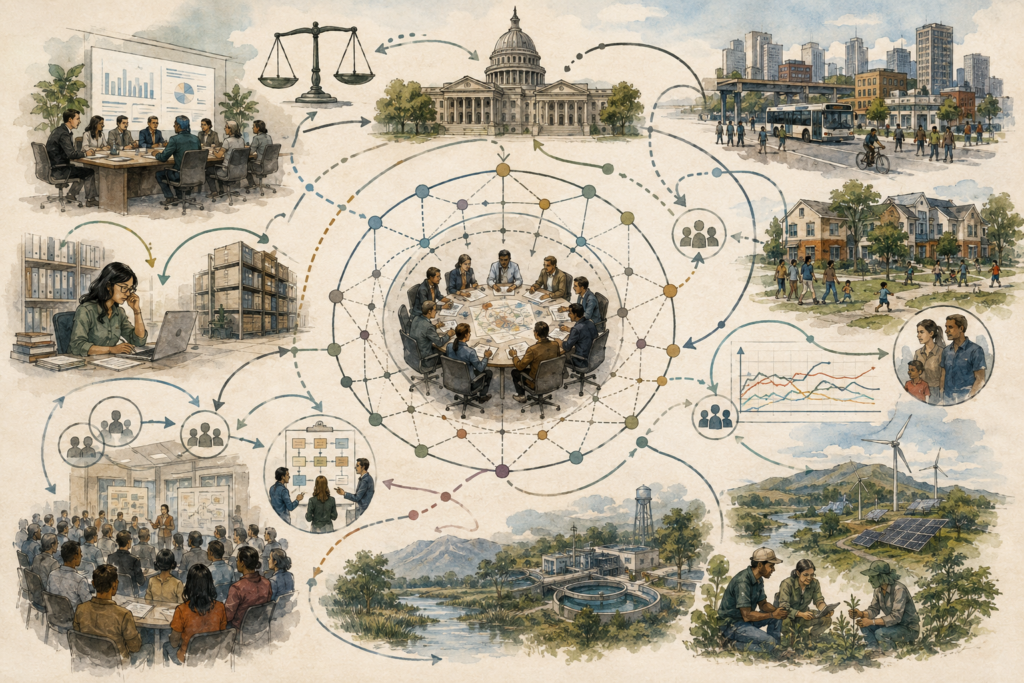
Editorial illustration of public policy as an interconnected system, showing civic institutions, community meetings, transit, housing, public services, environmental restoration, data analysis, and feedback pathways.

Systems Thinking in Public Policy

Systems Thinking in Public Policy examines why public problems rarely fit the boundaries of single agencies, sectors, or policy instruments. The article explains how policy outcomes emerge from feedback loops, institutional incentives, public trust, resource flows, legal rules, administrative capacity, social behavior, ecological limits, and uneven power. It shows why narrow interventions can create unintended consequences, shift burdens, or solve visible symptoms while reinforcing deeper structures. Through examples from housing, transportation, public health, climate adaptation, infrastructure, education, welfare administration, AI governance, and environmental regulation, readers learn how to map policy systems, identify stocks and flows, trace delays, include affected communities, evaluate trade-offs, and design accountable learning loops. The article frames systems thinking as a practical public-governance discipline for diagnosing complexity, improving policy coherence, avoiding policy resistance, strengthening institutional learning, and aligning action with justice, resilience, sustainability, and democratic accountability.
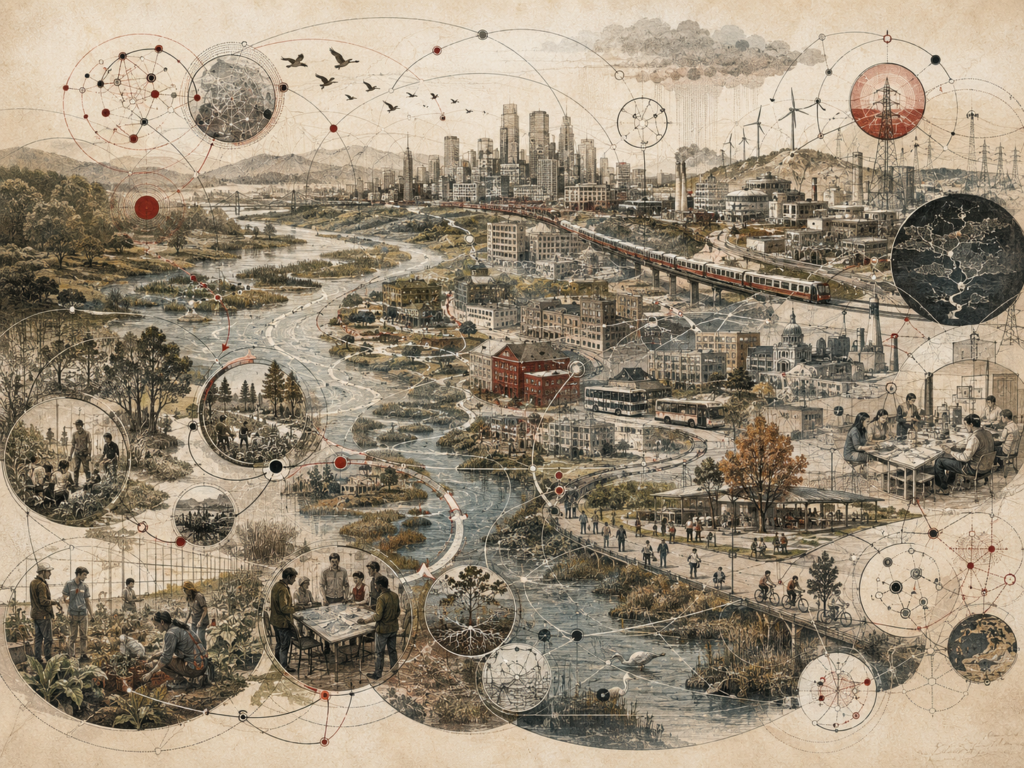
Scholarly systems-thinking illustration of an interconnected urban, ecological, technological, and civic landscape with rivers, wetlands, transit, energy systems, communities, laboratories, and network overlays.

Systems Thinking in an Age of Complexity

Systems Thinking in an Age of Complexity concludes the Systems Thinking series by showing why today’s defining problems require more than linear problem solving, narrow expertise, or isolated optimization. The article brings together interdependence, feedback loops, delays, stocks and flows, emergence, adaptation, resilience, leverage, unintended consequences, technology, institutions, ecology, and ethics into one practical framework for action under uncertainty. It explains why climate instability, AI governance, platform power, public health, housing, infrastructure fragility, ecological degradation, institutional distrust, and democratic stress unfold through systems that change over time. Readers learn how to move from events to patterns, structures, and mental models; identify feedback and delay; widen boundaries; include affected knowledge; distinguish resilience from justice; evaluate technology as sociotechnical infrastructure; and build learning, accountability, repair, and transformation into complex public, ecological, technological, and institutional systems in the present age of complexity.

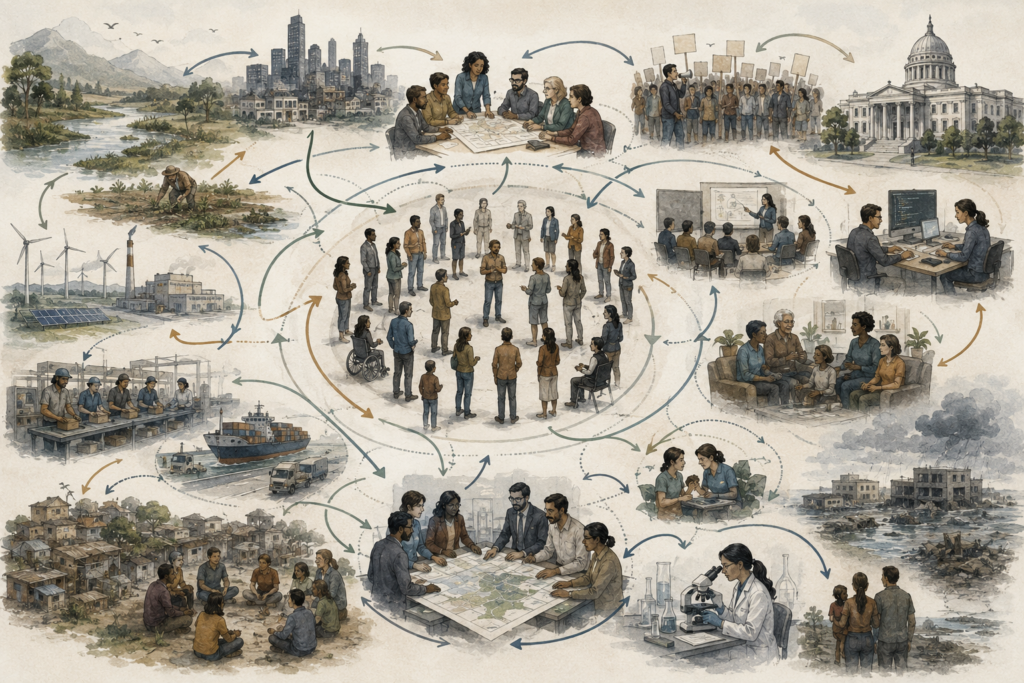
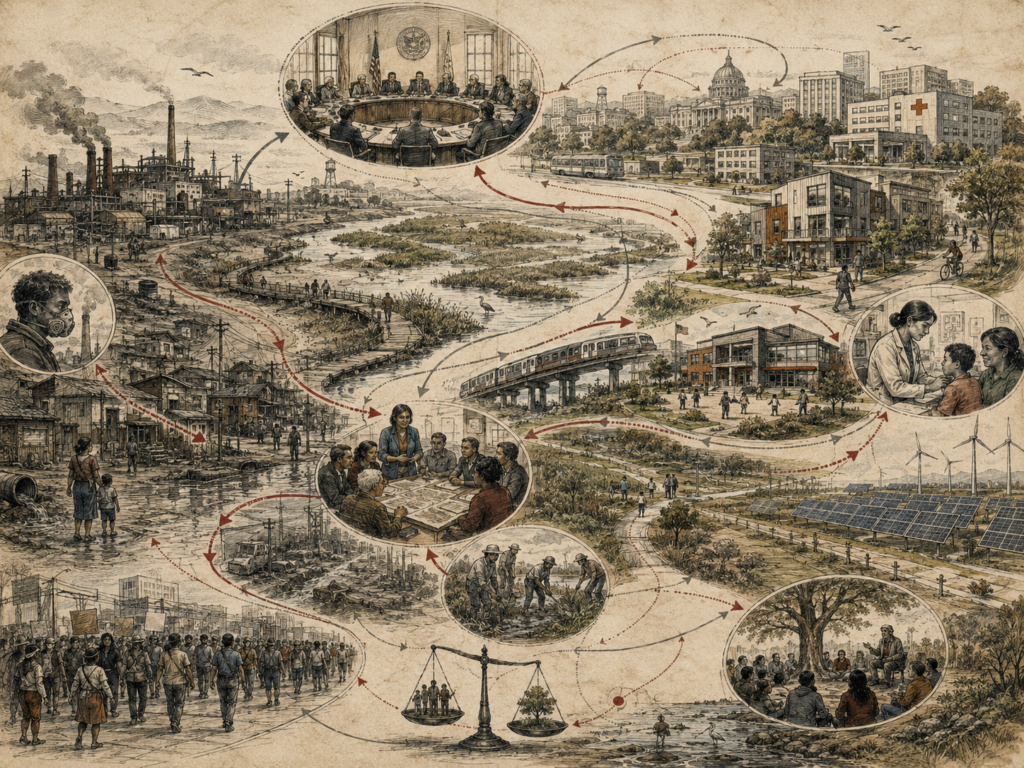
Scholarly systems-thinking illustration of environmental injustice, public institutions, community planning, healthcare, renewable infrastructure, restoration work, civic accountability, and feedback pathways.

The Ethics of Systems Thinking

The Ethics of Systems Thinking examines systems thinking as a moral, civic, ecological, and institutional practice rather than a neutral analytical method. The article explains why boundaries, goals, evidence, models, feedback loops, optimization, and interventions always carry ethical consequences. It shows how systems thinking can reveal structural harm, cumulative burden, unequal exposure, hidden externalities, and delayed consequences, while also warning that systems language can be misused to avoid accountability, rationalize control, or make harmful systems more efficient. Through examples from climate adaptation, AI governance, urban redevelopment, public health, infrastructure maintenance, workplace systems, environmental monitoring, and digital platforms, readers learn how to diagnose boundary harm, include affected voice, evaluate model risk, distinguish resilience from justice, build repair pathways, and identify ethical leverage points for transforming systems toward dignity, ecological responsibility, public accountability, power redistribution, and structural repair in practice today.

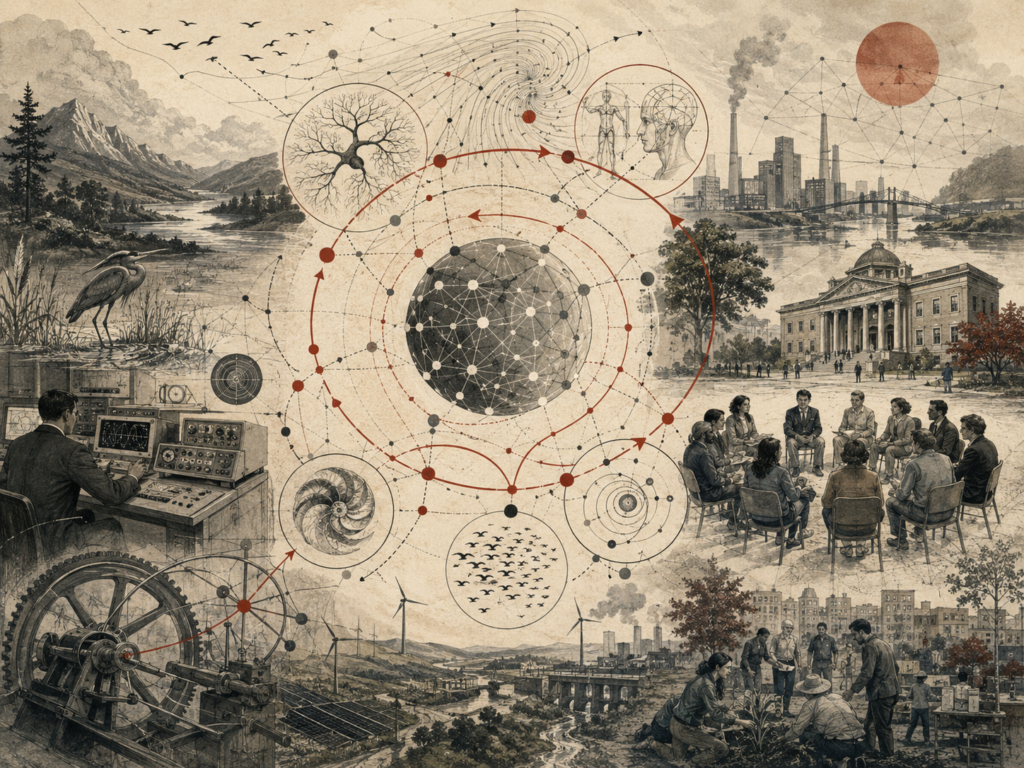
Scholarly systems-thinking illustration of cybernetic feedback, general systems theory, ecological systems, mechanical control, civic institutions, social learning, networks, and circular causal pathways.

Cybernetics, General Systems Theory, and Systems Thinking

Cybernetics, General Systems Theory, and Systems Thinking explains how cybernetics and general systems theory shaped modern systems thinking through feedback, communication, control, open systems, boundaries, requisite variety, adaptation, and accountability. The article traces the work of Norbert Wiener, W. Ross Ashby, Stafford Beer, Ludwig von Bertalanffy, Kenneth Boulding, Anatol Rapoport, Gregory Bateson, Margaret Mead, Jay Forrester, Donella Meadows, and Peter Senge, showing how their ideas converged around relationships, information, regulation, emergence, learning, and whole-system behavior. Readers learn why complex systems cannot be understood by isolating parts alone, why feedback can stabilize or destabilize systems, why response variety must match disturbance variety, why boundaries are ethical choices, and why control-oriented thinking must be tempered by humility, participation, public accountability, ecological responsibility, and attention to power in AI, platforms, infrastructure, organizations, climate systems, and governance across contemporary public and technical life.

Scholarly editorial illustration of Peter Senge-inspired organizational learning, showing collaborative teams, systems diagrams, dialogue circles, field learning, ecological settings, and feedback networks.

Peter Senge and the Learning Organization

Peter Senge and the Learning Organization explains how Senge brought systems thinking into organizational learning through The Fifth Discipline and the five disciplines of personal mastery, mental models, shared vision, team learning, and systems thinking. The article shows why organizations often fail to learn from experience: feedback is filtered, mental models remain hidden, defensive routines protect authority, departments optimize locally, and institutional memory disappears through turnover and fragmentation. It examines learning organizations as systems of feedback use, psychological safety, dialogue, shared purpose, leadership, knowledge flow, trust, adaptation, and accountability. Through examples from healthcare, public agencies, schools, technology organizations, infrastructure systems, climate institutions, nonprofits, and workplace culture change, readers learn how to diagnose learning failure, surface assumptions, reduce defensive routines, strengthen team learning, preserve institutional memory, redesign feedback structures, and connect organizational learning to ethical purpose and public responsibility today.

Scholarly editorial illustration of Donella Meadows with systems diagrams, ecological landscapes, community planning scenes, farms, wetlands, feedback loops, and structural network patterns.

Donella Meadows and the Practice of Structural Insight

Donella Meadows and the Practice of Structural Insight explains Meadows’s role in making systems thinking a public discipline of feedback, limits, leverage, humility, and responsibility. The article examines her work in the system dynamics tradition, her contribution to The Limits to Growth, and her later writing on leverage points, stocks, flows, delays, overshoot, resilience, information flows, rules, goals, and paradigms. It shows why structural insight means looking beneath events toward the feedback structures and system purposes that generate recurring patterns. Through examples from climate systems, infrastructure backlog, public trust, platform accountability, food systems, housing affordability, organizational burnout, and environmental monitoring, readers learn how to diagnose accumulations, trace flows, identify delayed feedback, distinguish shallow from deep leverage, connect sustainability with justice, and use models as tools for learning, repair, accountability, and ethical intervention within complex ecological, institutional, and social systems.

Documentary-style editorial collage of Jay Forrester, early system dynamics diagrams, behavior-over-time graphs, stock-flow structures, computer simulation scenes, MIT research settings, and global systems mapping.

Jay Forrester and the Origins of System Dynamics

Jay Forrester and the Origins of System Dynamics explains how Forrester’s work in engineering control systems, early computing, industrial management, urban modeling, and global simulation helped create system dynamics as a method for understanding behavior over time. The article traces the movement from servomechanisms, feedback control, Whirlwind computing, and magnetic-core memory into industrial dynamics, urban dynamics, world dynamics, stock-flow modeling, delayed feedback, policy resistance, and simulation-based learning. It shows why persistent social, organizational, ecological, and institutional problems often arise from feedback structure rather than isolated events. Readers learn how stocks, flows, delays, decision rules, compensating feedback, and structural leverage explain supply-chain instability, infrastructure backlog, public trust, climate overshoot, platform behavior, and policy failure. The article also addresses technocratic limits, public accountability, participatory modeling, ethical boundary critique, and the need to use models as learning tools rather than unquestionable authorities.

Restrained editorial illustration of communities, civic institutions, workspaces, environmental systems, public meetings, research activity, and social networks connected by looping feedback arrows.

Complex Adaptive Systems and Social Change

Complex Adaptive Systems and Social Change explains social transformation as an adaptive process shaped by agents, networks, institutions, norms, feedback loops, resistance, learning, technology, and power. The article shows why social change rarely follows a linear plan and why reforms, movements, policies, platforms, and institutions respond to each other over time. It examines emergence, local rules, threshold dynamics, diffusion, trust, legitimacy, backlash, path dependence, institutional memory, coalition building, policy feedback, governance learning, transformation, resilience, and justice. Through examples from public health, climate justice, housing reform, technology governance, workplace culture, education, democratic renewal, and environmental restoration, readers learn how to diagnose social-change systems, map feedback loops, anticipate counter-adaptation, build learning capacity, identify leverage points, evaluate distributional effects, and design strategies that change rules, relationships, institutions, narratives, and accountability structures toward durable public value and repair across time, institutions, and scales.

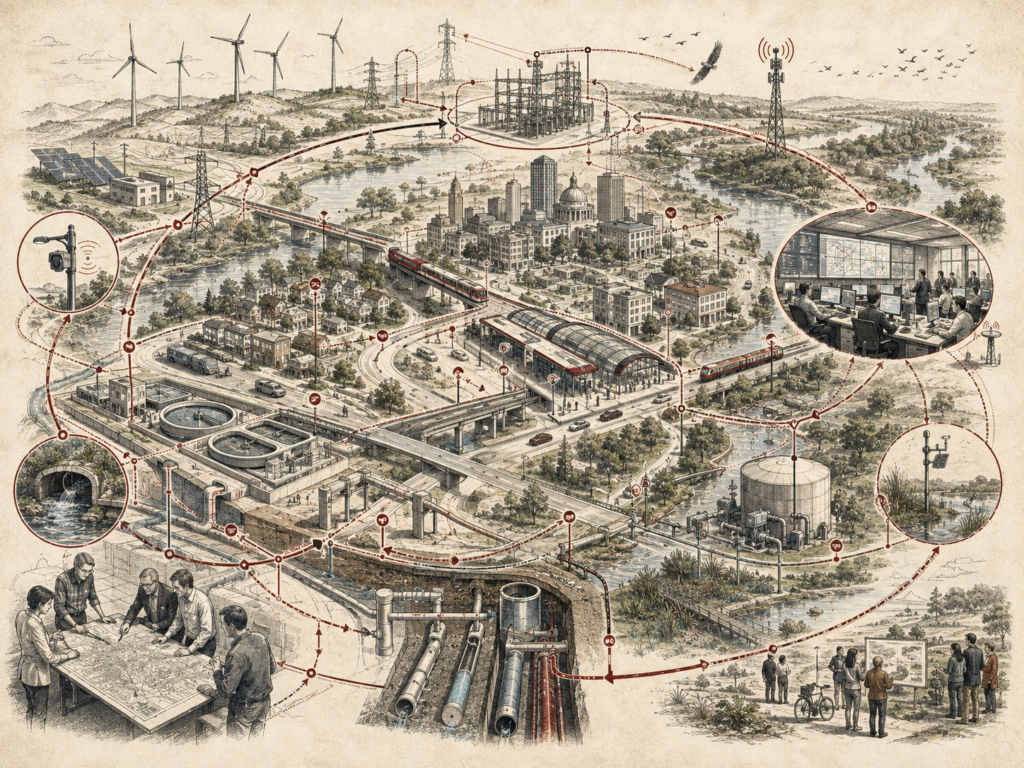
Scholarly systems-thinking illustration of intelligent infrastructure with transit, energy grids, water systems, sensors, communications, civic planning, wetlands, and urban services connected by feedback pathways.

Intelligent Infrastructure as a System

Intelligent Infrastructure as a System explains infrastructure as a cyber-physical, institutional, and public system shaped by physical assets, sensors, data pipelines, AI models, maintenance workers, vendors, communities, climate risk, and governance. The article shows why smart infrastructure is not simply infrastructure with sensors attached. It examines roads, bridges, water systems, power grids, transit, buildings, environmental monitoring, digital twins, predictive maintenance, cybersecurity, vendor dependency, public trust, labor, equity, and resilience. Through examples from smart grids, water monitoring, structural health systems, intelligent transportation, building automation, flood and stormwater systems, environmental sensor networks, and urban digital twins, readers learn how to diagnose infrastructure feedback loops, evaluate asset risk, identify cyber-physical dependency, prioritize maintenance, account for climate exposure, protect privacy, reduce cascade risk, and design intelligent infrastructure that serves safety, reliability, ecological stewardship, justice, and public accountability across generations and under future stress.

Scroll to Top