
Last Updated May 3, 2026
Arabic literature preserves one of the great civilizational traditions through which language became memory, refinement, ethical formation, wit, argument, historical consciousness, and public style. Across poetry, prose, belles-lettres, wisdom literature, biography, travel writing, history, anthologies, maqamat, mirrors-for-princes writing, epistolary arts, and scholarly culture, Arabic literary production carried forward a richly layered archive of eloquence, remembrance, social conduct, cultivated knowledge, and moral reflection. In this world, literature was never only a matter of aesthetic creation in the narrow modern sense. It was also a practice of forming persons, shaping elites, refining judgment, preserving exempla, organizing inherited knowledge, and sustaining a shared civilizational language across regions, dynasties, and centuries.
The concept of adab stands at the center of this archive. Adab names far more than literature as a bounded genre. It refers to a broad cultivated world of eloquence, learning, literary sensibility, ethical comportment, intellectual companionship, social polish, and disciplined familiarity with inherited knowledge. To study Arabic literature through the lens of adab is therefore to study not only poems and books, but a civilizational method of shaping character and cultural order through language. Adab links speech to ethics, memory to style, literary delight to instruction, and textual inheritance to the formation of cultivated persons and publics.
Current Space
Literature & Cultural Memory
Related Topic
Maghrebi & Andalusi Literature & Cultural Memory
Related Topic
Arabian & Levantine Myth, Folklore & Sacred Memory
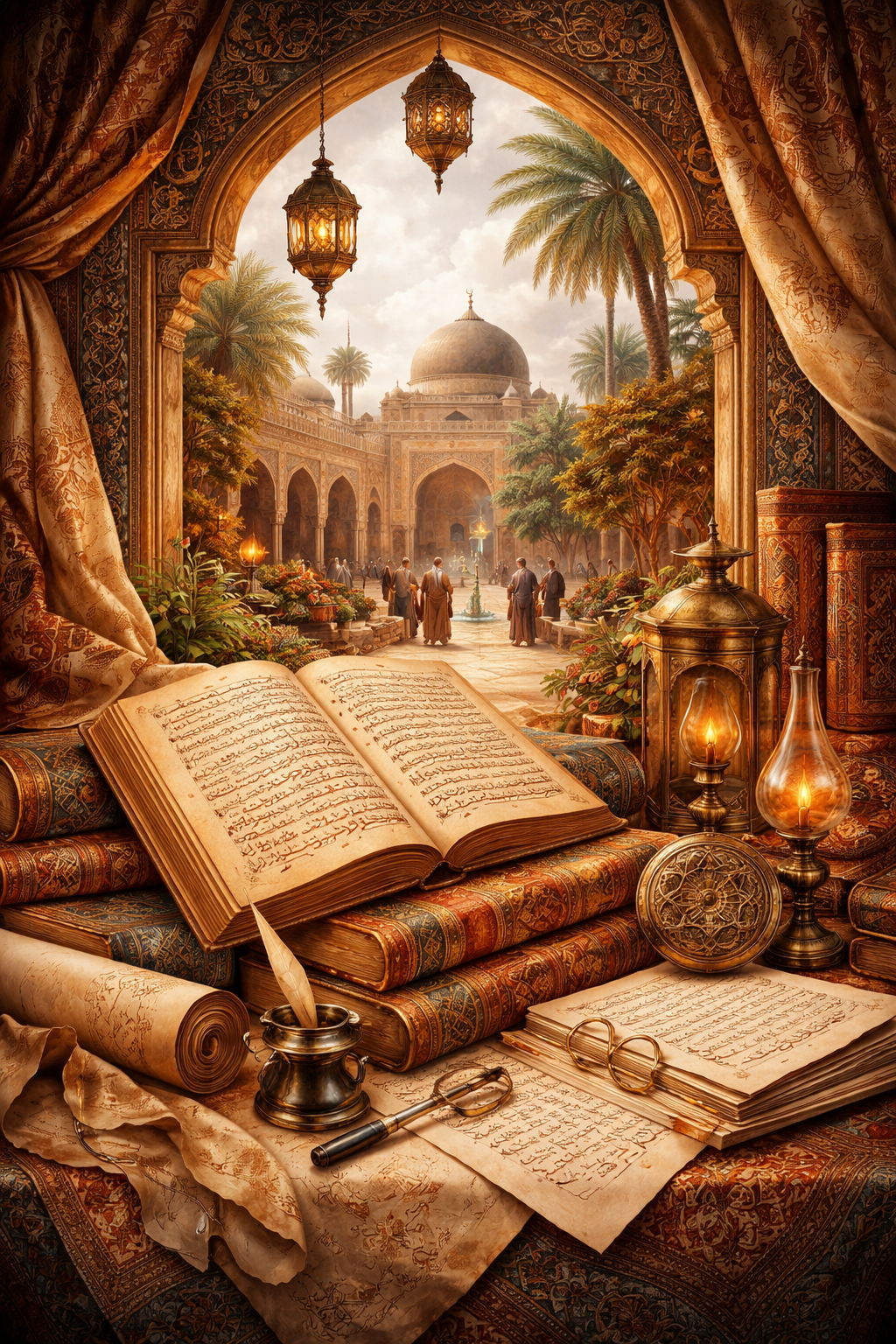
This content pillar approaches Arabic Literature and Adab as an expansive memory system rather than a narrow canon of isolated masterpieces. Its canonical spine includes pre-Islamic poetry, Qur’anic language as linguistic and rhetorical horizon, early Islamic eloquence, Abbasid prose and belles-lettres, adab anthologies, the maqama tradition, historiographical and biographical writing, travel literature, courtly prose, philosophical and ethical reflection, Andalusi and Maghrebi literary forms, and the wider Arabic ecumene stretching from the Arabian Peninsula and Iraq to the Levant, Egypt, North Africa, and al-Andalus. It includes poetry and prose alike because Arabic literary civilization never confined refinement to one form alone. Poetry remained central to prestige, memory, and linguistic excellence, but prose became equally indispensable for adab, anecdote, biography, wit, commentary, ethical instruction, and the arrangement of knowledge.
Read in this way, Arabic literature becomes more than literary history. It becomes a record of how a civilization understood eloquence, memory, hospitality, satire, moral intelligence, sacred language, worldly power, urbanity, desert inheritance, courtly performance, scholarly discipline, and the social life of style. It shows how literary form mediated relations between oral and written expression, revelation and rhetoric, tribal memory and imperial administration, courtly polish and scholarly seriousness, pleasure and instruction, worldly cultivation and moral accountability. Arabic Literature and Adab therefore stands at the intersection of literary history, philology, religious history, political thought, urban culture, ethical reflection, and the history of education. It asks how language becomes cultivation, how texts become conduct, and how a civilization preserves itself through eloquence.
Arabic Literature and Adab as Civilizational Memory
Arabic literature is one of the great archives of civilizational memory because it binds language, ethics, style, memory, social formation, and intellectual cultivation into a single long tradition. It preserves the desert and the city, the poet and the court, the scholar and the patron, the traveler and the compiler, the satirist and the moralist, the grammarian and the adib. It remembers the abandoned campsite, the praised patron, the sharp-tongued satirist, the cultivated companion, the eloquent epistle, the wandering trickster, the biographical notice, the moral anecdote, the learned anthology, and the manuscript copied across generations.
In this archive, eloquence is never merely decorative. Language is a social power, a moral discipline, a form of memory, and a sign of cultivation. Poetry preserves prestige, longing, praise, complaint, tribal identity, urban refinement, and political ambition. Prose arranges knowledge, trains judgment, displays wit, preserves anecdotes, reflects on conduct, and gathers the materials of civilized life. Philology, grammar, rhetoric, and commentary preserve the conditions of literary authority itself. Arabic literary civilization therefore treats language not simply as expression, but as inheritance, training, and public order.
To study Arabic Literature and Adab is therefore to study how a language-world became a civilizational memory system. The pillar does not reduce Arabic literature to religious writing, courtly ornament, or aesthetic form alone. It reads Arabic literature as a broad cultural field in which sacred language, poetic prestige, adab cultivation, scholarly discipline, ethical instruction, social wit, political counsel, historical memory, and literary pleasure intersect.
Why This Pillar Matters
Arabic Literature and Adab matters because it preserves one of the most comprehensive traditions through which language became a vehicle of memory, style, ethical discipline, and public intelligence. Arabic literary culture did not merely produce texts; it produced habits of attention, forms of eloquence, practices of citation, standards of refinement, and institutions of transmission through which societies educated elites, formed scholarly communities, remembered exemplary lives, and negotiated the relation between sacred inheritance and worldly cultivation. Through poetry, anecdote, biography, rhetoric, epistle, history, and literary prose, Arabic-speaking societies created an archive in which language itself became a principal instrument of civilization.
It also matters because adab names a broader humanistic order than “literature” alone can capture. Adab links literary pleasure to conduct, rhetorical skill to ethical formation, and inherited knowledge to social poise. It presumes that cultivated language shapes the self and the public alike. To understand Arabic literature through adab is therefore to understand how literary traditions participate in education, political life, urbanity, scholarly culture, and the making of civilized persons. This gives Arabic literary history unusual breadth: it includes not only canonical poems and prose works, but anthologies, letters, biographical dictionaries, travel accounts, mirrors-for-princes literature, witty exchanges, philological commentary, and the disciplined enjoyment of eloquence itself.
This pillar also matters because Arabic literature is central to the broader intellectual history of the Islamic world without being reducible to theology or religious doctrine. Qur’anic language and sacred learning form an indispensable rhetorical and linguistic horizon, but Arabic literature also includes courtly play, satire, erotic poetry, urban wit, philosophical conversation, travel narrative, geographical curiosity, historical compilation, ethical reflection, and worldly social observation. The tradition is therefore not narrow. It is one of the broadest humanistic archives in world literary history.
Scope and Method
This pillar is intentionally expansive, but ordered by a clear center. It includes pre-Islamic poetry, Qur’anic rhetoric as linguistic horizon, early Islamic and Abbasid literary formation, the classical adab tradition, poetry and court culture, maqamat, historiography, biography, travel writing, ethical and wisdom literature, philology, rhetoric, grammar, Andalusi and Maghrebi writing, later manuscript and commentary traditions, and the institutional afterlives by which Arabic literature was copied, taught, excerpted, and canonized. The pillar includes both poetry and prose because Arabic literary civilization repeatedly made both central. Poetry retained extraordinary prestige as a medium of memory, honor, praise, satire, elegy, love, and linguistic mastery; prose became the preferred medium for adab, anecdote, scholarly organization, epistolary display, narrative wit, ethical reflection, and literary compilation.
The method throughout is to read Arabic literature as both art and civilizational practice. That means attending to genre, rhetoric, style, performance, literary convention, and historical context while also asking what these texts did in the worlds that preserved them. How did poetry carry tribal memory, political prestige, or moral complaint? How did Qur’anic language reshape literary possibility? How did adab turn reading into ethical and social formation? How did anthologies organize a civilization’s sense of exemplary language? How did prose wit, anecdote, and display create models of cultivated intelligence? How did philology and grammar preserve the language of revelation and poetry alike? How did travel writing and biography widen the scope of literary memory across geography and time?
This pillar also reads Arabic literature with attention to power and exclusion. Courtly patronage, social hierarchy, gendered voice, enslavement, ethnic identity, sectarian boundary, political authority, and scholarly gatekeeping all shape the archive. A serious account of adab must therefore preserve admiration for its refinement without turning refinement into nostalgia. Literary civilization includes brilliance, but also institutions, hierarchies, rivalries, exclusions, and struggles over whose language counts.
Reading Architecture for a Humanities Pillar
This literature pillar does not require a GitHub repository. Its research infrastructure is textual, bibliographic, philological, and interpretive rather than code-based. The appropriate scholarly architecture consists of primary texts, reliable translations, critical editions, manuscript histories, commentary traditions, anthologies, university press scholarship, open library records, and carefully organized reading pathways.
The central research practices for this pillar are close reading, genre analysis, historical contextualization, philological awareness, reception history, translation comparison, canon formation, manuscript transmission, and critical engagement with adab as both literature and social practice. The key scholarly materials are editions, translations, literary histories, Cambridge and Oxford companions, Library of Arabic Literature editions, Brill scholarship, philological studies, and primary Arabic works in translation or bilingual edition.
A strong Arabic Literature and Adab pillar should therefore foreground:
- primary Arabic texts in reliable translations, bilingual editions, or scholarly editions;
- major genre pathways such as qasida, lyric, adab prose, epistle, maqama, historiography, biography, travel writing, wisdom literature, and philological commentary;
- historical sequence from pre-Islamic poetry through Qur’anic linguistic transformation, Umayyad and Abbasid development, Andalusi and Maghrebi regional traditions, and later manuscript culture;
- conceptual pathways such as eloquence, cultivation, ethical formation, wit, memory, urbanity, courtly prestige, sacred language, and worldly learning;
- attention to transmission through recitation, memorization, anthology, commentary, manuscript copying, grammar, education, and scholarly citation;
- critical reading of hierarchy, patronage, gender, enslavement, ethnicity, political authority, and the social conditions of literary production.
The Canonical Spine of the Tradition
A strongest-sense account of Arabic Literature and Adab should be clearly anchored in the major formations and figures that define its high canonical and civilizational center. The pre-Islamic qasida and the Mu‘allaqat establish the prestige of Arabic poetic memory. The Qur’an provides the linguistic, rhetorical, and cultural horizon within which later Arabic literary expression develops, even when literary and sacred discourses remain distinct. The Abbasid age brings the adab tradition into classical maturity through figures such as al-Jahiz, Ibn Qutaybah, al-Tanukhi, al-Tawhidi, and others who transform prose into a vehicle of wit, cultural range, ethical observation, and cultivated intelligence.
Abu Tammam, al-Buhturi, al-Mutanabbi, and Abu Nuwas anchor major poetic developments in praise, self-fashioning, satire, wine poetry, transgression, and stylistic ambition. Al-Hamadhani and al-Hariri elevate the maqama into one of the great arts of prose virtuosity. Historians, biographers, travelers, and anthologists such as al-Tabari, al-Mas‘udi, Yaqut, Ibn Khallikan, and Ibn Battuta broaden literary memory into geographical, historical, and human record.
This spine does not exhaust Arabic literature, but it clarifies the hierarchy through which the tradition is most visibly recognized and most durably transmitted. Around it gather the wider worlds of grammar, philology, ethical prose, courtly epistles, Andalusi lyric, Maghrebi literary culture, manuscript transmission, and later commentary. A strong pillar does not reduce that richness. It orders it.
Foundational Questions
- How did Arabic literature become a medium of memory, refinement, ethical formation, and cultivated public life?
- What does adab mean, and how does it exceed modern notions of literature alone?
- How do poetry and prose function differently within Arabic literary civilization?
- How did pre-Islamic poetic memory, Qur’anic language, and Abbasid urban culture shape the classical literary archive?
- How do adab anthologies, anecdotes, maqamat, and epistles organize cultivated knowledge and social intelligence?
- How did history, biography, travel writing, and geographical literature expand the narrative scope of Arabic memory?
- How did grammar, philology, and rhetoric become part of literary culture rather than merely adjacent disciplines?
- How did Arabic literature mediate relations between desert and city, court and scholar, sacred and worldly knowledge, authority and wit?
- How did Arabic literary traditions travel across regions stretching from Arabia and Iraq to the Levant, Egypt, North Africa, and al-Andalus?
- How should Arabic literary history be read alongside patronage, hierarchy, gender, enslavement, ethnicity, political authority, and social exclusion?
I. Pre-Islamic Poetry and the Foundations of Arabic Literary Memory
Any deepest-sense treatment of Arabic Literature and Adab begins with pre-Islamic poetry. The qasida, with its movement through abandoned campsite, journey, boast, praise, tribal memory, longing, and ordeal, preserves one of the foundational structures of Arabic literary consciousness. Pre-Islamic poetry records honor, hospitality, kinship, warfare, praise, satire, vulnerability, endurance, and the emotional weather of a world shaped by movement, memory, and speech. It established Arabic poetry as a medium of prestige and preservation long before the emergence of the classical adab tradition.
The Mu‘allaqat and the broader corpus of early Arabic poetry became fundamental not only because of aesthetic excellence, but because they preserved linguistic authority and exemplary expression. They gave later generations a remembered Arabia of desert camps, tribal loyalties, erotic recollection, martial self-assertion, and moral intensity. Even after the political and urban transformations of Islamicate civilization, this poetic archive remained central as a source of language, memory, and eloquent precedent.
- Pre-Islamic Poetry and the Foundations of Arabic Literary Memory (planned) — A foundational article on the qasida, oral prestige, tribal memory, honor, endurance, and poetic authority.
- The Mu‘allaqat and the Prestige of the Qasida (planned) — A study of the suspended odes, poetic canon formation, and the qasida as monument of memory.
- Desert, Memory, and the Nasib in Classical Arabic Poetry (planned) — A reading of the abandoned campsite, longing, trace, and poetic recollection.
- Praise, Satire, and Tribal Prestige in Early Arabic Verse (planned) — An article on poetry as social power, reputational weapon, and archive of honor.
- Orality, Performance, and the Preservation of Pre-Islamic Poetry (planned) — A study of recitation, transmission, memory, and the later stabilization of early verse.
- Antarah ibn Shaddad and the Poetics of Valor, Love, and Marginality (planned) — A focused article on war poetry, social identity, heroism, and the literary memory of Antarah.
II. Qur’anic Language, Revelation, and the Rhetorical Horizon of Arabic Literature
The Qur’an stands at the center of Arabic linguistic and rhetorical history, not as a literary text in a reductive secular sense, but as the revelatory horizon within which later Arabic language, style, exegesis, rhetoric, and literary self-consciousness necessarily develop. Qur’anic Arabic transformed conceptions of eloquence, semantic depth, rhythm, recitation, and the relation between speech and truth. Later literary culture would continuously negotiate its proximity to this sacred linguistic center, drawing from it, differentiating itself from it, and building systems of rhetoric and philology adequate to its study and prestige.
This makes the Qur’anic horizon indispensable to Arabic Literature and Adab. It shaped the language of learning, debate, commentary, citation, and style. It intensified grammatical and philological inquiry. It reoriented moral and intellectual sensibility. And it made literary eloquence answerable to a sacred standard even when writers moved in worldly, witty, courtly, satirical, or playful directions.
- Qur’anic Arabic and the Transformation of Literary Language (planned) — A study of sacred speech, linguistic authority, rhythm, eloquence, and later literary consciousness.
- Revelation, Eloquence, and the Rhetorical Horizon of Arabic Literature (planned) — An article on how the Qur’an shaped rhetorical theory, language prestige, and literary self-understanding.
- Recitation, Rhythm, and Sacred Speech in Arabic Culture (planned) — A study of recitation, sound, memorization, and the embodied life of Arabic language.
- How the Qur’an Shaped Grammar, Philology, and Literary Consciousness (planned) — An article on grammar, exegesis, linguistic preservation, and scholarly discipline.
- Sacred Language and Worldly Eloquence in Arabic Civilization (planned) — A broader article on the relation between revelation, adab, courtly style, and literary pleasure.
III. Early Islamic, Umayyad, and Early Abbasid Literary Formation
The early Islamic and Umayyad periods preserve a world in transition: from tribal memory to imperial administration, from oral prestige to expanding written culture, from localized poetic competition to broader literary and political circulation. Poetry remained central, but its social worlds changed. Court patronage, political contestation, factional rivalry, urban development, and new centers of power reshaped the functions of language. Praise, satire, love poetry, political verse, and pious discourse all developed within this new order.
The Abbasid period then becomes decisive for the maturation of Arabic literary civilization. Baghdad and other urban centers fostered translation, scholarship, prose experimentation, philology, anthologizing, literary salon culture, and the classical consolidation of adab. This is one of the great turning points in the history of world literature: the moment when Arabic becomes not only a sacred and administrative language, but one of the most sophisticated vehicles of cultivated prose and literary self-consciousness anywhere.
- From Tribal Memory to Imperial Language in Early Arabic Literature (planned) — A study of how Arabic literary culture moved from tribal prestige into imperial scale.
- Umayyad Poetry, Politics, and Public Prestige (planned) — An article on court poetry, factional rivalry, political authority, praise, and satire.
- Love Poetry and Urban Refinement in the Early Arabic Tradition (planned) — A study of ghazal, desire, urbanity, affect, and changing poetic worlds.
- The Abbasid Turn and the Maturation of Arabic Literary Culture (planned) — A major article on the Abbasid transformation of prose, poetry, scholarship, and adab.
- Baghdad, Translation, and the Rise of Cultivated Prose (planned) — An article on urban intellectual culture, translation movements, salons, scribes, and prose expansion.
- Scribes, Secretaries, and the Literary Culture of Administration (planned) — A study of epistolary style, bureaucracy, statecraft, and the formation of educated prose.
IV. Adab, Belles-Lettres, and the World of Cultivated Prose
The classical heart of the category lies here. Adab prose transforms literature into a broad art of cultivated intelligence. In the hands of writers such as al-Jahiz, Ibn Qutaybah, al-Tanukhi, al-Tawhidi, and others, prose becomes a vehicle for anecdote, wit, ethical reflection, linguistic play, observation of social life, erudition, curiosity, and the arrangement of inherited knowledge. Adab is rarely reducible to one fixed form. It includes essays, anthologies, epistles, collections of anecdotes, observations on society and language, reflections on friendship and envy, mirrors-for-princes materials, literary criticism, and compilations designed to educate while delighting.
What makes adab central is its capaciousness. It links literary pleasure with judgment, intellectual range with social polish, and memory with conduct. It assumes that cultivated reading forms cultivated persons. In this sense, adab is not only a genre cluster but a civilizational ideal: the disciplined, eloquent, ethically alert enjoyment of language and knowledge.
- Adab as a Civilizational Ideal (planned) — A foundational article defining adab as literature, cultivation, ethics, social polish, and humanistic formation.
- al-Jahiz and the Intelligence of Arabic Prose (planned) — A study of curiosity, wit, observation, argument, literary range, and prose energy.
- The Book of Misers and the Social Comedy of Adab (planned) — A focused reading of miserliness, anecdote, social satire, and comic observation.
- Ibn Qutaybah and the Ordering of Knowledge in Arabic Literature (planned) — An article on classification, cultural memory, literary selection, and adab organization.
- al-Tanukhi and the Anecdotal Imagination of Relief, Piety, and Fortune (planned) — A study of story collection, moral pattern, everyday reversal, and social memory.
- al-Tawhidi, Friendship, and the Ethics of Cultivated Conversation (planned) — A reading of conversation, companionship, alienation, philosophical inquiry, and literary self-consciousness.
- Anecdote, Wit, and the Formation of the Adib (planned) — An article on literary taste, memory, social intelligence, and the cultivated person.
- Anthology, Selection, and the Architecture of Adab (planned) — A study of anthological method, excerpt culture, preservation, and literary judgment.
V. Poetry, Courtly Culture, and the Social Prestige of Language
Arabic poetry remained central even as prose flourished. Courtly praise, self-fashioning, satire, lampoon, wine poetry, elegy, and stylized displays of poetic mastery all became major components of literary culture. Abu Tammam, al-Buhturi, al-Mutanabbi, and Abu Nuwas exemplify different possibilities within the classical archive: the rhetorical density of praise poetry, the brilliance of self-conscious poetic ambition, the pleasures and provocations of wine and urbanity, and the extraordinary capacity of verse to concentrate prestige, rivalry, and memory.
In courtly and elite settings, poetry was a medium of symbolic power. It could raise reputations, shape patronage, immortalize rulers, encode critique, and display unparalleled linguistic command. Poetry remained a field in which social authority and literary excellence were constantly negotiated.
- Poetry and Prestige in the Classical Arabic Court (planned) — A study of patronage, praise, rivalry, performance, and the symbolic power of verse.
- Abu Tammam and the Poetics of Verbal Brilliance (planned) — An article on rhetorical density, innovation, praise, and the art of difficult beauty.
- al-Buhturi and the Elegance of Praise (planned) — A study of courtly refinement, descriptive poetry, balance, and classical polish.
- al-Mutanabbi and the Sovereignty of the Poetic Self (planned) — A major article on ambition, self-fashioning, authority, pride, and poetic immortality.
- Abu Nuwas, Urbanity, and the Literature of Transgressive Wit (planned) — An article on wine poetry, urban play, satire, desire, and literary provocation.
- Elegy, Satire, and Self-Fashioning in Classical Arabic Verse (planned) — A synthetic article on poetic persona, social exposure, grief, and reputation.
- Praise Poetry and the Politics of Literary Immortality (planned) — A study of patronage, memory, public fame, and the poet’s role in preserving rulers.
VI. Maqamat, Performance, and the Art of Prose Display
The maqama tradition represents one of the highest achievements of Arabic prose virtuosity. In the works of al-Hamadhani and al-Hariri, rhymed prose, anecdote, trickster intelligence, linguistic brilliance, and performative narration converge in an art form that is at once playful, dazzling, learned, and socially observant. The maqamat dramatize eloquence itself. They make style into event. They turn verbal resourcefulness into one of literature’s central pleasures.
Maqama matters within adab because it reveals how cultivated prose could delight by display while remaining deeply tied to social worlds of mobility, wit, deception, urban knowledge, and linguistic command. It is one of the clearest examples of Arabic literature treating language not only as a means of communication, but as a field of exquisite public performance.
- The Maqama and the Performance of Eloquence (planned) — A foundational article on rhymed prose, display, narration, trickery, and cultivated literary performance.
- al-Hamadhani and the Invention of the Maqama Tradition (planned) — A study of origin, prose artistry, social observation, and narrative persona.
- al-Hariri and the Art of Rhymed Prose (planned) — An article on verbal virtuosity, literary difficulty, ornate style, and classical reception.
- Trickster, Wanderer, and Narrator in Arabic Literary Performance (planned) — A study of social mobility, deception, performance, and literary intelligence.
- Linguistic Display and Social Intelligence in the Maqamat (planned) — An article on style as spectacle, urban wit, and the public testing of eloquence.
VII. History, Biography, Travel, and the Narrative Ordering of Memory
Arabic literary civilization also preserved itself through historical narrative, biography, geographies of travel, and the arrangement of exemplary lives. Historians, compilers, biographers, and travelers created prose archives that joined narrative, documentation, moral reflection, curiosity, and literary style. These works extend adab beyond belles-lettres narrowly conceived into a broader civilizational memory project.
Al-Tabari, al-Mas‘udi, Yaqut, Ibn Khallikan, and Ibn Battuta belong here not simply as historians or travelers, but as literary organizers of memory. Their works preserve dynasties, regions, cities, scholars, rulers, anecdotes, marvels, genealogies, and reputations. They convert the movement of time and space into forms of literary intelligibility. Biography, travel, and history thus become part of how Arabic civilization narrates itself to itself.
- History as Literary Memory in Arabic Civilization (planned) — A study of historical prose, chronology, narrative authority, moral judgment, and civilizational record.
- al-Tabari and the Ordering of Historical Time (planned) — An article on chronicle, transmission, narrative sequence, and historical authority.
- al-Mas‘udi and the Literary Geography of the World (planned) — A study of geography, wonder, history, travel, and cosmopolitan curiosity.
- Ibn Khallikan and the Biographical Preservation of Reputation (planned) — An article on biography, memory, learned lives, and the preservation of scholarly identity.
- Ibn Battuta and the Narrative of Travel Across the Islamic World (planned) — A study of travel, mobility, observation, geography, and narrative self-fashioning.
- Adab, Curiosity, and the Literature of Wonder (planned) — An article on marvels, travel, anecdote, knowledge, and imaginative geography.
- Biographical Dictionaries and the Social Archive of Arabic Learning (planned) — A study of scholars, chains of memory, reputation, and the organization of intellectual life.
VIII. Ethical Reflection, Wisdom Literature, and the Formation of Character
Adab is inseparable from ethical formation. Arabic literary culture produced a wide range of wisdom literature, mirrors-for-princes texts, maxims, anecdotes, conduct literature, and reflective prose designed to shape judgment and character. These works reveal that literature was valued not only for pleasure or display, but for the formation of prudence, self-command, social intelligence, generosity, and moral discernment. Literary cultivation and ethical cultivation were repeatedly understood as mutually reinforcing.
This ethical archive belongs to the center of the pillar because adab always implied more than taste. It implied comportment, discrimination, timing, memory, measure, and fitness of speech. It was a moral-aesthetic category at once.
- Adab and the Ethical Formation of the Self (planned) — A foundational article on cultivated conduct, speech, judgment, social poise, and literary formation.
- Wisdom, Conduct, and Cultivated Speech in Arabic Literature (planned) — A study of maxims, moral instruction, conduct, and refined expression.
- Mirrors-for-Princes and the Ethics of Political Counsel (planned) — An article on rulership, advice, prudence, justice, and the literary shaping of authority.
- Maxims, Anecdotes, and Moral Intelligence in the Adab Tradition (planned) — A study of brief forms, memorable instruction, social observation, and ethical wit.
- Pleasure, Instruction, and the Humanistic Scope of Arabic Belles-Lettres (planned) — An article on delight, cultivation, pedagogy, and the moral pleasure of language.
- Friendship, Envy, and Intellectual Companionship in Adab (planned) — A study of social rivalry, companionship, learned conversation, and moral self-knowledge.
IX. Philology, Grammar, Rhetoric, and the Scholarly Preservation of Eloquence
Arabic literature cannot be understood apart from the disciplines that preserved and explained its language. Grammar, philology, rhetoric, lexicography, and textual commentary were not merely technical supports external to literature. They were integral to the civilization’s understanding of eloquence itself. The preservation of Qur’anic Arabic, pre-Islamic poetry, and literary prose demanded systems of linguistic analysis capable of stabilizing usage, recording variation, defining correctness, and explaining figurative power.
These disciplines made literary culture durable. They sustained the authority of texts, the prestige of eloquence, and the transmission of exemplary language across time. Arabic literary civilization is therefore inseparable from the scholarly cultures that studied its words with extraordinary seriousness.
- Grammar and the Preservation of Arabic Literary Authority (planned) — A study of grammatical science, language standardization, and the protection of textual authority.
- Philology, Lexicography, and the Archive of Eloquence (planned) — An article on dictionaries, rare words, poetic evidence, and linguistic memory.
- Rhetoric and the Analysis of Literary Power in Arabic Tradition (planned) — A study of balagha, metaphor, eloquence, persuasion, and stylistic judgment.
- Commentary, Correctness, and the Scholarly Life of the Text (planned) — An article on commentary traditions, explanation, pedagogy, and textual survival.
- Language, Revelation, and the Authority of Classical Arabic (planned) — A broader article on sacred text, poetry, grammar, and linguistic prestige.
X. al-Andalus, the Maghrib, and the Western Arabic Literary World
Arabic Literature and Adab also extends westward through al-Andalus and the Maghrib, where literary culture developed in distinctive dialogue with courtly life, urban refinement, music, love poetry, philosophical prose, and the memory of place. Andalusi and Maghrebi writing expands the archive geographically and tonally. It preserves gardens, cities, exile, courtly elegance, lyric invention, and the layered social worlds of the western Islamic Mediterranean.
This western Arabic world matters not as a peripheral appendix, but as one of the major regional formations of Arabic literary civilization. It produced its own constellations of adab, lyric, memory, and cultivated sociability, while remaining tied to the broader eastern canon.
- Arabic Literature in al-Andalus and the Maghrib (planned) — A foundational article on western Arabic literary culture, regional refinement, and Mediterranean memory.
- Garden, City, and Longing in Andalusi Literary Imagination (planned) — A study of place, lyric refinement, urban memory, and cultivated landscape.
- Courtly Refinement and Lyric Form in the Western Arabic World (planned) — An article on patronage, music, love poetry, poetic play, and literary sociability.
- Exile, Memory, and the Loss of al-Andalus in Later Literary Consciousness (planned) — A study of nostalgia, historical loss, literary afterlife, and cultural memory.
- Ibn Zaydun, Wallada, and the Poetics of Andalusi Love and Rivalry (planned) — A focused article on lyric voice, courtly identity, and literary memory in al-Andalus.
XI. Later Transformations, Manuscript Culture, and Literary Afterlives
Arabic literary culture endured through manuscripts, recitation, anthologizing, commentary, abridgment, quotation, school transmission, and regional reperformance. Later centuries did not simply preserve the classical archive passively; they reorganized, excerpted, moralized, taught, and renewed it. Manuscript culture, calligraphy, commentary traditions, and the continued citation of classical texts helped ensure that adab remained socially legible long after its earliest formations.
A strongest-sense pillar therefore includes not only the formative periods, but the long afterlife through which Arabic literary memory was carried forward into later pedagogical, courtly, scholarly, and modern worlds.
- Manuscript Culture and the Material Life of Arabic Literature (planned) — A study of copying, codices, libraries, scribal labor, marginalia, and textual survival.
- Anthology, Excerpt, and the Preservation of Adab (planned) — An article on compilation, selection, memorability, and the architecture of literary memory.
- Calligraphy, Recitation, and the Embodied Life of Literary Language (planned) — A study of written beauty, vocal performance, memory, and material culture.
- Later Commentary Traditions and the Renewal of the Canon (planned) — An article on gloss, explanation, pedagogy, interpretation, and canon maintenance.
- Why Arabic Adab Endured Across Regions and Dynasties (planned) — A synthetic article on portability, education, language prestige, and civilizational continuity.
- The Nahda and the Modern Reinterpretation of Arabic Literary Heritage (planned) — A bridge article on revival, reform, print culture, and modern literary consciousness.
XII. Major Genres Across Arabic Literature and Adab
A comprehensive pillar should also organize the archive by genre, since genre is one of the principal ways Arabic literary civilization differentiates memory and refinement. The qasida monumentalizes praise, complaint, recollection, and tribal or courtly prestige. The lyric and love poem preserve longing, intimacy, and emotional exactness. Adab prose gathers anecdote, wisdom, erudition, social observation, and literary pleasure. The maqama dramatizes eloquence through performance and artifice. History and biography narrate public time and exemplary lives. Travel writing orders geography through narrative curiosity. Mirrors-for-princes literature links language to governance. Philological and rhetorical works preserve the technical conditions of eloquence itself.
- The Qasida as Monument of Arabic Memory (planned) — A genre article on praise, loss, journey, boast, and the poetic preservation of prestige.
- Lyric, Love, and Emotional Precision in Arabic Poetry (planned) — A study of desire, longing, intimacy, separation, and poetic refinement.
- Adab Prose and the Art of Cultivated Intelligence (planned) — An article on anecdote, wit, learning, judgment, and civilizational polish.
- Maqama and the Performance of Eloquence (planned) — A study of rhymed prose, narrative trickery, performance, and verbal display.
- Biography and the Preservation of Exemplary Lives (planned) — An article on reputation, learned lives, moral memory, and biographical form.
- Travel Writing and the Narrative of the Wider World (planned) — A study of geography, curiosity, mobility, marvels, and narrative witness.
- Ethical Prose and the Formation of Character (planned) — An article on wisdom, counsel, conduct, and literary moral formation.
- Philology and Rhetoric as Literary Foundations (planned) — A study of the scholarly disciplines that made eloquence durable.
- Epistle, Letter, and the Art of Cultivated Address (planned) — An article on correspondence, style, diplomacy, social relationship, and prose authority.
XIII. Recurring Themes and Civilizational Structures
Across these genres, certain themes and structures recur with remarkable persistence: memory of the campsite and the traces of loss; praise and prestige; satire and exposure; hospitality and generosity; longing and separation; desert endurance and urban refinement; sacred speech and worldly eloquence; wit and moral intelligence; exile and return; the formation of rulers and courtiers; scholarly discipline; friendship, envy, and social rivalry; wonder, travel, and geography; the relation between pleasure and instruction. These recurring patterns are among the reasons Arabic literature became so durable. They allow each generation to inherit a world of expression without exhausting its meanings.
- Memory, Ruin, and the Abandoned Campsite in Arabic Poetry (planned) — A thematic article on traces, loss, recollection, and the nasib.
- Praise, Prestige, and the Politics of Literary Immortality (planned) — A study of panegyric, patronage, reputation, and poetic survival.
- Satire, Exposure, and the Social Uses of Wit (planned) — An article on ridicule, social correction, verbal aggression, and literary power.
- Hospitality, Generosity, and Ethical Reputation (planned) — A study of noble conduct, social memory, and the moral economy of praise.
- Desert and City in the Arabic Literary Imagination (planned) — An article on Bedouin memory, urban sophistication, nostalgia, and literary contrast.
- Friendship, Envy, and Intellectual Companionship in Adab (planned) — A study of learned sociability, rivalry, conversation, and moral observation.
- Pleasure and Instruction as Twin Aims of Literature (planned) — An article on delight, education, usefulness, and literary cultivation.
- Sacred Language and Worldly Eloquence in Arabic Civilization (planned) — A study of revelation, rhetoric, adab, courtly prose, and linguistic authority.
- Exile, Longing, and the Geography of Memory (planned) — An article on displacement, travel, place, loss, and literary remembrance.
XIV. Anthology, Commentary, Education, and Canon Formation
Arabic literature became canonical through institutions of transmission. Anthologies, recitation, memorization, commentary, literary salons, grammar instruction, scribal culture, manuscript copying, and educational curricula all helped determine what survived and how it was valued. The Arabic canon is not only the result of poetic and prose genius; it is also the result of repeated acts of preservation, citation, arrangement, selection, and pedagogy.
Anthology is especially important. Adab culture repeatedly organized itself through selection: the gathering of memorable verses, instructive anecdotes, eloquent letters, wise sayings, and exemplary stories. Canon formation in Arabic literature is therefore inseparable from excerpt culture and the educational arts of remembering, repeating, and redeploying what deserved to endure.
- How the Arabic Literary Canon Was Made (planned) — A study of selection, preservation, teaching, anthology, quotation, and literary authority.
- Anthology and the Architecture of Memory in Adab (planned) — An article on compilation, excerpting, arrangement, and the preservation of cultivated language.
- Memorization, Recitation, and the Social Life of Eloquence (planned) — A study of embodied transmission, oral performance, pedagogy, and public style.
- Commentary and the Layered Reading of Arabic Texts (planned) — An article on gloss, interpretation, marginalia, explanation, and scholastic afterlife.
- Education, Civility, and the Making of the Adib (planned) — A study of cultivated formation, reading, social comportment, and literary identity.
- Manuscripts, Libraries, and the Institutional Survival of Arabic Literature (planned) — A study of textual materiality, copying, collections, and transmission.
Expanded Article Architecture
The following long-range architecture preserves the full breadth of the category while clarifying its canonical center. It is designed to support gradual expansion without losing hierarchy. All entries below should be treated as planned unless already completed elsewhere on the site.
Foundations and Pre-Islamic Memory
- Pre-Islamic Poetry and the Foundations of Arabic Literary Memory (planned)
- The Mu‘allaqat and the Prestige of the Qasida (planned)
- Desert, Memory, and the Nasib in Classical Arabic Poetry (planned)
- Praise, Satire, and Tribal Prestige in Early Arabic Verse (planned)
- Orality, Performance, and the Preservation of Pre-Islamic Poetry (planned)
- Antarah ibn Shaddad and the Poetics of Valor, Love, and Marginality (planned)
Qur’anic and Early Islamic Horizons
- Qur’anic Arabic and the Transformation of Literary Language (planned)
- Revelation, Eloquence, and the Rhetorical Horizon of Arabic Literature (planned)
- Recitation, Rhythm, and Sacred Speech in Arabic Culture (planned)
- How the Qur’an Shaped Grammar, Philology, and Literary Consciousness (planned)
- From Tribal Memory to Imperial Language in Early Arabic Literature (planned)
- Sacred Language and Worldly Eloquence in Arabic Civilization (planned)
Early Islamic, Umayyad, and Abbasid Formation
- Umayyad Poetry, Politics, and Public Prestige (planned)
- Love Poetry and Urban Refinement in the Early Arabic Tradition (planned)
- The Abbasid Turn and the Maturation of Arabic Literary Culture (planned)
- Baghdad, Translation, and the Rise of Cultivated Prose (planned)
- Scribes, Secretaries, and the Literary Culture of Administration (planned)
Poetry and Courtly Prestige
- Poetry and Prestige in the Classical Arabic Court (planned)
- Abu Tammam and the Poetics of Verbal Brilliance (planned)
- al-Buhturi and the Elegance of Praise (planned)
- al-Mutanabbi and the Sovereignty of the Poetic Self (planned)
- Abu Nuwas, Urbanity, and the Literature of Transgressive Wit (planned)
- Elegy, Satire, and Self-Fashioning in Classical Arabic Verse (planned)
- Praise Poetry and the Politics of Literary Immortality (planned)
Adab and Cultivated Prose
- Adab as a Civilizational Ideal (planned)
- al-Jahiz and the Intelligence of Arabic Prose (planned)
- The Book of Misers and the Social Comedy of Adab (planned)
- Ibn Qutaybah and the Ordering of Knowledge in Arabic Literature (planned)
- al-Tanukhi and the Anecdotal Imagination of Relief, Piety, and Fortune (planned)
- al-Tawhidi, Friendship, and the Ethics of Cultivated Conversation (planned)
- Anecdote, Wit, and the Formation of the Adib (planned)
- Anthology, Selection, and the Architecture of Adab (planned)
Maqamat and Prose Performance
- The Maqama and the Performance of Eloquence (planned)
- al-Hamadhani and the Invention of the Maqama Tradition (planned)
- al-Hariri and the Art of Rhymed Prose (planned)
- Trickster, Wanderer, and Narrator in Arabic Literary Performance (planned)
- Linguistic Display and Social Intelligence in the Maqamat (planned)
History, Biography, and Travel
- History as Literary Memory in Arabic Civilization (planned)
- al-Tabari and the Ordering of Historical Time (planned)
- al-Mas‘udi and the Literary Geography of the World (planned)
- Ibn Khallikan and the Biographical Preservation of Reputation (planned)
- Ibn Battuta and the Narrative of Travel Across the Islamic World (planned)
- Adab, Curiosity, and the Literature of Wonder (planned)
- Biographical Dictionaries and the Social Archive of Arabic Learning (planned)
Ethics, Wisdom, and Formation
- Adab and the Ethical Formation of the Self (planned)
- Wisdom, Conduct, and Cultivated Speech in Arabic Literature (planned)
- Mirrors-for-Princes and the Ethics of Political Counsel (planned)
- Maxims, Anecdotes, and Moral Intelligence in the Adab Tradition (planned)
- Pleasure, Instruction, and the Humanistic Scope of Arabic Belles-Lettres (planned)
- Friendship, Envy, and Intellectual Companionship in Adab (planned)
Philology and Literary Scholarship
- Grammar and the Preservation of Arabic Literary Authority (planned)
- Philology, Lexicography, and the Archive of Eloquence (planned)
- Rhetoric and the Analysis of Literary Power in Arabic Tradition (planned)
- Commentary, Correctness, and the Scholarly Life of the Text (planned)
- Language, Revelation, and the Authority of Classical Arabic (planned)
al-Andalus and the Western Arabic World
- Arabic Literature in al-Andalus and the Maghrib (planned)
- Garden, City, and Longing in Andalusi Literary Imagination (planned)
- Courtly Refinement and Lyric Form in the Western Arabic World (planned)
- Exile, Memory, and the Loss of al-Andalus in Later Literary Consciousness (planned)
- Ibn Zaydun, Wallada, and the Poetics of Andalusi Love and Rivalry (planned)
Transmission and Afterlives
- Manuscript Culture and the Material Life of Arabic Literature (planned)
- Anthology, Excerpt, and the Preservation of Adab (planned)
- Calligraphy, Recitation, and the Embodied Life of Literary Language (planned)
- Later Commentary Traditions and the Renewal of the Canon (planned)
- Why Arabic Adab Endured Across Regions and Dynasties (planned)
- The Nahda and the Modern Reinterpretation of Arabic Literary Heritage (planned)
Genres and Forms
- The Qasida as Monument of Arabic Memory (planned)
- Lyric, Love, and Emotional Precision in Arabic Poetry (planned)
- Adab Prose and the Art of Cultivated Intelligence (planned)
- Maqama and the Performance of Eloquence (planned)
- Biography and the Preservation of Exemplary Lives (planned)
- Travel Writing and the Narrative of the Wider World (planned)
- Ethical Prose and the Formation of Character (planned)
- Philology and Rhetoric as Literary Foundations (planned)
- Epistle, Letter, and the Art of Cultivated Address (planned)
Major Themes
- Memory, Ruin, and the Abandoned Campsite in Arabic Poetry (planned)
- Praise, Prestige, and the Politics of Literary Immortality (planned)
- Satire, Exposure, and the Social Uses of Wit (planned)
- Hospitality, Generosity, and Ethical Reputation (planned)
- Desert and City in the Arabic Literary Imagination (planned)
- Friendship, Envy, and Intellectual Companionship in Adab (planned)
- Pleasure and Instruction as Twin Aims of Literature (planned)
- Sacred Language and Worldly Eloquence in Arabic Civilization (planned)
- Exile, Longing, and the Geography of Memory (planned)
Closing Perspective
Arabic Literature and Adab should be understood as a major archive of eloquence, memory, cultivation, ethical formation, and civilizational continuity rather than as a narrow shelf of poems and prose works alone. Its range extends from pre-Islamic poetic memory and the rhetorical horizon of Qur’anic Arabic to Abbasid adab, court poetry, maqamat, biography, travel writing, philology, Andalusi refinement, and the anthological and pedagogical practices that carried literary memory across centuries and regions. Read in the strongest sense, the category shows how language can preserve not only beauty or instruction, but an entire cultural method of becoming civilized.
It is therefore central to any serious understanding of the literary history of the Arabic-speaking world and of the broader intellectual history of the Islamic world. Arabic literature reveals how societies organize inherited knowledge, shape sensibility through style, form publics through eloquence, and preserve richly layered memory through both poetry and prose. It also shows how literary cultivation can become a mode of ethical life, social order, and historical endurance.
Related Reading
- Literature & Cultural Memory
- Classical Literature and Civilizational Memory
- Islamic Medicine
- Maghrebi & Andalusi Thought
- Abrahamic Traditions
- Islamic & Mystical Thought
- Political Philosophy and Justice
Further Reading
- Allen, R. and Richards, D. S. (eds.) (2006). Arabic Literature in the Post-Classical Period. Cambridge: Cambridge University Press. https://www.cambridge.org/core/books/arabic-literature-in-the-postclassical-period/bibliography/910B4B895D77D35C091E92963F93E7C7
- Ashtiany, J., Bray, J., Davies, J., Kennedy, H. and Latham, R. (eds.) (1990). ‘Abbasid Belles-Lettres. Cambridge: Cambridge University Press. https://www.cambridge.org/core/services/aop-cambridge-core/content/view/B80FD7CD53CEAAE98C443EE49CE88CD8/9781139424905pre_pi-xvi_CBO.pdf/frontmatter.pdf
- Bonebakker, S. A. (1990). “Adab and the concept of belles-lettres.” In J. Ashtiany, J. Bray, J. Davies, H. Kennedy and R. Latham (eds.), ‘Abbasid Belles-Lettres. Cambridge: Cambridge University Press. https://resolve.cambridge.org/core/services/aop-cambridge-core/content/view/E423F3EB436E882ABA6C7C41B07FA728/9781139424905c1_p16-30_CBO.pdf/adab_and_the_concept_of_belleslettres.pdf
- El Shakry, H. (2024). “Adab: Literary Form and Social Praxis.” PMLA, 139(3). https://www.cambridge.org/core/journals/pmla/article/adab-literary-form-and-social-praxis/23DFE38105309E53A8C6A91E9D0E0108
- Gruendler, B. (ed. and trans.) (2015). The Life and Times of Abū Tammām. New York: Library of Arabic Literature / NYU Press. https://www.libraryofarabicliterature.org/books/9781479868025/the-life-and-times-of-abu-tammam/
- Hämeen-Anttila, J. (2002). Maqama: A History of a Genre. Wiesbaden: Harrassowitz.
- Monroe, J. T. (2000). The Art of Badī‘ az-Zamān al-Hamadhānī as Picaresque Narrative. Beirut: American University of Beirut Press.
- Oxford Academic (2020). “The Disciplines of Arabic Literature.” In The Oxford Handbook of Arab and Arabic Literature. Oxford: Oxford University Press. https://academic.oup.com/edited-volume/61883/chapter/547775636
- Oxford Academic (2020). “Arabic Literary Theory.” In The Oxford Handbook of Arab and Arabic Literature. Oxford: Oxford University Press. https://academic.oup.com/edited-volume/61883/chapter/547789895
- Oxford Academic (2025). “Arabic Literature and the Problem of Periodization.” In The Oxford Handbook of Arab and Arabic Literature. Oxford: Oxford University Press. https://academic.oup.com/edited-volume/61883/chapter/547831084
- Rosenthal, F. (1968). A History of Muslim Historiography. 2nd edn. Leiden: Brill.
- Toorawa, S. M. (2005). Ibn Abī Ṭāhir Ṭayfūr and Arabic Writerly Culture. London: RoutledgeCurzon.
- Webb, P. (2016). Imagining the Arabs: Arab Identity and the Rise of Islam. Edinburgh: Edinburgh University Press.
References
- ‘Antarah ibn Shaddād (2018). War Songs. Edited and translated by J. E. Montgomery and R. Sieburth. New York: Library of Arabic Literature / NYU Press. https://www.libraryofarabicliterature.org/books/9781479858798/war-songs/
- Abū Tammām (2015). The Life and Times of Abū Tammām. By al-Ṣūlī. Edited and translated by B. Gruendler. New York: Library of Arabic Literature / NYU Press. https://www.libraryofarabicliterature.org/books/9781479868025/the-life-and-times-of-abu-tammam/
- al-Ḥarīrī (2020). Impostures. Translated by M. Cooperson. New York: Library of Arabic Literature / NYU Press. https://www.libraryofarabicliterature.org/books/9781479800841/impostures/
- al-Ḥarīrī (2020). Maqāmāt Abī Zayd al-Sarūjī. Arabic edition. New York: Library of Arabic Literature / NYU Press. https://www.libraryofarabicliterature.org/books/9781479800896/maqamat-abi-zayd-al-saruji/
- al-Jāḥiẓ (2025). The Turks and the Caliphal Army. Edited and translated by R. G. Hoyland. New York: Library of Arabic Literature / NYU Press. https://www.libraryofarabicliterature.org/books/9781479840625/the-turks-and-the-caliphal-army/
- al-Qāḍī al-Quḍāʿī (2014). A Treasury of Virtues: Sayings, Sermons, and Teachings of ʿAlī, with the One Hundred Proverbs attributed to al-Jāḥiẓ. Edited and translated by T. Qutbuddin. New York: Library of Arabic Literature / NYU Press. https://www.libraryofarabicliterature.org/books/9781479826551/a-treasury-of-virtues/
- al-Sīrāfī, Abū Zayd and Ibn Faḍlān (2014). Two Arabic Travel Books. Edited and translated by T. Mackintosh-Smith and J. E. Montgomery. New York: Library of Arabic Literature / NYU Press. https://www.libraryofarabicliterature.org/books/9781479803507/two-arabic-travel-books/
- al-Tanūkhī (2019). Stories of Piety and Prayer. Translated by J. Bray. New York: Library of Arabic Literature / NYU Press. https://www.libraryofarabicliterature.org/books/9781479855964/stories-of-piety-and-prayer/
- al-Tawḥīdī, Abū Ḥayyān and Miskawayh, Abū ʿAlī (2021). The Philosopher Responds. Edited and translated by S. Ahmed and W. Orfali. New York: Library of Arabic Literature / NYU Press. https://www.libraryofarabicliterature.org/books/9781479834600/the-philosopher-responds/
- Ashtiany, J., Bray, J., Davies, J., Kennedy, H. and Latham, R. (eds.) (1990). ‘Abbasid Belles-Lettres. Cambridge: Cambridge University Press. https://www.cambridge.org/core/services/aop-cambridge-core/content/view/B80FD7CD53CEAAE98C443EE49CE88CD8/9781139424905pre_pi-xvi_CBO.pdf/frontmatter.pdf
- Bonebakker, S. A. (1990). “Adab and the concept of belles-lettres.” In J. Ashtiany, J. Bray, J. Davies, H. Kennedy and R. Latham (eds.), ‘Abbasid Belles-Lettres. Cambridge: Cambridge University Press. https://resolve.cambridge.org/core/services/aop-cambridge-core/content/view/E423F3EB436E882ABA6C7C41B07FA728/9781139424905c1_p16-30_CBO.pdf/adab_and_the_concept_of_belleslettres.pdf
- Cambridge University Press (n.d.). “Arabic Literary Prose, Adab Literature, and the Formation of Islamicate Imperial Culture.” In The Cambridge History of World Literature. Cambridge: Cambridge University Press. https://www.cambridge.org/core/books/cambridge-history-of-world-literature/arabic-literary-prose-adab-literature-and-the-formation-of-islamicate-imperial-culture/CC916ECDE19E3879EC5CA4C919C8075F
- Ibn al-Jawzī (2013). Virtues of the Imam Aḥmad ibn Ḥanbal. Edited and translated by M. Cooperson. New York: Library of Arabic Literature / NYU Press. https://www.libraryofarabicliterature.org/books/9780814771662/virtues-of-the-imam-ahmad-ibn-hanbal/
- Ibn Qutaybah (2019). The Excellence of the Arabs. Translated by S. B. Savant and P. Webb. New York: Library of Arabic Literature / NYU Press. https://www.libraryofarabicliterature.org/books/9781479899265/the-excellence-of-the-arabs/
- Oxford Academic (2020). “The Disciplines of Arabic Literature.” In The Oxford Handbook of Arab and Arabic Literature. Oxford: Oxford University Press. https://academic.oup.com/edited-volume/61883/chapter/547775636
- Oxford Academic (2020). “Arabic Literary Theory.” In The Oxford Handbook of Arab and Arabic Literature. Oxford: Oxford University Press. https://academic.oup.com/edited-volume/61883/chapter/547789895
- Oxford Academic (2025). “Arabic Literature and the Problem of Periodization.” In The Oxford Handbook of Arab and Arabic Literature. Oxford: Oxford University Press. https://academic.oup.com/edited-volume/61883/chapter/547831084
- Rosenthal, F. (1968). A History of Muslim Historiography. 2nd edn. Leiden: Brill.
- Toorawa, S. M. (2005). Ibn Abī Ṭāhir Ṭayfūr and Arabic Writerly Culture. London: RoutledgeCurzon.
- Webb, P. (2016). Imagining the Arabs: Arab Identity and the Rise of Islam. Edinburgh: Edinburgh University Press.