
Last Updated May 3, 2026
Maghrebi and Andalusi legend, folklore, and sacred imagination examine the narrative, devotional, oral, symbolic, and place-based traditions through which North Africa and al-Andalus imagined sanctity, wonder, exile, blessing, spiritual danger, memory, healing, and the hidden dimensions of the world. As a major category within the Mythology knowledge series, this pillar studies the Maghreb and al-Andalus not as a single mythological canon, but as a layered civilizational field in which Amazigh, Arab, Islamic, Jewish, Mediterranean, Saharan, Andalusi, Morisco, and Sephardi inheritances continually overlap. In this world, oral storytelling, saintly legend, sacred geography, pilgrimage, jinn lore, trance and healing practice, miracle accounts, devotional memory, ritual music, household belief, and popular narrative all contribute to enduring forms of collective imagination.
This field includes Amazigh oral traditions, North African regional legends, saint narratives, maraboutic memory, Jewish and Muslim folklore, shrine cultures, stories of baraka, miraculous intercession, wandering holy figures, hidden beings, sacred landscapes, medinas, ports, deserts, mountains, caves, springs, frontier zones, Andalusi and Morisco memory traditions, Sephardi afterlives in North Africa, and the mixed symbolic worlds produced by migration, expulsion, trade, conquest, slavery, ritual healing, colonial disruption, reformist critique, and historical remembrance. It also includes transitional spaces in which official religion, household practice, oral narrative, music, possession, pilgrimage, and communal memory produce sacred worlds that are neither purely doctrinal nor merely secular, but part of a wider lived imagination through which communities understand blessing, danger, belonging, and loss.
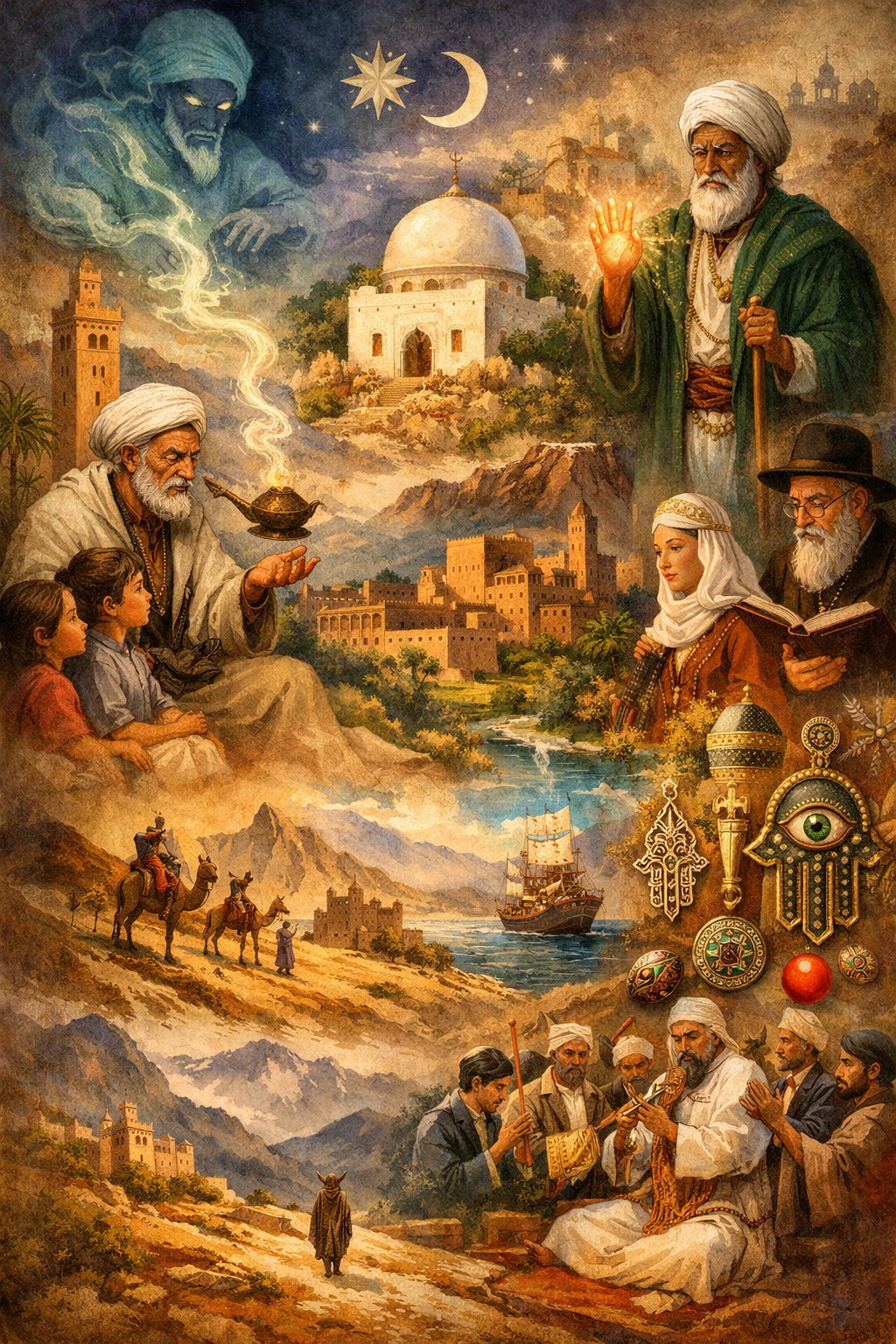
Its distinctive force lies in the way it binds sanctity to place, oral tradition to civilizational memory, popular storytelling to religious life, and landscape to unseen presence. Maghrebi and Andalusi traditions ask how blessing moves through shrines and lineages, how the dead remain present through visitation and memory, how jinn and hidden powers inhabit thresholds, ruins, wells, baths, wild places, and seas, how exile reshapes the imagination of homeland, and how stories preserve worlds after political collapse. The result is one of the richest regional traditions of sacred folklore in the western Islamic world.
This category is especially important because it expands mythology beyond narrower definitions organized around divine pantheons, heroic genealogies, or fixed textual canons. Maghrebi and Andalusi sacred imagination is often preserved through saints, shrines, baraka, dreams, healing rites, household protections, oral tales, ritual music, Jewish and Muslim pilgrimage traditions, Amazigh memory, Saharan travel, Mediterranean crossings, and the remembered aura of al-Andalus. It is therefore a field in which mythology, folklore, religion, anthropology, history, music, migration, and cultural memory must be studied together.
The goal of this pillar is not to force Maghrebi and Andalusi traditions into an artificial mythological system they never possessed. It is to show why these worlds are indispensable precisely because they preserve a more layered form of sacred imagination, one shaped by shrines, saints, pilgrimage, healing, reform and resistance, local memory, frontier fear, hidden beings, trance, music, exile, interreligious encounter, colonial reframing, and the symbolic life of landscapes. It is also to show that this tradition is not singular. It is a field of overlapping stories, practices, and inherited worlds shaped by Amazigh continuity, Islamization, Jewish and Muslim devotional culture, urban memory, Saharan travel, Mediterranean exchange, Morisco displacement, Sephardi resettlement, and the afterlives of al-Andalus.
Why This Field Matters
Maghrebi and Andalusi sacred imagination matters because it offers one of the clearest examples of how sacred narrative survives not only through formal theology, literary canon, or dynastic history, but through oral tradition, local devotion, geography, healing practice, migration, reform, music, memory, and household belief. It reveals how communities imagine the unseen, sanctify the landscape, preserve civilizational loss, and sustain meaning in worlds shaped by plurality, conquest, movement, enslavement, pilgrimage, displacement, colonial classification, and historical fracture.
North Africa and al-Andalus cannot be understood only through rulers, jurists, theologians, philosophers, poets, or dynasties. They were also worlds of shrine visitation, saintly intercession, household protection, shared sacred spaces, popular fear, women’s devotional memory, healing ceremony, spirit affliction, ritual music, pilgrimage, and oral transmission. These forms of imagination shaped how ordinary people understood blessing, protection, danger, illness, travel, loss, fertility, envy, and belonging.
The category also matters because it expands mythology itself. It shows that mythology is not always organized around a pantheon, a closed sacred canon, or a heroic genealogy. It may instead survive through saint-legend, sacred place, folk belief, baraka, jinn traditions, trance and healing, stories of exile, protective practices, and the remembered aura of lost civilizations. In that sense, Maghrebi and Andalusi traditions are essential to a fuller theory of folklore, legend, and sacred imagination.
The field also matters because it helps correct overgeneralized accounts of “Islamic folklore” or “Arab mythology.” The Maghreb is not culturally flat, and al-Andalus is not merely a nostalgic literary symbol. The region preserves Amazigh, Arab, Jewish, Islamic, Mediterranean, Saharan, Morisco, and Sephardi layers, each requiring careful interpretation. The strongest account must hold plurality and relation together.
The Problem of the Archive
A serious series in Maghrebi and Andalusi legend, folklore, and sacred imagination must begin with the recognition that this is not a tradition preserved primarily through a single canonical scripture of myth. Its sources are layered and diverse: oral storytelling, saintly biography, shrine memory, local miracle narratives, pilgrimage practice, healing rituals, oral epic, Amazigh song and tale traditions, Jewish storytelling, urban anecdote, household belief, travel literature, Andalusi remembrance, Morisco afterlife traditions, Sephardi memory, confraternal ritual, music, and the remembered sacred geographies of North Africa and Iberia.
Much of the tradition survives not in one unified textual archive, but in the interplay between spoken narrative, collective memory, ritual practice, music, and place. A saint may be remembered through a shrine rather than a book. A healing tradition may survive in musical ceremony rather than formal doctrine. A jinn story may be preserved as household caution rather than literary tale. A city may carry legend through its gates, fountains, cemeteries, saints, markets, and remembered losses. A family may preserve Andalusi or Sephardi memory through names, songs, recipes, prayers, oral genealogies, or neighborhood traditions.
This archive also poses methodological challenges. Colonial ethnography, missionary writing, reformist critique, nationalist reframing, and modern academic classification have all shaped what survives in written form. Some materials were preserved because outsiders found them exotic. Others were dismissed as superstition. Some practices were hidden, contested, or abandoned under reformist pressure. The modern archive is therefore not neutral.
Interpretation must ask not only what a story says, but where it was told, who preserved it, what practice sustained it, what community claimed it, what power relations reframed it, and whether the tradition remains living, contested, memorialized, or fragmentary. A research-grade pillar must treat the archive as layered, partial, and historically mediated.
Myth Without a Single Canon
Maghrebi and Andalusi sacred imagination is best approached as a plural and adaptive field rather than as a closed mythology. It does not possess one master epic, one authoritative mythographic handbook, or one unified religious canon of legend. Instead, it survives through saint stories, oral tales, jinn lore, Amazigh traditions, Jewish and Muslim pilgrimage memory, trance-healing practice, Andalusi nostalgia, Morisco and Sephardi displacement, Saharan travel, medina folklore, protective rites, and devotional geographies.
This absence of a single canon is not a weakness. It is one of the tradition’s defining features. Sacred imagination in this context is cumulative. It gathers layers: indigenous North African memory, Islamization, Arabic literary culture, Sufi practice, Jewish communal life, Mediterranean exchange, Saharan routes, Iberian exile, colonial classification, and modern heritage formation. No single layer replaces the others completely.
The result is a world of overlapping narrative authorities. A saint’s tomb may carry local authority. A healing ceremony may carry embodied ritual authority. A folktale may carry domestic authority. An Andalusi poem may carry civilizational authority. A Jewish pilgrimage memory may carry communal authority. An Amazigh tale may carry indigenous memory. A jinn warning may carry practical authority in the everyday navigation of risk.
This pillar therefore treats mythology in a careful scholarly sense: not as false religion, and not as a single pantheon, but as a field of symbols, stories, beings, practices, places, and memories through which communities narrate sacred presence, danger, loss, protection, and belonging.
A Layered World of Memory, Devotion, and Place
The Maghrebi and Andalusi narrative world is best understood as layered. Amazigh oral inheritances, Arabization, Islamization, Jewish communal life, Saharan networks, Mediterranean exchange, urban devotional culture, Morisco displacement, Sephardi resettlement, and the long memory of al-Andalus all overlap rather than neatly replacing one another. Sacred imagination in this context emerges through sedimentation: older landscapes, newer religious forms, local shrines, inherited stories, displaced populations, musical ritual, and reinterpreted memory worlds all combine.
This matters because the region’s folklore cannot be reduced to any one identity. It is not simply Amazigh, simply Arab, simply Muslim, simply Jewish, simply Andalusi, simply Saharan, or simply Mediterranean. It is often several of these at once, in unequal but durable relation. The same city, saint, shrine, spirit-place, or story may bear multiple layers of meaning depending on who tells it, where, and why.
A comprehensive pillar should therefore emphasize not only individual legends, but the structure of overlap itself. The sacred imagination of the Maghreb and al-Andalus is cumulative, relational, migratory, and geographically rooted. It is built from places that remember: mountains, medinas, zawiyas, deserts, ports, Jewish mellahs, saintly tombs, Andalusi quarters, Saharan routes, healing lodges, shrines, cemeteries, caves, wells, and old city gates.
This layered quality also gives the field its ethical and historical force. Sacred imagination becomes a way of preserving continuity through rupture. When kingdoms fall, communities move, lineages are displaced, or practices are contested, stories remain as carriers of belonging.
Regional Sacred Worlds Across the Maghreb
A fully comprehensive pillar must differentiate the regional sacred worlds of Morocco, Algeria, Tunisia, Libya, Mauritania, and the Sahara rather than treating the Maghreb as culturally flat. While these regions share broad patterns of saint veneration, jinn lore, oral transmission, pilgrimage, household protection, and sacred geography, they do not preserve identical narrative worlds.
The mountain saint cultures of Morocco, the shrine and urban-devotional worlds of Algeria and Tunisia, the layered Ottoman, Saharan, and local traditions of Libya, the frontier and desert continuities of Mauritania, and the trans-Saharan imaginations that cross conventional borders all require clearer attention. Coastal piety is not identical to oasis piety. Libyan sacred topography is not identical to Moroccan, Algerian, Tunisian, or Mauritanian shrine worlds.
Folklore is always locally inflected. Sacred places, holy lineages, ritual customs, trance traditions, jinn stories, and narratives of danger are shaped by ecology, language, trade routes, colonial history, confessional composition, and the texture of regional memory. Mountains, deserts, medinas, oasis towns, ports, and frontier zones generate different sacred imaginations.
A serious pillar should therefore register the Maghreb as a family of sacred worlds rather than a single undifferentiated field. Its unity lies not in sameness, but in recurring structures of sanctity, oral memory, unseen danger, healing, place, and movement.
Amazigh Oral Traditions and Indigenous Memory
No fully comprehensive account can begin without Amazigh oral traditions. These traditions preserve Indigenous memory through folktale, proverb, song, epic fragments, local legends, ritual forms, and inherited understandings of land, ancestry, danger, wisdom, resistance, and protection. In many regions, oral transmission remained one of the primary vehicles through which identity, memory, and symbolic worldviews were preserved across changing political and religious orders.
This matters because Amazigh traditions are not simply a background layer beneath later Islamic folklore. They are an ongoing presence within North African imagination. Stories of landscape, kinship, spirits, ordeal, wit, animal helpers, local saints, women’s songs, and sacred place often retain older textures even where they later coexist with Islamic saint-veneration or broader regional folklore.
Amazigh oral worlds also complicate linguistic and cultural assumptions. Sacred imagination in the Maghreb was not only Arabic-speaking, even when Arabic literary and religious vocabularies became dominant in many settings. Tamazight languages, oral performance, mountain memory, and local ritual knowledge remain foundational to the region’s narrative life.
A serious pillar should therefore treat Amazigh narrative worlds not as a peripheral addition, but as one of the foundational imaginative strata of Maghrebi folklore and sacred memory.
Arab, Islamic, Jewish, and Mediterranean Overlays
The sacred imagination of the Maghreb and al-Andalus was reshaped by Arab and Islamic expansion, by Jewish communal life, and by wider Mediterranean exchange. These did not erase what came before. Rather, they reconfigured narrative worlds through new scriptural vocabularies, saint traditions, prophetic memory, pilgrimage patterns, urban cultures, legal norms, devotional practice, and shared symbolic idioms of exile, blessing, and sanctity.
Muslim and Jewish communities could inhabit related sacred geographies, revere particular figures or sites in different ways, and contribute to overlapping narrative worlds of wonder, danger, healing, pilgrimage, and holy presence. Mediterranean contact added further layers: maritime travel, captivity, trade, exile, port cities, Andalusi memory, Ottoman-era circulation, and encounters with Iberia, Sicily, the western Mediterranean, and the wider Islamic world.
This does not mean that differences disappear. Muslim and Jewish traditions preserved distinct theologies, legal frameworks, liturgies, communal memories, and sacred calendars. But a historically grounded account must also recognize proximity, exchange, shared landscapes, and parallel forms of devotion. The same hill, tomb, cave, spring, or saintly memory might occupy different positions in different communities while remaining part of a common regional landscape.
A comprehensive pillar should therefore frame the region not as culturally sealed, but as a space of braided inheritances and intersecting sacred vocabularies.
Saints, Shrines, Marabouts, and the Geography of Baraka
One of the most important features of Maghrebi sacred imagination is the role of saints, shrines, and maraboutic memory. Across North Africa, saintly figures became anchors of local memory, moral authority, healing hope, territorial identity, and sacred protection. Their tombs, lodges, domed shrines, or associated sites often served as nodes of pilgrimage, intercession, communal gathering, and popular devotion. Baraka was not merely an abstract blessing. It was imagined as concentrated, transmissible, and place-bearing.
Saint tradition gives the region one of its strongest alternatives to centralized religious abstraction. Sacred power becomes local, embodied, geographic, and relational. Shrines are where memory and hope converge. A saint may be remembered not only through text but through visitation, vow, seasonal festival, lineage claim, healing story, or inherited family memory.
This sacred geography can be intensely local. A mountain saint may protect a valley. A city saint may guard a medina. A desert holy figure may anchor routes of travel. A shrine may be visited for fertility, healing, protection, reconciliation, or relief from affliction. A saintly lineage may preserve social authority through genealogy, hospitality, and custodianship of baraka.
For that reason, Maghrebi legend is often inseparable from sacred geography. The holy is mapped onto the land through lineages of sanctity and remembered presence.
Zawiyas, Lineages, and the Social World of Sanctity
A fully comprehensive account should also foreground zawiyas, saintly lineages, and the social institutions through which sanctity was organized and transmitted. In the Maghreb, holiness was often not purely individual. It moved through families, discipleship, hospitality networks, local teaching institutions, ritual calendars, and territorial memory.
Zawiyas could serve as devotional centers, places of mediation, educational spaces, lodgings for travelers, and custodians of sacred reputation. They could organize relations among students, pilgrims, neighbors, rural communities, tribes, merchants, travelers, and saintly descendants. Sanctity became institutional without becoming merely bureaucratic.
This matters because saint folklore risks appearing purely miraculous if its social world is ignored. A saint’s authority is often sustained through descendants, caretakers, affiliated communities, ritual obligations, oral transmission, annual festivals, and practices of hospitality. The shrine world is therefore also a social world.
Zawiyas and saintly lineages show how sacred imagination becomes durable. Stories remain powerful because institutions, families, routes, buildings, rituals, and communities keep them in circulation.
Pilgrimage, Visitation, and Devotional Landscape
Visitation and pilgrimage are central to Maghrebi and Andalusi sacred imagination. To visit a shrine, tomb, city, spring, cave, mountain, or saintly resting place was not merely to arrive somewhere. It was to enter an inherited story-world already charged with memory, baraka, danger, and expectation.
Sacred imagination is often spatial before it is textual. Pilgrimage routes, ziyara practices, and devotional journeys teach communities how to inhabit meaning through movement and place. The landscape itself becomes interpretive. A road may recall a saint. A mountain may preserve a retreat. A city gate may hold a story. A cemetery may carry moral memory. A shrine may gather the living and the dead into ritual relation.
Visitation also makes sacred memory repeatable. Each journey renews the story. The site is not simply remembered; it is revisited, touched, prayed at, circled, cleaned, decorated, narrated, or protected. Devotional movement gives narrative bodily form.
This gives the region a powerful geography of sanctity in which roads, deserts, mountain paths, medinas, coastal routes, and frontier zones become narrative as well as physical spaces.
Jinn, Hidden Beings, and the Unseen World
No serious account of Maghrebi and Andalusi folklore can ignore jinn traditions and the wider imagination of hidden beings. Across North African storytelling, household belief, sacred warning, healing practice, and local caution, jinn occupy a crucial role as inhabitants of thresholds, ruins, wilderness, caves, wells, baths, abandoned places, nighttime spaces, crossroads, and spiritually unstable environments. They belong to the unseen but are often imagined as near.
Jinn lore is one of the principal ways the region narrates spiritual danger, unseen agency, psychological unease, territorial taboo, and the uncertain permeability of the world. Such stories are not merely “superstitions” in the dismissive sense. They organize conduct, caution, fear, ritual practice, spatial etiquette, and the sense that reality is layered beyond human control.
In the Maghrebi context, jinn traditions often intersect with Islamic cosmology, local place-memory, inherited oral warning, household ritual, illness interpretation, and healing practice. A place may be avoided because it is inhabited. A bathhouse may require caution. A well may be dangerous. A night journey may invite unseen presence. A person’s suffering may be read through an idiom of affliction or contact with hidden beings.
Jinn lore therefore belongs centrally to sacred folklore rather than as a detachable curiosity. It gives narrative form to the unstable boundary between the seen and unseen worlds.
Evil Eye, Amulets, Healing, and Protective Folklore
Protective folklore is central to the lived sacred world of the Maghreb: the evil eye, amulets, written charms, blessing formulas, protective recitation, healing objects, household safeguards, gestures, color symbolism, saintly protection, and vernacular practices of spiritual defense. Such traditions are often transmitted through family memory, neighborhood custom, and women’s domestic practice as much as through formal religious instruction.
Sacred imagination is not only about wonder or fear in the abstract. It is also about living safely in a world believed to be vulnerable to envy, affliction, impurity, hidden force, and spiritual instability. Protective practices narrate danger even when they do not appear in extended story form. An amulet is a compressed narrative of vulnerability and protection. A blessing formula is a miniature ritual of safety. A household practice is a theory of unseen risk.
Healing traditions also reveal how religion, folklore, and the body overlap. Illness may be interpreted through natural, social, spiritual, or moral frameworks at once. Communities may seek remedies through medicine, prayer, saintly visitation, recitation, ritual specialists, family practices, or inherited knowledge.
These traditions belong centrally to folklore because they reveal how communities ritualize caution, hope, and resilience in everyday life.
Possession, Affliction, and Ritual Response
Possession, affliction, and ritual response also belong inside a fully comprehensive account. In many North African settings, unexplained suffering, disturbed behavior, bodily unease, persistent misfortune, infertility, nightmares, or emotional distress could be interpreted through frameworks involving jinn, spiritual harm, imbalance, saintly testing, envy, or affliction. Ritual responses might include recitation, healing visits, amuletic practices, saintly intercession, communal ceremonies, trance-healing, or locally recognized therapeutic forms.
Folklore is not only narrative but diagnostic. It gives communities ways of naming and responding to what feels spiritually or socially disordered. Such traditions reveal the close relation between belief, suffering, ritual, and interpretation. They also reveal why dismissive categories such as “superstition” are analytically weak. Communities often use these frameworks to organize care, meaning, social attention, and ritual response around suffering that might otherwise remain unintelligible.
Affliction narratives also expose social pressures. Gender, class, migration, family conflict, poverty, illness, and grief may all be expressed through idioms of spirit contact or hidden harm. This does not reduce the sacred dimension to social explanation; it shows how sacred and social worlds interact.
Including this dimension helps complete the pillar’s account of the lived sacred, especially where storytelling, healing, fear, and religious practice intersect.
Gnawa, Trance-Healing, and Spirit Cosmology
Gnawa traditions are essential because they bring together spirit cosmology, trance, healing, musical ceremony, possession idioms, devotional practice, and the historical memory of slavery and trans-Saharan movement. Their ceremonial life reveals a sacred imagination in which the unseen is engaged through embodied sound, color, rhythm, invocation, sacrifice, lineage, and therapeutic performance.
Gnawa traditions are not simply musical subculture or anthropological curiosity. They preserve one of the most vivid ritual cosmologies of the Maghreb, linking healing, spirit-affliction, memory, and devotional practice. They also enlarge the pillar’s Saharan and transregional dimensions by connecting North African sacred life to sub-Saharan histories, enslavement, movement, and spiritual inheritance.
The power of Gnawa practice lies partly in embodiment. Sacred imagination is not only told; it is sounded, danced, felt, endured, and ritually negotiated. Rhythm becomes a pathway. Color becomes classification. Ceremony becomes diagnosis and response. Spirit worlds become socially and bodily present.
Including Gnawa makes the treatment of possession, healing, memory, and trans-Saharan sacred imagination much more complete.
Aissawa, Hamadsha, and Ritual Brotherhood Folklore
Ritual brotherhood traditions such as the Aissawa and Hamadsha illuminate how saintly memory, ecstatic practice, healing, music, ordeal, possession idioms, and communal ceremony overlap in North African sacred life. These confraternal worlds are central to understanding folklore as embodied practice rather than only oral narrative.
Brotherhood traditions preserve memories of founders, saints, disciplines, ritual repertoires, healing capacities, and modes of collective performance. Their practices may include music, procession, chant, trance, bodily ordeal, and public festival, making sacred imagination visible and audible in social space.
This matters because folklore in the Maghreb is not only domestic or textual. It is also collective, ritualized, musical, and embodied. It may be performed in streets, shrines, festivals, healing ceremonies, and public gatherings. Brotherhood traditions preserve vocabularies of affliction and cure that are central to lived sacred imagination.
This dimension strengthens the pillar by showing how sanctity and folklore are enacted as well as told.
Desert, Mountain, and Frontier Imaginaries
The Maghreb’s sacred imagination is inseparable from terrain. Deserts, mountains, forests, borderlands, abandoned sites, caves, wells, caravan routes, and frontier spaces all function as narrative intensifiers. These are places of danger, revelation, deprivation, holy retreat, hidden beings, saintly wandering, ordeal, and encounter. Landscape is not passive backdrop. It shapes the symbolic grammar of the region.
Frontier environments often become zones where the visible and invisible feel close together. The mountain may be a place of refuge, resistance, saintly isolation, or older memory. The desert may signify both threat and revelation. The cave may shelter saints, spirits, fugitives, or hidden knowledge. The well may preserve blessing or danger. Threshold spaces intensify the possibility of spiritual encounter and metaphysical fear.
This terrain-based imagination also reflects historical realities. Communities moved through difficult landscapes; traders crossed deserts; saints wandered; pilgrims traveled; exiles fled; colonial armies entered; pastoral and agricultural worlds met; mountain communities preserved distinct identities. Sacred geography is often shaped by the pressures of survival.
A comprehensive pillar should therefore treat terrain as one of the central agents of Maghrebi folklore and not merely a scenic frame.
Saharan and Trans-Saharan Sacred Imagination
The Saharan and trans-Saharan dimension is indispensable. Caravan routes, oasis towns, desert saints, wandering holy figures, trans-Saharan trade, slavery routes, pilgrimage, scholarly networks, and mobile ritual worlds helped shape a sacred imagination distinct from coastal or urban North Africa. The Sahara was not empty space. It was a zone of ordeal, exchange, revelation, vulnerability, and spiritual intensity.
Saharan sacred imagination is structured by movement. Routes matter. Wells matter. Saints who protect travelers matter. Oases become storied places. Desert danger produces narratives of rescue, disappearance, blessing, and trial. Trans-Saharan movement also carried music, spirit traditions, healing practices, Islamic learning, enslaved communities, commodities, texts, and memories across vast distances.
This matters because the Maghreb cannot be understood only through Mediterranean cities and northern shrine worlds. Saharan mobility shaped legends, saintly authority, spirit worlds, memory of danger, and the circulation of ritual forms across North Africa and the Sahel.
This layer gives the pillar a more accurate geographic and civilizational depth.
City Memory, Medinas, and Sacred Urban Space
Sacred imagination in North Africa and al-Andalus is not confined to wilderness or shrine peripheries. Cities, medinas, gates, markets, mosques, synagogues, quarters, cemeteries, fountains, hammams, old schools, palaces, and city walls also become storied and symbolically charged. Urban sacred memory gathers around saints, scholars, founders, protectors, hidden graves, miracle sites, and remembered neighborhoods.
Fes, Tlemcen, Marrakesh, Tunis, Tripoli, Kairouan, Rabat, Salé, Algiers, Granada, Córdoba, Seville, and many other cities carry layered narrative worlds. A medina may be remembered through its saints, crafts, gates, guilds, scholars, Jewish quarters, markets, water systems, mosques, zawiyas, cemeteries, and origin legends. Urban folklore preserves the city as moral atmosphere, not merely architecture.
Cities in the Maghrebi and Andalusi world often preserve civilizational memory through layered sacred topographies. A city may be imagined not only through institutions but through aura, holy figures, stories of founding, losses, refinements, and relations to blessing or decline.
Urban folklore therefore belongs at the center of this pillar. The sacred imagination of the medina is as important as that of the desert or mountain.
Ports, Coasts, and the Sacred Mediterranean
The littoral world of the Maghreb and al-Andalus also deserves sustained attention. Ports, harbors, sea-crossings, islands, fishing communities, captivity routes, corsair memory, coastal shrines, shipwrecks, merchant routes, and maritime danger all contribute to a sacred Mediterranean imagination distinct from inland saint geographies or desert worlds. The coast is a place of trade, exile, peril, passage, and encounter.
Maritime life generates its own folklore: prayers for safe crossing, legends of rescue, stories of disappearance, coastal saints, protective shrines, shipwreck memory, captivity narratives, and tales of return. Sea-danger is one of the region’s underrecognized sacred frontiers. The Mediterranean is not simply a highway of exchange; it is also a space of fear, enslavement, piracy, pilgrimage, migration, and longing.
Ports also connect the Maghreb to al-Andalus, Sicily, the Ottoman Mediterranean, sub-Saharan routes, Jewish and Muslim migration, European trade, and colonial penetration. Coastal sacred imagination therefore links devotion to political history.
Including this dimension makes the pillar geographically fuller and more historically Mediterranean.
Animals, Omens, and Vernacular Cosmology
A full account should also include vernacular cosmology: omen lore, animal symbolism, feared and protective creatures, birds as signs, serpents, horses, dogs, jackals, insects, weather, dreams, crossings, and unusual natural events. Not all sacred imagination in the Maghreb is organized around saints or jinn alone. Everyday cosmological reading also matters.
Folklore is often woven into ordinary perception. Animals, sounds, weather shifts, household incidents, dreams, misfortunes, and chance encounters may be read as warnings, blessings, signs of hidden disturbance, or calls for ritual caution. Such traditions reveal how communities inhabit a world filled with layered significance.
Animal and omen traditions also connect the Maghreb to older ecological and pastoral worlds. Horses may carry prestige and protection; serpents may signify danger or hidden presence; birds may mark destiny or transition; dogs and jackals may evoke boundary zones; insects and household creatures may become signs in domestic cosmology.
Including this material helps complete the pillar beyond shrine-centered devotion and toward a fuller vernacular cosmology.
Seasonal Festivals and Ritual Time
Ritual time is as important as sacred place. Local saint festivals, annual commemorations, seasonal gatherings, agricultural rhythms, Mawlid-related narrative worlds, pilgrimage seasons, trance-healing nights, harvest observances, weddings, mourning cycles, and communal celebrations all shape when and how sacred stories are told. Folklore is often calendrical as well as spatial.
Ritual time gives narrative recurrence. Stories return on feast days, pilgrimage seasons, healing nights, communal gatherings, and anniversaries of saints. The same saintly miracle may be retold during an annual moussem. The same family memory may return at a wedding or funeral. The same healing repertoire may be activated at a ceremonial night.
Calendrical repetition helps traditions endure. A story told once may fade; a story tied to a festival returns. Ritual time gives narrative a schedule, a community, a place, and a body of practice.
This temporal dimension helps explain how Maghrebi and Andalusi sacred imagination remains durable: it is repeated in cycles of movement, performance, gathering, mourning, celebration, and visitation.
Andalusi Memory, Exile, and the Lost Homeland
One of the most distinctive dimensions of this category is Andalusi memory. The afterlife of al-Andalus in North African and wider western Islamic imagination is not only historical. It is affective, symbolic, and civilizational. Exile, loss, beauty, refinement, displacement, and remembrance all gather around Andalusi memory traditions. The lost homeland becomes part of the region’s sacred and cultural imagination.
Al-Andalus survives not only as a historical polity, but as a remembered world. Stories, songs, lineages, place-names, devotional inheritance, urban memory, craft traditions, music, literary nostalgia, and diasporic consciousness all help preserve its symbolic life. The fall of al-Andalus becomes not only a political event but a narrative wound.
The memory of al-Andalus is not singular. It can function as paradise lost, as the image of refinement and beauty, as the memory of convivencia, as a civilizational wound, as a warning about moral decline, and as a mirror for later questions of identity, belonging, and historical fragility.
A fully comprehensive pillar therefore needs exile and loss at its center. Andalusi memory gives the category one of its deepest themes: the preservation of civilization through narrative after dispossession.
Morisco and Sephardi Afterlives in North Africa
Morisco afterlives must be distinguished from Andalusi memory in the broader sense. The expulsions of Muslim communities from Iberia and their resettlement in North Africa did not simply preserve memory; they transformed it. Morisco communities carried lineage consciousness, crafts, devotional habits, place-memory, language traces, and stories of loss into new Maghrebi settings, where those inheritances reshaped local sacred and folkloric worlds.
Sephardi afterlives are equally important. The expulsion and migration of Iberian Jews, their settlement in Maghrebi cities, and the reshaping of communal memory, saint traditions, liturgical worlds, household belief, Judeo-Arabic and Judeo-Spanish inheritances, and vernacular storytelling belong centrally to the region’s sacred imagination. Sephardi memory, like Morisco memory, transformed North African cultural life.
These afterlives matter because displacement makes memory portable. What was once anchored in Iberian places became carried through families, songs, manuscripts, names, prayers, foodways, craft traditions, urban neighborhoods, and stories of origin. North African cities became repositories of lost Iberian worlds.
Without Morisco and Sephardi afterlives, the pillar’s treatment of exile remains incomplete. The afterlife of al-Andalus is not only literary nostalgia; it is socially embodied memory.
Al-Andalus as Paradise-Memory and Civilizational Warning
Al-Andalus often functions as paradise-memory: a remembered world of gardens, learning, poetry, architecture, refinement, music, coexistence, beauty, and cultivated urban life. But it also functions as civilizational warning. The memory of its fall can be read through moral decline, disunity, betrayal, conquest, loss, and historical fragility. Its symbolic power lies in the tension between beauty and disappearance.
This matters because al-Andalus is not only a lost place but a moral and symbolic mirror. Communities project into it hopes, warnings, longings, and judgments about the present. The memory of its fall becomes part of a larger sacred and civilizational reflection on loss. The past becomes a way of asking what makes societies flourish and why they collapse.
Andalusi literary legend and adab memory also preserve another register: wit, elegance, courtly refinement, poetic rivalry, cultivated friendship, philosophical brilliance, and urban beauty. Not all Andalusi afterlife is shrine memory or exile lament. Some survives through literary nostalgia and symbolic urban refinement.
This deepens the pillar’s treatment of Andalusi afterlife beyond exile into a philosophy of history, style, and remembrance.
Muslim and Jewish Folklore in the Western Islamic World
A fully comprehensive content pillar must account for Jewish and Muslim folklore together where appropriate, especially in the Maghrebi and Andalusi worlds shaped by long coexistence, mutual awareness, and overlapping sacred geographies. Jewish communities in North Africa developed their own saint stories, pilgrimage traditions, healing legends, protective practices, household tales, and memory worlds, some of which intersected spatially or symbolically with Muslim settings.
Shared sacred spaces and confessional overlap are crucial. In some settings, Muslims and Jews maintained related relationships to saints, tombs, caves, springs, hills, and sites of blessing or danger, even where their practices, interpretations, and theologies differed. Sacred geography could therefore become layered confessional space rather than exclusive territory.
Plurality should not be romanticized. Shared spaces could coexist with hierarchy, tension, exclusion, and political vulnerability. But ignoring overlap would narrow the cultural reality of the Maghreb and al-Andalus. Difference and proximity must both be preserved.
A serious pillar should therefore recognize that plurality is part of what makes the region’s folklore so rich. Sacred imagination here is not one archive but a set of adjacent and overlapping worlds.
Women, Saints, Domestic Piety, and Household Belief
No fully comprehensive pillar should confine sacred imagination to male saints, public shrines, or institutional religion alone. Women’s devotional memory, household practice, healing rituals, lullabies, protective customs, local saint narratives, fertility traditions, mourning practices, and domestic storytelling all play a major role in sustaining folklore and sacred belief. The home is often one of the principal sites where invisible danger, blessing, prayer, fertility, illness, and inherited caution are narrated and managed.
Household belief is one of the most durable carriers of folklore. Stories about jinn, saints, omens, purity, protection, fertility, illness, envy, and baraka often persist through domestic transmission long after more formal institutions change. Women’s piety and women’s storytelling therefore belong centrally to this world.
Women saints and holy women also deserve careful attention. Their stories may involve healing, fertility, protection, saintly descent, local memory, spiritual power, or moral example. They complicate any account that treats sanctity as exclusively male or public.
This broadens the pillar beyond shrine-centered public religion and toward the lived sacred textures of everyday life.
Miracle, Legend, and the Popular Sacred
Miracle stories are among the central narrative forms of Maghrebi and Andalusi sacred imagination. Accounts of healing, rescue, dream visitation, extraordinary knowledge, saintly intervention, hidden protection, fertility, safe travel, and impossible survival do not simply record marvels. They help communities narrate divine nearness, legitimize local holy figures, and anchor memory in emotionally powerful forms.
Miracle legend often becomes the bridge between formal religious worlds and everyday experience. A saint’s story is not only about doctrine. It is about what people believe can happen in the presence of grace, baraka, or sacred intercession. It gives narrative form to hope under conditions of illness, danger, infertility, exile, poverty, drought, fear, or political instability.
The popular sacred is therefore not lesser sacred life. It is the domain in which sacred power becomes locally meaningful. People remember the saint who healed a child, the shrine that protected a village, the dream that guided a family, the vow that was fulfilled, or the visitation that transformed grief into endurance.
Miracle is one of the principal narrative engines of popular religion in the region and a key element of its folklore.
Oral Genres, Performance, and the Transmission of Memory
A fully comprehensive pillar should distinguish oral genres and performance traditions clearly. Folktale, saint legend, miracle narrative, proverb, sung poetry, women’s household song, lament, anecdote, seasonal narration, local historical legend, market storytelling, ritual chant, trance music, and epic recitation do not function identically. Each carries memory differently and each gives sacred imagination a distinct rhythm and social setting.
Folklore is not only content but performance. Stories are told in homes, shrines, markets, festivals, seasonal gatherings, roads, family circles, trance ceremonies, and pilgrimage contexts. Who tells the story, to whom, when, and under what conditions shapes what the story means. A tale told to a child at night differs from a miracle story told at a shrine, a healing song performed in ceremony, or a proverb used in conflict mediation.
Performance also preserves what text cannot: tone, gesture, repetition, improvisation, audience response, memory gaps, emotional intensity, and local interpretation. These features are not accidental; they are part of how sacred imagination lives.
Including oral performance makes the pillar less like a static archive and more like a living cultural world.
Popular Religion, Reformist Critique, and Colonial Reframing
A fully comprehensive pillar must acknowledge that shrine culture, saint devotion, amulets, healing practice, spirit ceremony, trance traditions, and other forms of popular religion have not gone uncontested. Reformist critiques across modern and late premodern periods have often challenged saint intercession, maraboutism, ziyara practices, shrine-centered devotion, and what critics describe as superstition or innovation. These critiques are themselves part of the folklore world because they reshape which practices are defended, hidden, abandoned, or reinterpreted.
Sacred imagination is not static. It is argued over. The line between devotion and superstition, reverence and excess, local piety and religious reform becomes one of the major fault lines in the modern history of North African popular religion. Practices survive not only by repetition but by adaptation under criticism.
Colonial disruption and ethnographic capture must also be recognized. Colonial administrations, Orientalist scholarship, missionary writing, reformist critique, and modern state projects all altered how Maghrebi folklore was classified, preserved, suppressed, romanticized, or fragmented. Traditions once lived as sacred practice were often redescribed as folklore, superstition, pathology, or cultural residue.
To understand Maghrebi and Andalusi sacred imagination fully is therefore also to understand how it was reclassified under modern power. This makes the pillar more historically self-aware and better suited to a research-grade mythology architecture.
Major Questions of Interpretation
This pillar is organized around several major questions. How should Maghrebi and Andalusi legend, folklore, and sacred imagination be studied when its archive includes oral storytelling, Amazigh traditions, Muslim and Jewish saint veneration, shrine memory, jinn lore, healing rituals, Gnawa and brotherhood ceremonies, domestic piety, Andalusi nostalgia, Morisco and Sephardi displacement, colonial ethnography, and modern heritage discourse? What does it mean to study mythology when the field is organized less by gods and more by sanctity, place, unseen presence, blessing, exile, and ritual practice?
The pillar also asks how landscape becomes sacred memory. Why do mountains, deserts, medinas, ports, caves, wells, baths, shrines, cemeteries, and lost cities carry such symbolic force? How do jinn and hidden beings structure fear and caution? How do saints and marabouts localize baraka? How do women’s household practices preserve cosmology? How do Morisco and Sephardi memories transform North African worlds after expulsion? How do reformist critique and colonial classification reshape what is remembered as folklore?
These questions keep the category from becoming a simple inventory of legends. They open Maghrebi and Andalusi sacred imagination as a field of religious, oral, domestic, musical, material, geographical, interconfessional, performative, and historical inquiry. The tradition is not only a collection of stories. It is one of the great symbolic systems through which communities have imagined blessing, danger, healing, displacement, and sacred presence across North Africa, Iberia, the Sahara, and the Mediterranean.
Expanded Article Architecture
The following structure gathers the pillar into a long-range architecture suitable for a major mythology knowledge series. It is designed to support Amazigh oral traditions, Maghrebi saint veneration, Jewish and Muslim folklore, jinn lore, healing and possession traditions, ritual brotherhoods, sacred geography, Andalusi memory, Morisco and Sephardi afterlives, Saharan and Mediterranean worlds, women’s domestic transmission, colonial reframing, and modern afterlives. All entries below should be treated as planned unless already completed elsewhere on the site.
Foundations and Source Problems
- What Is Maghrebi & Andalusi Legend, Folklore & Sacred Imagination? (planned)
- The Problem of Sources in Maghrebi and Andalusi Sacred Folklore (planned)
- Maghrebi and Andalusi Sacred Imagination Without a Single Canon (planned)
- Oral Tradition, Shrine Memory, Ritual Practice, and Place in the Western Islamic World (planned)
- How to Read Maghrebi and Andalusi Legend Across Genres and Communities (planned)
- Mythology Beyond Pantheon: Sanctity, Baraka, and the Lived Sacred (planned)
Regional Sacred Worlds of the Maghreb
- Regional Sacred Worlds of Morocco, Algeria, Tunisia, Libya, Mauritania, and the Sahara (planned)
- Morocco’s Mountain Saints, Medinas, and Ritual Brotherhoods (planned)
- Algerian Shrine Worlds, Colonial Memory, and Local Sacred Geography (planned)
- Tunisian Saints, Urban Piety, and Mediterranean Sacred Memory (planned)
- Libyan Sacred Topographies Between Coast, Desert, and Ottoman Memory (planned)
- Mauritania, Desert Scholarship, and the Sacred Imagination of Mobility (planned)
- The Maghreb as a Family of Sacred Worlds (planned)
Amazigh Oral Traditions and Indigenous Memory
- Amazigh Oral Traditions and the Deep Memory of North Africa (planned)
- Indigenous Storyworlds in the Maghreb (planned)
- Amazigh Folktales, Proverbs, Songs, and Sacred Landscapes (planned)
- Mountain Memory, Kinship, and Oral Authority in Amazigh Worlds (planned)
- Amazigh Women’s Songs and the Transmission of Local Cosmology (planned)
- Land, Ancestry, and Protection in North African Indigenous Memory (planned)
Arabization, Islamization, and Sacred Reordering
- Arabization, Islamization, and the Reordering of Sacred Narrative (planned)
- Arabic Sacred Vocabulary and the Transformation of Local Memory (planned)
- Islamic Devotional Worlds and the Adaptation of Older Landscapes (planned)
- Qurʾanic Moral Imagination and North African Folklore (planned)
- Prophetic Memory, Saints, and Local Islam in the Maghreb (planned)
- Continuity and Transformation in Maghrebi Religious Folklore (planned)
Jewish and Muslim Folklore in the Western Islamic World
- Jewish and Muslim Folklore in the Western Islamic World (planned)
- Jewish Saint Veneration and Sacred Memory in the Maghreb (planned)
- Shared Sacred Spaces in Maghrebi Jewish and Muslim Memory (planned)
- Holy Tombs, Healing Legends, and Pilgrimage Across Communities (planned)
- Judeo-Arabic Storytelling and North African Sacred Folklore (planned)
- Difference, Proximity, and Sacred Geography in Maghrebi Plurality (planned)
Saints, Shrines, Marabouts, and Baraka
- Saints, Shrines, Marabouts, and the Geography of Baraka in North Africa (planned)
- Marabouts, Zawiyas, and the Social World of North African Sanctity (planned)
- Pilgrimage, Ziyara, and the Sacred Landscape of the Maghreb (planned)
- Saintly Lineages, Local Authority, and the Transmission of Blessing (planned)
- Miracle Stories and the Popular Sacred (planned)
- Healing, Protection, and the Narrative Life of Baraka (planned)
- Saints as Guardians of Villages, Cities, Routes, and Frontiers (planned)
Jinn, Hidden Beings, and Spiritual Danger
- Jinn Lore and the Hidden World in Maghrebi Folklore (planned)
- Ruins, Wells, Baths, and Threshold Spaces of Spiritual Danger (planned)
- Jinn, Caves, Mountains, and Abandoned Places in North African Storytelling (planned)
- Spiritual Etiquette and the Everyday Management of the Unseen (planned)
- Fear, Possession, and the Narrative Geography of Hidden Beings (planned)
- Jinn Between Islamic Cosmology and Local Folklore (planned)
Protection, Healing, and Ritual Response
- Evil Eye, Amulets, and Protective Folklore in North Africa (planned)
- Healing, Possession, and Ritual Response in Maghrebi Sacred Life (planned)
- Written Charms, Protective Recitation, and the Material Life of Sacred Words (planned)
- Household Safeguards, Blessing Formulas, and Domestic Protection (planned)
- Affliction, Diagnosis, and Ritual Care in North African Folklore (planned)
- Healing Between Shrine, Household, Recitation, and Ceremony (planned)
Gnawa, Brotherhoods, and Embodied Sacred Practice
- Gnawa, Spirit Worlds, and Trance-Healing Cosmologies (planned)
- Aissawa, Hamadsha, and Ritual Brotherhood Folklore (planned)
- Music, Possession, and Healing in Moroccan Sacred Performance (planned)
- Color, Rhythm, Spirit Classification, and Ritual Knowledge in Gnawa Worlds (planned)
- Slavery, Trans-Saharan Memory, and the Sacred History of Gnawa Practice (planned)
- Embodied Folklore: Trance, Ordeal, and Communal Ceremony (planned)
Landscape, Terrain, and Sacred Geography
- Desert Imaginaries in North African Sacred Storytelling (planned)
- Mountains, Caves, and Holy Retreat in Maghrebi Legend (planned)
- Saharan and Trans-Saharan Sacred Imaginations (planned)
- Caravan Routes, Oases, and Desert Saints (planned)
- City Saints, Medinas, and Urban Sacred Memory (planned)
- Fes, Tlemcen, Marrakesh, Tunis, Tripoli, and the Aura of Sacred Cities (planned)
- Ports, Coasts, and the Sacred Mediterranean of the Maghreb (planned)
- Animals, Omens, and Vernacular Cosmology in North African Folklore (planned)
Ritual Time, Festivals, and Communal Recurrence
- Seasonal Festivals, Saint Feasts, and Ritual Time (planned)
- Moussem Traditions and the Annual Return of Sacred Memory (planned)
- Mawlid, Local Devotion, and Narrative Recurrence in North Africa (planned)
- Harvest, Rain, Fertility, and Agricultural Sacred Time (planned)
- Festival, Market, Shrine, and the Social Life of Story (planned)
- How Ritual Time Keeps Folklore Alive (planned)
Women, Domestic Piety, and Household Belief
- Women, Household Belief, and Domestic Sacred Imagination (planned)
- Women Saints and Local Lineages of Devotion (planned)
- Lullabies, Laments, Wedding Songs, and Protective Knowledge (planned)
- Birth, Fertility, Illness, and Women’s Ritual Authority (planned)
- Domestic Jinn Lore, Omens, and Threshold Practices (planned)
- Women as Tellers, Healers, Custodians, and Interpreters of Baraka (planned)
Andalusi Memory, Exile, and the Lost Homeland
- Andalusi Memory and the Sacred Afterlife of al-Andalus (planned)
- Exile, Loss, and the Legend of the Lost Homeland (planned)
- Granada, Córdoba, Seville, and the Memory of Andalusi Civilization (planned)
- Al-Andalus as Paradise-Memory and Civilizational Warning (planned)
- Andalusi Literary Legend, Adab, and the Memory of Refinement (planned)
- Music, Architecture, Poetry, and the Aesthetic Afterlife of al-Andalus (planned)
Morisco and Sephardi Afterlives
- Morisco Exile, Memory, and the Afterlife of al-Andalus in North Africa (planned)
- Andalusi Refugees and the Transmission of Story Across the Maghreb (planned)
- Sephardi Afterlives and Jewish Sacred Geography in North Africa (planned)
- Morisco and Sephardi Memory as Portable Civilizational Archive (planned)
- Iberian Loss, North African Resettlement, and the Folklore of Displacement (planned)
- Lineage, Neighborhood, Song, and the Social Memory of Expulsion (planned)
Oral Genres, Performance, and Transmission
- Storytellers, Oral Performance, and the Transmission of Sacred Memory (planned)
- Storytelling, Migration, and the Preservation of Civilizational Memory (planned)
- Folktale, Proverb, Song, Lament, and the Genres of Maghrebi Memory (planned)
- Market Storytelling, Shrine Narration, and Household Tale Worlds (planned)
- Oral Performance as Sacred Interpretation (planned)
- From Spoken Story to Ethnographic Archive (planned)
Contestation, Colonialism, and Modern Afterlives
- Popular Religion and Reformist Critique in Maghrebi Sacred Life (planned)
- Colonial Ethnography and the Reframing of Maghrebi Folklore (planned)
- The Maghreb and the Sacred Mediterranean (planned)
- Heritage, Tourism, and the Modern Display of Sacred Folklore (planned)
- Moroccan Gnawa, Global Music, and the Transformation of Ritual Memory (planned)
- Maghrebi and Andalusi Legend in Comparative Perspective (planned)
- Why Maghrebi and Andalusi Sacred Imagination Still Matters (planned)
Closing Perspective
Maghrebi and Andalusi legend, folklore, and sacred imagination reveal one of the great layered archives of the western Islamic and Mediterranean world. They preserve Amazigh oral memory, saintly baraka, shrine visitation, jinn lore, healing ritual, trance music, Jewish and Muslim sacred geographies, domestic piety, Andalusi nostalgia, Morisco and Sephardi displacement, Saharan travel, port-city memory, medina folklore, and the contested afterlives of popular religion. Their power lies not in a single fixed canon, but in a living continuity of place, performance, ritual, family memory, and sacred story.
This is what makes the category so important within Mythology. Maghrebi and Andalusi sacred imagination shows how mythology can be devotional and folkloric, oral and embodied, Muslim and Jewish, Amazigh and Arab, Saharan and Mediterranean, local and transregional, ancient and continually reinterpreted. It also shows why mythology must be studied through landscape, ritual, healing, gender, music, material culture, exile, and lived community, not only through story summary.
The strongest reason to study this field is that it clarifies how communities preserve meaning across rupture. Saints protect places; stories remember lost homes; jinn mark thresholds; healing ceremonies give suffering a language; women transmit household cosmologies; shrines localize blessing; Andalusi memory turns historical loss into civilizational reflection. These traditions do not belong only to the past. They continue to shape how communities imagine belonging, danger, sanctity, displacement, and the hidden life of the world.
Related Reading
- Mythology
- Arabian and Levantine Myth, Folklore, and Sacred Narrative
- African Myth, Folklore, and Sacred Narrative
- Maghrebi and Andalusi Thought
- Maghrebi and Andalusi Literature and Cultural Memory
- Indigenous and Oral Traditions
- Islamic Mystical Thought
- Religion and Society
- Comparative Sacred Themes
- Healing Traditions
Primary Sources
Amazigh, Oral, and Regional Narrative Materials
- Amazigh oral traditions, including folktales, songs, proverbs, ritual narratives, women’s songs, local legends, and regional memories of land, ancestry, protection, danger, and wisdom.
- North African folktale collections documenting jinn lore, animal tales, household stories, saint legends, women’s narratives, moral tales, and vernacular cosmology.
- Regional oral traditions from Morocco, Algeria, Tunisia, Libya, Mauritania, and Saharan communities, especially where stories are tied to mountains, oases, medinas, shrines, caravan routes, and local holy figures.
Saints, Shrines, Hagiography, and Devotional Memory
- Maghrebi hagiographical materials, including saint biographies, miracle stories, lineages, ziyara traditions, and local accounts of baraka, shrine visitation, and holy presence.
- Texts and oral traditions associated with zawiyas, saintly families, maraboutic authority, pilgrimage centers, and local sacred geographies.
- Miracle narratives, votive stories, shrine accounts, healing legends, dream visitations, and local memories of saints as protectors of communities, routes, and landscapes.
Andalusi, Morisco, and Sephardi Memory
- Andalusi literary and historical sources preserving the memory of cities, scholars, poets, courts, refinement, civilizational loss, and the symbolic afterlife of al-Andalus.
- Morisco memory traditions, including narratives of expulsion, hidden practice, resettlement, craft memory, family history, and the afterlife of Iberian Muslim communities in North Africa.
- Sephardi Jewish memory traditions in North Africa, including pilgrimage stories, saint veneration, liturgical memory, Judeo-Arabic and Judeo-Spanish inheritances, household storytelling, and sacred geography.
Travel, Geography, and Mediterranean Transmission
- Arabic geographical and travel literature describing North African cities, routes, saints, marvels, ports, deserts, and sacred places, including works associated with al-Bakri, al-Idrisi, Ibn Battuta, Ibn Khaldun, and related traditions.
- Travel accounts, pilgrimage narratives, and local histories preserving the sacred geography of Fes, Marrakesh, Tlemcen, Tunis, Tripoli, Kairouan, Granada, Córdoba, Seville, Saharan routes, and Mediterranean ports.
- Stories tied to maritime travel, captivity, corsair memory, coastal shrines, sea crossings, and Mediterranean exchange.
Healing, Trance, and Ritual Performance
- Gnawa ritual repertoires, trance-healing traditions, spirit cosmologies, musical ceremonies, and oral histories associated with trans-Saharan memory, slavery, affliction, and healing.
- Aissawa, Hamadsha, and related ritual brotherhood traditions preserving saint memory, ecstatic practice, healing, ceremony, music, and embodied sacred performance.
- Protective practices including amulets, evil-eye traditions, household safeguards, written charms, healing formulas, and ritual responses to affliction.
Digital and Institutional Gateways
- UNESCO Intangible Cultural Heritage, Morocco and Maghrebi-related heritage listings. Useful for living performance traditions, ritual music, and cultural transmission: https://ich.unesco.org/en/state/morocco-MA?info=elements-on-the-lists
- UNESCO World Heritage Centre, Medina of Fez. Useful for urban sacred memory and the historical layering of Maghrebi medina culture: https://whc.unesco.org/en/list/170/
- UNESCO World Heritage Centre, Alhambra, Generalife and Albayzín, Granada. Useful for Andalusi architectural memory and the later symbolic life of al-Andalus: https://whc.unesco.org/en/list/314/
- Library of Congress and major manuscript repositories for North African, Andalusi, Arabic, Hebrew, and Judeo-Arabic manuscripts relevant to folklore, hagiography, travel writing, and sacred memory: https://www.loc.gov/
Further Reading
- Ben-Amos, D. (1967) Tales of the Wonder Workers. Berkeley, CA: University of California Press.
- Boum, A. (2013) Memories of Absence: How Muslims Remember Jews in Morocco. Stanford, CA: Stanford University Press.
- Briggs, R. and Pérez, M. (eds.) (2020) Popular Culture in Medieval and Early Modern Iberia. London: Routledge.
- Calderwood, E. (2018) Colonial al-Andalus: Spain and the Making of Modern Moroccan Culture. Cambridge, MA: Harvard University Press.
- Crapanzano, V. (1973) The Hamadsha: A Study in Moroccan Ethnopsychiatry. Berkeley, CA: University of California Press.
- Eickelman, D.F. (1976) Moroccan Islam: Tradition and Society in a Pilgrimage Center. Austin, TX: University of Texas Press.
- Elinson, A. and Dov, J. (eds.) (2018) Reimagining al-Andalus: Muslim, Christian and Jewish Traditions. University Park, PA: Pennsylvania State University Press.
- Gellner, E. (1969) Saints of the Atlas. Chicago: University of Chicago Press.
- Geertz, C. (1968) Islam Observed: Religious Development in Morocco and Indonesia. Chicago: University of Chicago Press.
- Gottreich, E. (2020) Jewish Morocco: A History from Pre-Islamic to Postcolonial Times. London: I.B. Tauris.
- Hoffman, K.E. and Miller, S.G. (eds.) (2010) Berber Culture on the World Stage: From Village to Video. Bloomington, IN: Indiana University Press.
- Kapchan, D.A. (2007) Traveling Spirit Masters: Moroccan Gnawa Trance and Music in the Global Marketplace. Middletown, CT: Wesleyan University Press.
- Legey, F. (1935) Essai de folklore marocain. Paris: Geuthner.
- Slyomovics, S. (1987) The Merchant of Art: An Egyptian Hilali Oral Epic Poet in Performance. Berkeley, CA: University of California Press.
- Slyomovics, S. (2005) The Performance of Human Rights in Morocco. Philadelphia: University of Pennsylvania Press.
- Stillman, N.A. (1979) The Jews of Arab Lands: A History and Source Book. Philadelphia: Jewish Publication Society.
- Zafrani, H. (2005) Two Thousand Years of Jewish Life in Morocco. New York: Ktav.
References
- Ben-Amos, D. (1967) Tales of the Wonder Workers. Berkeley, CA: University of California Press.
- Boum, A. (2013) Memories of Absence: How Muslims Remember Jews in Morocco. Stanford, CA: Stanford University Press.
- Briggs, R. and Pérez, M. (eds.) (2020) Popular Culture in Medieval and Early Modern Iberia. London: Routledge.
- Calderwood, E. (2018) Colonial al-Andalus: Spain and the Making of Modern Moroccan Culture. Cambridge, MA: Harvard University Press.
- Crapanzano, V. (1973) The Hamadsha: A Study in Moroccan Ethnopsychiatry. Berkeley, CA: University of California Press.
- Eickelman, D.F. (1976) Moroccan Islam: Tradition and Society in a Pilgrimage Center. Austin, TX: University of Texas Press.
- Elinson, A. and Dov, J. (eds.) (2018) Reimagining al-Andalus: Muslim, Christian and Jewish Traditions. University Park, PA: Pennsylvania State University Press.
- Geertz, C. (1968) Islam Observed: Religious Development in Morocco and Indonesia. Chicago: University of Chicago Press.
- Gellner, E. (1969) Saints of the Atlas. Chicago: University of Chicago Press.
- Gottreich, E. (2020) Jewish Morocco: A History from Pre-Islamic to Postcolonial Times. London: I.B. Tauris.
- Hoffman, K.E. and Miller, S.G. (eds.) (2010) Berber Culture on the World Stage: From Village to Video. Bloomington, IN: Indiana University Press.
- Kapchan, D.A. (2007) Traveling Spirit Masters: Moroccan Gnawa Trance and Music in the Global Marketplace. Middletown, CT: Wesleyan University Press.
- Legey, F. (1935) Essai de folklore marocain. Paris: Geuthner.
- Library of Congress (n.d.) ‘Library of Congress’. Available at: https://www.loc.gov/
- Slyomovics, S. (1987) The Merchant of Art: An Egyptian Hilali Oral Epic Poet in Performance. Berkeley, CA: University of California Press.
- Slyomovics, S. (2005) The Performance of Human Rights in Morocco. Philadelphia: University of Pennsylvania Press.
- Stillman, N.A. (1979) The Jews of Arab Lands: A History and Source Book. Philadelphia: Jewish Publication Society.
- UNESCO Intangible Cultural Heritage (n.d.) ‘Morocco’. Available at: https://ich.unesco.org/en/state/morocco-MA?info=elements-on-the-lists
- UNESCO World Heritage Centre (n.d.) ‘Medina of Fez’. Available at: https://whc.unesco.org/en/list/170/
- UNESCO World Heritage Centre (n.d.) ‘Alhambra, Generalife and Albayzín, Granada’. Available at: https://whc.unesco.org/en/list/314/
- Zafrani, H. (2005) Two Thousand Years of Jewish Life in Morocco. New York: Ktav.