
Last Updated May 3, 2026
South Asian Traditions examines the religious, philosophical, ritual, contemplative, legal, ethical, literary, healing, and civilizational worlds that emerged from the Indian subcontinent through sacred texts, oral traditions, teacher lineages, contemplative disciplines, devotional movements, monastic orders, ritual systems, legal commentaries, embodied practices, and enduring reflections on selfhood, suffering, duty, liberation, consciousness, moral causation, and cosmic order. As a major category within the Religious Studies knowledge series, it studies these traditions first through their own primary texts, internal interpretive lineages, ritual practices, and lived communities, and only after that through modern scholarship.
The religious traditions of South Asia are among the richest and most intellectually generative in human history. They have produced vast scriptural corpora, complex metaphysical systems, intricate ritual orders, highly developed practices of meditation and renunciation, major legal and ethical traditions, refined theories of language and consciousness, and enduring debates about reality, desire, violence, liberation, devotion, embodiment, and the structure of human life. They cannot be reduced to a single creed, founder, doctrine, or civilizational essence. Rather, they comprise overlapping worlds of revelation, commentary, practice, philosophy, narrative, devotion, law, ritual, discipline, song, pilgrimage, social hierarchy, reform, and spiritual experimentation.
This category includes traditions commonly grouped under Hinduism, Buddhism, Jainism, and Sikhism, while also recognizing that these terms often compress internally diverse schools, scriptures, institutions, regions, languages, social histories, and historical developments. South Asian religious worlds have been shaped by Vedic ritual, Upanishadic speculation, epic and puranic narrative, śramaṇa critique, Buddhist monastic and philosophical traditions, Jain ascetic ethics, Sikh scripture and devotion, temple worship, pilgrimage, bhakti, yoga, tantra, Ayurveda, law literature, caste and anti-caste struggle, vernacular devotional movements, and the long historical interplay between sacred inheritance and social life.
Current Space
Religious Studies
Related Topic
Foundations of Religion
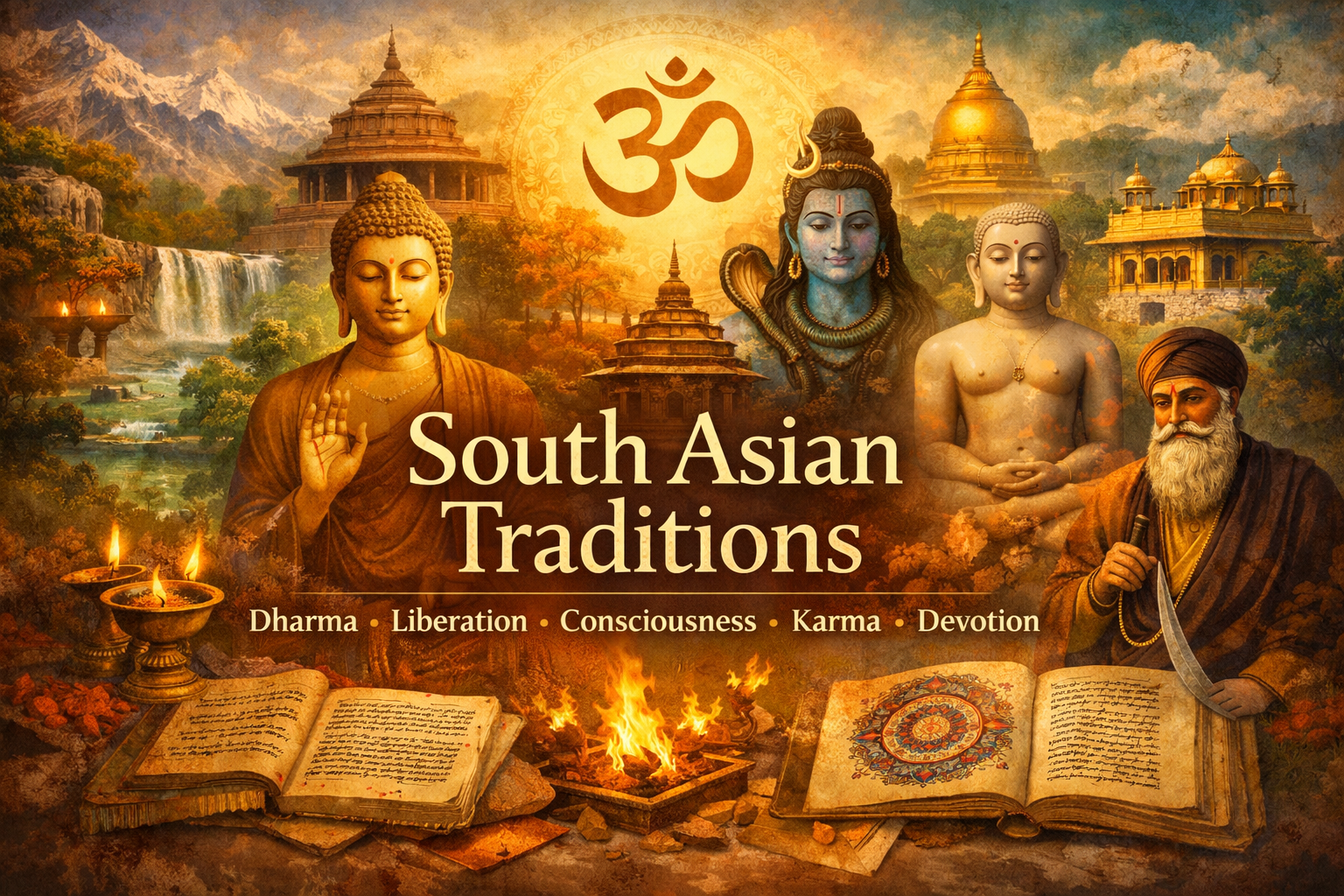
South Asian Traditions is especially important to the broader architecture of this site because it provides one of the deepest reservoirs of reflection on metaphysics, consciousness, moral causation, liberation, contemplation, language, embodiment, healing, and the disciplined transformation of the self. In this respect, the category links not only to Foundations of Religion and Comparative Sacred Themes, but also to Philosophy, Psychology, Mysticism and Contemplative Traditions, Religion and Law, Religion and Society, Healing Traditions, and South Asian Literature and Sacred Memory.
The goal of this pillar is not to flatten South Asian traditions into vague spirituality, generic “Eastern wisdom,” or a single civilizational essence. It is to take them seriously as internally differentiated religious worlds with their own sacred texts, interpretive traditions, ritual structures, metaphysical debates, social visions, contemplative technologies, devotional cultures, and histories of reform, conflict, hierarchy, and resistance. These traditions have shaped not only South Asian history, but the global history of religion, ethics, meditation, metaphysics, medicine, psychology, and the study of consciousness.
This pillar also recognizes that South Asian religious history cannot be reduced to Sanskritic elite traditions alone. Sanskrit texts, Vedic authority, Brahmanical institutions, monastic philosophy, and classical schools are indispensable, but so are Prakrit, Pali, Tamil, Punjabi, Bengali, Marathi, Hindi, vernacular, oral, Dalit, Adivasi, devotional, women’s, folk, regional, and diaspora traditions. A serious Religious Studies approach must hold textual authority and lived practice together, while also attending to social power, caste hierarchy, gendered exclusion, colonial classification, reform movements, and the voices of communities historically marginalized within dominant religious narratives.
Why South Asian Traditions Matter
South Asian traditions matter because they preserve some of the most sustained reflections in human history on selfhood, suffering, desire, duty, memory, ritual power, consciousness, moral causation, rebirth, embodiment, language, nonviolence, devotion, and liberation. They ask whether the self is identical with ultimate reality, whether the self is illusory, whether bondage is rooted in ignorance or action or desire, whether nonviolence is the highest law, whether devotion can save, whether knowledge transforms, and whether liberation lies in renunciation, disciplined action, divine grace, contemplative realization, ethical purification, or some combination of these.
These traditions also matter because they resist the categories through which religion is often simplified in Western discourse. They are not organized around one single revelation event, one universal creed, one exclusive institution, or one fixed orthodoxy. Many of them emerge instead through cumulative textuality, commentary, ritual continuity, philosophical argument, teacher lineages, monastic institutions, oral performance, legal discourse, regional devotional cultures, and embodied practices transmitted across generations. They are therefore indispensable for any serious understanding of religion beyond the narrow model of belief plus scripture.
At the same time, South Asian traditions are not merely inward or contemplative. They include temple cultures, kingship, law codes, pilgrimage routes, public rituals, sectarian institutions, monastic economies, caste hierarchies, anti-caste movements, gendered disciplines, household rites, reform traditions, and profound debates about duty, renunciation, community, and justice. The category must therefore hold together metaphysics and social order, devotion and discipline, contemplation and law, ritual and philosophy, liberation and lived inequality. Only then does its civilizational depth become visible.
This breadth makes South Asian Traditions central to the wider Sustainable Catalyst architecture. The category connects religious studies to metaphysics, psychology, healing, social hierarchy, ethics, embodied cognition, contemplative practice, and comparative sacred themes. It offers not one answer to the problem of human life, but an extraordinary field of disciplined disagreement about what reality is and how human beings might be transformed.
The Problem of Category and Civilizational Scope
The term “South Asian Traditions” is useful because it identifies a broad civilizational field shaped by shared geographies, languages, textual inheritances, ritual practices, debates, institutions, and histories of transmission. Yet the category must be used carefully. It is not a claim that all South Asian religions are variations of one thing. Hindu traditions, Buddhist traditions, Jain traditions, Sikh tradition, and the wider sacred worlds of the region are distinct religious worlds with different scriptures, practices, metaphysical commitments, social histories, and communal forms.
At the same time, these traditions do share an intellectual and historical environment in which certain questions recur with extraordinary persistence: karma, dharma, liberation, rebirth, ritual efficacy, discipline of the self, nonviolence, sacred sound, the authority of revelation, the role of teachers, the place of renunciation, the relation between worldly duty and transcendence, and the possibility of release from ignorance, suffering, or bondage. Even where traditions reject one another’s answers, they often participate in the same larger field of dispute.
The category also raises problems of naming. “Hinduism” is not a single ancient self-description that cleanly maps onto all the traditions now gathered under that term. “Buddhism,” “Jainism,” and “Sikhism” likewise name vast internal diversities rather than uniform systems. “South Asian” is geographically broader and more inclusive, but it can still conceal regional, linguistic, caste, gender, and community differences. A serious pillar must therefore use categories as tools, not cages.
For that reason, South Asian Traditions works best as a comparative civilizational framework rather than as a total explanation. It highlights common questions, overlapping inheritances, and shared patterns of debate while preserving the internal particularity of each tradition. Done well, this makes possible a richer understanding of religious diversity than a model based only on isolated world religions.
Shared Questions Across South Asian Traditions
Across the South Asian religious world, certain questions recur with unusual depth. What is the self? Is there an enduring inner reality, or is the self a temporary aggregate? What binds beings to suffering and recurrence? Is bondage caused by ignorance, action, attachment, violence, delusion, desire, or social obligation? Can disciplined practice transform consciousness? What is the relation between ritual action and moral action? What does liberation mean, and who can attain it?
Other questions are equally central. What is dharma, and how is it known? What is the moral structure of the cosmos? What is the role of sacred sound, recitation, and memorization? What makes a life rightly ordered? Is the highest path one of household duty, ascetic renunciation, contemplative insight, nonviolent restraint, loving devotion, service, or embodied discipline? What is the place of teachers, gurus, monastic communities, scripture, and inherited lineage in the pursuit of truth?
The traditions differ sharply in their answers. Some affirm an enduring self; others deny it. Some center divine devotion; others center discipline, analysis, or nonviolence. Some authorize Vedic revelation; others reject it. Some develop householder paths; others elevate monastic renunciation. Some imagine liberation as realization of unity; others as release from karmic matter, cessation of suffering, union through devotion, or liberation from egoic bondage.
These shared questions do not make the traditions identical. On the contrary, they help explain why South Asian religions generated such elaborate systems of disagreement. The civilizational power of the region lies partly in the fact that it produced not one answer to these questions, but a vast and disciplined multiplicity of answers.
Vedic Religion, Sacrifice, and Cosmic Order
The earliest stratum of what later develops into Hindu religious civilization is deeply marked by the Vedic world of hymn, sacrifice, recitation, ritual precision, priestly transmission, and cosmic order. The Vedas preserve a sacred universe in which spoken sound, ritual action, divine invocation, and inherited liturgical knowledge participate in the maintenance of order. Sacrifice is not merely symbolic offering. It is a serious act of alignment between human action and cosmic structure.
In this world, knowledge is practical, liturgical, and sacred. To know rightly is to recite rightly, to perform rightly, and to uphold a larger order through disciplined ritual relation. The Vedic tradition is therefore crucial because it shows a religious civilization grounded not first in individual belief, but in sacred speech, transmitted form, inherited precision, and the conviction that the cosmos can be ritually sustained.
Vedic religion also reveals the importance of sound. Mantra, meter, recitation, and oral preservation are not external decorations. They are part of the sacred structure itself. The authority of the Vedas depends not only on content but on precise transmission. This gives South Asian religious history one of its defining features: language, sound, memory, and ritual power become inseparable.
This early ritual world establishes many of the categories that later South Asian traditions will inherit, transform, or reject. Questions of sacred language, authoritative transmission, priestly mediation, cosmological order, and the efficacy of disciplined action all begin here, even when later traditions subject them to radical critique.
Upanishadic Speculation and the Search for Ultimate Reality
The Upanishads mark one of the great turns in world religious history: from ritual centrality toward speculative depth, inward inquiry, and the search for ultimate reality. Here the questions of self, knowledge, consciousness, and liberation become more explicit. What is the deepest self? What is the ultimate ground of reality? How is ignorance overcome? Can knowledge itself become liberation?
Through concepts associated with ātman, brahman, inner realization, and the unreliability of surface appearances, the Upanishadic world opens a profound metaphysical horizon. It does not simply abandon ritual, but reinterprets it through deeper ontological and contemplative questions. The search for truth becomes at once philosophical and spiritual.
This makes the Upanishadic inheritance foundational not only for later Hindu philosophy, but for the broader South Asian religious field. Even traditions that reject its conclusions often engage the same questions: selfhood, illusion, attachment, realization, the limits of external ritual, and the possibility of inward transformation.
The Upanishadic turn also helps explain why South Asian traditions became so important for later comparative philosophy and contemplative psychology. The interior life is not treated as private emotion alone. It becomes a domain of disciplined inquiry into the structure of reality, consciousness, and liberation.
Epic Tradition, Dharma, and the Problem of Action
The epic traditions, especially as represented by the Mahābhārata and the Rāmāyaṇa, give South Asian religion one of its richest narrative and ethical worlds. Here questions of law, kinship, violence, kingship, duty, fidelity, exile, loyalty, gender, divine presence, and moral ambiguity take dramatic form. Epic literature does not merely entertain. It stages the moral complexity of living in a world where competing obligations cannot always be harmonized.
The Bhagavad Gītā, in particular, becomes one of the most influential texts in the religious history of South Asia because it addresses the problem of action under conditions of moral crisis. It asks whether one must renounce the world or act within it, whether disciplined action can become a path of liberation, and how devotion, knowledge, and duty may be joined. The result is not a simple answer, but a profound theological and philosophical synthesis.
The epic world is therefore indispensable to this pillar because it holds together narrative, law, devotion, and ethical struggle. It shows that South Asian traditions are not merely abstract systems of metaphysics or meditation, but also richly moral and civilizational worlds of story, exemplarity, conflict, and contested duty.
At the same time, the epics must be read critically as well as reverently. They preserve powerful ideals, but also raise difficult questions about violence, gender, caste, kingship, obedience, and social hierarchy. Their greatness lies partly in their refusal to reduce moral life to clean formulas. They dramatize dharma as a field of difficulty.
Puranic, Temple, and Devotional Worlds
South Asian religious history cannot be understood through Vedic and philosophical texts alone. Puranic traditions, temple cultures, pilgrimage routes, regional devotional movements, images, festivals, and local sacred geographies are central to lived Hindu worlds. The Puranas preserve cosmology, myth, genealogy, theology, ritual instruction, sacred geography, and devotional imagination. They helped make divine worlds narratively and ritually available to communities across regions and languages.
Temple religion gives the category a major material and institutional dimension. The temple is not merely a building. It is a ritual center, sacred body, economic institution, artistic world, pilgrimage destination, social hierarchy, and site of divine presence. Images are not simply illustrations of belief; in many traditions they are ritually enlivened presences around which worship, offering, music, movement, and community gather.
Bhakti traditions transformed South Asian religion by intensifying the emotional and personal dimensions of devotion. Through love, surrender, song, poetry, and remembrance, the divine becomes intimate. Bhakti also generated vernacular literatures that allowed religious experience to move beyond elite Sanskritic forms into regional languages and community life.
These worlds matter because they prevent South Asian Traditions from becoming too textually or philosophically narrow. Religion is lived through festivals, food, songs, bodies, architecture, offerings, vows, images, roads, rivers, and local sacred histories. The devotional and temple worlds show how metaphysical questions become embodied public life.
Buddhism: Suffering, Impermanence, and Liberation
Buddhism emerges as one of the most powerful internal critiques of inherited ritual and metaphysical assumptions in South Asia. Centered on the Buddha’s diagnosis of suffering, impermanence, craving, and ignorance, it reframes the religious problem with extraordinary clarity. The question is no longer only how to align with cosmic order or realize an ultimate self, but how to understand suffering as it arises, how attachment sustains it, and how disciplined practice leads beyond it.
The Buddhist denial of a permanent self, its emphasis on dependent arising, its monastic structures, and its insistence on meditative and ethical discipline create one of the most distinctive religious and philosophical traditions in human history. Yet Buddhism remains deeply South Asian in its participation in the wider field of karma, rebirth, renunciation, discipline, liberation, and sacred community.
Over time, Buddhist traditions develop enormous textual, philosophical, devotional, and monastic diversity. Early Buddhist texts, Abhidharma traditions, Mahāyāna sutras, Madhyamaka, Yogācāra, Vajrayāna, monastic codes, ritual practices, and contemplative lineages all extend the initial diagnosis into major civilizational systems. Buddhism therefore belongs at the center of South Asian Traditions not only as a historical religion, but as one of the greatest reorientations of religious thought in the world.
For the broader site, Buddhism is also crucial for Psychology, Philosophy, and Contemplative Traditions. Its analyses of attention, perception, craving, suffering, impermanence, compassion, and no-self remain among the most sophisticated religious resources for thinking about mind, experience, and transformation.
Jainism: Nonviolence, Discipline, and Many-Sided Truth
Jainism preserves one of the most radical ethical visions in the history of religion. Its commitment to nonviolence, restraint, ascetic discipline, and responsibility for the consequences of action is unmatched in rigor. Here religious life is shaped by the conviction that harm binds beings more deeply to the cycle of suffering and that liberation requires severe discipline of desire, speech, consumption, movement, and bodily action.
Jain traditions also contribute a striking intellectual perspective through doctrines associated with many-sided truth and the limits of one-sided claims. This plural and disciplined epistemic posture enriches the broader South Asian field by showing that truth may require humility before the partiality of ordinary perspective. In that sense, Jainism contributes not only ethics but a distinctive intellectual style.
Jainism also matters because it makes the body a site of disciplined ethical responsibility. Eating, walking, speaking, owning, desiring, and acting all become morally charged. The line between metaphysics and everyday conduct becomes unusually strict. The soul’s liberation is inseparable from careful relation to life.
Jainism therefore reveals a civilizational path where religion becomes radical responsibility, ascetic seriousness, and scrupulous moral relation to living beings. It is one of the strongest counterweights to any assumption that religion is primarily belief rather than disciplined ethical transformation.
Sikhism: Scripture, Devotion, and Communal Life
Sikh tradition emerges later than the Vedic, Upanishadic, Buddhist, and Jain worlds, but it is no less significant. Centered on the Gurus, the Guru Granth Sahib, devotion to the divine name, equality, service, courage, and communal discipline, Sikhism creates a distinctive religious synthesis that is scriptural, devotional, ethical, musical, and communal all at once.
Sikhism is especially important because it reorders several South Asian religious themes while refusing others. It affirms devotion, sacred song, disciplined remembrance, and communal equality while rejecting empty ritualism, caste hierarchy, and spiritual pretension. Its scripture functions not merely as doctrine but as a living devotional and communal center.
The Sikh tradition also places service, courage, community, and ethical life at the center of religious identity. The langar, the sangat, the discipline of remembrance, and the history of the Khalsa all show how devotion becomes social form. Sikhism is therefore not only a tradition of inward piety but a powerful model of religious community, equality, responsibility, and moral courage.
In this respect, Sikhism shows how the South Asian religious world remains dynamic across time. It is not only an archive of ancient texts, but a continuing field of religious creativity, reform, devotion, and community formation.
Ritual, Devotion, Yoga, and the Discipline of the Self
One of the most distinctive features of South Asian traditions is the extraordinary diversity of techniques through which the self is disciplined, transformed, purified, stabilized, or transcended. Ritual offerings, sacred recitation, pilgrimage, temple worship, mantra, yoga, meditation, renunciation, ascetic vows, devotional singing, contemplative analysis, ethical restraint, and service all appear as possible means of religious life. This diversity matters because the traditions of South Asia have never accepted a single model of sacred practice.
Bhakti gives the category one of its most powerful emotional and devotional dimensions. Through loving devotion to the divine, religious life becomes intimate, poetic, embodied, and affective. Devotion can cross boundaries of literacy, social rank, language, and formal philosophical training, even when devotional communities remain shaped by social hierarchy and historical limitation.
Yoga, meanwhile, names not merely a modern wellness practice, but a complex family of disciplines oriented toward concentration, control, union, insight, stillness, liberation, or devotion depending on the tradition and text in question. Classical yoga, devotional yoga, tantric yoga, haṭha yoga, Buddhist meditation, Jain ascetic discipline, and Sikh remembrance all show that South Asian traditions developed multiple technologies of attention and transformation.
These practices make South Asian Traditions especially important for the wider site because they connect directly to questions of selfhood, consciousness, contemplative practice, psychology, healing, and moral transformation. They are among the deepest laboratories of inward and disciplined life in the history of religion.
Tantra, Sacred Power, and the Body
Tantric traditions are essential to a serious account of South Asian religious history. They appear in Hindu, Buddhist, Jain, and regional contexts and include ritual technologies, mantra, visualization, initiation, deity practice, subtle body systems, sacred diagrams, guru-disciple transmission, and disciplined uses of power, embodiment, and imagination. Tantra cannot be reduced to modern stereotypes about sexuality. It is a complex field of ritual, metaphysics, embodiment, and transformation.
Tantric traditions often treat the body not as an obstacle alone, but as a site of sacred power and realization. Breath, sound, gesture, visualization, energy channels, mantra, and ritual space become means through which ordinary perception is transformed. The body becomes a field of practice, not merely a prison to be escaped.
Tantra also raises important questions about authority, secrecy, initiation, transgression, gender, power, and the relation between elite ritual knowledge and lived practice. Some tantric traditions seek liberation through disciplined ritual and contemplative technologies that intentionally challenge ordinary boundaries. Others become integrated into temple, monastic, devotional, or household life.
This section matters because Tantra is one of the places where South Asian traditions most clearly refuse simple categories. It is ritual and metaphysical, embodied and symbolic, disciplined and dangerous, orthodox and transgressive, philosophical and practical. It belongs at the center of the pillar because it shows how sacred power is imagined, transmitted, and embodied.
Ayurveda, Healing, and the Religious Life of the Body
South Asian traditions also make major contributions to the study of healing, embodiment, diet, longevity, balance, and the relation between body, mind, ethics, and environment. Ayurveda is not simply “alternative medicine” in the modern sense. It is a learned medical tradition shaped by theories of constitution, balance, digestion, disease, regimen, herbs, diet, environment, and disciplined living.
Ayurveda belongs within this pillar because healing traditions in South Asia often intersect with religious life, philosophy, ethics, ritual purity, diet, yoga, monastic practice, household discipline, and ideas of cosmic order. The body is not merely biological. It is ethical, ecological, ritual, psychological, and cosmological. Illness can be approached through material causes, regimen, imbalance, karma, conduct, environment, and spiritual discipline depending on the tradition and context.
The study of South Asian healing also requires care. Modern wellness culture often extracts fragments of yoga, Ayurveda, mantra, meditation, or tantra while severing them from historical, ethical, and religious contexts. A serious pillar should avoid both romanticization and dismissal. It should study these traditions as historically complex systems of body, mind, environment, practice, and meaning.
This makes South Asian Traditions a natural bridge to Healing Traditions, Ayurveda and South Asian Healing Traditions, Psychology, and Mysticism and Contemplative Traditions.
Law, Society, Caste, and Sacred Order
South Asian traditions are often romanticized in modern discourse as purely inward, mystical, or otherworldly. That reading is incomplete. The religious worlds of South Asia also developed law codes, normative teachings, social hierarchies, monastic regulations, temple economies, ritual obligations, kingship models, and communal institutions. Dharma is not merely private morality; it is also social order, obligation, role, and right relation within a larger world.
This means that South Asian religion must be studied not only through contemplative texts and metaphysical reflection, but also through legal, social, and political forms. The problem of caste, the authority of law, the role of renunciation in relation to household life, the place of kingship, the status of women, the organization of monastic communities, and the tension between ideal order and lived injustice all belong inside the category.
Caste requires especially careful treatment. It cannot be reduced to one text, one doctrine, or one timeless essence, but it also cannot be minimized as merely social custom unrelated to religious authority. Caste has been justified, contested, ritualized, reformed, resisted, and reinterpreted across South Asian history. Anti-caste thinkers and movements, including Dalit intellectual traditions, are therefore not outside the study of religion. They are central to understanding how sacred order can become social hierarchy and how religious language can also become a resource for liberation.
For this reason, South Asian Traditions should connect directly to Religion and Law, Religion and Society, and Ethics & Moral Philosophy. Its traditions offer major examples of how sacred ideas become institutional and social worlds, and how those worlds are challenged by voices demanding justice, dignity, and equality.
Women, Gender, and Marginalized Voices
A serious South Asian Traditions pillar cannot remain centered only on male renouncers, priests, philosophers, kings, gurus, monks, and textual elites. Women, householders, poets, nuns, devotees, Dalit communities, Adivasi communities, regional practitioners, healers, artisans, and vernacular religious actors have all shaped the religious life of South Asia. Many of the most important religious practices have been carried through household ritual, song, birth and death rites, pilgrimage, devotion, healing, oral tradition, and everyday discipline.
Women’s religious worlds are especially important because they reveal forms of agency that do not always appear in formal philosophical or legal texts. Goddesses, women saints, bhakti poets, Buddhist nuns, Jain renunciants, Sikh women, ritual specialists, mothers, widows, devotees, and household practitioners all complicate any account that treats religious authority as exclusively male or institutionally formal.
Marginalized voices also force the pillar to confront the gap between sacred ideals and social reality. Traditions that speak of liberation, compassion, nonviolence, equality, or divine presence may coexist with caste exclusion, gender inequality, ritual hierarchy, and social violence. The task is not to dismiss the traditions as hypocrisy, nor to excuse injustice in the name of heritage. The task is to study how sacred ideas are lived, institutionalized, contested, and transformed.
This section is therefore central to the pillar’s ethical seriousness. South Asian Traditions must foreground not only metaphysical brilliance, but also the human struggles over access, dignity, voice, embodiment, and liberation within lived religious worlds.
Metaphysics, Consciousness, and the Civilizational Depth of South Asian Thought
Few religious civilizations have contributed more to the philosophical and contemplative study of consciousness than South Asia. The traditions gathered here ask whether the self is ultimate or illusory, whether consciousness is fundamental, whether thought obscures reality, whether suffering arises through misperception, whether liberation is cognitive, ethical, devotional, or ontological, and whether the deepest truth is unity, emptiness, multiplicity, difference, relation, or divine presence.
This metaphysical depth makes South Asian Traditions indispensable to the broader site architecture. It connects directly to questions of ontology, personal identity, causation, embodiment, contemplative psychology, ritual efficacy, moral responsibility, and the disciplined reordering of perception. It also makes the category central to later work in Metaphysics, Mind, Matter, and Consciousness, Psychology, and Thinking.
South Asian traditions are especially valuable because they do not isolate philosophy from practice. Metaphysics is linked to meditation, debate, ritual, ethics, renunciation, devotion, and liberation. The goal is not only to describe reality, but to transform the conditions under which reality is misperceived. In this sense, South Asian philosophy is often simultaneously theoretical and therapeutic.
South Asian traditions therefore do not belong on the margins of a global religious map. They are among the central civilizational sites in which humanity has asked what reality is, what suffering means, how desire binds, what moral causation does, and how disciplined practice might transform the conditions of existence itself.
South Asian Traditions in Comparative Religion
South Asian Traditions are indispensable to comparative religion because they challenge assumptions formed primarily from Abrahamic or modern Western models. They show that religion need not center one creator God, one prophet, one canonical scripture, or one church-like institution to be intellectually and ritually powerful. They also show that religion can be organized around liberation, discipline, rebirth, moral causation, sacred sound, contemplative realization, lineage, devotion, nonviolence, or ritual order.
The category also complicates the distinction between religion and philosophy. In South Asian contexts, metaphysics, logic, epistemology, meditation, ethics, ritual, grammar, and liberation often belong to the same intellectual world. Schools of thought are not merely academic systems; they are frequently tied to practices of transformation, liberation, and disciplined perception.
Comparatively, South Asian traditions also deepen the study of the body. The body may be ritually purified, disciplined, renounced, healed, contemplated, adorned, restrained, sacrificed, fed, starved, regulated, or imagined as a subtle field of sacred power. This makes the category crucial for healing traditions, contemplative studies, psychology, and embodied religion.
Finally, South Asian traditions force comparative religion to confront social complexity. A civilization can produce extraordinary philosophies of liberation while also sustaining powerful systems of hierarchy. A serious comparative framework must therefore study brilliance and harm, interior transformation and social exclusion, sacred beauty and institutional injustice together.
Major Questions of Interpretation
This pillar is organized around several major questions. How should South Asian Traditions be studied when the category includes Vedic religion, Upanishadic speculation, epic narrative, puranic devotion, temple worship, Buddhism, Jainism, Sikhism, yoga, tantra, Ayurveda, dharma literature, caste hierarchy, anti-caste critique, vernacular devotion, monastic life, and diaspora communities? How can the field remain comparative without flattening difference?
The pillar also asks how sacred traditions imagine the self. Is the self eternal, constructed, obscured, empty, bound, embodied, divine, or relational? How do action, desire, ignorance, violence, karma, and social duty bind beings to suffering? How do ritual, knowledge, devotion, meditation, renunciation, nonviolence, service, and grace transform the person? How do religious systems define liberation, and how do they restrict or expand access to it?
These questions keep South Asian Traditions from becoming a generic survey. The goal is not to list traditions, but to build a serious interpretive framework for one of the world’s most profound religious and philosophical civilizations. South Asian traditions matter because they repeatedly ask how human beings can know reality, discipline desire, reduce suffering, live ethically, and move toward liberation.
South Asian Traditions Pillar Map
The following article map is designed as a serious research agenda for the South Asian Traditions pillar, with emphasis on primary texts, internal interpretive traditions, contemplative practice, social order, healing, and civilizational depth.
South Asian Traditions is organized to move from category formation and shared questions into Vedic, Upanishadic, epic, Hindu, Buddhist, Jain, Sikh, yogic, tantric, healing, legal, social, philosophical, and comparative themes. The goal is to preserve the distinctiveness of each tradition while making visible the larger civilizational field in which debates over selfhood, suffering, duty, karma, rebirth, liberation, devotion, nonviolence, and consciousness unfold.
Foundational Frames
- What Are South Asian Traditions? (planned)
Introduces South Asian Traditions as a Religious Studies category spanning Hindu, Buddhist, Jain, Sikh, yogic, tantric, healing, devotional, and philosophical worlds. - Religion, Civilization, and the Indian Subcontinent (planned)
Explores the Indian subcontinent as a civilizational field shaped by language, region, ritual, philosophy, social order, and sacred geography. - Karma, Dharma, and Liberation Across South Asian Traditions (planned)
Compares major organizing concepts across Hindu, Buddhist, Jain, and Sikh contexts without flattening their differences. - Selfhood, Consciousness, and the Problem of Bondage (planned)
Examines competing theories of self, no-self, consciousness, ignorance, attachment, and liberation. - South Asian Traditions Beyond “Eastern Wisdom” (planned)
Critiques modern simplifications and situates the traditions within rigorous textual, ritual, social, and philosophical history.
Vedic and Upanishadic Worlds
- The Vedas (planned)
Introduces the Vedic corpus as sacred speech, ritual archive, poetic revelation, and foundation for later Hindu traditions. - Vedic Ritual, Sacred Sound, and Cosmic Order (planned)
Studies sacrifice, mantra, recitation, priestly knowledge, and the ritual maintenance of order. - The Upanishads (planned)
Examines the turn toward inward inquiry, ultimate reality, selfhood, knowledge, and liberation. - Ātman, Brahman, and Ultimate Reality (planned)
Explores major metaphysical concepts associated with self, reality, and liberation. - Sacred Speech, Memory, and Oral Transmission (planned)
Studies the preservation of sacred knowledge through recitation, memorization, lineage, and sound.
Epic, Puranic, and Devotional Traditions
- The Mahābhārata (planned)
Introduces the epic as a vast archive of dharma, kinship, war, kingship, grief, and moral ambiguity. - The Rāmāyaṇa (planned)
Studies exile, kingship, devotion, duty, gender, ethical conflict, and regional retellings. - The Bhagavad Gītā (planned)
Examines action, devotion, knowledge, discipline, and liberation under conditions of moral crisis. - Dharma, Action, and the Moral Crisis of the Epic World (planned)
Explores how epic narrative stages conflicting obligations and difficult moral judgment. - The Puranas and the Expansion of Sacred Narrative (planned)
Studies cosmology, myth, genealogy, devotion, sacred geography, and divine manifestation. - Bhakti and the Religious Life of Devotion (planned)
Explores loving devotion, song, surrender, vernacular spirituality, and the intimacy of divine relation. - Temple Worship, Image, and Sacred Presence (planned)
Examines temples, murti, ritual offering, pilgrimage, architecture, and material religion.
Buddhist Traditions
- Early Buddhist Texts and the Pali Canon (planned)
Introduces early Buddhist textual traditions, monastic discipline, sermons, and foundational teachings. - The Buddha and the Problem of Suffering (planned)
Studies the Four Noble Truths, awakening, renunciation, compassion, and the diagnosis of suffering. - Impermanence, No-Self, and Liberation (planned)
Examines key Buddhist analyses of reality, selfhood, attachment, and release. - Dependent Arising and the Structure of Experience (planned)
Explores causation, interdependence, ignorance, craving, and the continuity of suffering. - Abhidharma and Buddhist Analysis of Mind (planned)
Studies Buddhist taxonomies of experience, perception, mental factors, and liberation. - Mahāyāna, Compassion, and the Expansion of Buddhist Thought (planned)
Examines bodhisattva ideals, emptiness, compassion, and new scriptural worlds. - Madhyamaka, Yogācāra, and Buddhist Philosophy (planned)
Introduces major philosophical schools and their accounts of emptiness, cognition, and reality.
Jain Traditions
- Jain Agamas (planned)
Introduces Jain scriptural traditions, transmission, ethics, asceticism, and community. - Nonviolence, Asceticism, and Moral Discipline (planned)
Studies ahimsa, restraint, karma, bodily discipline, and the ethics of minimizing harm. - Many-Sided Truth and the Jain Intellectual Tradition (planned)
Explores anekāntavāda, syādvāda, epistemic humility, and plural perspectives. - Karma, Matter, and Liberation in Jain Thought (planned)
Examines Jain theories of karmic bondage, purification, soul, and liberation. - Jain Monasticism, Lay Ethics, and the Discipline of Life (planned)
Studies the relation between ascetic ideals, lay responsibility, vows, and community.
Sikh Tradition
- The Guru Granth Sahib (planned)
Introduces Sikh scripture as living Guru, devotional center, poetic revelation, and communal authority. - Guru, Scripture, and Devotional Community (planned)
Studies the Gurus, sacred song, remembrance, sangat, and the formation of Sikh religious life. - Equality, Service, and the Sikh Moral Vision (planned)
Explores langar, seva, social equality, courage, justice, and communal responsibility. - The Khalsa, Discipline, and Religious Identity (planned)
Examines initiation, discipline, symbols, courage, and the public formation of Sikh identity. - Sikhism in South Asian and Global Context (planned)
Studies Sikh history, diaspora, memory, colonialism, and global community formation.
Yoga, Tantra, and Contemplative Practice
- Yoga, Meditation, and the Transformation of Consciousness (planned)
Introduces yoga and meditation as disciplined technologies of attention, self-transformation, and liberation. - Patañjali and Classical Yoga (planned)
Studies the Yoga Sūtras, concentration, mental discipline, liberation, and the restraint of mental fluctuations. - Mantra, Sacred Sound, and Contemplative Practice (planned)
Explores sound, repetition, vibration, memory, and sacred speech across South Asian traditions. - Tantra, Initiation, and Sacred Power (planned)
Examines tantric ritual, secrecy, mantra, visualization, deity practice, and embodied transformation. - The Subtle Body in South Asian Religious Practice (planned)
Studies channels, centers, breath, energy, visualization, and embodied metaphysics. - Renunciation, Discipline, and the Reordering of Desire (planned)
Compares ascetic, monastic, yogic, Jain, Buddhist, and devotional approaches to desire and discipline.
Healing, Body, and Ecology
- Ayurveda and South Asian Healing Traditions (planned)
Introduces Ayurveda as a learned medical and philosophical tradition of body, mind, regimen, and balance. - Body, Mind, and Environment in South Asian Healing (planned)
Studies health as a relation among constitution, diet, conduct, ecology, ritual, and disciplined living. - Food, Fasting, Purity, and Religious Discipline (planned)
Examines food rules, fasting, purity, asceticism, compassion, and bodily regulation. - Yoga, Ayurveda, and Modern Wellness Culture (planned)
Critically studies extraction, adaptation, globalization, and the modern transformation of South Asian practices. - Religion, Animals, and Nonviolence in South Asian Traditions (planned)
Explores ahimsa, vegetarianism, animal ethics, ritual life, and ecological relation.
Law, Society, Caste, and Reform
- South Asian Traditions and the Question of Law (planned)
Studies dharma, monastic law, Sikh discipline, Jain vows, and Buddhist vinaya as normative systems. - Dharmaśāstra, Social Order, and Legal Imagination (planned)
Examines law literature, duty, social hierarchy, household life, kingship, and ritual order. - Caste, Religion, and Social Hierarchy (planned)
Studies caste as a religious, social, political, and historical problem across South Asian traditions. - Anti-Caste Thought and Religious Reform (planned)
Centers Dalit, Buddhist, bhakti, Sikh, reformist, and modern critiques of caste hierarchy. - Women, Gender, and Religious Authority in South Asia (planned)
Explores women’s religious roles, exclusion, agency, devotion, renunciation, and interpretive authority. - Householder, Renouncer, Monk, and Devotee (planned)
Compares different religious roles and life-paths across South Asian traditions.
Philosophy, Metaphysics, and Consciousness
- South Asian Metaphysics and the Problem of Reality (planned)
Introduces major questions of being, selfhood, consciousness, causation, illusion, and liberation. - Vedānta and the Interpretation of Ultimate Reality (planned)
Studies nondual, qualified nondual, and dualist interpretations of self, God, and ultimate reality. - Sāṃkhya, Yoga, and the Analysis of Purusha and Prakriti (planned)
Explores dualist metaphysics, consciousness, nature, liberation, and disciplined perception. - Nyāya, Vaiśeṣika, and the Logic of Knowing (planned)
Examines epistemology, logic, categories, perception, inference, and debate. - Mīmāṃsā, Ritual Authority, and the Power of Sacred Language (planned)
Studies Vedic authority, ritual action, language, duty, and interpretive method. - Buddhist and Jain Theories of Knowledge (planned)
Compares epistemology, perception, inference, many-sided truth, and critique of self. - Consciousness, Selfhood, and Personal Identity in South Asian Thought (planned)
Connects South Asian philosophy to wider questions in psychology, metaphysics, and mind.
Comparative Themes
- Rebirth, Moral Causation, and the Cycle of Existence (planned)
Compares karma, rebirth, bondage, and liberation across Hindu, Buddhist, Jain, and Sikh contexts. - Liberation, Salvation, Enlightenment, and Release (planned)
Compares moksha, nirvana, kevala, grace, devotion, and other models of ultimate transformation. - Sacred Geography, Pilgrimage, and Rivers in South Asian Religion (planned)
Studies pilgrimage, sacred rivers, mountains, temples, shrines, and place-based religious memory. - Devotion, Love, and Divine Presence Across South Asian Traditions (planned)
Explores bhakti, sacred song, Sikh devotion, Buddhist compassion, and devotional community. - South Asian Traditions and the Social Order (planned)
Connects religion, hierarchy, reform, law, caste, gender, and justice. - South Asian Traditions in Global Religious History (planned)
Studies transmission, diaspora, colonialism, modern global influence, and comparative significance. - Why South Asian Traditions Still Matter (planned)
Concludes the series by connecting South Asian religious history to contemporary questions of consciousness, ethics, healing, justice, and liberation.
This structure allows the category to remain civilizational and comparative while still making room for distinct religious traditions to speak from their own texts and internal lineages. It also connects the pillar to the wider site architecture by linking South Asian sacred worlds to philosophy, psychology, healing, mysticism, law, social order, environmental ethics, and comparative religion.
Closing Perspective
South Asian Traditions gives Religious Studies one of its deepest and most internally diverse civilizational archives. It includes Vedic ritual, Upanishadic speculation, epic dharma, puranic devotion, temple practice, Buddhism, Jainism, Sikhism, yoga, tantra, Ayurveda, bhakti, monastic law, caste critique, metaphysics, contemplative psychology, and living communities across South Asia and the diaspora.
The strongest reason to study this field is that it refuses simple answers to the human condition. It does not ask only what to believe. It asks how to act, how to know, how to discipline desire, how to reduce harm, how to understand suffering, how to relate to the body, how to live in society, how to see through illusion, how to love the divine, and how to move toward liberation. Its traditions repeatedly join metaphysical depth to embodied practice.
For the broader Sustainable Catalyst architecture, this pillar is strategically important. It strengthens Religious Studies while linking to Philosophy, Psychology, Healing Traditions, Mysticism, Religion and Law, Religion and Society, and Comparative Sacred Themes. South Asian traditions show how a civilization can think through the deepest questions of religion: What is the self? What binds the soul or mind? What is the moral structure of action? What does liberation mean? How can disciplined practice transform the conditions of suffering?
Related Reading
- Religious Studies
- Foundations of Religion
- Persian Traditions
- East Asian Traditions
- Mysticism and Contemplative Traditions
- Religion and Law
- Religion and Society
- Religion and Ecology
- Comparative Sacred Themes
- Healing Traditions
- Ayurveda and South Asian Healing Traditions
- Vital Energy Healing Traditions
- Philosophy
- Metaphysics
- Mind, Matter, and Consciousness
- Psychology
- South Asian Literature and Sacred Memory
- Indus Region Myth, Folklore, and Sacred Narrative
Primary Texts
- Vedas: Foundational Sanskrit sacred texts preserving hymn, ritual, sacrifice, recitation, and early Indo-Aryan religious imagination.
- Upanishads: Major speculative texts exploring selfhood, ultimate reality, knowledge, consciousness, and liberation.
- Mahābhārata: Vast epic text exploring dharma, kinship, violence, kingship, duty, grief, and moral complexity.
- Rāmāyaṇa: Epic tradition of exile, kingship, devotion, duty, relational ethics, and regional retellings.
- Bhagavad Gītā: Foundational dialogue on action, devotion, knowledge, discipline, and liberation.
- Puranas: Textual traditions preserving cosmology, myth, theology, devotion, sacred geography, and divine narratives.
- Yoga Sūtras: Classical text associated with Patañjali and the discipline of mind, concentration, and liberation.
- Early Buddhist texts and the Pali Canon: Foundational Buddhist scriptures preserving discourses, monastic discipline, and early doctrinal analysis.
- Mahāyāna sutras: Textual traditions associated with the bodhisattva ideal, emptiness, compassion, and expanded Buddhist cosmology.
- Jain Agamas: Jain scriptural traditions preserving ascetic discipline, ethics, cosmology, and community instruction.
- Guru Granth Sahib: Sikh scripture and living Guru, central to devotion, song, communal life, equality, and remembrance of the divine name.
- Dharmaśāstra and legal literature: Texts concerning duty, social order, ritual obligation, household life, kingship, and law.
- Tantric texts: Hindu, Buddhist, and other South Asian ritual and metaphysical texts concerning mantra, initiation, visualization, sacred power, and the body.
- Ayurvedic texts: Classical medical texts such as the Caraka Saṃhitā and Suśruta Saṃhitā, important for healing, embodiment, regimen, and the relation between body and environment.
Internal Interpretive Traditions
- Hindu traditions: Vedānta, Sāṃkhya, Yoga, Mīmāṃsā, Nyāya, Vaiśeṣika, bhakti lineages, puranic traditions, temple traditions, tantric lineages, dharma literature, ritual commentary, and vernacular devotional movements.
- Buddhist traditions: Abhidharma, Theravāda commentarial traditions, Mahāyāna commentarial traditions, Madhyamaka, Yogācāra, Vajrayāna, monastic lineages, meditation manuals, and philosophical debate traditions.
- Jain traditions: classical commentaries, ascetic and ethical literature, monastic and lay traditions, philosophical traditions of anekāntavāda and syādvāda, and scriptural interpretation across Jain communities.
- Sikh tradition: Gurus, Guru Granth Sahib, devotional exegesis, kirtan, liturgical practice, sangat, langar, Khalsa discipline, and communal institutions.
- Healing and embodied traditions: Ayurveda, yoga lineages, meditation traditions, tantric practice, dietetics, ritual healing, and household health practices.
- Social and reform traditions: anti-caste thought, bhakti reform currents, Sikh egalitarian practice, Buddhist revival movements, Dalit intellectual traditions, women’s devotional voices, and modern reform movements.
Modern Scholarship
- Radhakrishnan, S. and Moore, C.A. A Sourcebook in Indian Philosophy.
- Olivelle, P. The Early Upanishads.
- Olivelle, P. Manu’s Code of Law.
- Doniger, W. The Hindus: An Alternative History.
- Flood, G. An Introduction to Hinduism.
- Gethin, R. The Foundations of Buddhism.
- Harvey, P. An Introduction to Buddhism.
- Dundas, P. The Jains.
- Mandair, A.-P.S. Sikhism: A Guide for the Perplexed.
- McLeod, W.H. Sikhism.
- Bronkhorst, J. Greater Magadha.
- King, R. Indian Philosophy: An Introduction to Hindu and Buddhist Thought.
- Larson, G.J. Classical Sāṃkhya.
- White, D.G. Yoga in Practice.
- Samuel, G. The Origins of Yoga and Tantra.
- Fields, G. Religious Therapeutics: Body and Health in Yoga, Ayurveda, and Tantra.
- Ambedkar, B.R. Annihilation of Caste.
- Omvedt, G. Dalits and the Democratic Revolution.
- Narayan, V. The Vernacular Veda.
Further Reading
- Ambedkar, B.R. (1936) Annihilation of Caste.
- Bronkhorst, J. (2007) Greater Magadha: Studies in the Culture of Early India. Leiden: Brill.
- Doniger, W. (2009) The Hindus: An Alternative History. New York: Penguin Press.
- Dundas, P. (2002) The Jains. 2nd edn. London: Routledge.
- Fields, G. (2001) Religious Therapeutics: Body and Health in Yoga, Ayurveda, and Tantra. Albany, NY: State University of New York Press.
- Flood, G. (1996) An Introduction to Hinduism. Cambridge: Cambridge University Press.
- Gethin, R. (1998) The Foundations of Buddhism. Oxford: Oxford University Press.
- Harvey, P. (2013) An Introduction to Buddhism: Teachings, History and Practices. 2nd edn. Cambridge: Cambridge University Press.
- King, R. (1999) Indian Philosophy: An Introduction to Hindu and Buddhist Thought. Edinburgh: Edinburgh University Press.
- Larson, G.J. (1969) Classical Sāṃkhya: An Interpretation of Its History and Meaning. Delhi: Motilal Banarsidass.
- Mandair, A.-P.S. (2013) Sikhism: A Guide for the Perplexed. London: Bloomsbury.
- McLeod, W.H. (1997) Sikhism. London: Penguin.
- Narayan, V. (1994) The Vernacular Veda: Revelation, Recitation, and Ritual. Columbia: University of South Carolina Press.
- Olivelle, P. (1998) The Early Upanishads: Annotated Text and Translation. Oxford: Oxford University Press.
- Olivelle, P. (2004) Manu’s Code of Law: A Critical Edition and Translation of the Mānava-Dharmaśāstra. Oxford: Oxford University Press.
- Omvedt, G. (1994) Dalits and the Democratic Revolution: Dr Ambedkar and the Dalit Movement in Colonial India. New Delhi: Sage.
- Radhakrishnan, S. and Moore, C.A. (eds.) (1957) A Sourcebook in Indian Philosophy. Princeton, NJ: Princeton University Press.
- Samuel, G. (2008) The Origins of Yoga and Tantra: Indic Religions to the Thirteenth Century. Cambridge: Cambridge University Press.
- White, D.G. (ed.) (2012) Yoga in Practice. Princeton, NJ: Princeton University Press.
References
- Access to Insight (n.d.) Tipitaka: The Pali Canon. Available at: https://www.accesstoinsight.org/tipitaka/ (Accessed: 10 April 2026).
- Ambedkar, B.R. (1936) Annihilation of Caste. Available at: https://ccnmtl.columbia.edu/projects/mmt/ambedkar/web/index.html (Accessed: 10 April 2026).
- Encyclopaedia Britannica (n.d.) Bhagavadgita. Available at: https://www.britannica.com/topic/Bhagavadgita (Accessed: 10 April 2026).
- Encyclopaedia Britannica (n.d.) Upanishad. Available at: https://www.britannica.com/topic/Upanishad (Accessed: 10 April 2026).
- Internet Sacred Text Archive (n.d.) Hinduism. Available at: https://www.sacred-texts.com/hin/ (Accessed: 10 April 2026).
- Internet Sacred Text Archive (n.d.) Buddhism. Available at: https://www.sacred-texts.com/bud/index.htm (Accessed: 10 April 2026).
- Sacred Texts (n.d.) The Bhagavad Gita. Available at: https://www.sacred-texts.com/hin/gita/ (Accessed: 10 April 2026).
- SuttaCentral (n.d.) Early Buddhist Texts, Translations, and Parallels. Available at: https://suttacentral.net/ (Accessed: 10 April 2026).
- SriGranth (n.d.) Sri Guru Granth Sahib. Available at: https://www.srigranth.org/servlet/gurbani.gurbani?Action=Page&Param=1 (Accessed: 10 April 2026).
- World History Encyclopedia (n.d.) Jainism. Available at: https://www.worldhistory.org/Jainism/ (Accessed: 10 April 2026).