
Last Updated May 3, 2026
Maghrebi and Andalusi literature preserves one of the most moving archives of place, refinement, devotion, exile, and recollection in the broader Mediterranean and Islamicate worlds. Across poetry, prose, adab, devotional writing, travel narrative, historiography, saintly biography, courtly literature, oral tradition, song, and exile lament, the literary cultures of North Africa and al-Andalus carried forward memories of cities, courts, scholars, saints, gardens, dynasties, ports, schools, households, and homelands marked by both flourishing and rupture. In these traditions, literature has often borne the emotional and symbolic burden of preserving what political history displaced, fractured, conquered, or transformed.
This content pillar approaches Maghrebi and Andalusi Literature and Cultural Memory not as a marginal branch of Arabic writing, but as a major archive of regional and civilizational memory shaped by Amazigh, Arab, Islamic, Jewish, Mediterranean, and Andalusi inheritances. It includes Andalusi poetry and prose, Maghrebi adab, devotional and Sufi writing, travel literature, urban memory, exile poetry, historiography, oral narrative, saintly literature, music, manuscript culture, and the afterlives of Andalusian civilization in North African consciousness. The category is organized by a double fidelity: fidelity to rooted places and fidelity to remembered loss.
Current Space
Literature & Cultural Memory
Related Topic
Arabic Literature & Adab
Related Topic
Maghrebi & Andalusi Legend, Folklore, & Sacred Imagination
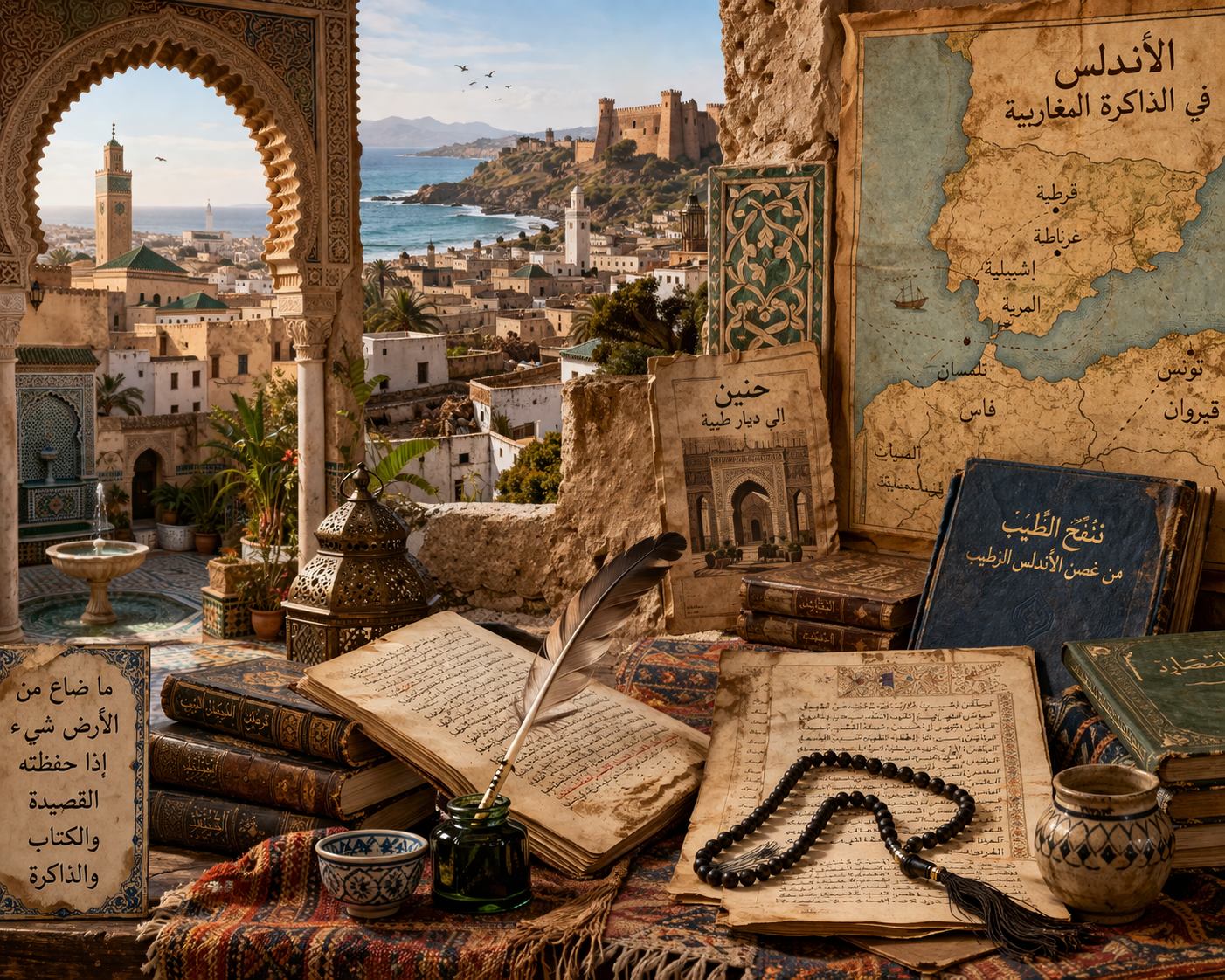
Read in this way, Maghrebi and Andalusi literature becomes more than regional literary history. It becomes a memory system of unusual intensity. It records the attachment of literature to cities such as Córdoba, Granada, Fez, Marrakech, Tlemcen, Tunis, Kairouan, and countless smaller sacred and urban geographies. It preserves worlds of learning, piety, sociability, lyric elegance, legal and theological seriousness, musical refinement, and courtly brilliance, while also carrying the sorrow of dispersal, dynastic change, forced migration, conquest, colonial violence, and post-imperial recollection. It shows how literature can become a shelter for worlds unsettled by history, and how memory can remain culturally alive through text, song, recitation, devotion, and inherited forms of longing.
Maghrebi and Andalusi Literature and Cultural Memory therefore stands at the intersection of literary history, religious history, Mediterranean history, Jewish and Islamic intellectual history, Amazigh cultural memory, post-imperial memory, manuscript culture, music, and the study of regionally rooted forms of feeling. It asks how North African and Andalusi texts preserve cultivated life, sacred geography, historical grief, multilingual inheritance, devotional authority, and the afterlife of vanished courts and cities. It also asks how literature can function as a homeland of memory when political sovereignty is lost, transformed, or permanently displaced. In this sense, the category is not only about works of literature. It is about literature as an act of civilizational survival.
Maghrebi and Andalusi Literature as Cultural Memory
Maghrebi and Andalusi literature preserves one of the richest archives of remembered place in world literature. It gathers cities, gardens, courts, mosques, shrines, schools, ports, desert routes, sea crossings, manuscripts, songs, genealogies, saints, scholars, lovers, exiles, and travelers into a long literary memory of the western Islamic Mediterranean. Its imaginative world is shaped by both splendor and fracture: the refinement of Andalusi court culture, the devotional density of Maghrebi sacred geography, the brilliance of multilingual intellectual life, the melancholy of exile, and the persistence of cultural forms after political loss.
This archive is not defined by nostalgia alone. It preserves institutions, practices, genres, and communities that remained living and generative across centuries. Andalusi poetry and music continued to circulate in North Africa. Maghrebi cities produced their own scholarly, devotional, legal, poetic, and historical traditions. Jewish, Arabic, Amazigh, and Mediterranean inheritances overlapped in complex ways. Travel writers and historians organized regional memory across sea, city, desert, and empire. Modern writers and thinkers later returned to al-Andalus as a symbol of loss, cultural plurality, political aspiration, and contested inheritance.
To study Maghrebi and Andalusi literature as cultural memory is therefore to study how literature preserves worlds that history unsettles. It is to ask how cities survive in poems, how exile becomes a language of belonging, how sacred geography anchors identity, how music carries displaced inheritance, how manuscripts make memory portable, and how literary form turns loss into continuity.
Why This Pillar Matters
Maghrebi and Andalusi literature matters because it preserves a civilizational memory shaped as much by disappearance as by flourishing. Few literary traditions have carried so enduring a burden of cultural afterlife: the memory of cities lost, dynasties ended, routes broken, communities dispersed, and refined worlds transformed into inheritance rather than present order. Yet this archive is not defined by grief alone. It also preserves intellectual brilliance, lyric delicacy, sacred learning, legal seriousness, urban beauty, convivial exchange, musical refinement, and devotional depth. It shows how literature can sustain rootedness and displacement at once.
This category also matters because the Maghreb and al-Andalus are best understood not as isolated literary zones but as deeply entangled memory worlds. Andalusian civilization did not simply vanish into the past. It continued to live in North African courts, scholarly lineages, manuscript traditions, Sufi networks, musical repertoires, urban identities, architectural forms, and inherited emotional vocabularies of loss and beauty. Maghrebi literary culture, meanwhile, cannot be reduced to an afterlife of al-Andalus. It has its own powerful urban, devotional, Amazigh, legal, courtly, and oral traditions.
The strongest version of the pillar therefore holds both truths together: Andalusian memory remained central to Maghrebi consciousness, and Maghrebi literary life remained fully generative in its own right. The result is a regional literary archive that is simultaneously Arabic, Amazigh, Jewish, Islamic, Mediterranean, African, Iberian, devotional, courtly, oral, textual, and post-imperial.
Scope and Method
This pillar is expansive by design. It includes the literary worlds of North Africa and al-Andalus across poetry, prose, adab, devotional and Sufi writing, historical narrative, travel literature, saintly biography, exile poetry, oral tradition, song, architecture-inscribed poetry, manuscript culture, and recollective forms that preserve place through rhythm, narrative, and memory. It includes Arabic-speaking traditions centrally, but it also makes room for Amazigh inheritances, Jewish literary cultures, Hebrew and Judeo-Arabic mediation, Mediterranean exchange, and the broader multilingual contexts in which Maghrebi and Andalusi literature developed.
The category is organized less by narrow genre boundaries than by memory functions: how literature preserves city, homeland, sacred landscape, courtly refinement, intellectual companionship, devotional authority, regional belonging, and historical loss. The method throughout is to read Maghrebi and Andalusi literature as both regional literary history and post-imperial archive. That means attending to form, style, courtly and devotional settings, orality and manuscript transmission, urban and rural attachments, musical performance, and the afterlives of political collapse.
It also means asking what these works did for the communities that preserved them. How did poetry hold a lost city in language? How did travel writing map belonging across sea and desert? How did devotional literature anchor memory in shrines, saints, and sacred routes? How did music and oral tradition keep Andalusi forms alive after political displacement? How did Maghrebi writing absorb Andalusi memory without becoming reducible to it? How did colonial modernity reactivate older structures of loss, longing, language, and cultural survival?
Reading Architecture for a Humanities Pillar
This literature pillar does not require a GitHub repository. Its research infrastructure is textual, bibliographic, philological, musical, historical, and interpretive rather than code-based. The appropriate scholarly architecture consists of primary texts, reliable translations, critical editions, manuscript records, musicological studies, urban histories, devotional materials, travel narratives, literary histories, university press scholarship, and carefully organized reading pathways.
The central research practices for this pillar are close reading, historical contextualization, genre analysis, reception history, translation comparison, manuscript study, music and performance history, urban memory analysis, and critical engagement with multilingual and post-imperial inheritance. The most important resources are not scripts or datasets, but editions, translations, anthologies, historical chronicles, rihla texts, devotional writings, tazkiras, scholarly monographs, and studies of al-Andalus, the Maghreb, and the wider western Islamic Mediterranean.
A strong Maghrebi and Andalusi Literature and Cultural Memory pillar should therefore foreground:
- primary Andalusi and Maghrebi texts in reliable translation, scholarly edition, or manuscript context;
- major figures and formations including Ibn Zaydun, Wallada bint al-Mustakfi, al-Mu‘tamid ibn ‘Abbad, Ibn Khafaja, Ibn Hamdis, Ibn Hazm, Ibn al-Khatib, Ibn Zamrak, Ibn Battuta, Ibn Khaldun, al-Yusi, and major Jewish Andalusi poets and thinkers;
- major memory forms such as courtly lyric, exile poetry, adab prose, devotional writing, saintly biography, rihla, chronicle, oral poetry, and Andalusi music;
- regional anchors such as Córdoba, Granada, Fez, Marrakech, Tlemcen, Tunis, Kairouan, coastal crossings, shrine networks, ports, deserts, and gardens;
- transmission through manuscript copying, recitation, musical repertoire, teaching circles, shrine networks, urban memory, exile communities, and modern reinterpretation;
- critical attention to conquest, expulsion, coexistence and conflict, colonial violence, Arab-Amazigh relations, Jewish-Muslim literary exchange, gender, language hierarchy, and the politics of memory.
The Canonical Spine of the Tradition
A strongest-sense account of Maghrebi and Andalusi Literature and Cultural Memory should be clearly anchored in the major formations and figures that define its high civilizational center. On the Andalusi side, the canonical spine includes the lyric and courtly traditions associated with figures such as Ibn Zaydun, Wallada bint al-Mustakfi, al-Mu‘tamid ibn ‘Abbad, Ibn Khafaja, Ibn Hamdis, Lisan al-Din ibn al-Khatib, Ibn Zamrak, and other poets and prose writers who preserve urban grace, love, exile, landscape, political fragility, and the splendor of court culture. It also includes major intellectual and historical figures such as Ibn Hazm, Ibn Rushd, Maimonides, Judah Halevi, Ibn Gabirol, and Ibn Khaldun, whose relevance exceeds literature narrowly defined but whose works belong centrally to the region’s memory archive.
On the Maghrebi side, the canonical center includes the literary cultures of Fez, Marrakech, Tlemcen, Tunis, Kairouan, and related scholarly and devotional worlds, as well as saintly writing, travel accounts, urban chronicles, oral traditions, Sufi prose, Andalusi musical afterlives, and later forms of recollective literature shaped by dynastic change, trans-Saharan and Mediterranean movement, and colonial modernity. Around this spine gather Andalusi exile traditions in North Africa, Jewish Andalusi and Maghrebi poetic legacies, Amazigh oral continuities, and the region’s long history of sacred and scholarly mobility.
The strength of the pillar lies in ordering these elements without flattening their diversity. It should make al-Andalus visible without turning the Maghreb into an afterimage. It should make Maghrebi sacred, urban, oral, and learned traditions visible without severing them from the powerful memory of Andalusi loss.
Foundational Questions
- How did Maghrebi and Andalusi literature preserve place, refinement, devotion, and loss across centuries of political change?
- In what sense are the Maghreb and al-Andalus best understood as intertwined memory worlds rather than separate literary zones?
- How did literature preserve cities, courts, gardens, learned circles, shrines, schools, and homelands after the political orders that sustained them collapsed?
- How do poetry, prose, adab, devotional writing, travel narrative, oral tradition, and music function differently as archives of memory?
- How did Andalusi loss become a durable symbolic force in North African and Mediterranean consciousness?
- How did Amazigh, Arab, Islamic, Jewish, Hebrew, Judeo-Arabic, and Mediterranean inheritances shape literary production in the region?
- How did migration, conquest, dynastic change, expulsion, exile, and colonial violence reshape literary memory without extinguishing it?
- How did sacred geography, shrines, saints, Sufi lineages, and devotional practices anchor regional belonging?
- How did music, manuscript transmission, oral recitation, and recollective traditions preserve Andalusi and Maghrebi forms beyond courtly collapse?
- How should this archive be read without romanticizing convivencia, flattening conflict, or turning loss into nostalgia alone?
I. The Maghreb and al-Andalus as Intertwined Memory Worlds
The strongest version of this pillar begins by refusing too rigid a separation between North Africa and al-Andalus. The two belong to one another historically and imaginatively. Courts, scholars, merchants, refugees, jurists, poets, musicians, saints, and manuscripts moved repeatedly across the western Islamic Mediterranean. Political boundaries shifted, but literary and civilizational continuity persisted through routes of travel, teaching, patronage, devotion, and memory. The Maghreb preserved and transformed Andalusian inheritances, while al-Andalus drew from North African dynastic, intellectual, legal, and cultural worlds. Literary memory in one sphere cannot be fully understood without the other.
This intertwined structure became even more pronounced after the political fragmentation and eventual loss of Muslim rule in Iberia. Al-Andalus survived not only as history but as memory-world: an idealized and mourned archive of cultivated life, sacred learning, lyric refinement, urban grace, musical inheritance, and civilizational brilliance. North Africa became one of its principal homes of transmission. Yet that transmission was never passive. Maghrebi societies refashioned Andalusi memory within their own cities, institutions, languages, devotional practices, and historical struggles.
- The Maghreb and al-Andalus as Intertwined Memory Worlds (planned) — A foundational article on the shared literary, religious, scholarly, musical, and migratory life of North Africa and al-Andalus.
- Routes of Scholarship, Exile, and Cultural Transmission Across the Western Mediterranean (planned) — A study of the movement of scholars, jurists, poets, manuscripts, music, refugees, and lineages across sea and shore.
- How Andalusi Memory Lived On in North Africa (planned) — An article on Andalusi afterlives in Maghrebi cities, courts, music, manuscripts, education, and identity.
- Literature as a Bridge Between Lost Courts and Living Cities (planned) — A study of how texts connect vanished political worlds to later civic, devotional, and cultural memory.
- The Western Islamic Mediterranean as Literary Space (planned) — A synthetic article on sea, city, route, port, shrine, school, and manuscript as coordinates of literary memory.
II. Courtly al-Andalus: Poetry, Refinement, and Urban Splendor
Andalusi literary culture preserves one of the most refined urban and courtly archives in the premodern world. In its poetry and prose, cities become luminous with cultivated life: gardens, pavilions, fountains, libraries, salons, patronage networks, musical gatherings, and forms of intellectual companionship and lyric play that tied literature to elegance, social performance, and emotional finesse. The poetry of love, longing, political fragility, and landscape acquired a distinct texture in al-Andalus, shaped by urbanity, court culture, Arabic literary inheritance, Mediterranean sensibility, and the intimate awareness that beauty and loss were never far apart.
Ibn Zaydun and Wallada remain central to this archive not only for romantic memory but for what their literary world reveals about prestige, desire, intellect, and the social life of eloquence. Al-Mu‘tamid embodies the union of rulership, poetry, vulnerability, and exile. Ibn Khafaja and related poets preserve landscape and the sensuous life of place. Later figures such as Ibn al-Khatib and Ibn Zamrak bind courtly prose and lyric to the final brilliance and fragility of Nasrid Granada. This is one of the great memory clusters of lost splendor in world literature.
- Ibn Zaydun, Wallada, and the Poetics of Love and Prestige in al-Andalus (planned) — A major article on desire, literary rivalry, aristocratic sociability, gendered voice, and the politics of courtly memory.
- al-Mu‘tamid and the Tragedy of Courtly Exile (planned) — A study of poet-king memory, dynastic loss, captivity, exile, and the vulnerability of sovereignty.
- Landscape, Garden, and Urban Grace in Andalusi Poetry (planned) — An article on garden imagery, urban refinement, water, architecture, and the literary aesthetics of place.
- Ibn Khafaja and the Poetics of Place (planned) — A focused study of landscape, nature, longing, aging, and place-conscious lyricism.
- Granada, the Alhambra, and the Literary Splendor of the Nasrid World (planned) — An article on the final brilliance of Nasrid literary culture and the intertwining of architecture, inscription, and poetic memory.
- Ibn al-Khatib and the Prose of Courtly Intelligence (planned) — A study of statesmanship, history, prose style, court culture, and intellectual life in late al-Andalus.
- Ibn Zamrak and the Inscription of Poetry into Architecture (planned) — An article on architectural poetry, the Alhambra, inscription, patronage, and materialized literary memory.
III. Loss, Exile, and the Afterlife of al-Andalus
Few literary traditions have made historical loss as symbolically durable as Andalusi and post-Andalusi writing. The fall of cities, the collapse of regimes, forced migrations, expulsion, and the gradual dismemberment of Muslim and Jewish life in Iberia generated a body of literature in which exile became one of the central structures of memory. Here literature functions not simply as lament but as a portable homeland. It preserves names, places, gardens, households, musical forms, scholarly lineages, and ways of life that political history could no longer protect.
The afterlife of al-Andalus in North Africa is especially important. Exiles carried manuscripts, songs, legal traditions, craft lineages, urban habits, genealogies, and emotional geographies with them. Memory of al-Andalus remained active in Morocco, Algeria, Tunisia, and beyond as a vision of cultivated civilization, sorrow, refinement, and irreversible loss. This memory was repeatedly reactivated under later forms of upheaval, including colonial violence and modern dislocation. A serious pillar must therefore treat Andalusi loss as historical experience, literary structure, and modern symbolic resource.
- Exile and the Literary Afterlife of al-Andalus (planned) — A foundational article on exile as memory form, homeland substitute, and post-imperial literary structure.
- Lost Cities, Remembered Gardens, and the Poetics of Andalusi Mourning (planned) — A study of cities, gardens, ruins, water, and beauty as objects of lament and recollection.
- Andalusi Exiles in North Africa and the Re-rooting of Memory (planned) — An article on migration, resettlement, manuscripts, music, families, and the remaking of Andalusi identity in Maghrebi settings.
- Literature as Homeland After Political Rupture (planned) — A broader article on texts, songs, recitation, and memory as substitutes for lost political place.
- The Symbolic Force of Andalusian Loss in Later North African Thought (planned) — A study of al-Andalus as metaphor, wound, inheritance, and cultural horizon in later Maghrebi consciousness.
- Al-Andalus Between History and Longing (planned) — A critical article on how to read Andalusi memory without reducing it to either nostalgia or simple historical fact.
IV. Maghrebi Cities, Learned Culture, and Urban Literary Memory
The Maghreb possesses its own dense literary worlds independent of Andalusi afterlife, even while often intertwined with it. Cities such as Fez, Marrakech, Tlemcen, Tunis, Kairouan, Rabat, Meknes, and smaller sacred or scholarly centers served as sites of legal scholarship, Sufi devotion, courtly patronage, urban sociability, manuscript culture, and literary production. Maghrebi literature preserves these places as centers of learning, sanctity, beauty, discipline, and civic memory. Urban writing, chronicles, biographical traditions, devotional works, travel accounts, and literary prose all contributed to a regional archive in which city, shrine, market, court, school, and library become enduring literary coordinates.
This urban literary memory is central because it shows the Maghreb not merely as receiver of loss but as producer of forms: forms of devotion, scholarship, sociability, historical writing, legal thought, local sainthood, and cultural resilience that shaped North African identity across centuries. Maghrebi literary culture is not an appendix to al-Andalus. It is a major memory system in its own right.
- Fez and the Literary Memory of Sacred Urban Learning (planned) — A study of Fez as scholarly city, sacred urban center, manuscript environment, and memory-world of Islamic learning.
- Marrakech, Courtly Power, and Maghrebi Cultural Imagination (planned) — An article on dynastic power, urban symbolism, court culture, and literary memory in Marrakech.
- Tlemcen and the Western Islamic Literary World (planned) — A study of Tlemcen’s scholarly, devotional, and poetic importance in western Islamic memory.
- Tunis, Kairouan, and the Cities of Maghrebi Scholarly Memory (planned) — An article on Ifriqiyan learning, urban sanctity, legal scholarship, and literary continuity.
- Urban Chronicle, Biography, and the Preservation of Maghrebi Civic Worlds (planned) — A study of how chronicles and biographical writing preserve cities as literary and moral worlds.
- Libraries, Schools, and Manuscript Culture in the Maghreb (planned) — An article on institutions of textual survival, teaching, copying, and learned authority.
V. Devotional Writing, Sufi Traditions, and Sacred Geography
Maghrebi and Andalusi literary memory is inseparable from sacred geography. Shrines, saints, lodges, pilgrimage routes, lineages of blessing, devotional recitation, and learned Sufi communities all shaped the literary imagination of the region. Sufi writing, saintly biography, devotional poetry, prayers, invocations, and recollective narratives attached memory to place through sanctity as much as through politics. Sacred geography often outlasted dynastic power; literature helped make it transmissible.
In North Africa especially, saintly and devotional traditions formed one of the most durable memory networks available to local communities. Literature preserved the charisma of saints, the moral reputation of places, the teachings of Sufi lineages, and the intimacy between devotion and region. This gives the category a depth not reducible to courtly nostalgia or urban refinement alone. It also makes Maghrebi literature central to the study of how sacred authority, local belonging, and textual transmission reinforce one another.
- Sacred Geography and Literary Memory in the Maghreb (planned) — A foundational article on shrines, saints, routes, lodges, and the literary preservation of blessed place.
- Saintly Biography and the Preservation of Regional Holiness (planned) — A study of hagiography, sainthood, moral reputation, miracle narrative, and local authority.
- Sufi Writing and the Devotional Imagination of North Africa (planned) — An article on Sufi prose, poetry, prayer, commentary, and the literary life of devotion.
- Shrines, Routes, and the Poetics of Blessed Place (planned) — A study of pilgrimage routes, regional sanctity, spiritual geography, and memory.
- Devotional Literature Beyond the Courtly Archive (planned) — An article on non-courtly literary life, communal recitation, prayer books, saintly memory, and local devotion.
- al-Yusi and the Intellectual World of Early Modern Morocco (planned) — A focused article on Moroccan adab, Sufism, learned prose, theology, and literary self-reflection.
- al-Tilimsani, Divine Names, and North African Mystical Theology (planned) — A study of Sufi commentary, theology, literary style, and devotional intellectual culture.
VI. Jewish, Arabic, Amazigh, and Multilingual Inheritances
A strongest-sense pillar must make room for the multilingual and multi-communal reality of the region. Maghrebi and Andalusi literary memory was shaped by Islamic, Jewish, Arabic, Hebrew, Judeo-Arabic, Amazigh, and Mediterranean inheritances that frequently overlapped even when marked by hierarchy, tension, or fracture. Jewish Andalusi poetry and philosophy belong centrally to the western Mediterranean literary world. Hebrew poetry in al-Andalus developed in intimate conversation with Arabic forms, meters, genres, and courtly culture. Jewish philosophers, poets, and intellectuals participated in the broader literary and philosophical ecology of the region even when communal boundaries remained real.
Amazigh oral and regional traditions also form part of the wider memory archive through story, song, place-name, saintly memory, oral epic, legal custom, and local sacred inheritance. Arabic remained dominant in many learned and literary contexts, but it never existed in cultural isolation. This layer matters because the memory of coexistence, contestation, translation, and cultural sharing is itself part of what later generations remember under the sign of al-Andalus and the Maghreb. The region’s literature is not homogeneous. Its richness lies partly in its layered plurality.
- Jewish Andalusi Poetry and the Shared Literary World of al-Andalus (planned) — A major article on Hebrew poetry, Arabic models, court culture, philosophy, and Jewish literary memory.
- Arabic and Hebrew in the Western Mediterranean Literary Imagination (planned) — A study of linguistic exchange, translation, imitation, rivalry, and shared literary forms.
- Amazigh Oral Memory and the Wider Literary Landscape of North Africa (planned) — An article on Amazigh oral forms, song, story, place, saintly memory, and regional continuity.
- Multilingual Inheritance, Coexistence, and Conflict in Regional Literary Memory (planned) — A critical article on plurality without romantic flattening: exchange, hierarchy, violence, and cultural borrowing.
- Convivencia, Fracture, and the Ethics of Remembering al-Andalus (planned) — A study of how modern memory alternately idealizes, critiques, and reuses medieval pluralism.
VII. Travel Writing, History, and the Narrative Ordering of Region
Travel writing, historical reflection, geography, and biographical memory play a major role in the literary archive of the Maghreb and al-Andalus. These forms preserve routes, cities, courts, saints, scholars, marvels, ports, deserts, caravan worlds, islands, and the texture of connected geographies. They order memory across movement. They also transform region into narrative: the Maghreb as sacred and scholarly landscape, al-Andalus as courtly and tragic memory, the western Mediterranean as corridor of exchange, migration, and loss, and the broader Islamic world as a field of travel and comparison.
Writers such as Ibn Battuta and Ibn Khaldun are especially important here, not because they belong neatly to one modern literary category, but because they organize civilizational self-understanding through movement, history, sociology, narration, and reflection. Ibn Battuta’s travel narrative links Morocco to an immense Afro-Eurasian geography of Islamic mobility. Ibn Khaldun transforms Maghrebi and wider Islamic historical experience into one of the most influential frameworks for thinking about civilization, power, dynasty, and social cohesion. Their works widen the pillar from lyric and court memory into larger questions of region, civilization, and historical change.
- Ibn Battuta and the Narrative Geography of the Maghreb and Beyond (planned) — A major article on rihla, travel, geography, wonder, identity, and Moroccan connection to the wider Islamic world.
- Ibn Khaldun and the Historical Intelligence of Post-Imperial Memory (planned) — A study of dynasty, social cohesion, history, civilizational analysis, and the Maghrebi context of historical theory.
- Travel Writing and the Literary Mapping of the Western Islamic World (planned) — An article on routes, ports, cities, scholars, saints, and narrative geography.
- Chronicle, Biography, and the Preservation of Dynastic and Urban Worlds (planned) — A study of historical prose, civic memory, dynastic legitimacy, and learned biography.
- Rihla as Literary Form and Spiritual Geography (planned) — An article on travel as pilgrimage, education, social mapping, and literary self-fashioning.
VIII. Oral Tradition, Song, and the Memory of Place
Not all cultural memory in the Maghreb and the afterlife of al-Andalus was preserved through elite manuscripts alone. Song, oral narrative, musical traditions, regional poetry, and performative memory carried inherited worlds into domestic, communal, ceremonial, and urban life. Andalusi musical traditions in North Africa are among the most powerful examples of cultural afterlife through sound. Oral poetry and song preserved attachment to place, lineage, honor, longing, devotion, seasonal rhythm, and inherited form beyond the library and court.
This layer matters because literature here is not only textual. It is also sounded, remembered, and inhabited. The category therefore includes recollective forms that move between text, voice, melody, and communal memory. In many cases, music and oral performance preserve emotional structures that written history alone cannot carry: longing for a lost city, pride in a lineage, attachment to a shrine, the memory of migration, or the continued life of a form whose political world has vanished.
- Andalusi Music and the Sound of Cultural Afterlife in North Africa (planned) — A major article on music as memory, Andalusi repertoires, urban performance, and cultural survival.
- Oral Poetry and the Memory of Region in the Maghreb (planned) — A study of oral verse, local identity, performance, honor, devotion, and place-memory.
- Song, Ceremony, and the Survival of Andalusi Form (planned) — An article on ceremonial music, inherited repertoires, urban identity, and embodied cultural memory.
- Literature Beyond the Page: Voice, Rhythm, and Place-Memory (planned) — A synthetic article on how oral and musical forms preserve literary worlds outside manuscript culture.
- Domestic Memory, Communal Performance, and the Afterlife of Lost Worlds (planned) — A study of how households and communities sustain memory through song, recitation, and ceremony.
IX. Colonial Rupture, Modernity, and Post-Imperial Memory
Maghrebi literary memory was reshaped again under colonial conquest, dispossession, linguistic pressure, administrative violence, and the social dislocations of modernity. Colonial rule did not create the region’s consciousness of loss, but it reactivated and transformed it. The memory of al-Andalus, the attachment to city and shrine, the experience of exile and displacement, and the sense of a broken or endangered cultural continuity all acquired new resonance under French, Spanish, and other imperial pressures. Language itself became a site of struggle: Arabic, Amazigh languages, French, Spanish, Hebrew, and other linguistic forms became implicated in education, authority, memory, and resistance.
A strongest-sense pillar therefore carries the story forward into modernity, not to dissolve the classical archive but to show its reuse. Post-imperial memory in the Maghreb often draws power from much older literary structures of longing, dignity, sacred attachment, and civilizational recollection. Modern al-Andalus is not merely a medieval memory; it becomes a symbolic resource in debates over identity, colonialism, Arabness, Amazighness, Islam, Europe, music, migration, feminism, Palestine, and Mediterranean belonging.
- Colonial Violence and the Rewriting of Maghrebi Cultural Memory (planned) — A major article on colonialism, language policy, education, archives, displacement, and literary memory.
- The Modern Reuse of Andalusi Memory in North African Thought (planned) — A study of al-Andalus as modern symbol, aspiration, wound, and political-cultural resource.
- Language, Rupture, and Literary Continuity in the Colonial Maghreb (planned) — An article on Arabic, Amazigh, French, Spanish, education, literary authority, and cultural survival.
- Post-Imperial Literature and the Afterlife of Lost Worlds (planned) — A study of how modern literature inherits and reworks older structures of exile, loss, and recollection.
- Al-Andalus in Modern Music, Film, and Public Memory (planned) — An article on contemporary afterlives of Andalusi memory in music, media, identity, and politics.
X. Major Genres Across Maghrebi and Andalusi Literary Memory
A comprehensive pillar should also organize the archive by genre. Courtly lyric preserves urban grace, love, praise, and cultivated sociability. Exile poetry preserves loss, longing, and remembered homeland. Adab prose gathers wit, anecdote, ethical observation, literary polish, and learned selection. Devotional writing anchors sanctity, piety, and sacred geography. Biography and saintly literature preserve reputations, lineages, and blessed lives. Travel writing maps belonging across movement. Historical writing orders dynasties, cities, and civilizational change. Oral song and performative tradition preserve memory through repetition and sound.
These genres are not merely formal containers. They are different ways of keeping a world alive. Each preserves a different relation to memory: courtly splendor, sacred legitimacy, civic belonging, exile, journey, voice, performance, or historical explanation.
- Courtly Lyric and the Refinement of Andalusi Urban Memory (planned) — A genre article on love poetry, praise, garden imagery, urban grace, and courtly sociability.
- Exile Poetry and the Literature of Lost Homeland (planned) — A study of forced movement, longing, homeland, memory, and literary survival after rupture.
- Adab and Cultivated Memory in the Western Islamic World (planned) — An article on prose, wit, anthology, ethical observation, and refined learning.
- Devotional Writing and Sacred Regional Belonging (planned) — A study of prayers, saints, shrines, Sufi prose, and place-based devotion.
- Biography, Saintly Memory, and Urban Reputation (planned) — An article on learned lives, hagiography, city memory, lineage, and moral authority.
- Travel Narrative and the Literary Mapping of the Maghreb (planned) — A study of travel, geography, education, pilgrimage, and regional consciousness.
- History as Post-Imperial Memory (planned) — An article on chronicle, dynastic rise and fall, urban loss, and historical explanation.
- Song and Oral Tradition as Archives of Cultural Survival (planned) — A study of performance, memory, sound, inheritance, and non-written forms of literary continuity.
XI. Recurring Themes and Symbolic Structures
Across these genres, certain structures recur with particular force: city and garden as forms of cultivated order; court and school as sites of refinement; shrine and saint as anchors of blessed place; sea crossing and migration as structures of uncertainty; exile and longing as permanent emotional coordinates; lost homeland as symbolic center; coexistence and fracture as layered memories; dynastic splendor and sudden ruin; sacred learning and post-imperial survival; beauty preserved against historical violence. These themes help explain why the literature of the region remains so emotionally and symbolically potent.
The pillar should treat these themes carefully. City and garden imagery should not become decorative nostalgia. Convivencia should not be flattened into a sentimental myth. Exile should not be romanticized. Sacred geography should not be reduced to folklore. The force of the archive lies precisely in the fact that beauty, violence, plurality, hierarchy, devotion, and loss are intertwined.
- City, Garden, and the Literary Memory of Cultivated Life (planned) — A thematic article on gardens, courtyards, water, urban elegance, and remembered refinement.
- Exile, Longing, and the Poetics of Lost Homeland (planned) — A study of displacement, homesickness, memory, and the literary reconstruction of place.
- Shrine, Saint, and Sacred Geography in Regional Memory (planned) — An article on devotional place, sanctity, routes, saints, and spiritual belonging.
- Sea, Crossing, and Mediterranean Uncertainty in Literary Imagination (planned) — A study of sea routes, migration, exile, travel, commerce, danger, and connection.
- Flourishing and Ruin in the Memory of al-Andalus (planned) — An article on splendor, collapse, nostalgia, mourning, and post-imperial interpretation.
- Beauty Against Historical Violence (planned) — A critical article on how literary beauty preserves dignity without erasing conquest, expulsion, colonialism, or rupture.
- Convivencia, Conflict, and the Ethics of Cultural Memory (planned) — A study of plural coexistence, hierarchy, exchange, violence, and the responsibilities of remembering.
XII. Manuscript, Recitation, Music, and Canon Formation
Maghrebi and Andalusi literary memory endured through manuscripts, recitation, song, commentary, urban teaching circles, legal and devotional lineages, and inherited repertoires of performance. The canon was not preserved solely by printed books or formal institutions of modern literary history. It survived through embodied practices: copying, memorizing, teaching, singing, invoking, and recontextualizing. Andalusi poetry survived in North African manuscript culture and musical practice. Maghrebi devotional and historical memory survived in shrine networks, local scholarly circles, and regional forms of recitation and textual transmission.
This means canon formation in the region is inseparable from performance, pedagogy, affect, and communal use. What endured did so not only because it was admired, but because it remained usable in collective life. A poem could be sung, a saintly life could authorize a place, a chronicle could preserve a city, a manuscript could carry a displaced world, and a musical repertoire could sustain the sound of a lost civilization.
- Manuscript Culture and the Preservation of Maghrebi and Andalusi Memory (planned) — A study of copying, libraries, manuscripts, marginalia, and textual transmission across the western Islamic Mediterranean.
- Recitation, Teaching, and the Social Life of Literary Memory (planned) — An article on pedagogy, memorization, oral transmission, and learned performance.
- Music as Archive in the Andalusi Afterlife (planned) — A major article on Andalusi musical repertoires as forms of historical, emotional, and urban memory.
- Commentary, Anthology, and the Regional Canon (planned) — A study of selection, preservation, explanation, local literary authority, and canon formation.
- Why Lost Worlds Remain Literarily Alive (planned) — A synthetic article on memory, transmission, performance, longing, and the afterlife of vanished political orders.
Expanded Article Architecture
The following long-range architecture preserves the full breadth of the category while clarifying its major centers of gravity: courtly Andalusian splendor, Maghrebi sacred and urban memory, Jewish and Amazigh inheritances, exile and post-imperial recollection, travel and historical intelligence, oral tradition, music, manuscript transmission, and modern reuse.
Foundations and Intertwined Worlds
- The Maghreb and al-Andalus as Intertwined Memory Worlds (planned)
- Routes of Scholarship, Exile, and Cultural Transmission Across the Western Mediterranean (planned)
- How Andalusi Memory Lived On in North Africa (planned)
- Literature as a Bridge Between Lost Courts and Living Cities (planned)
- The Western Islamic Mediterranean as Literary Space (planned)
Courtly al-Andalus
- Ibn Zaydun, Wallada, and the Poetics of Love and Prestige in al-Andalus (planned)
- al-Mu‘tamid and the Tragedy of Courtly Exile (planned)
- Landscape, Garden, and Urban Grace in Andalusi Poetry (planned)
- Ibn Khafaja and the Poetics of Place (planned)
- Granada, the Alhambra, and the Literary Splendor of the Nasrid World (planned)
- Ibn al-Khatib and the Prose of Courtly Intelligence (planned)
- Ibn Zamrak and the Inscription of Poetry into Architecture (planned)
Loss and Exile
- Exile and the Literary Afterlife of al-Andalus (planned)
- Lost Cities, Remembered Gardens, and the Poetics of Andalusi Mourning (planned)
- Andalusi Exiles in North Africa and the Re-rooting of Memory (planned)
- Literature as Homeland After Political Rupture (planned)
- The Symbolic Force of Andalusian Loss in Later North African Thought (planned)
- Al-Andalus Between History and Longing (planned)
Maghrebi Urban and Sacred Worlds
- Fez and the Literary Memory of Sacred Urban Learning (planned)
- Marrakech, Courtly Power, and Maghrebi Cultural Imagination (planned)
- Tlemcen and the Western Islamic Literary World (planned)
- Tunis, Kairouan, and the Cities of Maghrebi Scholarly Memory (planned)
- Urban Chronicle, Biography, and the Preservation of Maghrebi Civic Worlds (planned)
- Libraries, Schools, and Manuscript Culture in the Maghreb (planned)
Devotion, Sufism, and Sacred Geography
- Sacred Geography and Literary Memory in the Maghreb (planned)
- Saintly Biography and the Preservation of Regional Holiness (planned)
- Sufi Writing and the Devotional Imagination of North Africa (planned)
- Shrines, Routes, and the Poetics of Blessed Place (planned)
- Devotional Literature Beyond the Courtly Archive (planned)
- al-Yusi and the Intellectual World of Early Modern Morocco (planned)
- al-Tilimsani, Divine Names, and North African Mystical Theology (planned)
Plural and Multilingual Inheritances
- Jewish Andalusi Poetry and the Shared Literary World of al-Andalus (planned)
- Arabic and Hebrew in the Western Mediterranean Literary Imagination (planned)
- Amazigh Oral Memory and the Wider Literary Landscape of North Africa (planned)
- Multilingual Inheritance, Coexistence, and Conflict in Regional Literary Memory (planned)
- Convivencia, Fracture, and the Ethics of Remembering al-Andalus (planned)
History, Travel, and Intellectual Memory
- Ibn Battuta and the Narrative Geography of the Maghreb and Beyond (planned)
- Ibn Khaldun and the Historical Intelligence of Post-Imperial Memory (planned)
- Travel Writing and the Literary Mapping of the Western Islamic World (planned)
- Chronicle, Biography, and the Preservation of Dynastic and Urban Worlds (planned)
- Rihla as Literary Form and Spiritual Geography (planned)
Song, Orality, and Afterlives
- Andalusi Music and the Sound of Cultural Afterlife in North Africa (planned)
- Oral Poetry and the Memory of Region in the Maghreb (planned)
- Song, Ceremony, and the Survival of Andalusi Form (planned)
- Literature Beyond the Page: Voice, Rhythm, and Place-Memory (planned)
- Domestic Memory, Communal Performance, and the Afterlife of Lost Worlds (planned)
Colonial and Modern Reuse
- Colonial Violence and the Rewriting of Maghrebi Cultural Memory (planned)
- The Modern Reuse of Andalusi Memory in North African Thought (planned)
- Language, Rupture, and Literary Continuity in the Colonial Maghreb (planned)
- Post-Imperial Literature and the Afterlife of Lost Worlds (planned)
- Al-Andalus in Modern Music, Film, and Public Memory (planned)
Genres and Forms
- Courtly Lyric and the Refinement of Andalusi Urban Memory (planned)
- Exile Poetry and the Literature of Lost Homeland (planned)
- Adab and Cultivated Memory in the Western Islamic World (planned)
- Devotional Writing and Sacred Regional Belonging (planned)
- Biography, Saintly Memory, and Urban Reputation (planned)
- Travel Narrative and the Literary Mapping of the Maghreb (planned)
- History as Post-Imperial Memory (planned)
- Song and Oral Tradition as Archives of Cultural Survival (planned)
Major Themes
- City, Garden, and the Literary Memory of Cultivated Life (planned)
- Exile, Longing, and the Poetics of Lost Homeland (planned)
- Shrine, Saint, and Sacred Geography in Regional Memory (planned)
- Sea, Crossing, and Mediterranean Uncertainty in Literary Imagination (planned)
- Flourishing and Ruin in the Memory of al-Andalus (planned)
- Beauty Against Historical Violence (planned)
- Convivencia, Conflict, and the Ethics of Cultural Memory (planned)
Closing Perspective
Maghrebi and Andalusi Literature and Cultural Memory should be understood as a major archive of place, devotion, refinement, loss, sacred attachment, and post-imperial endurance rather than as a peripheral regional branch of Arabic literary history. Its range extends from courtly Andalusian lyric and prose to Maghrebi urban and devotional writing, from exile literature and remembered gardens to song, oral memory, sacred geography, multilingual inheritance, travel narrative, historical theory, colonial rupture, and modern reuse. Read in the strongest sense, the category shows how literature can preserve not only beauty or historical information, but entire regional worlds of feeling and belonging.
It is therefore central to any serious understanding of North African and western Mediterranean literary consciousness. Maghrebi and Andalusi literature reveals how texts, songs, poems, chronicles, saintly lives, and recollective traditions sustain memory across borders, preserve cultural forms beyond the life of regimes, and transmit homes of feeling that remain central to self-understanding long after history has unsettled the worlds that first produced them. It also shows, with unusual clarity, how literature can become a dwelling place for civilizations that survive most powerfully in memory.
Related Reading
- Literature & Cultural Memory
- Arabic Literature and Adab
- Persian Poetry and Cultural Memory
- Abrahamic Traditions
- Middle East & North Africa
- Maghrebi & Andalusi Thought
- African Healing Traditions
Further Reading
- Calderwood, E. (2018). Colonial al-Andalus: Spain and the Making of Modern Moroccan Culture. Cambridge, MA: Harvard University Press. https://www.hup.harvard.edu/books/9780674980327
- Calderwood, E. (2023). On Earth or in Poems: The Many Lives of al-Andalus. Cambridge, MA: Harvard University Press. https://www.hup.harvard.edu/books/9780674980365
- Hirschkind, C. (2020). The Feeling of History: Islam, Romanticism, and Andalusia. Chicago: University of Chicago Press. https://academic.oup.com/chicago-scholarship-online/book/38399
- Howe, M. (2017). Al-Andalus Rediscovered: Iberia’s New Muslims and the Quest for a Lost Paradise. Oxford: Oxford University Press. https://global.oup.com/academic/product/al-andalus-rediscovered-9780199327577
- Ibn Battuta (2013). The Travels of Ibn Baṭūta. Cambridge Library Collection. Cambridge: Cambridge University Press. https://www.cambridge.org/core/books/travels-of-ibn-batuta/387FF83D9A246F5AF847103305AE9DDE
- Menocal, M. R., Scheindlin, R. P. and Sells, M. (eds.) (2000). The Literature of Al-Andalus. Cambridge: Cambridge University Press. https://www.cambridge.org/core/books/literature-of-alandalus/32A7BC8DE88D0C226BB10602578DB152
- Ruggles, D. F. (1993). “Arabic Poetry and Architectural Memory in al-Andalus.” Ars Orientalis, 23, pp. 171–178. https://www.jstor.org/stable/4629447
- Stroumsa, S. (2019). Andalus and Sefarad: On Philosophy and Its History in Islamic Spain. Princeton: Princeton University Press. https://academic.oup.com/princeton-scholarship-online/book/30924
- al-Tilimsānī, ʿAfīf al-Dīn (2025). The Divine Names: A Mystical Theology of the Names of God in the Qurʾan. Library of Arabic Literature. New York: NYU Press. https://www.libraryofarabicliterature.org/books/9781479826124/the-divine-names/
- al-Yūsī, al-Ḥasan (2021). The Discourses: Reflections on History, Sufism, Theology, and Literature. Edited and translated by J. Stearns. Library of Arabic Literature. New York: NYU Press. https://www.libraryofarabicliterature.org/books/9780814764572/the-discourses/
References
- Calderwood, E. (2018). Colonial al-Andalus: Spain and the Making of Modern Moroccan Culture. Cambridge, MA: Harvard University Press. https://www.hup.harvard.edu/books/9780674980327
- Calderwood, E. (2023). On Earth or in Poems: The Many Lives of al-Andalus. Cambridge, MA: Harvard University Press. https://www.hup.harvard.edu/books/9780674980365
- Cambridge University Press (2000). “The maqama.” In M. R. Menocal, R. P. Scheindlin and M. Sells (eds.), The Literature of Al-Andalus. Cambridge: Cambridge University Press. https://www.cambridge.org/core/books/literature-of-alandalus/maqama/826850312FAB66C7F85A745FB1183869
- Cambridge University Press (2000). “The qasida.” In M. R. Menocal, R. P. Scheindlin and M. Sells (eds.), The Literature of Al-Andalus. Cambridge: Cambridge University Press. https://www.cambridge.org/core/books/literature-of-alandalus/qasida/C8C228DFAA4B09773A7C6AAD9AF7DDEF
- Hirschkind, C. (2020). The Feeling of History: Islam, Romanticism, and Andalusia. Chicago: University of Chicago Press. https://academic.oup.com/chicago-scholarship-online/book/38399
- Howe, M. (2017). Al-Andalus Rediscovered: Iberia’s New Muslims and the Quest for a Lost Paradise. Oxford: Oxford University Press. https://global.oup.com/academic/product/al-andalus-rediscovered-9780199327577
- Ibn Battuta (2013). The Travels of Ibn Baṭūta. Cambridge Library Collection. Cambridge: Cambridge University Press. https://www.cambridge.org/core/books/travels-of-ibn-batuta/387FF83D9A246F5AF847103305AE9DDE
- Ibn Khaldūn (2026). The Muqaddimah: An Introduction to History. Translated by F. Rosenthal. Princeton: Princeton University Press. https://books.google.com/books/about/The_Muqaddimah.html?id=pyyQEQAAQBAJ
- Menocal, M. R., Scheindlin, R. P. and Sells, M. (eds.) (2000). The Literature of Al-Andalus. Cambridge: Cambridge University Press. https://www.cambridge.org/core/books/literature-of-alandalus/32A7BC8DE88D0C226BB10602578DB152
- Oxford Academic (n.d.). “The Golden Age of Jews in Al-Andalus.” In The Oxford Handbook of Jewish Life in Medieval Spain. Oxford: Oxford University Press. https://academic.oup.com/edited-volume/62249/chapter/552806362
- Ruggles, D. F. (1993). “Arabic Poetry and Architectural Memory in al-Andalus.” Ars Orientalis, 23, pp. 171–178. https://www.jstor.org/stable/4629447
- Stroumsa, S. (2019). Andalus and Sefarad: On Philosophy and Its History in Islamic Spain. Princeton: Princeton University Press. https://academic.oup.com/princeton-scholarship-online/book/30924
- al-Tilimsānī, ʿAfīf al-Dīn (2025). The Divine Names: A Mystical Theology of the Names of God in the Qurʾan. Library of Arabic Literature. New York: NYU Press. https://www.libraryofarabicliterature.org/books/9781479826124/the-divine-names/
- al-Yūsī, al-Ḥasan (2021). The Discourses: Reflections on History, Sufism, Theology, and Literature. Edited and translated by J. Stearns. Library of Arabic Literature. New York: NYU Press. https://www.libraryofarabicliterature.org/books/9780814764572/the-discourses/