
Last Updated May 3, 2026
Environment, place, and ecological knowledge examine how human communities understand, inhabit, interpret, adapt to, and struggle over the natural worlds around them. In cultural anthropology, environments are not viewed only as physical settings, resource bases, ecological constraints, or technical management problems. They are also culturally mediated landscapes shaped by memory, livelihood, risk, symbolism, mobility, territorial belonging, local knowledge, environmental change, and systems of stewardship. Human-environment relations are therefore approached not merely as technical interactions, but as lived and historically situated forms of ecological life.
This content pillar brings together the major domains through which cultural anthropology studies environment, place, and ecological knowledge. It examines cultural ecology, environmental anthropology, ethno-ecology, Indigenous and local ecological knowledge, place attachment, landscape memory, subsistence, livelihood, water, forests, commons, sacred landscapes, mobility, settlement, climate adaptation, conservation conflict, environmental justice, extraction, dispossession, urban environments, resilience, stewardship, and the moral worlds through which communities understand land, water, seasonality, nonhuman life, and ecological change. It treats environment not as a neutral backdrop to social life, but as one of the fundamental interfaces between culture, survival, adaptation, memory, power, and the reproduction of everyday life.
Current Space
Cultural Anthropology
Related Topic
Development & Modernity
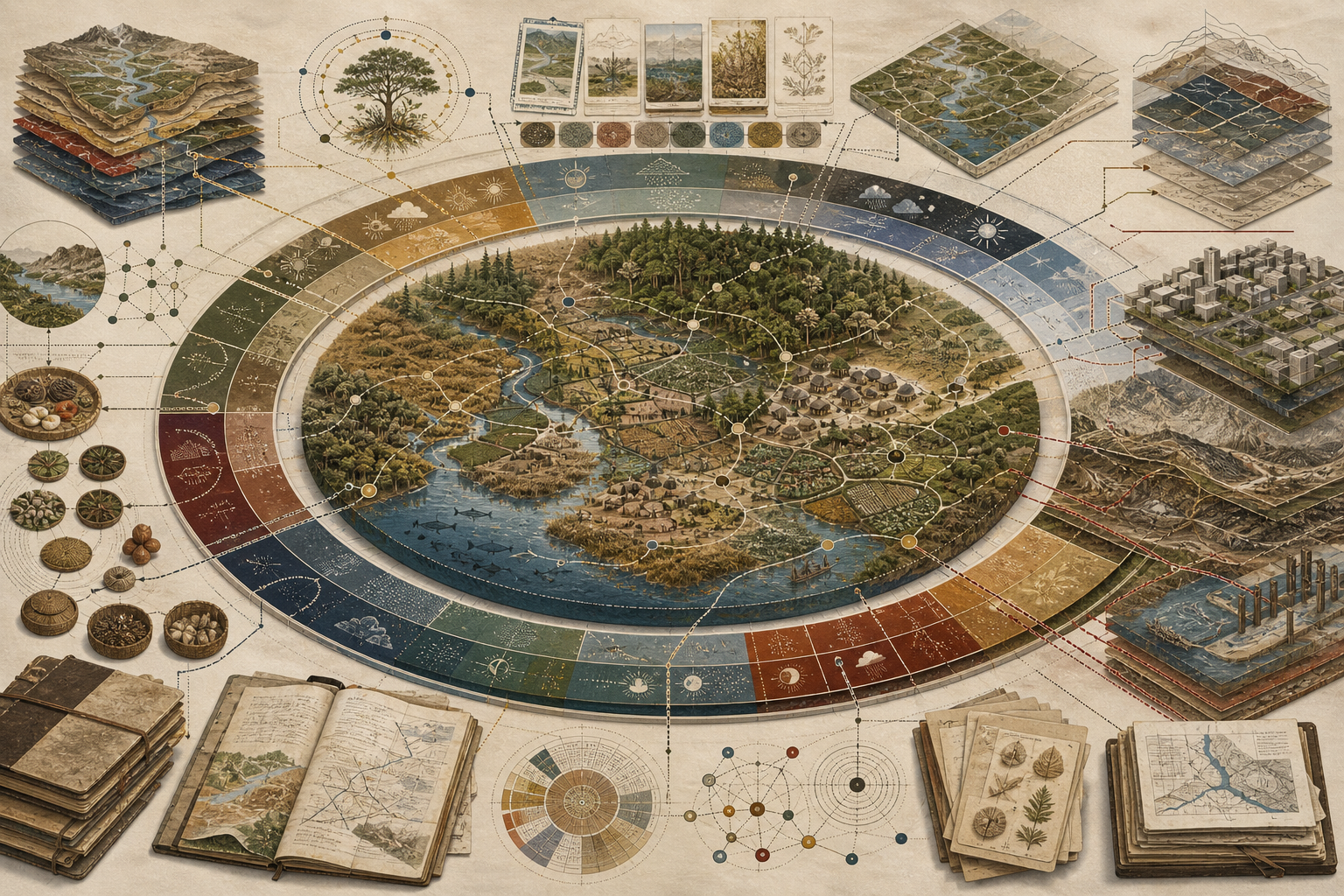
This series also approaches ecological anthropology as a field that benefits from careful research infrastructure: landscape case files, place-memory notes, ecological-knowledge codebooks, seasonal calendars, livelihood records, resource-use templates, water and forest case notes, conservation-conflict files, environmental justice memos, interview guides, fieldnote templates, local classification records, ethical review notes, source catalogs, and reproducible research documentation. Cultural anthropology cannot reduce environmental life to datasets, resource inventories, land-cover maps, or climate indicators alone. Environment is lived through labor, memory, language, territory, mobility, ritual, risk, ecological observation, sensory knowledge, and unequal power. Yet research repositories can strengthen this work by making sources, interpretive decisions, fieldnote structures, methodological assumptions, and ethical concerns more transparent.
For that reason, this pillar integrates cultural anthropology with open research workflows where appropriate. Python may support synthetic ecological-knowledge inventories, place-based source catalogs, seasonal-calendar examples, water-use records, conservation-conflict metadata, and research utilities. R may support qualitative-code summaries, seasonal pattern summaries, livelihood-code tables, ecological-knowledge comparisons, and reproducible research reports. SQL may support structured catalogs for sources, places, ecological classifications, seasonal observations, livelihood practices, resource-use events, environmental conflicts, interview excerpts, and interpretive memos. Markdown and notebooks may support research logs, literature reviews, concept maps, reflexive memos, methods documentation, and article-level research packages. These tools do not replace anthropological interpretation. They help make environmental research more organized, auditable, and reusable while preserving context, place, ethics, reflexivity, and the central anthropological responsibility of interpretation.
Environment, place, and ecological knowledge therefore appear here not only as classic anthropological concerns, but also as a research architecture for studying how ecological life becomes meaningful, practical, contested, and historically durable. The aim of the series is to preserve the interpretive and comparative richness of ecological anthropology while building a more transparent scholarly workflow around concepts, places, sources, landscapes, livelihoods, environmental memory, and stewardship. In that sense, this pillar treats environment not simply as nature, resource, or risk, but as a lived world where culture, ecology, memory, power, and survival meet.
Environment, Place, and Ecological Knowledge Research Repository
The Environment, Place, and Ecological Knowledge knowledge series is supported by an open research repository with article-level folders, annotated bibliographies, research notes, place-memory templates, ecological-knowledge inventories, seasonal-calendar examples, livelihood and resource-use templates, ethical fieldwork guidance, qualitative codebooks, synthetic teaching datasets, source metadata, SQL research schemas, Python and R workflow examples, notebooks, and reproducible research scaffolding where appropriate.
View the Environment, Place, and Ecological Knowledge Research Repository
Environment, Place, and Ecological Knowledge as a Foundational Anthropological Field
Environment, place, and ecological knowledge occupy a central place in cultural anthropology because human communities do not merely exist in environments. They dwell in places, inherit landscapes, interpret ecological signals, classify nonhuman life, organize subsistence, remember territorial histories, and build systems of livelihood and obligation around the conditions of land, water, seasonality, climate, and ecological relation. To study environment in this sense is to study one of the fundamental interfaces between culture, survival, adaptation, memory, and the reproduction of everyday life.
Anthropology has long treated human-environment relations as something more complex than resource use or environmental constraint. In a stronger analytical sense, environmental life refers to the patterned ways communities inhabit landscapes, interpret ecological variation, organize subsistence, respond to risk, and encode relationships with land, water, animals, plants, weather, territory, and climate into systems of practice and meaning. Environments are not simply external conditions acting on passive populations. They are lived settings of labor, memory, classification, spirituality, mobility, and survival.
This perspective matters because ecological life is never purely material. Communities do not encounter forests, rivers, coastlines, grasslands, mountains, deserts, wetlands, farms, or cities as neutral physical spaces alone. They encounter them through names, stories, territorial practices, inherited knowledge, livelihood systems, ritual obligations, seasonal rhythms, and culturally specific understandings of danger, fertility, scarcity, abundance, obligation, and stewardship. Place therefore matters not only because it provides resources, but because it anchors identity, memory, belonging, and practical reasoning.
A serious anthropology of environment therefore asks not only how people adapt to ecological conditions, but how environments become meaningful, contested, remembered, governed, endangered, and defended. It asks how people classify soils, plants, animals, winds, water, seasons, and territories; how they organize mobility and settlement; how knowledge is transmitted across generations; how ecological change is interpreted; how conservation and extraction reshape landscapes; and how environmental power determines whose knowledge counts.
Environment as Lived World
Environment may be understood as lived world. Human beings work in environments, move through them, name them, remember them, mark them ritually, fear them, depend on them, and narrate them. Landscapes become meaningful through repeated use and inherited practice. A river may be a water source, a transport corridor, a sacred entity, a territorial boundary, a danger, a legal object, an ecological system, and a memory-laden feature of collective identity all at once. This multiplicity is central to ecological anthropology because it shows that environmental life is irreducibly cultural as well as material.
This perspective also helps explain why environmental conflict is rarely just a dispute over resources. It is often a struggle over competing understandings of land, ownership, use, stewardship, livelihood, sovereignty, memory, and value. Conservation, extraction, agriculture, urban growth, infrastructure, and climate adaptation all transform lived environments, but they do so in ways filtered through social meaning and unequal power. Anthropology therefore pays close attention to the gap between administrative or technical representations of environment and the environments communities actually inhabit.
Environment as lived world also clarifies why displacement is not simply movement from one location to another. When people lose land, forests, fishing grounds, pastures, rivers, neighborhoods, burial sites, or seasonal routes, they may lose forms of memory, knowledge, identity, and practical skill that cannot be replaced by compensation alone. Place-based knowledge is often accumulated across generations. It is carried in language, bodily practice, route memory, ritual, stories, work routines, and the shared recognition of ecological signs.
To study environmental life anthropologically is therefore to study human beings as ecological, historical, symbolic, and practical actors. It is to recognize that land, water, plants, animals, weather, and climate are never encountered outside social worlds. They are always interpreted through culture, livelihood, memory, and power.
Ecological Anthropology as Interpretive Research Practice
Ecological anthropology is an interpretive research practice because environmental knowledge does not reveal itself fully through maps, inventories, resource statistics, climate data, or policy documents. Those materials matter, but they do not tell the whole story. Anthropologists ask how environments are experienced, how ecological categories are learned, how places become meaningful, how local knowledge is transmitted, how environmental change is narrated, and how communities interpret risk, scarcity, abundance, stewardship, and loss.
This requires close attention to the difference between external classification and lived classification. A government map may show land parcels, forest zones, conservation boundaries, or flood-risk areas, while local residents may understand the same landscape through paths, sacred sites, grazing routes, water memories, soil qualities, seasonal signals, ancestral stories, or histories of dispossession. A conservation project may define biodiversity through species counts, while communities may define landscape value through food, ritual, medicine, kinship, work, burial, and moral obligation. Both forms of knowledge may be important, but they are not interchangeable.
Interpretive ecological research also requires reflexivity. Researchers often work near powerful institutions: conservation organizations, development agencies, environmental regulators, extractive companies, scientific teams, state agencies, and climate-adaptation programs. Fieldwork may involve communities whose knowledge has been appropriated, dismissed, romanticized, or turned into expert data without adequate authority or consent. A research repository for this pillar can support careful work by organizing sources, fieldnotes, seasonal calendars, place-memory records, ecological classifications, ethical restrictions, and interpretive memos. But the central scholarly task remains contextual interpretation.
The goal is not to turn ecological knowledge into extractive data detached from people and place. It is to make the research process more careful: to distinguish local categories from researcher categories, to document uncertainty, to protect sensitive knowledge, to avoid exposing sacred or strategic environmental information, and to interpret ecological life in relation to history, power, memory, and lived practice.
What This Pillar Studies
This pillar studies human-environment relations as culturally organized, historically situated, materially consequential, and politically contested. It examines how communities understand landscapes, classify nonhuman life, organize livelihood, manage risk, remember place, adapt to ecological variation, and respond to environmental change. It asks how land, water, forests, coasts, animals, plants, soils, seasons, weather, and climate become meaningful within social worlds.
At the level of everyday practice, the pillar examines farming, fishing, hunting, gathering, pastoralism, gardening, water use, forest management, settlement, mobility, seasonal labor, ecological observation, food systems, local classification, and environmental memory. At the level of place and identity, it examines sacred landscapes, territorial belonging, place names, ancestral memory, landscape narratives, urban neighborhoods, rural commons, and the cultural meaning of dwelling. At the level of power and conflict, it examines conservation, extraction, environmental justice, climate adaptation, land governance, infrastructure, displacement, environmental policy, and the unequal recognition of ecological knowledge.
The pillar also studies ecological knowledge as practical and interpretive. Local ecological knowledge may include classifications of soils, plants, animal behavior, rainfall patterns, water cycles, fire regimes, seed varieties, fisheries, grazing conditions, and land-use histories. Such knowledge is not simply raw observation. It is embedded in language, livelihood, pedagogy, ritual, territorial practice, historical experience, and social organization.
Finally, this pillar studies environmental change and adaptation. Climate disruption, biodiversity loss, water scarcity, land degradation, pollution, urban expansion, and extractive development all intensify the need to understand how communities interpret risk, retain ecological memory, negotiate policy interventions, and adapt under pressure. Place-based knowledge does not eliminate conflict or guarantee sustainability, but it remains a critical dimension of how environmental change is perceived and lived.
Major Intellectual Lineages
The anthropology of environment and place draws on several major intellectual traditions. One important lineage comes from cultural ecology, which examined how societies adapt features of technology, economic organization, subsistence, settlement, and social life to particular environmental conditions. In this tradition, environments are neither all-determining nor irrelevant; they present problems and opportunities to which communities respond through culturally organized strategies of livelihood, mobility, and resource use. This approach helped move anthropology beyond simplistic environmental determinism while still taking ecological conditions seriously.
A second lineage comes from ecological and environmental anthropology more broadly, which expanded attention from adaptation alone to include ecosystems, resource use, conservation, environmental justice, development, environmental degradation, and human impact on ecological processes. This tradition asks how environmental change, policy intervention, and environmental conflict reshape social life, and how cultural practices shape ecological outcomes. It moves ecological anthropology from narrow adaptation toward political, historical, and applied environmental questions.
A third lineage centers on ethno-ecology, traditional ecological knowledge, Indigenous knowledge, and related approaches to local environmental understanding. This tradition studies how people conceptualize elements of the natural environment and human activity within it, including culturally specific classifications of plants, animals, weather, terrain, water, soils, and ecological relations. It is significant because it shows that environmental knowledge is structured through language, practice, cognition, observation, pedagogy, and long-term engagement with particular environments.
A fourth lineage emphasizes place, landscape, dwelling, and human-environment meaning. This work treats places not as neutral containers but as socially and culturally produced worlds infused with memory, value, power, and identity. Landscape is understood not just as scenery but as a record of labor, mobility, ecological change, settlement, colonial intervention, infrastructural development, and social hierarchy. Anthropology therefore moves from “environment” as external backdrop to “place” as inhabited and interpreted world.
A fifth lineage intersects with political ecology, environmental justice, postcolonial critique, and Indigenous studies. This tradition asks how environmental knowledge and environmental harm are distributed through unequal power. It studies conservation conflict, extraction, dispossession, land rights, climate vulnerability, environmental racism, colonial legacies, and the politics of whose ecological knowledge is recognized as legitimate. From this perspective, environmental anthropology is not only about adaptation. It is also about authority, territory, inequality, and justice.
Taken together, these lineages show that environment, place, and ecological knowledge are not peripheral topics. They are among the discipline’s central pathways for understanding adaptation, livelihood, memory, environmental meaning, ecological conflict, and the cultural mediation of environmental change. Anthropology’s contribution lies in showing that environments are simultaneously material, social, historical, and interpretive.
Place, Identity, and Landscape
Place is more than location. It is space made socially meaningful through habitation, memory, naming, history, work, ritual, attachment, and struggle. Places anchor identity and organize the terms under which communities experience continuity and change. Place matters in rural and urban worlds alike, since neighborhoods, farms, forests, coasts, mountains, rivers, fishing grounds, pastures, sacred sites, and informal settlements can all become sites of belonging, exclusion, aspiration, and conflict.
Landscape, in this sense, is not just scenery. It is a record of labor, power, environmental change, mobility, and cultural imagination. Landscapes may reflect settlement history, colonial intervention, ecological adaptation, infrastructural development, plantation economies, conservation boundaries, mining, agriculture, urban expansion, or social hierarchy. They are therefore both ecological formations and social texts. Anthropology treats landscape as something read, inhabited, shaped, and contested, rather than as a neutral backdrop for human action.
Place attachment also helps explain the moral intensity of environmental conflict. Land, water, forests, and coastlines may carry ancestral memory, subsistence value, sacred obligation, territorial identity, or histories of struggle. When external institutions redefine these places through property law, conservation zoning, extraction permits, climate-risk maps, or development corridors, they often transform not only land use but also the meanings through which communities understand continuity, responsibility, and belonging.
Ecological Knowledge and Adaptation
Ecological knowledge refers to the practical, classificatory, sensory, and interpretive understandings communities develop through sustained engagement with specific environments. This may include knowledge of soils, seasons, water flows, animal behavior, seed varieties, weather signs, crop timing, foraging grounds, fisheries, fire regimes, forest succession, medicinal plants, pastoral routes, coastal hazards, and settlement patterns. Anthropology’s contribution is not simply to note that such knowledge exists, but to show how it is embedded in language, livelihood, pedagogy, ritual, territorial practice, memory, and social organization.
Adaptation, likewise, is not treated as a purely biological or technical response. It is culturally organized and historically mediated. Communities adapt through labor practices, mobility strategies, exchange systems, settlement forms, ritual calendars, ecological observation, social memory, and institutional arrangements that shape how environmental signals are interpreted and acted upon. Cultural ecology emphasized this point by showing that adaptation involves technology, economic organization, settlement, and social practice rather than mechanical adjustment alone.
This perspective is especially important under contemporary conditions of environmental stress. Climate disruption, biodiversity loss, water scarcity, land degradation, pollution, and extractive development intensify the need to understand how local communities interpret risk, retain ecological memory, and negotiate adaptation under pressure. Place-based knowledge does not replace climate science, conservation biology, hydrology, or environmental engineering. But it can reveal dimensions of ecological change, local vulnerability, and practical adaptation that external models may miss.
Core Themes in Ecological Anthropology
One major theme in this field is human-environment interaction. Anthropology studies how communities shape and are shaped by environmental conditions through livelihood, settlement, mobility, subsistence, resource use, and ecological observation. This includes attention to agriculture, pastoralism, fisheries, foraging, water use, forest management, urban ecology, and broader patterns of ecological adaptation.
A second major theme is place-based meaning. People inhabit not just environments but named, remembered, worked, and contested places. Anthropology examines how environmental attachment, territorial identity, sacred geography, landscape memory, and local history structure social belonging and shape responses to change.
A third theme is ecological knowledge. Ethno-ecological work studies how people conceptualize the environment and classify ecological life, while broader anthropological approaches ask how such knowledge is transmitted, contested, protected, and linked to livelihood and stewardship. Environmental knowledge is treated as practical and cognitive, but also social, cultural, historical, and political.
A fourth theme is environmental power and conflict. Conservation, extraction, land governance, infrastructural development, water control, climate adaptation, and environmental policy all raise questions about whose environmental knowledge counts, who controls territory, and which visions of stewardship or development prevail. Anthropology is especially attentive to how environmental policies interact with local histories and unequal authority.
A fifth theme is adaptation and resilience. Communities confront ecological variability through social organization, subsistence practice, mobility, exchange, ecological memory, and institutional adaptation. Anthropology studies how resilience is built, strained, invoked, romanticized, or transformed under drought, flooding, displacement, degradation, and other forms of environmental instability.
Finally, this field raises persistent questions of stewardship and continuity. How do communities imagine obligations to land, water, nonhuman beings, ancestors, and future generations? How do moral systems shape environmental use? How do environments become sites of care, extraction, reverence, struggle, or abandonment? These questions connect ecological anthropology directly to sustainability, ethics, and long-run human survival.
Environment, Place, and Ecological Knowledge Pillar Map
The map below organizes the Environment, Place, and Ecological Knowledge series into conceptual domains, moving from cultural ecology and ethno-ecology into place, landscape, subsistence, water, forests, climate adaptation, conservation, Indigenous ecological knowledge, environmental justice, extraction, urban environments, resilience, stewardship, and research practice.
This pillar is organized to move from foundations and first principles into cultural ecology, environmental anthropology, ethno-ecology, place attachment, landscape memory, subsistence, livelihood, water, territory, forests, commons, sacred landscapes, climate variability, mobility, conservation, Indigenous ecological knowledge, extraction, environmental justice, urban environments, resilience, adaptation, stewardship, and long-term habitation. Research infrastructure is integrated where it strengthens scholarly practice, especially through annotated bibliographies, place-memory templates, seasonal calendars, ecological-knowledge inventories, livelihood profiles, resource-use records, environmental-conflict case files, qualitative codebooks, fieldnote templates, synthetic teaching datasets, Python utilities, R summaries, SQL research catalogs, and reproducible notebooks. The goal is a pillar that remains fully anthropological while making its research practices more transparent, organized, place-sensitive, and ethically responsible.
Foundations of Environmental and Ecological Anthropology
- What Is Environment in Anthropological Thought? (planned) — A foundational article defining environment as lived world, ecological setting, cultural field, and historically situated site of adaptation, memory, and power.
- Cultural Ecology and the Human Adaptation Tradition (planned) — An article on cultural ecology, multilinear evolution, subsistence, settlement, technology, and culturally organized adaptation to ecological conditions.
- Environmental Anthropology and the Study of Human-Environment Relations (planned) — A major article on ecological anthropology, environmental anthropology, sustainability, environmental justice, conservation, and human impact on ecological systems.
- Nature, Culture, and the Question of the Human-Environment Divide (planned) — An article on the nature-culture distinction, alternative ontologies, and anthropological critiques of treating nature as separate from culture.
- Dwelling, Perception, and Skill in Environmental Life (planned) — An article on how people learn environments through practice, movement, sensory attention, skill, and long participation in place.
- Emic and Etic Categories in Ecological Anthropology (planned) — A methodological article on distinguishing local ecological categories, scientific categories, policy categories, and researcher categories.
Ethno-Ecology, Indigenous Knowledge, and Local Classification
- Ethno-Ecology and the Classification of Nature (planned) — A core article on how communities classify plants, animals, soils, water, seasons, weather, and ecological relations through culturally specific systems of knowledge.
- Indigenous Ecological Knowledge and Environmental Governance (planned) — A major article on Indigenous knowledge, sovereignty, stewardship, conservation, co-management, and the politics of recognition.
- Local Ecological Knowledge, Observation, and Practice (planned) — An article on practical environmental knowledge built through fishing, farming, herding, gathering, hunting, gardening, and everyday ecological attention.
- Plants, Animals, and Cultural Classification Systems (planned) — An article on folk taxonomy, species knowledge, medicinal plants, animal behavior, classification, and ecological meaning.
- Weather Signs, Seasonal Calendars, and Environmental Memory (planned) — An article on seasonal knowledge, climate variability, weather interpretation, ecological signals, and inherited environmental timing.
- Knowledge as Process Rather Than Static Content (planned) — An article on ecological knowledge as practice, transmission, observation, adaptation, and situated learning rather than fixed tradition.
Place, Landscape, Memory, and Belonging
- Place, Belonging, and the Social Meaning of Landscape (planned) — A major article on place attachment, landscape memory, naming, dwelling, territorial identity, and the social meaning of inhabited environments.
- Land, Memory, and Territorial Identity (planned) — An article on how land carries ancestry, memory, obligation, belonging, property claims, displacement histories, and political identity.
- Sacred Landscapes and Environmental Meaning (planned) — An article on sacred places, ritual geography, nonhuman presence, pilgrimage, taboo, and moral relationships with land and water.
- Landscape as Archive: Labor, Power, and Environmental History (planned) — An article on landscapes as records of settlement, agriculture, colonial intervention, infrastructure, extraction, and social hierarchy.
- Place Names, Routes, and Environmental Memory (planned) — An article on naming, path knowledge, route memory, oral geography, and the cultural organization of movement through place.
- Displacement, Loss, and the Unmaking of Place (planned) — A sensitive article on resettlement, land loss, climate displacement, infrastructure removal, conservation eviction, and the destruction of place-based worlds.
Subsistence, Livelihood, and Ecological Practice
- Subsistence, Livelihood, and Human-Environment Relations (planned) — A foundational article on how communities organize food, labor, mobility, technology, and social relations through ecological practice.
- Agriculture, Soil, and the Cultural Life of Cultivation (planned) — An article on farming systems, soil knowledge, seed selection, labor, ritual, land tenure, and agrarian adaptation.
- Pastoralism, Mobility, and Ecological Strategy (planned) — An article on herding, grazing routes, seasonal movement, animal relations, risk, drought, and territorial negotiation.
- Fishing, Coasts, and Marine Ecological Knowledge (planned) — An article on fisheries, tides, currents, species behavior, coastal livelihoods, marine governance, and ecological uncertainty.
- Foraging, Forest Knowledge, and Seasonal Practice (planned) — An article on gathering, hunting, forest skill, plant knowledge, animal tracking, seasonal timing, and environmental memory.
- Food Systems, Ecological Knowledge, and Cultural Continuity (planned) — An article on food production, preparation, storage, exchange, taste, ritual, and environmental dependence.
Water, Territory, Forests, and Commons
- Water, Territory, and Ecological Dependence (planned) — A major article on water as resource, relation, territory, memory, livelihood foundation, spiritual presence, and site of conflict.
- Rivers, Watersheds, and Social Worlds of Water (planned) — An article on rivers, irrigation, flood memory, watershed governance, hydrological knowledge, and social life around water flows.
- Forests, Commons, and the Social Life of Resource Use (planned) — A major article on forests, commons, community management, access, tenure, biodiversity, livelihood, and environmental governance.
- Commons, Cooperation, and Environmental Stewardship (planned) — An article on common-pool resources, rules, collective action, responsibility, conflict, and the moral life of shared environmental systems.
- Fire, Burning, and Environmental Practice (planned) — An article on cultural burning, fire regimes, landscape management, ecological knowledge, risk, and policy conflict.
- Soils, Seeds, and Local Agricultural Knowledge (planned) — An article on seed saving, soil classification, fertility, agroecology, local experimentation, and the politics of agricultural modernization.
Climate, Risk, Adaptation, and Environmental Uncertainty
- Climate Variability, Risk, and Local Adaptation (planned) — A major article on how communities interpret drought, flood, heat, storms, seasonal change, ecological uncertainty, and climate risk.
- Resilience, Adaptation, and Environmental Uncertainty (planned) — An article on resilience as lived practice, social memory, adaptation strategy, and sometimes burden-shifting discourse.
- Environmental Knowledge and Ecological Memory (planned) — An article on how communities remember prior environmental conditions, disasters, land-use change, and ecological baselines.
- Drought, Flood, and the Social Life of Environmental Extremes (planned) — An article on extreme events, risk interpretation, household strategy, memory, infrastructure, and unequal vulnerability.
- Climate Adaptation, Local Knowledge, and Institutional Power (planned) — An article on adaptation projects, expert models, participatory planning, local knowledge, and the politics of whose risk counts.
- Waiting, Forecasting, and Environmental Uncertainty (planned) — An article on anticipation, seasonal waiting, forecast interpretation, risk communication, and everyday decision-making under uncertainty.
Conservation, Stewardship, and Environmental Conflict
- Conservation, Stewardship, and Environmental Conflict (planned) — A major article on protected areas, biodiversity, local livelihoods, community conservation, displacement, and contested stewardship.
- Conservation Is Our Government Now: Protected Areas and Local Authority (planned) — A focused article on conservation as governance, NGO authority, restrictions, community claims, and environmental power.
- Community-Based Conservation and Its Contradictions (planned) — An article on participation, co-management, local benefit, institutional control, and the limits of conservation partnership language.
- Wildlife, Human-Animal Relations, and Environmental Conflict (planned) — An article on animals as neighbors, threats, kin, resources, symbols, conservation subjects, and contested beings.
- Environmental Justice and the Unequal Geography of Harm (planned) — An article on pollution, land loss, toxic exposure, conservation burden, climate vulnerability, and unequal environmental protection.
- Stewardship, Obligation, and the Moral Life of Environmental Care (planned) — An article on responsibility toward land, water, nonhuman beings, ancestors, and future generations.
Extraction, Development, and Ecological Loss
- Extraction, Dispossession, and Ecological Loss (planned) — A major article on mining, logging, plantations, fossil fuels, land grabbing, infrastructure, and the destruction of lived environments.
- Environment, Development, and the Politics of Place (planned) — An article on how development and environmental policy transform place through roads, dams, corridors, conservation, and relocation.
- Mining, Territory, and the Anthropology of Extraction (planned) — An article on extractive economies, labor, land rights, environmental damage, compensation, and political conflict.
- Dams, Displacement, and the Reorganization of Water Worlds (planned) — An article on hydropower, irrigation, resettlement, river transformation, and the cultural consequences of water control.
- Plantations, Monoculture, and Landscape Transformation (planned) — An article on plantation ecologies, labor, biodiversity loss, land tenure, colonial legacies, and ecological simplification.
- Pollution, Toxic Exposure, and Environmental Inequality (planned) — An article on contamination, environmental health, industrial burden, local knowledge, and unequal exposure.
Urban Environments, Infrastructure, and Everyday Place
- Urban Environments and the Cultural Meaning of Place (planned) — A major article on neighborhoods, informal settlements, infrastructure, heat, pollution, public space, memory, and urban belonging.
- Infrastructure, Environment, and Everyday Ecological Life (planned) — An article on roads, pipes, grids, drainage, waste systems, and the environmental life of built systems.
- Waste, Repair, and Urban Environmental Practice (planned) — An article on waste work, recycling, informal repair, sanitation, disposal, and the cultural politics of urban material flows.
- Green Space, Public Space, and Environmental Belonging (planned) — An article on parks, gardens, commons, urban trees, environmental memory, exclusion, and the politics of access.
- Heat, Housing, and the Unequal Urban Environment (planned) — An article on urban heat, housing quality, infrastructure, vulnerability, public health, and environmental injustice.
- Urban Ecologies and the Nonhuman Life of Cities (planned) — An article on animals, plants, microbes, water, waste, and multispecies life in urban environments.
Research Methods, Ethics, and Ecological Knowledge Repositories
- Fieldnotes, Landscapes, and the Documentation of Environmental Life (planned) — A methodological article on documenting place, ecological practice, sensory experience, environmental memory, and landscape change.
- Interviewing About Place, Knowledge, Risk, and Environmental Change (planned) — A research-practice article on ethical interviews about land, water, livelihood, climate, displacement, and ecological memory.
- Seasonal Calendars, Place Maps, and Ethical Representation (planned) — An article on documenting ecological knowledge without exposing sacred, strategic, or vulnerable information.
- Codebooks for Environment, Place, and Ecological Knowledge (planned) — A practical article on qualitative coding for place, livelihood, seasonal knowledge, resource use, risk, environmental memory, and stewardship.
- Ecological Knowledge, Confidentiality, and Anthropological Ethics (planned) — A critical article on why ecological knowledge can be sensitive, appropriated, strategic, sacred, or politically vulnerable.
- Digital Research Repositories for Ecological Anthropology (planned) — A practical article on organizing sources, notes, synthetic examples, place-memory templates, ecological-knowledge inventories, ethics notes, and reproducible workflows without reducing environment to data.
Python Workflow: Ecological Knowledge Inventory and Place Metadata
A useful Python workflow for this pillar is a synthetic ecological-knowledge inventory and place-metadata workflow. The workflow can begin with a small synthetic teaching dataset containing place identifiers, ecological categories, local classification terms, environmental signals, seasonal observations, livelihood practices, resource-use contexts, stewardship notes, and ethical sensitivity flags. Python can be used to validate records, classify ecological-knowledge domains, summarize seasonal observations, identify sensitive knowledge flags, and export structured tables for research review. In a more advanced version, the workflow can incorporate place-memory notes, seasonal calendars, fieldnote excerpts, conservation-conflict records, water-use examples, resource-access histories, and links between ecological categories and interpretive memos.
This workflow belongs naturally with articles on ethno-ecology, Indigenous ecological knowledge, local classification, seasonal calendars, landscape memory, subsistence, water, forests, commons, and adaptation. It demonstrates how research infrastructure can support interpretation without replacing it. The purpose is not to automate ecological knowledge or extract place-based knowledge into detached data. The purpose is to show how synthetic examples and transparent documentation can help researchers think carefully about place, classification, livelihood, risk, stewardship, and ethical restriction while foregrounding consent, context, authority, and power.
R Workflow: Seasonal Calendars, Livelihood Codes, and Environmental Memory
A useful R workflow for this pillar is a seasonal-calendar, livelihood-code, and environmental-memory summary workflow. The workflow can begin with a synthetic coding table containing excerpt identifiers, source types, season categories, ecological signals, livelihood practices, place-memory themes, environmental-change indicators, adaptation strategies, and researcher memos. R can be used to summarize code frequencies, compare livelihood practices across seasons, visualize seasonal observation patterns, and create reproducible tables for article drafting. In a more advanced version, the workflow can incorporate qualitative coding for drought memory, flood experience, fishing seasons, planting calendars, grazing movement, conservation restrictions, climate adaptation, and environmental loss.
This workflow belongs naturally with articles on ecological knowledge, climate variability, adaptation, subsistence, environmental memory, place, and resilience. It demonstrates that computational summaries can support ecological anthropology only when they remain subordinate to ethnographic interpretation. A table showing that “drought,” “migration,” and “adaptation” co-occur in a synthetic corpus does not explain a community’s environmental life by itself. It simply identifies a pattern that requires close reading, participant context, ecological history, and ethical care.
Fieldwork Ethics and the Sensitivity of Ecological Knowledge
Ecological-knowledge research requires particular ethical care because information about plants, water, animals, sacred sites, harvesting locations, migration routes, fire practices, medicinal knowledge, fishing grounds, land claims, resource conflicts, or environmental vulnerability can place communities at risk. Such knowledge may be sacred, restricted, strategic, proprietary, politically sensitive, or vulnerable to appropriation. A public map of a plant location, fishing site, water source, ritual place, or grazing route may expose people to extraction, tourism, state control, conservation restriction, or commercial exploitation.
For that reason, research infrastructure for this pillar must treat ecological knowledge as sensitive by default. Real fieldnotes, interviews, place maps, seasonal calendars, resource-use records, sacred-site references, medicinal-plant knowledge, or conflict notes should not be stored in public repositories unless there is explicit permission, careful anonymization, community authority, and a clear ethical basis. Synthetic teaching datasets are preferable for public code examples. Place maps should be generalized. Fieldnotes should separate public observations from restricted knowledge. Ecological classifications should not be detached from the authority of the people and communities who sustain them.
Ethical ecological research also requires attention to power. Researchers may work near conservation organizations, development agencies, environmental regulators, scientists, extractive companies, and state institutions that already have authority over land and resources. Participants may depend on those institutions or be harmed by them. The researcher’s responsibility is not merely to document ecological knowledge, but to avoid increasing vulnerability or enabling extraction. A repository can support this responsibility by including consent notes, restricted-data warnings, anonymization guidance, ethical checklists, and clear distinctions between synthetic examples and real research material.
Environment, Place, and Power
Environmental knowledge often becomes political when different institutions compete to define what a place is. A forest may be classified as biodiversity habitat, carbon stock, timber reserve, ancestral land, hunting ground, sacred space, tourist landscape, watershed, military zone, or conservation area. Each classification carries power because it determines what forms of use are legitimate, whose knowledge is recognized, and who may remain, move, harvest, build, govern, or speak.
Place also carries power because memory, belonging, and territory are unevenly recognized. Communities may understand landscapes through generations of labor, ritual, migration, and ecological knowledge, while external institutions may understand the same places through maps, titles, concessions, protected-area boundaries, infrastructure plans, or risk zones. The gap between lived place and administrative space is often central to environmental conflict.
At the same time, place-based knowledge can become a source of resistance, stewardship, and political claim-making. Communities may defend land, water, forests, and coasts by mobilizing memory, ecological knowledge, legal rights, sacred obligation, and environmental evidence. The anthropology of environment therefore studies both ecological adaptation and environmental power: how people inhabit landscapes, how landscapes become contested, and how environmental futures are shaped by unequal authority.
Environmental Knowledge and Modern Institutions
Modern environmental governance depends on institutions, but institutions do not operate only through technical design. Conservation agencies, climate-adaptation programs, environmental regulators, development projects, scientific teams, water authorities, land offices, NGOs, and infrastructure planners all depend on categories, maps, indicators, permits, boundaries, expertise, trust, and everyday interpretation. A conservation boundary may be drawn centrally but enforced locally. A climate-risk map may appear technical but become meaningful through housing, livelihood, insurance, displacement, or public investment. A water policy may be written as law but lived through access, scarcity, infrastructure, and local authority.
This matters for sustainability, climate adaptation, biodiversity protection, restoration, disaster planning, and environmental justice. A conservation project may fail if it misunderstands local livelihood, ritual obligation, land memory, or seasonal movement. A climate-adaptation project may shift burdens onto communities already facing unequal vulnerability. A restoration effort may succeed only when it respects local knowledge, long-term stewardship, and community authority. Environmental governance therefore requires more than technical expertise. It requires legitimacy, place sensitivity, and accountability.
Environmental knowledge also moves between institutions. Local ecological knowledge may be translated into policy, scientific data, conservation plans, legal testimony, or development reports. That translation can create recognition, but it can also distort, appropriate, or decontextualize knowledge. Anthropology’s role is to examine these translations carefully, asking what is gained, what is lost, who benefits, and who retains authority over knowledge and place.
Environment, Place, and Ecological Knowledge in a Wider Intellectual Context
Environment, place, and ecological knowledge occupy a distinctive place in human knowledge because they explain how human life is embedded in ecological worlds. They show that societies are not only organized by kinship, institutions, symbols, technologies, or markets. They are also organized by water, land, seasonality, nonhuman life, soil, climate, memory, livelihood, and the practical knowledge required to inhabit place.
This wider intellectual significance makes ecological anthropology indispensable for understanding contemporary life. Climate change, biodiversity loss, water stress, land degradation, urbanization, conservation, extraction, pollution, displacement, food systems, and sustainability all require attention to human-environment relations. Yet environmental change is not self-interpreting. It becomes meaningful through local histories, ecological knowledge, moral obligation, risk perception, institutional authority, and unequal exposure.
A serious Environment, Place, and Ecological Knowledge pillar therefore belongs within a larger architecture of cultural anthropology, environmental anthropology, political ecology, Indigenous studies, geography, sustainability, environmental science, development studies, climate adaptation, ethics, and governance. It gives readers a way to understand environment not as scenery or resource alone, but as lived world, remembered place, contested territory, and the ecological condition of human social life.
Related Reading
- Cultural Anthropology
- Culture, Meaning, and Symbolism
- Power, Norms, and Institutions
- Development, Modernity, and Global Change
- Technology, Infrastructure, and Everyday Systems
- Sustainable Development
- Risk & Resilience
Further Reading
- Berkes, F. (2018). Sacred Ecology. 4th edn. New York: Routledge. https://www.routledge.com/Sacred-Ecology-Learning-from-Indigenous-Knowledge-and-Stewardship/Berkes/p/book/9781032703701
- Descola, P. (2013). Beyond Nature and Culture. Translated by J. Lloyd. Chicago: University of Chicago Press. https://press.uchicago.edu/ucp/books/book/chicago/B/bo9826233.html
- Haenn, N., Wilk, R. R., and Harnish, A. (eds.) (2016). The Environment in Anthropology: A Reader in Ecology, Culture, and Sustainable Living. 2nd edn. New York: NYU Press. https://nyupress.org/9781479876761/the-environment-in-anthropology-second-edition/
- Ingold, T. (2000). The Perception of the Environment: Essays on Livelihood, Dwelling and Skill. London: Routledge. https://www.routledge.com/The-Perception-of-the-Environment-Essays-on-Livelihood-Dwelling-and-Skill/Ingold/p/book/9781032052274
- Kottak, C. P. (1999). “The New Ecological Anthropology.” American Anthropologist, 101(1), pp. 23–35. https://anthrosource.onlinelibrary.wiley.com/doi/abs/10.1525/aa.1999.101.1.23
- Steward, J. H. (1955). Theory of Culture Change: The Methodology of Multilinear Evolution. Urbana: University of Illinois Press. https://www.press.uillinois.edu/books/?id=p002953
- West, P. (2006). Conservation Is Our Government Now: The Politics of Ecology in Papua New Guinea. Durham: Duke University Press.
- West, P. (2016). Dispossession and the Environment: Rhetoric and Inequality in Papua New Guinea. New York: Columbia University Press. https://cup.columbia.edu/book/dispossession-and-the-environment/9780231541923/
References
- Berkes, F. (2018). Sacred Ecology. 4th edn. New York: Routledge. https://www.routledge.com/Sacred-Ecology-Learning-from-Indigenous-Knowledge-and-Stewardship/Berkes/p/book/9781032703701
- Descola, P. (2013). Beyond Nature and Culture. Translated by J. Lloyd. Chicago: University of Chicago Press. https://press.uchicago.edu/ucp/books/book/chicago/B/bo9826233.html
- Dove, M. R. and Carpenter, C. (eds.) (2008). Environmental Anthropology: A Historical Reader. Malden, MA: Wiley-Blackwell.
- Haenn, N., Wilk, R. R., and Harnish, A. (eds.) (2016). The Environment in Anthropology: A Reader in Ecology, Culture, and Sustainable Living. 2nd edn. New York: NYU Press. https://nyupress.org/9781479876761/the-environment-in-anthropology-second-edition/
- Ingold, T. (2000). The Perception of the Environment: Essays on Livelihood, Dwelling and Skill. London: Routledge. https://www.routledge.com/The-Perception-of-the-Environment-Essays-on-Livelihood-Dwelling-and-Skill/Ingold/p/book/9781032052274
- Kottak, C. P. (1999). “The New Ecological Anthropology.” American Anthropologist, 101(1), pp. 23–35. https://anthrosource.onlinelibrary.wiley.com/doi/abs/10.1525/aa.1999.101.1.23
- Milton, K. (1996). Environmentalism and Cultural Theory: Exploring the Role of Anthropology in Environmental Discourse. London: Routledge.
- Rappaport, R. A. (1968). Pigs for the Ancestors: Ritual in the Ecology of a New Guinea People. New Haven: Yale University Press.
- Steward, J. H. (1955). Theory of Culture Change: The Methodology of Multilinear Evolution. Urbana: University of Illinois Press. https://www.press.uillinois.edu/books/?id=p002953
- Tsing, A. L. (2005). Friction: An Ethnography of Global Connection. Princeton: Princeton University Press. https://www.jstor.org/stable/j.ctt7s1xk
- West, P. (2006). Conservation Is Our Government Now: The Politics of Ecology in Papua New Guinea. Durham: Duke University Press.
- West, P. (2016). Dispossession and the Environment: Rhetoric and Inequality in Papua New Guinea. New York: Columbia University Press. https://cup.columbia.edu/book/dispossession-and-the-environment/9780231541923/