
Last Updated May 11, 2026
Planetary boundaries define the Earth-system conditions within which human societies can pursue long-run flourishing without destabilizing the climate, biosphere, freshwater systems, land systems, nutrient cycles, oceans, atmosphere, ozone layer, and synthetic chemical environment that make complex life and civilization possible. The framework asks whether human activity remains within a safe operating space for a stable and resilient Earth system, or whether cumulative pressure is pushing planetary processes into zones of rising systemic risk.
Planetary boundaries are not simply environmental indicators, climate warnings, or scientific thresholds detached from human life. They are a disciplined framework for understanding the co-evolution of Earth-system stability, development, infrastructure, food systems, water systems, energy systems, public health, biodiversity, technological power, institutional capacity, and justice. They join questions that are too often separated: climate and poverty, biodiversity and food security, chemical pollution and public health, freshwater disruption and settlement, economic growth and ecological overshoot, planetary stewardship and intergenerational responsibility.
This content pillar brings together the major domains through which planetary-boundary thinking interprets human activity under Earth-system constraint. Across Holocene stability, the Great Acceleration, safe operating space, threshold behavior, the nine planetary boundaries, resilience, cascading risk, development justice, governance, finance, business strategy, data systems, scenario modeling, and planetary stewardship, the framework provides an indispensable language for asking whether human flourishing can remain viable within the limits of a finite and dynamic Earth system.
Main Library
Publications
Article Map
Browse the Series
Related Topic
Sustainable Development
Related Topic
Earth Science
Related Topic
Environmental Science
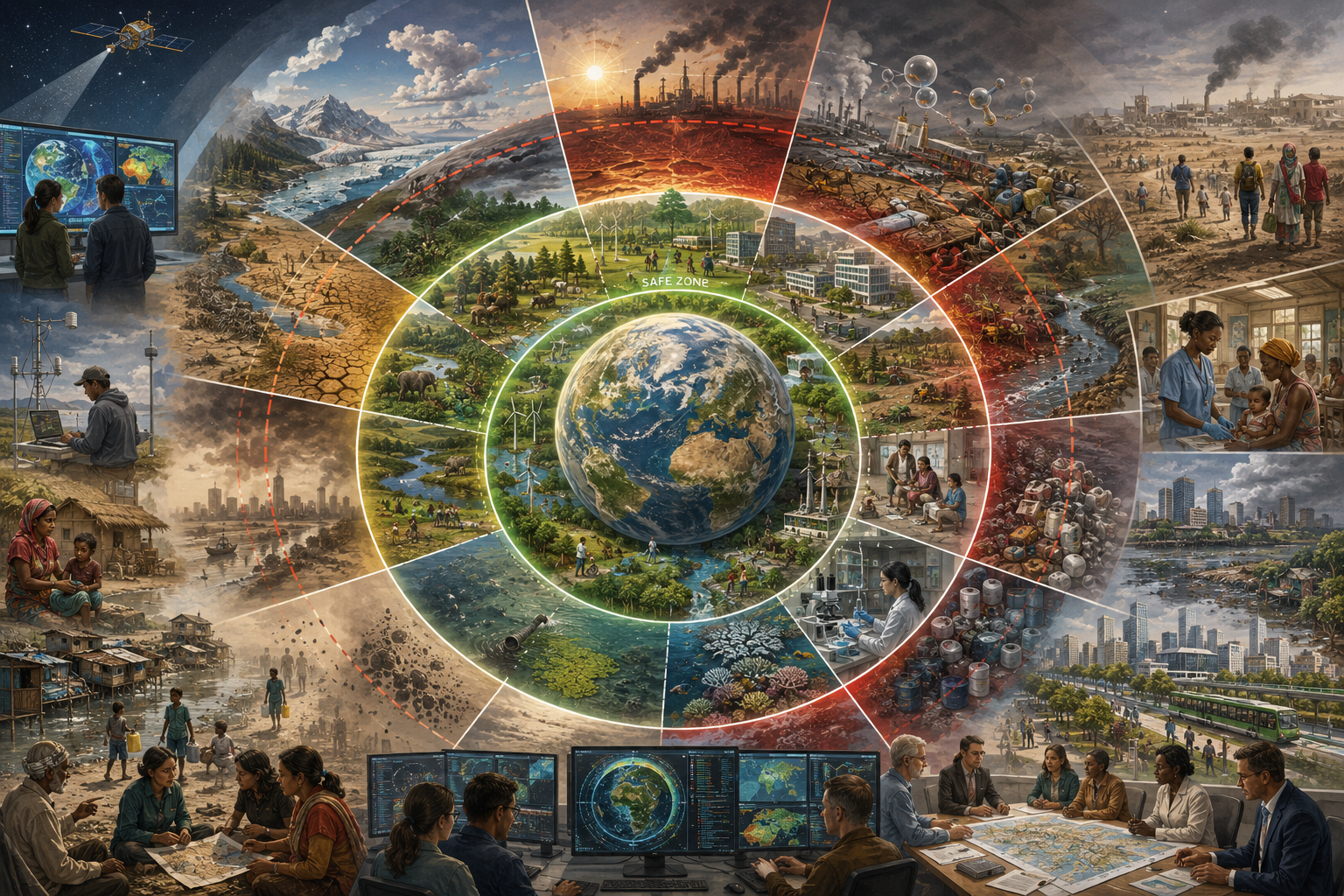
Planetary-boundary thinking is increasingly inseparable from Earth-system data, quantitative indicators, control variables, threshold analysis, geospatial evidence, systems modeling, scenario simulation, uncertainty analysis, and reproducible scientific workflows. Many of the most important questions in the field now require not only conceptual synthesis and policy interpretation, but programmable environments capable of analyzing climate pressure, biodiversity loss, freshwater disruption, land-system change, nutrient loading, ocean acidification, aerosol effects, chemical pollution, cascading risk, social exposure, and safe-and-just operating spaces.
Planetary Boundaries Code Repository
The Planetary Boundaries knowledge series is supported by an open computational repository with article-level folders, reproducible examples, synthetic datasets, documentation, boundary-indicator workflows, scenario models, and full-stack Earth-system analytics scaffolding across Python, R, Julia, C++, Fortran, C, Rust, SQL, Go, and notebooks where appropriate.
Planetary Boundaries as a Foundational Earth-System Framework
Planetary boundaries occupy a distinctive place within contemporary Earth-system science because they provide a framework for understanding the biophysical conditions under which complex societies remain viable. Climate stability, biosphere integrity, freshwater availability, land-system regulation, nutrient cycles, ocean chemistry, atmospheric composition, ozone protection, and the containment of novel entities are not separate background issues. They are part of the planetary operating conditions that make agriculture, cities, public health, infrastructure, economies, and institutions possible.
This foundational role does not mean that planetary boundaries replace climate science, ecology, hydrology, biogeochemistry, oceanography, atmospheric science, environmental chemistry, or development studies. Rather, the framework provides an integrating architecture through which those fields can be brought into relation. It asks how major Earth-system processes interact, how human pressure alters them, how far those processes can be pushed before systemic risk rises, and how governance should respond when planetary stability can no longer be assumed.
Planetary boundaries also provide a bridge between scientific diagnosis and institutional responsibility. They do not merely describe environmental decline. They ask whether human activity is eroding the Earth-system resilience on which long-run development depends. The framework therefore occupies a powerful middle ground: it is scientific, precautionary, quantitative, ethical, institutional, strategic, and philosophical at the same time.
This is why the framework matters beyond environmental science narrowly understood. It reframes sustainability as a condition of civilization rather than as a policy niche. It shows that human development is not merely affected by the Earth system; it is embedded within it.
Planetary Boundaries as a Science of Stability, Limits, and Risk
Planetary boundaries may be understood as one of the great contemporary sciences of stability, limits, and systemic risk. The framework begins from the recognition that the Earth system is not an infinite backdrop for human activity. It is a dynamic, coupled, self-regulating system whose major processes can be weakened, destabilized, or pushed into less favorable states. The goal is not ecological purity, but the preservation of a safe operating space within which human development can remain compatible with planetary resilience.
The framework is best understood against the background of the Holocene: the relatively stable climate and environmental state of the past 11,700 years. Agriculture, permanent settlement, cities, states, infrastructure, trade networks, and modern institutions emerged within this comparatively stable environmental envelope. The planetary boundaries framework does not seek to return society to the past. It uses Holocene-like Earth-system conditions as a reference for the stability range within which human civilization became possible.
The Great Acceleration transformed that relationship. After the mid-twentieth century, population, economic output, fossil energy use, fertilizer consumption, transport, urbanization, telecommunications, water use, material extraction, and global trade increased rapidly. Earth-system indicators moved with them. Atmospheric carbon dioxide, methane, nitrous oxide, global temperature, ocean acidification, tropical forest loss, nitrogen loading, biodiversity decline, and synthetic chemical burdens all intensified. Planetary boundaries give scientific and strategic form to this new condition: human development has become a planetary force.
That does not mean humanity has equal responsibility for planetary pressure. Historical emissions, material consumption, extraction, land conversion, industrialization, and financial power have been deeply unequal. The framework is therefore strongest when it is paired with justice: ecological limits must be interpreted alongside historical responsibility, development need, unequal vulnerability, and the right of all people to live with dignity.
Planetary Boundaries as a Quantitative and Computational Field
Modern planetary-boundary analysis is deeply quantitative. Boundary status is not only described conceptually; it is evaluated through control variables, thresholds, indicators, datasets, uncertainty ranges, spatial analysis, model outputs, and scientific assessment. Climate change can be tracked through atmospheric carbon dioxide, radiative forcing, temperature, and other variables. Biosphere integrity can be assessed through genetic diversity, functional integrity, species loss, and ecosystem change. Freshwater disruption can be studied through blue-water and green-water indicators. Biogeochemical flows can be measured through nitrogen and phosphorus loading. Novel entities require new forms of chemical and material-risk assessment.
This does not mean that planetary boundaries become a purely technical dashboard. Rather, it means that serious planetary governance must move across modes of inquiry. A researcher may analyze global datasets, interpret land-system maps, examine freshwater stress, model nutrient loading, compare climate scenarios, evaluate boundary transgression, document methods in a notebook, store metadata in SQL, and interpret the results through resilience science, environmental justice, development theory, and governance. Planetary-boundary thinking is one of the clearest examples of a field in which Earth-system science, data systems, institutions, ethics, and computation must work together.
For that reason, this pillar treats mathematics, statistics, Earth-system data, computational modeling, geospatial analysis, SQL metadata, reproducible notebooks, and open code repositories as increasingly important parts of planetary-boundary literacy. Some articles remain primarily conceptual, historical, ethical, or governance-oriented. Others naturally require control variables, indicators, models, maps, uncertainty analysis, dashboards, or reproducible code. The aim is not to reduce planetary boundaries to metrics, but to show how Earth-system risk is actually studied, communicated, and governed.
Computation also creates responsibilities. Models can clarify planetary risk, but they can also conceal assumptions. Indicators can make pressure visible, but they can also simplify uncertainty. Dashboards can support accountability, but they can also encourage false precision. A serious computational approach to planetary boundaries must therefore remain transparent, interpretable, reproducible, and open to ethical and political scrutiny.
What Planetary Boundaries Study
Planetary boundaries study the Earth-system processes that regulate the stability and resilience of a habitable planet. At the climate level, the framework examines warming, greenhouse gases, radiative forcing, cryosphere change, ocean heat uptake, extreme events, and the systemic consequences of destabilizing the climate system. At the biosphere level, it examines biodiversity loss, ecosystem function, species decline, genetic diversity, functional integrity, food webs, habitat disruption, and the weakening of the living systems that regulate planetary conditions.
At the hydrological, land, and biogeochemical levels, planetary-boundary analysis studies freshwater change, soil moisture, groundwater depletion, land-system transformation, deforestation, agricultural expansion, nitrogen and phosphorus flows, eutrophication, and the ecological stresses created by human material throughput. At the atmospheric and oceanic levels, it studies ocean acidification, aerosol loading, ozone depletion, air pollution, cloud dynamics, atmospheric chemistry, and the relationship between emissions, chemistry, climate, and public health.
Planetary boundaries also study human systems. They ask how development, industry, agriculture, infrastructure, trade, finance, governance, technology, consumption, and inequality interact with Earth-system pressure. The framework is therefore not merely about the planet “out there.” It is about the coupled human-Earth system: how human societies destabilize planetary processes, how destabilized planetary processes feed back into development, and how institutions might preserve a safe and just space for human flourishing.
The result is a field of inquiry that must move from atmospheric chemistry to political economy, from biodiversity indicators to food systems, from hydrological thresholds to urban infrastructure, from chemical pollution to industrial governance, and from scientific measurement to moral responsibility. Planetary boundaries are not one topic among many. They are a way to understand how many topics become connected under planetary pressure.
What This Pillar Covers
This pillar brings together the major domains through which planetary boundaries interpret Earth-system risk. It includes Holocene stability, the Great Acceleration, the Anthropocene, safe operating space, threshold logic, control variables, boundary measurement, uncertainty, precaution, resilience, feedback loops, cascading risk, the nine planetary boundaries, global inequality, sustainable development, Doughnut Economics, Earth-system governance, business strategy, financial risk, stewardship, critique, and future directions.
The pillar also treats each planetary boundary as both a scientific domain and a systems problem. Climate change, biosphere integrity, land-system change, freshwater change, biogeochemical flows, ocean acidification, stratospheric ozone depletion, atmospheric aerosol loading, and novel entities differ in their mechanisms, evidence bases, control variables, and governance challenges. Yet they are linked by the central question of whether human activity is eroding Earth-system stability.
The series also treats planetary boundaries as a field that links the scientific and the strategic. Boundary thinking informs sustainable development, climate policy, biodiversity protection, industrial transformation, chemical governance, food systems, water systems, infrastructure planning, financial disclosure, corporate strategy, resilience planning, and planetary stewardship. For that reason, the pillar is designed not only to introduce the framework, but to clarify why planetary-boundary reasoning is indispensable for understanding the contemporary world.
The guiding question is not only whether boundaries have been transgressed. It is what follows from that knowledge. What kinds of governance, technology, finance, law, ethics, development strategy, and institutional learning become necessary once the stability of the Earth system can no longer be assumed?
Mathematics, Computation, and Earth-System Modeling in Planetary Boundaries
Mathematics provides part of the formal language through which planetary-boundary analysis understands threshold behavior, feedback loops, system stability, nonlinear change, risk, uncertainty, and safe operating space. Boundary reasoning depends on rates of change, cumulative pressure, stock-flow dynamics, probability, control variables, coupled systems, tipping points, and the difference between gradual degradation and abrupt regime shift. Statistics supports uncertainty analysis, trend detection, spatial comparison, environmental indicators, model validation, and the interpretation of noisy global datasets.
Computation is especially valuable where planetary systems become too complex for direct intuition alone. R supports environmental statistics, indicator analysis, uncertainty estimation, visualizations, reproducible reports, and public Earth-system datasets. Python supports geospatial data processing, climate and environmental workflows, scenario simulation, dashboards, automation, machine learning, and reproducible analysis. Julia supports high-performance systems modeling, optimization, differential equations, and coupled numerical simulation. SQL supports structured boundary datasets, environmental observations, metadata, provenance, scenario assumptions, and auditable research infrastructure. C++, Fortran, C, Rust, and Go support performance-critical simulation, embedded monitoring, scientific utilities, command-line workflows, numerical kernels, and resilient environmental data systems.
Used together, mathematics, computation, Earth-system indicators, notebooks, SQL metadata, and open code repositories help make planetary-boundary analysis more explicit, testable, reproducible, and accountable. They allow assumptions to be examined rather than hidden, uncertainty to be represented rather than ignored, and boundary status to be interpreted through transparent evidence. In this series, those tools are integrated where they deepen explanation rather than distract from ecological, institutional, and ethical reasoning.
The deeper point is that planetary boundaries require disciplined imagination as well as measurement. Models help explore futures. Indicators help describe current pressure. Scenarios help compare pathways. But no model can replace political judgment, moral responsibility, or public deliberation about how societies should live within planetary limits.
Major Domains of Planetary Boundaries
The planetary boundaries framework includes a wide range of major domains, each of which illuminates a different dimension of Earth-system stability. Climate change examines greenhouse gases, warming, radiative forcing, ice systems, atmospheric and oceanic change, and the destabilization of climatic conditions. Biosphere integrity examines biodiversity, ecosystem function, genetic diversity, species decline, food webs, ecological resilience, and the living infrastructure of Earth-system regulation. Land-system change examines deforestation, agriculture, habitat conversion, carbon storage, albedo, soil stability, and the transformation of terrestrial systems.
Freshwater change examines blue water, green water, rivers, lakes, groundwater, soil moisture, agriculture, ecosystems, and regional hydrological stability. Biogeochemical flows examine nitrogen, phosphorus, fertilizer, livestock systems, eutrophication, dead zones, soil chemistry, and the chemical disruption of nutrient cycles. Ocean acidification examines carbon dioxide absorption, seawater chemistry, carbonate saturation, calcifying organisms, marine food webs, and the chemical transformation of ocean systems.
Stratospheric ozone depletion examines ultraviolet protection, ozone-depleting substances, atmospheric chemistry, treaty governance, and recovery through international cooperation. Atmospheric aerosol loading examines particulate pollution, cloud formation, monsoon systems, regional climate effects, visibility, and human health. Novel entities examine synthetic chemicals, plastics, pesticides, pharmaceuticals, radioactive materials, engineered materials, and other human-created substances whose aggregate effects may exceed society’s ability to assess and govern them.
Many of these domains are now inseparable from computational and data-driven methods. Climate analysis depends on models and observations. Biodiversity assessment depends on monitoring, remote sensing, and ecological datasets. Freshwater and land-system analysis depend on geospatial evidence. Chemical and nutrient boundaries require measurement systems, inventories, and fate modeling. Planetary-boundary science therefore continues to broaden not only in ecological and institutional scope, but also in formal and technical depth.
Why Planetary Boundaries Matter
The planetary boundaries framework matters because it changes the scale and logic of environmental analysis. Instead of asking only whether environmental degradation is occurring, it asks whether key Earth-system processes are being pushed beyond ranges compatible with long-term planetary stability. This is a profound shift. Environmental deterioration is no longer treated as a collection of local or sectoral problems, but as a systemic risk to the conditions that make organized human life possible.
The framework therefore places the economy, infrastructure, agriculture, urbanization, technology, finance, and development itself inside a wider biophysical envelope. Economic systems are not separate from climate, water, soils, biodiversity, oceans, nutrients, and atmospheric chemistry. They depend on them. A development model that erodes the stability of those systems may generate short-term growth while weakening the conditions for future prosperity.
Its significance is scientific, political, and philosophical. Scientifically, it synthesizes research from climatology, ecology, hydrology, oceanography, biogeochemistry, resilience science, and Earth-system science into a shared architecture of planetary risk. Politically, it challenges models of development that assume indefinite expansion without regard to ecological thresholds. Philosophically, it revives an old but newly urgent question: what does prosperity mean on a finite planet whose regulatory systems can be destabilized by cumulative human action?
Planetary boundaries also matter because they clarify why environmental governance cannot be delayed until damage is locally visible or politically convenient. Many Earth-system risks involve delayed feedback, cumulative pressure, spatial displacement, and threshold behavior. By the time damage becomes fully obvious, some options may already have narrowed. Boundary thinking therefore belongs to the logic of prevention, prudence, and long-run stewardship.
Planetary Boundaries and Human Self-Understanding
Planetary boundaries change how human beings understand themselves because they place human development inside the Earth system rather than above or outside it. The framework challenges the assumption that the planet is a passive stage on which economic growth, technological innovation, and political ambition unfold. It shows that human societies are embedded in biophysical processes whose stability can be weakened by cumulative action.
Yet planetary boundaries also complicate simple narratives of restraint. The framework does not imply that development is illegitimate or that poverty reduction, infrastructure, sanitation, health care, education, energy access, and food security should be abandoned. Instead, it asks how those legitimate human needs can be met within a safe and just operating space. It therefore reframes the problem: not whether humanity should develop, but how development can be redesigned so that human flourishing does not undermine the planetary conditions that sustain it.
For that reason, planetary boundaries have philosophical as well as scientific significance. They raise enduring questions about justice, responsibility, risk, progress, intergenerational obligation, technological power, and the meaning of prosperity. They ask what societies owe to future generations, to vulnerable communities, to nonhuman life, and to the Earth-system processes that make civilization possible.
A serious planetary-boundaries framework should therefore not end with indicators alone. It should clarify the wider implications of planetary risk for ethics, governance, human self-understanding, and the long-run viability of civilization. Boundary thinking is not only a way to measure pressure. It is a way to rethink what it means to inhabit the Earth responsibly.
Planetary Boundaries Pillar Map
The map below organizes the Planetary Boundaries knowledge series into conceptual domains, moving from Holocene stability and Earth-system history toward the core framework, the nine boundaries, cascading risk, justice, governance, business strategy, critique, and future stewardship.
The Planetary Boundaries pillar is organized to move from foundational Earth-system context into safe operating space, boundary measurement, the nine Earth-system processes, resilience, cascading risk, justice, governance, finance, strategy, critique, and long-run stewardship. Mathematics, R, Python, Julia, C++, Fortran, C, Rust, SQL, Go, and computational notebooks are integrated within the series where they deepen understanding, especially in areas such as boundary indicators, Earth-system data, climate risk, biodiversity monitoring, freshwater modeling, nutrient flows, geospatial analysis, scenario simulation, uncertainty, systemic risk, and reproducible environmental workflows. The goal is a pillar grounded in planetary-boundary science while also reflecting the quantitative, computational, institutional, and ethical depth of contemporary Earth-system practice.
Foundational Context: Holocene Stability, the Great Acceleration, and the Anthropocene
- The Holocene: The Stable Climate State That Enabled Human Civilization — A foundational article on the relatively stable climate and environmental conditions of the past 11,700 years. This piece explains why agriculture, settlement, cities, institutions, and infrastructure emerged within a favorable Earth-system envelope and why Holocene stability matters for planetary-boundary thinking.
- The Great Acceleration: How Human Activity Reshaped the Earth System — An article on the rapid post-1950 expansion of population, industrial output, fossil energy use, fertilizer consumption, transport, water use, material extraction, and global trade. This piece shows how social and economic acceleration became visible in Earth-system indicators.
- Navigating the Anthropocene: Sustainable Development in a 3–6–9 World — A synthesis article on human-driven planetary change, development risk, and the challenge of governing a world in which multiple boundaries have been transgressed. This piece connects Anthropocene thinking to sustainable development strategy.
- The Planetary Squeeze: Four Forces Driving the Sustainability Crisis — An article on the interacting pressures that drive planetary risk, including material expansion, ecological degradation, institutional delay, and uneven vulnerability. This piece provides a systems-level explanation of why sustainability pressures are intensifying.
- Anthropocene Sustainable Development: Rethinking Prosperity on a Finite Planet — A major article on how development theory must change under Earth-system pressure. It asks how prosperity, infrastructure, wellbeing, and justice can be pursued when human activity now shapes planetary conditions.
- Resilience Thinking in the Anthropocene — A systems article on resilience, disturbance, adaptive capacity, transformation, social-ecological systems, and the need to govern under conditions of planetary volatility and uncertainty.
- Earth System Science and the Rise of Planetary Thinking (Planned) — A historical and conceptual article on how climate science, ecology, geology, atmospheric chemistry, Earth observation, systems modeling, and resilience science converged into a planetary-scale understanding of human environmental change.
- Human Development After the Great Acceleration (Planned) — An article on how postwar economic expansion, fossil energy, infrastructure, industrial agriculture, chemical production, and consumer systems transformed both human welfare and Earth-system pressure.
Core Framework and Concepts
- What Are Planetary Boundaries? — An opening article defining the planetary boundaries framework, its nine Earth-system processes, its concept of safe operating space, and its significance for climate, biodiversity, water, land, nutrients, ocean chemistry, air pollution, ozone, and novel entities.
- The Origins of the Planetary Boundaries Framework — An article on the scientific and intellectual development of the framework, including Earth system science, resilience thinking, limits to growth, ecological thresholds, and the effort to translate planetary risk into a shared analytical architecture.
- Safe Operating Space and the Logic of Thresholds — A conceptual article on boundary zones, precaution, uncertainty, nonlinear change, tipping points, resilience, and the logic of preserving margins of safety before irreversible damage becomes undeniable.
- How Planetary Boundaries Are Measured — A methodological article on control variables, indicators, global datasets, uncertainty, threshold selection, proxy measurement, and the scientific difficulty of translating Earth-system processes into boundary assessments.
- Uncertainty, Precaution, and Scientific Debate in Boundary Setting — An article on the uncertainties, critiques, and scientific debates behind planetary-boundary assessment. This piece explains why precautionary governance remains necessary even when exact thresholds are difficult to define.
- Control Variables, Thresholds, and Boundary Zones (Planned) — A technical-conceptual article on the variables used to evaluate boundary status, the difference between thresholds and boundary zones, and the role of uncertainty in precautionary Earth-system governance.
- Safe and Just Operating Space for Humanity (Planned) — A bridge article connecting planetary ceilings with social foundations, justice, minimum human needs, responsibility, and the challenge of protecting both ecological stability and human dignity.
- Planetary Boundaries and the Problem of Scale (Planned) — An article on the difficulty of translating global boundaries into regional, national, local, watershed, biome, and community-level governance contexts without losing scientific meaning or justice.
The Nine Planetary Boundaries
- Climate Change as a Planetary Boundary — A major article on climate change as a systemic destabilization risk affecting temperature, hydrology, cryosphere stability, ocean systems, food systems, wildfire risk, public health, infrastructure, and nearly every other boundary.
- Biosphere Integrity and the Stability of Life Systems — An article on biodiversity, ecosystem function, genetic diversity, functional integrity, food webs, species decline, and the living systems that regulate Earth-system resilience.
- Land-System Change and Ecological Transformation — A treatment of deforestation, agriculture, land conversion, habitat fragmentation, carbon storage, soil stability, regional climate effects, hydrology, and the transformation of terrestrial systems.
- Freshwater Change and Earth System Risk — An article on blue water, green water, groundwater depletion, soil moisture, rivers, lakes, agriculture, ecosystems, settlements, and the planetary significance of freshwater disruption.
- Biogeochemical Flows: Nitrogen, Phosphorus, and Planetary Destabilization — A study of nitrogen and phosphorus disruption through fertilizer, livestock, agriculture, wastewater, eutrophication, dead zones, greenhouse gases, and chemical destabilization of nutrient cycles.
- Ocean Acidification and the Chemistry of Planetary Change — An article on carbon dioxide absorption, seawater chemistry, carbonate saturation, calcifying organisms, coral reefs, marine food webs, and the chemical transformation of ocean systems.
- Stratospheric Ozone Depletion and Global Environmental Governance — A governance-focused article on ozone depletion, ultraviolet radiation, atmospheric chemistry, the Montreal Protocol, scientific monitoring, treaty cooperation, and one of the clearest examples of effective planetary-scale environmental response.
- Atmospheric Aerosol Loading and Regional Planetary Risk — An article on aerosols, particulate matter, air quality, cloud formation, monsoons, regional climate effects, visibility, health risk, and the difficulty of assessing boundary status for regionally uneven atmospheric processes.
- Novel Entities and the Problem of Synthetic Overload — A treatment of synthetic chemicals, plastics, pesticides, pharmaceuticals, radioactive materials, engineered materials, industrial compounds, and the widening gap between technological production and planetary stewardship.
- Climate-Biosphere Interactions and Boundary Cascades (Planned) — An article on how warming, ecosystem degradation, carbon sinks, fire regimes, land-system change, and biodiversity loss interact across boundary domains.
- Green Water, Soil Moisture, and the Hidden Freshwater Boundary (Planned) — A focused article on green-water disruption, soil moisture, vegetation systems, rainfall recycling, agriculture, and why freshwater change cannot be reduced to rivers and aquifers alone.
- Novel Entities, Plastics, and Chemical Governance (Planned) — A deeper article on chemical production, plastics, persistent pollutants, toxicological uncertainty, regulatory lag, and the difficulty of governing synthetic overload before full harm is measurable.
Systems Risk, Resilience, and Cascading Change
- Planetary Boundaries and Earth System Resilience — A systems article on resilience, recovery capacity, functional redundancy, feedbacks, thresholds, and the ability of Earth-system processes to absorb pressure without shifting into less favorable states.
- Resilience Thinking in the Anthropocene — A bridge article on adaptive capacity, disturbance, transformation, governance, and social-ecological systems in a period of human-driven planetary change.
- Tipping Points, Feedback Loops, and Cascading Ecological Change — An article on nonlinear change, self-reinforcing feedbacks, regime shifts, cascading risk, threshold behavior, and why multiple boundary transgressions are more dangerous than isolated environmental degradation.
- Compound Boundary Transgression and Systemic Risk (Planned) — An article on the risks that emerge when several planetary boundaries are under pressure at once, including interaction effects, cascading instability, and loss of resilience across coupled systems.
- Early Warning Signals, Regime Shifts, and Planetary Risk Detection (Planned) — A methodological article on variance, autocorrelation, slowing recovery, critical transitions, ecological monitoring, and the limits of detecting tipping points before they arrive.
- Planetary Boundaries Under Deep Uncertainty (Planned) — A decision-making article on robust strategies, precaution, scenario planning, adaptive pathways, and governance when Earth-system risks cannot be forecast with precision.
Justice, Development, Governance, and Strategy
- Sustainable Development Goals Within Planetary Boundaries — An article on how human development goals must be pursued within Earth-system limits. This piece examines the relationship between poverty reduction, infrastructure, health, education, food security, and ecological stability.
- Planetary Boundaries, Justice, and Global Inequality — A justice-centered article on historical responsibility, unequal exposure, development space, ecological debt, vulnerability, and the distributional politics of operating within planetary limits.
- Planetary Boundaries and Doughnut Economics — A bridge article connecting planetary ceilings to social foundations. This piece examines the concept of a safe and just space in which human needs are met without exceeding Earth-system limits.
- Earth System Governance in an Age of Limits — An article on the institutional challenge of governing cumulative, cross-border, long-horizon Earth-system pressures through law, policy, science, finance, public administration, and international coordination.
- Business Strategy Within Planetary Boundaries — A strategic article on how planetary boundaries affect firms, supply chains, risk exposure, resource dependence, legitimacy, resilience, transition planning, and long-term business viability.
- Finance, Disclosure, and Systemic Environmental Risk — A finance-focused article on planetary risk, disclosure, stranded assets, physical risk, transition risk, legal exposure, insurance, valuation, and the challenge of representing Earth-system destabilization in financial systems.
- Planetary Boundaries and International Law (Planned) — An article on whether existing legal regimes are adequate for Earth-system risk, including environmental treaties, human rights, state responsibility, climate law, biodiversity law, and duties to future generations.
- Indigenous Stewardship and Planetary Boundaries (Planned) — An article on Indigenous ecological knowledge, land defense, biodiversity protection, relational ethics, territorial rights, and the importance of non-extractive governance traditions in planetary stewardship.
- Food Systems Within Planetary Boundaries (Planned) — An article on agriculture, diets, nitrogen and phosphorus flows, land conversion, freshwater demand, biodiversity loss, climate emissions, and the redesign of food systems within Earth-system limits.
- Cities, Infrastructure, and Planetary Boundaries (Planned) — An article on urban metabolism, construction materials, transport systems, land take, heat, water, energy demand, waste, and how cities can reduce pressure while expanding human capability.
Measurement, Data Systems, and Computational Practice
- Planetary Boundary Indicators and Data Architecture (Planned) — A methodological article on indicator databases, metadata, provenance, uncertainty, control variables, reproducible workflows, SQL schemas, and the data infrastructure needed for transparent planetary-boundary assessment.
- Remote Sensing, Earth Observation, and Boundary Monitoring (Planned) — An article on satellites, land-cover data, vegetation indices, freshwater monitoring, coastal change, biodiversity proxies, atmospheric observations, and the politics of global environmental visibility.
- Scenario Modeling for Planetary Boundary Pathways (Planned) — A computational article on how models can explore boundary trajectories under different assumptions about energy, land use, consumption, restoration, chemical regulation, governance, and development pathways.
- AI, Environmental Data, and Planetary Stewardship (Planned) — An article on machine learning, environmental monitoring, remote sensing, pattern detection, risk forecasting, model interpretability, ecological uncertainty, and the governance risks of AI-mediated planetary analysis.
Critique, Stewardship, and Future Directions
- Critiques of the Planetary Boundaries Framework — An article on scientific, political, regional, ethical, and governance critiques of the framework. This piece explains how planetary boundaries should be used carefully: not as a deterministic prophecy, but as a precautionary architecture for systemic risk.
- The Future of Planetary Stewardship — A capstone-style article on planetary stewardship, institutional learning, science-policy interfaces, restoration, justice, governance, technology, finance, and the long-run task of organizing civilization within Earth-system limits.
- Planetary Boundaries and the Ethics of Restraint (Planned) — A philosophical article on sufficiency, responsibility, freedom, intergenerational justice, restraint, technological power, and the moral meaning of living within Earth-system limits.
- Restoration, Regeneration, and Boundary Recovery (Planned) — An article on ecological restoration, reforestation, wetland recovery, soil repair, circular material systems, pollution reduction, and whether boundary transgression can be reversed or only stabilized.
- Future Directions in Planetary Boundary Science (Planned) — A forward-looking article on new indicators, regionalization, safe-and-just boundaries, chemical assessment, AI-enabled monitoring, governance integration, and the next generation of Earth-system risk research.
Measurement, Control Variables, and Earth-System Practice
One reason the planetary boundaries framework has had such enduring influence is that it combines conceptual clarity with quantitative ambition. Each boundary is associated with one or more control variables intended to track the state of the relevant Earth-system process. Yet the framework also recognizes that these variables are imperfect proxies, that thresholds are difficult to define with precision, and that irreducible uncertainty is a permanent feature of complex systems.
This is not a weakness so much as a defining feature of serious planetary governance. The framework does not claim omniscience. It offers a disciplined way of thinking under uncertainty by identifying rising zones of danger rather than waiting for irreversible change to become undeniable. In this sense, planetary boundaries resemble other mature risk architectures in public health, engineering, finance, and infrastructure planning: their value lies not in perfect prediction, but in structured anticipation and prudent restraint.
Measurement also matters because governance depends on visibility. What is measured can be monitored, debated, audited, and improved. But measurement should never be confused with the whole reality of a system. Planetary-boundary analysis must be paired with qualitative judgment, local knowledge, regional interpretation, uncertainty analysis, historical responsibility, Indigenous knowledge, democratic accountability, and attention to uneven vulnerability.
The strongest use of planetary-boundary measurement is therefore not technocratic closure, but transparent public reasoning. Control variables help organize evidence. They do not eliminate politics, ethics, or interpretation. They make the terms of planetary risk more explicit so that institutions and communities can confront them more honestly.
Planetary Boundaries, Technology, and the Modern World
Planetary boundaries are inseparable from technology because modern societies transform the Earth system through infrastructures, tools, machines, chemicals, energy systems, production networks, logistics, agriculture, computation, and industrial design. Fossil energy systems alter the climate. Fertilizer systems alter nitrogen and phosphorus cycles. Industrial chemistry produces novel entities. Transport, mining, agriculture, and urban systems transform land. Digital infrastructure, sensors, satellites, and models now shape how these pressures are observed, measured, and governed.
Technology therefore has a double role. It is one of the drivers of planetary pressure, but it can also become part of the response. Renewable energy, circular material systems, ecological monitoring, satellite observation, precision agriculture, water analytics, chemical screening, biodiversity sensing, public data systems, and infrastructure redesign can help reduce pressure if governed responsibly. Yet technological optimism becomes dangerous when it treats innovation as a substitute for ecological restraint, institutional reform, and justice.
For that reason, planetary-boundary thinking requires a careful account of technological power. The question is not whether technology matters, but which technologies are developed, under whose control, with what material footprints, with what distribution of risks and benefits, and within what Earth-system limits. A mature planetary-boundary framework must therefore link innovation to ecological responsibility, institutional accountability, democratic legitimacy, and long-run resilience.
The modern world is not outside planetary boundaries. It is one of the main forces acting upon them. But technology can also become one of the means through which societies learn to measure, reduce, repair, and govern planetary pressure. The difference depends on institutions, incentives, ethics, and public control.
Planetary Boundaries, Computation, and Scenario Simulation
Computation has become central to planetary-boundary work because the framework deals with complex, interconnected, high-dimensional systems. Climate change, land-system transformation, freshwater stress, nutrient loading, biodiversity decline, ocean chemistry, aerosols, and novel entities unfold across space, time, scale, and institutional systems. These systems cannot be understood through single indicators or linear forecasts alone. They require models, scenarios, simulations, maps, uncertainty analysis, reproducible workflows, and careful interpretation.
Scenario simulation is especially important because planetary-boundary analysis is future-oriented. The question is not only what has already been transgressed, but what pathways remain possible. Different assumptions about energy systems, agriculture, land use, consumption, restoration, chemical regulation, population, finance, governance, and technology can generate different risk trajectories. Computational modeling makes those assumptions more explicit, not by predicting the future perfectly, but by clarifying trade-offs, sensitivities, thresholds, and plausible pathways.
For that reason, this pillar treats computation as a supporting discipline of planetary-boundary analysis, not as a replacement for political judgment. Models must be transparent, interpretable, reproducible, and accountable to the communities and ecosystems affected by their use. Data systems must be governed ethically. AI systems must be evaluated for bias, uncertainty, ecological relevance, and public purpose. The strongest form of computational planetary-boundary practice is not technocratic automation, but auditable Earth-system reasoning in service of safe and just futures.
Computational work should therefore be designed around reproducibility and humility. It should clarify what is known, what is uncertain, what is assumed, what is contested, and what remains beyond the reach of the model. In planetary-boundary science, the purpose of computation is not to erase uncertainty, but to make uncertainty more usable for responsible decision-making.
Planetary Boundaries in a Wider Intellectual Context
Planetary boundaries belong not only to environmental science, but to the broader history of human thought about progress, limits, responsibility, and civilization. The framework challenges older assumptions that economic growth, industrial expansion, technological innovation, and institutional development can proceed indefinitely without destabilizing the biophysical systems on which they depend. It also challenges narrow environmentalism by placing ecological limits in direct relation to human development, justice, governance, and long-run prosperity.
The framework changes the imagination of the planet. It forces thought to move between the local and global, the present and future, the measurable and uncertain, the scientific and ethical, the technical and political. It shows that the Earth system is not a passive background for human ambition. It is the enabling condition of agriculture, infrastructure, health, food, water, public order, and civilization itself.
For that reason, planetary boundaries should be understood as both a scientific and civilizational achievement. They bring together Earth-system science, resilience thinking, ecology, climatology, hydrology, biogeochemistry, oceanography, atmospheric science, economics, governance, ethics, finance, and computational analysis in a sustained effort to ask how human societies can flourish without destabilizing their own planetary foundations.
The framework remains indispensable for any serious intellectual project concerned with responsible development, ecological limits, systemic risk, and the future of civilization. It does not answer every question. But it asks one of the questions that now structures all the others: what does human flourishing require when humanity has become powerful enough to destabilize the Earth system itself?
Related Reading
- Sustainable Development
- Systems Thinking
- Systems Modeling
- Earth System Science
- Environmental Science
- Biology
- Chemistry
- Climate Change as a Development Constraint
- Data Systems & Analytics
Further Reading
- Gupta, J., Liverman, D., Prodani, K., Aldunce, P., Bai, X., Broadgate, W., Ciobanu, D., Gifford, L., Gordon, C., Hurlbert, M., Inoue, C.Y.A., Jacobson, L., Kanie, N., Lade, S.J., Lenton, T.M., Obura, D., Okereke, C., Otto, I.M., Pereira, L., Revi, A., Rockström, J., Scholtens, B., Stewart-Koster, B., Verburg, P.H. and Winkelmann, R. (2024) Building Capabilities for Earth System Governance. Cambridge: Cambridge University Press. Available at: https://www.cambridge.org/core/elements/building-capabilities-for-earth-system-governance/7F1CDA0C47DD04BCB97550E9F5353703
- International Commission on Stratigraphy (2024) ‘Joint statement by the IUGS and ICS on the vote by the ICS Subcommission on Quaternary Stratigraphy’. Available at: https://stratigraphy.org/news/152
- OECD (2025) Environmental Outlook on the Triple Planetary Crisis. Paris: OECD Publishing. Available at: https://www.oecd.org/en/publications/environmental-outlook-on-the-triple-planetary-crisis_257ffbb6-en.html
- Planetary Health Check (2025) Planetary Health Check 2025. Potsdam: Potsdam Institute for Climate Impact Research. Available at: https://www.planetaryhealthcheck.org/
- Raworth, K. (2017) Doughnut Economics: Seven Ways to Think Like a 21st-Century Economist. London: Random House. Available at: https://www.kateraworth.com/doughnut/
- Rockström, J., Gupta, J., Qin, D., Lade, S.J., Abrams, J.F., Andersen, L.S., Armstrong McKay, D.I., Bai, X., Bala, G., Bunn, S.E., Ciobanu, D., DeClerck, F., Ebi, K.L., Gifford, L., Gordon, C., Hasan, S., Kanie, N., Lenton, T.M., Obura, D., Ospina, D., Prodani, K., Rammelt, C., Revi, A., Scholtens, B., Stewart-Koster, B., Tharammal, T., Winkelmann, R., Liverman, D. and Gupta, J. (2025) ‘Planetary Boundaries guide humanity’s future on Earth’, Nature Reviews Earth & Environment. Available at: https://www.nature.com/articles/s43017-025-00696-5
- Stockholm Resilience Centre (2024) ‘Review: The emergence of the Planetary Boundaries framework and its impact on society and policy’. Available at: https://www.stockholmresilience.org/research/research-stories/2024-11-21-review-the-emergence-of-the-planetary-boundaries-framework-and-its-impact-on-society-and-policy.html
- Voyer, M., Hurlbert, M., Rockström, J., Gupta, J. and Folke, C. (eds.) (2025) Ethics and Planetary Boundaries. Cambridge: Cambridge University Press. Available at: https://www.cambridge.org/9781009443579
References
- International Commission on Stratigraphy (2024) ‘Joint statement by the IUGS and ICS on the vote by the ICS Subcommission on Quaternary Stratigraphy’. Available at: https://stratigraphy.org/news/152
- Planetary Health Check (2025) Planetary Health Check 2025. Potsdam: Potsdam Institute for Climate Impact Research. Available at: https://www.planetaryhealthcheck.org/
- Richardson, K., Steffen, W., Lucht, W., Bendtsen, J., Cornell, S.E., Donges, J.F., Drüke, M., Fetzer, I., Bala, G., von Bloh, W., Feulner, G., Fiedler, S., Gerten, D., Gleeson, T., Hofmann, M., Huiskamp, W., Jakobsson, C., Jürgensen, J.H., Kummu, M., Mohan, C., Nogués-Bravo, D., Petri, S., Porkka, M., Rahmstorf, S., Schaphoff, S., Schulte-Uebbing, L., Staal, A., Sun, Z., Sakschewski, B. and Wang-Erlandsson, L. (2023) ‘Earth beyond six of nine planetary boundaries’, Science Advances, 9(37), eadh2458. Available at: https://www.science.org/doi/10.1126/sciadv.adh2458
- Rockström, J., Gupta, J., Qin, D., Lade, S.J., Abrams, J.F., Andersen, L.S., Armstrong McKay, D.I., Bai, X., Bala, G., Bunn, S.E., Ciobanu, D., DeClerck, F., Ebi, K.L., Gifford, L., Gordon, C., Hasan, S., Kanie, N., Lenton, T.M., Obura, D., Ospina, D., Prodani, K., Rammelt, C., Revi, A., Scholtens, B., Stewart-Koster, B., Tharammal, T., Winkelmann, R., Liverman, D. and Gupta, J. (2025) ‘Planetary Boundaries guide humanity’s future on Earth’, Nature Reviews Earth & Environment. Available at: https://www.nature.com/articles/s43017-025-00696-5
- Rockström, J., Steffen, W., Noone, K., Persson, Å., Chapin, F.S. III, Lambin, E.F., Lenton, T.M., Scheffer, M., Folke, C., Schellnhuber, H.J., Nykvist, B., de Wit, C.A., Hughes, T., van der Leeuw, S., Rodhe, H., Sörlin, S., Snyder, P.K., Costanza, R., Svedin, U., Falkenmark, M., Karlberg, L., Corell, R.W., Fabry, V.J., Hansen, J., Walker, B., Liverman, D., Richardson, K., Crutzen, P. and Foley, J.A. (2009a) ‘A safe operating space for humanity’, Nature, 461, pp. 472–475. Available at: https://www.nature.com/articles/461472a
- Rockström, J., Steffen, W., Noone, K., Persson, Å., Chapin, F.S. III, Lambin, E.F., Lenton, T.M., Scheffer, M., Folke, C., Schellnhuber, H.J., Nykvist, B., de Wit, C.A., Hughes, T., van der Leeuw, S., Rodhe, H., Sörlin, S., Snyder, P.K., Costanza, R., Svedin, U., Falkenmark, M., Karlberg, L., Corell, R.W., Fabry, V.J., Hansen, J., Walker, B., Liverman, D., Richardson, K., Crutzen, P. and Foley, J.A. (2009b) ‘Planetary boundaries: Exploring the safe operating space for humanity’, Ecology and Society, 14(2), p. 32. Available at: https://www.ecologyandsociety.org/vol14/iss2/art32/
- Steffen, W., Broadgate, W., Deutsch, L., Gaffney, O. and Ludwig, C. (2015a) ‘The trajectory of the Anthropocene: The Great Acceleration’, The Anthropocene Review, 2(1), pp. 81–98. Available at: https://journals.sagepub.com/doi/10.1177/2053019614564785
- Steffen, W., Richardson, K., Rockström, J., Cornell, S.E., Fetzer, I., Bennett, E.M., Biggs, R., Carpenter, S.R., de Vries, W., de Wit, C.A., Folke, C., Gerten, D., Heinke, J., Mace, G.M., Persson, L.M., Ramanathan, V., Reyers, B. and Sörlin, S. (2015b) ‘Planetary boundaries: Guiding human development on a changing planet’, Science, 347(6223), 1259855. Available at: https://www.science.org/doi/10.1126/science.1259855
- Stockholm Resilience Centre (n.d.) Planetary Boundaries. Available at: https://www.stockholmresilience.org/research/planetary-boundaries.html
- Stockholm Resilience Centre (2025) ‘Seven of nine planetary boundaries now breached’. Available at: https://www.stockholmresilience.org/news–events/general-news/2025-09-24-seven-of-nine-planetary-boundaries-now-breached.html