
Last Updated May 3, 2026
African and diasporic literature preserves one of the world’s most powerful archives of memory under conditions of rupture, survival, resistance, spiritual continuity, and historical recovery. Across oral traditions, praise poetry, epics, proverbs, folktales, sacred speech, slave narratives, novels, testimony, memoir, drama, liberation writing, sermon, song, performance, postcolonial reflection, and modern Black intellectual prose, African societies and dispersed African-descended communities have carried forward ancestral inheritance, communal history, cosmology, suffering, dignity, resistance, and the continuing struggle to narrate lives shaped by enslavement, colonial conquest, racial domination, forced migration, dispossession, and renewal. In these traditions, literature is rarely only aesthetic artifact. It is also witness, inheritance, ritual act, historical recovery, communal speech, moral argument, and a means of preserving worlds that systems of power repeatedly sought to fragment or erase.
This content pillar approaches African and Diasporic Literature and Cultural Memory not as a single canon, but as a vast transregional archive of memory, survival, relation, and liberation. Its canonical spine includes oral epics, griot and praise traditions, sacred and ritual speech, anti-colonial writing, Black Atlantic intellectual and literary formation, African modernisms, liberation poetics, postcolonial fiction, Caribbean and Afro-diasporic narrative, African American literary memory, testimony literature, Black feminist writing, performance traditions, religious and prophetic speech, and works shaped by migration, exile, racial terror, and the search for continuity across dispersal. Around that spine gather questions of language, translation, creolization, ancestral relation, music, performance, gendered memory, nationalism, decolonization, spirituality, intergenerational trauma, and the ethics of historical recovery.
Current Space
Literature & Cultural Memory
Related Topic
African Myth & Sacred Narrative
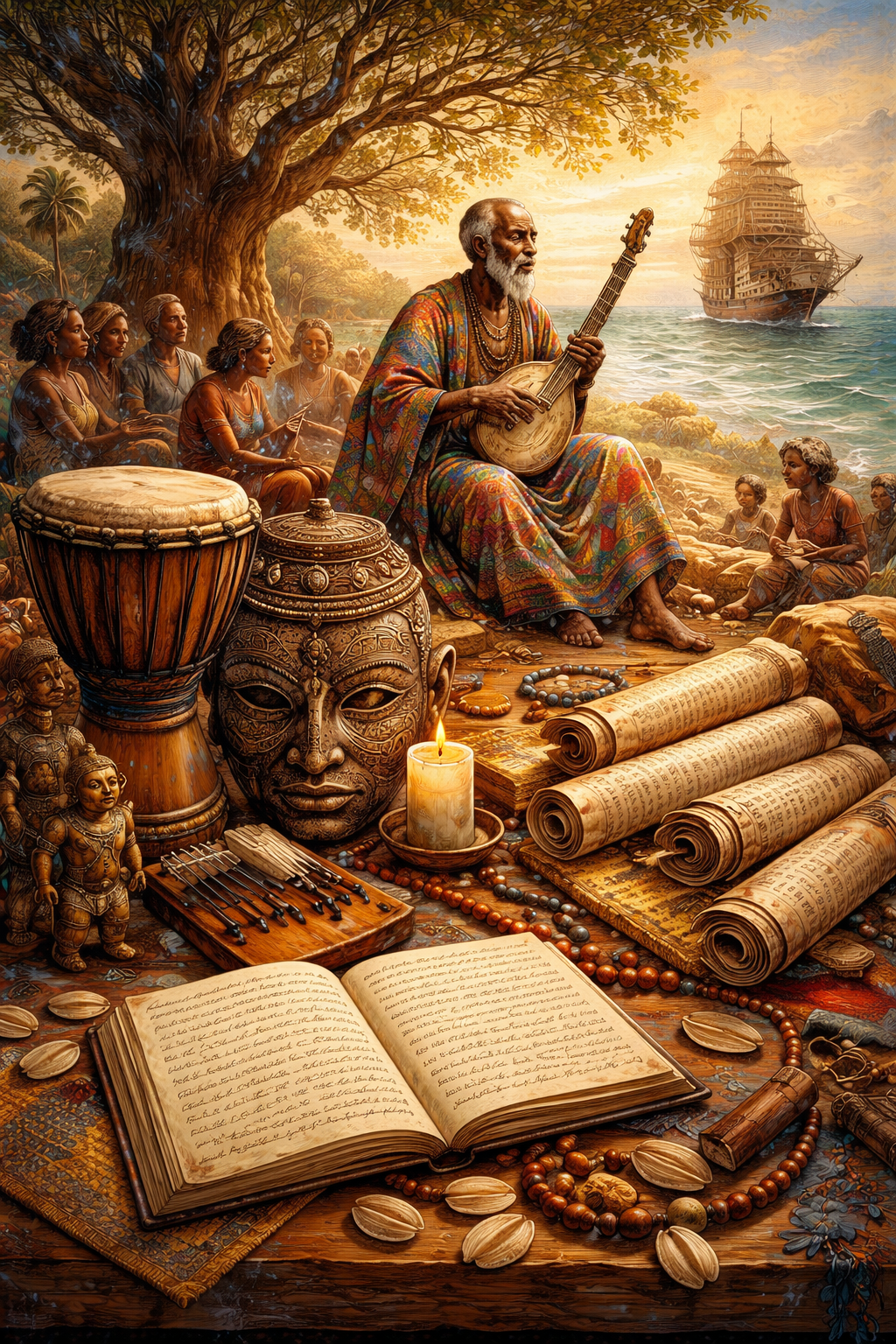
Read in this way, African and diasporic literature becomes more than literary history. It becomes a record of how communities remember through fracture; how oral tradition, song, story, proverb, invocation, testimony, sermon, and written narrative preserve histories that official archives distorted, suppressed, or violently interrupted; how the dead remain present in cultural memory; how the memory of capture, crossing, labor, exile, revolt, dispossession, migration, and return travels across generations; and how literature can sustain dignity where social orders depended on dehumanization. These traditions do not preserve suffering alone. They also preserve cosmology, beauty, humor, kinship, rhythm, ceremony, improvisation, language-play, moral intelligence, and visions of life beyond domination. Their seriousness lies in the refusal to allow violence to define the whole of memory, even when violence remains central to historical truth.
African and Diasporic Literature and Cultural Memory therefore stands at the intersection of literary history, oral performance, music, ritual, slavery studies, colonial and postcolonial history, Black studies, anthropology, spirituality, migration, gender studies, theology, political thought, and the history of liberation movements. It asks how literature transmits ancestral relation across rupture; how memory survives when lineages are broken; how oral and written forms interact; how language itself becomes a site of struggle and renewal; how literature bears witness to enslavement, segregation, empire, racial terror, genocide, and state violence without reducing a people to injury; and how cultural memory becomes both burden and source of strength in the making of modern worlds. In this sense, African and diasporic literature is one of the great traditions through which the world can study literature as historical recovery, moral witness, spiritual continuity, collective survival, and the making of modern consciousness under pressure.
African and Diasporic Literature as Cultural Memory
African and diasporic literature is one of the great memory systems of world literature because it repeatedly turns voice, rhythm, ritual, testimony, narrative, song, sermon, and written form into means of survival. Its deepest concern is not simply the preservation of texts, but the preservation of relation: relation to ancestors, land, community, language, spirit, history, the dead, the unborn, and the future. It is a literature of rupture, but also of continuity under pressure.
The tradition’s power comes from the fact that it had to carry memory across forms of historical violence that often targeted memory itself. Enslavement broke kinship lines and severed people from language, land, name, and archive. Colonialism reorganized education, land, law, religion, and cultural authority. Racial domination made Black subjecthood a problem inside legal, political, and symbolic systems built to deny it. Diaspora created new worlds across the Atlantic, Caribbean, Americas, Europe, and beyond, but those worlds were often formed through forced movement and unfinished grief. Literature became one of the principal means by which these losses could be named, resisted, remembered, and transformed.
Yet the tradition should never be reduced to injury. African and diasporic literature preserves laughter, music, ritual brilliance, cosmology, kinship, erotic life, spiritual power, vernacular intelligence, political imagination, formal experimentation, and the beauty of survival. Its memory is not only retrospective. It is also generative. It asks what can still be made from broken archives, interrupted lineages, violated bodies, and languages marked by power.
Why This Pillar Matters
African and Diasporic Literature and Cultural Memory matters because few literary traditions have had to preserve so much against so much. Across continents and oceans, communities shaped by enslavement, colonial violence, extraction, racial hierarchy, forced migration, and cultural assault developed literary forms capable of carrying names, lineages, gods, routes, losses, songs, and counter-histories even when formal archives were hostile, silent, or deliberately destructive. These traditions matter not because they are reducible to oppression, but because they show how memory survives where historical systems were designed to sever memory from land, ancestry, language, and selfhood.
They also matter because they reveal literature as a collective technology of survival. The epic, the praise poem, the folktale, the proverb, the sermon, the spiritual, the testimony, the novel, the liberation lyric, the memoir, the blues line, the jazz-inflected essay, the Black feminist novel, and the stage performance all become ways of refusing erasure. They preserve the dignity of communities whose histories were often narrated by others as absence, lack, pathology, or objecthood. African and diasporic literature instead makes memory active, relational, and future-facing. It remembers not only what happened, but what remained possible.
At the same time, these traditions matter because they preserve modern consciousness under racial domination. They are not only archives of communal inheritance and collective struggle; they are also archives of interior fracture, moral argument, shame, invisibility, estrangement, spiritual wrestling, sexuality, self-fashioning, and the search for personhood inside modern systems built on anti-Blackness. This is one reason figures such as Frederick Douglass, Harriet Jacobs, W.E.B. Du Bois, Zora Neale Hurston, Richard Wright, Ralph Ellison, James Baldwin, Toni Morrison, Chinua Achebe, Ngũgĩ wa Thiong’o, Wole Soyinka, Aimé Césaire, Derek Walcott, Kamau Brathwaite, and Édouard Glissant matter so much to the pillar’s architecture: they deepen cultural memory into art, thought, critique, interiority, and world-making.
Scope and Method
This pillar is expansive by design, but ordered by a clear memory center. It includes oral performance, epic traditions, praise poetry, proverbs, folktales, ritual and sacred speech, slave narratives, abolitionist writing, anti-colonial prose, Black Atlantic thought, postcolonial fiction, African American literature, Caribbean literature, Afro-Latin, Black British, and wider diasporic writing, modern and contemporary African literature, diasporic poetry, memoir, testimony, drama, sermon, music-inflected prose, and hybrid forms shaped by migration, multilingualism, and performance. It does not flatten Africa and the diaspora into one homogeneous field. Instead, it treats them as historically connected yet distinct formations linked by routes of violence, exchange, return, translation, and cultural reinvention.
The method throughout is to read African and diasporic literature as both art and historical recovery. That means attending to form, voice, performance context, rhythm, ritual background, language choice, genre, narrative structure, audience, and historical setting while also asking what these works preserve about ancestry, bondage, racialization, resistance, belonging, and cultural renewal. How does oral tradition carry memory differently from print? How does testimony reshape the status of witness? How do music and literature interpenetrate? How does diaspora alter the meaning of homeland? How does literature sustain spirituality under domination? How do gender, family, and kinship inflect what is remembered and how? How do communities narrate themselves after the archive has been weaponized against them? How do modern Black writers transform communal memory into symbolic, urban, existential, theological, democratic, and philosophical critique?
This pillar also reads critically. It does not romanticize oral tradition, flatten Africa into ancestry alone, treat diaspora only as loss, or turn suffering into spectacle. It asks how power enters the archive, how canons are made, how language choices carry political consequences, how gender and sexuality reshape memory, how class and nation complicate liberation narratives, and how literature remembers injury without making injury the final meaning of Black life.
Reading Architecture for a Humanities Pillar
This literature pillar does not require a GitHub repository. Its research infrastructure is textual, oral-historical, bibliographic, archival, performative, historical, and interpretive rather than code-based. The appropriate scholarly architecture consists of primary texts, reliable editions, oral epic collections, slave narrative archives, abolitionist writings, Black Atlantic theory, postcolonial scholarship, African and Caribbean literary histories, African American literary histories, performance studies, music studies, Black feminist criticism, language and translation scholarship, university press resources, and carefully ordered reading pathways.
A strong African and Diasporic Literature and Cultural Memory pillar should therefore foreground:
- primary texts in reliable editions, anthologies, archival collections, or public-domain sources where appropriate;
- oral foundations including epic, praise poetry, proverb, folktale, sacred speech, ritual performance, and griot or bardic memory;
- the archive of enslavement and diaspora, including slave narrative, spirituals, abolitionist writing, Middle Passage memory, plantation memory, maroonage, and testimonial traditions;
- major African, Caribbean, African American, Afro-Latin, Black British, and wider diasporic literary formations;
- major authors and traditions including Sunjata epic traditions, Equiano, Douglass, Jacobs, Du Bois, Hurston, Wright, Ellison, Baldwin, Morrison, Achebe, Ngũgĩ, Soyinka, Senghor, Césaire, Walcott, Brathwaite, Glissant, Fanon, and many others;
- major form-problems including orality and print, testimony and archive, creolization and translation, music and literary rhythm, religion and prophetic voice, Black feminist memory, migration and return, and postcolonial renewal;
- critical attention to enslavement, colonialism, anti-Blackness, empire, language hierarchy, gendered violence, nationalism, diaspora, archive power, and the politics of canon formation.
The Canonical Spine of the Tradition
A strongest-sense account of African and Diasporic Literature and Cultural Memory should be anchored in several interconnected canonical centers rather than a single literary sequence. One center is oral: epics, praise poetry, praise names, folktales, proverbs, ritual utterance, and the performative archive preserved by griots, bards, praise singers, diviners, elders, musicians, and communal storytellers. Another is the archive of enslavement and diaspora: the memory of capture, crossing, plantation life, maroonage, abolition, emancipation, racial terror, and the long afterlife of slavery across the Black Atlantic. A third is anti-colonial and postcolonial writing, where the novel, essay, poem, and play become instruments of national and cultural reclamation. A fourth is the wider diasporic field—African American, Caribbean, Afro-Latin, Black British, and other formations—in which memory becomes transoceanic, multilingual, creolized, and formally hybrid.
Within this wider architecture stand figures, traditions, and works that help define the moral and imaginative center of the field: oral epic traditions such as the Sunjata cycle; the memory-rich prose of slave narrative; anti-colonial and postcolonial writers such as Chinua Achebe, Ngũgĩ wa Thiong’o, Wole Soyinka, Léopold Sédar Senghor, Aimé Césaire, Frantz Fanon as a prose thinker of colonial memory, and many others; the African American lineage from Frederick Douglass and Harriet Jacobs through W.E.B. Du Bois, Zora Neale Hurston, Richard Wright, Ralph Ellison, James Baldwin, Toni Morrison, Alice Walker, Audre Lorde, Octavia Butler, and beyond; Caribbean and Black Atlantic voices such as Derek Walcott, Édouard Glissant, Kamau Brathwaite, Maryse Condé, Jamaica Kincaid, C.L.R. James, and others who make language, history, relation, and creolization central.
The strength of the pillar lies in holding these traditions together without erasing their differences. Africa is not simply origin. The diaspora is not simply loss. The Black Atlantic is not simply movement. African American literature is not simply national literature. Caribbean writing is not simply postcolonial testimony. Together, these formations create one of the world’s most powerful literary archives of broken continuity, collective imagination, and historical repair.
Foundational Questions
- How do African and diasporic literary traditions preserve memory under conditions of rupture, enslavement, colonialism, racial domination, and displacement?
- How do oral performance, ritual, music, testimony, sermon, and print preserve history differently?
- What happens to memory when lineages are broken, languages displaced, names changed, and archives controlled by domination?
- How do literature and spirituality sustain ancestral relation across dispersal?
- How do anti-colonial and postcolonial writers transform literature into instruments of recovery, critique, and liberation?
- What role do creolization, multilingualism, translation, and code-switching play in diasporic literary formation?
- How do African American and Caribbean literary traditions preserve the afterlives of slavery and racial domination without reducing Black life to suffering alone?
- How do gender, kinship, sexuality, and family shape what communities remember?
- How do Wright, Ellison, Baldwin, Morrison, Hurston, and related writers turn historical memory into modern consciousness, moral argument, and interior form?
- How do music, sermon, blues, jazz, spirituals, dub, performance poetry, and spoken testimony reshape literary form?
- How does speculative writing, including Afrofuturism, turn historical memory into future-making?
I. Oral Foundations: Epic, Praise, Proverb, and the Living Archive
A strongest-sense treatment of African and diasporic literary memory should begin with orality, not as prehistory to writing, but as a major literary order in its own right. Across many African societies, oral performance preserved genealogy, kingship, moral instruction, cosmology, migration, warfare, praise, warning, satire, land memory, ritual obligation, and social authority long before or alongside print-based literary canons. Epic traditions such as the Sunjata cycle, praise poetry, praise names, proverbs, folktales, and performance-based historical remembrance all show that literature can live in voice, body, gesture, music, and communal participation.
This matters because cultural memory here is often embodied and relational rather than solely textual. The performer is not simply reciting a fixed text but reactivating communal memory in the present. A serious pillar must therefore refuse the assumption that literary seriousness begins only with the printed page.
- Orality as Archive: African Literary Memory Before and Beyond Print (planned) — A foundational article on oral tradition as living archive, performance, authority, and communal memory.
- The Sunjata Epic and the Political Memory of West Africa (planned) — A study of epic, kingship, lineage, griot authority, Mandé memory, and political imagination.
- Praise Poetry, Praise Names, and the Performance of History (planned) — An article on praise as recognition, memory, rank, satire, genealogy, and historical speech.
- Proverb, Folktale, and Moral Instruction in African Literary Worlds (planned) — A study of compressed wisdom, communal ethics, trickster intelligence, and social teaching.
- The Griot as Historian, Artist, and Custodian of Collective Memory (planned) — An article on the performer as archive, mediator, political voice, and cultural historian.
- Ritual Speech and the Sacred Authority of the Spoken Word (planned) — A study of invocation, blessing, lament, divination, and the performative power of speech.
II. Ancestral Relation, Sacred Worlds, and Literary Memory
African and diasporic literary memory is frequently inseparable from spiritual worlds. Ancestors, sacred presences, ritual obligations, cosmological order, possession, divination, prophecy, mourning, and spiritual continuity enter literature not as decorative motifs but as organizing realities. Literature preserves relation across living and dead, visible and invisible, land and spirit, ritual and history. In many traditions, memory itself is sacred because it is bound to those who came before and to obligations that exceed the individual.
This matters because African and diasporic literature often refuses the secular reduction of memory to mere information. The remembered past remains inhabited, morally charged, spiritually near, and communally binding. A fully serious pillar must therefore make room for sacred relation as a central literary structure.
- Ancestral Relation and the Sacred Structure of Literary Memory (planned) — A foundational article on ancestry, obligation, the dead, and sacred continuity in literature.
- Ritual, Spirit, and Story in African Literary Traditions (planned) — A study of ritual speech, sacred narrative, spiritual authority, and literary form.
- Cosmology, Possession, and the Literary Imagination of Presence (planned) — An article on visible and invisible worlds, spirit presence, embodiment, and narrative power.
- How Spiritual Worlds Survive in African and Diasporic Literature (planned) — A synthetic article on sacred continuity across rupture, migration, and translation.
- Ancestor, Archive, and the Living Dead in Diasporic Narrative (planned) — A study of ancestral memory, haunting, rememory, grief, and intergenerational relation.
III. Slavery, the Middle Passage, and the Literature of Rupture
No serious account of African and diasporic cultural memory can avoid the catastrophe of slavery and the Atlantic trade. The memory of capture, sale, crossing, plantation violence, kinship rupture, forced labor, naming, racialization, and death shaped the formation of diasporic literary memory at the deepest level. Yet literature does not preserve this only as trauma. It preserves it as testimony, resistance, mourning, refusal, survival, and the search for forms adequate to unbearable rupture.
This matters because slavery is not only an event in the background of diasporic literature. It is one of the structuring breaks through which memory must be reconstructed. Literary forms of witness, lament, narrative self-assertion, song, and later historical reimagining become crucial because the archive is broken precisely where memory most needs to endure.
- Slavery and the Broken Archive of African Diasporic Memory (planned) — A major article on slavery as rupture of land, language, kinship, name, archive, and selfhood.
- The Middle Passage as Literary and Historical Rupture (planned) — A study of oceanic violence, crossing, death, memory, and Black Atlantic formation.
- Slave Narrative and the Recovery of the Speaking Self (planned) — An article on testimony, authorship, abolition, personhood, literacy, and self-assertion.
- Plantation Violence, Kinship Rupture, and the Ethics of Witness (planned) — A study of family separation, labor, sexual violence, memory, and testimonial responsibility.
- Remembering the Crossing in Black Atlantic Literature (planned) — A study of ships, water, memory, haunting, and transoceanic literary imagination.
- Equiano, Douglass, Jacobs, and the Formation of Testimonial Authority (planned) — A focused article on major slave narrative authors and the politics of witness.
IV. Black Atlantic Thought, Creolization, and Diasporic Literary Formation
The Black Atlantic is one of the great memory zones of modernity. Routes of slavery, trade, exile, religion, revolt, language contact, migration, and intellectual exchange created literary cultures that cannot be fully contained by national frameworks. African and diasporic literature must therefore be read through circulation as well as origin. Creole forms, multilingual poetics, hybrid identity, oceanic memory, and transnational relation all reshape what cultural memory can mean.
This matters because diaspora is not simply loss of homeland. It is also the formation of new relational worlds. Literature becomes one of the principal means by which these worlds are imagined, contested, mourned, and given depth. A strongest-sense pillar should therefore include Black Atlantic thought not as an optional theory layer, but as part of the literary field itself.
- Black Atlantic Literature and the Memory of Oceanic Dispersal (planned) — A major article on Atlantic routes, slavery, modernity, double consciousness, and diasporic form.
- Creolization, Relation, and the Making of Diasporic Form (planned) — A study of Glissant, Caribbean relation, language mixture, and literary world-making.
- Language Mixture and the Recomposition of Literary Memory (planned) — An article on creole language, code-switching, multilingual voice, and memory after rupture.
- Diaspora Beyond Loss: New Worlds of Cultural Continuity (planned) — A synthetic article on diaspora as rupture, creativity, relation, and future-making.
- Black Atlantic Modernity and Double Consciousness (planned) — A study of Du Bois, Gilroy, migration, modernity, and divided subjecthood.
V. Colonialism, Anti-Colonial Writing, and National Liberation
Colonialism transformed language, education, land, labor, religion, law, family structures, political authority, and the conditions of literary production across Africa. Anti-colonial writing emerges not only as protest but as cultural recovery: the reclaiming of names, histories, myths, languages, sacred worlds, land memory, and political dignity under conditions where colonial rule attempted to define African life through inferiority, dependency, and administrative violence. The novel, essay, drama, and liberation poem become principal media through which memory is returned to the colonized.
This layer matters because anti-colonial literature is not merely reactive. It is world-making. It reopens buried pasts, reconstructs collective subjectivity, and asks what liberation requires culturally as well as politically.
- Colonialism and the Assault on African Cultural Memory (planned) — A major article on empire, education, language, archives, land, and the colonial reclassification of African life.
- Anti-Colonial Writing as Historical Recovery (planned) — A study of literature as reclamation of memory, dignity, language, and political agency.
- Literature, Nationalism, and the Reclamation of Collective Voice (planned) — An article on nation-making, liberation discourse, oral memory, and literary authority.
- Language, Empire, and the Politics of Decolonizing Form (planned) — A study of colonial language, African languages, translation, and the politics of literary medium.
- Liberation Poetics and the Imagination of Freedom (planned) — An article on poetry, song, drama, and revolutionary imagination in anti-colonial struggle.
- Fanon, Césaire, Senghor, and the Literary-Political Imagination of Decolonization (planned) — A study of anti-colonial thought, Négritude, consciousness, and cultural reclamation.
VI. The African Novel, Modernism, and the Recasting of Historical Memory
The African novel becomes one of the most important modern forms through which communal memory, colonial disruption, nationalism, disillusionment, urban change, religious transformation, gender conflict, and postcolonial crisis are narrated. It often bears a double responsibility: to record worlds under transformation and to critique inherited and imported structures alike. African modernist and postcolonial writing repeatedly asks how history can be narrated when both oral continuity and colonial archives are unstable or compromised.
This matters because the African novel is not simply the arrival of a European genre in Africa. It becomes a site of cultural negotiation in which orality, proverb, community memory, political critique, and formal experimentation can coexist. Writers such as Achebe, Ngũgĩ, Soyinka, Ayi Kwei Armah, Mariama Bâ, Buchi Emecheta, Naguib Mahfouz, Nuruddin Farah, Ben Okri, Chimamanda Ngozi Adichie, Tsitsi Dangarembga, and many others show the African novel as a major archive of historical consciousness.
- The African Novel and the Recasting of Historical Memory (planned) — A foundational article on the African novel as archive, critique, and narrative recovery.
- Orality, Proverb, and Narrative Form in African Fiction (planned) — A study of oral memory, proverbial form, communal voice, and print narrative.
- Chinua Achebe and the Return of Historical Voice (planned) — A major article on Things Fall Apart, colonial encounter, Igbo memory, and narrative recovery.
- Ngũgĩ wa Thiong’o and the Politics of Language, Memory, and Decolonization (planned) — A study of language choice, Gikuyu, anti-colonial memory, theater, and decolonizing form.
- Wole Soyinka and the Drama of Ritual, Power, and Historical Violence (planned) — An article on theater, ritual structure, Yoruba cosmology, and political critique.
- Postcolonial Disillusion and the Crisis of National Promise (planned) — A study of independence, corruption, failed promise, authoritarianism, and literary reckoning.
- Modernism, Urban Change, and Literary Self-Reinvention in Africa (planned) — An article on modernity, urban life, alienation, experiment, and postcolonial self-making.
VII. Caribbean Literature, Plantation Memory, and Creole Worlds
Caribbean literature is indispensable to this pillar because it preserves one of the most intense archives of plantation memory, colonial violence, linguistic transformation, and cultural invention in the modern world. Here literature repeatedly works against imposed forgetting. It remembers sugar, slavery, maroonage, indenture, revolt, creole language, island ecology, migration, color hierarchy, empire, and the unstable inheritances of colonial rule. It also does so through some of the most innovative formal thinking in the diaspora.
This matters because the Caribbean shows memory under maximum rupture: shattered lineages, forced linguistic mixture, colonial extraction, and the making of new worlds under impossible conditions. Literature becomes one of the chief means by which these worlds become thinkable in their depth rather than reduced to colonial stereotype.
- Plantation Memory and the Literary Archive of the Caribbean (planned) — A major article on plantation society, slavery, sugar, land, violence, and memory.
- Creole Worlds, Island Histories, and Diasporic Form (planned) — A study of creolization, island form, language, relation, and historical invention.
- Maroonage, Revolt, and the Literature of Refusal (planned) — An article on resistance, flight, hidden communities, and the literary memory of refusal.
- Caribbean Poetics and the Recomposition of Historical Memory (planned) — A study of Walcott, Brathwaite, Glissant, Césaire, and the poetic reconstruction of history.
- Derek Walcott and the Epic Burden of Caribbean Memory (planned) — A focused article on epic form, sea, island history, language, and inheritance.
- Édouard Glissant and the Poetics of Relation (planned) — A study of relation, opacity, creolization, memory, and world literature.
VIII. African American Literature and the Archive of Racial History
African American literature forms another indispensable center of diasporic cultural memory. From slavery and emancipation through Reconstruction, segregation, migration, lynching, Jim Crow, civil rights struggle, urban transformation, mass incarceration, and continuing racial violence, African American writing has preserved the moral and historical record of a society structured by anti-Blackness while also sustaining traditions of beauty, voice, style, survival, kinship, spirituality, humor, and thought. This archive includes slave narrative, spiritual autobiography, essay, sermon, blues-inflected prose, modernist experimentation, poetry, testimony, drama, and the novel.
This matters because African American literature is one of the clearest examples of literature as counter-archive: a sustained refusal to allow domination to define the whole meaning of Black life, while refusing also to let racial violence disappear into abstraction or denial. It also becomes one of the key branches through which African and diasporic memory enters the central problem of modern democratic contradiction.
- African American Literature and the Counter-Archive of Racial History (planned) — A foundational article on Black writing as historical witness, cultural memory, and counter-archive.
- From Slave Narrative to Black Modernism (planned) — A study of testimony, self-making, literary experimentation, migration, and modern consciousness.
- Segregation, Migration, and the Literary Memory of Black America (planned) — An article on Jim Crow, northern migration, urban life, family memory, and racial violence.
- Witness, Beauty, and the Refusal of Racial Erasure (planned) — A study of aesthetic form as historical resistance and cultural dignity.
- Black Freedom Struggle and the Literary Imagination of Justice (planned) — An article on civil rights, protest, law, democracy, and literary visions of justice.
- Du Bois, Double Consciousness, and the Literary-Intellectual Archive of Black Modernity (planned) — A study of double consciousness, sorrow songs, democratic contradiction, and Black intellectual form.
IX. Harlem Renaissance, Black Modernity, and the Recasting of Cultural Memory
A stronger pillar must explicitly foreground Black modernity. The Harlem Renaissance and related currents do more than celebrate artistic emergence. They recast African diasporic memory into urban form, modernist experimentation, jazz-inflected style, racial self-consciousness, mass migration, and a new relation between ancestral inheritance and metropolitan life. The city becomes a site where Black memory is intensified rather than dissolved. Literature becomes one of the principal means by which a modern Black self is imagined in relation to migration, performance, style, and collective aspiration.
This matters because African and diasporic literary memory is not only ancestral, rural, sacred, or communal. It is also modern, urban, improvisational, cosmopolitan, and formally experimental. A serious project must make room for that shift in consciousness.
- Harlem Renaissance and the Recasting of Black Cultural Memory (planned) — A major article on Harlem, modernity, migration, race pride, art, and literary self-fashioning.
- Black Modernity, Migration, and Urban Literary Form (planned) — A study of city life, migration, style, alienation, opportunity, and modern Black consciousness.
- Jazz, Rhythm, and the Modern Shape of Memory (planned) — An article on jazz aesthetics, improvisation, modernism, and literary rhythm.
- The City as Archive in African American Literary History (planned) — A study of Harlem, Chicago, Detroit, New York, Paris, London, and urban memory.
- Langston Hughes, Zora Neale Hurston, and the Vernacular Imagination of Black Modernity (planned) — A focused article on folk memory, modern style, vernacular voice, and artistic independence.
X. Wright, Ellison, Baldwin, and the Deepening of Modern Black Consciousness
Richard Wright, Ralph Ellison, and James Baldwin deserve explicit treatment as major named centers of the pillar rather than implied presence inside broader African American literary history. Wright preserves the literature of racial fear, social violence, migration, anger, and modern urban determinism. Ellison transforms Black literary memory into a meditation on invisibility, symbolism, improvisation, democratic contradiction, and the fractured self. Baldwin binds moral witness, sexuality, religion, exile, love, and the afterlife of American innocence into one of the most searching prose traditions of the twentieth century.
These writers matter because they deepen the pillar beyond collective suffering and historical recovery into modern consciousness itself. They show how racial history becomes interior conflict, moral argument, symbolic form, spiritual struggle, and national critique. Their inclusion makes the category feel less like a broad cultural map and more like a serious intellectual project.
- Richard Wright and the Literature of Racial Fear, Protest, and Urban Modernity (planned) — A major article on fear, violence, migration, protest fiction, determinism, and modern Black consciousness.
- Ralph Ellison and Invisibility, Memory, and Democratic Contradiction (planned) — A study of invisibility, symbolism, jazz, performance, and the contradictions of American democracy.
- James Baldwin and Moral Witness in the Afterlife of American Innocence (planned) — An article on religion, sexuality, exile, love, innocence, racial truth, and prophetic prose.
- Double Consciousness, Invisibility, and the Fractured Self (planned) — A thematic article on divided subjectivity, racial perception, and modern selfhood.
- City, Migration, and the Literature of Northern Black Modernity (planned) — A study of Chicago, Harlem, New York, urban pressure, migration, and modern literary form.
XI. Morrison, Black Feminist Memory, and the Literature of Rememory
Toni Morrison belongs at the center of this pillar because her work transforms African American and diasporic memory into one of the most profound literary projects of the modern world. Morrison’s fiction turns slavery, motherhood, haunting, community, language, sexuality, ancestral presence, and the unfinished life of the dead into a theory of memory written through narrative form. Her idea of “rememory” makes clear that the past is not simply behind the present. It remains active, spatial, embodied, and unresolved.
Morrison also opens the pillar toward Black feminist memory more broadly. African and diasporic literary history is not preserved only through public political speech or heroic masculine figures. It is also preserved through mothers, daughters, grandmothers, household memory, reproductive labor, sexual violence, care, kinship repair, ritual continuity, and the intimate forms through which communities survive. Black feminist writing repeatedly carries histories that official, nationalist, or male-centered narratives overlook.
- Toni Morrison and Rememory as Literary Method (planned) — A major article on Morrison’s theory of memory, haunting, slavery, motherhood, and narrative form.
- Beloved and the Unfinished Life of the Dead (planned) — A close reading of haunting, slavery, trauma, maternal love, and historical return.
- Black Feminist Memory and the Recovery of Suppressed Histories (planned) — A study of gendered memory, archive repair, women’s authorship, and historical recovery.
- Alice Walker, Womanist Memory, and the Creative Survival of Black Women (planned) — An article on womanism, creativity, mothers’ gardens, and suppressed artistic inheritance.
- Audre Lorde and the Poetics of Survival, Anger, and Difference (planned) — A study of poetry, essay, Black feminism, sexuality, illness, and political speech.
XII. Women’s Writing, Gendered Memory, and Family Survival
A fully serious pillar must foreground women’s writing and the gendered archive of memory. African and diasporic literary history is not preserved only through public political speech or heroic masculine figures. It is also preserved through mothers, daughters, grandmothers, household memory, reproductive labor, sexual violence, care, kinship repair, ritual continuity, domestic economies, and the intimate forms through which communities survive. Women’s literature repeatedly carries histories that official, nationalist, or male-centered narratives overlook.
This matters because gender shapes what can be remembered, what must be hidden, and how survival is narrated. Family memory and the domestic archive are often essential sites of cultural continuity under domination.
- Women’s Writing and the Gendered Archive of Cultural Memory (planned) — A foundational article on women’s writing as memory, testimony, family archive, and political critique.
- Motherhood, Kinship, and Intergenerational Survival in Diasporic Literature (planned) — A study of mothers, daughters, grandmothers, care, memory, and continuity.
- Sexual Violence, Silence, and the Recovery of Suppressed Histories (planned) — An article on violence, silence, testimony, survival, and ethical narration.
- Family, Care, and the Domestic Work of Remembering (planned) — A study of household memory, kinship repair, labor, and survival.
- Harriet Jacobs and the Gendered Form of Slave Narrative (planned) — A focused article on testimony, sexual violence, motherhood, secrecy, and self-recovery.
- Women’s Writing Across Africa, the Caribbean, and the Black Diaspora (planned) — A comparative article on gendered memory, language, migration, family, and historical recovery.
XIII. Music, Performance, Testimony, and the Voice of Collective Survival
African and diasporic literary forms cannot be separated from music, performance, and spoken testimony. Spirituals, blues, jazz poetics, chant, sermon, performance poetry, dub, griot recitation, theater, communal lament, praise song, and testimonial speech all shape the literary field. The voice carries history in ways print alone cannot. Rhythm becomes memory. Repetition becomes survival. Performance becomes archive.
This matters because the literary tradition here is profoundly sonic. A serious intellectual project must treat music and performance not as surrounding contexts, but as co-constitutive forms of literary memory. It is also one of the places where modern form, especially in Ellison and broader Black modernism, becomes inseparable from improvisation and musical intelligence.
- Music as Archive in African and Diasporic Literary History (planned) — A major article on rhythm, voice, song, and musical memory as literary form.
- Spirituals, Blues, and the Poetics of Survival (planned) — A study of sorrow songs, blues form, spiritual endurance, and expressive survival.
- Jazz, Improvisation, and the Form of Black Literary Memory (planned) — An article on improvisation, Ellison, modernism, rhythm, and narrative structure.
- Performance Poetry, Dub, and the Speaking Memory of the Diaspora (planned) — A study of spoken word, dub poetry, oral performance, and diasporic voice.
- Testimony, Orality, and the Ethics of Collective Witness (planned) — An article on testimony, audience, memory, responsibility, and collective truth.
- Theater, Ritual, and the Staging of Liberation Memory (planned) — A study of drama, ritual, political performance, and communal witnessing.
XIV. Religion, the Black Church, and the Language of Prophetic Witness
Religion is not merely one topic among others in African and diasporic literature. In many diasporic traditions, and especially within African American literary memory, the Black church, sermon form, prophetic speech, spiritual autobiography, scriptural cadence, mourning ritual, and religious struggle have profoundly shaped literary language. Faith appears as consolation, discipline, burden, contradiction, communal refuge, and site of critique. Baldwin in particular makes clear that religious inheritance may be both source of eloquence and object of moral struggle.
This matters because literature here often inherits its voice from worship, lament, prophecy, and homiletic address. To neglect that would be to neglect one of the deepest formal and rhetorical sources of diasporic memory.
- Religion, the Black Church, and the Language of Prophetic Witness (planned) — A foundational article on religious speech, Black church memory, sermon form, and literary witness.
- Sermon Form, Scriptural Cadence, and Literary Memory (planned) — A study of biblical rhythm, preaching, prophecy, and literary voice.
- Faith, Doubt, and Spiritual Struggle in Diasporic Writing (planned) — An article on belief, unbelief, struggle, theology, and moral crisis.
- James Baldwin, Religion, and the Moral Grammar of Witness (planned) — A focused article on Baldwin’s religious inheritance, critique, love, and prophetic prose.
- Spiritual Autobiography and the Recovery of the Self (planned) — A study of conversion, confession, testimony, and religious self-narration.
XV. Language, Translation, and the Politics of Literary Form
Language is one of the central struggles of African and diasporic literature. Colonial languages, African languages, creoles, vernaculars, code-switching, translation, multilingual composition, and the pressure to write for multiple audiences all shape literary form. Writing in a colonial language may be read as compromise, appropriation, necessity, or strategic reworking; writing in African languages may be read as reclamation, locality, or another set of political and practical commitments. No serious pillar can avoid this debate.
This matters because literary memory is carried not only by content but by the medium of speech itself. The politics of language is also a politics of audience, inheritance, class, education, intimacy, and belonging.
- Language Choice and the Politics of Memory in African Literature (planned) — A major article on African languages, colonial languages, audience, and literary authority.
- Creole, Colonial, and Indigenous Languages in Diasporic Literary Form (planned) — A study of creole poetics, indigenous language survival, and the politics of speech.
- Translation, Audience, and the Fate of Cultural Specificity (planned) — An article on translation as access, loss, mediation, and cultural power.
- Writing Back Through Language: Form, Power, and Reclamation (planned) — A study of language as resistance, appropriation, and formal innovation.
- Vernacular English, Black Speech, and Literary Authority (planned) — An article on African American language, literature, performance, identity, and canon politics.
XVI. Migration, Exile, Return, and the Geography of Belonging
African and diasporic literature is deeply shaped by movement: forced migration, voluntary migration, exile, return, imagined homeland, and the impossibility of return. Home may be remembered, invented, mourned, visited, refused, or multiply inhabited. Geography here is never neutral. It is charged by history. Ports, islands, plantations, ships, cities, borders, compounds, villages, prisons, churches, schools, and ancestral lands become sites where memory is tested.
This matters because belonging in these traditions is often unsettled. Literature becomes one of the principal means by which communities think through relation to homeland, hostland, route, and return. It also includes the city of migration—Chicago, Harlem, Detroit, New York, Paris, London, Lagos, Kingston, Port-au-Prince, Accra, Johannesburg—as a major modern memory site rather than a mere backdrop.
- Migration, Exile, and the Literary Geography of Belonging (planned) — A major article on movement, displacement, arrival, return, and unsettled belonging.
- Homeland, Return, and the Ethics of Ancestral Desire (planned) — A study of return narratives, ancestry, longing, and the difficulty of homecoming.
- The City, the Port, and the Memory of Movement (planned) — An article on urban migration, port cities, diasporic routes, and modern memory.
- Routes of Return and the Unfinished Meaning of Home (planned) — A study of diaspora, tourism, pilgrimage, repatriation, and impossible return.
- Black Exile, Paris, London, and the International Life of Literary Memory (planned) — A study of transnational literary communities and diasporic thought.
XVII. Postcolonial Trauma, Afterlives of Empire, and the Work of Renewal
Postcolonial and diasporic literature also preserves the afterlife of formal independence, when colonial power structures persist through economics, language, borders, violence, corruption, authoritarianism, extraction, debt, development regimes, and memory struggle. The work of literature in this field is not only to indict empire, but to ask what repair, renewal, and future-making might mean after immense fragmentation. How does one imagine continuity after repeated interruption? How does one narrate a future without erasing the weight of the past?
This matters because African and diasporic literature is not merely retrospective. It is also visionary. It carries grief forward into thought, and memory into possibility.
- Postcolonial Trauma and the Afterlives of Empire in Literature (planned) — A major article on independence, disillusion, violence, memory, and postcolonial repair.
- Corruption, Disillusion, and the Crisis of National Promise (planned) — A study of failed liberation promises, political violence, and literary critique.
- Repair, Renewal, and the Literary Imagination of Future Freedom (planned) — An article on healing, future-making, justice, and postcolonial imagination.
- How Memory Becomes Strength in Postcolonial Literary Worlds (planned) — A synthetic article on memory as burden, resource, and source of renewal.
- Genocide, Civil War, and the Ethics of Literary Witness in African Contexts (planned) — A study of atrocity, testimony, survivor memory, and ethical narration.
XVIII. Afrofuturism, Speculative Memory, and Future-Making
A fullest-sense pillar should also include speculative and future-oriented writing. Afrofuturism, Africanfuturism, speculative fiction, magical realism, mythic realism, and visionary Black writing do not abandon historical memory. They often begin from it. By imagining futures, alternate pasts, ancestral technologies, cosmic belonging, and transformed worlds, speculative Black literature asks what becomes possible when history is not allowed to imprison imagination.
This matters because memory is not only preservation. It can be a platform for future-making. Speculative forms allow African and diasporic writers to reconfigure time itself: the past returns, the future answers, the dead speak, technology becomes ancestral, and liberation becomes imaginable beyond the limits of historical realism.
- Afrofuturism and the Reimagining of African Diasporic Memory (planned) — A major article on technology, ancestry, futurity, music, and speculative Black imagination.
- Octavia Butler and the Ethics of Survival Across Time (planned) — A focused article on time, slavery, kinship, power, survival, and speculative historical memory.
- Africanfuturism and the Re-centering of African Worlds (planned) — A study of speculative writing rooted in African settings, futures, and cosmologies.
- Speculative Fiction as Historical Repair (planned) — An article on alternate history, counter-memory, future justice, and imaginative reconstruction.
XIX. Major Genres Across African and Diasporic Cultural Memory
A comprehensive pillar should also organize the archive by genre. Oral epic preserves polity and lineage. Praise poetry preserves rank, virtue, criticism, and historical relation. Folktale preserves communal ethics and imaginative continuity. Slave narrative preserves the recovery of subjecthood from objectification. The novel preserves social complexity under colonial and postcolonial transformation. Drama stages power, ritual, and collective struggle. Memoir and testimony preserve witness. Lyric poetry condenses grief, praise, revolt, and longing. Music-inflected literature preserves rhythm as historical knowledge. Modern Black essay and symbolic novel preserve moral argument, interiority, and the contradictions of modern public life.
- Epic and the Political Memory of African Worlds (planned) — A genre article on oral epic, kingship, lineage, historical performance, and political legitimacy.
- Praise Poetry and the Language of Communal Recognition (planned) — A study of praise, satire, memory, name, honor, and communal identity.
- Slave Narrative and the Recovery of Voice (planned) — An article on testimony, literacy, abolition, authorship, and personhood.
- The Postcolonial Novel as Historical Reckoning (planned) — A study of fiction as critique, recovery, social memory, and political diagnosis.
- Drama, Ritual, and Collective Witness (planned) — An article on stage, ritual, audience, liberation, and communal memory.
- Memoir, Testimony, and the Ethics of Survival (planned) — A study of life writing, trauma, witness, credibility, and memory.
- Lyric Poetry, Music, and the Compression of Cultural Memory (planned) — An article on poetry, rhythm, song, grief, praise, and liberation.
- The Essay and the Modern Black Tradition of Moral Argument (planned) — A study of Du Bois, Baldwin, Lorde, Walker, Morrison, and Black intellectual prose.
- Speculative Fiction and the Future Archive of Black Memory (planned) — An article on Afrofuturism, alternate history, future-making, and historical repair.
XX. Recurring Themes and Memory Structures
Across these genres, certain structures recur with extraordinary force: ancestry and rupture; capture and crossing; land and dispossession; naming and renaming; silence and testimony; mourning and praise; spirit and survival; language and power; family fracture and kinship repair; exile and return; resistance and liberation; beauty and endurance. Just as important are invisibility, double consciousness, urban estrangement, moral witness, prophetic speech, spiritual struggle, improvisation, and the unfinished effort to reconcile selfhood with societies structured by racial domination. These themes help explain why African and diasporic literature remains so powerful. It preserves not only facts of history, but the patterned emotional, spiritual, political, and communal worlds through which history is endured and transformed.
- Ancestry, Rupture, and the Burden of Remembering (planned) — A thematic article on broken lineage, ancestral obligation, and the work of memory.
- Naming, Renaming, and the Struggle for Selfhood (planned) — A study of names, slave naming, colonial naming, self-naming, and identity.
- Land, Dispossession, and the Memory of Home (planned) — An article on land, village, plantation, exile, return, and belonging.
- Silence, Testimony, and the Ethics of Witness (planned) — A study of unspeakability, testimony, listening, and historical responsibility.
- Beauty, Rhythm, and Endurance Beyond Historical Violence (planned) — An article on aesthetic power, music, joy, and survival beyond injury.
- Resistance, Liberation, and the Future Work of Memory (planned) — A study of memory as struggle, repair, and future-making.
- Double Consciousness, Invisibility, and the Fractured Modern Self (planned) — A thematic article on racial perception, selfhood, and modern Black interiority.
- Haunting, Rememory, and the Return of the Suppressed Past (planned) — A study of ghosts, traumatic memory, ancestral return, and unresolved history.
XXI. Transmission, Archive, Performance, and Canon Formation
African and diasporic literary memory survives through complex systems of transmission: oral inheritance, apprenticeship, ritual repetition, song, sermon, print publication, translation, school curricula, communal performance, archives, anthologies, university syllabi, recovered manuscripts, family memory, museum collections, digital archives, and contemporary public scholarship. Canon formation in this field is always politically charged because what counts as literature, archive, or authority is bound up with histories of exclusion. To build a canon here is also to argue about whose memory matters and how it should be preserved.
This matters because the archive is never innocent. A serious intellectual project must therefore include both preservation and critique: the recovery of suppressed histories and the examination of the institutions that once excluded them. It must also name the authors, performers, movements, and communities whose work has redefined what the canon can hold.
- Archive, Recovery, and the Politics of Canon Formation in African and Diasporic Literature (planned) — A major article on archive power, recovery, canon formation, and suppressed memory.
- Performance, Apprenticeship, and the Living Transmission of Memory (planned) — A study of oral transmission, ritual repetition, performance, and embodied literary knowledge.
- Anthology, Curriculum, and the Institutional Life of Black Literature (planned) — An article on anthologies, university teaching, canon expansion, and literary legitimacy.
- Whose Memory Counts? Literature, Archive, and the Struggle Against Erasure (planned) — A critical article on exclusion, preservation, authority, and historical repair.
- Digital Recovery and the Future Archive of African and Diasporic Literature (planned) — A study of digital archives, access, preservation, metadata, and public memory.
Expanded Article Architecture
The following long-range architecture preserves the full breadth of the category while clarifying its major centers of gravity: oral archive, sacred and ancestral relation, slavery and rupture, Black Atlantic formation, anti-colonial and postcolonial writing, African American modern consciousness, Caribbean poetics, Black feminist memory, music and performance, religion, language struggle, migration, speculative future-making, and renewal after empire.
Oral and Sacred Foundations
- Orality as Archive: African Literary Memory Before and Beyond Print (planned)
- The Sunjata Epic and the Political Memory of West Africa (planned)
- Praise Poetry, Praise Names, and the Performance of History (planned)
- Proverb, Folktale, and Moral Instruction in African Literary Worlds (planned)
- The Griot as Historian, Artist, and Custodian of Collective Memory (planned)
- Ritual Speech and the Sacred Authority of the Spoken Word (planned)
- Ancestral Relation and the Sacred Structure of Literary Memory (planned)
- Ritual, Spirit, and Story in African Literary Traditions (planned)
- Cosmology, Possession, and the Literary Imagination of Presence (planned)
Slavery, Diaspora, and the Black Atlantic
- Slavery and the Broken Archive of African Diasporic Memory (planned)
- The Middle Passage as Literary and Historical Rupture (planned)
- Slave Narrative and the Recovery of the Speaking Self (planned)
- Plantation Violence, Kinship Rupture, and the Ethics of Witness (planned)
- Remembering the Crossing in Black Atlantic Literature (planned)
- Equiano, Douglass, Jacobs, and the Formation of Testimonial Authority (planned)
- Black Atlantic Literature and the Memory of Oceanic Dispersal (planned)
- Creolization, Relation, and the Making of Diasporic Form (planned)
- Black Atlantic Modernity and Double Consciousness (planned)
Anti-Colonial and Postcolonial Worlds
- Colonialism and the Assault on African Cultural Memory (planned)
- Anti-Colonial Writing as Historical Recovery (planned)
- Literature, Nationalism, and the Reclamation of Collective Voice (planned)
- Language, Empire, and the Politics of Decolonizing Form (planned)
- Liberation Poetics and the Imagination of Freedom (planned)
- Fanon, Césaire, Senghor, and the Literary-Political Imagination of Decolonization (planned)
- Postcolonial Trauma and the Afterlives of Empire in Literature (planned)
- Repair, Renewal, and the Literary Imagination of Future Freedom (planned)
African Novel, Drama, and Modernism
- The African Novel and the Recasting of Historical Memory (planned)
- Orality, Proverb, and Narrative Form in African Fiction (planned)
- Chinua Achebe and the Return of Historical Voice (planned)
- Ngũgĩ wa Thiong’o and the Politics of Language, Memory, and Decolonization (planned)
- Wole Soyinka and the Drama of Ritual, Power, and Historical Violence (planned)
- Postcolonial Disillusion and the Crisis of National Promise (planned)
- Modernism, Urban Change, and Literary Self-Reinvention in Africa (planned)
Caribbean and Creole Memory
- Plantation Memory and the Literary Archive of the Caribbean (planned)
- Creole Worlds, Island Histories, and Diasporic Form (planned)
- Maroonage, Revolt, and the Literature of Refusal (planned)
- Caribbean Poetics and the Recomposition of Historical Memory (planned)
- Derek Walcott and the Epic Burden of Caribbean Memory (planned)
- Édouard Glissant and the Poetics of Relation (planned)
African American Archives and Black Modernity
- African American Literature and the Counter-Archive of Racial History (planned)
- From Slave Narrative to Black Modernism (planned)
- Segregation, Migration, and the Literary Memory of Black America (planned)
- Witness, Beauty, and the Refusal of Racial Erasure (planned)
- Black Freedom Struggle and the Literary Imagination of Justice (planned)
- Du Bois, Double Consciousness, and the Literary-Intellectual Archive of Black Modernity (planned)
- Harlem Renaissance and the Recasting of Black Cultural Memory (planned)
- Langston Hughes, Zora Neale Hurston, and the Vernacular Imagination of Black Modernity (planned)
Wright, Ellison, Baldwin, Morrison, and Black Interior Life
- Richard Wright and the Literature of Racial Fear, Protest, and Urban Modernity (planned)
- Ralph Ellison and Invisibility, Memory, and Democratic Contradiction (planned)
- James Baldwin and Moral Witness in the Afterlife of American Innocence (planned)
- Double Consciousness, Invisibility, and the Fractured Self (planned)
- Toni Morrison and Rememory as Literary Method (planned)
- Beloved and the Unfinished Life of the Dead (planned)
- Haunting, Rememory, and the Return of the Suppressed Past (planned)
Gender, Family, and Intimate Survival
- Women’s Writing and the Gendered Archive of Cultural Memory (planned)
- Motherhood, Kinship, and Intergenerational Survival in Diasporic Literature (planned)
- Sexual Violence, Silence, and the Recovery of Suppressed Histories (planned)
- Family, Care, and the Domestic Work of Remembering (planned)
- Harriet Jacobs and the Gendered Form of Slave Narrative (planned)
- Black Feminist Memory and the Recovery of Suppressed Histories (planned)
- Alice Walker, Womanist Memory, and the Creative Survival of Black Women (planned)
- Audre Lorde and the Poetics of Survival, Anger, and Difference (planned)
Music, Religion, Language, and Performance
- Music as Archive in African and Diasporic Literary History (planned)
- Spirituals, Blues, and the Poetics of Survival (planned)
- Jazz, Improvisation, and the Form of Black Literary Memory (planned)
- Performance Poetry, Dub, and the Speaking Memory of the Diaspora (planned)
- Religion, the Black Church, and the Language of Prophetic Witness (planned)
- Sermon Form, Scriptural Cadence, and Literary Memory (planned)
- Faith, Doubt, and Spiritual Struggle in Diasporic Writing (planned)
- Language Choice and the Politics of Memory in African Literature (planned)
- Creole, Colonial, and Indigenous Languages in Diasporic Literary Form (planned)
- Vernacular English, Black Speech, and Literary Authority (planned)
Migration, Return, and Future-Making
- Migration, Exile, and the Literary Geography of Belonging (planned)
- Homeland, Return, and the Ethics of Ancestral Desire (planned)
- The City, the Port, and the Memory of Movement (planned)
- Routes of Return and the Unfinished Meaning of Home (planned)
- Black Exile, Paris, London, and the International Life of Literary Memory (planned)
- Afrofuturism and the Reimagining of African Diasporic Memory (planned)
- Octavia Butler and the Ethics of Survival Across Time (planned)
- Africanfuturism and the Re-centering of African Worlds (planned)
- Speculative Fiction as Historical Repair (planned)
Genres, Themes, and Canon Formation
- Epic and the Political Memory of African Worlds (planned)
- Praise Poetry and the Language of Communal Recognition (planned)
- Slave Narrative and the Recovery of Voice (planned)
- The Postcolonial Novel as Historical Reckoning (planned)
- Drama, Ritual, and Collective Witness (planned)
- Memoir, Testimony, and the Ethics of Survival (planned)
- Lyric Poetry, Music, and the Compression of Cultural Memory (planned)
- The Essay and the Modern Black Tradition of Moral Argument (planned)
- Ancestry, Rupture, and the Burden of Remembering (planned)
- Naming, Renaming, and the Struggle for Selfhood (planned)
- Silence, Testimony, and the Ethics of Witness (planned)
- Archive, Recovery, and the Politics of Canon Formation in African and Diasporic Literature (planned)
- Whose Memory Counts? Literature, Archive, and the Struggle Against Erasure (planned)
Closing Perspective
African and Diasporic Literature and Cultural Memory should be understood as a major archive of ancestral relation, collective trauma, resistance, spirituality, beauty, modern consciousness, and renewal rather than as a narrow sequence of texts about oppression. Its range extends from oral epic and praise tradition to slave narrative, anti-colonial prose, the African novel, Caribbean poetics, African American literature, testimony, performance, sermon, music, Black feminist writing, speculative futures, and postcolonial reflection. Read in the strongest sense, the category shows how literature can preserve not only suffering, but the worlds of rhythm, kinship, imagination, sacred continuity, symbolic complexity, and collective endurance that systems of domination could not fully destroy.
It is therefore central to any serious understanding of literature as recovery, witness, survival, and inward self-making under pressure. African and diasporic literary traditions reveal how communities remember across broken archives, how language and performance become instruments of dignity, and how memory can remain a source of future-making rather than a prison of loss. They also show, with unusual force, how literature can become one of the greatest shelters of human continuity when history has been organized around dispossession, and one of the sharpest instruments for naming the unfinished contradictions of the modern world.
Related Reading
- Literature & Cultural Memory
- African Myth, Folklore, and Sacred Narrative
- Pan-African and Black Political Thought
- Liberation, Anti-Colonial, and Decolonial Thought
- Religious Studies
- Philosophy
- Poetry, Memory, and Imagination
- Tragedy, Drama, and Collective Memory
Further Reading
- Irele, F. A. and Gikandi, S. (eds.) (2004). The Cambridge History of African and Caribbean Literature. Cambridge: Cambridge University Press. https://www.cambridge.org/core/books/cambridge-history-of-african-and-caribbean-literature/1B9F2963235BC68CB3CA5EA6D534AC60
- Graham, M. and Ward, J. (eds.) (2011). The Cambridge History of African American Literature. Cambridge: Cambridge University Press. https://www.cambridge.org/core/books/cambridge-history-of-african-american-literature/DBABFB9509C4B4BDAB428848CE6664D0
- Irele, F. A. (ed.) (2009). The Cambridge Companion to the African Novel. Cambridge: Cambridge University Press. https://www.cambridge.org/core/books/cambridge-companion-to-the-african-novel/42A0B73D73257AC81CBD4F47E0A057A2
- Graham, M. (ed.) (2004). The Cambridge Companion to the African American Novel. Cambridge: Cambridge University Press. https://www.cambridge.org/core/books/cambridge-companion-to-the-african-american-novel/5EA03FF7C6BC025330CA6CE1E40E0D39
- Fisch, A. (ed.) (2007). The Cambridge Companion to the African American Slave Narrative. Cambridge: Cambridge University Press. https://www.cambridge.org/0521615267
- Mitchell, A. and Taylor, D. K. (eds.) (2009). The Cambridge Companion to African American Women’s Literature. Cambridge: Cambridge University Press. https://www.cambridge.org/core/books/cambridge-companion-to-african-american-womens-literature/C7449F63C2363676BEC2A05C017A18FD
- Ernest, J. (ed.) (2014). The Oxford Handbook of the African American Slave Narrative. Oxford: Oxford University Press. https://academic.oup.com/edited-volume/28124
- Lanehart, S. L. (ed.) (2015). The Oxford Handbook of African American Language. Oxford: Oxford University Press. https://academic.oup.com/edited-volume/28056
- Gates, H. L. Jr. and Smith, V. (eds.) (2024). The Norton Anthology of African American Literature. New York: W. W. Norton. https://wwnorton.com/books/9781324047063
- Gilroy, P. (1993). The Black Atlantic: Modernity and Double Consciousness. Cambridge, MA: Harvard University Press. https://www.hup.harvard.edu/books/9780674076068
- Library of America (n.d.). Frederick Douglass. New York: Library of America. https://www.loa.org/writers/215-frederick-douglass/
- Library of America (n.d.). Zora Neale Hurston. New York: Library of America. https://www.loa.org/writers/308-zora-neale-hurston/
- Library of America (n.d.). Richard Wright. New York: Library of America. https://www.loa.org/writers/269-richard-wright/
- Library of America (n.d.). Ralph Ellison. New York: Library of America. https://www.loa.org/writers/681-ralph-ellison/
- Library of America (n.d.). James Baldwin. New York: Library of America. https://www.loa.org/writers/233-james-baldwin/
- Library of Congress (n.d.). Toni Morrison. Washington, DC: Library of Congress. https://www.loc.gov/programs/poetry-and-literature/prizes/fiction-prize/item/n80131379/toni-morrison/
- Poetry Foundation (n.d.). Aimé Césaire. Chicago: Poetry Foundation. https://www.poetryfoundation.org/poets/aimae-fernand-caesaire
- Poetry Foundation (n.d.). Derek Walcott. Chicago: Poetry Foundation. https://www.poetryfoundation.org/poets/derek-walcott
References
- Equiano, O. (n.d.). The Interesting Narrative of the Life of Olaudah Equiano, Or Gustavus Vassa, The African. Project Gutenberg. https://www.gutenberg.org/ebooks/15399
- Douglass, F. (n.d.). Autobiographies. New York: Library of America. https://www.loa.org/books/37-autobiographies/
- Douglass, F. (n.d.). Speeches & Writings. New York: Library of America. https://www.loa.org/books/720-speeches-amp-writings/
- Library of Congress (2025). Frederick Douglass: A Resource Guide – Digital Collections. Washington, DC: Library of Congress. https://guides.loc.gov/frederick-douglass/digital-collections
- Hurston, Z. N. (n.d.). Novels & Stories. New York: Library of America. https://www.loa.org/books/52-novels-amp-stories/
- Hurston, Z. N. (n.d.). Folklore, Memoirs, & Other Writings. New York: Library of America. https://www.loa.org/books/113-folklore-memoirs-amp-other-writings/
- Wright, R. (n.d.). Early Works. New York: Library of America. https://www.loa.org/books/68-early-works/
- Wright, R. (n.d.). Later Works. New York: Library of America. https://www.loa.org/books/96-later-works/
- Ellison, R. (n.d.). Author page. New York: Library of America. https://www.loa.org/writers/681-ralph-ellison/
- Library of Congress (n.d.). Ralph Ellison. Washington, DC: Read.gov, Library of Congress. https://www.read.gov/fiction/ellison.html
- Library of Congress (n.d.). Ralph Ellison Papers. Washington, DC: Library of Congress. https://hdl.loc.gov/loc.mss/eadmss.ms002008.3
- Baldwin, J. (n.d.). Collected Essays. New York: Library of America. https://www.loa.org/books/121-collected-essays/
- Baldwin, J. (n.d.). Early Novels & Stories. New York: Library of America. https://www.loa.org/books/118-early-novels-amp-stories/
- Baldwin, J. (n.d.). Later Novels. New York: Library of America. https://www.loa.org/books/432-later-novels/
- Library of Congress (2024). An Honest Man and a Good Writer: 100 Years of James Baldwin. Washington, DC: Library of Congress. https://blogs.loc.gov/bibliomania/2024/08/29/an-honest-man-and-a-good-writer-100-years-of-james-baldwin/
- Morrison, T. (n.d.). Author page. Washington, DC: Library of Congress. https://www.loc.gov/programs/poetry-and-literature/prizes/fiction-prize/item/n80131379/toni-morrison/
- Césaire, A. (n.d.). Author page. Chicago: Poetry Foundation. https://www.poetryfoundation.org/poets/aimae-fernand-caesaire
- Poetry Foundation (n.d.). Négritude. Chicago: Poetry Foundation. https://www.poetryfoundation.org/education/glossary/negritude
- Walcott, D. (n.d.). Author page. Chicago: Poetry Foundation. https://www.poetryfoundation.org/poets/derek-walcott
- Irele, F. A. and Gikandi, S. (eds.) (2004). The Cambridge History of African and Caribbean Literature. Cambridge: Cambridge University Press. https://www.cambridge.org/core/books/cambridge-history-of-african-and-caribbean-literature/1B9F2963235BC68CB3CA5EA6D534AC60
- Graham, M. and Ward, J. (eds.) (2011). The Cambridge History of African American Literature. Cambridge: Cambridge University Press. https://www.cambridge.org/core/books/cambridge-history-of-african-american-literature/DBABFB9509C4B4BDAB428848CE6664D0
- Ernest, J. (ed.) (2014). The Oxford Handbook of the African American Slave Narrative. Oxford: Oxford University Press. https://academic.oup.com/edited-volume/28124
- Gilroy, P. (1993). The Black Atlantic: Modernity and Double Consciousness. Cambridge, MA: Harvard University Press. https://www.hup.harvard.edu/books/9780674076068