Economic Systems

Economic systems describe the structures through which societies organize production, distribution, and exchange. These systems determine how resources are allocated, how markets operate, and how wealth and opportunity are distributed across populations.

Different economic models—including market economies, mixed economies, and welfare-state systems—reflect distinct institutional arrangements and policy priorities. Economic performance is shaped not only by market dynamics but also by regulatory frameworks, social institutions, and public investment strategies.

In the context of sustainable development, economic systems must be evaluated not only by aggregate growth but also by resilience, equity, and long-term ecological stability. Scholars increasingly examine how economic institutions can support inclusive prosperity while respecting environmental constraints and planetary boundaries.

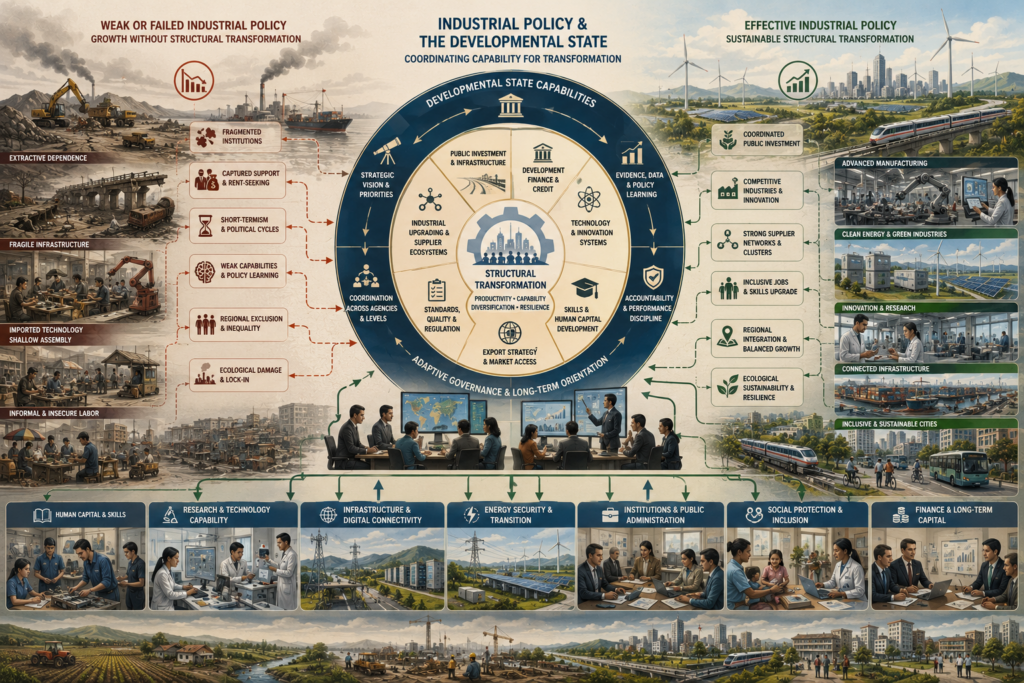
Editorial systems illustration showing industrial policy, developmental-state capacity, strategic sectors, public investment, technology learning, infrastructure, labor skills, regional clusters, and sustainable industrial transformation.

Industrial Policy and the Developmental State

Growth, development, and structural transformation are central to economic analysis because they explain how societies change not only in output, but in capability, institutional depth, infrastructural strength, and long-term resilience. This article distinguishes economic growth from development and shows why structural transformation matters as the historical reorganization of labor, production, technology, energy systems, and state capacity across time. It explores the difference between growth and genuine developmental progress, examines the movement from agriculture to industry to services, and shows how productivity, learning, urbanization, trade, finance, and industrial policy shape whether economies deepen or stall. It also argues that development must be judged by its social and ecological pattern, not only by aggregate expansion. Within sustainable systems, the deeper issue is whether growth produces broader capability, resilience, and public capacity or merely increases scale while intensifying inequality, dependency, and material fragility.
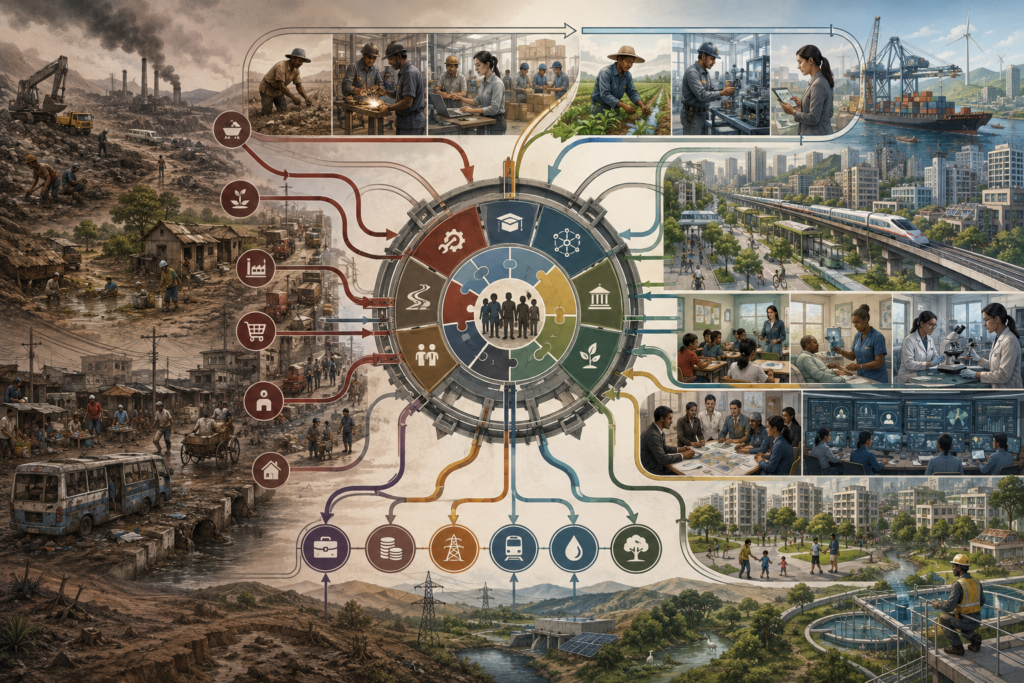
Editorial systems illustration showing economic growth, structural transformation, agriculture, industry, services, infrastructure, public institutions, technological capability, ecological limits, and sustainable development pathways.

Growth, Development, and Structural Transformation

Growth, development, and structural transformation are central to economic analysis because they explain how societies change not only in output, but in capability, institutional depth, infrastructural strength, and long-term resilience. This article distinguishes economic growth from development and shows why structural transformation matters as the historical reorganization of labor, production, technology, energy systems, and state capacity across time. It explores the difference between growth and genuine developmental progress, examines the movement from agriculture to industry to services, and shows how productivity, learning, urbanization, trade, finance, and industrial policy shape whether economies deepen or stall. It also argues that development must be judged by its social and ecological pattern, not only by aggregate expansion. Within sustainable systems, the deeper issue is whether growth produces broader capability, resilience, and public capacity or merely increases scale while intensifying inequality, dependency, and material fragility.
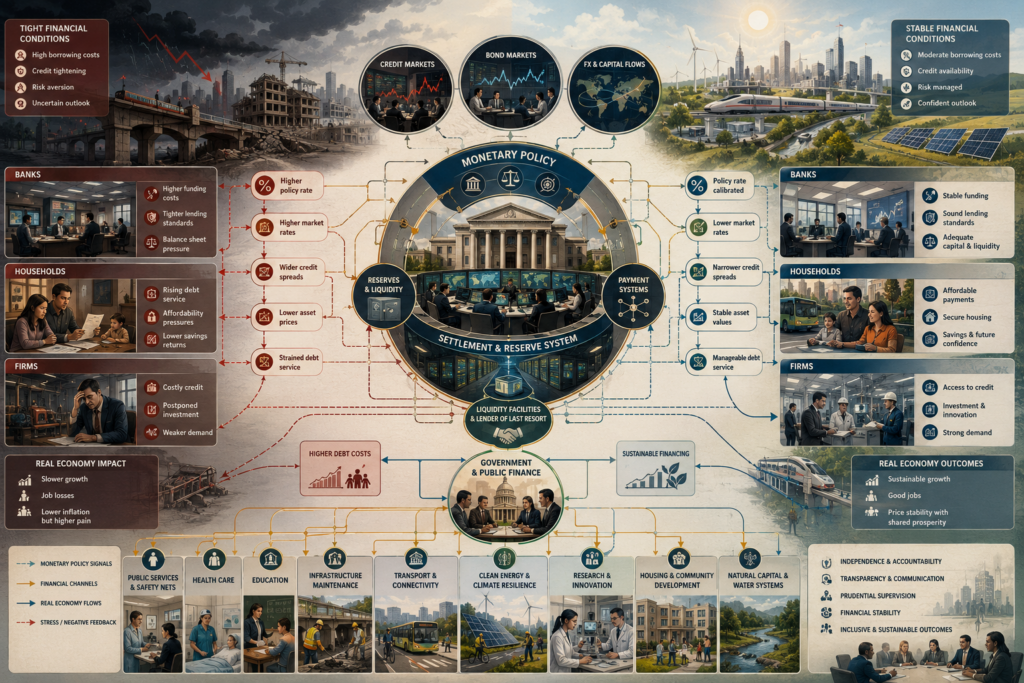
Editorial systems illustration showing monetary policy, central banking, interest rates, reserves, liquidity, payment systems, credit transmission, household debt stress, public finance, and resilient financial conditions.

Monetary Policy, Central Banking, and Financial Conditions

Monetary policy, central banking, and financial conditions are central to economic analysis because they shape how modern economies govern money, credit, liquidity, refinancing, and macroeconomic adjustment across time. This article examines how central banks influence not only policy rates, but also reserves, settlement systems, expectations, and the broader financial environment through which firms, households, banks, and governments make decisions. It explores why financial conditions extend beyond the policy rate alone, how monetary transmission works unevenly through debt, housing, asset prices, exchange rates, and banking structures, and why lender-of-last-resort functions reveal the public foundations of monetary order. It also shows that monetary governance is never purely technical: it distributes burden across labor markets, balance sheets, housing systems, and public finance, while shaping which forms of investment remain viable under uncertainty.

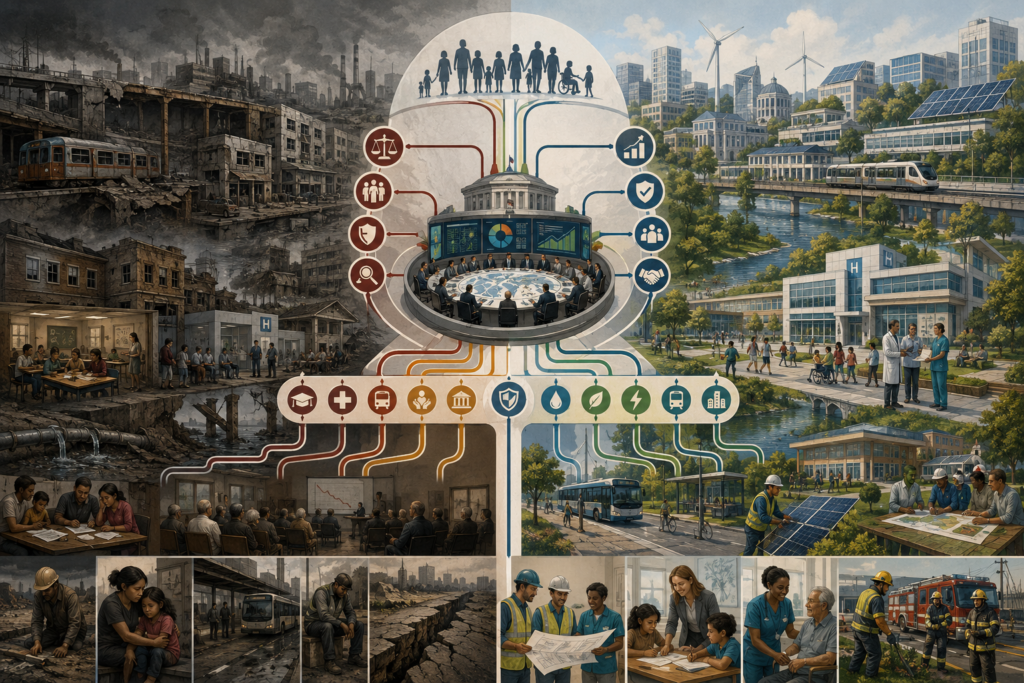
Editorial systems illustration showing taxation, public budgeting, infrastructure, schools, hospitals, transit, water systems, maintenance, public investment, fiscal weakness, and resilient public capacity.

Fiscal Policy, Taxation, and Public Investment

Fiscal policy, taxation, and public investment are central to economic analysis because they determine how societies mobilize resources, distribute burdens, stabilize demand, and build the infrastructures and institutions on which collective life depends. This article examines taxation not only as a source of revenue, but as a system of social design that shapes incentives, fairness, state capacity, and legitimacy. It explores how public spending supports public goods, social insurance, macroeconomic stabilization, and the effective social wage, while public investment builds long-horizon capacity through infrastructure, maintenance, education, health, and adaptation. It also shows why deficits, debt, and fiscal responsibility must be understood in relation to context, purpose, and institutional resilience rather than abstract budget morality alone. Within sustainable systems, the deeper issue is whether fiscal institutions are strong enough to preserve public capacity, reduce fragility, and widen future possibility across time.

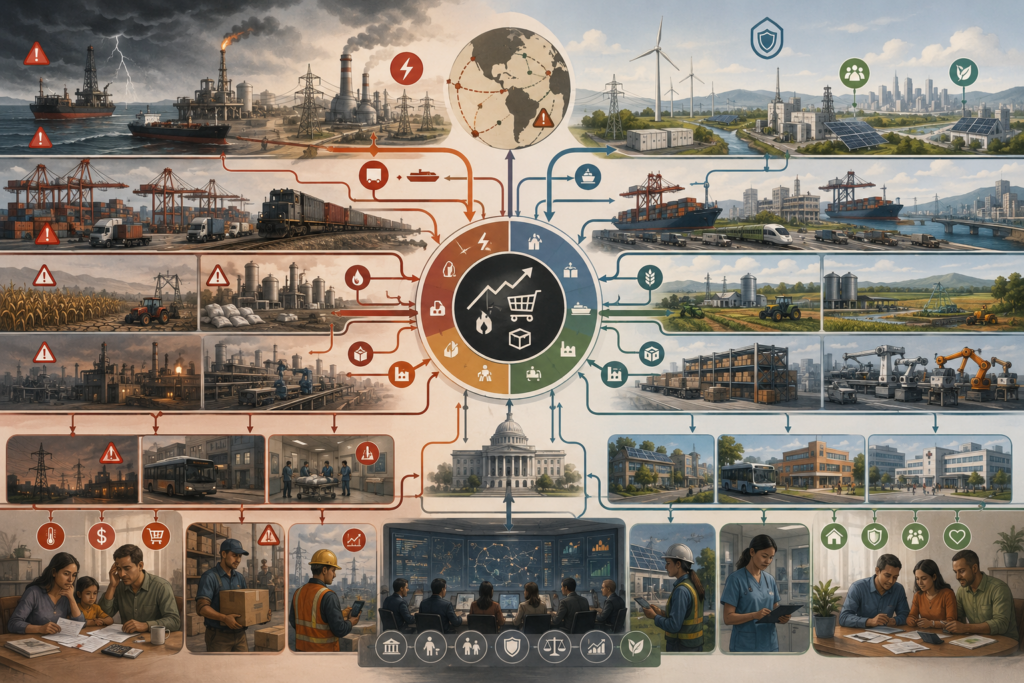
Editorial systems illustration showing inflation driven by energy shocks and supply constraints across fuel systems, ports, freight, farms, factories, infrastructure, households, and public institutions, contrasted with more resilient energy and supply systems.

Inflation, Energy Shocks, and Supply Constraints

Inflation, energy shocks, and supply constraints are central to economic analysis because price instability often reflects more than excess demand or loose money alone. This article examines how inflation can emerge from rising input costs, fragile logistics, concentrated supply, energy dependence, exchange-rate exposure, and unresolved distributional conflict over who absorbs real loss when scarcity intensifies. It explores energy as a system-wide input, traces how supply bottlenecks and fuel shocks spread through production chains and household budgets, and shows why inflation management cannot be reduced to interest-rate policy when the underlying problem is infrastructural, geopolitical, or ecological. Within sustainable systems, the deeper issue is not only whether prices are rising, but whether the economy is organized in ways that convert inevitable shocks into manageable adjustment or into recurring monetary, social, and political strain.

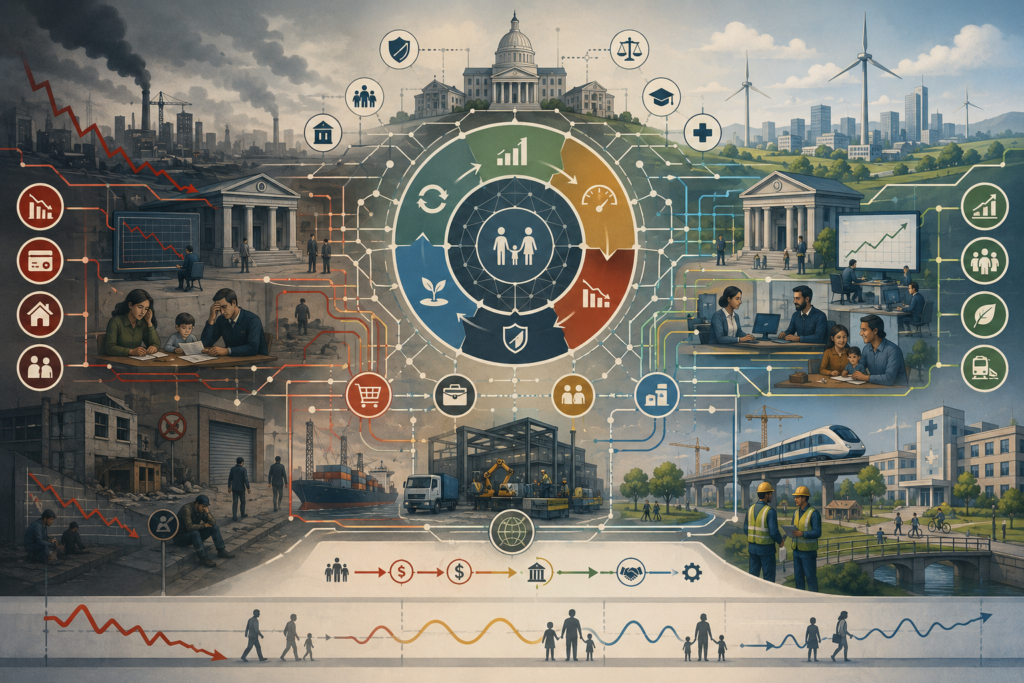
Editorial systems illustration showing business cycles, macroeconomic crisis, falling demand, job losses, credit contraction, policy response, public investment, household security, and resilient economic recovery.

Macroeconomic Stability, Business Cycles, and Crisis

Macroeconomic stability, business cycles, and crisis are central to economic analysis because modern economies do not move smoothly through time, but oscillate through changing patterns of demand, investment, credit, employment, prices, and institutional confidence. This article examines why business cycles emerge from decentralized decisions under uncertainty, how aggregate demand, finance, inventories, debt burdens, and expectations can amplify both expansion and contraction, and why crises occur when the ordinary mechanisms of coordination begin to fail. It also explores how fiscal capacity, automatic stabilizers, monetary policy, household security, and global transmission shape the depth and durability of downturns. Within sustainable systems, the deeper issue is not only whether growth resumes after shock, but whether macroeconomic order is resilient enough to preserve employment, public capacity, infrastructure, adaptation, and long-horizon social stability across periods of structural change and disruption.

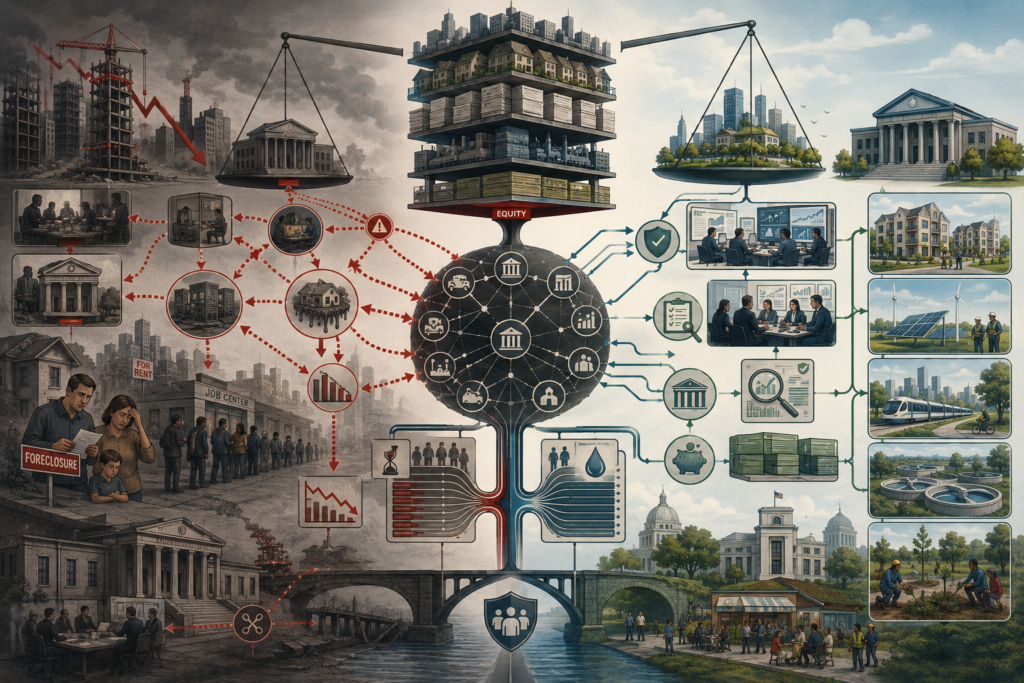
Editorial systems illustration showing leveraged financial structures, interconnected balance sheets, household debt stress, liquidity bottlenecks, public backstops, regulatory oversight, and a contrast between fragile finance and resilient sustainable finance.

Finance, Leverage, and Systemic Risk

Finance, leverage, and systemic risk are central to economic analysis because modern economies operate not only through production and exchange, but through layered claims, balance sheets, collateral structures, and expectations about liquidity, refinancing, and public support. This article examines how leverage amplifies both gains and losses, how interconnection and shared exposures turn firm-level fragility into system-wide instability, and how liquidity stress, fire sales, procyclicality, and hidden leverage can transform ordinary financial pressures into crisis. It also explores why public backstops, macroprudential governance, household indebtedness, and long-tail ecological and infrastructural risks make systemic finance a question of public resilience rather than private technique alone. Within sustainable systems, the deeper issue is not only whether finance expands, but whether it builds durable collective capacity or multiplies claims on increasingly fragile foundations.

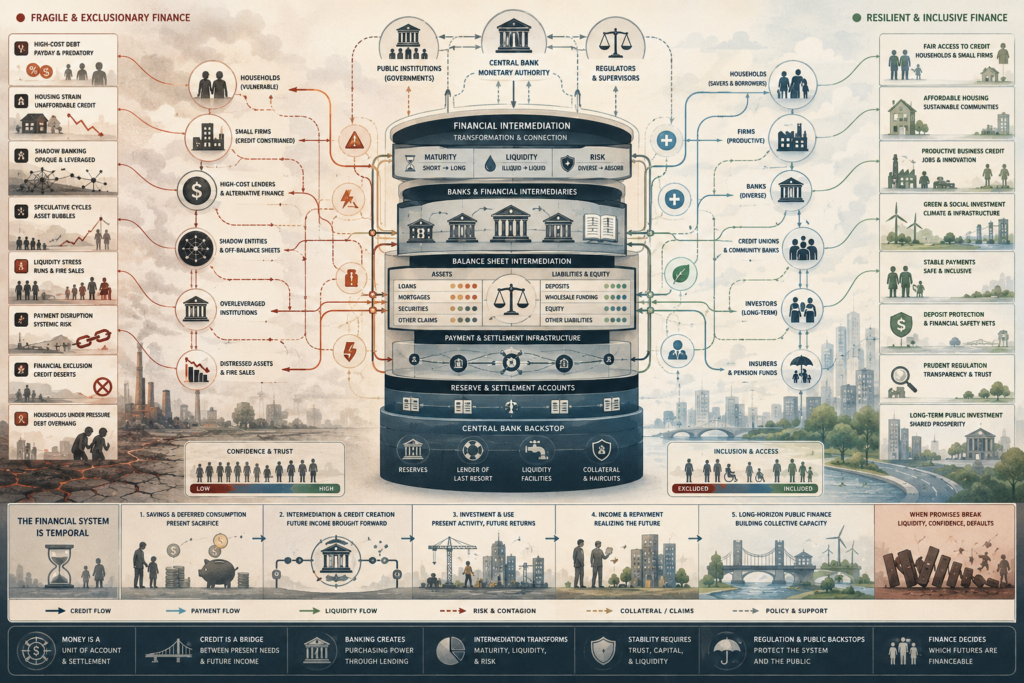
Editorial systems illustration showing money, banking, credit, payment systems, balance sheets, liquidity, central-bank support, financial fragility, fair credit access, and resilient financial intermediation.

Money, Banking, Credit, and Financial Intermediation

Money, banking, credit, and financial intermediation are central to economic analysis because they shape how modern economies organize promises, payments, liquidity, and access to future claims across time. This article examines money not as a neutral technical instrument, but as a socially accepted and institutionally governed claim used to denominate, settle, and store value. It explores how banks create deposit money through lending, how credit expands purchasing power while generating future obligation, how financial intermediation transforms maturity, liquidity, and risk, and how central banks, payment systems, and public guarantees stabilize a structurally fragile monetary order. It also shows why finance must be judged not only by growth or efficiency, but by who gains access to credit, whose risks are socialized, what kinds of futures become financeable, and whether the financial architecture of the economy supports resilient, inclusive, and sustainable development.

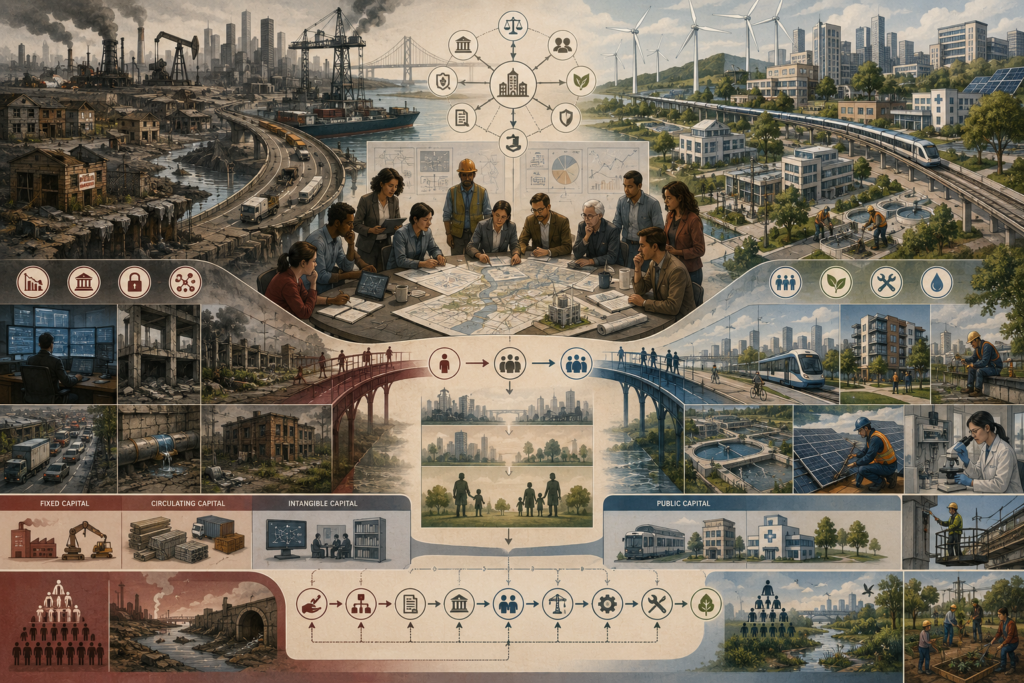
Editorial systems illustration showing capital accumulation through infrastructure, finance, ownership, maintenance, public investment, clean energy, housing, research, and long-term development choices.

Capital, Investment, and the Dynamics of Accumulation

Capital, investment, and the dynamics of accumulation are central to economic analysis because they determine how societies build, preserve, and direct productive capacity across time. This article examines capital not only as a stock of productive assets such as infrastructure, machinery, software, and research capability, but also as a social relation organized through ownership, finance, law, and claims on future income. It explores how investment links present sacrifice to future capacity, how accumulation can widen shared capability or deepen inequality and fragility, how finance and public policy shape the direction of capital, and why maintenance, measurement, and long-horizon stewardship are as important as innovation and expansion. It also shows why sustainable systems require not merely more capital, but different patterns of accumulation that support resilience, ecological viability, and broadly shared future possibility.

Scroll to Top