Economic Systems

Economic systems describe the structures through which societies organize production, distribution, and exchange. These systems determine how resources are allocated, how markets operate, and how wealth and opportunity are distributed across populations.

Different economic models—including market economies, mixed economies, and welfare-state systems—reflect distinct institutional arrangements and policy priorities. Economic performance is shaped not only by market dynamics but also by regulatory frameworks, social institutions, and public investment strategies.

In the context of sustainable development, economic systems must be evaluated not only by aggregate growth but also by resilience, equity, and long-term ecological stability. Scholars increasingly examine how economic institutions can support inclusive prosperity while respecting environmental constraints and planetary boundaries.

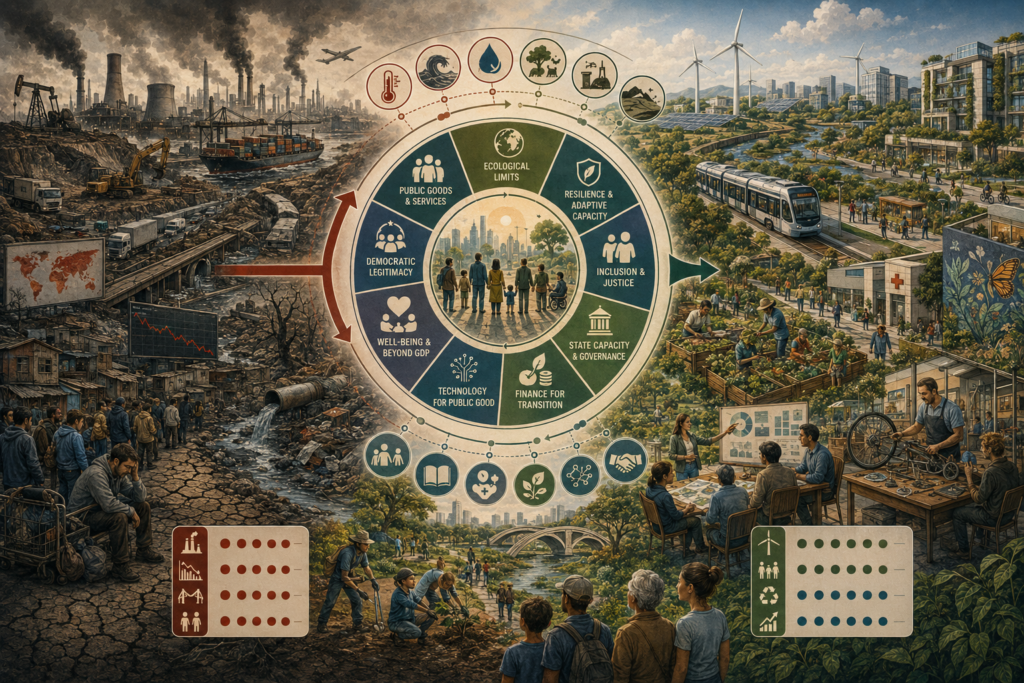
Editorial systems illustration showing the future of economic systems under ecological limits, with old expansionary assumptions contrasted against resilient, inclusive, boundary-aware, regenerative economic redesign.

The Future of Economic Systems in an Age of Limits

The future of economic systems in an age of limits examines how economies must adapt to a world shaped by ecological ceilings, material pressure, climate risk, inequality, and institutional strain. This article explores how the old assumptions of cheap fossil energy, expanding throughput, and growth-first governance are being challenged by planetary boundaries, resource constraints, fragility, and the need for broader measures of progress. It addresses energy transition, material redesign, public goods, state capacity, finance, resilience, post-growth debate, technology, global inequality, democratic legitimacy, and regenerative economic models. Within sustainable systems, the deeper issue is whether economic life can be reorganized to remain compatible with Earth-system stability, human dignity, and long-run collective flourishing at the same time.
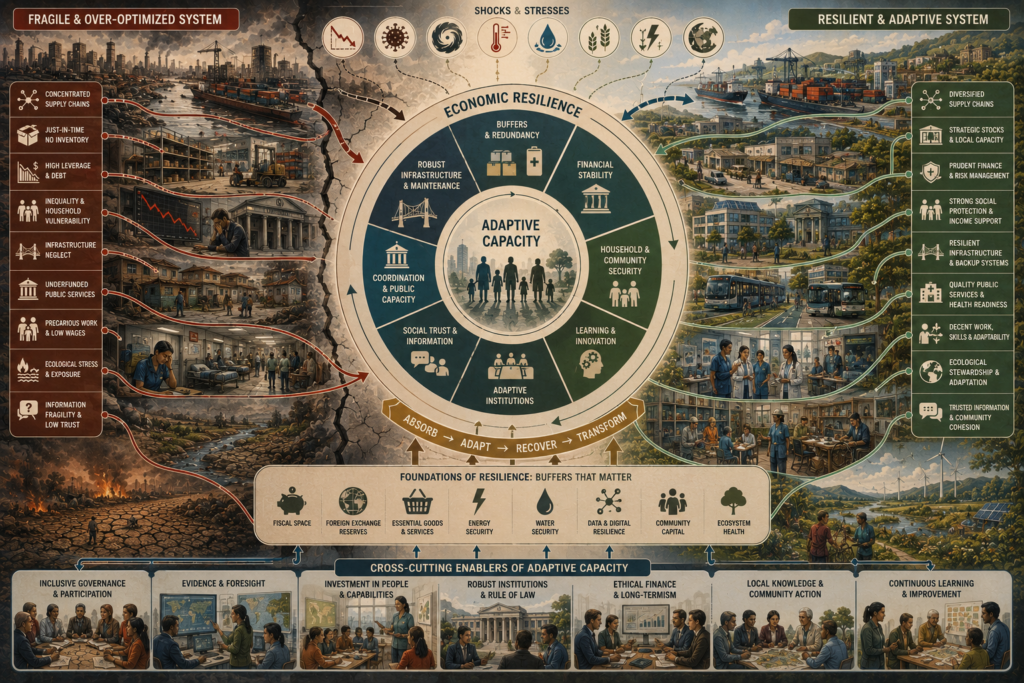
Editorial systems illustration showing economic resilience, fragility, adaptive capacity, shocks, buffers, redundancy, public institutions, supply chains, household security, infrastructure, finance, and ecological risk.

Economic Resilience, Fragility, and Adaptive Capacity

Economic resilience, fragility, and adaptive capacity examine how economies absorb disruption, endure stress, and reorganize under pressure. This article explores resilience as the ability of economic systems to withstand disturbance while maintaining core functions; fragility as the structural condition that makes systems vulnerable to breakdown, contagion, and cascading failure; and adaptive capacity as the institutional, social, financial, and technical ability to learn, coordinate, and change in response to crisis. It addresses shock exposure, over-optimization, buffers, public institutions, unequal household and firm resilience, infrastructure interdependence, debt, labor adaptation, ecological stress, trust, and transformational recovery. Within sustainable systems, the deeper issue is whether economic life is being organized for genuine durability and intelligent adaptation or for short-term performance that leaves societies increasingly brittle when disruption arrives.

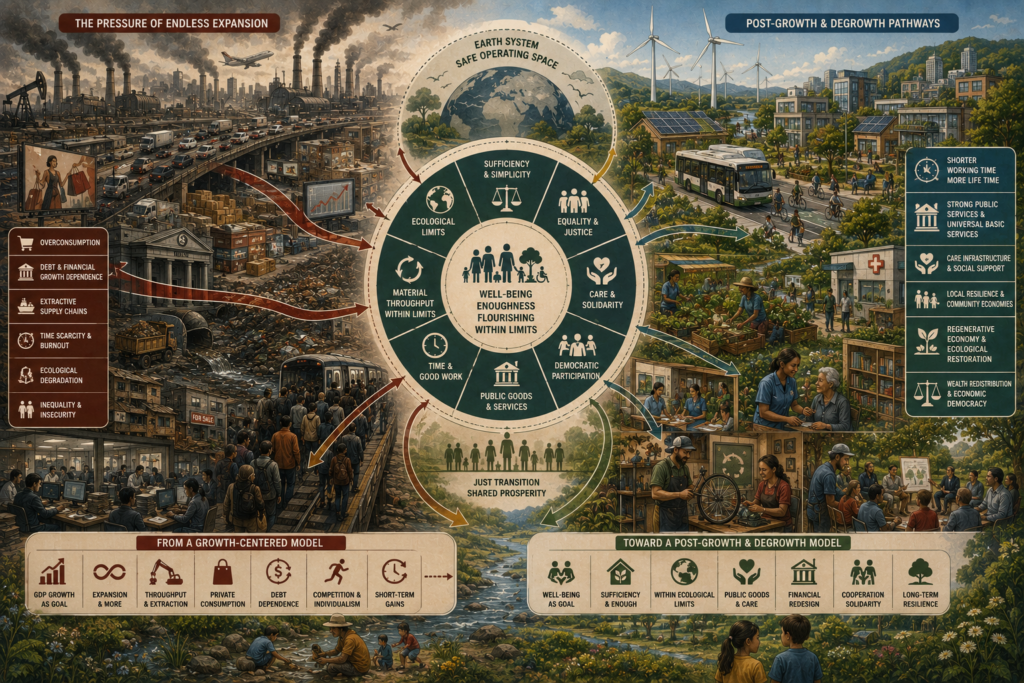
Editorial systems illustration showing post-growth and degrowth as alternatives to endless expansion, with sufficiency, care, public goods, ecological limits, shorter working time, repair economies, and democratic transition.

Post-Growth, Degrowth, and the Critique of Endless Expansion

Post-growth, degrowth, and the critique of endless expansion examine whether modern societies can remain organized around perpetual GDP growth under conditions of ecological strain, inequality, and institutional fragility. This article explores post-growth as a broad family of approaches that seek to organize economic life around wellbeing, sufficiency, resilience, and ecological stability rather than output expansion as an end in itself; degrowth as a more explicit argument for planned reductions in resource and energy throughput in high-income economies alongside stronger equality, care, public goods, and democratic capacity; and the wider critique of endless expansion as a challenge to the idea that rising output is the master solution to social problems. It addresses wellbeing beyond output, material throughput, distribution, care, productivity, debt, finance, decoupling, sufficiency, global justice, and the institutional dependence of modern systems on continuous growth.

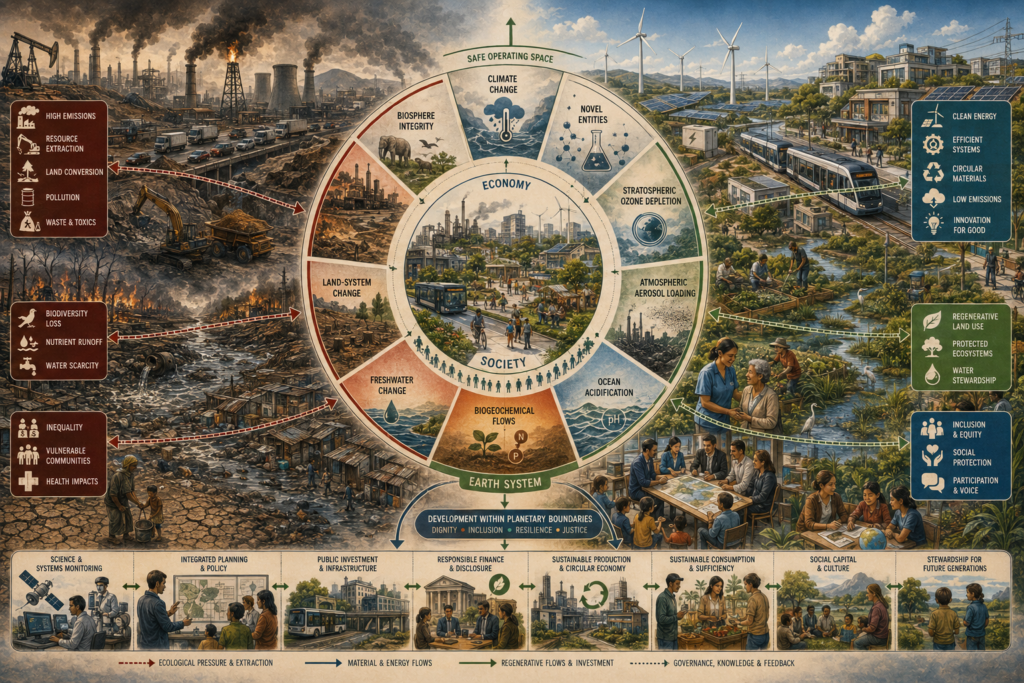
Editorial systems illustration showing the economy nested within society and Earth-system limits, with planetary boundaries, safe operating space, overshoot, resource use, ecological pressure, and boundary-aware governance.

Economic Systems Within Planetary Boundaries

Economic systems within planetary boundaries examines how economies must be governed as subsystems of the Earth system rather than as autonomous engines of unlimited expansion. This article explores the planetary boundaries framework as a way of identifying the safe operating space within which human societies can preserve the ecological conditions that support civilization, and it considers what that means for production, infrastructure, finance, public policy, development, and resource use. It addresses growth, material throughput, overshoot, energy-food-land-water interdependence, justice, state capacity, transition institutions, finance, and boundary-aware measurement. Within sustainable systems, the deeper issue is whether economic life can be reorganized to remain compatible with Earth-system resilience while still supporting dignity, inclusion, and long-run collective flourishing.

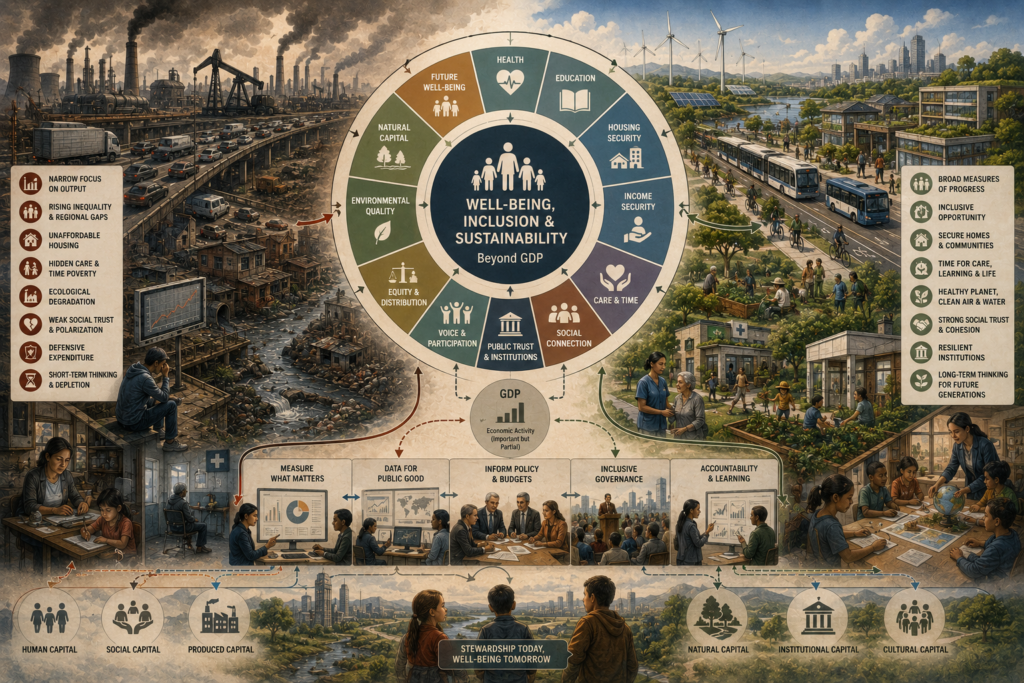
Editorial systems illustration showing a beyond-GDP framework for measuring well-being, inclusion, sustainability, health, education, housing security, care, public trust, natural capital, and future well-being.

Beyond GDP: Measuring Well-Being, Inclusion, and Sustainability

Beyond GDP: measuring well-being, inclusion, and sustainability is central to contemporary political economy because gross domestic product was never designed to capture the full quality of collective life. This article examines GDP as a measure of aggregate economic activity, while showing why it cannot adequately register health, security, care, inequality, ecological stability, social trust, or the long-term conditions of future wellbeing. It explores well-being, inclusion, distribution, sustainability, capability, subjective experience, households and care, natural capital, composite indices, human development, inclusive wealth, the SDGs, and the politics of measurement. Within sustainable systems, the deeper issue is whether societies can build richer frameworks of public evaluation that measure what they genuinely value rather than allowing market output alone to dominate how progress is understood and governed.

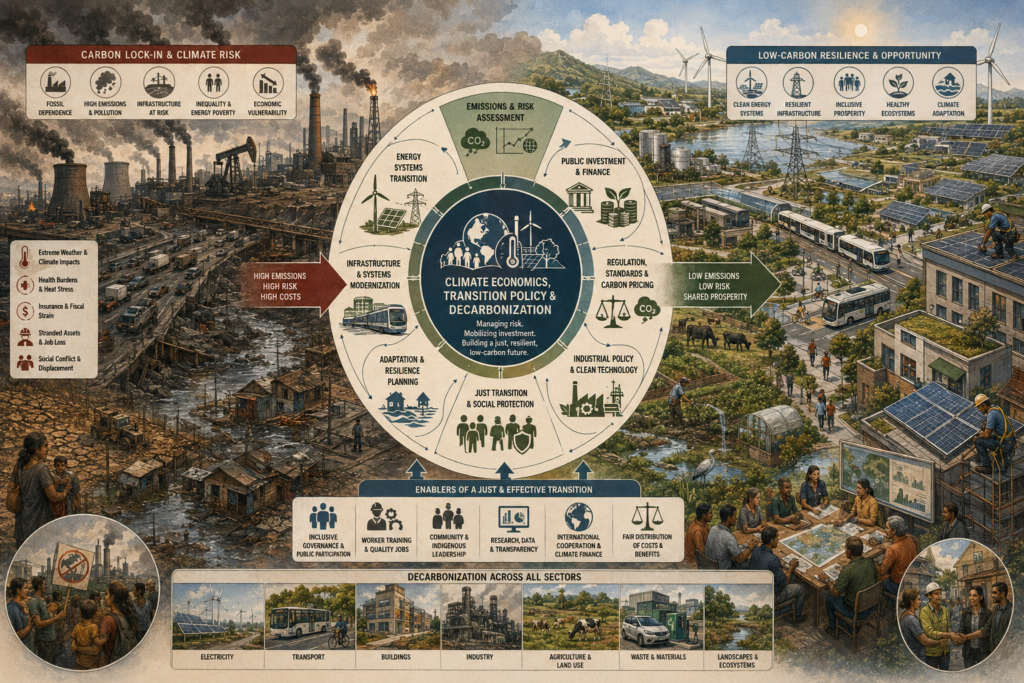
Editorial systems illustration showing climate economics, transition policy, decarbonization, carbon lock-in, fossil infrastructure, clean energy, public investment, just transition, adaptation, and low-carbon resilience.

Climate Economics, Transition Policy, and Decarbonization

Climate economics, transition policy, and decarbonization are central to contemporary political economy because they address how societies reduce greenhouse gas emissions, reorganize energy and production systems, and manage the social, industrial, fiscal, and territorial consequences of that transformation. This article examines climate economics as the study of how emissions, climate damages, energy systems, investment, and public policy interact within economic life; transition policy as the institutional strategies used to move from fossil-fuel dependence toward lower-carbon systems; and decarbonization as the reduction of carbon emissions across electricity, transport, buildings, industry, agriculture, and infrastructure. It explores climate risk, carbon lock-in, pricing and regulation, public investment, industrial policy, hard-to-abate sectors, land use, finance, adaptation, just transition, and global inequality in climate governance.

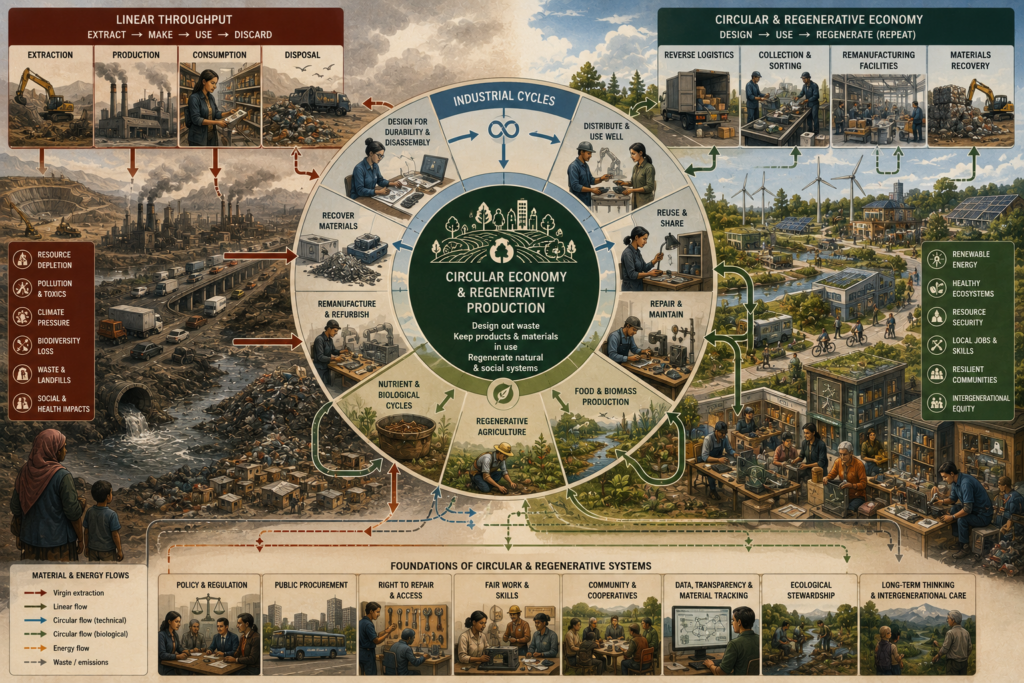
Editorial systems illustration showing circular economy and regenerative production through material loops, repair, reuse, remanufacturing, reverse logistics, regenerative agriculture, ecological restoration, and waste reduction.

Circular Economy and Regenerative Production

Circular economy and regenerative production challenge the linear industrial logic of extraction, consumption, and disposal. This article examines how economies can preserve material value through durability, repair, reuse, remanufacturing, recycling, and circular design while also moving beyond efficiency toward ecological and social renewal. Circularity asks how products, components, and materials can remain useful for longer; regeneration asks whether production can restore soil, water, biodiversity, local capacity, repair cultures, and long-term resilience. The article explores material flows, waste systems, product life extension, repair labor, reverse logistics, right-to-repair policy, product-service models, rebound effects, circular justice, and the limits of recycling alone. It argues that sustainable production requires more than closing loops: it requires scale discipline, public infrastructure, dignified labor, fair burden-sharing, and production systems designed to renew the conditions of future life.

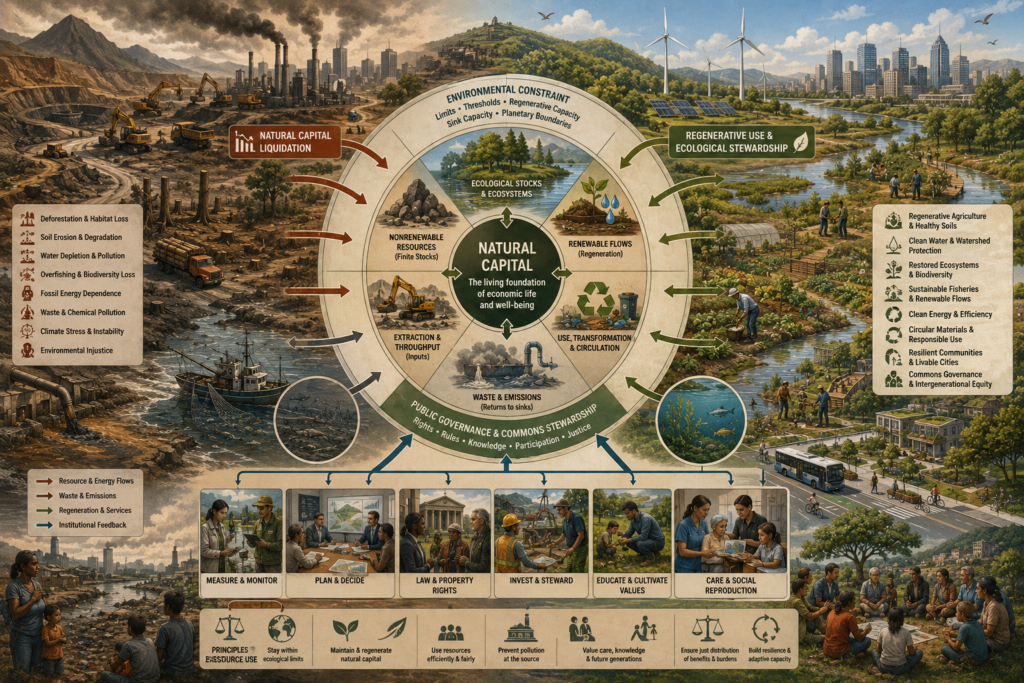
Editorial systems illustration showing natural capital, resource extraction, ecological stocks and flows, forests, soils, water systems, minerals, pollution sinks, regeneration, commons governance, and environmental limits.

Natural Capital, Resource Use, and Environmental Constraint

Natural capital, resource use, and environmental constraint are central to sustainable economic thought because economies depend on land, water, forests, minerals, biodiversity, fertile soils, stable climate systems, and the ecological processes that support production and life across time. This article examines natural capital as the stock of natural assets that generate goods, ecological functions, and life-supporting services; resource use as the extraction, transformation, circulation, and consumption of matter and energy within economic systems; and environmental constraint as the limits, thresholds, regenerative rates, and absorptive capacities that shape what ecological systems can sustain without degradation or breakdown. It explores stocks and flows, renewable and nonrenewable resources, extraction, ecosystem functions, soil, water, forests, minerals, pollution, substitution, accounting, commons governance, ecological justice, and resilience under conditions of environmental stress.

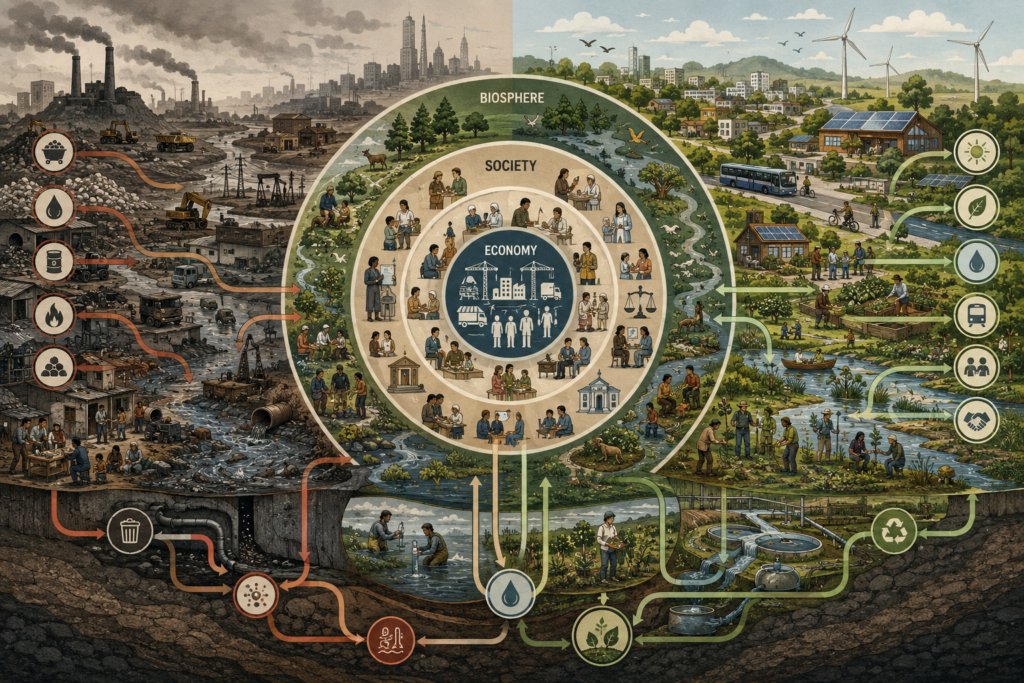
Editorial systems illustration showing the economy nested within society and the biosphere, with material throughput, ecological regeneration, care work, public institutions, commons governance, and sustainable systems.

Ecological Economics and the Embedded Economy

Ecological economics and the embedded economy are central to sustainable thought because they begin from a simple but often neglected reality: the economy is not separate from society or nature. This article examines ecological economics as the study of the economy as a subsystem of the biosphere, dependent on material and energy throughput and constrained by ecological limits, and the embedded economy as the recognition that economic life is also nested within care systems, households, institutions, infrastructures, and political orders. It explores throughput, externalities, care and reproduction, scale, strong sustainability, entropy, commons, valuation beyond price, growth and degrowth debates, ecological justice, and socio-ecological resilience. Within sustainable systems, the deeper issue is whether economies can be governed in ways that recognize ecological dependence, respect material limits, and preserve the social and living foundations on which all future prosperity depends.

Scroll to Top