
Last Updated May 9, 2026
Growth, development, and structural transformation are central to economic analysis because they address one of the deepest questions in political economy: how societies change over time in their productive capacity, material welfare, institutional complexity, and social possibility. Economic growth concerns increases in output, income, and productive scale. Development concerns broader changes in capability, security, health, education, infrastructure, and the institutional conditions of human flourishing. Structural transformation concerns the reorganization of the economy itself: the shift of labor, capital, technology, energy use, and productive weight across sectors, regions, and social forms.
These distinctions matter because societies can grow without developing, and they can develop in some respects without securing durable structural transformation. Output may rise through extractive booms, speculative finance, or commodity windfalls without producing resilient institutions, broad-based capability, or productive diversification. Conversely, a country may improve literacy, health, or public administration while still confronting fragile energy systems, unequal land relations, or dependence on a narrow export base. The serious study of growth therefore requires more than counting what is produced. It requires examining how production is organized, who benefits from it, what institutions sustain it, and whether it widens long-horizon collective possibility.
Structural transformation is especially important because development is not only about more economic activity, but about different economic activity. Low-productivity agriculture, insecure informal labor, fragile urbanization, commodity dependence, or imported industrial dependence often mark economies whose productive structure leaves them vulnerable to stagnation, inequality, and external shock. Development in the deeper sense involves changes in sectoral composition, technological capability, infrastructure, state capacity, labor productivity, and the relation between domestic institutions and the world economy. It is therefore a historical process, not merely an annual statistic.
Main Library
Publications
Article Map
Economic Systems
Related Topic
Sustainable Development
Related Topic
Institutions & Governance
Related Topic
Risk & Resilience
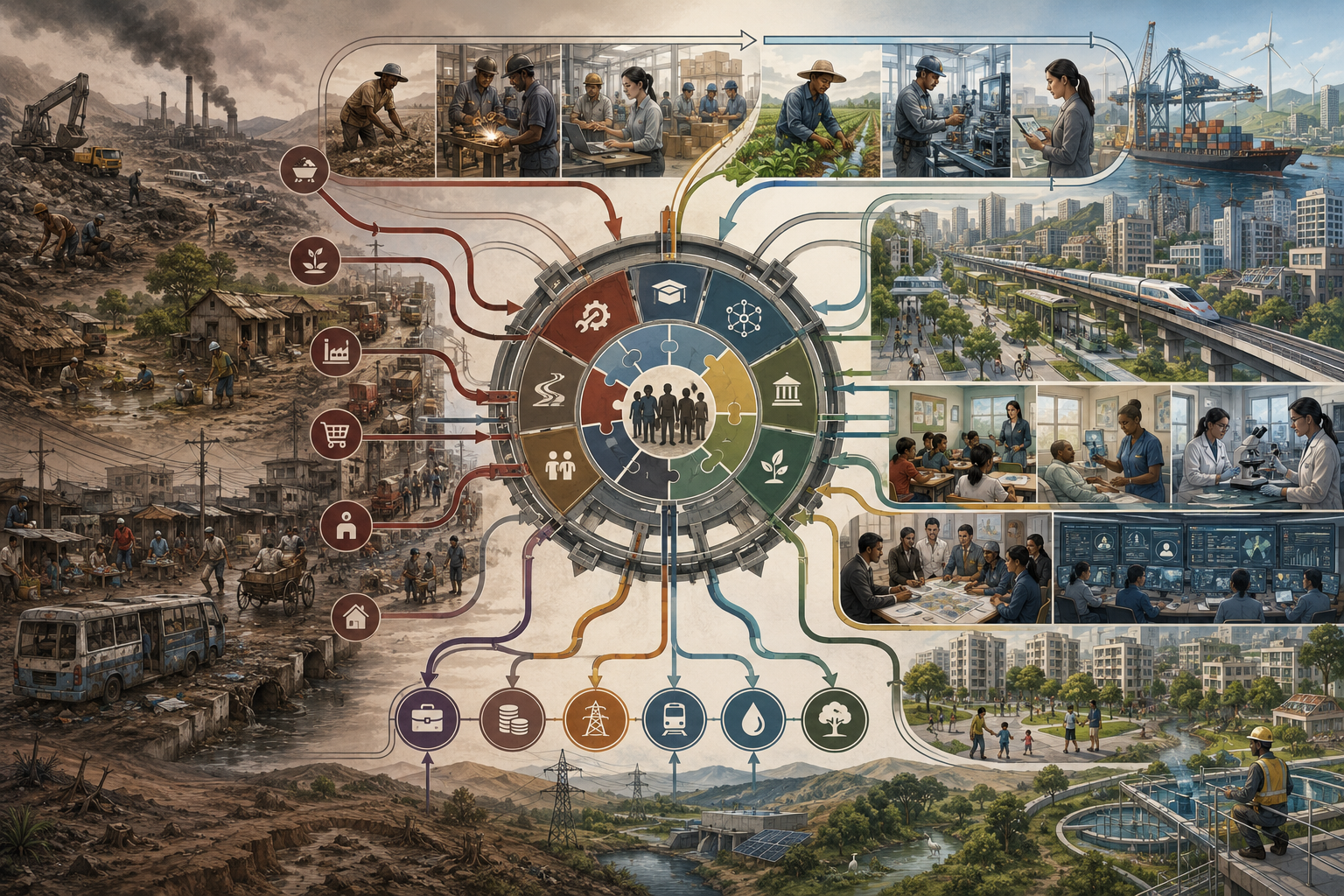
Within a sustainable systems framework, growth, development, and structural transformation must be assessed not only by whether output expands, but by whether economies become more resilient, more equitable, less ecologically destructive, and more capable of maintaining collective life under changing conditions. A society may record high growth while exhausting ecosystems, deepening regional inequality, locking in carbon-intensive infrastructure, or leaving core public systems underbuilt. The serious study of development therefore asks not only how fast economies grow, but what kinds of systems they are becoming.
Why This Topic Matters
Growth, development, and structural transformation matter because they shape the material foundations of social life. They influence whether households have secure employment, whether states can fund public goods, whether infrastructure is reliable, whether cities function, whether food and energy systems remain stable, and whether future generations inherit stronger or weaker institutional capacity. Economic change is therefore never just about output. It is about the evolving structure of collective life.
This matters analytically because aggregate growth can conceal deep differences in quality, distribution, and durability. Two economies may expand at similar rates while following radically different developmental paths. One may deepen productive capability, build public systems, and reduce vulnerability. The other may rely on fragile asset booms, ecological depletion, imported technology, and unequal gains. Growth rates alone cannot distinguish these trajectories.
These issues also matter politically. Development changes the social composition of a country: class structure, labor relations, urban form, regional inequality, educational demand, infrastructure needs, and the capacity of institutions to respond to rising complexity. When structural transformation is blocked or uneven, political strain often follows. Regions may be left behind, informal work may remain dominant, industrial upgrading may stall, and public legitimacy may weaken.
For this reason, the study of growth and development is inseparable from the study of power, institutions, and long-term system design. It asks whether economic change is producing broader capability or simply increasing throughput without durable improvement in collective resilience.
It also asks a more difficult question: development for whom, and at what cost. The answer cannot be read off from national income alone. It must be inferred from the social, institutional, and ecological pattern of transformation itself.
Development also matters because it changes what a society can realistically govern. A low-capacity economy may struggle to maintain public health, infrastructure, education, and disaster response even when intentions are strong. A more developed system has deeper institutional reach, stronger knowledge systems, and greater capacity to coordinate across uncertainty. Development is therefore not only about material abundance. It is about expanding the range of collective problems a society can solve.
What Growth Means
Economic growth usually refers to an increase in total output or income over time, often measured through gross domestic product or related national-account aggregates. At a basic level, growth indicates that more goods and services are being produced, more income is circulating, or the economy’s productive scale is expanding.
This matters because growth can support employment, tax revenue, investment, and material welfare. Sustained growth may make it easier to fund schools, public health, infrastructure, and social insurance while improving average living standards. In low-income settings especially, growth can help relieve severe material scarcity.
But growth is not self-interpreting. Output can expand because more labor and resources are being used, because productivity is improving, because terms of trade temporarily shift, because credit is expanding, or because asset inflation and extraction are boosting measured activity without building long-run strength. A serious analysis therefore asks not only whether growth occurs, but what drives it and whether it is durable.
Growth also has composition. Growth in manufacturing, logistics, and technological capability means something different from growth in speculative real estate, resource depletion, or narrowly concentrated services. The developmental meaning of growth depends partly on what is growing.
For this reason, growth is best treated as a starting indicator, not a final judgment. It tells us that economic scale is changing, but not yet whether that change is broad-based, resilient, or socially and ecologically viable.
Growth also has a temporal structure. Some forms of expansion consume the future in order to enlarge the present, drawing down soils, aquifers, ecosystems, public systems, or financial stability to sustain current output. Others build capacity that makes future development more feasible. The distinction matters profoundly.
A systems view therefore asks whether growth is regenerative or extractive, capability-building or capacity-depleting, inclusive or exclusionary, resilient or fragile. The same numerical growth rate can carry very different meanings depending on the structure beneath it.
What Development Means
Development is a broader concept than growth. It refers to the expansion of human capabilities, institutional effectiveness, infrastructural reliability, public health, education, security, and the material conditions that allow societies to sustain more complex and less vulnerable forms of life. Development includes income, but it is not reducible to income.
This matters because societies can become richer on average without becoming more secure, more equitable, or more capable. If health systems remain weak, infrastructure decays, regions are abandoned, ecological conditions deteriorate, and large parts of the population remain excluded from productive opportunity, development remains incomplete even where output rises.
Development therefore has a qualitative dimension. It concerns the character of the economy and the institutions embedded within it. It asks whether people have access to education, care, transport, safety, productive employment, and public systems strong enough to reduce avoidable vulnerability.
A research-grade treatment must therefore place development alongside human capability, institutional legitimacy, and infrastructural depth. It is not simply the economy becoming larger. It is the economy becoming more organized, more capable, and more able to support durable collective life.
This broader understanding also helps explain why development debates often center on health, schooling, sanitation, legal capacity, gender inclusion, and regional integration. These are not peripheral to development. They are among its clearest expressions.
Development also implies a change in what kinds of futures become thinkable and governable. A society with stronger schools, public health, transport, electricity, legal order, and administrative reach does not merely consume more. It gains a wider range of institutional and human possibilities.
For this reason, development should be understood as the organized expansion of capability across people, places, and institutions. It is the difference between an economy that merely generates income and an economy that can sustain dignity, learning, security, complexity, and resilience across generations.
What Structural Transformation Means
Structural transformation refers to the reorganization of an economy’s productive composition across sectors, technologies, and social relations. Historically, it often includes shifts from low-productivity agriculture toward industry and modern services, from rural labor to urban employment, from subsistence activity to monetized production, and from narrow commodity dependence toward more diversified and complex capability.
This matters because development is not only a matter of adding output to an unchanged structure. Economies develop by changing what they produce, how they produce it, what infrastructures support it, and what kinds of labor and institutions become central. Structural transformation is therefore the economic expression of historical change in organized productive life.
It also matters because some structures are more developmentally generative than others. Sectors differ in productivity, learning potential, linkages to the rest of the economy, export potential, technological spillovers, and capacity to generate stable employment. An economy heavily dependent on enclave extraction or low-wage informal services may grow, but remain structurally fragile.
A serious account of development therefore asks how labor, capital, energy, and knowledge are being reallocated. Structural transformation is not a side effect of development. It is one of its core mechanisms.
In this sense, transformation is both economic and institutional. It includes factories, grids, ports, skills, finance, cities, supply chains, and state capacities that permit new sectors and new forms of coordination to emerge and persist.
Structural transformation also has a political meaning. It changes who counts as strategically important in the economy: farmers, industrial workers, engineers, traders, logistics coordinators, software designers, financiers, public administrators, and care workers may all occupy changing positions as the structure evolves. Development is therefore also a reorganization of social power.
That reorganization can be inclusive or exclusionary. It can draw people into higher-productivity, more secure livelihoods, or it can displace them into urban informality and insecurity. The value of structural change depends on the quality of the new structure that replaces the old one.
Growth Without Development
Growth without development occurs when output expands without corresponding broad improvement in capability, resilience, inclusion, or productive depth. Commodity booms, speculative real-estate cycles, debt-fueled consumption surges, and enclave extraction can all increase measured income while leaving public systems weak, labor markets insecure, and technological capability shallow.
This matters because aggregate expansion can create the illusion of developmental success while underlying fragility deepens. If gains are concentrated narrowly, if infrastructure remains inadequate, if ecological degradation accelerates, or if external dependence worsens, the apparent boom may not be translating into durable progress.
Growth without development also matters politically. It can intensify inequality, inflate expectations, and generate frustration when prosperity is visible statistically but inaccessible socially. Regions left outside the growth core may experience abandonment rather than advancement. Public legitimacy may weaken when success is experienced as exclusion by large parts of the population.
A research-grade perspective therefore treats growth without structural and institutional deepening as developmentally incomplete. The relevant question is not whether growth occurred, but whether it widened capability, diversified the economy, and strengthened collective resilience.
This distinction is especially important in assessing short booms. Temporary expansion can mask chronic underinvestment in maintenance, education, industrial upgrading, and ecological stability. What looks like success may therefore be a delay in recognizing deeper structural weakness.
It also helps explain why some apparently successful growth models collapse quickly under stress. If the underlying structure has not deepened, then external price reversals, debt shocks, political disruptions, or ecological disturbances can expose how thin the development process had actually been.
Growth without development is therefore not a paradox. It is a warning that scale alone is not enough. A society can become larger in measured output while failing to become more capable, just, or resilient in the ways that matter for long-term human flourishing.
From Agriculture to Industry to Services
One classic pattern of structural transformation involves a declining share of labor in agriculture, rising industrial employment and output, and eventually a larger role for services. This pattern reflects differences in productivity, urbanization, technological change, and shifts in demand as incomes rise.
This matters because sectors are not developmentally interchangeable. Agriculture can remain crucial for food security and livelihoods, but low-productivity agricultural structures often limit broad income growth. Industry has historically played a special role because it can absorb labor, raise productivity, generate export capacity, and support learning-by-doing across supply chains. Services, meanwhile, can range from highly productive knowledge sectors to precarious informal work with limited development effect.
The transition therefore is not automatically progressive. Economies can deindustrialize prematurely, move labor into low-productivity urban services, or remain stuck between declining rural viability and insufficient industrial absorption. Structural change can then occur without broad-based upgrading.
For this reason, the sectoral pattern of transformation matters greatly. Development depends not only on labor leaving one sector, but on whether the receiving sectors support higher productivity, stronger institutions, and durable livelihood security.
It also depends on sequence. The timing and quality of agricultural productivity growth, industrial buildout, urban planning, and service expansion can shape whether transition becomes productive integration or disordered displacement.
In contemporary settings, this sequence has become even more complex. Some countries confront service-led growth, digital-sector expansion, or premature deindustrialization under global competition. The older historical path remains instructive, but it cannot simply be presumed to repeat itself unchanged.
A sustainable development framework must therefore ask what kind of services are expanding, whether industry is upgrading, whether agriculture is becoming more productive and ecological, and whether workers are moving into more secure and higher-capability livelihoods rather than merely leaving one precarious position for another.
Productivity, Learning, and Capability Formation
Productivity growth is central to long-run development because it allows more output, income, and public capacity to be generated from available labor, capital, and energy. But productivity is not simply a technical variable. It depends on learning, organizational capability, infrastructure, management, education, and the institutional ecology within which production takes place.
This matters because development is cumulative. Economies become more productive not only by acquiring machines, but by learning to use, adapt, maintain, and improve them. Skills, engineering capacity, supplier networks, logistics competence, and administrative reliability all contribute to productivity growth over time.
Capability formation is therefore one of the deepest developmental processes. A country that imports advanced equipment without building domestic learning and maintenance capacity may remain technologically dependent. One that develops supplier ecosystems, technical education, managerial depth, and research capability may climb toward more complex forms of production.
A research-grade framework thus treats productivity as socially organized learning. Structural transformation succeeds not when sectors change name on a statistical table, but when the economy accumulates real capability to coordinate more complex and more productive activity.
This is why development strategy so often turns toward education, vocational systems, industrial ecosystems, standards, and public research. These are not peripheral supports. They are part of the machinery through which productivity becomes cumulative rather than episodic.
Productivity also has a collective dimension. It is often misread as a property of isolated firms, when in fact it depends heavily on public infrastructures, standards, logistics, rule systems, and institutions of learning that no single firm fully creates alone. Developmental productivity is therefore both private and public in origin.
The deepest productivity gains often emerge from systems of coordination: reliable electricity, skilled labor, predictable regulation, transport networks, supplier quality, public data, health, and institutional trust. Productivity is therefore a social achievement before it becomes a firm-level statistic.
Urbanization, Infrastructure, and Spatial Reorganization
Development is often spatially transformative. Urbanization shifts populations toward cities, alters labor markets, intensifies infrastructure demand, and changes the geography of production, consumption, and public administration. Structural transformation is therefore also spatial transformation.
This matters because cities can concentrate productivity, learning, logistics, and public services, but they can also concentrate exclusion, congestion, housing stress, and infrastructural breakdown if growth outruns planning and investment. Urbanization is not developmental by default. Its quality depends on transport systems, land governance, sanitation, energy reliability, housing supply, and local state capacity.
Infrastructure is especially important because it links sectors and regions into a functional national economy. Roads, rail, ports, electricity, water systems, schools, health networks, and digital connectivity help transform isolated economic activity into coordinated development. Without them, productive change remains thin, fragmented, and vulnerable.
A serious account of development must therefore attend to territorial integration and infrastructural depth. Structural transformation does not occur in the abstract. It is built materially in space through networks, settlement patterns, and public systems that make more complex economic life possible.
Spatial reorganization also raises questions of regional justice. Development that enriches metropolitan cores while abandoning secondary cities, rural areas, or frontier regions may increase measured output while leaving the national system more polarized and politically unstable.
This is one reason infrastructure is developmental in more than an engineering sense. It binds territories, lowers distance, widens access, and changes which parts of a country can plausibly participate in higher-value economic activity. Spatial inequality is often a sign of incomplete structural transformation.
Urban and regional development therefore must be evaluated by whether it creates integrated systems of opportunity rather than enclaves of productivity surrounded by zones of exclusion. A city can be economically dynamic and developmentally unjust if its growth depends on informal settlements, unaffordable housing, weak transit, and spatial segregation.
Institutions, State Capacity, and Developmental Governance
Institutions matter because growth and structural transformation do not unfold through markets alone. Property systems, contract enforcement, industrial regulation, education systems, infrastructure agencies, customs administration, public finance, land governance, and development planning all shape what kinds of economic change become possible.
This matters because state capacity is often decisive in sustaining development. Economies that successfully transform typically do not do so through laissez-faire drift alone. They rely on states capable of taxing, investing, coordinating, enforcing standards, supporting infrastructure, and responding to crisis without chronic administrative breakdown.
Developmental governance does not imply identical policies everywhere. But it does imply institutions able to learn, implement, adapt, and sustain long-term commitments beyond short political cycles. Weak states may announce ambitious strategies yet fail at execution. Stronger states may build credible infrastructure, export capacity, and industrial learning over time.
A research-grade treatment therefore places institutions inside the core of development analysis. The question is not whether the state matters, but what kind of state exists, what capacities it possesses, and whether it can translate ambition into durable economic organization.
Institutional quality also matters because transformation generates conflict. Land reallocation, labor migration, industrial policy, and public investment all create winners and losers. Developmental governance must therefore manage coordination and contestation simultaneously, not merely administer technical plans.
State capacity is therefore not only about control. It is about competence, memory, sequencing, and the ability to maintain direction through uncertainty. Development often fails not because ambition is absent, but because institutions cannot sustain complexity long enough for structural change to consolidate.
Public legitimacy is part of this capacity. Developmental states need not only technical competence, but enough public trust to mobilize resources, coordinate change, and sustain long-horizon investments whose benefits may not be immediate. Without legitimacy, even technically sound development strategies can become politically fragile.
Trade, Industrial Policy, and the World Economy
No serious theory of development can ignore the world economy. Trade creates access to markets, technology, intermediate goods, and foreign exchange. But it also exposes countries to volatile prices, competition, external dependence, and uneven power within global production networks. Development therefore unfolds within an international hierarchy, not a flat global marketplace.
This matters because trade can support structural transformation or freeze it. Export opportunities may help build industry, learning, and scale. But specialization in raw materials or low-value tasks may lock countries into vulnerable positions. The issue is not trade versus autarky, but the terms on which integration occurs and the domestic capabilities that accompany it.
Industrial policy matters here because transformation often requires more than passive exposure to global markets. Public coordination may be needed to support strategic sectors, learning systems, financing channels, infrastructure, and domestic suppliers. Industrial policy, at its best, is not arbitrary favoritism. It is the organized attempt to build productive capability where market signals alone may be too short-term or too risk-averse.
A research-grade framework therefore treats global integration and domestic strategy as interdependent. Development depends partly on how countries navigate trade, technology, finance, and industrial upgrading within an international order that is neither neutral nor evenly structured.
This also means that geopolitical shifts can profoundly alter developmental possibility. Trade access, energy dependence, sanctions, supply-chain realignment, and technology controls may open or close pathways of transformation irrespective of domestic intention alone.
The world economy therefore does not merely reward efficiency. It structures opportunity and dependence. Development strategy must ask not only how to compete, but how to avoid becoming permanently locked into low-learning, low-sovereignty roles within larger global systems.
For sustainable development, trade and industrial policy must also address energy transition, critical minerals, food security, technological sovereignty, and climate-related adjustment. The goal is not isolation, but a form of integration that deepens domestic capability rather than leaving the economy permanently exposed to external shocks and low-value specialization.
Inequality, Inclusion, and the Social Pattern of Development
Development is always socially patterned. Growth can occur alongside exclusion, regional disparity, labor informality, gendered inequality, and unequal access to education, land, health, and finance. Structural transformation may create dynamic sectors while leaving large parts of the population in low-security work or low-service territories.
This matters because inclusion is not merely an ethical add-on to development. It is part of developmental durability. Economies with extreme inequality often underinvest in broad capability, tolerate fragmented public goods, and generate political tension that can destabilize long-term development strategy. Broad inclusion, by contrast, can widen demand, strengthen legitimacy, and support deeper institutional investment.
Inequality also shapes the quality of transformation. If gains from new sectors are concentrated narrowly while labor markets remain insecure and public services weak, productive change may coexist with social fragility. A development path that produces elite complexity atop mass precarity is structurally unstable even if headline output rises.
A serious account of growth and transformation must therefore include distribution. The question is not only whether the economy is becoming more complex, but whether broader populations can participate in and benefit from that complexity.
This makes social policy developmental rather than merely compensatory. Education, health, labor protection, housing, and public services help determine whether transformation becomes a broad social project or a segmented process whose benefits remain too narrow to sustain legitimacy.
Inclusion also affects learning itself. Economies that waste human capability through exclusion, undereducation, ill health, or geographic abandonment reduce their own developmental potential. Inequality is therefore not only a moral issue; it is also a drag on structural depth and long-run resilience.
In this sense, an inclusive development path is not weaker or less ambitious than a narrow growth path. It is often stronger because it mobilizes more human capability, produces deeper legitimacy, and builds a wider social base for long-term transformation.
Energy Systems, Material Throughput, and Ecological Limits
Growth and development are materially grounded. They depend on energy systems, mineral extraction, land use, water, transport, and ecological conditions. This means that structural transformation cannot be understood purely in monetary or sectoral terms. It also involves changing patterns of material throughput and environmental pressure.
This matters because historical growth has often relied on energy-intensive and ecologically costly systems. Industrialization brought productivity gains, but also fossil dependence, pollution, land transformation, and rising resource throughput. Today, the developmental challenge is more complex: societies still need higher capability and infrastructural depth, but they must pursue them under planetary constraints more visible than in earlier industrial eras.
Energy systems are especially significant because they determine both productive possibility and vulnerability. Economies dependent on imported fossil fuels, brittle grids, or carbon-intensive infrastructure may face inflationary pressure, external fragility, and ecological cost simultaneously. Development strategy therefore increasingly requires energy transition as part of structural transformation itself.
A research-grade framework must therefore connect development with ecological realism. The relevant question is not whether societies can simply repeat older growth paths, but how productive upgrading, human welfare, and resilience can be pursued within tighter material and environmental constraints.
This does not eliminate the developmental question. It deepens it. Development now requires not only more capability, but different capability: systems able to deliver welfare, infrastructure, and productivity with lower fragility and lower ecological damage.
Material throughput also changes the meaning of efficiency. A development path that increases output while intensifying dependency on unstable energy, water scarcity, or ecological overshoot may be efficient in narrow cost terms and deeply inefficient in civilizational terms. Structural transformation must therefore be judged partly by what kinds of material metabolism it creates.
Sustainable development is therefore not anti-development. It is a demand that development stop depending on forms of growth that undermine their own ecological and social preconditions. The challenge is to build capability without building fragility into the material base of the future.
Technological Change, Digital Capacity, and Development Paths
Technological change shapes growth and transformation by altering productivity, coordination, communication, and the kinds of sectors that become strategically important. Digital infrastructure, automation, software systems, data capability, and platform power now influence development alongside older industrial capacities such as steel, transport, and electrification.
This matters because digital capacity can widen opportunity, improve logistics, and support new service exports, but it can also deepen dependence if core technologies, standards, and infrastructures remain externally controlled. A country that uses digital tools without building domestic technical depth may gain efficiency while remaining strategically dependent.
Technological change also affects labor markets. Automation can raise productivity while displacing routine work. Platformization can create new sectors while increasing precarious labor forms. The developmental meaning of new technology therefore depends on governance, capability-building, and whether learning remains domestic or is captured elsewhere.
A serious development framework must therefore treat technological change not as a neutral wave, but as a structured field of power, capability, and institutional choice. The question is whether new technologies deepen autonomous productive capacity or merely update dependency in digital form.
This is why digital public infrastructure, technical education, research systems, interoperability standards, and strategic control over data and networks increasingly matter to development analysis. Structural transformation today includes code, platforms, and computation as well as factories and ports.
Technological change also raises sequencing questions. Economies that leap toward digital services without solving energy reliability, educational depth, or industrial capability may gain islands of sophistication without wider transformation. Technology becomes developmental when it is embedded in a broader system of capability, not merely imported as a layer of tools.
The digital economy also changes the politics of value capture. Data, platforms, intellectual property, cloud infrastructure, and algorithmic systems can concentrate rents and dependency in new forms. Development strategy must therefore ask who owns the digital infrastructures of transformation and whether they expand domestic capability or drain value outward.
Crisis, Middle-Income Traps, and Developmental Fragility
Development is rarely linear. Economies can stall after early industrial gains, remain dependent on imported technology, fail to move from low-wage competitiveness to higher-value production, or become trapped in structures that generate moderate income but insufficient innovation and weak productivity acceleration. These patterns are often described through the language of developmental traps, including the so-called middle-income trap.
This matters because transformation can lose momentum. Early growth may come from rural labor transfer, basic industrialization, or favorable trade conditions, but later stages often require more demanding capabilities: research systems, advanced technical education, managerial depth, infrastructure reliability, domestic finance, and institutional coordination across more complex sectors.
Crisis can accelerate these vulnerabilities. External debt shocks, commodity collapses, energy inflation, political instability, climate disasters, or financial crises can interrupt transformation before new productive structures are secure. Economies then face the danger of partial modernization without durable resilience.
A research-grade account therefore treats fragility as endogenous to development. The question is not simply why some countries grew more slowly than others, but why some forms of transformation prove easier to begin than to deepen or sustain.
This perspective also helps explain why resilience matters developmentally. A system repeatedly derailed by external shocks, banking stress, infrastructure weakness, or political fragmentation may never accumulate the continuity needed for deeper transformation, regardless of occasional bursts of rapid growth.
Developmental fragility is therefore not a peripheral concern. It is part of the central problem. A country that cannot preserve gains through crisis may remain trapped in repeated partial takeoffs that never consolidate into a more stable and capable structural order.
The middle-income challenge is not only about income thresholds. It is about whether an economy can move from imitation to innovation, from low-cost labor to capability, from externally dependent growth to more sovereign coordination, and from growth momentum to durable institutional depth.
Finance, Debt, and Developmental Sovereignty
Development depends not only on production, but on finance. Investment in infrastructure, industry, energy systems, cities, and human capability requires mechanisms for mobilizing savings, extending credit, and sustaining long-horizon commitments. Yet financial structure can either support structural transformation or undermine it.
This matters because externally denominated debt, volatile capital flows, short-horizon financial markets, and weak domestic credit systems can make development vulnerable to abrupt reversal. Economies may need investment most urgently precisely when global conditions tighten, exchange rates weaken, or debt service becomes more burdensome. Financial dependency can therefore narrow developmental sovereignty.
Domestic financial systems matter as well. If banks prefer short-term collateralized lending over industrial upgrading, if capital markets reward speculative assets more than productive transformation, or if public development finance is weak, structural change may remain underfunded even where growth opportunities exist.
A research-grade treatment therefore places finance inside development rather than outside it. The question is not only whether capital is available, but on what terms, with what maturity, in which currency, for which sectors, and under what political and institutional control.
Developmental sovereignty in this sense does not imply isolation. It implies sufficient control over finance, public investment, and external vulnerability that an economy can pursue transformation without having its long-run priorities repeatedly subordinated to short-run funding pressures.
This is especially important for sustainable systems. Climate adaptation, energy transition, housing, water, and transport require patient finance. If the financial structure punishes long-horizon investment and rewards short-term extraction, development will remain fragile even where technical solutions are known.
Financial sovereignty is therefore not merely monetary nationalism. It is the capacity to align finance with the long-run formation of capability rather than allowing developmental priorities to be repeatedly interrupted by currency pressure, debt stress, speculative cycles, or external creditor discipline.
Historical Lessons from Developmental Pathways
Historical experience shows that development has followed multiple pathways rather than a single universal sequence. Some countries industrialized through strong states and coordinated finance. Others relied more heavily on exports, settler colonial land systems, resource extraction, or geopolitical patronage. Some built broad social institutions alongside growth; others tolerated deep exclusion while expanding output.
This matters because development theory becomes shallow when it treats one historical path as natural law. The relevant lesson from history is not that every country must repeat the same sequence, but that transformation always depends on a specific combination of institutions, world-system position, resource structure, labor regime, and public capacity.
Historical comparison also reveals recurring themes: the importance of infrastructure, the role of state capability, the centrality of learning and industrial depth, the risks of dependency on narrow exports, and the danger of unequal transformation that outruns social integration. These themes recur even when sectoral and technological contexts differ.
A research-grade approach therefore uses history diagnostically rather than dogmatically. It asks what previous transformations reveal about capability, fragility, and the governance of long-run change under real political and material constraints.
History also warns against developmental triumphalism. Many periods of apparent takeoff later exposed hidden weaknesses in ecology, finance, inequality, or institutional depth. Durable development is usually quieter, slower, and more infrastructure-heavy than celebratory growth narratives suggest.
Historical perspective also shows that developmental success usually involves institutional layering rather than singular breakthroughs. Transport, education, finance, sanitation, energy, taxation, and state coordination tend to deepen one another cumulatively. Transformation is rarely the result of one reform alone.
The historical lesson is therefore not that development can be engineered perfectly from above, nor that markets alone will deliver it automatically. It is that durable transformation requires coordinated learning across institutions, sectors, finance, infrastructure, and social capability over time.
Growth, Development, and Sustainable Systems
Within sustainable systems, growth, development, and structural transformation must be judged by whether they widen resilience, reduce fragility, and support long-horizon collective capability. A society that grows rapidly while undermaintaining infrastructure, degrading ecosystems, concentrating wealth, and locking in volatile energy dependence may be increasing measured output while weakening its own future viability.
This changes the meaning of successful development. The goal is not merely to maximize throughput, but to build productive systems capable of supporting welfare, public capacity, ecological stability, and adaptation across time. Structural transformation must therefore include not only industrial and technological upgrading, but also energy transition, infrastructural maintenance, territorial integration, and social inclusion.
Sustainable systems require a developmental model strong enough to deliver material progress without treating ecological overshoot, social fragmentation, and brittle infrastructure as acceptable collateral effects. This implies more attention to quality of growth, composition of investment, resilience of public systems, and the ability of institutions to learn under conditions of uncertainty.
In this sense, development becomes a systems question. It asks whether economies are becoming more capable of reproducing collective life under stress, or whether they are merely expanding scale while deepening the conditions of future breakdown.
This also means that sustainability should not be framed as a brake on development. Properly understood, it is part of development’s redefinition under contemporary conditions: the attempt to achieve higher capability, security, and productive depth without building futures that are materially unstable or ecologically self-undermining.
A sustainable developmental path therefore requires a different synthesis: productivity with resilience, infrastructure with maintenance, inclusion with capability-building, and growth with ecological realism. The challenge is not to abandon transformation, but to transform the terms on which transformation is pursued.
Sustainable development also requires a moral shift in measurement. An economy that grows while eroding public trust, social cohesion, and ecological foundations is not becoming more developed in the deepest sense. Development should expand the conditions of life, not merely the volume of monetized activity.
How Development Systems Should Be Judged
Growth and development systems should not be judged only by GDP growth, per-capita income, or investment rates. A broader economic systems framework asks whether growth is producing productivity, capability, institutional strength, ecological resilience, and inclusion across people and places.
| Dimension | Narrow Question | Systems Question |
|---|---|---|
| Growth | Is output rising? | What is driving growth, who benefits, and does it build future capacity? |
| Productivity | Is output per worker increasing? | Is productivity rooted in learning, infrastructure, technology, and institutional capability? |
| Sectoral Change | Are sector shares changing? | Are workers and capital moving into higher-productivity, higher-learning, and more secure activities? |
| Development | Is average income higher? | Are health, education, infrastructure, security, and public capability improving broadly? |
| Urbanization | Are cities growing? | Are urban systems inclusive, serviced, affordable, connected, and institutionally governable? |
| Trade | Are exports expanding? | Does integration deepen domestic capability or lock the economy into dependency and volatility? |
| Inclusion | Is poverty falling? | Are inequality, informality, regional exclusion, and social vulnerability being structurally reduced? |
| Sustainability | Is development continuing? | Is the development path reducing ecological damage, energy vulnerability, and future systemic risk? |
This framework prevents a common mistake: treating development as a race to increase output without asking what kind of economy is being built. A country can grow while remaining dependent, unequal, ecologically fragile, institutionally weak, and financially exposed. A more serious development framework asks whether the structure of the economy is becoming capable of sustaining dignified life under changing historical conditions.
The central question is therefore not simply whether the economy is getting bigger. The deeper question is whether it is becoming more capable, more resilient, more just, and more able to support future generations without undermining the systems they will depend on.
Mathematical Lens
Mathematics can clarify growth, development, and structural transformation by making output growth, labor productivity, sectoral shares, employment shifts, capability indices, structural-change decomposition, energy intensity, and fragility scores explicit. These equations do not determine which development path is just or sustainable, but they help reveal what must be examined beyond aggregate output.
1. Growth Rate
g = \frac{Y_t – Y_{t-1}}{Y_{t-1}}
\]
Interpretation: The growth rate \(g\) measures the percentage change in output from \(Y_{t-1}\) to \(Y_t\). It shows how aggregate scale changes over time, but not whether the change is broad-based or structurally deep.
2. Labor Productivity
LP = \frac{Y}{L}
\]
Interpretation: Labor productivity \(LP\) equals output \(Y\) divided by labor input \(L\). Development often depends not only on using more labor, but on raising output per worker through learning, capital, infrastructure, organization, and technology.
3. Sectoral Output Share
s_i = \frac{Y_i}{Y}
\]
Interpretation: A sector’s output share \(s_i\) equals sector output \(Y_i\) divided by total output \(Y\). Structural transformation can be tracked partly through changing sectoral shares over time.
4. Sectoral Employment Share
e_i = \frac{L_i}{L}
\]
Interpretation: A sector’s employment share \(e_i\) equals labor employed in sector \(i\), \(L_i\), divided by total labor \(L\). Development often involves labor moving from low-productivity to higher-productivity sectors, though this is not guaranteed.
5. Development Capability Indicator
D = f(Income, Health, Education, Infrastructure, Security)
\]
Interpretation: A stylized development index \(D\) can combine income, health, education, infrastructure, and security. This expresses the core point that development is multidimensional rather than reducible to output alone.
6. Structural Change Contribution
\Delta Y = \sum_i(\Delta LP_i \times L_i) + \sum_i(\Delta L_i \times LP_i)
\]
Interpretation: Growth may come from productivity improvements within sectors and from labor reallocation across sectors. This decomposition helps distinguish upgrading within the existing structure from transformation across the structure.
7. Energy Intensity
EI = \frac{Energy\ Use}{Y}
\]
Interpretation: Energy intensity \(EI\) compares energy use with output. A lower value can indicate that an economy produces more output per unit of energy, though ecological interpretation also depends on energy source, emissions, and material throughput.
8. Developmental Fragility
F = f(Export\ Concentration, Debt\ Exposure, Inequality, Energy\ Dependence, Infrastructure\ Gaps)
\]
Interpretation: Developmental fragility \(F\) can be modeled as a function of export concentration, debt exposure, inequality, energy dependence, and infrastructure gaps. This captures why some growth paths become unstable under shock.
9. Practical Interpretation
The mathematical lens clarifies several structural points. Growth measures scale change, but not developmental quality by itself. Productivity gains are central to sustained development. Changing sectoral shares help reveal structural transformation. Labor movement across sectors can raise or lower development potential depending on destination sectors. Development must be interpreted through multiple capability dimensions, not output alone. Energy intensity and fragility measures help reveal whether growth is becoming more resilient or more vulnerable.
Formalization helps clarify mechanism, but it does not determine which developmental path is most just, resilient, or ecologically viable. Those remain institutional, historical, and political questions.
Python Workflow: Growth, Development, and Structural Transformation
Python is useful for turning development concepts into reproducible calculations. The following compact workflow models output growth, labor productivity, sectoral output shares, labor shares, a development capability index, energy intensity, and a simple developmental fragility score.
# Growth, Development, and Structural Transformation
# Simple Python workflow

import pandas as pd

# Output growth
Y_t_1 = 950
Y_t = 1015
growth_rate = (Y_t - Y_t_1) / Y_t_1
print("Growth rate:", round(growth_rate, 3))

# Labor productivity
labor = 420
productivity = Y_t / labor
print("Labor productivity:", round(productivity, 2))

# Sectoral output shares
sector_output = {
    "agriculture": 120,
    "industry": 340,
    "services": 555
}

total_output = sum(sector_output.values())
output_shares = {
    sector: value / total_output
    for sector, value in sector_output.items()
}

print("Sectoral output shares:", output_shares)

# Sectoral labor shares
sector_labor = {
    "agriculture": 150,
    "industry": 110,
    "services": 160
}

total_labor = sum(sector_labor.values())
labor_shares = {
    sector: value / total_labor
    for sector, value in sector_labor.items()
}

print("Sectoral labor shares:", labor_shares)

# Sectoral productivity
sector_productivity = {
    sector: sector_output[sector] / sector_labor[sector]
    for sector in sector_output
}

print("Sectoral productivity:", sector_productivity)

# Development capability index
income_index = 0.70
health_index = 0.76
education_index = 0.78
infrastructure_index = 0.72
security_index = 0.68

capability_index = (
    0.22 * income_index
    + 0.20 * health_index
    + 0.20 * education_index
    + 0.22 * infrastructure_index
    + 0.16 * security_index
)

print("Capability index:", round(capability_index, 3))

# Energy intensity
energy_use = 610
output = 1220
energy_intensity = energy_use / output
print("Energy intensity:", round(energy_intensity, 3))

# Developmental fragility score
export_concentration = 0.60
external_debt_ratio = 0.45
inequality = 0.50
energy_dependence = 0.55
infrastructure_gap = 0.40

fragility_score = (
    0.22 * export_concentration
    + 0.22 * external_debt_ratio
    + 0.20 * inequality
    + 0.18 * energy_dependence
    + 0.18 * infrastructure_gap
)

print("Developmental fragility score:", round(fragility_score, 3))

df = pd.DataFrame({
    "Metric": [
        "Growth Rate",
        "Labor Productivity",
        "Agriculture Output Share",
        "Industry Output Share",
        "Services Output Share",
        "Capability Index",
        "Energy Intensity",
        "Developmental Fragility Score"
    ],
    "Value": [
        growth_rate,
        productivity,
        output_shares["agriculture"],
        output_shares["industry"],
        output_shares["services"],
        capability_index,
        energy_intensity,
        fragility_score
    ]
})

print(df)
This workflow is useful because it connects aggregate expansion to productivity, sectoral composition, capability, energy use, and fragility. It helps distinguish mere growth from deeper structural transformation by asking whether output expansion is accompanied by productivity upgrading, capability formation, lower vulnerability, and more sustainable material foundations.
The full GitHub repository expands this example into multi-period growth paths, sectoral transformation tables, labor-productivity diagnostics, capability indices, urban infrastructure scenarios, trade diversification analysis, inequality and inclusion scoring, energy-intensity and emissions measures, debt-fragility scenarios, SQL queries, R and Stata replication workflows, Julia simulations, and article-ready figures.
R Workflow: Growth, Development, and Structural Transformation
R is useful for development summaries, productivity comparisons, sectoral transformation tables, and publication-ready graphics. The following compact workflow performs the same growth, productivity, sectoral-share, capability, energy-intensity, and fragility calculations in R.
# Growth, Development, and Structural Transformation
# Simple R workflow

# Output growth
Y_t_1 <- 950
Y_t <- 1015
growth_rate <- (Y_t - Y_t_1) / Y_t_1
cat("Growth rate:", round(growth_rate, 3), "\n")

# Labor productivity
labor <- 420
productivity <- Y_t / labor
cat("Labor productivity:", round(productivity, 2), "\n")

# Sectoral output shares
agriculture <- 120
industry <- 340
services <- 555
total_output <- agriculture + industry + services

ag_share <- agriculture / total_output
ind_share <- industry / total_output
srv_share <- services / total_output

cat("Agriculture output share:", round(ag_share, 3), "\n")
cat("Industry output share:", round(ind_share, 3), "\n")
cat("Services output share:", round(srv_share, 3), "\n")

# Sectoral labor shares
labor_ag <- 150
labor_ind <- 110
labor_srv <- 160
total_labor <- labor_ag + labor_ind + labor_srv

e_ag <- labor_ag / total_labor
e_ind <- labor_ind / total_labor
e_srv <- labor_srv / total_labor

cat("Agriculture labor share:", round(e_ag, 3), "\n")
cat("Industry labor share:", round(e_ind, 3), "\n")
cat("Services labor share:", round(e_srv, 3), "\n")

# Development capability index
income_index <- 0.70
health_index <- 0.76
education_index <- 0.78
infrastructure_index <- 0.72
security_index <- 0.68

capability_index <- (
  0.22 * income_index +
  0.20 * health_index +
  0.20 * education_index +
  0.22 * infrastructure_index +
  0.16 * security_index
)

cat("Capability index:", round(capability_index, 3), "\n")

# Energy intensity
energy_use <- 610
output <- 1220
energy_intensity <- energy_use / output
cat("Energy intensity:", round(energy_intensity, 3), "\n")

# Developmental fragility score
export_concentration <- 0.60
external_debt_ratio <- 0.45
inequality <- 0.50
energy_dependence <- 0.55
infrastructure_gap <- 0.40

fragility_score <- (
  0.22 * export_concentration +
  0.22 * external_debt_ratio +
  0.20 * inequality +
  0.18 * energy_dependence +
  0.18 * infrastructure_gap
)

cat("Developmental fragility score:", round(fragility_score, 3), "\n")

summary_df <- data.frame(
  Metric = c(
    "Growth Rate",
    "Labor Productivity",
    "Agriculture Output Share",
    "Industry Output Share",
    "Services Output Share",
    "Capability Index",
    "Energy Intensity",
    "Developmental Fragility Score"
  ),
  Value = c(
    growth_rate,
    productivity,
    ag_share,
    ind_share,
    srv_share,
    capability_index,
    energy_intensity,
    fragility_score
  )
)

print(summary_df)
This R workflow is deliberately compact for article readability. In the full repository, R reads structured growth-path, sector-transformation, capability, infrastructure, trade, inequality, energy, and debt-fragility scenarios; calculates growth rates, labor productivity, sectoral shares, capability indices, energy intensity, and sustainable growth indicators; and visualizes how development paths diverge across structural conditions.
Future Economic Systems articles can extend this foundation with national accounts, employment by sector, productivity series, human development indicators, household survey data, export concentration metrics, infrastructure quality indicators, energy balances, emissions data, public investment records, and external debt statistics.
GitHub Repository
The article body includes selected computational examples so the conceptual, institutional, and mathematical argument remains readable. The full repository contains the expanded research infrastructure: Python growth and productivity analysis, R development-path summaries, Stata applied development-economics replication workflows, SQL development scenario tables, Julia productivity and transformation simulations, sectoral output and labor shares, capability indices, urban infrastructure scenarios, trade diversification, inequality and inclusion measures, energy intensity, ecological pressure, debt fragility, documentation, reproducible sample data, and article-ready figures and tables.
Complete Code Repository
The full code distribution for this article, including selected article examples and advanced research-style computational scaffolding for output growth, labor productivity, sectoral transformation, employment reallocation, development capability, urbanization, infrastructure depth, export diversification, inequality, energy intensity, ecological pressure, debt exposure, middle-income fragility, sustainable development pathways, reproducibility documentation, and cross-language economic analysis, is available on GitHub.
Conclusion
Growth, development, and structural transformation are central to economic analysis because they show how societies change not only in scale, but in capability, complexity, and resilience. Growth measures expansion. Development concerns the wider improvement of human and institutional conditions. Structural transformation concerns the reorganization of production, labor, infrastructure, technology, finance, energy, and capability through which durable development becomes possible.
To understand an economic system seriously, one must therefore ask not only whether output is rising, but what is driving that rise, which sectors are deepening, how productivity and learning are evolving, whether institutions are gaining strength, how burdens and benefits are distributed, and whether ecological and infrastructural limits are being respected. These questions reveal whether an economy is merely becoming larger or actually becoming more capable of sustaining collective life across time.
The serious study of development also shows why historical transformation cannot be reduced to a universal formula. Growth paths differ because institutions, resources, world-system position, finance, politics, geography, technology, and social structure differ. Development is not a single ladder. It is a set of contested pathways through which societies try to build capability under constraint.
In a sustainable economic system, development must mean more than expanded throughput. It must mean stronger public capacity, broader inclusion, more resilient infrastructure, lower ecological vulnerability, and deeper productive learning. The central developmental question is therefore not simply how to grow faster. It is how to transform in ways that make dignified, resilient, and future-oriented collective life more possible.
Related Reading
- Economic Systems
- Capital, Investment, and the Dynamics of Accumulation
- Labor, Wages, Productivity, and the Social Organization of Work
- Fiscal Policy, Taxation, and Public Investment
- Macroeconomic Stability, Business Cycles, and Crisis
- Inflation, Energy Shocks, and Supply Constraints
- Monetary Policy, Central Banking, and Financial Conditions
- Sustainable Development
- Institutions & Governance
- Risk & Resilience
Further Reading
- International Labour Organization (ILO) (n.d.). Employment, productivity and development. Available at: https://www.ilo.org/
- Organisation for Economic Co-operation and Development (OECD) (n.d.). Productivity. Available at: https://www.oecd.org/en/topics/productivity.html
- United Nations Conference on Trade and Development (UNCTAD) (n.d.). Structural transformation and development. Available at: https://unctad.org/
- United Nations Development Programme (UNDP) (n.d.). Human Development Reports. Available at: https://hdr.undp.org/
- World Bank (n.d.). Macroeconomics, Trade, and Investment. Available at: https://www.worldbank.org/en/topic/macroeconomics
- World Bank (n.d.). World Development Indicators. Available at: https://databank.worldbank.org/source/world-development-indicators
- United Nations Industrial Development Organization (UNIDO) (n.d.). Industrial development reports and statistics. Available at: https://www.unido.org/
References
- International Labour Organization (ILO) (n.d.). Employment, productivity and development. Available at: https://www.ilo.org/
- Organisation for Economic Co-operation and Development (OECD) (n.d.). Productivity. Available at: https://www.oecd.org/en/topics/productivity.html
- United Nations Conference on Trade and Development (UNCTAD) (n.d.). Structural transformation and development. Available at: https://unctad.org/
- United Nations Development Programme (UNDP) (n.d.). Human Development Reports. Available at: https://hdr.undp.org/
- United Nations Industrial Development Organization (UNIDO) (n.d.). Industrial development reports and statistics. Available at: https://www.unido.org/
- World Bank (n.d.). Macroeconomics, Trade, and Investment. Available at: https://www.worldbank.org/en/topic/macroeconomics
- World Bank (n.d.). World Development Indicators. Available at: https://databank.worldbank.org/source/world-development-indicators