Economic Systems

Economic systems describe the structures through which societies organize production, distribution, and exchange. These systems determine how resources are allocated, how markets operate, and how wealth and opportunity are distributed across populations.

Different economic models—including market economies, mixed economies, and welfare-state systems—reflect distinct institutional arrangements and policy priorities. Economic performance is shaped not only by market dynamics but also by regulatory frameworks, social institutions, and public investment strategies.

In the context of sustainable development, economic systems must be evaluated not only by aggregate growth but also by resilience, equity, and long-term ecological stability. Scholars increasingly examine how economic institutions can support inclusive prosperity while respecting environmental constraints and planetary boundaries.

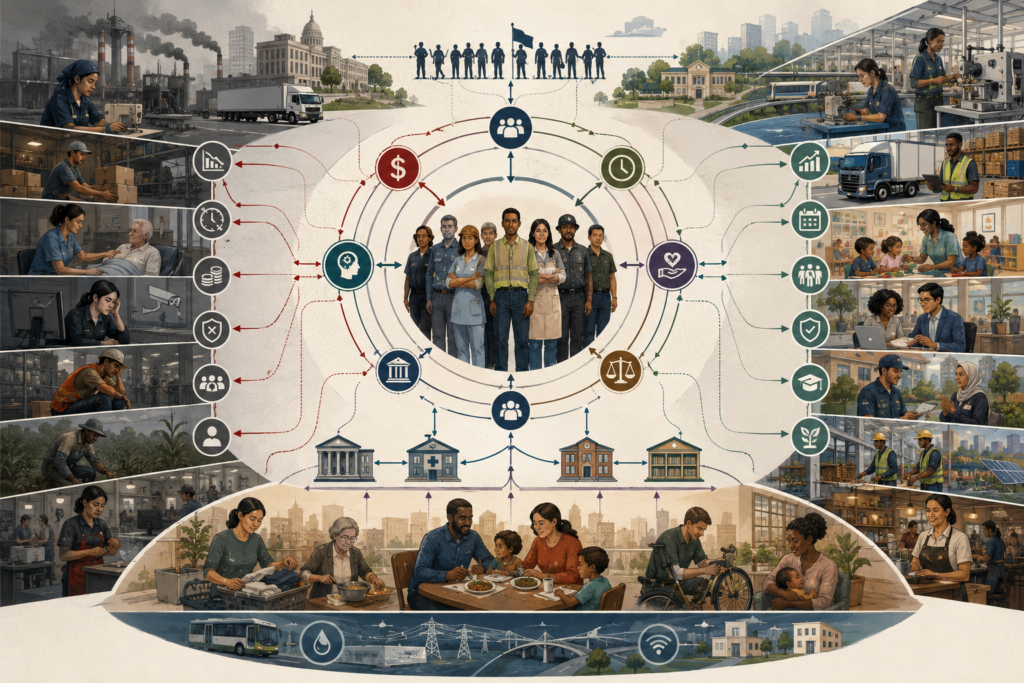
Editorial systems illustration showing workers across sectors connected to wages, productivity, care work, bargaining power, institutions, household stability, public services, technology, and sustainable labor organization.

Labor, Wages, Productivity, and the Social Organization of Work

Labor, wages, productivity, and the social organization of work are central to economic analysis because production is carried by human effort organized under institutions that shape distribution, time, security, bargaining power, and social order. This article examines labor not merely as a technical input, but as a socially embedded relation through which households survive, firms coordinate, states stabilize, and societies reproduce themselves across time. It explores how wages function as both income and institution, how productivity gains are created and contested, how care work and reproductive labor remain structurally undervalued, and how work time, legal protections, and technological change shape the quality of employment. It also shows why sustainable systems require labor arrangements that support dignity, household stability, social reproduction, and long-run resilience rather than narrow output growth alone.
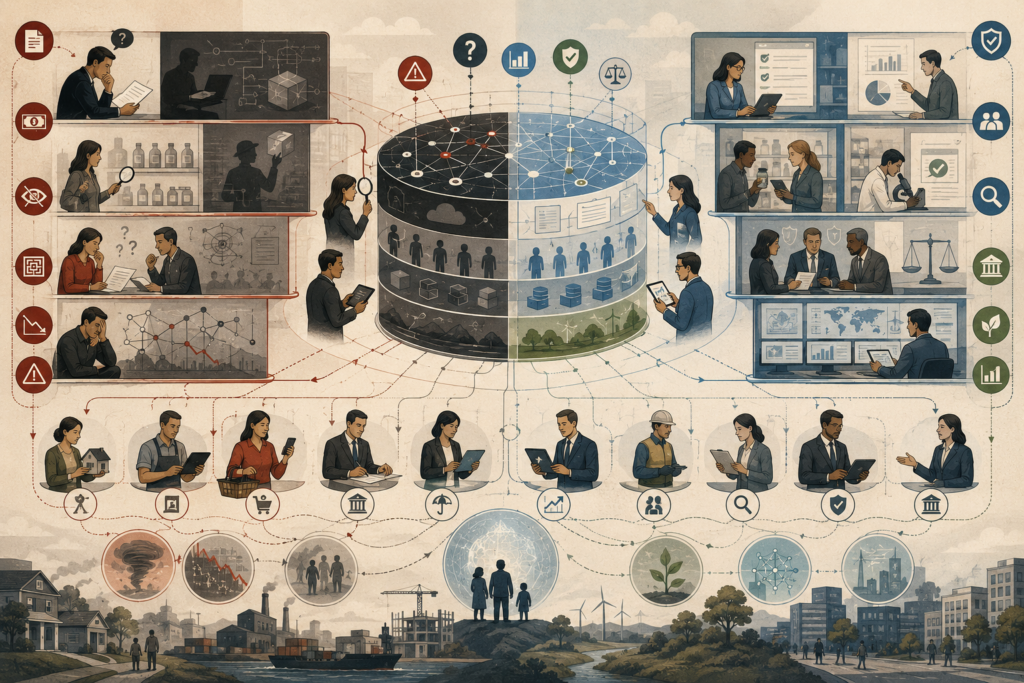

Editorial systems illustration showing imperfect markets shaped by hidden risk, unequal information, complex contracts, consumer uncertainty, financial opacity, disclosure, audits, certification, regulation, and institutional trust.

Information, Uncertainty, and Imperfect Markets

Information, uncertainty, and imperfect markets examine how real exchange operates when knowledge is incomplete, uneven, costly, hidden, or strategically manipulated. This article moves beyond the ideal of perfect information to explain how asymmetric information, adverse selection, moral hazard, signaling, screening, disclosure, consumer opacity, and deep uncertainty shape market outcomes. It shows why prices can coordinate knowledge while still failing to reveal hidden quality, systemic risk, ecological harm, or long-term fragility. From credit and insurance to financial markets, health plans, sustainability claims, and climate risk, imperfect information affects trust, bargaining power, regulation, and resilience. By connecting information economics with Python, R, Stata, SQL, and Julia workflows, the article frames market coordination as an institutional problem of credibility, intelligibility, prudence, and accountable knowledge.

Editorial systems illustration showing people making economic decisions under cognitive limits, uncertainty, time pressure, and institutional design, contrasting confusing choice environments with clearer, supportive decision systems.

Behavioral Economics and Bounded Rationality

Behavioral economics and bounded rationality are central to economic analysis because they show how decision-making actually occurs under real conditions of uncertainty, time pressure, limited attention, social influence, and institutional complexity. Rather than assuming frictionless optimization, this article examines how human beings use heuristics, respond to framing, struggle with present bias, interpret risk through psychologically meaningful filters, and act within environments that shape what choices are cognitively possible. It also explores how behavioral insights matter for households, firms, policy design, collective goods, and sustainable systems, where long-term welfare often depends on institutions that are better aligned with actual human judgment rather than idealized rationality alone.

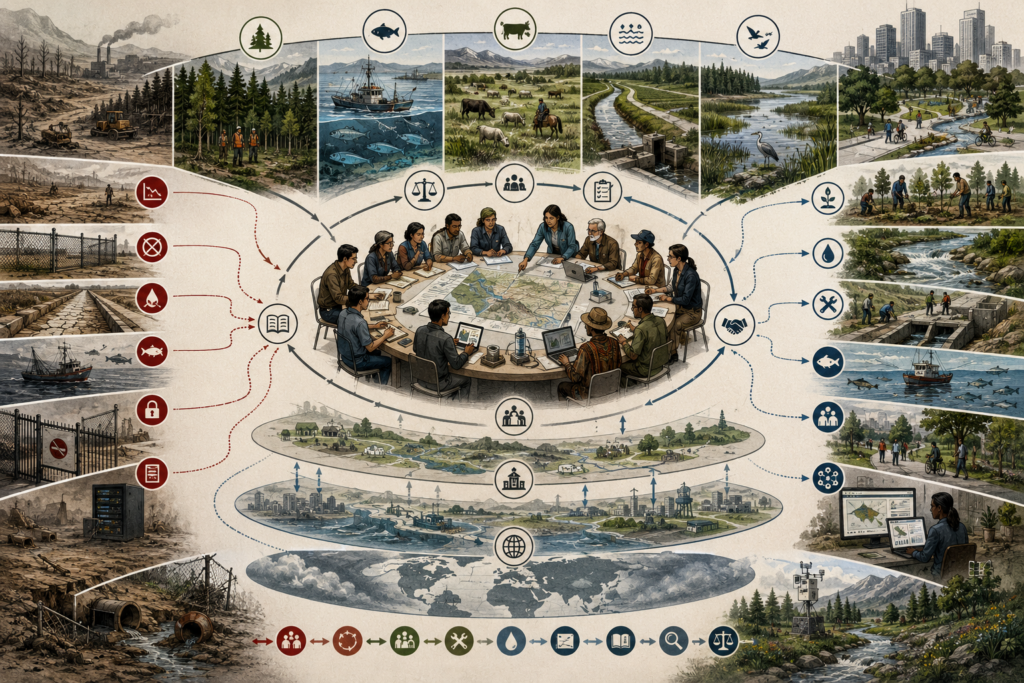
Editorial systems illustration showing commons governance across forests, fisheries, grazing land, irrigation, wetlands, urban public space, open knowledge, monitoring, and institutional stewardship, with contrasts between degradation and regenerative management.

Commons, Shared Resources, and Institutional Governance

Commons, shared resources, and institutional governance examine how societies sustain resources that many actors depend upon but no single actor can safely manage alone. This article moves beyond the simplistic “tragedy of the commons” narrative to explain commons as governed arrangements shaped by rules, boundaries, monitoring, sanctions, maintenance, local knowledge, legitimacy, and institutional design. It explores fisheries, forests, groundwater, watersheds, public spaces, knowledge systems, digital infrastructures, and atmospheric sinks as shared systems vulnerable to overuse, enclosure, undermaintenance, exclusion, and institutional breakdown. Sustainable systems depend not only on production and exchange, but on the durable governance of shared foundations.

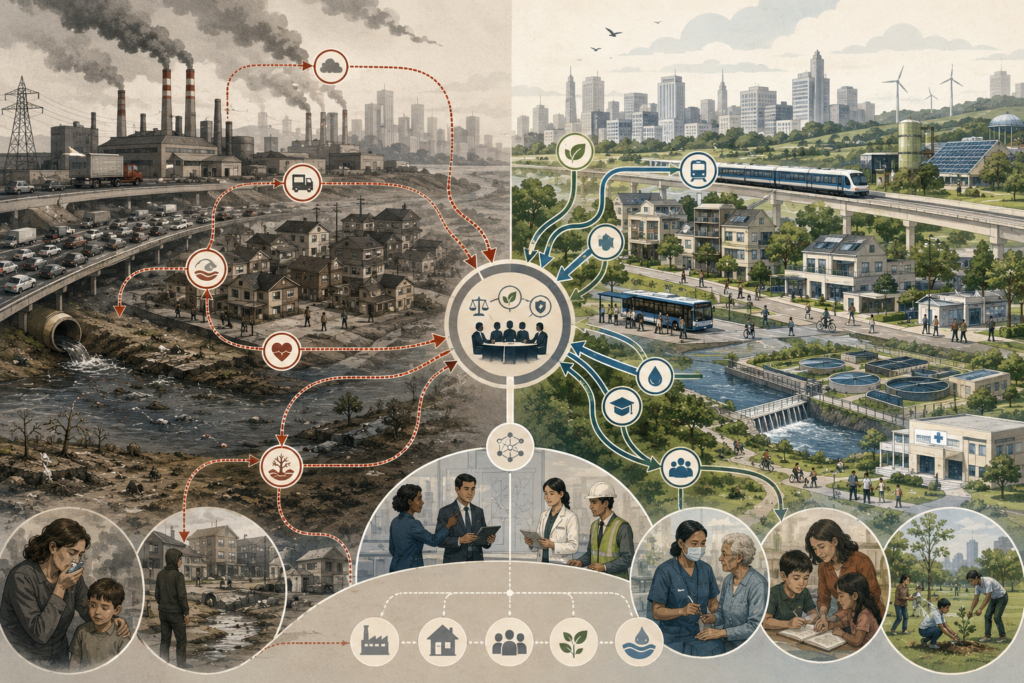
Editorial systems illustration contrasting pollution, traffic, health burdens, and ecological damage with public transit, clean water, public health, education, green infrastructure, and collective governance.

Externalities, Public Goods, and Collective Provision

Externalities, public goods, and collective provision are central to economic analysis because they reveal where private coordination diverges from collective welfare. Externalities arise when costs or benefits spill beyond the transaction itself. Public goods involve benefits that are difficult to confine to paying users and are therefore often underprovided by markets alone. Collective provision names the institutional arrangements through which societies finance, govern, and sustain shared goods such as infrastructure, public health, research, ecological protection, and risk management. This article examines how spillover harms, shared benefits, burden sharing, and long-term governance shape the wider organization of economic life within sustainable systems.

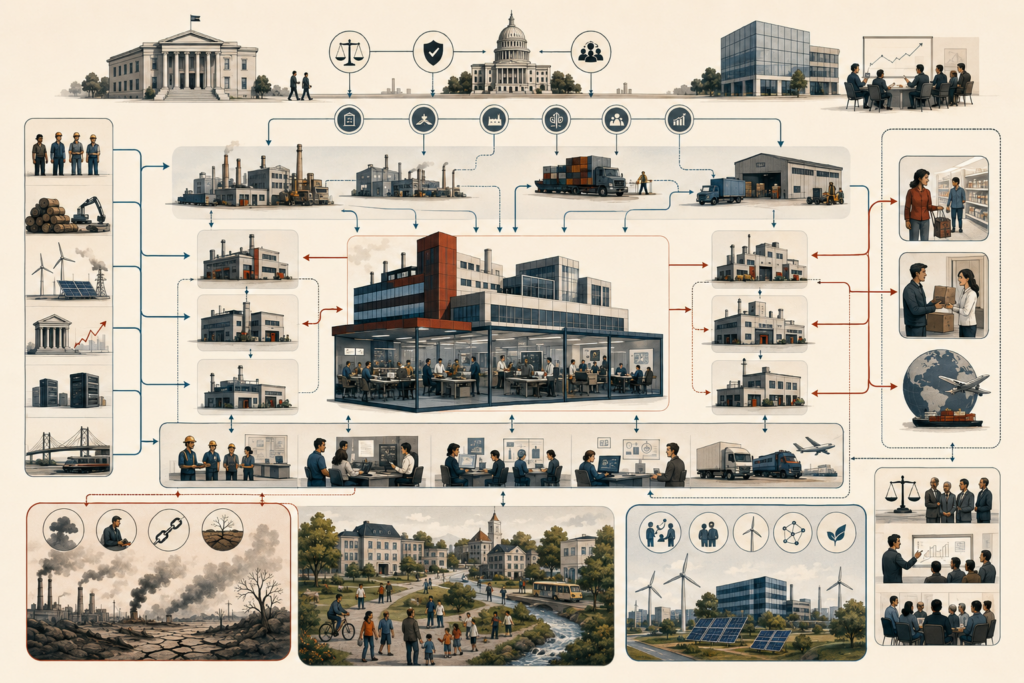
Editorial systems illustration showing firms, suppliers, workers, households, logistics, regulation, market concentration, externalities, and sustainable production within a layered economic network.

Firms, Costs, Competition, and Market Structure

Firms, costs, competition, and market structure are central to economic analysis because they reveal how production is organized, how prices are formed, how power is distributed, and how sectors evolve across time. Firms are not merely technical units of production, but strategic institutions embedded in labor systems, supply chains, financial structures, public rules, and industrial environments. This article examines how cost structures shape pricing, output, investment, and concentration; how competition varies across real markets; and how market structure conditions innovation, bargaining power, resilience, and public legitimacy. It also shows that firm-level efficiency is not always the same as system-level rationality, especially when costs are shifted onto workers, households, public systems, or ecosystems.

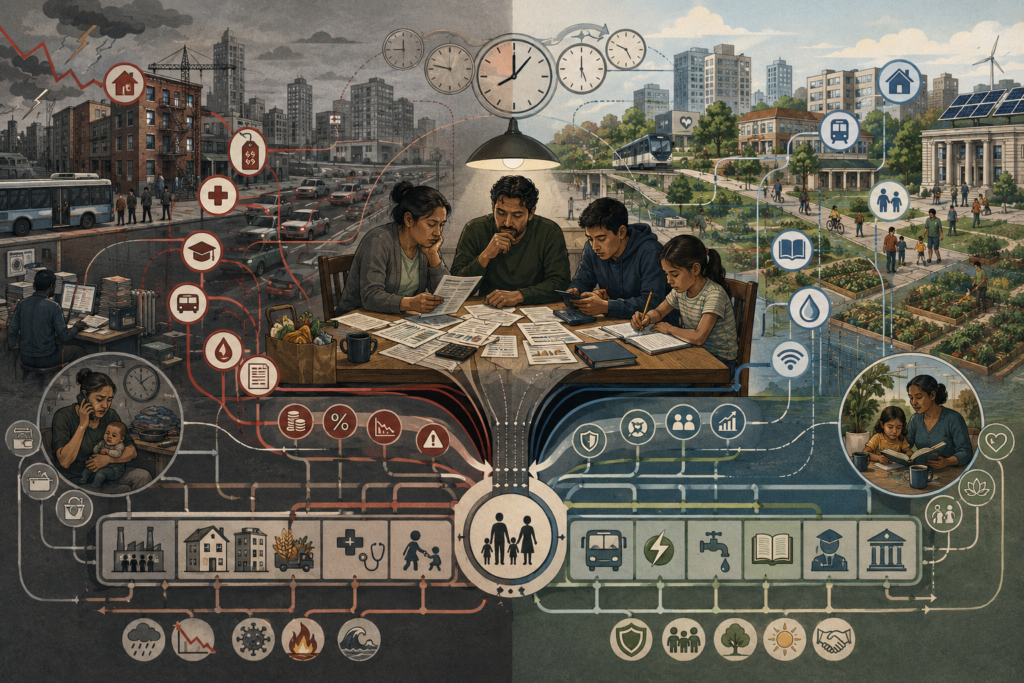
Editorial systems illustration showing a household managing bills, food costs, debt, time pressure, public goods, and everyday economic trade-offs, contrasted with conditions of fragility and more resilient household support systems.

Consumer Choice, Household Welfare, and Everyday Economic Life

Consumer choice is often presented as individual preference, but household welfare reveals a deeper systems problem: how everyday life is provisioned under conditions of income, prices, debt, care, time scarcity, public goods, and unequal access. This article examines how households allocate limited resources across rent, food, transport, utilities, health care, education, debt service, savings, and caregiving while navigating constraints shaped by wages, assets, public provision, infrastructure, and market power. It moves beyond narrow utility and budget-constraint models to explore essentials burdens, time poverty, household fragility, public goods, debt, effective access, and welfare measurement. By connecting consumer choice with Python, R, Stata, SQL, and Julia workflows, the article frames household welfare as a lived test of whether economic systems support dignity, resilience, and durable everyday life.

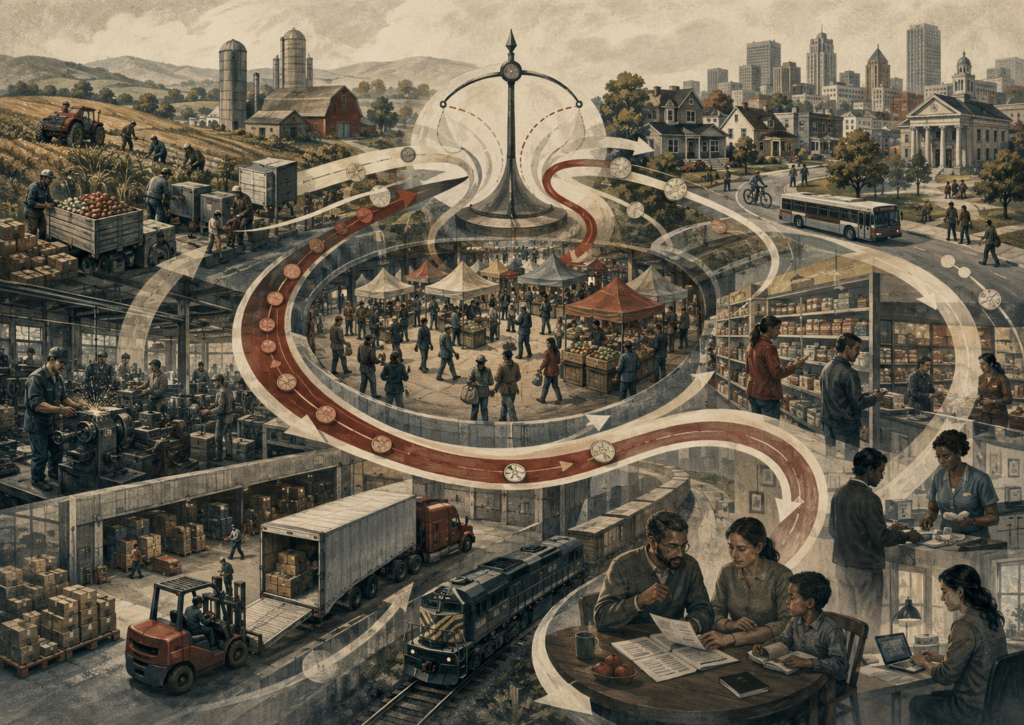
Editorial illustration of farms, factories, warehouses, markets, transport systems, stores, households, and public spaces connected by flowing pathways that symbolize supply, demand, prices, exchange, and economic coordination.

Supply, Demand, Prices, and Economic Coordination

Supply, demand, prices, and coordination explain how decentralized economies organize exchange under scarcity, interdependence, and incomplete information. This article examines supply as productive capacity shaped by labor, energy, finance, logistics, infrastructure, market structure, and ecological limits; demand as need filtered through income, credit, expectations, public provision, and purchasing power; and prices as signals that both communicate scarcity and ration access. It moves beyond textbook equilibrium to examine elasticity, supply shocks, demand shifts, market power, public goods, externalities, missing prices, and the difference between monetized demand and social need. By connecting supply-demand theory with Python, R, Stata, SQL, and Julia workflows, the article frames economic coordination as an institutional, distributional, and ecological problem—not merely the meeting of curves.

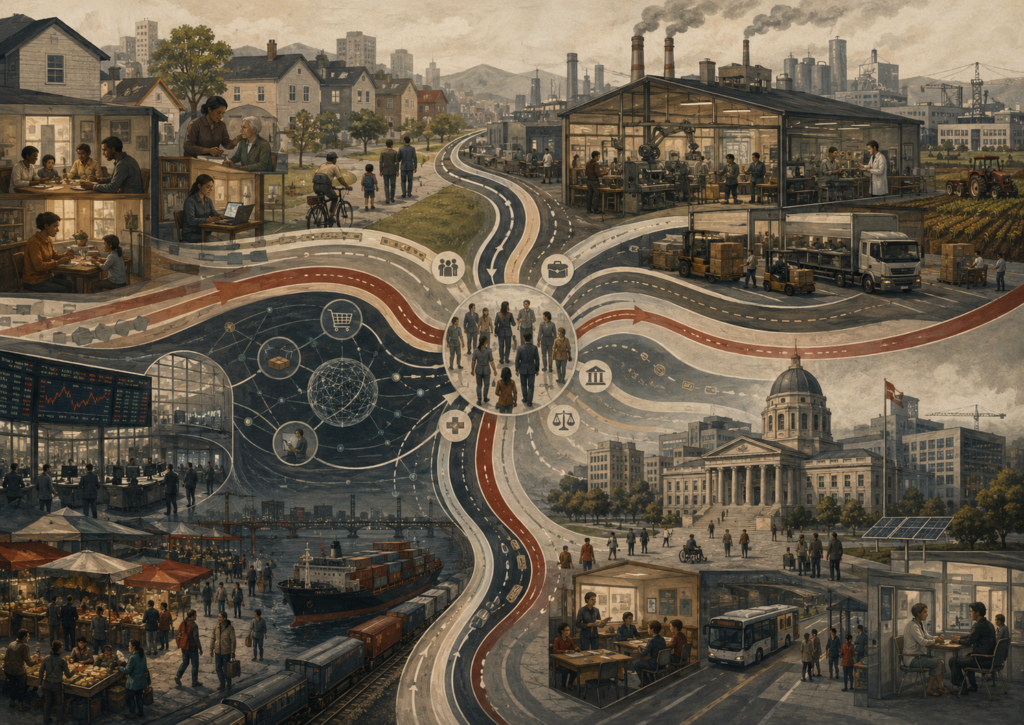
Editorial illustration of households, firms, markets, and public institutions connected by flowing pathways that represent labor, consumption, production, exchange, taxation, regulation, and public services.

Households, Firms, Markets, and States

Households, firms, markets, and states are the central institutional actors through which modern economies organize work, exchange, public authority, and social reproduction. This article explains how households sustain daily life through labor, consumption, care, saving, and borrowing; how firms organize production, employment, investment, and innovation; how markets coordinate exchange through prices, contracts, competition, and purchasing power; and how states provide legal order, public goods, redistribution, regulation, and macroeconomic stabilization. It emphasizes that these institutions are mutually dependent rather than separate spheres. Households absorb shocks, firms shape productive capacity, markets transmit signals and exclusions, and states distribute risk through public policy. By connecting institutional economics with Python, R, Stata, SQL, and Julia workflows, the article frames economic systems as living structures of dependency, power, resilience, and public purpose.

Scroll to Top