Economic Systems

Economic systems describe the structures through which societies organize production, distribution, and exchange. These systems determine how resources are allocated, how markets operate, and how wealth and opportunity are distributed across populations.

Different economic models—including market economies, mixed economies, and welfare-state systems—reflect distinct institutional arrangements and policy priorities. Economic performance is shaped not only by market dynamics but also by regulatory frameworks, social institutions, and public investment strategies.

In the context of sustainable development, economic systems must be evaluated not only by aggregate growth but also by resilience, equity, and long-term ecological stability. Scholars increasingly examine how economic institutions can support inclusive prosperity while respecting environmental constraints and planetary boundaries.

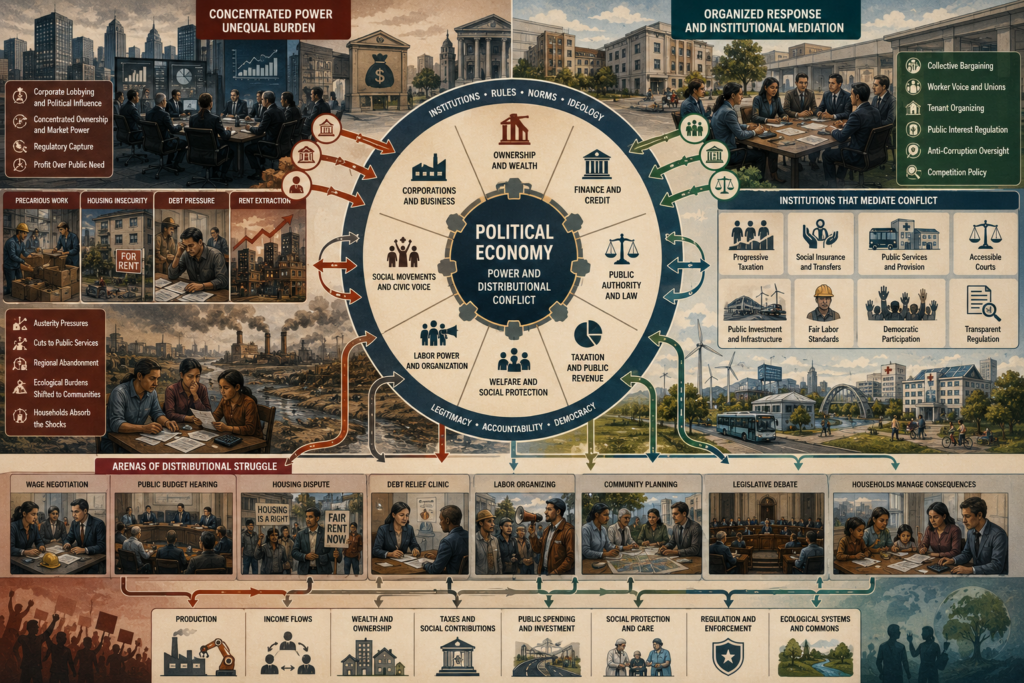
Editorial systems illustration showing political economy, ownership, labor power, finance, taxation, welfare, bargaining, housing insecurity, debt pressure, concentrated power, and institutions that mediate distributional conflict.

Political Economy, Power, and Distributional Conflict

Political economy, power, and distributional conflict are central to economic analysis because economies do not allocate resources, risks, and rewards through neutral mechanisms alone. This article examines political economy as the study of how institutions, law, social conflict, and public authority shape production and distribution; power as the capacity of firms, classes, states, and organized groups to influence rules and outcomes; and distributional conflict as the ongoing struggle over wages, profits, rents, taxation, welfare, debt, and social protection. It explores capital-labor conflict, fiscal order, inflation, property, welfare states, industrial strategy, globalization, ideology, and crisis as sites where competing interests are institutionalized and contested. Within sustainable systems, the deeper issue is whether institutions can mediate conflict in ways that preserve legitimacy, resilience, and shared security or whether concentrated power steadily captures the terms of economic order.
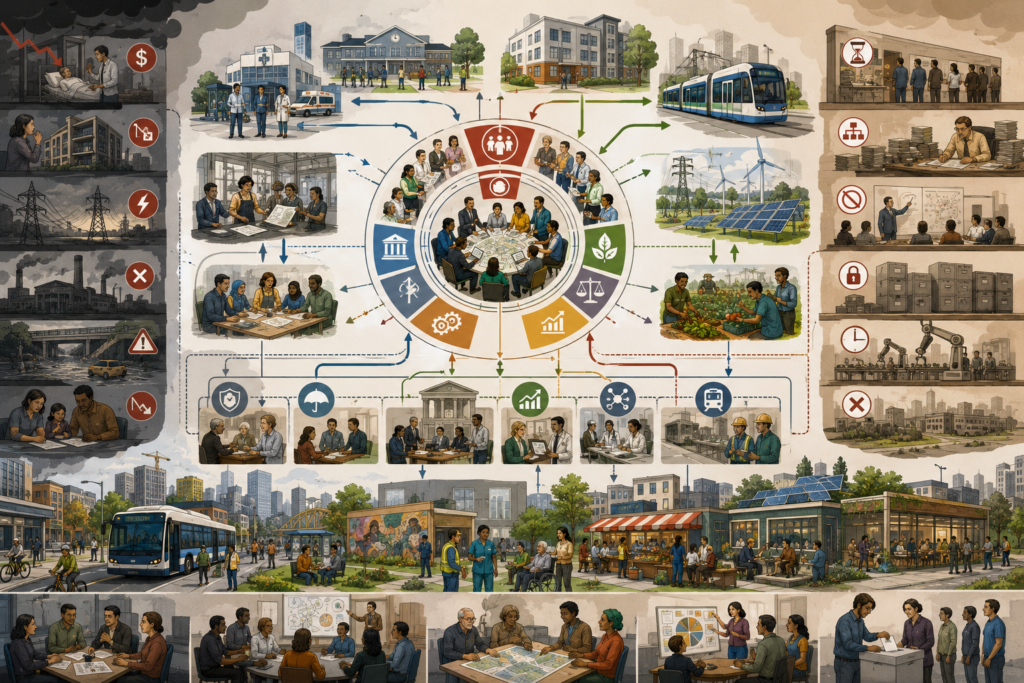
Editorial systems illustration showing socialism, planning, and the mixed economy through public services, markets, social rights, infrastructure, utilities, cooperatives, regulation, democratic planning, and collective provision.

Socialism, Planning, and the Mixed Economy

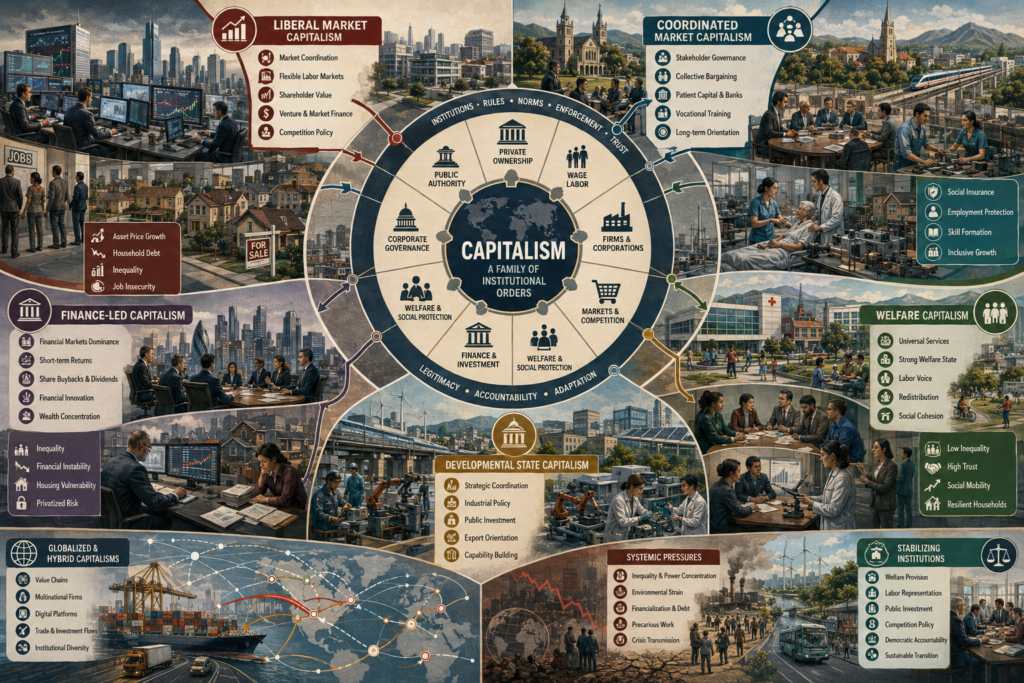
Capitalism and its varieties are central to political economy because private ownership, wage labor, market exchange, and capital accumulation are organized differently across societies. This article examines capitalism not as a single universal model, but as a family of institutional orders shaped by different combinations of labor regimes, financial systems, welfare institutions, corporate governance, industrial policy, and state capacity. It explores liberal market economies, coordinated market economies, developmental and state-led capitalisms, finance-led regimes, and welfare capitalism, while showing how each distributes risk, organizes innovation, and structures power in distinct ways. Within sustainable systems, the deeper question is whether a given capitalist order can sustain prosperity, legitimacy, social membership, and resilience over time, or whether its internal dynamics generate widening insecurity, inequality, and instability.

Editorial systems illustration showing capitalism as a family of institutional orders, including liberal market capitalism, coordinated market capitalism, finance-led capitalism, developmental state capitalism, welfare capitalism, and globalized hybrid systems.

Capitalism and Its Varieties

Capitalism and its varieties are central to political economy because private ownership, wage labor, market exchange, and capital accumulation are organized differently across societies. This article examines capitalism not as a single universal model, but as a family of institutional orders shaped by different combinations of labor regimes, financial systems, welfare institutions, corporate governance, industrial policy, and state capacity. It explores liberal market economies, coordinated market economies, developmental and state-led capitalisms, finance-led regimes, and welfare capitalism, while showing how each distributes risk, organizes innovation, and structures power in distinct ways. Within sustainable systems, the deeper question is whether a given capitalist order can sustain prosperity, legitimacy, social membership, and resilience over time, or whether its internal dynamics generate widening insecurity, inequality, and instability.

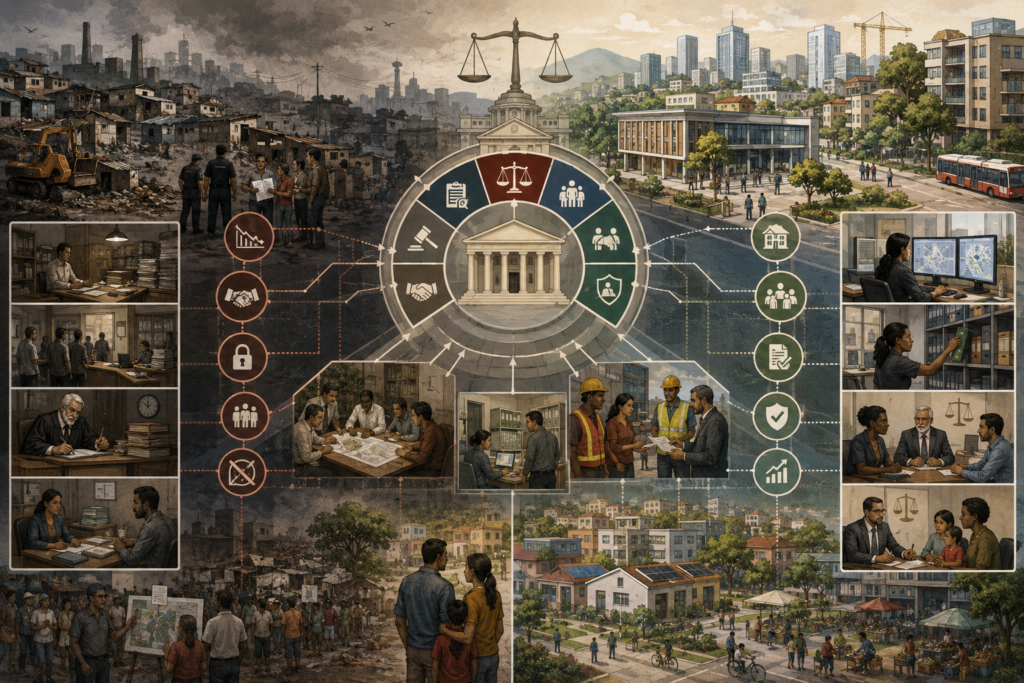
Editorial systems illustration showing institutions, property rights, courts, registries, housing, contracts, labor rights, administrative capacity, unequal enforcement, access to justice, and inclusive economic order.

Institutions, Property Rights, and Economic Order

Institutions, property rights, and economic order are central to political economy because economies do not function through prices alone. This article examines institutions as the formal and informal rules that structure behavior across markets, states, firms, and households; property rights as socially recognized claims over land, housing, capital, intellectual assets, and other resources; and economic order as the wider pattern through which authority, ownership, exchange, and distribution are organized. It explores how contract enforcement, administrative capacity, land and housing regimes, corporate governance, labor protections, and access to justice shape both investment and inequality. Within sustainable systems, the deeper issue is whether institutions create durable, credible, and inclusive forms of order or whether formal rules coexist with unequal enforcement, concentrated power, and persistent fragility.

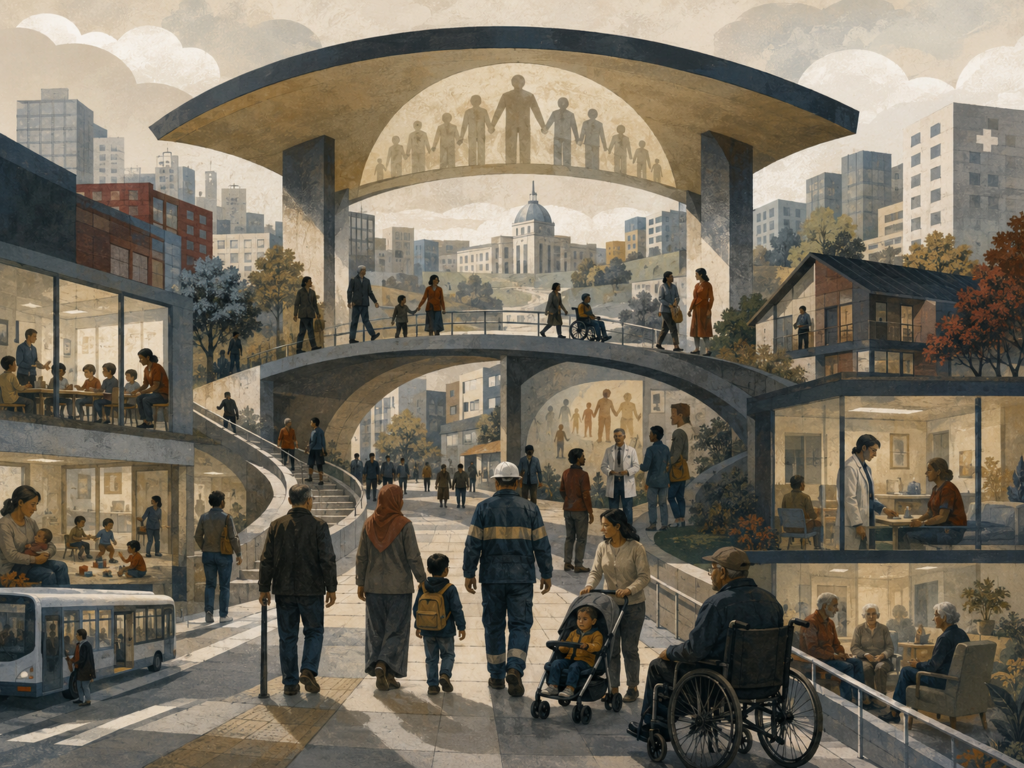
Editorial illustration of a civic welfare system with public institutions, schools, healthcare spaces, housing, transit, childcare, eldercare, accessible pathways, and people of different ages connected under a protective architectural canopy

The Welfare State and Social Protection

The welfare state and social protection are central to political economy because modern societies do not leave livelihoods, health, old age, disability, unemployment, care, and family survival entirely to market income or private charity. This article examines the welfare state as the institutional settlement through which public authority organizes income security, healthcare, pensions, labor-market protection, family support, and social provision, and social protection as the practical system through which societies reduce vulnerability across the life course. It explores social insurance, assistance, universal provision, unemployment protection, family policy, care systems, redistribution, fiscal capacity, and the broader question of how public institutions transform economic capacity into durable security.

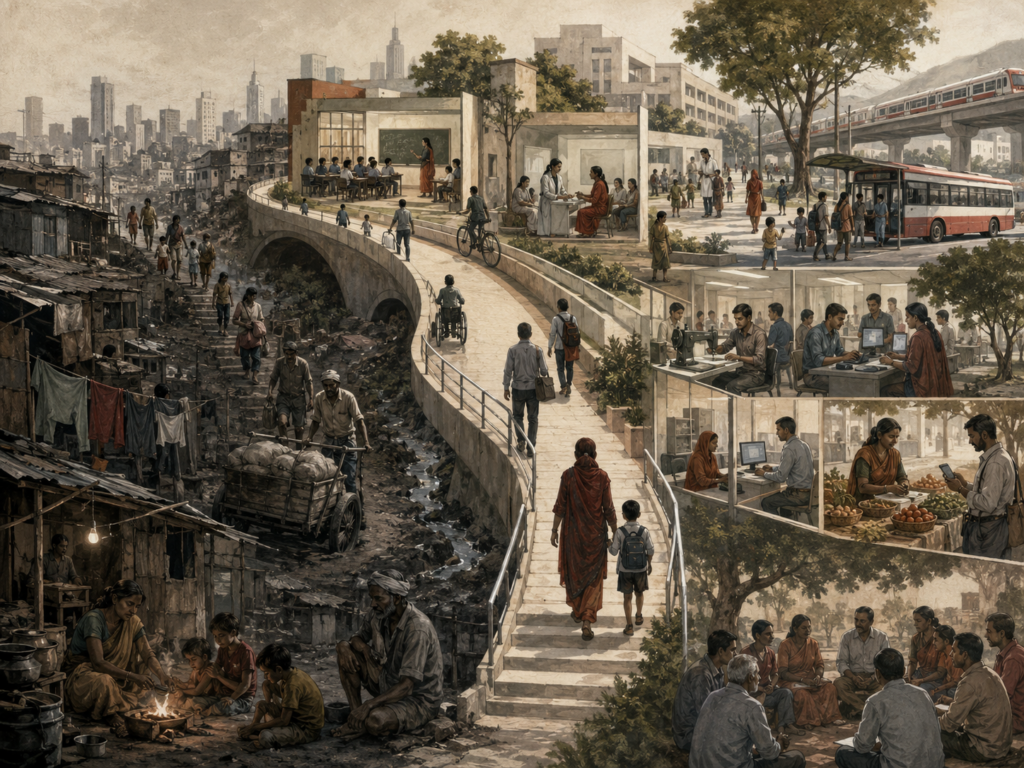
Editorial illustration of poverty and economic inclusion showing precarious housing, families, workers, schools, clinics, transit, training centers, small businesses, and public pathways connecting exclusion to opportunity.

Poverty, Capability, and Economic Inclusion

Poverty, capability, and economic inclusion belong together because deprivation is never only a matter of low income. This article examines poverty as a condition shaped by insecurity, weak access to housing, healthcare, education, transport, finance, and public services; capability as the real freedom people have to convert resources into health, mobility, learning, dignity, and participation; and economic inclusion as the degree to which modern institutions allow people to take part in work, infrastructure, services, and opportunity on stable and meaningful terms. It explores multidimensional deprivation, precarious labor, care burdens, territorial exclusion, digital access, and the role of public systems in widening or narrowing life chances. Within sustainable systems, the deeper issue is whether an economy expands the practical foundations of agency and belonging or leaves large populations navigating ordinary life under chronic constraint.

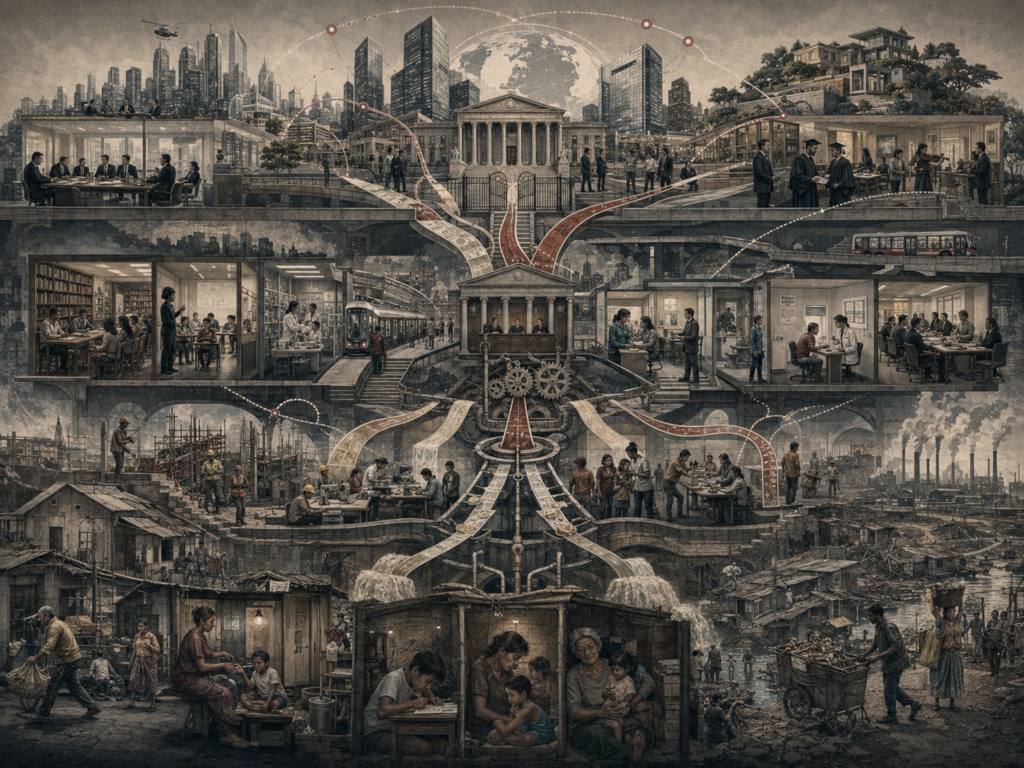
Editorial illustration of a stratified society with wealthy districts, public institutions, schools, clinics, workplaces, transit systems, precarious neighborhoods, and families connected by symbolic flows of redistribution and mobility.

Inequality, Redistribution, and Social Mobility

Inequality, redistribution, and social mobility are central to economic analysis because they show how societies distribute not only income and wealth, but also risk, security, and future possibility. This article examines inequality as a structured pattern of differences in income, assets, housing, health, education, and access to opportunity; redistribution as the institutional reshaping of market outcomes through taxation, transfers, public services, and social insurance; and social mobility as the degree to which individuals and families can move across positions over time. It explores how labor markets, inheritance, place, schooling, healthcare, and public policy shape the reproduction or interruption of advantage across generations. Within sustainable systems, the deeper issue is whether an economy creates broad-based conditions for security, participation, and advancement or allows market inequality to harden into durable civic hierarchy.

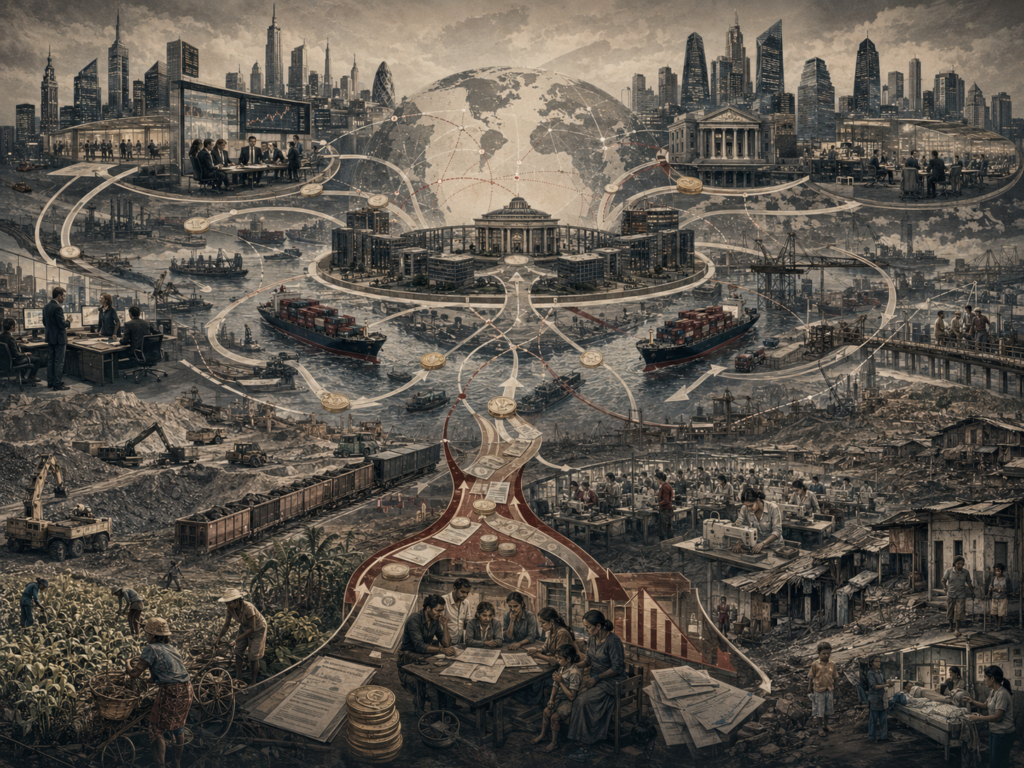
Editorial illustration of global financial centers, banks, trade routes, ports, debt documents, mines, farms, factories, and vulnerable communities connected by flows of loans, capital, repayment, commodities, and policy influence.

Debt, Dependency, and Global Financial Order

Debt, dependency, and global financial order are central to economic analysis because development is shaped not only by production and trade, but by the monetary and financial terms on which societies secure time, imports, and investment. This article examines debt as both a financial instrument and a political relationship, showing how external borrowing can support infrastructure, industrialization, and public capacity in one phase while later narrowing sovereignty through debt service, currency mismatch, refinancing risk, and external discipline. It explores dependency as a structural condition produced through foreign-currency borrowing, narrow export bases, imported technology, and externally constrained policy space, and explains how the wider global financial order distributes borrowing power unevenly through reserve-currency hierarchy, sovereign-bond markets, multilateral institutions, legal regimes, and creditor influence.

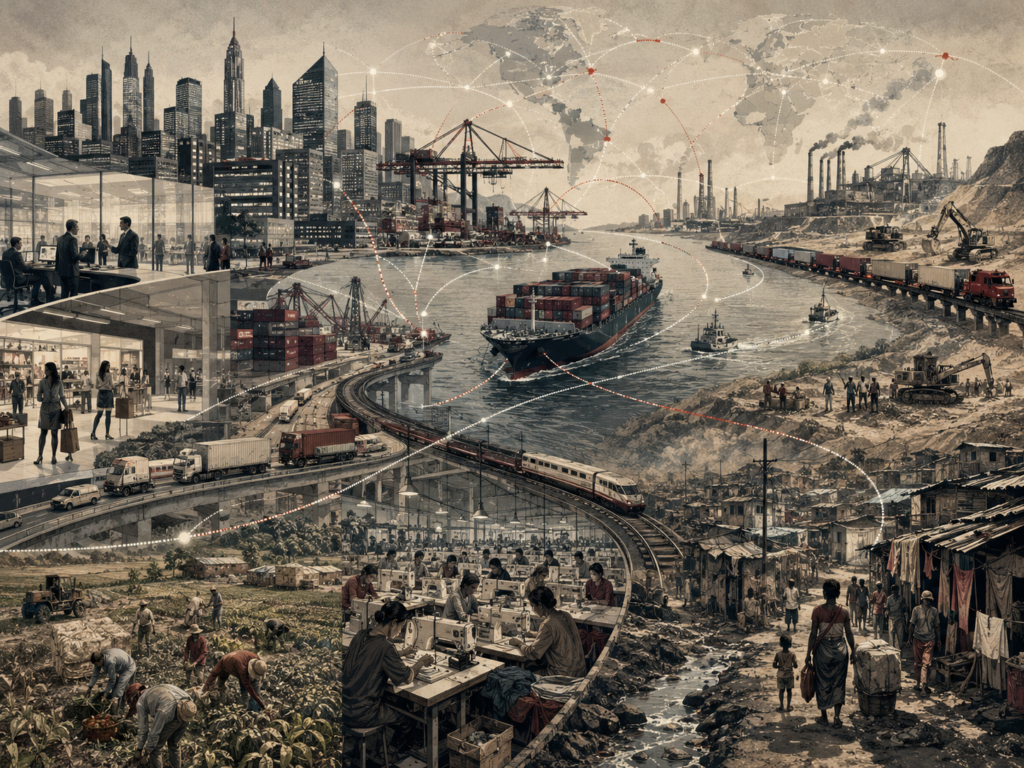
Editorial illustration of global trade networks linking ports, ships, factories, farms, mines, financial districts, garment workers, freight systems, and informal settlements, showing globalization and uneven development.

Trade, Globalization, and Uneven Development

Trade, globalization, and uneven development are central to economic analysis because cross-border integration does not produce equal outcomes across countries, regions, sectors, or social groups. This article examines how trade links economies through goods, finance, technology, logistics, and institutional rules while distributing value, risk, and power unevenly across the world system. It explores the limits of comparative advantage as a developmental doctrine, the hierarchy of global value chains, the fragility of commodity dependence, the regional and labor-market disruptions of globalization, and the role of finance, currency power, and geopolitical fragmentation in shaping who can benefit from openness and who remains vulnerable within it. It also argues that the real question is not whether economies are open, but what position they occupy within global structures of production and control.

Scroll to Top