
Last Updated May 9, 2026
Macroeconomic stability concerns the conditions under which an economy can sustain employment, production, income, prices, investment, financial circulation, household security, and public capacity without repeatedly being thrown into inflationary disorder, debt deflation, prolonged stagnation, or systemic crisis. It is therefore not merely a matter of keeping one target variable, such as inflation, within a preferred range. It is a question of whether the wider economic order can reproduce itself across time without recurrent breakdowns that erode household security, weaken public institutions, destroy productive capacity, and undermine confidence in the future.
Business cycles are one of the clearest signs that modern economies do not move forward in a smooth line. Output rises and falls. Investment surges and retrenches. Credit expands and contracts. Employment strengthens and weakens. Expectations turn optimistic, then fearful. Prices may remain stable in one period and accelerate in another. These oscillations are not accidental surface noise. They reflect the deeper structure of capitalist and mixed economies, in which decentralized decisions about spending, production, leverage, inventories, labor, and policy interact under uncertainty and often reinforce one another cumulatively.
Crisis emerges when cyclical disturbance intensifies into breakdown. A recession may reduce output and employment temporarily. A crisis does more: it damages the mechanisms through which the economy ordinarily coordinates itself. Credit channels freeze, layoffs become generalized, public revenues weaken, private balance sheets deteriorate, investment collapses, and uncertainty becomes self-reinforcing. In such moments, macroeconomic stability is revealed not as a technical backdrop, but as a central public good on which social order, democratic legitimacy, household security, and long-horizon development depend.
Main Library
Publications
Article Map
Economic Systems
Related Topic
Sustainable Development
Related Topic
Institutions & Governance
Related Topic
Risk & Resilience
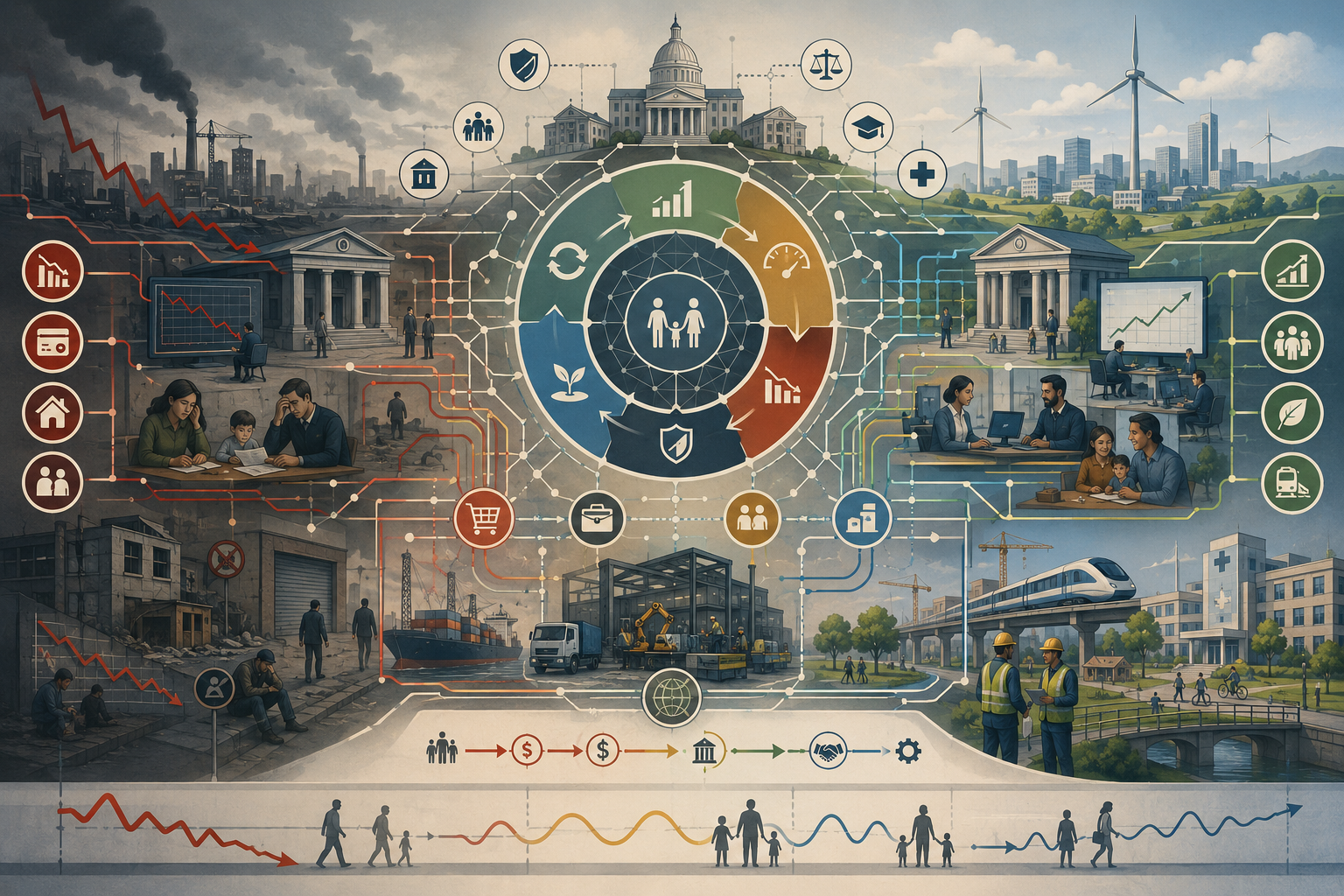
Within a sustainable systems framework, macroeconomic stability must be understood more broadly than short-run growth management alone. The deeper question is whether an economy can maintain employment, investment, household security, public capacity, ecological adaptation, and financial resilience across shocks and structural change. A society may achieve temporary expansion while quietly accumulating debt fragility, ecological exposure, infrastructure decay, household precarity, or institutional distrust that later turns cyclical stress into systemic crisis. The serious study of macroeconomic stability therefore connects business cycles to institutions, distribution, finance, public policy, and the long-horizon resilience of the wider social system.
Why This Topic Matters
Macroeconomic stability, business cycles, and crisis matter because societies do not experience “the economy” as an abstract model. They experience it through jobs gained or lost, prices rising or stabilizing, firms expanding or closing, public services strengthening or deteriorating, and households feeling either secure or exposed. When macroeconomic stability weakens, insecurity spreads far beyond financial markets or national statistics. It reaches housing, health, education, local government, family planning, political trust, and long-term confidence in institutions.
This matters analytically because the macroeconomy is not just the sum of individual transactions. Interdependence changes everything. One person’s spending is another person’s income. One firm’s layoffs reduce demand for another firm. One bank’s retrenchment affects credit for many borrowers. Government austerity in a downturn can weaken private income further. The macroeconomic problem is therefore systemic from the start: what appears prudent from one balance sheet may become destructive when generalized.
These issues also matter politically. Repeated instability can erode trust in institutions, increase inequality, strengthen reaction against democratic governance, and make long-horizon public projects harder to sustain. Stability is therefore not merely a preference for calm. It is one of the conditions under which a society can deliberate, invest, adapt, and reproduce itself without being continually thrown back into emergency management.
For this reason, the study of cycles and crisis belongs at the center of political economy. It reveals whether an economy has the institutional capacity to absorb shocks, sustain demand, manage finance, and protect households when coordination weakens. It also reveals that macroeconomic order has a moral dimension. Deep instability is never only a statistical event. It changes whose lives are interrupted, whose assets are preserved, whose debts become unbearable, and whose future is deferred. The question of stability is therefore inseparable from the question of how a society distributes insecurity.
Macroeconomic instability also has memory. A severe downturn can mark workers, firms, public budgets, local communities, and entire generations long after the official recession has ended. Skills decay, businesses close, public services are cut, families postpone formation or education, and political anger deepens. Stability is therefore not simply about avoiding one quarter of negative growth. It is about preserving the social and institutional continuity that allows a society to plan beyond crisis.
What Macroeconomic Stability Means
Macroeconomic stability does not mean the absence of all fluctuation. No complex economy can eliminate every shock, adjustment, or seasonal movement. Rather, stability refers to an order in which fluctuations do not regularly become severe disruptions of employment, income, credit, pricing, and public capacity. A stable macroeconomic system can absorb shocks without spiraling into cumulative inflation, financial panic, debt deflation, or prolonged mass unemployment.
This broader meaning matters because stability is often reduced too narrowly to low inflation alone. Price stability is important, but it is not sufficient. An economy can exhibit moderate inflation while maintaining strong employment and productive investment, or it can exhibit low inflation alongside deep stagnation, weak wages, household insecurity, and underused capacity. A serious conception of stability must therefore include employment, output, public finance, financial resilience, and social security as well as prices.
Macroeconomic stability is also temporal. It concerns whether an economy can maintain viable conditions across time rather than merely perform well in a single quarter or year. A boom built on excessive leverage, speculative asset prices, or unstable household debt may look healthy in the short run while quietly undermining longer-run stability. For that reason, the key question is not simply whether the economy is growing now. It is whether the pattern of growth, finance, distribution, and policy is durable enough to survive reversal without imposing intolerable social cost.
Stability therefore has qualitative as well as quantitative dimensions. It includes whether employment is secure rather than precarious, whether investment is productive rather than speculative, whether public institutions retain room to act, and whether households can withstand ordinary shocks without turning personal strain into macroeconomic contraction.
Stability also includes institutional credibility. Households and firms must believe that public authorities can respond to crisis, that payments will clear, that banking systems will remain functional, and that public services will not collapse under stress. The macroeconomy is therefore stabilized not only by variables, but by trust in the institutions that govern those variables.
Why Business Cycles Occur
Business cycles occur because capitalist and mixed economies are decentralized, forward-looking, and financially structured systems in which decisions are made under uncertainty. Firms invest based on expected future demand, not certain future demand. Households spend based on income, wealth, expectations, and credit access that can change suddenly. Banks and financial markets expand and contract the availability of leverage. Governments and central banks alter fiscal and monetary conditions in response to changing circumstances. These decisions interact and can reinforce one another in both upward and downward directions.
This matters because cycles are not explained adequately by a single cause. Some arise from shifts in investment expectations, some from financial instability, some from commodity or energy shocks, some from inventory adjustment, some from policy error, and some from external disruptions such as war, pandemic, or geopolitical fracture. Yet the common pattern is that decentralized adjustment under uncertainty creates feedback loops. Expansion encourages more expansion; contraction encourages more contraction.
Cycles are therefore better understood as emergent properties of the system rather than as isolated mistakes. The important task is not to imagine a frictionless economy without cycles, but to understand which institutional structures amplify or dampen cyclical dynamics. A research-grade treatment must therefore ask why optimism becomes overextension, why ordinary slowdown becomes recession, and why some economies recover quickly while others remain trapped in stagnation long after the initial shock has passed.
Cycles also occur because capitalist economies are governed by time expectations rather than present conditions alone. Investment, employment, borrowing, and pricing are all shaped by anticipations of what the future will be. When those anticipations converge in one direction, the system can move far from any stable path before corrective information is accepted or acted upon.
The cycle is therefore not only mechanical. It is interpretive. Households, firms, banks, investors, and governments continually read signals about the future and adjust behavior accordingly. When interpretation becomes synchronized, macroeconomic movement can accelerate sharply. Confidence can become a productive force in expansion and a destructive force in contraction.
Aggregate Demand, Output, and Employment
Aggregate demand refers to the total demand for goods and services in the economy at a given level of prices and output. It includes household consumption, business investment, government spending, and net external demand. When aggregate demand weakens sharply, firms often respond by reducing production, delaying investment, and cutting employment. The fall in income then feeds back into weaker demand, deepening the downturn.
This matters because output is not determined solely by productive capacity. An economy may be fully capable of producing more goods and services than it actually does. If demand is insufficient, labor and capital remain underused. Idle workers, empty factories, and undermaintained infrastructure are not evidence of low potential alone; they are often evidence of macroeconomic coordination failure.
Employment is especially important here. Workers are not simply one more market-clearing variable. Loss of employment weakens household income, damages future skill formation, worsens health and security, and reduces social trust. Persistent unemployment therefore signals not only inefficiency, but a failure to use available human capability in ways that support collective welfare.
The macroeconomic challenge is therefore not merely to increase production abstractly, but to sustain sufficient demand so that productive capacity, labor time, and public resources are not left unused by avoidable coordination failure. Aggregate demand also matters because its composition is not neutral. Demand led by rising wages, stable public services, and productive investment creates different macroeconomic foundations from demand led by speculative borrowing or asset-price appreciation. The pattern of demand shapes the quality as well as the level of macroeconomic order.
This is one reason a sustainable macroeconomic framework must ask not only how much demand exists, but what kind of demand is sustaining the economy. A demand structure rooted in household debt, speculative construction, asset inflation, and fragile consumption can expand output for a time while preparing future instability. A demand structure rooted in wages, public investment, care, maintenance, and productive capacity can support a more durable macroeconomic order.
Investment, Expectations, and Cyclical Amplification
Investment is one of the most volatile components of aggregate demand because it depends heavily on expectations about the future. Firms invest when they anticipate sales, profitability, and financing conditions supportive of expansion. When confidence weakens, investment can fall quickly, even before current demand collapses fully. This makes investment a major channel of cyclical amplification.
This matters because investment decisions are made under uncertainty, not certainty. Businesses cannot know the future with precision, and this creates room for optimism, hesitation, imitation, and sudden reversal. During expansions, rising sales and favorable financing conditions may validate further investment. During downturns, falling sales and weaker confidence may lead firms to postpone or cancel projects, worsening the decline in income and employment.
Expectations are therefore not mere background psychology. They are structurally important to macroeconomic outcomes. Once enough actors become cautious at the same time, the future they fear can help bring itself into existence through reduced spending and hiring. This is one reason stabilization policy matters. Private expectations alone do not reliably converge on socially desirable outcomes. Public institutions often have to sustain demand, liquidity, and confidence when decentralized actors become collectively too defensive.
Investment is also path-shaping. A collapse in investment does not only reduce current demand; it weakens future capacity, productivity, maintenance, and adaptation. Downturns that destroy investment therefore carry a double cost: they reduce present output and damage future developmental possibility.
This is especially important for sustainable systems. Investment downturns often delay precisely the forms of spending that matter most for long-horizon resilience: infrastructure repair, energy transition, public health systems, climate adaptation, education, research, and maintenance. A cyclical slowdown can therefore become a structural setback if societies allow investment collapse to erode future capability.
Credit, Finance, and the Monetary Dimension of the Cycle
Business cycles are deeply financial. Credit expansion can support investment, consumption, housing, and asset-price appreciation during upswings. Credit contraction can intensify recession by reducing liquidity, tightening borrowing conditions, damaging collateral values, and weakening balance sheets. The cycle is therefore not only about real production and spending, but about monetary and financial structures that support or undermine them.
This matters because many modern booms are financed booms. Rising asset prices strengthen collateral, easier credit supports further borrowing, and borrowing supports further spending and asset inflation. Yet the apparent stability of expansion may depend on conditions that are fragile: low rates, refinancing capacity, rising prices, and continuing confidence. When these reverse, the cycle can turn sharply downward.
Credit also affects the distribution of cyclical pain. Actors with strong balance sheets may weather tightening conditions. Highly leveraged households, firms, or local governments may not. Macro instability is therefore transmitted not evenly, but through balance-sheet hierarchy. A serious account of business cycles must therefore integrate finance from the outset. Monetary systems do not simply lubricate the real economy. They can also amplify both expansion and collapse.
This monetary dimension also means that business cycles are not only movements in real output. They are also movements in the willingness and ability of the system to honor, extend, refinance, and circulate claims. When that capacity weakens, production and employment often follow.
Credit cycles also affect the politics of stabilization. A downturn driven by weak demand may require one policy mix; a downturn driven by balance-sheet repair, banking fragility, or collapsing collateral may require another. The more financial the cycle, the more stabilization must address solvency, liquidity, credit channels, and debt overhang as well as ordinary spending flows.
Inventories, Production Adjustment, and Firm Behavior
Firms make production decisions based not only on current sales, but on expected future sales and desired inventory levels. If firms find that inventories are accumulating unexpectedly, they may cut orders, reduce output, and delay hiring. If inventories fall too low relative to expected demand, they may ramp production up. These adjustments can appear minor individually, but they matter macroeconomically because they synchronize across sectors during turning points.
This matters because business cycles often involve production adjustments that are sharper than the original change in final demand. A modest slowdown in sales can produce a larger decline in orders if firms try to shrink inventories quickly. Conversely, a modest recovery in sales can produce a stronger rebound in production when firms rebuild depleted inventories.
Inventory dynamics show how the cycle is amplified through organizational response. The economy is not simply a smooth relation between consumption and output. It includes planning, forecasting, caution, and overreaction inside firms operating under uncertainty. These mechanisms also remind us that macroeconomics works through institutions and decisions. Warehouses, procurement systems, logistics chains, and managerial expectations are part of how cyclical movement becomes materially real.
In highly integrated supply systems, inventory behavior can become even more destabilizing. Lean production may look efficient in stable conditions while magnifying volatility when shocks occur, because the system has less slack to absorb interruption before output adjustment becomes abrupt.
Inventory cycles also reveal that efficiency and stability can conflict. A production system optimized for minimal inventories and just-in-time delivery may reduce carrying costs in normal times while weakening macroeconomic resilience under disruption. The quality of macroeconomic order therefore depends partly on how much slack, redundancy, and adaptive capacity firms and supply chains preserve.
Inflation, Unemployment, and Policy Tradeoffs
Macroeconomic governance is often described as a balancing act between inflation and unemployment. This framing captures something real, but it is incomplete. Inflation can emerge from excess demand, supply disruption, wage-price conflict, exchange-rate movements, energy shocks, profit-margin expansion, or financial speculation in key sectors. Unemployment can result from deficient demand, technological displacement, contractionary policy, debt crises, or structural change.
This matters because policy tradeoffs are rarely as simple as textbook diagrams suggest. A rise in prices caused by supply shocks may not be solved cleanly through demand suppression. A fall in unemployment may be compatible with stable prices under some institutional conditions and inflationary under others. The policy challenge is not merely to choose one target over another, but to understand the structure and cause of the disturbance.
Inflation and unemployment also have different social meanings depending on who bears them. Tight monetary policy may discipline inflation but at the cost of weaker labor markets and reduced public investment. Tolerating some inflation may preserve employment and debt sustainability under conditions where mass unemployment would be more socially destructive. These are not purely technical decisions. They distribute burden across classes, sectors, and time horizons.
A research-grade perspective therefore treats macroeconomic tradeoffs as institutional and political as well as analytical. Stability policy is always, in part, about who is asked to absorb adjustment. It is also about sequencing. Some inflationary episodes call for supply repair, public coordination, competition policy, energy stabilization, fiscal support, or income-policy responses rather than singular reliance on contractionary tools. The form of stability sought should be matched to the structure of the disorder faced.
This does not mean inflation can be ignored. Persistent inflation can erode real income, destabilize contracts, and damage trust. But inflation control should not be treated as the whole of macroeconomic governance. The deeper task is to preserve price stability, employment, productive investment, and household security in ways that do not sacrifice long-run public capacity or impose adjustment disproportionately on workers and vulnerable households.
Recession, Depression, and Crisis
A recession is generally understood as a period of significant economic decline involving falling output, rising unemployment, weaker investment, and reduced demand. A depression is more severe and prolonged, involving deeper and more durable breakdown in production, employment, and confidence. A crisis goes beyond either term when the mechanisms of coordination themselves are impaired: finance freezes, payment systems strain, public capacity weakens, and uncertainty becomes cumulative.
This matters because not all downturns are alike. Some recessions are relatively shallow inventory and rate cycles. Others are balance-sheet recessions driven by debt overhang and financial fragility. Others combine supply disruption, inflation pressure, and weak growth in ways that make recovery harder. The categories matter because different crises require different policy responses.
Crisis is therefore not just a matter of magnitude. It is also a matter of structure. A downturn becomes a crisis when the economy’s normal means of adjustment no longer function reliably or when attempts at adjustment intensify rather than relieve distress. This is why historical and institutional context matters so much. Crisis management cannot rely on generic formulas alone. It depends on financial architecture, fiscal capacity, distributional structure, political legitimacy, and the social durability of households and firms under stress.
Depression is particularly significant because it reveals how temporary shocks can become long-duration regime failures. Skills decay, institutions weaken, infrastructure is deferred, and whole cohorts can be marked by lost years. The long tail of crisis often exceeds the initial contraction itself.
Crisis also changes the meaning of policy delay. In ordinary times, slow response may be inefficient. In crisis, slow response can be destructive because uncertainty and contraction become self-reinforcing. Once firms, households, banks, and local governments all retrench together, recovery becomes harder and more expensive. This is why crisis governance requires speed, credibility, and institutional readiness built before the shock arrives.
Debt Deflation, Balance Sheets, and Cumulative Contraction
One of the most destructive macroeconomic mechanisms is debt deflation. When incomes and asset prices fall while nominal debts remain fixed, the real burden of debt rises. Households and firms then cut spending to service obligations, sell assets under stress, or default. These responses weaken demand further, depress prices and output further, and worsen the debt burden for others.
This matters because balance-sheet distress transforms ordinary downturn into cumulative contraction. What begins as a fall in spending or asset prices becomes a wider problem because private efforts to restore solvency reduce aggregate demand. Deleveraging that is prudent individually can become disastrous collectively.
Debt deflation is especially dangerous in leveraged housing systems, speculative booms, and financialized economies where balance sheets are central to ordinary life. It shows why macroeconomic stability cannot be separated from debt structure, asset prices, and credit conditions. A serious analysis of crisis must therefore look not only at flows such as income and expenditure, but at stocks such as debt, assets, collateral, and net worth. Macroeconomic contraction is often a balance-sheet event as much as a spending event.
Balance-sheet recession also has a temporal asymmetry. Credit booms can build quickly, but balance-sheet repair often occurs slowly. This is one reason recoveries after financial crisis are often weak, uneven, and politically destabilizing even after the initial panic has passed.
Debt deflation also exposes unequal resilience. Households with savings, secure employment, and low leverage may survive downturns with limited damage. Households with high debt-service burdens and thin savings may be forced to cut consumption sharply or default. At scale, those individual balance-sheet constraints become macroeconomic contraction. Household security is therefore not only a social policy concern. It is a macroeconomic stabilizer.
Automatic Stabilizers, Fiscal Policy, and Public Capacity
Automatic stabilizers are institutions that dampen downturns without requiring entirely new legislation each time conditions worsen. Unemployment insurance, progressive taxation, income support, and certain transfer systems help sustain household income when private demand weakens. Fiscal policy goes further when governments deliberately increase spending or reduce taxes to support employment, demand, and public investment.
This matters because decentralized private recovery is often too slow or too weak to restore full employment after severe downturns. Households cut spending when incomes fall. Firms reduce investment when demand weakens. If government does the same, contraction deepens. Public fiscal capacity is therefore central to macroeconomic resilience.
Fiscal policy also matters because it can direct recovery toward long-horizon public value rather than merely restoring private balance sheets. Infrastructure, care systems, maintenance, education, public health, and ecological adaptation can all function as stabilization measures while strengthening future capacity at the same time. The deeper issue is not simply whether government “intervenes,” but whether the economy possesses institutions capable of preventing private retrenchment from becoming cumulative social breakdown.
Public capacity is decisive here. A state that lacks administrative reach, fiscal legitimacy, or borrowing credibility may recognize the need for stabilization and still fail to deliver it effectively. Macroeconomic resilience is therefore partly an institutional stock built before crisis, not only a policy decision made during it.
Fiscal stabilization also has distributional consequences. Spending choices determine whether support flows to households, firms, banks, public services, infrastructure, local governments, or asset markets. A recovery package can reduce insecurity and build capacity, or it can stabilize balance sheets while leaving ordinary households exposed. The quality of fiscal policy therefore matters as much as its size.
Monetary Policy, Liquidity, and Macroeconomic Governance
Monetary policy influences macroeconomic conditions by shaping interest rates, liquidity, funding conditions, and expectations. Central banks can lower rates to support borrowing and activity, raise rates to contain inflationary pressure, and provide emergency liquidity when financial systems are under stress. In doing so, they help stabilize both the macroeconomy and the monetary-financial architecture on which it depends.
This matters because liquidity crises can intensify recessions rapidly. Even solvent actors may cut activity sharply if funding evaporates. Central-bank action can therefore prevent panic, support settlement, and reduce the likelihood that financial instability spills fully into production and employment.
But monetary policy also has limits. Lower rates do not guarantee recovery if firms are unwilling to invest, households are heavily indebted, or banks are too impaired to lend. Monetary policy can support stabilization, but it cannot substitute for every form of fiscal, regulatory, or structural intervention. A research-grade approach therefore treats monetary governance as necessary but not omnipotent. Stable macroeconomic order depends on interaction among monetary institutions, fiscal capacity, labor markets, financial regulation, and the broader distributional structure of the economy.
Monetary policy also changes asset prices, debt service, and exchange rates, so its effects are not evenly distributed. Even when acting in the name of macroeconomic stability, it rearranges burdens and supports across households, sectors, and balance sheets.
The deeper lesson is that liquidity is a public condition as well as a private convenience. When payment systems, credit channels, and funding markets freeze, the economy cannot coordinate normally. Monetary governance exists because the capacity to settle obligations, roll over claims, and maintain confidence is too important to leave entirely to private market discipline in moments of systemic stress.
Distribution, Household Security, and Macroeconomic Fragility
Macroeconomic instability is shaped by how income, wealth, and risk are distributed. Economies with weak wages, high household debt, thin savings buffers, and expensive basic necessities are more vulnerable to demand shocks because households have less capacity to absorb interruption. Economies with strong social protection, more equal income distribution, and greater public services often possess stronger automatic resilience.
This matters because macroeconomic fragility is not only about aggregate size or growth rate. It is also about whether ordinary households can withstand job loss, rising rates, inflation shocks, medical expenses, or housing stress without sharply cutting spending or defaulting. Household insecurity can become macroeconomic weakness when large populations are forced into retrenchment at once.
Distribution also influences the quality of recovery. Growth concentrated in asset prices and upper-income balance sheets may not restore broad demand effectively. Recovery rooted in wages, employment, public investment, and reduced insecurity often has more durable macroeconomic foundations. For this reason, macroeconomic policy cannot be separated from social policy. Household security is itself a stabilizing institution.
Distribution also shapes political tolerance for adjustment. A society in which shocks are absorbed upward through buffers, insurance, and public services is more resilient than one in which the same shocks are pushed immediately onto wage earners, renters, and the indebted.
Macroeconomic stability therefore cannot be fully separated from the organization of labor, housing, credit, health care, and public services. If households are structurally precarious in normal times, they become transmission channels for downturns in crisis. A stable macroeconomy requires social foundations strong enough to prevent ordinary shocks from becoming mass insecurity.
Open Economies, Global Shocks, and Transmission
Macroeconomic stability is harder to maintain in open economies because trade, capital flows, exchange rates, commodity prices, and geopolitical events transmit shocks across borders. A financial crisis in one region can tighten credit elsewhere. Energy shocks can raise inflation globally. Export contractions can weaken domestic output even where internal demand was initially stable.
This matters because national policy operates within international constraints. Exchange-rate movements affect import prices, debt burdens, and competitiveness. Capital-flow reversals can destabilize countries reliant on external financing. Global supply-chain disruption can weaken output without any immediate domestic policy failure.
Open-economy vulnerability also means that resilience depends partly on external position, industrial structure, energy dependence, reserve capacity, and monetary sovereignty. Some countries can absorb external shocks more effectively than others because their institutional and financial position is stronger. A serious treatment of cycles and crisis must therefore include global transmission. The macroeconomy is not sealed within national borders. It is embedded in a wider world of trade, finance, conflict, and uneven power.
Global transmission also makes asymmetry central. The same external shock does not affect all countries equally. The structure of currency hierarchy, debt denomination, import dependence, and reserve access determines whether a disturbance becomes manageable adjustment or destabilizing crisis.
For sustainable systems, open-economy stability also includes exposure to energy systems, food systems, supply chains, climate shocks, and geopolitical fragmentation. A country that appears stable internally may still be highly vulnerable if it depends on fragile external flows for essential imports, credit, technology, or public revenue. Resilience therefore requires attention to domestic capacity and external dependence together.
Stability Beyond Growth: The Quality of Macroeconomic Order
Macroeconomic success is often judged by growth alone, but the quality of macroeconomic order matters just as much. An economy may grow while relying on speculative housing, insecure labor, weak public investment, household debt dependence, or undermaintained infrastructure. Such an order may appear strong statistically while remaining fragile socially and structurally.
This matters because the purpose of stability is not to defend any expansion whatever. It is to sustain an order in which employment, income, public capacity, and future investment remain viable without repeated emergency repair. Stability should therefore be judged partly by how robust everyday life remains under pressure.
This broader view also changes how one thinks about policy success. A temporary boom followed by severe contraction is not evidence of good macroeconomic performance. Nor is low inflation achieved through chronic underemployment and weak investment. A high-quality macroeconomic order is one in which growth, employment, distribution, finance, and public institutions reinforce rather than undermine one another.
In that sense, stability is not merely the absence of crisis. It is the presence of institutions capable of making crisis less likely and recovery less socially destructive when shocks occur. Such an order also includes slack in the right places: fiscal space, liquid public institutions, resilient infrastructure, stable household finances, and financial rules that prevent ordinary shocks from becoming nonlinear breakdowns. Efficiency without slack is often fragility in disguise.
Quality also means recoverability. A macroeconomic order should be judged by how quickly and fairly it can restore employment, income, public services, and investment after a shock. A system that returns asset markets to normal while leaving workers, regions, and public institutions damaged has not fully recovered. It has stabilized only part of the economy.
Historical Time, Structural Change, and Regime Shifts
Macroeconomic stability must also be understood historically. Economies do not cycle around an unchanging center. They undergo structural change: industrialization, deindustrialization, demographic transition, technological reorganization, financialization, geopolitical realignment, ecological disruption, and institutional reform. These shifts alter the very conditions under which cycles unfold.
This matters because some crises are not merely cyclical downturns within a stable regime. They are symptoms of regime transition. A growth model built on one energy system, one labor regime, one financial structure, or one geopolitical order may weaken before a viable successor has been fully built. In such moments, familiar policy tools may still matter, but they operate inside deeper structural uncertainty.
A research-grade treatment therefore distinguishes cyclical instability from regime instability while recognizing that the two can overlap. Business cycles occur inside historical time. Their meaning depends partly on whether the institutions, production structures, and social compacts that once stabilized the economy remain intact or are already eroding.
This perspective is especially important for long-horizon analysis. Structural change can make formerly stabilizing arrangements less effective and formerly marginal vulnerabilities more central. Macroeconomic resilience therefore requires not only countercyclical skill, but adaptive institutional intelligence.
Regime shifts also change the politics of stabilization. Tools designed to restore a previous pattern may fail when the previous pattern itself has become unsustainable. A fossil-fuel growth model, debt-led consumption model, or asset-price-driven housing model may be stabilizable in the short run while remaining structurally fragile in the long run. Sustainable macroeconomics must therefore ask whether recovery restores a viable order or merely restarts the dynamics that produced crisis.
Macroeconomic Stability and Sustainable Systems
Within sustainable systems, macroeconomic stability must be evaluated in relation to resilience, maintenance, adaptation, and long-run social reproduction rather than in relation to output growth alone. A society can achieve short-run expansion while underinvesting in public health, ecological adaptation, energy transition, and infrastructure repair, thereby making future crises more likely and more costly.
This changes the meaning of stabilization. Supporting demand in downturns remains crucial, but the composition of demand also matters. Recovery organized around speculative leverage, fragile consumption, or high-carbon lock-in may restore activity while worsening long-run vulnerability. Recovery organized around public capability, resilient infrastructure, care systems, and ecological transition may strengthen both present demand and future stability.
Sustainable systems therefore require macroeconomic governance that can absorb shocks without sacrificing long-horizon capacity. That means fiscal institutions able to invest countercyclically, monetary systems able to preserve liquidity, financial systems restrained enough not to destabilize the whole economy, and distributional arrangements that keep households from becoming the default shock absorbers of every downturn.
In this sense, macroeconomic stability becomes a systems question. It asks whether the economy can remain socially and institutionally functional while undergoing structural change, external disruption, and ecological stress rather than repeatedly turning volatility into crisis. This also means that sustainability is not an “extra” added onto macroeconomics later. The long-term viability of infrastructure, public health, ecological systems, energy supply, and household reproduction is part of what makes macroeconomic order durable in the first place.
A sustainable macroeconomic order must therefore join stabilization and transformation. It must preserve employment and demand in the present while redirecting investment toward the infrastructures, institutions, and ecological foundations needed for the future. Stabilization that protects the old sources of fragility without building new foundations is incomplete. Transformation that ignores employment, income, and household security is politically and socially fragile. The two must be designed together.
How Macroeconomic Systems Should Be Judged
Macroeconomic systems should not be judged only by growth rates, inflation targets, or financial-market performance. A broader economic systems framework asks whether macroeconomic order sustains employment, household security, public capacity, productive investment, financial resilience, and long-run social and ecological viability.
| Dimension | Narrow Question | Systems Question |
|---|---|---|
| Growth | Is output rising? | Is growth durable, broadly shared, productive, and compatible with long-run resilience? |
| Employment | Is unemployment low? | Are jobs secure, decent, regionally inclusive, and supportive of household stability? |
| Inflation | Are prices stable? | What is causing price pressure, who bears adjustment, and does policy preserve productive capacity? |
| Demand | Is aggregate demand strong? | Is demand supported by wages, public investment, and stable income, or by fragile debt and asset inflation? |
| Finance | Is credit available? | Does credit support productive capacity and resilience, or amplify leverage, speculation, and crisis risk? |
| Fiscal Capacity | Can government spend? | Can public institutions stabilize downturns while investing in long-horizon social and ecological capacity? |
| Households | Are consumers spending? | Do households have income, savings, services, and protections sufficient to absorb shocks? |
| Sustainability | Has activity recovered? | Does recovery reduce future vulnerability and strengthen the foundations of durable collective life? |
This framework prevents a common mistake: treating macroeconomic success as a narrow statistical condition rather than a social and institutional achievement. An economy can grow while becoming more fragile. It can stabilize prices while tolerating avoidable unemployment. It can restore asset prices while weakening households. It can recover output while failing to rebuild public capacity. A serious macroeconomic systems framework asks whether stability is deep enough to sustain the people and institutions on which economic life depends.
The central question is therefore not simply whether the economy avoids recession in the short run. The deeper question is whether macroeconomic order can support secure, adaptive, and sustainable life across cycles, shocks, and structural change.
Mathematical Lens
Mathematics can clarify macroeconomic stability, business cycles, and crisis by making relationships among demand components, output gaps, consumption, investment, debt burdens, fiscal policy, and unemployment explicit. These equations do not determine what kind of macroeconomic order is just or sustainable, but they help reveal the mechanisms through which cycles and crises intensify.
1. National Income Identity
Y = C + I + G + NX
\]
Interpretation: Output or income \(Y\) equals household consumption \(C\), investment \(I\), government spending \(G\), and net exports \(NX\). This identity clarifies that downturns can emerge from weakness in any major component of aggregate demand.
2. Output Gap
Gap = \frac{Y – Y^*}{Y^*}
\]
Interpretation: The output gap compares actual output \(Y\) with potential output \(Y^*\). A negative gap indicates underused capacity, while a positive gap suggests demand pressure beyond estimated potential.
3. Consumption Function
C = a + bY_d
\]
Interpretation: Consumption \(C\) depends on autonomous consumption \(a\), the marginal propensity to consume \(b\), and disposable income \(Y_d\). This helps illustrate why falling income can reduce spending and thereby worsen downturns.
4. Investment Sensitivity
I = I_0 + f(E, r, Credit)
\]
Interpretation: Investment \(I\) depends on baseline investment \(I_0\), expectations \(E\), interest rates \(r\), and credit conditions. This formalizes the article’s point that investment responds to confidence, borrowing conditions, and expected profitability rather than to current output alone.
5. Debt-Service Burden
DBR = \frac{Debt\ Service}{Income}
\]
Interpretation: The debt-burden ratio \(DBR\) compares required debt payments with income. Higher debt-service burdens can weaken consumption, increase default risk, and intensify downturns through balance-sheet pressure.
6. Debt-Deflation Pressure
Real\ Debt\ Burden = \frac{Nominal\ Debt}{P}
\]
Interpretation: When the price level \(P\) falls while nominal debts remain fixed, the real debt burden rises. This captures the logic of debt deflation: falling prices and incomes can make fixed debts harder to service, forcing spending cuts and defaults.
7. Fiscal Multiplier Logic
\Delta Y = k \times \Delta G
\]
Interpretation: A change in public spending \(\Delta G\) affects output \(\Delta Y\) through a fiscal multiplier \(k\). This captures the idea that public spending can have effects larger than the initial spending change when private demand is weak and resources are underused.
8. Okun-Style Unemployment Relation
\Delta u \approx -\beta(g – g^*)
\]
Interpretation: A stylized Okun-type relation links changes in unemployment \(\Delta u\) to the gap between actual output growth \(g\) and benchmark growth \(g^*\). Weak growth relative to the benchmark tends to raise unemployment.
9. Practical Interpretation
The mathematical lens clarifies several structural points. Output depends on multiple demand components, not one market alone. Underused capacity can persist if aggregate demand is insufficient. Consumption and investment can amplify downturns when income and expectations weaken. Debt burdens can turn slowdown into balance-sheet contraction. Fiscal policy can stabilize output when private demand retrenches. Weak output growth can translate into labor-market deterioration.
Formalization helps reveal core mechanisms, but it does not determine what level of unemployment is socially acceptable, what kind of inflationary burden should be tolerated, or how the gains and pains of stabilization should be distributed. Those remain institutional, ethical, and political questions.
Python Workflow: Macroeconomic Stability, Business Cycles, and Crisis
Python is useful for turning macroeconomic stability concepts into reproducible demand, output-gap, debt-burden, fiscal-policy, and unemployment-response calculations. The following compact workflow models aggregate demand, output gaps, debt-service stress, fiscal stabilization, and an Okun-style unemployment response.
# Macroeconomic Stability, Business Cycles, and Crisis
# Simple Python workflow

import pandas as pd

# National income identity
C = 500
I = 150
G = 220
NX = -20

Y = C + I + G + NX
print("Output Y:", Y)

# Output gap
Y_potential = 900
output_gap = (Y - Y_potential) / Y_potential
print("Output gap:", round(output_gap, 3))

# Debt burden ratio
debt_service = 60
income = 500
dbr = debt_service / income
print("Debt burden ratio:", round(dbr, 3))

# Debt-deflation pressure
nominal_debt = 1000
price_level_before = 1.00
price_level_after = 0.94

real_debt_before = nominal_debt / price_level_before
real_debt_after = nominal_debt / price_level_after
real_debt_change = (real_debt_after - real_debt_before) / real_debt_before

print("Real debt burden change:", round(real_debt_change, 3))

# Fiscal stabilization scenario
multiplier = 1.4
delta_G = 40
delta_Y = multiplier * delta_G
print("Estimated output effect of fiscal expansion:", delta_Y)

# Okun-style unemployment response
growth_rate = 0.01
benchmark_growth = 0.02
beta = 0.5
delta_u = -beta * (growth_rate - benchmark_growth)
print("Estimated change in unemployment:", round(delta_u, 3))

df = pd.DataFrame({
    "Metric": [
        "Output",
        "Output Gap",
        "Debt Burden Ratio",
        "Real Debt Burden Change",
        "Fiscal Output Effect",
        "Change in Unemployment"
    ],
    "Value": [
        Y,
        output_gap,
        dbr,
        real_debt_change,
        delta_Y,
        delta_u
    ]
})

print(df)
This workflow is useful because it links demand, spare capacity, household balance-sheet strain, debt-deflation pressure, public stabilization capacity, and labor-market response within one simple macroeconomic frame. It shows how recession risk is not located in one variable alone, but in the interaction among output, income, debt, expectations, and policy.
The full GitHub repository expands this example into aggregate-demand scenarios, business-cycle phase paths, household balance-sheet stress, credit contraction, debt-deflation scenarios, fiscal-stabilization analysis, inflation-unemployment tradeoff scoring, open-economy shock transmission, crisis-recovery paths, SQL queries, R and Stata replication workflows, Julia simulations, and article-ready figures.
R Workflow: Macroeconomic Stability, Business Cycles, and Crisis
R is useful for macroeconomic summaries, business-cycle visualization, output-gap tables, fiscal-stabilization comparisons, and publication-ready graphics. The following compact workflow performs the same demand, output-gap, debt-burden, debt-deflation, multiplier, and unemployment-response calculations in R.
# Macroeconomic Stability, Business Cycles, and Crisis
# Simple R workflow

# National income identity
C <- 500
I <- 150
G <- 220
NX <- -20

Y <- C + I + G + NX
cat("Output Y:", Y, "\n")

# Output gap
Y_potential <- 900
output_gap <- (Y - Y_potential) / Y_potential
cat("Output gap:", round(output_gap, 3), "\n")

# Debt burden ratio
debt_service <- 60
income <- 500
dbr <- debt_service / income
cat("Debt burden ratio:", round(dbr, 3), "\n")

# Debt-deflation pressure
nominal_debt <- 1000
price_level_before <- 1.00
price_level_after <- 0.94

real_debt_before <- nominal_debt / price_level_before
real_debt_after <- nominal_debt / price_level_after
real_debt_change <- (real_debt_after - real_debt_before) / real_debt_before

cat("Real debt burden change:", round(real_debt_change, 3), "\n")

# Fiscal stabilization scenario
multiplier <- 1.4
delta_G <- 40
delta_Y <- multiplier * delta_G
cat("Estimated output effect of fiscal expansion:", delta_Y, "\n")

# Okun-style unemployment response
growth_rate <- 0.01
benchmark_growth <- 0.02
beta <- 0.5
delta_u <- -beta * (growth_rate - benchmark_growth)
cat("Estimated change in unemployment:", round(delta_u, 3), "\n")

summary_df <- data.frame(
  Metric = c(
    "Output",
    "Output Gap",
    "Debt Burden Ratio",
    "Real Debt Burden Change",
    "Fiscal Output Effect",
    "Change in Unemployment"
  ),
  Value = c(
    Y,
    output_gap,
    dbr,
    real_debt_change,
    delta_Y,
    delta_u
  )
)

print(summary_df)
This R workflow is deliberately compact for article readability. In the full repository, R reads structured aggregate-demand, business-cycle, household, credit, fiscal, external-shock, inflation-policy, and recovery-path scenarios; calculates output gaps, demand shares, household debt burden, post-shock income stress, fiscal output effects, and business-cycle paths; and visualizes how alternative stabilization strategies change recovery.
Future Economic Systems articles can extend this foundation with national accounts, FRED data, labor-market indicators, inflation series, household debt data, credit aggregates, public-finance records, central-bank data, exchange-rate data, business-cycle dating datasets, and macroeconomic resilience indicators.
GitHub Repository
The article body includes selected computational examples so the conceptual, institutional, and mathematical argument remains readable. The full repository contains the expanded research infrastructure: Python aggregate-demand and output-gap analysis, R business-cycle summaries, Stata applied macroeconomics replication workflows, SQL macroeconomic scenario tables, Julia crisis-recovery simulations, household balance-sheet stress, credit-contraction and debt-deflation scenarios, fiscal multiplier analysis, automatic stabilizer indicators, inflation-unemployment tradeoff scoring, open-economy shock transmission, documentation, reproducible sample data, and article-ready figures and tables.
Complete Code Repository
The full code distribution for this article, including selected article examples and advanced research-style computational scaffolding for aggregate demand, output gaps, business cycles, recession dynamics, debt deflation, household balance sheets, fiscal multipliers, automatic stabilizers, Okun-style unemployment response, open-economy shocks, crisis recovery paths, macroeconomic resilience, reproducibility documentation, and cross-language economic analysis, is available on GitHub.
Conclusion
Macroeconomic stability, business cycles, and crisis are central to economic analysis because they show how modern economies can move from expansion to contraction through interacting changes in demand, finance, expectations, employment, and policy. Business cycles are not minor disturbances around an otherwise frictionless path. They are expressions of a system in which decentralized decisions, financial structures, and institutional responses can reinforce either stability or instability.
To understand an economic system seriously, one must therefore ask not only how goods are produced and exchanged, but how demand is sustained, how balance sheets shape recovery or collapse, how public institutions absorb or intensify shocks, and whether households, firms, and states possess the resilience needed to prevent ordinary slowdown from becoming cumulative crisis. These questions reveal whether macroeconomic order is robust enough to support durable collective life or fragile enough to translate recurring volatility into social breakdown.
The serious study of macroeconomic stability also shows why growth alone is not enough. A growing economy may remain unstable if it depends on household debt, speculative credit, underpaid labor, undermaintained infrastructure, ecological exposure, or fragile public institutions. A stable economy, by contrast, requires durable employment, resilient finance, household buffers, public capacity, adaptive investment, and institutional trust.
In a sustainable economic system, stabilization and transformation must be treated together. The goal is not merely to return output to trend after each disruption, but to build a macroeconomic order that reduces avoidable instability, protects people from preventable insecurity, and directs recovery toward the long-run foundations of public, social, and ecological resilience.
Related Reading
- Economic Systems
- Finance, Leverage, and Systemic Risk
- Money, Banking, Credit, and Financial Intermediation
- Capital, Investment, and the Dynamics of Accumulation
- Labor, Wages, Productivity, and the Social Organization of Work
- Information, Uncertainty, and Imperfect Markets
- Public Finance, State Capacity, and Collective Goods
- Risk & Resilience
- Sustainable Development
Further Reading
- Bank for International Settlements (BIS) (n.d.). Macroeconomic and financial stability. Available at: https://www.bis.org/
- Federal Reserve Bank of St. Louis (FRED) (n.d.). Business cycle indicators and macroeconomic data. Available at: https://fred.stlouisfed.org/
- International Monetary Fund (IMF) (n.d.). Fiscal Policy. Available at: https://www.imf.org/en/Topics/fiscal-policy
- International Monetary Fund (IMF) (n.d.). World Economic Outlook. Available at: https://www.imf.org/en/Publications/WEO
- Organisation for Economic Co-operation and Development (OECD) (n.d.). Economic Outlook. Available at: https://www.oecd.org/en/topics/economic-outlook.html
- World Bank (n.d.). Macroeconomics, Trade, and Investment. Available at: https://www.worldbank.org/en/topic/macroeconomics
- World Bank (n.d.). Global Economic Prospects. Available at: https://www.worldbank.org/en/publication/global-economic-prospects
References
- Bank for International Settlements (BIS) (n.d.). Macroeconomic and financial stability. Available at: https://www.bis.org/
- Federal Reserve Bank of St. Louis (FRED) (n.d.). Business cycle indicators and macroeconomic data. Available at: https://fred.stlouisfed.org/
- International Monetary Fund (IMF) (n.d.). Fiscal Policy. Available at: https://www.imf.org/en/Topics/fiscal-policy
- International Monetary Fund (IMF) (n.d.). World Economic Outlook. Available at: https://www.imf.org/en/Publications/WEO
- Organisation for Economic Co-operation and Development (OECD) (n.d.). Economic Outlook. Available at: https://www.oecd.org/en/topics/economic-outlook.html
- World Bank (n.d.). Macroeconomics, Trade, and Investment. Available at: https://www.worldbank.org/en/topic/macroeconomics