Storytelling

Storytelling examines the narrative structures, symbolic patterns, rhetorical forms, and imaginative frameworks through which human beings organize experience, communicate meaning, and make sense of themselves and the world. In the history of culture and communication, storytelling has served not only as a mode of entertainment, but as a fundamental medium for memory, identity, persuasion, moral reflection, and the transmission of knowledge across generations.

This category explores storytelling as both an ancient human practice and a contemporary framework for shaping meaning, including its use of plot, character, voice, conflict, transformation, archetype, and narrative sequence. It considers how stories create emotional resonance, how they structure perception and expectation, how they encode values and worldviews, and how narrative forms influence the ways individuals, institutions, and cultures interpret reality.

Storytelling plays an important role in content frameworks and the wider study of communication because it reveals how ideas become memorable, how narratives shape belief and behavior, and how symbolic structure gives force to language and thought. By engaging storytelling seriously, this category deepens understanding of narrative as a foundational human practice and broadens reflection on meaning, persuasion, imagination, and the forms through which experience becomes intelligible.

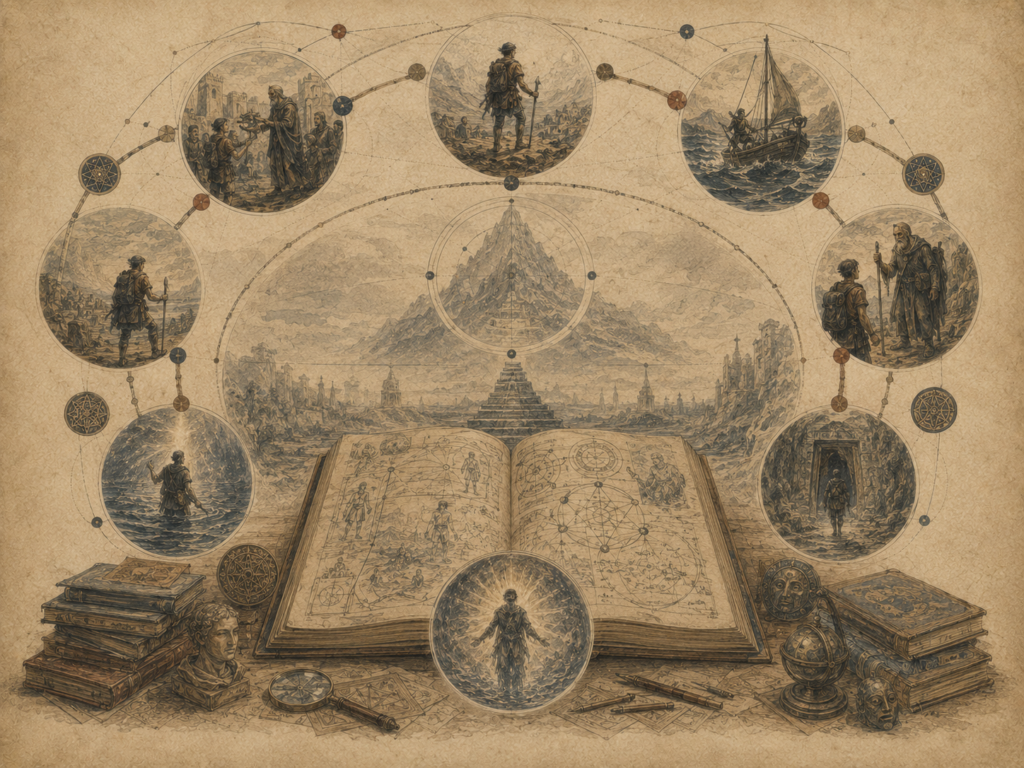
Editorial illustration of an open manuscript surrounded by connected mythic journey scenes, including departure, sea crossing, mentor encounter, descent, transformation, and return.

The Monomyth: What Joseph Campbell Actually Argued About the Hero’s Journey

The Monomyth: What Campbell Actually Argued clarifies one of the most influential and misunderstood ideas in modern storytelling. This article explains that Joseph Campbell’s monomyth was not a rigid screenwriting formula, but a comparative and symbolic model of heroic transformation organized around departure, initiation, and return. It examines the call to adventure, threshold crossing, trial, descent, symbolic death, boon, reentry, and the difficult problem of bringing transformation back into the ordinary world. The article also distinguishes Campbell’s actual argument from later formulaic uses of the hero’s journey in writing guides, film analysis, branding, and leadership culture. It addresses strengths, limits, gender critique, cultural specificity, counterexamples, formula drift, and ethical risk. As part of the Storytelling series, it connects myth studies, comparative mythology, analytical psychology, narrative structure, cultural memory, and responsible interpretation across ancient, modern, sacred, literary, and institutional stories.
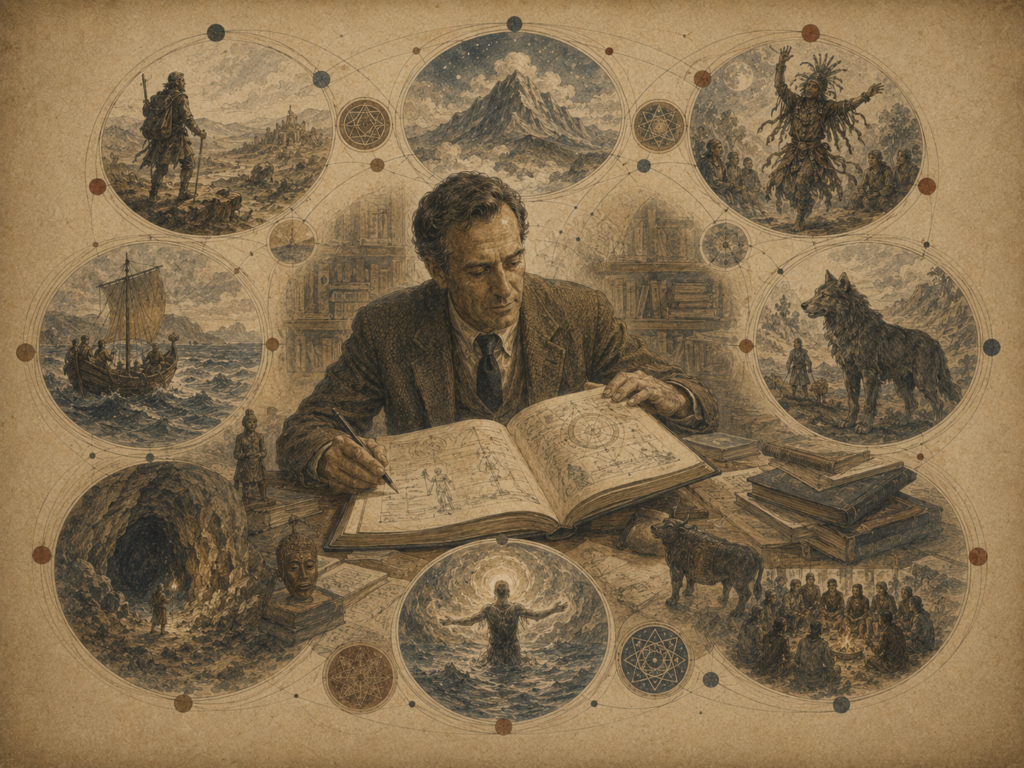
Editorial illustration of a myth scholar studying an open notebook, surrounded by connected mythic scenes of journeys, mountains, ritual figures, animal guides, caves, rebirth, and communal gatherings.

Joseph Campbell and the Comparative Study of Myth: The Monomyth, Archetypes, and Responsible Comparison

Joseph Campbell and the Comparative Study of Myth examines Campbell’s influential role in bringing comparative mythology, archetypal interpretation, and the hero’s journey into modern storytelling culture. This article explains what Campbell was trying to do, why The Hero with a Thousand Faces became so influential, how the monomyth was later simplified into a popular story formula, and why Campbell’s work remains useful but limited. It explores comparative mythology, symbolic pattern, departure, initiation, return, archetypes, ritual context, source traditions, film influence, creative writing, public scholarship, and modern mythmaking. The article also addresses critiques involving universalism, selective evidence, gender, cultural specificity, colonial framing, and formula drift. As part of the Storytelling series, it connects myth studies with narrative theory, analytical psychology, cultural memory, ethics, and practical methods for comparing stories responsibly without flattening difference, context, authority, or tradition.

Editorial illustration of a ceremonial storytelling gathering surrounded by mythic symbols, ritual objects, dancers, animals, seasonal imagery, and symbolic pathways.

Myth, Ritual, and the Symbolic Work of Story: Meaning, Power, and Transformation

Myth, Ritual, and the Symbolic Work of Story examines how symbolic narratives and embodied practices organize origin, order, memory, identity, transformation, authority, and belonging. This article explains why myth should not be reduced to falsehood and why ritual should not be dismissed as empty repetition. It explores creation stories, sacred narratives, ritual action, symbolic objects, liminality, thresholds, sacrifice, renewal, repair, public ceremony, institutional myth, modern civic rituals, psychological interpretation, and the ethical risks of symbolic storytelling. The article also considers how myths and rituals can sustain communal meaning while also legitimizing hierarchy, exclusion, scapegoating, appropriation, or institutional power. As part of the Storytelling series, it connects myth studies, ritual theory, symbolic interpretation, cultural memory, analytical psychology, ethics, and practical methods for interpreting symbolic stories with context, humility, governance, and responsibility across religious, civic, cultural, psychological, and institutional life today.

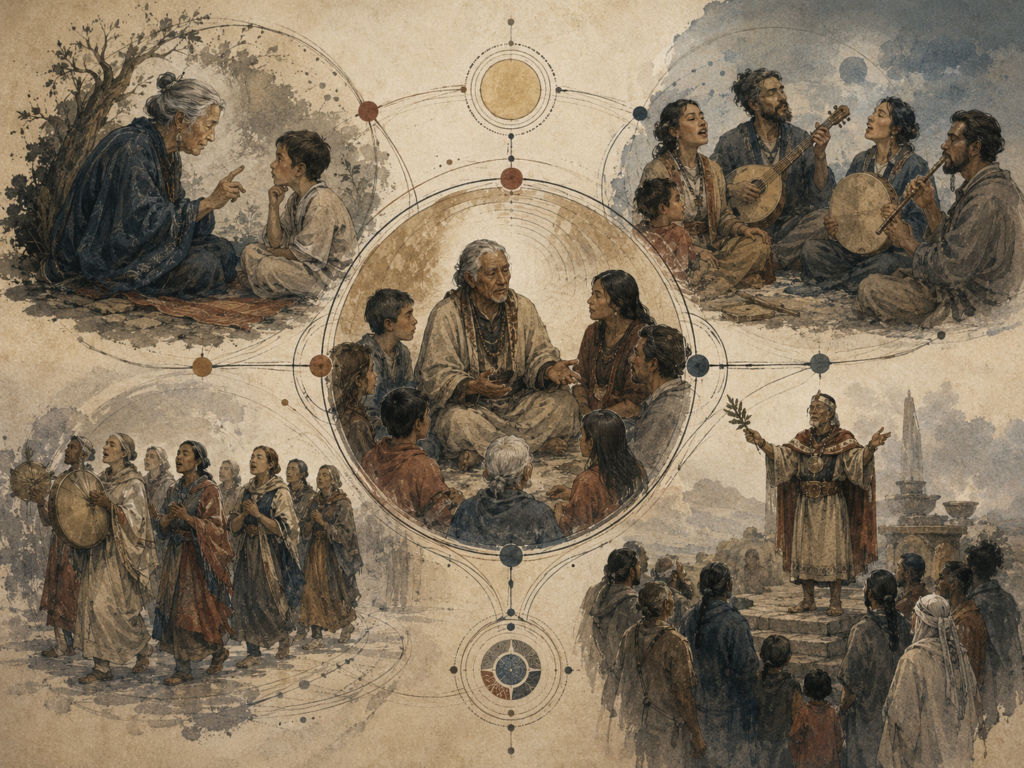
Editorial illustration of an elder speaking to an intergenerational circle, surrounded by scenes of proverb teaching, communal song, chant, and ritual speech.

Proverb, Song, Chant, and Ritual Speech: Compact Forms of Oral Storytelling

Proverb, Song, Chant, and Ritual Speech examines compact, musical, rhythmic, and ceremonial forms of oral storytelling that carry meaning without always relying on extended plot. This article explains how proverbs compress social knowledge, moral judgment, warning, humor, and critique; how songs preserve memory through melody, rhythm, refrain, voice, and belonging; how chants use cadence, repetition, and collective voicing to create ritual or public force; and how ritual speech blesses, names, mourns, vows, invokes, authorizes, or transforms social reality. It explores language, sound, performance context, repetition, participation, translation, authority, access protocol, documentation, archive risk, digital circulation, and ethical interpretation. As part of the Storytelling series, it connects oral tradition with cultural memory, folklore, ritual practice, performance studies, narrative ethics, and practical methods for analyzing compact oral forms with context, consent, and responsibility.

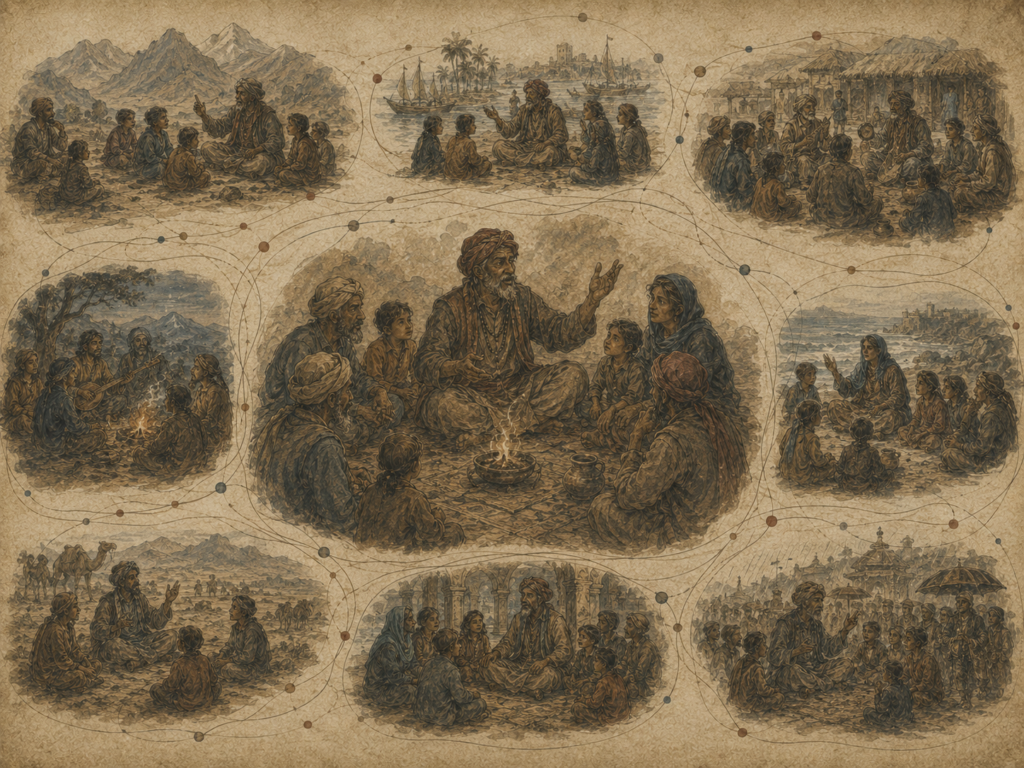
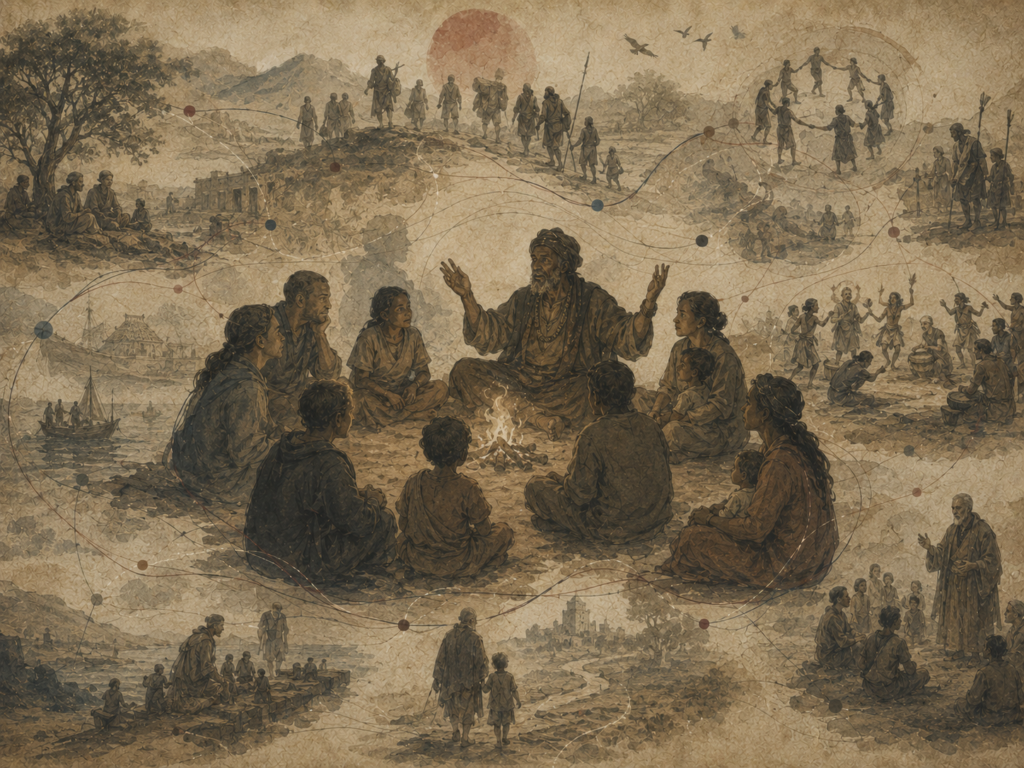
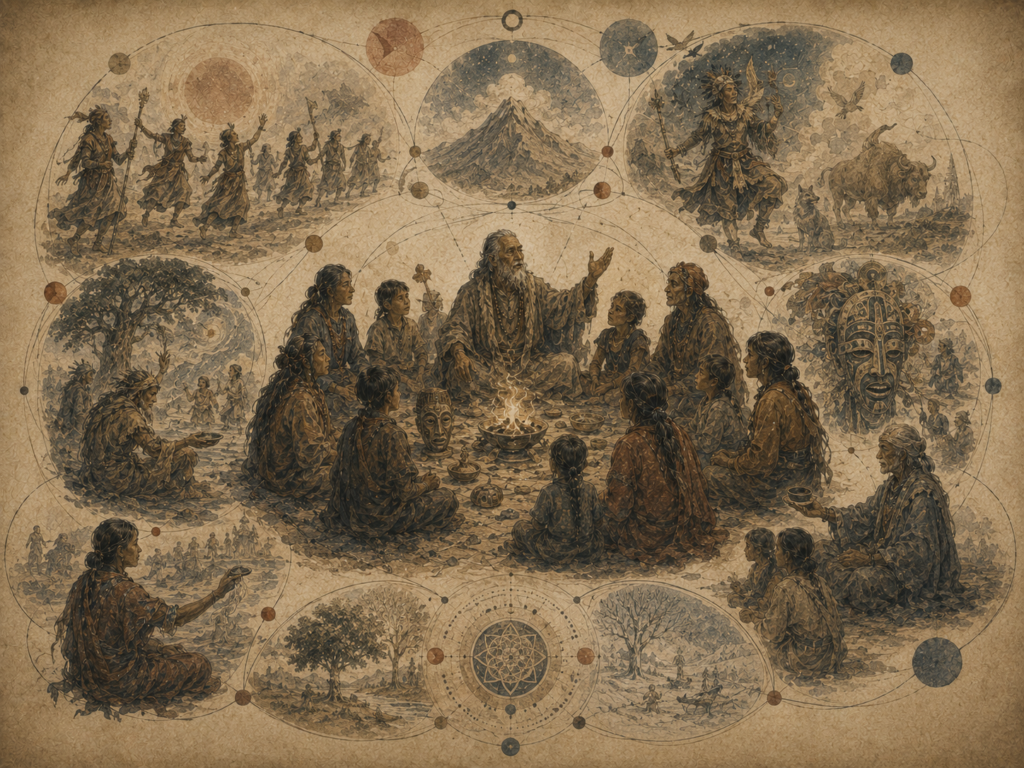
Editorial illustration of a central oral storyteller surrounded by multiple storytelling gatherings across different landscapes, communities, and generations.

Performance, Memory, and Variation in Oral Storytelling: How Living Stories Change

Performance, Memory, and Variation in Oral Storytelling examines oral storytelling as a living performance practice rather than a fixed text. This article explains how stories are remembered, voiced, timed, embodied, repeated, adapted, corrected, and transmitted through tellers, audiences, occasions, places, languages, gestures, formulas, and social relationships. It explores performance as composition, memory as practice, variation as continuity, formula and repetition, audience participation, voice and embodiment, apprenticeship, transmission, stability, change, archive risk, digital circulation, translation, access protocols, and ethical documentation. The article also warns against treating variation as error or treating one transcript, recording, or platform clip as the definitive version of a living tradition. As part of the Storytelling series, it connects oral tradition with cultural memory, performance studies, folklore, narrative ethics, and practical methods for analyzing variation while preserving context, consent, authority, and community responsibility across generations responsibly.

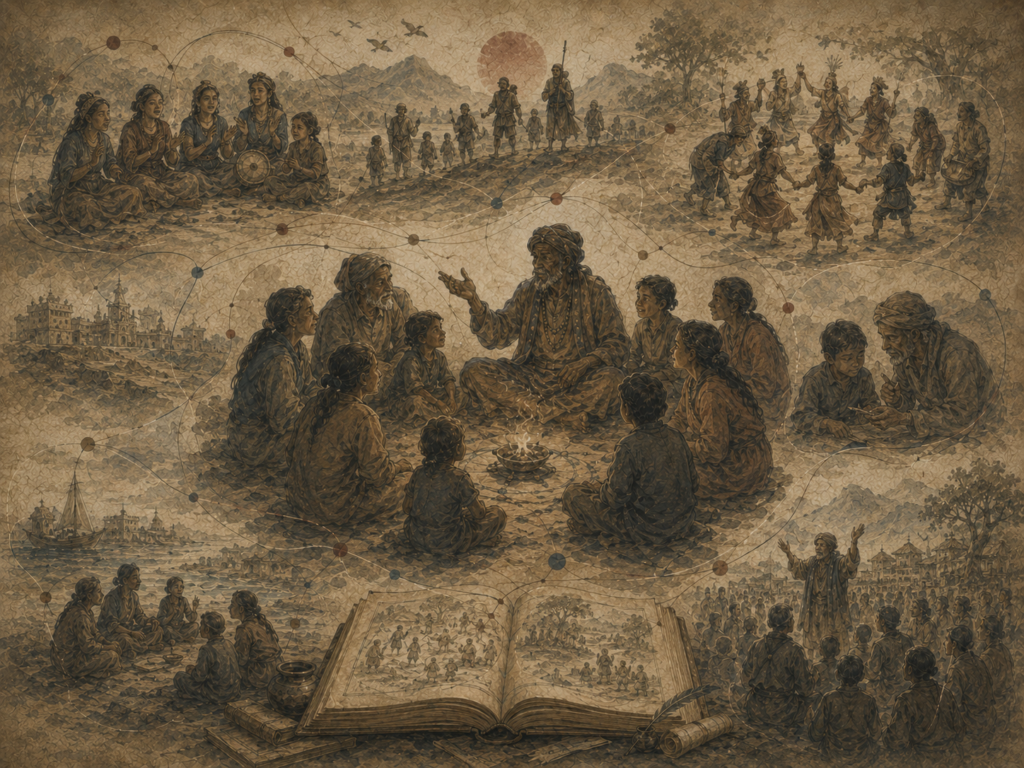
Editorial illustration of an elder storyteller speaking to an intergenerational circle, surrounded by scenes of song, ritual, teaching, travel, and communal memory.

Storytelling as Intangible Cultural Heritage: Safeguarding Living Narrative Traditions

Storytelling as Intangible Cultural Heritage examines storytelling as a living cultural practice rather than a detachable artifact, transcript, recording, or archive item. This article explains why stories are preserved not only by saving words, but by sustaining the people, languages, performances, rituals, places, memories, permissions, and transmission systems that keep them meaningful. It explores oral tradition, language vitality, intergenerational learning, performance context, ritual setting, community recognition, safeguarding, documentation, digital archives, tourism, education, ownership, consent, restricted knowledge, access control, platform risk, and community authority. The article also warns against freezing living traditions into official versions or exposing sensitive material through careless preservation. As part of the Storytelling series, it connects intangible cultural heritage with narrative practice, cultural memory, ethical documentation, digital governance, and practical methods for safeguarding stories while supporting living transmission across generations, languages, communities, and changing media contexts.

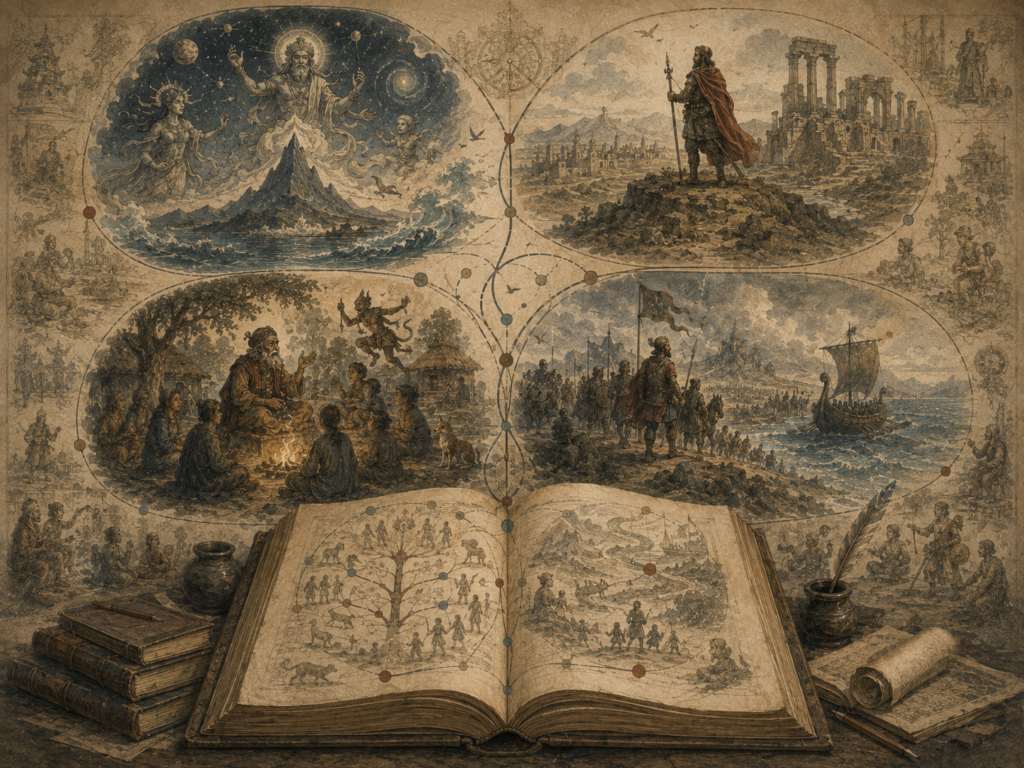
Editorial illustration of an open manuscript connecting four storytelling traditions: cosmic myth, heroic legend, village folktale, and epic journey.

Myths, Legends, Folktales, and Epics: How Traditional Stories Shape Culture

Myths, Legends, Folktales, and Epics examines four traditional narrative forms that are often grouped together but do different cultural work. This article explains how myth organizes sacred origin, cosmic order, ritual meaning, and ultimate explanation; how legend connects story to place, memory, belief, and historical possibility; how folktale carries pattern, wonder, trickery, social imagination, and variation; and how epic expands narrative into heroic scale, public conflict, lineage, and collective memory. It compares truth claims, performance contexts, transmission paths, memory functions, narrative structures, hybrid forms, and adaptation risks. The article also warns against flattening traditional narratives into generic content, universal formulas, or simple entertainment. As part of the Storytelling series, it connects folklore, oral tradition, cultural memory, myth studies, epic performance, media adaptation, and practical methods for comparing narrative forms with context, humility, and ethical care across living story traditions.

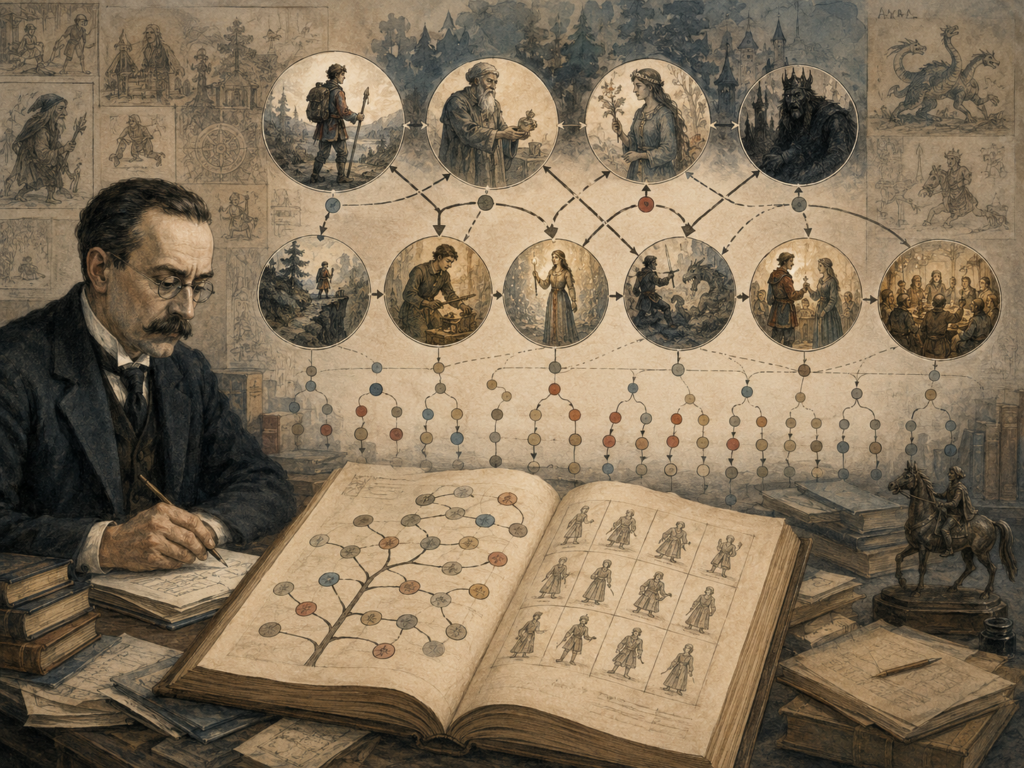
Editorial illustration of a folklorist studying an open manuscript, with connected folktale scenes, roles, arrows, nodes, and structural story diagrams.

Folktale Structure and Vladimir Propp’s Morphology: Functions, Roles, and Story Patterns

Folktale Structure and Vladimir Propp’s Morphology examines how folktales organize action through recurring functions, roles, sequence, variation, and transformation. This article explains Propp’s influential method for analyzing wonder tales by asking what characters do in the plot rather than treating them only as symbolic figures or psychological personalities. It explores Propp’s thirty-one functions, seven spheres of action, function-before-character analysis, tale-type classification, sequence integrity, variant comparison, oral performance, cultural context, and the limits of structural analysis. The article also warns against using Propp as a universal story formula, showing why morphology must be balanced with folklore scholarship, source context, translation awareness, community authority, and ethical interpretation. As part of the Storytelling series, it connects folktale structure with oral tradition, narrative theory, computational modeling, media adaptation, and practical methods for analyzing patterned stories without erasing culture, performance, living tradition, or variation.

Editorial illustration of a storyteller speaking around a fire to a circle of listeners, surrounded by scenes of ritual, migration, teaching, and communal memory.

Oral Tradition, Performance, and Collective Memory: How Stories Preserve Culture

Oral Tradition, Performance, and Collective Memory examines storytelling as a living practice of voice, body, audience, place, ritual, repetition, variation, and cultural transmission. This article explains why oral tradition is not simply speech before writing, but a structured system for preserving knowledge, values, identity, history, ecological memory, sacred meaning, humor, warning, and communal responsibility across generations. It explores performance as composition, memory as social practice, formula and variation, storytellers and audiences, major oral genres, collective memory, place-based storytelling, ritual embodiment, authority, transmission, documentation, preservation, and archive risk. The article also examines ethical responsibilities involving consent, ownership, restricted knowledge, translation, community governance, extraction, context, and digital reuse. As part of the Storytelling series, it connects oral tradition with narrative structure, cultural memory, media change, intangible heritage, and practical methods for analyzing performance without reducing living stories to text or artifact.

Scroll to Top