
Storytelling

Storytelling examines the narrative structures, symbolic patterns, rhetorical forms, and imaginative frameworks through which human beings organize experience, communicate meaning, and make sense of themselves and the world. In the history of culture and communication, storytelling has served not only as a mode of entertainment, but as a fundamental medium for memory, identity, persuasion, moral reflection, and the transmission of knowledge across generations.

This category explores storytelling as both an ancient human practice and a contemporary framework for shaping meaning, including its use of plot, character, voice, conflict, transformation, archetype, and narrative sequence. It considers how stories create emotional resonance, how they structure perception and expectation, how they encode values and worldviews, and how narrative forms influence the ways individuals, institutions, and cultures interpret reality.

Storytelling plays an important role in content frameworks and the wider study of communication because it reveals how ideas become memorable, how narratives shape belief and behavior, and how symbolic structure gives force to language and thought. By engaging storytelling seriously, this category deepens understanding of narrative as a foundational human practice and broadens reflection on meaning, persuasion, imagination, and the forms through which experience becomes intelligible.

Editorial illustration of an open manuscript branching into scenes of oral storytelling, reading, community dialogue, public discussion, and digital storytelling.

Why Storytelling Still Matters: Meaning, Memory, Ethics, and Public Life

Why Storytelling Still Matters examines why narrative remains essential in an age of information overload, institutional distrust, platform acceleration, synthetic media, artificial intelligence, public fragmentation, and ethical uncertainty. This article argues that story is not a substitute for truth, evidence, or responsible judgment; it is one of the ways truth becomes intelligible, memorable, contestable, and accountable in human life. It explores story as sensemaking, memory, identity, culture, moral imagination, public reasoning, institutional accountability, education, science communication, systems explanation, digital media, AI storytelling, and narrative ethics. The article also warns against story worship, data worship, emotional shortcutting, context collapse, representation flattening, institutional self-mythology, platform optimization, synthetic authority, formula drift, and revision resistance. As the closing article in the Storytelling series, it argues that responsible storytelling should preserve truthfulness, dignity, consent, context, uncertainty, human judgment, and accountability across public life today.

Editorial illustration of an open manuscript split between careful testimony and distorted narrative manipulation, with fragmented images, crowds, chains, and red warning threads.

Narrative Risk and the Misuse of Story: Evidence, Trust, and Hidden-Power Narratives

Narrative Systems and Story Structure Modeling examines how stories can be understood as dynamic systems of agents, events, goals, constraints, causes, consequences, conflicts, worlds, temporal patterns, relationships, audience knowledge, and interpretation. This article explains why story structure is not the same as formula: useful models clarify how narrative parts interact, while rigid templates can flatten culture, genre, agency, ethics, and meaning. It explores story units, events, agents, states, causality, character agency, storyworld boundaries, temporal architecture, conflict pressure, feedback loops, relationship networks, plot models, state change, audience information, computational narrative modeling, and AI-assisted structure analysis. The article also warns against formula capture, plot-only modeling, causality simplification, agency erasure, network overconfidence, computational reduction, and AI structure fluency. As part of the Storytelling series, it argues that responsible narrative modeling should preserve context, judgment, uncertainty, and human interpretation across narrative systems today.

Editorial illustration of an open manuscript branching into scenes of public speech, dialogue, writing, audience response, and ethical judgment.

Rhetorical Moves and the Ethics of Persuasive Story: How Persuasion Can Remain Accountable

Rhetorical Moves and the Ethics of Persuasive Story examines how stories persuade by arranging credibility, emotion, evidence, identification, framing, metaphor, causality, witness, urgency, values, audience relation, and calls to action. This article explains why persuasion is not automatically manipulation: responsible rhetorical moves can clarify stakes, support public reasoning, and mobilize care, while unethical moves can exploit emotion, hide evidence, pressure belief, scapegoat, or bypass judgment. It explores ethos, pathos, logos, identification, framing, causal stories, witness, example, moral pressure, omission, selective evidence, advocacy, policy narrative, digital platform persuasion, and AI-personalized influence. The article also warns against urgency coercion, anecdote inflation, metaphor smuggling, social-proof pressure, platform optimization, synthetic testimony, and vulnerability targeting. As part of the Storytelling series, it argues that ethical persuasive story should preserve truthfulness, proportionality, dignity, consent, transparency, uncertainty, and audience agency across public communication and civic life.

Editorial illustration of an open manuscript branching into connected story scenes, character arcs, pathways, nodes, and narrative system diagrams.

Narrative Systems and Story Structure Modeling: How Stories Work as Dynamic Systems

Narrative Systems and Story Structure Modeling examines how stories can be understood as dynamic systems of agents, events, goals, constraints, causes, consequences, conflicts, worlds, temporal patterns, relationships, audience knowledge, and interpretation. This article explains why story structure is not the same as formula: useful models clarify how narrative parts interact, while rigid templates can flatten culture, genre, agency, ethics, and meaning. It explores story units, events, agents, states, causality, character agency, storyworld boundaries, temporal architecture, conflict pressure, feedback loops, relationship networks, plot models, state change, audience information, computational narrative modeling, and AI-assisted structure analysis. The article also warns against formula capture, plot-only modeling, causality simplification, agency erasure, network overconfidence, computational reduction, and AI structure fluency. As part of the Storytelling series, it argues that responsible narrative modeling should preserve context, judgment, uncertainty, and human interpretation across narrative systems today.

Editorial illustration of an open manuscript connecting global storytelling traditions, oral gatherings, sacred narratives, theater, shadow puppetry, literature, film, and comparative story networks.

Storytelling in Comparative Perspective: How to Compare Stories Without Flattening Them

Storytelling in Comparative Perspective examines how stories can be studied across cultures, periods, media, languages, religions, genres, and institutions without reducing them to one universal template. This article explains why comparison is useful but risky: similar motifs, plots, rituals, characters, journeys, floods, tricksters, transformations, or origin stories may serve very different social, ecological, political, theological, or historical purposes. It explores folklore classification, tale types, motifs, oral performance, myth, ritual, cosmology, comparative narratology, translation, transmission, media form, colonial archives, universal patterns, local meanings, and AI-assisted comparison. The article also warns against flattening, template capture, archive innocence, translation blindness, performance erasure, origin obsession, motif extraction, comparative ranking, and AI overconfidence. As part of the Storytelling series, it argues that responsible comparison should preserve source context, difference, protocol, local interpretation, evidence limits, and methodological humility across narrative traditions and public interpretation today.

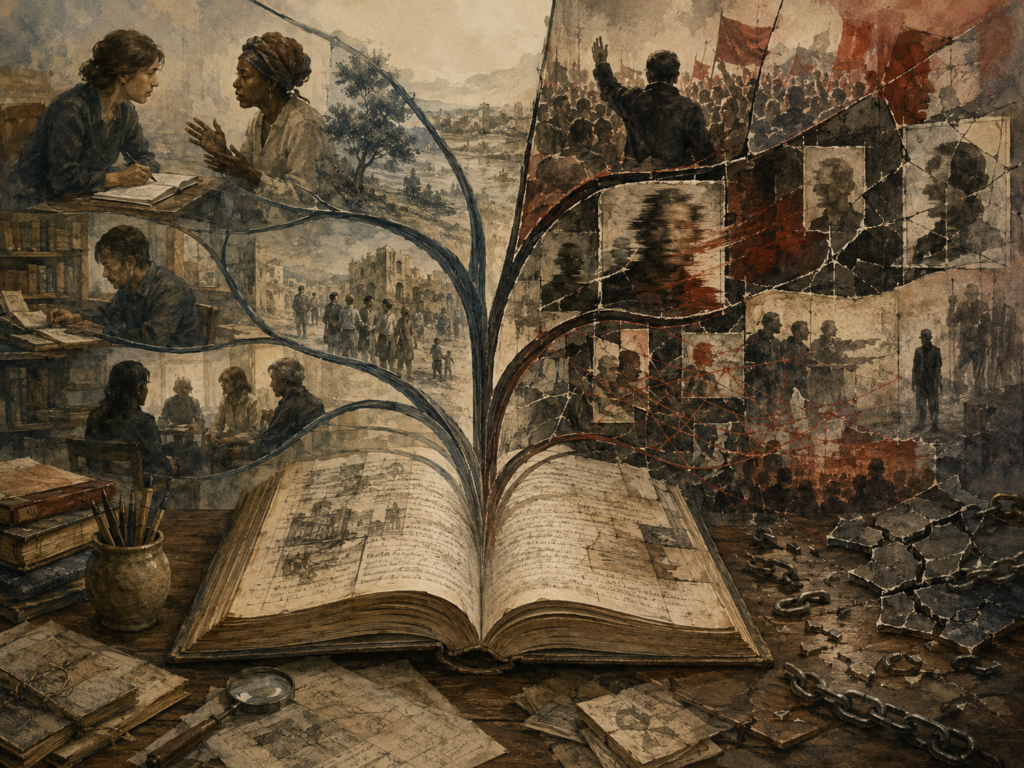
Editorial illustration of an open manuscript split between careful listening, portraiture, community dialogue, fragmented memory, and contested representation.

Storytelling and the Ethics of Representation: How to Portray People Responsibly

Storytelling and the Ethics of Representation examines how stories portray people, communities, cultures, histories, suffering, identity, conflict, institutions, and difference. This article explains why representation is never neutral: every narrative selects, frames, names, images, translates, simplifies, or amplifies someone for an audience. It explores voice, power, consent, visibility, stereotype, testimony, trauma, image ethics, cultural context, appropriation, institutional storytelling, audience responsibility, and AI-generated representation. The article also warns against positive stereotypes, visibility optimism, consent minimalism, voice replacement, trauma extraction, context collapse, image spectacle, cultural inventory, institutional self-congratulation, and synthetic authority. As part of the Storytelling series, it argues that responsible representation should preserve dignity, agency, context, source accuracy, provenance, consent, cultural protocols, community review, human accountability, and the right of represented people not to be reduced to narrative material across institutional, digital, visual, educational, political, and public storytelling today alike.

Editorial illustration of an open archival manuscript branching into creators, viewers, devices, media fragments, archives, and networked pathways of digital participation.

Digital Storytelling and Platform Culture: How Platforms Shape Modern Narrative

Digital Storytelling and Platform Culture examines how stories are shaped by websites, social media, video platforms, podcasts, newsletters, livestreams, feeds, creator networks, recommendation systems, archives, metrics, moderation, and AI-mediated publishing. This article explains why platforms are not neutral containers: they organize visibility, participation, monetization, memory, identity, public meaning, and governance. It explores personal digital stories, profiles, feeds, networked identity, algorithmic recommendation, remix, spreadability, short-form compression, multimodal video and audio, creator labor, analytics, platform power, digital archives, context collapse, platform decay, and synthetic media. The article also warns against metric worship, vulnerability extraction, formula drift, moderation blindness, archive neglect, synthetic authority, and AI optimization capture. As part of the Storytelling series, it argues that responsible digital storytelling should preserve consent, context, provenance, source authority, audience care, human review, archival memory, and narrative accountability across platforms in public digital life today.

Editorial illustration of an open manuscript transformed into a branching game map, with pathways, tokens, decision points, scenes, and alternate narrative routes.

Games, Interactivity, and Branching Narrative: How Player Choice Changes Story

Games, Interactivity, and Branching Narrative examines how games organize story through rules, action, choice, feedback, space, systems, avatars, quests, failure, replay, multiplayer interaction, emergence, and AI generation. This article explains why games are not films with buttons or novels with options: they are interactive narrative systems where story is authored, discovered, performed, simulated, interrupted, failed, repeated, and co-created. It explores rules and fictional worlds, player agency, branching structure, choice and consequence, environmental storytelling, quests, progression, emergent stories, avatar identity, multiplayer social narrative, production constraints, and generative AI. The article also warns against cosmetic choice, mechanic-story mismatch, lore dumping, checklist quests, failure friction, identity flattening, manipulative feedback, and automated quest machinery. As part of the Storytelling series, it argues that responsible game narratives should preserve meaningful agency, world memory, feedback clarity, player consent, identity care, human review, and ethical consequence.

Editorial illustration of an open manuscript branching into filmstrips, episode panels, character portraits, television scenes, and long-form narrative pathways.

Serial Storytelling, Television, and Long-Form Narrative: How TV Builds Story Over Time

Serial Storytelling, Television, and Long-Form Narrative examines how television and long-form popular narrative organize stories through episodes, seasons, arcs, cliffhangers, recaps, ensemble casts, delayed payoffs, audience memory, platform viewing, and return over time. This article explains why serial form is not simply a stretched-out movie or novel: it is a narrative system built around repetition, interruption, recurrence, continuity, accumulation, and revisable meaning. It explores episodic and serial structures, hybrid procedurals, narrative complexity, character memory, worldbuilding, ensemble storytelling, streaming, bingeing, fandom, writers’ rooms, production constraints, endings, and AI-assisted season planning. The article also warns against empty cliffhangers, mystery-box overload, trauma recycling, continuity burden, finale failure, and automated arc machinery. As part of the Storytelling series, it argues that responsible serial storytelling should honor audience trust, character consequence, ethical representation, payoff integrity, and the long memory of narrative time across seasons.

Scroll to Top