
Last Updated June 10, 2026
Myths, legends, folktales, and epics are often grouped together as traditional stories, but they do not all do the same work. A myth may explain sacred origins or cosmic order. A legend may connect memory to a place, person, event, or historical possibility. A folktale may travel through patterned action, wonder, trickery, transformation, humor, or moral testing. An epic may organize collective identity through heroic action, public conflict, oral performance, and cultural memory.
Myths, Legends, Folktales, and Epics examines four major traditional narrative forms without collapsing them into one category. It explains how each form organizes memory, authority, truth claim, performance, cultural value, and narrative structure differently. The article also shows why these distinctions matter for storytelling, folklore, religious studies, literary analysis, cultural memory, media adaptation, and responsible interpretation.
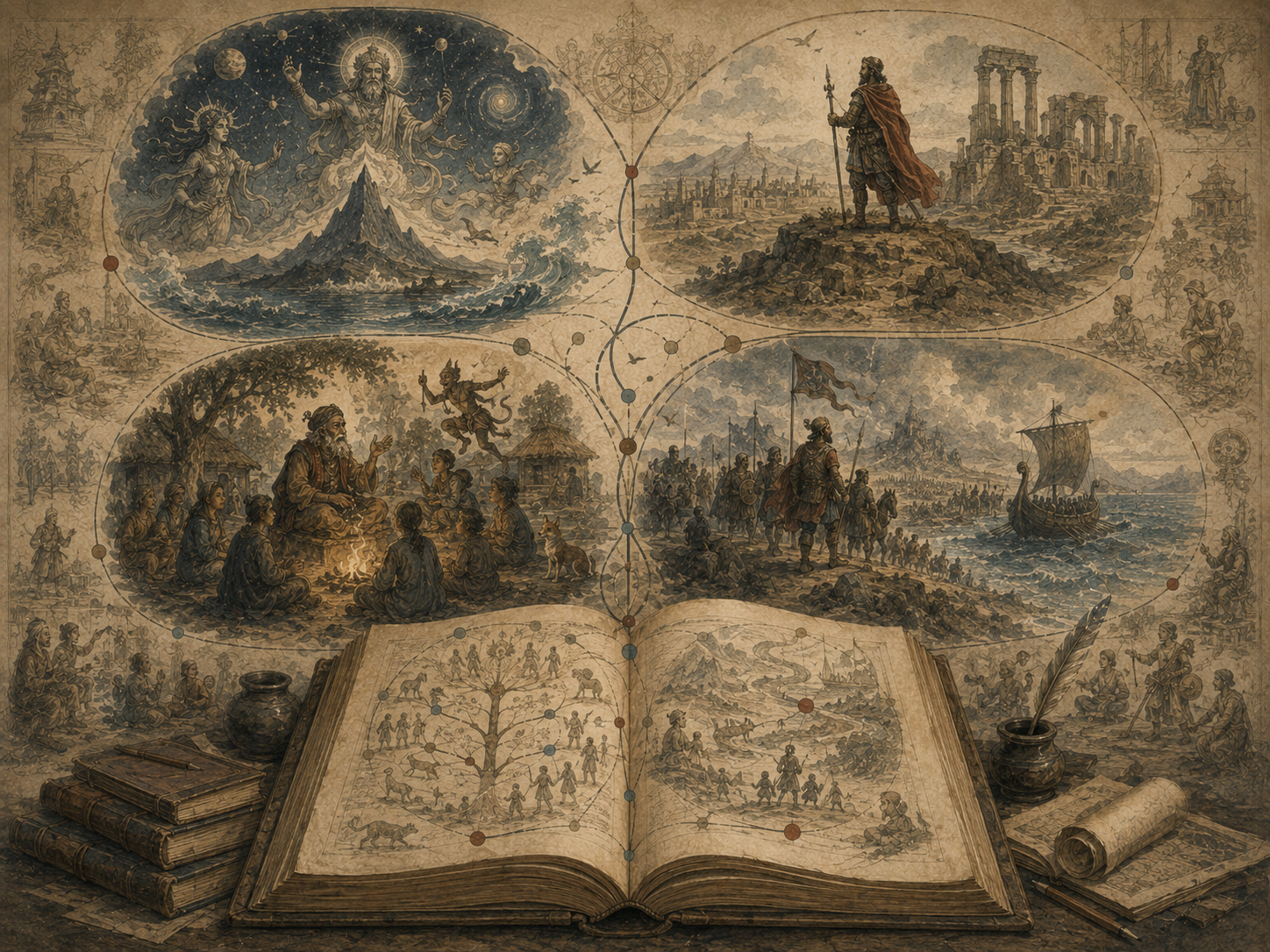
This article treats myth, legend, folktale, and epic as related but distinct traditional narrative forms. It compares their truth claims, social functions, relation to sacred order, relation to history, structure, performance, transmission, memory, and adaptation. It also includes computational workflows for auditing traditional narrative forms, genre confusion, cultural context, performance traces, adaptation risk, and Catalyst Canvas-ready governance outputs.
Why Traditional Narrative Forms Matter
Traditional narrative forms matter because stories do not all carry the same kind of authority. A myth, legend, folktale, and epic may all be old, communal, repeated, and culturally meaningful, but they organize meaning differently. They do not simply differ by length or by whether magical things happen. They differ by social function, truth claim, setting, performance context, relation to memory, and relation to cultural order.
A myth may be connected to sacred time, divine action, origin, ritual, cosmic structure, or ultimate explanation. A legend may be linked to historical memory, local place, ancestral reputation, saint, hero, haunting, battle, migration, or extraordinary event. A folktale may use patterned action, wonder, trickery, repetition, reversal, and social imagination. An epic may transform communal memory into large-scale heroic performance.
These forms matter because misclassification can distort interpretation. Calling a sacred myth a folktale may strip away ritual authority. Treating a legend as simple fiction may erase place memory or local historical consciousness. Turning an epic into an individual adventure may miss its public scale. Reading a folktale as literal historical claim may misunderstand its imaginative logic.
| Form | Primary orientation | Common social function |
|---|---|---|
| Myth | Sacred origin, cosmic order, divine or more-than-human action. | Explains world, ritual, identity, values, and ultimate relation. |
| Legend | Historical possibility, place memory, local or communal belief. | Connects people to events, places, ancestors, warnings, and reputations. |
| Folktale | Wonder, pattern, trickery, social imagination, transformation. | Entertains, teaches, tests values, and circulates adaptable narrative forms. |
| Epic | Heroic scale, public conflict, collective memory, long-form performance. | Organizes identity, honor, conflict, ancestry, and cultural continuity. |
Traditional narrative forms matter because they help us ask what kind of story we are encountering before we decide what it means.
Myth, Legend, Folktale, and Epic: Core Distinctions
Myth, legend, folktale, and epic overlap, but they are not interchangeable. They can share motifs, characters, sacred references, magical events, heroes, monsters, journeys, transformations, and moral questions. The difference lies in how each form asks to be heard.
A myth often claims authority at the level of sacred order. It may explain why the world is as it is, why a ritual exists, why death exists, why a people came into being, or how humans relate to gods, ancestors, spirits, nature, law, or cosmic forces. Its setting may belong to primordial time or sacred time rather than ordinary historical time.
A legend usually operates closer to remembered or imagined history. It may concern a named place, notable person, miraculous event, battle, migration, founding, ghost, saint, or hero. A folktale often foregrounds narrative pattern, wonder, cleverness, transformation, and reversibility. An epic expands storytelling into public scale: long-form heroic memory, lineage, conflict, honor, and communal identity.
| Category | Typical time | Typical authority | Typical movement |
|---|---|---|---|
| Myth | Primordial, sacred, origin time, or time beyond ordinary history. | Religious, cosmological, ritual, ancestral, or sacred authority. | Origin, ordering, transgression, transformation, explanation, renewal. |
| Legend | Remembered, local, historical, or near-historical time. | Place memory, communal belief, testimony, reputation, historical possibility. | Encounter, warning, marvel, founding, haunting, miracle, heroic deed. |
| Folktale | Indeterminate “once upon a time” or tale-time. | Traditional pattern, entertainment, moral testing, social imagination. | Lack, quest, trickery, test, magical aid, reversal, recognition, reward. |
| Epic | Heroic past, ancestral time, foundational conflict, public memory. | Collective identity, heroic tradition, oral performance, cultural prestige. | War, journey, trial, lineage, honor, return, loss, fame, cultural continuity. |
These distinctions are analytic tools, not prison walls. A story may move across categories or be interpreted differently by different communities.
Myth: Sacred Origin and Cosmic Order
Myth is often misunderstood as a false story. In scholarly use, myth is better understood as a traditional narrative that carries sacred, cosmological, origin, ritual, or existential significance. A myth may explain how the world began, how humans came to be, why seasons change, why death exists, why rituals matter, why a people holds a covenant or obligation, or how divine and human orders relate.
Myth does not have to be believed in the same way everywhere or at all times. Its authority may be ritual, symbolic, theological, communal, philosophical, or cultural. The important point is that myth usually asks to be heard as more than entertainment. It often concerns ultimate order, sacred beings, origins, transformations, boundaries, prohibitions, transgressions, and renewal.
Myths often structure identity by placing human life within a larger order. They can explain where people come from, what powers govern existence, what obligations continue, what dangers threaten disorder, and what rituals restore balance. They can also be contested, reinterpreted, rejected, revived, adapted, or politicized.
| Mythic feature | How it works | Analytic question |
|---|---|---|
| Origin | Explains beginning of world, humans, death, ritual, law, or social order. | What does the myth say began, and why does that beginning matter? |
| Sacred order | Connects human life to gods, ancestors, spirits, cosmic forces, or ultimate reality. | What order does the myth establish or renew? |
| Ritual relation | Provides narrative context for ceremony, sacrifice, festival, taboo, or obligation. | How does story support practice? |
| Boundary | Marks limits between human and divine, life and death, culture and nature, order and chaos. | What boundary is protected, crossed, or restored? |
| Transformation | Explains changes in body, landscape, species, status, season, or cosmic condition. | What transformation gives the world its present form? |
| Authority | Gives weight to identity, value, law, or worldview. | Who is authorized by this myth, and who may be excluded? |
Myth should not be dismissed as primitive explanation or simple fantasy. It is a narrative form through which communities organize sacred meaning, origins, and world-ordering thought.
Legend: Memory, Place, and Historical Possibility
Legend usually stands closer to history than myth or folktale, but it is not the same as verified history. A legend often concerns a person, place, event, saint, hero, ghost, monster, miracle, battle, migration, treasure, boundary, warning, or founding memory that is believed, half-believed, debated, or situated within historical possibility.
Legends often attach narrative to place. A hill, river, road, bridge, house, grave, battlefield, cave, tree, or ruined building may become meaningful because a story is told about what happened there. The legend gives place a memory and gives memory a location.
Legends can also function as moral and social warnings. They may warn against trespass, pride, betrayal, greed, disrespect, dangerous roads, haunted places, broken promises, or violation of communal norms. A legend may preserve fear, local identity, historical trauma, suppressed memory, or communal pride.
| Legend feature | How it works | Analytic question |
|---|---|---|
| Place attachment | A story is anchored to a specific location or landscape. | How does place become memorable through story? |
| Historical possibility | The narrative is framed as something that may have happened. | What kind of belief or doubt surrounds the story? |
| Local authority | Community memory gives the story weight. | Who tells the legend, and who recognizes it? |
| Warning | The legend instructs through danger, haunting, punishment, or consequence. | What behavior does the legend regulate? |
| Heroic or saintly memory | A person becomes larger than ordinary history. | How does reputation become narrative? |
| Contestation | Different groups may dispute the story’s meaning or truth. | Whose memory is being preserved or challenged? |
Legend turns place, memory, rumor, history, fear, identity, and belief into narrative form.
Folktale: Pattern, Wonder, and Social Imagination
Folktales are traditional stories that often unfold in an indeterminate tale-world. They may include magical helpers, talking animals, impossible tasks, youngest siblings, tricksters, witches, giants, transformations, tests, reversals, punishments, rewards, and repeated patterns. They do not usually ask to be believed as sacred truth or historical memory in the same way myths and legends may.
Folktales are powerful because they make social imagination portable. A tale can travel across languages, regions, families, and performers while preserving recognizable structures. It can entertain, warn, instruct, parody authority, reward cleverness, dramatize injustice, test moral values, and imagine reversals of power.
Folktales often work through pattern. Three attempts, repeated scenes, forbidden acts, donor tests, magical aid, hidden identity, recognition, exposure, and transformed status help audiences anticipate movement. Variation keeps the tale alive. Names, settings, helpers, villains, objects, endings, and moral emphasis may shift across versions.
| Folktale feature | How it works | Analytic question |
|---|---|---|
| Indeterminate time | The story happens in tale-time rather than exact historical time. | What freedom does this give the narrative? |
| Patterned action | Repetition, tests, tasks, reversals, and recognition structure movement. | What pattern organizes the tale? |
| Wonder | Magic, transformation, animals, objects, or impossible events appear as part of the tale-world. | What does wonder make imaginable? |
| Social reversal | The weak, poor, youngest, foolish, or underestimated may triumph. | What social order is tested or inverted? |
| Trickery | Cleverness may defeat power, greed, danger, or stupidity. | What does the tale value: strength, wit, patience, luck, kindness, or endurance? |
| Variation | Versions change across tellers and contexts. | What remains stable, and what changes? |
Folktales show how narrative pattern can travel widely while adapting to local performance, humor, fear, value, and imagination.
Epic: Heroic Memory and Public Scale
Epic is a large-scale narrative form often associated with heroic action, public conflict, journeys, warfare, lineage, divine or supernatural involvement, cultural origins, and collective memory. Epics may be performed orally, written down, reshaped through literary tradition, or adapted across media.
Epic differs from the folktale partly by scale. It often concerns a world of public consequence: war, migration, founding, honor, exile, return, kinship, city, kingdom, people, or civilization. The hero’s action is not merely personal. It becomes connected to collective identity, ancestral memory, political order, or cultural prestige.
Epic also often depends on performance tradition. Oral epic can rely on formula, meter, repeated scenes, epithets, type-scenes, and trained performance techniques. Written epics may preserve or transform these features. The epic is therefore both story and cultural monument, both performance and memory, both action and identity.
| Epic feature | How it works | Analytic question |
|---|---|---|
| Heroic scale | Characters act within public, ancestral, or cosmic stakes. | What community or order is affected by the hero’s action? |
| Long-form structure | The narrative may include many episodes, battles, journeys, speeches, and returns. | How does the epic sustain large-scale movement? |
| Formula and repetition | Recurring phrases, scenes, epithets, and patterns support performance and memory. | How does repetition organize oral or literary composition? |
| Collective memory | The epic preserves or reimagines a people’s past, values, conflict, or identity. | What kind of memory does the epic authorize? |
| Heroic ambiguity | Heroes may be noble, violent, flawed, excessive, tragic, or divided. | What does the epic admire, mourn, or question? |
| Public voice | The story is often told with ceremonial, communal, or literary authority. | Who speaks for the past, and on whose behalf? |
Epic transforms story into public memory, carrying heroic action into the scale of culture, lineage, and collective identity.
Truth Claims and Belief
Myths, legends, folktales, and epics differ partly in their truth claims. This does not mean one form is “true” and another is “false.” It means each form asks to be heard under different conditions of belief, authority, memory, and interpretation.
A myth may be true in a sacred, ritual, cosmological, symbolic, or theological sense. A legend may be true as local memory, historical possibility, warning, testimony, or communal belief, even when evidence remains uncertain or contested. A folktale may not require belief in literal events; its truth may lie in pattern, social imagination, humor, moral testing, or narrative possibility. An epic may mix historical memory, heroic idealization, ritual prestige, poetic form, and cultural identity.
The analyst should ask what kind of truth is being claimed, by whom, and in what context. A story can be historically uncertain and culturally powerful. It can be sacred without being reducible to literal fact. It can be fictionalized and still preserve social truth. It can be entertaining and still transmit values.
| Form | Common truth claim | Responsible interpretive question |
|---|---|---|
| Myth | Sacred, cosmological, ritual, symbolic, or origin truth. | What order or obligation does the story make meaningful? |
| Legend | Historical possibility, local memory, reputation, warning, or belief. | How does the story relate to place, memory, evidence, and community? |
| Folktale | Imaginative, moral, social, comic, or structural truth. | What pattern of action or value does the tale dramatize? |
| Epic | Heroic, ancestral, public, poetic, or collective-memory truth. | How does the epic organize cultural identity and public consequence? |
Traditional narratives should be interpreted according to their own truth conditions rather than forced into a single modern category of fact or fiction.
Performance and Transmission
Traditional narrative forms are transmitted through performance, repetition, teaching, adaptation, writing, translation, collection, publication, ritual, schooling, media, and memory. Their form cannot be separated from how they are carried.
A myth may be transmitted through ritual, scripture, liturgy, chant, teaching, iconography, seasonal festival, or family explanation. A legend may circulate through local telling, rumor, pilgrimage, tourist narrative, family memory, historical writing, or place-based instruction. A folktale may pass through oral performance, children’s collections, printed anthologies, classrooms, animation, and games. An epic may survive through oral singers, manuscripts, recitation, national literature, translation, public education, or performance revival.
Transmission changes meaning. A myth translated into textbook prose may lose ritual context. A legend turned into tourism may alter local memory. A folktale collected by an outsider may reflect editorial selection. An epic written down may preserve words while changing performance dynamics. Responsible analysis asks how a story reached us.
| Transmission path | What it preserves | What it may change |
|---|---|---|
| Oral performance | Voice, audience relation, timing, gesture, and variation. | May leave fewer stable textual records. |
| Ritual or ceremonial transmission | Sacred context, authority, and practice. | May restrict access or require protocol. |
| Manuscript or text | Words, sequence, commentary, and formal preservation. | May reduce performance variability. |
| Collection and anthology | Comparability, preservation, teaching access. | May reflect collector bias, translation, and editing. |
| School and national curriculum | Shared cultural literacy and canon formation. | May nationalize or simplify diverse traditions. |
| Digital media | Circulation, remix, access, and new participation. | May create context collapse, appropriation, or loss of control. |
Traditional narratives are not only inherited stories. They are transmitted practices, and every mode of transmission shapes the story’s meaning.
Memory and Cultural Continuity
Myths, legends, folktales, and epics all carry memory, but they do so differently. Myth can remember sacred origin. Legend can remember place and event. Folktale can remember social pattern, danger, wit, injustice, and transformation. Epic can remember heroic past, collective conflict, genealogy, honor, and public identity.
Memory in traditional narrative is not merely storage. It is active interpretation. A community repeats what matters, changes what must adapt, omits what becomes painful or politically inconvenient, and revives what risks being lost. Traditional stories can preserve memory, but they can also contest memory, reshape memory, or authorize a selective version of the past.
This is especially important when stories are used in public life. A myth may support identity or exclusion. A legend may preserve suppressed memory or spread fear. A folktale may carry popular wisdom or reinforce stereotype. An epic may inspire collective dignity or glorify violence. Memory and power are often intertwined.
| Memory function | Myth | Legend | Folktale | Epic |
|---|---|---|---|---|
| Origin memory | Strong | Moderate | Variable | Strong |
| Place memory | Variable | Strong | Variable | Moderate |
| Ritual memory | Strong | Variable | Limited or indirect | Variable |
| Social pattern memory | Moderate | Moderate | Strong | Moderate |
| Heroic memory | Variable | Strong | Variable | Strong |
| Collective identity | Strong | Strong | Moderate | Strong |
Traditional narrative forms preserve cultural continuity not by remaining unchanged, but by being retold, reinterpreted, and governed across time.
Structure and Narrative Movement
Myths, legends, folktales, and epics have different structures of movement. A myth may move from chaos to order, origin to present condition, transgression to consequence, or sacred action to ritual obligation. A legend may move from encounter to proof, warning, wonder, or local meaning. A folktale may move from lack to quest, test, aid, reversal, and recognition. An epic may move through extended episodes of conflict, journey, heroism, loss, return, and fame.
These forms are not structurally identical. Applying a folktale morphology to a myth may miss sacred order. Reading an epic as an enlarged folktale may miss public memory and heroic scale. Treating a legend as a simple myth may miss place-based historical possibility. Treating a folktale as failed realism may misunderstand wonder.
Structure should therefore be genre-aware. The analyst should ask what kind of movement the story invites, what form of closure it offers, and what kind of memory or authority the movement supports.
| Form | Common movement | Closure tendency |
|---|---|---|
| Myth | Origin, ordering, separation, transgression, transformation, renewal. | World condition, ritual grounding, sacred explanation, or cosmic order. |
| Legend | Encounter, event, marvel, warning, local proof, memory, reputation. | Belief, caution, place meaning, or historical residue. |
| Folktale | Lack, departure, test, magical aid, struggle, reversal, recognition. | Reward, punishment, marriage, restoration, social inversion, or comic return. |
| Epic | Heroic conflict, journey, battle, lineage, loss, return, fame, public consequence. | Memory, honor, founding, tragedy, cultural continuity, or heroic legacy. |
Narrative structure is not only plot shape. It is the way a form organizes meaning, authority, memory, and consequence.
Boundaries, Overlap, and Hybrid Forms
The boundaries among myths, legends, folktales, and epics are useful, but they are not absolute. A myth may become legend when attached to a historical place or named ancestor. A legend may become folktale when its historical claim weakens and its pattern travels widely. A folktale may absorb mythic beings. An epic may include mythic episodes, legendary heroes, and folktale motifs.
Hybrid forms are common because stories travel. Communities retell inherited material under new conditions. A sacred story may be secularized. A local legend may be commercialized. A folktale may be nationalized. An epic may be adapted into school curriculum, film, game, or political symbol. A mythic figure may become a superhero. A legendary event may become tourist folklore.
This does not make categories useless. It means categories should be used as diagnostic lenses. The analyst can ask: Which features are mythic? Which are legendary? Which are folktale-like? Which are epic? What happens when forms blend?
| Hybrid pattern | How it works | Analytic caution |
|---|---|---|
| Mythic legend | Sacred or supernatural meaning attaches to a place or historical figure. | Do not reduce sacred memory to local color. |
| Legendary epic | A heroic figure becomes center of large-scale public memory. | Distinguish evidence, reputation, and poetic expansion. |
| Folktale with mythic figures | Gods, spirits, or sacred beings appear in tale-like patterns. | Ask whether sacred authority remains active. |
| Epic with folktale motifs | Tests, helpers, disguises, recognition, and magical objects appear inside epic scale. | Track function without reducing epic to folktale. |
| Modern media adaptation | Traditional forms are remixed through film, games, novels, or platforms. | Review appropriation, context, and source attribution. |
| Nationalized tradition | Local or diverse stories are turned into official heritage. | Ask what variation or minority memory is erased. |
The goal is not to police categories rigidly, but to understand what kind of narrative authority is active in each form and mixture.
Adaptation, Media, and Modern Reuse
Myths, legends, folktales, and epics are constantly adapted. They move into novels, children’s books, film, animation, television, comics, games, branding, education, public ritual, tourism, museum exhibitions, digital archives, podcasts, and social media. Adaptation can keep traditional narratives alive, but it can also distort or extract them.
Myths are often adapted into fantasy, theology, nationalism, psychology, and popular entertainment. Legends become tourist narratives, horror stories, local heritage, or conspiracy-like public folklore. Folktales become children’s media, animated films, game quests, moral lessons, or brand metaphors. Epics become national literature, prestige cinema, school canon, opera, games, or political memory.
Modern reuse requires caution. A traditional story may belong to a community, ritual context, language, or place. A myth may be sacred. A legend may involve trauma or contested memory. A folktale may carry cultural specificity even when it seems widely known. An epic may be tied to national or ethnic identity. Adaptation should ask what is being changed, who benefits, and who has authority to approve or object.
| Adaptation context | Potential value | Risk |
|---|---|---|
| Education | Introduces students to comparative narrative forms. | May simplify living traditions into textbook categories. |
| Film and television | Expands audience and visual interpretation. | May commercialize sacred or culturally specific material. |
| Games | Turns quests, roles, and worlds into interactive systems. | May reduce tradition to mechanics or loot structures. |
| Tourism | Connects place, story, and public memory. | May commodify legends or flatten local complexity. |
| Digital archive | Preserves and shares vulnerable materials. | May expose restricted stories or remove community control. |
| AI and data systems | Can support analysis, indexing, and comparison. | May extract story patterns without consent or context. |
Adaptation should not treat traditional stories as free-floating content. It should preserve context, credit, authority, and responsibility.
The Ethics of Comparison
Comparing myths, legends, folktales, and epics can be illuminating, but comparison can also flatten difference. It is tempting to treat all traditional stories as versions of one universal pattern, one hero journey, one psychological archetype, one national origin, or one content framework. That temptation should be resisted.
Ethical comparison begins with context. What community carries the story? What language does it come from? Who collected it? Who translated it? Who has authority over it? Is it sacred, restricted, public, contested, or commercialized? What happens when the story is moved into a classroom, article, game, dataset, film, or AI system?
Comparison should also preserve asymmetry. A myth with ritual authority should not be treated the same as a public-domain literary adaptation. A legend connected to a traumatic place should not be treated as harmless atmosphere. A folktale from a living oral tradition should not be mined for plot devices without context. An epic tied to communal identity should not be reduced to an individual hero arc.
| Ethical concern | Risk | Responsible practice |
|---|---|---|
| Sacred context | Myth is treated as fantasy material. | Identify ritual, religious, or restricted dimensions. |
| Place memory | Legend is detached from local history or community. | Preserve place, source, and contested memory. |
| Living tradition | Folktale is treated as anonymous content. | Document source tradition and variant history. |
| Collective identity | Epic is reduced to individual adventure. | Analyze public memory, lineage, and cultural scale. |
| Translation | Nuance, genre, humor, ritual, and sound are lost. | Name translation limits and consult specialist sources. |
| Extraction | Stories are reused without benefit, credit, consent, or governance. | Respect protocols, ownership, access, and community review. |
The ethics of comparison require humility: categories help interpretation, but they must not erase the people and practices that keep stories alive.
Examples of Traditional Narrative Form Analysis
The examples below show how myth, legend, folktale, and epic can be distinguished without treating the categories as rigid containers.
Creation story
Weak: The story is dismissed as a false scientific explanation.
Stronger: The analysis asks how the story organizes sacred origin, human place, ritual obligation, and cosmic order.
Why it works: Myth is interpreted according to its sacred and cultural function.
Haunted bridge legend
Weak: The story is treated as simple superstition.
Stronger: The analysis asks how place, warning, memory, fear, death, and local identity become attached to the bridge.
Why it works: Legend is read as place-based social memory.
Trickster folktale
Weak: The tale is reduced to a moral lesson.
Stronger: The analysis tracks pattern, reversal, social critique, comic intelligence, and variation across tellings.
Why it works: Folktale structure and social imagination are preserved.
Oral epic performance
Weak: The epic is summarized as a hero’s adventure.
Stronger: The analysis considers formula, performance, heroic scale, public memory, lineage, conflict, and cultural identity.
Why it works: Epic is treated as collective memory, not only plot.
Film adaptation of myth
Weak: The adaptation treats sacred material as generic fantasy.
Stronger: The analysis asks what sacred context was altered, what audience is addressed, and what responsibility remains.
Why it works: Adaptation is evaluated ethically, not only aesthetically.
Tourist legend
Weak: The story is marketed as local charm without history.
Stronger: The analysis asks whose memory is being sold, who benefits, and what context is missing.
Why it works: Public storytelling is connected to place, power, and responsibility.
Traditional narrative analysis works best when it distinguishes form, function, truth claim, performance, memory, and ethics.
Mathematics, Computation, and Modeling
Myths, legends, folktales, and epics should not be reduced to formulas, but modeling can help clarify how a story is being classified and what interpretive risks appear. A computational workflow can audit genre signals, truth claims, memory functions, performance traces, adaptation risk, and ethical review needs.
A form classification score can estimate whether a narrative has been classified with enough evidence:
C_f = \frac{T_c + S_f + M_o + P_t + A_c + G_n}{6}
\]
Interpretation: Form classification \(C_f\) averages truth-claim clarity \(T_c\), social function \(S_f\), memory orientation \(M_o\), performance trace \(P_t\), authority context \(A_c\), and genre notes \(G_n\).
A narrative-form distinction score can estimate whether the analysis separates myth, legend, folktale, and epic responsibly:
D_n = \frac{B_c + C_s + H_t + R_a + V_m}{5}
\]
Interpretation: Narrative distinction \(D_n\) averages boundary clarity \(B_c\), category specificity \(C_s\), hybrid tracking \(H_t\), responsible analogy \(R_a\), and variation management \(V_m\).
A cultural-memory function score can estimate how strongly a story carries communal memory:
M_c = \frac{O_m + P_m + R_m + H_m + I_m + F_o}{6}
\]
Interpretation: Cultural memory \(M_c\) averages origin memory \(O_m\), place memory \(P_m\), ritual memory \(R_m\), heroic memory \(H_m\), identity memory \(I_m\), and future obligation \(F_o\).
An adaptation-risk score can estimate whether reuse may distort or extract traditional narrative material:
R_a = C_rw_c + S_rw_s + P_ow_p + T_lw_t + E_xw_e + (1 – G_c)w_g
\]
Interpretation: Adaptation risk \(R_a\) rises with context removal \(C_r\), sacred or restricted material \(S_r\), performance omission \(P_o\), translation loss \(T_l\), extraction risk \(E_x\), and weak governance control \(G_c\).
| Modeling task | Narrative question | Example output |
|---|---|---|
| Form classification | Is this story best analyzed as myth, legend, folktale, epic, or hybrid? | Classification evidence table. |
| Truth-claim audit | What kind of belief, authority, or memory does the story claim? | Truth claim score. |
| Memory-function mapping | What kind of cultural memory does the story carry? | Cultural memory profile. |
| Boundary audit | Are categories being distinguished without rigid overclassification? | Boundary clarity report. |
| Adaptation audit | What risks appear when the story is reused in media, education, or AI? | Adaptation risk score. |
| Governance queue | Which items need cultural, source, translation, or ethics review? | Traditional narrative governance queue. |
Computation can help make classification and governance decisions visible, but it should remain subordinate to folklore scholarship, cultural context, source knowledge, translation review, and human judgment.
Python Workflow: Traditional Narrative Form Audit
The Python workflow below evaluates traditional narrative items by truth-claim clarity, social function, memory orientation, performance trace, authority context, genre notes, boundary clarity, category specificity, hybrid tracking, responsible analogy, variation management, origin memory, place memory, ritual memory, heroic memory, identity memory, future obligation, context removal, sacred or restricted material, performance omission, translation loss, extraction risk, and governance control. The companion repository version extends this into a Catalyst Canvas-ready module with schemas, package-style Python, tests, JSON exports, Canvas cards, markdown governance queues, and reusable traditional-narrative templates.
# traditional_narrative_forms_audit.py
# Dependency-light workflow for auditing myths, legends, folktales, and epics.

from __future__ import annotations

from dataclasses import dataclass
from pathlib import Path
import csv
import json
from statistics import mean

ARTICLE_ROOT = Path(__file__).resolve().parents[1]
OUTPUTS = ARTICLE_ROOT / "outputs"
TABLES = OUTPUTS / "tables"
JSON_DIR = OUTPUTS / "json"
MARKDOWN = OUTPUTS / "markdown"


@dataclass
class TraditionalNarrativeItem:
    item: str
    proposed_form: str
    truth_claim_clarity: float
    social_function: float
    memory_orientation: float
    performance_trace: float
    authority_context: float
    genre_notes: float
    boundary_clarity: float
    category_specificity: float
    hybrid_tracking: float
    responsible_analogy: float
    variation_management: float
    origin_memory: float
    place_memory: float
    ritual_memory: float
    heroic_memory: float
    identity_memory: float
    future_obligation: float
    context_removal: float
    sacred_or_restricted_material: float
    performance_omission: float
    translation_loss: float
    extraction_risk: float
    governance_control: float
    community_sensitivity: float
    public_consequence: float
    owner: str
    status: str

    def form_classification(self) -> float:
        return mean([
            self.truth_claim_clarity,
            self.social_function,
            self.memory_orientation,
            self.performance_trace,
            self.authority_context,
            self.genre_notes,
        ])

    def narrative_distinction(self) -> float:
        return mean([
            self.boundary_clarity,
            self.category_specificity,
            self.hybrid_tracking,
            self.responsible_analogy,
            self.variation_management,
        ])

    def cultural_memory_function(self) -> float:
        return mean([
            self.origin_memory,
            self.place_memory,
            self.ritual_memory,
            self.heroic_memory,
            self.identity_memory,
            self.future_obligation,
        ])

    def adaptation_risk(self) -> float:
        return min(
            1.0,
            self.context_removal * 0.18
            + self.sacred_or_restricted_material * 0.22
            + self.performance_omission * 0.16
            + self.translation_loss * 0.16
            + self.extraction_risk * 0.18
            + (1 - self.governance_control) * 0.10,
        )

    def governance_priority_score(self) -> float:
        return min(
            1.0,
            self.adaptation_risk() * 0.35
            + self.community_sensitivity * 0.25
            + self.public_consequence * 0.20
            + (1 - self.narrative_distinction()) * 0.20,
        )

    def review_priority(self) -> str:
        risk = self.adaptation_risk()
        priority = self.governance_priority_score()
        distinction = self.narrative_distinction()

        if self.status == "revise" or risk >= 0.55 or priority >= 0.62 or distinction < 0.55:
            return "high"
        if self.status == "review" or risk >= 0.40 or priority >= 0.48 or distinction < 0.68:
            return "medium"
        return "standard"


def write_csv(path: Path, rows: list[dict[str, object]]) -> None:
    path.parent.mkdir(parents=True, exist_ok=True)
    if not rows:
        raise ValueError(f"No rows to write: {path}")
    with path.open("w", encoding="utf-8", newline="") as handle:
        writer = csv.DictWriter(handle, fieldnames=list(rows[0].keys()))
        writer.writeheader()
        writer.writerows(rows)


def write_json(path: Path, payload: object) -> None:
    path.parent.mkdir(parents=True, exist_ok=True)
    path.write_text(json.dumps(payload, indent=2), encoding="utf-8")


def write_markdown_queue(path: Path, rows: list[dict[str, object]]) -> None:
    path.parent.mkdir(parents=True, exist_ok=True)
    lines = [
        "# Traditional Narrative Forms Governance Queue",
        "",
        "| Item | Proposed form | Classification | Distinction | Memory function | Adaptation risk | Priority | Owner |",
        "|---|---|---:|---:|---:|---:|---|---|",
    ]

    for row in rows:
        lines.append(
            f"| {row['item']} | {row['proposed_form']} | "
            f"{row['form_classification']} | {row['narrative_distinction']} | "
            f"{row['cultural_memory_function']} | {row['adaptation_risk']} | "
            f"{row['review_priority']} | {row['owner']} |"
        )

    path.write_text("\n".join(lines) + "\n", encoding="utf-8")


def main() -> None:
    items = [
        TraditionalNarrativeItem(
            "Creation story",
            "myth",
            0.90, 0.88, 0.92, 0.74, 0.86, 0.82,
            0.82, 0.86, 0.70, 0.78, 0.74,
            0.96, 0.62, 0.90, 0.58, 0.88, 0.82,
            0.34, 0.76, 0.42, 0.44, 0.50, 0.72,
            0.92, 0.74,
            "cultural review", "review"
        ),
        TraditionalNarrativeItem(
            "Haunted bridge story",
            "legend",
            0.78, 0.72, 0.82, 0.66, 0.70, 0.76,
            0.80, 0.78, 0.64, 0.72, 0.70,
            0.42, 0.94, 0.38, 0.48, 0.72, 0.56,
            0.28, 0.32, 0.36, 0.30, 0.34, 0.80,
            0.70, 0.62,
            "editorial", "active"
        ),
        TraditionalNarrativeItem(
            "Trickster tale",
            "folktale",
            0.74, 0.80, 0.70, 0.72, 0.66, 0.78,
            0.84, 0.82, 0.74, 0.78, 0.88,
            0.36, 0.50, 0.30, 0.44, 0.76, 0.52,
            0.22, 0.20, 0.30, 0.34, 0.26, 0.82,
            0.66, 0.54,
            "research", "active"
        ),
        TraditionalNarrativeItem(
            "Oral epic performance",
            "epic",
            0.86, 0.88, 0.90, 0.92, 0.82, 0.84,
            0.86, 0.88, 0.78, 0.82, 0.80,
            0.68, 0.64, 0.62, 0.96, 0.92, 0.78,
            0.30, 0.34, 0.24, 0.42, 0.32, 0.76,
            0.82, 0.78,
            "performance review", "active"
        ),
        TraditionalNarrativeItem(
            "Sacred story adapted as game quest",
            "hybrid adaptation",
            0.48, 0.52, 0.54, 0.30, 0.28, 0.42,
            0.38, 0.34, 0.46, 0.32, 0.40,
            0.70, 0.44, 0.78, 0.52, 0.66, 0.58,
            0.84, 0.88, 0.76, 0.70, 0.86, 0.22,
            0.94, 0.86,
            "governance", "revise"
        ),
    ]

    rows = []

    for item in items:
        rows.append({
            "item": item.item,
            "proposed_form": item.proposed_form,
            "form_classification": round(item.form_classification(), 3),
            "narrative_distinction": round(item.narrative_distinction(), 3),
            "cultural_memory_function": round(item.cultural_memory_function(), 3),
            "adaptation_risk": round(item.adaptation_risk(), 3),
            "governance_priority_score": round(item.governance_priority_score(), 3),
            "review_priority": item.review_priority(),
            "owner": item.owner,
            "status": item.status,
        })

    priority_order = {"high": 3, "medium": 2, "standard": 1}
    rows = sorted(
        rows,
        key=lambda row: (
            priority_order.get(str(row["review_priority"]), 0),
            float(row["adaptation_risk"])
        ),
        reverse=True,
    )

    governance_queue = [
        row for row in rows
        if row["review_priority"] != "standard"
    ]

    write_csv(TABLES / "traditional_narrative_forms_audit.csv", rows)
    write_csv(TABLES / "traditional_narrative_forms_governance_queue.csv", governance_queue)

    write_json(JSON_DIR / "traditional_narrative_forms_canvas_cards.json", rows)
    write_json(JSON_DIR / "traditional_narrative_forms_governance_queue.json", governance_queue)

    write_markdown_queue(MARKDOWN / "traditional_narrative_forms_governance_queue.md", governance_queue)

    print("Traditional narrative forms audit complete.")


if __name__ == "__main__":
    main()
This workflow helps distinguish myth, legend, folktale, epic, and hybrid adaptation while flagging context loss, sacred-material risk, translation loss, extraction risk, and weak governance.
R Workflow: Myth, Legend, Folktale, and Epic Diagnostics
The R workflow below creates a synthetic traditional-narrative dataset, calculates form classification, narrative distinction, cultural-memory function, adaptation risk, governance priority, and review priority, then exports summary tables and base R plots. It is intentionally portable and uses only base R.
# traditional_narrative_forms_diagnostics.R
# Base R workflow for myths, legends, folktales, and epics.

args <- commandArgs(trailingOnly = FALSE)
file_arg <- grep("^--file=", args, value = TRUE)

if (length(file_arg) > 0) {
  script_path <- normalizePath(sub("^--file=", "", file_arg[1]), mustWork = TRUE)
  article_root <- normalizePath(file.path(dirname(script_path), ".."), mustWork = TRUE)
} else {
  article_root <- getwd()
}

setwd(article_root)

tables_dir <- file.path(article_root, "outputs", "tables")
figures_dir <- file.path(article_root, "outputs", "figures")
dir.create(tables_dir, recursive = TRUE, showWarnings = FALSE)
dir.create(figures_dir, recursive = TRUE, showWarnings = FALSE)

items <- data.frame(
  item = c(
    "Creation story",
    "Haunted bridge story",
    "Trickster tale",
    "Oral epic performance",
    "Sacred story adapted as game quest"
  ),
  proposed_form = c(
    "myth",
    "legend",
    "folktale",
    "epic",
    "hybrid adaptation"
  ),
  truth_claim_clarity = c(0.90, 0.78, 0.74, 0.86, 0.48),
  social_function = c(0.88, 0.72, 0.80, 0.88, 0.52),
  memory_orientation = c(0.92, 0.82, 0.70, 0.90, 0.54),
  performance_trace = c(0.74, 0.66, 0.72, 0.92, 0.30),
  authority_context = c(0.86, 0.70, 0.66, 0.82, 0.28),
  genre_notes = c(0.82, 0.76, 0.78, 0.84, 0.42),
  boundary_clarity = c(0.82, 0.80, 0.84, 0.86, 0.38),
  category_specificity = c(0.86, 0.78, 0.82, 0.88, 0.34),
  hybrid_tracking = c(0.70, 0.64, 0.74, 0.78, 0.46),
  responsible_analogy = c(0.78, 0.72, 0.78, 0.82, 0.32),
  variation_management = c(0.74, 0.70, 0.88, 0.80, 0.40),
  origin_memory = c(0.96, 0.42, 0.36, 0.68, 0.70),
  place_memory = c(0.62, 0.94, 0.50, 0.64, 0.44),
  ritual_memory = c(0.90, 0.38, 0.30, 0.62, 0.78),
  heroic_memory = c(0.58, 0.48, 0.44, 0.96, 0.52),
  identity_memory = c(0.88, 0.72, 0.76, 0.92, 0.66),
  future_obligation = c(0.82, 0.56, 0.52, 0.78, 0.58),
  context_removal = c(0.34, 0.28, 0.22, 0.30, 0.84),
  sacred_or_restricted_material = c(0.76, 0.32, 0.20, 0.34, 0.88),
  performance_omission = c(0.42, 0.36, 0.30, 0.24, 0.76),
  translation_loss = c(0.44, 0.30, 0.34, 0.42, 0.70),
  extraction_risk = c(0.50, 0.34, 0.26, 0.32, 0.86),
  governance_control = c(0.72, 0.80, 0.82, 0.76, 0.22),
  community_sensitivity = c(0.92, 0.70, 0.66, 0.82, 0.94),
  public_consequence = c(0.74, 0.62, 0.54, 0.78, 0.86),
  owner = c("cultural review", "editorial", "research", "performance review", "governance"),
  status = c("review", "active", "active", "active", "revise"),
  stringsAsFactors = FALSE
)

items$form_classification <- rowMeans(items[, c(
  "truth_claim_clarity",
  "social_function",
  "memory_orientation",
  "performance_trace",
  "authority_context",
  "genre_notes"
)])

items$narrative_distinction <- rowMeans(items[, c(
  "boundary_clarity",
  "category_specificity",
  "hybrid_tracking",
  "responsible_analogy",
  "variation_management"
)])

items$cultural_memory_function <- rowMeans(items[, c(
  "origin_memory",
  "place_memory",
  "ritual_memory",
  "heroic_memory",
  "identity_memory",
  "future_obligation"
)])

items$adaptation_risk <- pmin(
  1,
  items$context_removal * 0.18 +
    items$sacred_or_restricted_material * 0.22 +
    items$performance_omission * 0.16 +
    items$translation_loss * 0.16 +
    items$extraction_risk * 0.18 +
    (1 - items$governance_control) * 0.10
)

items$governance_priority_score <- pmin(
  1,
  items$adaptation_risk * 0.35 +
    items$community_sensitivity * 0.25 +
    items$public_consequence * 0.20 +
    (1 - items$narrative_distinction) * 0.20
)

items$review_priority <- ifelse(
  items$status == "revise" | items$adaptation_risk >= 0.55 | items$governance_priority_score >= 0.62 | items$narrative_distinction < 0.55,
  "high",
  ifelse(
    items$status == "review" | items$adaptation_risk >= 0.40 | items$governance_priority_score >= 0.48 | items$narrative_distinction < 0.68,
    "medium",
    "standard"
  )
)

items <- items[order(items$adaptation_risk, decreasing = TRUE), ]

write.csv(
  items,
  file.path(tables_dir, "traditional_narrative_forms_diagnostics.csv"),
  row.names = FALSE
)

governance_queue <- items[items$review_priority != "standard", ]

write.csv(
  governance_queue,
  file.path(tables_dir, "traditional_narrative_forms_governance_queue.csv"),
  row.names = FALSE
)

png(file.path(figures_dir, "form_classification_scores.png"), width = 1200, height = 700)
barplot(
  items$form_classification,
  names.arg = items$item,
  las = 2,
  ylab = "Form classification",
  main = "Traditional Narrative Form Classification Scores"
)
grid()
dev.off()

png(file.path(figures_dir, "adaptation_risk_scores.png"), width = 1200, height = 700)
barplot(
  items$adaptation_risk,
  names.arg = items$item,
  las = 2,
  ylab = "Adaptation risk",
  main = "Traditional Narrative Adaptation Risk Scores"
)
grid()
dev.off()

print(items[, c(
  "item",
  "proposed_form",
  "form_classification",
  "narrative_distinction",
  "cultural_memory_function",
  "adaptation_risk",
  "governance_priority_score",
  "review_priority"
)])
This workflow turns traditional narrative-form analysis into a reviewable editorial artifact. It helps distinguish myth, legend, folktale, epic, and hybrid reuse while identifying where cultural, sacred, performance, translation, or governance review is needed.
GitHub Repository
The companion repository for this article supports myths, legends, folktales, and epics as a Catalyst Canvas-ready analysis module. It includes narrative-form classification, truth-claim audits, cultural-memory mapping, form-boundary diagnostics, adaptation-risk scoring, JSON schemas, package-style Python, R workflows, SQL structures, Canvas cards, markdown governance queues, synthetic datasets, documentation, and reusable traditional-narrative templates.
Complete Code Repository
Companion repository for the article, including Catalyst Canvas-ready code for myth, legend, folktale, epic, hybrid narrative classification, truth claims, cultural memory, adaptation risk, governance queues, JSON exports, Canvas cards, and reproducible research workflows.
articles/myths-legends-folktales-and-epics/
├── canvas/
│   ├── canvas_manifest.json
│   ├── input_schema.json
│   ├── output_schema.json
│   ├── canvas_cards.json
│   └── governance_queue.json
├── html/
├── css/
├── php/
├── java/
├── python/
│   ├── traditional_narrative_forms_canvas/
│   │   ├── __init__.py
│   │   ├── __main__.py
│   │   ├── cli.py
│   │   ├── models.py
│   │   ├── scoring.py
│   │   ├── validation.py
│   │   ├── governance.py
│   │   └── exporters.py
│   ├── tests/
│   │   └── test_traditional_narrative_forms_canvas.py
│   └── run_traditional_narrative_forms_canvas_audit.py
├── r/
│   ├── traditional_narrative_forms_diagnostics.R
│   └── run_all_traditional_narrative_forms_workflows.R
├── sql/
│   ├── canvas_schema.sql
│   └── canvas_queries.sql
├── docs/
│   ├── article_notes.md
│   ├── modeling_principles.md
│   ├── myth.md
│   ├── legend.md
│   ├── folktale.md
│   ├── epic.md
│   ├── adaptation_risk.md
│   └── governance_notes.md
├── data/
│   ├── traditional_narrative_forms_items.csv
│   ├── form_distinctions.csv
│   ├── truth_claims.csv
│   ├── memory_functions.csv
│   ├── adaptation_risks.csv
│   └── traditional_narrative_governance_notes.csv
├── outputs/
│   ├── figures/
│   ├── json/
│   ├── markdown/
│   └── tables/
├── notebooks/
├── shared/
│   ├── schemas/
│   ├── narrative-templates/
│   ├── story-archetypes/
│   ├── character-models/
│   ├── plot-structures/
│   ├── rhetorical-frameworks/
│   ├── cultural-memory/
│   ├── traditional-narrative-forms/
│   └── governance/
├── tests/
└── README.md
Related Articles
- Oral Tradition, Performance, and Collective Memory
- Folktale Structure and Vladimir Propp’s Morphology
- Storytelling as Intangible Cultural Heritage
- Performance, Memory, and Variation in Oral Storytelling
- Proverb, Song, Chant, and Ritual Speech
- Myth, Ritual, and the Symbolic Work of Story
A Practical Method for Comparing Traditional Narrative Forms
1. Identify the proposed form
Begin with a provisional classification: myth, legend, folktale, epic, or hybrid.
2. Ask what kind of truth claim is active
Determine whether the story claims sacred, historical, imaginative, heroic, symbolic, ritual, or communal truth.
3. Identify the social function
Ask whether the story explains, warns, entertains, instructs, preserves memory, authorizes ritual, or organizes identity.
4. Map memory orientation
Identify origin memory, place memory, ritual memory, heroic memory, identity memory, or future obligation.
5. Examine performance and transmission
Ask how the story is told, repeated, recorded, translated, adapted, or archived.
6. Compare structure
Identify movement: origin, encounter, lack, quest, trickery, conflict, heroic action, return, recognition, or restoration.
7. Track boundary overlap
Note mythic, legendary, folktale-like, and epic features without forcing one category too quickly.
8. Review cultural and language context
Document source community, collector, translator, publication history, and variant status where possible.
9. Audit adaptation risk
Look for sacred-material risk, context removal, performance omission, translation loss, extraction risk, and weak governance.
10. Add governance notes
Document ownership, permission, access level, community sensitivity, public consequence, and revision recommendations.
This method treats categories as interpretive tools, not rigid labels.
Common Pitfalls
Several pitfalls appear when myths, legends, folktales, and epics are confused.
- Calling myth falsehood: Myth should not be reduced to error. It often carries sacred, symbolic, ritual, or cosmological authority.
- Treating legend as failed history: Legend often works through memory, belief, place, warning, and historical possibility.
- Reducing folktale to children’s entertainment: Folktales carry structure, social imagination, wit, reversal, and moral testing.
- Making epic only a long adventure: Epic often organizes public memory, lineage, conflict, and collective identity.
- Assuming categories are universal: Traditional narrative categories vary by culture, language, discipline, and community use.
- Ignoring performance: Oral performance, ritual context, audience, and transmission shape meaning.
- Ignoring translation: Genre, tone, humor, sacred terms, and social roles can shift across languages.
- Flattening hybrid forms: Many stories combine mythic, legendary, folktale, and epic features.
- Extracting for adaptation: Traditional stories should not be treated as free material without source context or governance.
- Overusing universal story models: Comparative frameworks should not erase cultural specificity or living tradition.
The central pitfall is treating all traditional stories as interchangeable when their authority, function, memory, and ethical obligations differ.
Why These Distinctions Still Matter
The distinctions among myths, legends, folktales, and epics still matter because traditional stories continue to shape public memory, identity, education, entertainment, religion, media, politics, tourism, games, digital archives, and AI systems. These forms are not relics. They remain active in how communities explain origins, remember places, imagine justice, honor heroes, warn children, preserve language, and debate belonging.
Understanding the difference among these forms helps prevent interpretive flattening. Myth is not merely falsehood. Legend is not merely rumor. Folktale is not merely childish fantasy. Epic is not merely a long quest. Each form carries a different relation among story, belief, memory, authority, performance, and culture.
Responsible storytelling analysis does not ask only, “What is the plot?” It asks what kind of story this is, how it asks to be heard, who carries it, what memory it preserves, what power it serves, what risks adaptation creates, and what obligations follow when we retell, teach, classify, publish, or model it.
Further Reading
- Bascom, W. (1965) ‘The Forms of Folklore: Prose Narratives’, The Journal of American Folklore, 78(307), pp. 3–20. Available at: https://userweb.ucs.louisiana.edu/~jjl5766/share/Bascom_1965.pdf
- Britannica (2026) Myth: Relation of Myths to Other Narrative Forms. Available at: https://www.britannica.com/topic/myth/Relation-of-myths-to-other-narrative-forms
- Dundes, A. (ed.) (1984) Sacred Narrative: Readings in the Theory of Myth. Berkeley: University of California Press.
- Finnegan, R. (1992) Oral Traditions and the Verbal Arts: A Guide to Research Practices. London: Routledge.
- Kirk, G.S. (1970) Myth: Its Meaning and Functions in Ancient and Other Cultures. Cambridge: Cambridge University Press.
- Lord, A.B. (2019) The Singer of Tales. 3rd edn. Edited by D.F. Elmer. Cambridge, MA: Harvard University Press. Available at: https://www.hup.harvard.edu/books/9780674975736
- Ong, W.J. (2012) Orality and Literacy: The Technologizing of the Word. 30th anniversary edn. London: Routledge. Available at: https://www.routledge.com/Orality-and-Literacy-30th-Anniversary-Edition/Ong/p/book/9780415538381
- Thompson, S. (1977) The Folktale. Berkeley: University of California Press.
- UNESCO (n.d.) Oral Traditions and Expressions Including Language as a Vehicle of the Intangible Cultural Heritage. Available at: https://ich.unesco.org/en/oral-traditions-and-expressions-00053
- Vansina, J. (1985) Oral Tradition as History. Madison: University of Wisconsin Press.
References
- Bascom, W. (1965) ‘The Forms of Folklore: Prose Narratives’, The Journal of American Folklore, 78(307), pp. 3–20. Available at: https://userweb.ucs.louisiana.edu/~jjl5766/share/Bascom_1965.pdf
- Britannica (2026) Myth: Relation of Myths to Other Narrative Forms. Available at: https://www.britannica.com/topic/myth/Relation-of-myths-to-other-narrative-forms
- Dundes, A. (ed.) (1984) Sacred Narrative: Readings in the Theory of Myth. Berkeley: University of California Press.
- Finnegan, R. (1992) Oral Traditions and the Verbal Arts: A Guide to Research Practices. London: Routledge.
- Kirk, G.S. (1970) Myth: Its Meaning and Functions in Ancient and Other Cultures. Cambridge: Cambridge University Press.
- Lord, A.B. (2019) The Singer of Tales. 3rd edn. Edited by D.F. Elmer. Cambridge, MA: Harvard University Press. Available at: https://www.hup.harvard.edu/books/9780674975736
- Ong, W.J. (2012) Orality and Literacy: The Technologizing of the Word. 30th anniversary edn. London: Routledge. Available at: https://www.routledge.com/Orality-and-Literacy-30th-Anniversary-Edition/Ong/p/book/9780415538381
- Thompson, S. (1977) The Folktale. Berkeley: University of California Press.
- UNESCO (n.d.) Oral Traditions and Expressions Including Language as a Vehicle of the Intangible Cultural Heritage. Available at: https://ich.unesco.org/en/oral-traditions-and-expressions-00053
- Vansina, J. (1985) Oral Tradition as History. Madison: University of Wisconsin Press.