
Last Updated June 10, 2026
Myth is often misunderstood as false explanation, primitive science, or imaginative story detached from reality. Ritual is often misunderstood as empty repetition, ceremony without thought, or symbolic decoration around belief. But in many traditions, myth and ritual work together. Myth gives narrative shape to origin, order, danger, obligation, transformation, and sacred relation. Ritual gives that meaning embodied form through action, repetition, speech, gesture, song, place, object, timing, and community participation.
Myth, Ritual, and the Symbolic Work of Story examines how stories do symbolic work in religious, cultural, political, communal, and psychological life. It explains how myth does more than explain the world. Myth can authorize ritual, dramatize values, organize memory, frame crisis, mark transition, structure identity, interpret suffering, connect human action to sacred order, and make collective life meaningful. The article also shows why symbolic stories require careful interpretation: myths can create belonging and moral orientation, but they can also justify exclusion, hierarchy, violence, or institutional power.
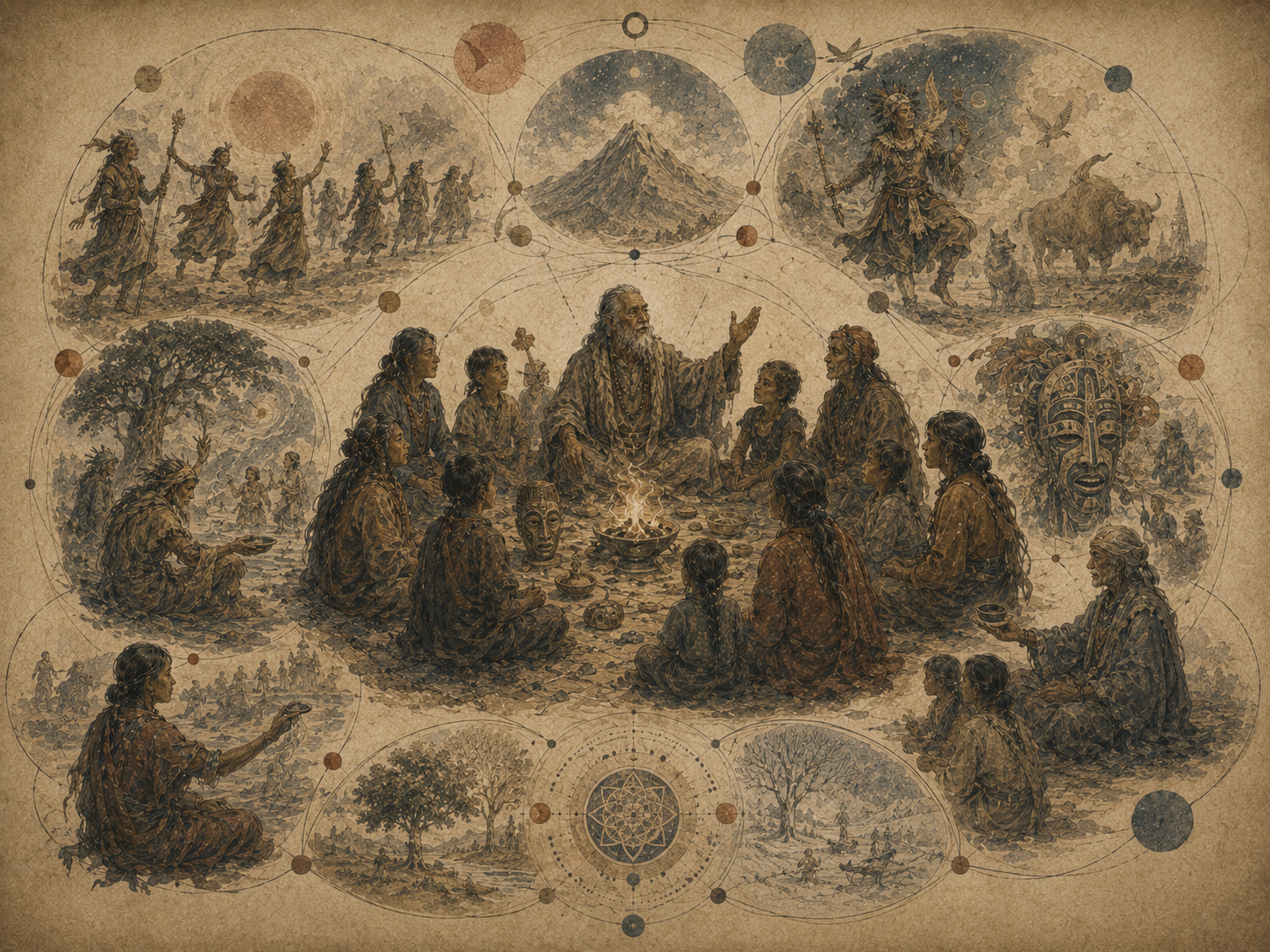
This article treats myth and ritual as linked systems of narrative, symbol, action, memory, and social meaning. It examines origin stories, sacred narratives, ritual action, symbolic objects, liminality, sacrifice, renewal, initiation, cultural identity, public authority, psychological interpretation, political misuse, and ethical interpretation. It also includes computational workflows for auditing symbolic narrative functions, ritual context, authority, ethical risk, interpretive uncertainty, and Catalyst Canvas-ready governance outputs.
Why Myth and Ritual Matter
Myth and ritual matter because human communities do not live by information alone. They live by meaningful patterns: stories of beginning, belonging, obligation, danger, loss, renewal, justice, exile, return, sacrifice, transformation, and hope. Myth gives symbolic narrative form to these patterns. Ritual makes them visible, repeatable, embodied, and socially shared.
A myth may tell how the world began, how death entered human life, why a people belong to a place, why a law has authority, why a ceremony must be repeated, why suffering has meaning, why a ruler is legitimate, why a moral boundary matters, or why a community must remember. Ritual can enact, recall, renew, or dramatize that story. Together, myth and ritual allow people to inhabit meaning rather than merely describe it.
This does not mean myth and ritual are always good. They can sustain courage, memory, solidarity, mourning, healing, and moral imagination. They can also justify hierarchy, exclusion, conquest, sacrifice, gender control, nationalism, institutional authority, or violence. The symbolic power of myth and ritual makes them both necessary and dangerous.
| Dimension | Mythic role | Ritual role |
|---|---|---|
| Origin | Tells where a world, people, practice, law, or obligation begins. | Reenacts or commemorates beginning through repeated action. |
| Order | Explains how reality, society, morality, or sacred relation is structured. | Embodies order through sequence, gesture, role, place, and timing. |
| Memory | Preserves what must not be forgotten. | Returns memory to communal action. |
| Transition | Gives narrative meaning to change, crisis, death, initiation, exile, or return. | Marks thresholds through formal action. |
| Identity | Names who “we” are and what obligations follow. | Makes belonging visible through participation. |
| Power | Can authorize authority, hierarchy, resistance, or critique. | Can stage legitimacy, loyalty, protest, renewal, or exclusion. |
Myth and ritual matter because they show how story becomes a structure of lived meaning.
Myth Is Not Simply Falsehood
In ordinary speech, “myth” often means false belief. In the study of religion, folklore, anthropology, literature, and cultural memory, myth has a more serious meaning. A myth is a symbolic narrative that carries significance for a community. It may speak about sacred origin, cosmic order, divine action, ancestral memory, moral boundary, cultural identity, or the deep pattern of human life.
Calling a story myth does not mean the analyst is dismissing it as a lie. It means the story is doing symbolic and cultural work. It may organize a community’s understanding of beginnings, obligations, relationships, dangers, hopes, and limits. A myth may be believed literally, interpreted symbolically, reenacted ritually, debated theologically, adapted artistically, or invoked politically. Its power lies in the work it performs.
Myth also differs from simple explanation. A myth may explain, but it often does more than explain. It orients. It authorizes. It remembers. It dramatizes. It warns. It places human life within a larger order. It gives emotional and moral force to ideas that abstract statements alone may not carry.
| Weak reading of myth | Stronger reading | Why it matters |
|---|---|---|
| Myth means falsehood. | Myth is symbolic narrative with cultural, sacred, or social significance. | It avoids dismissing traditions before understanding their work. |
| Myth only explains natural phenomena. | Myth also organizes values, memory, identity, authority, and ritual practice. | It captures myth’s social and symbolic functions. |
| Myth belongs only to ancient cultures. | Modern societies also create myths of origin, progress, nation, market, heroism, and destiny. | It shows symbolic story operating in public life today. |
| Myth is irrational. | Myth often works through symbol, image, analogy, drama, and ritual logic. | It recognizes non-technical forms of reasoning. |
| Myth is merely a story. | Myth can authorize institutions, rituals, moral worlds, and collective action. | It shows why myth has power. |
Myth is not simply an old story about things that did not happen. It is a symbolic story about what a community understands to be ultimately meaningful.
Ritual Is Not Empty Repetition
Ritual is often dismissed as mechanical repetition. But ritual repetition is not necessarily empty. Repetition can create order, memory, attention, discipline, belonging, transition, solemnity, anticipation, renewal, and recognition. A ritual may be repeated precisely because the community needs a stable form for returning to meaning.
Ritual can include speech, gesture, posture, movement, silence, song, chant, object use, costume, procession, sacrifice, washing, naming, blessing, oath, meal, exchange, burial, initiation, festival, or calendar observance. It may be religious, civic, familial, political, institutional, educational, or personal. Ritual may be formal and sacred, but it can also appear in graduation, court procedure, memorial ceremony, national commemoration, protest, workplace induction, or public mourning.
Ritual does not only represent meaning. It enacts meaning. A wedding ceremony does not merely discuss union; it publicly marks relation. A funeral does not merely state loss; it performs mourning. A civic oath does not merely describe loyalty; it binds a person to role. A protest march does not merely express disagreement; it stages collective presence.
| Ritual element | Symbolic function | Example question |
|---|---|---|
| Sequence | Orders action into meaningful stages. | What must happen first, next, and last? |
| Repetition | Stabilizes memory and recognition. | What meaning depends on repeated form? |
| Gesture | Embodies relation, humility, authority, grief, blessing, or transition. | What does the body do that words alone do not? |
| Object | Concentrates symbolic meaning in material form. | What object carries memory, authority, or sacred relation? |
| Place | Frames action within a charged setting. | Why must the ritual occur here? |
| Participation | Makes meaning communal and visible. | Who participates, watches, leads, or is excluded? |
Ritual is repeated action that makes meaning socially present.
The Symbolic Work of Story
The symbolic work of story is the work a narrative does beyond literal description. A story can hold together meanings that are difficult to state directly: birth and death, purity and danger, exile and belonging, guilt and repair, chaos and order, sacrifice and renewal, forbidden knowledge and transformation, human limitation and sacred possibility.
Symbols do not work by simple code. A symbol can gather many meanings at once. Fire may mean destruction, purification, knowledge, divine presence, danger, renewal, or judgment depending on context. Water may mean birth, cleansing, death, passage, blessing, chaos, fertility, or boundary. A journey may mean exile, pilgrimage, maturation, testing, punishment, discovery, or return.
Mythic stories use symbolic patterns to organize experience. Rituals often embody those patterns. The story of descent may become a ritual of mourning or initiation. The story of creation may become a festival of renewal. The story of sacrifice may become a meal, offering, remembrance, or moral drama. The story of return may become pilgrimage, procession, or commemorative gathering.
| Symbolic pattern | Story function | Ritual or cultural function |
|---|---|---|
| Creation | Explains beginning, order, relation, or obligation. | Renewal festival, sacred calendar, institutional founding. |
| Fall or rupture | Names loss, disorder, guilt, exile, or broken relation. | Confession, mourning, repair, purification. |
| Journey | Frames testing, growth, exile, pilgrimage, or return. | Procession, pilgrimage, initiation, public march. |
| Descent | Represents death, grief, hidden knowledge, trial, or transformation. | Funerary rite, initiation, vigil, underworld symbolism. |
| Sacrifice | Dramatizes cost, offering, substitution, loss, renewal, or obligation. | Offering, memorial, oath, communal meal, renunciation. |
| Return | Restores relation, memory, identity, or rightful order. | Homecoming, restoration ritual, annual commemoration. |
The symbolic work of story is not decoration. It is how narrative carries meanings too dense for simple explanation.
Origin, Order, and Cosmos
Many myths begin with origin. They tell how the world, a people, a law, a ritual, a place, a plant, an animal, a season, a language, a moral boundary, a sacred object, or an institution came to be. Origin stories matter because beginnings often carry authority. To tell how something began is often to tell what it is for.
An origin myth may establish cosmic order: sky and earth, life and death, human and divine, male and female, kin and stranger, sacred and ordinary, purity and danger, law and transgression. The story may not be concerned with chronological history in a modern sense. Its concern may be symbolic order: how the world is meaningful and how human beings should live within it.
Ritual can return to origin. A community may reenact creation, retell a founding story, repeat a sacred phrase, visit a place of beginning, observe an annual festival, renew a covenant, or recite a genealogy. The ritual does not merely remember the beginning; it makes the beginning present as a source of identity and obligation.
| Origin theme | Mythic question | Symbolic work |
|---|---|---|
| World origin | How did ordered reality emerge? | Creates a cosmos rather than a random environment. |
| Human origin | What kind of beings are humans? | Defines dignity, limitation, duty, vulnerability, or relation. |
| Social origin | How did a people, law, office, or institution begin? | Authorizes collective identity and structure. |
| Ritual origin | Why must this ceremony be repeated? | Connects present action to sacred or ancestral precedent. |
| Moral origin | Why are certain acts forbidden, required, or honored? | Gives values narrative force. |
| Place origin | Why does this land, river, city, shrine, or route matter? | Links geography to memory and obligation. |
Origin stories do symbolic work by making the beginning a source of order.
Ritual Action and Embodied Meaning
Ritual turns symbolic meaning into action. A story may speak of purification; ritual washing embodies cleansing. A story may speak of exile; ritual procession embodies movement. A story may speak of sacrifice; an offering embodies cost. A story may speak of death and renewal; burial, mourning, vigil, or seasonal festival gives that pattern visible form.
Embodied meaning matters because people do not only think meaning. They stand, kneel, sing, chant, walk, touch, taste, wash, fast, feast, exchange, wear, carry, mark, light, bury, lift, bow, and gather. Ritual makes symbolic order tangible. It gives the body a role in memory and transformation.
Ritual action also makes meaning public. A private belief becomes visible in ceremony. A transition becomes recognized by others. A loss becomes mourned together. A vow becomes witnessed. A social identity becomes enacted. A collective story becomes shared action.
| Ritual action | Possible symbolic meaning | Story relation |
|---|---|---|
| Washing | Cleansing, renewal, boundary crossing, preparation. | Embodies purification, birth, return, or readiness. |
| Procession | Journey, pilgrimage, exile, return, public presence. | Enacts movement through symbolic space. |
| Offering | Gratitude, sacrifice, exchange, obligation, dependence. | Dramatizes relation between human action and larger order. |
| Fasting | Discipline, mourning, preparation, purification, dependence. | Embodies restraint and threshold experience. |
| Feasting | Communion, abundance, memory, celebration, reconciliation. | Turns story into shared meal and belonging. |
| Naming | Recognition, identity, lineage, transformation, status. | Marks a person or community within a narrative order. |
Ritual action matters because symbolic story becomes social reality through the body.
Liminality, Thresholds, and Transformation
Many myths and rituals focus on thresholds. A person moves from childhood to adulthood, outsider to insider, uninitiated to initiated, single to married, living to dead, impure to purified, ordinary time to sacred time, exile to return, danger to restoration, chaos to order. The threshold is a dangerous and meaningful middle state.
Liminality names this threshold condition. In a liminal phase, ordinary categories may be suspended or rearranged. The person or group is no longer what they were, but not yet what they will become. Story often frames this moment through images of wilderness, night, descent, exile, trial, cave, forest, sea, mountain, tomb, journey, or underworld. Ritual gives the threshold structure.
Threshold rituals are powerful because transformation needs form. Without form, change can feel chaotic or invisible. A ritual marks the transition, witnesses it, protects it, and integrates it into communal meaning. Myth explains why the threshold matters; ritual carries people through it.
| Threshold pattern | Mythic image | Ritual function |
|---|---|---|
| Initiation | Trial, seclusion, instruction, symbolic death, new name. | Marks passage into new social or spiritual role. |
| Marriage | Union, covenant, journey, joining of families or worlds. | Publicly recognizes changed relation. |
| Death | Descent, crossing, return to ancestors, transformation, judgment. | Frames mourning and communal continuity. |
| Exile | Wilderness, wandering, loss, testing, longing. | Gives form to displacement and hope of return. |
| Purification | Stain, cleansing, boundary, renewal. | Restores relation or prepares entry. |
| Renewal | Spring, rebirth, restoration, new creation. | Reopens the future after rupture. |
Myth and ritual give thresholds a language, a sequence, and a social witness.
Memory, Identity, and Belonging
Myth and ritual are powerful systems of collective memory. They tell communities what must be remembered, how it should be remembered, who belongs to the memory, and what obligations follow. A founding story, pilgrimage, calendar festival, ancestor ceremony, national memorial, sacred meal, commemorative procession, or ritual recitation can transform memory into identity.
Memory becomes identity when stories answer the question “Who are we?” Myth may answer through origin, covenant, migration, exile, sacrifice, victory, suffering, revelation, survival, or return. Ritual allows the community to rehearse that identity. Participation says: this story includes us, and we continue it.
Belonging, however, always has boundaries. Mythic belonging can include and exclude. A story of chosen people, founding sacrifice, ancestral land, sacred destiny, or national mission can create solidarity, but it can also make outsiders dangerous, impure, inferior, invisible, or disposable. Responsible interpretation asks how mythic memory forms identity and how it treats those outside the circle.
| Memory form | Story function | Ethical question |
|---|---|---|
| Founding memory | Tells how the community began. | Who is included or excluded from the founding story? |
| Ancestral memory | Connects the present to past generations. | Whose ancestors are remembered, and whose are erased? |
| Suffering memory | Preserves trauma, oppression, exile, or sacrifice. | Does memory heal, warn, politicize, or harden into grievance? |
| Victory memory | Celebrates survival, liberation, conquest, or renewal. | Whose loss is hidden inside another group’s triumph? |
| Covenant memory | Binds identity to obligation. | What responsibilities follow from belonging? |
| Return memory | Frames homecoming, restoration, or future hope. | What claims does return create over land, people, or institutions? |
Myth and ritual make memory durable by turning it into identity and repeated practice.
Sacrifice, Renewal, and Repair
Sacrifice is one of the most powerful and dangerous symbolic patterns in myth and ritual. It can represent offering, gratitude, renunciation, cost, substitution, purification, exchange, devotion, atonement, repair, or renewal. It can also justify harm when communities decide that someone or something must bear the cost of restoring order.
Myths of sacrifice often address rupture. Something has gone wrong: disorder, guilt, drought, plague, violence, loss, sin, broken covenant, or social crisis. Sacrifice becomes a symbolic grammar of repair. The offering may restore relation, acknowledge dependence, mark seriousness, transfer blame, dramatize cost, or renew community.
The ethical danger is scapegoating. When symbolic repair is projected onto vulnerable people, sacrifice becomes violence. A community may imagine that order can be restored by expelling, punishing, silencing, blaming, or destroying someone marked as impure, foreign, guilty, corrupting, or dangerous. Responsible interpretation distinguishes symbolic patterns of repair from actual harm.
| Sacrificial pattern | Symbolic work | Ethical risk |
|---|---|---|
| Offering | Expresses gratitude, dependence, devotion, or obligation. | Can become coercive if demanded by power. |
| Renunciation | Marks discipline, seriousness, or transformation. | Can glorify suffering unnecessarily. |
| Substitution | Transfers cost or represents repair through another figure. | Can justify scapegoating. |
| Purification | Symbolically removes pollution, guilt, or disorder. | Can mark people as impure. |
| Memorial sacrifice | Honors loss and binds community memory. | Can demand endless loyalty to past violence. |
| Renewal | Opens a future after rupture. | Can hide who paid the cost of renewal. |
Sacrifice is symbolically powerful because it dramatizes cost. It is ethically dangerous when the cost is imposed on others without justice.
Myth, Ritual, and Power
Myth and ritual are never separate from power. A myth may authorize a king, priesthood, nation, family order, legal system, caste, class, institution, profession, market, army, school, or movement. A ritual may stage loyalty, legitimacy, succession, obedience, protest, remembrance, or resistance. Symbolic stories help communities know what is sacred, lawful, honorable, shameful, heroic, forbidden, or necessary.
Power uses myth because myth reaches deeper than policy. It can make authority feel natural, ancient, sacred, inevitable, or heroic. Power uses ritual because ritual makes authority visible and repeatable. Coronations, inaugurations, pledges, uniforms, flags, memorials, court ceremonies, academic processions, military rites, and corporate rituals all use symbolic form to stage order.
But myth and ritual can also challenge power. Prophetic stories, liberation narratives, protest chants, counter-memorials, public mourning, pilgrimages, and rituals of refusal can expose injustice and imagine another order. The same symbolic machinery that stabilizes institutions can also contest them.
| Power function | Mythic mechanism | Ritual mechanism |
|---|---|---|
| Legitimation | Authority is tied to origin, destiny, sacred order, or founding sacrifice. | Authority is staged through ceremony, office, procession, oath, or symbol. |
| Obedience | Duties are framed as cosmic, ancestral, national, or moral necessity. | Repetition trains recognition and loyalty. |
| Boundary-making | Insiders and outsiders are narratively distinguished. | Participation or exclusion marks belonging. |
| Resistance | Counter-stories expose false order or remember suppressed suffering. | Counter-rituals stage refusal, mourning, protest, or solidarity. |
| Institutional memory | Founding stories define mission and identity. | Anniversaries, initiations, and ceremonies renew institutional meaning. |
| Public emotion | Stories organize fear, hope, grief, pride, guilt, or anger. | Gatherings embody and amplify emotion. |
Myth and ritual shape power because they define not only what people think, but what they feel, repeat, honor, and enact.
Psychological and Symbolic Interpretation
Myth and ritual also invite psychological interpretation. Stories of descent, monster, shadow, divine child, great mother, wise elder, trickster, death, rebirth, exile, return, hero, flood, garden, sacrifice, and transformation can express recurring human experiences. Ritual can give form to grief, fear, desire, guilt, maturity, separation, belonging, and renewal.
Analytical psychology has treated myth as one place where symbolic patterns of the psyche become visible. This does not mean every myth has one universal meaning. It means mythic images can resonate across personal and cultural life because they give shape to difficult experiences: inner conflict, maturation, shadow, loss, longing, wholeness, and transformation.
A strong symbolic interpretation must remain culturally responsible. Psychological meaning should not erase historical context, language, ritual authority, community ownership, or religious belief. A myth may carry psychological meaning, but it is also part of a tradition. Interpretation becomes irresponsible when it treats living stories as raw material for private symbolism alone.
| Symbolic motif | Possible psychological resonance | Interpretive caution |
|---|---|---|
| Descent | Encounter with grief, fear, unconscious material, or hidden knowledge. | May also have specific ritual, religious, or cultural meaning. |
| Monster | Externalized danger, shadow, chaos, or moral testing. | Can be used to dehumanize outsiders. |
| Trickster | Disruption, ambiguity, creativity, appetite, boundary crossing. | Should not be flattened into comic rebellion alone. |
| Great mother | Nurture, origin, engulfment, fertility, earth, protection, danger. | Can become gender essentialism if mishandled. |
| Death and rebirth | Transformation, loss, initiation, renewal, identity change. | Should not trivialize actual death or trauma. |
| Return | Integration, homecoming, reconciliation, restored relation. | May involve contested land, memory, or political claim. |
Symbolic interpretation is valuable when it deepens meaning without removing myth from culture, ritual, history, and ethical responsibility.
Modern Myths and Public Rituals
Modern societies often imagine themselves as post-mythic. Yet modern public life is full of mythic and ritual forms. Nations tell founding myths. Companies tell origin stories. Movements tell liberation stories. Institutions repeat ceremonies. Markets tell stories of progress and innovation. Technologies are framed as salvation, disruption, destiny, or apocalypse. Public life is organized through flags, anthems, inaugurations, memorials, graduations, anniversaries, pledges, awards, marches, brand rituals, and platform events.
These modern myths may not involve gods, but they still perform symbolic work. They organize identity, authority, hope, fear, legitimacy, sacrifice, progress, and belonging. They tell people where they are in history and what role they are expected to play. Public rituals make these stories visible.
Modern myths are especially powerful because they often deny that they are myths. A story of inevitable progress may present itself as neutral analysis. A national destiny story may present itself as history. A market myth may present itself as common sense. A technology myth may present itself as innovation. Critical interpretation asks what symbolic pattern is operating.
| Modern setting | Mythic pattern | Ritual form |
|---|---|---|
| Nation | Founding, sacrifice, destiny, chosen people, liberation, renewal. | Inauguration, memorial, anthem, flag ceremony, national holiday. |
| Corporation | Founder hero, disruption, mission, origin garage, transformation. | Launch event, onboarding, award ceremony, annual meeting. |
| Technology | Salvation, apocalypse, acceleration, frontier, new creation. | Keynote, demo, release cycle, platform ritual. |
| Social movement | Liberation, awakening, sacrifice, return of justice. | March, chant, vigil, teach-in, memorial action. |
| Education | Initiation, passage, merit, enlightenment, professional identity. | Graduation, oath, robe, procession, diploma ceremony. |
| Media culture | Hero, villain, scandal, redemption, downfall, return. | Award show, fan convention, live spectacle, public apology. |
Modernity does not abolish myth and ritual. It relocates them into public, institutional, technological, and media life.
Ethical Risks in Mythic and Ritual Storytelling
Mythic and ritual storytelling carries ethical risk because symbolic stories do not merely entertain. They orient emotion, identity, obedience, belonging, and action. A myth can make a community generous, resilient, and accountable. It can also make a community fearful, superior, resentful, or violent.
One risk is totalization. A myth may become so powerful that alternative stories are treated as betrayal. Another risk is scapegoating: symbolic repair is projected onto an enemy who must be expelled. Another risk is sacred cover: institutions use myth and ritual to protect power from criticism. Another risk is symbolic appropriation: sacred stories or rituals are taken from communities and reused for branding, entertainment, therapy, or political spectacle.
Ethical interpretation does not destroy myth. It asks how myth works, who benefits, who is harmed, who is authorized, what memory is preserved, what memory is erased, and what action the story invites.
| Ethical risk | How it appears | Review question |
|---|---|---|
| Totalization | One myth becomes the only permitted account of identity or truth. | What alternative memories are excluded? |
| Scapegoating | Rupture is blamed on a marked person or group. | Who is made to carry symbolic guilt? |
| Sacred cover | Ritual or myth shields authority from accountability. | What power is protected by the story? |
| Appropriation | Stories, symbols, or rituals are reused without consent. | Who has authority to adapt or perform this material? |
| Mythic simplification | Complex history becomes destiny, purity, heroism, or betrayal. | What complexity has been erased? |
| Ritual exclusion | Belonging is performed by excluding others from participation. | Who is barred from the ritual community? |
The ethical task is not to eliminate symbolic story, but to interpret its power responsibly.
Examples of Myth, Ritual, and Symbolic Story Work
The examples below show how myth and ritual can be analyzed without reducing them to falsehood, superstition, or decoration.
Creation story and renewal festival
Weak: The creation story is treated as an outdated explanation of nature.
Stronger: The analysis asks how the story organizes cosmic order, sacred time, agricultural rhythm, ritual renewal, and communal obligation.
Why it works: Myth is read as symbolic orientation, not failed science.
Initiation rite
Weak: The ritual is described as strange repetition.
Stronger: The analysis tracks separation, threshold, instruction, ordeal, symbolic death, new name, and return to community.
Why it works: Ritual is read as a structured passage through transformation.
National founding myth
Weak: The founding story is repeated as neutral history.
Stronger: The analysis asks what sacrifice, destiny, belonging, exclusion, and authority the story creates.
Why it works: Public myth is examined as symbolic power.
Memorial ceremony
Weak: The ceremony is treated as a formal tribute.
Stronger: The analysis asks how grief, sacrifice, identity, obligation, and public memory are ritualized.
Why it works: Ritual is understood as communal memory in action.
Corporate origin story
Weak: The founder story is treated as branding copy.
Stronger: The analysis asks how origin, heroism, mission, sacrifice, disruption, and employee identity are constructed.
Why it works: Mythic form is recognized in institutional life.
Appropriated ritual symbol
Weak: The symbol is admired for aesthetic meaning.
Stronger: The analysis asks who owns, performs, transmits, restricts, or authorizes the symbol and what harm occurs through reuse.
Why it works: Symbolic interpretation is joined to ethics and authority.
Myth and ritual analysis should ask what symbolic work a story performs and what responsibilities follow from that work.
Mathematics, Computation, and Modeling
Myth and ritual cannot be reduced to formulas, but modeling can help make interpretive questions explicit. A computational workflow can audit whether a symbolic story is being interpreted with enough attention to context, ritual form, community authority, ethical risk, power, memory, and interpretive uncertainty.
A symbolic-function score can estimate how many layers of symbolic work are present:
S_f = \frac{O_r + C_o + M_e + I_d + T_r + A_u}{6}
\]
Interpretation: Symbolic function \(S_f\) averages origin function \(O_r\), cosmological order \(C_o\), memory function \(M_e\), identity function \(I_d\), transition function \(T_r\), and authority function \(A_u\).
A ritual-context score can estimate whether the analysis preserves the ritual setting:
R_c = \frac{S_q + P_l + G_e + O_b + A_d + P_t}{6}
\]
Interpretation: Ritual context \(R_c\) averages sequence clarity \(S_q\), place linkage \(P_l\), gesture documentation \(G_e\), object symbolism \(O_b\), audience or participant role \(A_d\), and protocol transparency \(P_t\).
An ethical-risk score can estimate whether symbolic story may justify harm or misuse:
E_r = T_ow_t + S_cw_s + X_cw_x + A_pw_a + H_ew_h + (1 – G_c)w_g
\]
Interpretation: Ethical risk \(E_r\) rises with totalizing order \(T_o\), scapegoating \(S_c\), exclusion \(X_c\), appropriation risk \(A_p\), harm exposure \(H_e\), and weak governance control \(G_c\).
A symbolic-interpretation readiness score can estimate whether the article, archive, lesson, or analysis is ready for publication:
I_r = \frac{C_x + R_v + L_n + A_c + G_o + U_m}{6}
\]
Interpretation: Interpretation readiness \(I_r\) averages context explanation \(C_x\), ritual verification \(R_v\), language notes \(L_n\), access control \(A_c\), governance oversight \(G_o\), and uncertainty marking \(U_m\).
| Modeling task | Interpretive question | Example output |
|---|---|---|
| Symbolic function audit | What work does the myth perform beyond plot? | Symbolic function score. |
| Ritual context audit | Is ritual sequence, place, object, gesture, and participant role preserved? | Ritual context score. |
| Power audit | What authority, identity, exclusion, or resistance does the story authorize? | Power and legitimacy table. |
| Ethical-risk audit | Does the story totalize, scapegoat, appropriate, erase, or justify harm? | Ethical risk score. |
| Interpretive readiness audit | Are context, language, ritual verification, access, and uncertainty documented? | Publication readiness table. |
| Governance queue | Which items need cultural, source, ethics, access, or power review? | Symbolic story governance queue. |
Computation can support myth and ritual analysis when it makes symbolic function, ritual context, and ethical risk visible. It should never replace community interpretation, religious understanding, cultural expertise, or human judgment.
Python Workflow: Myth and Ritual Symbolic Function Audit
The Python workflow below evaluates myth and ritual items by origin function, cosmological order, memory function, identity function, transition function, authority function, sequence clarity, place linkage, gesture documentation, object symbolism, participant role, protocol transparency, totalizing order, scapegoating risk, exclusion risk, appropriation risk, harm exposure, governance control, context explanation, ritual verification, language notes, access control, governance oversight, and uncertainty marking. The companion repository version extends this into a Catalyst Canvas-ready module with schemas, package-style Python, tests, JSON exports, Canvas cards, markdown governance queues, and reusable symbolic interpretation templates.
# myth_ritual_symbolic_audit.py
# Dependency-light workflow for auditing myth, ritual, and symbolic story work.

from __future__ import annotations

from dataclasses import dataclass
from pathlib import Path
import csv
import json
from statistics import mean

ARTICLE_ROOT = Path(__file__).resolve().parents[1]
OUTPUTS = ARTICLE_ROOT / "outputs"
TABLES = OUTPUTS / "tables"
JSON_DIR = OUTPUTS / "json"
MARKDOWN = OUTPUTS / "markdown"


@dataclass
class MythRitualSymbolicItem:
    item: str
    symbolic_context: str
    origin_function: float
    cosmological_order: float
    memory_function: float
    identity_function: float
    transition_function: float
    authority_function: float
    sequence_clarity: float
    place_linkage: float
    gesture_documentation: float
    object_symbolism: float
    participant_role: float
    protocol_transparency: float
    totalizing_order: float
    scapegoating_risk: float
    exclusion_risk: float
    appropriation_risk: float
    harm_exposure: float
    governance_control: float
    context_explanation: float
    ritual_verification: float
    language_notes: float
    access_control: float
    governance_oversight: float
    uncertainty_marking: float
    community_sensitivity: float
    public_consequence: float
    owner: str
    status: str

    def symbolic_function(self) -> float:
        return mean([
            self.origin_function,
            self.cosmological_order,
            self.memory_function,
            self.identity_function,
            self.transition_function,
            self.authority_function,
        ])

    def ritual_context(self) -> float:
        return mean([
            self.sequence_clarity,
            self.place_linkage,
            self.gesture_documentation,
            self.object_symbolism,
            self.participant_role,
            self.protocol_transparency,
        ])

    def ethical_risk(self) -> float:
        return min(
            1.0,
            self.totalizing_order * 0.18
            + self.scapegoating_risk * 0.20
            + self.exclusion_risk * 0.18
            + self.appropriation_risk * 0.18
            + self.harm_exposure * 0.16
            + (1 - self.governance_control) * 0.10,
        )

    def interpretation_readiness(self) -> float:
        return mean([
            self.context_explanation,
            self.ritual_verification,
            self.language_notes,
            self.access_control,
            self.governance_oversight,
            self.uncertainty_marking,
        ])

    def governance_priority_score(self) -> float:
        return min(
            1.0,
            self.ethical_risk() * 0.35
            + self.community_sensitivity * 0.25
            + self.public_consequence * 0.20
            + (1 - self.interpretation_readiness()) * 0.20,
        )

    def review_priority(self) -> str:
        risk = self.ethical_risk()
        priority = self.governance_priority_score()
        readiness = self.interpretation_readiness()

        if self.status == "revise" or risk >= 0.55 or priority >= 0.62 or readiness < 0.55:
            return "high"
        if self.status == "review" or risk >= 0.40 or priority >= 0.48 or readiness < 0.68:
            return "medium"
        return "standard"


def write_csv(path: Path, rows: list[dict[str, object]]) -> None:
    path.parent.mkdir(parents=True, exist_ok=True)
    if not rows:
        raise ValueError(f"No rows to write: {path}")
    with path.open("w", encoding="utf-8", newline="") as handle:
        writer = csv.DictWriter(handle, fieldnames=list(rows[0].keys()))
        writer.writeheader()
        writer.writerows(rows)


def write_json(path: Path, payload: object) -> None:
    path.parent.mkdir(parents=True, exist_ok=True)
    path.write_text(json.dumps(payload, indent=2), encoding="utf-8")


def write_markdown_queue(path: Path, rows: list[dict[str, object]]) -> None:
    path.parent.mkdir(parents=True, exist_ok=True)
    lines = [
        "# Myth and Ritual Symbolic Governance Queue",
        "",
        "| Item | Context | Symbolic function | Ritual context | Ethical risk | Readiness | Priority | Owner |",
        "|---|---|---:|---:|---:|---:|---|---|",
    ]

    for row in rows:
        lines.append(
            f"| {row['item']} | {row['symbolic_context']} | "
            f"{row['symbolic_function']} | {row['ritual_context']} | "
            f"{row['ethical_risk']} | {row['interpretation_readiness']} | "
            f"{row['review_priority']} | {row['owner']} |"
        )

    path.write_text("\n".join(lines) + "\n", encoding="utf-8")


def main() -> None:
    items = [
        MythRitualSymbolicItem(
            "Creation story and renewal festival",
            "origin myth and ritual calendar",
            0.94, 0.92, 0.84, 0.76, 0.70, 0.78,
            0.82, 0.78, 0.74, 0.82, 0.76, 0.70,
            0.32, 0.22, 0.24, 0.28, 0.30, 0.78,
            0.80, 0.74, 0.70, 0.72, 0.76, 0.70,
            0.74, 0.62,
            "editorial", "active"
        ),
        MythRitualSymbolicItem(
            "Initiation rite",
            "threshold ritual and transformation story",
            0.70, 0.66, 0.78, 0.84, 0.94, 0.82,
            0.90, 0.74, 0.86, 0.78, 0.88, 0.72,
            0.36, 0.28, 0.42, 0.34, 0.40, 0.72,
            0.76, 0.82, 0.68, 0.66, 0.78, 0.72,
            0.82, 0.70,
            "cultural review", "active"
        ),
        MythRitualSymbolicItem(
            "National founding myth",
            "public origin story and civic ritual",
            0.88, 0.78, 0.86, 0.94, 0.62, 0.92,
            0.76, 0.84, 0.62, 0.78, 0.88, 0.74,
            0.76, 0.58, 0.70, 0.30, 0.62, 0.54,
            0.70, 0.64, 0.72, 0.78, 0.66, 0.62,
            0.82, 0.88,
            "ethics review", "review"
        ),
        MythRitualSymbolicItem(
            "Corporate origin story",
            "institutional founding myth",
            0.82, 0.42, 0.64, 0.76, 0.48, 0.88,
            0.54, 0.40, 0.36, 0.50, 0.60, 0.42,
            0.64, 0.22, 0.40, 0.36, 0.44, 0.50,
            0.54, 0.38, 0.42, 0.48, 0.44, 0.46,
            0.50, 0.68,
            "institutional review", "review"
        ),
        MythRitualSymbolicItem(
            "Appropriated ritual symbol",
            "symbolic reuse without authority",
            0.44, 0.48, 0.54, 0.50, 0.40, 0.56,
            0.34, 0.32, 0.28, 0.52, 0.26, 0.20,
            0.42, 0.28, 0.62, 0.94, 0.78, 0.18,
            0.30, 0.22, 0.34, 0.18, 0.24, 0.28,
            0.96, 0.84,
            "governance", "revise"
        ),
    ]

    rows = []

    for item in items:
        rows.append({
            "item": item.item,
            "symbolic_context": item.symbolic_context,
            "symbolic_function": round(item.symbolic_function(), 3),
            "ritual_context": round(item.ritual_context(), 3),
            "ethical_risk": round(item.ethical_risk(), 3),
            "interpretation_readiness": round(item.interpretation_readiness(), 3),
            "governance_priority_score": round(item.governance_priority_score(), 3),
            "review_priority": item.review_priority(),
            "owner": item.owner,
            "status": item.status,
        })

    priority_order = {"high": 3, "medium": 2, "standard": 1}
    rows = sorted(
        rows,
        key=lambda row: (
            priority_order.get(str(row["review_priority"]), 0),
            float(row["ethical_risk"])
        ),
        reverse=True,
    )

    governance_queue = [
        row for row in rows
        if row["review_priority"] != "standard"
    ]

    write_csv(TABLES / "myth_ritual_symbolic_audit.csv", rows)
    write_csv(TABLES / "myth_ritual_symbolic_governance_queue.csv", governance_queue)

    write_json(JSON_DIR / "myth_ritual_symbolic_canvas_cards.json", rows)
    write_json(JSON_DIR / "myth_ritual_symbolic_governance_queue.json", governance_queue)

    write_markdown_queue(MARKDOWN / "myth_ritual_symbolic_governance_queue.md", governance_queue)

    print("Myth and ritual symbolic audit complete.")


if __name__ == "__main__":
    main()
This workflow helps distinguish symbolic interpretation from weak context, ritual flattening, cultural appropriation, scapegoating, totalizing myth, and ethical risk.
R Workflow: Myth, Ritual, and Symbolic Risk Diagnostics
The R workflow below creates a synthetic myth-and-ritual dataset, calculates symbolic function, ritual context, ethical risk, interpretation readiness, governance priority, and review priority, then exports summary tables and base R plots. It is intentionally portable and uses only base R.
# myth_ritual_symbolic_diagnostics.R
# Base R workflow for myth, ritual, and symbolic story analysis.

args <- commandArgs(trailingOnly = FALSE)
file_arg <- grep("^--file=", args, value = TRUE)

if (length(file_arg) > 0) {
  script_path <- normalizePath(sub("^--file=", "", file_arg[1]), mustWork = TRUE)
  article_root <- normalizePath(file.path(dirname(script_path), ".."), mustWork = TRUE)
} else {
  article_root <- getwd()
}

setwd(article_root)

tables_dir <- file.path(article_root, "outputs", "tables")
figures_dir <- file.path(article_root, "outputs", "figures")
dir.create(tables_dir, recursive = TRUE, showWarnings = FALSE)
dir.create(figures_dir, recursive = TRUE, showWarnings = FALSE)

items <- data.frame(
  item = c(
    "Creation story and renewal festival",
    "Initiation rite",
    "National founding myth",
    "Corporate origin story",
    "Appropriated ritual symbol"
  ),
  symbolic_context = c(
    "origin myth and ritual calendar",
    "threshold ritual and transformation story",
    "public origin story and civic ritual",
    "institutional founding myth",
    "symbolic reuse without authority"
  ),
  origin_function = c(0.94, 0.70, 0.88, 0.82, 0.44),
  cosmological_order = c(0.92, 0.66, 0.78, 0.42, 0.48),
  memory_function = c(0.84, 0.78, 0.86, 0.64, 0.54),
  identity_function = c(0.76, 0.84, 0.94, 0.76, 0.50),
  transition_function = c(0.70, 0.94, 0.62, 0.48, 0.40),
  authority_function = c(0.78, 0.82, 0.92, 0.88, 0.56),
  sequence_clarity = c(0.82, 0.90, 0.76, 0.54, 0.34),
  place_linkage = c(0.78, 0.74, 0.84, 0.40, 0.32),
  gesture_documentation = c(0.74, 0.86, 0.62, 0.36, 0.28),
  object_symbolism = c(0.82, 0.78, 0.78, 0.50, 0.52),
  participant_role = c(0.76, 0.88, 0.88, 0.60, 0.26),
  protocol_transparency = c(0.70, 0.72, 0.74, 0.42, 0.20),
  totalizing_order = c(0.32, 0.36, 0.76, 0.64, 0.42),
  scapegoating_risk = c(0.22, 0.28, 0.58, 0.22, 0.28),
  exclusion_risk = c(0.24, 0.42, 0.70, 0.40, 0.62),
  appropriation_risk = c(0.28, 0.34, 0.30, 0.36, 0.94),
  harm_exposure = c(0.30, 0.40, 0.62, 0.44, 0.78),
  governance_control = c(0.78, 0.72, 0.54, 0.50, 0.18),
  context_explanation = c(0.80, 0.76, 0.70, 0.54, 0.30),
  ritual_verification = c(0.74, 0.82, 0.64, 0.38, 0.22),
  language_notes = c(0.70, 0.68, 0.72, 0.42, 0.34),
  access_control = c(0.72, 0.66, 0.78, 0.48, 0.18),
  governance_oversight = c(0.76, 0.78, 0.66, 0.44, 0.24),
  uncertainty_marking = c(0.70, 0.72, 0.62, 0.46, 0.28),
  community_sensitivity = c(0.74, 0.82, 0.82, 0.50, 0.96),
  public_consequence = c(0.62, 0.70, 0.88, 0.68, 0.84),
  owner = c("editorial", "cultural review", "ethics review", "institutional review", "governance"),
  status = c("active", "active", "review", "review", "revise"),
  stringsAsFactors = FALSE
)

items$symbolic_function <- rowMeans(items[, c(
  "origin_function",
  "cosmological_order",
  "memory_function",
  "identity_function",
  "transition_function",
  "authority_function"
)])

items$ritual_context <- rowMeans(items[, c(
  "sequence_clarity",
  "place_linkage",
  "gesture_documentation",
  "object_symbolism",
  "participant_role",
  "protocol_transparency"
)])

items$ethical_risk <- pmin(
  1,
  items$totalizing_order * 0.18 +
    items$scapegoating_risk * 0.20 +
    items$exclusion_risk * 0.18 +
    items$appropriation_risk * 0.18 +
    items$harm_exposure * 0.16 +
    (1 - items$governance_control) * 0.10
)

items$interpretation_readiness <- rowMeans(items[, c(
  "context_explanation",
  "ritual_verification",
  "language_notes",
  "access_control",
  "governance_oversight",
  "uncertainty_marking"
)])

items$governance_priority_score <- pmin(
  1,
  items$ethical_risk * 0.35 +
    items$community_sensitivity * 0.25 +
    items$public_consequence * 0.20 +
    (1 - items$interpretation_readiness) * 0.20
)

items$review_priority <- ifelse(
  items$status == "revise" | items$ethical_risk >= 0.55 | items$governance_priority_score >= 0.62 | items$interpretation_readiness < 0.55,
  "high",
  ifelse(
    items$status == "review" | items$ethical_risk >= 0.40 | items$governance_priority_score >= 0.48 | items$interpretation_readiness < 0.68,
    "medium",
    "standard"
  )
)

items <- items[order(items$ethical_risk, decreasing = TRUE), ]

write.csv(
  items,
  file.path(tables_dir, "myth_ritual_symbolic_diagnostics.csv"),
  row.names = FALSE
)

governance_queue <- items[items$review_priority != "standard", ]

write.csv(
  governance_queue,
  file.path(tables_dir, "myth_ritual_symbolic_governance_queue.csv"),
  row.names = FALSE
)

png(file.path(figures_dir, "symbolic_function_scores.png"), width = 1200, height = 700)
barplot(
  items$symbolic_function,
  names.arg = items$item,
  las = 2,
  ylab = "Symbolic function",
  main = "Myth and Ritual Symbolic Function Scores"
)
grid()
dev.off()

png(file.path(figures_dir, "ethical_risk_scores.png"), width = 1200, height = 700)
barplot(
  items$ethical_risk,
  names.arg = items$item,
  las = 2,
  ylab = "Ethical risk",
  main = "Myth and Ritual Ethical Risk Scores"
)
grid()
dev.off()

print(items[, c(
  "item",
  "symbolic_context",
  "symbolic_function",
  "ritual_context",
  "ethical_risk",
  "interpretation_readiness",
  "governance_priority_score",
  "review_priority"
)])
This workflow turns myth, ritual, and symbolic interpretation into a reviewable analysis object while preserving the central point: symbolic stories require context, ritual understanding, ethical caution, and interpretive humility.
GitHub Repository
The companion repository for this article supports myth, ritual, and symbolic story analysis as a Catalyst Canvas-ready module. It includes symbolic-function scoring, ritual-context diagnostics, ethical-risk review, interpretation-readiness checks, power and authority review, cultural and access governance, JSON schemas, package-style Python, R workflows, SQL structures, Canvas cards, markdown governance queues, synthetic datasets, documentation, and reusable symbolic interpretation templates.
Complete Code Repository
Companion repository for the article, including Catalyst Canvas-ready code for myth, ritual, symbolic function, ritual context, interpretation readiness, ethical risk, governance queues, JSON exports, Canvas cards, and reproducible research workflows.
articles/myth-ritual-and-the-symbolic-work-of-story/
├── canvas/
│   ├── canvas_manifest.json
│   ├── input_schema.json
│   ├── output_schema.json
│   ├── canvas_cards.json
│   └── governance_queue.json
├── html/
├── css/
├── php/
├── java/
├── python/
│   ├── myth_ritual_symbolic_canvas/
│   │   ├── __init__.py
│   │   ├── __main__.py
│   │   ├── cli.py
│   │   ├── models.py
│   │   ├── scoring.py
│   │   ├── validation.py
│   │   ├── governance.py
│   │   └── exporters.py
│   ├── tests/
│   │   └── test_myth_ritual_symbolic_canvas.py
│   └── run_myth_ritual_symbolic_canvas_audit.py
├── r/
│   ├── myth_ritual_symbolic_diagnostics.R
│   └── run_all_myth_ritual_symbolic_workflows.R
├── sql/
│   ├── canvas_schema.sql
│   └── canvas_queries.sql
├── docs/
│   ├── article_notes.md
│   ├── modeling_principles.md
│   ├── myth.md
│   ├── ritual.md
│   ├── symbolic_work.md
│   ├── liminality.md
│   ├── myth_ritual_power.md
│   ├── ethical_risk.md
│   └── governance_notes.md
├── data/
│   ├── myth_ritual_symbolic_items.csv
│   ├── symbolic_functions.csv
│   ├── ritual_contexts.csv
│   ├── power_and_authority_notes.csv
│   ├── ethical_risks.csv
│   └── myth_ritual_governance_notes.csv
├── outputs/
│   ├── figures/
│   ├── json/
│   ├── markdown/
│   └── tables/
├── notebooks/
├── shared/
│   ├── schemas/
│   ├── narrative-templates/
│   ├── story-archetypes/
│   ├── character-models/
│   ├── plot-structures/
│   ├── rhetorical-frameworks/
│   ├── cultural-memory/
│   ├── myth-ritual-symbolism/
│   └── governance/
├── tests/
└── README.md
Related Articles
- Proverb, Song, Chant, and Ritual Speech
- Myths, Legends, Folktales, and Epics
- Storytelling as Intangible Cultural Heritage
- Joseph Campbell and the Comparative Study of Myth
- The Monomyth: What Campbell Actually Argued
- Sacred History and Revelatory Narrative
A Practical Method for Interpreting Myth and Ritual
1. Identify the mythic form
Clarify whether the material is an origin myth, sacred narrative, ritual explanation, founding story, symbolic tale, public myth, institutional myth, or adaptation.
2. Document the ritual context
Record sequence, place, objects, gestures, participants, timing, speech forms, songs, chants, and access protocols.
3. Ask what symbolic work the story performs
Identify origin, order, memory, identity, transition, authority, sacrifice, renewal, repair, or boundary-making functions.
4. Distinguish belief, symbol, and use
Avoid reducing myth to falsehood or treating symbolic interpretation as the only valid reading.
5. Analyze power
Ask what authority, legitimacy, hierarchy, belonging, exclusion, resistance, or institutional memory the myth supports.
6. Examine ethical risk
Look for totalization, scapegoating, appropriation, erased memory, ritual exclusion, or harm justified by symbolic language.
7. Preserve cultural and religious context
Document source tradition, language, community authority, ritual role, restricted material, and interpretive limits.
8. Mark uncertainty
State when interpretation is tentative, comparative, symbolic, psychological, historical, theological, or source-dependent.
9. Review adaptation and reuse
Ask who has permission to retell, perform, quote, visualize, teach, commercialize, or transform the story or ritual.
10. Create governance notes
Document review owner, access level, symbolic function, ritual context, ethical risk, and revision recommendations.
This method supports symbolic interpretation without turning living myth and ritual into detached content.
Common Pitfalls
Several pitfalls appear when myth and ritual are interpreted too quickly.
- Treating myth as falsehood: Myth should not be dismissed before its symbolic, ritual, cultural, and ethical work is understood.
- Treating ritual as empty repetition: Repetition can carry memory, order, transition, discipline, and belonging.
- Ignoring cultural context: A myth cannot be interpreted responsibly without source tradition, language, authority, and use context.
- Reducing myth to psychology: Psychological interpretation can be useful, but it should not erase ritual, history, theology, or community ownership.
- Over-universalizing symbols: Fire, water, descent, sacrifice, and return do not mean the same thing everywhere.
- Missing power: Myth and ritual can legitimize authority, boundary, hierarchy, resistance, or exclusion.
- Ignoring ethical risk: Totalizing myths, scapegoating patterns, and ritual exclusions can justify harm.
- Appropriating sacred material: Symbols, rituals, and stories require consent, authority, and access review.
- Over-fixing one interpretation: Symbolic stories often carry multiple meanings and should be interpreted with uncertainty.
- Separating story from action: Myth and ritual often work together; narrative meaning may be embodied in repeated practice.
The central pitfall is treating myth and ritual as objects to decode rather than living symbolic systems with power, context, and responsibility.
Why Symbolic Story Still Matters
Symbolic story still matters because human beings continue to make meaning through narrative, ritual, image, repetition, and communal action. We may live with scientific explanation, digital media, institutional systems, and data-driven decision-making, but we still return to stories of origin, fall, sacrifice, renewal, destiny, exile, return, heroism, mourning, and transformation.
Myth and ritual reveal that storytelling is not only a way to describe the world. It is a way to inhabit a world. A myth can make a beginning meaningful. A ritual can make a transition visible. A symbol can hold contradictory meanings together. A ceremony can transform private feeling into public memory. A story can authorize action, heal rupture, demand sacrifice, mark belonging, or imagine renewal.
Because symbolic story has power, it requires ethical care. The same forms that sustain memory and meaning can also justify exclusion and harm. The task is not to abandon myth and ritual, but to interpret them responsibly: with cultural context, historical awareness, community authority, symbolic sensitivity, and moral attention.
Further Reading
- Bell, C. (1992) Ritual Theory, Ritual Practice. Oxford: Oxford University Press.
- Britannica (2026) Myth. Available at: https://www.britannica.com/topic/myth
- Britannica (2026) Myth and Religion: Rituals, Symbols, Beliefs. Available at: https://www.britannica.com/topic/myth/Myth-and-religion
- Britannica (n.d.) Religious Symbolism and Iconography. Available at: https://www.britannica.com/topic/religious-symbolism/Relation-of-religious-symbolism-and-iconography-to-other-aspects-of-religion-and-culture
- Eliade, M. (1954) The Myth of the Eternal Return: Cosmos and History. Princeton: Princeton University Press.
- Geertz, C. (1973) The Interpretation of Cultures. New York: Basic Books.
- Jung, C.G. (1969) The Archetypes and the Collective Unconscious. 2nd edn. Princeton: Princeton University Press.
- Ricoeur, P. (1967) The Symbolism of Evil. Boston: Beacon Press.
- Turner, V. (1967) The Forest of Symbols: Aspects of Ndembu Ritual. Ithaca: Cornell University Press.
- UNESCO (n.d.) Oral Traditions and Expressions Including Language as a Vehicle of the Intangible Cultural Heritage. Available at: https://ich.unesco.org/en/oral-traditions-and-expressions-00053
References
- Bell, C. (1992) Ritual Theory, Ritual Practice. Oxford: Oxford University Press.
- Britannica (2026) Myth. Available at: https://www.britannica.com/topic/myth
- Britannica (2026) Myth and Religion: Rituals, Symbols, Beliefs. Available at: https://www.britannica.com/topic/myth/Myth-and-religion
- Britannica (n.d.) Religious Symbolism and Iconography. Available at: https://www.britannica.com/topic/religious-symbolism/Relation-of-religious-symbolism-and-iconography-to-other-aspects-of-religion-and-culture
- Eliade, M. (1954) The Myth of the Eternal Return: Cosmos and History. Princeton: Princeton University Press.
- Geertz, C. (1973) The Interpretation of Cultures. New York: Basic Books.
- Jung, C.G. (1969) The Archetypes and the Collective Unconscious. 2nd edn. Princeton: Princeton University Press.
- Ricoeur, P. (1967) The Symbolism of Evil. Boston: Beacon Press.
- Turner, V. (1967) The Forest of Symbols: Aspects of Ndembu Ritual. Ithaca: Cornell University Press.
- UNESCO (n.d.) Oral Traditions and Expressions Including Language as a Vehicle of the Intangible Cultural Heritage. Available at: https://ich.unesco.org/en/oral-traditions-and-expressions-00053