
Last Updated June 10, 2026
The monomyth is one of the most famous and most misunderstood ideas in modern storytelling. In popular writing culture, it is often treated as a universal plot formula: a hero receives a call, meets a mentor, crosses a threshold, faces trials, wins a reward, and returns transformed. That version is useful as a simplified teaching tool, but it is not the full argument Joseph Campbell made in The Hero with a Thousand Faces.
The Monomyth: What Campbell Actually Argued examines Campbell’s original claim more carefully. Campbell was not merely offering a screenplay template. He was arguing that heroic myths from many traditions often organize transformation through a symbolic movement of departure, initiation, and return. The monomyth was a comparative, psychological, symbolic, and spiritual interpretation of mythic adventure, not simply a checklist for plot design. This article explains what Campbell argued, what he did not argue, why the idea became influential, and why it must be used with caution.
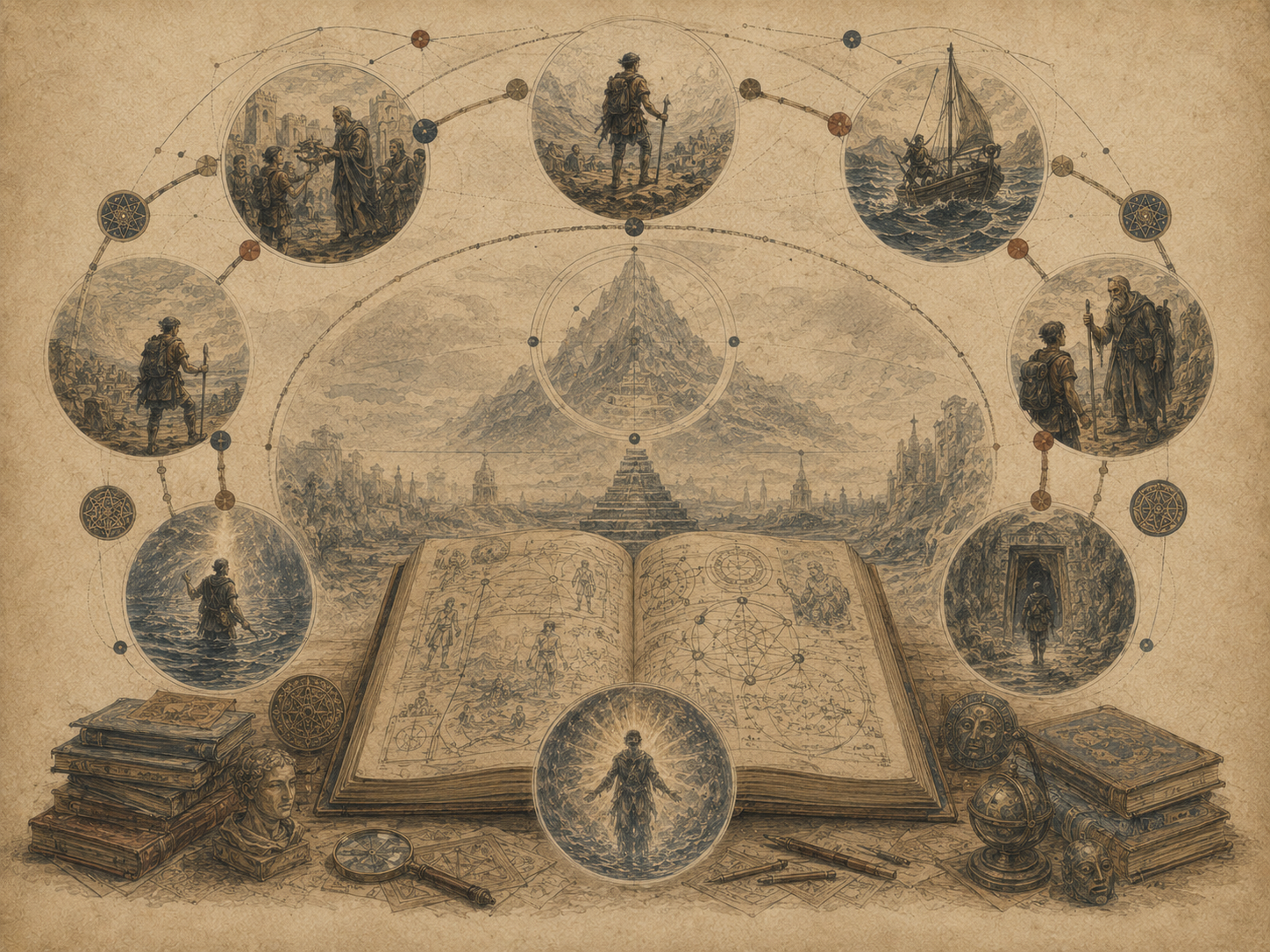
This article treats the monomyth as a historically situated interpretive framework rather than a universal law of storytelling. It examines departure, initiation, return, threshold crossing, symbolic death, boon, transformation, Campbell’s comparative method, archetypal interpretation, formula drift, scholarly critique, creative use, and ethical risk. It also includes computational workflows for auditing monomyth claims, cultural specificity, evidence selection, formula reduction, counterexamples, and Catalyst Canvas-ready governance outputs.
Why the Monomyth Matters
The monomyth matters because it changed how many people talk about story structure. Writers, filmmakers, teachers, game designers, marketers, and narrative theorists often use the hero’s journey as shorthand for transformation. A character leaves home, crosses into danger, encounters trials, changes, and returns with something valuable. That pattern has become part of contemporary storytelling vocabulary.
But the monomyth also matters because it is frequently misused. It is often treated as if Campbell discovered the one hidden structure behind all meaningful stories. It is used as a universal template even when stories do not fit it. It is applied to myths without enough attention to culture, religion, language, ritual, oral performance, gender, power, or historical context. It is also used in corporate and leadership storytelling as if every life, institution, or brand needs to become a heroic quest.
A careful reading of Campbell is more useful. The monomyth is best understood as a symbolic pattern of transformation that appears in many heroic myths. It can help readers notice thresholds, ordeals, helpers, descents, revelations, gifts, and returns. But it is not the only story pattern, and it should not be used to erase other forms of narrative meaning.
| Why it matters | Useful contribution | Risk |
|---|---|---|
| Story structure | Gives a language for transformation arcs. | Can become a rigid plot formula. |
| Myth comparison | Highlights recurring mythic motifs. | Can flatten cultural difference. |
| Symbolic interpretation | Connects story movement to psychological and spiritual change. | Can reduce religion, ritual, and culture to private psychology. |
| Creative writing | Helps writers diagnose threshold, conflict, ordeal, and return. | Can make stories predictable and mechanical. |
| Education | Offers an accessible entry into mythic structure. | Can become the only framework students learn. |
| Public storytelling | Explains why transformation stories feel powerful. | Can be used to manipulate audiences through false heroism. |
The monomyth matters most when it opens interpretation. It becomes weakest when it closes interpretation.
What Campbell Meant by Monomyth
Campbell used the term monomyth to describe a recurring pattern he saw across heroic myths. The word itself signals a “single myth” or underlying mythic structure, but Campbell’s argument was not simply that every story has the same plot. His project was comparative and symbolic. He wanted to show that many heroic myths dramatize a movement from ordinary life into a zone of danger, revelation, transformation, and return.
In Campbell’s reading, the hero’s journey is not merely external adventure. It is also an inward symbolic drama. The hero confronts fear, death, power, desire, the unknown, the divine, the unconscious, and the possibility of transformation. The journey is a passage through threshold experience. The hero does not simply travel; the hero changes.
This is why the monomyth is often linked to initiation. Initiation involves separation from ordinary status, passage through trial or instruction, and return to the community in a changed condition. Campbell interpreted many hero myths as variations on this pattern. The journey gives narrative shape to transformation.
| Campbell’s concern | How the monomyth expresses it | Interpretive implication |
|---|---|---|
| Transformation | The hero leaves one condition and returns changed. | The journey is about becoming, not travel alone. |
| Threshold | The hero crosses from known world into unknown world. | Boundaries and passages are central. |
| Initiation | Trials and ordeals mark symbolic death, learning, and rebirth. | The pattern echoes rites of passage. |
| Symbolic depth | Figures and events represent inner and cosmic forces. | Characters are also symbolic roles. |
| Return | The hero brings back a boon, gift, insight, or renewal. | Transformation has social consequence. |
| Comparison | Myths from different traditions can be read alongside one another. | Comparison must still preserve difference. |
Campbell’s monomyth is a symbolic model of heroic transformation, not a command that every story must follow one route.
The Three-Part Structure: Departure, Initiation, and Return
The most basic structure of Campbell’s monomyth is threefold: departure, initiation, and return. These three movements are more important than the many individual stages often listed in writing manuals. The hero separates from the ordinary world, undergoes testing or transformation, and returns with a boon, insight, or renewed relation to the world.
Departure marks separation. The hero is called away from ordinary life, often reluctantly. Initiation marks transformation. The hero crosses into danger, receives aid, faces trials, descends, undergoes symbolic death, or encounters revelation. Return marks reintegration. The hero must bring the boon back, communicate it, use it, or struggle to return at all.
These movements form a symbolic cycle. The hero leaves, changes, and returns. The pattern is not only physical. A person may depart from childhood, innocence, social order, ignorance, illusion, safety, or ordinary identity. Initiation may involve combat, suffering, knowledge, temptation, sacrifice, reconciliation, or vision. Return may involve healing, teaching, failure, refusal, exile, or social renewal.
| Movement | Basic meaning | Common symbolic features |
|---|---|---|
| Departure | Separation from the known world. | Call, refusal, helper, threshold, crossing, loss of ordinary security. |
| Initiation | Testing and transformation in the unknown world. | Trials, descent, monster, temptation, revelation, symbolic death, apotheosis. |
| Return | Reentry into the world with a boon or changed status. | Gift, escape, rescue, crossing back, refusal, teaching, renewal. |
The three-part structure is simple, but Campbell used it to describe a deep symbolic movement: separation, transformation, and reintegration.
Departure: Leaving the Known World
Departure begins when the hero is drawn, forced, summoned, tempted, exiled, or awakened out of ordinary life. The known world may be home, childhood, village, city, palace, family, identity, habit, certainty, or social order. The hero may resist the call because departure means risk. To leave the known world is to give up the protection of the familiar.
Campbell’s departure phase often includes the call to adventure, refusal of the call, supernatural aid, crossing the first threshold, and the belly of the whale. These should not be treated as mandatory plot beats. They are symbolic variations around separation. The hero is being pulled into a larger field of meaning.
Departure can be external or internal. A hero may leave home physically, but a story may also dramatize inward departure from illusion, false security, denial, innocence, or social expectation. The important point is not that the hero travels to a faraway place. The important point is that the old form of life can no longer contain the hero’s transformation.
| Departure element | Symbolic function | Interpretive question |
|---|---|---|
| Call to adventure | Signals that ordinary life is no longer sufficient. | What summons the hero beyond the known world? |
| Refusal of the call | Shows fear, attachment, denial, or unreadiness. | What does the hero fear losing? |
| Supernatural aid | Provides guidance, object, blessing, or threshold knowledge. | Who or what makes departure possible? |
| First threshold | Marks entry into a different order of experience. | What boundary is crossed? |
| Belly of the whale | Represents engulfment, symbolic death, or full entry into transformation. | What old identity is being swallowed? |
Departure is not simply the beginning of adventure. It is the symbolic break from a previous life-world.
Initiation: Trial, Descent, Revelation, and Transformation
Initiation is the central zone of transformation. The hero has crossed the threshold and entered a world governed by different rules. This stage may involve tests, allies, enemies, temptations, descent, confrontation with death, encounter with divine or monstrous forces, sacred marriage, atonement, apotheosis, or the gaining of a boon.
Campbell’s initiation phase is often the most symbolically dense. The hero is not merely overcoming obstacles. The hero is being remade through trial. The trial may reveal hidden strength, expose weakness, force sacrifice, dramatize fear, or bring the hero into contact with forces larger than personal will. The journey’s danger is not just physical. It is existential and symbolic.
Initiation can also be misunderstood. In formulaic versions of the hero’s journey, initiation becomes a sequence of escalating challenges. But Campbell’s deeper concern was symbolic transformation. A monster may represent chaos, fear, shadow, taboo, or sacred danger. A descent may represent death, grief, unconscious knowledge, or passage into hidden reality. A boon may represent insight, renewal, healing, power, forgiveness, or restored relation.
| Initiation element | Symbolic function | Interpretive question |
|---|---|---|
| Road of trials | Tests the hero’s endurance, courage, judgment, and readiness. | What must be learned through difficulty? |
| Temptation | Exposes desire, distraction, fear, or false completion. | What could divert transformation? |
| Descent | Brings the hero into darkness, death, hidden knowledge, or underworld space. | What must be faced below ordinary consciousness? |
| Atonement | Confronts authority, ancestry, father, law, divinity, or origin. | What relation must be reconciled or judged? |
| Apotheosis | Represents heightened understanding, vision, or transformation. | What new perception becomes possible? |
| Ultimate boon | Grants gift, insight, power, healing, or renewal. | What is gained, and who is it for? |
Initiation is where adventure becomes transformation. Without transformation, the hero’s journey is only movement through events.
Return: The Boon and the Problem of Reentry
Return is often treated as the easy final step: the hero comes home changed. Campbell’s actual treatment is more complicated. Return can be difficult, resisted, delayed, or refused. The hero may not want to return to ordinary life. The ordinary world may not understand the boon. The hero may need rescue from outside. The gift may be hard to communicate. The transformed person may no longer fit the world they left.
Return matters because transformation is not complete until it enters relation. The hero gains something in the unknown world, but the meaning of that gain depends on how it is brought back. The boon may heal a community, renew a kingdom, restore order, teach wisdom, reconcile divisions, or transform the hero’s relationship to ordinary life.
The return also raises ethical questions. Who benefits from the boon? Does the hero return to serve the community, dominate it, escape it, or abandon it? Does the hero’s knowledge repair the world, or does it become private power? A responsible reading asks whether return produces restoration, domination, alienation, or unfinished work.
| Return element | Symbolic function | Interpretive question |
|---|---|---|
| Refusal of the return | Shows difficulty reentering ordinary life. | Why does the hero resist coming back? |
| Magic flight | Represents dangerous escape with the boon. | What pursues the transformed hero? |
| Rescue from without | Shows that return may require help from the world left behind. | Who helps restore relation? |
| Crossing the return threshold | Marks reintegration between worlds. | Can the hero connect insight with ordinary life? |
| Master of two worlds | Represents movement between ordinary and extraordinary realities. | Can the hero hold both worlds together? |
| Freedom to live | Represents release from fear, attachment, or false division. | What new mode of life becomes possible? |
Return is not simply coming back. It is the test of whether transformation can become shared life.
Symbolic Pattern, Not Mechanical Formula
The most important correction to popular uses of the monomyth is this: Campbell’s pattern was symbolic, not mechanical. He was not writing a rigid plot manual. He was interpreting mythic adventure as a symbolic drama of transformation. The stages are not required beats. They are recurring motifs that may appear, disappear, combine, invert, or shift meaning.
A mechanical reading asks, “Which stage is this?” A symbolic reading asks, “What kind of transformation is happening here?” A mechanical reading treats the mentor as a necessary character type. A symbolic reading asks what kind of aid, instruction, blessing, or threshold knowledge appears. A mechanical reading treats the ordeal as a required climax. A symbolic reading asks what fear, death, descent, revelation, sacrifice, or transformation the story dramatizes.
This distinction matters for writers and analysts. A story can be monomythic in spirit without following every stage. Another story can follow the stages superficially without achieving symbolic depth. The pattern becomes meaningful when movement, threshold, trial, transformation, and return are connected to the story’s deeper concerns.
| Mechanical use | Symbolic use | Better question |
|---|---|---|
| Find the exact stage. | Identify the symbolic movement. | What kind of transformation is underway? |
| Insert a mentor figure. | Ask how guidance or threshold knowledge appears. | What makes crossing possible? |
| Add trials because the template requires them. | Make trial reveal character, danger, or meaning. | What must be tested? |
| Force a return. | Ask whether return, exile, refusal, or unresolved relation fits the story. | What happens after transformation? |
| Apply the same pattern to every culture. | Preserve local meaning before comparison. | What does this pattern mean here? |
| Use Campbell as rulebook. | Use Campbell as one interpretive lens. | What does this lens reveal and hide? |
The monomyth is strongest as symbolic interpretation. It is weakest as mechanical prescription.
What Campbell Did Not Argue
Campbell is often blamed for claims made by later simplified versions of his work. He did make broad comparative claims, and those claims deserve critique. But it is still useful to distinguish Campbell’s actual project from later formula culture.
Campbell did not argue that all stories are identical. He did not argue that every good story must follow every monomyth stage. He did not write a screenwriting manual. He did not claim that plot mechanics alone produce mythic depth. He did not intend the hero’s journey to replace all other narrative forms. He was making a comparative argument about recurring heroic adventure patterns and symbolic transformation.
That does not remove the limits of his work. Campbell often generalized broadly. He selected examples to support large patterns. He emphasized universal resonance more than cultural specificity. He leaned heavily on psychological and symbolic interpretation. But careful critique should address what he actually argued rather than only the most simplified popular version.
| Common assumption | Better reading | Why the distinction matters |
|---|---|---|
| Campbell created a writing formula. | Campbell offered a comparative symbolic interpretation of hero myths. | It separates scholarship from later template culture. |
| Every story must follow the hero’s journey. | The monomyth describes one major recurring heroic pattern. | It protects other narrative forms. |
| Every stage must appear. | Stages are variations within a larger movement. | It avoids mechanical analysis. |
| All myths mean the same thing. | Campbell emphasized recurring symbolic structures across difference. | It allows critique without caricature. |
| The hero’s journey is only external adventure. | Campbell linked adventure to inner, symbolic, and spiritual transformation. | It restores depth to the model. |
| Campbell is sufficient for myth study. | Campbell is one figure in a wider field of myth scholarship. | It encourages broader reading. |
Campbell’s argument is more interesting than the formula often attributed to him, and more limited than his strongest admirers sometimes claim.
Why the Monomyth Became a Writing Template
The monomyth became a writing template because it is memorable, teachable, and useful. Writers need ways to think about movement, stakes, tension, change, climax, and resolution. The hero’s journey offers a strong pattern: ordinary life, disruption, threshold, trial, transformation, and return. It is easy to map onto films, novels, games, memoirs, and brand narratives.
The template version also spread because it fits modern media production. Film and television development often values structures that can be taught, repeated, and pitched. Screenwriting manuals simplified Campbell into usable beat sheets. The framework became practical, especially for adventure, fantasy, coming-of-age, superhero, and quest narratives.
But usefulness can become overuse. Once a symbolic pattern becomes a template, it can flatten complexity. Writers may begin adding mentors, ordeals, and returns because the model requires them, not because the story needs them. Audiences may begin seeing every story through the same lens. Institutions may turn the hero’s journey into motivational branding.
| Reason for template spread | Benefit | Cost |
|---|---|---|
| Memorable structure | Easy to teach and remember. | Can oversimplify mythic interpretation. |
| Creative utility | Helps diagnose transformation arcs. | Can produce predictable plotting. |
| Media fit | Works well for many adventure and fantasy narratives. | Can marginalize non-quest structures. |
| Public appeal | Connects personal change to story. | Can become self-help cliché. |
| Institutional use | Gives organizations a language of mission and transformation. | Can hide power behind heroic language. |
| Educational simplicity | Gives students an entry point into myth. | Can become the only framework taught. |
The monomyth became a template because it works. The problem begins when “works sometimes” becomes “explains everything.”
Strengths of the Monomyth
The monomyth has real strengths. It helps readers notice that many stories are organized around transformation. It gives language to thresholds, ordeals, helpers, descent, revelation, return, and renewal. It shows that adventure can be symbolic rather than merely eventful. It links plot to psychological and existential change.
The model is especially useful for stories of initiation. Coming-of-age narratives, quests, pilgrimages, healing journeys, spiritual transformations, exile-and-return stories, heroic myths, and some modern films can be illuminated by Campbell’s pattern. The model helps explain why crossing into danger and returning changed can feel emotionally satisfying.
The monomyth also encourages symbolic reading. A cave may not be only a cave. A monster may not be only an obstacle. A guide may not be only a helpful character. A return may not be only an ending. Campbell’s framework encourages readers to ask what narrative events mean within a deeper pattern of transformation.
| Strength | Why it helps | Best use |
|---|---|---|
| Transformation focus | Connects story movement to character change. | Use for initiation and growth narratives. |
| Threshold awareness | Highlights boundaries between life-worlds. | Use when stories involve crossing, exile, descent, or discovery. |
| Symbolic depth | Encourages interpretation beyond surface plot. | Use to analyze image, ordeal, helper, boon, and return. |
| Comparative insight | Shows recurring patterns across traditions. | Use with source context and counterexamples. |
| Creative diagnostic | Helps writers find weak thresholds, stakes, or transformation. | Use as a revision tool, not a blueprint. |
| Teaching clarity | Gives beginners a graspable model. | Use as an entry point before complicating it. |
The monomyth is valuable when it helps us ask better questions about transformation.
Limits and Critiques
The monomyth also has serious limits. Its biggest risk is overgeneralization. If every myth is treated as a version of the same journey, then cultural difference becomes surface variation. Myths that do not fit the model may be ignored, distorted, or judged as incomplete. This is a major problem for responsible scholarship.
Another limit is source selection. A comparative model depends on what examples are selected. If the analyst chooses only stories that fit the pattern, the pattern will appear stronger than it is. Strong comparison requires counterexamples, non-fitting traditions, variant forms, and attention to stories that resist departure-initiation-return structure.
The monomyth also risks psychological reduction. Campbell often interpreted myth through inner transformation. That can be illuminating, but myths also have ritual, theological, ecological, political, legal, historical, and communal meanings. A sacred story cannot be responsibly reduced to a hero’s inner journey.
| Critique | Problem | Responsible response |
|---|---|---|
| Overgeneralization | Different myths are forced into one pattern. | Treat the monomyth as hypothesis, not law. |
| Selective evidence | Examples that fit receive more attention. | Include counterexamples and variant forms. |
| Cultural flattening | Local meanings become interchangeable symbols. | Begin with source tradition, language, and context. |
| Psychological reduction | Religious or ritual meaning becomes inner development only. | Hold psychological, ritual, cultural, and historical readings together. |
| Gender bias | Heroic departure can overcenter male-coded agency. | Compare with heroine, relational, communal, and non-heroic structures. |
| Formula drift | Symbolic interpretation becomes mandatory plot design. | Use the model diagnostically, not mechanically. |
The critique of the monomyth is not that patterns never recur. It is that patterns must not be allowed to erase context, difference, or power.
Gender, Community, and Alternative Structures
One of the most important critiques of the monomyth concerns gender and agency. The hero’s journey often centers a solitary protagonist who leaves home, enters danger, conquers or endures ordeal, gains power or knowledge, and returns. This can be a powerful pattern, but it is not the only way transformation works.
Many stories emphasize relational transformation rather than solitary conquest. Some center healing, reconciliation, care, endurance, memory, community survival, ecological relation, or return to the body. Some stories are organized around women’s experience in ways that do not fit male-coded quest structure. Some are communal rather than individual. Some are cyclical rather than linear. Some are tragic, unresolved, anti-heroic, or place-based.
This does not mean the monomyth is useless. It means the monomyth must be placed alongside other structures. Maureen Murdock’s heroine’s journey, feminist narrative theory, Indigenous storytelling, postcolonial narrative, tragedy, cyclical story, ensemble narrative, oral tradition, and ritual performance all complicate Campbell’s model.
| Alternative structure | How it differs from monomyth | Why it matters |
|---|---|---|
| Heroine’s journey | Often centers wholeness, embodiment, descent, repair, and integration. | Challenges male-coded quest assumptions. |
| Communal narrative | Transformation belongs to a group rather than one hero. | Protects collective agency. |
| Place-based story | Meaning centers land, relation, memory, and continuity. | Resists abstract universal movement. |
| Cyclical story | Returns through seasonal, ritual, or generational recurrence. | Challenges linear departure-return assumptions. |
| Tragedy | Transformation may fail, clarify, destroy, or expose limits. | Resists compulsory triumph. |
| Fragmented narrative | Meaning emerges through broken memory, trauma, or discontinuity. | Resists neat integration. |
The monomyth is one path through transformation. It is not the map of all narrative life.
Using the Monomyth Responsibly
Using the monomyth responsibly begins with humility. The model should be treated as a lens, not a universal law. Before applying the hero’s journey, the analyst should first understand the story’s source tradition, language, genre, ritual context, audience, performance setting, historical moment, and cultural authority.
The next step is to ask whether the pattern actually fits. Does the story involve departure, threshold, trial, transformation, and return? Are those elements central, or are they being imposed by the analyst? What parts of the story resist the pattern? Are those resistant parts minor details, or are they the key to the story?
Responsible use also requires ethical review. Is the story sacred, restricted, Indigenous, oral, gendered, traumatic, or politically contested? Does applying Campbell extract the story from its community? Does it turn a ritual narrative into a writing example? Does it erase local meaning in favor of universal symbolism?
| Responsible step | Question | Purpose |
|---|---|---|
| Document source context | Where does the story come from, and how is it used? | Prevents extraction. |
| Identify actual fit | Which monomyth elements are genuinely present? | Avoids forced mapping. |
| Track resistance | What does not fit the model? | Protects narrative difference. |
| Review ethics | Who has authority to interpret or retell this story? | Protects cultural and sacred material. |
| Mark limits | What does the Campbell lens reveal and hide? | Builds interpretive honesty. |
Responsible use of the monomyth means using it to sharpen attention, not to erase complexity.
Examples of Monomyth Analysis Done Carefully
The examples below show how the monomyth can be used responsibly without turning it into a universal template.
Quest myth
Weak: The myth is reduced to “hero leaves, wins, returns.”
Stronger: The analysis asks what departure means in the source tradition, what ritual or sacred context shapes the trial, and what obligation follows from return.
Why it works: Structure is connected to meaning.
Coming-of-age film
Weak: Every scene is forced into Campbell’s stage list.
Stronger: The analysis identifies threshold, ordeal, and return only where they illuminate the character’s transformation.
Why it works: The model supports interpretation without becoming mechanical.
Heroine-centered story
Weak: The story is judged incomplete because it lacks heroic departure and triumphant return.
Stronger: The analysis compares Campbell with heroine’s journey, embodiment, descent, relational repair, and social constraint.
Why it works: Alternative structures are treated as meaningful.
Indigenous place-based narrative
Weak: The story is abstracted into a universal hero pattern.
Stronger: The analysis begins with land, relational memory, oral performance, community authority, and access protocol.
Why it works: Cultural specificity comes before comparison.
Corporate transformation story
Weak: The company presents itself as the hero overcoming obstacles for the audience.
Stronger: The analysis asks who is centered, who is erased, what power is hidden, and whether heroic language manipulates trust.
Why it works: Monomyth language is ethically audited.
Tragic narrative
Weak: The tragedy is forced into a failed hero’s journey.
Stronger: The analysis recognizes that the story may clarify limits, expose error, or refuse restoration rather than complete a return.
Why it works: Non-monomythic structure is respected.
Careful monomyth analysis asks what the pattern reveals, what the story resists, and what responsibilities follow from comparison.
Mathematics, Computation, and Modeling
The monomyth can be modeled as an interpretive audit, not as an automated meaning engine. A computational workflow can help ask whether a story has monomythic features, whether the analysis preserves cultural specificity, whether the pattern is being overgeneralized, and whether counterexamples have been included.
A monomyth-pattern score can estimate how strongly a story resembles Campbell’s departure-initiation-return movement:
M_p = \frac{D_p + T_c + I_t + D_s + B_o + R_n}{6}
\]
Interpretation: Monomyth pattern \(M_p\) averages departure pattern \(D_p\), threshold crossing \(T_c\), initiation trial \(I_t\), descent or symbolic death \(D_s\), boon \(B_o\), and return \(R_n\).
A specificity-preservation score can estimate whether the analysis protects source context:
S_p = \frac{L_n + C_t + R_x + H_c + O_p + A_u}{6}
\]
Interpretation: Specificity preservation \(S_p\) averages language notes \(L_n\), cultural tradition \(C_t\), ritual context \(R_x\), historical context \(H_c\), oral or performance context \(O_p\), and authority notes \(A_u\).
A formula-drift score can estimate whether symbolic analysis is becoming mechanical:
F_d = S_lw_s + B_mw_b + C_lw_c + O_fw_o + U_cw_u + (1 – X_n)w_x
\]
Interpretation: Formula drift \(F_d\) rises with stage literalism \(S_l\), beat matching \(B_m\), context loss \(C_l\), overfitting \(O_f\), universal claim strength \(U_c\), and weak counterexample inclusion \(X_n\).
An interpretation-readiness score can estimate whether the monomyth claim is ready to publish:
I_r = \frac{S_p + X_n + M_l + E_g + R_v + U_m}{6}
\]
Interpretation: Interpretation readiness \(I_r\) averages specificity preservation \(S_p\), counterexample inclusion \(X_n\), method limits \(M_l\), ethics governance \(E_g\), ritual verification \(R_v\), and uncertainty marking \(U_m\).
| Modeling task | Interpretive question | Example output |
|---|---|---|
| Pattern audit | Does the story actually involve departure, initiation, and return? | Monomyth-pattern score. |
| Specificity audit | Are language, ritual, culture, history, and source authority preserved? | Specificity-preservation score. |
| Formula audit | Is the analysis becoming mechanical stage matching? | Formula-drift score. |
| Counterexample audit | What does not fit Campbell’s model? | Counterexample table. |
| Ethics audit | Does comparison flatten, appropriate, or erase local meaning? | Governance queue. |
| Readiness audit | Is the monomyth claim carefully contextualized? | Interpretation-readiness table. |
Computation can help audit method and risk. It cannot decide what a myth means.
Python Workflow: Monomyth Claim Audit
The Python workflow below evaluates monomyth claims by departure pattern, threshold crossing, initiation trial, descent or symbolic death, boon, return, language notes, cultural tradition, ritual context, historical context, oral or performance context, authority notes, stage literalism, beat matching, context loss, overfitting, universal claim strength, counterexample inclusion, method limits, ethics governance, ritual verification, and uncertainty marking. The companion repository version extends this into a Catalyst Canvas-ready module with schemas, package-style Python, tests, JSON exports, Canvas cards, markdown governance queues, and reusable monomyth analysis templates.
# monomyth_claim_audit.py
# Dependency-light workflow for auditing monomyth claims.

from __future__ import annotations

from dataclasses import dataclass
from pathlib import Path
import csv
import json
from statistics import mean

ARTICLE_ROOT = Path(__file__).resolve().parents[1]
OUTPUTS = ARTICLE_ROOT / "outputs"
TABLES = OUTPUTS / "tables"
JSON_DIR = OUTPUTS / "json"
MARKDOWN = OUTPUTS / "markdown"


@dataclass
class MonomythClaim:
    item: str
    claim_context: str
    departure_pattern: float
    threshold_crossing: float
    initiation_trial: float
    descent_symbolic_death: float
    boon: float
    return_pattern: float
    language_notes: float
    cultural_tradition: float
    ritual_context: float
    historical_context: float
    oral_performance_context: float
    authority_notes: float
    stage_literalism: float
    beat_matching: float
    context_loss: float
    overfitting: float
    universal_claim_strength: float
    counterexample_inclusion: float
    method_limits: float
    ethics_governance: float
    ritual_verification: float
    uncertainty_marking: float
    community_sensitivity: float
    public_consequence: float
    owner: str
    status: str

    def monomyth_pattern(self) -> float:
        return mean([
            self.departure_pattern,
            self.threshold_crossing,
            self.initiation_trial,
            self.descent_symbolic_death,
            self.boon,
            self.return_pattern,
        ])

    def specificity_preservation(self) -> float:
        return mean([
            self.language_notes,
            self.cultural_tradition,
            self.ritual_context,
            self.historical_context,
            self.oral_performance_context,
            self.authority_notes,
        ])

    def formula_drift(self) -> float:
        return min(
            1.0,
            self.stage_literalism * 0.18
            + self.beat_matching * 0.18
            + self.context_loss * 0.18
            + self.overfitting * 0.16
            + self.universal_claim_strength * 0.16
            + (1 - self.counterexample_inclusion) * 0.14,
        )

    def interpretation_readiness(self) -> float:
        return mean([
            self.specificity_preservation(),
            self.counterexample_inclusion,
            self.method_limits,
            self.ethics_governance,
            self.ritual_verification,
            self.uncertainty_marking,
        ])

    def governance_priority_score(self) -> float:
        return min(
            1.0,
            self.formula_drift() * 0.35
            + self.community_sensitivity * 0.25
            + self.public_consequence * 0.20
            + (1 - self.interpretation_readiness()) * 0.20,
        )

    def review_priority(self) -> str:
        drift = self.formula_drift()
        priority = self.governance_priority_score()
        readiness = self.interpretation_readiness()

        if self.status == "revise" or drift >= 0.55 or priority >= 0.62 or readiness < 0.55:
            return "high"
        if self.status == "review" or drift >= 0.40 or priority >= 0.48 or readiness < 0.68:
            return "medium"
        return "standard"


def write_csv(path: Path, rows: list[dict[str, object]]) -> None:
    path.parent.mkdir(parents=True, exist_ok=True)
    if not rows:
        raise ValueError(f"No rows to write: {path}")
    with path.open("w", encoding="utf-8", newline="") as handle:
        writer = csv.DictWriter(handle, fieldnames=list(rows[0].keys()))
        writer.writeheader()
        writer.writerows(rows)


def write_json(path: Path, payload: object) -> None:
    path.parent.mkdir(parents=True, exist_ok=True)
    path.write_text(json.dumps(payload, indent=2), encoding="utf-8")


def write_markdown_queue(path: Path, rows: list[dict[str, object]]) -> None:
    path.parent.mkdir(parents=True, exist_ok=True)
    lines = [
        "# Monomyth Claim Governance Queue",
        "",
        "| Item | Claim context | Pattern | Specificity | Formula drift | Readiness | Priority | Owner |",
        "|---|---|---:|---:|---:|---:|---|---|",
    ]

    for row in rows:
        lines.append(
            f"| {row['item']} | {row['claim_context']} | "
            f"{row['monomyth_pattern']} | {row['specificity_preservation']} | "
            f"{row['formula_drift']} | {row['interpretation_readiness']} | "
            f"{row['review_priority']} | {row['owner']} |"
        )

    path.write_text("\n".join(lines) + "\n", encoding="utf-8")


def main() -> None:
    claims = [
        MonomythClaim(
            "Quest myth",
            "source-tradition myth analysis",
            0.88, 0.84, 0.86, 0.72, 0.78, 0.80,
            0.74, 0.82, 0.78, 0.76, 0.70, 0.72,
            0.34, 0.30, 0.32, 0.36, 0.46, 0.74,
            0.72, 0.76, 0.78, 0.70,
            0.72, 0.62,
            "editorial", "active"
        ),
        MonomythClaim(
            "Coming-of-age film",
            "popular media analysis",
            0.82, 0.78, 0.74, 0.56, 0.64, 0.76,
            0.48, 0.54, 0.42, 0.62, 0.36, 0.40,
            0.64, 0.70, 0.56, 0.68, 0.66, 0.58,
            0.56, 0.54, 0.46, 0.52,
            0.42, 0.70,
            "story review", "review"
        ),
        MonomythClaim(
            "Heroine-centered story",
            "alternative transformation structure",
            0.36, 0.42, 0.48, 0.64, 0.52, 0.40,
            0.70, 0.66, 0.58, 0.64, 0.56, 0.62,
            0.28, 0.24, 0.30, 0.32, 0.36, 0.86,
            0.80, 0.76, 0.62, 0.78,
            0.70, 0.66,
            "gender review", "active"
        ),
        MonomythClaim(
            "Indigenous place-based narrative",
            "place-based oral tradition",
            0.22, 0.30, 0.34, 0.28, 0.26, 0.24,
            0.86, 0.94, 0.88, 0.82, 0.94, 0.90,
            0.22, 0.18, 0.20, 0.18, 0.30, 0.92,
            0.88, 0.90, 0.84, 0.86,
            0.96, 0.82,
            "cultural review", "active"
        ),
        MonomythClaim(
            "Corporate hero narrative",
            "brand story using hero journey",
            0.82, 0.72, 0.68, 0.46, 0.78, 0.84,
            0.22, 0.18, 0.16, 0.28, 0.12, 0.18,
            0.92, 0.88, 0.86, 0.90, 0.94, 0.18,
            0.22, 0.24, 0.16, 0.26,
            0.70, 0.88,
            "governance", "revise"
        ),
    ]

    rows = []

    for claim in claims:
        rows.append({
            "item": claim.item,
            "claim_context": claim.claim_context,
            "monomyth_pattern": round(claim.monomyth_pattern(), 3),
            "specificity_preservation": round(claim.specificity_preservation(), 3),
            "formula_drift": round(claim.formula_drift(), 3),
            "interpretation_readiness": round(claim.interpretation_readiness(), 3),
            "governance_priority_score": round(claim.governance_priority_score(), 3),
            "review_priority": claim.review_priority(),
            "owner": claim.owner,
            "status": claim.status,
        })

    priority_order = {"high": 3, "medium": 2, "standard": 1}
    rows = sorted(
        rows,
        key=lambda row: (
            priority_order.get(str(row["review_priority"]), 0),
            float(row["formula_drift"])
        ),
        reverse=True,
    )

    governance_queue = [
        row for row in rows
        if row["review_priority"] != "standard"
    ]

    write_csv(TABLES / "monomyth_claim_audit.csv", rows)
    write_csv(TABLES / "monomyth_claim_governance_queue.csv", governance_queue)

    write_json(JSON_DIR / "monomyth_claim_canvas_cards.json", rows)
    write_json(JSON_DIR / "monomyth_claim_governance_queue.json", governance_queue)

    write_markdown_queue(MARKDOWN / "monomyth_claim_governance_queue.md", governance_queue)

    print("Monomyth claim audit complete.")


if __name__ == "__main__":
    main()
This workflow helps distinguish useful monomyth analysis from mechanical stage matching, cultural flattening, formula drift, and overconfident universal claims.
R Workflow: Monomyth Diagnostics
The R workflow below creates a synthetic monomyth-claim dataset, calculates monomyth pattern, specificity preservation, formula drift, interpretation readiness, governance priority, and review priority, then exports summary tables and base R plots. It is intentionally portable and uses only base R.
# monomyth_claim_diagnostics.R
# Base R workflow for auditing monomyth claims.

args <- commandArgs(trailingOnly = FALSE)
file_arg <- grep("^--file=", args, value = TRUE)

if (length(file_arg) > 0) {
  script_path <- normalizePath(sub("^--file=", "", file_arg[1]), mustWork = TRUE)
  article_root <- normalizePath(file.path(dirname(script_path), ".."), mustWork = TRUE)
} else {
  article_root <- getwd()
}

setwd(article_root)

tables_dir <- file.path(article_root, "outputs", "tables")
figures_dir <- file.path(article_root, "outputs", "figures")
dir.create(tables_dir, recursive = TRUE, showWarnings = FALSE)
dir.create(figures_dir, recursive = TRUE, showWarnings = FALSE)

claims <- data.frame(
  item = c(
    "Quest myth",
    "Coming-of-age film",
    "Heroine-centered story",
    "Indigenous place-based narrative",
    "Corporate hero narrative"
  ),
  claim_context = c(
    "source-tradition myth analysis",
    "popular media analysis",
    "alternative transformation structure",
    "place-based oral tradition",
    "brand story using hero journey"
  ),
  departure_pattern = c(0.88, 0.82, 0.36, 0.22, 0.82),
  threshold_crossing = c(0.84, 0.78, 0.42, 0.30, 0.72),
  initiation_trial = c(0.86, 0.74, 0.48, 0.34, 0.68),
  descent_symbolic_death = c(0.72, 0.56, 0.64, 0.28, 0.46),
  boon = c(0.78, 0.64, 0.52, 0.26, 0.78),
  return_pattern = c(0.80, 0.76, 0.40, 0.24, 0.84),
  language_notes = c(0.74, 0.48, 0.70, 0.86, 0.22),
  cultural_tradition = c(0.82, 0.54, 0.66, 0.94, 0.18),
  ritual_context = c(0.78, 0.42, 0.58, 0.88, 0.16),
  historical_context = c(0.76, 0.62, 0.64, 0.82, 0.28),
  oral_performance_context = c(0.70, 0.36, 0.56, 0.94, 0.12),
  authority_notes = c(0.72, 0.40, 0.62, 0.90, 0.18),
  stage_literalism = c(0.34, 0.64, 0.28, 0.22, 0.92),
  beat_matching = c(0.30, 0.70, 0.24, 0.18, 0.88),
  context_loss = c(0.32, 0.56, 0.30, 0.20, 0.86),
  overfitting = c(0.36, 0.68, 0.32, 0.18, 0.90),
  universal_claim_strength = c(0.46, 0.66, 0.36, 0.30, 0.94),
  counterexample_inclusion = c(0.74, 0.58, 0.86, 0.92, 0.18),
  method_limits = c(0.72, 0.56, 0.80, 0.88, 0.22),
  ethics_governance = c(0.76, 0.54, 0.76, 0.90, 0.24),
  ritual_verification = c(0.78, 0.46, 0.62, 0.84, 0.16),
  uncertainty_marking = c(0.70, 0.52, 0.78, 0.86, 0.26),
  community_sensitivity = c(0.72, 0.42, 0.70, 0.96, 0.70),
  public_consequence = c(0.62, 0.70, 0.66, 0.82, 0.88),
  owner = c("editorial", "story review", "gender review", "cultural review", "governance"),
  status = c("active", "review", "active", "active", "revise"),
  stringsAsFactors = FALSE
)

claims$monomyth_pattern <- rowMeans(claims[, c(
  "departure_pattern",
  "threshold_crossing",
  "initiation_trial",
  "descent_symbolic_death",
  "boon",
  "return_pattern"
)])

claims$specificity_preservation <- rowMeans(claims[, c(
  "language_notes",
  "cultural_tradition",
  "ritual_context",
  "historical_context",
  "oral_performance_context",
  "authority_notes"
)])

claims$formula_drift <- pmin(
  1,
  claims$stage_literalism * 0.18 +
    claims$beat_matching * 0.18 +
    claims$context_loss * 0.18 +
    claims$overfitting * 0.16 +
    claims$universal_claim_strength * 0.16 +
    (1 - claims$counterexample_inclusion) * 0.14
)

claims$interpretation_readiness <- rowMeans(data.frame(
  specificity_preservation = claims$specificity_preservation,
  counterexample_inclusion = claims$counterexample_inclusion,
  method_limits = claims$method_limits,
  ethics_governance = claims$ethics_governance,
  ritual_verification = claims$ritual_verification,
  uncertainty_marking = claims$uncertainty_marking
))

claims$governance_priority_score <- pmin(
  1,
  claims$formula_drift * 0.35 +
    claims$community_sensitivity * 0.25 +
    claims$public_consequence * 0.20 +
    (1 - claims$interpretation_readiness) * 0.20
)

claims$review_priority <- ifelse(
  claims$status == "revise" | claims$formula_drift >= 0.55 | claims$governance_priority_score >= 0.62 | claims$interpretation_readiness < 0.55,
  "high",
  ifelse(
    claims$status == "review" | claims$formula_drift >= 0.40 | claims$governance_priority_score >= 0.48 | claims$interpretation_readiness < 0.68,
    "medium",
    "standard"
  )
)

claims <- claims[order(claims$formula_drift, decreasing = TRUE), ]

write.csv(
  claims,
  file.path(tables_dir, "monomyth_claim_diagnostics.csv"),
  row.names = FALSE
)

governance_queue <- claims[claims$review_priority != "standard", ]

write.csv(
  governance_queue,
  file.path(tables_dir, "monomyth_claim_governance_queue.csv"),
  row.names = FALSE
)

png(file.path(figures_dir, "monomyth_pattern_scores.png"), width = 1200, height = 700)
barplot(
  claims$monomyth_pattern,
  names.arg = claims$item,
  las = 2,
  ylab = "Monomyth pattern",
  main = "Monomyth Pattern Scores"
)
grid()
dev.off()

png(file.path(figures_dir, "formula_drift_scores.png"), width = 1200, height = 700)
barplot(
  claims$formula_drift,
  names.arg = claims$item,
  las = 2,
  ylab = "Formula drift",
  main = "Monomyth Formula Drift Scores"
)
grid()
dev.off()

print(claims[, c(
  "item",
  "claim_context",
  "monomyth_pattern",
  "specificity_preservation",
  "formula_drift",
  "interpretation_readiness",
  "governance_priority_score",
  "review_priority"
)])
This workflow turns monomyth interpretation into a reviewable analysis object while preserving the central point: the monomyth is useful only when context, counterexamples, limits, and ethical risks remain visible.
GitHub Repository
The companion repository for this article supports monomyth analysis as a Catalyst Canvas-ready module. It includes monomyth-pattern scoring, specificity-preservation diagnostics, formula-drift review, interpretation-readiness checks, counterexample tracking, source and authority review, ethical governance, JSON schemas, package-style Python, R workflows, SQL structures, Canvas cards, markdown governance queues, synthetic datasets, documentation, and reusable monomyth analysis templates.
Complete Code Repository
Companion repository for the article, including Catalyst Canvas-ready code for monomyth analysis, departure-initiation-return pattern review, specificity preservation, formula drift, counterexample tracking, governance queues, JSON exports, Canvas cards, and reproducible research workflows.
articles/the-monomyth-what-campbell-actually-argued/
├── canvas/
│   ├── canvas_manifest.json
│   ├── input_schema.json
│   ├── output_schema.json
│   ├── canvas_cards.json
│   └── governance_queue.json
├── html/
├── css/
├── php/
├── java/
├── python/
│   ├── monomyth_canvas/
│   │   ├── __init__.py
│   │   ├── __main__.py
│   │   ├── cli.py
│   │   ├── models.py
│   │   ├── scoring.py
│   │   ├── validation.py
│   │   ├── governance.py
│   │   └── exporters.py
│   ├── tests/
│   │   └── test_monomyth_canvas.py
│   └── run_monomyth_canvas_audit.py
├── r/
│   ├── monomyth_claim_diagnostics.R
│   └── run_all_monomyth_workflows.R
├── sql/
│   ├── canvas_schema.sql
│   └── canvas_queries.sql
├── docs/
│   ├── article_notes.md
│   ├── modeling_principles.md
│   ├── campbell_argument.md
│   ├── departure_initiation_return.md
│   ├── symbolic_not_mechanical.md
│   ├── formula_drift.md
│   ├── critiques_and_limits.md
│   ├── responsible_use.md
│   └── governance_notes.md
├── data/
│   ├── monomyth_claims.csv
│   ├── source_contexts.csv
│   ├── pattern_features.csv
│   ├── specificity_notes.csv
│   ├── formula_drift_risks.csv
│   └── monomyth_governance_notes.csv
├── outputs/
│   ├── figures/
│   ├── json/
│   ├── markdown/
│   └── tables/
├── notebooks/
├── shared/
│   ├── schemas/
│   ├── narrative-templates/
│   ├── story-archetypes/
│   ├── character-models/
│   ├── plot-structures/
│   ├── rhetorical-frameworks/
│   ├── cultural-memory/
│   ├── monomyth/
│   └── governance/
├── tests/
└── README.md
Related Articles
- Joseph Campbell and the Comparative Study of Myth
- The Hero’s Journey: Departure, Initiation, and Return
- Thresholds, Trials, and Transformative Ordeals
- The Four Functions of Myth and the Cultural Work of Story
- Maureen Murdock and the Heroine’s Journey
- Alternative Story Structures Beyond the Monomyth
A Practical Method for Using the Monomyth
1. Start with source context
Identify the story’s tradition, language, genre, ritual setting, historical context, performance mode, and authority structure.
2. Identify the actual claim
Clarify whether the analysis claims structural similarity, symbolic resonance, psychological transformation, creative influence, or direct historical connection.
3. Map only what fits
Look for departure, initiation, and return, but do not force every episode into Campbell’s stage list.
4. Track what resists the pattern
Record non-fitting elements, alternative structures, reversals, missing returns, communal forms, circular patterns, or unresolved endings.
5. Distinguish structure from meaning
A story can share a journey shape while meaning something entirely different in its own tradition.
6. Compare other frameworks
Use the heroine’s journey, tragedy, oral tradition, ritual theory, narratology, Indigenous storytelling, postcolonial narrative, and systems storytelling where they fit better.
7. Watch for formula drift
Ask whether the monomyth is helping interpretation or merely producing mechanical stage matching.
8. Review ethical risk
Check for cultural flattening, sacred material extraction, gender bias, power masking, and false universality.
9. Mark uncertainty
State where the comparison is tentative, partial, symbolic, or method-limited.
10. Use the model to deepen, not close, reading
A good monomyth analysis should make the story richer, not smaller.
This method treats Campbell’s model as a disciplined prompt for interpretation, not a master template.
Common Pitfalls
Several pitfalls appear when the monomyth is used carelessly.
- Stage matching: The analyst tries to identify every Campbell stage whether or not the story supports it.
- Formula drift: A symbolic model becomes a mandatory plot template.
- False universality: One recurring heroic pattern is treated as the structure of all stories.
- Cultural flattening: Source tradition, language, ritual, and oral performance disappear behind abstract pattern.
- Gender bias: Male-coded heroic departure is treated as the default form of transformation.
- Psychological reduction: Religious, ritual, ecological, political, and communal meanings are reduced to inner growth.
- Counterexample avoidance: Stories that resist the monomyth are ignored or forced to fit.
- Compulsory return: The model assumes restoration even when a story is tragic, unresolved, exilic, or cyclical.
- Brand heroism: Organizations use hero’s journey language to make self-serving stories feel morally elevated.
- Interpretive closure: Campbell’s model becomes the answer rather than the beginning of analysis.
The central pitfall is mistaking a powerful pattern for the only legitimate pattern.
Why Campbell’s Actual Argument Still Matters
Campbell’s actual argument still matters because it is more interesting than the simplified formula that often circulates in writing culture. He was not merely saying that stories need mentors, thresholds, and climaxes. He was arguing that many heroic myths dramatize transformation through separation, initiation, and return. That idea remains useful when treated as symbolic interpretation.
The monomyth helps readers notice that adventure stories often concern more than adventure. A journey can represent maturation. A threshold can represent the boundary between old and new life. A descent can represent symbolic death. A boon can represent healing or insight. A return can represent the difficult work of reintegration. These insights remain powerful.
But Campbell’s actual argument also matters because its limits teach us how to read better. We need comparison, but not flattening. We need symbolic interpretation, but not cultural extraction. We need story structure, but not formula. We need recurring patterns, but also counterexamples. The monomyth is a useful lens when it helps us see transformation more clearly. It becomes a problem when it prevents us from seeing anything else.
Further Reading
- Campbell, J. (1949) The Hero with a Thousand Faces. New York: Pantheon Books.
- Campbell, J. (1968) The Masks of God: Creative Mythology. New York: Viking Press.
- Campbell, J. and Moyers, B. (1988) The Power of Myth. New York: Doubleday.
- Britannica (2026) Joseph Campbell. Available at: https://www.britannica.com/biography/Joseph-Campbell-American-author
- Britannica (n.d.) The Hero with a Thousand Faces. Available at: https://www.britannica.com/topic/The-Hero-with-a-Thousand-Faces
- Joseph Campbell Foundation (n.d.) Joseph Campbell and the Hero’s Journey. Available at: https://www.jcf.org/learn/joseph-campbell-heros-journey
- Joseph Campbell Foundation (2020) Separation, Initiation, and Return. Available at: https://www.jcf.org/post/separation-initiation-and-return
- Jung, C.G. (1969) The Archetypes and the Collective Unconscious. 2nd edn. Princeton: Princeton University Press.
- Murdock, M. (1990) The Heroine’s Journey: Woman’s Quest for Wholeness. Boston: Shambhala.
- Segal, R.A. (1999) Theorizing About Myth. Amherst: University of Massachusetts Press.
References
- Campbell, J. (1949) The Hero with a Thousand Faces. New York: Pantheon Books.
- Campbell, J. (1968) The Masks of God: Creative Mythology. New York: Viking Press.
- Campbell, J. and Moyers, B. (1988) The Power of Myth. New York: Doubleday.
- Britannica (2026) Joseph Campbell. Available at: https://www.britannica.com/biography/Joseph-Campbell-American-author
- Britannica (n.d.) The Hero with a Thousand Faces. Available at: https://www.britannica.com/topic/The-Hero-with-a-Thousand-Faces
- Joseph Campbell Foundation (n.d.) Joseph Campbell and the Hero’s Journey. Available at: https://www.jcf.org/learn/joseph-campbell-heros-journey
- Joseph Campbell Foundation (2020) Separation, Initiation, and Return. Available at: https://www.jcf.org/post/separation-initiation-and-return
- Jung, C.G. (1969) The Archetypes and the Collective Unconscious. 2nd edn. Princeton: Princeton University Press.
- Murdock, M. (1990) The Heroine’s Journey: Woman’s Quest for Wholeness. Boston: Shambhala.
- Segal, R.A. (1999) Theorizing About Myth. Amherst: University of Massachusetts Press.