
Last Updated June 10, 2026
Folktales often feel endlessly varied: one story has a dragon, another a witch, another a lost child, another a magical helper, another a forbidden door, another a youngest sibling who succeeds where others fail. Yet beneath this variety, many folktales show recurring patterns of departure, prohibition, violation, testing, aid, struggle, return, recognition, punishment, and restoration.
Folktale Structure and Vladimir Propp’s Morphology examines one of the most influential attempts to describe those patterns. Vladimir Propp’s morphology of the folktale did not treat tales as random collections of motifs. It treated them as structured sequences of actions. Propp asked what characters do in the story, not merely who they are. His method helped create a formal vocabulary for analyzing folktale movement, function, role, sequence, variation, and transformation.
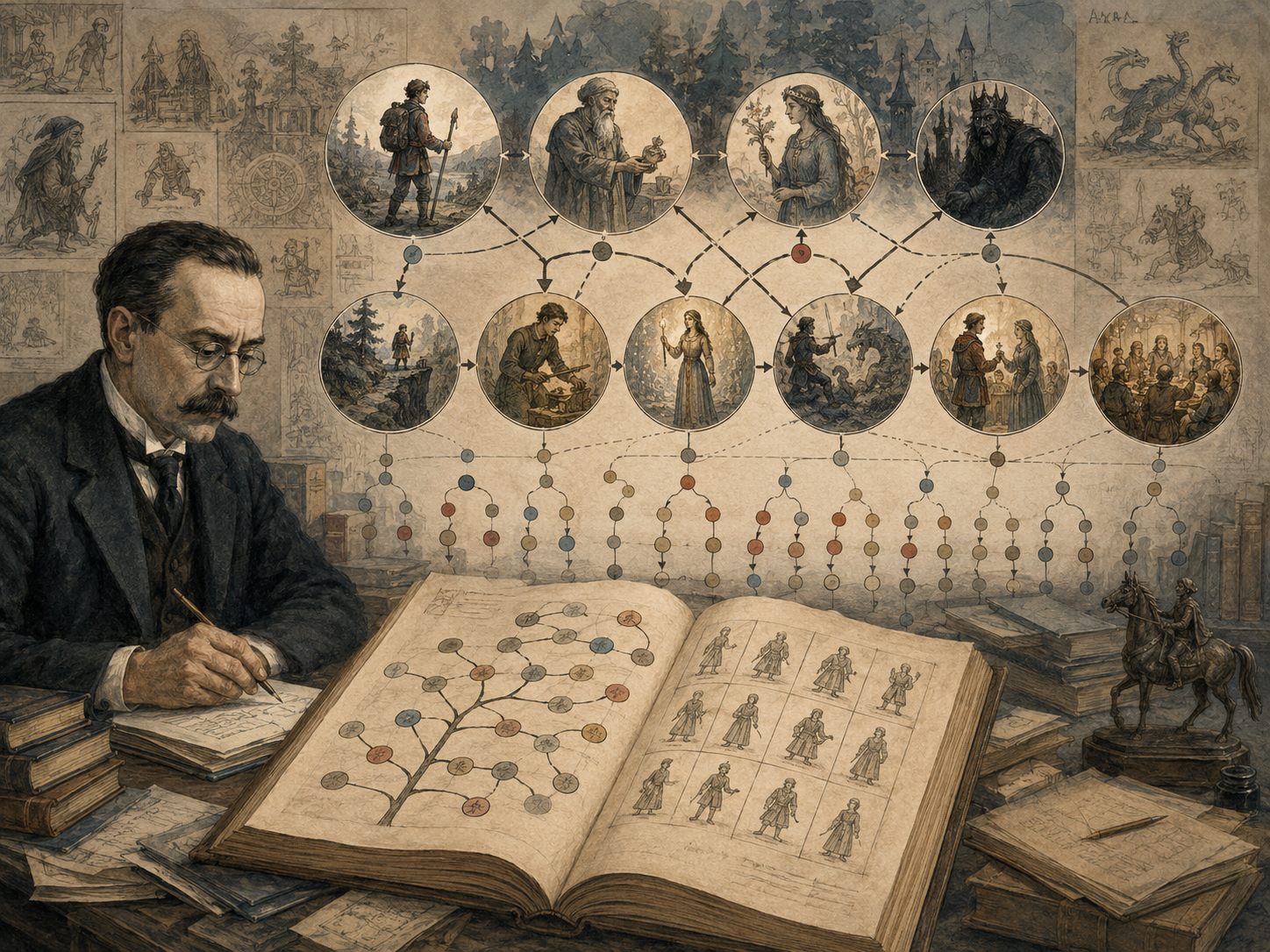
This article explains Propp’s morphology as a method for studying folktale structure, not as a universal template for all stories. It examines functions, dramatis personae, sequence, absence, interdiction, violation, testing, magical aid, struggle, return, recognition, and wedding or restoration. It also considers Propp’s limits, including his focus on wonder tales, the danger of formulaic reading, and the need to combine structural analysis with performance, culture, history, ethics, and living tradition. The article includes computational workflows for auditing folktale functions, role distribution, sequence integrity, variation, cultural context, reduction risk, and Catalyst Canvas-ready governance outputs.
Why Folktale Structure Matters
Folktale structure matters because folktales are not merely collections of magical details. Beneath the surface of wolves, witches, talking animals, enchanted objects, forbidden rooms, missing children, impossible tasks, and miraculous helpers, folktales often organize action through recognizable patterns. Someone leaves home. A prohibition is given. A rule is broken. A villain causes harm. A hero is tested. A helper appears. A difficult task is completed. A return occurs. A false claim may be exposed. Recognition restores order.
This does not make folktales mechanical. Structure is not the opposite of imagination. Structure helps a tale remain transmissible across tellers, places, languages, and generations. A folktale can vary in names, settings, magical objects, local references, moral emphasis, and performance style while preserving a recognizable pattern of action.
Studying folktale structure helps researchers compare versions without assuming that one version is original or correct. It also helps storytellers understand how narrative movement works: not simply through characters, but through actions that change the state of the story.
| Structural feature | How it appears in folktales | Why it matters |
|---|---|---|
| Recurring action | Departure, testing, aid, struggle, return, recognition. | Creates recognizable narrative movement. |
| Role pattern | Hero, villain, donor, helper, princess or sought-for person, dispatcher, false hero. | Organizes action without requiring fixed character types. |
| Sequence | Functions often appear in patterned order. | Supports comparison across tale variants. |
| Variation | Details shift while functions remain recognizable. | Explains how tradition adapts across performance and context. |
| Motif | Magical object, taboo, disguise, test, animal helper, impossible task. | Provides memorable material within structural movement. |
| Closure | Recognition, punishment, marriage, restoration, return, or reward. | Marks changed order after disruption. |
Folktale structure matters because it shows how stories can be both patterned and variable, inherited and adaptive, recognizable and renewed.
Who Was Vladimir Propp?
Vladimir Propp was a Russian folklorist best known for Morphology of the Folktale, first published in Russian in 1928 and later translated into English. His work became one of the foundational texts of structural folklore analysis and influenced narratology, semiotics, literary theory, anthropology, media studies, game studies, and computational story modeling.
Propp studied a corpus of Russian wonder tales. His method focused on recurring actions rather than on surface details. He argued that while characters and motifs may vary widely, the underlying functions of action recur in a relatively stable order. A king, merchant, peasant, witch, dragon, stepmother, or animal may perform different roles in different tales, but the function of harm, testing, aid, struggle, return, or recognition may remain structurally comparable.
This is why Propp’s work became so influential. He offered a way to analyze story form without reducing tales to themes alone. Instead of asking only what a tale is “about,” Propp asked how the tale moves.
| Propp’s contribution | What it changed | Continuing value |
|---|---|---|
| Focused on functions | Shifted attention from characters as names to actions as structural units. | Helps compare tales with different surface details. |
| Studied sequence | Showed that functions often appear in patterned order. | Supports narrative mapping and computational analysis. |
| Separated role from actor | One character can perform several functions, and one role can be filled by different figures. | Prevents simplistic character typing. |
| Limited the corpus | Focused primarily on wonder tales rather than all folklore. | Reminds analysts not to universalize the model. |
| Formalized comparison | Made folktale structure more analytically explicit. | Supports careful study of variants and transformations. |
| Influenced later theory | Opened paths into structuralism, narratology, and story modeling. | Still useful when combined with cultural and performance analysis. |
Propp’s importance lies not in giving storytellers a rigid formula, but in showing that folktale action can be studied as a system.
What Propp Meant by Morphology
Propp borrowed the term “morphology” from the study of form. In biological morphology, one studies the structure of organisms. In folktale morphology, Propp studied the structure of tales: their component parts, their relations, and their order.
For Propp, the key component was not a motif in the broad sense, nor a character name, nor a moral theme. The key component was the function: an action defined by its role in the plot. For example, a villain may abduct a person, steal a magical object, cast a spell, or cause lack. The surface action varies, but structurally it may serve the same function: villainy or lack creates the need for narrative movement.
Morphology therefore asks what a story’s parts do. A prohibition warns. A violation breaks a rule. Reconnaissance seeks information. Delivery gives information to a villain. Trickery deceives. Complicity allows deception to work. Departure moves the hero outward. Testing evaluates the hero. Magical aid changes capacity. Return brings the hero back. Recognition reveals truth.
| Morphological question | Example | Analytic value |
|---|---|---|
| What action occurs? | A child leaves home. | Identifies a narrative event. |
| What function does it serve? | Departure. | Places the event in structural movement. |
| Who performs it? | The youngest sibling, a prince, a girl, an orphan, or another figure. | Separates actor from function. |
| What changes afterward? | The hero enters a field of testing or danger. | Shows consequence. |
| Where does it appear in sequence? | After lack, villainy, or dispatch. | Supports comparison across variants. |
| What varies across versions? | The departure may be voluntary, forced, ritual, accidental, or exile. | Preserves difference within structural analysis. |
Morphology treats folktales as structured systems of action rather than as loose strings of magical details.
Function Before Character
One of Propp’s most important moves was to place function before character. In many folktales, characters are not psychologically developed in the way modern novels often expect. They are often defined by what they do: they harm, forbid, test, help, deceive, guide, rescue, pursue, recognize, or reward.
This does not mean characters are meaningless. It means their structural role matters. A witch may be a villain in one tale, a donor in another, a tester in another, or a helper after a successful test. A king may be a dispatcher, a father, a prize-giver, or an obstructive authority. A magical animal may be a helper. A sibling may become a false hero. Roles are not always identical with character types.
This distinction is useful because folktales often preserve action patterns while changing surface figures. A dragon, ogre, stepmother, demon, rival, or official may all perform villainy. A fairy, animal, dead parent, old woman, forest spirit, or humble stranger may serve as donor or helper. The function remains comparable even when the cultural imagery changes.
| Surface figure | Possible function | Why role matters |
|---|---|---|
| Witch | Villain, donor, tester, helper, or deceiver. | The same figure can serve different structural purposes. |
| King | Dispatcher, father, reward-giver, obstacle, or authority. | Institutional role can shift by tale. |
| Animal | Helper, guide, grateful creature, messenger, or disguise. | Nonhuman figures may carry agency and obligation. |
| Youngest sibling | Hero, underestimated actor, tested figure, or restorer. | Social position becomes narrative potential. |
| False hero | Claimant, deceiver, usurper, or rival. | Recognition and exposure become structurally important. |
| Magical object | Aid, test result, reward, or transformation device. | Objects can function as narrative capacity. |
Function-before-character analysis helps reveal what a tale’s figures do in the structure, not merely what they symbolize on the surface.
Propp’s Thirty-One Functions
Propp famously identified thirty-one functions in the Russian wonder tale. Not every tale contains every function. Some functions are absent, compressed, repeated, or transformed. But when functions appear, Propp argued that they tend to appear in a stable order.
The functions begin with family situation, absence, prohibition, violation, reconnaissance, delivery, trickery, complicity, villainy or lack, mediation, counteraction, and departure. The middle often includes donor testing, hero reaction, magical aid, guidance, struggle, branding, victory, liquidation of lack, and return. The later sequence may include pursuit, rescue, unrecognized arrival, false claims, difficult task, solution, recognition, exposure, transfiguration, punishment, and wedding or accession.
The full list is useful, but it should not be treated as a checklist to force onto every folktale. It is better understood as a structural vocabulary. The analyst asks which functions appear, how they are realized, what is absent, what is repeated, how the order works, and what the tale gains or loses through variation.
| Function range | Typical movement | Examples of functions |
|---|---|---|
| Opening disturbance | The ordinary world is weakened, warned, violated, or disrupted. | Absentation, interdiction, violation, reconnaissance, trickery, villainy, lack. |
| Hero activation | The need becomes known and movement begins. | Mediation, beginning counteraction, departure. |
| Testing and aid | The hero encounters a donor, responds, and gains capacity. | First donor function, hero reaction, receipt of magical agent. |
| Quest movement | The hero is guided toward struggle or task. | Guidance, struggle, branding, victory, liquidation of lack. |
| Return and pursuit | The hero returns but may be pursued, rescued, or unrecognized. | Return, pursuit, rescue, unrecognized arrival. |
| Recognition and closure | False claims are exposed, truth is recognized, and order is restored or transformed. | Difficult task, solution, recognition, exposure, transfiguration, punishment, wedding. |
Propp’s functions offer a vocabulary for tracing narrative movement from disruption to transformation, but they should be applied with attention to corpus, culture, performance, and variation.
The Seven Spheres of Action
Propp also described recurring spheres of action sometimes associated with seven broad roles: villain, donor, helper, princess or sought-for person and her father, dispatcher, hero, and false hero. These are not modern psychological character categories. They are structural roles within the movement of the tale.
The villain causes harm, creates lack, obstructs, deceives, or pursues. The donor tests the hero and provides a magical agent or capacity. The helper aids the hero’s movement, task, rescue, or transformation. The princess or sought-for person may represent what is sought, harmed, rescued, or restored. The dispatcher sends the hero. The hero responds to lack, undergoes testing, and acts. The false hero makes an improper claim or takes credit without earning it.
A single character may occupy multiple spheres of action. A donor may become a helper. A figure who appears threatening may provide aid. A family member may cause harm and later be punished. The important question is not what label a character carries, but what role they perform in a particular sequence.
| Sphere of action | Primary function | Analytic caution |
|---|---|---|
| Villain | Creates harm, lack, obstruction, pursuit, or deception. | Do not reduce villainy to one fixed character type. |
| Donor | Tests the hero and enables aid. | Testing may be moral, practical, ritual, or symbolic. |
| Helper | Guides, rescues, transports, assists, or transforms. | Helpers may be human, animal, object, spirit, or force. |
| Princess or sought-for person | Represents the object of search, rescue, marriage, restoration, or value. | This role reflects Propp’s corpus and may not fit all tales ethically or culturally. |
| Dispatcher | Sends the hero or reveals the need for action. | Dispatch can come from authority, crisis, lack, command, or chance. |
| Hero | Responds, departs, undergoes testing, acts, returns, and is recognized. | Heroism may be active, patient, clever, moral, lucky, or relational. |
| False hero | Makes an illegitimate claim and is exposed. | False claim structures recognition and justice. |
The seven spheres of action are useful when they are treated as role functions, not as fixed universal character identities.
Sequence and Variation
Propp’s morphology depends on both sequence and variation. The functions are not merely a bag of recurring elements. Their order matters. Villainy or lack usually comes before mediation, departure before testing, testing before receipt of aid, struggle before victory, and recognition before exposure or reward.
At the same time, folktales vary. A tale may omit functions, combine functions, repeat functions, shift emphasis, or localize details. One version may stress prohibition and violation. Another may stress magical aid. Another may stress false hero exposure. Another may give more weight to the helper, the donor, the task, or the return. These differences matter.
The analyst should therefore avoid two opposite errors. The first error is treating every variant as wholly unrelated because details differ. The second error is forcing all variants into the same rigid sequence and ignoring meaningful difference. Propp’s method is strongest when it supports comparison without erasing variation.
| Variation type | How it appears | Analytic response |
|---|---|---|
| Omission | A function expected in the sequence does not appear. | Ask whether the tale compresses, skips, or replaces that movement. |
| Compression | Several functions occur in a single episode. | Separate structural roles within the same scene. |
| Expansion | One function becomes a long episode. | Ask why this function receives emphasis. |
| Repetition | A test, task, or encounter repeats three times or more. | Track escalation, pattern, and change. |
| Substitution | Different characters or objects perform similar functions. | Compare role rather than surface identity alone. |
| Localization | Names, places, animals, customs, or moral emphasis shift by community. | Preserve cultural specificity within structural comparison. |
Sequence makes comparison possible. Variation keeps the tale alive.
Propp and Tale-Type Classification
Propp’s morphology should be distinguished from tale-type classification. Tale-type systems such as the Aarne-Thompson-Uther index group folktales by recurring plot types across traditions. A tale type helps researchers identify related story families and compare variants across languages, regions, and collections.
Propp’s morphology works differently. It analyzes the internal structure of a tale by identifying functions and their sequence. Tale-type classification asks what kind of tale this is in a comparative index. Morphological analysis asks how this tale moves structurally. The two approaches can work together, but they should not be confused.
For example, tale-type classification may group stories in which a persecuted heroine, magical aid, recognition, and restoration recur across versions. Proppian analysis may then examine how lack, testing, aid, false claims, recognition, and transformation operate within a particular version. One approach classifies; the other maps action.
| Approach | Primary question | Best use |
|---|---|---|
| Tale-type classification | What family or type does this tale belong to? | Comparing variants across collections, regions, and languages. |
| Motif indexing | What recurring elements appear in this tale? | Tracking magical objects, tests, animals, taboos, transformations, and themes. |
| Proppian morphology | What functions structure the tale’s action? | Mapping sequence, roles, and movement. |
| Performance analysis | How is this tale told in a specific social event? | Understanding audience, occasion, voice, embodiment, and variation. |
| Cultural analysis | What values, histories, relations, or conflicts does the tale carry? | Situating form within community and meaning. |
| Ethical analysis | What permissions, ownership, and interpretive responsibilities apply? | Preventing extraction, misuse, and flattening. |
A responsible folktale analysis can use morphology, tale-type classification, motif study, performance context, cultural history, and ethics together.
What Propp Clarifies
Propp clarifies that folktales often move through structured actions rather than through psychological realism. This is especially useful for wonder tales, where characters may appear less as interiorized individuals and more as agents within a sequence of lack, testing, aid, struggle, and restoration.
Propp also clarifies how tales can vary while remaining recognizable. A magical horse, grateful animal, wise old woman, fairy, or dead parent may all provide aid. A dragon, witch, ogre, rival, or stepmother may all produce harm. A princess, lost child, stolen object, cure, kingdom, or marriage may all represent what is sought or restored. The surface materials differ, but the structural movement can remain comparable.
Finally, Propp clarifies that narrative analysis can be systematic without being purely mechanical. His method encourages careful segmentation, comparison, and attention to sequence. It helps analysts avoid vague claims such as “many folktales are about journeys” by asking what specific functions organize the journey.
| Propp clarifies | What this helps analysts see | Example question |
|---|---|---|
| Action structure | What the story does, not just what it contains. | What function does this event perform? |
| Role flexibility | Characters can shift roles across tales or within tales. | Is this figure a villain, donor, helper, or tester here? |
| Sequential logic | Functions often create ordered movement. | What changes before and after this function? |
| Comparative method | Different versions can be compared structurally. | What remains stable across variants? |
| Formal economy | Folktales can be analyzed without overpsychologizing them. | What action pattern is doing the work? |
| Structural transformation | Closure often involves recognition, exposure, punishment, reward, or restoration. | What kind of order is produced at the end? |
Propp helps analysts see folktales as patterned systems of action.
What Propp Does Not Explain
Propp’s method is powerful, but limited. It does not explain everything about folktales. It does not fully account for performance, audience, ritual context, place, cultural ownership, historical change, gender, colonial power, translation, local meaning, or emotional experience. It also does not apply equally to every story genre.
Propp’s corpus matters. His morphology was developed from Russian wonder tales. Applying it to all folktales, all myths, all novels, all films, or all games can distort both Propp and the stories being analyzed. A legend, joke, proverb, ritual chant, testimony, or sacred narrative may operate according to different rules.
Propp’s model can also encourage formulaic thinking if misused. When analysts treat the thirty-one functions as a universal recipe, they may ignore what makes a tale culturally specific, ethically sensitive, or formally different. The method is best used as a lens, not a cage.
| Limit | Why it matters | Responsible response |
|---|---|---|
| Corpus limit | Propp studied wonder tales, not all narrative forms. | State the genre and corpus before applying the model. |
| Performance limit | Morphology can miss voice, gesture, audience, place, and occasion. | Combine with oral-tradition and performance analysis. |
| Cultural limit | Functions may not capture local meanings, rituals, or values. | Use cultural and historical context. |
| Ethical limit | Structural analysis can treat living traditions as raw data. | Respect ownership, consent, and community authority. |
| Psychological limit | Function analysis may not address interiority or affect. | Use psychological and interpretive methods where appropriate. |
| Formula risk | The model may be mistaken for a universal story machine. | Use it descriptively, not prescriptively. |
Propp’s morphology is most valuable when its scope is clear and its limits are acknowledged.
Folktale Structure and Oral Tradition
Folktale structure should not be separated from oral tradition. A folktale’s functions may be visible in a written transcription, but the life of the tale often depends on performance, memory, audience, setting, repetition, variation, and cultural transmission.
A Proppian function may appear as a line in a structural chart, but in performance it may unfold through voice, gesture, suspense, humor, song, silence, audience anticipation, or ritual timing. A donor test may be comic in one telling, frightening in another, moral in another, and ceremonial in another. A helper may carry ecological, ancestral, spiritual, or local meaning beyond its structural function.
This is why morphology and performance analysis should work together. Morphology shows the action pattern. Oral-tradition analysis shows how that pattern becomes socially alive. Cultural analysis shows what the pattern means in a particular community. Ethics asks who has the right to record, retell, classify, adapt, or publish the tale.
| Structural lens | Performance lens | Combined question |
|---|---|---|
| Function | How the function is voiced, timed, embodied, and received. | How does this action work in performance? |
| Sequence | How pacing, repetition, pause, and audience expectation shape order. | How does performance make sequence felt? |
| Role | How teller and audience recognize a figure’s social meaning. | What does this role mean in this tradition? |
| Variation | How local tellers adapt names, settings, emphasis, and moral force. | What changes, and why? |
| Closure | How ending is performed as restoration, warning, laughter, grief, or instruction. | What kind of communal meaning does the ending create? |
| Archive | How transcription or recording changes the living event. | What does documentation preserve, and what does it lose? |
Folktale morphology is strongest when it remains connected to oral performance and collective memory.
From Morphology to Modern Story Models
Propp’s morphology influenced many later story models. Structuralism, narratology, semiotics, media theory, game studies, screenwriting, and computational storytelling have all drawn from the idea that stories can be analyzed through recurring functions, roles, and sequences.
Modern uses of Propp often appear in character-role models, quest structures, narrative grammars, story-generation systems, game quest design, interactive narrative, and artificial intelligence research. A game may model a quest through lack, dispatch, trial, helper, object acquisition, struggle, return, and reward. A computational system may represent narrative events as functions or states. A content framework may use structural roles to map audience journey or transformation.
These applications can be useful, but they also risk flattening folktale traditions into generic templates. Propp did not provide a universal recipe for blockbuster plots, brand storytelling, or every narrative system. His model was a descriptive analysis of a specific tale tradition. Modern applications should preserve that specificity.
| Modern use | Value | Risk |
|---|---|---|
| Story grammar | Represents narrative movement formally. | May over-regularize diverse traditions. |
| Game quest design | Clarifies roles, tasks, aids, obstacles, and rewards. | May reduce narrative to task mechanics. |
| Computational storytelling | Supports event modeling and sequence generation. | May ignore culture, performance, and ethics. |
| Screenwriting adaptation | Provides structural insight into quest and transformation patterns. | May become formula if treated prescriptively. |
| Content frameworks | Shows how functions can guide audience movement. | May appropriate folklore language superficially. |
| Education | Helps students see pattern, variation, and comparison. | May erase local meaning if examples are decontextualized. |
Modern story models can learn from Propp, but they should not turn morphology into a universal machine for producing narratives.
The Ethics of Structural Analysis
Structural analysis can be clarifying, but it can also be extractive. When a folktale is reduced to functions, roles, and sequence alone, the analyst may ignore the people, languages, places, histories, and responsibilities connected to the tradition. A living story can become a diagram detached from community.
Ethical structural analysis begins with humility. A tale’s morphology is one layer. It does not exhaust meaning. The analyst should ask where the tale comes from, who tells it, who has authority over it, whether it is public or restricted, how it has been translated, how it has been collected, and what harms may follow from reuse or simplification.
This matters especially when folktales are adapted for education, entertainment, content strategy, games, AI systems, or commercial media. A structure may be portable, but a tradition is not simply free material. The more a project benefits from folktale structure, the more carefully it should handle attribution, context, permission, and cultural difference.
| Ethical issue | Structural-analysis risk | Responsible practice |
|---|---|---|
| Decontextualization | The tale becomes a generic structure without cultural setting. | Document source, context, tradition, and limits. |
| Appropriation | Living traditions are mined for reusable plot parts. | Respect ownership, permission, and community authority. |
| Translation loss | Functions are mapped from translated text alone. | Note language limits and translation mediation. |
| Formulaic adaptation | Structure becomes a recipe that erases variation. | Preserve difference, performance, and local meaning. |
| Archive bias | Collected tales are treated as complete tradition. | Ask who collected, selected, translated, and published. |
| AI extraction | Folktale structures are used without attribution or governance. | Use transparent sourcing, consent review, and cultural caution. |
The ethics of morphology require remembering that structure belongs to stories carried by people, not just to abstract systems.
Examples of Proppian Folktale Analysis
The examples below show how Proppian analysis can clarify folktale structure without reducing the tale to a formula.
Forbidden room tale
Weak: The analyst says the tale is simply about curiosity.
Stronger: The analyst maps interdiction, violation, discovery, danger, testing, and consequence.
Why it works: The moral theme is connected to structural movement.
Youngest sibling tale
Weak: The youngest sibling is treated as a generic hero archetype.
Stronger: The analyst tracks lack, dispatch, donor test, helper, task, recognition, and social reversal.
Why it works: Social position becomes part of the structure.
Animal helper tale
Weak: The animal helper is treated as decorative magic.
Stronger: The analyst asks how aid is earned, what obligation exists, and what function the helper performs.
Why it works: Magical aid becomes relational and structural.
False hero tale
Weak: The false hero is treated only as a villain.
Stronger: The analyst maps false claim, difficult task, solution, recognition, exposure, and punishment.
Why it works: Recognition and justice become structural.
Collected folktale variant
Weak: One written version is treated as definitive.
Stronger: The analyst compares variants, performance context, collector notes, and translation limits.
Why it works: Structure and variation are held together.
Modern game quest
Weak: Propp is used as a universal quest template.
Stronger: Propp is used as one lens for lack, aid, task, return, and reward while preserving medium-specific agency.
Why it works: Morphology informs design without becoming formula.
Proppian analysis works best when it clarifies movement while preserving cultural, performative, and ethical context.
Mathematics, Computation, and Modeling
Folktale morphology lends itself to modeling because Propp’s functions can be represented as ordered events, roles, transitions, and variants. Computation can help compare tales, identify sequence patterns, detect missing functions, map roles, and generate governance queues for reduction risk.
A function coverage score can estimate how completely a tale has been mapped against a chosen morphology:
F_c = \frac{F_i + S_c + R_m + V_t + C_n}{5}
\]
Interpretation: Function coverage \(F_c\) averages function identification \(F_i\), sequence clarity \(S_c\), role mapping \(R_m\), variation tracking \(V_t\), and context notes \(C_n\).
A sequence integrity score can estimate whether the mapped functions preserve meaningful order:
S_i = \frac{O_c + T_l + G_m + R_a + C_h}{5}
\]
Interpretation: Sequence integrity \(S_i\) averages order coherence \(O_c\), transition logic \(T_l\), gap management \(G_m\), repetition awareness \(R_a\), and closure handling \(C_h\).
A morphology-context balance score can estimate whether structural mapping remains culturally responsible:
B_m = \frac{P_c + C_s + L_n + T_r + E_g}{5}
\]
Interpretation: Morphology balance \(B_m\) averages performance context \(P_c\), cultural specificity \(C_s\), language notes \(L_n\), tradition review \(T_r\), and ethical governance \(E_g\).
A reduction-risk score can estimate whether the analysis is becoming too formulaic:
R_f = U_mw_u + C_ew_c + P_ow_p + V_ow_v + (1 – B_m)w_b
\]
Interpretation: Formula reduction risk \(R_f\) rises with universalization \(U_m\), cultural erasure \(C_e\), performance omission \(P_o\), variation omission \(V_o\), and weak morphology-context balance \(B_m\).
| Modeling task | Narrative question | Example output |
|---|---|---|
| Function mapping | Which Proppian functions appear in this tale? | Function coverage table. |
| Role mapping | Which figures perform villain, donor, helper, hero, or false hero roles? | Sphere-of-action map. |
| Sequence audit | How do functions unfold, repeat, compress, or disappear? | Sequence integrity score. |
| Variant comparison | What remains stable or changes across versions? | Function-variant matrix. |
| Context audit | Is performance, culture, language, and tradition documented? | Morphology-context balance score. |
| Reduction-risk audit | Is Propp being used as formula rather than method? | Governance review queue. |
Computation can help make structural comparison explicit, but it should remain subordinate to folklore expertise, source context, performance history, cultural interpretation, and ethical review.
Python Workflow: Folktale Morphology Audit
The Python workflow below evaluates folktale items by function identification, sequence clarity, role mapping, variation tracking, context notes, order coherence, transition logic, gap management, repetition awareness, closure handling, performance context, cultural specificity, language notes, tradition review, ethical governance, universalization risk, cultural erasure risk, performance omission, and variation omission. The companion repository version extends this into a Catalyst Canvas-ready module with schemas, package-style Python, tests, JSON exports, Canvas cards, markdown governance queues, and reusable morphology templates.
# folktale_morphology_audit.py
# Dependency-light workflow for auditing folktale structure and Proppian morphology.

from __future__ import annotations

from dataclasses import dataclass
from pathlib import Path
import csv
import json
from statistics import mean

ARTICLE_ROOT = Path(__file__).resolve().parents[1]
OUTPUTS = ARTICLE_ROOT / "outputs"
TABLES = OUTPUTS / "tables"
JSON_DIR = OUTPUTS / "json"
MARKDOWN = OUTPUTS / "markdown"


@dataclass
class FolktaleMorphologyItem:
    item: str
    tale_type: str
    function_identification: float
    sequence_clarity: float
    role_mapping: float
    variation_tracking: float
    context_notes: float
    order_coherence: float
    transition_logic: float
    gap_management: float
    repetition_awareness: float
    closure_handling: float
    performance_context: float
    cultural_specificity: float
    language_notes: float
    tradition_review: float
    ethical_governance: float
    universalization_risk: float
    cultural_erasure_risk: float
    performance_omission: float
    variation_omission: float
    archive_bias: float
    community_sensitivity: float
    public_consequence: float
    owner: str
    status: str

    def function_coverage(self) -> float:
        return mean([
            self.function_identification,
            self.sequence_clarity,
            self.role_mapping,
            self.variation_tracking,
            self.context_notes,
        ])

    def sequence_integrity(self) -> float:
        return mean([
            self.order_coherence,
            self.transition_logic,
            self.gap_management,
            self.repetition_awareness,
            self.closure_handling,
        ])

    def morphology_context_balance(self) -> float:
        return mean([
            self.performance_context,
            self.cultural_specificity,
            self.language_notes,
            self.tradition_review,
            self.ethical_governance,
        ])

    def reduction_risk(self) -> float:
        return min(
            1.0,
            self.universalization_risk * 0.22
            + self.cultural_erasure_risk * 0.22
            + self.performance_omission * 0.18
            + self.variation_omission * 0.18
            + (1 - self.morphology_context_balance()) * 0.20,
        )

    def governance_priority_score(self) -> float:
        return min(
            1.0,
            self.reduction_risk() * 0.35
            + self.archive_bias * 0.20
            + self.community_sensitivity * 0.20
            + self.public_consequence * 0.15
            + (1 - self.morphology_context_balance()) * 0.10,
        )

    def review_priority(self) -> str:
        risk = self.reduction_risk()
        priority = self.governance_priority_score()
        balance = self.morphology_context_balance()

        if self.status == "revise" or risk >= 0.55 or priority >= 0.62 or balance < 0.55:
            return "high"
        if self.status == "review" or risk >= 0.40 or priority >= 0.48 or balance < 0.68:
            return "medium"
        return "standard"


def write_csv(path: Path, rows: list[dict[str, object]]) -> None:
    path.parent.mkdir(parents=True, exist_ok=True)
    if not rows:
        raise ValueError(f"No rows to write: {path}")
    with path.open("w", encoding="utf-8", newline="") as handle:
        writer = csv.DictWriter(handle, fieldnames=list(rows[0].keys()))
        writer.writeheader()
        writer.writerows(rows)


def write_json(path: Path, payload: object) -> None:
    path.parent.mkdir(parents=True, exist_ok=True)
    path.write_text(json.dumps(payload, indent=2), encoding="utf-8")


def write_markdown_queue(path: Path, rows: list[dict[str, object]]) -> None:
    path.parent.mkdir(parents=True, exist_ok=True)
    lines = [
        "# Folktale Morphology Governance Queue",
        "",
        "| Item | Tale type | Function coverage | Sequence integrity | Context balance | Reduction risk | Priority | Owner |",
        "|---|---|---:|---:|---:|---:|---|---|",
    ]

    for row in rows:
        lines.append(
            f"| {row['item']} | {row['tale_type']} | "
            f"{row['function_coverage']} | {row['sequence_integrity']} | "
            f"{row['morphology_context_balance']} | {row['reduction_risk']} | "
            f"{row['review_priority']} | {row['owner']} |"
        )

    path.write_text("\n".join(lines) + "\n", encoding="utf-8")


def main() -> None:
    items = [
        FolktaleMorphologyItem(
            "Forbidden room tale",
            "wonder tale",
            0.82, 0.78, 0.76, 0.70, 0.72,
            0.80, 0.74, 0.68, 0.66, 0.78,
            0.62, 0.68, 0.58, 0.64, 0.70,
            0.24, 0.28, 0.36, 0.34, 0.32,
            0.70, 0.58,
            "editorial", "active"
        ),
        FolktaleMorphologyItem(
            "Youngest sibling quest",
            "wonder tale",
            0.88, 0.84, 0.82, 0.78, 0.74,
            0.86, 0.82, 0.76, 0.80, 0.84,
            0.72, 0.74, 0.66, 0.68, 0.72,
            0.20, 0.24, 0.28, 0.26, 0.30,
            0.64, 0.54,
            "structure review", "active"
        ),
        FolktaleMorphologyItem(
            "Animal helper variant",
            "animal-helper tale",
            0.76, 0.74, 0.82, 0.80, 0.70,
            0.72, 0.76, 0.70, 0.78, 0.74,
            0.76, 0.82, 0.68, 0.72, 0.74,
            0.18, 0.22, 0.24, 0.20, 0.26,
            0.72, 0.56,
            "research", "active"
        ),
        FolktaleMorphologyItem(
            "Generic hero formula adaptation",
            "modern adaptation",
            0.64, 0.58, 0.54, 0.32, 0.28,
            0.62, 0.56, 0.44, 0.30, 0.50,
            0.24, 0.22, 0.18, 0.26, 0.20,
            0.86, 0.82, 0.78, 0.84, 0.76,
            0.80, 0.76,
            "governance", "revise"
        ),
        FolktaleMorphologyItem(
            "Collected tale translation",
            "translated folktale",
            0.72, 0.68, 0.70, 0.62, 0.46,
            0.70, 0.66, 0.58, 0.60, 0.68,
            0.48, 0.52, 0.34, 0.42, 0.44,
            0.42, 0.48, 0.58, 0.46, 0.70,
            0.84, 0.66,
            "archive review", "review"
        ),
    ]

    rows = []

    for item in items:
        rows.append({
            "item": item.item,
            "tale_type": item.tale_type,
            "function_coverage": round(item.function_coverage(), 3),
            "sequence_integrity": round(item.sequence_integrity(), 3),
            "morphology_context_balance": round(item.morphology_context_balance(), 3),
            "reduction_risk": round(item.reduction_risk(), 3),
            "governance_priority_score": round(item.governance_priority_score(), 3),
            "review_priority": item.review_priority(),
            "owner": item.owner,
            "status": item.status,
        })

    priority_order = {"high": 3, "medium": 2, "standard": 1}
    rows = sorted(
        rows,
        key=lambda row: (
            priority_order.get(str(row["review_priority"]), 0),
            float(row["reduction_risk"])
        ),
        reverse=True,
    )

    governance_queue = [
        row for row in rows
        if row["review_priority"] != "standard"
    ]

    write_csv(TABLES / "folktale_morphology_audit.csv", rows)
    write_csv(TABLES / "folktale_morphology_governance_queue.csv", governance_queue)

    write_json(JSON_DIR / "folktale_morphology_canvas_cards.json", rows)
    write_json(JSON_DIR / "folktale_morphology_governance_queue.json", governance_queue)

    write_markdown_queue(MARKDOWN / "folktale_morphology_governance_queue.md", governance_queue)

    print("Folktale morphology audit complete.")


if __name__ == "__main__":
    main()
This workflow helps identify whether Proppian analysis is being used responsibly: as a structured interpretive lens, not as a universal formula that erases performance, culture, translation, or variation.
R Workflow: Folktale Function Diagnostics
The R workflow below creates a synthetic folktale morphology dataset, calculates function coverage, sequence integrity, morphology-context balance, reduction risk, governance priority, and review priority, then exports summary tables and base R plots. It is intentionally portable and uses only base R.
# folktale_morphology_diagnostics.R
# Base R workflow for folktale structure and Vladimir Propp's morphology.

args <- commandArgs(trailingOnly = FALSE)
file_arg <- grep("^--file=", args, value = TRUE)

if (length(file_arg) > 0) {
  script_path <- normalizePath(sub("^--file=", "", file_arg[1]), mustWork = TRUE)
  article_root <- normalizePath(file.path(dirname(script_path), ".."), mustWork = TRUE)
} else {
  article_root <- getwd()
}

setwd(article_root)

tables_dir <- file.path(article_root, "outputs", "tables")
figures_dir <- file.path(article_root, "outputs", "figures")
dir.create(tables_dir, recursive = TRUE, showWarnings = FALSE)
dir.create(figures_dir, recursive = TRUE, showWarnings = FALSE)

items <- data.frame(
  item = c(
    "Forbidden room tale",
    "Youngest sibling quest",
    "Animal helper variant",
    "Generic hero formula adaptation",
    "Collected tale translation"
  ),
  tale_type = c(
    "wonder tale",
    "wonder tale",
    "animal-helper tale",
    "modern adaptation",
    "translated folktale"
  ),
  function_identification = c(0.82, 0.88, 0.76, 0.64, 0.72),
  sequence_clarity = c(0.78, 0.84, 0.74, 0.58, 0.68),
  role_mapping = c(0.76, 0.82, 0.82, 0.54, 0.70),
  variation_tracking = c(0.70, 0.78, 0.80, 0.32, 0.62),
  context_notes = c(0.72, 0.74, 0.70, 0.28, 0.46),
  order_coherence = c(0.80, 0.86, 0.72, 0.62, 0.70),
  transition_logic = c(0.74, 0.82, 0.76, 0.56, 0.66),
  gap_management = c(0.68, 0.76, 0.70, 0.44, 0.58),
  repetition_awareness = c(0.66, 0.80, 0.78, 0.30, 0.60),
  closure_handling = c(0.78, 0.84, 0.74, 0.50, 0.68),
  performance_context = c(0.62, 0.72, 0.76, 0.24, 0.48),
  cultural_specificity = c(0.68, 0.74, 0.82, 0.22, 0.52),
  language_notes = c(0.58, 0.66, 0.68, 0.18, 0.34),
  tradition_review = c(0.64, 0.68, 0.72, 0.26, 0.42),
  ethical_governance = c(0.70, 0.72, 0.74, 0.20, 0.44),
  universalization_risk = c(0.24, 0.20, 0.18, 0.86, 0.42),
  cultural_erasure_risk = c(0.28, 0.24, 0.22, 0.82, 0.48),
  performance_omission = c(0.36, 0.28, 0.24, 0.78, 0.58),
  variation_omission = c(0.34, 0.26, 0.20, 0.84, 0.46),
  archive_bias = c(0.32, 0.30, 0.26, 0.76, 0.70),
  community_sensitivity = c(0.70, 0.64, 0.72, 0.80, 0.84),
  public_consequence = c(0.58, 0.54, 0.56, 0.76, 0.66),
  owner = c("editorial", "structure review", "research", "governance", "archive review"),
  status = c("active", "active", "active", "revise", "review"),
  stringsAsFactors = FALSE
)

items$function_coverage <- rowMeans(items[, c(
  "function_identification",
  "sequence_clarity",
  "role_mapping",
  "variation_tracking",
  "context_notes"
)])

items$sequence_integrity <- rowMeans(items[, c(
  "order_coherence",
  "transition_logic",
  "gap_management",
  "repetition_awareness",
  "closure_handling"
)])

items$morphology_context_balance <- rowMeans(items[, c(
  "performance_context",
  "cultural_specificity",
  "language_notes",
  "tradition_review",
  "ethical_governance"
)])

items$reduction_risk <- pmin(
  1,
  items$universalization_risk * 0.22 +
    items$cultural_erasure_risk * 0.22 +
    items$performance_omission * 0.18 +
    items$variation_omission * 0.18 +
    (1 - items$morphology_context_balance) * 0.20
)

items$governance_priority_score <- pmin(
  1,
  items$reduction_risk * 0.35 +
    items$archive_bias * 0.20 +
    items$community_sensitivity * 0.20 +
    items$public_consequence * 0.15 +
    (1 - items$morphology_context_balance) * 0.10
)

items$review_priority <- ifelse(
  items$status == "revise" | items$reduction_risk >= 0.55 | items$governance_priority_score >= 0.62 | items$morphology_context_balance < 0.55,
  "high",
  ifelse(
    items$status == "review" | items$reduction_risk >= 0.40 | items$governance_priority_score >= 0.48 | items$morphology_context_balance < 0.68,
    "medium",
    "standard"
  )
)

items <- items[order(items$reduction_risk, decreasing = TRUE), ]

write.csv(
  items,
  file.path(tables_dir, "folktale_morphology_diagnostics.csv"),
  row.names = FALSE
)

governance_queue <- items[items$review_priority != "standard", ]

write.csv(
  governance_queue,
  file.path(tables_dir, "folktale_morphology_governance_queue.csv"),
  row.names = FALSE
)

png(file.path(figures_dir, "function_coverage_scores.png"), width = 1200, height = 700)
barplot(
  items$function_coverage,
  names.arg = items$item,
  las = 2,
  ylab = "Function coverage",
  main = "Folktale Function Coverage Scores"
)
grid()
dev.off()

png(file.path(figures_dir, "reduction_risk_scores.png"), width = 1200, height = 700)
barplot(
  items$reduction_risk,
  names.arg = items$item,
  las = 2,
  ylab = "Formula reduction risk",
  main = "Formula Reduction Risk Scores"
)
grid()
dev.off()

print(items[, c(
  "item",
  "tale_type",
  "function_coverage",
  "sequence_integrity",
  "morphology_context_balance",
  "reduction_risk",
  "governance_priority_score",
  "review_priority"
)])
This workflow turns Proppian morphology into a reviewable editorial artifact. It helps identify where structural analysis is strong and where cultural, performance, translation, or ethical context is missing.
GitHub Repository
The companion repository for this article supports folktale structure and Vladimir Propp’s morphology as a Catalyst Canvas-ready analysis module. It includes function-coverage audits, sequence-integrity scoring, sphere-of-action mapping, variant comparison, morphology-context balance, formula-reduction risk, JSON schemas, package-style Python, R workflows, SQL structures, Canvas cards, markdown governance queues, synthetic datasets, documentation, and reusable Proppian morphology templates.
Complete Code Repository
Companion repository for the article, including Catalyst Canvas-ready code for folktale function mapping, Proppian morphology, role distribution, tale variants, sequence integrity, formula-reduction risk, governance queues, JSON exports, Canvas cards, and reproducible research workflows.
articles/folktale-structure-and-vladimir-propps-morphology/
├── canvas/
│   ├── canvas_manifest.json
│   ├── input_schema.json
│   ├── output_schema.json
│   ├── canvas_cards.json
│   └── governance_queue.json
├── html/
├── css/
├── php/
├── java/
├── python/
│   ├── folktale_morphology_canvas/
│   │   ├── __init__.py
│   │   ├── __main__.py
│   │   ├── cli.py
│   │   ├── models.py
│   │   ├── scoring.py
│   │   ├── validation.py
│   │   ├── governance.py
│   │   └── exporters.py
│   ├── tests/
│   │   └── test_folktale_morphology_canvas.py
│   └── run_folktale_morphology_canvas_audit.py
├── r/
│   ├── folktale_morphology_diagnostics.R
│   └── run_all_folktale_morphology_workflows.R
├── sql/
│   ├── canvas_schema.sql
│   └── canvas_queries.sql
├── docs/
│   ├── article_notes.md
│   ├── modeling_principles.md
│   ├── propp_functions.md
│   ├── spheres_of_action.md
│   ├── sequence_and_variation.md
│   ├── formula_reduction_risk.md
│   └── governance_notes.md
├── data/
│   ├── folktale_morphology_items.csv
│   ├── propp_function_map.csv
│   ├── spheres_of_action.csv
│   ├── tale_variants.csv
│   ├── morphology_risks.csv
│   └── folktale_governance_notes.csv
├── outputs/
│   ├── figures/
│   ├── json/
│   ├── markdown/
│   └── tables/
├── notebooks/
├── shared/
│   ├── schemas/
│   ├── narrative-templates/
│   ├── story-archetypes/
│   ├── character-models/
│   ├── plot-structures/
│   ├── rhetorical-frameworks/
│   ├── cultural-memory/
│   ├── folktale-morphology/
│   └── governance/
├── tests/
└── README.md
Related Articles
- Oral Tradition, Performance, and Collective Memory
- Myths, Legends, Folktales, and Epics
- Storytelling as Intangible Cultural Heritage
- Performance, Memory, and Variation in Oral Storytelling
- Proverb, Song, Chant, and Ritual Speech
- Narratology and the Grammar of Story
A Practical Method for Using Propp Responsibly
1. Identify the corpus
Clarify whether the material is a wonder tale, folktale, legend, myth, proverb, ritual speech, modern adaptation, game quest, or another form.
2. Establish source context
Document collector, translator, publication context, community context, language, and version history where possible.
3. Segment the tale into actions
Break the tale into events that change the story state.
4. Map functions cautiously
Identify Proppian functions where they fit, but do not force every event into the model.
5. Map spheres of action
Ask which figures perform villain, donor, helper, dispatcher, hero, sought-for person, or false hero functions.
6. Track sequence
Record the order of functions and note omissions, compressions, repetitions, and expansions.
7. Compare variants
Ask what remains stable across tellings and what changes by performer, collector, language, place, or context.
8. Add performance and culture
Document oral context, audience, teller role, local meaning, ritual setting, and cultural specificity.
9. Review reduction risk
Ask whether morphology is erasing performance, cultural context, variation, translation, or ethics.
10. Add governance notes
Document source limits, permissions, cultural sensitivity, archive concerns, community authority, and adaptation risks.
This method uses Propp as a structural lens while keeping folktales attached to living traditions, histories, and contexts.
Common Pitfalls
Several pitfalls appear when Propp’s morphology is misunderstood.
- Treating Propp as universal: Propp studied a specific body of wonder tales, not every story ever told.
- Using functions as a recipe: The thirty-one functions are an analytic vocabulary, not a required plot formula.
- Forcing every tale into the model: Some stories operate according to different genres, traditions, and rules.
- Ignoring performance: A function chart cannot replace voice, audience, place, ritual, timing, and embodiment.
- Confusing motif with function: A magical object is not automatically a function; the question is what it does structurally.
- Fixing roles too rigidly: A figure may perform different spheres of action across tales or even within one tale.
- Erasing variation: Differences across variants may carry cultural, historical, or performative meaning.
- Ignoring translation and collection history: Published tales are mediated by collectors, translators, editors, and archives.
- Reducing culture to pattern: Structure should not erase values, community authority, or local meaning.
- Appropriating story infrastructure: Folktale morphology should not become a tool for extracting living traditions without context or permission.
The central pitfall is turning a powerful analytic method into a formula that flattens the very traditions it was meant to help describe.
Why Propp Still Matters
Propp still matters because he showed that folktales have structure beneath surface variety. His morphology helps analysts see recurring actions, functions, roles, and sequences across tale variants. It gives researchers and students a vocabulary for comparing stories without reducing them only to themes or symbols.
But Propp matters most when used carefully. His model is not a universal story machine. It is a method developed from a specific body of wonder tales. It should be combined with tale-type classification, motif study, oral-tradition analysis, performance context, cultural history, translation awareness, and ethical governance.
Folktales are patterned, but they are not dead patterns. They live through tellers, listeners, places, languages, archives, adaptations, and communities. Propp’s morphology helps us understand how action works in folktale structure. Responsible storytelling scholarship then asks what those structures mean, who carries them, how they change, and what obligations follow when we classify, teach, adapt, or model them.
Further Reading
- Aarne, A. and Thompson, S. (1961) The Types of the Folktale: A Classification and Bibliography. 2nd rev. Helsinki: Academia Scientiarum Fennica.
- Dundes, A. (1964) The Morphology of North American Indian Folktales. Helsinki: Academia Scientiarum Fennica.
- Dundes, A. (ed.) (1997) Madness in Method Plus a Plea for Projective Inversion in Myth. New York: Peter Lang.
- Folklore Fellows (2024) The Types of International Folktales: A Classification and Bibliography, Revised and Supplemented Edition. Available at: https://www.folklorefellows.fi/ffc-284-286-2024-edition/
- Jones, S.S. (2002) The Fairy Tale: The Magic Mirror of Imagination. New York: Routledge.
- Lüthi, M. (1982) The European Folktale: Form and Nature. Translated by J.D. Niles. Bloomington: Indiana University Press.
- Propp, V. (1968) Morphology of the Folktale. 2nd edn. Translated by L. Scott. Edited by L.A. Wagner. Austin: University of Texas Press. Available at: https://utpress.utexas.edu/9780292783768/
- Thompson, S. (1977) The Folktale. Berkeley: University of California Press.
- Uther, H.-J. (2004) The Types of International Folktales: A Classification and Bibliography. 3 vols. Helsinki: Academia Scientiarum Fennica.
- Vocabulary Server (n.d.) Aarne-Thompson-Uther Classification of Folk Tales. Available at: https://vocabularyserver.com/atu/en/
References
- Aarne, A. and Thompson, S. (1961) The Types of the Folktale: A Classification and Bibliography. 2nd rev. Helsinki: Academia Scientiarum Fennica.
- Dundes, A. (1964) The Morphology of North American Indian Folktales. Helsinki: Academia Scientiarum Fennica.
- Folklore Fellows (2024) The Types of International Folktales: A Classification and Bibliography, Revised and Supplemented Edition. Available at: https://www.folklorefellows.fi/ffc-284-286-2024-edition/
- Jones, S.S. (2002) The Fairy Tale: The Magic Mirror of Imagination. New York: Routledge.
- Lüthi, M. (1982) The European Folktale: Form and Nature. Translated by J.D. Niles. Bloomington: Indiana University Press.
- Propp, V. (1968) Morphology of the Folktale. 2nd edn. Translated by L. Scott. Edited by L.A. Wagner. Austin: University of Texas Press. Available at: https://utpress.utexas.edu/9780292783768/
- Thompson, S. (1977) The Folktale. Berkeley: University of California Press.
- Uther, H.-J. (2004) The Types of International Folktales: A Classification and Bibliography. 3 vols. Helsinki: Academia Scientiarum Fennica.
- Vocabulary Server (n.d.) Aarne-Thompson-Uther Classification of Folk Tales. Available at: https://vocabularyserver.com/atu/en/