
Last Updated June 10, 2026
Storytelling is often treated as content: a tale, a book, a script, a transcript, a film, a recording, a post, or an archive item. But in many communities, storytelling is not simply a finished product. It is a living cultural practice carried through voice, memory, performance, language, gesture, ritual, place, apprenticeship, audience participation, and social responsibility.
Storytelling as Intangible Cultural Heritage examines storytelling as a living practice rather than as a detachable artifact. It explains why stories are not only preserved by collecting texts or recordings, but by sustaining the people, languages, contexts, ceremonies, skills, relationships, and transmission systems that keep them meaningful. The article also shows why safeguarding storytelling requires more than archiving. It requires consent, continuity, community authority, cultural governance, ethical documentation, and respect for living tradition.
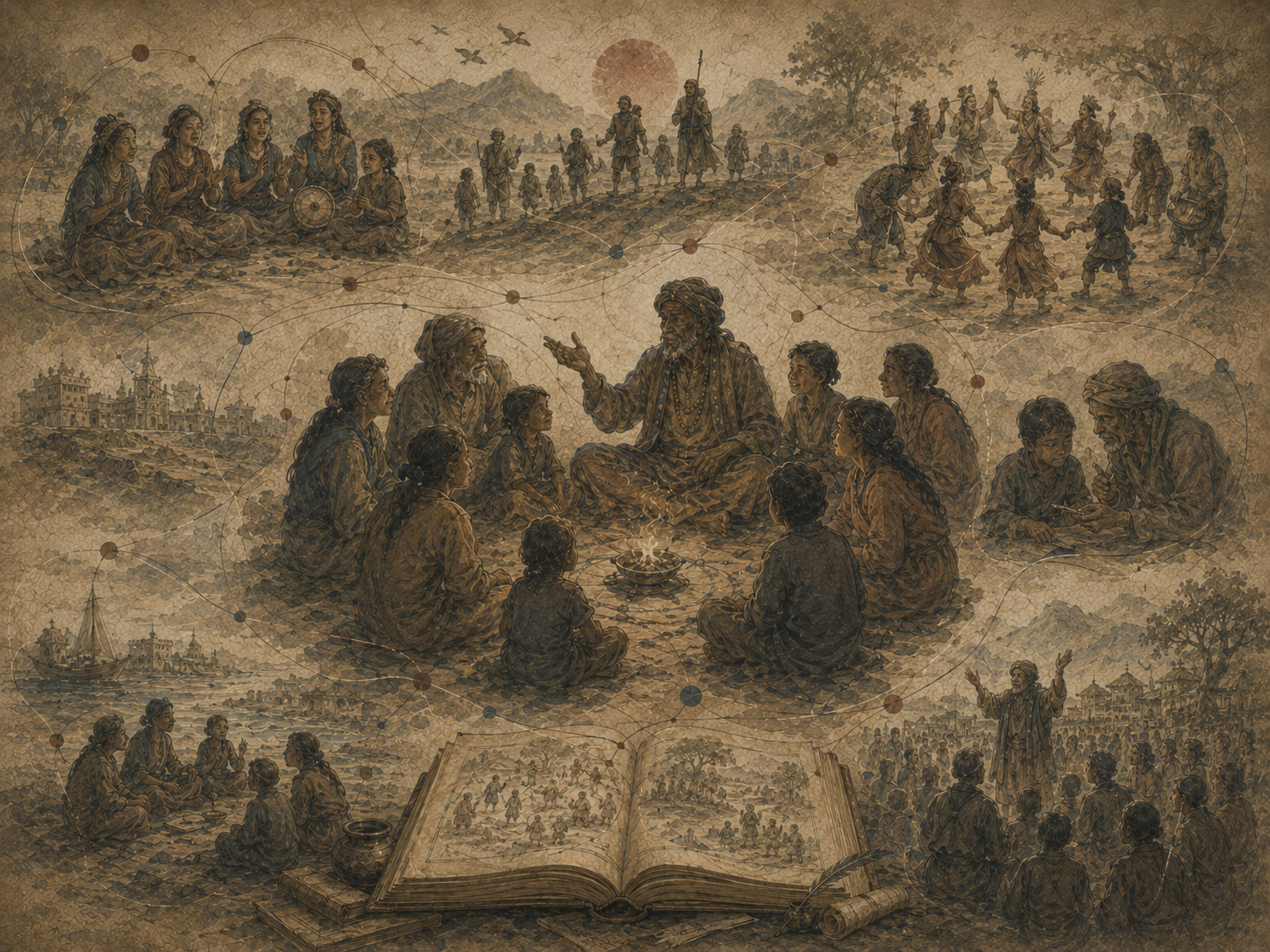
This article treats storytelling as a form of living cultural heritage. It examines oral traditions, performance, ritual context, language, memory, apprenticeship, community authority, preservation, safeguarding, documentation, digitization, adaptation, tourism, education, and ethical governance. It also includes computational workflows for auditing storytelling heritage practices, safeguarding priorities, context preservation, consent risk, archive risk, community control, adaptation pressure, and Catalyst Canvas-ready governance outputs.
Why Storytelling as Heritage Matters
Storytelling as heritage matters because stories are not only things people create. They are practices people inherit, perform, revise, protect, teach, and transmit. A story may carry a community’s memory, language, worldview, humor, grief, sacred relation, ecological knowledge, moral instruction, ritual obligation, or sense of belonging. When the practice of storytelling weakens, more than individual tales may be lost. Ways of remembering, speaking, listening, gathering, interpreting, and transmitting knowledge may also be weakened.
This is why storytelling cannot be fully safeguarded by saving a transcript alone. A transcript may preserve words, but it may not preserve voice, gesture, timing, audience participation, ceremonial setting, local language, permission protocols, seasonal restrictions, place relations, or the social authority of the teller. A recording may preserve sound, but not necessarily the living system that allows future tellers to learn, adapt, and continue the practice.
Storytelling heritage also matters because it challenges narrow ideas of culture as monuments, buildings, objects, or written canons. Living heritage often survives through practice: telling, singing, chanting, reciting, performing, remembering, teaching, correcting, and gathering.
| Storytelling heritage element | What it carries | Why it matters |
|---|---|---|
| Voice | Tone, rhythm, pause, emphasis, personality, and authority. | Meaning is carried through performance, not words alone. |
| Memory | Origins, migrations, losses, warnings, ancestors, places, and values. | Story becomes a social memory system. |
| Language | Idioms, proverbs, names, metaphors, sound patterns, and worldview. | Translation may preserve plot while losing cultural meaning. |
| Community | Audience, elders, learners, families, ritual groups, and knowledge holders. | Storytelling depends on relationships of transmission. |
| Place | Landscapes, routes, homes, shrines, waters, burial grounds, and gathering spaces. | Stories may belong to specific locations and obligations. |
| Practice | Performance, apprenticeship, correction, adaptation, and repetition. | Heritage remains alive through doing. |
Storytelling heritage matters because it shows culture as a living practice of memory, relation, language, performance, and continuity.
What Intangible Cultural Heritage Means
Intangible cultural heritage refers to living practices, expressions, knowledge, skills, and forms of transmission that communities recognize as part of their heritage. Unlike a monument, artifact, manuscript, or building, intangible heritage is carried through people and practice. It may involve oral traditions, performing arts, rituals, festivals, social practices, craft knowledge, ecological knowledge, healing practices, music, dance, language practices, storytelling, and forms of communal knowledge.
The key word is living. Intangible heritage is not merely old. It is inherited, practiced, transmitted, adapted, and recognized by communities. It is not preserved by freezing it into one official version. It survives through continuity and change.
Storytelling belongs naturally within this frame because stories often exist as living expressions. They are spoken, performed, sung, chanted, memorized, improvised, taught, corrected, embodied, and adapted. They may depend on language, gesture, ritual, season, place, kinship, apprenticeship, and permission. Storytelling can therefore be heritage not only because of what the story says, but because of how the practice continues.
| Heritage type | Material heritage example | Intangible heritage example |
|---|---|---|
| Object and practice | A manuscript, mask, instrument, garment, building, or artifact. | The telling, singing, making, performing, or ritual use connected to it. |
| Preservation focus | Conservation of physical form. | Safeguarding of living transmission and practice. |
| Primary carrier | Object, site, archive, or collection. | Community, practitioner, performer, teacher, elder, apprentice, or group. |
| Risk of loss | Damage, decay, theft, neglect, destruction. | Transmission break, language loss, displacement, commodification, context collapse. |
| Documentation role | Cataloging, conservation record, provenance. | Consent-based recording, context notes, access governance, transmission support. |
| Ethical question | Who owns, protects, or repatriates the object? | Who has authority to perform, teach, record, publish, adapt, or restrict access? |
Intangible cultural heritage shifts attention from cultural objects alone to the living practices and communities that keep meaning active.
Storytelling as Living Practice
Storytelling becomes intangible cultural heritage when it is recognized as a living practice that carries meaning across generations. This includes more than oral stories in a narrow sense. It may include myths, legends, folktales, epics, proverbs, riddles, chants, prayers, laments, praise poetry, ritual speech, historical testimony, family memory, origin stories, performance narratives, and community accounts.
A living storytelling practice includes skills. The teller must know when to speak, how to begin, what tone to use, what can be said publicly, what must be withheld, how to respond to audience, how to remember long sequences, how to use repetition, how to adapt without violating tradition, and how to transmit the practice to others.
A living storytelling practice also includes social recognition. A story may be known by many, but not everyone may have authority to tell it. Some stories are public; others are restricted. Some are told only in certain seasons, rituals, places, or life stages. Some require apprenticeship or permission. Some are family property, communal memory, sacred knowledge, or place-based obligation.
| Living practice feature | Storytelling example | Safeguarding implication |
|---|---|---|
| Skill | Voice, timing, memory, improvisation, gesture, pacing, and audience awareness. | Support training and intergenerational learning. |
| Context | Ritual, festival, family gathering, mourning, teaching, seasonal event, or public performance. | Document setting without stripping meaning from it. |
| Protocol | Rules about who may tell, hear, record, translate, or adapt a story. | Respect access and authority limits. |
| Transmission | Apprenticeship, listening, repetition, correction, practice, and performance. | Preserve pathways, not only recordings. |
| Variation | Different tellers adapt emphasis, length, humor, imagery, or local detail. | Do not freeze one version as the only correct form. |
| Recognition | Community members know what belongs to the tradition and what violates it. | Include community review in documentation and reuse. |
Storytelling heritage lives where practice, memory, skill, authority, and community recognition meet.
Oral Tradition, Language, and Transmission
Storytelling heritage is deeply tied to oral tradition and language. Oral traditions can carry knowledge, values, collective memory, humor, history, ecological awareness, spiritual meaning, and social norms. Language is often not merely a vehicle for plot. It carries rhythm, sound, metaphor, naming, gesture, grammar, politeness, worldview, and memory.
When a storytelling tradition loses language, much more than vocabulary may be lost. A translated story may preserve sequence but lose wordplay, sacred terms, local place names, kinship distinctions, tonal emphasis, proverbs, humor, or ritual force. A chant may lose meaning when separated from melody. A proverb may lose force when detached from the situation in which it is spoken.
Transmission is therefore central. Storytelling heritage depends on people learning how to remember, perform, interpret, and adapt stories responsibly. Transmission may happen through families, elders, apprenticeships, ritual roles, schools, performance groups, language revitalization programs, community archives, festivals, or informal listening.
| Transmission element | How it supports heritage | Risk when weakened |
|---|---|---|
| Language continuity | Preserves sound, idiom, worldview, naming, rhythm, and relational meaning. | Translation may flatten cultural meaning. |
| Intergenerational learning | Moves knowledge from elders to younger tellers. | Transmission chain may break. |
| Apprenticeship | Teaches not only words but timing, protocol, voice, and responsibility. | Recording may replace training instead of supporting it. |
| Repetition | Builds memory, recognition, and continuity. | Stories may become isolated archival fragments. |
| Correction | Allows community to guide accuracy and appropriate variation. | Unauthorized versions may circulate as authoritative. |
| Adaptation | Allows tradition to remain meaningful under changing conditions. | Overcontrol may freeze a living practice. |
Storytelling as intangible heritage depends on transmission systems that keep language, memory, performance, and responsibility alive.
Performance, Ritual, and Community Context
A story can change meaning depending on where, when, and how it is told. A tale told beside a fire, a chant performed during ceremony, a family story repeated at a funeral, an epic performed before a gathering, a legend told at a specific site, and a proverb spoken during a dispute are not simply containers of information. They are social events.
Performance gives storytelling its force. Voice, rhythm, pause, silence, gesture, repetition, movement, call and response, audience reaction, costume, object, instrument, and setting can all carry meaning. Ritual context can make storytelling part of transition, mourning, initiation, blessing, healing, remembrance, obligation, or renewal.
Community context also determines who is present and what the story does. A story may teach children, honor ancestors, mark a seasonal change, warn visitors, settle conflict, strengthen identity, mourn loss, celebrate survival, or transmit ecological knowledge. Without context, a recording may preserve words while missing the action the story performs.
| Context layer | Storytelling function | Documentation question |
|---|---|---|
| Occasion | Frames why the story is told now. | What event, ritual, season, or social need calls the story forth? |
| Audience | Shapes tone, length, emphasis, and permission. | Who may hear this story? |
| Place | Anchors memory to land, route, home, shrine, or gathering site. | Does the story belong to a specific location? |
| Embodiment | Uses voice, gesture, movement, posture, and silence. | What meaning is carried beyond words? |
| Ritual frame | Connects story to ceremony, transition, obligation, or sacred order. | What should remain restricted or contextualized? |
| Community recognition | Authorizes the telling and recognizes proper variation. | Who decides whether the telling is appropriate? |
To safeguard storytelling heritage responsibly, the performance event must be understood as part of the heritage itself.
Memory, Identity, and Continuity
Storytelling heritage is a way communities remember who they are, where they come from, what they have endured, what they value, and what obligations remain. Stories can preserve origin memory, place memory, ancestral memory, trauma memory, ritual memory, ecological memory, migration memory, resistance memory, and moral memory.
This memory is not neutral storage. It is shaped by repetition, selection, interpretation, omission, and performance. Communities remember some events through stories and silence others. Stories may preserve suppressed histories, but they may also reinforce dominant versions of the past. They can sustain identity, but they can also exclude. They can strengthen continuity, but they can also be politicized.
Continuity does not mean sameness. A living storytelling tradition may adapt to new audiences, new media, new crises, new migration patterns, new language conditions, and new forms of education. The question is not whether the story changes. The question is whether change remains accountable to the people and practices that carry the tradition.
| Memory type | Storytelling role | Continuity concern |
|---|---|---|
| Origin memory | Explains beginnings of people, places, practices, or obligations. | Origins may be simplified or politicized. |
| Place memory | Links story to land, water, route, settlement, shrine, or landmark. | Story may be detached from place and community. |
| Ancestral memory | Preserves names, relations, deeds, losses, and responsibilities. | Genealogy may be erased or commercialized. |
| Trauma memory | Carries loss, displacement, violence, or survival. | Retelling may expose pain without care. |
| Ecological memory | Transmits knowledge of seasons, animals, plants, water, weather, and land use. | Knowledge may be extracted without community control. |
| Ritual memory | Connects story to ceremony and repeated practice. | Documentation may reveal restricted knowledge. |
Storytelling heritage sustains continuity by keeping memory active, interpretable, and accountable across generations.
Safeguarding, Not Freezing
Safeguarding storytelling heritage does not mean freezing one version of a story forever. Living traditions change. Tellers adapt details, listeners shift, languages evolve, communities migrate, rituals respond to new conditions, and media transform circulation. A tradition that cannot change may become a museum piece rather than a living practice.
The goal of safeguarding is to support continuity under community authority. This can include documentation, education, language revitalization, apprenticeships, festivals, community archives, protected access, practitioner support, intergenerational programs, public recognition, and transmission spaces. But safeguarding should not turn living heritage into static content for outside consumption.
Freezing is a risk when institutions, governments, tourism boards, publishers, museums, schools, or digital platforms select one version of a practice as official and then treat variation as error. A living tradition may become a staged performance for outsiders, a brand asset, a heritage label, or a dataset detached from practitioners.
| Safeguarding approach | Healthy form | Risky form |
|---|---|---|
| Documentation | Records performances with consent, context, and access controls. | Extracts stories and circulates them without governance. |
| Education | Supports community-led teaching and language continuity. | Turns stories into simplified textbook folklore. |
| Festival presentation | Creates practitioner-led public recognition. | Stages heritage mainly for tourism or spectacle. |
| Archive creation | Builds community-controlled access and metadata. | Centralizes control in outside institutions. |
| Digital preservation | Supports secure storage, discoverability, and permissions. | Creates context collapse and uncontrolled reuse. |
| Adaptation | Allows responsible renewal under community guidance. | Commercializes sacred or communal material without consent. |
Safeguarding storytelling means supporting living transmission, not turning heritage into a fixed display.
Documentation and Archive Risk
Documentation can be valuable. Audio recordings, video recordings, transcripts, translations, photographs, field notes, metadata, teaching materials, dictionaries, glossaries, and digital archives can help sustain storytelling traditions, especially when language loss, displacement, conflict, environmental change, migration, or generational rupture threaten transmission.
But documentation also creates risk. A transcript can flatten performance. A recording can escape its intended audience. A translation can distort meaning. A metadata field can misclassify a story. A public archive can expose sacred or sensitive material. A researcher may gain career benefit while a community loses control. A platform may turn living heritage into searchable content detached from permission.
Archive risk is not an argument against documentation. It is an argument for responsible documentation. The question is not only “How do we save this?” but “Who controls what is saved, how it is described, who may access it, how it may be reused, and how the practice itself will continue?”
| Documentation form | Potential value | Risk |
|---|---|---|
| Audio recording | Preserves voice, sound, rhythm, and pause. | May circulate beyond consent. |
| Video recording | Preserves gesture, setting, audience, objects, and movement. | May reveal restricted ritual or private context. |
| Transcript | Supports reading, search, translation, and teaching. | May erase performance and treat one version as fixed. |
| Translation | Expands access across languages. | May lose cultural meaning, sound, humor, or sacred terminology. |
| Metadata | Supports classification and discovery. | May impose outside categories or reduce living practice to fields. |
| Digital archive | Supports preservation and access. | May remove control from community or practitioner. |
The archive should support living storytelling practice. It should not become a substitute for it.
Digital Platforms and Context Collapse
Digital platforms can give storytelling heritage visibility, reach, and preservation support. A community can share performances, teach language, archive elders’ voices, connect diaspora members, document endangered practices, and build educational materials. Digital tools can also support controlled access, multilingual metadata, and collaborative annotation.
But platforms can also create context collapse. A story told for one audience may be consumed by another. A sacred or restricted performance may be clipped and circulated without permission. A joke may be misunderstood outside its language community. A ritual story may become entertainment content. A legend may be detached from place. A storyteller’s voice may be used for remix, training data, or commercial material without consent.
Digital heritage work must therefore think beyond upload and access. It should consider community governance, permission tiers, takedown procedures, restricted metadata, cultural protocols, source attribution, licensing, platform terms, data persistence, search visibility, and future reuse.
| Digital issue | Risk | Responsible practice |
|---|---|---|
| Audience collapse | Material intended for one group reaches unintended audiences. | Use access levels and contextual warnings. |
| Platform extraction | Stories become data for engagement, advertising, or training systems. | Review platform terms and data reuse conditions. |
| Searchability | Restricted or sensitive materials become discoverable. | Limit indexing and use controlled metadata. |
| Remix culture | Stories are edited, mocked, sampled, or decontextualized. | Clarify reuse permissions and cultural limits. |
| Permanent circulation | Material remains online after consent changes. | Create removal, review, and access-update processes. |
| AI reuse | Storytelling materials are absorbed into systems without consent. | Use explicit restrictions, documentation, and governance review. |
Digital preservation should extend community control rather than replacing it with platform logic.
Education, Tourism, and Public Heritage
Storytelling heritage often enters public life through education, museums, festivals, tourism, libraries, schools, documentaries, exhibitions, and cultural programs. Public heritage can increase recognition and support. It can help younger generations value inherited stories, help outsiders understand cultural practice, and create resources for language and memory work.
But public heritage can also simplify. Stories may be shortened for visitors, stripped of context for school curricula, staged for festivals, branded for tourism, translated into generic moral lessons, or turned into local color. The more a tradition becomes publicly visible, the greater the need for careful framing.
Education and tourism should not treat storytelling heritage as decorative. They should explain context, transmission, language, performer authority, variation, and limits. They should also avoid treating communities as static carriers of ancient material for outside consumption. Living communities interpret, debate, change, and govern their own heritage.
| Public use | Possible benefit | Safeguarding concern |
|---|---|---|
| School curriculum | Builds cultural literacy and respect. | May flatten sacred or living traditions into simple lessons. |
| Museum exhibition | Provides context, visibility, and documentation. | May separate objects from living performance. |
| Festival | Supports performance, recognition, and intergenerational pride. | May stage tradition for outsider expectations. |
| Tourism | Can bring resources and public attention. | May commodify memory, place, or sacred story. |
| Documentary | Can preserve voice and public testimony. | May edit for drama and remove governance nuance. |
| Community workshop | Supports local transmission and skill development. | Requires long-term support beyond one event. |
Public heritage work is strongest when it is community-led, context-rich, and designed to support transmission rather than only display.
Ownership, Consent, and Community Authority
Storytelling heritage raises difficult questions of ownership and consent. Some stories are individual creations. Some are family histories. Some are communal traditions. Some are sacred narratives. Some are tied to place, lineage, ritual office, gendered knowledge, initiation, season, or restricted status. Some may be public in one context and restricted in another.
Consent must therefore be specific and ongoing. Permission to listen is not always permission to record. Permission to record is not always permission to publish. Permission to publish in one language or archive is not always permission to remix, monetize, translate, teach, or train a digital system. Consent can also change as circumstances change.
Community authority matters because a storyteller may not be the only stakeholder. A teller may have permission to perform but not to authorize global publication. A researcher may have a recording but not the right to circulate it. A museum may hold an archive but not moral authority over reuse. Responsible storytelling heritage work asks who has the right to decide.
| Consent layer | Question | Why it matters |
|---|---|---|
| Listening consent | Who may hear the story? | Some stories are audience-restricted. |
| Recording consent | May the performance be recorded? | Recording changes circulation and permanence. |
| Publication consent | May the story be published or shared publicly? | Public access may violate protocol. |
| Translation consent | May the story be translated, and by whom? | Translation can alter meaning and authority. |
| Adaptation consent | May the story be changed for media, education, games, or performance? | Adaptation may distort or commercialize heritage. |
| Data consent | May recordings, transcripts, or metadata be used in datasets or AI systems? | Digital reuse can be hard to control after release. |
Consent in storytelling heritage should be layered, documented, revisitable, and governed by the people connected to the tradition.
Storytelling Heritage and Power
Heritage is never only about preservation. It is also about power. Who gets recognized as a heritage bearer? Which traditions are funded? Which stories are listed, archived, translated, taught, staged, or promoted? Which languages are protected? Which communities control access? Which narratives become national heritage, tourist identity, or media content?
Storytelling heritage can protect communities from erasure, but it can also expose them to appropriation. Public recognition can bring pride and resources, but it can also invite outside control. A government may promote a story as national identity while ignoring local variation. A platform may amplify a performance while capturing value. An institution may collect stories while excluding community governance.
Power also shapes what is considered heritage. Everyday storytelling, women’s oral histories, minority languages, migrant narratives, working-class memory, Indigenous knowledge, diasporic performance, and informal practices may be undervalued compared with official, spectacular, or tourist-friendly forms. Responsible analysis asks who benefits from heritage recognition and who remains unheard.
| Power issue | Risk | Responsible question |
|---|---|---|
| Recognition | Some traditions become visible while others remain ignored. | Who decides what counts as heritage? |
| Representation | Outsiders describe a practice without community authority. | Who speaks for the tradition? |
| Funding | Resources shape which practices survive or become public. | Who receives support and under what conditions? |
| Nationalization | Local or diverse stories are turned into official identity. | What variation or dissent is erased? |
| Extraction | Researchers, platforms, or institutions gain value while communities lose control. | What governance and benefit-sharing exist? |
Storytelling heritage must be analyzed not only as culture, but as a field of recognition, control, value, and responsibility.
The Ethics of Safeguarding Storytelling
The ethics of safeguarding storytelling begin with a simple principle: stories are not just content to be saved. They are carried by people, languages, places, practices, and relationships. Safeguarding should strengthen those relationships rather than extracting material from them.
Ethical safeguarding asks who defines the heritage, who participates in documentation, who controls access, who benefits from public recognition, who teaches the next generation, and who can refuse publication. It also asks what should not be recorded, translated, digitized, or shared. Preservation is not always publicity. Sometimes safeguarding means protecting privacy, limiting access, preserving context, or supporting transmission without broad distribution.
Ethical safeguarding also recognizes change. Living heritage can adapt without becoming inauthentic. The goal is not to trap communities in the past. It is to support continuity under their own authority.
| Ethical principle | What it requires | What it prevents |
|---|---|---|
| Community authority | Decision-making by practitioners, communities, and appropriate knowledge holders. | Outside control of living heritage. |
| Informed consent | Clear permission for recording, storage, access, translation, reuse, and adaptation. | Uncontrolled circulation. |
| Context preservation | Documentation of performance, occasion, language, place, and protocol. | Flattened story fragments. |
| Access governance | Public, restricted, private, seasonal, or community-only access levels. | Exposure of sensitive material. |
| Benefit sharing | Credit, compensation, copies, training, infrastructure, or community value. | Extractive research or media use. |
| Living transmission | Support for apprenticeships, language, gatherings, teaching, and practice. | Archive-only preservation. |
Safeguarding storytelling heritage is an ethical practice of care, not merely a technical practice of preservation.
Examples of Storytelling as Intangible Heritage
The examples below show how storytelling heritage can be analyzed without reducing it to archive content alone.
Intergenerational folktale practice
Weak: The story is preserved only as a printed text.
Stronger: The safeguarding plan supports elder tellers, youth learning, language practice, performance context, and variant documentation.
Why it works: The practice of storytelling is protected, not only the tale.
Ritual chant recording
Weak: A recording is uploaded publicly for cultural visibility.
Stronger: Access is governed by consent, ceremonial protocol, seasonal restrictions, and community review.
Why it works: Preservation does not override sacred context.
Community legend archive
Weak: Legends are collected as local curiosities.
Stronger: The archive documents place, teller, audience, historical memory, variant accounts, and community interpretation.
Why it works: Place memory remains connected to community authority.
Language revitalization storytelling workshop
Weak: Stories are translated into a dominant language for easier teaching.
Stronger: Workshops support original-language telling, pronunciation, idiom, rhythm, and younger speakers.
Why it works: Language remains part of the heritage.
Digital storytelling platform
Weak: All recordings are made searchable and downloadable.
Stronger: The platform uses tiered access, consent metadata, takedown options, cultural protocols, and community administration.
Why it works: Digital visibility is balanced with control.
Festival performance
Weak: A tradition is staged for tourist entertainment.
Stronger: Practitioners lead framing, choose what can be shared, explain context, and support transmission beyond the event.
Why it works: Public presentation serves living heritage rather than spectacle alone.
Storytelling heritage analysis should ask how stories are practiced, transmitted, governed, and protected by the communities that carry them.
Mathematics, Computation, and Modeling
Storytelling heritage cannot be reduced to formulas, but modeling can help make safeguarding questions explicit. A computational workflow can audit whether a storytelling practice has enough documentation, transmission support, context preservation, consent clarity, archive governance, and community control.
A living-practice continuity score can estimate whether a storytelling tradition is supported as a practice rather than merely archived:
L_c = \frac{T_s + P_c + L_v + A_p + C_r + V_m}{6}
\]
Interpretation: Living continuity \(L_c\) averages transmission support \(T_s\), performance context \(P_c\), language vitality \(L_v\), apprenticeship pathways \(A_p\), community recognition \(C_r\), and variation management \(V_m\).
A safeguarding readiness score can estimate whether documentation and preservation plans are responsible:
S_r = \frac{C_l + G_p + M_q + A_c + B_s + R_p}{6}
\]
Interpretation: Safeguarding readiness \(S_r\) averages consent clarity \(C_l\), governance protocol \(G_p\), metadata quality \(M_q\), access control \(A_c\), benefit sharing \(B_s\), and review process \(R_p\).
A heritage-context preservation score can estimate whether the analysis preserves the cultural setting of the story:
H_p = \frac{O_c + P_l + R_f + E_b + S_t + K_h}{6}
\]
Interpretation: Heritage preservation \(H_p\) averages occasion context \(O_c\), place linkage \(P_l\), ritual frame \(R_f\), embodiment \(E_b\), social transmission \(S_t\), and knowledge-holder context \(K_h\).
An archive-risk score can estimate whether documentation or digital reuse may harm the practice:
R_a = C_rw_c + S_rw_s + P_ow_p + T_lw_t + E_xw_e + (1 – G_c)w_g
\]
Interpretation: Archive risk \(R_a\) rises with context removal \(C_r\), sacred or restricted material \(S_r\), performance omission \(P_o\), translation loss \(T_l\), extraction risk \(E_x\), and weak governance control \(G_c\).
| Modeling task | Safeguarding question | Example output |
|---|---|---|
| Living-practice audit | Is the storytelling tradition being supported as a living practice? | Living continuity score. |
| Transmission audit | Are elders, practitioners, apprentices, and learners supported? | Transmission support table. |
| Context audit | Are performance, place, ritual, language, and audience documented? | Heritage-context preservation score. |
| Consent audit | Are recording, storage, translation, access, and reuse permissions clear? | Consent and access report. |
| Archive-risk audit | Could documentation expose, flatten, commercialize, or extract the story? | Archive-risk score. |
| Governance queue | Which items need community, cultural, source, or ethics review? | Storytelling heritage governance queue. |
Computation can support safeguarding review, but it must remain subordinate to community authority, cultural expertise, consent, and human judgment.
Python Workflow: Storytelling Heritage Audit
The Python workflow below evaluates storytelling heritage items by transmission support, performance context, language vitality, apprenticeship pathways, community recognition, variation management, consent clarity, governance protocol, metadata quality, access control, benefit sharing, review process, occasion context, place linkage, ritual frame, embodiment, social transmission, knowledge-holder context, context removal, sacred or restricted material, performance omission, translation loss, extraction risk, and governance control. The companion repository version extends this into a Catalyst Canvas-ready module with schemas, package-style Python, tests, JSON exports, Canvas cards, markdown governance queues, and reusable safeguarding templates.
# storytelling_heritage_audit.py
# Dependency-light workflow for auditing storytelling as intangible cultural heritage.

from __future__ import annotations

from dataclasses import dataclass
from pathlib import Path
import csv
import json
from statistics import mean

ARTICLE_ROOT = Path(__file__).resolve().parents[1]
OUTPUTS = ARTICLE_ROOT / "outputs"
TABLES = OUTPUTS / "tables"
JSON_DIR = OUTPUTS / "json"
MARKDOWN = OUTPUTS / "markdown"


@dataclass
class StorytellingHeritageItem:
    item: str
    heritage_context: str
    transmission_support: float
    performance_context: float
    language_vitality: float
    apprenticeship_pathways: float
    community_recognition: float
    variation_management: float
    consent_clarity: float
    governance_protocol: float
    metadata_quality: float
    access_control: float
    benefit_sharing: float
    review_process: float
    occasion_context: float
    place_linkage: float
    ritual_frame: float
    embodiment: float
    social_transmission: float
    knowledge_holder_context: float
    context_removal: float
    sacred_or_restricted_material: float
    performance_omission: float
    translation_loss: float
    extraction_risk: float
    governance_control: float
    community_sensitivity: float
    public_consequence: float
    owner: str
    status: str

    def living_continuity(self) -> float:
        return mean([
            self.transmission_support,
            self.performance_context,
            self.language_vitality,
            self.apprenticeship_pathways,
            self.community_recognition,
            self.variation_management,
        ])

    def safeguarding_readiness(self) -> float:
        return mean([
            self.consent_clarity,
            self.governance_protocol,
            self.metadata_quality,
            self.access_control,
            self.benefit_sharing,
            self.review_process,
        ])

    def heritage_context_preservation(self) -> float:
        return mean([
            self.occasion_context,
            self.place_linkage,
            self.ritual_frame,
            self.embodiment,
            self.social_transmission,
            self.knowledge_holder_context,
        ])

    def archive_risk(self) -> float:
        return min(
            1.0,
            self.context_removal * 0.18
            + self.sacred_or_restricted_material * 0.22
            + self.performance_omission * 0.16
            + self.translation_loss * 0.16
            + self.extraction_risk * 0.18
            + (1 - self.governance_control) * 0.10,
        )

    def governance_priority_score(self) -> float:
        return min(
            1.0,
            self.archive_risk() * 0.35
            + self.community_sensitivity * 0.25
            + self.public_consequence * 0.20
            + (1 - self.safeguarding_readiness()) * 0.20,
        )

    def review_priority(self) -> str:
        risk = self.archive_risk()
        priority = self.governance_priority_score()
        readiness = self.safeguarding_readiness()

        if self.status == "revise" or risk >= 0.55 or priority >= 0.62 or readiness < 0.55:
            return "high"
        if self.status == "review" or risk >= 0.40 or priority >= 0.48 or readiness < 0.68:
            return "medium"
        return "standard"


def write_csv(path: Path, rows: list[dict[str, object]]) -> None:
    path.parent.mkdir(parents=True, exist_ok=True)
    if not rows:
        raise ValueError(f"No rows to write: {path}")
    with path.open("w", encoding="utf-8", newline="") as handle:
        writer = csv.DictWriter(handle, fieldnames=list(rows[0].keys()))
        writer.writeheader()
        writer.writerows(rows)


def write_json(path: Path, payload: object) -> None:
    path.parent.mkdir(parents=True, exist_ok=True)
    path.write_text(json.dumps(payload, indent=2), encoding="utf-8")


def write_markdown_queue(path: Path, rows: list[dict[str, object]]) -> None:
    path.parent.mkdir(parents=True, exist_ok=True)
    lines = [
        "# Storytelling Heritage Governance Queue",
        "",
        "| Item | Context | Living continuity | Safeguarding readiness | Context preservation | Archive risk | Priority | Owner |",
        "|---|---|---:|---:|---:|---:|---|---|",
    ]

    for row in rows:
        lines.append(
            f"| {row['item']} | {row['heritage_context']} | "
            f"{row['living_continuity']} | {row['safeguarding_readiness']} | "
            f"{row['heritage_context_preservation']} | {row['archive_risk']} | "
            f"{row['review_priority']} | {row['owner']} |"
        )

    path.write_text("\n".join(lines) + "\n", encoding="utf-8")


def main() -> None:
    items = [
        StorytellingHeritageItem(
            "Intergenerational folktale practice",
            "family and community oral tradition",
            0.86, 0.82, 0.76, 0.78, 0.84, 0.80,
            0.72, 0.70, 0.68, 0.66, 0.64, 0.70,
            0.76, 0.70, 0.44, 0.72, 0.84, 0.78,
            0.28, 0.20, 0.34, 0.36, 0.30, 0.76,
            0.72, 0.58,
            "editorial", "active"
        ),
        StorytellingHeritageItem(
            "Ritual chant recording",
            "restricted ceremonial storytelling",
            0.72, 0.90, 0.82, 0.70, 0.88, 0.62,
            0.54, 0.76, 0.58, 0.48, 0.46, 0.62,
            0.88, 0.80, 0.96, 0.92, 0.76, 0.88,
            0.72, 0.92, 0.84, 0.68, 0.76, 0.42,
            0.96, 0.82,
            "cultural review", "review"
        ),
        StorytellingHeritageItem(
            "Community legend archive",
            "place-based memory archive",
            0.78, 0.74, 0.66, 0.62, 0.82, 0.76,
            0.70, 0.72, 0.76, 0.74, 0.64, 0.72,
            0.72, 0.94, 0.42, 0.60, 0.72, 0.78,
            0.38, 0.30, 0.42, 0.34, 0.36, 0.78,
            0.78, 0.66,
            "community archive", "active"
        ),
        StorytellingHeritageItem(
            "Digital platform story collection",
            "public digital heritage platform",
            0.52, 0.46, 0.48, 0.38, 0.44, 0.42,
            0.36, 0.30, 0.44, 0.28, 0.26, 0.32,
            0.40, 0.34, 0.28, 0.36, 0.40, 0.32,
            0.82, 0.64, 0.78, 0.66, 0.84, 0.18,
            0.88, 0.78,
            "platform review", "revise"
        ),
        StorytellingHeritageItem(
            "Language revitalization storytelling workshop",
            "community-led language and story transmission",
            0.90, 0.78, 0.92, 0.86, 0.88, 0.82,
            0.82, 0.84, 0.78, 0.80, 0.76, 0.82,
            0.74, 0.66, 0.50, 0.70, 0.90, 0.84,
            0.20, 0.18, 0.28, 0.22, 0.24, 0.86,
            0.80, 0.70,
            "language team", "active"
        ),
    ]

    rows = []

    for item in items:
        rows.append({
            "item": item.item,
            "heritage_context": item.heritage_context,
            "living_continuity": round(item.living_continuity(), 3),
            "safeguarding_readiness": round(item.safeguarding_readiness(), 3),
            "heritage_context_preservation": round(item.heritage_context_preservation(), 3),
            "archive_risk": round(item.archive_risk(), 3),
            "governance_priority_score": round(item.governance_priority_score(), 3),
            "review_priority": item.review_priority(),
            "owner": item.owner,
            "status": item.status,
        })

    priority_order = {"high": 3, "medium": 2, "standard": 1}
    rows = sorted(
        rows,
        key=lambda row: (
            priority_order.get(str(row["review_priority"]), 0),
            float(row["archive_risk"])
        ),
        reverse=True,
    )

    governance_queue = [
        row for row in rows
        if row["review_priority"] != "standard"
    ]

    write_csv(TABLES / "storytelling_heritage_audit.csv", rows)
    write_csv(TABLES / "storytelling_heritage_governance_queue.csv", governance_queue)

    write_json(JSON_DIR / "storytelling_heritage_canvas_cards.json", rows)
    write_json(JSON_DIR / "storytelling_heritage_governance_queue.json", governance_queue)

    write_markdown_queue(MARKDOWN / "storytelling_heritage_governance_queue.md", governance_queue)

    print("Storytelling heritage audit complete.")


if __name__ == "__main__":
    main()
This workflow helps distinguish living transmission from archive-only preservation while flagging weak consent, restricted material, context loss, translation loss, extraction risk, and weak governance control.
R Workflow: Safeguarding and Archive-Risk Diagnostics
The R workflow below creates a synthetic storytelling-heritage dataset, calculates living continuity, safeguarding readiness, heritage-context preservation, archive risk, governance priority, and review priority, then exports summary tables and base R plots. It is intentionally portable and uses only base R.
# storytelling_heritage_diagnostics.R
# Base R workflow for storytelling as intangible cultural heritage.

args <- commandArgs(trailingOnly = FALSE)
file_arg <- grep("^--file=", args, value = TRUE)

if (length(file_arg) > 0) {
  script_path <- normalizePath(sub("^--file=", "", file_arg[1]), mustWork = TRUE)
  article_root <- normalizePath(file.path(dirname(script_path), ".."), mustWork = TRUE)
} else {
  article_root <- getwd()
}

setwd(article_root)

tables_dir <- file.path(article_root, "outputs", "tables")
figures_dir <- file.path(article_root, "outputs", "figures")
dir.create(tables_dir, recursive = TRUE, showWarnings = FALSE)
dir.create(figures_dir, recursive = TRUE, showWarnings = FALSE)

items <- data.frame(
  item = c(
    "Intergenerational folktale practice",
    "Ritual chant recording",
    "Community legend archive",
    "Digital platform story collection",
    "Language revitalization storytelling workshop"
  ),
  heritage_context = c(
    "family and community oral tradition",
    "restricted ceremonial storytelling",
    "place-based memory archive",
    "public digital heritage platform",
    "community-led language and story transmission"
  ),
  transmission_support = c(0.86, 0.72, 0.78, 0.52, 0.90),
  performance_context = c(0.82, 0.90, 0.74, 0.46, 0.78),
  language_vitality = c(0.76, 0.82, 0.66, 0.48, 0.92),
  apprenticeship_pathways = c(0.78, 0.70, 0.62, 0.38, 0.86),
  community_recognition = c(0.84, 0.88, 0.82, 0.44, 0.88),
  variation_management = c(0.80, 0.62, 0.76, 0.42, 0.82),
  consent_clarity = c(0.72, 0.54, 0.70, 0.36, 0.82),
  governance_protocol = c(0.70, 0.76, 0.72, 0.30, 0.84),
  metadata_quality = c(0.68, 0.58, 0.76, 0.44, 0.78),
  access_control = c(0.66, 0.48, 0.74, 0.28, 0.80),
  benefit_sharing = c(0.64, 0.46, 0.64, 0.26, 0.76),
  review_process = c(0.70, 0.62, 0.72, 0.32, 0.82),
  occasion_context = c(0.76, 0.88, 0.72, 0.40, 0.74),
  place_linkage = c(0.70, 0.80, 0.94, 0.34, 0.66),
  ritual_frame = c(0.44, 0.96, 0.42, 0.28, 0.50),
  embodiment = c(0.72, 0.92, 0.60, 0.36, 0.70),
  social_transmission = c(0.84, 0.76, 0.72, 0.40, 0.90),
  knowledge_holder_context = c(0.78, 0.88, 0.78, 0.32, 0.84),
  context_removal = c(0.28, 0.72, 0.38, 0.82, 0.20),
  sacred_or_restricted_material = c(0.20, 0.92, 0.30, 0.64, 0.18),
  performance_omission = c(0.34, 0.84, 0.42, 0.78, 0.28),
  translation_loss = c(0.36, 0.68, 0.34, 0.66, 0.22),
  extraction_risk = c(0.30, 0.76, 0.36, 0.84, 0.24),
  governance_control = c(0.76, 0.42, 0.78, 0.18, 0.86),
  community_sensitivity = c(0.72, 0.96, 0.78, 0.88, 0.80),
  public_consequence = c(0.58, 0.82, 0.66, 0.78, 0.70),
  owner = c("editorial", "cultural review", "community archive", "platform review", "language team"),
  status = c("active", "review", "active", "revise", "active"),
  stringsAsFactors = FALSE
)

items$living_continuity <- rowMeans(items[, c(
  "transmission_support",
  "performance_context",
  "language_vitality",
  "apprenticeship_pathways",
  "community_recognition",
  "variation_management"
)])

items$safeguarding_readiness <- rowMeans(items[, c(
  "consent_clarity",
  "governance_protocol",
  "metadata_quality",
  "access_control",
  "benefit_sharing",
  "review_process"
)])

items$heritage_context_preservation <- rowMeans(items[, c(
  "occasion_context",
  "place_linkage",
  "ritual_frame",
  "embodiment",
  "social_transmission",
  "knowledge_holder_context"
)])

items$archive_risk <- pmin(
  1,
  items$context_removal * 0.18 +
    items$sacred_or_restricted_material * 0.22 +
    items$performance_omission * 0.16 +
    items$translation_loss * 0.16 +
    items$extraction_risk * 0.18 +
    (1 - items$governance_control) * 0.10
)

items$governance_priority_score <- pmin(
  1,
  items$archive_risk * 0.35 +
    items$community_sensitivity * 0.25 +
    items$public_consequence * 0.20 +
    (1 - items$safeguarding_readiness) * 0.20
)

items$review_priority <- ifelse(
  items$status == "revise" | items$archive_risk >= 0.55 | items$governance_priority_score >= 0.62 | items$safeguarding_readiness < 0.55,
  "high",
  ifelse(
    items$status == "review" | items$archive_risk >= 0.40 | items$governance_priority_score >= 0.48 | items$safeguarding_readiness < 0.68,
    "medium",
    "standard"
  )
)

items <- items[order(items$archive_risk, decreasing = TRUE), ]

write.csv(
  items,
  file.path(tables_dir, "storytelling_heritage_diagnostics.csv"),
  row.names = FALSE
)

governance_queue <- items[items$review_priority != "standard", ]

write.csv(
  governance_queue,
  file.path(tables_dir, "storytelling_heritage_governance_queue.csv"),
  row.names = FALSE
)

png(file.path(figures_dir, "living_continuity_scores.png"), width = 1200, height = 700)
barplot(
  items$living_continuity,
  names.arg = items$item,
  las = 2,
  ylab = "Living continuity",
  main = "Storytelling Heritage Living Continuity Scores"
)
grid()
dev.off()

png(file.path(figures_dir, "archive_risk_scores.png"), width = 1200, height = 700)
barplot(
  items$archive_risk,
  names.arg = items$item,
  las = 2,
  ylab = "Archive risk",
  main = "Storytelling Heritage Archive Risk Scores"
)
grid()
dev.off()

print(items[, c(
  "item",
  "heritage_context",
  "living_continuity",
  "safeguarding_readiness",
  "heritage_context_preservation",
  "archive_risk",
  "governance_priority_score",
  "review_priority"
)])
This workflow turns storytelling heritage safeguarding into a reviewable editorial artifact. It helps identify where living transmission is strong, where documentation is useful, and where cultural, source, consent, access, or ethics review is needed.
GitHub Repository
The companion repository for this article supports storytelling as intangible cultural heritage as a Catalyst Canvas-ready analysis module. It includes living-practice continuity scoring, safeguarding-readiness diagnostics, heritage-context preservation, archive-risk checks, consent and access review, community-control mapping, adaptation-risk review, JSON schemas, package-style Python, R workflows, SQL structures, Canvas cards, markdown governance queues, synthetic datasets, documentation, and reusable safeguarding templates.
Complete Code Repository
Companion repository for the article, including Catalyst Canvas-ready code for storytelling heritage, living transmission, safeguarding readiness, performance context, language vitality, consent review, archive risk, governance queues, JSON exports, Canvas cards, and reproducible research workflows.
articles/storytelling-as-intangible-cultural-heritage/
├── canvas/
│   ├── canvas_manifest.json
│   ├── input_schema.json
│   ├── output_schema.json
│   ├── canvas_cards.json
│   └── governance_queue.json
├── html/
├── css/
├── php/
├── java/
├── python/
│   ├── storytelling_heritage_canvas/
│   │   ├── __init__.py
│   │   ├── __main__.py
│   │   ├── cli.py
│   │   ├── models.py
│   │   ├── scoring.py
│   │   ├── validation.py
│   │   ├── governance.py
│   │   └── exporters.py
│   ├── tests/
│   │   └── test_storytelling_heritage_canvas.py
│   └── run_storytelling_heritage_canvas_audit.py
├── r/
│   ├── storytelling_heritage_diagnostics.R
│   └── run_all_storytelling_heritage_workflows.R
├── sql/
│   ├── canvas_schema.sql
│   └── canvas_queries.sql
├── docs/
│   ├── article_notes.md
│   ├── modeling_principles.md
│   ├── living_practice.md
│   ├── safeguarding.md
│   ├── archive_risk.md
│   ├── consent_and_access.md
│   ├── digital_context_collapse.md
│   └── governance_notes.md
├── data/
│   ├── storytelling_heritage_items.csv
│   ├── safeguarding_contexts.csv
│   ├── transmission_pathways.csv
│   ├── consent_access_controls.csv
│   ├── archive_risks.csv
│   └── storytelling_heritage_governance_notes.csv
├── outputs/
│   ├── figures/
│   ├── json/
│   ├── markdown/
│   └── tables/
├── notebooks/
├── shared/
│   ├── schemas/
│   ├── narrative-templates/
│   ├── story-archetypes/
│   ├── character-models/
│   ├── plot-structures/
│   ├── rhetorical-frameworks/
│   ├── cultural-memory/
│   ├── storytelling-heritage/
│   └── governance/
├── tests/
└── README.md
Related Articles
- Oral Tradition, Performance, and Collective Memory
- Folktale Structure and Vladimir Propp’s Morphology
- Myths, Legends, Folktales, and Epics
- Performance, Memory, and Variation in Oral Storytelling
- Proverb, Song, Chant, and Ritual Speech
- Myth, Ritual, and the Symbolic Work of Story
A Practical Method for Safeguarding Storytelling Heritage
1. Identify the storytelling practice
Clarify whether the material is a folktale, myth, legend, epic, chant, proverb, ritual speech, family memory, testimony, song, or another form.
2. Identify the community and knowledge holders
Document who carries, performs, teaches, recognizes, and governs the tradition.
3. Document performance context
Record teller role, audience, occasion, place, timing, embodiment, ritual frame, and social function.
4. Map transmission pathways
Ask how the practice is learned, corrected, adapted, repeated, and passed on.
5. Review language and translation
Identify original language, translation limits, sound patterns, idioms, names, proverbs, and untranslatable terms.
6. Establish consent layers
Separate permission to listen, record, store, translate, publish, teach, adapt, monetize, or use as data.
7. Set access levels
Determine whether materials are public, community-only, restricted, seasonal, private, sacred, or not to be archived.
8. Evaluate archive risk
Look for context removal, performance omission, translation loss, restricted material, extraction risk, and platform risk.
9. Support living transmission
Prioritize apprenticeships, workshops, language support, practitioner compensation, community archives, and intergenerational learning.
10. Create governance notes
Document review owner, cultural protocols, access rules, benefit sharing, revision recommendations, and future review dates.
This method supports storytelling heritage as living practice rather than archive content alone.
Common Pitfalls
Several pitfalls appear when storytelling heritage is misunderstood.
- Saving the text but losing the practice: A transcript cannot preserve the full performance event, transmission system, or community authority.
- Freezing a living tradition: Safeguarding should support continuity and responsible change, not lock one version in place.
- Confusing visibility with protection: Public recognition may expose a tradition to commodification, extraction, or misuse.
- Ignoring consent layers: Permission to listen is not permission to record, publish, translate, adapt, monetize, or digitize.
- Flattening language: Translation may preserve plot while losing sound, humor, ritual force, idiom, and worldview.
- Replacing transmission with archives: Archives can support heritage, but they should not substitute for learning, practice, and community continuity.
- Publishing restricted knowledge: Some stories require seasonal, ceremonial, gendered, kinship, initiation, or community access controls.
- Staging heritage for outsiders: Festivals and tourism can distort living practice when spectacle replaces context.
- Using platforms without governance: Digital circulation can create context collapse, uncontrolled reuse, and data extraction.
- Treating community heritage as free content: Storytelling traditions require attribution, benefit sharing, permission, and cultural respect.
The central pitfall is treating storytelling heritage as detachable content rather than living practice.
Why Storytelling Heritage Still Matters
Storytelling heritage still matters because the future of culture depends not only on what is stored, but on what is practiced. Stories survive when people remember them, tell them, teach them, revise them, perform them, protect them, and recognize their meaning. A story kept in an archive but no longer practiced may be preserved as evidence, but weakened as living heritage.
This does not mean archives are unimportant. Documentation can be essential, especially under conditions of language loss, displacement, conflict, climate stress, migration, aging knowledge holders, and disrupted transmission. But documentation should support living practice, not replace it.
Storytelling as intangible cultural heritage asks us to treat narrative as memory, performance, language, relationship, responsibility, and continuity. It reminds us that culture is not only what can be owned, displayed, digitized, or quoted. It is also what people do together across time. Safeguarding storytelling means protecting the conditions that allow stories to remain alive.
Further Reading
- Bauman, R. (1986) Story, Performance, and Event: Contextual Studies of Oral Narrative. Cambridge: Cambridge University Press.
- Finnegan, R. (1992) Oral Traditions and the Verbal Arts: A Guide to Research Practices. London: Routledge.
- Kirshenblatt-Gimblett, B. (2004) ‘Intangible Heritage as Metacultural Production’, Museum International, 56(1–2), pp. 52–65.
- Lord, A.B. (2019) The Singer of Tales. 3rd edn. Edited by D.F. Elmer. Cambridge, MA: Harvard University Press. Available at: https://www.hup.harvard.edu/books/9780674975736
- Smithsonian Center for Folklife and Cultural Heritage (n.d.) Intangible Cultural Heritage. Available at: https://folklife.si.edu/cultural-heritage-policy/ICH/smithsonian
- UNESCO (2003) Text of the Convention for the Safeguarding of the Intangible Cultural Heritage. Available at: https://ich.unesco.org/en/convention
- UNESCO (n.d.) What Is Intangible Cultural Heritage? Available at: https://ich.unesco.org/en/what-is-intangible-heritage-00003
- UNESCO (n.d.) Oral Traditions and Expressions Including Language as a Vehicle of the Intangible Cultural Heritage. Available at: https://ich.unesco.org/en/oral-traditions-and-expressions-00053
- Vansina, J. (1985) Oral Tradition as History. Madison: University of Wisconsin Press.
- Waterton, E. and Smith, L. (2009) Taking Archaeology Out of Heritage. Newcastle upon Tyne: Cambridge Scholars Publishing.
References
- Bauman, R. (1986) Story, Performance, and Event: Contextual Studies of Oral Narrative. Cambridge: Cambridge University Press.
- Finnegan, R. (1992) Oral Traditions and the Verbal Arts: A Guide to Research Practices. London: Routledge.
- Kirshenblatt-Gimblett, B. (2004) ‘Intangible Heritage as Metacultural Production’, Museum International, 56(1–2), pp. 52–65.
- Lord, A.B. (2019) The Singer of Tales. 3rd edn. Edited by D.F. Elmer. Cambridge, MA: Harvard University Press. Available at: https://www.hup.harvard.edu/books/9780674975736
- Smithsonian Center for Folklife and Cultural Heritage (n.d.) Intangible Cultural Heritage. Available at: https://folklife.si.edu/cultural-heritage-policy/ICH/smithsonian
- UNESCO (2003) Text of the Convention for the Safeguarding of the Intangible Cultural Heritage. Available at: https://ich.unesco.org/en/convention
- UNESCO (n.d.) What Is Intangible Cultural Heritage? Available at: https://ich.unesco.org/en/what-is-intangible-heritage-00003
- UNESCO (n.d.) Oral Traditions and Expressions Including Language as a Vehicle of the Intangible Cultural Heritage. Available at: https://ich.unesco.org/en/oral-traditions-and-expressions-00053
- Vansina, J. (1985) Oral Tradition as History. Madison: University of Wisconsin Press.
- Waterton, E. and Smith, L. (2009) Taking Archaeology Out of Heritage. Newcastle upon Tyne: Cambridge Scholars Publishing.