
Last Updated June 10, 2026
Joseph Campbell is one of the most influential and controversial modern interpreters of myth. His work brought comparative mythology to a broad public audience, especially through The Hero with a Thousand Faces, the idea of the monomyth, and later popular conversations about myth, creativity, psychology, and modern life. For many readers, Campbell opened the door to seeing recurring patterns across world mythologies. For many scholars, his work also raises important questions about comparison, universality, cultural specificity, gender, colonial framing, source selection, and the risks of turning myth into formula.
Joseph Campbell and the Comparative Study of Myth examines Campbell’s role in popularizing comparative mythology while also placing his work in context. It explains what Campbell was trying to do, why his approach became influential, how his ideas shaped modern storytelling, why the hero’s journey became so widely adopted, and why responsible myth study requires more than searching for universal patterns. The article treats Campbell as a major figure in the history of storytelling theory, not as the final authority on myth.
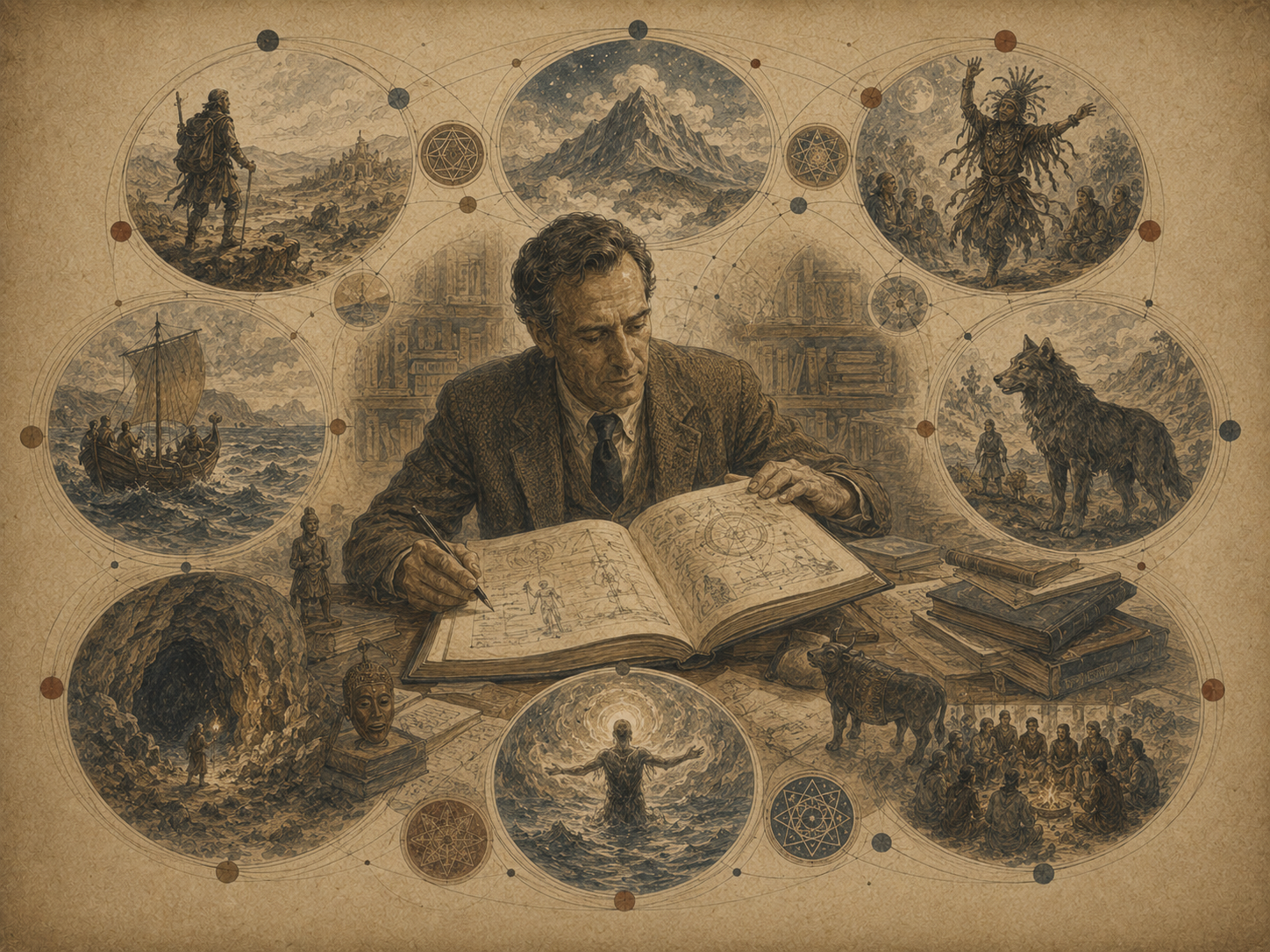
This article treats Campbell as a bridge between scholarly myth comparison, literary interpretation, psychology, religion, and popular storytelling. It examines comparative mythology, the monomyth, archetypal interpretation, Campbell’s sources, his public influence, his use in film and writing culture, and major critiques of his method. It also includes computational workflows for auditing comparative myth claims, source diversity, pattern generalization, cultural specificity, ethical risk, and Catalyst Canvas-ready governance outputs.
Why Campbell Matters
Joseph Campbell matters because he changed how many modern readers, writers, filmmakers, teachers, and general audiences think about myth. He did not invent comparative mythology, archetypal interpretation, ritual theory, or the study of recurring narrative patterns. But he synthesized those traditions in a highly accessible form and brought them into public culture.
For Campbell, myths were not merely old stories. They were symbolic narratives that helped people confront birth, death, fear, desire, maturation, suffering, transformation, and the search for meaning. He argued that myths from different cultures often contain recurring structures because human beings face recurring existential problems. This made his work appealing to readers who wanted myth to speak to modern life.
His influence is especially visible in storytelling culture. The hero’s journey became a familiar language in screenwriting, fiction, game design, leadership training, education, branding, and personal development. That influence is powerful, but it is also risky. Campbell’s work can deepen symbolic literacy when used carefully. It can flatten cultural difference when used carelessly.
| Campbell’s importance | What he helped popularize | Why it matters |
|---|---|---|
| Comparative myth | Reading myths across cultures for recurring symbolic patterns. | Encouraged readers to see connections across traditions. |
| The monomyth | A recurring heroic adventure pattern of departure, initiation, and return. | Became a major framework in modern storytelling culture. |
| Myth as psychology | Interpreting myth as symbolic drama of inner life and human development. | Linked myth to personal transformation and meaning. |
| Myth in modern life | Arguing that myth remains relevant beyond ancient religion. | Made myth feel alive for contemporary audiences. |
| Public scholarship | Communicating mythic interpretation to non-specialist audiences. | Expanded interest in myth, story, religion, and symbolism. |
| Creative influence | Providing story language used by writers and filmmakers. | Changed how many creators think about narrative structure. |
Campbell matters because he made myth feel like a living symbolic language. The challenge is to preserve that insight without turning his framework into a universal template.
What Comparative Mythology Tries to Do
Comparative mythology studies myths across cultures, traditions, languages, and historical settings. It asks why certain images, themes, structures, divine figures, heroic patterns, creation stories, flood stories, underworld journeys, trickster figures, sacrificial motifs, and transformation narratives appear in more than one cultural setting.
Comparison can be useful. It can reveal shared human concerns, cultural contact, migration, ritual patterns, literary inheritance, religious transformation, symbolic recurrence, and narrative adaptation. It can also help readers avoid provincialism by showing that no one tradition has a monopoly on origin, meaning, heroism, death, renewal, or sacred order.
But comparison is dangerous when it ignores difference. Two stories may share a surface motif while doing very different cultural work. A descent into the underworld may mean initiation in one context, mourning in another, divine conquest in another, seasonal renewal in another, and political legitimacy in another. A strong comparative method asks both what is similar and what is different.
| Comparative question | Responsible use | Risky use |
|---|---|---|
| What patterns recur? | Identify recurring motifs while preserving source context. | Assume all similar motifs mean the same thing. |
| How do myths travel? | Study diffusion, translation, adaptation, and contact. | Ignore history and treat all recurrence as universal psychology. |
| What does a myth do? | Analyze ritual, social, theological, literary, and ethical function. | Reduce the myth to plot structure alone. |
| Who interprets? | Include scholarship, community knowledge, language, and source tradition. | Let an outside framework overrule local meaning. |
| What is universal? | Use universality cautiously as a hypothesis. | Declare one pattern the key to all stories. |
| What remains different? | Respect non-equivalence, contradiction, and cultural specificity. | Erase difference in the name of unity. |
Comparative mythology is strongest when comparison becomes a disciplined question, not a shortcut to sameness.
Campbell’s Core Project
Campbell’s core project was to interpret myths as symbolic stories that reveal recurring patterns of human experience. He was interested in why certain images and narrative structures appear across cultures, why myths continue to matter, and how symbolic stories help people move through life stages, inner conflict, and transformation.
He often approached myth through broad comparison. Rather than treating each myth only as a local artifact, Campbell looked for repeated patterns: departure, trial, helper, threshold, descent, ordeal, revelation, transformation, return. He read myths through psychology, literature, religion, ritual, and comparative symbolism.
This broad method gave Campbell’s work its reach. It also created many of the criticisms later directed at him. His approach often emphasized universal meaning more than historical specificity. It sometimes foregrounded psychological and symbolic pattern over language, politics, gender, colonial history, community authority, and ritual context. The result is a body of work that remains generative but requires careful use.
| Campbell’s emphasis | Value | Needed correction |
|---|---|---|
| Recurring pattern | Helps readers see structural similarity across stories. | Must be balanced with local meaning and historical difference. |
| Symbolic psychology | Connects myth to inner development and transformation. | Must not erase religion, ritual, politics, or culture. |
| Comparative range | Encourages cross-cultural curiosity. | Must avoid treating cultures as interchangeable examples. |
| Public accessibility | Makes myth study approachable. | May oversimplify scholarly debates. |
| Creative usefulness | Gives writers a language for narrative transformation. | Can become formulaic screenwriting if used mechanically. |
| Myth as living meaning | Shows that myth still speaks to modern life. | Must avoid extracting sacred or cultural material for personal use alone. |
Campbell’s core project was not merely to catalog stories. It was to argue that myth expresses deep symbolic patterns of human life.
The Hero with a Thousand Faces
The Hero with a Thousand Faces, published in 1949, is Campbell’s most famous work. It presents the hero’s adventure as a recurring mythic structure found in many traditions. Campbell described this structure as a movement through departure, initiation, and return, with many episodes and symbolic thresholds along the way.
The book became influential because it gave readers a memorable map. The hero leaves the familiar world, crosses a threshold, faces trials, receives aid, descends into danger, encounters transformation, gains a boon, and returns with renewed meaning. This structure seemed to connect ancient myth, religious narrative, fairy tale, epic, psychological transformation, and modern storytelling.
Yet The Hero with a Thousand Faces should not be read as a neutral catalog of all myth. It is a highly interpretive synthesis. Campbell selects, compares, abstracts, and arranges examples in service of a broader argument. The book is powerful because of its pattern-making; it is limited for the same reason. It is less useful as a final authority on any one tradition and more useful as a historical landmark in comparative myth interpretation.
| Element | Campbell’s use | Responsible reading |
|---|---|---|
| Departure | The hero leaves ordinary life and crosses a threshold. | Ask what departure means in the specific tradition. |
| Initiation | The hero undergoes trials, symbolic death, revelation, or transformation. | Distinguish psychological pattern from ritual, religious, and social context. |
| Return | The hero brings back a boon, wisdom, or renewed relation. | Ask who benefits from the return and what power it authorizes. |
| Threshold | Boundary between known and unknown worlds. | Analyze place, ritual, danger, and cultural specificity. |
| Helper | Figure who provides aid, object, advice, or protection. | Do not reduce complex figures to plot function alone. |
| Boon | Gift, insight, power, healing, or renewal brought back. | Ask what social, moral, or sacred obligation follows. |
The book’s lasting value is not that every story follows one exact pattern. Its value is that it made many readers aware that mythic stories often organize transformation through patterned movement.
The Monomyth Before the Formula
The monomyth is often reduced to a formula: ordinary world, call to adventure, mentor, threshold, tests, ordeal, reward, return. That simplified structure has become common in writing guides and media analysis. But Campbell’s original treatment was more symbolic and interpretive than many later templates suggest.
Campbell was not only offering a plot outline. He was interpreting the hero adventure as a symbolic pattern of separation, transformation, and return. The hero’s journey was a way to discuss initiation, maturation, danger, revelation, spiritual testing, psychological development, and the renewal of life. It was less a screenplay checklist than a symbolic grammar.
The formulaic version of the monomyth can be useful for teaching basic story movement. But it can also become reductive. Not every story is heroic. Not every culture organizes transformation through a solitary male-coded hero. Not every important narrative moves from departure to return. Some stories are cyclical, tragic, communal, fragmented, anti-heroic, place-centered, relational, or unresolved.
| Monomyth as symbolic model | Monomyth as formula | Risk |
|---|---|---|
| Interprets transformation through mythic pattern. | Prescribes a sequence every story should follow. | Formula replaces interpretation. |
| Connects story to initiation and symbolic change. | Becomes a beat sheet for plot mechanics. | Psychological depth becomes surface structure. |
| Invites comparison across traditions. | Collapses traditions into one universal template. | Cultural difference disappears. |
| Analyzes one major recurring pattern. | Claims to explain all meaningful narrative. | Other story forms are marginalized. |
| Raises questions about symbolic return. | Assumes return is always the correct endpoint. | Tragedy, exile, rupture, and unresolved harm are flattened. |
The monomyth is most useful when treated as one interpretive lens. It becomes harmful when treated as the master key to all stories.
Campbell and Archetypal Interpretation
Campbell’s work is closely associated with archetypal interpretation. Archetypes are recurring symbolic patterns, figures, situations, or images that appear across stories and dreams. Campbell drew heavily from psychological and symbolic traditions that treated myth as a way of expressing deep structures of human experience.
In Campbell’s reading, mythic figures such as hero, mother, father, trickster, guardian, goddess, monster, guide, shadow, child, and wise elder are not only characters. They are symbolic forms. They dramatize fear, dependence, authority, desire, danger, instruction, death, rebirth, and transformation. Myths become symbolic theaters where human beings encounter the forces that shape life.
Archetypal interpretation can be illuminating. It helps readers understand why certain images feel powerful even across time. But it must be used carefully. A mother figure in one tradition is not automatically the same as a goddess in another tradition. A trickster in one context may have ceremonial, cosmological, comic, political, or sacred significance that cannot be reduced to generic disruption. Archetypal comparison must not erase local meaning.
| Archetypal figure | Possible symbolic function | Interpretive caution |
|---|---|---|
| Hero | Transformation, trial, agency, sacrifice, return. | Can overcenter individual male-coded action. |
| Guide | Instruction, initiation, protection, threshold knowledge. | May have specific ritual or religious authority. |
| Monster | Danger, chaos, shadow, taboo, boundary, fear. | Can dehumanize enemies when used politically. |
| Trickster | Ambiguity, appetite, creativity, disruption, boundary crossing. | Should not be flattened into comic mischief alone. |
| Mother figure | Origin, nurture, fertility, protection, engulfment, earth. | Can become gender essentialism if universalized. |
| Underworld | Death, hidden knowledge, grief, trial, transformation. | Meanings vary widely across traditions. |
Archetypal interpretation is valuable when it deepens symbolic reading. It becomes irresponsible when it overrides culture, language, ritual, gender, and history.
Sources, Influences, and Intellectual Context
Campbell’s work emerged from a dense intellectual context. He drew from comparative religion, anthropology, folklore, psychoanalysis, Jungian psychology, literary modernism, Indology, ritual theory, and earlier myth scholarship. His writing reflects a mid-twentieth-century moment when scholars and public intellectuals were trying to understand myth as symbolic structure, psychological drama, and cultural inheritance.
Important influences include earlier comparative mythologists, ritual theorists, anthropologists, psychologists, and literary figures. Campbell was especially shaped by a broad humanistic style of scholarship: wide reading, synthesis, symbolic interpretation, and cross-cultural comparison. This gave his work energy and range, but it also made it vulnerable to overgeneralization.
A responsible reading of Campbell should therefore ask what kinds of sources he used, which traditions he emphasized, which voices he did not include, which scholarly debates he simplified, and how later work in folklore, religious studies, anthropology, gender studies, Indigenous studies, postcolonial theory, and narrative theory complicates his approach.
| Influence area | How it shaped Campbell | Critical question |
|---|---|---|
| Comparative religion | Encouraged broad comparison across sacred stories. | Does comparison preserve doctrinal and ritual difference? |
| Anthropology | Supplied examples of ritual, myth, and cultural practice. | Are communities represented through their own authority? |
| Jungian psychology | Supported archetypal and symbolic interpretation. | Does psychology override cultural specificity? |
| Folklore | Encouraged attention to recurring motifs and tale patterns. | Are oral performance and variation preserved? |
| Literary modernism | Encouraged symbolic and intertextual reading. | Does literary synthesis distort living traditions? |
| Ritual theory | Linked myth to initiation, threshold, and transformation. | Is ritual context documented or merely abstracted? |
Campbell should be read historically: as a synthesizer whose influence is inseparable from the intellectual assumptions and limitations of his time.
Why Campbell Became Popular
Campbell became popular because he gave people a compelling way to connect ancient stories with personal meaning. His work suggested that myths were not dead artifacts but living maps of transformation. Readers could approach myth not only as religion, folklore, or literature, but as symbolic guidance for life.
This appeal was amplified by his ability to speak across audiences. Campbell’s language could reach writers, filmmakers, teachers, spiritual seekers, psychologists, artists, and general readers. He translated complex mythic material into broad patterns of departure, trial, death, rebirth, and return. Those patterns felt usable.
Campbell also became popular because modern societies often lack shared symbolic frameworks. In a fragmented media culture, his work offered a grammar of meaning. The hero’s journey seemed to provide order beneath difference. For creators, it offered structure. For readers, it offered resonance. For institutions, it offered a vocabulary of mission and transformation.
| Audience | Why Campbell appealed | Risk |
|---|---|---|
| Writers | Provided a usable structure for transformation stories. | Can become formulaic plotting. |
| Filmmakers | Linked popular narrative to mythic depth. | Can overfit every film to the same pattern. |
| Teachers | Made myth accessible to students. | Can oversimplify cultural traditions. |
| Spiritual seekers | Presented myth as guidance for life stages and meaning. | Can detach myths from source communities. |
| Institutions | Supplied language for mission, journey, and transformation. | Can become branding myth or leadership cliché. |
| General readers | Made ancient stories feel relevant. | Can mistake synthesis for final scholarship. |
Campbell’s popularity comes from the power of pattern. His limitation also comes from the seduction of pattern.
Campbell, Film, and Modern Storytelling
Campbell’s influence on modern storytelling is especially visible in film. Many writers and filmmakers have used the hero’s journey as a way to understand character transformation, adventure structure, initiation, mentor figures, thresholds, ordeals, and return. Popular culture has made Campbell’s ideas far more widely known than most works of comparative mythology.
This influence is not limited to fantasy or science fiction. Campbell’s pattern has been applied to coming-of-age stories, superhero narratives, quests, sports films, leadership arcs, memoir, games, brand storytelling, and educational design. The framework is attractive because it turns narrative into a movement of transformation.
Yet the same influence can narrow storytelling. When every story is expected to resemble a hero’s journey, other forms become harder to see: collective struggle, tragedy, cyclical return, domestic narrative, fragmented memory, Indigenous place-based story, postcolonial counter-narrative, heroine-centered transformation, ensemble structure, nonhuman perspective, or stories that refuse closure.
| Storytelling use | What Campbell helps reveal | What Campbell can obscure |
|---|---|---|
| Adventure film | Threshold, trial, mentor, ordeal, return. | Local culture, politics, gender, and non-heroic forms. |
| Coming-of-age story | Initiation, identity formation, symbolic transition. | Social conditions and collective support. |
| Fantasy or science fiction | Mythic scale, symbolic world, transformation arc. | Worldbuilding specificity and historical difference. |
| Memoir | Personal transformation and life threshold. | Trauma, ambiguity, and unresolved experience. |
| Game narrative | Quest movement, challenge, power gain, return. | Branching agency and non-linear play. |
| Brand storytelling | Mission, challenge, transformation, shared aspiration. | Manipulative mythmaking and false heroism. |
Campbell can help creators understand symbolic transformation. He should not be used to make every story walk the same path.
Strengths of Campbell’s Approach
Campbell’s approach has several real strengths. First, it treats myth as meaningful rather than obsolete. Second, it encourages cross-cultural curiosity. Third, it links story to transformation, not only entertainment. Fourth, it shows that narrative patterns can shape how people understand life stages, fear, maturity, loss, courage, and return. Fifth, it gives creators and readers a language for symbolic structure.
Campbell also helped recover the seriousness of myth for a modern audience. In a culture that often separates reason from symbol, his work reminded readers that human beings need more than facts. They need images, rituals, stories, thresholds, and symbolic forms that help them live through change.
His approach is also useful for teaching. Students can quickly grasp the idea that stories often involve movement from ordinary stability into danger, transformation, and return. From there, teachers can complicate the framework by asking where it fits, where it fails, and what other narrative forms it misses.
| Strength | Why it helps | Best use |
|---|---|---|
| Symbolic literacy | Encourages readers to see deeper patterns beneath plot. | Use as an entry point into mythic interpretation. |
| Comparative curiosity | Invites readers to look beyond one tradition. | Pair with cultural and historical specificity. |
| Transformation focus | Connects narrative movement to life change. | Use for initiation, growth, and threshold stories. |
| Creative usability | Gives writers a practical vocabulary. | Use as a diagnostic lens, not a mandatory formula. |
| Public accessibility | Makes myth study approachable. | Use as a bridge to deeper scholarship. |
| Mythic seriousness | Treats ancient stories as living meaning systems. | Use to resist dismissive readings of myth. |
Campbell’s best use is as a doorway into symbolic comparison, not as the entire building.
Limits and Critiques
Campbell’s work has been widely criticized, and many critiques are important. One concern is over-universalization. Campbell often emphasized what myths share, sometimes at the expense of what makes each tradition distinct. Another concern is selective evidence: examples from different cultures can be arranged to support a pattern while ignoring stories that do not fit.
A second critique concerns gender. Campbell’s hero model often centers male-coded departure, conquest, ordeal, and return. This can marginalize stories of relational transformation, embodied care, domestic labor, motherhood, community survival, spiritual receptivity, ecological relation, and non-heroic forms of agency. Later discussions of the heroine’s journey and feminist narrative theory often emerge in response to this limitation.
A third critique concerns colonial and cultural framing. Comparative mythology can unintentionally treat the world’s traditions as raw material for outside synthesis. Sacred stories, Indigenous traditions, oral narratives, and ritual materials require context, consent, language knowledge, and community authority. A universal pattern can become extractive when it ignores those responsibilities.
| Critique | Problem | Responsible response |
|---|---|---|
| Over-universalization | Different traditions are made to fit one pattern. | Treat universality as a question, not a conclusion. |
| Selective comparison | Examples that fit the pattern receive more attention. | Include counterexamples and non-fitting stories. |
| Gender bias | Heroic departure may overcenter masculine-coded agency. | Compare with heroine, relational, collective, and non-heroic structures. |
| Cultural extraction | Myths become examples for outside theory. | Preserve source authority, language, and context. |
| Formula drift | Symbolic interpretation becomes a writing template. | Use Campbell as lens, not rulebook. |
| Psychological reduction | Religious, ritual, and political meanings become inner symbols only. | Keep psychological, cultural, and ritual readings together. |
The strongest critique of Campbell is not that comparison is useless. It is that comparison must remain accountable to difference, power, source, and context.
Using Campbell Responsibly
Using Campbell responsibly means treating his work as one interpretive framework among many. It can help identify recurring patterns of transformation, but it should not decide in advance what every myth means. It can support symbolic reading, but it should not replace historical, cultural, theological, linguistic, feminist, Indigenous, postcolonial, or performance-based interpretation.
A responsible Campbell-informed reading begins with the source tradition. What is the story’s language, ritual context, community use, historical setting, and authority structure? Is the story sacred, literary, oral, public, restricted, adapted, translated, or mediated by a collector? What does the story do in its own setting before it is compared to others?
Only after those questions should comparison begin. Does the story share motifs with other myths? Does it involve departure, trial, descent, transformation, or return? Does it resist those categories? What is lost if the story is forced into the hero’s journey? What becomes visible if Campbell is used as one layer rather than the whole interpretation?
| Responsible practice | Question to ask | Why it matters |
|---|---|---|
| Start with context | What tradition, language, community, ritual, or source carries the story? | Prevents abstract extraction. |
| Identify function | What does the story do in its own setting? | Preserves local meaning. |
| Compare cautiously | Which patterns recur, and which differences matter? | Avoids false universality. |
| Include counterexamples | What stories do not fit Campbell’s model? | Protects narrative diversity. |
| Mark uncertainty | Where is interpretation speculative? | Builds interpretive humility. |
| Review ethics | Who has authority to interpret, adapt, quote, or teach this material? | Protects cultural and sacred contexts. |
Campbell is most useful when used as a comparative prompt. He is least useful when used as a universal answer.
Campbell Beyond the Hero’s Journey
Campbell is often reduced to the hero’s journey, but his larger project concerned mythology as a symbolic system. He was interested in myth’s psychological, spiritual, social, and cosmological functions. His work asked how myths help people live with mortality, social order, awe, transformation, and the unknown.
This broader view matters because it reminds us that myth is not only structure. Myth is also meaning. A mythic image can hold fear, longing, reverence, danger, sexuality, death, renewal, and transcendence. A ritual can carry a community through grief or transition. A symbol can connect private experience to collective memory.
Reading Campbell only as a story-structure theorist narrows his contribution. His work belongs in a larger conversation about religion, symbolism, psychology, literature, ritual, and cultural meaning. The next article in this series examines the monomyth more directly, but Campbell’s larger legacy is the question of how mythic stories continue to organize human meaning.
| Beyond structure | Campbell’s broader interest | Article-series connection |
|---|---|---|
| Myth and meaning | How symbolic stories help humans live with mystery and mortality. | Connects to sacred history and ritual narrative. |
| Myth and psychology | How images dramatize inner conflict and transformation. | Connects to analytical psychology and narrative identity. |
| Myth and ritual | How stories connect with initiation, threshold, and renewal. | Connects to myth, ritual, and symbolic work. |
| Myth and art | How modern creators reuse mythic patterns. | Connects to film, adaptation, games, and digital storytelling. |
| Myth and culture | How communities preserve symbolic orientation. | Connects to cultural memory and oral tradition. |
Campbell’s legacy is larger than a plot diagram. It is the modern question of how myth continues to make meaning.
Examples of Responsible Campbell-Informed Analysis
The examples below show how Campbell’s ideas can be useful when paired with context, critique, and interpretive humility.
Ancient hero myth
Weak: The myth is forced into a hero’s journey outline.
Stronger: The analysis first documents source tradition, ritual setting, divine figures, political context, and then asks whether departure, initiation, and return are useful categories.
Why it works: Campbell becomes one lens rather than the whole interpretation.
Modern film
Weak: Every plot event is matched mechanically to Campbell’s stages.
Stronger: The analysis asks how threshold, ordeal, mentor, transformation, and return shape the film’s emotional movement while noting what does not fit.
Why it works: The framework explains symbolic movement without becoming a checklist.
Heroine-centered narrative
Weak: The story is judged deficient because it does not follow Campbell’s masculine-coded quest pattern.
Stronger: The analysis compares Campbell with heroine’s journey, relational transformation, social constraint, embodiment, and community memory.
Why it works: The story is not forced into an unsuitable model.
Indigenous place-based story
Weak: The story is read as another universal hero adventure.
Stronger: The analysis foregrounds land, relational memory, community authority, oral tradition, and restricted knowledge before making comparison.
Why it works: Cultural authority is preserved.
Corporate mission story
Weak: The company casts itself as the hero transforming the world.
Stronger: The analysis asks who is centered, what conflict is simplified, what harm is hidden, and whether mythic language masks power.
Why it works: Campbell-informed story analysis becomes ethically aware.
Game narrative
Weak: A branching game is reduced to a single linear journey.
Stronger: The analysis tracks thresholds, trials, choices, failure states, return loops, and player agency while acknowledging non-linear structure.
Why it works: Mythic pattern is adapted to interactive form.
Responsible Campbell-informed analysis asks what the pattern reveals, what it hides, and who has authority to interpret the material.
Mathematics, Computation, and Modeling
Campbell’s comparative method can be modeled cautiously as an interpretive workflow. Modeling cannot determine mythic meaning, but it can help audit whether comparison is being conducted responsibly. A computational workflow can ask whether source diversity is adequate, whether cultural specificity is preserved, whether pattern claims are overgeneralized, whether counterexamples are included, and whether ethical review is needed.
A comparative-pattern score can estimate how strongly a story resembles a proposed mythic pattern:
P_c = \frac{D_p + T_h + O_r + H_l + R_t + B_n}{6}
\]
Interpretation: Comparative pattern \(P_c\) averages departure pattern \(D_p\), threshold crossing \(T_h\), ordeal or trial \(O_r\), helper presence \(H_l\), return pattern \(R_t\), and boon or renewal \(B_n\).
A cultural-specificity score can estimate whether local context is preserved:
C_s = \frac{L_g + R_c + H_x + C_a + S_t + P_o}{6}
\]
Interpretation: Cultural specificity \(C_s\) averages language notes \(L_g\), ritual context \(R_c\), historical context \(H_x\), community authority \(C_a\), source tradition \(S_t\), and performance or oral context \(P_o\).
A generalization-risk score can estimate whether comparison is becoming too broad:
G_r = U_cw_u + S_ew_s + C_lw_c + F_rw_f + E_rw_e + (1 – X_n)w_x
\]
Interpretation: Generalization risk \(G_r\) rises with universal claim strength \(U_c\), selective evidence \(S_e\), context loss \(C_l\), formula reduction \(F_r\), ethical risk \(E_r\), and weak counterexample inclusion \(X_n\).
An interpretation-readiness score can estimate whether a Campbell-informed comparison is ready to publish:
I_r = \frac{C_s + X_n + M_l + R_v + E_g + U_m}{6}
\]
Interpretation: Interpretation readiness \(I_r\) averages cultural specificity \(C_s\), counterexample inclusion \(X_n\), method limits \(M_l\), ritual verification \(R_v\), ethics governance \(E_g\), and uncertainty marking \(U_m\).
| Modeling task | Interpretive question | Example output |
|---|---|---|
| Pattern audit | Does the story actually show departure, trial, transformation, and return? | Comparative pattern score. |
| Specificity audit | Are language, ritual, history, performance, and community authority preserved? | Cultural specificity score. |
| Counterexample audit | What stories resist the Campbell pattern? | Non-fitting narrative table. |
| Generalization audit | Is the comparison becoming too universal? | Generalization-risk score. |
| Ethics audit | Does the analysis extract or flatten sacred, Indigenous, gendered, or oral material? | Ethical review queue. |
| Readiness audit | Is the Campbell-informed claim sufficiently contextualized? | Interpretation-readiness table. |
Computation can support responsible comparative mythology when it audits method, evidence, context, and risk. It should not automate mythic meaning.
Python Workflow: Comparative Myth Claim Audit
The Python workflow below evaluates comparative myth claims by departure pattern, threshold crossing, ordeal or trial, helper presence, return pattern, boon or renewal, language notes, ritual context, historical context, community authority, source tradition, performance or oral context, universal claim strength, selective evidence, context loss, formula reduction, ethical risk, counterexample inclusion, method limits, ritual verification, ethics governance, and uncertainty marking. The companion repository version extends this into a Catalyst Canvas-ready module with schemas, package-style Python, tests, JSON exports, Canvas cards, markdown governance queues, and reusable comparative myth templates.
# campbell_comparative_myth_audit.py
# Dependency-light workflow for auditing Campbell-informed comparative myth claims.

from __future__ import annotations

from dataclasses import dataclass
from pathlib import Path
import csv
import json
from statistics import mean

ARTICLE_ROOT = Path(__file__).resolve().parents[1]
OUTPUTS = ARTICLE_ROOT / "outputs"
TABLES = OUTPUTS / "tables"
JSON_DIR = OUTPUTS / "json"
MARKDOWN = OUTPUTS / "markdown"


@dataclass
class ComparativeMythClaim:
    item: str
    claim_context: str
    departure_pattern: float
    threshold_crossing: float
    ordeal_or_trial: float
    helper_presence: float
    return_pattern: float
    boon_or_renewal: float
    language_notes: float
    ritual_context: float
    historical_context: float
    community_authority: float
    source_tradition: float
    performance_or_oral_context: float
    universal_claim_strength: float
    selective_evidence: float
    context_loss: float
    formula_reduction: float
    ethical_risk: float
    counterexample_inclusion: float
    method_limits: float
    ritual_verification: float
    ethics_governance: float
    uncertainty_marking: float
    community_sensitivity: float
    public_consequence: float
    owner: str
    status: str

    def comparative_pattern(self) -> float:
        return mean([
            self.departure_pattern,
            self.threshold_crossing,
            self.ordeal_or_trial,
            self.helper_presence,
            self.return_pattern,
            self.boon_or_renewal,
        ])

    def cultural_specificity(self) -> float:
        return mean([
            self.language_notes,
            self.ritual_context,
            self.historical_context,
            self.community_authority,
            self.source_tradition,
            self.performance_or_oral_context,
        ])

    def generalization_risk(self) -> float:
        return min(
            1.0,
            self.universal_claim_strength * 0.18
            + self.selective_evidence * 0.18
            + self.context_loss * 0.18
            + self.formula_reduction * 0.16
            + self.ethical_risk * 0.16
            + (1 - self.counterexample_inclusion) * 0.14,
        )

    def interpretation_readiness(self) -> float:
        return mean([
            self.cultural_specificity(),
            self.counterexample_inclusion,
            self.method_limits,
            self.ritual_verification,
            self.ethics_governance,
            self.uncertainty_marking,
        ])

    def governance_priority_score(self) -> float:
        return min(
            1.0,
            self.generalization_risk() * 0.35
            + self.community_sensitivity * 0.25
            + self.public_consequence * 0.20
            + (1 - self.interpretation_readiness()) * 0.20,
        )

    def review_priority(self) -> str:
        risk = self.generalization_risk()
        priority = self.governance_priority_score()
        readiness = self.interpretation_readiness()

        if self.status == "revise" or risk >= 0.55 or priority >= 0.62 or readiness < 0.55:
            return "high"
        if self.status == "review" or risk >= 0.40 or priority >= 0.48 or readiness < 0.68:
            return "medium"
        return "standard"


def write_csv(path: Path, rows: list[dict[str, object]]) -> None:
    path.parent.mkdir(parents=True, exist_ok=True)
    if not rows:
        raise ValueError(f"No rows to write: {path}")
    with path.open("w", encoding="utf-8", newline="") as handle:
        writer = csv.DictWriter(handle, fieldnames=list(rows[0].keys()))
        writer.writeheader()
        writer.writerows(rows)


def write_json(path: Path, payload: object) -> None:
    path.parent.mkdir(parents=True, exist_ok=True)
    path.write_text(json.dumps(payload, indent=2), encoding="utf-8")


def write_markdown_queue(path: Path, rows: list[dict[str, object]]) -> None:
    path.parent.mkdir(parents=True, exist_ok=True)
    lines = [
        "# Comparative Myth Claim Governance Queue",
        "",
        "| Item | Claim context | Pattern | Cultural specificity | Generalization risk | Readiness | Priority | Owner |",
        "|---|---|---:|---:|---:|---:|---|---|",
    ]

    for row in rows:
        lines.append(
            f"| {row['item']} | {row['claim_context']} | "
            f"{row['comparative_pattern']} | {row['cultural_specificity']} | "
            f"{row['generalization_risk']} | {row['interpretation_readiness']} | "
            f"{row['review_priority']} | {row['owner']} |"
        )

    path.write_text("\n".join(lines) + "\n", encoding="utf-8")


def main() -> None:
    claims = [
        ComparativeMythClaim(
            "Ancient hero myth",
            "source-tradition myth comparison",
            0.86, 0.82, 0.88, 0.70, 0.76, 0.74,
            0.72, 0.78, 0.76, 0.70, 0.82, 0.68,
            0.48, 0.34, 0.32, 0.36, 0.34, 0.72,
            0.70, 0.76, 0.74, 0.70,
            0.72, 0.62,
            "editorial", "active"
        ),
        ComparativeMythClaim(
            "Modern film hero arc",
            "popular storytelling analysis",
            0.92, 0.86, 0.82, 0.76, 0.88, 0.80,
            0.50, 0.42, 0.62, 0.46, 0.58, 0.36,
            0.70, 0.54, 0.58, 0.72, 0.44, 0.62,
            0.58, 0.46, 0.56, 0.54,
            0.46, 0.72,
            "story review", "review"
        ),
        ComparativeMythClaim(
            "Heroine-centered narrative",
            "gender critique and alternative structure",
            0.42, 0.48, 0.52, 0.44, 0.38, 0.46,
            0.72, 0.60, 0.66, 0.58, 0.64, 0.54,
            0.38, 0.32, 0.28, 0.30, 0.44, 0.84,
            0.78, 0.64, 0.72, 0.76,
            0.66, 0.68,
            "gender review", "active"
        ),
        ComparativeMythClaim(
            "Indigenous place-based story",
            "place-based oral tradition",
            0.30, 0.36, 0.40, 0.34, 0.28, 0.32,
            0.84, 0.88, 0.80, 0.86, 0.90, 0.92,
            0.34, 0.26, 0.22, 0.20, 0.62, 0.90,
            0.86, 0.82, 0.88, 0.84,
            0.96, 0.82,
            "cultural review", "active"
        ),
        ComparativeMythClaim(
            "Corporate hero branding",
            "brand story using hero journey",
            0.78, 0.72, 0.64, 0.58, 0.82, 0.76,
            0.26, 0.18, 0.30, 0.20, 0.22, 0.16,
            0.92, 0.80, 0.84, 0.88, 0.78, 0.20,
            0.22, 0.16, 0.24, 0.26,
            0.70, 0.86,
            "governance", "revise"
        ),
    ]

    rows = []

    for claim in claims:
        rows.append({
            "item": claim.item,
            "claim_context": claim.claim_context,
            "comparative_pattern": round(claim.comparative_pattern(), 3),
            "cultural_specificity": round(claim.cultural_specificity(), 3),
            "generalization_risk": round(claim.generalization_risk(), 3),
            "interpretation_readiness": round(claim.interpretation_readiness(), 3),
            "governance_priority_score": round(claim.governance_priority_score(), 3),
            "review_priority": claim.review_priority(),
            "owner": claim.owner,
            "status": claim.status,
        })

    priority_order = {"high": 3, "medium": 2, "standard": 1}
    rows = sorted(
        rows,
        key=lambda row: (
            priority_order.get(str(row["review_priority"]), 0),
            float(row["generalization_risk"])
        ),
        reverse=True,
    )

    governance_queue = [
        row for row in rows
        if row["review_priority"] != "standard"
    ]

    write_csv(TABLES / "comparative_myth_claim_audit.csv", rows)
    write_csv(TABLES / "comparative_myth_claim_governance_queue.csv", governance_queue)

    write_json(JSON_DIR / "comparative_myth_claim_canvas_cards.json", rows)
    write_json(JSON_DIR / "comparative_myth_claim_governance_queue.json", governance_queue)

    write_markdown_queue(MARKDOWN / "comparative_myth_claim_governance_queue.md", governance_queue)

    print("Comparative myth claim audit complete.")


if __name__ == "__main__":
    main()
This workflow helps distinguish responsible comparative mythology from pattern overreach, formula reduction, context loss, selective evidence, and cultural extraction.
R Workflow: Comparative Mythology Diagnostics
The R workflow below creates a synthetic comparative myth dataset, calculates comparative pattern, cultural specificity, generalization risk, interpretation readiness, governance priority, and review priority, then exports summary tables and base R plots. It is intentionally portable and uses only base R.
# campbell_comparative_myth_diagnostics.R
# Base R workflow for Joseph Campbell and comparative mythology analysis.

args <- commandArgs(trailingOnly = FALSE)
file_arg <- grep("^--file=", args, value = TRUE)

if (length(file_arg) > 0) {
  script_path <- normalizePath(sub("^--file=", "", file_arg[1]), mustWork = TRUE)
  article_root <- normalizePath(file.path(dirname(script_path), ".."), mustWork = TRUE)
} else {
  article_root <- getwd()
}

setwd(article_root)

tables_dir <- file.path(article_root, "outputs", "tables")
figures_dir <- file.path(article_root, "outputs", "figures")
dir.create(tables_dir, recursive = TRUE, showWarnings = FALSE)
dir.create(figures_dir, recursive = TRUE, showWarnings = FALSE)

claims <- data.frame(
  item = c(
    "Ancient hero myth",
    "Modern film hero arc",
    "Heroine-centered narrative",
    "Indigenous place-based story",
    "Corporate hero branding"
  ),
  claim_context = c(
    "source-tradition myth comparison",
    "popular storytelling analysis",
    "gender critique and alternative structure",
    "place-based oral tradition",
    "brand story using hero journey"
  ),
  departure_pattern = c(0.86, 0.92, 0.42, 0.30, 0.78),
  threshold_crossing = c(0.82, 0.86, 0.48, 0.36, 0.72),
  ordeal_or_trial = c(0.88, 0.82, 0.52, 0.40, 0.64),
  helper_presence = c(0.70, 0.76, 0.44, 0.34, 0.58),
  return_pattern = c(0.76, 0.88, 0.38, 0.28, 0.82),
  boon_or_renewal = c(0.74, 0.80, 0.46, 0.32, 0.76),
  language_notes = c(0.72, 0.50, 0.72, 0.84, 0.26),
  ritual_context = c(0.78, 0.42, 0.60, 0.88, 0.18),
  historical_context = c(0.76, 0.62, 0.66, 0.80, 0.30),
  community_authority = c(0.70, 0.46, 0.58, 0.86, 0.20),
  source_tradition = c(0.82, 0.58, 0.64, 0.90, 0.22),
  performance_or_oral_context = c(0.68, 0.36, 0.54, 0.92, 0.16),
  universal_claim_strength = c(0.48, 0.70, 0.38, 0.34, 0.92),
  selective_evidence = c(0.34, 0.54, 0.32, 0.26, 0.80),
  context_loss = c(0.32, 0.58, 0.28, 0.22, 0.84),
  formula_reduction = c(0.36, 0.72, 0.30, 0.20, 0.88),
  ethical_risk = c(0.34, 0.44, 0.44, 0.62, 0.78),
  counterexample_inclusion = c(0.72, 0.62, 0.84, 0.90, 0.20),
  method_limits = c(0.70, 0.58, 0.78, 0.86, 0.22),
  ritual_verification = c(0.76, 0.46, 0.64, 0.82, 0.16),
  ethics_governance = c(0.74, 0.56, 0.72, 0.88, 0.24),
  uncertainty_marking = c(0.70, 0.54, 0.76, 0.84, 0.26),
  community_sensitivity = c(0.72, 0.46, 0.66, 0.96, 0.70),
  public_consequence = c(0.62, 0.72, 0.68, 0.82, 0.86),
  owner = c("editorial", "story review", "gender review", "cultural review", "governance"),
  status = c("active", "review", "active", "active", "revise"),
  stringsAsFactors = FALSE
)

claims$comparative_pattern <- rowMeans(claims[, c(
  "departure_pattern",
  "threshold_crossing",
  "ordeal_or_trial",
  "helper_presence",
  "return_pattern",
  "boon_or_renewal"
)])

claims$cultural_specificity <- rowMeans(claims[, c(
  "language_notes",
  "ritual_context",
  "historical_context",
  "community_authority",
  "source_tradition",
  "performance_or_oral_context"
)])

claims$generalization_risk <- pmin(
  1,
  claims$universal_claim_strength * 0.18 +
    claims$selective_evidence * 0.18 +
    claims$context_loss * 0.18 +
    claims$formula_reduction * 0.16 +
    claims$ethical_risk * 0.16 +
    (1 - claims$counterexample_inclusion) * 0.14
)

claims$interpretation_readiness <- rowMeans(data.frame(
  cultural_specificity = claims$cultural_specificity,
  counterexample_inclusion = claims$counterexample_inclusion,
  method_limits = claims$method_limits,
  ritual_verification = claims$ritual_verification,
  ethics_governance = claims$ethics_governance,
  uncertainty_marking = claims$uncertainty_marking
))

claims$governance_priority_score <- pmin(
  1,
  claims$generalization_risk * 0.35 +
    claims$community_sensitivity * 0.25 +
    claims$public_consequence * 0.20 +
    (1 - claims$interpretation_readiness) * 0.20
)

claims$review_priority <- ifelse(
  claims$status == "revise" | claims$generalization_risk >= 0.55 | claims$governance_priority_score >= 0.62 | claims$interpretation_readiness < 0.55,
  "high",
  ifelse(
    claims$status == "review" | claims$generalization_risk >= 0.40 | claims$governance_priority_score >= 0.48 | claims$interpretation_readiness < 0.68,
    "medium",
    "standard"
  )
)

claims <- claims[order(claims$generalization_risk, decreasing = TRUE), ]

write.csv(
  claims,
  file.path(tables_dir, "comparative_myth_claim_diagnostics.csv"),
  row.names = FALSE
)

governance_queue <- claims[claims$review_priority != "standard", ]

write.csv(
  governance_queue,
  file.path(tables_dir, "comparative_myth_claim_governance_queue.csv"),
  row.names = FALSE
)

png(file.path(figures_dir, "comparative_pattern_scores.png"), width = 1200, height = 700)
barplot(
  claims$comparative_pattern,
  names.arg = claims$item,
  las = 2,
  ylab = "Comparative pattern",
  main = "Comparative Myth Pattern Scores"
)
grid()
dev.off()

png(file.path(figures_dir, "generalization_risk_scores.png"), width = 1200, height = 700)
barplot(
  claims$generalization_risk,
  names.arg = claims$item,
  las = 2,
  ylab = "Generalization risk",
  main = "Comparative Myth Generalization Risk Scores"
)
grid()
dev.off()

print(claims[, c(
  "item",
  "claim_context",
  "comparative_pattern",
  "cultural_specificity",
  "generalization_risk",
  "interpretation_readiness",
  "governance_priority_score",
  "review_priority"
)])
This workflow turns Campbell-informed comparison into a reviewable analysis object while preserving the central point: comparison must remain accountable to culture, source, method, ethics, and uncertainty.
GitHub Repository
The companion repository for this article supports Campbell-informed comparative mythology as a Catalyst Canvas-ready analysis module. It includes comparative-pattern scoring, cultural-specificity diagnostics, generalization-risk review, interpretation-readiness checks, source-diversity review, counterexample tracking, ethical governance, JSON schemas, package-style Python, R workflows, SQL structures, Canvas cards, markdown governance queues, synthetic datasets, documentation, and reusable comparative myth templates.
Complete Code Repository
Companion repository for the article, including Catalyst Canvas-ready code for comparative mythology, Campbell-informed pattern analysis, cultural specificity, generalization risk, source review, governance queues, JSON exports, Canvas cards, and reproducible research workflows.
articles/joseph-campbell-and-the-comparative-study-of-myth/
├── canvas/
│   ├── canvas_manifest.json
│   ├── input_schema.json
│   ├── output_schema.json
│   ├── canvas_cards.json
│   └── governance_queue.json
├── html/
├── css/
├── php/
├── java/
├── python/
│   ├── comparative_myth_canvas/
│   │   ├── __init__.py
│   │   ├── __main__.py
│   │   ├── cli.py
│   │   ├── models.py
│   │   ├── scoring.py
│   │   ├── validation.py
│   │   ├── governance.py
│   │   └── exporters.py
│   ├── tests/
│   │   └── test_comparative_myth_canvas.py
│   └── run_comparative_myth_canvas_audit.py
├── r/
│   ├── campbell_comparative_myth_diagnostics.R
│   └── run_all_comparative_myth_workflows.R
├── sql/
│   ├── canvas_schema.sql
│   └── canvas_queries.sql
├── docs/
│   ├── article_notes.md
│   ├── modeling_principles.md
│   ├── campbell_context.md
│   ├── comparative_mythology.md
│   ├── monomyth_method.md
│   ├── archetypal_interpretation.md
│   ├── critiques_and_limits.md
│   ├── responsible_use.md
│   └── governance_notes.md
├── data/
│   ├── comparative_myth_claims.csv
│   ├── source_contexts.csv
│   ├── pattern_features.csv
│   ├── cultural_specificity_notes.csv
│   ├── generalization_risks.csv
│   └── comparative_myth_governance_notes.csv
├── outputs/
│   ├── figures/
│   ├── json/
│   ├── markdown/
│   └── tables/
├── notebooks/
├── shared/
│   ├── schemas/
│   ├── narrative-templates/
│   ├── story-archetypes/
│   ├── character-models/
│   ├── plot-structures/
│   ├── rhetorical-frameworks/
│   ├── cultural-memory/
│   ├── comparative-mythology/
│   └── governance/
├── tests/
└── README.md
Related Articles
- Myth, Ritual, and the Symbolic Work of Story
- The Monomyth: What Campbell Actually Argued
- The Hero’s Journey: Departure, Initiation, and Return
- Thresholds, Trials, and Transformative Ordeals
- Maureen Murdock and the Heroine’s Journey
- Alternative Story Structures Beyond the Monomyth
A Practical Method for Reading Campbell Responsibly
1. Start with the source tradition
Document the story’s language, community, ritual context, historical setting, genre, and source history before applying Campbell’s framework.
2. Identify the claim being made
Clarify whether the analysis is claiming structural similarity, symbolic resonance, psychological pattern, literary influence, or direct historical connection.
3. Separate pattern from meaning
A story may share a departure-return pattern without meaning the same thing as another story.
4. Look for non-fitting evidence
Identify moments that do not fit the monomyth or hero’s journey. Treat those moments as important, not as errors.
5. Preserve cultural specificity
Include language notes, ritual setting, theological context, oral performance, community authority, and local history.
6. Compare multiple frameworks
Read Campbell alongside folklore studies, ritual theory, feminist theory, Indigenous studies, postcolonial criticism, narratology, and performance studies.
7. Watch for formula drift
Do not turn symbolic interpretation into a mandatory story template.
8. Audit ethical risk
Ask whether the comparison extracts sacred material, flattens culture, ignores gender, erases power, or appropriates community knowledge.
9. Mark uncertainty
State when a Campbell-informed interpretation is suggestive, partial, comparative, or speculative.
10. Use Campbell as a beginning
Let Campbell open symbolic questions, then deepen the analysis through context, critique, and source-specific scholarship.
This method keeps Campbell useful without allowing his framework to dominate the story being interpreted.
Common Pitfalls
Several pitfalls appear when Campbell is used too mechanically.
- Turning comparison into sameness: Similar motifs do not prove identical meanings.
- Forcing every story into the hero’s journey: Many stories are cyclical, communal, tragic, relational, fragmented, or place-based.
- Ignoring source tradition: Myth should not be separated from language, ritual, community, and history.
- Reducing myth to psychology: Inner symbolism matters, but it should not erase religion, politics, ecology, or oral tradition.
- Overlooking gender: Heroic departure is not the only model of transformation.
- Using Campbell as a writing formula: A symbolic lens becomes thin when treated as a checklist.
- Ignoring power: Hero myths can authorize hierarchy, conquest, exclusion, or institutional authority.
- Extracting sacred stories: Comparative analysis must respect access, consent, and cultural authority.
- Ignoring counterexamples: Stories that do not fit Campbell may be the most important evidence.
- Mistaking popularity for completeness: Campbell’s influence does not make his framework sufficient for all myth study.
The central pitfall is treating Campbell’s pattern as the truth beneath all stories rather than one historically situated way of reading myth.
Why Campbell Still Matters
Joseph Campbell still matters because he gave modern audiences a language for taking myth seriously. He helped readers see that ancient stories are not dead fragments, but symbolic structures that continue to shape imagination, identity, art, and public meaning. His work made comparative mythology accessible and gave creators a powerful vocabulary for transformation.
But Campbell also matters because his limitations teach us what responsible myth study requires. Comparison must not erase difference. Archetypes must not replace culture. The hero’s journey must not become the only story worth telling. Universal patterns must be tested against historical specificity, gendered experience, oral performance, ritual context, community authority, and ethical responsibility.
The best way to read Campbell now is neither rejection nor devotion. It is disciplined use. Campbell can open the door to symbolic interpretation, but readers must walk beyond him into deeper scholarship, wider traditions, stronger critique, and more careful listening. His legacy is not only the hero’s journey. It is the ongoing question of how stories from many cultures can be compared without being flattened.
Further Reading
- Campbell, J. (1949) The Hero with a Thousand Faces. New York: Pantheon Books.
- Campbell, J. (1968) The Masks of God: Creative Mythology. New York: Viking Press.
- Campbell, J. and Moyers, B. (1988) The Power of Myth. New York: Doubleday.
- Britannica (2026) Joseph Campbell. Available at: https://www.britannica.com/biography/Joseph-Campbell-American-author
- Britannica (n.d.) The Hero with a Thousand Faces. Available at: https://www.britannica.com/topic/The-Hero-with-a-Thousand-Faces
- Joseph Campbell Foundation (n.d.) About Joseph Campbell. Available at: https://www.jcf.org/learn/joseph-campbell-biography
- Joseph Campbell Foundation (n.d.) Joseph Campbell and the Hero’s Journey. Available at: https://www.jcf.org/learn/joseph-campbell-heros-journey
- Jung, C.G. (1969) The Archetypes and the Collective Unconscious. 2nd edn. Princeton: Princeton University Press.
- Murdock, M. (1990) The Heroine’s Journey: Woman’s Quest for Wholeness. Boston: Shambhala.
- Segal, R.A. (1999) Theorizing About Myth. Amherst: University of Massachusetts Press.
References
- Campbell, J. (1949) The Hero with a Thousand Faces. New York: Pantheon Books.
- Campbell, J. (1968) The Masks of God: Creative Mythology. New York: Viking Press.
- Campbell, J. and Moyers, B. (1988) The Power of Myth. New York: Doubleday.
- Britannica (2026) Joseph Campbell. Available at: https://www.britannica.com/biography/Joseph-Campbell-American-author
- Britannica (n.d.) The Hero with a Thousand Faces. Available at: https://www.britannica.com/topic/The-Hero-with-a-Thousand-Faces
- Joseph Campbell Foundation (n.d.) About Joseph Campbell. Available at: https://www.jcf.org/learn/joseph-campbell-biography
- Joseph Campbell Foundation (n.d.) Joseph Campbell and the Hero’s Journey. Available at: https://www.jcf.org/learn/joseph-campbell-heros-journey
- Jung, C.G. (1969) The Archetypes and the Collective Unconscious. 2nd edn. Princeton: Princeton University Press.
- Murdock, M. (1990) The Heroine’s Journey: Woman’s Quest for Wholeness. Boston: Shambhala.
- Segal, R.A. (1999) Theorizing About Myth. Amherst: University of Massachusetts Press.