Technology & Systems Intelligence

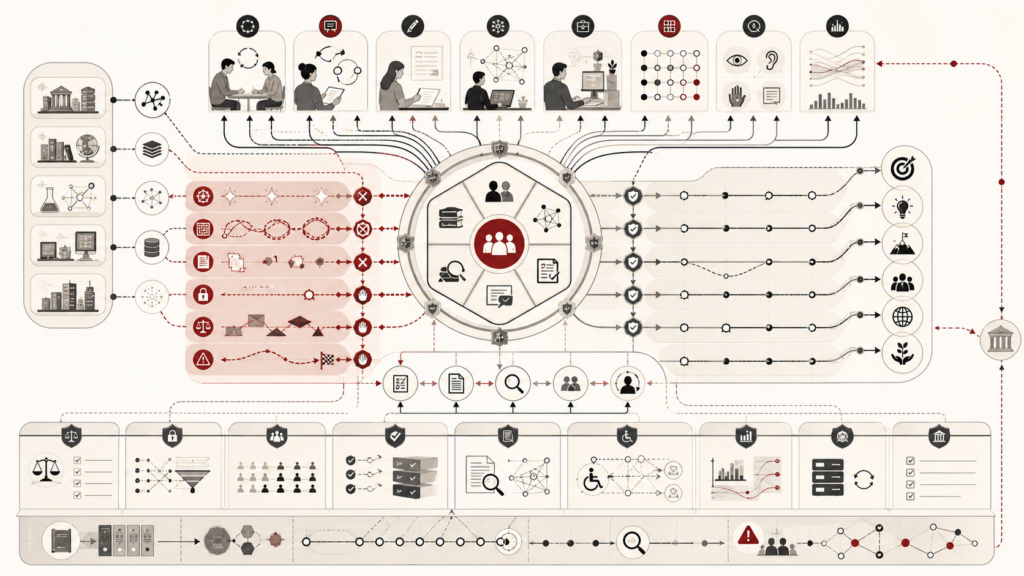
Technology and systems intelligence examine how advanced analytical tools and digital technologies can enhance our understanding of complex systems. Technologies such as artificial intelligence, machine learning, sensor networks, and large-scale data analytics are increasingly used to analyze environmental, economic, and social systems.

Systems intelligence emphasizes the ability to integrate data, models, and human expertise in order to interpret complex patterns and support informed decision-making. Rather than replacing human judgment, these technologies augment the capacity of researchers and institutions to detect trends, simulate outcomes, and evaluate policy interventions.

As digital technologies become more deeply integrated into governance and sustainability research, the challenge lies in deploying them responsibly. Effective systems intelligence requires transparency, accountability, and careful integration with ethical and institutional frameworks.

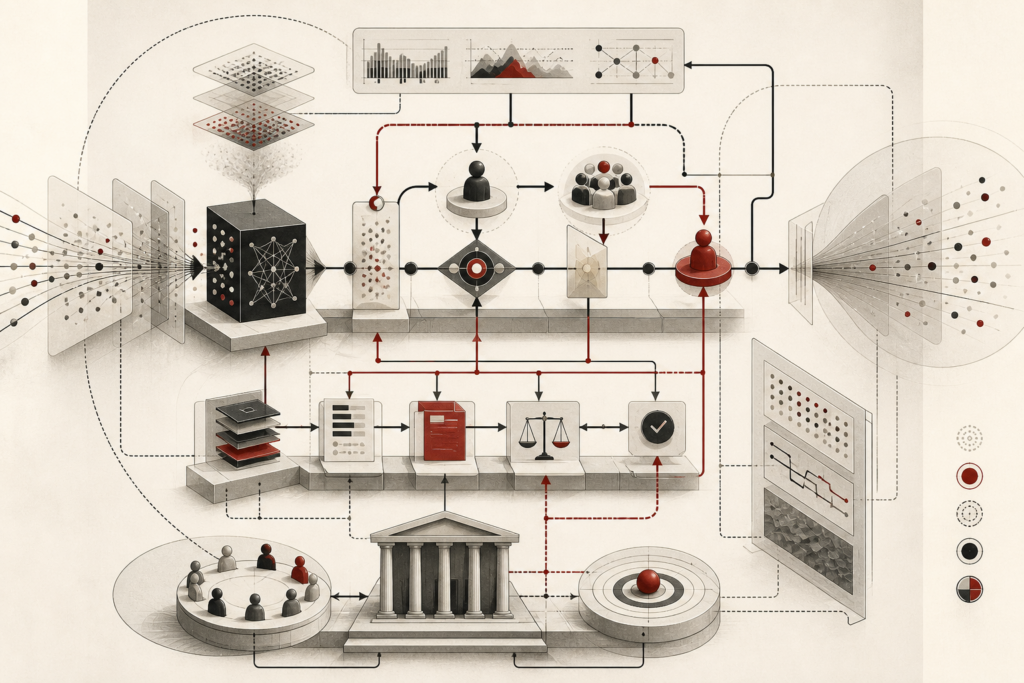
Abstract editorial illustration showing probabilistic AI as an uncertainty-aware system connecting evidence streams, priors, Bayesian inference, posterior distributions, predictive intervals, calibration review, risk estimation, decision routing, monitoring, and governance controls.

Probabilistic Machine Learning and Bayesian AI Systems

Probabilistic machine learning and Bayesian AI systems provide a framework for reasoning under uncertainty, learning from evidence, updating beliefs, and making decisions when data is incomplete, noisy, biased, sparse, or changing. Instead of treating model outputs as fixed answers, probabilistic AI systems represent uncertainty explicitly through posterior distributions, predictive intervals, latent variables, risk estimates, calibration, and expected utility. This article explains Bayes’ theorem, priors, likelihoods, posteriors, probabilistic graphical models, Bayesian networks, Gaussian processes, Bayesian deep learning, approximate inference, probabilistic programming, and Bayesian decision-making. It also examines governance risks involving misleading priors, poor calibration, approximate inference errors, threshold design, uncertainty communication, and institutional accountability. The central argument is that responsible AI systems must not only predict; they must communicate uncertainty, update with evidence, and support reviewable decisions.

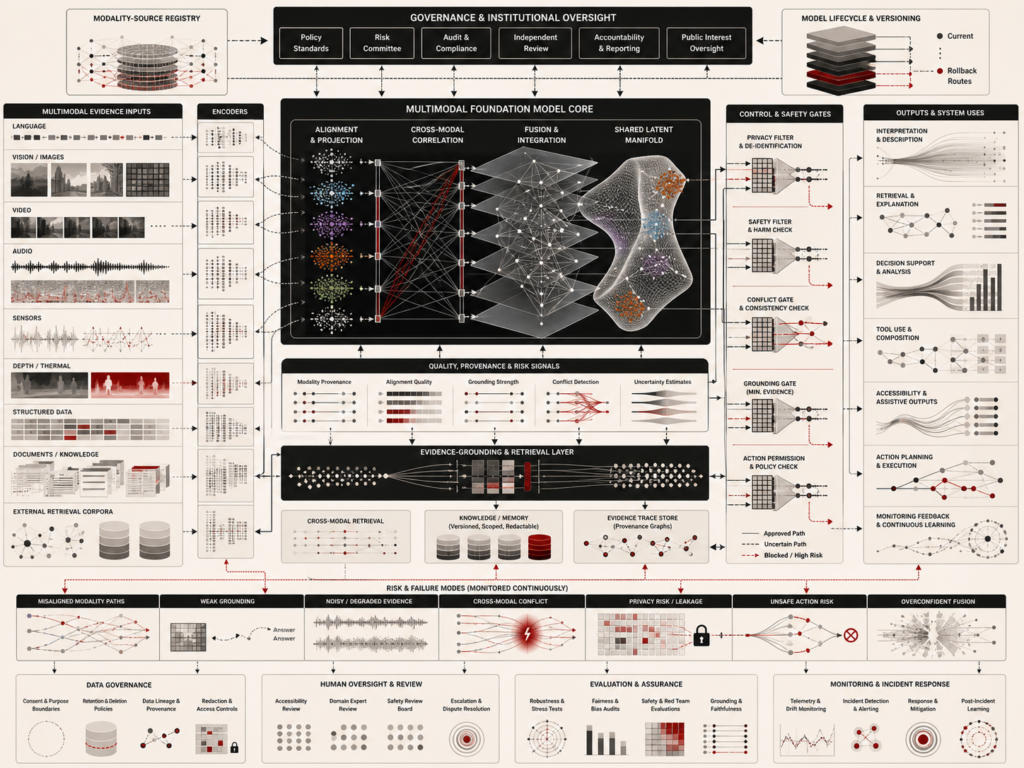
Abstract editorial illustration showing large-scale multimodal data transformed through self-supervised learning objectives into a central foundation-model core, reusable representations, downstream adaptation pathways, deployment systems, monitoring loops, and governance controls.

Self-Supervised Learning and Foundation Models

Self-supervised learning and foundation models explain how modern AI systems learn from the structure of large-scale data without requiring manual labels for every task. Instead of depending only on supervised examples, these systems create learning signals from masked tokens, next-token prediction, reconstructed image patches, contrastive pairs, multimodal alignment, code structure, scientific data, and other internal patterns. This article explains how self-supervised objectives support reusable representations, foundation models, language modeling, masked autoencoding, contrastive learning, multimodal AI, transfer learning, prompting, fine-tuning, retrieval, and downstream adaptation. It also examines risks involving data provenance, bias, privacy, memorization, grounding, scale, compute cost, benchmark limits, and correlated downstream failures. The central argument is that foundation models are not just models; they are reusable AI infrastructure requiring evaluation, monitoring, governance, and institutional accountability.

Abstract editorial illustration showing a pretrained AI model transferring knowledge into multiple fine-tuning and adaptation pathways, with evaluation gates, drift signals, versioning, monitoring, rollback routes, and governance controls.

Transfer Learning, Fine-Tuning, and Model Adaptation

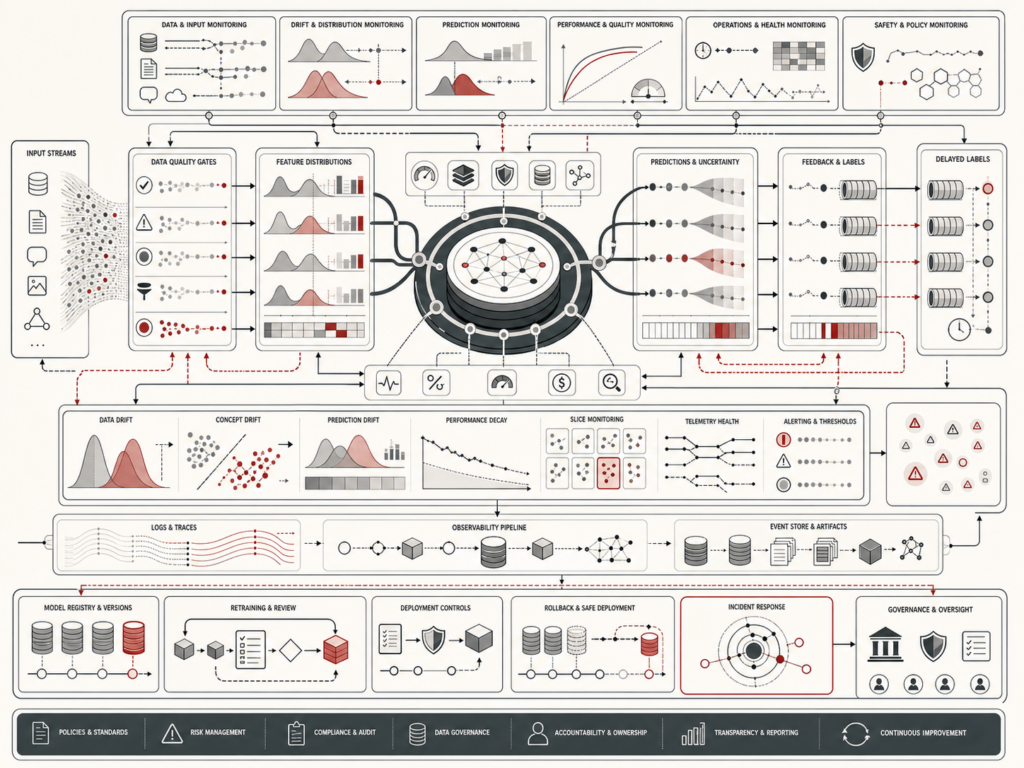
Transfer learning, fine-tuning, and model adaptation explain how AI systems reuse pretrained representations, model parameters, and general capabilities in new domains, tasks, and institutional contexts. Rather than training every model from scratch, modern AI systems often begin with a foundation model, encoder, or representation system, then adapt it through full fine-tuning, regularized fine-tuning, adapters, LoRA, QLoRA, prefix-tuning, or task-specific heads. This article explains source and target distributions, domain adaptation, parameter-efficient fine-tuning, catastrophic forgetting, negative transfer, evaluation, versioning, and governance. It also emphasizes that adaptation is not automatically improvement. Fine-tuned models can overfit, forget prior capabilities, inherit bias, or fail under distribution shift. The central argument is that model adaptation must be treated as a lifecycle process requiring documentation, evaluation, monitoring, rollback, and institutional accountability.

Abstract editorial illustration showing multimodal data flowing through model layers into a high-dimensional embedding space with clusters, similarity pathways, retrieval results, projection surfaces, and governance checkpoints.

Representation Learning and Embedding Spaces

Representation learning and embedding spaces explain how modern AI systems transform complex data into structured mathematical spaces where similarity, meaning, relevance, and pattern can be computed. Text, images, audio, video, code, documents, users, molecules, graphs, and scientific observations can all be represented as vectors. This article explains how embedding spaces work, moving from hand-engineered features to learned representations, vector similarity, cosine distance, contrastive learning, language embeddings, multimodal alignment, semantic retrieval, vector search, dimensionality reduction, and embedding evaluation. It also examines governance risks, including bias, drift, misleading visualizations, weak retrieval quality, stale indexes, and the false assumption that similarity equals truth. The central argument is that embeddings are not neutral maps of reality; they are learned infrastructures of relevance that require evaluation, monitoring, and accountability.

Abstract editorial illustration of artificial intelligence as an integrated systems discipline connecting data pipelines, model layers, infrastructure, monitoring, governance, feedback loops, and lifecycle assurance.

Artificial Intelligence as a Systems Discipline

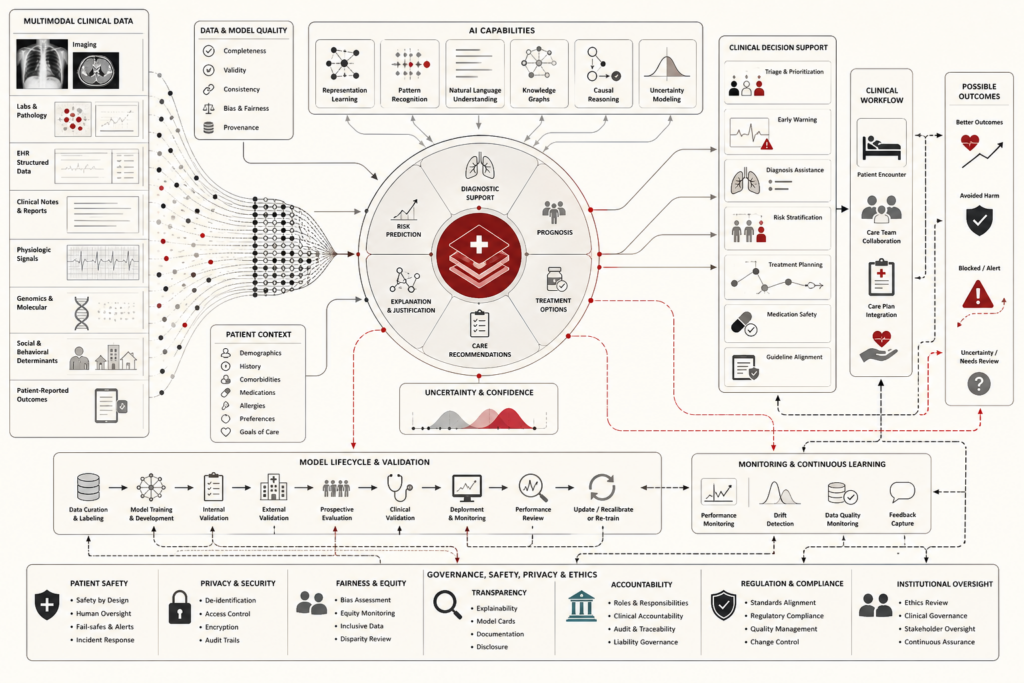
Artificial intelligence as a systems discipline examines AI not as isolated algorithms or models, but as interconnected sociotechnical systems shaped by data, infrastructure, feedback loops, human judgment, institutional workflows, and governance. Modern AI systems classify, predict, recommend, generate, optimize, and support decisions across science, infrastructure, media, public administration, and digital life. This article explains why AI must be evaluated across its full lifecycle: problem framing, data quality, model reliability, deployment, monitoring, human oversight, governance, incident response, and retirement. It also examines system-level risks such as feedback failure, automation bias, weak accountability, distribution shift, hidden technical debt, and legitimacy failure. The central argument is that trustworthy AI requires more than model performance; it requires systems engineering, lifecycle assurance, human-centered design, institutional accountability, and responsible governance.

Illustration of infrastructure asset management and predictive maintenance showing bridges, rail, pipes, substations, industrial equipment, sensors, analytics layers, and lifecycle stewardship processes.

Asset Management and Predictive Maintenance Systems: Lifecycle Stewardship and Infrastructure Performance

Asset management and predictive maintenance systems explain how infrastructure assets are monitored, maintained, renewed, and governed across their full lifecycle to preserve service performance, manage risk, and sustain long-term public value. This article examines asset registers, condition assessment, maintenance strategies, criticality analysis, lifecycle costing, reliability metrics, digital twins, predictive analytics, governance, resilience, and the risk of false precision. It distinguishes reactive, preventive, condition-based, and predictive maintenance while showing how asset condition, failure probability, service consequence, and budget constraints shape maintenance priorities. The article also introduces mathematical lenses for deterioration, risk scoring, remaining useful life, lifecycle cost, and portfolio optimization, alongside Python and R workflows for asset registers, criticality scoring, lifecycle-cost diagnostics, and predictive-maintenance modeling. It frames maintenance as lifecycle stewardship rather than repair alone.

Digital twin infrastructure diagram showing layered city systems, transport, energy, water, communications, telemetry, scenario testing, risk evaluation, and decision-support pathways.

Digital Twins and Infrastructure Simulation: Scenario Testing, Modeling and Infrastructure Intelligence

Digital twins turn infrastructure data into scenario-tested intelligence for planning, operations, maintenance, and resilience. Roads, bridges, rail, tunnels, power grids, water systems, wastewater facilities, communications networks, public buildings, reservoirs, and underground utilities can be represented as connected digital systems rather than isolated assets. This article examines how digital twins link telemetry, asset registries, spatial models, network states, simulations, uncertainty, hazard exposure, criticality, and resilience options into decision-support workflows. Their value is not visual replication alone; it is the ability to test disruptions, forecast cascading impacts, compare interventions, prioritize maintenance, evaluate recovery pathways, and coordinate infrastructure decisions across agencies and systems. By connecting physical infrastructure to modeling, scenario testing, and accountable governance, digital twins help institutions understand risk, improve reliability, and steward public systems more intelligently.

Restrained intelligent infrastructure systems diagram showing transportation, water, energy, communications, stormwater, sensors, AI platforms, resilience pathways, and public value governance.

The Future of Intelligent Infrastructure: AI, Resilience and Public Value

Intelligent infrastructure turns connected public systems into evidence-based, accountable platforms for resilience and public value. Transportation networks, bridges, rail, tunnels, water systems, wastewater facilities, stormwater infrastructure, power grids, communications networks, public buildings, parks, and ecological buffers increasingly depend on sensors, telemetry, AI analytics, scenario testing, predictive maintenance, and coordinated operations. This article examines how intelligent infrastructure can improve reliability, safety, equity, stewardship, and adaptation when digital systems are designed around public purpose rather than automation alone. Infrastructure intelligence is not simply a smart-city upgrade; it is a governance challenge involving interdependencies, risk, maintenance priorities, data quality, institutional capacity, and transparent decision-making. By linking AI, resilience planning, asset health, environmental stress, and public accountability, intelligent infrastructure can help communities anticipate disruption, protect essential services, and invest in long-term public value.

Restrained infrastructure risk management diagram showing transportation, water, energy, communications, critical assets, uncertainty, continuity planning, scenario testing, and recovery pathways.

Infrastructure Risk Management Systems: Criticality, Continuity and Uncertainty

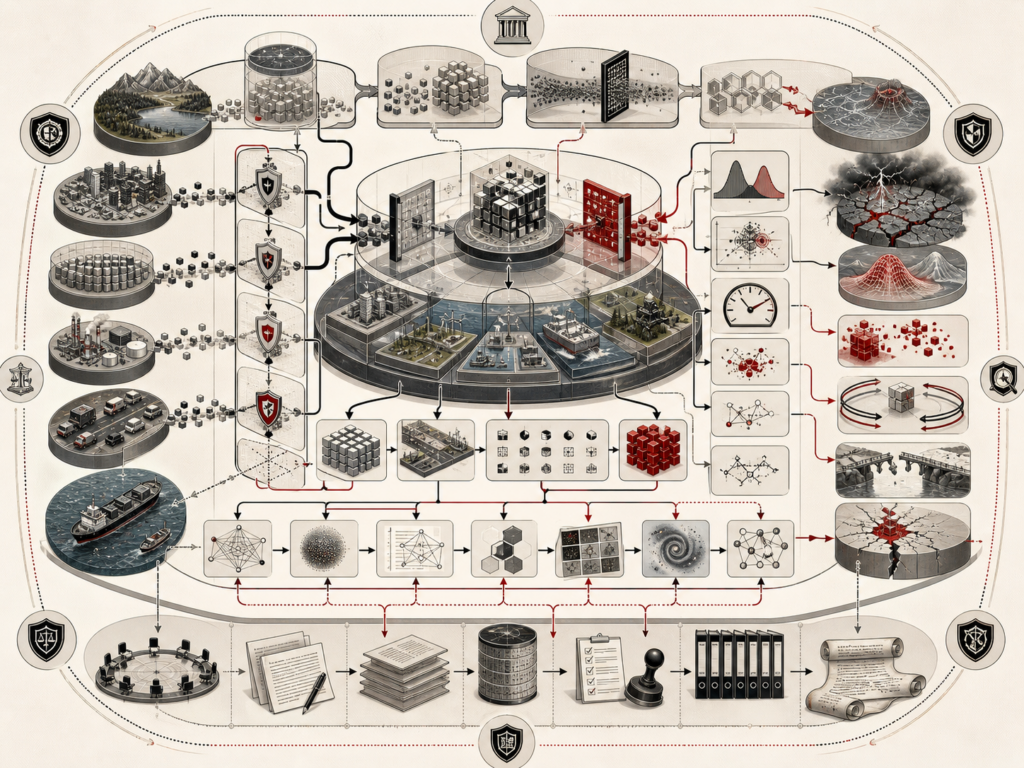
Infrastructure risk management systems help institutions protect essential services under uncertainty. Transportation, water, energy, communications, stormwater, wastewater, public facilities, and underground utilities do not fail in isolation; they are connected through physical, operational, informational, financial, and governance dependencies. This article examines how criticality analysis, asset condition, hazard exposure, scenario testing, consequence pathways, uncertainty assessment, continuity planning, redundancy, response coordination, and service-restoration sequencing support more resilient infrastructure decisions. Risk management is not only about identifying what could go wrong; it is about understanding which failures matter most, how disruptions cascade, which services must continue, and where intervention can reduce harm. By linking criticality, continuity, and uncertainty to accountable planning, infrastructure risk management supports public safety, institutional readiness, adaptive recovery, and long-term public value.

Scroll to Top