
Last Updated May 14, 2026
Digital twins and infrastructure simulation are the physical, digital, analytical, institutional, and governance systems through which infrastructure assets, networks, and environments are represented in dynamic digital form to support monitoring, analysis, forecasting, scenario testing, risk evaluation, and decision-making. They combine sensor data, engineering records, geospatial systems, operational platforms, computational models, maintenance histories, climate and environmental data, and decision-support workflows to create digital representations that evolve with infrastructure conditions over time. A digital twin is therefore not simply a static 3D model, design visualization, or promotional smart-city dashboard. It is an operational and analytical infrastructure for understanding how assets and systems behave, how they may fail, how interventions may perform, and how public institutions can reason before consequences unfold in the physical world.
Infrastructure systems are increasingly difficult to govern through periodic inspection, isolated asset registers, and siloed operational data alone. Transport networks, water systems, energy grids, buildings, communications infrastructure, ports, airports, public facilities, and urban environments now generate large volumes of information, but observation by itself does not automatically improve decision quality. What matters is whether institutions can use that information to simulate conditions, compare interventions, anticipate disruption, evaluate tradeoffs, and learn across the infrastructure life cycle. Digital twins and infrastructure simulation become valuable when they help institutions move from passive observability toward structured inference.
This article develops Digital Twins and Infrastructure Simulation: Scenario Testing, Modeling, and Infrastructure Intelligence as an advanced article within the Intelligent Infrastructure Systems knowledge series. It explains digital twins, simulation architectures, asset twins, network twins, urban and territorial twins, lifecycle continuity, predictive insight, scenario testing, standards, interoperability, validation, trust, governance, uncertainty, and the risk of overconfidence. Selected Python and R examples appear here, while the full GitHub repository contains expanded computational scaffolding for digital-twin registries, simulation scenarios, telemetry streams, model validation, risk testing, SQL metadata, governance documentation, and reproducible decision-support workflows.
Main Library
Publications
Article Map
Intelligent Infrastructure
Related Article Map
Data Systems
Related Article Map
Embedded & Edge Systems
Related Article Map
Institutions & Governance
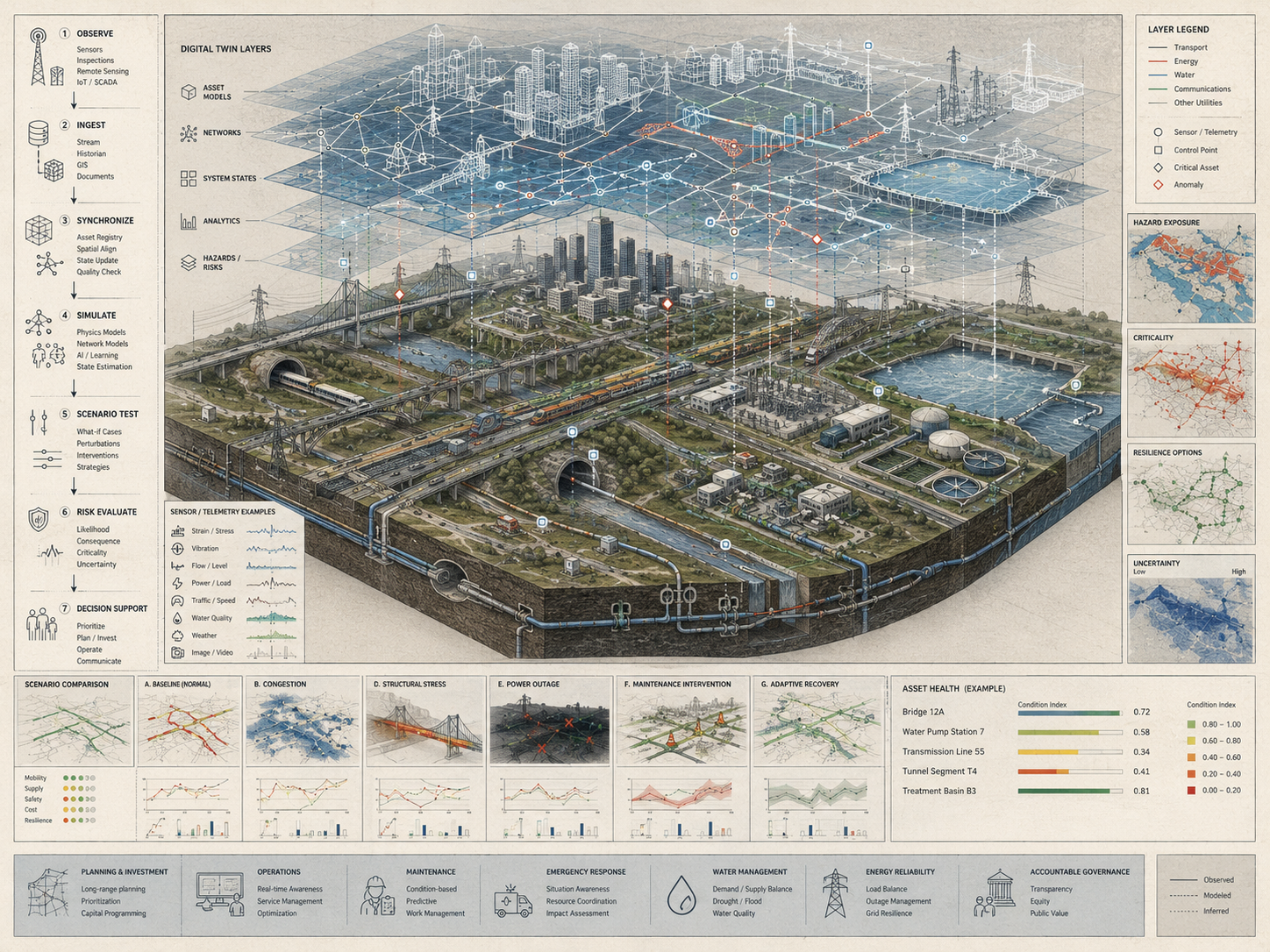
Digital twins belong at the center of intelligent infrastructure because intelligence is not only real-time sensing or automated control. It is the institutional ability to represent physical systems, test alternative futures, evaluate consequences, and connect simulated insight to operational and public decisions. A digital twin becomes meaningful when it links representation to inference: when it helps operators understand current conditions, planners test future scenarios, engineers compare design options, and institutions evaluate risk before decisions are made in the physical world.
Engineering Problem
The engineering problem is how to design digital twins and simulation environments that can represent infrastructure systems accurately enough, dynamically enough, and transparently enough to support real decisions without creating false confidence. A digital twin is useful only when it connects physical assets, data streams, model assumptions, system behavior, uncertainty, and decision pathways in a way that improves institutional reasoning. A visually compelling twin that cannot be validated, updated, interpreted, or governed is not an infrastructure intelligence system. It is a representation without accountable decision value.
This problem is difficult because infrastructure systems are materially complex, organizationally fragmented, and temporally extended. Assets deteriorate over decades. Networks interact across sectors. Data may come from sensors, inspections, SCADA systems, BIM models, GIS layers, work orders, environmental observations, traffic counts, weather records, and financial systems. Some data arrive continuously; other data are periodic, incomplete, historical, or manually entered. Models may be physics-based, statistical, geospatial, agent-based, hydraulic, electrical, structural, operational, or hybrid. The twin must make these heterogeneous inputs usable without pretending they are equally reliable.
Strong digital twins therefore require more than data integration. They require explicit model scope, state estimation, validation, interoperability, governance, uncertainty communication, version control, scenario logic, and institutional decision rights. The decisive question is not whether a digital twin looks like the physical system. It is whether it can support trustworthy reasoning about behavior, risk, performance, and intervention.
| Engineering Tension | Why It Matters | Required Evidence |
|---|---|---|
| Visual representation versus behavioral simulation | A twin must represent how infrastructure behaves, not only how it looks. | Model description, behavior assumptions, validation results, scenario outputs |
| Real-time data versus lifecycle knowledge | Current telemetry is useful only when connected to asset history, design assumptions, maintenance records, and future obligations. | Telemetry registry, asset register, maintenance history, lifecycle metadata |
| Model sophistication versus institutional usability | Highly complex simulations may fail if decision-makers cannot understand or act on outputs. | Decision-use statement, user workflow, model card, governance review |
| Interoperability versus bespoke implementation | Twins built as isolated products may be difficult to maintain, scale, or connect across systems. | Data dictionary, API specification, standards mapping, integration architecture |
| Scenario exploration versus prediction certainty | Scenario simulation helps compare possibilities; it should not be confused with guaranteed prediction. | Scenario assumptions, uncertainty ranges, sensitivity tests, caveats |
| Operational decision support versus governance opacity | Twins can centralize authority if assumptions, data quality, and model limitations are hidden. | Version log, audit trail, access controls, review board, public evidence package |
| Technical integration versus public value | A twin may be technically impressive while failing to improve maintenance, resilience, safety, equity, or service performance. | Decision log, intervention record, performance metrics, public-purpose evaluation |
The practical question is therefore: can the digital twin make infrastructure behavior more understandable, decisions more accountable, and consequences more testable before real-world failure or intervention occurs?
Reference Architecture
A practical digital-twin architecture can be understood as a layered infrastructure intelligence system. The exact implementation may include physical assets, environmental conditions, sensor networks, telemetry streams, geospatial layers, BIM and engineering records, operational systems, maintenance histories, simulation models, scenario engines, analytics, dashboards, decision-support tools, governance logs, and public evidence packages. The responsibilities remain consistent: observe, integrate, represent, simulate, validate, compare, communicate, decide, and revise.
| Layer | Engineering Role | Primary Risk | Evidence Artifact |
|---|---|---|---|
| Physical system layer | Defines the real assets, networks, environments, and operational boundaries represented by the twin. | The twin’s scope is ambiguous or misaligned with the decision problem. | System boundary statement, asset register, network map, scope document |
| Data acquisition layer | Collects sensor data, inspections, operational records, geospatial data, maintenance history, and environmental context. | Data feeds are incomplete, stale, poorly documented, or not decision-relevant. | Telemetry registry, data source catalog, metadata records, data-quality report |
| Integration and interoperability layer | Connects heterogeneous data sources, formats, schemas, APIs, platforms, and institutional systems. | The twin becomes a brittle, vendor-specific silo. | Data dictionary, schema map, API documentation, standards mapping |
| Representation layer | Creates digital state representations of assets, networks, flows, conditions, dependencies, and constraints. | The twin represents appearance without behavior or behavior without sufficient evidence. | State model, asset graph, geospatial model, system topology |
| Simulation and analytics layer | Runs scenarios, forecasts, stress tests, optimization routines, anomaly detection, and intervention comparisons. | Simulation outputs are used without validation, sensitivity analysis, or uncertainty caveats. | Scenario manifest, model card, validation report, sensitivity analysis |
| Decision-support layer | Translates model outputs into operational choices, maintenance plans, resilience strategies, and policy analysis. | Outputs remain dashboards rather than decision workflows. | Decision log, work-order linkage, planning memo, intervention comparison |
| Governance and trust layer | Defines ownership, access, model update rules, review processes, assumptions, accountability, and public communication. | The twin centralizes opaque authority and hides uncertainty. | Governance log, access policy, version history, public evidence package |
This architecture makes clear that a digital twin is not one thing. It is an integrated system of physical reference, data infrastructure, model representation, simulation logic, decision workflow, and governance.
Implementation Pattern
A rigorous digital-twin implementation begins with the decision problem, not the visualization platform. A bridge-maintenance twin, water-network twin, building-energy twin, transport-corridor twin, urban-planning twin, climate-adaptation twin, and territorial environmental twin require different data sources, models, update frequencies, validation methods, governance controls, and user workflows. The implementation must therefore define what the twin is for before deciding what it should display.
| Artifact | Purpose | Suggested Format |
|---|---|---|
| Digital twin objective manifest | Defines system scope, decision use, asset classes, modeled behavior, update frequency, and valid-use limits. | YAML, Markdown, architecture decision record |
| Asset and system registry | Stores assets, components, network nodes, dependencies, ownership, and service roles. | CSV, SQL table, graph model, GeoJSON |
| Telemetry and data source registry | Documents sensors, operational feeds, inspection systems, environmental data, and refresh rates. | CSV, JSON, SQL table, data catalog |
| Model registry and model card | Defines simulation models, assumptions, validation status, uncertainty, and intended decision use. | Markdown, YAML, model registry table |
| State-estimation workflow | Converts raw data into a current representation of asset, network, or environmental state. | Python/R scripts, notebooks, SQL views |
| Scenario manifest | Defines future or counterfactual conditions such as demand, failure, climate stress, intervention, or disruption. | YAML, JSON, CSV scenario table |
| Simulation output table | Stores scenario results, performance indicators, risk metrics, and uncertainty ranges. | CSV, SQL table, Parquet |
| Validation and sensitivity report | Tests whether model outputs are credible for the intended use. | Markdown, notebook, model-validation table |
| Decision and intervention log | Connects simulation outputs to maintenance, planning, policy, resilience, or operational decisions. | CSV, SQL table, governance log |
| Public evidence package | Documents what the twin can and cannot claim, including assumptions, uncertainty, and governance ownership. | Markdown, HTML, PDF |
The implementation goal is to make simulated infrastructure reasoning reconstructable. A user should be able to move from a dashboard output, risk score, scenario comparison, planning recommendation, or maintenance decision back to the data sources, models, assumptions, validation evidence, uncertainty ranges, and governance decisions that produced it.
Research-Grade Framing: Digital Twins as Infrastructure Intelligence Systems
A research-grade account of digital twins begins by treating them as infrastructure intelligence systems rather than as technical artifacts or visualization platforms. The twin is valuable not because it is digital, but because it extends institutional reasoning. It allows decision-makers to represent physical systems, estimate present state, simulate possible futures, test interventions, evaluate risk, and preserve knowledge across planning, operation, maintenance, renewal, and adaptation.
This distinction matters because digital twins are often oversold as visual replicas. A visually rich representation may support communication, but visual fidelity is not the same as analytical credibility. Infrastructure intelligence depends on whether the twin can represent relevant behavior, connect to trustworthy data, expose assumptions, update over time, validate against observed outcomes, and support decisions that would otherwise be harder to reason through.
Digital twins are also institutional systems. They encode decisions about what counts as infrastructure reality, which data are trusted, whose models are authoritative, which scenarios are considered plausible, and how uncertainty is communicated. They can improve public governance by making systems more understandable and decisions more testable. They can also reproduce blind spots if model scope, data coverage, institutional access, or public accountability are weak.
| Limited Pattern | Stronger Pattern | Why the Shift Matters |
|---|---|---|
| Build a 3D representation | Represent asset state, behavior, dependencies, constraints, and decision pathways | Infrastructure decisions require behavior and consequence, not appearance alone. |
| Connect many data feeds | Document data quality, metadata, latency, provenance, and valid-use limits | Data volume can create false confidence if quality is unknown. |
| Run simulations | Define scenarios, assumptions, uncertainty, validation, and sensitivity tests | Simulation outputs need credibility and interpretability. |
| Display dashboards | Connect outputs to maintenance, planning, resilience, and governance workflows | A twin should support decisions, not only visualization. |
| Optimize known operations | Test counterfactuals, stress conditions, cascading effects, and non-stationary futures | Infrastructure must be governed under uncertainty. |
| Treat the twin as authoritative | Expose assumptions, model limits, uncertainty, governance, and review processes | Trust requires transparency and institutional accountability. |
The central research question is not “Can we build a digital twin?” but “What kinds of infrastructure behavior, risk, consequence, and decision tradeoff can this twin make knowable, with what reliability, uncertainty, and public accountability?”
Formal Model: State, Observation, Simulation, Scenario, and Decision
A useful formal model separates the physical system, digital state, observation stream, model dynamics, scenario assumptions, simulated outcomes, error, uncertainty, and decision value. Let \(x_t\) represent the physical infrastructure state at time \(t\), \(z_t\) an observation or telemetry stream, \(\hat{x}_t\) the estimated digital-twin state, \(f(\cdot)\) the model that evolves system state, \(s\) a scenario, \(u\) an intervention, \(y\) a simulated outcome, and \(D\) a decision rule.
z_t = h(x_t) + \eta_t
\]
Interpretation: Observations \(z_t\) are noisy measurements or records derived from the physical state \(x_t\), where \(\eta_t\) represents measurement noise, missingness, or uncertainty.
\hat{x}_t = g(z_t, m_t, r_t)
\]
Interpretation: The digital-twin state \(\hat{x}_t\) is estimated from observations \(z_t\), model metadata \(m_t\), and relevant records \(r_t\), such as asset history, inspections, or operational context.
\hat{x}_{t+1} = f(\hat{x}_t, u_t, s_t, \theta)
\]
Interpretation: The simulated future state depends on current estimated state, intervention \(u_t\), scenario assumptions \(s_t\), and model parameters \(\theta\).
e_t = \lVert x_t – \hat{x}_t \rVert
\]
Interpretation: Twin error measures the distance between physical system state and estimated digital state. In practice, only partial validation is often possible.
V(u,s)=B(y_{u,s})-C(u)-R(y_{u,s})
\]
Interpretation: Decision value can be framed as the benefit of simulated outcomes under an intervention and scenario, minus intervention cost and residual risk.
u^*=\arg\max_u \mathbb{E}[V(u,s)]
\]
Interpretation: A decision-support system may compare interventions by expected value across scenarios, but governance review is required before acting on simulated optimization.
This formal structure protects against a common mistake in digital-twin work: treating the simulated representation as the physical system itself. A digital twin is an estimate, model, and decision-support environment. Its value depends on how well the relationship between data, model, uncertainty, scenario, and decision is governed.
What Are Digital Twins and Infrastructure Simulation?
Digital twins are dynamic digital representations of physical assets, systems, or environments that are linked to real or periodically updated data and used to support analysis, monitoring, forecasting, scenario testing, and decision-making. In infrastructure settings, a digital twin may represent a bridge, pump station, substation, water network, energy grid, transport corridor, building portfolio, port, airport, urban district, watershed, or broader territorial system. Infrastructure simulation refers to the broader use of computational models and scenarios to test how those systems behave under different conditions.
This is broader than three-dimensional modeling or asset visualization. A digital model can show what infrastructure looks like; a digital twin seeks to represent how infrastructure behaves. That behavioral dimension matters because infrastructure is not static. Flows change, materials deteriorate, demand fluctuates, weather shifts, operating conditions vary, and interventions alter system performance. The twin becomes useful when it connects representation to changing state, modeled behavior, and decision consequences.
Digital twins are therefore best understood as evolving analytical layers for infrastructure systems. They help institutions move from simply recording conditions toward simulating consequences and comparing courses of action. In their strongest form, they combine asset knowledge, telemetry, geospatial data, engineering models, operational constraints, scenarios, validation, and governance into a system for structured reasoning under uncertainty.
| System Form | Primary Question | Typical Evidence | Main Risk |
|---|---|---|---|
| Asset twin | How is a specific physical asset behaving and how might it fail? | Sensor data, inspections, condition history, engineering model, maintenance records | The asset is represented without sufficient system context. |
| Network twin | How do flows, dependencies, bottlenecks, and failures propagate across a system? | Network topology, telemetry, demand data, flow models, dependency maps | Local model accuracy hides system-level uncertainty. |
| Urban or territorial twin | How do land, infrastructure, environment, mobility, population, and services interact? | GIS layers, remote sensing, planning data, infrastructure models, demographic context | The twin becomes too broad to validate or govern clearly. |
| Operational twin | What is happening now and what intervention should operators consider? | Real-time telemetry, state estimation, anomaly detection, operational constraints | Operators overtrust automated outputs without understanding uncertainty. |
| Planning and scenario twin | What happens if demand, climate, disruption, investment, or land use changes? | Scenario assumptions, simulation models, stress tests, performance indicators | Scenario outputs are mistaken for predictions. |
| Governance twin | How can simulated evidence support transparent public decisions? | Decision logs, public evidence packages, assumptions, uncertainty, review records | Public decisions become hidden inside technical models. |
Digital twins and infrastructure simulation therefore belong to the broader field of intelligent infrastructure because they connect observation, modeling, and governance into a structured capacity for learning before acting.
Why Infrastructure Needs Simulation as Well as Observation
Infrastructure increasingly needs simulation because observability alone is not enough. Sensors, telemetry, asset databases, SCADA systems, remote sensing, field inspections, and control platforms can reveal what is happening now or what happened recently, but infrastructure decisions often concern what has not yet happened. Which asset will fail first? Which intervention will perform best? What demand pattern will stress the network most? How will a system behave under extreme heat, flooding, traffic disruption, cyber-physical failure, supply-chain delay, or aging infrastructure? Observation can inform these questions, but it cannot answer them without modeling and scenario reasoning.
This matters because infrastructure institutions operate under uncertainty. They must decide how to prioritize maintenance, where to invest, how to respond to climate stress, how to redesign capacity, how to coordinate across systems, and how to protect public value over long time horizons. Simulation strengthens those decisions by allowing planners and operators to examine possible futures before those futures are locked into physical consequences.
Digital twins become valuable not only when they improve visibility, but when they improve counterfactual reasoning. Their contribution lies in helping institutions ask not only “what is happening?” but “what if conditions change?” and “what if we intervene differently?” A system that observes without simulating may be reactive. A system that simulates without grounding in observation may be speculative. A mature digital twin connects both.
| Decision Problem | Observation Contribution | Simulation Contribution |
|---|---|---|
| Maintenance prioritization | Shows condition, defects, failures, and performance trends. | Tests failure pathways, intervention timing, and service consequences. |
| Capacity planning | Shows current demand, flow, congestion, or load. | Tests future demand, network expansion, bottlenecks, and stress conditions. |
| Climate adaptation | Shows current hazards, exposure, and asset performance. | Tests non-stationary futures, adaptation pathways, and resilience tradeoffs. |
| Emergency response | Shows current disruption and asset status. | Tests cascading failure, recovery sequencing, and resource allocation. |
| Public investment | Shows existing conditions and service gaps. | Compares alternatives before committing irreversible capital. |
| Governance accountability | Shows what has been measured and recorded. | Makes tradeoffs, assumptions, scenarios, and decisions more inspectable. |
Infrastructure simulation is therefore a way to reason about consequences before consequences become physical, expensive, disruptive, or irreversible.
Core Architecture of Digital Twins
Digital twins can be understood through a layered architecture that connects physical systems to digital inference. What matters is not simply the existence of digital models, but how the layers connect physical assets, data, representation, simulation, validation, decision-making, and governance.
Physical Asset and Environment Layer
This layer includes the real infrastructure being represented: roads, substations, treatment plants, buildings, pipelines, rail systems, bridges, tunnels, communications networks, ports, watersheds, landscapes, or urban environments. It defines the physical referent of the twin. Without a clear physical scope, the twin’s outputs can be overgeneralized or misapplied.
Data Acquisition Layer
This layer includes sensors, telemetry, inspections, geospatial data, maintenance records, BIM models, remote sensing, environmental observations, control systems, and other sources that provide information about the system’s state and context. Data acquisition must preserve metadata, timestamping, quality flags, provenance, and valid-use limits.
Model and Representation Layer
This layer includes engineering models, physics-based simulation, geospatial representations, process models, statistical models, network models, agent-based models, and other digital structures that represent system behavior rather than just appearance. The representation should be adequate to the question being asked. A structural asset twin, hydraulic network twin, traffic simulation, and urban territorial twin require different model forms.
Integration and Platform Layer
This layer includes data pipelines, interoperability standards, APIs, data lakes, cloud services, edge systems, semantic models, and platform architectures that allow diverse sources and models to work together. Interoperability is not a technical afterthought. It is one of the conditions under which digital twins become scalable infrastructure systems rather than isolated products.
Analytics and Decision Layer
This layer includes forecasting, anomaly detection, scenario testing, optimization, risk scoring, intervention comparison, and institutional workflows. Validation is especially important here because the reliability of digital twins affects operational efficiency, safety, cost, and public trust. Model outputs must be understandable, testable, and tied to decision rights.
Governance and Learning Layer
This layer defines ownership, access, update cycles, review processes, model assumptions, data stewardship, security, privacy, accountability, and public communication. A digital twin becomes durable only when it is governed as a living infrastructure knowledge system rather than a one-time technology project.
What matters is not only the existence of these layers, but how well they are connected. A digital twin is strongest when data, models, validation, and operational decisions reinforce one another in a credible and sustainable way.
Types of Infrastructure Digital Twins
Infrastructure digital twins can exist at several scales and for several purposes. The distinction among asset, system, urban, and territorial twins matters because each requires different data, models, validation methods, governance structures, and decision uses.
Asset Twins
Asset twins represent individual assets such as bridges, pumps, turbines, transformers, buildings, tunnel components, road segments, rail components, HVAC systems, or treatment-plant equipment. Their primary value often lies in condition monitoring, maintenance planning, remaining-useful-life estimation, failure-mode analysis, and performance diagnostics. Asset twins are especially useful where deterioration is observable and intervention timing matters.
System Twins
System twins represent networks such as water distribution systems, power grids, transport corridors, district energy systems, drainage networks, communications infrastructure, or logistics systems. Their value lies in understanding flows, dependencies, bottlenecks, cascading effects, redundancy, and system-wide consequences of localized change. A system twin must model relationships among assets, not simply assets themselves.
Urban or Territorial Twins
Urban and territorial twins represent districts, cities, watersheds, coastal zones, land systems, or broader geospatial environments. Their value lies in cross-sector coordination, planning, land management, environmental analysis, resilience assessment, public policy design, and long-horizon scenario testing. These twins often integrate infrastructure, land use, mobility, environmental, demographic, and climate data.
Operational Twins
Operational twins support near-real-time monitoring and intervention. They may estimate current state, identify anomalies, evaluate operating constraints, or recommend action under current conditions. Their value depends on telemetry freshness, state-estimation quality, operational workflow integration, and clear decision rights.
Planning and Scenario Twins
Planning and scenario twins are used to compare alternatives before implementation. They may evaluate climate adaptation pathways, urban growth, capacity expansion, maintenance strategies, emergency response, service-equity outcomes, or resilience investments. Their outputs are most useful when assumptions and uncertainty are explicit.
| Twin Type | Scale | Primary Use | Validation Challenge |
|---|---|---|---|
| Asset twin | Individual asset or component | Condition monitoring, maintenance, reliability, failure analysis | Failure modes may be rare, partial, or poorly observed. |
| System twin | Network or infrastructure system | Flow modeling, dependency analysis, operations, resilience | Interdependencies can make causal behavior difficult to isolate. |
| Urban twin | District or city | Planning, coordination, land use, mobility, public services | Social, behavioral, and institutional dynamics may be underrepresented. |
| Territorial twin | Regional, environmental, or geospatial system | Climate, watershed, coastal, land, and environmental scenario testing | Large-scale models may be hard to validate locally. |
| Operational twin | Active service environment | Monitoring, anomaly detection, intervention support | Requires trustworthy real-time data and operational integration. |
| Planning twin | Future or counterfactual system | Alternative comparison, investment analysis, policy testing | Scenario assumptions can dominate results. |
Not every infrastructure twin needs to be citywide or real-time. Some of the most useful twins may be relatively narrow in scope but strong in operational relevance, validation, and governance.
Digital Twins Across the Infrastructure Life Cycle
Digital twins can support infrastructure across the full life cycle rather than at only one stage. During planning and design, they can help compare layouts, capacities, environmental interactions, service consequences, and system dependencies before capital decisions are locked in. During construction and commissioning, they can help align design assumptions with actual delivery conditions. During operations, they can help monitor performance, identify anomalies, and test interventions. During maintenance and renewal, they can support condition assessment, remaining-useful-life estimation, work sequencing, budget planning, and resilience assessment. During adaptation or decommissioning, they can help compare long-horizon pathways.
This matters because infrastructure performance is produced over time. A twin that is useful only during design may still leave operators blind in later stages. Conversely, an operational twin without lifecycle continuity may inherit weak assumptions from earlier phases. A mature digital-twin strategy preserves continuity between design models, asset records, operational telemetry, maintenance history, renewal decisions, and public accountability.
| Life-Cycle Stage | Digital-Twin Contribution | Failure Risk |
|---|---|---|
| Planning | Tests alternatives, demand assumptions, environmental constraints, and public-service tradeoffs. | Scenario assumptions are hidden or treated as neutral. |
| Design | Represents asset form, performance expectations, capacity, interdependencies, and constraints. | Design models are not transferred into operational knowledge systems. |
| Construction | Tracks delivery, commissioning, deviations, and as-built conditions. | As-built changes fail to update the twin. |
| Operations | Monitors current state, detects anomalies, tests control choices, and supports coordination. | Telemetry is trusted without sufficient QC or context. |
| Maintenance | Supports condition assessment, predictive maintenance, risk prioritization, and work-order planning. | Predictions are disconnected from workforce, budget, and procurement. |
| Renewal | Compares repair, rehabilitation, replacement, redesign, or decommissioning pathways. | Lifecycle cost, risk, and public-service consequences are not integrated. |
| Adaptation | Tests climate, demand, disruption, or policy scenarios over long time horizons. | Non-stationary conditions exceed model assumptions. |
Digital twins are therefore most valuable when they support continuity of knowledge across planning, delivery, operations, maintenance, renewal, and adaptation rather than functioning as one-off digital artifacts.
Operations, Maintenance, and Predictive Insight
One of the strongest practical uses of digital twins lies in operations and maintenance. Infrastructure operators often work with incomplete information about degradation, failure pathways, demand shifts, and performance anomalies. Digital twins can improve this by linking condition data, operational histories, telemetry streams, engineering models, and system consequences in a way that makes maintenance more anticipatory and less reactive.
This matters because infrastructure institutions usually face constrained budgets, long asset lives, and large portfolios. They need to know not only which asset is deteriorating, but which deterioration matters most for service continuity, safety, environmental protection, regulatory compliance, or downstream dependence. A well-designed twin can support predictive maintenance, fault localization, intervention sequencing, spare-parts planning, outage coordination, and more efficient use of repair resources. See also Asset Management and Predictive Maintenance Systems.
The key point is that digital twins can move infrastructure management from observation toward inference. They do not simply reveal condition; they help interpret condition in relation to consequence, timing, operational choice, and institutional capacity. But predictive insight is valuable only when it connects to action. A digital twin that produces maintenance forecasts without work-order pathways, budget authority, workforce coordination, or governance review remains an analytical artifact rather than a stewardship system.
| Use Case | Twin Input | Decision Output | Evidence Risk |
|---|---|---|---|
| Anomaly detection | Telemetry, operating history, state estimates, expected behavior | Inspection, alarm review, operational adjustment | False positives or false negatives if baseline behavior is poorly defined. |
| Predictive maintenance | Condition data, degradation signals, failure history, criticality | Maintenance priority, intervention timing, work-order trigger | Predictions may not be actionable or validated. |
| Fault localization | Network state, sensor signals, topology, event timing | Likely failure location or component to inspect | Unobserved dependencies may mislead diagnosis. |
| Operational optimization | Demand, constraints, flows, energy use, service targets | Control settings, routing, sequencing, dispatch | Optimization may ignore resilience, equity, or recovery constraints. |
| Renewal planning | Asset condition, lifecycle cost, service consequence, scenario assumptions | Repair, rehabilitate, replace, defer, redesign, or decommission | Lifecycle cost may hide uncertainty or non-monetized public consequences. |
A mature digital-twin environment does not replace asset management. It strengthens asset management by helping institutions understand when, where, why, and how intervention should occur.
Scenario Analysis, Risk Testing, and Infrastructure Futures
Digital twins also matter because infrastructure decisions increasingly concern uncertain futures rather than stable operating baselines. Climate extremes, changing demand, urban growth, water stress, energy transition, cyber-physical interdependence, aging assets, and fiscal constraints all make scenario testing more important. Digital twins can support this by allowing institutions to test what happens under different assumptions before those conditions emerge physically.
This matters because infrastructure is expensive, path-dependent, and difficult to reverse. Testing scenarios in a simulation environment can help planners compare alternatives with fewer real-world consequences. A transportation agency can compare corridor redesigns before construction. A water utility can test drought, pipe failure, pressure loss, and demand shifts. A power system operator can test load, outage, and distributed energy scenarios. A city can compare adaptation pathways under heat, flood, or growth scenarios. The digital twin becomes a structured environment for counterfactual reasoning.
| Scenario Type | Question | Typical Outputs | Governance Caveat |
|---|---|---|---|
| Demand growth | What happens if service demand increases or shifts geographically? | Capacity stress, bottlenecks, cost, service gaps | Demand assumptions should be transparent and revisable. |
| Asset failure | What happens if a critical asset fails? | Service disruption, cascade risk, recovery time, affected users | Failure modes and dependencies must be validated where possible. |
| Climate stress | How does heat, flooding, drought, wildfire smoke, or storm intensity affect performance? | Vulnerability maps, adaptation priorities, service risk | Non-stationary futures require uncertainty ranges and scenario comparison. |
| Investment alternatives | Which intervention creates better lifecycle value or resilience? | Cost, performance, risk reduction, equity impact | Financial metrics should not hide public value or distributional effects. |
| Emergency response | How should resources be sequenced during disruption? | Recovery pathways, resource needs, critical dependencies | Simulation must account for field constraints and institutional capacity. |
| Policy or land-use change | How would rules, zoning, mobility, development, or service standards change system outcomes? | Spatial impacts, service levels, risk distribution, tradeoffs | Political and social assumptions must be made visible. |
Digital twins therefore expand the role of infrastructure intelligence beyond present-state optimization. They create a bridge from operations into futures thinking, risk analysis, and long-horizon planning. See also Infrastructure Risk Management Systems and The Future of Intelligent Infrastructure.
Standards, Interoperability, and Data Integration
One of the central barriers to useful digital twins is not the lack of models, but the lack of interoperability. Infrastructure data are often fragmented across asset systems, departments, vendors, consultants, historical files, CAD and BIM environments, GIS platforms, SCADA systems, work-order software, spreadsheets, sensor networks, and cloud platforms. Twins built as isolated solutions may work locally yet remain difficult to scale, combine, validate, or sustain.
Interoperability is therefore not a technical detail. It is one of the conditions under which digital twins become public infrastructure rather than bespoke digital products. A twin that cannot exchange data, document assumptions, preserve metadata, or integrate with other systems may become a costly silo. A scalable digital-twin ecosystem requires common data models, semantic alignment, version control, API governance, cybersecurity, metadata standards, and institutional data stewardship.
| Requirement | Purpose | Failure Risk |
|---|---|---|
| Asset identity management | Ensures the same asset can be recognized across GIS, BIM, work orders, telemetry, and finance systems. | Records fragment across platforms and cannot be reconciled. |
| Data dictionary and schema governance | Defines units, fields, methods, timestamps, quality flags, and model variables. | Data integration produces silent semantic errors. |
| API and platform integration | Allows models, dashboards, and operational systems to exchange information. | The twin becomes a standalone visualization tool. |
| Model versioning | Tracks changes in assumptions, parameters, validation, and scenario logic. | Outputs cannot be reproduced or audited. |
| Cybersecurity and access control | Protects sensitive infrastructure data and operational systems. | Expanded integration increases attack surface and governance risk. |
| Public evidence documentation | Makes assumptions, uncertainty, and valid-use limits inspectable. | Public decisions appear to emerge from opaque technical systems. |
Digital-twin interoperability is therefore inseparable from governance. It determines whether simulated infrastructure intelligence can move across departments, systems, time periods, and public decisions without losing meaning.
Governance, Trust, and Institutional Capacity
Digital twins are governance systems. Institutions must decide what data enters the twin, how it is validated, who can access it, how models are updated, what assumptions are encoded, how uncertainty is displayed, and how much decision authority is placed on simulated outputs. A twin can improve coordination, but it can also centralize opacity if governance is weak.
This matters because trust in digital twins depends on more than visual fidelity. It depends on data quality, model transparency, version control, institutional ownership, cybersecurity, public communication, and clear limits on what the twin can and cannot credibly represent. Public institutions may be tempted to treat highly rendered twins as authoritative even when underlying assumptions remain partial, uncertain, or politically contested.
Institutional capacity therefore matters as much as technical sophistication. A digital twin is only as useful as the governance system that can maintain it, interpret it, question it, validate it, revise it, and connect it to real decisions without surrendering judgment to simulation. For the broader institutional dimension, see Infrastructure Governance and Policy Systems.
| Governance Responsibility | Question | Evidence Needed |
|---|---|---|
| Scope governance | What physical system, decision problem, and valid-use boundary does the twin cover? | Scope statement, decision-use statement, model boundary |
| Data governance | Who owns, updates, validates, and documents the data feeding the twin? | Data catalog, metadata registry, quality report, owner map |
| Model governance | How are assumptions, parameters, versions, validation, and uncertainty handled? | Model card, validation report, version history, uncertainty statement |
| Access governance | Who can view, edit, export, or act on twin outputs? | Access-control policy, role matrix, cybersecurity review |
| Decision governance | How do simulation outputs influence planning, operations, maintenance, and public decisions? | Decision log, approval workflow, human-review record |
| Public accountability | Can affected publics understand assumptions, uncertainty, and consequences? | Public evidence package, plain-language caveats, review process |
A trustworthy digital twin is not one that eliminates human judgment. It is one that improves human and institutional judgment by making assumptions, evidence, uncertainty, and consequences more visible.
Limits, Failure Modes, and the Problem of Overconfidence
Digital twins are powerful, but they also carry risks. A twin may create the illusion of completeness even when coverage is partial, sensor quality is uneven, model assumptions are narrow, or data governance is weak. It may centralize decision-making while obscuring uncertainty. It may be expensive to maintain or difficult to update across long infrastructure life cycles. It may be technically advanced yet institutionally unused.
This matters because simulation can encourage overconfidence. A model that performs well under known conditions may be weak under extreme or emerging conditions. A beautifully integrated platform may still fail to capture social behavior, institutional delay, informal operational knowledge, political constraints, or field improvisation. The more persuasive the representation, the more important it becomes to preserve humility about what is actually known.
| Failure Mode | Description | Mitigation |
|---|---|---|
| Visual overconfidence | Users trust a polished representation more than the underlying evidence warrants. | Expose data quality, uncertainty, validation, and valid-use limits. |
| Data completeness failure | Important assets, dependencies, or conditions are missing from the twin. | Maintain coverage audits and explicit blind-spot registers. |
| Model transfer failure | A model calibrated for one system or condition is applied elsewhere without validation. | Require model cards, scenario constraints, and validation before reuse. |
| Scenario misuse | Scenario outputs are treated as predictions rather than conditional analyses. | Label assumptions, ranges, uncertainty, and decision context. |
| Interoperability failure | The twin cannot integrate with operational systems or other models. | Use schema governance, APIs, standards mapping, and asset identifiers. |
| Governance opacity | Decision authority becomes hidden inside technical systems. | Maintain decision logs, human review, and public evidence documentation. |
| Maintenance burden | The twin becomes stale because updates, ownership, or funding are inadequate. | Treat the twin as a lifecycle asset with stewardship obligations. |
Digital twins should therefore be treated as decision-support systems, not decision substitutes. Their greatest value lies in improving structured reasoning under uncertainty, not eliminating uncertainty itself.
Deployment Readiness Gate
Before a digital twin is used for operations, maintenance prioritization, investment planning, public communication, risk assessment, climate adaptation, emergency response, or governance decisions, it should pass a deployment readiness gate. This gate should test whether the twin is scoped, data-grounded, model-documented, validated, interoperable, governable, secure, uncertainty-aware, and decision-connected.
| Readiness Area | Required Question | Pass Evidence |
|---|---|---|
| Purpose readiness | Does the twin define its decision use, system scope, intended users, and valid-use limits? | Digital twin objective manifest, scope statement, decision-use statement |
| Data readiness | Are data sources documented, current, quality-checked, and linked to metadata? | Data catalog, telemetry registry, quality report, metadata table |
| Model readiness | Are model assumptions, parameters, versions, and behavioral logic documented? | Model card, model registry, version log, parameter file |
| Validation readiness | Has the twin been tested against observed outcomes or expert review? | Validation report, benchmark comparison, sensitivity analysis |
| Scenario readiness | Are scenario assumptions, stressors, interventions, and uncertainty ranges explicit? | Scenario manifest, assumption register, output table |
| Interoperability readiness | Can the twin exchange data with relevant platforms, standards, and institutional systems? | Schema map, API documentation, standards mapping, integration test |
| Security readiness | Are sensitive infrastructure data, access controls, and cyber-physical risks managed? | Access policy, cybersecurity review, role matrix |
| Governance readiness | Are ownership, review, update, decision, and accountability processes defined? | Governance log, stewardship plan, decision workflow |
| Public evidence readiness | Can users understand what the twin can and cannot claim? | Public evidence package, caveats, uncertainty statement |
This readiness gate prevents digital twins from being treated as credible merely because they are visually sophisticated or technically integrated. The stronger standard is whether they can support trustworthy infrastructure reasoning.
Data and Configuration Artifacts
A reproducible digital-twin workflow should include explicit artifacts for system scope, asset registries, telemetry sources, model assumptions, scenarios, validation, simulation outputs, decision logs, and governance. These artifacts make digital-twin claims auditable rather than hidden inside platforms, dashboards, or proprietary model interfaces.
| Artifact | Purpose | Suggested Path |
|---|---|---|
| Digital twin objective manifest | Defines system scope, decision use, users, update frequency, and valid-use limits. | config/digital_twin_objective.yml |
| Asset and system registry | Stores assets, network nodes, dependencies, service roles, and ownership. | data/twin_asset_registry.csv |
| Telemetry source registry | Documents sensors, operational feeds, refresh rates, quality flags, and data ownership. | data/telemetry_source_registry.csv |
| Digital state table | Stores estimated system state values used by the twin. | data/digital_twin_state_table.csv |
| Simulation scenario manifest | Defines scenario assumptions, interventions, stressors, time horizon, and uncertainty. | data/simulation_scenario_manifest.csv |
| Simulation output table | Stores performance, risk, cost, disruption, and resilience outcomes. | data/simulation_outputs.csv |
| Model registry | Documents model type, version, assumptions, validation status, and owner. | data/model_registry.csv |
| Validation and sensitivity log | Tracks calibration, validation, uncertainty, and sensitivity tests. | data/validation_sensitivity_log.csv |
| Decision and intervention log | Links twin outputs to operational, maintenance, planning, or governance decisions. | data/decision_intervention_log.csv |
| Public evidence package | Documents assumptions, uncertainty, scope, governance, and valid-use caveats. | docs/public_evidence_package.md |
These artifacts turn digital twins into reproducible infrastructure intelligence systems rather than opaque visual or computational products.
Mathematical Lens: State, Observation, Scenario, Error, and Decision Value
A mathematics-first view begins with a physical infrastructure state:
x_t \in \mathbb{R}^n
\]
Interpretation: The physical system state \(x_t\) contains variables describing infrastructure condition, flow, load, performance, environment, or operational status at time \(t\).
Observed data can be represented as:
z_t = h(x_t) + \eta_t
\]
Interpretation: Observations \(z_t\) are noisy, partial, or delayed measurements of physical state, where \(\eta_t\) captures measurement error, missingness, or uncertainty.
The digital twin estimates state as:
\hat{x}_t = g(z_t, m_t, r_t)
\]
Interpretation: Estimated twin state \(\hat{x}_t\) is built from observations, model metadata, and records such as asset history, inspection logs, or operational context.
Scenario simulation can be written as:
\hat{x}_{t+1} = f(\hat{x}_t, u_t, s_t, \theta)
\]
Interpretation: Future simulated state depends on current estimated state, intervention \(u_t\), scenario assumptions \(s_t\), and model parameters \(\theta\).
Twin error can be approximated where ground truth exists:
e_t = \lVert x_t – \hat{x}_t \rVert
\]
Interpretation: Twin error measures divergence between the physical system and digital representation. Many infrastructure twins can validate only parts of this relationship.
Scenario outcome value can be expressed as:
V(u,s)=B(y_{u,s})-C(u)-R(y_{u,s})
\]
Interpretation: The value of intervention \(u\) under scenario \(s\) depends on benefits, intervention costs, and residual risk.
Decision selection can be represented as:
u^*=\arg\max_u \mathbb{E}[V(u,s)]
\]
Interpretation: The preferred intervention may be modeled as the option with highest expected value across scenarios, but final action requires governance review.
This mathematical lens shows that digital twins are not merely data visualization systems. They are structured relationships among physical state, observation, estimated state, scenario simulation, error, uncertainty, intervention, and decision value.
Python Workflow: Digital Twin Scenario Testing and Risk Scoring
Python is useful for simulating infrastructure state, running scenario comparisons, and ranking interventions. The following educational workflow creates a simplified infrastructure twin state table, applies scenario stressors, estimates service risk, and compares intervention outcomes.
"""
Digital Twins and Infrastructure Simulation Mini-Workflow

This example demonstrates:
1. synthetic infrastructure twin state records
2. scenario stress testing
3. intervention comparison
4. risk and performance scoring
5. decision-support output generation

It is educational and does not use operational infrastructure data.
"""

from __future__ import annotations

import numpy as np
import pandas as pd


RANDOM_SEED = 42
rng = np.random.default_rng(RANDOM_SEED)

n_assets = 120

assets = pd.DataFrame({
    "asset_id": [f"DT-{i:04d}" for i in range(1, n_assets + 1)],
    "asset_class": rng.choice(
        ["pump_station", "bridge", "substation", "road_segment", "water_main"],
        size=n_assets,
        p=[0.20, 0.20, 0.18, 0.25, 0.17],
    ),
    "condition_state": rng.uniform(0.25, 0.98, size=n_assets),
    "service_criticality": rng.uniform(0.20, 1.00, size=n_assets),
    "load_factor": rng.uniform(0.30, 1.10, size=n_assets),
    "climate_exposure": rng.uniform(0.00, 1.00, size=n_assets),
})

scenarios = pd.DataFrame({
    "scenario_id": ["baseline", "heat_stress", "flood_stress", "demand_surge"],
    "load_multiplier": [1.00, 1.15, 1.05, 1.30],
    "climate_multiplier": [1.00, 1.25, 1.45, 1.10],
})

interventions = pd.DataFrame({
    "intervention": ["defer", "inspect", "targeted_repair", "renewal"],
    "condition_gain": [0.00, 0.03, 0.15, 0.35],
    "cost_index": [0.00, 0.10, 0.35, 0.85],
})

def simulate_scenario(
    asset_frame: pd.DataFrame,
    scenario: pd.Series,
    intervention: pd.Series,
) -> pd.DataFrame:
    simulated = asset_frame.copy()

    simulated["sim_condition"] = np.clip(
        simulated["condition_state"] + intervention["condition_gain"],
        0,
        1,
    )

    simulated["stress_index"] = (
        scenario["load_multiplier"] * simulated["load_factor"]
        + scenario["climate_multiplier"] * simulated["climate_exposure"]
    ) / 2

    simulated["failure_risk"] = np.clip(
        (1 - simulated["sim_condition"]) * 0.55
        + simulated["stress_index"] * 0.30
        + simulated["service_criticality"] * 0.15,
        0,
        1,
    )

    simulated["service_risk"] = (
        simulated["failure_risk"] * simulated["service_criticality"]
    )

    simulated["decision_value"] = (
        1.25 * (simulated["condition_state"] - simulated["service_risk"])
        - intervention["cost_index"]
    )

    simulated["scenario_id"] = scenario["scenario_id"]
    simulated["intervention"] = intervention["intervention"]
    simulated["intervention_cost_index"] = intervention["cost_index"]

    return simulated

outputs = []

for _, scenario in scenarios.iterrows():
    for _, intervention in interventions.iterrows():
        outputs.append(simulate_scenario(assets, scenario, intervention))

results = pd.concat(outputs, ignore_index=True)

summary = (
    results
    .groupby(["scenario_id", "intervention"], observed=True)
    .agg(
        mean_failure_risk=("failure_risk", "mean"),
        max_failure_risk=("failure_risk", "max"),
        mean_service_risk=("service_risk", "mean"),
        mean_decision_value=("decision_value", "mean"),
        intervention_cost_index=("intervention_cost_index", "mean"),
    )
    .reset_index()
    .sort_values(["scenario_id", "mean_service_risk"])
)

best_options = (
    summary
    .sort_values(["scenario_id", "mean_decision_value"], ascending=[True, False])
    .groupby("scenario_id", observed=True)
    .head(1)
    .reset_index(drop=True)
)

print("Scenario and intervention summary:")
print(summary)

print("\nHighest-value intervention by scenario:")
print(best_options)
This workflow is deliberately simplified. Its value is conceptual: it shows how a digital twin can connect state estimation, scenario stress, intervention comparison, and decision value. A real infrastructure twin would require validated models, asset-class-specific behavior, uncertainty ranges, field review, stakeholder governance, and operational integration before use.
R Workflow: Simulation Results, Scenario Diagnostics, and Governance Reporting
R is useful for summarizing simulation outputs, comparing scenarios, preparing governance reports, and producing review-ready diagnostics. The following workflow simulates infrastructure assets, scenarios, and interventions, then summarizes failure risk and decision value across scenario groups.
# Digital Twin Scenario Diagnostics
#
# This educational workflow simulates:
# - digital twin asset states
# - scenario stressors
# - intervention options
# - failure-risk proxies
# - decision-value summaries

set.seed(42)

n <- 120

assets <- data.frame(
  asset_id = sprintf("DT-%04d", 1:n),
  asset_class = sample(
    c("pump_station", "bridge", "substation", "road_segment", "water_main"),
    n,
    replace = TRUE,
    prob = c(0.20, 0.20, 0.18, 0.25, 0.17)
  ),
  condition_state = runif(n, 0.25, 0.98),
  service_criticality = runif(n, 0.20, 1.00),
  load_factor = runif(n, 0.30, 1.10),
  climate_exposure = runif(n, 0.00, 1.00)
)

scenarios <- data.frame(
  scenario_id = c("baseline", "heat_stress", "flood_stress", "demand_surge"),
  load_multiplier = c(1.00, 1.15, 1.05, 1.30),
  climate_multiplier = c(1.00, 1.25, 1.45, 1.10)
)

interventions <- data.frame(
  intervention = c("defer", "inspect", "targeted_repair", "renewal"),
  condition_gain = c(0.00, 0.03, 0.15, 0.35),
  cost_index = c(0.00, 0.10, 0.35, 0.85)
)

simulate_case <- function(asset_data, scenario, intervention) {
  sim_condition <- pmin(
    1,
    asset_data$condition_state + intervention$condition_gain
  )

  stress_index <- (
    scenario$load_multiplier * asset_data$load_factor +
    scenario$climate_multiplier * asset_data$climate_exposure
  ) / 2

  failure_risk <- pmin(
    1,
    (1 - sim_condition) * 0.55 +
      stress_index * 0.30 +
      asset_data$service_criticality * 0.15
  )

  service_risk <- failure_risk * asset_data$service_criticality

  decision_value <- (
    1.25 * (asset_data$condition_state - service_risk) -
      intervention$cost_index
  )

  data.frame(
    asset_id = asset_data$asset_id,
    asset_class = asset_data$asset_class,
    scenario_id = scenario$scenario_id,
    intervention = intervention$intervention,
    sim_condition = sim_condition,
    failure_risk = failure_risk,
    service_risk = service_risk,
    decision_value = decision_value,
    intervention_cost_index = intervention$cost_index
  )
}

results <- do.call(
  rbind,
  lapply(seq_len(nrow(scenarios)), function(s) {
    do.call(
      rbind,
      lapply(seq_len(nrow(interventions)), function(i) {
        simulate_case(assets, scenarios[s, ], interventions[i, ])
      })
    )
  })
)

summary_table <- aggregate(
  cbind(failure_risk, service_risk, decision_value, intervention_cost_index) ~
    scenario_id + intervention,
  data = results,
  FUN = mean
)

summary_table <- summary_table[order(summary_table$scenario_id, summary_table$service_risk), ]

best_options <- do.call(
  rbind,
  lapply(split(summary_table, summary_table$scenario_id), function(x) {
    x[which.max(x$decision_value), ]
  })
)

dir.create("../outputs", recursive = TRUE, showWarnings = FALSE)
write.csv(summary_table, "../outputs/r_digital_twin_scenario_summary.csv", row.names = FALSE)
write.csv(best_options, "../outputs/r_digital_twin_best_options.csv", row.names = FALSE)

print(summary_table)
print(best_options)
This R workflow supports governance reporting by summarizing how simulated risk and decision value change under different assumptions. In practice, such outputs should be treated as review inputs, not automatic decisions.
Systems Code: Twin Registries, Telemetry, Simulation Scenarios, Validation, and Governance Logs
Digital twins and infrastructure simulation depend on full-stack data and systems infrastructure. The stack includes asset registries, telemetry feeds, geospatial layers, model registries, scenario manifests, simulation outputs, validation logs, dashboard specifications, decision logs, cybersecurity controls, and governance records. A serious companion repository should therefore include both analytical workflows and systems-code scaffolding.
| Language / Tool | Role in Companion Repository | Example Use |
|---|---|---|
| Python | State estimation, scenario simulation, risk scoring, intervention comparison, and validation diagnostics | Digital twin scenario-testing workflow |
| R | Scenario reporting, governance summaries, model diagnostics, and simulation-output review | Review-ready scenario and decision-value summaries |
| SQL | Asset registries, telemetry records, model registries, scenarios, simulation outputs, validation logs, and decision records | Auditable digital-twin metadata schema |
| GeoJSON | Asset locations, network nodes, service zones, scenario geography, and exposure areas | Spatial twin scope and coverage mapping |
| TypeScript | Dashboard and platform data types | Twin state cards, scenario panels, risk views, and decision-support interfaces |
| Go | Lightweight status endpoint | Expose twin data, model, validation, and governance readiness |
| Rust | Safe validation CLI for twin records and scenario manifests | Validate asset IDs, scenario fields, telemetry units, and model versions |
| C / C++ | Low-level telemetry-record and simulation-event examples | Demonstrate state update records and priority queues |
| Shell scripts | Reproducible directory, validation, and export workflows | One-command scaffold validation and output generation |
This breadth is appropriate because digital twins are not only models. They are infrastructure knowledge systems spanning data engineering, simulation, validation, operations, governance, and public accountability.
GitHub Repository
The article body includes selected computational examples so the conceptual and mathematical argument remains readable. The full repository should contain expanded computational infrastructure: digital twin objective manifests, twin asset registries, telemetry source catalogs, model registries, scenario manifests, simulation outputs, validation logs, governance documentation, SQL schemas, TypeScript data types, Python/R workflows, and reproducible notebooks.
Testing and Validation
Testing digital twins requires more than checking whether the platform loads or the dashboard updates. It requires validating scope, data quality, asset identity, telemetry freshness, model assumptions, state estimates, scenario definitions, simulation outputs, uncertainty, access controls, cybersecurity, decision workflows, and governance records. A twin can appear sophisticated while producing weak evidence if its underlying data, model, or governance chain is not testable.
| Test Type | Purpose | Example Test |
|---|---|---|
| Scope test | Ensure the twin’s physical boundary and decision use are explicit. | Validate twin objective manifest and system boundary statement. |
| Asset identity test | Ensure assets can be reconciled across registries, GIS, telemetry, and work-order systems. | Check unique asset IDs and cross-system mappings. |
| Telemetry freshness test | Ensure operational feeds are current enough for the intended decision. | Compare expected and actual telemetry timestamps. |
| Data-quality test | Ensure missingness, unit errors, outliers, and stale records are flagged. | Run schema, range, unit, and QC checks. |
| Model documentation test | Ensure model type, assumptions, parameters, version, and owner are documented. | Validate model registry and model card fields. |
| State-estimation test | Ensure estimated twin state is traceable to data and model assumptions. | Review state table, data lineage, and update logic. |
| Scenario test | Ensure scenarios define assumptions, stressors, interventions, and time horizons. | Validate scenario manifest completeness. |
| Validation test | Ensure model outputs are compared against observed outcomes or expert review where possible. | Review benchmark, backtest, field validation, or peer review records. |
| Sensitivity test | Ensure outputs are not overly dependent on hidden assumptions. | Run parameter variation and uncertainty analysis. |
| Governance test | Ensure outputs connect to human review, decision logs, and accountability. | Review decision and intervention log. |
Validation should test the digital twin as a data-to-decision chain. The decisive question is not whether the twin generates outputs, but whether those outputs are trustworthy enough for the decision being made.
Operational Signals and Digital-Twin Observability
Digital twins must observe themselves. A twin that represents infrastructure conditions but cannot report its own data freshness, model version, validation status, telemetry gaps, simulation queue, uncertainty, cybersecurity posture, and governance ownership is operationally fragile. Twin observability should track both the physical system and the digital representation.
| Signal | Why It Matters | Failure Indicator |
|---|---|---|
| Telemetry freshness | Determines whether current-state estimates are based on recent data. | Stale feed, delayed update, missing sensor records. |
| Data completeness | Determines whether state estimation has adequate coverage. | Unobserved assets, missing fields, incomplete network segments. |
| Model version | Determines whether outputs can be reproduced and audited. | Unknown model version, undocumented parameter change. |
| Validation status | Determines whether outputs remain credible for the decision use. | Expired validation, failed benchmark, missing backtest. |
| Scenario queue | Determines whether simulations are running as expected. | Failed scenario job, incomplete output, unreviewed results. |
| Uncertainty status | Determines whether users understand confidence and valid-use limits. | No uncertainty range, hidden sensitivity, overconfident dashboard. |
| Security status | Determines whether sensitive infrastructure data and control-adjacent systems are protected. | Unauthorized access, exposed asset data, weak role controls. |
| Governance closure | Determines whether outputs are reviewed and connected to action. | Simulations are generated but no decision owner exists. |
Operational observability protects digital twins from becoming stale, overtrusted, or disconnected from institutional action. A twin that cannot describe its own reliability should not be treated as an authoritative representation of infrastructure reality.
Engineer and Researcher Checklist
- Define the twin’s physical scope, decision use, users, update frequency, and valid-use limits before building the platform.
- Distinguish visualization, digital model, digital shadow, simulation environment, and decision-support digital twin.
- Document data sources, telemetry feeds, asset identifiers, metadata, quality flags, refresh rates, and ownership.
- Use model cards to describe assumptions, parameters, validation status, uncertainty, and intended decision use.
- Separate observed state, estimated state, simulated state, and recommended action.
- Make scenario assumptions explicit, including stressors, interventions, time horizons, and uncertainty ranges.
- Validate models against observed outcomes, expert review, benchmark cases, or sensitivity analysis where possible.
- Ensure interoperability across GIS, BIM, asset registers, telemetry systems, work orders, and planning data.
- Design governance processes for access, update, review, cybersecurity, public communication, and accountability.
- Treat digital twins as decision-support systems, not decision substitutes.
- Audit whether the twin improves maintenance, resilience, planning, public value, or institutional learning.
- Preserve humility: a persuasive representation can still be incomplete, uncertain, or wrong.
Where This Fits in the Series
This article connects Intelligent Infrastructure Systems to infrastructure data platforms, asset management, predictive maintenance, urban sensor networks, risk management, climate adaptation, infrastructure governance, and systems modeling. It sits at the simulation and scenario-testing layer of the series: the point where infrastructure observability becomes structured reasoning about behavior, consequence, and future intervention.
Within the broader series, digital twins and infrastructure simulation provide a bridge between current-state monitoring and future-oriented governance. They help infrastructure institutions understand what exists, estimate what is happening, test what might happen, compare what could be done, and document why a decision was made. Their value is not the digital replica itself, but the institutional capacity for better reasoning that the replica can support.
Related Articles
- Intelligent Infrastructure Systems
- Infrastructure Data Platforms and Analytics
- Urban Sensor Networks and Infrastructure Monitoring
- Asset Management and Predictive Maintenance Systems
- Infrastructure Risk Management Systems
- Infrastructure Governance and Policy Systems
- Infrastructure Systems for Climate Adaptation
- Infrastructure Systems for Urban Resilience
- The Future of Intelligent Infrastructure
- Systems Modeling
These connections are substantive rather than decorative. Digital twins are not an isolated visualization trend, but a systems domain linking infrastructure observability, simulation, risk evaluation, interoperability, public governance, and strategic decision-making.
Future Directions
The future of digital twins in infrastructure will likely involve stronger standardization, broader interoperability, deeper integration of geospatial and environmental data, more operational use in maintenance and continuity planning, and wider use in scenario analysis across climate, mobility, land, water, energy, communications, and public-service systems. Public-sector innovation work, European digital-twin initiatives, and current standardization efforts all point toward digital twins as part of larger infrastructure intelligence ecosystems rather than isolated tools.
Several directions are especially important. First, digital twins will need to become more lifecycle-aware, connecting design, construction, operations, maintenance, renewal, and adaptation. Second, twins will need stronger validation and uncertainty communication so simulation outputs do not become overconfident claims. Third, interoperability will become a central governance issue as institutions try to connect asset systems, geospatial records, sensors, models, and decision workflows. Fourth, digital twins will increasingly intersect with AI, but AI-generated insights will need model governance, audit trails, and human review. Fifth, public institutions will need to decide how much of simulated infrastructure intelligence should be open, explainable, and publicly contestable.
The deeper challenge, however, is not simply building more twins. It is ensuring that simulated infrastructure systems remain trustworthy, governable, maintainable, and tied to real public value. Digital twins and infrastructure simulation will matter most where they improve planning, maintenance, resilience, and institutional learning rather than merely expanding technical representation. The long-run goal is not a digital mirror for its own sake. It is a more intelligent infrastructure system capable of thinking through consequences before failure makes them visible in the physical world.
Further Reading
- National Institute of Standards and Technology (2025) Digital Twin Standardization. Available at: https://www.nist.gov/digital-twins/digital-twin-standardization
- National Institute of Standards and Technology (2025) NIST Hosts Second Stakeholder Workshop on Digital Twins. Available at: https://www.nist.gov/news-events/news/2025/01/nist-hosts-second-stakeholder-workshop-digital-twins
- National Institute of Standards and Technology (2025) Security and Trust Considerations for Digital Twin Technology. Available at: https://nvlpubs.nist.gov/nistpubs/ir/2025/NIST.IR.8356.pdf
- National Institute of Standards and Technology (2025) Validating and Advancement. Available at: https://www.nist.gov/digital-twins/validating-and-advancement
- European Commission (n.d.) Destination Earth. Available at: https://digital-strategy.ec.europa.eu/en/policies/destination-earth
- European Commission (n.d.) European Digital Twin Ocean. Available at: https://research-and-innovation.ec.europa.eu/funding/funding-opportunities/funding-programmes-and-open-calls/horizon-europe/eu-missions-horizon-europe/restore-our-ocean-and-waters/european-digital-twin-ocean_en
- Organisation for Economic Co-operation and Development (2024) Global Trends in Government Innovation 2024. Available at: https://www.oecd.org/en/publications/global-trends-in-government-innovation-2024_c1bc19c3-en/full-report/component-8.html
- World Bank (n.d.) Global Smart City Partnership Program. Available at: https://www.worldbank.org/en/programs/global-smart-city-partnership-program/overview
References
- European Commission (n.d.) Destination Earth. Available at: https://digital-strategy.ec.europa.eu/en/policies/destination-earth (Accessed: 14 May 2026).
- European Commission (n.d.) European Digital Twin Ocean. Available at: https://research-and-innovation.ec.europa.eu/funding/funding-opportunities/funding-programmes-and-open-calls/horizon-europe/eu-missions-horizon-europe/restore-our-ocean-and-waters/european-digital-twin-ocean_en (Accessed: 14 May 2026).
- National Institute of Standards and Technology (2025) Digital Twin Standardization. Available at: https://www.nist.gov/digital-twins/digital-twin-standardization (Accessed: 14 May 2026).
- National Institute of Standards and Technology (2025) NIST Hosts Second Stakeholder Workshop on Digital Twins. Available at: https://www.nist.gov/news-events/news/2025/01/nist-hosts-second-stakeholder-workshop-digital-twins (Accessed: 14 May 2026).
- National Institute of Standards and Technology (2025) Security and Trust Considerations for Digital Twin Technology. Gaithersburg, MD: National Institute of Standards and Technology. Available at: https://nvlpubs.nist.gov/nistpubs/ir/2025/NIST.IR.8356.pdf (Accessed: 14 May 2026).
- National Institute of Standards and Technology (2025) Validating and Advancement. Available at: https://www.nist.gov/digital-twins/validating-and-advancement (Accessed: 14 May 2026).
- Organisation for Economic Co-operation and Development (2024) Global Trends in Government Innovation 2024. Available at: https://www.oecd.org/en/publications/global-trends-in-government-innovation-2024_c1bc19c3-en/full-report/component-8.html (Accessed: 14 May 2026).
- World Bank (n.d.) Global Smart City Partnership Program. Available at: https://www.worldbank.org/en/programs/global-smart-city-partnership-program/overview (Accessed: 14 May 2026).