
Last Updated May 14, 2026
The future of intelligent infrastructure lies in the convergence of physical systems, digital networks, environmental sensing, analytical intelligence, operational resilience, and institutional governance into infrastructure systems that are more adaptive, interoperable, secure, accountable, and publicly valuable. Intelligent infrastructure increasingly means more than embedding sensors into roads, utilities, buildings, water systems, energy grids, transportation networks, or communications assets. It refers to infrastructure systems that can observe changing conditions, interpret complex signals, coordinate across sectors, anticipate disruption, support better decisions, and evolve under environmental, technological, fiscal, and social change.
For much of the early smart-infrastructure era, intelligence was often equated with instrumentation. The emphasis fell on connected devices, dashboards, optimization software, and the promise that more data would automatically create better infrastructure outcomes. That framing is no longer sufficient. The future of intelligent infrastructure will be shaped not only by digital capability, but by whether those capabilities are integrated into resilient public systems, supported by trusted institutions, aligned with environmental realities, secured against cascading failure, and designed for broad public value rather than narrow technical novelty.
This article develops The Future of Intelligent Infrastructure as the capstone article in the Intelligent Infrastructure Systems knowledge series. It examines the next stage of infrastructure intelligence: from sensors to observability, from dashboards to decision support, from automation to accountable governance, from isolated platforms to digital public infrastructure, from static design assumptions to adaptive systems, and from technology display to public-value performance. Selected Python and R examples appear here, while the full GitHub repository contains expanded computational scaffolding for infrastructure intelligence assessment, scenario readiness, digital platform governance, cyber-resilience indicators, KPI frameworks, and reproducible public-infrastructure analytics.
Main Library
Publications
Article Map
Intelligent Infrastructure
Related Article Map
Data Systems
Related Article Map
Embedded & Edge Systems
Related Article Map
Environmental Monitoring
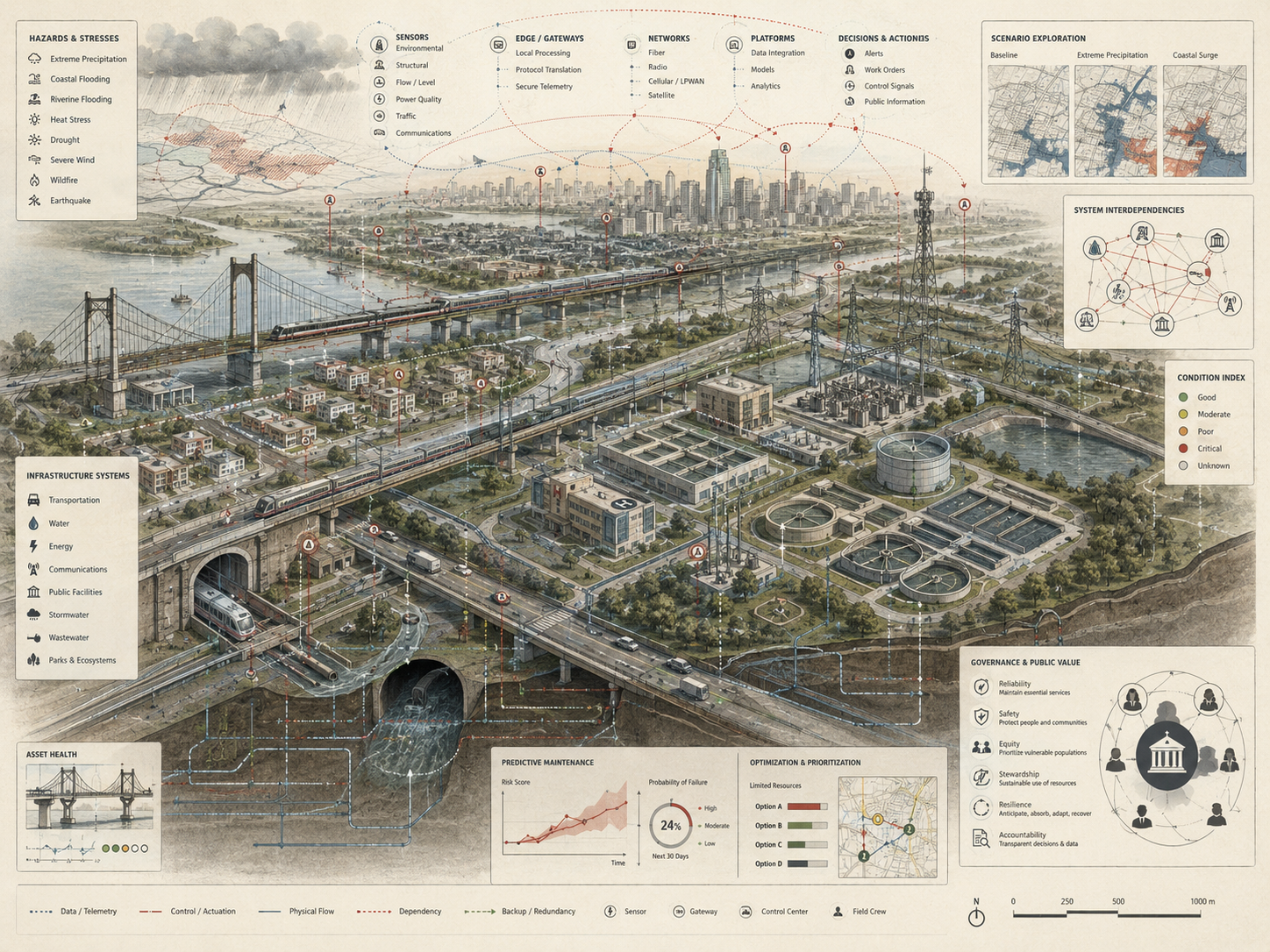
The future therefore belongs not to infrastructure that is merely connected, but to infrastructure that is context-aware, risk-aware, interoperable, resilient, governable, and capable of learning across its life cycle. In that sense, intelligent infrastructure is becoming less a discrete technology category and more a new infrastructural condition: one in which physical assets, data systems, analytical models, operational teams, and public institutions increasingly operate as a single socio-technical system.
Engineering Problem
The engineering problem is how to design infrastructure systems that can sense, interpret, coordinate, adapt, recover, and remain publicly accountable under conditions of complexity and uncertainty. Future infrastructure cannot be evaluated simply by whether it has sensors, connectivity, dashboards, AI models, or digital twins. It must be evaluated by whether those technologies improve service continuity, resilience, maintenance quality, public safety, environmental performance, cyber-physical security, institutional learning, and equitable access to essential services.
This problem is difficult because infrastructure intelligence is not located in a single device, platform, or algorithm. It emerges from the relationship among physical assets, field sensing, embedded systems, communications networks, data platforms, models, operators, maintenance teams, regulators, emergency managers, cybersecurity practices, public institutions, and communities. A highly instrumented system can remain unintelligent if its data are siloed, its models are unvalidated, its cyber risks are unmanaged, its operators lack authority, or its benefits are distributed unevenly. Conversely, a modestly instrumented system can become more intelligent if it improves observability, decision quality, coordination, resilience, and public accountability.
Strong intelligent infrastructure therefore requires a shift from technology adoption to systems capability. The question is not “How smart is the asset?” but “Can the infrastructure system detect changing conditions, interpret consequences, prioritize action, coordinate across dependencies, fail safely, recover credibly, and preserve public value over time?”
| Engineering Tension | Why It Matters | Required Evidence |
|---|---|---|
| Connected assets versus intelligent systems | Sensors and connectivity do not automatically produce better infrastructure decisions. | Decision workflows, operator authority, intervention logs, performance outcomes |
| Optimization versus resilience | Highly optimized systems can become brittle if redundancy, recovery, and safe failure are ignored. | Resilience scenarios, recovery plans, redundancy maps, stress tests |
| AI capability versus institutional accountability | AI can improve triage and forecasting while creating opacity, bias, and overreliance if governance is weak. | Model cards, audit trails, human review, AI risk governance records |
| Real-time visibility versus lifecycle stewardship | Current-state dashboards are useful only when linked to maintenance, renewal, capital planning, and long-term adaptation. | Asset history, lifecycle cost, work orders, renewal plans, climate-adaptation pathways |
| Platform integration versus concentration risk | Shared platforms can improve coordination while creating single points of failure or vendor lock-in. | Interoperability policy, open schemas, redundancy, portability, exit plans |
| Automation versus human judgment | Critical infrastructure requires human authority, fallback capacity, and contestable decision processes. | Escalation rules, override logs, training records, manual operating procedures |
| Technical performance versus public value | Infrastructure intelligence must be judged by service outcomes, resilience, inclusion, accountability, and environmental performance. | Public-value KPIs, equity audit, resilience metrics, service-quality indicators |
The practical question is therefore: can future infrastructure systems become more adaptive and intelligent without becoming less governable, less equitable, less secure, or less publicly accountable?
Reference Architecture
A practical reference architecture for future intelligent infrastructure can be understood as a layered public systems architecture. The exact implementation may vary across water, energy, transport, buildings, communications, waste, stormwater, ports, airports, rail, logistics, and urban systems, but the responsibilities remain consistent: observe physical conditions, connect data streams, integrate platforms, analyze patterns, simulate scenarios, support decisions, execute interventions, secure operations, govern accountability, and learn over time.
| Layer | Engineering Role | Primary Risk | Evidence Artifact |
|---|---|---|---|
| Physical asset and service layer | Defines the roads, bridges, water systems, energy assets, buildings, communications networks, and public services being supported. | Digital intelligence becomes detached from material infrastructure and service obligations. | Asset register, service map, dependency register, public-service baseline |
| Sensing and field-observation layer | Collects conditions from sensors, meters, inspections, edge devices, remote sensing, and field records. | Infrastructure appears observable while key assets, neighborhoods, or failure modes remain invisible. | Sensor registry, inspection log, telemetry catalog, coverage audit |
| Connectivity and edge layer | Moves data from distributed assets through secure networks, edge systems, gateways, and communications infrastructure. | Connectivity creates cyber exposure, latency, fragility, or dependency on fragile external services. | Network architecture, edge-processing policy, cybersecurity review, fallback plan |
| Data and platform layer | Integrates identifiers, schemas, data feeds, APIs, governance rules, metadata, and platform services. | Data remain siloed, semantically inconsistent, or locked inside vendor systems. | Data dictionary, API specification, schema map, interoperability plan |
| Analytics and AI layer | Supports forecasting, anomaly detection, predictive maintenance, optimization, simulation, and decision support. | Models become opaque, unvalidated, biased, or overtrusted. | Model registry, model cards, validation reports, AI risk review |
| Decision and operations layer | Connects intelligence to operators, maintenance teams, emergency managers, planners, regulators, and public agencies. | Insights do not translate into action, or action occurs without accountable review. | Decision log, work-order linkage, escalation protocol, human-review record |
| Resilience and recovery layer | Supports safe failure, redundancy, cyber isolation, emergency response, continuity, and recovery. | Intelligent systems become brittle under disruption. | Stress test, recovery plan, redundancy map, continuity protocol |
| Governance and public-value layer | Defines ownership, accountability, standards, public communication, equity, privacy, security, and legitimacy. | Infrastructure intelligence improves technical performance while weakening public trust. | Governance charter, public evidence package, equity audit, standards mapping |
This architecture makes clear that intelligent infrastructure is not a single technology stack. It is a layered operating model for public systems under complexity.
Implementation Pattern
A rigorous implementation pattern begins with public-service purpose rather than technology procurement. Intelligent infrastructure should be designed around the services it must sustain, the risks it must manage, the communities it must serve, the environmental conditions it must withstand, the decisions it must support, and the accountability standards it must meet. Only then should institutions decide which sensors, platforms, AI models, digital twins, dashboards, edge systems, cybersecurity controls, and governance workflows are appropriate.
| Artifact | Purpose | Suggested Format |
|---|---|---|
| Infrastructure intelligence objective manifest | Defines system scope, public-service purpose, decision use, responsible institution, and valid-use limits. | YAML, Markdown, architecture decision record |
| Asset and dependency register | Stores assets, networks, services, interdependencies, owners, criticality, and recovery roles. | CSV, SQL table, graph database, GeoJSON |
| Sensing and observability registry | Documents sensors, inspections, telemetry feeds, data quality, update frequency, coverage, and blind spots. | CSV, SQL table, data catalog |
| Platform and interoperability map | Shows how data, identifiers, APIs, schemas, systems, and institutions connect. | Data dictionary, system map, API documentation |
| AI and analytics model registry | Documents models, assumptions, versions, validation, intended use, and governance. | Model cards, JSON/YAML registry, SQL table |
| Resilience scenario manifest | Defines climate, cyber, operational, demand, supply-chain, and cascading-failure scenarios. | YAML, CSV, scenario table |
| Cyber-resilience plan | Documents isolation, recovery, fallback, access control, incident response, and continuity assumptions. | Markdown, control matrix, risk register |
| Public-value KPI table | Measures service continuity, reliability, equity, sustainability, resilience, trust, and accountability. | CSV, SQL table, dashboard schema |
| Decision and intervention log | Connects observations, models, scenarios, and recommendations to human decisions and actions. | CSV, SQL table, governance log |
| Public evidence package | Explains what the intelligent infrastructure system can and cannot claim. | Markdown, HTML, PDF |
The implementation goal is to make infrastructure intelligence reconstructable. A user should be able to move from a dashboard, AI recommendation, maintenance priority, resilience plan, public KPI, or emergency decision back to the data, models, assumptions, scenarios, validation evidence, governance rules, and accountability process that produced it.
Research-Grade Framing: Intelligent Infrastructure as Public Systems Intelligence
A research-grade account of future intelligent infrastructure begins by treating intelligence as a public systems capacity rather than a product feature. The important question is not whether infrastructure is “smart,” connected, automated, AI-enabled, or digitally transformed. The important question is whether infrastructure institutions can sense material conditions, interpret risk, coordinate across dependencies, allocate resources, recover from disruption, adapt to non-stationary environments, and sustain public value.
This framing matters because infrastructure is not a consumer technology domain. It is the material basis of collective life. Water, energy, mobility, communications, sanitation, public buildings, stormwater, ports, emergency systems, and digital networks are not simply assets to optimize. They are public-service systems whose failures can produce cascading harm. Intelligent infrastructure must therefore be judged by its ability to strengthen service continuity, resilience, safety, environmental performance, equity, and public accountability.
The future of intelligent infrastructure is also institutional. Sensors can observe; algorithms can recommend; platforms can coordinate; digital twins can simulate. But institutions decide what counts as risk, who receives service priority, which scenarios matter, how uncertainty is communicated, how failure is governed, and how public trust is preserved. Intelligence becomes meaningful only when technical systems are connected to legitimate decision-making.
| Limited Pattern | Stronger Pattern | Why the Shift Matters |
|---|---|---|
| Install connected devices | Build observable, interpretable, and actionable infrastructure systems | Connectivity does not guarantee decision quality. |
| Create dashboards | Connect data products to maintenance, operations, emergency response, planning, and governance | Visibility without action can become performative. |
| Optimize individual systems | Manage interdependencies, cascading effects, and cross-sector coordination | Infrastructure risk often propagates across systems. |
| Use AI for automation | Use AI for accountable decision support, triage, forecasting, and scenario comparison | Critical infrastructure requires human authority and governance. |
| Measure technology deployment | Measure reliability, resilience, inclusion, environmental performance, and public value | Technology counts are weak proxies for infrastructure intelligence. |
| Treat smartness as innovation branding | Treat intelligence as long-term public capacity under uncertainty | Infrastructure must serve people over time, not merely display novelty. |
The central research question is therefore: how can infrastructure systems become more intelligent in ways that make public services more reliable, resilient, equitable, secure, sustainable, and governable?
Formal Model: Observation, Intelligence, Action, Resilience, and Public Value
A useful formal model separates infrastructure state, observation, interpretation, action, resilience, interoperability, trust, and public value. Let \(x_t\) represent infrastructure state at time \(t\), \(z_t\) observed data, \(\hat{x}_t\) estimated state, \(I_t\) intelligence capability, \(u_t\) intervention, \(R_t\) resilience capacity, \(G_t\) governance readiness, and \(V_t\) public value.
z_t = h(x_t) + \eta_t
\]
Interpretation: Observed infrastructure data \(z_t\) are partial, noisy, delayed, or biased measurements of physical and operational state \(x_t\), with uncertainty represented by \(\eta_t\).
\hat{x}_t = g(z_t, m_t, r_t)
\]
Interpretation: Estimated infrastructure state \(\hat{x}_t\) depends on observed data, model metadata \(m_t\), and institutional records \(r_t\), such as asset history, work orders, inspection logs, and environmental context.
I_t = f(O_t, A_t, C_t, S_t, G_t)
\]
Interpretation: Infrastructure intelligence \(I_t\) depends on observability \(O_t\), analytical capability \(A_t\), coordination capacity \(C_t\), security and resilience \(S_t\), and governance readiness \(G_t\).
R_t = \frac{P_t}{D_t + T_t}
\]
Interpretation: A simplified resilience capacity \(R_t\) can be framed as preserved performance \(P_t\) relative to disruption severity \(D_t\) and recovery time \(T_t\).
PV_t =
w_1Q_t +
w_2R_t +
w_3E_t +
w_4S_t +
w_5A_t +
w_6G_t
\]
Interpretation: Public value \(PV_t\) combines service quality \(Q_t\), resilience \(R_t\), equity \(E_t\), sustainability \(S_t\), adaptability \(A_t\), and governance legitimacy \(G_t\).
u^* = \arg\max_u \mathbb{E}[PV(u,s)]
\]
Interpretation: Infrastructure decisions can be evaluated by expected public value under intervention \(u\) and scenario \(s\), but final action requires institutional judgment, public accountability, and review.
This formal structure protects against a common mistake in intelligent infrastructure: treating technical capability as intelligence. True infrastructure intelligence depends on whether observation, analysis, coordination, resilience, governance, and public value work together.
What Will Make Future Infrastructure “Intelligent”?
Future infrastructure will be intelligent not simply because it is digital, but because it can connect observation, analysis, coordination, and action across infrastructure systems. A road with traffic sensors is not necessarily intelligent in a meaningful public sense if the data are siloed, the maintenance regime is weak, the system cannot support safer mobility, and no institution is empowered to act on what is observed. By contrast, infrastructure becomes genuinely intelligent when sensing, communications, data, planning, operations, and governance reinforce one another in a way that improves service continuity, resilience, public accountability, and adaptive capacity.
This means that infrastructure intelligence must be understood functionally rather than cosmetically. It concerns whether systems can detect changing conditions, identify anomalies, support timely decisions, coordinate across sectors, learn over time, and preserve public service under stress. Intelligence in this sense is not a decorative technological layer. It is the capacity of infrastructure to become more observable, more interpretable, more resilient, and more governable under complexity.
Future infrastructure will also need to be intelligent across time. It must support real-time operations, but also maintenance planning, capital renewal, climate adaptation, cyber recovery, public accountability, and long-term institutional learning. A system that optimizes today while weakening tomorrow is not genuinely intelligent. The future belongs to infrastructure that can learn across its life cycle.
| Characteristic | Meaning | Evidence of Maturity |
|---|---|---|
| Observable | The system can detect relevant physical, operational, environmental, and service conditions. | Sensor coverage, inspection coverage, telemetry quality, blind-spot register |
| Interpretable | Data are translated into meaningful state, risk, performance, and decision information. | Model documentation, analytics registry, decision-support rules |
| Coordinated | Information supports action across agencies, sectors, assets, and operational teams. | Shared identifiers, workflows, escalation paths, interagency protocols |
| Adaptive | The system can adjust operations, maintenance, planning, or investment under changing conditions. | Scenario workflows, feedback loops, adaptive policy triggers |
| Resilient | The system can absorb disruption, fail safely, recover credibly, and preserve core services. | Stress tests, redundancy, recovery plans, cyber isolation, continuity protocols |
| Governable | Decisions remain accountable, auditable, secure, and aligned with public purposes. | Governance logs, human review, public evidence packages, accountability rules |
| Equitable | Benefits, service quality, risk reduction, and digital access are not concentrated among already advantaged users. | Equity metrics, coverage audits, vulnerable-population analysis, service-gap tracking |
The future of intelligent infrastructure therefore depends as much on governance and institutional design as on engineering or software. Infrastructure may be heavily instrumented and still remain unintelligent in practice if data cannot be integrated, operators lack authority, systems are too fragmented to support coordinated response, or the benefits of intelligence are unequally distributed.
The Major Drivers of Intelligent Infrastructure Transformation
Several forces are now pushing infrastructure toward more intelligent forms. The first is environmental pressure. Climate volatility, water stress, heat, flooding, wildfire, drought, storm intensity, and compound disruptions are increasing the need for infrastructure that can observe conditions continuously, adjust operations dynamically, and support anticipatory response. Static design assumptions are increasingly inadequate where baseline conditions are shifting.
The second driver is digital dependence. More infrastructure sectors now rely on software, connectivity, analytics, remote coordination, automation, cloud platforms, and digital service layers as part of routine operation. This dependence creates new opportunities for coordination and optimization, but also new vulnerabilities in cybersecurity, platform reliability, data governance, and operational continuity.
The third driver is institutional demand for efficiency, visibility, and service quality under fiscal constraint. Aging assets, deferred maintenance, limited budgets, workforce constraints, and growing service expectations make it harder to manage infrastructure through periodic inspection and reactive intervention alone. Predictive maintenance, asset analytics, digital twins, and data-driven planning can improve stewardship where they are governed well.
The fourth driver is the rise of AI and advanced data systems. Infrastructure operators increasingly have access to machine learning, anomaly detection, predictive maintenance, computer vision, optimization systems, simulation platforms, and decision-support tools that can transform how assets are monitored and managed. The World Bank’s 2025 digital progress work emphasizes the foundational importance of connectivity, compute, context, and competency for AI readiness; infrastructure systems face similar foundation requirements before AI can produce dependable public value.
The fifth driver is the growth of cross-sector policy frameworks that increasingly treat infrastructure as integrated rather than purely sectoral. Energy, digital infrastructure, climate adaptation, urban systems, environmental monitoring, public health, emergency response, and public-service delivery are being tied together more explicitly. The result is that intelligent infrastructure is no longer primarily an urban-innovation concept. It is becoming a broad systems concept that applies across water, transport, energy, digital public infrastructure, climate adaptation, logistics, buildings, communications, and public services.
| Driver | System Pressure | Future Capability Required |
|---|---|---|
| Climate volatility | Non-stationary hazards strain assets designed around historical baselines. | Climate sensing, adaptive operations, resilience scenarios, recovery planning |
| Aging infrastructure | Deferred maintenance and asset deterioration increase failure risk. | Asset intelligence, predictive maintenance, lifecycle costing, renewal prioritization |
| Digital dependence | Operations increasingly rely on software, connectivity, platforms, and automation. | Cyber resilience, fallback procedures, platform governance, interoperability |
| Fiscal constraint | Institutions must do more with limited capital, workforce, and maintenance budgets. | Evidence-based prioritization, risk-weighted investment, public-value KPIs |
| AI and analytics | New tools can interpret complexity but also increase opacity and dependence. | AI risk management, validation, human review, model governance |
| Cross-sector interdependence | Failures propagate across energy, water, transport, communications, and public services. | Dependency mapping, shared platforms, emergency coordination, resilience exercises |
| Public accountability | Communities expect infrastructure to be reliable, fair, transparent, and sustainable. | Open evidence, explainable decisions, equity audits, service-quality reporting |
These drivers are converging. The future of intelligent infrastructure is not being shaped by one technology trend, but by the need to govern complex public systems under accelerating environmental, digital, financial, and institutional pressure.
The Emerging Architecture of Intelligent Infrastructure
The future of intelligent infrastructure can be understood through an emerging layered architecture. What matters is not just the existence of the layers, but whether they are connected into a coherent operating system for public infrastructure under changing conditions.
Physical Asset Layer
This layer includes roads, bridges, substations, water systems, drainage networks, railways, ports, buildings, fiber, towers, treatment plants, communications assets, and all other material infrastructures that provide the physical basis of service delivery. Intelligent infrastructure does not replace material infrastructure; it depends on material infrastructure being understood, maintained, renewed, and governed.
Sensing and Connectivity Layer
This layer includes sensors, meters, control devices, communications networks, telemetry, edge devices, remote inspection technologies, and other systems that allow infrastructure to observe itself and its operating environment in real time or near real time. Sensing enables observability, but only when coverage, quality, calibration, latency, cybersecurity, and valid-use limits are understood.
Data and Platform Layer
This layer includes data architectures, integration platforms, APIs, digital twins, event systems, observability tools, data catalogs, cloud or edge platforms, and centralized or federated infrastructure data environments. It makes cross-system information usable. Its future importance lies in interoperability: the ability to connect assets, services, institutions, and public decisions without collapsing into brittle data silos.
Analytics and Intelligence Layer
This layer includes forecasting, optimization, anomaly detection, AI decision support, simulation, scenario modeling, predictive maintenance, and risk scoring. It is where infrastructure systems move from observation to inference. It is also where governance becomes essential, because analytical outputs can be wrong, biased, overconfident, or misused when assumptions and validation are hidden.
Governance and Action Layer
This layer includes operators, planners, regulators, emergency coordinators, maintenance teams, cybersecurity teams, public institutions, and affected communities. It converts analytical intelligence into decisions, interventions, accountability, and long-run policy learning. Without this layer, intelligent infrastructure remains a technical display rather than a public system.
| Layer | Primary Capability | Maturity Question |
|---|---|---|
| Physical asset layer | Material service delivery | Are assets, dependencies, age, condition, and service roles known? |
| Sensing and connectivity layer | Observation and telemetry | Are relevant conditions observable, current, calibrated, and secure? |
| Data and platform layer | Integration and interoperability | Can systems exchange data with shared meaning and governance? |
| Analytics and intelligence layer | Inference, forecasting, simulation, and decision support | Are models documented, validated, and connected to decisions? |
| Governance and action layer | Human authority, accountability, and public value | Can institutions act responsibly on what the system reveals? |
The future of intelligent infrastructure will be determined less by isolated technical excellence than by whether these layers form a coherent, secure, adaptive, and publicly legitimate infrastructure operating system.
AI, Automation, and Decision Support in Infrastructure Systems
Artificial intelligence will likely play a growing role in intelligent infrastructure, but its most important uses may be more operational than dramatic. Much of the value is likely to come from anomaly detection, predictive maintenance, demand forecasting, network optimization, fault localization, scenario comparison, computer vision for inspections, asset-priority triage, and support for faster or more consistent operational decision-making. In infrastructure settings, AI is less important as spectacle than as a practical layer for interpreting complexity that would otherwise overwhelm human operators.
This matters because infrastructure systems generate large amounts of heterogeneous data under tight operational constraints. Human operators remain central, but AI may increasingly help identify which signals matter, where attention should be directed, and which interventions are most urgent. The strongest long-run use case is likely to be decision support rather than fully autonomous control. In critical systems, human judgment, governance, fallback capability, and contestable review will remain indispensable.
AI in infrastructure should therefore be governed as a high-consequence decision-support capability. Model performance is not enough. Institutions need model documentation, validation, drift monitoring, bias review, cybersecurity assessment, human override, incident reporting, and clear limits on what the system can decide. The NIST AI Risk Management Framework is useful in this context because it emphasizes trustworthiness, risk management, and structured governance rather than treating AI deployment as self-justifying.
| AI Use Case | Infrastructure Value | Governance Requirement |
|---|---|---|
| Anomaly detection | Identifies unusual patterns in telemetry, traffic, energy use, water pressure, vibration, or environmental conditions. | False-positive review, false-negative analysis, operator escalation, model drift monitoring |
| Predictive maintenance | Prioritizes inspection, repair, rehabilitation, or renewal before service failure. | Asset-criticality review, work-order pathway, validation against field records |
| Demand forecasting | Supports capacity planning, staffing, dispatch, energy management, and service reliability. | Scenario caveats, demographic assumptions, uncertainty ranges |
| Computer vision inspection | Assists defect detection in roads, bridges, pipelines, facilities, or field assets. | Ground-truth review, bias testing, human inspection, error documentation |
| Network optimization | Improves routing, signal timing, dispatch, pumping, storage, load balancing, or resource allocation. | Safety constraints, resilience constraints, equity review, manual override |
| Scenario simulation | Compares disruption, climate, investment, demand, and intervention futures. | Assumption register, sensitivity testing, public evidence package |
| Decision triage | Helps institutions prioritize scarce attention and resources. | Human authority, audit trails, contestability, accountability owner |
The future of intelligent infrastructure is therefore unlikely to be defined by total automation. It is more plausibly defined by hybrid systems in which human institutions retain authority while machine intelligence improves visibility, triage, forecasting, and coordination.
Resilience, Adaptation, and the End of Stationary Infrastructure
One of the clearest reasons intelligent infrastructure is becoming more important is that infrastructure can no longer be planned against stable environmental assumptions. Climate change, repeated extreme events, changing hydrology, heat stress, wildfire, drought, sea-level rise, stormwater overload, and systemic uncertainty mean that infrastructure must increasingly respond to moving baselines rather than fixed design expectations. This shifts intelligence from a convenience feature to a resilience requirement.
In this context, future infrastructure must be able to detect stress earlier, interpret changing conditions more accurately, and support adaptive operation before failure becomes systemic. An intelligent water system is not simply one with smart meters, but one that can manage drought, flood, leakage, contamination risk, pressure changes, and shifting demand under uncertainty. An intelligent transport system is not simply one with connected signals, but one that can preserve mobility and emergency access under flood, heat, disruption, energy constraint, or communications failure.
The future of intelligent infrastructure is therefore inseparable from the future of resilient infrastructure. Intelligence increasingly matters because conditions are becoming less predictable, dependencies more complex, and the cost of late response much higher. Climate-resilient infrastructure requires not only stronger assets, but better monitoring, scenario planning, adaptation pathways, and institutional capacity to update decisions as evidence changes.
| Resilience Function | Intelligent Infrastructure Capability | Example Evidence |
|---|---|---|
| Anticipation | Detects emerging stress, forecasts demand, and simulates future conditions. | Early-warning signals, scenario models, forecast validation |
| Absorption | Maintains essential service during disturbance. | Redundancy, reserve capacity, continuity metrics |
| Adaptation | Adjusts operations, standards, maintenance, investment, and planning over time. | Adaptation triggers, investment pathways, monitoring feedback |
| Recovery | Restores service after disruption with clear sequencing and accountability. | Recovery-time records, emergency plans, restoration priorities |
| Learning | Uses failure, near-miss, and stress-event data to improve future design and governance. | After-action reviews, model updates, standards revisions |
| Safe failure | Prevents localized failure from becoming systemic collapse. | Isolation plans, cyber segmentation, fallback operations, dependency maps |
The future of infrastructure resilience will depend on whether sensing, analytics, maintenance, adaptation, recovery, and governance can operate as one system rather than as separate institutional functions.
Interoperability, Platforms, and Digital Public Infrastructure
The future of intelligent infrastructure also depends on interoperability. Infrastructure systems have often evolved in silos: transport data in one platform, energy telemetry in another, environmental sensing somewhere else, asset records in a work-order system, and public-service data disconnected again. That fragmentation limits the practical value of digital capability. The next phase of intelligent infrastructure will depend increasingly on whether systems can exchange data, align identifiers, support common standards, and connect local operations with broader public platforms.
This is where digital public infrastructure becomes increasingly relevant. Future-ready infrastructure is likely to depend not only on smart assets, but on the digital backbones that allow systems to interoperate across institutions and services. Data-sharing frameworks, public digital platforms, city operating layers, registries, identity and access systems, open APIs, and standards-based architectures may matter as much as the sensors embedded in the field.
Interoperability also affects public accountability. If infrastructure intelligence is trapped inside proprietary systems, disconnected dashboards, undocumented schemas, or non-portable vendor platforms, it becomes harder to audit, compare, sustain, and govern. A future-ready infrastructure system should be able to preserve public meaning across technical change.
| Requirement | Purpose | Failure Risk |
|---|---|---|
| Stable asset identifiers | Connects assets across GIS, BIM, telemetry, inspection, finance, and work-order systems. | Records fragment and cannot support lifecycle stewardship. |
| Shared data dictionaries | Defines units, timestamps, fields, methods, and quality flags. | Systems integrate syntactically but not semantically. |
| API governance | Supports controlled exchange among agencies, platforms, and public applications. | Data sharing becomes brittle, insecure, or opaque. |
| Open and portable schemas | Reduces vendor lock-in and supports long-term institutional continuity. | Infrastructure knowledge becomes platform-dependent. |
| Cybersecurity and access control | Protects sensitive infrastructure and operational technology data. | Integration expands attack surface without adequate protection. |
| Public evidence standards | Makes performance, assumptions, and decisions inspectable. | Public decisions become hidden inside technical systems. |
Intelligence therefore requires more than connectivity. It requires connective tissue: the standards, interfaces, institutional agreements, and governance practices that allow digital infrastructure to support collective action rather than isolated automation.
Governance, Standards, and Public Legitimacy
The future of intelligent infrastructure will be shaped as much by governance as by technology. As infrastructure becomes more data-intensive, AI-enabled, interoperable, and operationally connected, questions of authority, accountability, transparency, standards, privacy, security, and legitimacy become more important. Who owns infrastructure data, who can act on algorithmic recommendations, how systems are audited, how public values are encoded in design, and how risks are governed will all shape whether intelligence deepens trust or undermines it.
This matters because intelligent infrastructure can fail politically as well as technically. A system may optimize traffic while worsening inequality, collect environmental data while weakening privacy, improve efficiency while making public services more opaque, or automate triage while hiding value judgments behind technical outputs. Infrastructure intelligence that is not accompanied by democratic accountability and public-purpose governance can become extractive, exclusionary, or brittle.
Standards, indicators, and governance frameworks help discipline this field. ISO 37120 defines indicators for city services and quality of life; U4SSC and ITU smart-city work emphasizes people-centered and sustainable urban digital transformation; NIST’s AI risk framework supports risk management for trustworthy AI systems; and critical-infrastructure guidance increasingly emphasizes resilience, security, recovery, and continuity. These sources point toward a common principle: future infrastructure intelligence must be measurable, governable, and accountable, not merely technologically advanced.
| Governance Responsibility | Question | Evidence Needed |
|---|---|---|
| Purpose governance | What public-service problem is the intelligent infrastructure system meant to solve? | Objective manifest, public-value statement, decision-use record |
| Data governance | Who owns, updates, validates, shares, secures, and explains the data? | Data catalog, metadata, access controls, quality report |
| AI governance | How are models documented, validated, monitored, and reviewed? | Model cards, validation report, drift monitoring, human review |
| Cyber governance | How are operational systems isolated, protected, monitored, and recovered? | Cyber-resilience plan, incident response, isolation procedures, recovery test |
| Equity governance | Who benefits from infrastructure intelligence, and who remains exposed or excluded? | Equity audit, service-gap analysis, vulnerable-population review |
| Decision governance | How do technical outputs influence public action? | Decision log, accountability owner, appeal path, public evidence package |
The future therefore belongs less to “smartness” in the marketing sense than to intelligent infrastructure that is people-centered, governed by clear standards, secured against misuse, and institutionally accountable.
Equity, Inclusion, and the Social Geography of Intelligence
Future intelligent infrastructure will also have a distributional dimension. Intelligence is not socially neutral. Where infrastructure investment, connectivity, service quality, and digital access are uneven, the benefits of intelligent systems may also be uneven. Well-resourced districts may receive advanced service optimization while marginalized neighborhoods remain poorly served. Wealthier users may benefit from platform-enabled convenience while vulnerable communities remain most exposed to outages, environmental burden, poor air quality, flooding, heat, transit gaps, and digital exclusion.
This matters because infrastructure intelligence should be judged not only by technical performance, but by whether it broadens reliable access to safety, mobility, water, energy, communications, public information, and environmental protection. If intelligent infrastructure intensifies territorial inequality or concentrates optimization where the most powerful users already benefit, it may deepen fragility rather than reduce it.
Equity must therefore be built into the definition of intelligence. This means measuring service gaps, representing under-monitored areas, integrating community knowledge, ensuring accessible communication, auditing algorithmic impacts, and making sure resilience investments do not bypass the people most exposed to infrastructure failure. Public value is not produced when intelligence is concentrated in already advantaged places.
| Equity Dimension | Question | Evidence Needed |
|---|---|---|
| Service access | Do intelligent systems improve baseline service for underserved communities? | Service-quality metrics by geography and population |
| Monitoring visibility | Are vulnerable, informal, rural, low-income, or historically burdened areas observable? | Sensor coverage audit, environmental monitoring coverage, blind-spot registry |
| Digital access | Can residents access infrastructure information, alerts, services, and benefits? | Digital inclusion metrics, accessibility review, multilingual communication |
| Risk distribution | Who bears outage, flood, heat, pollution, transport, cyber, or service-continuity risk? | Risk maps, vulnerability layers, public-health and exposure analysis |
| Algorithmic impact | Do optimization or prioritization systems reproduce existing inequalities? | Model bias audit, decision review, equity-weighted scoring |
| Public participation | Can affected communities shape priorities, evidence, and response? | Engagement records, community monitoring, participatory governance |
The future of intelligent infrastructure will be strongest where intelligence improves the public baseline of service rather than merely adding premium layers of capability for already advantaged populations.
Risks, Fragilities, and Future Failure Modes
The future of intelligent infrastructure brings new fragilities. More connectivity can mean more cyber exposure. More automation can mean greater dependence on opaque systems or degraded human oversight. More centralized data platforms can create concentration risk and single points of failure. More AI-driven infrastructure can reproduce bias, misclassification, or overconfident decision-making if institutions are weak. More interoperability can improve coordination while expanding the blast radius of failure.
This matters because intelligence does not eliminate risk; it often redistributes it. A highly optimized system may become less tolerant of disruption. A predictive system may fail under novel conditions. A digital public platform may create huge public value while also becoming indispensable and therefore highly vulnerable. A city operating layer may improve coordination while creating new governance questions about access, surveillance, privacy, vendor control, and public accountability.
Future infrastructure must therefore be designed not only to be smart, but to fail safely, isolate harm, recover credibly, and remain governable under stress. Critical-infrastructure resilience increasingly requires preparation for cyber outages, operational technology compromise, communications failure, supply-chain disruption, and cascading interdependency failure. Intelligent infrastructure should be judged by how it behaves when intelligence itself is degraded.
| Failure Mode | Description | Mitigation |
|---|---|---|
| Cyber-physical compromise | Connected operational systems are disrupted, manipulated, or disabled. | Segmentation, isolation, recovery playbooks, access control, incident drills |
| Automation overreliance | Operators lose situational awareness or defer excessively to automated recommendations. | Human-in-the-loop governance, manual fallback, training, override logs |
| Platform concentration | Critical operations depend on a small number of platforms, vendors, or cloud services. | Portability, redundancy, exit plans, resilience testing |
| Model drift | AI or analytical models degrade as conditions, assets, or behavior change. | Monitoring, retraining policy, validation, drift alerts |
| Optimization brittleness | Systems optimized for normal conditions fail poorly under stress. | Stress tests, redundancy, safe-failure design, resilience constraints |
| Data blind spots | Unmonitored places, populations, assets, or failure modes remain invisible. | Coverage audits, community data, field validation, inspection programs |
| Governance opacity | Public decisions become difficult to understand or contest because they are mediated by technical systems. | Public evidence packages, decision logs, explainability, accountability owner |
The future of intelligent infrastructure is thus not a frictionless utopia. It is a negotiation between capability and fragility, automation and oversight, data abundance and public trust, optimization and resilience.
Measurement, KPIs, and Infrastructure Intelligence Assessment
As intelligent infrastructure matures, institutions will need better ways to assess whether it is actually becoming more intelligent in a meaningful public sense. This cannot be reduced to the number of sensors, connected devices, dashboards, deployed AI models, or digital platforms. Useful assessment must also consider whether infrastructure is becoming more observable, more interoperable, more resilient, more adaptive, more inclusive, more secure, and more accountable.
That is why KPI frameworks, benchmarking systems, and infrastructure data standards matter. They help shift attention from technological display toward comparative institutional performance. A city or utility should not be judged intelligent simply because it has a control room or dashboard. It should be judged by whether that infrastructure produces better decisions, more reliable services, lower exposure, faster recovery, more equitable access, stronger adaptation, and greater public value over time.
Future measurement should combine technical, operational, social, environmental, and governance indicators. ISO city indicators, U4SSC smart-sustainable-city frameworks, resilience metrics, digital readiness frameworks, AI risk governance, and public-service performance reporting all point toward a broader assessment model. Infrastructure intelligence must be measured as a system capability, not as a procurement category.
| Dimension | Example Metric | Interpretive Caveat |
|---|---|---|
| Observability | Share of critical assets with current condition, telemetry, inspection, or monitoring records. | Coverage must include vulnerable locations and important failure modes. |
| Interoperability | Share of core systems using shared identifiers, documented APIs, and governed schemas. | Technical integration must preserve meaning, security, and accountability. |
| Reliability | Service uptime, outage frequency, mean time to repair, and continuity of critical services. | Reliability should be measured across geography and population groups. |
| Resilience | Recovery time, redundancy, stress-test performance, and continuity under disruption. | Normal-operation efficiency is not the same as resilience. |
| Adaptability | Ability to update operations, maintenance, investment, and planning under changing conditions. | Adaptation requires governance, not only analytics. |
| Equity | Service-quality gaps, exposure reduction, monitoring coverage, and digital access by community. | Aggregate performance can hide uneven benefits. |
| Governance | Presence of model cards, decision logs, public evidence packages, and human-review processes. | Documentation must be used, not merely stored. |
| Security | Cyber-resilience testing, segmentation, access control, incident response, and recovery readiness. | More connectivity requires stronger protective governance. |
The future of intelligent infrastructure assessment will therefore combine technical indicators with resilience, sustainability, governance, security, and inclusion metrics rather than treating infrastructure intelligence as a purely engineering question.
Deployment Readiness Gate
Before an intelligent infrastructure system is used for operations, public reporting, AI-assisted triage, infrastructure planning, predictive maintenance, emergency response, cyber-physical coordination, digital public services, or climate adaptation decisions, it should pass a deployment readiness gate. This gate should test whether the system is observable, interoperable, validated, secure, resilient, governed, equitable, and connected to real institutional action.
| Readiness Area | Required Question | Pass Evidence |
|---|---|---|
| Purpose readiness | Does the system define the public-service problem, decision use, responsible owner, and valid-use limits? | Objective manifest, decision-use statement, owner map |
| Observability readiness | Are relevant assets, conditions, risks, and service outcomes observable? | Asset register, sensor registry, inspection coverage, blind-spot audit |
| Data readiness | Are data sources documented, current, quality-checked, interoperable, and governed? | Data dictionary, metadata catalog, quality report, schema map |
| AI and analytics readiness | Are models documented, validated, monitored, and connected to human review? | Model cards, validation records, drift monitoring, review workflow |
| Cyber-resilience readiness | Can the system isolate, protect, sustain, and recover critical operations under cyber stress? | Segmentation plan, recovery playbook, access-control review, incident exercise |
| Resilience readiness | Has the system been tested against climate, demand, outage, cyber, and cascading-failure scenarios? | Scenario manifest, stress-test results, recovery metrics, continuity plan |
| Equity readiness | Are benefits, service quality, monitoring coverage, and risk reduction evaluated across communities? | Equity audit, service-gap report, vulnerable-population analysis |
| Governance readiness | Are accountability, decision rights, review processes, public communication, and update responsibilities defined? | Governance charter, decision log, public evidence package |
| Action readiness | Can insights be converted into maintenance, operations, emergency response, or planning decisions? | Work-order linkage, escalation protocol, budget pathway, responsible team |
This readiness gate prevents intelligent infrastructure from being treated as complete merely because it is digital. The stronger standard is whether the system can support trustworthy public decision-making under stress.
Data and Configuration Artifacts
A reproducible intelligent-infrastructure workflow should include explicit artifacts for system objectives, asset registers, observability, interoperability, analytics, AI governance, cyber resilience, scenario testing, public-value KPIs, decision logs, and public evidence. These artifacts make future infrastructure intelligence auditable rather than hidden inside dashboards, proprietary platforms, or informal operational routines.
| Artifact | Purpose | Suggested Path |
|---|---|---|
| Infrastructure intelligence objective manifest | Defines system scope, service purpose, decision use, institutional owner, and valid-use limits. | config/infrastructure_intelligence_objective.yml |
| Asset and service register | Stores critical assets, services, owners, dependencies, condition status, and criticality. | data/asset_service_register.csv |
| Observability registry | Tracks sensors, inspections, telemetry, update frequency, coverage, and blind spots. | data/observability_registry.csv |
| Interoperability map | Documents platforms, schemas, identifiers, APIs, and integration responsibilities. | data/interoperability_map.csv |
| AI and analytics registry | Documents model purpose, assumptions, version, validation, governance, and human-review requirements. | data/ai_analytics_registry.csv |
| Cyber-resilience control matrix | Tracks segmentation, access control, isolation, recovery, incident response, and fallback capability. | data/cyber_resilience_controls.csv |
| Resilience scenario manifest | Defines climate, cyber, demand, outage, supply-chain, and cascading-failure scenarios. | data/resilience_scenario_manifest.csv |
| Infrastructure intelligence KPI table | Stores observability, interoperability, reliability, resilience, equity, sustainability, security, and governance metrics. | data/infrastructure_intelligence_kpis.csv |
| Decision and intervention log | Links observations, analytics, scenarios, and recommendations to human decisions and public actions. | data/decision_intervention_log.csv |
| Public evidence package | Documents what the intelligent infrastructure system can and cannot claim. | docs/public_evidence_package.md |
These artifacts turn intelligent infrastructure from a concept into a reproducible public systems workflow.
Mathematical Lens: Observability, Adaptation, Risk, Interoperability, and Public Value
A mathematics-first view can help clarify what future infrastructure intelligence should measure. The goal is not to reduce public infrastructure to a single score, but to expose the dimensions that make intelligence operationally and institutionally meaningful.
O = \frac{N_{\mathrm{observable\ critical\ assets}}}{N_{\mathrm{critical\ assets}}}
\]
Interpretation: Observability measures the share of critical assets with usable current-state evidence, such as telemetry, inspections, condition records, or validated monitoring.
I_{\mathrm{interop}} =
\frac{N_{\mathrm{systems\ with\ shared\ identifiers}}}{N_{\mathrm{core\ systems}}}
\]
Interpretation: Interoperability improves when core systems can exchange data through shared identifiers, documented schemas, and governed interfaces.
R = P_{\mathrm{failure}} \times C_{\mathrm{consequence}}
\]
Interpretation: Infrastructure risk can be approximated as failure probability multiplied by consequence, though real systems require uncertainty, dependencies, and distributional impacts.
A =
\frac{N_{\mathrm{adaptive\ decisions}}}{N_{\mathrm{material\ stress\ events}}}
\]
Interpretation: Adaptive capacity can be assessed by whether institutions update operations, maintenance, investment, or response after material stress events.
S_{\mathrm{secure}} =
w_1C_{\mathrm{seg}} +
w_2C_{\mathrm{access}} +
w_3C_{\mathrm{recovery}} +
w_4C_{\mathrm{monitoring}}
\]
Interpretation: Cyber-resilience readiness depends on segmentation, access controls, recovery capability, and security monitoring.
Q_{\mathrm{intelligence}} =
w_1O +
w_2I_{\mathrm{interop}} +
w_3A +
w_4R_{\mathrm{resilience}} +
w_5E +
w_6G +
w_7S_{\mathrm{secure}}
\]
Interpretation: Infrastructure intelligence quality combines observability, interoperability, adaptability, resilience, equity, governance, and security.
These metrics are simplifications, but they make one point clear: intelligent infrastructure is not measured by the presence of technology alone. It is measured by whether technology improves the system’s ability to know, decide, adapt, recover, and serve the public.
Python Workflow: Infrastructure Intelligence Readiness Scoring
Python is useful for building a reproducible readiness workflow that evaluates intelligent infrastructure across observability, interoperability, AI governance, resilience, cyber resilience, equity, and public-value dimensions. The following educational workflow creates a simplified readiness table and identifies which systems require governance review.
"""
Future Intelligent Infrastructure Readiness Workflow

This educational workflow demonstrates:
1. infrastructure system readiness scoring
2. observability, interoperability, resilience, cyber, equity, and governance metrics
3. public-value scoring
4. governance-review prioritization

It uses synthetic data and is intended for article companion-code scaffolding.
"""

from __future__ import annotations

from dataclasses import dataclass
from typing import List
import pandas as pd


@dataclass
class InfrastructureSystem:
    system_id: str
    sector: str
    service_role: str
    observability: float
    interoperability: float
    ai_governance: float
    resilience_readiness: float
    cyber_resilience: float
    equity_readiness: float
    public_accountability: float
    adaptive_capacity: float
    high_criticality: bool


def intelligence_quality(system: InfrastructureSystem) -> float:
    return (
        0.15 * system.observability
        + 0.13 * system.interoperability
        + 0.12 * system.ai_governance
        + 0.15 * system.resilience_readiness
        + 0.14 * system.cyber_resilience
        + 0.12 * system.equity_readiness
        + 0.10 * system.public_accountability
        + 0.09 * system.adaptive_capacity
    )


def classify_review(system: InfrastructureSystem, score: float) -> str:
    if system.high_criticality and system.cyber_resilience < 0.70:
        return "urgent_cyber_resilience_review"
    if system.high_criticality and system.resilience_readiness < 0.70:
        return "urgent_resilience_review"
    if system.ai_governance < 0.70:
        return "ai_governance_review"
    if system.interoperability < 0.65:
        return "interoperability_review"
    if system.equity_readiness < 0.65:
        return "equity_review"
    if system.public_accountability < 0.65:
        return "public_accountability_review"
    if score < 0.70:
        return "infrastructure_intelligence_review"
    return "routine_monitoring"


systems: List[InfrastructureSystem] = [
    InfrastructureSystem(
        "water-network-intelligence",
        "water",
        "drinking_water_distribution",
        0.78,
        0.66,
        0.70,
        0.74,
        0.68,
        0.72,
        0.70,
        0.73,
        True,
    ),
    InfrastructureSystem(
        "transport-corridor-intelligence",
        "transport",
        "freight_bus_emergency_access",
        0.82,
        0.70,
        0.68,
        0.76,
        0.72,
        0.62,
        0.66,
        0.71,
        True,
    ),
    InfrastructureSystem(
        "energy-grid-intelligence",
        "energy",
        "critical_distribution",
        0.80,
        0.74,
        0.72,
        0.78,
        0.69,
        0.68,
        0.70,
        0.75,
        True,
    ),
    InfrastructureSystem(
        "stormwater-monitoring-intelligence",
        "stormwater",
        "flood_risk_and_drainage",
        0.70,
        0.58,
        0.64,
        0.66,
        0.62,
        0.78,
        0.68,
        0.70,
        True,
    ),
    InfrastructureSystem(
        "public-buildings-intelligence",
        "buildings",
        "schools_hospitals_civic_facilities",
        0.67,
        0.61,
        0.66,
        0.64,
        0.60,
        0.74,
        0.72,
        0.65,
        False,
    ),
]

records = []
for system in systems:
    score = intelligence_quality(system)
    records.append({
        "system_id": system.system_id,
        "sector": system.sector,
        "service_role": system.service_role,
        "observability": system.observability,
        "interoperability": system.interoperability,
        "ai_governance": system.ai_governance,
        "resilience_readiness": system.resilience_readiness,
        "cyber_resilience": system.cyber_resilience,
        "equity_readiness": system.equity_readiness,
        "public_accountability": system.public_accountability,
        "adaptive_capacity": system.adaptive_capacity,
        "intelligence_quality": round(score, 3),
        "review_priority": classify_review(system, score),
    })

df = pd.DataFrame(records)
print(df.sort_values(["review_priority", "intelligence_quality"]))
This workflow intentionally avoids treating infrastructure intelligence as a gadget count. It evaluates whether a system has the institutional and technical capacity to observe, integrate, govern, secure, adapt, and serve the public.
R Workflow: Public-Value and Resilience Readiness Reporting
R is useful for producing review-ready summaries of intelligent infrastructure readiness. The following workflow groups systems by sector, calculates an infrastructure intelligence score, and flags governance priorities for resilience, cyber resilience, interoperability, AI governance, equity, and accountability.
# Future Intelligent Infrastructure Readiness Reporting
#
# This educational workflow summarizes:
# - infrastructure intelligence readiness
# - resilience and cyber readiness
# - AI governance readiness
# - equity and public accountability
# - review priorities by system and sector

library(dplyr)
library(readr)

systems <- tibble::tribble(
  ~system_id, ~sector, ~service_role, ~observability, ~interoperability, ~ai_governance, ~resilience_readiness, ~cyber_resilience, ~equity_readiness, ~public_accountability, ~adaptive_capacity, ~high_criticality,
  "water-network-intelligence", "water", "drinking_water_distribution", 0.78, 0.66, 0.70, 0.74, 0.68, 0.72, 0.70, 0.73, TRUE,
  "transport-corridor-intelligence", "transport", "freight_bus_emergency_access", 0.82, 0.70, 0.68, 0.76, 0.72, 0.62, 0.66, 0.71, TRUE,
  "energy-grid-intelligence", "energy", "critical_distribution", 0.80, 0.74, 0.72, 0.78, 0.69, 0.68, 0.70, 0.75, TRUE,
  "stormwater-monitoring-intelligence", "stormwater", "flood_risk_and_drainage", 0.70, 0.58, 0.64, 0.66, 0.62, 0.78, 0.68, 0.70, TRUE,
  "public-buildings-intelligence", "buildings", "schools_hospitals_civic_facilities", 0.67, 0.61, 0.66, 0.64, 0.60, 0.74, 0.72, 0.65, FALSE
)

readiness <- systems %>%
  mutate(
    intelligence_quality = round(
      0.15 * observability +
      0.13 * interoperability +
      0.12 * ai_governance +
      0.15 * resilience_readiness +
      0.14 * cyber_resilience +
      0.12 * equity_readiness +
      0.10 * public_accountability +
      0.09 * adaptive_capacity,
      3
    ),
    review_priority = case_when(
      high_criticality & cyber_resilience < 0.70 ~ "urgent_cyber_resilience_review",
      high_criticality & resilience_readiness < 0.70 ~ "urgent_resilience_review",
      ai_governance < 0.70 ~ "ai_governance_review",
      interoperability < 0.65 ~ "interoperability_review",
      equity_readiness < 0.65 ~ "equity_review",
      public_accountability < 0.65 ~ "public_accountability_review",
      intelligence_quality < 0.70 ~ "infrastructure_intelligence_review", TRUE ~ "routine_monitoring" ) ) %>%
  arrange(review_priority, intelligence_quality)

sector_summary <- readiness %>%
  group_by(sector) %>%
  summarise(
    systems = n(),
    mean_intelligence_quality = round(mean(intelligence_quality), 3),
    mean_resilience = round(mean(resilience_readiness), 3),
    mean_cyber_resilience = round(mean(cyber_resilience), 3),
    mean_equity_readiness = round(mean(equity_readiness), 3),
    review_items = sum(review_priority != "routine_monitoring"),
    .groups = "drop"
  ) %>%
  arrange(desc(review_items), mean_intelligence_quality)

dir.create("outputs", recursive = TRUE, showWarnings = FALSE)
write_csv(readiness, "outputs/intelligent_infrastructure_readiness.csv")
write_csv(sector_summary, "outputs/intelligent_infrastructure_sector_summary.csv")

print(readiness)
print(sector_summary)
The R workflow helps shift infrastructure intelligence reporting away from procurement metrics and toward public systems capability. It asks whether infrastructure is observable, interoperable, resilient, cyber-ready, equitable, accountable, and adaptive enough for the claims being made about it.
Systems Code: Future Infrastructure Intelligence Stack
The future of intelligent infrastructure depends on full-stack systems capability. The companion repository should therefore include objective manifests, asset-service registers, observability registries, interoperability maps, AI governance records, cyber-resilience controls, scenario manifests, KPI tables, decision logs, public evidence templates, and reproducible analytical workflows.
| Language / Tool | Role in Companion Repository | Example Use |
|---|---|---|
| Python | Readiness scoring, risk triage, scenario testing, public-value analytics, and governance watchlists | Infrastructure intelligence readiness workflow |
| R | Sector summaries, KPI reporting, resilience diagnostics, and public-value tables | Review-ready infrastructure intelligence reporting |
| SQL | Asset registers, observability records, interoperability maps, model registries, cyber controls, KPIs, and decision logs | Auditable public-infrastructure intelligence database |
| GeoJSON | Asset locations, service zones, resilience geographies, vulnerable areas, and dependency maps | Spatial intelligence and coverage audits |
| TypeScript | Dashboard, API, and public-evidence data types | Readiness cards, resilience panels, public-service KPI views |
| Go | Lightweight service-status endpoint | Expose observability, interoperability, model, cyber, and governance readiness |
| Rust | Safe validation CLI for registers, manifests, and KPI records | Validate identifiers, readiness scores, required fields, and status flags |
| C / C++ | Low-level telemetry and priority-queue examples | Embedded infrastructure event records and resilience review queues |
| Shell scripts | Reproducible setup, validation, and export workflows | One-command scaffold validation and output generation |
This breadth is appropriate because intelligent infrastructure is not only a data-science problem. It is an infrastructure operating problem, a cyber-physical systems problem, an institutional governance problem, and a public-value problem.
GitHub Repository
The article body includes selected computational examples so the conceptual and governance argument remains readable. The full repository should contain expanded computational infrastructure: objective manifests, asset-service registers, observability registries, interoperability maps, AI governance records, cyber-resilience controls, resilience scenarios, KPI tables, SQL schemas, TypeScript data types, Python/R workflows, notebooks, validation scripts, and public evidence templates.
Testing and Validation
Testing future intelligent infrastructure requires more than confirming that a platform works. It requires validating whether the system improves public-service intelligence under real operating conditions. This means testing observability, data quality, interoperability, AI governance, cyber resilience, scenario readiness, equity, public accountability, and decision-action linkage.
| Test Type | Purpose | Example Test |
|---|---|---|
| Observability test | Ensure critical assets, dependencies, conditions, and service outcomes are visible. | Compare critical-asset register against telemetry, inspection, and monitoring coverage. |
| Interoperability test | Ensure systems exchange data through shared identifiers, schemas, and interfaces. | Validate asset IDs across GIS, telemetry, work orders, finance, and public dashboards. |
| Data-quality test | Ensure records are current, complete, valid, and documented. | Run schema, unit, timestamp, freshness, and completeness checks. |
| AI governance test | Ensure models are documented, validated, monitored, and subject to human review. | Review model cards, drift logs, validation reports, and override records. |
| Cyber-resilience test | Ensure the system can isolate, protect, sustain, and recover critical functions. | Run access-control review, segmentation drill, recovery exercise, and incident-response test. |
| Scenario test | Ensure climate, demand, cyber, outage, and cascading-failure scenarios are defined and reviewed. | Validate scenario manifest, assumptions, outputs, and sensitivity analysis. |
| Equity test | Ensure benefits, risks, monitoring coverage, and service quality are evaluated across populations. | Review service-gap metrics, coverage maps, and vulnerable-population indicators. |
| Decision-linkage test | Ensure intelligence outputs connect to real operational, maintenance, emergency, or planning decisions. | Trace recommendations to work orders, interventions, budgets, approvals, or public actions. |
| Public evidence test | Ensure claims are understandable, caveated, and accountable. | Review public evidence package and plain-language explanation. |
Validation should test intelligent infrastructure as a public systems chain. The decisive question is not whether the system generates data, but whether that data improves accountable action.
Operational Signals and Infrastructure Intelligence Observability
Intelligent infrastructure must observe itself. A system that monitors physical assets but cannot report its own telemetry freshness, data completeness, model status, cybersecurity posture, interoperability health, scenario readiness, equity coverage, and governance closure is operationally fragile. Observability should apply not only to infrastructure assets, but to the intelligence system built around them.
| Signal | Why It Matters | Failure Indicator |
|---|---|---|
| Telemetry freshness | Determines whether current-state estimates are based on timely data. | Stale feeds, delayed updates, missing sensor records. |
| Asset coverage | Determines whether critical assets and dependencies are represented. | Unmonitored assets, missing dependencies, incomplete service maps. |
| Interoperability health | Determines whether connected systems continue exchanging usable data. | Broken APIs, inconsistent identifiers, schema drift. |
| Model status | Determines whether AI and analytics outputs remain valid for decision use. | Expired validation, drift alerts, undocumented model changes. |
| Cyber posture | Determines whether critical digital and operational systems remain protected. | Access anomalies, unpatched systems, failed recovery drills. |
| Scenario readiness | Determines whether institutions have tested plausible future stress conditions. | No updated climate, cyber, outage, or demand scenarios. |
| Equity coverage | Determines whether intelligence benefits and monitoring coverage reach vulnerable communities. | Unmonitored neighborhoods, uneven service quality, inaccessible alerts. |
| Governance closure | Determines whether insights are reviewed, acted on, or publicly explained. | Recommendations without owners, unresolved decisions, no accountability record. |
Operational observability protects intelligent infrastructure from becoming performative. It helps ensure that the appearance of intelligence does not outlast the quality, security, and accountability of the systems beneath it.
Engineer and Researcher Checklist
- Define infrastructure intelligence by public-service capability, not by technology deployment.
- Document the physical assets, service roles, dependencies, owners, and communities affected by the system.
- Audit observability coverage across critical assets, vulnerable places, failure modes, and environmental stressors.
- Use shared identifiers, governed schemas, APIs, and metadata to support interoperability.
- Document AI and analytics models with assumptions, validation status, drift monitoring, and human-review requirements.
- Design intelligent infrastructure for resilience, not only efficiency.
- Include cyber isolation, access control, incident response, fallback procedures, and recovery testing.
- Measure public value through reliability, resilience, equity, sustainability, service quality, security, and accountability.
- Use scenario testing for climate, demand, outage, cyber, supply-chain, and cascading-failure futures.
- Preserve human authority, contestability, and public evidence for high-consequence decisions.
- Audit whether benefits are distributed equitably across communities and service users.
- Treat intelligent infrastructure as a lifecycle stewardship system, not a one-time digital transformation project.
Where This Fits in the Series
This article functions as the capstone synthesis for the Intelligent Infrastructure Systems knowledge series. It draws together digital infrastructure systems, infrastructure data platforms, urban sensor networks, cyber-physical systems, asset management, predictive maintenance, digital twins, smart grids, water systems, transportation networks, climate adaptation, urban resilience, infrastructure security, governance, and risk management into a broader account of where infrastructure intelligence is heading.
Its role is to clarify that intelligent infrastructure is not a single technical trend. It is the convergence of material assets, sensing, software, data, AI, simulation, cybersecurity, resilience planning, public governance, and long-term stewardship. The future is not merely smarter assets. It is more adaptive public infrastructure systems capable of sensing, learning, coordinating, recovering, and sustaining public value under changing conditions.
Related Articles
- Intelligent Infrastructure Systems
- Digital Infrastructure Systems
- Infrastructure Data Platforms and Analytics
- Urban Sensor Networks and Infrastructure Monitoring
- Digital Twins and Infrastructure Simulation
- Asset Management and Predictive Maintenance Systems
- Infrastructure Systems for Urban Resilience
- Infrastructure Systems for Climate Adaptation
- Infrastructure Security and Cyber Resilience
- Infrastructure Governance and Policy Systems
- Infrastructure Risk Management Systems
These links are not decorative. They reflect the central reality that the future of intelligent infrastructure is the synthesis of multiple infrastructural capabilities into a more adaptive public system.
Future Directions
The future of intelligent infrastructure will likely involve deeper integration of AI decision support, stronger digital public infrastructure, wider use of shared platforms and standards, more context-aware operations, and greater emphasis on resilience, climate adaptation, cyber protection, lifecycle stewardship, and public accountability. It will also likely involve more explicit efforts to measure intelligence through quality of service, public outcomes, equity, security, and adaptive capability rather than through technology counts alone.
Several directions are especially important. First, infrastructure intelligence will become more climate-aware as design assumptions become less stationary. Second, cyber resilience will move from a technical security concern to a core infrastructure continuity requirement. Third, AI will increasingly support maintenance, operations, forecasting, inspection, and scenario analysis, but only where governance and validation are strong enough to support trust. Fourth, interoperable public platforms will matter more as cities, regions, utilities, and agencies try to coordinate across sectors. Fifth, equity and public legitimacy will become harder to separate from technical performance.
The deeper challenge, however, is not simply building more connected infrastructure. It is ensuring that future infrastructure remains publicly legible, institutionally governable, operationally resilient, socially useful, and environmentally responsive as it becomes more digital and more complex. The long-run goal is not intelligence as branding. It is infrastructure capable of sensing, learning, coordinating, adapting, recovering, and sustaining public value under changing conditions.
Further Reading
- Organisation for Economic Co-operation and Development (2024) Infrastructure for a Climate-Resilient Future. Available at: https://www.oecd.org/en/publications/infrastructure-for-a-climate-resilient-future_a74a45b0-en.html
- Organisation for Economic Co-operation and Development (n.d.) Infrastructure. Available at: https://www.oecd.org/en/topics/infrastructure.html
- International Telecommunication Union (n.d.) Smart Sustainable Cities. Available at: https://www.itu.int/en/mediacentre/backgrounders/Pages/smart-sustainable-cities.aspx
- International Telecommunication Union / United for Smart Sustainable Cities (2025) Future-Ready Cities and Communities. Available at: https://www.itu.int/cities/wp-content/uploads/2025/07/2500523-Future-Ready-Cities-and-Communities.pdf
- International Telecommunication Union / United for Smart Sustainable Cities (2024) A Year of Impact 2024. Available at: https://www.itu.int/cities/wp-content/uploads/2024/12/2024-A-Year-of-Impact.pdf
- United Nations Human Settlements Programme (2024) World Smart Cities Outlook 2024. Available at: https://unhabitat.org/world-smart-cities-outlook-2024
- World Bank (2025) Digital Progress and Trends Report 2025: Strengthening AI Foundations. Available at: https://www.worldbank.org/en/publication/dptr2025-ai-foundations
- National Institute of Standards and Technology (2023) Artificial Intelligence Risk Management Framework. Available at: https://www.nist.gov/itl/ai-risk-management-framework
- Cybersecurity and Infrastructure Security Agency (2026) CISA Unveils New Initiative to Fortify America’s Critical Infrastructure. Available at: https://www.cisa.gov/news-events/news/cisa-unveils-new-initiative-fortify-americas-critical-infrastructure
- International Organization for Standardization (2018) ISO 37120: Sustainable cities and communities — Indicators for city services and quality of life. Available at: https://www.iso.org/standard/68498.html
References
- Cybersecurity and Infrastructure Security Agency (2026) CISA Unveils New Initiative to Fortify America’s Critical Infrastructure. Available at: https://www.cisa.gov/news-events/news/cisa-unveils-new-initiative-fortify-americas-critical-infrastructure (Accessed: 14 May 2026).
- Cybersecurity and Infrastructure Security Agency (n.d.) Critical Infrastructure Security and Resilience. Available at: https://www.cisa.gov/topics/critical-infrastructure-security-and-resilience (Accessed: 14 May 2026).
- International Organization for Standardization (2018) ISO 37120:2018 — Sustainable cities and communities — Indicators for city services and quality of life. Available at: https://www.iso.org/standard/68498.html (Accessed: 14 May 2026).
- International Telecommunication Union (n.d.) Smart Sustainable Cities. Available at: https://www.itu.int/en/mediacentre/backgrounders/Pages/smart-sustainable-cities.aspx (Accessed: 14 May 2026).
- International Telecommunication Union / United for Smart Sustainable Cities (2024) A Year of Impact 2024. Available at: https://www.itu.int/cities/wp-content/uploads/2024/12/2024-A-Year-of-Impact.pdf (Accessed: 14 May 2026).
- International Telecommunication Union / United for Smart Sustainable Cities (2025) Future-Ready Cities and Communities. Available at: https://www.itu.int/cities/wp-content/uploads/2025/07/2500523-Future-Ready-Cities-and-Communities.pdf (Accessed: 14 May 2026).
- National Institute of Standards and Technology (2023) Artificial Intelligence Risk Management Framework. Available at: https://www.nist.gov/itl/ai-risk-management-framework (Accessed: 14 May 2026).
- Organisation for Economic Co-operation and Development (2024) Infrastructure for a Climate-Resilient Future. Available at: https://www.oecd.org/en/publications/infrastructure-for-a-climate-resilient-future_a74a45b0-en.html (Accessed: 14 May 2026).
- Organisation for Economic Co-operation and Development (n.d.) Infrastructure. Available at: https://www.oecd.org/en/topics/infrastructure.html (Accessed: 14 May 2026).
- United Nations Human Settlements Programme (2024) World Smart Cities Outlook 2024. Available at: https://unhabitat.org/world-smart-cities-outlook-2024 (Accessed: 14 May 2026).
- World Bank (2025) Digital Progress and Trends Report 2025: Strengthening AI Foundations. Available at: https://www.worldbank.org/en/publication/dptr2025-ai-foundations (Accessed: 14 May 2026).