
Last Updated May 14, 2026
Infrastructure risk management systems are the physical, digital, analytical, financial, and institutional systems through which infrastructure risks are identified, assessed, prioritized, mitigated, monitored, financed, reviewed, and governed across the full asset and service life cycle. They include risk assessment, scenario analysis, criticality mapping, dependency modeling, contingency planning, redundancy design, asset monitoring, cyber-resilience controls, insurance and financing mechanisms, emergency coordination, and the governance arrangements that connect these functions to real decisions. In this sense, infrastructure risk management is not an auxiliary exercise performed after infrastructure is planned or built. It is a systems discipline through which infrastructure is designed, operated, protected, adapted, and held accountable under uncertainty.
Infrastructure is exposed to many different forms of risk: physical failure, climate stress, natural hazards, cyber disruption, operational error, fiscal instability, supply-chain dependence, regulatory uncertainty, institutional fragmentation, and social or political conflict. These risks do not remain neatly separated. They interact across networks, institutions, territories, service dependencies, digital platforms, financial systems, and public expectations. Infrastructure resilience therefore depends not only on asset strength, but on the capacity to understand and govern uncertainty across the systems that support essential public function.
This article develops Infrastructure Risk Management Systems: Criticality, Continuity, Uncertainty, and Public-Service Resilience as an advanced article within the Intelligent Infrastructure Systems knowledge series. It explains infrastructure risk management as a lifecycle, systems-governance, and public-continuity discipline. It examines risk identification, criticality, interdependence, cascading failure, continuity planning, risk financing, governance capacity, cyber-physical exposure, monitoring, review, and institutional learning. Selected Python and R examples appear here, while the full GitHub repository contains expanded computational scaffolding for risk registers, dependency maps, scenario testing, criticality scoring, continuity readiness, risk governance, SQL metadata, and reproducible infrastructure risk analytics.
Main Library
Publications
Article Map
Intelligent Infrastructure
Related Article Map
Risk & Resilience
Related Article Map
Data Systems
Related Article Map
Institutions & Governance
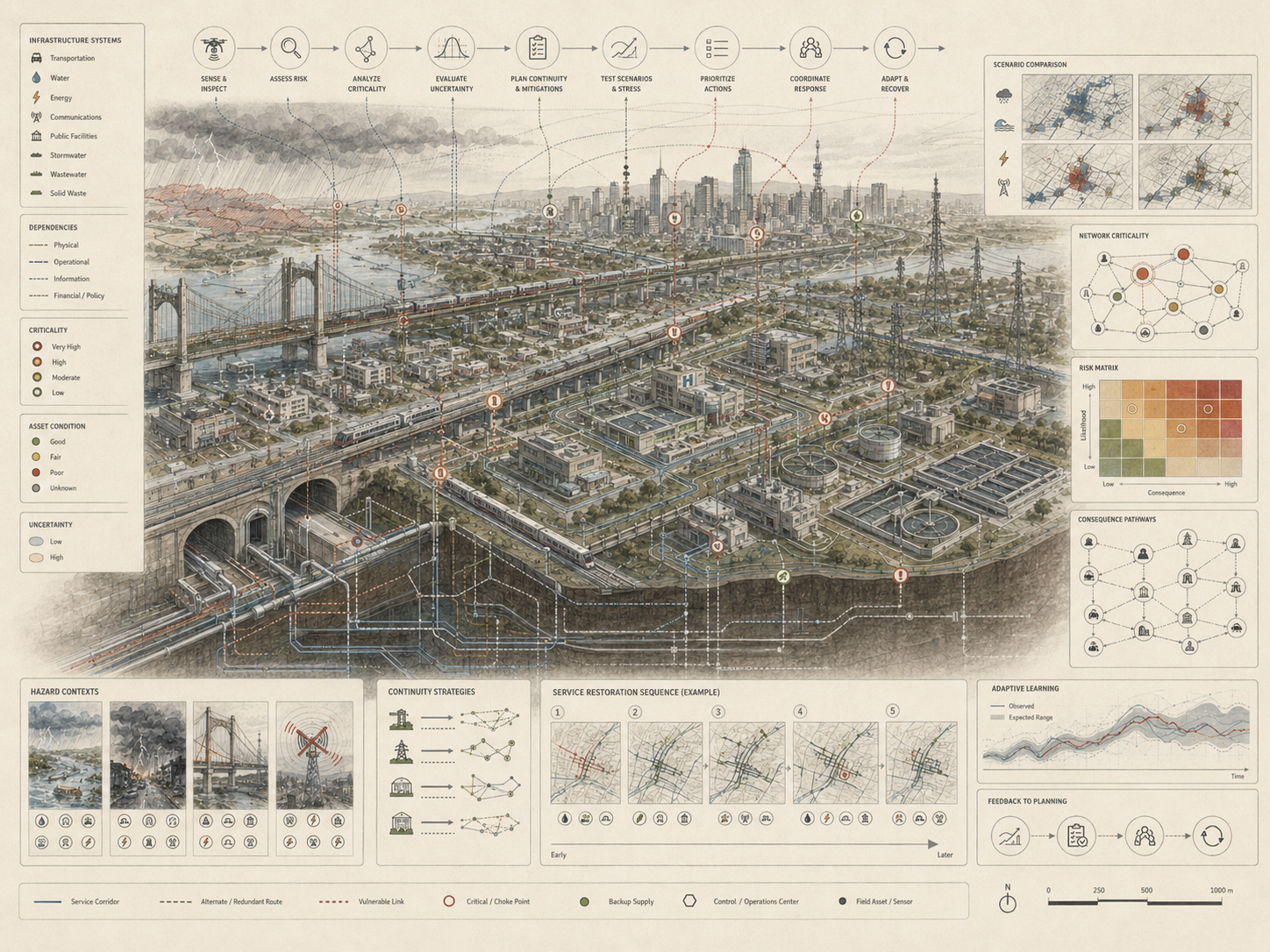
For that reason, infrastructure risk management should not be reduced to static risk registers, generic resilience language, narrow engineering safety margins, or compliance paperwork. A risk management system becomes meaningful when it helps institutions distinguish critical from non-critical vulnerabilities, prioritize interventions under constraint, manage cascading dependencies, preserve essential functions under stress, and revise assumptions after incidents occur. The central question is not whether risks can be listed. It is whether they can be made governable through analysis, prioritization, continuity planning, financing, institutional authority, and public accountability.
Engineering Problem
The engineering problem is how to design infrastructure risk management systems that can convert uncertainty into accountable public action. Infrastructure institutions need to know which assets, services, dependencies, and communities are most exposed; which failures would create the greatest consequences; which risks can be mitigated; which risks must be transferred, financed, or retained; which continuity functions must be preserved during disruption; and which governance structures can act before localized stress becomes systemic failure.
This problem is difficult because infrastructure risk is distributed across physical systems, digital systems, operational routines, fiscal capacity, institutional mandates, supply chains, environmental exposure, and public-service dependencies. A technically strong asset can sit inside a fragile system. A well-documented risk can remain unmanaged if no agency owns it. A financial transfer can shift liability without preserving service continuity. A cyber control can protect one platform while hidden dependencies remain exposed. A climate adaptation plan can reduce one hazard while increasing another. Risk management therefore requires more than enumeration. It requires systems reasoning.
Strong infrastructure risk management distinguishes hazards, vulnerabilities, exposure, criticality, likelihood, consequence, control effectiveness, residual risk, recovery capacity, and governance authority. It asks not only what might go wrong, but what would be lost, who would be affected, how failure would propagate, how quickly service could be restored, and whether institutions have the authority and resources to act.
| Engineering Tension | Why It Matters | Required Evidence |
|---|---|---|
| Risk listing versus risk governance | A risk register does not manage risk unless it changes decisions, budgets, controls, or continuity plans. | Decision logs, mitigation status, assigned owners, review cycles |
| Asset risk versus service risk | The most important risk may not be the most expensive asset, but the failure that disrupts essential public function. | Criticality mapping, service dependency analysis, continuity requirements |
| Local failure versus cascading consequence | Infrastructure failures propagate across energy, water, transport, communications, health, logistics, and digital services. | Dependency maps, scenario analysis, cascading-failure pathways |
| Prevention versus continuity | Prevention reduces risk, but continuity determines whether essential services survive when prevention fails. | Continuity plans, fallback modes, recovery objectives, exercises |
| Risk transfer versus risk reduction | Insurance, contracts, or financing tools may shift cost without restoring service or reducing vulnerability. | Risk-financing strategy, retained-risk analysis, continuity funding |
| Technical controls versus institutional authority | Controls fail when no institution has the power, budget, or mandate to maintain and act on them. | Risk ownership matrix, escalation protocol, funding pathway |
| Static assessment versus adaptive review | Risk changes as assets age, climate baselines shift, systems digitize, and dependencies evolve. | Monitoring indicators, after-action review, periodic reassessment |
The practical question is therefore: can infrastructure institutions convert uncertain threats into prioritized, financed, tested, and accountable actions that preserve essential public function under stress?
Reference Architecture
A practical reference architecture for infrastructure risk management links uncertainty analysis to operational and institutional action. The exact implementation may differ across water, energy, transport, communications, buildings, ports, logistics, flood protection, stormwater, and digital public infrastructure, but the core responsibilities remain consistent: identify risk, assess likelihood and consequence, map dependencies, prioritize treatment, finance mitigation and recovery, prepare for continuity, monitor changing exposure, and govern decision-making.
| Layer | Engineering Role | Primary Risk | Evidence Artifact |
|---|---|---|---|
| Asset and service layer | Defines physical assets, digital systems, service functions, owners, users, and public-service obligations. | Risk assessment focuses on assets while missing essential service dependency. | Asset-service register, service baseline, ownership map |
| Hazard and vulnerability layer | Identifies physical, environmental, cyber, operational, financial, institutional, and supply-chain threats. | Risk categories are treated as isolated rather than interacting. | Hazard inventory, vulnerability register, exposure map |
| Criticality and dependency layer | Maps which assets and functions are critical, which systems depend on them, and how failure propagates. | Critical dependencies remain invisible until failure occurs. | Criticality matrix, dependency graph, cascading-failure scenarios |
| Assessment and prioritization layer | Estimates likelihood, consequence, uncertainty, control effectiveness, residual risk, and intervention priority. | Prioritization becomes subjective, inconsistent, or politically distorted. | Risk register, scoring policy, uncertainty note, priority ranking |
| Treatment and mitigation layer | Defines controls, redundancy, maintenance, design improvements, cyber safeguards, ecological buffers, and procurement protections. | Mitigation is underfunded or disconnected from actual failure pathways. | Treatment plan, control matrix, mitigation status, work-order linkage |
| Finance and transfer layer | Determines which risks are reduced, retained, transferred, insured, reserved for, or financed through adaptation and recovery funds. | Risk is transferred financially but not reduced operationally. | Risk-financing plan, insurance register, retained-risk statement |
| Continuity and recovery layer | Defines fallback modes, emergency coordination, restoration priorities, recovery-time objectives, and after-action learning. | Assets are eventually repaired, but essential service continuity fails during disruption. | Continuity plan, recovery objective, exercise record, after-action review |
| Governance and review layer | Assigns risk ownership, review cycles, escalation thresholds, public evidence, and accountability for action. | Risk is understood but no institution is accountable for reducing it. | Risk ownership matrix, governance log, public evidence package |
This architecture makes clear that infrastructure risk management is not a single document or dashboard. It is an operating system for governing uncertainty across essential public services.
Implementation Pattern
A rigorous implementation pattern begins with essential service continuity. Infrastructure risk management should first define which public functions must be preserved, which assets and systems support those functions, and which dependencies could cause disruption. Only then should institutions choose scoring methods, dashboards, financing tools, emergency procedures, and control frameworks.
| Artifact | Purpose | Suggested Format |
|---|---|---|
| Risk management objective manifest | Defines system scope, service purpose, decision use, risk appetite, and valid-use limits. | YAML, Markdown, architecture decision record |
| Asset-service register | Connects assets, systems, services, owners, dependencies, users, and critical functions. | CSV, SQL table, graph database, GeoJSON |
| Risk register | Documents hazards, vulnerabilities, likelihood, consequence, controls, residual risk, and owners. | CSV, SQL table, risk database |
| Criticality matrix | Ranks assets and functions by service consequence, dependency importance, recovery difficulty, and substitute availability. | CSV, SQL table, graph metrics |
| Dependency graph | Maps cascading pathways across infrastructure sectors and public services. | Network edge list, graph model, GeoJSON |
| Scenario manifest | Defines climate, cyber, asset failure, fiscal, supply-chain, and compound-risk scenarios. | YAML, JSON, CSV scenario table |
| Treatment and mitigation plan | Links risk priorities to controls, design changes, maintenance, redundancy, procurement, finance, or adaptation actions. | CSV, work-order link, capital plan |
| Continuity and recovery log | Tracks fallback modes, recovery-time objectives, exercise results, incident performance, and after-action review. | CSV, SQL table, incident-management record |
| Risk governance log | Documents ownership, approvals, deferrals, escalation, residual-risk acceptance, and public communication. | CSV, SQL table, governance log |
| Public evidence package | Explains what risks are being managed, what remains uncertain, and who is accountable. | Markdown, HTML, PDF |
The implementation goal is to make risk decisions reconstructable. A user should be able to move from a mitigation priority, continuity plan, financing decision, or public statement back to the risk evidence, dependency assumptions, criticality logic, treatment option, funding decision, and governance record that produced it.
Research-Grade Framing: Risk Management as Infrastructure Continuity Governance
A research-grade account of infrastructure risk management begins by treating risk as a systems-governance problem rather than a technical checklist. Infrastructure risk is not only the probability of component failure. It is the possibility that essential public functions will be interrupted, degraded, made unsafe, made unaffordable, or rendered unrecoverable because the physical, digital, financial, institutional, and ecological systems supporting them are fragile.
This framing matters because infrastructure risk is produced by relationships. A single asset may appear manageable until its dependencies are recognized. A water system may depend on electricity, telecommunications, chemicals, roads, finance, and workforce availability. A hospital may depend on electricity, water, cooling, data systems, transport access, supply chains, and emergency communications. A bridge may be critical not because of its replacement cost, but because its failure isolates emergency routes, freight corridors, or vulnerable communities. Risk is therefore relational, not merely intrinsic.
Infrastructure risk management should therefore focus on continuity of essential function. The key question is not simply “What hazards exist?” but “Which combinations of hazards, vulnerabilities, dependencies, and institutional weaknesses could disrupt public function, and what can be done before, during, and after disruption to preserve service?”
| Limited Pattern | Stronger Pattern | Why the Shift Matters |
|---|---|---|
| Maintain a risk register | Connect risk records to owners, treatments, funding, continuity plans, and review cycles | Risk documentation has value only when it changes action. |
| Score assets individually | Assess criticality, interdependence, failure propagation, and service consequences | System risk often exceeds asset-by-asset risk. |
| Emphasize likelihood and consequence | Add uncertainty, control effectiveness, residual risk, recovery capacity, and governance readiness | A risk score without recovery or governance context can mislead. |
| Plan for known hazards | Test compound, cascading, cyber-physical, climate, fiscal, and supply-chain scenarios | Future risk often appears as combinations, not isolated events. |
| Transfer financial loss | Reduce vulnerability, fund continuity, and clarify retained risk | Financial transfer does not automatically preserve essential services. |
| Review risk periodically | Continuously monitor exposure, incidents, near misses, assumptions, and control performance | Infrastructure risk changes as systems age and conditions shift. |
The central research question is therefore: how can infrastructure institutions govern uncertainty in ways that reduce fragility, preserve essential services, and make risk decisions accountable before disruption becomes systemic failure?
Formal Model: Risk, Criticality, Interdependence, Continuity, and Governance
A useful formal model separates risk, criticality, dependency, control effectiveness, residual exposure, continuity capacity, and governance readiness. Let \(P_i\) represent failure probability for asset or function \(i\), \(C_i\) consequence, \(K_i\) criticality, \(D_i\) dependency centrality, \(M_i\) mitigation effectiveness, \(R_i\) residual risk, \(T_i\) recovery time, and \(G_i\) governance readiness.
R_i = P_i \times C_i
\]
Interpretation: A basic infrastructure risk score can be represented as failure probability multiplied by consequence.
K_i = w_1S_i + w_2D_i + w_3U_i + w_4H_i
\]
Interpretation: Criticality \(K_i\) can combine service importance \(S_i\), dependency centrality \(D_i\), lack of substitutes \(U_i\), and human or public-harm consequence \(H_i\).
R^{\mathrm{system}}_i = P_i \times C_i \times (1 + D_i)
\]
Interpretation: System risk increases when failure propagates through dependencies. A local asset failure can become wider service disruption when dependency centrality is high.
R^{\mathrm{residual}}_i = R_i(1 – M_i)
\]
Interpretation: Residual risk remains after mitigation, where \(M_i\) represents control, redundancy, maintenance, protection, or adaptation effectiveness.
C_{\mathrm{continuity}} = \frac{P_{\mathrm{essential}}}{T_{\mathrm{recovery}} + D_{\mathrm{disruption}}}
\]
Interpretation: Continuity capacity improves when essential performance is preserved and recovery time and disruption severity are reduced.
Q_{\mathrm{risk\ governance}} =
w_1O +
w_2A +
w_3F +
w_4C +
w_5L +
w_6G
\]
Interpretation: Risk governance quality can combine ownership \(O\), assessment quality \(A\), financing readiness \(F\), continuity planning \(C\), learning and review \(L\), and governance authority \(G\).
This mathematical lens clarifies that infrastructure risk management is not only about estimating probability. It is about understanding consequences, dependencies, controls, residual exposure, recovery capability, and the governance capacity required to act.
What Are Infrastructure Risk Management Systems?
Infrastructure risk management systems are the institutional and operational arrangements through which uncertainty is made actionable in infrastructure planning and stewardship. They include methods for identifying hazards and vulnerabilities, evaluating likelihood and consequence, comparing exposure across systems, prioritizing treatment options, financing mitigation, sustaining continuity, and learning from incidents. Unlike narrow project-risk exercises, infrastructure risk management is concerned not only with delivery risk during construction, but also with operational, systemic, cyber-physical, financial, environmental, and strategic risk after assets enter service.
This is broader than ordinary compliance or technical safety management. A bridge inspection program, cyber incident protocol, flood-warning system, insurance policy, capital-renewal plan, or financial contingency mechanism may each manage one part of risk, but a full infrastructure risk management system connects these concerns across physical assets, digital systems, operators, supply chains, public-service obligations, and governance authority. Risk management becomes infrastructurally meaningful when it helps decision-makers compare different forms of uncertainty on a common strategic horizon: what is most likely to fail, what would be most damaging if it did, what would be hardest to restore, and what must be acted on first.
Infrastructure risk management is therefore best understood as a governing system for uncertainty. It creates the conditions under which infrastructure decisions can be made with a clearer understanding of vulnerability, tradeoffs, public consequence, retained risk, and recovery obligations rather than on the assumption of stable or ideal conditions.
| Function | Question | Evidence Needed |
|---|---|---|
| Risk identification | What hazards, vulnerabilities, dependencies, and uncertainties affect the system? | Hazard inventory, asset register, vulnerability scan, dependency map |
| Risk assessment | How likely is disruption, and what consequences would follow? | Risk register, likelihood/consequence matrix, uncertainty note |
| Criticality analysis | Which functions, assets, or nodes matter most for essential service continuity? | Criticality matrix, service-dependency analysis |
| Risk treatment | What controls, investments, maintenance, redundancy, or adaptation measures reduce risk? | Mitigation plan, control register, work-order linkage |
| Risk financing | Which risks are reduced, retained, transferred, insured, or funded for recovery? | Insurance register, reserve policy, retained-risk statement |
| Continuity planning | How will essential functions continue under degraded conditions? | Continuity plan, recovery-time objectives, fallback mode documentation |
| Governance review | Who owns risk, accepts residual exposure, approves action, and updates assumptions? | Risk ownership matrix, governance log, after-action review |
Infrastructure risk management is strongest when it functions as a living decision system rather than as a static archive of concerns.
Why Infrastructure Risk Management Must Be Systemic
Infrastructure risk management must be systemic because infrastructure failure rarely remains confined to one asset or one organization. Electricity interruptions can affect telecommunications, water pumping, hospitals, fuel distribution, traffic signals, digital public services, and emergency response. Flooding can disrupt transport, water quality, logistics, health services, communications, and emergency access at the same time. A supplier failure can delay multiple capital projects, while fiscal stress can weaken maintenance and amplify future operational risk. What appears manageable within one institutional boundary may become dangerous once dependencies are taken seriously.
This matters because infrastructure operators are often tempted to focus on risks most legible within their own domain. But risk frequently enters from outside that domain: through upstream dependencies, common service providers, regulatory gaps, environmental pressures, cyber platforms, labor shortages, cross-jurisdictional coordination failures, or public-finance constraints. A system may appear robust asset by asset while remaining fragile network by network.
Systemic risk management therefore requires institutions to move beyond the question “what could fail here?” toward “how would failure propagate, who depends on this function, which services would be interrupted, who would be most affected, and what would be hardest to restore?” Risk becomes infrastructurally meaningful when it is linked to continuity of essential services rather than isolated component failure.
| Systemic Feature | Risk Implication | Management Requirement |
|---|---|---|
| Interdependence | Failure in one sector can disable functions in another. | Dependency mapping and cascading-failure scenarios |
| Common-mode exposure | Multiple systems may be affected by the same hazard, vendor, platform, or geography. | Compound-risk and common-cause analysis |
| Institutional fragmentation | No single actor may own the full risk pathway. | Cross-agency risk ownership and escalation rules |
| Temporal accumulation | Deferred maintenance and weak renewal can turn small risks into structural fragility. | Lifecycle risk review and capital planning |
| Digital dependence | Cyber, platform, and communications failures become operational failures. | Cyber-physical resilience and fallback modes |
| Uneven exposure | Disruption often harms vulnerable communities first and longest. | Equity-weighted risk review and public evidence |
Systemic risk management does not eliminate uncertainty. It improves the capacity to recognize how uncertainty moves through infrastructure systems before that movement becomes public harm.
Core Architecture of Infrastructure Risk Management
Infrastructure risk management can be understood through a layered architecture that links analysis to action. The layers are not merely conceptual; they correspond to artifacts, teams, systems, budgets, and responsibilities that must work together.
Risk Identification Layer
This layer includes hazard recognition, asset inventories, vulnerability scanning, dependency mapping, historical incident review, cyber exposure review, supply-chain analysis, climate and environmental assessment, and identification of critical functions. It establishes what kinds of risks exist, where they are located, who owns them, and which services they threaten.
Assessment and Prioritization Layer
This layer includes likelihood and consequence analysis, scenario testing, criticality assessment, exposure mapping, risk ranking, uncertainty characterization, and residual-risk evaluation. Its purpose is not simply to quantify uncertainty, but to determine where intervention matters most under real fiscal, operational, political, and capacity constraints.
Treatment and Mitigation Layer
This layer includes design changes, redundancy, protective measures, maintenance strategies, diversification, cyber controls, ecological buffers, procurement safeguards, workforce planning, and financing arrangements that reduce, redistribute, or prepare for risk.
Preparedness and Continuity Layer
This layer includes contingency planning, continuity arrangements, incident protocols, fallback modes, emergency coordination, mutual aid, spare-parts planning, backup systems, and recovery planning. It is where institutions prepare to function when risk is no longer hypothetical.
Monitoring and Review Layer
This layer includes indicators, dashboards, audits, near-miss reporting, after-action review, asset-condition monitoring, cyber monitoring, scenario refresh, and structured reassessment. Its role is to prevent risk management from becoming static by reconnecting planning assumptions to changing system conditions.
Governance and Accountability Layer
This layer assigns risk owners, approves risk appetite, sets thresholds, reviews residual risk, funds mitigation, accepts or rejects deferral, communicates with the public, and updates standards after events. Without this layer, risk analysis may remain technically sound but institutionally ineffective.
Together these layers show that infrastructure risk management is not simply about identifying threats. It is about building an institutional chain from uncertainty to prioritization, action, continuity, financing, recovery, and learning.
Risk Categories Across Infrastructure Systems
Infrastructure risk management must account for multiple categories of risk that differ in timescale, observability, ownership, and treatment options. These categories should not be treated as isolated silos. They often interact in ways that compound exposure.
| Risk Category | Description | Typical Treatment |
|---|---|---|
| Physical and asset risk | Deterioration, equipment failure, structural weakness, overload, design defects, and operational wear. | Inspection, renewal, preventive maintenance, redundancy, asset management |
| Environmental and climate risk | Flood, drought, heat, wildfire, erosion, sea-level rise, storm intensity, and changing environmental baselines. | Adaptation planning, scenario testing, protective design, nature-based buffers |
| Cyber and digital risk | Control-system compromise, communications failure, platform dependence, software weakness, and data integrity failure. | Segmentation, access control, monitoring, recovery drills, manual fallback |
| Operational risk | Human error, procedure failure, workforce shortage, maintenance backlog, incident mismanagement, and poor handoff. | Training, standard procedures, workforce planning, after-action review |
| Financial and fiscal risk | Cost overruns, revenue instability, contingent liabilities, debt exposure, insurance gaps, and weak maintenance funding. | Lifecycle costing, reserve funds, risk financing, affordability analysis |
| Supply-chain risk | Vendor concentration, component scarcity, delayed procurement, material dependence, and contract failure. | Diversification, stockpiles, procurement safeguards, supplier monitoring |
| Institutional and governance risk | Fragmented mandates, poor coordination, weak accountability, unstable regulation, and lack of technical capacity. | Governance reform, mandate clarification, interagency protocols, public reporting |
| Social and political risk | Public opposition, conflict, exclusion, affordability crisis, inequitable service, or legitimacy failure. | Public engagement, equity review, affordability policy, transparent evidence |
The key point is not only that infrastructure faces many risks, but that these categories interact. A technically manageable hazard can become a systems failure when finance, governance, digital dependence, or continuity planning is weak.
Criticality, Interdependence, and Cascading Failure
One of the most important functions of infrastructure risk management is determining what is critical and why. Not every asset requires the same level of protection, and not every failure has the same consequence. Criticality assessment therefore asks not merely whether an asset is important in a general sense, but whether it supports essential services, whether substitutes exist, how quickly failure would propagate, how many people or systems would be affected, and how difficult restoration would be.
This matters because a substation, bridge, water-treatment plant, telecom node, data center, pump station, drainage outlet, hospital utility connection, or logistics hub may be critical not because it is expensive or prominent, but because its failure disables many downstream functions. Criticality is therefore relational. It depends on network position, service dependency, restoration difficulty, and social consequence, not simply on asset value.
Interdependence intensifies this problem. A system that seems manageable in isolation may become dangerous when multiple services depend on it simultaneously. Cascading failure is therefore not an exceptional edge case. It is one of the central reasons infrastructure risk management must prioritize network logic rather than only asset logic.
| Dimension | Question | Risk Signal |
|---|---|---|
| Service importance | Which essential public functions depend on this asset or system? | Water, energy, health, emergency access, communications, sanitation, mobility |
| Dependency centrality | How many other assets, sectors, or services depend on this function? | High network centrality or many downstream dependencies |
| Substitutability | Are there alternate routes, redundant systems, backup supplies, or manual fallback options? | Low redundancy or no substitute |
| Recovery difficulty | How hard, expensive, slow, or specialized would restoration be? | Long lead times, rare parts, specialized labor, constrained access |
| Human consequence | Would failure threaten safety, health, shelter, accessibility, or public welfare? | High consequence for vulnerable or dependent populations |
| Cascading pathway | Could local failure trigger wider disruption across sectors? | Energy-water-communications-transport dependency chain |
A risk management system that does not evaluate criticality and dependency can misallocate resources: overprotecting visible assets while underprotecting hidden functions that sustain essential public life.
Risk Across the Infrastructure Life Cycle
Infrastructure risk changes across the asset life cycle. Risks at the planning and selection stage differ from those during design, procurement, construction, operation, maintenance, adaptation, and retirement. Governance quality at each stage shapes later exposure in ways that are often difficult to reverse.
At project selection, risk often concerns whether the wrong project is chosen, demand is overestimated, dependency is misunderstood, environmental and social conditions are poorly assessed, or long-term maintenance obligations are ignored. During procurement and delivery, risks include market concentration, contract failure, cost overruns, schedule delay, quality problems, corruption, labor constraints, and supply-chain disruption. During operations, risk shifts toward maintenance backlogs, asset degradation, workforce capability, service interruption, cyber exposure, climate stress, and fiscal strain.
Risk management fails when it is concentrated in one phase. A project may be well designed yet fiscally unsustainable in operation. A secure digital system may depend on weak vendor governance. A resilient asset may sit inside a fragile corridor. A flood-protection investment may reduce one exposure while increasing downstream risk. Lifecycle risk management is therefore essential because infrastructure performance is produced over time, not only at the moment of commissioning.
| Life-Cycle Stage | Typical Risks | Risk Management Requirement |
|---|---|---|
| Strategic planning | Wrong project selection, poor demand assumptions, weak public-value case, climate blind spots. | Needs assessment, options analysis, scenario planning, public-value review |
| Design | Underdesigned capacity, weak redundancy, poor climate assumptions, ignored dependency. | Design review, hazard analysis, resilience standards, dependency mapping |
| Procurement | Vendor concentration, contract failure, cost escalation, weak transparency. | Procurement governance, competition, contract-risk review, contingency planning |
| Construction | Schedule delay, quality failure, safety risk, materials shortage, cost overrun. | Project controls, quality assurance, safety management, supply-chain monitoring |
| Operations | Service interruption, cyber compromise, human error, asset deterioration, demand shift. | Operational monitoring, cyber resilience, maintenance, incident management |
| Maintenance and renewal | Backlog growth, deferred renewal, spare-parts shortage, aging workforce, hidden deterioration. | Asset management, lifecycle costing, predictive maintenance, renewal prioritization |
| Adaptation and retirement | Maladaptation, stranded assets, social opposition, environmental harm, transition risk. | Adaptation pathways, decommissioning plans, public consultation, residual-risk review |
A mature risk management system therefore treats the infrastructure life cycle as a chain of risk decisions, not as separate planning, delivery, and operations silos.
Governance, Risk Ownership, and Institutional Capacity
Infrastructure risk management is a governance problem as much as an analytical one. Institutions must decide who identifies risk, who owns it, how risk appetite is defined, what thresholds trigger action, how cross-sector risks are coordinated, how residual risk is accepted, how tradeoffs are communicated, and how the public can understand the evidence behind decisions. Without clarity on these questions, risk may be recognized but still remain institutionally unmanageable.
This matters because risk often goes unmanaged not for lack of awareness, but for lack of ownership. Risks that cross agencies, sectors, or jurisdictions can fall into institutional gaps where no one has both the authority and incentive to act. A regulator may identify exposure without controlling capital budgets. A local operator may understand vulnerabilities without being able to revise national standards. A ministry may demand resilience without financing maintenance or redundancy. A utility may have data but not public legitimacy. A contractor may hold information that public institutions cannot easily audit.
Institutional capacity therefore matters as much as technical sophistication. A strong risk framework on paper is weak in practice if staffing is thin, mandates are fragmented, data quality is poor, financing is inadequate, public trust is low, or review cycles do not influence investment and operations. Risk management becomes effective only when analysis is tied to authority, finance, institutional learning, and operational follow-through.
| Governance Responsibility | Question | Evidence Needed |
|---|---|---|
| Risk ownership | Who is accountable for each risk, control, treatment, and residual exposure? | Risk ownership matrix, escalation rules, accountable owner |
| Risk appetite | What level of risk is acceptable for different services, populations, and scenarios? | Threshold policy, service-continuity standard, public-value statement |
| Cross-sector coordination | How are dependencies governed across agencies, sectors, jurisdictions, and operators? | Interagency protocol, dependency register, mutual-aid agreement |
| Residual-risk acceptance | Who approves risks that remain after mitigation, transfer, or deferral? | Residual-risk log, approval record, public evidence note |
| Public accountability | Can affected publics understand the risks, assumptions, tradeoffs, and protections? | Public evidence package, plain-language risk summary, review process |
| Learning and review | Do incidents, near misses, exercises, and new data change standards and decisions? | After-action review, revised assumptions, updated risk register |
Risk governance is therefore not an administrative layer added to technical assessment. It is the mechanism through which uncertainty becomes accountable public action.
Financing, Insurance, and Risk Transfer
Infrastructure risk management also includes financial strategy. Some risks can be reduced through design, maintenance, adaptation, redundancy, monitoring, or operational change. Some can be retained and planned for through reserves, contingency funds, or continuity financing. Some can be partially transferred through insurance, contractual arrangements, catastrophe bonds, public-private risk-sharing, or diversified financing structures. Good risk management therefore requires not only technical assessment, but financial judgment about what should be mitigated, what can be absorbed, and what must be shared.
This matters because institutions often mismanage risk by confusing transfer with reduction. Insurance may cover part of a loss but does not preserve continuity of service on its own. A contract may shift liability but not necessarily operational consequence. A financing mechanism may fund recovery but not prevent avoidable harm. Likewise, underinvestment in maintenance can appear fiscally efficient in the short run while multiplying long-run risk exposure.
Risk financing is therefore part of infrastructure governance, not a separate actuarial exercise. It helps determine whether systems can absorb loss, recover function, avoid repeated vulnerability, and sustain public services under stress.
| Strategy | What It Does | What It Does Not Do Alone |
|---|---|---|
| Risk reduction | Reduces likelihood or consequence through design, maintenance, redundancy, adaptation, or protection. | It does not eliminate residual risk. |
| Risk retention | Accepts risk and prepares to absorb losses or disruption. | It does not reduce exposure unless paired with continuity planning. |
| Risk transfer | Shifts some financial consequence through insurance, contracts, or financing tools. | It does not guarantee service continuity or physical recovery. |
| Risk pooling | Spreads losses across institutions, geographies, or portfolios. | It does not replace local mitigation or governance. |
| Contingency reserves | Provides funding capacity for emergency response, repair, or recovery. | It does not identify which risks should be prioritized before failure. |
| Lifecycle investment | Reduces future risk through maintenance, renewal, adaptation, and modernization. | It requires long-term governance and budget discipline. |
A financially serious risk management system distinguishes between reducing risk, funding risk, transferring risk, retaining risk, and accepting risk. These are not interchangeable decisions.
Preparedness, Continuity, and Recovery
Infrastructure risk management becomes real when risk is no longer hypothetical. Preparedness, continuity, and recovery are the parts of the system that matter when disruption occurs despite mitigation efforts. No infrastructure system can eliminate all risk. The practical question is therefore whether critical functions can continue under degraded conditions, whether operators can shift to fallback modes, whether coordination holds under stress, whether essential users are protected, and whether recovery restores service in a credible timeframe.
Prevention, continuity, and recovery are related but not identical. Prevention reduces the likelihood or severity of disruption. Continuity planning focuses on sustaining essential function while disruption is underway. Recovery concerns restoration, repair, and the return of dependable service after interruption. A system may have strong preventive controls yet weak continuity capability. It may restore assets eventually but still fail in the shorter term if essential services cannot be maintained under degraded conditions.
Recovery is especially important because repeated disruption without learning can turn manageable risk into structural fragility. Mature risk management systems therefore include after-action review, revision of assumptions, and changes to standards, maintenance, procurement, financing, or governance after incidents occur.
| Function | Question | Evidence Needed |
|---|---|---|
| Preparedness | Are institutions ready before disruption occurs? | Exercise records, emergency protocols, spare parts, mutual-aid agreements |
| Continuity | Can essential services continue under degraded conditions? | Continuity plan, fallback modes, critical-function priority list |
| Response | Can operators coordinate quickly during disruption? | Incident command protocol, communication plan, escalation records |
| Recovery | Can service be restored within acceptable timeframes? | Recovery-time objectives, restoration sequence, repair capacity |
| Learning | Does the institution update risk assumptions after disruption? | After-action review, revised controls, updated risk register |
Continuity and recovery turn risk management from abstract planning into public-service stewardship. They determine whether infrastructure institutions can protect essential function when uncertainty becomes reality.
Measurement, Monitoring, and Risk Review
Infrastructure risk management is difficult to improve without review and measurement. This includes asset-condition indicators, criticality mapping, incident reporting, near-miss analysis, dependency monitoring, climate and cyber observability, control effectiveness, mitigation status, residual-risk review, and structured resilience assessment. Measurement is most useful when it sharpens prioritization rather than simply expanding reporting.
Risk registers alone do not manage risk. Institutions need signals that show whether exposure is changing, whether mitigation is working, whether dependencies are growing, whether control effectiveness is declining, whether continuity capability is improving or eroding, and whether assumptions have become obsolete. Review should therefore be iterative and decision-oriented rather than static and procedural.
Good assessment helps institutions identify where uncertainty is becoming more dangerous, where fiscal or operational fragility is accumulating, where climate or cyber exposure is shifting, and where intervention is most urgent across the system. The point of risk review is not to prove that uncertainty has been eliminated, but to ensure that uncertainty is being governed more intelligently over time.
| Metric Type | Example Signal | Interpretive Caveat |
|---|---|---|
| Risk exposure | Number of high-risk assets, services, or dependencies by sector and geography. | Aggregate counts may hide critical nodes. |
| Criticality | Share of critical functions with redundancy, substitutes, or continuity plans. | Redundancy must be tested under realistic scenarios. |
| Control effectiveness | Share of controls tested, current, funded, and linked to risk pathways. | Control presence is not the same as control performance. |
| Residual risk | Risk remaining after mitigation, transfer, financing, and continuity planning. | Residual risk requires explicit acceptance and review. |
| Continuity readiness | Recovery-time objectives, exercise success, fallback-mode readiness, and spare capacity. | Plans require practice, resources, and revision. |
| Cyber-physical resilience | Segmentation, access control, monitoring, recovery, and manual fallback status. | Digital controls must be connected to operational continuity. |
| Learning | Number of after-action findings converted into revised standards, budgets, or work orders. | Learning must change decisions, not only reports. |
Risk management maturity is not measured by how many risks are documented. It is measured by whether evidence changes priorities, investments, controls, continuity plans, and governance decisions.
Deployment Readiness Gate
Before an infrastructure risk management system is used for investment prioritization, resilience planning, continuity review, cyber-physical coordination, insurance strategy, public reporting, emergency preparedness, or risk-governance decisions, it should pass a readiness gate. This gate should test whether risk evidence is complete enough, actionable enough, and governable enough for the decision being made.
| Readiness Area | Required Question | Pass Evidence |
|---|---|---|
| Purpose readiness | Does the system define scope, decision use, public-service purpose, risk appetite, and valid-use limits? | Risk management objective manifest |
| Asset-service readiness | Are critical assets, services, owners, users, and dependencies documented? | Asset-service register, dependency map |
| Risk evidence readiness | Are hazards, vulnerabilities, likelihood, consequence, uncertainty, and controls documented? | Risk register and uncertainty notes |
| Criticality readiness | Are essential functions, substitutes, dependency centrality, and recovery difficulty assessed? | Criticality matrix and service dependency review |
| Scenario readiness | Have climate, cyber, asset failure, fiscal, supply-chain, and cascading-risk scenarios been tested? | Scenario manifest, stress-test outputs, sensitivity review |
| Treatment readiness | Are mitigation, redundancy, maintenance, adaptation, procurement, and control actions linked to risks? | Treatment plan, control matrix, work-order linkage |
| Finance readiness | Are risk reduction, retention, transfer, insurance, reserves, and recovery funding documented? | Risk-financing plan and retained-risk statement |
| Continuity readiness | Can essential functions continue under degraded conditions? | Continuity plan, fallback modes, recovery-time objectives |
| Governance readiness | Are risk owners, escalation rules, residual-risk approvals, and public evidence processes defined? | Risk ownership matrix, governance log, public evidence package |
This readiness gate prevents risk management systems from becoming static documentation. The stronger standard is whether risk evidence can support accountable action before, during, and after disruption.
Data and Configuration Artifacts
A reproducible infrastructure risk management workflow should include explicit artifacts for risk objectives, asset-service dependencies, risk registers, criticality scoring, scenario testing, treatment planning, financing, continuity, recovery, and governance. These artifacts make risk decisions auditable rather than hidden inside spreadsheets, dashboards, consultant reports, or informal institutional routines.
| Artifact | Purpose | Suggested Path |
|---|---|---|
| Risk management objective manifest | Defines system scope, decision use, risk appetite, public-service purpose, and valid-use limits. | config/risk_management_objective.yml |
| Asset-service register | Connects assets, services, owners, criticality, dependencies, and recovery responsibilities. | data/asset_service_register.csv |
| Infrastructure risk register | Documents hazards, vulnerabilities, likelihood, consequence, controls, residual risk, and owners. | data/infrastructure_risk_register.csv |
| Criticality matrix | Scores service importance, dependency centrality, substitutability, recovery difficulty, and public harm. | data/criticality_matrix.csv |
| Dependency graph | Maps interdependence among assets, sectors, and essential services. | data/dependency_graph_edges.csv |
| Scenario manifest | Defines climate, cyber, asset failure, supply-chain, fiscal, and cascading-risk scenarios. | data/risk_scenario_manifest.csv |
| Treatment and mitigation plan | Links risks to controls, maintenance, redundancy, adaptation, procurement, financing, and accountability. | data/treatment_mitigation_plan.csv |
| Continuity and recovery log | Tracks continuity functions, fallback modes, recovery-time objectives, exercises, and after-action review. | data/continuity_recovery_log.csv |
| Risk governance log | Documents ownership, approvals, deferrals, escalation, residual-risk acceptance, and public communication. | data/risk_governance_log.csv |
| Public evidence package | Documents what the risk management system can and cannot claim. | docs/public_evidence_package.md |
These artifacts turn infrastructure risk management into a reproducible public systems workflow rather than a disconnected compliance exercise.
Mathematical Lens: Risk, Criticality, Dependency, Continuity, and Residual Exposure
A mathematics-first view helps clarify why infrastructure risk management requires more than likelihood and consequence scoring. Risk must be connected to criticality, dependency, mitigation, recovery, and governance.
R_i = P_i \times C_i
\]
Interpretation: Basic risk for asset or function \(i\) is the product of failure probability \(P_i\) and consequence \(C_i\).
K_i = w_1S_i + w_2D_i + w_3U_i + w_4H_i
\]
Interpretation: Criticality combines service importance, dependency centrality, lack of substitutes, and human or public harm consequence.
R^{\mathrm{system}}_i = P_i \times C_i \times (1 + D_i)
\]
Interpretation: System risk increases when local failure can propagate through dependencies.
R^{\mathrm{residual}}_i = R_i(1 – M_i)
\]
Interpretation: Residual risk remains after mitigation, control effectiveness, redundancy, or adaptation is applied.
C_{\mathrm{continuity}} = \frac{P_{\mathrm{essential}}}{T_{\mathrm{recovery}} + D_{\mathrm{disruption}}}
\]
Interpretation: Continuity capacity improves when essential performance is preserved and recovery time and disruption severity are reduced.
Q_{\mathrm{risk\ governance}} =
w_1O +
w_2A +
w_3F +
w_4C +
w_5L +
w_6G
\]
Interpretation: Risk governance quality combines ownership, assessment quality, financing readiness, continuity planning, learning, and governance authority.
These equations are not substitutes for engineering judgment. They are scaffolds for making the logic of risk assessment inspectable: what is likely, what is consequential, what is critical, what is connected, what has been mitigated, what remains, and who is accountable.
Python Workflow: Infrastructure Risk Prioritization and Continuity Review
Python is useful for building a reproducible workflow that connects risk probability, consequence, criticality, dependency centrality, mitigation effectiveness, residual risk, continuity readiness, and governance review. The following educational example creates a simplified infrastructure risk register and ranks risks for intervention.
"""
Infrastructure Risk Management Workflow

This educational workflow demonstrates:
1. infrastructure risk register scoring
2. criticality and dependency-adjusted risk
3. residual risk after mitigation
4. continuity-readiness review
5. governance-priority classification

It uses synthetic data and is intended for article companion-code scaffolding.
"""

from __future__ import annotations

from dataclasses import dataclass
from typing import List
import pandas as pd


@dataclass
class InfrastructureRisk:
    risk_id: str
    asset_id: str
    sector: str
    risk_type: str
    failure_probability: float
    consequence_score: float
    service_importance: float
    dependency_centrality: float
    substitute_gap: float
    public_harm: float
    mitigation_effectiveness: float
    continuity_readiness: float
    governance_readiness: float
    high_criticality: bool


def basic_risk(risk: InfrastructureRisk) -> float:
    return risk.failure_probability * risk.consequence_score


def criticality_score(risk: InfrastructureRisk) -> float:
    return (
        0.30 * risk.service_importance
        + 0.25 * risk.dependency_centrality
        + 0.20 * risk.substitute_gap
        + 0.25 * risk.public_harm
    )


def system_risk(risk: InfrastructureRisk) -> float:
    return basic_risk(risk) * (1 + risk.dependency_centrality)


def residual_risk(risk: InfrastructureRisk) -> float:
    return system_risk(risk) * (1 - risk.mitigation_effectiveness)


def continuity_gap(risk: InfrastructureRisk) -> float:
    return max(0.0, 1 - risk.continuity_readiness)


def governance_gap(risk: InfrastructureRisk) -> float:
    return max(0.0, 1 - risk.governance_readiness)


def priority_score(risk: InfrastructureRisk) -> float:
    return (
        0.35 * residual_risk(risk)
        + 0.25 * criticality_score(risk)
        + 0.20 * continuity_gap(risk)
        + 0.20 * governance_gap(risk)
    )


def classify_review(risk: InfrastructureRisk) -> str:
    score = priority_score(risk)

    if risk.high_criticality and risk.continuity_readiness < 0.65:
        return "urgent_continuity_review"
    if risk.high_criticality and risk.governance_readiness < 0.65: return "urgent_governance_review" if residual_risk(risk) > 0.40:
        return "residual_risk_review"
    if risk.mitigation_effectiveness < 0.50: return "mitigation_review" if score > 0.50:
        return "priority_risk_review"
    return "routine_monitoring"


risks: List[InfrastructureRisk] = [
    InfrastructureRisk("R-001", "A-WATER-01", "water", "pipe_failure", 0.42, 0.80, 0.90, 0.70, 0.65, 0.80, 0.45, 0.58, 0.62, True),
    InfrastructureRisk("R-002", "A-POWER-07", "energy", "transformer_failure", 0.35, 0.88, 0.95, 0.82, 0.75, 0.76, 0.52, 0.64, 0.70, True),
    InfrastructureRisk("R-003", "A-BRIDGE-12", "transport", "bridge_closure", 0.28, 0.92, 0.88, 0.78, 0.70, 0.72, 0.48, 0.60, 0.66, True),
    InfrastructureRisk("R-004", "A-CYBER-03", "communications", "network_compromise", 0.31, 0.86, 0.92, 0.88, 0.82, 0.75, 0.55, 0.62, 0.58, True),
    InfrastructureRisk("R-005", "A-FLOOD-09", "stormwater", "extreme_rainfall", 0.46, 0.74, 0.78, 0.64, 0.60, 0.84, 0.40, 0.54, 0.60, True),
]

records = []

for risk in risks:
    records.append({
        "risk_id": risk.risk_id,
        "asset_id": risk.asset_id,
        "sector": risk.sector,
        "risk_type": risk.risk_type,
        "basic_risk": round(basic_risk(risk), 3),
        "criticality_score": round(criticality_score(risk), 3),
        "system_risk": round(system_risk(risk), 3),
        "residual_risk": round(residual_risk(risk), 3),
        "continuity_gap": round(continuity_gap(risk), 3),
        "governance_gap": round(governance_gap(risk), 3),
        "priority_score": round(priority_score(risk), 3),
        "review_priority": classify_review(risk),
    })

risk_table = pd.DataFrame(records).sort_values(
    ["review_priority", "priority_score"],
    ascending=[True, False],
)

print(risk_table)
This workflow demonstrates why infrastructure risk management should not stop at a single probability-by-consequence score. The strongest prioritization accounts for criticality, dependency, mitigation effectiveness, continuity readiness, and governance capacity.
R Workflow: Risk Register, Criticality, and Governance Reporting
R is useful for producing review-ready summaries of infrastructure risk by sector, criticality level, residual exposure, continuity readiness, and governance status. The following workflow creates a synthetic risk register and summarizes review priorities.
# Infrastructure Risk Management Reporting
#
# This educational workflow summarizes:
# - basic risk
# - criticality
# - dependency-adjusted system risk
# - residual risk
# - continuity and governance gaps
# - review priorities by sector

library(dplyr)
library(readr)

risks <- tibble::tribble(
  ~risk_id, ~asset_id, ~sector, ~risk_type, ~failure_probability, ~consequence_score, ~service_importance, ~dependency_centrality, ~substitute_gap, ~public_harm, ~mitigation_effectiveness, ~continuity_readiness, ~governance_readiness, ~high_criticality,
  "R-001", "A-WATER-01", "water", "pipe_failure", 0.42, 0.80, 0.90, 0.70, 0.65, 0.80, 0.45, 0.58, 0.62, TRUE,
  "R-002", "A-POWER-07", "energy", "transformer_failure", 0.35, 0.88, 0.95, 0.82, 0.75, 0.76, 0.52, 0.64, 0.70, TRUE,
  "R-003", "A-BRIDGE-12", "transport", "bridge_closure", 0.28, 0.92, 0.88, 0.78, 0.70, 0.72, 0.48, 0.60, 0.66, TRUE,
  "R-004", "A-CYBER-03", "communications", "network_compromise", 0.31, 0.86, 0.92, 0.88, 0.82, 0.75, 0.55, 0.62, 0.58, TRUE,
  "R-005", "A-FLOOD-09", "stormwater", "extreme_rainfall", 0.46, 0.74, 0.78, 0.64, 0.60, 0.84, 0.40, 0.54, 0.60, TRUE
)

risk_summary <- risks %>%
  mutate(
    basic_risk = failure_probability * consequence_score,
    criticality_score = (
      0.30 * service_importance +
      0.25 * dependency_centrality +
      0.20 * substitute_gap +
      0.25 * public_harm
    ),
    system_risk = basic_risk * (1 + dependency_centrality),
    residual_risk = system_risk * (1 - mitigation_effectiveness),
    continuity_gap = pmax(0, 1 - continuity_readiness),
    governance_gap = pmax(0, 1 - governance_readiness),
    priority_score = (
      0.35 * residual_risk +
      0.25 * criticality_score +
      0.20 * continuity_gap +
      0.20 * governance_gap
    ),
    review_priority = case_when(
      high_criticality & continuity_readiness < 0.65 ~ "urgent_continuity_review",
      high_criticality & governance_readiness < 0.65 ~ "urgent_governance_review", residual_risk > 0.40 ~ "residual_risk_review",
      mitigation_effectiveness < 0.50 ~ "mitigation_review", priority_score > 0.50 ~ "priority_risk_review",
      TRUE ~ "routine_monitoring"
    )
  ) %>%
  arrange(review_priority, desc(priority_score))

sector_summary <- risk_summary %>%
  group_by(sector) %>%
  summarise(
    risks = n(),
    mean_residual_risk = round(mean(residual_risk), 3),
    mean_criticality = round(mean(criticality_score), 3),
    mean_priority = round(mean(priority_score), 3),
    continuity_reviews = sum(review_priority == "urgent_continuity_review"),
    governance_reviews = sum(review_priority == "urgent_governance_review"),
    .groups = "drop"
  ) %>%
  arrange(desc(mean_priority))

dir.create("outputs", recursive = TRUE, showWarnings = FALSE)
write_csv(risk_summary, "outputs/infrastructure_risk_priority_table.csv")
write_csv(sector_summary, "outputs/infrastructure_risk_sector_summary.csv")

print(risk_summary)
print(sector_summary)
The R workflow supports governance reporting by making risk prioritization transparent. It shows which risks require continuity review, governance review, mitigation review, or routine monitoring.
Systems Code: Risk Registers, Scenario Manifests, Continuity Logs, and Governance Records
Infrastructure risk management depends on full-stack information infrastructure. Risk decisions require asset-service registries, risk registers, dependency graphs, scenario manifests, control matrices, continuity logs, incident records, treatment plans, financing records, and governance logs. A serious companion repository should therefore include both analytical workflows and systems-code scaffolding.
| Language / Tool | Role in Companion Repository | Example Use |
|---|---|---|
| Python | Risk scoring, criticality analysis, dependency-adjusted prioritization, scenario review, and governance watchlists | Infrastructure risk prioritization workflow |
| R | Risk-register reporting, sector summaries, continuity diagnostics, and governance-ready tables | Risk and criticality reporting workflow |
| SQL | Risk registers, asset-service records, dependency maps, scenario manifests, treatment plans, continuity logs, and governance records | Auditable infrastructure risk database |
| GeoJSON | Risk exposure zones, critical assets, service territories, hazard overlays, and recovery geography | Spatial risk and dependency mapping |
| TypeScript | Dashboard, API, and public-evidence data types | Risk cards, continuity panels, governance views |
| Go | Lightweight risk-status endpoint | Expose risk-register, continuity, scenario, and governance readiness |
| Rust | Safe validation CLI for risk records and scenario manifests | Validate required fields, risk scores, and governance status flags |
| C / C++ | Low-level telemetry and priority-queue examples | Embedded risk-signal records and continuity review queues |
| Shell scripts | Reproducible validation and export workflows | One-command scaffold validation and output generation |
This breadth is appropriate because infrastructure risk management is not only a spreadsheet exercise. It is a public systems problem involving data infrastructure, operational readiness, financial capacity, cyber-physical resilience, institutional authority, and public accountability.
GitHub Repository
The article body includes selected computational examples so the conceptual and governance argument remains readable. The full repository should contain expanded computational infrastructure: risk management objective manifests, asset-service registers, infrastructure risk registers, criticality matrices, dependency graphs, scenario manifests, treatment plans, continuity and recovery logs, governance records, SQL schemas, TypeScript data types, Python/R workflows, notebooks, validation scripts, and public evidence templates.
Testing and Validation
Testing infrastructure risk management systems requires more than checking whether a risk register exists. It requires validating whether the system can identify meaningful risks, distinguish critical dependencies, estimate consequence, document uncertainty, link risk to controls, test continuity, finance treatment, and assign accountable ownership. A system can be procedurally complete while still failing to govern real risk.
| Test Type | Purpose | Example Test |
|---|---|---|
| Asset-service test | Ensure risk records are connected to essential services and owners. | Validate asset-service register and ownership fields. |
| Risk-register completeness test | Ensure each risk includes hazard, vulnerability, likelihood, consequence, controls, residual risk, and owner. | Run schema and missing-field checks. |
| Criticality test | Ensure criticality reflects service importance, dependency centrality, substitutes, recovery difficulty, and public harm. | Review criticality matrix and sensitivity to scoring weights. |
| Dependency test | Ensure cascading pathways are represented across sectors. | Validate dependency graph and scenario pathways. |
| Scenario test | Ensure climate, cyber, asset failure, supply-chain, fiscal, and compound-risk scenarios are defined. | Review scenario manifest and assumptions. |
| Treatment test | Ensure controls and mitigation actions are linked to actual risks and owners. | Check treatment plan against high-priority risks. |
| Continuity test | Ensure essential functions have fallback modes and recovery-time objectives. | Review continuity plans and exercise results. |
| Finance test | Ensure risk reduction, retention, transfer, and recovery funding are documented. | Review insurance, reserves, contingency funds, and retained-risk statements. |
| Governance test | Ensure risk owners, escalation thresholds, residual-risk approvals, and public evidence processes exist. | Review governance log and decision records. |
Validation should test the full risk-to-action chain. The decisive question is not whether uncertainty is documented, but whether it can be governed.
Operational Signals and Risk Management Observability
Infrastructure risk management systems must observe themselves. A risk system that cannot report whether risk records are current, controls are tested, scenarios are updated, continuity plans are exercised, residual risks are accepted, and governance decisions are closed is itself a source of risk.
| Signal | Why It Matters | Failure Indicator |
|---|---|---|
| Risk record currency | Determines whether the risk register reflects current assets, threats, and conditions. | Stale assessment, outdated owner, obsolete likelihood or consequence score. |
| Control status | Determines whether mitigation measures are active and tested. | Untested control, expired inspection, unfunded mitigation. |
| Residual-risk status | Determines whether remaining risk has been explicitly accepted or escalated. | High residual risk with no approval record. |
| Continuity readiness | Determines whether essential services can continue under disruption. | No recovery objective, untested fallback mode, missing spare capacity. |
| Scenario freshness | Determines whether risk scenarios reflect current climate, cyber, fiscal, and dependency conditions. | No updated scenario after material change or incident. |
| Finance readiness | Determines whether mitigation, response, recovery, and retained-risk costs are fundable. | Unfunded treatment plan or unclear risk-financing strategy. |
| Governance closure | Determines whether identified risks lead to decisions and accountability. | Open high-priority risks without assigned owner or action. |
| Learning signal | Determines whether incidents, near misses, and exercises improve future risk management. | After-action reports without revised controls, standards, or budgets. |
Risk management observability protects institutions from the illusion of control. It helps determine whether risk governance is alive, stale, or merely decorative.
Engineer and Researcher Checklist
- Define infrastructure risk management by continuity of essential public function, not by risk-register completion alone.
- Connect assets to services, users, owners, dependencies, and recovery responsibilities.
- Distinguish hazards, vulnerabilities, exposure, likelihood, consequence, criticality, controls, residual risk, and uncertainty.
- Assess criticality using service importance, dependency centrality, substitutability, recovery difficulty, and public harm.
- Use dependency maps to test cascading failure across energy, water, transport, communications, health, logistics, and digital systems.
- Evaluate climate, cyber, physical, financial, institutional, supply-chain, and social risks as interacting systems.
- Link every high-priority risk to an owner, treatment option, financing pathway, continuity plan, and review cycle.
- Distinguish risk reduction, risk retention, risk transfer, risk financing, and residual-risk acceptance.
- Test continuity plans through exercises, fallback modes, recovery objectives, and after-action review.
- Measure whether risk controls are current, funded, tested, and linked to actual failure pathways.
- Document public evidence so risk decisions can be understood, caveated, and contested where appropriate.
- Treat risk management as a lifecycle stewardship system that changes as assets age, hazards shift, and institutions learn.
Where This Fits in the Series
This article sits at the risk-governance and continuity layer of the Intelligent Infrastructure Systems knowledge series. It connects infrastructure governance, urban resilience, climate adaptation, cyber resilience, asset management, digital twins, data platforms, early warning systems, and public-value assessment. Its role is to show how uncertainty becomes actionable when infrastructure institutions can identify risk, evaluate criticality, test scenarios, finance treatment, preserve continuity, and learn from disruption.
Within the broader series, infrastructure risk management systems provide the discipline that prevents intelligent infrastructure from becoming merely optimized or connected. They ask whether infrastructure remains resilient, governable, and publicly accountable when uncertainty materializes as real stress.
Related Articles
- Intelligent Infrastructure Systems
- Infrastructure Governance and Policy Systems
- Infrastructure Systems for Urban Resilience
- Infrastructure Systems for Climate Adaptation
- Infrastructure Security and Cyber Resilience
- Flood and Disaster Early Warning Infrastructure
- Infrastructure Data Platforms and Analytics
- Asset Management and Predictive Maintenance Systems
- Digital Twins and Infrastructure Simulation
- Decision Science
- Systems Modeling
These connections are substantive rather than decorative. Infrastructure risk management is not an isolated compliance topic, but a systems domain connecting uncertainty, governance, continuity, resilience, finance, and public-service protection.
Future Directions
The future of infrastructure risk management will likely involve stronger criticality assessment, better treatment of interdependence, deeper integration of climate and cyber risk, more structured resilience review methodologies, expanded continuity planning, and greater emphasis on essential-service preservation rather than asset protection alone. Risk management will also become increasingly data-driven as infrastructure systems incorporate sensors, digital twins, predictive maintenance, real-time monitoring, and cross-sector data platforms.
The deeper challenge, however, is not simply identifying more risks. It is building institutions that can prioritize, finance, govern, communicate, and revise infrastructure systems under conditions of persistent uncertainty. Infrastructure risk management systems will matter most where they improve continuity of public function rather than merely documenting vulnerability. The long-run goal is not risk awareness as paperwork. It is risk management as the institutional capacity to reduce fragility, preserve essential services, adapt before disruption becomes systemic failure, and learn after disruption occurs.
Future risk management will therefore need to be more systemic, more computational, more public, and more humble. It must recognize that uncertainty cannot be eliminated, but it can be governed more intelligently when evidence, authority, financing, continuity, and accountability are connected.
Further Reading
- Organisation for Economic Co-operation and Development (n.d.) Risk governance. Available at: https://www.oecd.org/en/topics/sub-issues/sustainable-and-resilient-infrastructure/risk-governance.html
- Organisation for Economic Co-operation and Development (n.d.) Infrastructure governance. Available at: https://www.oecd.org/en/topics/infrastructure-governance.html
- Organisation for Economic Co-operation and Development (2025) Ensuring the resilience of critical infrastructure. Available at: https://www.oecd.org/en/publications/2025/06/government-at-a-glance-2025_70e14c6c/full-report/ensuring-the-resilience-of-critical-infrastructure_896f59cf.html
- Organisation for Economic Co-operation and Development (2025) Managing Emerging Critical Risks. Available at: https://www.oecd.org/content/dam/oecd/en/publications/reports/2025/06/managing-emerging-critical-risks_6d57e49a/1f9858ea-en.pdf
- World Bank (2023) Overview of the Infrastructure Governance Framework. Available at: https://www.worldbank.org/en/topic/governance/brief/infrastructure-governance-framework
- World Bank (2020) Infrastructure Governance Assessment Framework. Available at: https://thedocs.worldbank.org/en/doc/96550c14d62154355b6edc367d4d7f33-0080012021/original/Infrastructure-Governance-Assessment-Framework-December-2020.pdf
- United Nations Office for Disaster Risk Reduction (2022) Principles for Resilient Infrastructure. Available at: https://www.undrr.org/publication/principles-resilient-infrastructure
- United Nations Office for Disaster Risk Reduction and Coalition for Disaster Resilient Infrastructure (2025) Global Methodology for Infrastructure Resilience Review. Available at: https://www.undrr.org/publication/global-methodology-infrastructure-resilience-review
- National Institute of Standards and Technology (n.d.) NIST Risk Management Framework. Available at: https://csrc.nist.gov/projects/risk-management
- National Institute of Standards and Technology (2018) Risk Management Framework for Information Systems and Organizations: A System Life Cycle Approach for Security and Privacy. Available at: https://csrc.nist.gov/pubs/sp/800/37/r2/final
References
- National Institute of Standards and Technology (n.d.) Risk Management Framework. Available at: https://csrc.nist.gov/projects/risk-management (Accessed: 14 May 2026).
- National Institute of Standards and Technology (2018) Risk Management Framework for Information Systems and Organizations: A System Life Cycle Approach for Security and Privacy. Available at: https://csrc.nist.gov/pubs/sp/800/37/r2/final (Accessed: 14 May 2026).
- Organisation for Economic Co-operation and Development (n.d.) Infrastructure governance. Available at: https://www.oecd.org/en/topics/infrastructure-governance.html (Accessed: 14 May 2026).
- Organisation for Economic Co-operation and Development (n.d.) Risk governance. Available at: https://www.oecd.org/en/topics/sub-issues/sustainable-and-resilient-infrastructure/risk-governance.html (Accessed: 14 May 2026).
- Organisation for Economic Co-operation and Development (2025) Ensuring the resilience of critical infrastructure. Available at: https://www.oecd.org/en/publications/2025/06/government-at-a-glance-2025_70e14c6c/full-report/ensuring-the-resilience-of-critical-infrastructure_896f59cf.html (Accessed: 14 May 2026).
- Organisation for Economic Co-operation and Development (2025) Managing Emerging Critical Risks. Available at: https://www.oecd.org/content/dam/oecd/en/publications/reports/2025/06/managing-emerging-critical-risks_6d57e49a/1f9858ea-en.pdf (Accessed: 14 May 2026).
- United Nations Office for Disaster Risk Reduction (2022) Principles for Resilient Infrastructure. Available at: https://www.undrr.org/publication/principles-resilient-infrastructure (Accessed: 14 May 2026).
- United Nations Office for Disaster Risk Reduction and Coalition for Disaster Resilient Infrastructure (2025) Global Methodology for Infrastructure Resilience Review. Available at: https://www.undrr.org/publication/global-methodology-infrastructure-resilience-review (Accessed: 14 May 2026).
- World Bank (2020) Infrastructure Governance Assessment Framework. Available at: https://thedocs.worldbank.org/en/doc/96550c14d62154355b6edc367d4d7f33-0080012021/original/Infrastructure-Governance-Assessment-Framework-December-2020.pdf (Accessed: 14 May 2026).
- World Bank (2023) Overview of the Infrastructure Governance Framework. Available at: https://www.worldbank.org/en/topic/governance/brief/infrastructure-governance-framework (Accessed: 14 May 2026).