
Last Updated May 12, 2026
Asset management and predictive maintenance systems are the physical, digital, analytical, financial, and institutional systems through which infrastructure assets are monitored, maintained, renewed, and governed across their full life cycle to preserve service performance, manage risk, and sustain long-term public value. They include asset inventories, condition assessment, maintenance strategies, criticality analysis, lifecycle costing, reliability engineering, predictive analytics, digital twins, workforce capability, and governance arrangements that connect technical evidence to operational and financial decisions. In this sense, asset management is not a back-office maintenance routine performed after capital investment decisions are made. It is a core infrastructure discipline through which value is preserved after assets are built.
Infrastructure systems often fail not only because they were poorly conceived at the point of construction, but because they were weakly managed over time. Roads deteriorate when maintenance is deferred. Water systems leak and lose reliability when asset condition is poorly tracked. Grid assets become more fragile when renewal is delayed. Public buildings become more expensive and less safe when lifecycle stewardship is subordinated to short-term budgeting. Asset value therefore depends not only on design and construction, but on sustained management, accountability, professional capacity, financial discipline, and data-informed intervention over time.
This article develops Asset Management and Predictive Maintenance Systems: Lifecycle Stewardship and Infrastructure Performance as an advanced article within the Intelligent Infrastructure Systems knowledge series. It explains asset-management systems, lifecycle stewardship, condition monitoring, reactive, preventive, condition-based, and predictive maintenance, criticality analysis, reliability metrics, lifecycle costing, digital twins, data platforms, governance, resilience, uncertainty, and the risk of false precision. Selected Python and R examples appear here, while the full GitHub repository contains expanded computational scaffolding for asset registers, condition scoring, criticality prioritization, remaining useful life estimation, Weibull-style reliability analysis, lifecycle cost comparison, SQL asset metadata, maintenance work orders, governance documentation, and advanced Jupyter notebooks.
Article Map
Intelligent Infrastructure Systems
Related Article Map
Data Systems & Analytics
Related Article Map
Environmental Monitoring Systems
Related Article Map
Embedded & Edge Systems
Related Article Map
Institutions & Governance
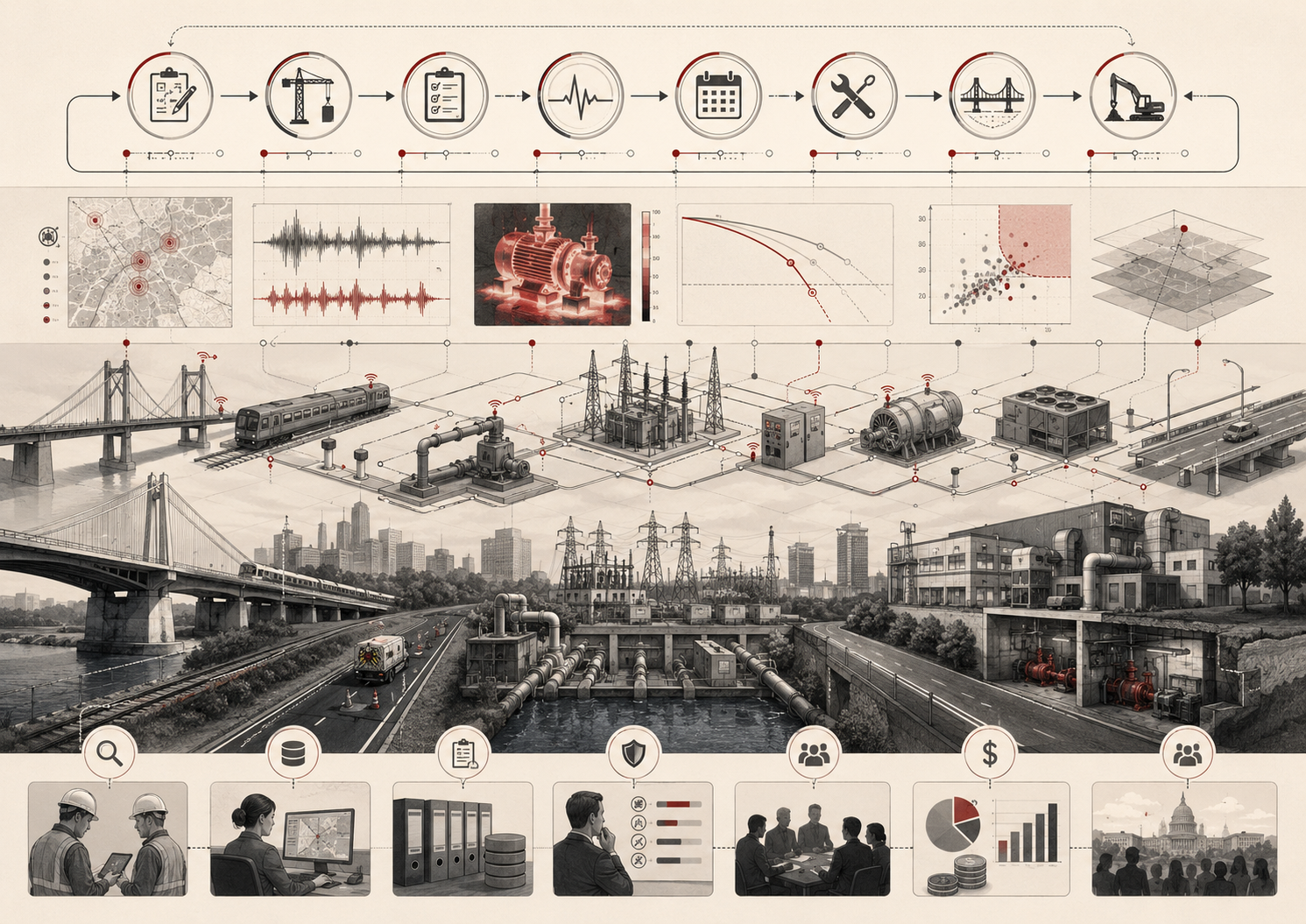
Asset management belongs at the center of intelligent infrastructure because intelligence is not only real-time sensing or automated control. It is the institutional ability to understand what exists, how it is changing, what failure would mean, when intervention is justified, and how public value can be protected across decades of use. Predictive maintenance adds analytical power to that responsibility, but the deeper discipline is lifecycle stewardship.
What Are Asset Management and Predictive Maintenance Systems?
Asset management and predictive maintenance systems are the institutional, technical, financial, and operational arrangements through which infrastructure owners preserve asset value and service performance over time. They help institutions know what assets exist, where they are located, what condition they are in, how critical they are to service continuity, what risks they pose, what interventions are available, and when action should be taken. Predictive maintenance refers more specifically to maintenance approaches that use monitoring data, condition information, degradation patterns, reliability models, or machine learning to anticipate failure or performance decline before breakdown occurs.
This is broader than maintenance scheduling alone. A maintenance crew can repair defects without a functioning asset-management system, but an institution cannot make sound long-term infrastructure decisions unless maintenance is linked to asset inventories, condition history, failure consequence, lifecycle cost, renewal planning, service levels, and budget accountability. Asset management is therefore a governance and performance system across planning, operation, maintenance, renewal, and end-of-life, not simply a workshop or engineering function.
Asset management is also broader than software. Asset-management platforms, computerized maintenance-management systems, geographic information systems, sensors, digital twins, and dashboards can all support the discipline, but they do not replace it. A sophisticated platform will fail if the organization lacks reliable data, decision rights, inspection routines, maintenance capacity, procurement pathways, or financial commitment. Conversely, a modest technical system can produce real value when it is embedded in disciplined lifecycle governance.
A useful distinction is this: asset management governs the long-term relationship between assets, service, risk, and value. Predictive maintenance improves the timing and targeting of interventions within that larger system. Predictive analytics are valuable only when they help institutions act earlier, prioritize better, reduce risk, extend useful life, or allocate scarce resources more intelligently.
Why Infrastructure Needs Lifecycle Stewardship
Infrastructure needs lifecycle stewardship because physical assets deteriorate continuously while budgets, institutions, and political attention are often organized episodically. Capital expenditure is visible and politically legible; maintenance is less visible and often easier to defer. Yet deferred maintenance does not remove cost. It shifts cost forward, amplifies deterioration, shortens asset life, reduces service quality, and increases the likelihood of larger renewal or emergency failure later.
This matters because infrastructure performance is produced over time. A road, bridge, pump, treatment plant, rail component, signal system, substation, tunnel, culvert, building, or data center is not governed successfully simply because it was built to specification. Its long-run value depends on inspection, maintenance, rehabilitation, renewal, and timely operational intervention. Infrastructure stewardship is therefore a permanent obligation, not a one-time capital achievement.
Lifecycle stewardship changes the governing question from “what did this asset cost to build?” to “how will this asset perform, deteriorate, and require intervention across decades of service?” It connects engineering with public finance because infrastructure assets create future obligations. Every asset that is built must later be inspected, maintained, repaired, renewed, replaced, or retired. Weak asset management hides these obligations until they become failures.
This is why asset management is central to resilient infrastructure. Resilience cannot be built only through new capital projects. It also depends on whether existing assets are understood, cared for, and renewed in ways that preserve dependable service under pressure. A neglected system is less able to absorb shocks, less able to recover after disruption, and more likely to fail at points that institutions did not see clearly enough.
Core Architecture of Asset Management Systems
Asset management systems can be understood through a layered architecture that links asset knowledge to operational, financial, and governance decision-making. The goal is not simply to store information. The goal is to create a reliable institutional chain from physical assets to condition evidence, from evidence to risk interpretation, from risk interpretation to maintenance action, and from maintenance action to public accountability.
Asset Knowledge Layer
The asset knowledge layer includes asset registers, location data, configuration records, age, design information, installation history, ownership clarity, maintenance history, component hierarchies, and dependencies. Institutions cannot manage assets well if they do not know what they own, where assets are located, who is responsible for them, or how they connect to service delivery.
An asset register is therefore not merely an administrative spreadsheet. It is the knowledge base through which infrastructure institutions establish visibility over their physical systems. Weak registers create blind spots. Incomplete asset hierarchies make it difficult to connect component failure to system consequence. Poor location data slows inspection and emergency response. Missing maintenance history weakens predictive insight.
Condition and Performance Layer
The condition and performance layer includes inspections, sensor data, reliability information, deterioration indicators, service-level measures, work-order history, downtime records, environmental stressors, load patterns, and observed defects. This layer answers the question: how are assets actually performing?
Condition data may be qualitative, quantitative, manual, automated, periodic, or continuous. A bridge inspection, pavement condition index, pipe break record, vibration signal, thermal image, pump efficiency reading, pressure transient, or transformer temperature record can all contribute to asset intelligence. What matters is not just collecting data, but connecting it to intervention decisions.
Risk and Criticality Layer
The risk and criticality layer includes consequence analysis, service dependency, redundancy assessment, failure impact, safety exposure, environmental consequence, regulatory exposure, equity implications, and recovery difficulty. It distinguishes assets whose failure is inconvenient from assets whose failure would interrupt essential service, harm public safety, create environmental damage, or trigger cascading effects.
Criticality is essential because condition alone does not determine priority. A severely degraded low-consequence asset may be less urgent than a moderately degraded asset whose failure would close a strategic corridor, interrupt water supply, disable signaling, or compromise emergency access. Asset management must therefore evaluate both probability and consequence.
Maintenance and Intervention Layer
The maintenance and intervention layer includes preventive tasks, condition-based triggers, predictive alerts, emergency repair, inspection schedules, workforce planning, spare-parts strategy, procurement, outage coordination, and work-order execution. This is where asset management becomes action rather than documentation.
A predictive model that produces a useful failure forecast but does not trigger work planning has limited value. Likewise, a maintenance plan that is not connected to budget, workforce, parts, or procurement may remain a theoretical schedule. Operational maturity requires connecting insight to action.
Financial and Renewal Layer
The financial and renewal layer includes lifecycle costing, capital planning, operating budgets, maintenance budgets, rehabilitation schedules, replacement timing, reserve strategies, deferred-maintenance tracking, and long-term financial planning. Lifecycle performance depends on financial discipline as much as engineering method.
Infrastructure institutions often separate capital and operating budgets in ways that obscure lifecycle tradeoffs. A maintenance deferral may help this year’s operating budget while creating a much larger future capital need. A lifecycle asset-management system makes such tradeoffs visible.
Governance and Accountability Layer
The governance layer defines decision rights, roles, accountability, standards, audit procedures, review cycles, service-level targets, risk tolerance, data ownership, and reporting obligations. Asset management becomes durable only when institutions define who owns asset information, who approves maintenance priorities, who accepts residual risk, and who is responsible for lifecycle performance.
What matters is not merely the existence of these layers, but whether they are connected. Asset management becomes powerful when institutions can move coherently from asset knowledge to condition insight, from condition insight to prioritized intervention, from intervention to budget strategy, and from budget strategy to accountable long-term service stewardship.
Reactive, Preventive, Condition-Based, and Predictive Maintenance
Maintenance strategies differ in logic and maturity. Reactive maintenance responds after failure has already occurred. Preventive maintenance follows scheduled routines intended to reduce failure probability. Condition-based maintenance uses inspections or monitoring to trigger intervention when asset condition crosses a threshold. Predictive maintenance goes further by using data trends, analytical models, and sometimes digital twins or machine learning to estimate when intervention should occur before performance loss or failure emerges.
Reactive maintenance may be unavoidable for some low-criticality assets, but it is usually costly and disruptive when applied to assets essential to service continuity. A reactive regime often appears cheap until emergency costs, service disruption, public complaints, safety risk, overtime labor, spare-parts shortages, and reputational damage are included. It is least appropriate where failures are consequential, recovery is difficult, or failure modes are observable before breakdown.
Preventive maintenance improves discipline by creating scheduled interventions. It is especially useful where failure intervals are reasonably understood, inspection is difficult, and routine tasks materially reduce risk. However, preventive maintenance can also waste resources if assets are maintained too early or according to generic schedules that ignore actual condition.
Condition-based maintenance is often a practical middle ground. It uses evidence from inspections, sensor readings, performance thresholds, or condition scores to trigger action. It does not require highly complex prediction, but it does require reliable monitoring and clear thresholds. For many infrastructure assets, condition-based maintenance may be more realistic and valuable than advanced predictive modeling.
Predictive maintenance becomes most justified where four conditions come together: the asset is consequential, degradation signals can be observed with useful reliability, intervention timing materially affects service or cost, and the organization can actually act on predictive outputs. Where those conditions are absent, predictive maintenance can be oversold. A low-criticality asset, an asset with weak data coverage, or an organization unable to translate forecasts into work orders will not automatically benefit from sophisticated predictive tooling.
The mature question is not “how do we make everything predictive?” but “where does predictive insight create meaningful operational and financial value?” A mature asset-management system may use reactive maintenance for some assets, preventive maintenance for others, condition-based maintenance for monitored assets, and predictive maintenance for high-criticality assets with observable degradation and actionable lead time.
Criticality, Service Consequence, and Maintenance Prioritization
One of the most important functions of asset management is prioritization. Infrastructure institutions rarely have the budget, workforce, or operational flexibility to intervene everywhere at once. They therefore need to know which assets matter most for public safety, service continuity, environmental protection, regulatory compliance, equity, and downstream dependence.
This matters because asset condition alone is not enough. A severely degraded low-consequence asset may still be less urgent than a moderately degraded asset whose failure would interrupt water supply, close a strategic corridor, disable emergency communication, or shut down a critical pump station. Maintenance prioritization must combine condition with consequence.
A criticality framework typically considers:
- Service consequence: How much service would be disrupted if the asset failed?
- Safety consequence: Would failure create risk to workers, users, or the public?
- Environmental consequence: Could failure cause pollution, flooding, contamination, or ecological harm?
- Redundancy: Are there alternate routes, backup systems, or substitute assets?
- Recovery difficulty: How long, costly, or complex would restoration be?
- Regulatory consequence: Would failure violate service obligations, permits, standards, or legal requirements?
- Equity consequence: Would failure disproportionately affect communities already facing service vulnerability?
Criticality-based asset management moves institutions beyond a flat maintenance queue. It supports decisions that align scarce maintenance resources with service consequence rather than visibility, complaint pressure, administrative habit, or asset age alone. It also helps make tradeoffs explicit. When an institution chooses not to maintain a critical asset, that decision becomes a risk acceptance decision, not an invisible budget convenience.
Data, Monitoring, and Predictive Insight
Predictive maintenance depends on data, but not just on data volume. It requires usable data about condition, environment, load, operating history, failure patterns, intervention outcomes, and service consequences. Monitoring systems, inspections, asset platforms, work-order systems, geographic information systems, supervisory control systems, and digital twins can all contribute to this visibility.
Infrastructure data is often sparse, uneven, delayed, or biased. Some assets are heavily instrumented while others are inspected only periodically. Newer assets may generate rich telemetry while older assets are represented mainly through maintenance notes and fragmented records. Some failure modes produce clear leading indicators; others do not. Predictive systems built on partial data can still be useful, but only if institutions remain clear about what is actually observable and what is being inferred indirectly.
The strongest predictive-maintenance systems connect data acquisition, asset history, engineering understanding, and operational decision-making. They do not assume that dashboards or models are self-explanatory. They treat data quality, data gaps, and uneven observability as core management issues rather than technical side notes. Predictive insight becomes valuable when it improves timing and prioritization without pretending that all uncertainty has been resolved.
A practical predictive-maintenance data model may include:
- asset age, class, material, location, and design attributes;
- inspection scores and observed defects;
- sensor readings such as vibration, pressure, temperature, flow, voltage, strain, moisture, or acoustic signals;
- work-order history, repairs, replacements, and downtime;
- operating load, demand, environment, and climate exposure;
- failure labels or degradation outcomes;
- cost, spare-parts, workforce, and intervention constraints;
- service consequence and criticality scores.
Predictive maintenance is therefore not a single model. It is a data-to-decision pipeline. That pipeline must connect observation, signal processing, condition assessment, probability or risk estimation, intervention planning, work execution, feedback, and post-intervention learning.
Digital Twins, Simulation, and Asset Intelligence
Digital twins can strengthen asset management when they connect physical assets, operational data, simulation, and decision support. A digital twin is not merely a three-dimensional visualization or a dashboard. At its best, it is a dynamic representation of an asset or system that integrates data, state estimation, scenarios, and feedback. For asset management, digital twins can support condition monitoring, predictive maintenance, failure simulation, lifecycle planning, and operational coordination.
Digital twins are especially useful where assets are complex, interconnected, and operationally consequential. A water network, rail system, power grid, bridge portfolio, airport, port, tunnel, manufacturing facility, or district energy system may contain many interacting components whose failures affect one another. A digital twin can help operators test scenarios before intervention, compare maintenance options, evaluate redundancy, assess stress under changing demand, and understand cascading effects.
However, digital twins require strong data governance and interoperability. If asset data, sensor data, inspection records, work orders, design information, and operational models remain in disconnected systems, the digital twin becomes a presentation layer rather than a decision engine. Interoperability, metadata, versioning, data quality, and model validation are therefore central to digital-twin value.
Digital twins also raise governance questions. Who owns the model? How is it validated? What assumptions does it encode? How are scenarios reviewed? How are updates controlled? How are model outputs connected to work orders and budgets? How is uncertainty communicated? A digital twin that appears precise but rests on uncertain assumptions may create false confidence. A mature digital-twin environment should therefore be treated as an auditable infrastructure intelligence system.
Lifecycle Cost, Budgeting, and Renewal Strategy
Asset management is inseparable from finance because maintenance, repair, rehabilitation, and renewal decisions are timing decisions about cost, risk, and service. A mature asset-management system helps institutions compare earlier intervention against later failure, emergency response, service disruption, accelerated deterioration, or premature replacement. Lifecycle performance depends on financial management and accountability as much as engineering method.
A common failure in infrastructure governance is the separation of capital and maintenance decisions. New capital projects may receive political attention and dedicated funding, while maintenance appears as a competing operational expense. But every capital project creates future maintenance obligations. If those obligations are not recognized, the institution may expand its asset base faster than it can steward it.
Lifecycle costing helps reveal the long-run consequences of short-term deferral. Earlier intervention may cost more in the present budget cycle but reduce whole-life cost. Conversely, replacing an asset too early can waste remaining useful life. Asset management therefore requires comparing alternatives over time: do nothing, inspect more frequently, repair, rehabilitate, replace, redesign, decommission, or accept risk.
Lifecycle financial planning should also account for uncertainty. Costs, deterioration rates, climate exposure, demand, regulation, labor availability, and technology can change. Asset-management finance is therefore not just accounting. It is scenario-aware stewardship of future obligations.
Governance, Accountability, and Professional Capacity
Asset management is a governance problem as much as a technical one. Institutions must decide who owns asset data, who is accountable for condition and performance, how maintenance priorities are reviewed, how decisions are audited, and how lifecycle tradeoffs are made visible to finance, leadership, regulators, and the public. Asset management depends on accountability and professional capacity, not only on tools.
Asset-management systems often underperform not for lack of software, but for lack of decision rights, workforce capability, executive sponsorship, financial alignment, and organizational discipline. A utility or transport agency may have condition information yet still defer action if governance structures reward short-term budget restraint over lifecycle performance. Predictive maintenance can also fail institutionally if analytical outputs do not translate into credible work planning, procurement, staffing, or budgeting.
Professional capacity is therefore essential. Asset management depends on engineers, operators, inspectors, data analysts, finance staff, procurement teams, planners, managers, and executives who can interpret condition, connect it to consequence, and act across long time horizons. The best systems make the relationship between technical evidence and governance decisions visible.
A mature governance model should define:
- asset ownership and data stewardship;
- service-level objectives and performance measures;
- maintenance prioritization criteria;
- risk tolerance and escalation thresholds;
- budget review and lifecycle planning procedures;
- roles for operators, engineers, finance, and leadership;
- audit and assurance processes;
- review cycles for condition, risk, and renewal plans.
Asset management succeeds when it becomes an institutional rhythm: observe, assess, prioritize, fund, intervene, document, learn, and revise.
Resilience, Reliability, and Long-Term Infrastructure Performance
Asset management and predictive maintenance are resilience disciplines. Infrastructure systems become more resilient when condition is understood, vulnerabilities are addressed before failure, and recovery burdens are reduced through anticipatory care. Reliability is not separate from resilience here. A poorly maintained system is less able to absorb shock, less able to operate under stress, and more likely to fail in ways that cascade across services.
This matters because climate, demand, fiscal pressure, aging assets, supply-chain constraints, and cyber-physical integration are increasing the consequences of weak maintenance. Resilience cannot be built only through new capital works. It also depends on whether existing assets are stewarded in a way that preserves dependable service under changing conditions.
Asset management supports resilience in several ways:
- it identifies vulnerable assets before they fail;
- it prioritizes critical assets whose failure would produce severe service consequences;
- it improves intervention timing, reducing emergency repair exposure;
- it supports redundancy and recovery planning;
- it connects maintenance with long-term renewal strategy;
- it creates records that help institutions learn from failures and near misses.
Long-term infrastructure performance therefore depends not only on how infrastructure is designed, but on how it is maintained, monitored, and renewed as conditions change. Asset management is one of the most concrete ways public institutions preserve resilience after the ribbon-cutting is over.
Limits, Failure Modes, and the Risk of False Precision
Asset management and predictive maintenance systems are powerful, but they also have limits. Condition data may be incomplete, inconsistent, outdated, or biased toward assets that are easiest to monitor. Predictive models may perform well under familiar operating conditions yet weaken under unusual loads, environmental shifts, changed maintenance practices, or novel failure mechanisms. A highly quantified asset-management system may create an illusion of precision that exceeds what the underlying data can support.
This matters because model confidence is not the same as operational certainty. A confident prediction built on narrow data, unstable assumptions, or incomplete failure history can mislead decision-makers. In infrastructure settings, false confidence can be especially damaging because it may justify deferral, over-target maintenance resources narrowly, or encourage institutions to underweight inspection, operator judgment, redundancy, and precaution.
Common failure modes include:
- Data completeness failure: key assets are missing from the register or condition data is outdated.
- Signal failure: monitored variables do not provide useful warning for the relevant failure mode.
- Model transfer failure: models trained on one asset class, geography, or operating regime are applied elsewhere without validation.
- Governance failure: predictions are generated but not connected to work orders, budgets, or accountability.
- False precision: numerical scores are treated as more certain than the evidence allows.
- Maintenance displacement: attention shifts toward instrumented assets while uninstrumented assets deteriorate invisibly.
- Equity failure: asset intelligence is stronger in well-resourced areas than in underserved communities, shaping unequal maintenance response.
Maintenance decisions therefore still require judgment. Predictive insight should improve institutional reasoning, not replace it. Some assets justify sophisticated predictive approaches; others remain better governed through simpler maintenance regimes and human inspection. The goal is not total algorithmic control over maintenance. It is a more intelligent stewardship system that improves timing, prioritization, and service reliability while remaining transparent about uncertainty and limits.
Mathematical Lens
A mathematics-first view begins with an asset register:
A=\{a_1,a_2,\ldots,a_n\}
\]
Interpretation: The asset portfolio \(A\) contains individual assets \(a_i\) that must be monitored, maintained, renewed, or retired.
Each asset has a condition state:
C_i(t)\in[0,1]
\]
Interpretation: Asset condition \(C_i(t)\) describes the health or performance state of asset \(i\) at time \(t\), with lower values often indicating poorer condition.
A simplified deterioration model can be written as:
C_i(t+1)=C_i(t)-d_i(t)+m_i(t)
\]
Interpretation: Future condition depends on current condition, deterioration \(d_i(t)\), and maintenance or renewal effect \(m_i(t)\).
Risk combines probability and consequence:
R_i=P_iF_i
\]
Interpretation: Asset risk \(R_i\) can be approximated as failure probability \(P_i\) multiplied by failure consequence \(F_i\).
A criticality-weighted priority score can be written as:
Q_i=w_C(1-C_i)+w_FF_i+w_RR_i-w_BB_i
\]
Interpretation: Priority \(Q_i\) increases when condition is poor, consequence is high, and risk is high, while budget or feasibility constraints \(B_i\) may reduce immediate actionability.
Remaining useful life can be expressed as a threshold problem:
RUL_i=\min\{t:C_i(t)\leq C_{\mathrm{min}}\}
\]
Interpretation: Remaining useful life is the time until condition falls below an acceptable minimum threshold.
A lifecycle cost objective can be written as:
LCC_i=\sum_{t=0}^{T}\frac{M_i(t)+O_i(t)+K_i(t)+H_i(t)}{(1+r)^t}
\]
Interpretation: Lifecycle cost includes maintenance \(M_i\), operations \(O_i\), capital renewal \(K_i\), and failure or disruption cost \(H_i\), discounted over time by rate \(r\).
A portfolio optimization problem can be written as:
\max \sum_{i=1}^{n} V_i x_i
\quad \mathrm{subject\ to} \quad
\sum_{i=1}^{n} Cost_i x_i \leq B
\]
Interpretation: Asset managers may seek to maximize intervention value \(V_i\) under a budget constraint \(B\), where \(x_i\) indicates whether intervention \(i\) is selected.
This mathematical lens shows that asset management is not only maintenance scheduling. It is a formal system of condition, deterioration, consequence, risk, intervention, lifecycle cost, budget constraint, and governance.
Variables and System Interpretation
| Symbol or Term | Meaning | Typical Unit or Type | System Interpretation |
|---|---|---|---|
| \(A\) | Asset portfolio | set of assets | The infrastructure assets under management |
| \(a_i\) | Individual asset | asset record | A road segment, pump, transformer, bridge component, building system, or other maintainable unit |
| \(C_i(t)\) | Condition state | index, score, or probability | Observed or estimated health of asset \(i\) at time \(t\) |
| \(d_i(t)\) | Deterioration | condition loss per period | How asset condition declines under age, use, environment, and stress |
| \(m_i(t)\) | Maintenance effect | condition improvement or risk reduction | How inspection, repair, rehabilitation, or renewal changes condition or risk |
| \(P_i\) | Failure probability | probability | Likelihood of failure or unacceptable performance |
| \(F_i\) | Failure consequence | severity score or cost | Service, safety, environmental, financial, or social consequence if the asset fails |
| \(R_i\) | Asset risk | risk score | Combination of probability and consequence used for prioritization |
| \(Q_i\) | Priority score | index | Decision-support score for maintenance or renewal ranking |
| \(RUL_i\) | Remaining useful life | time period | Estimated time until condition or performance falls below threshold |
| \(LCC_i\) | Lifecycle cost | currency | Total discounted cost of operating, maintaining, renewing, and managing failure risk |
| \(B\) | Budget constraint | currency | Resource limit shaping feasible intervention decisions |
Note: Asset-management metrics are decision-support tools, not substitutes for engineering judgment, governance review, field inspection, service equity analysis, and public accountability.
Worked Example: From Asset Condition to Maintenance Priority
Suppose an agency manages a portfolio of pump stations. Each station has a condition score, a failure consequence score, and an estimated failure probability. The agency wants to prioritize maintenance under a limited budget.
The asset condition score is:
C_i \in [0,1]
\]
Interpretation: A lower value indicates worse condition and therefore greater maintenance concern.
Failure risk is estimated as:
R_i=P_iF_i
\]
Interpretation: A moderately likely failure can become high priority if consequence is severe.
A simple priority score is then calculated:
Q_i=0.4(1-C_i)+0.3P_i+0.3F_i
\]
Interpretation: Priority increases when condition is poor, failure probability is high, and failure consequence is severe.
The intervention decision becomes:
x_i=
\begin{cases}
1, & Q_i \geq \tau \\
0, & Q_i < \tau
\end{cases}
\]
Interpretation: Assets above the priority threshold \(\tau\) are selected for maintenance review or intervention.
But this is only the first step. The agency must then ask whether high-priority assets are actually actionable. Are parts available? Is outage coordination possible? Is the asset accessible? Is the intervention cost within budget? Does the model reflect current field conditions? Are underserved communities disproportionately affected by deferred assets? A mathematical score should start the governance conversation, not end it.
Computational Modeling
Computational modeling makes asset management more auditable. A small asset register can show how condition, age, failure probability, consequence, and maintenance priority interact. A reliability workflow can estimate expected failure behavior. A lifecycle-cost workflow can compare preventive, condition-based, and replacement strategies. A digital-twin workflow can simulate deterioration under load and environmental stress. A SQL metadata schema can document asset registers, inspections, sensors, work orders, failures, interventions, costs, risk scores, and governance reviews.
The selected examples below focus on asset priority and lifecycle diagnostics because they are foundational, readable, and directly reusable. The GitHub repository extends the same logic into advanced Jupyter notebooks, synthetic asset portfolios, remaining-useful-life estimation, reliability diagnostics, Weibull-style failure simulation, lifecycle cost comparison, criticality scoring, SQL asset metadata, model-card notes, and governance documentation.
Python Workflow: Asset Criticality and Maintenance Priority
Python is useful for asset registers, risk scoring, predictive-maintenance diagnostics, and maintenance prioritization. The following workflow creates a synthetic asset portfolio, estimates failure probability from age and condition, calculates risk and priority, and exports an intervention shortlist.
"""
Asset Management and Predictive Maintenance Mini-Workflow

This example demonstrates:
1. synthetic infrastructure asset register
2. condition and age-based failure probability
3. criticality-weighted risk scoring
4. maintenance priority ranking
5. intervention shortlist creation

It is educational and does not use operational infrastructure data.
"""

from __future__ import annotations

import numpy as np
import pandas as pd


RANDOM_SEED = 42
rng = np.random.default_rng(RANDOM_SEED)

n_assets = 250

assets = pd.DataFrame({
    "asset_id": [f"A-{i:04d}" for i in range(1, n_assets + 1)],
    "asset_class": rng.choice(
        ["pump", "valve", "bridge_component", "road_segment", "substation_asset"],
        size=n_assets,
        p=[0.20, 0.20, 0.20, 0.25, 0.15],
    ),
    "age_years": rng.integers(1, 60, size=n_assets),
    "condition_score": rng.uniform(0.15, 0.98, size=n_assets),
    "service_consequence": rng.integers(1, 6, size=n_assets),
    "environmental_exposure": rng.uniform(0.0, 1.0, size=n_assets),
})

# Estimate failure probability using a simple logistic-style risk proxy.
# In a real system, this should be validated against failure history,
# engineering judgment, asset class, operating conditions, and inspection data.
linear_risk = (
    -3.0
    + 0.045 * assets["age_years"]
    + 2.5 * (1 - assets["condition_score"])
    + 0.9 * assets["environmental_exposure"]
)

assets["failure_probability"] = 1 / (1 + np.exp(-linear_risk))

assets["risk_score"] = (
    assets["failure_probability"] * assets["service_consequence"]
)

assets["priority_score"] = (
    0.40 * (1 - assets["condition_score"])
    + 0.30 * assets["failure_probability"]
    + 0.20 * (assets["service_consequence"] / 5)
    + 0.10 * assets["environmental_exposure"]
)

assets["recommended_strategy"] = pd.cut(
    assets["priority_score"],
    bins=[-0.01, 0.35, 0.55, 0.75, 1.01],
    labels=[
        "monitor",
        "condition_based_maintenance",
        "planned_intervention",
        "urgent_review",
    ],
)

shortlist = (
    assets
    .sort_values("priority_score", ascending=False)
    .head(20)
    .reset_index(drop=True)
)

summary = (
    assets
    .groupby(["asset_class", "recommended_strategy"], observed=True)
    .agg(
        asset_count=("asset_id", "count"),
        mean_condition=("condition_score", "mean"),
        mean_failure_probability=("failure_probability", "mean"),
        mean_risk_score=("risk_score", "mean"),
    )
    .reset_index()
)

print("Top maintenance-priority assets:")
print(shortlist[[
    "asset_id",
    "asset_class",
    "age_years",
    "condition_score",
    "failure_probability",
    "service_consequence",
    "risk_score",
    "priority_score",
    "recommended_strategy",
]])

print("\nPortfolio summary:")
print(summary)
This workflow is deliberately synthetic. Its value is conceptual: it shows how asset condition, failure probability, consequence, environmental exposure, and maintenance strategy can be made explicit and auditable. A real system would require asset-class-specific deterioration models, validated thresholds, inspection history, engineering review, field feedback, and governance approval before operational use.
R Workflow: Lifecycle Cost and Reliability Diagnostics
R is useful for lifecycle-cost comparison, reliability summaries, grouped diagnostics, and governance reporting. The following workflow simulates a simplified portfolio and compares lifecycle cost across maintenance strategy types.
# Asset Management Lifecycle Cost and Reliability Diagnostics
#
# This educational workflow simulates:
# - infrastructure assets
# - condition scores
# - service consequence
# - maintenance strategy
# - expected lifecycle cost proxy
# - reliability risk summaries

set.seed(42)

n <- 300

asset_data <- data.frame(
  asset_class = sample(
    c("pump", "valve", "road_segment", "bridge_component", "substation_asset"),
    n,
    replace = TRUE,
    prob = c(0.20, 0.20, 0.25, 0.20, 0.15)
  ),
  age_years = sample(1:60, n, replace = TRUE),
  condition_score = runif(n, min = 0.15, max = 0.98),
  service_consequence = sample(1:5, n, replace = TRUE),
  environmental_exposure = runif(n, min = 0, max = 1)
)

linear_risk <- -3.0 +
  0.045 * asset_data$age_years +
  2.5 * (1 - asset_data$condition_score) +
  0.9 * asset_data$environmental_exposure

asset_data$failure_probability <- 1 / (1 + exp(-linear_risk))
asset_data$risk_score <- asset_data$failure_probability * asset_data$service_consequence

asset_data$maintenance_strategy <- ifelse( asset_data$risk_score >= 2.5, "urgent_review",
  ifelse(asset_data$risk_score >= 1.5, "planned_intervention",
  ifelse(asset_data$risk_score >= 0.75, "condition_based_maintenance", "monitor"))
)

# Cost proxy: intervention cost plus expected failure consequence.
# In a real system, this should be replaced by validated cost models.
strategy_cost <- ifelse(
  asset_data$maintenance_strategy == "monitor", 5000,
  ifelse(asset_data$maintenance_strategy == "condition_based_maintenance", 18000,
  ifelse(asset_data$maintenance_strategy == "planned_intervention", 50000, 90000))
)

expected_failure_cost <- asset_data$failure_probability *
  asset_data$service_consequence *
  100000

asset_data$expected_lifecycle_cost_proxy <- strategy_cost + expected_failure_cost

summary_table <- aggregate(
  cbind(risk_score, failure_probability, expected_lifecycle_cost_proxy) ~
    asset_class + maintenance_strategy,
  data = asset_data,
  FUN = mean
)

count_table <- aggregate(
  risk_score ~ asset_class + maintenance_strategy,
  data = asset_data,
  FUN = length
)

names(count_table)[3] <- "asset_count"

summary_table <- merge(
  summary_table,
  count_table,
  by = c("asset_class", "maintenance_strategy")
)

dir.create("../outputs", recursive = TRUE, showWarnings = FALSE)
write.csv(summary_table, "../outputs/r_asset_lifecycle_reliability_summary.csv", row.names = FALSE)

print(summary_table)
This workflow is also synthetic, but the diagnostic logic is real. Asset management requires connecting risk, consequence, maintenance strategy, and lifecycle cost rather than treating maintenance as a simple queue of repair requests.
GitHub Repository
The article body includes selected computational examples so the conceptual and mathematical argument remains readable. The full repository contains expanded computational infrastructure: advanced Jupyter notebooks, synthetic asset registers, condition-scoring workflows, criticality analysis, remaining-useful-life estimation, reliability diagnostics, lifecycle-cost comparison, maintenance strategy simulation, SQL asset metadata schemas, model-card notes, governance documentation, and reproducible outputs.
The full code distribution for this article, including examples, computational workflows, advanced Jupyter notebooks, asset registers, predictive-maintenance diagnostics, SQL metadata, and audit scaffolding, is available on GitHub.
From Maintenance to Lifecycle Stewardship
Asset management and predictive maintenance systems show that infrastructure performance is produced long after assets are designed and built. Maintenance is not merely repair. It is the ongoing stewardship of public value, service continuity, safety, resilience, and fiscal responsibility. Predictive maintenance is important because it improves timing and prioritization, but it becomes meaningful only when embedded in a broader asset-management system.
The central lesson is that infrastructure value must be governed across time. Asset registers, inspections, sensors, reliability models, digital twins, lifecycle-cost analysis, work orders, budgets, and governance reviews are not separate administrative artifacts. They are parts of one stewardship system. When they are disconnected, institutions drift toward reactive repair, deferred maintenance, hidden liabilities, and avoidable failures. When they are connected, maintenance becomes a strategic tool for sustaining service performance.
The future of intelligent infrastructure will require more than smart sensors and predictive dashboards. It will require institutions that can convert asset knowledge into credible decisions, budget commitments, operational action, and long-term accountability. In short, predictive maintenance should not be understood as a technology trend alone. It should be understood as one component of lifecycle stewardship.
Related Articles
Asset management and predictive maintenance systems sit at the intersection of infrastructure governance, data platforms, simulation, risk management, resilience, security, and long-term public value. These related articles develop the adjacent systems needed to make asset stewardship technically credible and institutionally durable.
- Infrastructure Governance and Policy Systems
- Infrastructure Data Platforms and Analytics
- Digital Twins and Infrastructure Simulation
- Infrastructure Risk Management Systems
- Infrastructure Systems for Urban Resilience
- Infrastructure Systems for Climate Adaptation
- Infrastructure Security and Cyber Resilience
- The Future of Intelligent Infrastructure
These links are substantive rather than decorative. Asset management is not an operational afterthought, but a systems domain connecting infrastructure performance, public finance, predictive insight, governance capacity, and long-term stewardship.
Future Directions
The future of asset management and predictive maintenance will likely involve stronger lifecycle governance, wider use of condition monitoring, deeper integration of digital twins and analytics, more criticality-based intervention planning, and greater emphasis on resilience, climate adaptation, and service-equity outcomes.
Several directions are especially important. First, asset-management systems will increasingly connect inspection, telemetry, work orders, financial planning, and risk registers into integrated asset intelligence environments. Second, digital twins will become more useful where they are connected to operational decisions rather than treated as visualization projects. Third, predictive-maintenance models will need stronger validation, uncertainty communication, and human review. Fourth, infrastructure institutions will need to connect lifecycle costing to budgeting practices so maintenance is not consistently sacrificed to short-term fiscal pressure.
The deeper challenge, however, is not simply instrumenting more assets. It is building institutions that can convert asset knowledge into disciplined maintenance, timely renewal, and credible service performance over decades. Asset management and predictive maintenance systems will matter most where they improve continuity of public function rather than merely expanding technical reporting. The long-run goal is not maintenance as repair. It is maintenance as intelligent stewardship of infrastructure value under uncertainty.
Further Reading
- International Organization for Standardization (2024) ISO 55000:2024 Asset management — Vocabulary, overview and principles. Available at: https://www.iso.org/standard/83053.html
- International Organization for Standardization (2024) ISO 55001:2024 Asset management — Asset management system — Requirements. Available at: https://www.iso.org/standard/83054.html
- Organisation for Economic Co-operation and Development (2026) Management of assets throughout their life cycle. Available at: https://www.oecd.org/en/publications/management-of-assets-throughout-their-life-cycle_86ce92d8-en.html
- Organisation for Economic Co-operation and Development (2025) Management of asset performance throughout the life cycle. Available at: https://www.oecd.org/en/publications/government-at-a-glance-2025_0efd0bcd-en/full-report/management-of-asset-performance-throughout-the-life-cycle_77aa88af.html
- National Institute of Standards and Technology (2025) Summary Report: CHIPS R&D Semiconductor Supply Chain Trust and Assurance Data Standards & Digital Twin Data Interoperability Standards Workshops. Available at: https://www.nist.gov/publications/summary-report-chips-rd-semiconductor-supply-chain-trust-and-assurance-data-standards
- National Institute of Standards and Technology (2024) CHIPS R&D Digital Twin Data Interoperability Standards Workshop. Available at: https://www.nist.gov/news-events/events/2024/04/chips-rd-digital-twin-data-interoperability-standards-workshop
- World Bank (2025) World Bank invests in Santa Catarina’s road resilience and safety. Available at: https://www.worldbank.org/en/news/press-release/2025/02/28/world-bank-invests-in-santa-catarina-s-road-resilience-and-safety
- World Bank (2025) Innovative Approaches to Urban Infrastructure Management: Insights from Japan and Global Applications. Available at: https://www.worldbank.org/en/programs/tokyo-development-learning-center/brief/innovative_approaches_to_urban_infrastructure_management
References
- International Organization for Standardization (2024) ISO 55000:2024 Asset management — Vocabulary, overview and principles. Available at: https://www.iso.org/standard/83053.html.
- International Organization for Standardization (2024) ISO 55001:2024 Asset management — Asset management system — Requirements. Available at: https://www.iso.org/standard/83054.html.
- National Institute of Standards and Technology (NIST) (2024) CHIPS R&D Digital Twin Data Interoperability Standards Workshop. Available at: https://www.nist.gov/news-events/events/2024/04/chips-rd-digital-twin-data-interoperability-standards-workshop.
- National Institute of Standards and Technology (NIST) (2025) Summary Report: CHIPS R&D Semiconductor Supply Chain Trust and Assurance Data Standards & Digital Twin Data Interoperability Standards Workshops. Available at: https://www.nist.gov/publications/summary-report-chips-rd-semiconductor-supply-chain-trust-and-assurance-data-standards.
- Organisation for Economic Co-operation and Development (OECD) (2025) Management of asset performance throughout the life cycle. Available at: https://www.oecd.org/en/publications/government-at-a-glance-2025_0efd0bcd-en/full-report/management-of-asset-performance-throughout-the-life-cycle_77aa88af.html.
- Organisation for Economic Co-operation and Development (OECD) (2026) Management of assets throughout their life cycle. Available at: https://www.oecd.org/en/publications/management-of-assets-throughout-their-life-cycle_86ce92d8-en.html.
- World Bank (2025) Innovative Approaches to Urban Infrastructure Management: Insights from Japan and Global Applications. Available at: https://www.worldbank.org/en/programs/tokyo-development-learning-center/brief/innovative_approaches_to_urban_infrastructure_management.
- World Bank (2025) World Bank invests in Santa Catarina’s road resilience and safety. Available at: https://www.worldbank.org/en/news/press-release/2025/02/28/world-bank-invests-in-santa-catarina-s-road-resilience-and-safety.