Technology & Systems Intelligence

Technology and systems intelligence examine how advanced analytical tools and digital technologies can enhance our understanding of complex systems. Technologies such as artificial intelligence, machine learning, sensor networks, and large-scale data analytics are increasingly used to analyze environmental, economic, and social systems.

Systems intelligence emphasizes the ability to integrate data, models, and human expertise in order to interpret complex patterns and support informed decision-making. Rather than replacing human judgment, these technologies augment the capacity of researchers and institutions to detect trends, simulate outcomes, and evaluate policy interventions.

As digital technologies become more deeply integrated into governance and sustainability research, the challenge lies in deploying them responsibly. Effective systems intelligence requires transparency, accountability, and careful integration with ethical and institutional frameworks.

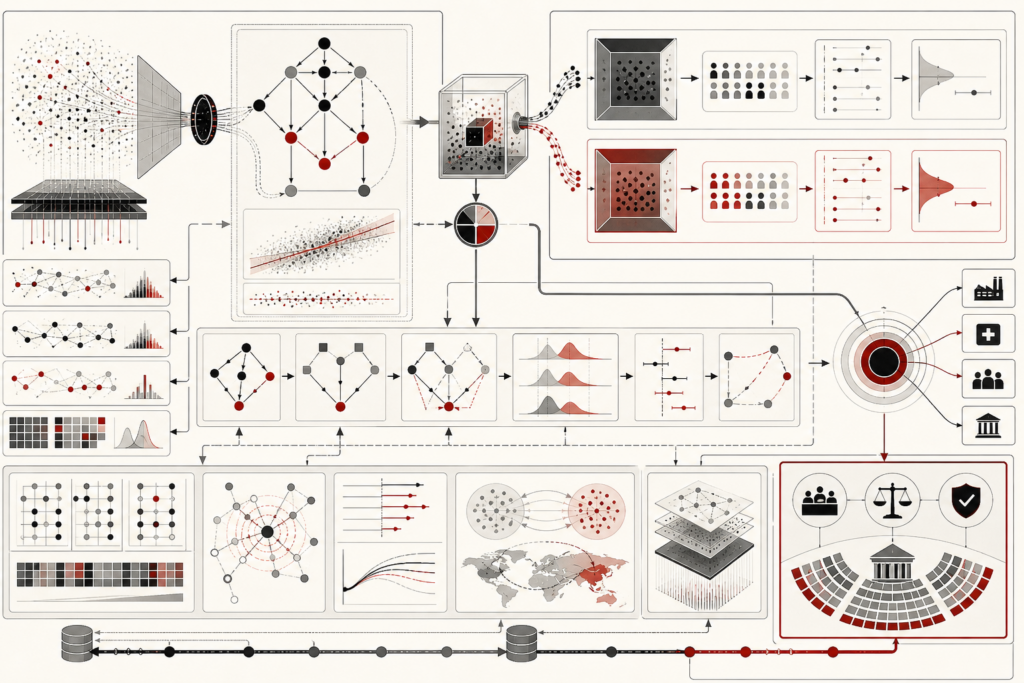
AI safety and system reliability architecture showing monitoring, drift detection, calibration, uncertainty review, audit trails, risk thresholds, human oversight, incident response, fallback controls, and governance checkpoints around a deployed artificial intelligence system.

AI Safety and System Reliability

AI safety and system reliability examine how artificial intelligence systems can be designed, deployed, monitored, and governed so they behave predictably under real-world conditions. Safety is not simply a model feature or benchmark score; it is a systems-level property shaped by data quality, robustness, uncertainty, infrastructure, human oversight, security, monitoring, and institutional accountability. This article explains how AI systems fail through distributional shift, miscalibration, proxy objectives, adversarial manipulation, automation bias, feedback loops, and governance gaps. It introduces mathematical tools for reasoning about deployment risk, reliability, safety thresholds, and uncertainty-based review. It also connects technical reliability to practical workflows for monitoring drift, calibration, incident response, assurance cases, and lifecycle governance. The goal is to show why trustworthy AI requires more than performance optimization: it requires auditable systems that can be tested, constrained, corrected, and responsibly managed over time.

Abstract visualization of explainable AI revealing hidden model pathways, feature attribution, surrogate explanations, counterfactual reasoning, causal explanation, uncertainty review, explanation stability, human oversight, contestability, audit trails, and accountable decision systems.

Explainable AI and Model Interpretability

Explainable AI and model interpretability examine how artificial intelligence systems can be made more transparent, understandable, auditable, and accountable. As models become more complex, especially deep neural networks, ensemble methods, and large-scale AI systems, their predictions can become difficult to inspect or justify. This article explains the black-box problem, the difference between intrinsic interpretability and post-hoc explanation, and the roles of feature attribution, SHAP, LIME, counterfactual explanations, causal reasoning, and explanation stability. It also shows why explanations must be evaluated for fidelity, usability, actionability, contestability, and governance value. The central argument is that explainability is not decorative transparency; it is a systems-level requirement for responsible AI deployment, helping users, auditors, institutions, and affected stakeholders understand when AI outputs should be trusted, challenged, corrected, or rejected.

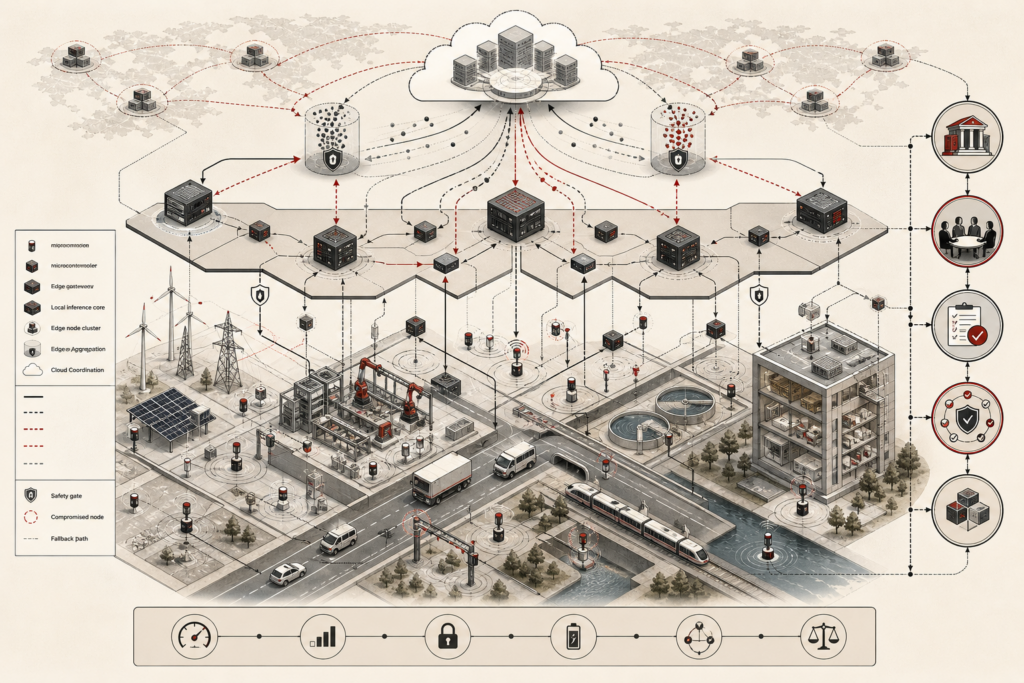
AI-enabled infrastructure system showing a digital twin of energy grids, water systems, transit networks, communications, buildings, ports, sensors, predictive models, resilience monitoring, cybersecurity controls, human oversight, equity review, audit trails, and public accountability across a smart cyber-physical network.

AI Systems for Infrastructure and Smart Networks

AI systems for infrastructure and smart networks integrate sensing, computation, prediction, optimization, and control across physical and digital systems. They help energy grids, transportation networks, water systems, buildings, communications infrastructure, and urban services become more adaptive, observable, and resilient. This article explains how AI supports smart infrastructure through sensor networks, edge data, graph modeling, digital twins, predictive maintenance, anomaly detection, control theory, and resilience analysis. It also examines the risks of cyber-physical systems, including data quality failures, cascading disruptions, cybersecurity vulnerabilities, opaque optimization, and unequal service impacts. The central argument is that smart infrastructure should not be measured only by efficiency or automation. It must be evaluated as a public-interest system shaped by reliability, safety, environmental performance, equity, governance, and accountability.

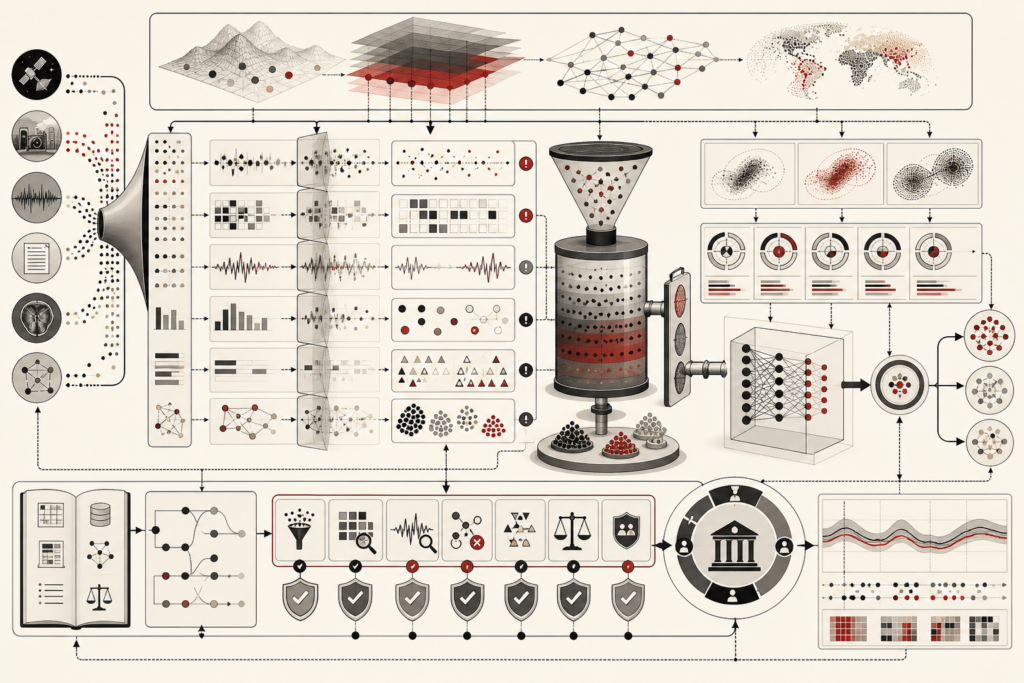
AI-enabled environmental monitoring system showing satellites, drones, weather stations, stream gauges, air-quality sensors, ocean buoys, biodiversity surveys, remote sensing, anomaly detection, uncertainty analysis, early warning, environmental justice review, and governance across a connected Earth-system landscape.

Artificial Intelligence in Environmental Monitoring

Artificial intelligence in environmental monitoring integrates sensing systems, Earth observation data, machine learning, scientific modeling, and governance workflows to observe and interpret complex environmental change. By combining in-situ sensors, satellite imagery, field surveys, climate records, and administrative data, AI systems can detect anomalies, forecast risks, classify land cover, monitor pollution, track ecosystem stress, and support early warning systems. This article explains how environmental AI works across sensor fusion, remote sensing, representation learning, spatiotemporal forecasting, physics-informed modeling, uncertainty analysis, and decision integration. It also emphasizes the risks of uneven monitoring coverage, weak validation, opaque models, retrieval uncertainty, and environmental injustice. The central argument is that AI-enabled monitoring should not become surveillance for its own sake; it should function as public-interest knowledge infrastructure for stewardship, accountability, ecological resilience, and sustainability.

Abstract editorial illustration of an AI-driven scientific discovery system connecting datasets, simulations, models, experiments, validation, and computational infrastructure.

AI for Scientific Discovery and Computational Research

AI for scientific discovery and computational research examines how artificial intelligence can extend the scientific workflow across data analysis, simulation, hypothesis generation, experimental design, and reproducible validation. Rather than replacing theory, observation, or experiment, AI acts as a scientific amplifier: it helps researchers search vast candidate spaces, learn representations from high-dimensional data, approximate expensive simulations, identify patterns, and prioritize what to test next. This article explains the fourth paradigm of data-intensive science, representation learning, surrogate modeling, active learning, Bayesian optimization, causal inference, symbolic discovery, and reproducibility governance. It also emphasizes the limits of AI-driven research, including prediction without explanation, correlation without causality, benchmark overfitting, opaque automation, and uneven access to scientific infrastructure. The central argument is that AI becomes scientifically valuable only when embedded in workflows that preserve evidence, uncertainty, validation, reproducibility, and human judgment.

Abstract editorial illustration of an AI decision support system connecting data streams, predictive models, scenario analysis, decision options, governance review, and feedback loops.

Artificial Intelligence in Decision Support Systems

AI in decision support systems integrates prediction, causal reasoning, optimization, uncertainty analysis, and human judgment to improve decisions in complex environments. Rather than replacing decision-makers, AI-enabled DSS translate data into forecasts, recommendations, scenario analyses, risk estimates, and structured decision options. This article explains how modern DSS move beyond dashboards into active decision workflows that combine Bayesian decision theory, expected utility, causal inference, prescriptive analytics, reinforcement learning, robust optimization, and human-AI collaboration. It also emphasizes that better prediction does not automatically produce better decisions. Decision quality depends on objectives, constraints, values, uncertainty, accountability, and institutional context. The central argument is that AI decision support must remain transparent, contestable, and governed, ensuring that recommendations improve human judgment rather than obscure responsibility behind automated systems.

Abstract editorial illustration of a generative AI system transforming data distributions into synthetic text, image, audio, video, code, and multimodal artifacts through model layers, evaluation, provenance, and governance.

Generative AI and Synthetic Content Systems

Generative AI and synthetic content systems model the structure of data in order to produce new text, images, audio, video, code, and multimodal artifacts. Rather than simply classifying or predicting, these systems learn from distributions, latent spaces, transformers, diffusion processes, prompts, retrieval context, and sampling methods to generate plausible outputs. This article explains generative modeling, autoregressive sequence generation, variational autoencoders, GANs, diffusion models, multimodal synthesis, controllability, evaluation, provenance, and synthetic-content governance. It also examines key risks, including hallucination, bias amplification, mode collapse, memorization, weak grounding, synthetic content flooding, authorship ambiguity, and authenticity erosion. The central argument is that generative AI should be understood not only as a creative tool, but as a governed information system requiring review, disclosure, provenance, accountability, and responsible publication workflows.

Speech recognition and multimodal AI system showing audio waveforms, spectrograms, text tokens, visual frames, video inputs, document fragments, gesture signals, transformer layers, attention maps, shared embeddings, uncertainty review, privacy controls, human correction loops, and audit accountability.

Speech Recognition and Multimodal AI Systems

Speech recognition and multimodal AI systems extend artificial intelligence from isolated pattern recognition into integrated architectures that process audio, language, vision, and context together. This article explains how continuous speech signals become acoustic features, spectrograms, token sequences, transcripts, and semantic representations, while multimodal systems align speech, text, image, video, and other data streams within shared embedding spaces. It covers sequence transduction, CTC alignment, attention, transformers, conformers, self-supervised speech models, contrastive learning, representation fusion, cross-modal retrieval, evaluation, and real-world deployment. The article also introduces mathematical lenses for waveform sampling, STFT, alignment, attention, similarity, and word error rate, alongside Python and R workflows for spectrogram generation, embedding similarity, and grouped speech-error diagnostics. By connecting perception, accessibility, infrastructure, bias, uncertainty, and governance, it frames multimodal AI as an auditable systems field for human-machine interaction.

Computer vision and machine perception system showing image pixels, video frames, depth maps, convolution filters, feature maps, segmentation masks, bounding boxes, vision transformer layers, attention pathways, embeddings, robustness testing, human review, and audit controls.

Computer Vision and Machine Perception

Computer vision and machine perception study how AI systems transform images, video, and visual sensor data into structured representations for recognition, detection, segmentation, reasoning, and action. This article explains vision as an inverse problem, showing how models infer scene structure from high-dimensional pixel arrays shaped by lighting, viewpoint, geometry, sensors, and context. It covers image tensors, representation learning, convolution, CNNs, invariance, equivariance, feature hierarchies, residual networks, vision transformers, multimodal image-text alignment, distribution shift, adversarial perturbations, and real-world perception infrastructure. The article also introduces mathematical lenses for image formation, convolution, classification, residual learning, attention, segmentation, IoU, and robustness, alongside Python and R workflows for synthetic images, edge detection, and grouped vision-error diagnostics. By connecting visual perception to safety, autonomy, bias, uncertainty, and governance, it frames computer vision as an auditable systems field.

Scroll to Top