
Last Updated May 10, 2026
AI systems for infrastructure and smart networks integrate sensing, computation, prediction, optimization, and control across physical and digital systems so that critical infrastructure can be monitored, modeled, and managed as an adaptive cyber-physical network. Energy grids, transportation systems, water networks, buildings, ports, communications infrastructure, industrial facilities, and urban services are no longer only collections of fixed assets. Increasingly, they are data-producing, model-mediated, networked systems whose behavior depends on sensors, software, machine learning, human operators, institutional rules, environmental conditions, and public accountability.
The central argument of this article is that AI-enabled infrastructure should be understood as a theory of governed cyber-physical intelligence. The promise is not simply automation, dashboards, or smart-city branding. The deeper possibility is more responsive, resilient, efficient, and evidence-informed infrastructure: grids that forecast demand and integrate renewables; transportation networks that adapt to congestion and disruption; water systems that detect leaks and quality risks; buildings that optimize energy use; and digital twins that allow decision-makers to simulate future scenarios before committing public resources.
Yet this promise comes with risk. Infrastructure is high-stakes, interdependent, spatially uneven, and institutionally governed. When AI systems are embedded in critical networks, failures can cascade across services, communities, and institutions. A model that optimizes a local metric may shift burdens elsewhere. A maintenance algorithm may reproduce historical underinvestment. A smart control system may expand cyber-physical attack surfaces. Smart infrastructure becomes intelligent only when data, models, controls, institutions, and human judgment are coordinated in ways that improve public value, resilience, equity, security, and accountability.
Main Library
Publications
Article Map
Artificial Intelligence Systems
Related Topic
Data Systems & Analytics
Related Topic
Embedded & Edge Systems
Related Topic
Intelligent Infrastructure Systems
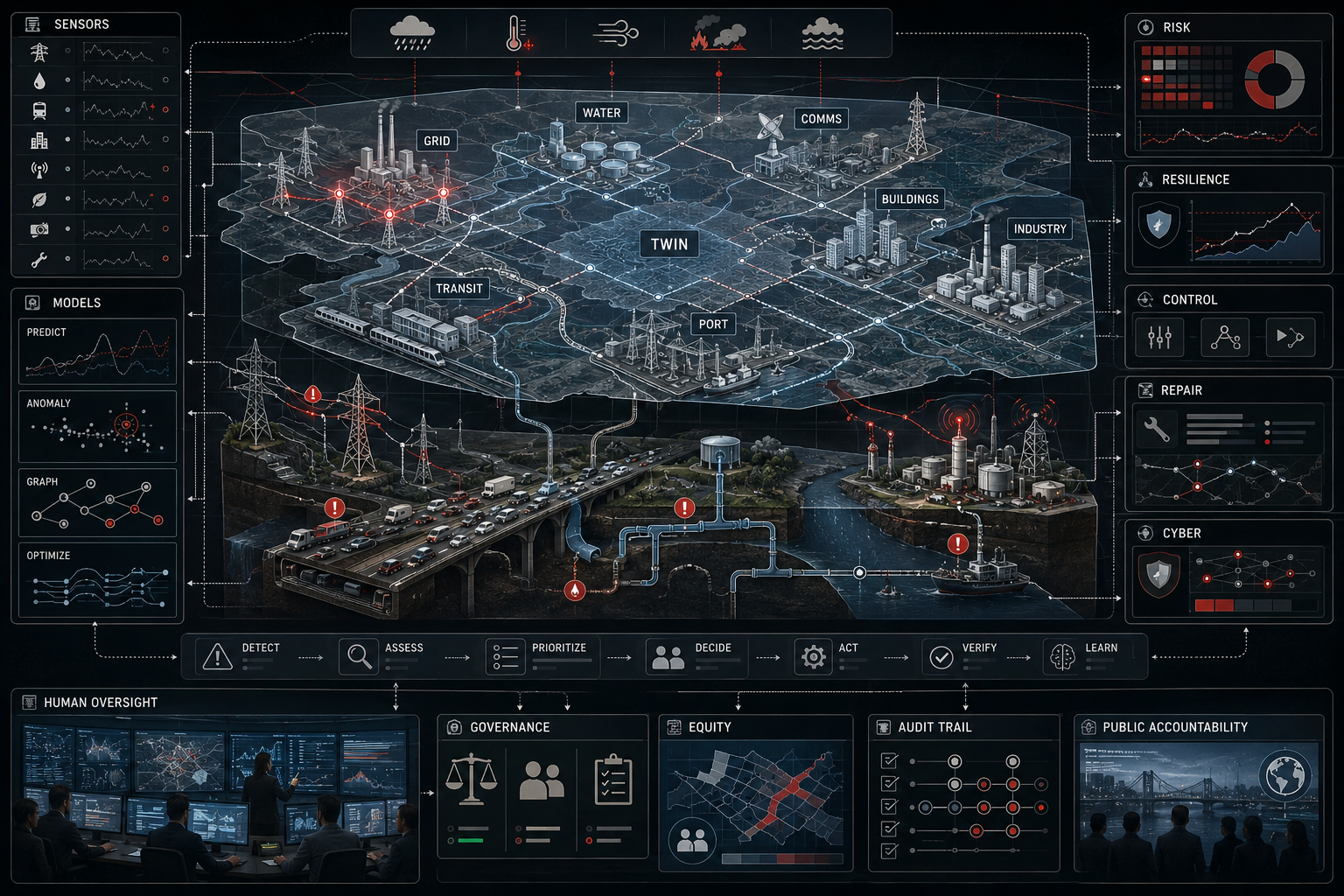
This article develops AI Systems for Infrastructure and Smart Networks as an advanced article within the Artificial Intelligence Systems knowledge series. It explains infrastructure as a complex networked system, cyber-physical sensing and control, sensor networks, edge data, observability, graph-based infrastructure modeling, digital twins, predictive maintenance, adaptive control, cascading failure, resilience, uncertainty, validation, cybersecurity, equity, and public accountability. Selected Python and R examples appear here, while the full GitHub repository contains expanded computational scaffolding for smart-network simulation, failure-risk scoring, centrality analysis, sensor-health diagnostics, infrastructure reliability review, equity flags, SQL metadata, governance documentation, and reproducible outputs.
Why AI Infrastructure and Smart Networks Matter
AI infrastructure matters because critical systems increasingly operate through data, models, and adaptive decision loops. Electricity grids depend on demand forecasts, renewable integration, storage coordination, outage prediction, and dispatch optimization. Transportation systems depend on traffic sensing, routing models, signal timing, transit scheduling, freight coordination, and real-time incident response. Water systems depend on pressure monitoring, leak detection, quality alerts, pump optimization, and watershed conditions. Buildings, ports, industrial systems, communications networks, and emergency services are all becoming more computationally mediated.
This does not mean infrastructure is becoming immaterial. The opposite is true. AI makes the material character of infrastructure more visible: pipes, wires, roads, bridges, pumps, substations, servers, sensors, control rooms, labor crews, maintenance budgets, and environmental conditions all shape what AI systems can know and do. A smart network is not a digital layer floating above the physical world. It is a cyber-physical system in which data and control interact with material assets, public institutions, and lived consequences.
The stakes are high because infrastructure failure is rarely isolated. A power outage can affect water pumping, hospital operations, communications, traffic signals, food storage, financial systems, emergency response, and public safety. A transportation disruption can affect labor access, freight, medical care, school attendance, and supply chains. A water-system failure can become a public-health crisis. AI can help anticipate, manage, and reduce these risks, but it can also create new dependencies, obscure accountability, and automate decisions that should remain publicly contestable.
Smart\ Infrastructure \neq Dashboard + Sensors
\]
Interpretation: Smart infrastructure requires reliable sensing, trustworthy models, safe control, human oversight, cybersecurity, equity review, and institutional accountability. Sensors and dashboards alone do not make a system intelligent.
| Infrastructure Context | Why Static Management Is Not Enough | AI System Question | Governance Concern |
|---|---|---|---|
| Energy grids | Demand, generation, weather, storage, and outages change continuously. | How can forecasting and control improve reliability while integrating renewables? | Cybersecurity, resilience, affordability, and unequal reliability. |
| Transportation systems | Congestion, incidents, demand, freight, and transit reliability vary across time and space. | How should networks adapt to disruption without shifting burdens onto vulnerable communities? | Surveillance, neighborhood burden shifting, and accessibility. |
| Water systems | Leaks, pressure, quality, demand, and climate stress can change rapidly. | How can sensors and predictive models improve maintenance and public health? | Under-monitoring, environmental injustice, and public accountability. |
| Buildings and campuses | Energy use, occupancy, comfort, safety, and equipment health vary dynamically. | How can AI optimize performance without undermining privacy or occupant wellbeing? | Privacy, vendor lock-in, and opaque optimization. |
| Ports and logistics | Queues, equipment, weather, labor, fuel, and supply chains interact across networks. | How can AI improve throughput while maintaining resilience and worker protections? | Brittle optimization, labor impacts, and supply-chain dependency. |
Note: AI becomes most important in infrastructure when sensing, prediction, control, uncertainty, interdependence, and public consequence are inseparable.
Infrastructure as a Complex Networked System
Infrastructure systems are networks of physical assets, flows, controls, institutions, users, and environments. A power grid connects generators, substations, transmission lines, distribution feeders, storage assets, buildings, and consumers. A transportation system connects roads, intersections, transit lines, vehicles, freight hubs, schedules, signals, and travelers. A water system connects reservoirs, treatment plants, pumping stations, pipes, sensors, households, watersheds, and regulatory obligations. These systems are not isolated machines; they are complex networks embedded in social and ecological conditions.
From a systems perspective, infrastructure has several defining properties:
- Interdependence: one system depends on others, such as water systems depending on electricity and communications.
- Feedback: operations affect future conditions, such as traffic routing influencing congestion or grid pricing influencing demand.
- Nonlinearity: small disturbances can sometimes produce large effects.
- Spatial structure: assets and users are distributed across geography.
- Temporal dynamics: demand, capacity, risk, and environmental conditions change over time.
- Unequal exposure: infrastructure benefits and failures are not distributed evenly across communities.
- Institutional control: technical systems are governed by budgets, regulations, maintenance priorities, ownership models, procurement structures, and political decisions.
AI can help model and manage these systems, but only if it respects their complexity. A model that optimizes a local metric may harm the broader network. A congestion algorithm may move traffic from highways into residential neighborhoods. An energy optimization system may reduce cost while increasing vulnerability during extreme weather. A predictive maintenance system may reproduce historical underinvestment if past service records reflect unequal attention. Infrastructure intelligence therefore requires network awareness, historical awareness, environmental awareness, and institutional accountability.
Local\ Efficiency \neq System\ Resilience
\]
Interpretation: A local optimization can reduce cost, delay, or energy use in one part of a system while increasing vulnerability, inequity, or cascading risk elsewhere.
| System Property | Meaning | AI Opportunity | Risk if Mishandled |
|---|---|---|---|
| Interdependence | Infrastructure systems depend on one another. | Model cross-system risk and cascading failure pathways. | Local failures propagate into wider disruption. |
| Feedback | Actions change future system conditions. | Use adaptive control and learning systems. | Optimization creates unintended behavior loops. |
| Spatial inequality | Assets, hazards, and service quality vary by place. | Map risk, access, and underinvestment. | Models reproduce historical neglect. |
| Temporal dynamics | Demand, weather, risk, and capacity change over time. | Forecast demand, failure, disruption, and recovery. | Models fail when conditions shift. |
| Institutional control | Budgets, rules, ownership, and governance shape technical action. | Support evidence-informed planning and accountability. | Technical systems obscure political choices. |
Note: Infrastructure AI must model physical networks, social consequences, environmental stress, and institutional decision-making together.
Cyber-Physical Systems and Smart Networks
Smart infrastructure is a form of cyber-physical system: a system in which computational components interact with physical processes through sensing, communication, modeling, and control. A cyber-physical infrastructure system may collect sensor readings, update a model, forecast a risk, recommend an action, trigger an automated response, and then observe the physical consequences of that response.
This creates a loop:
Sense \rightarrow Model \rightarrow Decide \rightarrow Control \rightarrow Observe
\]
Interpretation: Smart infrastructure operates through feedback between physical systems and computational systems. Safety depends on the quality of sensing, modeling, decision-making, control, and post-action observation.
The cyber-physical view matters because infrastructure AI is not only predictive. It can become operational. A prediction about electricity demand may influence dispatch. A traffic forecast may change signal timing. A flood model may trigger emergency routing. A maintenance model may shift crews and budgets. Once model outputs change physical or institutional behavior, AI becomes part of the system it is modeling.
This makes infrastructure AI different from passive analytics. It must be designed for latency, robustness, fail-safe operation, human oversight, cybersecurity, model drift, degraded-mode behavior, and institutional accountability. In high-stakes infrastructure, the question is not simply whether the model is accurate. The question is whether the integrated cyber-physical system remains safe and useful under stress.
| Loop Stage | Function | Infrastructure Example | Reliability Concern |
|---|---|---|---|
| Sense | Collect physical measurements. | Pressure, voltage, flow, vibration, temperature, traffic speed. | Sensor drift, missing data, calibration failure. |
| Model | Estimate state, risk, demand, or future behavior. | Leak probability, outage risk, congestion forecast, load estimate. | Distributional shift, biased data, uncertainty under stress. |
| Decide | Recommend or select actions. | Maintenance priority, routing change, dispatch recommendation. | Objective misalignment, equity tradeoffs, opaque thresholds. |
| Control | Act on physical or operational systems. | Valve adjustment, signal timing, storage dispatch, HVAC control. | Unsafe automation, latency, cyber-physical failure. |
| Observe | Monitor consequences and update understanding. | Post-action sensor readings, service impacts, operator feedback. | Weak feedback loops and failure to learn from incidents. |
Note: Once AI influences control or resource allocation, it becomes part of infrastructure operations rather than only an analytics tool.
Prediction + Control + Physical\ Consequence = Cyber\text{-}Physical\ Risk
\]
Interpretation: Infrastructure AI becomes higher-stakes when predictions influence physical operations, public services, emergency response, or resource allocation.
Sensor Networks, Edge Data, and Infrastructure Observability
Smart networks depend on observability: the capacity to understand system state through measurements. Sensors may measure voltage, pressure, flow, vibration, temperature, humidity, occupancy, particulate matter, traffic speed, vehicle counts, equipment load, structural strain, water quality, energy demand, or network latency. These measurements become useful only when they are integrated into reliable data infrastructure.
A mature infrastructure data layer includes:
- field sensors: physical devices collecting measurements in distributed environments;
- edge devices: local computing units that filter, validate, compress, or act on data close to where it is generated;
- communications networks: channels linking field devices, control centers, cloud systems, and operators;
- stream processing: pipelines that process time-sensitive data as it arrives;
- historical data stores: archives for trend analysis, model training, audit, and long-term planning;
- metadata and lineage: records of sensor identity, location, calibration, units, maintenance, and data transformations;
- operational dashboards: human-facing interfaces for monitoring system state, risk, uncertainty, and alerts.
Data quality is a central infrastructure risk. Sensors drift, fail, become miscalibrated, lose connectivity, produce outliers, or report values in inconsistent units. AI systems can amplify these problems if they treat measurements as clean facts. Smart infrastructure therefore requires data contracts, anomaly detection, sensor-health monitoring, redundancy, lineage tracking, and operational review.
| Data Layer | Purpose | Failure Mode | Governance Control |
|---|---|---|---|
| Sensors | Measure physical conditions. | Drift, failure, miscalibration, missing readings. | Calibration logs, redundancy, sensor-health scores. |
| Edge devices | Process data near the source. | Local software errors, device compromise, outdated firmware. | Patch management, secure configuration, local validation. |
| Communications | Move data between field systems and control centers. | Latency, outages, packet loss, cyber intrusion. | Network monitoring, encryption, failover plans. |
| Data pipelines | Clean, transform, and aggregate measurements. | Schema drift, unit errors, undocumented transformations. | Data contracts, lineage records, automated validation. |
| Dashboards | Present system state and alerts to operators. | False confidence, alert fatigue, hidden uncertainty. | Uncertainty display, escalation rules, operator review. |
Note: Infrastructure observability depends on the reliability of sensors, communications, metadata, pipelines, interfaces, and human interpretation.
Raw\ Measurement \neq Reliable\ Evidence
\]
Interpretation: Sensor data becomes reliable evidence only when calibration, metadata, lineage, quality checks, and context are preserved.
Network Theory and Graph-Based Infrastructure Modeling
Network theory provides a powerful framework for smart infrastructure because many infrastructure systems are defined by connectivity. Network analysis can identify critical nodes, vulnerable edges, redundant pathways, bottlenecks, communities, centrality structures, and cascading failure pathways.
Graph-based AI can support:
- traffic forecasting: modeling road segments as connected nodes or edges;
- grid stability analysis: modeling generators, substations, lines, and loads;
- water network monitoring: modeling pressure zones, pipes, pumps, and valves;
- asset prioritization: identifying infrastructure whose failure would disrupt many downstream services;
- communications resilience: modeling dependency among routers, data centers, fiber links, and control systems;
- interdependent risk: modeling how failures propagate across energy, water, transportation, health, and communications systems.
Graph neural networks extend machine learning to network-structured data. A simplified graph neural network update can be written as:
h_i^{(k+1)} =
\sigma \left(
W h_i^{(k)} +
\sum_{j \in N(i)} W_N h_j^{(k)}
\right)
\]
Interpretation: The representation of node \(i\) at layer \(k+1\) depends on its current representation and the representations of neighboring nodes \(N(i)\). This allows models to learn from infrastructure connectivity, not only from isolated asset features.
Graph learning is promising, but it must be validated carefully. Infrastructure graphs may be incomplete, outdated, proprietary, or politically sensitive. Network models may miss informal dependencies, emergency workarounds, undocumented assets, or unequal service conditions. Graph-based intelligence is only as reliable as the network representation it uses.
| Graph Element | Infrastructure Meaning | AI Use | Risk |
|---|---|---|---|
| Nodes | Assets, locations, sensors, substations, intersections, reservoirs. | Prediction, classification, vulnerability scoring. | Missing or misclassified assets distort risk. |
| Edges | Pipes, roads, wires, communications links, dependency pathways. | Flow modeling, routing, propagation analysis. | Outdated connectivity hides cascading risk. |
| Centrality | Importance of an asset within the network. | Maintenance prioritization and resilience planning. | Centrality may ignore social vulnerability or service need. |
| Communities | Clusters of assets or service zones. | Regional planning and isolation of failure domains. | Boundaries may not match lived service experience. |
| Interdependencies | Cross-system reliance among energy, water, communications, transport, and health systems. | Cascading failure analysis. | Hidden dependencies produce underprepared systems. |
Note: Graph models should be paired with field knowledge, maintenance records, public-service data, and community evidence.
Digital Twins and Scenario Simulation
A digital twin is a computational representation of a physical system that is updated with data and used for monitoring, simulation, prediction, and decision support. In infrastructure, digital twins may represent buildings, bridges, energy grids, water networks, airports, ports, rail systems, factories, cities, watersheds, or regional infrastructure corridors.
AI can enhance digital twins by enabling:
- forecasting of demand, load, failure risk, and environmental stress;
- anomaly detection from sensor streams;
- scenario simulation under climate, demographic, or operational change;
- predictive maintenance planning;
- resource allocation and scheduling;
- optimization of energy, flow, routing, and service levels;
- operator training and emergency planning.
A digital twin should not be treated as a perfect copy of reality. It is a model, and models have boundaries. A responsible digital twin must document what is included, what is excluded, how it is calibrated, how uncertainty is represented, how often it is updated, and what decisions it is allowed to inform.
Digital\ Twin = Model + Data + Calibration + Scenario\ Logic + Governance
\]
Interpretation: A digital twin is not simply a 3D visualization or dashboard. It is a governed modeling system whose assumptions, boundaries, updates, uncertainty, and decision uses must be documented.
| Digital Twin Function | Infrastructure Use | Value | Risk |
|---|---|---|---|
| Monitoring | Represent current state of assets and flows. | Improves situational awareness. | False confidence if sensor data is incomplete. |
| Simulation | Test future scenarios before action. | Supports planning and emergency preparation. | Assumptions may hide uncertainty or inequity. |
| Prediction | Forecast demand, failure, congestion, or exposure. | Supports proactive management. | Models may fail under climate or behavioral shifts. |
| Optimization | Compare alternative control or investment strategies. | Improves allocation and system performance. | Narrow objectives may displace public values. |
| Training | Support operator practice and emergency drills. | Improves readiness and institutional learning. | Training scenarios may exclude worst-case or marginalized impacts. |
Note: Digital twins should support decision-making without pretending to eliminate uncertainty, politics, or judgment.
Prediction, Forecasting, and Predictive Maintenance
Predictive maintenance is one of the most important applications of AI in infrastructure. Instead of waiting for assets to fail or relying only on fixed maintenance schedules, AI systems can estimate the probability of failure using historical maintenance data, sensor readings, environmental exposure, asset age, operating load, and network importance.
Prediction tasks include:
- failure probability estimation;
- remaining useful life forecasting;
- load and demand forecasting;
- anomaly detection;
- leak detection;
- congestion prediction;
- outage prediction;
- maintenance scheduling;
- asset risk ranking.
Predictive maintenance can improve reliability and reduce cost, but it can also reproduce historical inequities. If historical maintenance records are biased toward wealthier or better-monitored areas, a model may learn that well-documented assets deserve more attention. Infrastructure AI must therefore distinguish between true risk and measurement bias.
| Modeling Task | Typical Inputs | Operational Benefit | Governance Risk |
|---|---|---|---|
| Failure prediction | Age, sensor readings, break history, load, weather exposure. | Prioritizes inspection and repair before failure. | Historical data may reflect unequal monitoring. |
| Remaining useful life | Condition data, vibration, temperature, maintenance records. | Supports asset replacement planning. | Uncertainty may be hidden in single-point estimates. |
| Anomaly detection | Streaming sensor data and baseline behavior. | Detects leaks, faults, intrusions, or abnormal loads. | False alarms or missed anomalies can erode trust. |
| Risk ranking | Failure probability, network centrality, service population, equity flags. | Creates maintenance priority lists. | Optimization may prioritize visible assets over vulnerable communities. |
| Demand forecasting | Historical demand, weather, events, seasonality, demographics. | Supports dispatch, staffing, and capacity planning. | Future conditions may diverge from historical patterns. |
Note: Predictive maintenance should combine technical risk, data quality, network consequence, equity, and human review.
Predicted\ Risk = Physical\ Condition + Exposure + Network\ Consequence + Data\ Quality
\]
Interpretation: Infrastructure risk should not be estimated from physical condition alone. Network importance, environmental exposure, sensor reliability, and social consequence also matter.
Optimization, Control Theory, and Adaptive Operations
Smart infrastructure often requires real-time or near-real-time decisions. Control systems adjust signals, valves, pumps, storage, routing, dispatch, ventilation, cooling, charging, or other operational variables. AI can support control by forecasting system state, estimating risk, learning policies, and recommending actions.
In some systems, reinforcement learning can be used to learn a policy that maximizes long-term reward.
\max_{\pi} E \left[
\sum_{t=0}^{T} \gamma^t r(x_t, u_t)
\right]
\]
Interpretation: A policy \(\pi\) chooses actions \(u_t\) to maximize discounted rewards over time. In infrastructure, rewards must be designed carefully so that efficiency, safety, resilience, equity, and environmental constraints are not reduced to a narrow optimization target.
Adaptive control can be valuable when conditions change quickly, but fully automated control is not always appropriate. Many infrastructure systems require human-in-the-loop or human-on-the-loop governance. Operators need visibility into recommended actions, uncertainty, safety constraints, and override mechanisms. Control intelligence must be designed around fail-safe operation, not just optimization.
| Control Domain | Possible AI Action | Benefit | Constraint |
|---|---|---|---|
| Traffic systems | Adjust signal timing or routing recommendations. | Reduces congestion and improves emergency access. | Do not shift burdens onto residential or vulnerable areas. |
| Energy systems | Dispatch storage, adjust demand response, forecast loads. | Improves reliability and renewable integration. | Maintain reliability, affordability, and critical-load protection. |
| Water systems | Adjust pumps, valves, pressure zones, and maintenance priorities. | Reduces leaks and service disruption. | Protect quality, pressure, equity, and safety standards. |
| Buildings | Optimize HVAC, lighting, occupancy, and energy use. | Reduces energy and emissions. | Preserve comfort, health, privacy, and accessibility. |
| Emergency systems | Route resources, prioritize alerts, simulate response. | Improves response time and situational awareness. | Maintain human command authority and public accountability. |
Note: Infrastructure optimization should be constrained by safety, resilience, law, equity, environmental protection, and human oversight.
Optimization\ Without\ Constraints \rightarrow Public\ Risk
\]
Interpretation: Infrastructure systems should not optimize narrow metrics without safeguards for safety, equity, reliability, security, and public consequence.
Resilience, Cascading Failure, and Interdependence
Infrastructure resilience is the ability to prepare for, absorb, recover from, and adapt to disruption. AI can support resilience by identifying weak points, simulating stress scenarios, forecasting failures, prioritizing repairs, optimizing redundancy, and monitoring recovery. But AI can also introduce new dependencies and failure modes.
Cascading failure is especially important in interdependent infrastructure. A power outage can disrupt water pumping, telecommunications, traffic signals, hospitals, refrigeration, fuel distribution, and emergency response. A communications failure can disable monitoring and control for energy or transportation. A flood can simultaneously affect roads, substations, wastewater systems, and emergency access.
AI systems should therefore model both direct and indirect dependencies. Resilience analysis should ask:
- Which assets are most central to network function?
- Which communities are most exposed to service loss?
- Which systems depend on shared power, communications, or access routes?
- Where would a local failure propagate into regional disruption?
- Which interventions improve resilience rather than merely shifting risk elsewhere?
Resilience cannot be reduced to technical redundancy. It also depends on maintenance capacity, social trust, emergency planning, funding, public communication, institutional coordination, and equitable access to recovery resources.
| Resilience Dimension | AI Contribution | Infrastructure Example | Governance Concern |
|---|---|---|---|
| Preparedness | Scenario simulation and vulnerability mapping. | Simulate extreme heat, floods, outages, or demand surges. | Scenarios may exclude marginalized communities or compound risks. |
| Absorption | Real-time monitoring and adaptive response. | Detect stress and reroute flows before failure spreads. | Automation must remain safe under degraded conditions. |
| Recovery | Prioritize repairs and resource allocation. | Rank assets by service restoration value. | Recovery priorities must not reproduce inequality. |
| Adaptation | Learn from incidents and update plans. | Use post-event data to improve maintenance and investment. | Lessons must be institutionalized, not only logged. |
| Transformation | Identify structural redesign needs. | Plan distributed energy, redundancy, or climate adaptation. | Technical optimization must remain democratically accountable. |
Note: Resilience is a socio-technical property, not only a network metric.
Resilience = Absorb + Recover + Adapt + Learn
\]
Interpretation: A resilient infrastructure system does not merely avoid failure. It absorbs disruption, restores function, adapts to new conditions, and learns from stress.
Applications Across Infrastructure Domains
AI systems for infrastructure and smart networks apply across many domains. The common pattern is that AI helps transform infrastructure management from periodic and reactive to continuous and adaptive. The governance challenge is to ensure that adaptation serves public value rather than narrow efficiency, surveillance, or cost minimization alone.
| Domain | AI Applications | System Benefits | Key Risks |
|---|---|---|---|
| Energy grids | Load forecasting, renewable integration, outage prediction, dispatch optimization. | Reliability, flexibility, decarbonization support. | Cybersecurity, cascading outages, unequal reliability. |
| Transportation | Traffic prediction, signal optimization, transit planning, freight routing. | Reduced congestion, better service, adaptive mobility. | Surveillance, induced traffic, neighborhood burden shifting. |
| Water systems | Leak detection, pressure monitoring, quality prediction, pump optimization. | Reduced losses, public health protection, efficiency. | Sensor gaps, environmental injustice, under-monitored communities. |
| Buildings | Energy optimization, occupancy modeling, fault detection, predictive maintenance. | Efficiency, comfort, emissions reduction. | Privacy, vendor lock-in, poor occupant representation. |
| Ports and logistics | Queue prediction, equipment scheduling, routing, capacity planning. | Throughput, resilience, emissions reduction. | Labor displacement, brittle optimization, supply-chain dependency. |
| Urban services | Waste routing, emergency response, environmental monitoring, service prioritization. | Better targeting, responsiveness, resource allocation. | Bias, surveillance, unequal service distribution. |
| Communications | Network monitoring, anomaly detection, traffic engineering, outage prediction. | Availability, reliability, capacity management. | Security, systemic dependency, concentration risk. |
Note: The same AI capability can produce different consequences depending on ownership, oversight, constraints, public purpose, and institutional context.
Uncertainty, Validation, and Reliability Assurance
Infrastructure AI must operate under uncertainty. Sensors fail, environmental conditions change, demand patterns shift, asset records are incomplete, climate extremes exceed historical experience, and human behavior responds to system interventions. Validation must therefore go beyond average predictive performance.
Reliability assurance should include:
- out-of-sample validation: testing on data not used in training;
- spatial validation: testing performance across neighborhoods, regions, and network zones;
- temporal validation: testing performance across seasons, years, and disruption periods;
- stress testing: evaluating extreme weather, demand surges, outages, and sensor failures;
- uncertainty quantification: estimating where predictions are less reliable;
- human review: escalating high-uncertainty or high-consequence cases;
- monitoring: tracking drift, anomalies, latency, and system behavior after deployment;
- incident review: learning from failures, near misses, and operator overrides.
A prediction system that works under ordinary conditions but fails during emergencies is not reliable infrastructure intelligence. Validation must focus on the conditions where the system is most needed.
| Validation Type | Question | Evidence | Failure Mode |
|---|---|---|---|
| Spatial validation | Does the model work across places and service zones? | Neighborhood, region, asset-class, and network-zone evaluation. | Aggregate performance hides localized failures. |
| Temporal validation | Does the model work across seasons and time periods? | Seasonal, annual, and event-period testing. | Models fail under changing demand or climate stress. |
| Stress testing | Does the system work under extreme but plausible conditions? | Heat, flood, outage, cyber, sensor-failure, and surge scenarios. | Systems fail when most needed. |
| Uncertainty review | Where is the model least reliable? | Confidence intervals, uncertainty scores, data-quality flags. | Operators over-trust uncertain predictions. |
| Incident review | What did the system learn from failure or near miss? | Logs, root-cause analysis, operator notes, remediation records. | Failures repeat because lessons are not institutionalized. |
Note: Infrastructure AI should be evaluated under the conditions where failure would matter most, not only under ordinary operating conditions.
Validation = Spatial + Temporal + Stress + Uncertainty + Incident\ Review
\]
Interpretation: Reliable infrastructure AI requires validation across place, time, extreme conditions, uncertainty, and lived operational experience.
Governance, Equity, Security, and Public Accountability
AI-enabled infrastructure is never only a technical project. Infrastructure decisions shape access to mobility, water, energy, housing, public health, emergency services, environmental quality, and economic opportunity. Smart infrastructure can improve public services, but it can also intensify surveillance, privatize control, centralize vendor power, or optimize away the needs of less visible communities.
Governance should address:
- public purpose: what social, environmental, and service goals the system is meant to advance;
- accountability: who is responsible for model outputs, control actions, and harms;
- transparency: what data, models, assumptions, and constraints are documented;
- security: how cyber-physical attack surfaces are protected;
- equity: whether benefits and burdens are distributed fairly;
- procurement: whether agencies avoid lock-in, opaque systems, and unreviewable vendor claims;
- human oversight: when operators can override recommendations or suspend automation;
- public contestability: how communities can challenge infrastructure decisions informed by AI.
Critical infrastructure governance must connect technical assurance to democratic accountability. An AI system that improves operational efficiency while reducing transparency, weakening public control, or shifting burdens onto marginalized communities should not be considered successful.
| Governance Area | Question | Evidence Needed | Risk if Ignored |
|---|---|---|---|
| Public purpose | What public value does the system serve? | Use-case documentation, service goals, environmental objectives. | Technology serves efficiency without accountability. |
| Equity | Who benefits and who bears risk? | Spatial service analysis, community impact review, equity flags. | AI reproduces historical underinvestment. |
| Cybersecurity | How are sensors, controllers, networks, and models protected? | Threat models, access controls, patch records, incident plans. | Smart systems expand attack surfaces. |
| Human authority | Who can override, pause, or escalate the system? | Operator protocols, escalation paths, override logs. | Automation undermines professional and public judgment. |
| Public accountability | Can affected communities understand and contest decisions? | Public reporting, appeal mechanisms, procurement transparency. | Infrastructure governance becomes opaque and technocratic. |
Note: Smart infrastructure should strengthen public accountability, not replace it with technical opacity.
Efficiency + Opacity \neq Public\ Value
\]
Interpretation: AI-enabled infrastructure should be judged by reliability, resilience, equity, security, environmental performance, and accountability—not only efficiency.
Limits and Risks
AI systems for infrastructure and smart networks face serious limitations.
First, infrastructure data is often incomplete. Older assets may lack sensors, records may be fragmented, and maintenance histories may reflect institutional priorities rather than true physical condition. AI can make these gaps look precise if uncertainty is not documented.
Second, optimization can shift harm. A traffic system may reduce average delay while increasing neighborhood traffic. A grid model may reduce cost while increasing risk for vulnerable customers. A maintenance algorithm may prioritize assets with better data rather than greater need.
Third, smart systems expand cyber-physical attack surfaces. Sensors, controllers, communications links, digital twins, cloud platforms, and vendor systems create new security dependencies. Infrastructure AI must be governed as operational technology, not merely analytics software.
Fourth, digital twins can create false confidence. Simulations may appear authoritative even when assumptions are incomplete, calibration is weak, or uncertainty is ignored.
Fifth, infrastructure governance is political. Decisions about service quality, repair priority, environmental risk, and capital investment cannot be delegated to technical systems without public accountability.
The goal is not to reject smart infrastructure. The goal is to design infrastructure intelligence that is technically reliable, institutionally accountable, environmentally responsible, and socially just.
Smart\ System \neq Just\ System
\]
Interpretation: A technically sophisticated infrastructure system can still be unjust if it shifts risk, hides accountability, expands surveillance, or reproduces unequal service patterns.
Mathematical Lens: Graphs, Flows, Control, and Resilience
Infrastructure systems are often modeled as graphs. Nodes represent assets, locations, substations, intersections, reservoirs, sensors, buildings, or control points. Edges represent pipes, roads, transmission lines, communication channels, dependencies, or flows.
G = (V, E)
\]
Interpretation: A network \(G\) consists of nodes \(V\) and edges \(E\). In infrastructure systems, nodes may represent assets or locations, while edges represent physical, digital, operational, or dependency relationships.
The adjacency matrix records which nodes are connected.
A_{ij} =
\begin{cases}
1, & \text{if node } i \text{ is connected to node } j \\
0, & \text{otherwise}
\end{cases}
\]
Interpretation: The adjacency matrix \(A\) encodes infrastructure connectivity. It can represent whether two assets are physically connected, digitally linked, or operationally dependent.
Infrastructure often involves flows. Flow conservation expresses the idea that what enters, leaves, is stored, or is consumed must balance.
\sum_{j} q_{ji} – \sum_{j} q_{ij} + s_i – d_i = 0
\]
Interpretation: At node \(i\), incoming flows \(q_{ji}\), outgoing flows \(q_{ij}\), supply \(s_i\), and demand \(d_i\) must balance. This structure applies to water, energy, traffic, logistics, and communication networks in different forms.
Control models describe how system state changes over time.
x_{t+1} = A x_t + B u_t + w_t
\]
Interpretation: The future system state \(x_{t+1}\) depends on the current state \(x_t\), control action \(u_t\), system matrices \(A\) and \(B\), and disturbance \(w_t\). AI can support state estimation, forecasting, and adaptive control, but control must respect safety constraints.
Optimization expresses infrastructure management as a constrained decision problem.
\min_{u_{1:T}} \sum_{t=1}^{T} C(x_t, u_t)
\quad \text{subject to} \quad
h(x_t, u_t) \leq 0
\]
Interpretation: Infrastructure optimization chooses actions \(u_{1:T}\) to minimize cost, risk, delay, energy use, emissions, or failure probability while satisfying physical, safety, legal, equity, environmental, and operational constraints \(h(x_t, u_t) \leq 0\).
Resilience can be represented as the system’s ability to maintain or recover performance after disruption.
R = \frac{1}{T} \int_{0}^{T} \frac{P(t)}{P_0} \, dt
\]
Interpretation: Resilience \(R\) is represented as normalized performance over time after a disturbance. \(P(t)\) is system performance at time \(t\), and \(P_0\) is baseline performance. Higher resilience means the system maintains or recovers service more effectively.
A governance-aware priority score can combine technical risk, network consequence, data quality, service population, and equity.
Priority_i =
\alpha p_i +
\beta c_i +
\lambda e_i +
\mu q_i +
\rho v_i
\]
Interpretation: Asset priority \(Priority_i\) may combine failure probability \(p_i\), network criticality \(c_i\), equity priority \(e_i\), data-quality risk \(q_i\), and affected population or vulnerability \(v_i\). The weights should be governed, documented, and reviewed.
Variables and System Interpretation
| Symbol or Term | Meaning | Infrastructure Interpretation | AI System Relevance |
|---|---|---|---|
| \(G\) | Graph | Network representation of infrastructure. | Supports graph analytics, routing, vulnerability analysis, and graph neural networks. |
| \(V\) | Nodes | Assets, sensors, locations, substations, intersections, reservoirs. | Units of measurement, prediction, or control. |
| \(E\) | Edges | Pipes, roads, wires, communication links, dependency pathways. | Defines system connectivity and propagation pathways. |
| \(A\) | Adjacency or system matrix | Connectivity or dynamic transition structure. | Used in graph modeling, state estimation, and control. |
| \(x_t\) | State vector | Current system state at time \(t\). | Input for forecasting, anomaly detection, and control. |
| \(u_t\) | Control action | Signal timing, valve adjustment, dispatch decision, routing choice. | Action recommended or executed by AI-assisted control. |
| \(w_t\) | Disturbance | Weather shock, demand spike, sensor failure, cyber event, outage. | Uncertainty that models must handle robustly. |
| \(q_{ij}\) | Flow from node \(i\) to node \(j\) | Water, energy, traffic, goods, data, or service flow. | Used for optimization and anomaly detection. |
| \(d_i\) | Demand at node \(i\) | Local consumption, service demand, traffic volume, load. | Forecasting target and planning input. |
| \(C(x_t,u_t)\) | Cost or objective function | Delay, failure risk, emissions, energy cost, service loss. | Defines what the AI system optimizes. |
| \(h(x_t,u_t)\) | Constraint function | Safety, capacity, legal, equity, environmental, or operational limit. | Prevents optimization from violating system requirements. |
| \(R\) | Resilience index | Normalized performance during and after disturbance. | Evaluates robustness and recovery quality. |
Note: Infrastructure variables should be interpreted as social, physical, operational, and governance variables—not only technical model inputs.
Worked Example: AI for Water Network Reliability
Consider a municipal water system with reservoirs, treatment plants, pumping stations, pressure zones, pipes, valves, and neighborhood demand nodes. The city installs sensors that measure pressure, flow, pump vibration, water quality indicators, and tank levels. An AI system estimates leak risk and recommends maintenance priorities.
The system can be represented as a graph:
- nodes represent reservoirs, pumps, valves, junctions, and neighborhoods;
- edges represent pipes and dependency connections;
- node features include pressure, demand, age, sensor status, and service population;
- edge features include pipe material, diameter, age, break history, and flow;
- the model predicts leak probability and service disruption risk.
A narrow optimization system might prioritize repairs where leak probability is highest. A systems-aware AI system would also consider network centrality, service population, hospital dependence, environmental vulnerability, historical under-maintenance, and equity. It would distinguish between assets that are truly low risk and assets that are simply under-monitored.
A governance-ready recommendation might include:
- predicted leak probability;
- confidence or uncertainty score;
- sensor health status;
- network criticality score;
- affected population estimate;
- environmental exposure;
- equity flag for historically under-served areas;
- recommended maintenance action;
- human review requirement.
The decision is not merely technical. A public agency must decide how to balance risk, cost, service continuity, fairness, environmental protection, and public accountability. AI can support this decision, but it should not hide the value judgments involved.
| Recommendation Field | Meaning | Why It Matters | Review Question |
|---|---|---|---|
| Leak probability | Estimated probability of asset failure or leakage. | Supports technical prioritization. | Is the model calibrated for this pipe class and location? |
| Sensor health | Quality and reliability of measurement data. | Prevents false precision from poor data. | Is the asset high-risk or simply poorly observed? |
| Network criticality | Importance of the asset to system function. | Captures cascading service consequences. | Would failure disrupt hospitals, schools, or emergency services? |
| Equity flag | Indicator of historical underinvestment or social vulnerability. | Prevents maintenance algorithms from reinforcing past neglect. | Does the priority process correct or reproduce inequality? |
| Human review | Whether an operator or public agency should review the case. | Preserves judgment and accountability. | Who is authorized to override or escalate? |
Note: A governance-ready recommendation should explain technical risk, data quality, network consequence, social consequence, and review responsibility.
Maintenance\ Priority \neq Failure\ Probability\ Alone
\]
Interpretation: Infrastructure maintenance should consider failure probability, network consequence, service population, data uncertainty, environmental risk, and equity—not only the highest predicted failure score.
Computational Modeling
Computational modeling for smart infrastructure should produce artifacts that help people understand, govern, and improve infrastructure decisions. A useful workflow should not merely output a risk score. It should generate reviewable evidence: network centrality, failure probability, data-quality risk, equity flags, uncertainty indicators, human-review requirements, and asset-priority tables.
A practical infrastructure AI workflow should answer several questions:
- Which assets appear most at risk of failure?
- Which assets are most central to network function?
- Which predictions are weakened by poor sensor health or missing data?
- Which communities or service populations would be affected?
- Which recommendations require human review?
- Does the priority list reproduce or correct historical underinvestment?
- Can the model outputs be audited after decisions are made?
| Artifact | Purpose | Governance Value |
|---|---|---|
| Network asset table | Documents nodes, edges, asset attributes, and connectivity. | Supports traceability and network review. |
| Sensor-health report | Identifies weak, missing, or unreliable measurements. | Prevents false precision and supports field maintenance. |
| Failure-risk score | Estimates probability of asset failure or disruption. | Supports proactive inspection and maintenance planning. |
| Criticality score | Combines network centrality, population, risk, equity, and data quality. | Supports transparent prioritization. |
| Equity review table | Compares review, risk, and data quality across areas. | Identifies unequal monitoring or service patterns. |
| Governance summary | Summarizes assets reviewed, high-risk assets, review flags, and equity flags. | Supports audit, oversight, and public reporting. |
Note: Smart infrastructure analytics should produce evidence for action, review, correction, and public accountability.
Python Workflow: Smart Network Monitoring and Failure Risk
The following Python workflow models a simplified smart infrastructure network. It creates synthetic nodes and edges, estimates centrality, simulates sensor readings, predicts failure risk, and produces a governance-ready asset prioritization table. It is intentionally dependency-light so the logic can be adapted to real infrastructure datasets.
"""
AI Systems for Infrastructure and Smart Networks
Python workflow: smart network monitoring and failure-risk prioritization.

This example uses synthetic infrastructure data. Replace the generated
network, asset records, and sensor readings with real operational data
when adapting the workflow.
"""

from __future__ import annotations

from pathlib import Path

import numpy as np
import pandas as pd


RANDOM_SEED = 42
rng = np.random.default_rng(RANDOM_SEED)

OUTPUT_DIR = Path("outputs")
OUTPUT_DIR.mkdir(exist_ok=True)


def create_synthetic_network(n_nodes: int = 60) -> tuple[pd.DataFrame, pd.DataFrame]:
    """
    Create synthetic infrastructure nodes and edges.

    Nodes represent infrastructure assets. Edges represent physical or
    operational connectivity between assets.
    """
    nodes = pd.DataFrame(
        {
            "node_id": [f"N{i:03d}" for i in range(n_nodes)],
            "asset_age": rng.normal(22, 9, n_nodes).clip(1),
            "demand": rng.normal(100, 25, n_nodes).clip(10),
            "service_population": rng.integers(250, 5000, n_nodes),
            "sensor_health": rng.uniform(0.65, 1.00, n_nodes),
            "historical_breaks": rng.poisson(1.2, n_nodes),
            "equity_priority": rng.choice([0, 1], size=n_nodes, p=[0.75, 0.25]),
        }
    )

    edges = []

    # Create a backbone chain.
    for i in range(n_nodes - 1):
        edges.append((f"N{i:03d}", f"N{i+1:03d}"))

    # Add cross-links to create redundancy and network structure.
    for _ in range(n_nodes):
        a, b = rng.choice(n_nodes, size=2, replace=False)
        edges.append((f"N{a:03d}", f"N{b:03d}"))

    edge_df = pd.DataFrame(edges, columns=["source", "target"]).drop_duplicates()

    return nodes, edge_df


def degree_centrality(nodes: pd.DataFrame, edges: pd.DataFrame) -> pd.Series:
    """
    Calculate simple degree centrality without external graph libraries.

    Degree centrality is a basic measure of how connected an asset is.
    """
    counts = pd.concat([edges["source"], edges["target"]]).value_counts()
    centrality = nodes["node_id"].map(counts).fillna(0)
    centrality = centrality / max(centrality.max(), 1)

    return centrality


def simulate_sensor_readings(nodes: pd.DataFrame) -> pd.DataFrame:
    """
    Create synthetic pressure, vibration, and data-quality readings.

    In a real system, these values would come from field sensors,
    inspection records, SCADA logs, or asset-management systems.
    """
    readings = nodes.copy()

    readings["pressure_drop"] = (
        rng.normal(0.10, 0.04, len(nodes))
        + 0.004 * readings["asset_age"]
        + 0.03 * readings["historical_breaks"]
    ).clip(0, 1)

    readings["vibration_index"] = (
        rng.normal(0.20, 0.08, len(nodes))
        + 0.003 * readings["asset_age"]
    ).clip(0, 1)

    readings["data_quality_risk"] = 1 - readings["sensor_health"]

    return readings


def estimate_failure_risk(nodes: pd.DataFrame, edges: pd.DataFrame) -> pd.DataFrame:
    """
    Estimate infrastructure failure risk and governance priority.

    The priority score combines technical risk, network criticality,
    affected population, data-quality risk, and equity priority.
    """
    scored = simulate_sensor_readings(nodes)
    scored["network_centrality"] = degree_centrality(scored, edges)

    logit = (
        -3.4
        + 0.045 * scored["asset_age"]
        + 1.8 * scored["pressure_drop"]
        + 1.3 * scored["vibration_index"]
        + 0.22 * scored["historical_breaks"]
        + 1.0 * scored["network_centrality"]
        + 0.8 * scored["data_quality_risk"]
    )

    scored["failure_probability"] = 1 / (1 + np.exp(-logit))

    scored["criticality_score"] = (
        0.35 * scored["failure_probability"]
        + 0.25 * scored["network_centrality"]
        + 0.20 * (scored["service_population"] / scored["service_population"].max())
        + 0.10 * scored["data_quality_risk"]
        + 0.10 * scored["equity_priority"]
    )

    scored["review_required"] = (
        (scored["failure_probability"] > 0.55)
        | (scored["data_quality_risk"] > 0.25)
        | (scored["equity_priority"] == 1)
    )

    return scored.sort_values("criticality_score", ascending=False)


def main() -> None:
    """Run the smart network monitoring workflow and save governance artifacts."""
    nodes, edges = create_synthetic_network()
    scored = estimate_failure_risk(nodes, edges)

    nodes.to_csv(OUTPUT_DIR / "infrastructure_nodes.csv", index=False)
    edges.to_csv(OUTPUT_DIR / "infrastructure_edges.csv", index=False)
    scored.to_csv(OUTPUT_DIR / "smart_network_failure_risk.csv", index=False)

    governance_summary = pd.DataFrame(
        [
            {
                "assets_reviewed": len(scored),
                "mean_failure_probability": scored["failure_probability"].mean(),
                "high_risk_assets": int((scored["failure_probability"] > 0.55).sum()),
                "human_review_required": int(scored["review_required"].sum()),
                "equity_priority_assets": int(scored["equity_priority"].sum()),
                "mean_data_quality_risk": scored["data_quality_risk"].mean(),
            }
        ]
    )

    governance_summary.to_csv(
        OUTPUT_DIR / "smart_network_governance_summary.csv",
        index=False,
    )

    top_review = scored[
        [
            "node_id",
            "failure_probability",
            "network_centrality",
            "service_population",
            "data_quality_risk",
            "equity_priority",
            "criticality_score",
            "review_required",
        ]
    ].head(10)

    top_review.to_csv(OUTPUT_DIR / "top_assets_for_review.csv", index=False)

    memo = f"""# Smart Infrastructure Monitoring Memo

## Summary

Assets reviewed: {len(scored)}
Mean failure probability: {scored["failure_probability"].mean():.3f}
High-risk assets: {int((scored["failure_probability"] > 0.55).sum())}
Human review required: {int(scored["review_required"].sum())}
Equity-priority assets: {int(scored["equity_priority"].sum())}
Mean data-quality risk: {scored["data_quality_risk"].mean():.3f}

## Interpretation

- Failure probability estimates technical asset risk.
- Network centrality identifies assets whose failure may affect connected systems.
- Data-quality risk identifies assets where sensor evidence may be weak.
- Equity-priority flags help prevent maintenance prioritization from reproducing
  historical underinvestment.
- Human review should be required for high-risk, high-uncertainty, or
  equity-sensitive cases.
"""

    (OUTPUT_DIR / "smart_network_monitoring_memo.md").write_text(memo)

    print("Top infrastructure assets for review")
    print(top_review)

    print("\nGovernance summary")
    print(governance_summary.T)

    print("\nMonitoring memo")
    print(memo)


if __name__ == "__main__":
    main()
This workflow treats smart-network monitoring as a governance problem, not only a prediction problem. Failure probability, network centrality, service population, sensor quality, equity priority, and human-review requirements are all preserved as reviewable evidence.
R Workflow: Infrastructure Reliability and Equity Review
The following R workflow complements the Python example with a statistical reliability and equity review. It creates synthetic infrastructure assets, estimates risk, compares review rates by area type, and generates a governance table for maintenance prioritization.
# AI Systems for Infrastructure and Smart Networks
# R workflow: infrastructure reliability and equity review.

set.seed(42)

if (!dir.exists("outputs")) {
  dir.create("outputs")
}

n <- 80

assets <- data.frame(
  asset_id = paste0("A", sprintf("%03d", 1:n)),
  area_type = sample(
    c("central", "industrial", "residential", "historically_underinvested"),
    size = n,
    replace = TRUE,
    prob = c(0.25, 0.20, 0.35, 0.20)
  ),
  asset_age = pmax(rnorm(n, mean = 24, sd = 10), 1),
  sensor_health = runif(n, min = 0.60, max = 1.00),
  service_population = sample(250:6000, size = n, replace = TRUE),
  historical_breaks = rpois(n, lambda = 1.4),
  pressure_drop = pmin(pmax(rnorm(n, mean = 0.18, sd = 0.07), 0), 1),
  network_centrality = runif(n, min = 0, max = 1)
)

assets$equity_priority <- ifelse(
  assets$area_type == "historically_underinvested",
  1,
  0
)

assets$data_quality_risk <- 1 - assets$sensor_health

logit <- -3.4 +
  0.045 * assets$asset_age +
  1.8 * assets$pressure_drop +
  0.22 * assets$historical_breaks +
  1.0 * assets$network_centrality +
  0.8 * assets$data_quality_risk

assets$failure_probability <- 1 / (1 + exp(-logit))

assets$criticality_score <- 0.35 * assets$failure_probability +
  0.25 * assets$network_centrality +
  0.20 * (assets$service_population / max(assets$service_population)) +
  0.10 * assets$data_quality_risk +
  0.10 * assets$equity_priority

assets$review_required <- assets$failure_probability > 0.55 |
  assets$data_quality_risk > 0.25 |
  assets$equity_priority == 1

priority_table <- assets[order(-assets$criticality_score), ]

area_review <- aggregate(
  cbind(failure_probability, data_quality_risk, review_required, equity_priority) ~ area_type,
  data = assets,
  FUN = mean
)

names(area_review) <- c(
  "area_type",
  "mean_failure_probability",
  "mean_data_quality_risk",
  "review_rate",
  "equity_priority_rate"
)

governance_summary <- data.frame(
  assets_reviewed = nrow(assets),
  mean_failure_probability = mean(assets$failure_probability),
  high_risk_assets = sum(assets$failure_probability > 0.55),
  human_review_required = sum(assets$review_required),
  equity_priority_assets = sum(assets$equity_priority),
  mean_data_quality_risk = mean(assets$data_quality_risk)
)

write.csv(priority_table, "outputs/r_infrastructure_priority_table.csv", row.names = FALSE)
write.csv(area_review, "outputs/r_area_equity_review.csv", row.names = FALSE)
write.csv(governance_summary, "outputs/r_infrastructure_governance_summary.csv", row.names = FALSE)

memo <- paste0(
  "# Infrastructure Reliability and Equity Review Memo\n\n",
  "Assets reviewed: ", nrow(assets), "\n",
  "Mean failure probability: ", round(mean(assets$failure_probability), 3), "\n",
  "High-risk assets: ", sum(assets$failure_probability > 0.55), "\n",
  "Human review required: ", sum(assets$review_required), "\n",
  "Equity-priority assets: ", sum(assets$equity_priority), "\n",
  "Mean data-quality risk: ", round(mean(assets$data_quality_risk), 3), "\n\n",
  "Interpretation:\n",
  "- The priority table ranks assets by technical risk, centrality, population, data quality, and equity priority.\n",
  "- The area review table compares risk and review rates across area types.\n",
  "- Human review should examine whether historically underinvested areas are under-monitored or under-prioritized.\n",
  "- Governance teams should document whether model-driven maintenance priorities correct or reproduce historical patterns.\n"
)

writeLines(memo, "outputs/r_infrastructure_equity_review_memo.md")

print("Top infrastructure assets for review")
print(head(priority_table, 10))

print("Area-level equity and reliability review")
print(area_review)

print("Governance summary")
print(governance_summary)

cat(memo)
The R workflow is useful for governance review because it turns infrastructure modeling into interpretable tables: asset priority, area-level reliability, data-quality risk, equity review, and human-review requirements. These outputs can support maintenance planning, audit meetings, public reporting, and post-incident review.
GitHub Repository
The article body includes selected computational examples so the conceptual and mathematical argument remains readable. The full repository contains expanded computational infrastructure: advanced notebooks, Python and R workflows, SQL metadata, smart-network simulation, embedded sensing examples, edge-data patterns, monitoring services, dashboard logic, governance documentation, and reproducible outputs.
Complete Code Repository
The full code distribution for this article includes Python, R, SQL, Julia, smart-network simulation, infrastructure graph modeling, sensor-health diagnostics, predictive-maintenance workflows, reliability review, equity-priority scoring, governance documentation, reproducible outputs, and audit scaffolding for studying AI systems for infrastructure and smart networks.
From Smart Infrastructure to Governed Cyber-Physical Intelligence
AI systems for infrastructure and smart networks show that intelligence is not only prediction, classification, or automation. It is coordination across physical assets, digital systems, human operators, environmental conditions, institutional priorities, and public obligations. The strongest infrastructure AI systems will not simply detect patterns. They will help societies understand risk, anticipate failure, allocate maintenance, protect vulnerable communities, reduce environmental harm, and improve resilience under stress.
The central lesson is that smart infrastructure must be governed. Sensors, dashboards, digital twins, graph models, predictive maintenance systems, and adaptive controls are powerful only when they are trustworthy, secure, interpretable, validated, and accountable. A digital twin can inform planning, but it can also obscure uncertainty. A maintenance model can reduce failures, but it can also reproduce historical neglect. A control system can improve efficiency, but it can also create new cyber-physical risks. The intelligence of a system depends not only on its algorithms, but on the public purposes, constraints, and review mechanisms that shape its use.
The future of AI-enabled infrastructure will likely depend on hybrid systems that combine machine learning, graph analytics, digital twins, edge computing, control theory, resilience planning, cybersecurity, public governance, and community accountability. These systems will need to operate across multiple scales: sensors and substations, pipes and pumps, roads and signals, neighborhoods and watersheds, buildings and grids, control rooms and public institutions.
Within the Artificial Intelligence Systems knowledge series, this article belongs near Edge AI and Distributed Intelligence, AI Infrastructure: Data Pipelines, Compute, and Deployment Systems, AI Safety and System Reliability, Systemic Risk, Feedback Loops, and Cascading Failures in AI Systems, Real-Time AI Systems and Autonomous Decision-Making, Data Governance, Provenance, and Lineage in AI Systems, and Causal Inference and Experimental Design in AI Systems. It provides the cyber-physical and infrastructure layer for understanding how AI systems operate inside material networks and public-service environments.
The final point is democratic. Infrastructure is not merely technical capacity. It is how societies organize everyday life, mobility, water, energy, health, communication, safety, and opportunity. AI can help make infrastructure more adaptive and resilient, but only if smart systems remain accountable to the people and places they serve.
Related Articles
- AI Infrastructure: Data Pipelines, Compute, and Deployment Systems
- Edge AI and Distributed Intelligence
- AI Safety and System Reliability
- Systemic Risk, Feedback Loops, and Cascading Failures in AI Systems
- Real-Time AI Systems and Autonomous Decision-Making
- Causal Inference and Experimental Design in AI Systems
- Data Governance, Provenance, and Lineage in AI Systems
Further Reading
- Barabási, A.-L. (2016) Network Science. Cambridge: Cambridge University Press. Available at: https://networksciencebook.com/
- Buldyrev, S.V., Parshani, R., Paul, G., Stanley, H.E. and Havlin, S. (2010) ‘Catastrophic cascade of failures in interdependent networks’, Nature, 464, pp. 1025–1028. Available at: https://www.nature.com/articles/nature08932
- Fuller, A., Fan, Z., Day, C. and Barlow, C. (2020) ‘Digital Twin: Enabling Technologies, Challenges and Open Research’, IEEE Access, 8, pp. 108952–108971. Available at: https://ieeexplore.ieee.org/document/9099197
- National Institute of Standards and Technology (2017) Framework for Cyber-Physical Systems: Volume 1, Overview. NIST Special Publication 1500-201. Available at: https://www.nist.gov/publications/framework-cyber-physical-systems-volume-1-overview
- National Institute of Standards and Technology (2023) Artificial Intelligence Risk Management Framework (AI RMF 1.0). Available at: https://www.nist.gov/publications/artificial-intelligence-risk-management-framework-ai-rmf-10
- Cybersecurity and Infrastructure Security Agency (n.d.) Critical Infrastructure Security and Resilience. Available at: https://www.cisa.gov/topics/critical-infrastructure-security-and-resilience
- World Bank (n.d.) Overview of the Infrastructure Governance Framework. Available at: https://www.worldbank.org/en/topic/governance/brief/infrastructure-governance-framework
- Zanella, A., Bui, N., Castellani, A., Vangelista, L. and Zorzi, M. (2014) ‘Internet of Things for Smart Cities’, IEEE Internet of Things Journal, 1(1), pp. 22–32. Available at: https://ieeexplore.ieee.org/document/6740844
References
- Barabási, A.-L. (2016) Network Science. Cambridge: Cambridge University Press. Available at: https://networksciencebook.com/
- Buldyrev, S.V., Parshani, R., Paul, G., Stanley, H.E. and Havlin, S. (2010) ‘Catastrophic cascade of failures in interdependent networks’, Nature, 464, pp. 1025–1028. Available at: https://www.nature.com/articles/nature08932
- Cybersecurity and Infrastructure Security Agency (n.d.) Critical Infrastructure Security and Resilience. Available at: https://www.cisa.gov/topics/critical-infrastructure-security-and-resilience
- Fuller, A., Fan, Z., Day, C. and Barlow, C. (2020) ‘Digital Twin: Enabling Technologies, Challenges and Open Research’, IEEE Access, 8, pp. 108952–108971. Available at: https://ieeexplore.ieee.org/document/9099197
- National Institute of Standards and Technology (2017) Framework for Cyber-Physical Systems: Volume 1, Overview. NIST Special Publication 1500-201. Available at: https://www.nist.gov/publications/framework-cyber-physical-systems-volume-1-overview
- National Institute of Standards and Technology (2023) Artificial Intelligence Risk Management Framework (AI RMF 1.0). Available at: https://www.nist.gov/publications/artificial-intelligence-risk-management-framework-ai-rmf-10
- World Bank (n.d.) Overview of the Infrastructure Governance Framework. Available at: https://www.worldbank.org/en/topic/governance/brief/infrastructure-governance-framework
- Zanella, A., Bui, N., Castellani, A., Vangelista, L. and Zorzi, M. (2014) ‘Internet of Things for Smart Cities’, IEEE Internet of Things Journal, 1(1), pp. 22–32. Available at: https://ieeexplore.ieee.org/document/6740844