
Last Updated May 10, 2026
Speech recognition and multimodal AI systems extend artificial intelligence from single-modality pattern recognition into integrated perceptual architectures that process audio, language, vision, video, documents, sensor traces, and contextual signals within shared representational frameworks. Speech recognition transforms continuous acoustic pressure waves into linguistic units, while multimodal AI aligns heterogeneous streams of information so machines can compare, retrieve, generate, summarize, and act across forms of data that human beings normally experience together.
The central argument of this article is that speech recognition and multimodal AI should be understood as forms of governed perceptual infrastructure. These systems do not merely “hear,” “see,” or “understand.” They sample signals, transform them into features, learn representations, align modalities, decode outputs, display confidence, route information into downstream workflows, and shape how people interact with digital systems. Their value depends not only on accuracy, but also on robustness, accessibility, uncertainty communication, subgroup performance, privacy, provenance, interface design, and accountability.
Speech recognition is one of the most important bridges between physical signals and symbolic language. Human speech begins as pressure variation in air, but AI systems must convert that continuous signal into acoustic features, latent representations, phonetic structure, subword units, words, utterances, commands, transcripts, speaker turns, or semantic intent. Multimodal AI generalizes this problem. It asks how different forms of information can be encoded, aligned, fused, contrasted, retrieved, generated, and governed across modalities.
The result is a major shift in artificial intelligence: from isolated task-specific models toward integrated systems that approximate aspects of perception, communication, context, accessibility, and interaction. A speech model converts audio into text. A multimodal model connects speech to images, documents, gestures, video frames, diagrams, interface state, and user intent. A deployed multimodal system can become part of search, documentation, education, robotics, public services, healthcare, media analysis, accessibility tools, or generative interfaces. That makes speech and multimodal AI technical systems, social systems, and governance systems at the same time.
Main Library
Publications
Article Map
Artificial Intelligence Systems
Related Topic
Data Systems & Analytics
Related Topic
Embedded & Edge Systems
Related Topic
Generative AI
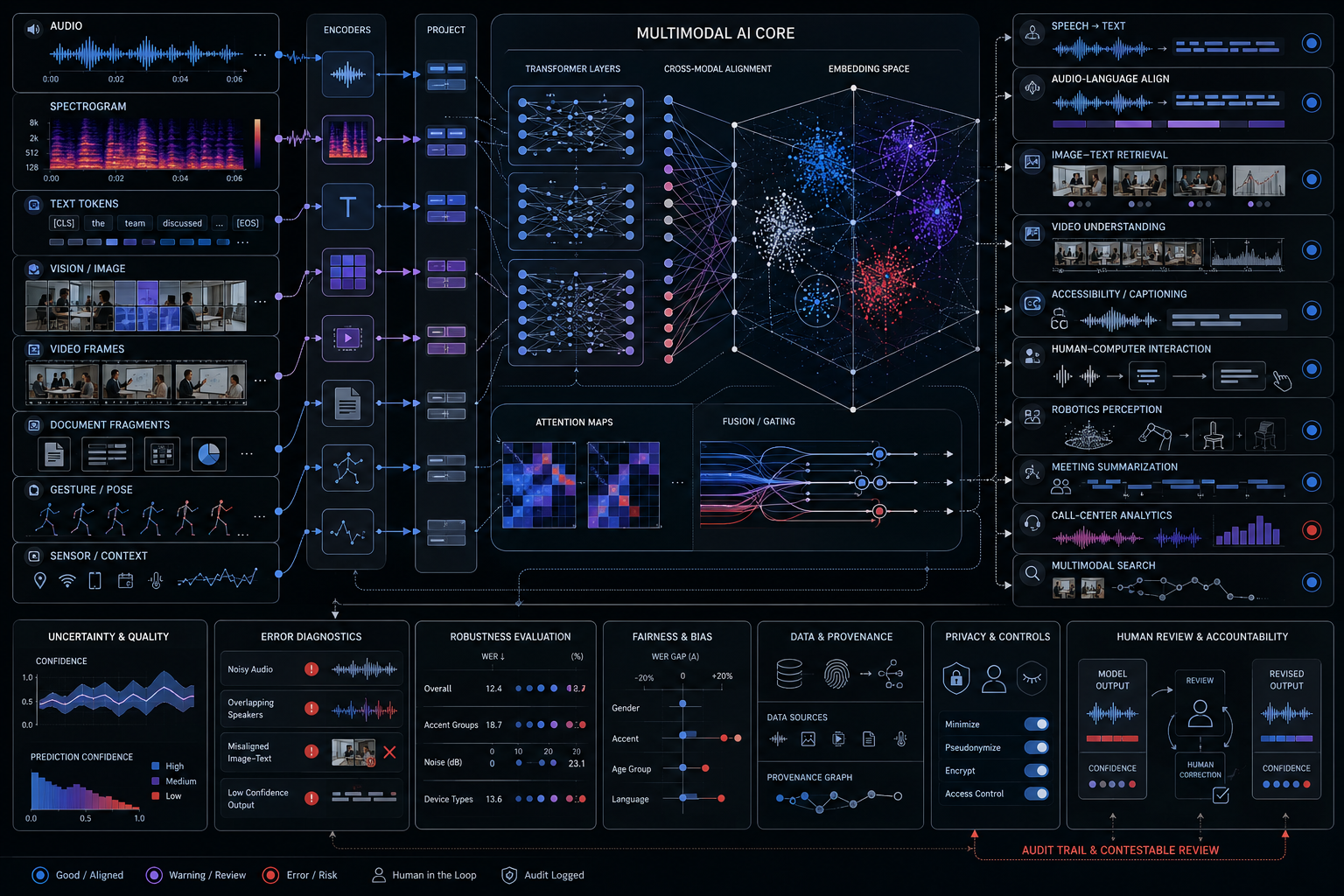
This article develops Speech Recognition and Multimodal AI Systems as an advanced article within the Artificial Intelligence Systems knowledge series. It explains speech as a continuous signal, acoustic representation, spectrograms, Mel-frequency features, sequence transduction, CTC alignment, sequence-to-sequence modeling, attention, transformers, conformers, wav2vec-style self-supervision, Whisper-style weak supervision, multimodal embeddings, contrastive learning, cross-modal alignment, modality fusion, generalization, accessibility, infrastructure, evaluation, bias, uncertainty, and governance. Selected Python and R examples appear here, while the full GitHub repository contains expanded computational scaffolding for audio feature extraction, spectrogram generation, CTC intuition, multimodal embedding simulation, cross-modal retrieval, grouped speech-recognition diagnostics, error analysis, drift monitoring, SQL metadata, and advanced Jupyter notebooks.
Why Speech and Multimodal AI Matter
Speech recognition and multimodal AI matter because human communication is not naturally single-modal. People speak, listen, read, gesture, look, point, write, interpret images, respond to context, and coordinate meaning across multiple streams of information. A voice assistant that hears words but ignores visual context is limited. A robotics system that sees objects but cannot interpret spoken instructions is limited. A medical documentation system that transcribes speech without domain context is limited. A content moderation system that evaluates text but ignores image, audio, or video context is limited.
Speech recognition made one of the first large-scale promises of human-computer interaction concrete: the possibility that machines could listen. Multimodal AI extends that promise toward systems that can connect speech to text, images to captions, video to events, documents to diagrams, sounds to scenes, and language to action. These systems power transcription, accessibility tools, search, dictation, call-center analytics, virtual assistants, meeting summaries, robotics, education tools, translation, autonomous systems, media analysis, and generative interfaces.
The technical stakes are high because speech and multimodal data are difficult. Audio is noisy, variable, continuous, speaker-dependent, accent-sensitive, and context-rich. Images contain spatial structure, ambiguity, occlusion, and cultural assumptions. Text carries grammar, semantics, pragmatics, and discourse context. Video introduces time, motion, and causality. When these modalities are combined, error can propagate across components. A speech recognition mistake can distort a downstream summary. A visual misclassification can shape a generated explanation. A biased representation can affect retrieval, ranking, or interaction quality.
For the Artificial Intelligence Systems knowledge series, speech and multimodal AI provide a bridge between machine learning foundations, deep learning, natural language processing, computer vision, human-AI interaction, AI infrastructure, accessibility, and governance. They show why modern AI is not merely a set of models, but a layered system of signals, representations, alignment, interfaces, evaluation, and accountability.
Perception\ System \neq Neutral\ Interface
\]
Interpretation: Speech and multimodal AI systems mediate what users say, see, hear, retrieve, summarize, and act on. Their errors and assumptions can shape downstream knowledge and institutional decisions.
| Use Context | Capability | Potential Value | Governance Concern |
|---|---|---|---|
| Accessibility | Speech-to-text, captions, audio descriptions, voice interfaces. | Expands participation and access to digital systems. | Unequal performance across accents, disabilities, languages, and noise conditions. |
| Knowledge work | Meeting transcription, search, summarization, multimodal retrieval. | Improves documentation, recall, and information organization. | Errors may become institutional records if not reviewed. |
| Healthcare and legal domains | Dictation, notes, transcripts, evidence review. | Reduces documentation burden and supports analysis. | Small transcription errors can have high-stakes consequences. |
| Robotics and embodied systems | Connects spoken commands, visual perception, and action. | Improves human-machine collaboration. | Misalignment can produce unsafe or unintended actions. |
| Generative interfaces | Audio, text, image, and video become interactive prompts. | Enables rich creative and assistive workflows. | Output fluency can hide weak grounding or multimodal error. |
Note: Speech and multimodal AI systems should be evaluated by accessibility, robustness, uncertainty, privacy, and downstream consequences—not only aggregate benchmark performance.
Speech as a Continuous Signal and Inference Problem
Speech is a continuous-time acoustic signal generated by human vocal mechanisms and transmitted as variation in air pressure. Unlike written text, which is already discrete and segmented, speech encodes linguistic information through frequency, amplitude, rhythm, duration, pitch, timbre, articulation, coarticulation, pauses, stress, prosody, and background context. Recognizing speech therefore requires transforming a continuous signal into discrete or structured representations such as phonemes, characters, subword tokens, words, utterances, speaker turns, or semantic intent.
This can be framed as an inference problem. Let \(x(t)\) represent the acoustic waveform and \(y\) represent the corresponding linguistic sequence. The goal is to infer the most likely linguistic sequence given the observed audio.
\hat{y}
=
\arg\max_y P(y \mid x(t))
\]
Interpretation: Speech recognition estimates the linguistic sequence \(y\) most likely to have produced or corresponded to the acoustic signal \(x(t)\).
This mapping is difficult because speech signals are noisy, variable across speakers, shaped by accent and dialect, affected by microphones and rooms, and temporally misaligned with written language. There is no explicit boundary in the waveform between phonemes or words. A speech recognition system must therefore learn both representation and alignment.
Speech recognition also illustrates a broader AI principle: raw data rarely arrives in the form needed for inference. Signals must be measured, sampled, transformed, encoded, modeled, decoded, and evaluated. What appears to the user as a transcript is the final output of a long computational pipeline.
| Speech Property | Technical Challenge | Modeling Response | Risk if Mishandled |
|---|---|---|---|
| Continuity | Speech is a continuous waveform, not pre-segmented text. | Sampling, feature extraction, sequence modeling. | Boundaries between sounds or words may be inferred incorrectly. |
| Speaker variation | Voices vary by pitch, accent, dialect, age, health, and style. | Large-scale training, adaptation, normalization. | Unequal error rates across user groups. |
| Acoustic noise | Rooms, microphones, background sound, and overlap distort signals. | Robust features, denoising, augmentation, uncertainty. | Noisy environments produce unreliable transcripts. |
| Temporal alignment | Input frames and output words have different lengths. | CTC, attention, transducer models, decoding. | Words may be inserted, deleted, or shifted. |
| Context dependence | Meaning depends on language, domain, topic, and discourse. | Language models, retrieval, domain adaptation. | Specialized terms or names may be mistranscribed. |
Note: Speech recognition is not a direct conversion from sound to text. It is probabilistic inference across signal, language, context, and alignment.
Acoustic Representation: Spectrograms, Mel Features, and MFCCs
To make speech tractable for machine learning, raw audio is commonly transformed into time-frequency representations. The waveform \(x(t)\) is one-dimensional in time, but speech contains important frequency structure. Vowels, consonants, fricatives, harmonics, noise bursts, and prosodic features all leave different signatures in the time-frequency domain.
The short-time Fourier transform, or STFT, converts a signal into localized frequency information by applying a window function across time.
X(\tau,\omega)
=
\int_{-\infty}^{\infty}
x(t)w(t-\tau)e^{-i\omega t}\,dt
\]
Interpretation: The STFT represents how frequency content changes over time by applying a moving window \(w(t-\tau)\) to the waveform.
The spectrogram is usually based on the squared magnitude of the STFT.
S(\tau,\omega)
=
|X(\tau,\omega)|^2
\]
Interpretation: A spectrogram shows signal energy across time and frequency, creating an image-like representation of sound.
Mel spectrograms transform frequency into a perceptually motivated scale that better approximates aspects of human auditory perception. MFCCs compress spectral information into coefficients historically useful for speech recognition. Contemporary deep learning systems may use raw waveforms, spectrograms, log-Mel features, learned convolutional front ends, or self-supervised representations.
These representations are analogous to image inputs in computer vision. Time and frequency form a two-dimensional structure, allowing convolutional, recurrent, and transformer-based architectures to learn local and long-range patterns. The representation step is therefore not a preprocessing detail. It shapes what the model can learn.
| Representation | What It Captures | Why It Is Useful | Limitation |
|---|---|---|---|
| Waveform | Raw sampled audio amplitude over time. | Preserves full signal information. | Requires models to learn acoustic structure from scratch. |
| Spectrogram | Energy across time and frequency. | Makes speech structure image-like and model-readable. | Depends on windowing, resolution, and preprocessing choices. |
| Log-Mel spectrogram | Frequency energy on a perceptual scale. | Common in modern speech and audio models. | May compress away details useful for some tasks. |
| MFCCs | Compact spectral envelope coefficients. | Historically effective for speech recognition. | Less expressive than learned deep representations. |
| Self-supervised embeddings | Learned acoustic structure from large unlabeled audio. | Can improve robustness and transfer. | Requires careful evaluation across domains and groups. |
Note: Acoustic representations are modeling choices. They influence accuracy, robustness, latency, fairness, and interpretability.
Sequence Transduction and Alignment
Speech recognition is fundamentally a sequence transduction problem. The input is a sequence of acoustic frames, while the output is a shorter sequence of linguistic tokens. The two sequences do not have the same length. A single word may span many frames. Several frames may correspond to silence. Different speakers may pronounce the same word at different speeds. Background noise can obscure parts of the signal.
This creates an alignment problem. The model must learn which parts of the input correspond to which parts of the output. Traditional speech systems often used separate acoustic models, pronunciation dictionaries, and language models. Modern systems increasingly learn representation, alignment, and decoding in more integrated ways.
A general sequence transduction problem can be written as:
x_{1:T}
\rightarrow
y_{1:U}
\]
Interpretation: Speech recognition maps a longer sequence of acoustic frames \(x_{1:T}\) to a shorter sequence of output tokens \(y_{1:U}\).
Usually \(T\) is much larger than \(U\). This difference is the source of the alignment challenge. Successful systems must model both acoustic evidence and linguistic plausibility.
| Component | Role | Typical Model Family | Failure Mode |
|---|---|---|---|
| Acoustic encoder | Turns frames into learned representations. | Convolutional networks, transformers, conformers. | Poor robustness to noise, accent, or device variation. |
| Alignment mechanism | Connects frames to output tokens. | CTC, attention, transducer models. | Insertions, deletions, repetitions, or timing errors. |
| Language context | Uses linguistic plausibility and domain context. | Language models, decoder networks, retrieval. | May hallucinate plausible but incorrect words. |
| Decoding | Selects final transcript from probabilities. | Greedy decoding, beam search, rescoring. | Confidence may not reflect downstream risk. |
Note: Speech recognition is not only acoustic modeling. It requires alignment, language modeling, decoding, and evaluation together.
Connectionist Temporal Classification
Connectionist Temporal Classification, or CTC, provides a framework for training sequence models when the alignment between input frames and output tokens is unknown. CTC introduces a blank token and defines possible alignment paths through the input sequence. The probability of an output sequence is computed by summing over valid alignment paths.
P(y \mid x)
=
\sum_{\pi \in \mathcal{B}^{-1}(y)}
P(\pi \mid x)
\]
Interpretation: CTC sums over all alignment paths \(\pi\) that collapse to the output sequence \(y\), where \(\mathcal{B}\) removes blanks and repeated symbols.
This is powerful because the model does not need frame-level labels. It only needs the final transcript. CTC therefore made it easier to train end-to-end speech recognition systems using paired audio and text.
CTC also illustrates a general principle of modern AI: when direct supervision is unavailable, the learning objective can marginalize over latent structure. The model does not know the exact alignment, but it can learn by considering all alignments consistent with the transcript.
| CTC Concept | Meaning | Why It Matters | Constraint |
|---|---|---|---|
| Blank token | Represents no emitted output at a frame. | Allows many frames to map to no visible token. | May produce deletion errors if overused. |
| Alignment path | Frame-level sequence that collapses to transcript. | Allows unknown alignments during training. | Assumes monotonic ordering between audio and text. |
| Collapse function | Removes blanks and repeated tokens. | Turns frame predictions into output sequence. | Can obscure timing ambiguity. |
| Path summation | Computes probability over all valid alignments. | Supports end-to-end learning from transcripts. | Does not solve all language-context ambiguity. |
Note: CTC is especially useful when transcripts are available but frame-level labels are not.
Sequence-to-Sequence Models and Attention
Sequence-to-sequence models offer another approach to speech recognition. An encoder maps the input audio representation into hidden states, while a decoder generates output tokens. Attention allows the decoder to focus on relevant parts of the encoded input when producing each token.
A simplified attention mechanism can be written as:
\alpha_{u,t}
=
\frac{\exp(e_{u,t})}
{\sum_{k=1}^{T}\exp(e_{u,k})}
\]
Interpretation: Attention weights \(\alpha_{u,t}\) describe how strongly output step \(u\) attends to input frame \(t\).
The context vector is then a weighted sum of encoder states:
c_u
=
\sum_{t=1}^{T}
\alpha_{u,t}h_t
\]
Interpretation: The context vector \(c_u\) summarizes the input information most relevant to the current output step.
Attention-based sequence-to-sequence models learn alignment implicitly. They can be flexible, but may require careful decoding, training data, and regularization. In speech recognition, the choice among CTC, attention, transducer models, and hybrid approaches depends on latency, data scale, streaming requirements, accuracy, and deployment constraints.
Alignment \neq Explanation
\]
Interpretation: Attention weights can suggest which input regions influenced an output, but they should not automatically be treated as complete explanations of model behavior.
Transformers, Conformers, and Modern Speech Modeling
Transformer architectures have become central to speech recognition, audio modeling, natural language processing, and multimodal AI. The transformer uses attention mechanisms to model relationships across sequences without relying exclusively on recurrence. This makes it highly parallelizable and effective at capturing long-range dependencies.
Scaled dot-product attention can be written as:
\mathrm{Attention}(Q,K,V)
=
\mathrm{softmax}
\left(
\frac{QK^T}{\sqrt{d_k}}
\right)V
\]
Interpretation: Attention compares queries \(Q\) with keys \(K\), normalizes the scores, and uses them to combine values \(V\).
In speech systems, attention operates over acoustic frames, spectrogram patches, learned audio representations, or token sequences. Transformers can model broad temporal context, but speech also contains important local patterns. Conformer architectures combine convolution and transformer layers so that models can capture both local acoustic structure and global contextual dependencies.
This hybrid design reflects an important AI systems principle: architecture encodes inductive bias. Convolutions help represent local temporal or spectral structure. Attention helps represent long-range dependency. A strong speech model often requires both.
| Architecture Element | What It Captures | Speech Relevance | System Concern |
|---|---|---|---|
| Self-attention | Long-range relationships across sequence elements. | Connects distant acoustic or linguistic context. | Can be computationally expensive for long audio. |
| Convolution | Local temporal and spectral structure. | Captures short-range acoustic patterns. | Window size and architecture choices shape representation. |
| Positional encoding | Sequence order information. | Preserves timing and relative structure. | Poor temporal handling can degrade alignment. |
| Hybrid conformer design | Combines local and global dependencies. | Effective for speech recognition and audio modeling. | Requires careful deployment evaluation for latency and robustness. |
Note: Modern speech architectures combine local signal processing structure with global attention-based context.
Self-Supervised and Weakly Supervised Speech Models
Modern speech recognition has been transformed by self-supervised and weakly supervised learning. Self-supervised models such as wav2vec-style systems learn representations from large amounts of unlabeled audio. Instead of requiring transcripts for every training example, the model learns by predicting masked or contrasted parts of the signal in latent space.
A simplified contrastive objective can be written as:
\mathcal{L}_{\mathrm{contrast}}
=
-\log
\frac{
\exp(\mathrm{sim}(z,c^+)/\tau)
}{
\exp(\mathrm{sim}(z,c^+)/\tau)
+
\sum_{j=1}^{K}
\exp(\mathrm{sim}(z,c_j^-)/\tau)
}
\]
Interpretation: A contrastive loss pulls related representations together while pushing unrelated negative examples apart.
Weakly supervised systems such as Whisper-style approaches train on large-scale audio-transcript pairs gathered from diverse sources. This can improve robustness across accents, noise conditions, domains, and languages, but it also raises questions about data provenance, licensing, evaluation coverage, error patterns, and downstream use.
The key shift is that speech recognition is no longer only a supervised transcript-matching problem. It is increasingly a representation-learning problem at scale.
| Approach | Training Signal | Benefit | Governance Concern |
|---|---|---|---|
| Supervised ASR | Paired audio and transcript labels. | Direct optimization for transcription. | Requires high-quality labeled data across groups and domains. |
| Self-supervised speech | Unlabeled audio with masked or contrastive objectives. | Learns robust acoustic representations at scale. | May learn biases from audio distribution and collection practices. |
| Weak supervision | Large noisy audio-transcript pairs. | Improves scale and domain coverage. | Raises provenance, licensing, and quality questions. |
| Fine-tuning | Domain-specific labeled data. | Adapts model to medical, legal, educational, or industrial settings. | Can overfit narrow domains or worsen subgroup performance. |
Note: Data scale can improve robustness, but it does not eliminate the need for subgroup testing, provenance review, and deployment monitoring.
Multimodal Learning and Representation Fusion
Multimodal AI systems integrate multiple data modalities into shared or coordinated representations. Modalities may include text, images, audio, video, speech, sensor data, structured tables, geospatial data, code, diagrams, and user-interface context. The central challenge is alignment: how can different forms of data be mapped into a space where relationships across modalities become computable?
A multimodal embedding model can be written as:
f:
(x_{\mathrm{text}},x_{\mathrm{vision}},x_{\mathrm{audio}})
\rightarrow
\mathbb{R}^{d}
\]
Interpretation: A multimodal encoder maps text, vision, and audio inputs into a shared \(d\)-dimensional representation space.
Fusion strategies vary. Early fusion combines inputs before or during representation learning. Late fusion combines outputs from separate models. Joint embedding learns a shared representation space across modalities. Cross-attention allows one modality to attend to another. Tool-augmented multimodal systems may combine perception models with retrieval, reasoning, memory, and action modules.
The design choice depends on the task. A speech-driven robot may need tight real-time fusion between audio, vision, and action. A multimodal search engine may need robust embedding alignment. A medical system may need interpretable fusion across imaging, notes, labs, and speech transcripts. A generative assistant may need flexible coordination across text, images, audio, and interface state.
| Fusion Strategy | How It Works | Best Use | Risk |
|---|---|---|---|
| Early fusion | Combines modalities near the input stage. | Tasks requiring tight joint interpretation. | Can be brittle when one modality is missing or noisy. |
| Late fusion | Combines outputs from separate models. | Modular systems with independent modality pipelines. | May miss deeper cross-modal relationships. |
| Joint embedding | Maps modalities into shared representation space. | Retrieval, search, matching, and alignment. | Can inherit spurious associations from training pairs. |
| Cross-attention | Allows one modality to attend to another. | Captioning, visual question answering, multimodal generation. | May create fluent but weakly grounded explanations. |
| Tool-augmented fusion | Combines perception with retrieval, memory, or action tools. | Assistants, robotics, enterprise workflows. | Errors can propagate across tools and modalities. |
Note: Fusion design should match the task, missing-data conditions, latency needs, and governance risk of the system.
Contrastive Learning and Cross-Modal Alignment
Contrastive learning is one of the central techniques in multimodal AI. It aligns representations by bringing matched pairs closer together while pushing unmatched pairs apart. A common example is image-text learning, where the model learns that an image and its corresponding caption should have similar embeddings.
Cosine similarity is often used to compare embeddings:
\mathrm{sim}(u,v)
=
\frac{u \cdot v}{\|u\|\|v\|}
\]
Interpretation: Cosine similarity measures the angular closeness of two embedding vectors, making it useful for retrieval and alignment.
A simplified image-text contrastive objective can be written as:
\mathcal{L}
=
-\frac{1}{N}
\sum_{i=1}^{N}
\log
\frac{
\exp(\mathrm{sim}(v_i,t_i)/\tau)
}{
\sum_{j=1}^{N}
\exp(\mathrm{sim}(v_i,t_j)/\tau)
}
\]
Interpretation: The model learns to match each visual embedding \(v_i\) with its paired text embedding \(t_i\) while distinguishing it from unrelated text examples.
This approach underlies important multimodal systems because it creates flexible shared representation spaces. Once images, text, audio, or video can be embedded into related spaces, systems can support retrieval, captioning, grounding, classification, search, and generation across modalities.
Alignment \neq Grounding
\]
Interpretation: A shared embedding space can align modalities statistically, but it does not guarantee that the system understands the real-world context or evidence behind the alignment.
Generalization Across Modalities and Domains
Multimodal systems must generalize both within modalities and across modalities. This is harder than ordinary single-modality generalization because each modality has its own noise, measurement process, distribution, resolution, and missingness pattern. Speech may be distorted by noise or accent. Images may be ambiguous or culturally specific. Text may be incomplete or misleading. Video may require temporal reasoning. Sensors may fail or drift.
Cross-modal generalization also depends on alignment quality. If the model learns spurious associations between captions and images, or between audio and visual context, it may appear capable while failing in edge cases. A system trained on clean studio audio may fail in emergency settings. A visual-language model trained on internet captions may inherit cultural bias. A multimodal assistant may overconfidently combine uncertain signals into a fluent but wrong answer.
Generalization must therefore be evaluated at multiple levels: within-modality performance, cross-modal alignment, robustness to noise, out-of-domain behavior, subgroup performance, latency, calibration, and human usefulness. The more modalities a system integrates, the more careful evaluation becomes.
| Generalization Challenge | Example | Evaluation Need | Governance Risk |
|---|---|---|---|
| Accent and dialect shift | Speech model performs well on majority accents but poorly elsewhere. | Grouped WER/CER and accessibility testing. | Unequal participation and service access. |
| Noise and device shift | Model trained on clean audio fails in field conditions. | Noisy-environment, microphone, and latency tests. | System appears reliable until real deployment. |
| Caption bias | Image-text model learns stereotypes from internet captions. | Bias, retrieval, and representation audits. | Misclassification or biased search results. |
| Missing modality | Video input lacks audio or audio lacks visual context. | Graceful degradation and uncertainty reporting. | System overconfidently fills missing evidence. |
| Domain shift | Medical, legal, emergency, or educational setting differs from training data. | Domain-specific validation and human review. | High-stakes outputs become unreliable. |
Note: Multimodal systems need stress testing across modalities, domains, subgroups, and missing-data scenarios.
Evaluation: WER, CER, Retrieval, Robustness, and Human Use
Speech recognition is often evaluated using word error rate, or WER. WER compares a predicted transcript with a reference transcript using substitutions, deletions, and insertions.
\mathrm{WER}
=
\frac{S+D+I}{N}
\]
Interpretation: Word error rate divides substitutions \(S\), deletions \(D\), and insertions \(I\) by the number of words \(N\) in the reference transcript.
Character error rate, or CER, applies a similar idea at the character level. Retrieval systems may use Recall@K, mean reciprocal rank, or mean average precision. Generative multimodal systems may require human evaluation, task success measures, groundedness checks, hallucination analysis, safety tests, and domain-specific audits.
Evaluation must match use. A transcription system used for casual meeting notes has different tolerance for error than one used for medical documentation, legal proceedings, emergency dispatch, accessibility, or public benefits. A small WER difference can matter greatly if errors are concentrated among particular accents, dialects, noise environments, languages, or user groups.
| Measure | What It Evaluates | Useful For | Limitation |
|---|---|---|---|
| WER | Word-level transcript error. | Speech recognition benchmarks and diagnostics. | Can hide unequal error distribution and semantic severity. |
| CER | Character-level transcript error. | Languages or domains where word boundaries vary. | May not reflect user-facing meaning. |
| Recall@K | Whether correct item appears in top retrieved results. | Cross-modal retrieval. | Does not measure explanation or grounding quality. |
| Robustness tests | Performance under noise, domain shift, or missing modalities. | Deployment readiness. | Requires realistic scenario design. |
| Human-use evaluation | Whether the system helps users accomplish tasks. | Accessibility, workflows, interfaces. | Can be expensive and context-dependent. |
| Subgroup diagnostics | Error patterns across accents, dialects, languages, disabilities, or devices. | Fairness and accessibility review. | Requires careful data collection and privacy protections. |
Note: Aggregate accuracy is insufficient when errors are concentrated in high-stakes settings or among particular user communities.
Multimodal Systems in Real-World Infrastructure
Multimodal AI systems are deployed in virtual assistants, meeting tools, accessibility products, robotics, autonomous systems, educational software, media platforms, contact centers, industrial monitoring, health documentation, and content generation platforms. These systems integrate perception, language, memory, retrieval, and decision support.
Real-world deployment creates system-level dynamics. Speech recognition errors can flow into summaries, search indexes, compliance logs, medical notes, or customer records. Visual misclassification can alter downstream recommendations. Audio and visual signals can reinforce each other when correct, but compound errors when misaligned. Feedback loops can alter data distributions over time. User correction behavior can become training data. Monitoring systems can define what failures are visible.
This makes multimodal AI an infrastructure problem, not merely a modeling problem. A deployed multimodal system requires data pipelines, model serving, latency management, privacy controls, access governance, logging, observability, error reporting, human review, domain validation, and incident response. The interface is part of the system. A transcript, caption, answer, or generated image is not simply an output; it is a representation that people may act on.
| Infrastructure Layer | Function | Why It Matters | Failure Mode |
|---|---|---|---|
| Data pipelines | Ingest audio, text, images, video, and metadata. | Supports reliable multimodal processing. | Missing, misaligned, or poorly documented data. |
| Model serving | Runs speech, vision, language, and fusion models. | Enables real-time or batch inference. | Latency, drift, and version-control problems. |
| Privacy controls | Protects sensitive audio, video, transcripts, and user context. | Prevents surveillance and misuse. | Voice and image data become persistent institutional records without consent. |
| Human review | Allows correction, override, escalation, and approval. | Preserves accountability under uncertainty. | Automated outputs become unchallengeable. |
| Monitoring and audit | Tracks errors, subgroup performance, drift, and incidents. | Supports continuous reliability and governance. | Failures remain invisible until harm occurs. |
Note: Multimodal deployment requires observability, privacy, review, and correction mechanisms, not only model endpoints.
Failure Modes, Bias, and Uncertainty
Speech and multimodal systems inherit failure modes from each modality and introduce new ones through interaction. Speech recognition systems can fail due to noise, accents, dialects, code-switching, specialized vocabulary, speech impairments, low-resource languages, overlapping speakers, microphone quality, room acoustics, or domain shift. Multimodal systems can fail through misalignment, spurious correlations, hallucinated grounding, modality dominance, missing signals, or conflicting inputs.
Bias is especially important. A speech model may have unequal error rates across accents or dialects. A visual-language model may learn stereotypes from captioned internet data. A multimodal retrieval system may rank some cultural contexts more accurately than others. A voice interface may perform poorly for users with disabilities or non-standard speech patterns. These are not merely technical inconveniences. They affect accessibility, dignity, participation, and institutional trust.
Uncertainty should therefore be explicit. A responsible system should communicate confidence when appropriate, allow correction, preserve source context, support human review, and avoid presenting uncertain multimodal inferences as unquestionable fact. Evaluation should include subgroup analysis, domain-specific tests, noisy-environment tests, multilingual coverage, accessibility review, and monitoring after deployment.
| Failure Mode | Description | Example | Mitigation |
|---|---|---|---|
| Acoustic failure | Speech model mishears due to noise, accent, overlap, or device quality. | Incorrect transcript in a medical or legal setting. | Noise testing, subgroup diagnostics, confidence reporting. |
| Cross-modal misalignment | System links the wrong audio, image, text, or video signal. | Caption describes an object not actually present. | Alignment validation and human review. |
| Modality dominance | One modality overwhelms others even when unreliable. | Visual cue overrides accurate spoken instruction. | Uncertainty-aware fusion and missing-data handling. |
| Hallucinated grounding | Model produces explanation that appears grounded in sensory evidence but is not. | Assistant claims an image shows something ambiguous or absent. | Grounding checks and cautious language under uncertainty. |
| Accessibility failure | System performs worse for users who rely on it most. | Captions fail for non-standard speech or assistive communication. | Inclusive evaluation and participatory design. |
Note: Multimodal errors can compound because one mistaken representation can influence downstream transcripts, summaries, search, recommendations, or actions.
Multimodal\ Confidence \neq Multimodal\ Correctness
\]
Interpretation: A system may produce a confident multimodal output even when one or more input signals are noisy, missing, biased, ambiguous, or misaligned.
Implications for Interaction, Knowledge, and Control
Multimodal AI systems reshape how humans interact with technology. Speech interfaces make systems feel conversational. Visual-language systems make machines appear perceptive. Audio-visual assistants may seem context-aware. These capabilities can improve accessibility and reduce friction, but they can also increase dependency, opacity, and surveillance risk.
Several governance questions follow. Who controls the audio and visual data used to train or operate the system? Are users aware when speech, image, or video signals are being processed? Are transcripts stored, indexed, or used for future training? Can users contest errors? Are confidence levels visible? Are systems evaluated across accents, languages, dialects, disabilities, and noisy environments? Are multimodal outputs grounded in evidence, or do they create fluent interpretations from weak signals?
Multimodal AI concentrates interpretive power because it mediates perception itself. It can decide what was said, what was seen, what matters, what should be summarized, and what should be retrieved. That makes transparency, privacy, auditability, and human oversight central to responsible design.
| Governance Area | Question | Evidence Needed | Risk if Ignored |
|---|---|---|---|
| Consent and privacy | Are users aware of audio, video, and transcript processing? | Consent records, retention rules, data-use policies. | Voice and image data become surveillance infrastructure. |
| Accessibility | Does the system work for those who depend on it most? | Testing across disabilities, accents, languages, and devices. | Assistive technology reproduces exclusion. |
| Contestability | Can users correct or challenge transcripts and multimodal outputs? | Correction interfaces, audit trails, escalation pathways. | Errors become permanent records or automated judgments. |
| Uncertainty | Does the system communicate when evidence is weak? | Confidence, calibration, missing-modality flags. | Users overtrust fluent outputs. |
| Downstream use | Where do outputs flow after generation? | Lineage records, workflow maps, system documentation. | Errors propagate into search, records, summaries, or decisions. |
Note: Multimodal AI governance should follow outputs downstream, because transcripts, captions, embeddings, and summaries often become inputs to other systems.
Mathematical Lens: Signals, Alignment, Attention, and Embeddings
A mathematics-first view begins with a sampled audio waveform:
x[n]=x(n\Delta t)
\]
Interpretation: A continuous acoustic signal is sampled at discrete time intervals \(\Delta t\) for computational processing.
The STFT maps the waveform into time-frequency representation:
X(\tau,\omega)
=
\int x(t)w(t-\tau)e^{-i\omega t}\,dt
\]
Interpretation: The STFT reveals how frequency content varies over time.
A spectrogram represents acoustic energy across time and frequency:
S(\tau,\omega)=|X(\tau,\omega)|^2
\]
Interpretation: The spectrogram converts audio into an image-like representation that models can process.
A model estimates the probability of an output sequence:
P(y_{1:U}\mid x_{1:T})
\]
Interpretation: Speech recognition estimates a token sequence \(y_{1:U}\) from acoustic frames \(x_{1:T}\).
CTC marginalizes over alignments:
P(y \mid x)
=
\sum_{\pi \in \mathcal{B}^{-1}(y)}
P(\pi \mid x)
\]
Interpretation: CTC handles unknown alignment by summing over valid frame-token paths.
Attention computes context-sensitive representations:
\mathrm{Attention}(Q,K,V)
=
\mathrm{softmax}
\left(
\frac{QK^T}{\sqrt{d_k}}
\right)V
\]
Interpretation: Attention learns which parts of a sequence or modality are relevant to other parts.
A multimodal encoder maps modalities into embeddings:
z_m=f_m(x_m)
\]
Interpretation: Each modality \(m\) has an encoder \(f_m\) that maps its input \(x_m\) into an embedding \(z_m\).
Cross-modal similarity supports retrieval and alignment:
\mathrm{sim}(z_a,z_b)
=
\frac{z_a\cdot z_b}{\|z_a\|\|z_b\|}
\]
Interpretation: Cosine similarity measures whether embeddings from different modalities represent related content.
Word error rate measures transcript error:
\mathrm{WER}
=
\frac{S+D+I}{N}
\]
Interpretation: WER summarizes substitutions, deletions, and insertions relative to the reference transcript length.
A governance-aware reliability score can combine transcription accuracy, subgroup performance, uncertainty, and downstream risk:
Reliability_i =
\alpha(1-\mathrm{WER}_i)
+
\beta C_i
–
\gamma U_i
–
\delta R_i
\]
Interpretation: Reliability for case \(i\) may combine transcript accuracy, confidence \(C_i\), uncertainty \(U_i\), and downstream risk \(R_i\). The weights should be governed and interpreted in context.
This mathematical lens shows that speech and multimodal AI are not only application areas. They are systems of signal transformation, sequence inference, alignment, embedding geometry, evaluation, and governance.
Variables and System Interpretation
| Symbol or Term | Meaning | Typical Type or Unit | System Interpretation |
|---|---|---|---|
| \(x(t)\) | Continuous acoustic signal | Pressure amplitude over time | Raw speech signal before sampling and feature extraction. |
| \(x[n]\) | Sampled waveform | Discrete audio samples | Digital representation of sound. |
| \(X(\tau,\omega)\) | Short-time Fourier transform | Complex-valued time-frequency representation | Local spectral structure of speech. |
| \(S(\tau,\omega)\) | Spectrogram | Energy across time and frequency | Image-like representation used by speech models. |
| \(x_{1:T}\) | Input frame sequence | Sequence of acoustic frames | Model input for speech recognition. |
| \(y_{1:U}\) | Output token sequence | Characters, subwords, words, or phonemes | Transcript or linguistic output. |
| \(\pi\) | Alignment path | Latent sequence | Frame-level path used in CTC alignment. |
| \(\alpha_{u,t}\) | Attention weight | Scalar probability-like weight | How strongly output step \(u\) attends to input frame \(t\). |
| \(Q,K,V\) | Query, key, and value matrices | Learned vector representations | Core components of attention. |
| \(z_m\) | Modality embedding | Vector in \(\mathbb{R}^d\) | Latent representation of audio, text, vision, or another modality. |
| \(\mathrm{sim}(z_a,z_b)\) | Embedding similarity | Cosine or related similarity score | Supports cross-modal retrieval and alignment. |
| \(\mathrm{WER}\) | Word error rate | Ratio | Transcript error measure based on edit distance. |
Note: Speech and multimodal systems depend on both mathematical representation and deployment context. The same metric can have different consequences depending on the domain, language, user group, and institutional use case.
Worked Example: From Audio Signal to Aligned Representation
A simplified speech recognition pipeline begins with a waveform:
x[n]
\]
Interpretation: The input is a sampled digital audio signal.
The waveform is transformed into a time-frequency representation:
S = \mathrm{Spectrogram}(x[n])
\]
Interpretation: The spectrogram provides structured acoustic features for learning.
An encoder maps the spectrogram into hidden states:
h_{1:T}=f_{\theta}(S)
\]
Interpretation: The encoder learns acoustic representations across time.
A decoder or CTC head estimates output tokens:
\hat{y}_{1:U}=g_{\phi}(h_{1:T})
\]
Interpretation: The output module converts learned acoustic states into a transcript or token sequence.
For multimodal alignment, an audio embedding and text embedding can be compared:
z_{\mathrm{audio}}=f_{\mathrm{audio}}(x),
\qquad
z_{\mathrm{text}}=f_{\mathrm{text}}(y)
\]
Interpretation: Separate encoders map audio and text into comparable representation spaces.
Their similarity can support retrieval or alignment:
\hat{y}
=
\arg\max_{y_j}
\mathrm{sim}(z_{\mathrm{audio}},z_{\mathrm{text},j})
\]
Interpretation: The system retrieves the text representation most similar to the audio representation.
This simplified example captures a larger pattern: multimodal AI works by transforming heterogeneous signals into representations that can be compared, fused, decoded, or used for action.
| Review Field | Meaning | Why It Matters | Review Question |
|---|---|---|---|
| Transcript confidence | Estimated reliability of speech-to-text output. | Prevents uncertain transcripts from being treated as settled records. | Should the transcript require human review? |
| Modality agreement | Degree to which audio, text, image, or video signals support each other. | Identifies cross-modal conflict or weak evidence. | Are modalities aligned or contradictory? |
| Subgroup diagnostic | Error analysis by accent, dialect, language, device, or setting. | Supports accessibility and fairness review. | Are errors concentrated among specific users? |
| Downstream use | Where the output will be used after generation. | Determines required review level. | Will this output affect decisions, records, or public communication? |
| Correction path | How users can revise or contest output. | Preserves accountability and trust. | Can mistakes be corrected before harm spreads? |
Note: A multimodal output should be reviewed not only for technical accuracy, but for downstream use, uncertainty, accessibility, and correction rights.
Computational Modeling
Computational modeling makes speech and multimodal AI more auditable. A spectrogram workflow can show how raw audio becomes a feature representation. A CTC toy model can illustrate alignment uncertainty. A multimodal embedding workflow can show how similarity supports retrieval. A grouped diagnostics workflow can reveal whether speech recognition errors differ across synthetic speaker groups, noise conditions, or accents. A SQL metadata schema can document datasets, modalities, evaluation runs, model versions, and known limitations.
The selected examples below focus on spectrogram construction, embedding similarity, and grouped error diagnostics because these are foundational, readable, and directly reusable. The GitHub repository extends the same logic into advanced Jupyter notebooks, synthetic audio generation, log-Mel features, toy CTC alignments, contrastive retrieval examples, WER/CER diagnostics, subgroup analysis, drift monitoring, metadata schemas, and governance documentation.
| Artifact | Purpose | Governance Value |
|---|---|---|
| Spectrogram output | Shows how waveform energy changes across time and frequency. | Supports representation transparency. |
| Embedding similarity table | Compares audio, text, image, or video representations. | Supports cross-modal retrieval and alignment review. |
| WER/CER diagnostics | Measures transcript error rates. | Supports evaluation by domain, language, and user group. |
| Grouped error report | Compares performance across speaker groups or conditions. | Supports accessibility and fairness review. |
| Metadata schema | Documents dataset, model, modality, evaluation, and version history. | Supports auditability and reproducibility. |
| Governance memo | Summarizes limitations, subgroup findings, and deployment cautions. | Supports institutional decision-making and review. |
Note: Speech and multimodal AI workflows should produce evidence for review, not only transcripts, captions, or embeddings.
Python Workflow: Spectrograms and Multimodal Embedding Similarity
Python is useful for audio processing, feature extraction, embedding experiments, and reproducible AI workflows. The following example generates a synthetic audio signal, computes a spectrogram, demonstrates cosine similarity between synthetic multimodal embeddings, and writes governance-ready outputs.
"""
Speech Recognition and Multimodal AI Systems
Python workflow: spectrograms and multimodal embedding similarity.

This educational workflow demonstrates:
1. synthetic audio generation
2. spectrogram construction
3. cosine similarity for multimodal embeddings
4. governance-ready output records

It does not require private audio data.
"""

from __future__ import annotations

from pathlib import Path

import numpy as np
import pandas as pd
from scipy.signal import spectrogram


RANDOM_SEED = 42
rng = np.random.default_rng(RANDOM_SEED)

OUTPUT_DIR = Path("outputs")
OUTPUT_DIR.mkdir(exist_ok=True)


def generate_synthetic_audio(
    sample_rate_hz: int = 16_000,
    duration_seconds: float = 1.0,
) -> tuple[np.ndarray, np.ndarray]:
    """
    Generate a synthetic audio signal.

    The signal combines two tones and light noise. In a real workflow,
    this would be replaced by recorded audio loaded from a file or stream.
    """
    time = np.linspace(
        0,
        duration_seconds,
        int(sample_rate_hz * duration_seconds),
        endpoint=False,
    )

    audio = (
        0.6 * np.sin(2 * np.pi * 220 * time)
        + 0.3 * np.sin(2 * np.pi * 440 * time)
        + 0.02 * rng.normal(size=len(time))
    )

    return time, audio


def compute_spectrogram(
    audio: np.ndarray,
    sample_rate_hz: int = 16_000,
) -> tuple[np.ndarray, np.ndarray, np.ndarray]:
    """Compute a spectrogram from the audio signal."""
    frequencies, times, power = spectrogram(
        audio,
        fs=sample_rate_hz,
        nperseg=512,
        noverlap=256,
    )

    return frequencies, times, power


def normalize_rows(matrix: np.ndarray) -> np.ndarray:
    """Normalize matrix rows to unit length."""
    norms = np.linalg.norm(matrix, axis=1, keepdims=True)
    return matrix / np.maximum(norms, 1e-12)


def cosine_similarity_matrix(a: np.ndarray, b: np.ndarray) -> np.ndarray:
    """Compute cosine similarity between normalized embedding matrices."""
    a_norm = normalize_rows(a)
    b_norm = normalize_rows(b)

    return a_norm @ b_norm.T


def create_multimodal_embedding_demo(n_text_candidates: int = 5) -> pd.DataFrame:
    """
    Create synthetic audio and text embeddings.

    In production, these vectors would come from trained audio and text encoders.
    """
    audio_embedding = rng.normal(size=(1, 128))
    text_embeddings = rng.normal(size=(n_text_candidates, 128))

    similarities = cosine_similarity_matrix(audio_embedding, text_embeddings).ravel()

    result = pd.DataFrame(
        {
            "text_candidate_id": [f"T{i:02d}" for i in range(n_text_candidates)],
            "cosine_similarity": similarities,
        }
    )

    result["rank"] = result["cosine_similarity"].rank(
        ascending=False,
        method="first",
    ).astype(int)

    result["best_match"] = result["rank"] == 1

    return result.sort_values("rank")


def main() -> None:
    """Run the spectrogram and multimodal embedding workflow."""
    sample_rate_hz = 16_000
    time, audio = generate_synthetic_audio(sample_rate_hz=sample_rate_hz)
    frequencies, times, power = compute_spectrogram(audio, sample_rate_hz=sample_rate_hz)

    embedding_results = create_multimodal_embedding_demo()

    audio_df = pd.DataFrame(
        {
            "time_seconds": time,
            "amplitude": audio,
        }
    )

    spectrogram_summary = pd.DataFrame(
        [
            {
                "sample_rate_hz": sample_rate_hz,
                "duration_seconds": float(time.max()),
                "audio_samples": len(audio),
                "frequency_bins": power.shape[0],
                "time_bins": power.shape[1],
                "max_power": float(power.max()),
                "mean_power": float(power.mean()),
            }
        ]
    )

    audio_df.to_csv(OUTPUT_DIR / "python_synthetic_audio_waveform.csv", index=False)
    embedding_results.to_csv(
        OUTPUT_DIR / "python_multimodal_embedding_similarity.csv",
        index=False,
    )
    spectrogram_summary.to_csv(
        OUTPUT_DIR / "python_spectrogram_summary.csv",
        index=False,
    )

    memo = f"""# Speech and Multimodal AI Workflow Memo

## Summary

Audio samples: {len(audio)}
Spectrogram frequency bins: {power.shape[0]}
Spectrogram time bins: {power.shape[1]}
Best matching text candidate: {embedding_results.loc[embedding_results["best_match"], "text_candidate_id"].iloc[0]}

## Interpretation

- The waveform is transformed into a time-frequency representation.
- The spectrogram exposes acoustic structure that can be used by speech models.
- Synthetic audio and text embeddings illustrate cross-modal similarity.
- In production systems, embedding similarity should be validated against real paired data.
- Cross-modal similarity should not be treated as complete semantic understanding.
"""

    (OUTPUT_DIR / "python_speech_multimodal_workflow_memo.md").write_text(memo)

    print("Spectrogram summary")
    print(spectrogram_summary.T)

    print("\nEmbedding similarity results")
    print(embedding_results)

    print("\nWorkflow memo")
    print(memo)


if __name__ == "__main__":
    main()
This example does not perform production speech recognition. Its purpose is to expose two core ideas: audio must be transformed into structured representations, and multimodal systems often compare learned embeddings across different information types.
R Workflow: Speech Error Diagnostics by Group
R is useful for error analysis, grouped diagnostics, reporting, and evaluation summaries. The following workflow simulates transcript-level speech recognition errors across synthetic speaker groups and noise conditions, then writes a governance-ready diagnostic summary.
# Speech Recognition and Multimodal AI Systems
# R workflow: speech error diagnostics by group.
#
# This educational workflow simulates word error rates across
# synthetic speaker groups and noise conditions.

set.seed(42)

if (!dir.exists("outputs")) {
  dir.create("outputs")
}

n <- 1000

speech_eval <- data.frame(
  utterance_id = paste0("U", sprintf("%04d", 1:n)),
  speaker_group = sample(
    c("A", "B", "C"),
    n,
    replace = TRUE,
    prob = c(0.5, 0.3, 0.2)
  ),
  noise_condition = sample(
    c("clean", "moderate_noise", "high_noise"),
    n,
    replace = TRUE,
    prob = c(0.45, 0.35, 0.20)
  ),
  reference_words = sample(5:30, n, replace = TRUE)
)

# Synthetic error process: higher noise increases expected errors.
noise_multiplier <- ifelse(
  speech_eval$noise_condition == "clean", 0.05,
  ifelse(speech_eval$noise_condition == "moderate_noise", 0.12, 0.22)
)

group_multiplier <- ifelse(
  speech_eval$speaker_group == "A", 1.00,
  ifelse(speech_eval$speaker_group == "B", 1.15, 1.35)
)

expected_errors <- speech_eval$reference_words *
  noise_multiplier *
  group_multiplier

speech_eval$substitutions <- rpois(n, expected_errors * 0.45)
speech_eval$deletions <- rpois(n, expected_errors * 0.35)
speech_eval$insertions <- rpois(n, expected_errors * 0.20)

speech_eval$wer <- (
  speech_eval$substitutions +
    speech_eval$deletions +
    speech_eval$insertions
) / speech_eval$reference_words

group_summary <- aggregate(
  wer ~ speaker_group + noise_condition,
  data = speech_eval,
  FUN = mean
)

names(group_summary)[3] <- "mean_word_error_rate"

overall_summary <- data.frame(
  utterances_reviewed = nrow(speech_eval),
  mean_word_error_rate = mean(speech_eval$wer),
  max_group_condition_wer = max(group_summary$mean_word_error_rate),
  min_group_condition_wer = min(group_summary$mean_word_error_rate),
  diagnostic_gap = max(group_summary$mean_word_error_rate) -
    min(group_summary$mean_word_error_rate)
)

review_flags <- group_summary[
  group_summary$mean_word_error_rate >
    overall_summary$mean_word_error_rate + 0.05,
]

write.csv(speech_eval, "outputs/r_speech_error_records.csv", row.names = FALSE)
write.csv(group_summary, "outputs/r_speech_error_diagnostics.csv", row.names = FALSE)
write.csv(overall_summary, "outputs/r_speech_overall_summary.csv", row.names = FALSE)
write.csv(review_flags, "outputs/r_speech_review_flags.csv", row.names = FALSE)

memo <- paste0(
  "# Speech Recognition Error Diagnostics Memo\n\n",
  "Utterances reviewed: ", nrow(speech_eval), "\n",
  "Mean WER: ", round(mean(speech_eval$wer), 3), "\n",
  "Maximum group-condition WER: ",
  round(max(group_summary$mean_word_error_rate), 3), "\n",
  "Minimum group-condition WER: ",
  round(min(group_summary$mean_word_error_rate), 3), "\n",
  "Diagnostic gap: ",
  round(overall_summary$diagnostic_gap, 3), "\n\n",
  "Interpretation:\n",
  "- Aggregate WER should not be the only evaluation metric.\n",
  "- Grouped diagnostics reveal whether errors differ across speaker groups and noise conditions.\n",
  "- Groups with elevated WER should trigger review before deployment in high-stakes settings.\n",
  "- Real systems should extend this analysis to accents, dialects, languages, disabilities, devices, and domains.\n"
)

writeLines(memo, "outputs/r_speech_error_diagnostics_memo.md")

print("Grouped speech recognition diagnostics")
print(group_summary)

print("Overall summary")
print(overall_summary)

print("Review flags")
print(review_flags)

cat(memo)
This workflow is synthetic, but the diagnostic logic is real. Speech recognition systems should not be evaluated only by aggregate WER. Error rates should be inspected across speakers, languages, accents, dialects, microphone conditions, noise settings, and use cases.
GitHub Repository
The article body includes selected computational examples so the conceptual and mathematical argument remains readable. The full repository contains expanded computational infrastructure: advanced Jupyter notebooks, synthetic audio workflows, spectrogram generation, multimodal embedding simulations, contrastive alignment examples, WER/CER diagnostics, grouped error analysis, SQL metadata schemas, model-card notes, governance documentation, and reproducible outputs.
Complete Code Repository
The full code distribution for this article includes Python, R, SQL, Julia, Rust, Go, TypeScript, synthetic audio data, spectrogram workflows, multimodal embedding experiments, speech-recognition diagnostics, cross-modal retrieval examples, metadata schemas, model-card notes, advanced notebooks, reproducible outputs, and audit scaffolding for studying speech recognition and multimodal AI systems.
From Speech Recognition to Auditable Multimodal Systems
Speech recognition and multimodal AI systems show how artificial intelligence moves from abstract prediction into perception, communication, accessibility, and interaction. They transform signals into representations, align representations across modalities, and produce outputs that people may use as transcripts, captions, answers, summaries, commands, recommendations, or evidence.
The power of these systems comes from integration. Speech models connect signal processing to language. Vision-language models connect images to text. Audio-language models connect sound to meaning. Multimodal systems connect perception to reasoning, retrieval, generation, and action. But integration also increases responsibility. Errors can propagate. Bias can compound. Uncertainty can be hidden behind fluent outputs. Interfaces can make systems appear more authoritative than their evidence supports.
The future of speech and multimodal AI will therefore depend not only on better architectures, but on better evaluation and governance. Robust systems must be tested across languages, accents, dialects, environments, disabilities, devices, and domains. They must document data provenance, model limitations, error patterns, uncertainty, and human oversight. They must be designed for contestability and correction. In short, multimodal intelligence must become auditable.
Within the Artificial Intelligence Systems knowledge series, this article belongs near Natural Language Processing and Computational Language Systems, Computer Vision and Machine Perception, Deep Learning Systems: Representation, Scale, and Generalization, Machine Learning Foundations: How Systems Learn from Data, Human-AI Interaction and Interface Design, Model Validation, Benchmarking, and Generalization Theory, Data Governance, Provenance, and Lineage in AI Systems, and Generative AI and Synthetic Content Systems. It provides the perceptual and multimodal bridge between signal processing, representation learning, interface design, and systems-level AI governance.
The final point is human. Speech and multimodal AI systems are often experienced as natural interfaces, but their naturalness is constructed. A transcript, caption, answer, or multimodal summary is the product of modeling choices, data histories, interface design, and institutional use. Responsible multimodal intelligence should make perception more accessible and useful without making machine interpretation unchallengeable.
Related Articles
- Machine Learning Foundations: How Systems Learn from Data
- Deep Learning Systems: Representation, Scale, and Generalization
- Natural Language Processing and Computational Language Systems
- Computer Vision and Machine Perception
- Neural Networks and Pattern Recognition
- Human-AI Interaction and Interface Design
- Model Validation, Benchmarking, and Generalization Theory
- Data Governance, Provenance, and Lineage in AI Systems
- Generative AI and Synthetic Content Systems
Further Reading
- Graves, A. and Jaitly, N. (2014) ‘Towards End-To-End Speech Recognition with Recurrent Neural Networks’, Proceedings of Machine Learning Research, 32(2), pp. 1764–1772. Available at: https://proceedings.mlr.press/v32/graves14.html
- Baevski, A., Zhou, Y., Mohamed, A. and Auli, M. (2020) ‘wav2vec 2.0: A Framework for Self-Supervised Learning of Speech Representations’, Advances in Neural Information Processing Systems. Available at: https://proceedings.neurips.cc/paper/2020/hash/92d1e1eb1cd6f9fba3227870bb6d7f07-Abstract.html
- Radford, A. et al. (2023) ‘Robust Speech Recognition via Large-Scale Weak Supervision’, Proceedings of the 40th International Conference on Machine Learning, PMLR 202, pp. 28492–28518. Available at: https://proceedings.mlr.press/v202/radford23a.html
- Vaswani, A. et al. (2017) ‘Attention Is All You Need’, Advances in Neural Information Processing Systems. Available at: https://arxiv.org/abs/1706.03762
- Gulati, A. et al. (2020) ‘Conformer: Convolution-augmented Transformer for Speech Recognition’, Interspeech 2020. Available at: https://arxiv.org/abs/2005.08100
- Radford, A. et al. (2021) ‘Learning Transferable Visual Models From Natural Language Supervision’, Proceedings of the 38th International Conference on Machine Learning, PMLR 139, pp. 8748–8763. Available at: https://arxiv.org/abs/2103.00020
- Goodfellow, I., Bengio, Y. and Courville, A. (2016) Deep Learning. Cambridge, MA: MIT Press. Available at: https://www.deeplearningbook.org/
- Jurafsky, D. and Martin, J.H. (2025) Speech and Language Processing. Draft. Available at: https://web.stanford.edu/~jurafsky/slp3/
References
- Baevski, A., Zhou, Y., Mohamed, A. and Auli, M. (2020) ‘wav2vec 2.0: A Framework for Self-Supervised Learning of Speech Representations’, Advances in Neural Information Processing Systems. Available at: https://proceedings.neurips.cc/paper/2020/hash/92d1e1eb1cd6f9fba3227870bb6d7f07-Abstract.html
- Goodfellow, I., Bengio, Y. and Courville, A. (2016) Deep Learning. Cambridge, MA: MIT Press. Available at: https://www.deeplearningbook.org/
- Graves, A. and Jaitly, N. (2014) ‘Towards End-To-End Speech Recognition with Recurrent Neural Networks’, Proceedings of Machine Learning Research, 32(2), pp. 1764–1772. Available at: https://proceedings.mlr.press/v32/graves14.html
- Gulati, A. et al. (2020) ‘Conformer: Convolution-augmented Transformer for Speech Recognition’, Interspeech 2020. Available at: https://arxiv.org/abs/2005.08100
- Jurafsky, D. and Martin, J.H. (2025) Speech and Language Processing. Draft. Available at: https://web.stanford.edu/~jurafsky/slp3/
- Radford, A. et al. (2021) ‘Learning Transferable Visual Models From Natural Language Supervision’, Proceedings of the 38th International Conference on Machine Learning, PMLR 139, pp. 8748–8763. Available at: https://arxiv.org/abs/2103.00020
- Radford, A. et al. (2023) ‘Robust Speech Recognition via Large-Scale Weak Supervision’, Proceedings of the 40th International Conference on Machine Learning, PMLR 202, pp. 28492–28518. Available at: https://proceedings.mlr.press/v202/radford23a.html
- Vaswani, A. et al. (2017) ‘Attention Is All You Need’, Advances in Neural Information Processing Systems. Available at: https://arxiv.org/abs/1706.03762