
Last Updated May 10, 2026
AI for scientific discovery and computational research represents a structural shift in how scientific knowledge is generated, tested, accelerated, and extended. Artificial intelligence is no longer only a tool for automating analysis after experiments are complete. It increasingly participates across the scientific workflow: organizing literature, extracting patterns from high-dimensional data, learning representations, building surrogate models, guiding experiments, proposing hypotheses, accelerating simulations, detecting anomalies, optimizing designs, and helping researchers navigate vast search spaces that would be impossible to explore manually.
The central argument of this article is that AI-driven science should be understood as a form of governed computational inquiry. AI can accelerate discovery, but it does not replace the scientific method. Scientific knowledge still depends on measurement, theory, experiment, simulation, causal reasoning, uncertainty analysis, reproducibility, peer review, and institutional accountability. AI becomes scientifically powerful when it extends human inquiry while remaining constrained by evidence, physical law, domain expertise, transparent workflows, and validation.
The central challenge is epistemic: how can machine learning systems contribute to reliable scientific knowledge rather than merely produce correlations, rankings, plausible hypotheses, optimized outputs, or impressive demonstrations? Scientific discovery requires more than prediction. It requires explanation, mechanism, causal structure, reproducibility, uncertainty, experimental validation, and a community capable of testing claims. AI-driven science therefore sits at the intersection of machine learning, computational science, philosophy of science, statistics, high-performance computing, data engineering, experimental design, and research governance.
Main Library
Publications
Article Map
Artificial Intelligence Systems
Related Topic
Data Systems & Analytics
Related Topic
Environmental Monitoring Systems
Related Topic
Intelligent Infrastructure Systems
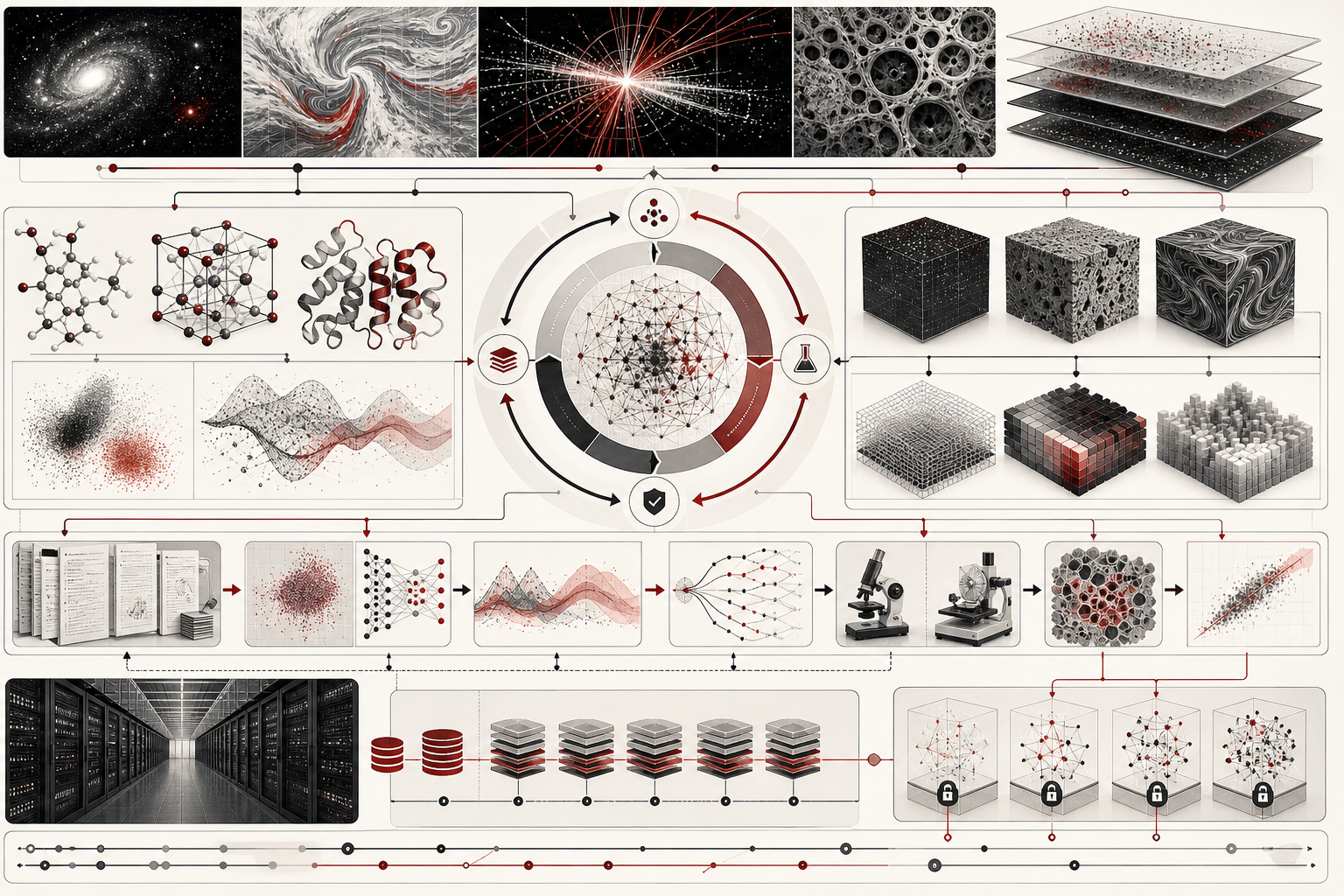
This article develops AI for Scientific Discovery and Computational Research as an advanced article within the Artificial Intelligence Systems knowledge series. It explains AI as part of the fourth paradigm of science, scientific workflow automation, representation learning, surrogate modeling, active learning, Bayesian optimization, causal discovery, symbolic regression, hypothesis generation, reproducibility, research infrastructure, scientific governance, and epistemic risk. Selected Python and R examples appear here, while the full GitHub repository contains expanded computational scaffolding for active learning, surrogate modeling, reproducibility diagnostics, scientific metadata, SQL schemas, Julia simulation, Rust validation tools, Go monitoring services, TypeScript dashboards, C/C++ numerical examples, Fortran grid simulation, advanced notebooks, and governance documentation.
Why AI for Scientific Discovery Matters
AI matters for scientific discovery because modern research increasingly exceeds unaided human pattern recognition. Scientific datasets are larger, more heterogeneous, and more computationally demanding than earlier research environments. Genomic sequences, protein structures, climate simulations, particle collision data, telescope observations, molecular libraries, materials databases, microscopy images, electronic health records, ecological sensor streams, and experimental logs create search spaces too large for manual exploration alone.
Machine learning can help by identifying structure in high-dimensional data, reducing dimensionality, approximating expensive simulations, ranking candidate experiments, detecting anomalies, extracting information from literature, and accelerating the iteration between hypothesis and test. In fields such as protein structure prediction, materials science, drug discovery, climate modeling, astronomy, high-energy physics, chemistry, genomics, ecology, and neuroscience, AI increasingly functions as a scientific amplifier.
Yet scientific amplification is not the same as scientific understanding. A model can predict accurately without explaining mechanisms. A generative system can propose candidates without proving that they work. A pattern can be statistically real but causally irrelevant. A simulation surrogate can be fast but wrong outside its training range. An automated experiment can optimize a narrow objective while missing the broader scientific question. For this reason, AI for science must be treated as a knowledge system, not just a performance technology.
Prediction \neq Scientific\ Understanding
\]
Interpretation: A scientific AI model may predict accurately while still failing to explain mechanism, support intervention, reproduce under independent conditions, or generalize beyond the data used to train it.
| Scientific Context | Why Conventional Search Is Not Enough | AI Contribution | Epistemic Risk |
|---|---|---|---|
| Biology | Sequences, structures, cells, and interactions create enormous search spaces. | Representation learning, protein modeling, imaging analysis, candidate prioritization. | Prediction may be mistaken for biological mechanism or experimental confirmation. |
| Materials science | Possible compositions and structures are too numerous to test exhaustively. | Surrogate models, active learning, inverse design, property prediction. | Candidate rankings may ignore synthesis feasibility or real-world stability. |
| Climate science | Earth systems require expensive simulations across scales and scenarios. | Emulation, downscaling, anomaly detection, hybrid forecasting. | Models may fail under shifting baselines or extrapolation. |
| Physics and astronomy | Instruments generate massive observational and experimental datasets. | Event classification, anomaly detection, simulation acceleration. | Instrument artifacts or selection effects may appear as discovery signals. |
| Medicine and chemistry | Candidate drugs, molecules, pathways, and reactions are combinatorially large. | Screening, generative design, biomarker discovery, synthesis planning. | Safety, efficacy, toxicity, and mechanism require validation. |
Note: AI strengthens scientific discovery when it narrows search spaces while preserving evidence, validation, uncertainty, and interpretability.
AI and the Fourth Paradigm of Science
Scientific practice is often described through several major modes of knowledge production: empirical observation, theoretical reasoning, experimental intervention, and computational simulation. Data-intensive science adds another layer: large-scale inference from massive datasets. AI intensifies this fourth paradigm by allowing models to learn patterns, representations, and predictions from complex scientific data at scales that exceed traditional statistical workflows.
The fourth-paradigm framing is useful because it recognizes that modern science is increasingly mediated by data infrastructure. Scientific discovery depends not only on equations and experiments, but also on databases, sensors, instruments, simulations, metadata, software, workflows, compute clusters, repositories, and reproducibility systems. AI operates within this infrastructure.
AI can expand scientific search by asking:
- Which candidates are most likely to have a desired property?
- Which experiment would reduce uncertainty the most?
- Which pattern is hidden in high-dimensional data?
- Which simulation parameter region is most important?
- Which mechanism is consistent with the evidence?
- Which anomaly may reveal a new phenomenon or instrument failure?
- Which hypothesis should be tested next?
These questions show why AI-driven discovery must remain connected to validation. Discovery is not complete when a model proposes a result. Scientific discovery requires evidence, replication, interpretation, and integration into a broader body of knowledge.
Data\text{-}Intensive\ Science = Instruments + Data + Models + Compute + Reproducibility
\]
Interpretation: AI-driven science depends on the infrastructure that collects, stores, documents, computes, validates, and reproduces scientific evidence.
| Scientific Mode | Primary Logic | AI Role | Validation Requirement |
|---|---|---|---|
| Empirical observation | Measure and describe phenomena. | Classify, detect, segment, and organize observations. | Measurement quality, calibration, and ground truth. |
| Theoretical reasoning | Explain phenomena through concepts, equations, and mechanisms. | Search symbolic forms, identify patterns, propose mechanisms. | Mechanistic interpretation and theoretical consistency. |
| Experimental intervention | Manipulate variables and test causal claims. | Guide experiment selection and optimize protocols. | Experimental design, controls, and replication. |
| Computational simulation | Model complex systems numerically. | Accelerate simulation, emulate expensive models, explore parameters. | Out-of-distribution testing and physical constraints. |
| Data-intensive inference | Discover patterns across large-scale datasets. | Learn representations, detect anomalies, generate candidates. | Reproducibility, uncertainty, and causal review. |
Note: AI extends scientific inquiry most responsibly when it is embedded within the larger evidentiary structure of science.
AI Across the Scientific Research Workflow
AI can support nearly every stage of scientific research, but different stages require different kinds of rigor. A system that summarizes literature needs source verification. A system that proposes experiments needs safety constraints. A system that ranks molecules needs validation. A system that approximates simulations needs uncertainty bounds. A system that proposes mechanisms needs causal and experimental testing.
| Research Stage | AI Contribution | Scientific Risk | Required Safeguard |
|---|---|---|---|
| Literature review | Retrieval, summarization, topic mapping, evidence extraction. | Misquotation, overgeneralization, missing context. | Source verification and expert review. |
| Data preparation | Cleaning, harmonization, segmentation, labeling, anomaly detection. | Hidden preprocessing bias. | Data lineage and quality audits. |
| Representation learning | Latent structure, embeddings, feature extraction. | Pattern without mechanism. | Domain validation and interpretability. |
| Simulation | Surrogate modeling, emulation, acceleration. | Failure outside training range. | Uncertainty bounds and physical constraints. |
| Hypothesis generation | Candidate mechanisms, symbolic forms, design proposals. | Speculative or spurious hypotheses. | Experimental testing and causal reasoning. |
| Experimental design | Active learning, Bayesian optimization, adaptive sampling. | Optimization of narrow objectives. | Multi-objective review and constraints. |
| Validation | Benchmarking, uncertainty estimation, replication checks. | Benchmark overfitting. | Independent test sets and preregistered criteria. |
| Dissemination | Visualization, explanation, reproducible notebooks, documentation. | Overclaiming and poor reproducibility. | Transparent code, data, and methods. |
Note: The best scientific AI systems do not replace the scientific workflow. They make the workflow more systematic, searchable, testable, and reproducible.
AI also changes the pace of scientific work. It can compress cycles of search, testing, and refinement. But speed is useful only when the evidence system is strong enough to prevent rapid error amplification. A fast discovery system without reproducibility can become a fast error-production system.
Acceleration\ Without\ Validation \rightarrow Faster\ Error
\]
Interpretation: AI can accelerate scientific search, but without validation, reproducibility, and uncertainty review, it can also accelerate misleading claims.
Representation Learning and Pattern Discovery
Representation learning is central to AI-driven scientific discovery. Scientific data is often too complex for hand-designed features alone. Neural networks, graph models, transformers, autoencoders, and other machine learning systems can learn structured representations that make hidden regularities computationally visible.
In biology, representations may encode protein sequences, protein structures, gene expression patterns, cellular images, or molecular interactions. In chemistry and materials science, they may encode molecular graphs, crystal structures, electronic properties, or synthesis conditions. In climate science, they may encode spatial fields, circulation patterns, teleconnections, or extreme-event signatures. In physics, they may encode detector events, waveforms, particle tracks, or simulation states.
Representation learning is powerful because it can reduce complexity. But it is not automatically explanatory. A latent representation can organize data in a useful way while remaining mechanistically obscure. Scientific use requires additional interpretation: What does the representation capture? Does it correspond to known mechanisms? Does it generalize outside the training set? Can it be tested experimentally? Does it preserve physical or biological constraints?
| Domain | Scientific Input | Learned Representation | Validation Question |
|---|---|---|---|
| Protein science | Sequences, structures, alignments, interactions. | Embeddings of structure, function, and evolutionary signal. | Does the representation predict experimental behavior? |
| Chemistry | Molecular graphs, reactions, spectra, assays. | Latent chemical structure and property patterns. | Does the model respect chemistry, toxicity, and synthesis constraints? |
| Materials science | Composition, crystal structure, processing history. | Embeddings of phase, stability, and property relationships. | Can proposed candidates be synthesized and remain stable? |
| Climate science | Spatiotemporal fields, simulations, observations. | Circulation patterns, teleconnections, extreme-event signatures. | Does the representation generalize under climate change? |
| Astronomy | Images, spectra, light curves, surveys. | Object classes, transient signatures, anomaly structures. | Does the pattern reflect astrophysics or instrument artifact? |
Note: Scientific representation learning should be evaluated by mechanistic relevance, generalization, uncertainty, and experimental usefulness—not only predictive accuracy.
Useful\ Scientific\ Representation = Compression + Prediction + Interpretability + Validation
\]
Interpretation: A scientific representation is valuable when it reduces complexity while preserving meaningful structure that can be interpreted, tested, and used for further inquiry.
Simulation, Surrogate Models, and Hybrid Scientific Systems
Many scientific fields rely on expensive simulations: climate models, computational fluid dynamics, molecular dynamics, density functional theory, astrophysical simulations, agent-based models, epidemiological simulations, and finite-element models. These simulations can be accurate but computationally costly. AI can help by learning surrogate models that approximate simulation outputs much faster.
Surrogate models can support:
- rapid parameter-space exploration;
- sensitivity analysis;
- uncertainty propagation;
- inverse modeling;
- real-time decision support;
- optimization and design;
- adaptive experimental planning.
Hybrid scientific systems combine mechanistic models with data-driven components. Rather than treating physics and machine learning as competitors, hybrid modeling asks where each is strongest. Physical models provide constraints, structure, and interpretability. Machine learning provides flexibility, approximation, pattern recognition, and acceleration. The strongest systems often combine both.
| Model Type | Role in Science | AI Contribution | Risk |
|---|---|---|---|
| Mechanistic simulation | Encodes scientific equations or process rules. | Provides training data, structure, or validation target. | Can be expensive or incomplete. |
| Surrogate model | Approximates expensive simulation or experiment. | Accelerates parameter search and optimization. | May fail outside training range. |
| Hybrid model | Combines mechanistic and learned components. | Balances scientific structure with data-driven flexibility. | Boundary between theory and learned approximation may be unclear. |
| Emulator | Produces fast approximations of complex models. | Enables scenario exploration and uncertainty analysis. | Can hide uncertainty if treated as the original simulator. |
| Inverse model | Infers causes, parameters, or designs from outcomes. | Supports design, calibration, and discovery. | May produce nonunique or physically impossible solutions. |
Note: Surrogate models should be governed by domain boundaries, uncertainty estimates, and validation against high-fidelity evidence.
Fast\ Approximation \neq Scientific\ Truth
\]
Interpretation: A surrogate can accelerate scientific exploration, but it must be validated against the simulator, experiment, or physical system it approximates.
Active Learning, Bayesian Optimization, and Experimental Design
Scientific search spaces are often enormous. A materials scientist may face millions of possible compounds. A biologist may face thousands of perturbations. A chemist may face many reaction conditions. A climate scientist may face many scenario and parameter combinations. Testing every possibility is impossible.
Active learning and Bayesian optimization help select experiments strategically. Instead of sampling randomly or exhaustively, the system proposes the next experiment based on expected information gain, predicted performance, uncertainty, feasibility, cost, and scientific value.
A scientific acquisition function may combine several goals:
a(x) = \alpha \mu(x) + \beta \sigma(x) – \gamma C(x)
\]
Interpretation: The value of testing candidate \(x\) may depend on predicted performance \(\mu(x)\), uncertainty \(\sigma(x)\), and experimental cost \(C(x)\). The weights \(\alpha\), \(\beta\), and \(\gamma\) express the tradeoff between exploitation, exploration, and cost.
This logic is especially important for self-driving laboratories and autonomous experimentation. The key governance question is whether the system is optimizing the right objective. A laboratory AI may find high-performing candidates while ignoring safety, cost, accessibility, synthesis feasibility, environmental impact, or theoretical significance. Scientific automation must remain aligned with scientific purpose.
| Design Goal | Acquisition Logic | Scientific Value | Risk if Over-Optimized |
|---|---|---|---|
| Exploitation | Test candidates predicted to perform well. | Finds high-performing candidates quickly. | May get trapped in familiar regions. |
| Exploration | Test uncertain or under-sampled candidates. | Improves knowledge of the search space. | May waste resources without scientific priorities. |
| Cost reduction | Prefer feasible, cheaper, or faster experiments. | Makes discovery more efficient. | May ignore expensive but important experiments. |
| Safety constraint | Avoid hazardous, unethical, or infeasible candidates. | Protects people, labs, ecosystems, and institutions. | Requires accurate hazard and feasibility data. |
| Scientific value | Select experiments that test theory or reduce uncertainty. | Improves knowledge, not only performance. | Harder to quantify than narrow objectives. |
Note: Active learning should optimize scientific value, not only predicted performance.
Best\ Candidate \neq Best\ Next\ Experiment
\]
Interpretation: The most promising candidate may not be the best next experiment if another candidate would reduce uncertainty, test a mechanism, or improve the model more effectively.
Causal Discovery and Scientific Inference
Science seeks more than prediction. It seeks explanations of why phenomena occur and how interventions would change them. This makes causality central. Machine learning can identify associations, but scientific understanding often requires causal structure: mechanisms, interventions, counterfactuals, and controlled experiments.
Causal discovery methods attempt to infer possible causal relationships from observational and experimental data. These tools can be useful, but they depend on assumptions. Confounding, selection bias, measurement error, feedback loops, and hidden variables can make causal discovery difficult. AI cannot overcome poor experimental design by computation alone.
A responsible scientific AI system should distinguish among:
- prediction: estimating likely outcomes;
- association: identifying statistical relationships;
- mechanism: explaining how a process works;
- intervention: estimating what would happen if a variable were changed;
- counterfactual: reasoning about what would have happened under different conditions.
This distinction prevents AI-generated patterns from being mistaken for scientific explanation.
| Scientific Claim Type | Question | Evidence Needed | AI Risk |
|---|---|---|---|
| Prediction | What outcome is likely? | Validation data, calibration, uncertainty. | Accuracy may be mistaken for understanding. |
| Association | Which variables are statistically related? | Observed data, controls, robustness checks. | Correlation may be mistaken for mechanism. |
| Mechanism | How does the process work? | Theory, experimental evidence, process models. | Latent patterns may be overinterpreted. |
| Intervention | What happens if a variable is changed? | Experiment, quasi-experiment, causal model. | Predictions may fail under manipulation. |
| Counterfactual | What would have happened otherwise? | Causal assumptions and model structure. | Speculative reasoning may appear definitive. |
Note: Scientific AI should label the kind of knowledge it produces: prediction, association, mechanism, intervention, or counterfactual claim.
Correlation + Fluency \neq Scientific\ Explanation
\]
Interpretation: A statistically supported or verbally plausible pattern still requires causal, mechanistic, and experimental validation before it becomes scientific explanation.
Hypothesis Generation, Symbolic Regression, and Theory Search
AI can help generate hypotheses by identifying anomalies, clusters, candidate mechanisms, symbolic relationships, or designs that merit testing. Symbolic regression is especially important because it searches for mathematical expressions that fit data, potentially producing compact equations rather than opaque models.
Generative models can propose molecules, materials, proteins, experimental protocols, or scientific designs. Language models can suggest possible mechanisms or organize literature. Search algorithms can explore theory spaces. These systems can widen the scope of scientific imagination.
However, hypothesis generation is not hypothesis confirmation. A generated hypothesis should be treated as a candidate for testing. It becomes scientific knowledge only through validation, replication, causal analysis, and integration with existing evidence. AI can help propose the next question, but the scientific community must still decide whether the answer is trustworthy.
Generated\ Hypothesis \rightarrow Testable\ Claim \rightarrow Evidence \rightarrow Scientific\ Knowledge
\]
Interpretation: AI can propose hypotheses, but hypotheses become scientific knowledge only through testing, validation, replication, and interpretation.
| Method | Scientific Use | Potential Value | Validation Requirement |
|---|---|---|---|
| Anomaly detection | Find unexpected observations or events. | May reveal new phenomena or instrument problems. | Rule out artifacts, noise, and selection effects. |
| Symbolic regression | Search compact mathematical expressions. | May suggest interpretable relationships. | Check dimensional consistency, mechanism, and out-of-sample behavior. |
| Generative design | Propose molecules, proteins, materials, or protocols. | Expands candidate search spaces. | Evaluate feasibility, safety, synthesis, and performance. |
| Literature mining | Connect claims across publications. | Reveals overlooked relationships. | Verify sources and avoid automated overclaiming. |
| Theory search | Explore alternative explanatory structures. | Supports scientific imagination and model comparison. | Requires experimental and conceptual scrutiny. |
Note: AI-generated hypotheses should be treated as research candidates, not as confirmed scientific claims.
Applications Across Scientific Domains
AI-driven discovery is already reshaping multiple scientific domains. Across these domains, AI’s strongest role is often triage: narrowing a vast search space so that human expertise, experiments, simulations, and peer review can focus on the most promising candidates.
| Domain | AI Discovery Tasks | Scientific Value | Key Risk |
|---|---|---|---|
| Biology | Protein structure prediction, protein design, genomics, cellular imaging. | Accelerates molecular understanding and biological hypothesis generation. | Prediction mistaken for experimental confirmation. |
| Chemistry | Reaction prediction, molecular generation, catalyst screening, synthesis planning. | Expands chemical design spaces. | Feasibility, toxicity, and mechanism may be undervalidated. |
| Materials science | Crystal prediction, property screening, phase stability, inverse design. | Accelerates discovery of materials for energy, electronics, and sustainability. | Candidate stability and synthesis pathways require validation. |
| Climate science | Downscaling, emulation, extreme-event detection, hybrid forecasting. | Improves modeling speed and pattern recognition. | Changing baselines and extrapolation risk. |
| Physics | Detector analysis, event classification, simulation acceleration, anomaly detection. | Supports analysis of high-dimensional experimental data. | Spurious anomaly claims and interpretability limits. |
| Astronomy | Survey classification, transient detection, image reconstruction, simulation emulation. | Scales discovery across massive observational datasets. | Selection effects and instrument artifacts. |
| Medicine | Drug discovery, imaging, biomarker discovery, trial design. | Improves candidate prioritization and translational research. | Clinical validity and safety require careful testing. |
| Ecology | Species detection, ecosystem monitoring, biodiversity modeling. | Supports conservation and environmental stewardship. | Sampling bias and uneven monitoring coverage. |
Note: AI’s scientific value depends on whether model outputs become testable, reproducible, interpretable, and validated claims.
Uncertainty, Validation, and Reproducibility
Scientific validity depends on uncertainty, validation, and reproducibility. AI systems in science must report not only predictions, but also what is known about prediction reliability. This includes epistemic uncertainty, aleatoric uncertainty, distribution shift, measurement uncertainty, simulation error, and uncertainty introduced by preprocessing or data selection.
Validation should include:
- held-out test sets: evaluating on data not used in training;
- out-of-distribution testing: testing beyond familiar regions of the data space;
- ablation studies: checking which data and model components matter;
- physical or biological plausibility checks: comparing outputs to domain constraints;
- independent replication: testing whether other teams can reproduce the result;
- experimental confirmation: verifying predictions in laboratory or field settings;
- code and data availability: enabling inspection of computational workflows;
- version control: tracking data, model, parameters, and environment.
Reproducibility is especially difficult in AI-driven science because results can depend on random seeds, hardware, package versions, preprocessing choices, training data, hyperparameters, hidden data leakage, and undocumented prompt or workflow decisions. Scientific AI requires research-grade software engineering.
| Requirement | Question | Evidence | Failure Mode |
|---|---|---|---|
| Uncertainty quantification | How reliable is the prediction? | Confidence intervals, posterior distributions, ensembles, calibration. | Single-point outputs appear more certain than they are. |
| Out-of-distribution testing | Does the model work beyond familiar data? | Novel candidate tests, stress tests, external datasets. | Models fail where discovery matters most. |
| Physical plausibility | Does the output respect scientific constraints? | Domain checks, conservation laws, expert review. | High-scoring candidates are impossible or meaningless. |
| Experimental validation | Does the prediction survive intervention? | Laboratory, field, clinical, or simulation confirmation. | Prediction is mistaken for evidence. |
| Computational reproducibility | Can others reproduce the workflow? | Code, data, environment, seeds, metadata, documentation. | Claims depend on hidden or fragile workflows. |
Note: Scientific AI requires both predictive validation and workflow reproducibility.
Scientific\ Claim = Prediction + Uncertainty + Validation + Reproducibility
\]
Interpretation: A model output becomes scientifically meaningful only when its uncertainty, validation status, and reproducibility conditions are documented.
AI in Scientific Infrastructure and Research Automation
AI for science increasingly depends on scientific infrastructure: high-performance computing, cloud systems, instrument control, laboratory automation, simulation platforms, data repositories, workflow managers, metadata standards, notebooks, provenance systems, and research software engineering.
Self-driving laboratories illustrate this infrastructure shift. In an autonomous experimental system, AI may select experiments, instruments perform them, sensors record outcomes, models update, and the cycle repeats. These systems can accelerate discovery, but they also require strong controls: safety limits, audit logs, calibration checks, human oversight, and scientific review.
Scientific infrastructure must preserve accountability. When an AI system proposes experiments, updates models, and generates results, researchers must be able to reconstruct what happened: which data was used, which model version generated the recommendation, which parameters were selected, which instruments were involved, which failures occurred, and how results were validated.
| Infrastructure Layer | Function | Scientific Value | Governance Concern |
|---|---|---|---|
| Data repositories | Store datasets, labels, metadata, and provenance. | Supports reuse, validation, and replication. | Incomplete metadata weakens scientific claims. |
| Workflow systems | Coordinate data processing, training, simulation, and analysis. | Improves reproducibility and automation. | Hidden pipeline steps create unreviewable results. |
| Compute infrastructure | Runs models, simulations, and large-scale searches. | Enables scientific scale and acceleration. | Access inequality concentrates scientific power. |
| Instrument integration | Connects models to laboratory or field equipment. | Supports autonomous experimentation. | Requires safety constraints and human oversight. |
| Provenance systems | Track data, code, model, environment, and outputs. | Makes claims auditable and reproducible. | Without provenance, results become difficult to trust. |
Note: AI-driven science depends on research infrastructure that can preserve evidence, context, and reproducibility.
Scientific\ Automation = Instruments + Models + Workflows + Audit\ Trails
\]
Interpretation: Automated scientific systems require not only models and instruments, but also records that preserve how knowledge was produced.
Governance, Epistemology, and Scientific Institutions
AI changes scientific institutions because it changes the conditions of knowledge production. Research groups with access to data, compute, models, instruments, and automation may gain major advantages. Proprietary systems may shape scientific agendas. Closed models may produce results that are difficult to inspect. Automated literature tools may influence which claims are noticed or ignored. Benchmark culture may reward performance without understanding.
Scientific governance should address:
- transparency of data, code, and model assumptions;
- access to compute and scientific infrastructure;
- reproducibility of AI-assisted claims;
- publication standards for model-generated hypotheses;
- documentation of uncertainty and limitations;
- conflicts between proprietary models and open science;
- laboratory safety and biosecurity where generative design is involved;
- equitable participation in AI-enabled research.
AI-driven science raises a philosophical question: what counts as understanding? If a model predicts a phenomenon accurately but cannot explain it mechanistically, does the result count as scientific understanding or only instrumental prediction? The answer depends on context. In some settings, prediction is valuable. In others, mechanism is essential. Responsible scientific AI should clarify which kind of knowledge it is producing.
| Governance Area | Question | Evidence Needed | Risk if Ignored |
|---|---|---|---|
| Open science | Can others inspect and reproduce the claim? | Code, data, metadata, model details, environment files. | Scientific claims become dependent on closed systems. |
| Compute access | Who can participate in AI-enabled science? | Infrastructure access, funding, shared resources. | Scientific power concentrates in wealthy institutions. |
| Safety and biosecurity | Can generative systems propose harmful designs? | Screening, constraints, review boards, safe-use policies. | Discovery systems create misuse pathways. |
| Epistemic transparency | What kind of knowledge is the system producing? | Prediction, causal, mechanistic, or exploratory claim labels. | Speculation is mistaken for established science. |
| Research accountability | Who is responsible for AI-assisted claims? | Authorship policies, audit trails, review records. | Responsibility diffuses across people and systems. |
Note: AI-driven science requires governance structures that protect scientific integrity, openness, safety, and equitable participation.
Limits and Failure Modes
AI for scientific discovery has major limitations.
First, AI can produce prediction without explanation. A model may predict accurately without revealing mechanism. In some contexts, prediction is useful. In others, scientific understanding requires causal structure, theory, and experimental interpretation.
Second, AI can confuse correlation with causality. Learned patterns may not survive intervention or experimental manipulation. Scientific discovery requires causal reasoning, not only statistical association.
Third, AI can inherit search-space bias. Models can only explore candidates represented in the data, simulator, generative system, or design space. If the search space is narrow, the discovery system may reproduce existing assumptions.
Fourth, AI can overfit benchmarks. Systems may improve on standard metrics without improving scientific understanding, experimental usefulness, or real-world validity.
Fifth, automation can become opaque. Automated systems can generate results that are difficult to reconstruct if data, code, model versions, seeds, instruments, and workflow decisions are not logged.
Sixth, scientific infrastructure can become unequal. Access to compute, proprietary models, specialized instruments, and large datasets may concentrate scientific power in a small number of institutions or companies.
Seventh, reproducibility gaps can weaken claims. Model results may depend on hidden preprocessing, random seeds, hardware, package versions, hyperparameters, proprietary tools, or undocumented prompt workflows.
Eighth, language models can create misleading fluency. A model may summarize, explain, or hypothesize in ways that sound plausible but require verification against sources, experiments, and domain knowledge.
These limitations do not undermine AI for science. They define the conditions under which it must be used. AI-driven discovery should be treated as an extension of scientific method, not an exemption from it.
AI\text{-}Generated\ Result \neq Scientific\ Claim
\]
Interpretation: A result produced by an AI system becomes a scientific claim only when it is validated, interpreted, documented, and made reproducible within a research community.
Mathematical Lens: Representation, Discovery, Causality, and Search
A scientific AI model often begins by mapping observations into a representation space.
z = f_{\theta}(x)
\]
Interpretation: The model \(f_{\theta}\) maps scientific data \(x\) into a learned representation \(z\). In biology, \(x\) might be a sequence or structure; in materials science, it might be composition and crystal geometry; in climate science, it might be a spatiotemporal field.
Prediction estimates an unknown scientific property or outcome.
\hat{y} = g_{\phi}(z)
\]
Interpretation: A second model \(g_{\phi}\) maps the learned representation \(z\) to a predicted property \(\hat{y}\), such as binding affinity, failure probability, catalytic activity, phase stability, or experimental response.
Surrogate modeling approximates an expensive scientific simulator or experiment.
S(x) \approx \hat{S}_{\theta}(x)
\]
Interpretation: A machine learning surrogate \(\hat{S}_{\theta}\) approximates an expensive simulation or experiment \(S\), enabling faster exploration of parameter spaces.
Active learning chooses the next experiment based on expected information gain, uncertainty, or utility.
x_{next} = \arg\max_{x \in \mathcal{X}} a(x)
\]
Interpretation: The next experiment \(x_{next}\) is selected from the candidate space \(\mathcal{X}\) by maximizing an acquisition function \(a(x)\), such as expected improvement, uncertainty reduction, or scientific value.
Bayesian updating formalizes how evidence changes belief.
P(H \mid D) =
\frac{P(D \mid H)P(H)}{P(D)}
\]
Interpretation: The probability of hypothesis \(H\) after observing data \(D\) depends on the likelihood of the data under the hypothesis, the prior plausibility of the hypothesis, and the overall probability of the data.
Scientific inference must distinguish observation from intervention.
P(y \mid x) \neq P(y \mid do(x))
\]
Interpretation: Observing \(x\) is not the same as intervening to set \(x\). Scientific explanation often requires causal inference, not prediction alone.
Reproducibility can be framed as stability of results under controlled reruns.
R = \mathbb{I}\left(|m(D, c) – m(D’, c’)| \leq \epsilon \right)
\]
Interpretation: A result is reproducible when the measured result \(m\) remains within tolerance \(\epsilon\) under documented data \(D\), code \(c\), replicated data \(D’\), and replicated code or conditions \(c’\).
A governed scientific discovery score can combine predicted performance, uncertainty, cost, feasibility, safety, and scientific value.
DiscoveryScore(x) =
\alpha \mu(x) +
\beta \sigma(x) –
\gamma C(x) –
\lambda R_{safety}(x) +
\eta V_{science}(x)
\]
Interpretation: A scientific candidate \(x\) may be prioritized using predicted performance \(\mu(x)\), uncertainty \(\sigma(x)\), cost \(C(x)\), safety risk \(R_{safety}(x)\), and scientific value \(V_{science}(x)\). The weights should be documented and reviewed.
Variables and System Interpretation
| Symbol or Term | Meaning | Typical Scientific Interpretation | System Relevance |
|---|---|---|---|
| \(x\) | Scientific input | Sequence, image, field, molecule, material, signal, or experimental condition. | Raw input to the scientific AI model. |
| \(z\) | Latent representation | Learned structure or embedding. | Supports pattern discovery and downstream prediction. |
| \(\hat{y}\) | Predicted property | Binding affinity, phase stability, risk score, response, or label. | Model output used for scientific reasoning. |
| \(S(x)\) | Scientific simulator or experiment | Expensive computation, laboratory experiment, or physical model. | Ground process being approximated or sampled. |
| \(\hat{S}_{\theta}(x)\) | Surrogate model | Fast approximation of a simulator or experiment. | Enables rapid search and sensitivity analysis. |
| \(\mathcal{X}\) | Candidate space | Possible molecules, materials, parameters, designs, or experiments. | Search space for discovery. |
| \(a(x)\) | Acquisition function | Expected value of testing candidate \(x\). | Guides active learning and experimental design. |
| \(H\) | Hypothesis | Candidate explanation, mechanism, relationship, or theory. | Object of scientific evaluation. |
| \(D\) | Data | Observations, experiments, simulations, or measurements. | Evidence used to update belief or train models. |
| \(P(H \mid D)\) | Posterior probability | Updated plausibility of a hypothesis after evidence. | Formalizes evidence-based reasoning. |
| \(do(x)\) | Intervention | Experimentally setting or manipulating \(x\). | Distinguishes causal inference from correlation. |
| \(R\) | Reproducibility indicator | Whether results hold under rerun or replication. | Central to scientific trustworthiness. |
Note: AI-driven discovery becomes scientifically meaningful only when model outputs are connected to measurement quality, validation, uncertainty, causal reasoning, and reproducible workflows.
Worked Example: AI-Assisted Materials Discovery
Consider a materials discovery workflow searching for candidate compounds with high stability, low cost, and desirable electronic properties. The candidate space may contain millions of possible compositions and structures. Direct simulation or synthesis for every candidate is impossible.
An AI-assisted workflow might proceed as follows:
- Compile a database of known materials, structures, properties, and experimental records.
- Train a representation model on composition, structure, and property data.
- Train a surrogate model to predict stability and target properties.
- Use an acquisition function to select candidates balancing predicted performance and uncertainty.
- Run high-fidelity simulations or laboratory synthesis on selected candidates.
- Update the model with new evidence.
- Repeat until candidate quality improves or uncertainty is reduced.
The scientific value of this workflow depends on more than the model ranking. Researchers must ask whether the candidates are physically plausible, synthesizable, stable under real conditions, environmentally acceptable, and interpretable in relation to materials theory. The AI system accelerates the search, but the discovery becomes credible through simulation, experiment, and scientific explanation.
| Output Field | Meaning | Why It Matters | Review Question |
|---|---|---|---|
| Predicted property | Estimated stability, conductivity, strength, activity, or other target value. | Supports candidate ranking. | Is the prediction calibrated and externally validated? |
| Uncertainty score | How uncertain the model is about the candidate. | Supports exploration and risk review. | Is the candidate outside the training distribution? |
| Synthesis feasibility | Likelihood that the material can be produced. | Prevents unrealistic recommendations. | Are required conditions practical and safe? |
| Safety or toxicity flag | Potential hazard, toxicity, or handling concern. | Protects laboratory and downstream use. | Does the candidate require special review or exclusion? |
| Scientific value | Whether testing the candidate advances theory or reduces uncertainty. | Prioritizes knowledge, not only performance. | What would be learned from testing this candidate? |
Note: Scientific ranking should combine predicted performance with uncertainty, feasibility, safety, and knowledge value.
Discovery\ Priority \neq Predicted\ Performance\ Alone
\]
Interpretation: A scientifically responsible candidate priority should consider uncertainty, feasibility, safety, cost, reproducibility, and theoretical value—not only the highest predicted score.
Computational Modeling
Computational modeling for AI-driven discovery should produce artifacts that help scientists evaluate, reproduce, and govern the discovery process. A useful workflow should not merely output a ranked candidate list. It should preserve the candidate space, observed experiments, surrogate model assumptions, acquisition scores, uncertainty measures, selected candidates, reproducibility metadata, and governance notes.
A practical scientific discovery workflow should answer several questions:
- Which candidates were available to the model?
- Which candidates were observed, simulated, or experimentally tested?
- Which model predicted candidate properties?
- Which acquisition function selected the next experiments?
- How were uncertainty, cost, safety, and feasibility handled?
- Which random seed, package versions, and model settings were used?
- Can another researcher reproduce the candidate ranking?
- Which candidates require independent validation before scientific claims are made?
| Artifact | Purpose | Governance Value |
|---|---|---|
| Candidate-space table | Documents all possible candidates, features, constraints, and known properties. | Supports search transparency and bias review. |
| Observed-candidate log | Records which experiments, simulations, or measurements have been performed. | Supports reproducibility and active learning audit. |
| Surrogate-model report | Documents model form, assumptions, training data, and validation. | Clarifies where model predictions can be trusted. |
| Acquisition-score table | Explains why candidates were selected next. | Supports review of exploration, exploitation, cost, and safety tradeoffs. |
| Reproducibility summary | Tracks seeds, environment, parameters, and repeated-run stability. | Supports scientific trust and independent verification. |
| Governance memo | Summarizes limitations, validation status, and next review steps. | Prevents model outputs from being overclaimed as discoveries. |
Note: Scientific AI workflows should generate evidence for reproducibility, review, and validation—not only optimized outputs.
Python Workflow: Active Learning for Scientific Discovery
Python is useful for discovery workflows because it supports data processing, modeling, simulation, experiment selection, and reproducible outputs. The following workflow demonstrates a simple active-learning loop for scientific discovery. It creates a synthetic candidate space, observes a small number of candidates, trains a surrogate model, ranks untested candidates by a discovery acquisition score, and writes governance-ready outputs.
"""
AI for Scientific Discovery and Computational Research
Python workflow: active learning for scientific candidate discovery.

This example uses a synthetic candidate space so it can be adapted to
materials discovery, molecular screening, experimental design, or simulation
parameter search.
"""

from __future__ import annotations

from pathlib import Path

import numpy as np
import pandas as pd


RANDOM_SEED = 42
rng = np.random.default_rng(RANDOM_SEED)

OUTPUT_DIR = Path("outputs")
OUTPUT_DIR.mkdir(exist_ok=True)


def create_candidate_space(n: int = 1200) -> pd.DataFrame:
    """
    Create synthetic scientific candidates with hidden true properties.

    In real scientific workflows, these candidates might be molecules,
    materials, proteins, simulation parameters, reaction conditions, or
    experimental designs.
    """
    x1 = rng.uniform(0, 1, n)
    x2 = rng.uniform(0, 1, n)
    x3 = rng.uniform(0, 1, n)
    x4 = rng.uniform(0, 1, n)

    true_property = (
        1.8 * np.sin(np.pi * x1)
        + 1.2 * np.cos(np.pi * x2)
        + 0.9 * x3 * x4
        - 0.4 * x2**2
        + rng.normal(0, 0.05, n)
    )

    synthesis_cost = 0.25 + 0.55 * x4 + 0.20 * rng.uniform(0, 1, n)
    safety_penalty = np.where(x2 > 0.85, 0.35, 0.00)

    return pd.DataFrame(
        {
            "candidate_id": [f"C{i:04d}" for i in range(n)],
            "feature_1": x1,
            "feature_2": x2,
            "feature_3": x3,
            "feature_4": x4,
            "true_property": true_property,
            "synthesis_cost": synthesis_cost,
            "safety_penalty": safety_penalty,
        }
    )


def design_matrix(df: pd.DataFrame) -> np.ndarray:
    """Create a polynomial design matrix for a simple surrogate model."""
    x1 = df["feature_1"].to_numpy()
    x2 = df["feature_2"].to_numpy()
    x3 = df["feature_3"].to_numpy()
    x4 = df["feature_4"].to_numpy()

    return np.column_stack(
        [
            np.ones(len(df)),
            x1,
            x2,
            x3,
            x4,
            x1**2,
            x2**2,
            x3**2,
            x4**2,
            x1 * x2,
            x3 * x4,
        ]
    )


def fit_ridge_surrogate(x: np.ndarray, y: np.ndarray, ridge: float = 0.01) -> np.ndarray:
    """
    Fit a ridge regression surrogate using linear algebra.

    This keeps the example dependency-light while still demonstrating
    surrogate modeling logic.
    """
    identity = np.eye(x.shape[1])
    identity[0, 0] = 0.0

    return np.linalg.solve(x.T @ x + ridge * identity, x.T @ y)


def predict_surrogate(beta: np.ndarray, x: np.ndarray) -> np.ndarray:
    """Predict candidate properties from surrogate coefficients."""
    return x @ beta


def uncertainty_proxy(candidates: pd.DataFrame, observed: pd.DataFrame) -> np.ndarray:
    """
    Estimate uncertainty using distance to nearest observed candidate.

    This is a dependency-light proxy for scientific exploration:
    candidates far from observed experiments receive higher uncertainty.
    """
    candidate_features = candidates[
        ["feature_1", "feature_2", "feature_3", "feature_4"]
    ].to_numpy()

    observed_features = observed[
        ["feature_1", "feature_2", "feature_3", "feature_4"]
    ].to_numpy()

    distances = []

    for row in candidate_features:
        d = np.sqrt(((observed_features - row) ** 2).sum(axis=1)).min()
        distances.append(d)

    distances = np.array(distances)

    return distances / max(distances.max(), 1e-8)


def run_active_learning_rounds(
    rounds: int = 5,
    initial_samples: int = 40,
    batch_size: int = 25,
) -> None:
    """
    Run active learning over a synthetic scientific candidate space.

    Each round trains a surrogate model on observed candidates and selects
    new candidates using predicted property, uncertainty, cost, and safety.
    """
    candidates = create_candidate_space()

    observed_ids = set(
        rng.choice(candidates["candidate_id"], size=initial_samples, replace=False)
    )

    history = []

    for round_id in range(1, rounds + 1):
        observed = candidates[candidates["candidate_id"].isin(observed_ids)].copy()
        unobserved = candidates[~candidates["candidate_id"].isin(observed_ids)].copy()

        beta = fit_ridge_surrogate(
            design_matrix(observed),
            observed["true_property"].to_numpy(),
        )

        unobserved["predicted_property"] = predict_surrogate(
            beta,
            design_matrix(unobserved),
        )

        unobserved["uncertainty_proxy"] = uncertainty_proxy(unobserved, observed)

        unobserved["acquisition_score"] = (
            0.60 * unobserved["predicted_property"]
            + 0.30 * unobserved["uncertainty_proxy"]
            - 0.20 * unobserved["synthesis_cost"]
            - 0.40 * unobserved["safety_penalty"]
        )

        selected = unobserved.sort_values(
            "acquisition_score",
            ascending=False,
        ).head(batch_size)

        observed_ids.update(selected["candidate_id"])

        history.append(
            {
                "round": round_id,
                "observed_candidates": len(observed_ids),
                "best_observed_property": candidates[
                    candidates["candidate_id"].isin(observed_ids)
                ]["true_property"].max(),
                "mean_selected_true_property": selected["true_property"].mean(),
                "mean_selected_cost": selected["synthesis_cost"].mean(),
                "mean_selected_safety_penalty": selected["safety_penalty"].mean(),
            }
        )

        selected.to_csv(
            OUTPUT_DIR / f"python_selected_candidates_round_{round_id}.csv",
            index=False,
        )

    final_observed = candidates[candidates["candidate_id"].isin(observed_ids)].copy()
    history_df = pd.DataFrame(history)

    candidates.to_csv(OUTPUT_DIR / "python_candidate_space.csv", index=False)
    final_observed.to_csv(OUTPUT_DIR / "python_observed_candidates.csv", index=False)
    history_df.to_csv(OUTPUT_DIR / "python_active_learning_history.csv", index=False)

    governance_summary = pd.DataFrame(
        [
            {
                "rounds_completed": rounds,
                "initial_samples": initial_samples,
                "batch_size": batch_size,
                "total_observed_candidates": len(final_observed),
                "best_observed_property": final_observed["true_property"].max(),
                "mean_observed_cost": final_observed["synthesis_cost"].mean(),
                "mean_observed_safety_penalty": final_observed["safety_penalty"].mean(),
            }
        ]
    )

    governance_summary.to_csv(
        OUTPUT_DIR / "python_active_learning_governance_summary.csv",
        index=False,
    )

    memo = f"""# Scientific Discovery Active Learning Memo

## Summary

Rounds completed: {rounds}
Initial samples: {initial_samples}
Batch size: {batch_size}
Total observed candidates: {len(final_observed)}
Best observed property: {final_observed["true_property"].max():.4f}

## Interpretation

- The surrogate model accelerates search through a large candidate space.
- The acquisition function balances predicted property, uncertainty, cost, and safety.
- Selected candidates still require simulation or experimental validation.
- The workflow should be versioned with data, code, seed, and model assumptions.
- Discovery claims should not be made from surrogate ranking alone.
"""

    (OUTPUT_DIR / "python_active_learning_governance_memo.md").write_text(memo)

    print("Active learning history")
    print(history_df)

    print("\nGovernance summary")
    print(governance_summary.T)

    print("\nGovernance memo")
    print(memo)


if __name__ == "__main__":
    run_active_learning_rounds()
This workflow illustrates a central pattern in AI-driven science: the model does not discover truth by itself. It helps prioritize where scientific attention should go next. The selected candidates still require validation by simulation, experiment, or independent evidence.
R Workflow: Reproducibility and Scientific Model Review
R is useful for statistical review, reproducibility diagnostics, uncertainty summaries, and research reporting. The following workflow simulates repeated scientific model runs and evaluates whether results remain stable across seeds and data samples.
# AI for Scientific Discovery and Computational Research
# R workflow: reproducibility and scientific model review.

set.seed(42)

if (!dir.exists("outputs")) {
  dir.create("outputs")
}

simulate_scientific_data <- function(n = 500, seed = 1) {
  set.seed(seed)

  x1 <- runif(n)
  x2 <- runif(n)
  x3 <- runif(n)

  y <- 1.5 * sin(pi * x1) +
    0.8 * x2^2 -
    0.6 * x3 +
    rnorm(n, mean = 0, sd = 0.10)

  data.frame(
    x1 = x1,
    x2 = x2,
    x3 = x3,
    y = y
  )
}

fit_review_model <- function(data) {
  model <- lm(y ~ x1 + x2 + x3 + I(x1^2) + I(x2^2), data = data)

  coefficients <- coef(model)
  rmse <- sqrt(mean(residuals(model)^2))

  data.frame(
    intercept = coefficients["(Intercept)"],
    x1 = coefficients["x1"],
    x2 = coefficients["x2"],
    x3 = coefficients["x3"],
    x1_squared = coefficients["I(x1^2)"],
    x2_squared = coefficients["I(x2^2)"],
    rmse = rmse
  )
}

runs <- list()

for (seed in 1:30) {
  data <- simulate_scientific_data(n = 500, seed = seed)
  runs[[seed]] <- fit_review_model(data)
}

review <- do.call(rbind, runs)
review$run_id <- 1:nrow(review)

metrics <- names(review)[names(review) != "run_id"]

stability_summary <- data.frame(
  metric = metrics,
  mean_value = sapply(review[metrics], mean),
  sd_value = sapply(review[metrics], sd),
  coefficient_of_variation = sapply(review[metrics], function(x) {
    sd(x) / abs(mean(x))
  })
)

# Flag unstable metrics using a simple coefficient-of-variation threshold.
stability_summary$stability_flag <-
  stability_summary$coefficient_of_variation < 0.25

governance_summary <- data.frame(
  runs_completed = nrow(review),
  mean_rmse = mean(review$rmse),
  sd_rmse = sd(review$rmse),
  max_coefficient_variation = max(stability_summary$coefficient_of_variation),
  unstable_metrics = sum(!stability_summary$stability_flag)
)

write.csv(review, "outputs/r_reproducibility_runs.csv", row.names = FALSE)
write.csv(stability_summary, "outputs/r_reproducibility_stability_summary.csv", row.names = FALSE)
write.csv(governance_summary, "outputs/r_reproducibility_governance_summary.csv", row.names = FALSE)

memo <- paste0(
  "# Scientific Reproducibility Review Memo\n\n",
  "Runs completed: ", nrow(review), "\n",
  "Mean RMSE: ", round(mean(review$rmse), 4), "\n",
  "SD RMSE: ", round(sd(review$rmse), 4), "\n",
  "Maximum coefficient of variation: ",
  round(max(stability_summary$coefficient_of_variation), 4), "\n",
  "Unstable metrics: ", sum(!stability_summary$stability_flag), "\n\n",
  "Interpretation:\n",
  "- Repeated model runs help identify whether scientific results are stable.\n",
  "- Coefficients with high variation may require more data, different model forms, ",
  "or stronger theoretical constraints.\n",
  "- Reproducibility review should preserve seeds, data versions, code versions, ",
  "software environments, and model parameters.\n",
  "- Scientific claims should report both results and their stability across reruns.\n"
)

writeLines(memo, "outputs/r_scientific_reproducibility_review_memo.md")

print("Reproducibility stability summary")
print(stability_summary)

print("Governance summary")
print(governance_summary)

cat(memo)
This example shows how reproducibility can be treated as a measurable property of a computational research workflow. Scientific AI systems should routinely preserve seeds, software versions, data versions, model parameters, and output summaries so that claims can be checked.
GitHub Repository
The article body includes selected computational examples so the conceptual and mathematical argument remains readable. The full repository contains expanded scientific-computing infrastructure: active learning workflows, surrogate modeling, reproducibility diagnostics, SQL metadata, Rust validation tools, Go monitoring services, Julia simulation, TypeScript dashboards, C/C++ numerical examples, Fortran grid simulation, advanced Jupyter notebooks, and governance documentation.
Complete Code Repository
The full code distribution for this article includes Python, R, SQL, Julia, active learning, surrogate modeling, scientific reproducibility diagnostics, discovery-governance documentation, scientific metadata schemas, advanced notebooks, and computational workflows for studying AI for scientific discovery and computational research.
From AI Tools to Scientific Knowledge Systems
AI for scientific discovery and computational research shows that artificial intelligence is becoming part of the epistemic machinery of science. It helps researchers search, simulate, classify, optimize, summarize, and generate hypotheses. It can accelerate discovery across biology, chemistry, physics, climate science, materials science, astronomy, medicine, ecology, and environmental research.
But scientific knowledge is not produced by computation alone. Knowledge requires evidence, explanation, validation, uncertainty, reproducibility, and communal scrutiny. AI systems become scientifically valuable when they are embedded in workflows that preserve these standards. The central question is not whether AI can generate impressive results. The central question is whether those results can be trusted as scientific claims.
The future of AI-driven science will likely depend on hybrid systems that combine machine learning, scientific simulation, causal inference, active learning, laboratory automation, open data infrastructure, research software engineering, high-performance computing, and governance. The strongest systems will not merely produce candidate answers. They will make the process of search, uncertainty, validation, and reproduction more visible.
Within the Artificial Intelligence Systems knowledge series, this article connects closely to Deep Learning Systems: Representation, Scale, and Generalization, Model Validation, Benchmarking, and Generalization Theory, Causal Inference and Experimental Design in AI Systems, Artificial Intelligence in Environmental Monitoring, AI Safety and System Reliability, Data Governance, Provenance, and Lineage in AI Systems, and Explainable AI and Model Interpretability. It provides the scientific-computing bridge between machine learning capability, computational research infrastructure, and responsible knowledge production.
The final point is epistemic. AI can expand what science can search, simulate, compare, and test. But the authority of science still comes from disciplined evidence. AI-driven discovery becomes trustworthy when model outputs are treated not as conclusions, but as candidates in a larger cycle of inquiry: propose, test, validate, reproduce, explain, and revise.
Related Articles
- Deep Learning Systems: Representation, Scale, and Generalization
- Model Training, Optimization, and Evaluation
- Model Validation, Benchmarking, and Generalization Theory
- Causal Inference and Experimental Design in AI Systems
- Artificial Intelligence in Environmental Monitoring
- AI Safety and System Reliability
- Data Governance, Provenance, and Lineage in AI Systems
- Explainable AI and Model Interpretability
Further Reading
- Hey, T., Tansley, S. and Tolle, K. (eds.) (2009) The Fourth Paradigm: Data-Intensive Scientific Discovery. Microsoft Research. Available at: https://www.microsoft.com/en-us/research/publication/fourth-paradigm-data-intensive-scientific-discovery/
- Pearl, J. (2009) Causality: Models, Reasoning, and Inference. Cambridge University Press. Available at: https://www.cambridge.org/core/books/causality/
- Jumper, J. et al. (2021) ‘Highly accurate protein structure prediction with AlphaFold’, Nature, 596, pp. 583–589. Available at: https://www.nature.com/articles/s41586-021-03819-2
- Abramson, J. et al. (2024) ‘Accurate structure prediction of biomolecular interactions with AlphaFold 3’, Nature. Available at: https://www.nature.com/articles/s41586-024-07487-w
- Butler, K.T. et al. (2018) ‘Machine learning for molecular and materials science’, Nature, 559, pp. 547–555. Available at: https://www.nature.com/articles/s41586-018-0337-2
- Merchant, A. et al. (2023) ‘Scaling deep learning for materials discovery’, Nature. Available at: https://www.nature.com/articles/s41586-023-06735-9
- Rudin, C. (2019) ‘Stop explaining black box machine learning models for high stakes decisions and use interpretable models instead’, Nature Machine Intelligence. Available at: https://www.nature.com/articles/s42256-019-0048-x
References
- Abramson, J. et al. (2024) ‘Accurate structure prediction of biomolecular interactions with AlphaFold 3’, Nature. Available at: https://www.nature.com/articles/s41586-024-07487-w
- Butler, K.T. et al. (2018) ‘Machine learning for molecular and materials science’, Nature, 559, pp. 547–555. Available at: https://www.nature.com/articles/s41586-018-0337-2
- Hey, T., Tansley, S. and Tolle, K. (eds.) (2009) The Fourth Paradigm: Data-Intensive Scientific Discovery. Microsoft Research. Available at: https://www.microsoft.com/en-us/research/publication/fourth-paradigm-data-intensive-scientific-discovery/
- Jumper, J. et al. (2021) ‘Highly accurate protein structure prediction with AlphaFold’, Nature, 596, pp. 583–589. Available at: https://www.nature.com/articles/s41586-021-03819-2
- Merchant, A. et al. (2023) ‘Scaling deep learning for materials discovery’, Nature. Available at: https://www.nature.com/articles/s41586-023-06735-9
- Nobel Prize Outreach (2024) The Nobel Prize in Chemistry 2024. Available at: https://www.nobelprize.org/prizes/chemistry/2024/press-release/
- Pearl, J. (2009) Causality: Models, Reasoning, and Inference. Cambridge University Press. Available at: https://www.cambridge.org/core/books/causality/
- Rudin, C. (2019) ‘Stop explaining black box machine learning models for high stakes decisions and use interpretable models instead’, Nature Machine Intelligence. Available at: https://www.nature.com/articles/s42256-019-0048-x