Intelligent Infrastructure Systems

Intelligent infrastructure systems examine how technological, physical, and informational systems interact to support modern society. Energy grids, transportation networks, water systems, communications infrastructure, and urban systems provide the foundational structures that enable economic activity, public services, and everyday life.

These systems increasingly combine physical infrastructure with sensor networks, data platforms, artificial intelligence, and distributed computing. This integration enables real-time monitoring, predictive maintenance, adaptive resource management, and stronger resilience. Because infrastructure systems are deeply interconnected, studying them requires a systems perspective that connects engineering, data science, governance, economics, and sustainability.

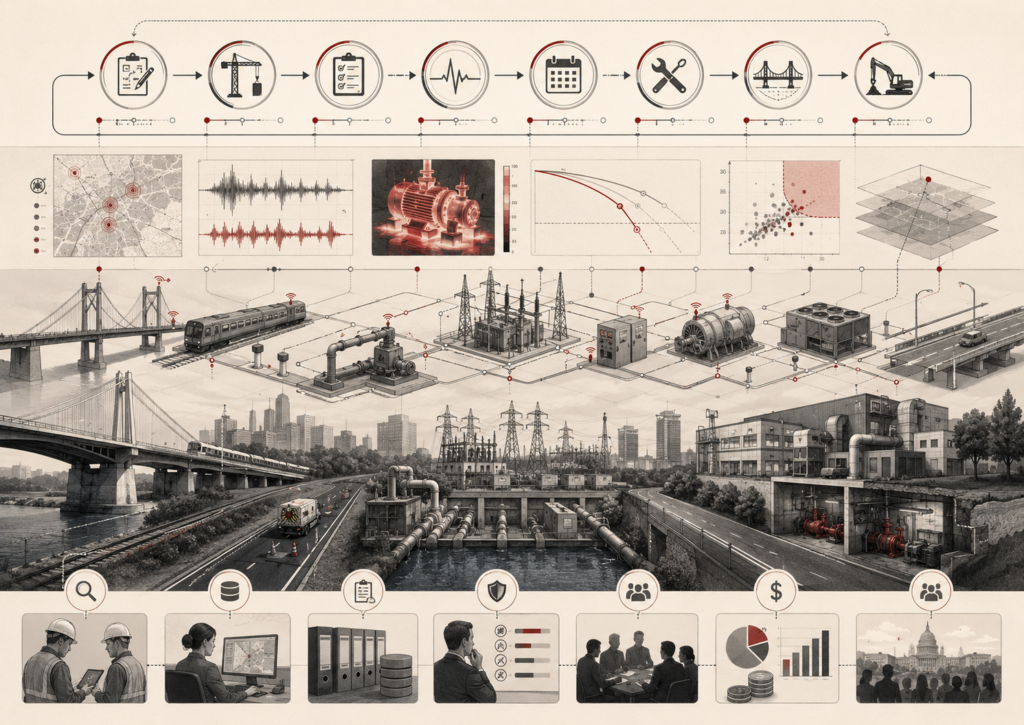
Illustration of infrastructure asset management and predictive maintenance showing bridges, rail, pipes, substations, industrial equipment, sensors, analytics layers, and lifecycle stewardship processes.

Asset Management and Predictive Maintenance Systems: Lifecycle Stewardship and Infrastructure Performance

Asset management and predictive maintenance systems explain how infrastructure assets are monitored, maintained, renewed, and governed across their full lifecycle to preserve service performance, manage risk, and sustain long-term public value. This article examines asset registers, condition assessment, maintenance strategies, criticality analysis, lifecycle costing, reliability metrics, digital twins, predictive analytics, governance, resilience, and the risk of false precision. It distinguishes reactive, preventive, condition-based, and predictive maintenance while showing how asset condition, failure probability, service consequence, and budget constraints shape maintenance priorities. The article also introduces mathematical lenses for deterioration, risk scoring, remaining useful life, lifecycle cost, and portfolio optimization, alongside Python and R workflows for asset registers, criticality scoring, lifecycle-cost diagnostics, and predictive-maintenance modeling. It frames maintenance as lifecycle stewardship rather than repair alone.
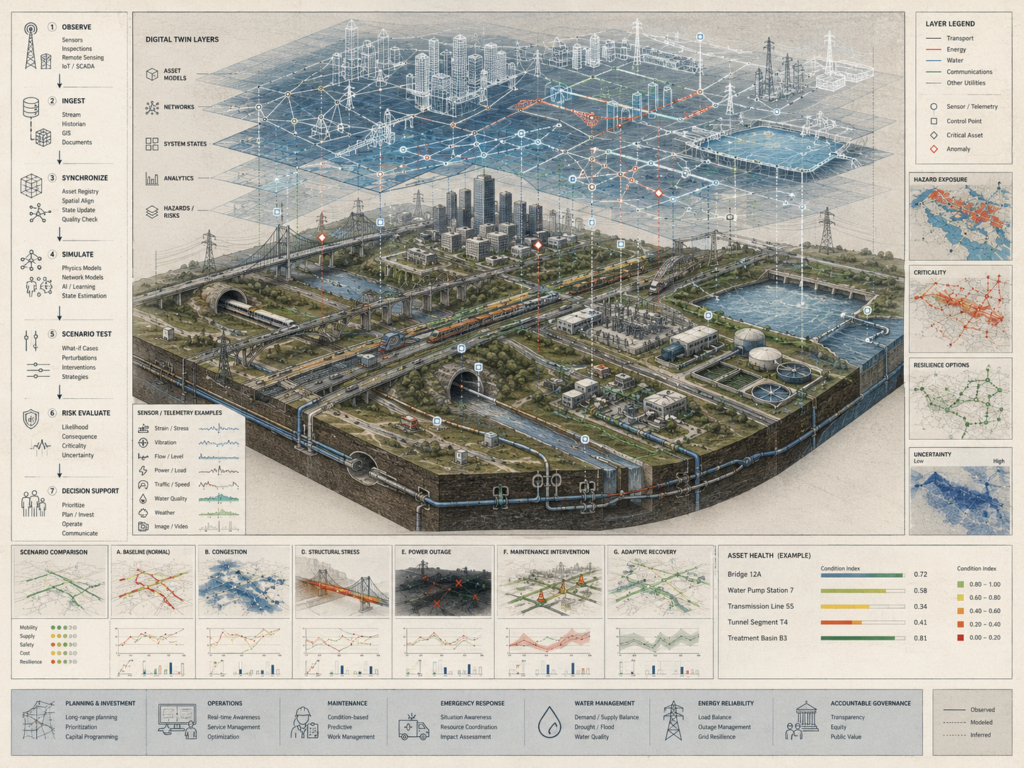
Digital twin infrastructure diagram showing layered city systems, transport, energy, water, communications, telemetry, scenario testing, risk evaluation, and decision-support pathways.

Digital Twins and Infrastructure Simulation: Scenario Testing, Modeling and Infrastructure Intelligence

Digital twins turn infrastructure data into scenario-tested intelligence for planning, operations, maintenance, and resilience. Roads, bridges, rail, tunnels, power grids, water systems, wastewater facilities, communications networks, public buildings, reservoirs, and underground utilities can be represented as connected digital systems rather than isolated assets. This article examines how digital twins link telemetry, asset registries, spatial models, network states, simulations, uncertainty, hazard exposure, criticality, and resilience options into decision-support workflows. Their value is not visual replication alone; it is the ability to test disruptions, forecast cascading impacts, compare interventions, prioritize maintenance, evaluate recovery pathways, and coordinate infrastructure decisions across agencies and systems. By connecting physical infrastructure to modeling, scenario testing, and accountable governance, digital twins help institutions understand risk, improve reliability, and steward public systems more intelligently.

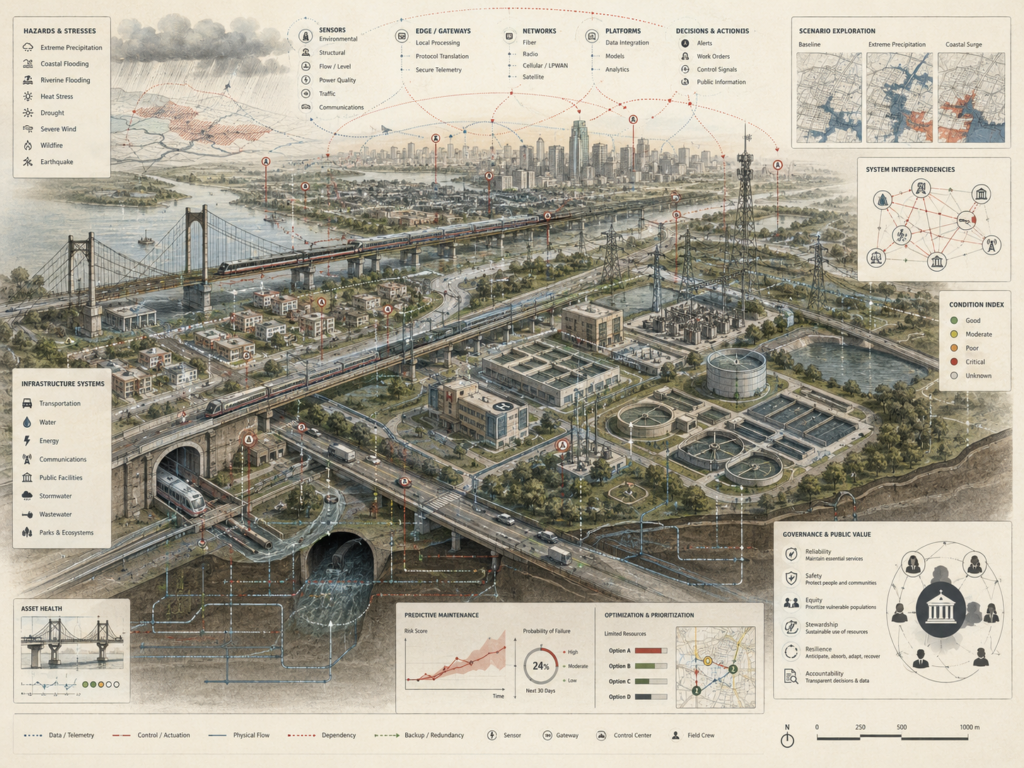
Restrained intelligent infrastructure systems diagram showing transportation, water, energy, communications, stormwater, sensors, AI platforms, resilience pathways, and public value governance.

The Future of Intelligent Infrastructure: AI, Resilience and Public Value

Intelligent infrastructure turns connected public systems into evidence-based, accountable platforms for resilience and public value. Transportation networks, bridges, rail, tunnels, water systems, wastewater facilities, stormwater infrastructure, power grids, communications networks, public buildings, parks, and ecological buffers increasingly depend on sensors, telemetry, AI analytics, scenario testing, predictive maintenance, and coordinated operations. This article examines how intelligent infrastructure can improve reliability, safety, equity, stewardship, and adaptation when digital systems are designed around public purpose rather than automation alone. Infrastructure intelligence is not simply a smart-city upgrade; it is a governance challenge involving interdependencies, risk, maintenance priorities, data quality, institutional capacity, and transparent decision-making. By linking AI, resilience planning, asset health, environmental stress, and public accountability, intelligent infrastructure can help communities anticipate disruption, protect essential services, and invest in long-term public value.

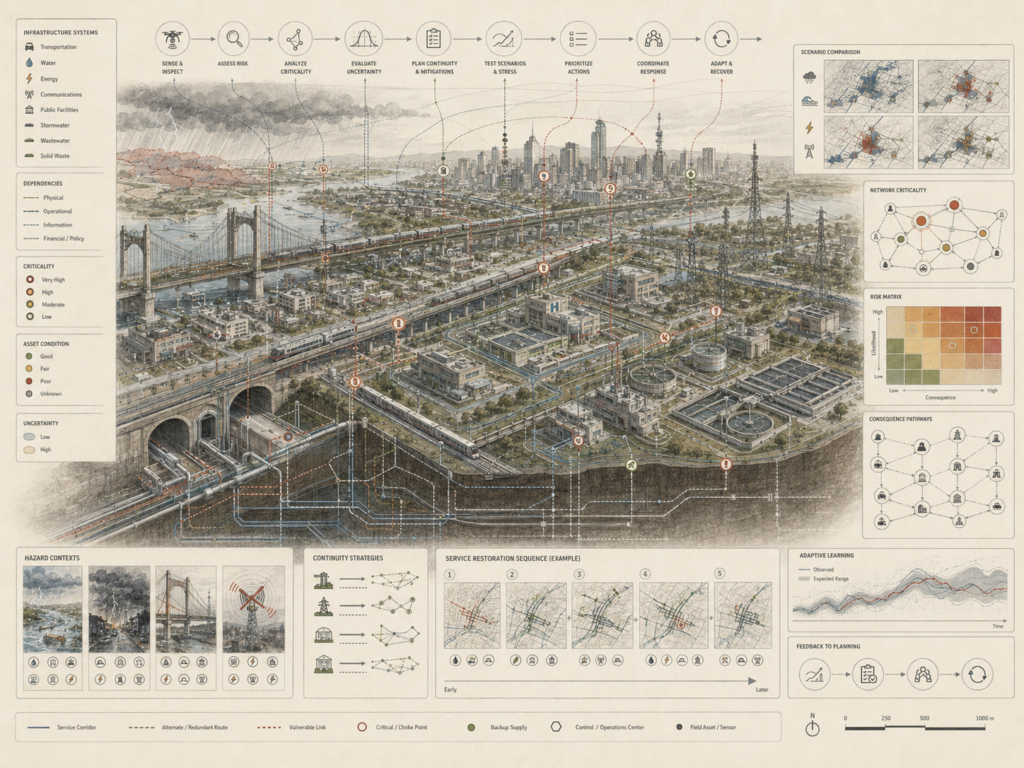
Restrained infrastructure risk management diagram showing transportation, water, energy, communications, critical assets, uncertainty, continuity planning, scenario testing, and recovery pathways.

Infrastructure Risk Management Systems: Criticality, Continuity and Uncertainty

Infrastructure risk management systems help institutions protect essential services under uncertainty. Transportation, water, energy, communications, stormwater, wastewater, public facilities, and underground utilities do not fail in isolation; they are connected through physical, operational, informational, financial, and governance dependencies. This article examines how criticality analysis, asset condition, hazard exposure, scenario testing, consequence pathways, uncertainty assessment, continuity planning, redundancy, response coordination, and service-restoration sequencing support more resilient infrastructure decisions. Risk management is not only about identifying what could go wrong; it is about understanding which failures matter most, how disruptions cascade, which services must continue, and where intervention can reduce harm. By linking criticality, continuity, and uncertainty to accountable planning, infrastructure risk management supports public safety, institutional readiness, adaptive recovery, and long-term public value.

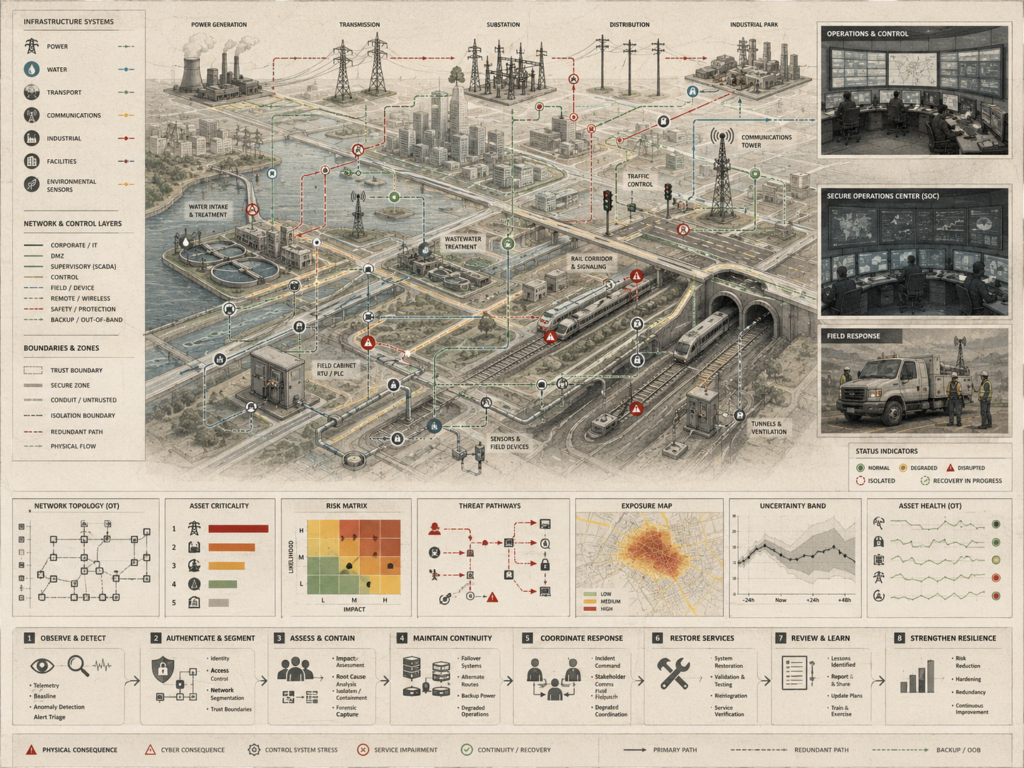
Restrained infrastructure security diagram showing power, water, transport, communications, industrial systems, OT networks, segmentation, risk pathways, continuity planning, response, and recovery workflows.

Infrastructure Security and Cyber Resilience: OT Protection, Continuity and Recovery

Infrastructure security and cyber resilience protect essential services by linking operational technology, continuity planning, and recovery into one public-safety framework. Power systems, water treatment, wastewater facilities, transportation corridors, rail signaling, communications towers, industrial sites, control cabinets, sensors, and field devices increasingly depend on connected networks that must remain reliable under disruption. This article examines how OT protection depends on segmentation, monitoring, access control, asset criticality, threat-pathway analysis, exposure mapping, uncertainty assessment, incident response, and service restoration. Cyber resilience is not only about preventing intrusion; it is about maintaining safe operations, isolating affected systems, coordinating field response, preserving backup pathways, and restoring public services responsibly. By connecting cybersecurity, infrastructure continuity, operational recovery, and governance accountability, resilient infrastructure security helps protect communities from cascading failure.

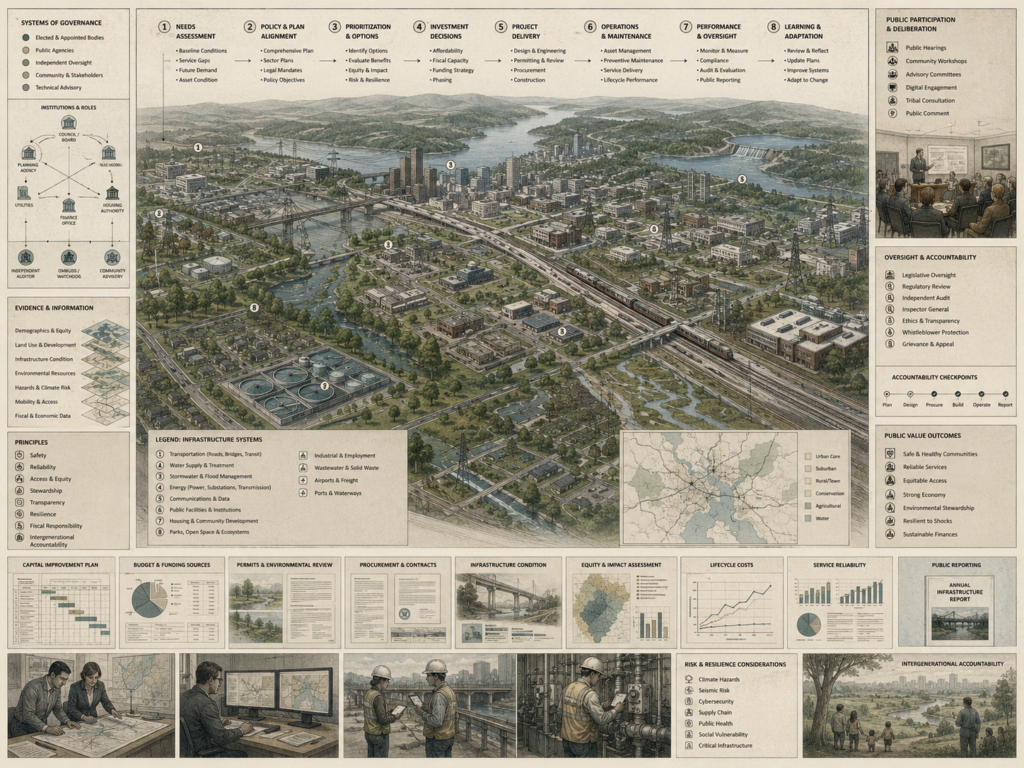
Restrained infrastructure governance diagram showing regional infrastructure systems, planning stages, public agencies, evidence layers, oversight pathways, accountability checkpoints, and public-value outcomes.

Infrastructure Governance and Policy Systems: Planning, Delivery and Public Accountability

Infrastructure governance and policy systems determine whether public infrastructure is planned, delivered, maintained, and reviewed in ways that serve long-term public value. Bridges, roads, rail corridors, water systems, stormwater networks, power infrastructure, communications systems, housing districts, public facilities, parks, reservoirs, and ecological buffers require more than engineering capacity; they require institutions, funding, oversight, participation, and accountability. This article examines how needs assessment, policy alignment, capital planning, procurement, environmental review, project delivery, operations, maintenance, performance monitoring, public reporting, and grievance review shape infrastructure outcomes. Good governance links evidence to decisions, decisions to delivery, and delivery to measurable service quality. By connecting planning, transparency, fiscal responsibility, resilience, equity, and intergenerational stewardship, infrastructure policy systems help protect public trust and accountable infrastructure futures.

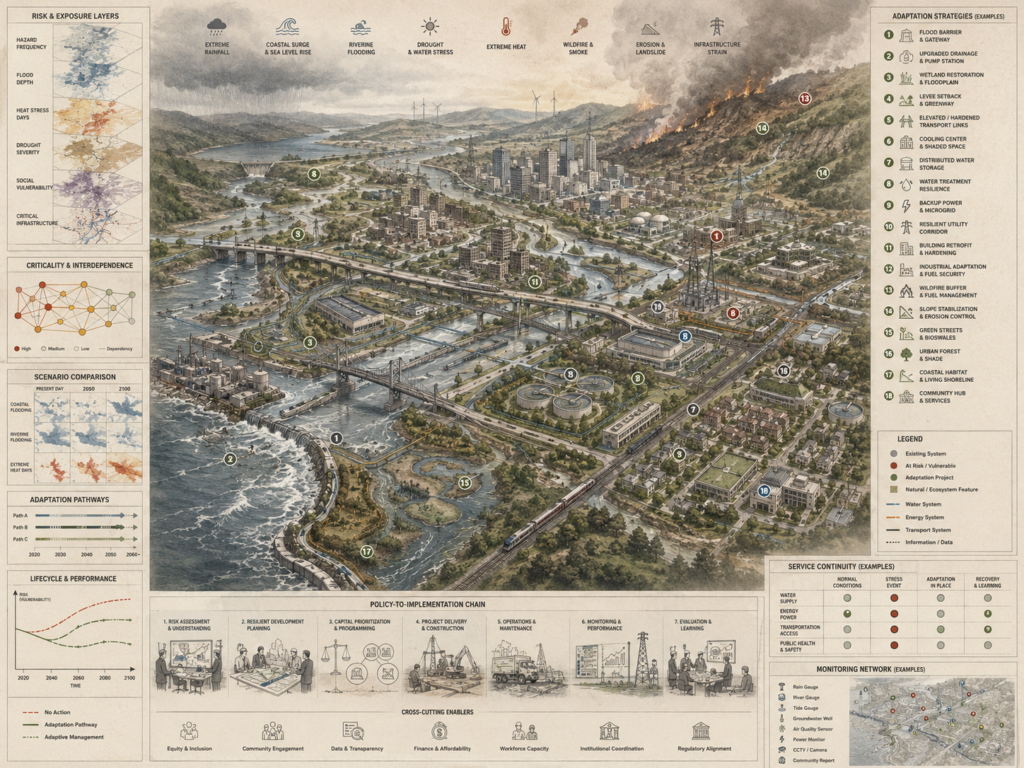
Climate adaptation infrastructure diagram showing coastal flooding, extreme heat, wildfire, drought, stormwater systems, transport networks, water systems, resilience projects, and implementation pathways.

Infrastructure Systems for Climate Adaptation: Risk, Resilient Development and Implementation

Infrastructure systems for climate adaptation connect risk assessment to resilient development and implementation. Extreme rainfall, coastal surge, river flooding, drought, heat, wildfire, erosion, landslide risk, and infrastructure strain affect transportation, water, energy, housing, ecosystems, and public services as interdependent systems. This article examines how adaptation depends on exposure mapping, criticality analysis, scenario comparison, project prioritization, resilient design, delivery capacity, monitoring, maintenance, and service continuity. Adaptation is not only a planning exercise; it requires institutions that can fund, build, operate, evaluate, and revise infrastructure under changing climate conditions. By linking risk evidence, green and gray infrastructure, public accountability, equity, and long-term stewardship, climate adaptation systems help communities reduce harm, protect essential services, and invest in resilient futures.

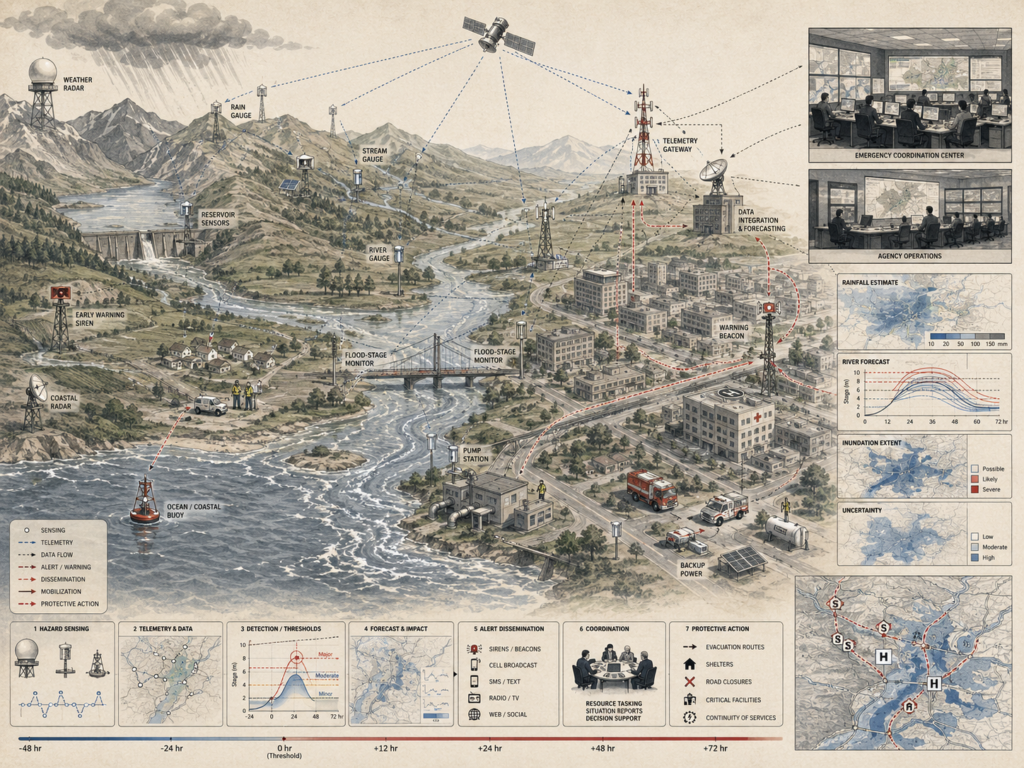
Flood and disaster early warning infrastructure diagram showing radar, rain gauges, river gauges, telemetry, forecasting, warning beacons, emergency coordination, evacuation routes, and protective action systems.

Flood and Disaster Early Warning Infrastructure: Detection, Communication and Protective Action

Flood and disaster early warning infrastructure turns hazard detection into protective action. Radar, rain gauges, stream gauges, river gauges, reservoir sensors, coastal buoys, telemetry gateways, forecasting systems, warning beacons, emergency operations centers, agency coordination, and field response teams must work as one chain before flooding or disaster impacts occur. This article examines how early warning systems connect rainfall estimates, river forecasts, inundation mapping, uncertainty assessment, thresholds, alerts, evacuation routes, shelters, road closures, critical facilities, and continuity planning. Effective warning is not only a technical sensing problem; it depends on trusted communication, institutional coordination, accessible alerts, and timely public action. By linking detection, forecasting, communication, mobilization, and protective decisions, early warning infrastructure helps reduce harm and strengthen community resilience.

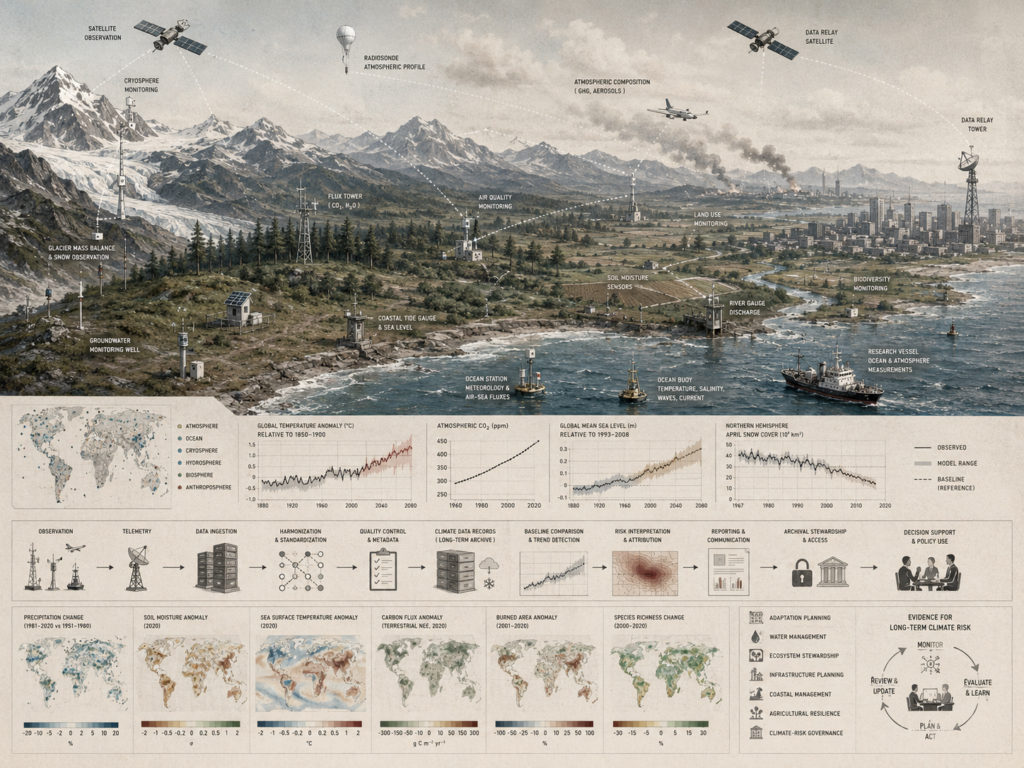
Restrained climate monitoring infrastructure diagram showing satellites, glacier stations, flux towers, ocean buoys, river gauges, coastal sensors, climate baselines, trend records, and long-term risk interpretation.

Climate Monitoring Infrastructure: Baselines, Observation and Long-Term Climate Risk

Climate monitoring infrastructure makes long-term climate risk visible through baselines, durable observation, and trusted environmental records. Satellites, glacier stations, flux towers, river gauges, tide gauges, ocean buoys, atmospheric sensors, soil monitors, biodiversity observations, and land-use monitoring systems measure change across atmosphere, land, ocean, cryosphere, ecosystems, and human settlements. This article examines how climate evidence becomes meaningful through telemetry, harmonization, quality control, climate data records, baseline comparison, trend detection, attribution, reporting, archival stewardship, and decision support. Long-term risk cannot be understood through isolated measurements alone; it requires consistent observation systems that reveal shifts in temperature, precipitation, sea level, snow cover, soil moisture, ocean conditions, carbon flux, burned area, and biodiversity.

Scroll to Top