
Last Updated May 14, 2026
Infrastructure systems for climate adaptation are the physical, ecological, digital, operational, and institutional systems through which societies adjust essential services to changing climatic baselines, rising extremes, and evolving patterns of environmental risk. They include water systems, transport networks, energy systems, buildings, coastal and riverine protections, urban cooling systems, communications infrastructure, nature-based systems, monitoring platforms, asset-management practices, public finance mechanisms, and the governance arrangements that connect them. In this sense, climate adaptation is not an auxiliary layer added after infrastructure is built. It is a systems orientation through which infrastructure is planned, upgraded, operated, financed, maintained, and revised for a changing climate rather than a stationary past.
Climate change alters the assumptions on which infrastructure has long depended. Temperature ranges shift, rainfall intensifies or becomes less predictable, drought conditions lengthen, wildfire risk expands, sea levels rise, storms interact with urbanization, and compound hazards place growing pressure on systems designed for older baselines. Infrastructure that once appeared adequate under historical conditions can become fragile, costly, or socially unequal under new climatic realities. A drainage system may fail because rainfall intensity has changed. A road may remain structurally sound but become unusable under repeated flooding or heat. A public building may still stand while becoming unsafe as a cooling refuge because power, ventilation, or staffing systems fail under stress.
The deeper challenge is that climate adaptation is not only a question of protecting assets. It is a question of sustaining public function under non-stationary conditions. A city does not become climate-adapted merely by elevating one road, adding one flood wall, hardening one substation, or retrofitting one facility. Infrastructure systems become adaptive when networks, standards, ecological buffers, monitoring systems, maintenance regimes, public institutions, funding models, and service priorities evolve together in response to changing climatic conditions.
Main Library
Publications
Article Map
Intelligent Infrastructure
Related Topic
Risk & Resilience
Related Topic
Environmental Monitoring
Related Topic
Data Systems
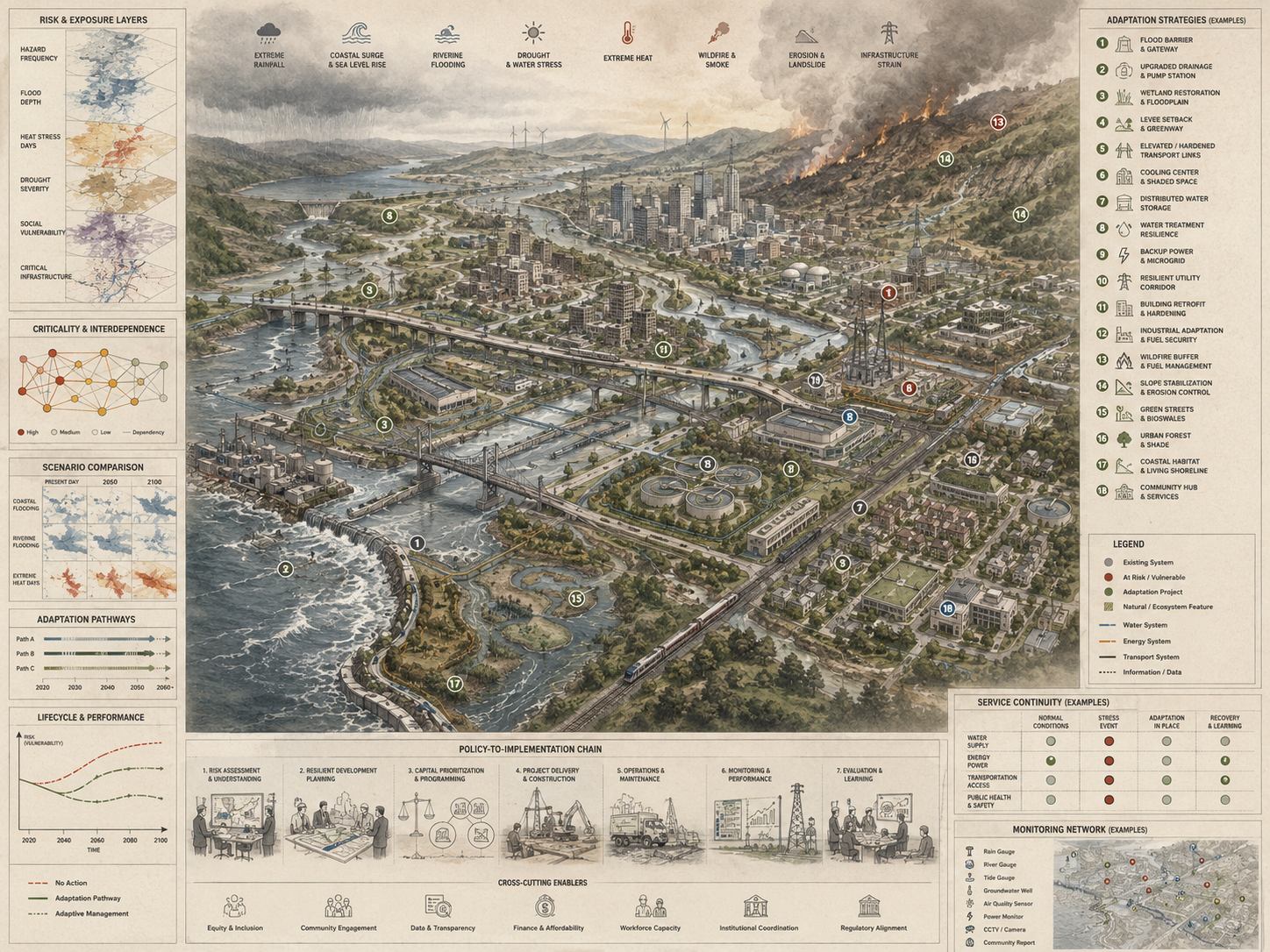
Infrastructure systems for climate adaptation therefore sit at the intersection of climate science, engineering, land use, ecological stewardship, public finance, risk governance, and social vulnerability. Where these layers remain disconnected, adaptation remains superficial and reactive. Where they are integrated thoughtfully, infrastructure can sustain essential services, reduce exposure, and support more durable social adjustment under climatic change.
Engineering Problem
The engineering problem is how to design, operate, finance, and govern infrastructure systems so that essential services remain safe, functional, equitable, and recoverable under changing climatic conditions. Climate adaptation is not simply a matter of adding protective works to existing assets. It requires identifying which services are at risk, which assets and networks support those services, which hazards and chronic stresses are changing, which populations are exposed, which thresholds define failure, and which institutional mechanisms can revise standards before failure becomes unavoidable.
This problem is difficult because infrastructure systems are long-lived, interdependent, and path-dependent. A bridge, wastewater plant, power substation, drainage network, port, hospital, transit corridor, or public-housing complex may remain in service for decades after design assumptions have become obsolete. The system may also depend on other systems: cooling depends on electricity; hospitals depend on water, transport, power, telecommunications, staffing, and supply chains; drainage depends on land cover, maintenance, upstream development, rainfall intensity, and downstream capacity. Adaptation therefore requires more than asset hardening. It requires service-level reasoning across interdependent systems.
A technically narrow adaptation project may reduce one visible risk while increasing another. A flood wall can protect a district but shift water elsewhere. Air-conditioning can reduce heat mortality while increasing peak electricity demand if the grid is not adapted. Road elevation can preserve a corridor while intensifying runoff or disconnecting surrounding communities. Infrastructure adaptation therefore has to be evaluated through system performance, distributional effects, ecological consequences, maintenance capacity, and long-run viability.
| Engineering Tension | Why It Matters | Required Evidence |
|---|---|---|
| Historical design assumptions versus future climate conditions | Infrastructure built for past baselines may fail under new temperature, rainfall, sea-level, drought, or wildfire regimes. | Climate scenario record, design-standard review, asset exposure inventory, future-condition stress test |
| Asset protection versus service continuity | A protected asset may not preserve the service if dependent systems fail. | Critical-service map, dependency model, continuity target, redundancy plan |
| Single-hazard defense versus compound risk | Heat, drought, fire, flooding, smoke, power stress, and displacement can interact. | Multi-hazard scenarios, cascading-failure analysis, emergency-service pathway review |
| Hard infrastructure versus ecological buffers | Engineered systems can be brittle if they ignore watersheds, coastlines, soils, vegetation, and land use. | Nature-based infrastructure plan, ecosystem performance metrics, maintenance responsibilities |
| Capital project delivery versus lifecycle stewardship | Adaptation fails when maintenance, monitoring, and operating budgets are not part of the project. | Lifecycle cost plan, maintenance schedule, monitoring program, renewal trigger |
| Average resilience versus unequal exposure | Aggregate metrics can hide the fact that vulnerable populations remain unprotected. | Equity screen, vulnerable-population exposure analysis, affordability and access review |
| Adaptation benefit versus maladaptation | Some projects postpone, redistribute, or intensify risk while appearing resilient. | Maladaptation review, downstream-impact assessment, lock-in analysis, governance decision log |
The practical question is therefore: can the infrastructure system preserve essential service under credible future climate stress, or does it merely protect selected assets while leaving system failure, social exposure, or ecological degradation unresolved?
Reference Architecture
A practical climate adaptation architecture can be understood as a climate-resilient infrastructure evidence system. The exact implementation may include climate projections, asset inventories, vulnerability assessments, hydrological models, heat-risk maps, wildfire exposure layers, flood-depth grids, drainage models, nature-based infrastructure plans, capital project portfolios, standards updates, monitoring systems, emergency operations, finance plans, equity screens, and public reporting. The responsibilities remain consistent: identify risk, assess exposure, define service thresholds, select interventions, finance delivery, monitor performance, revise standards, and report outcomes.
| Layer | Engineering Role | Primary Risk | Evidence Artifact |
|---|---|---|---|
| Climate-risk layer | Defines hazards, chronic stresses, future scenarios, uncertainty ranges, and plausible compound events. | Planning remains anchored to historical climate conditions. | Scenario manifest, hazard library, climate baseline update, uncertainty statement |
| Asset and service layer | Maps assets, networks, dependencies, critical services, service thresholds, and failure consequences. | Assets are hardened without understanding service dependency. | Asset registry, dependency map, continuity target, service criticality rating |
| Exposure and vulnerability layer | Identifies who and what is exposed, where sensitivity is highest, and which populations have fewer buffers. | Average resilience hides unequal exposure and limited adaptive capacity. | Exposure map, vulnerability index, equity screen, population-service overlay |
| Intervention layer | Compares hard infrastructure, nature-based systems, operational changes, relocation, redundancy, demand management, and standards reform. | One project is treated as adaptation without system-level review. | Adaptation option register, intervention typology, cost-benefit and distributional review |
| Finance and delivery layer | Links adaptation priorities to budgets, procurement, capital plans, maintenance funding, and implementation sequencing. | Planning activity expands while implementation and maintenance lag. | Capital plan, finance strategy, procurement requirements, implementation milestone log |
| Monitoring and data layer | Tracks climate conditions, asset condition, service disruptions, maintenance actions, project performance, and early warning signals. | Adaptation performance is asserted rather than measured. | Monitoring dashboard, telemetry registry, indicator set, service-outage record |
| Governance and revision layer | Updates standards, thresholds, design guidance, public reporting, institutional responsibilities, and decision accountability. | Adaptation remains fragmented across agencies and political cycles. | Governance log, standard revision record, public evidence package, accountability report |
This architecture makes adaptation more than a project category. It treats adaptation as a public evidence chain that connects changing climate conditions to infrastructure choices and service outcomes.
Implementation Pattern
A rigorous adaptation implementation begins with the service being protected, not the project being proposed. The first question is not “Which asset should be hardened?” but “Which service must remain available, for whom, under which climate stress, at what acceptable level of disruption, and with what evidence of reduced vulnerability?” This reframes adaptation from a construction list into an accountable service-continuity strategy.
Implementation then requires a structured sequence. First, define climate stressors and plausible futures. Second, identify critical infrastructure services and dependencies. Third, map exposure and vulnerability, including social vulnerability and ecological constraints. Fourth, evaluate adaptation options across hard, soft, operational, ecological, and governance measures. Fifth, prioritize interventions according to risk reduction, public need, feasibility, equity, lifecycle cost, and maladaptation risk. Sixth, finance and deliver projects with monitoring and maintenance built in. Seventh, revise standards and operating rules as evidence changes.
| Artifact | Purpose | Suggested Format |
|---|---|---|
| Climate scenario manifest | Defines baseline, future climate scenarios, time horizons, hazard variables, assumptions, and uncertainty ranges. | YAML, Markdown, climate-risk register |
| Critical service registry | Identifies the services, assets, routes, facilities, populations, and dependencies that must be protected. | CSV, SQL table, GIS layer |
| Asset exposure inventory | Connects infrastructure assets to heat, flood, drought, wildfire, coastal, rainfall, or compound-risk exposure. | CSV, GeoJSON, geodatabase, SQL table |
| Vulnerability and equity screen | Assesses whether risk reduction reaches communities with high exposure and lower adaptive capacity. | CSV, geospatial overlay, dashboard, public report |
| Adaptation option register | Compares hardening, redundancy, relocation, ecological buffers, demand management, operational changes, and standards updates. | CSV, Markdown, decision matrix |
| Maladaptation review | Flags lock-in, risk transfer, ecological damage, affordability burden, and unequal protection. | Checklist, review memo, governance log |
| Implementation and finance plan | Links priorities to budget, procurement, sequencing, maintenance, and responsible institutions. | Capital plan, YAML, project portfolio register |
| Monitoring and performance record | Tracks service continuity, outage frequency, recovery time, protective performance, and maintenance state. | CSV, SQL, dashboard export, telemetry feed |
| Public evidence package | Explains methods, assumptions, benefits, trade-offs, vulnerable-population impacts, and valid-use limits. | Markdown, HTML, PDF, public dashboard note |
The implementation goal is to make adaptation decisions reconstructable. A user should be able to move from a resilience claim back to the climate scenario, exposed asset, service target, intervention choice, financing decision, equity review, monitoring evidence, and governance owner that support it.
Research-Grade Framing: Adaptation as Infrastructure System Transformation
A research-grade account of climate adaptation begins by rejecting the idea that adaptation is simply a catalog of protective projects. Adaptation is a transformation in the conditions under which infrastructure knowledge, planning, operation, and accountability occur. It changes what counts as an acceptable design baseline, what counts as sufficient redundancy, what counts as a vulnerable population, what counts as a credible service-continuity target, and what counts as a responsible investment decision.
This role is epistemically demanding because adaptation knowledge is inherently uncertain, time-dependent, and politically consequential. Climate scenarios are not precise predictions. Asset condition is unevenly known. Interdependencies are often underdocumented. Vulnerable populations may be visible in aggregate data but invisible in project-level appraisal. Ecological systems can provide protection, but they also require land, time, maintenance, and governance. The adaptation system becomes trustworthy only when these uncertainties are made visible rather than hidden beneath a simple resilience label.
The strongest adaptation systems connect engineering with institutional learning. They do not merely ask whether an asset can survive a design event. They ask whether the infrastructure system can learn from changing conditions, update standards, finance preventive work, maintain protective systems, avoid transferring risk, and explain trade-offs publicly. Adaptation is therefore both technical and civic: it is a way of governing material systems under conditions of environmental change.
| Limited Pattern | Stronger Pattern | Why the Shift Matters |
|---|---|---|
| Harden selected assets | Protect critical services across asset networks, dependencies, and vulnerable populations | Prevents visible capital works from being mistaken for systemic adaptation. |
| Use historical design baselines | Update standards using future climate stressors, uncertainty ranges, and scenario planning | Prevents new investment from reproducing old risk. |
| Count adaptation projects | Evaluate service continuity, exposure reduction, maintenance, recovery, and distributional outcomes | Prevents implementation activity from being mistaken for reduced vulnerability. |
| Treat ecosystems as amenities | Treat ecological systems as protective infrastructure with performance, stewardship, and land-use requirements | Connects adaptation with watershed, coastal, heat, and biodiversity functions. |
| Plan without finance | Integrate adaptation into capital budgeting, procurement, lifecycle maintenance, and public finance | Addresses the gap between strategy documents and delivered protection. |
| Use average resilience metrics | Assess who gains protection, who remains exposed, and who bears costs | Centers adaptive capacity rather than abstract system performance. |
The central research question is not “Can this project be called resilient?” but “What vulnerability does this infrastructure system reduce, at what scale, for whom, under which future conditions, and with what evidence of sustained performance?”
Formal Model: Hazard, Exposure, Vulnerability, Service Continuity, and Adaptive Capacity
A useful formal model separates hazard intensity, exposure, vulnerability, adaptive capacity, service continuity, recovery, implementation progress, and maladaptation risk. Let \(H\) represent climate hazard intensity, \(E\) exposure, \(V\) vulnerability, \(A\) adaptive capacity, \(S\) service continuity, \(R\) recovery performance, \(M\) maladaptation risk, and \(I\) implementation progress. Adaptation quality depends on these dimensions together, not on the presence of one project or one dashboard.
R_{\mathrm{climate}} = H \times E \times V
\]
Interpretation: Climate risk increases when hazard intensity, exposure, and vulnerability reinforce one another. Adaptation can reduce risk by changing exposure, vulnerability, service design, or protective capacity.
V_{\mathrm{effective}} = \frac{V}{1 + A}
\]
Interpretation: Adaptive capacity reduces effective vulnerability when institutions, infrastructure, social supports, finance, and operational systems can respond before harm escalates.
S_{\mathrm{continuity}} = 1 – \frac{T_{\mathrm{outage}}}{T_{\mathrm{critical}}}
\]
Interpretation: Service continuity measures whether a critical infrastructure service remains available during the period in which failure would produce public harm.
B_{\mathrm{adaptation}} = L_{\mathrm{baseline}} – L_{\mathrm{adapted}}
\]
Interpretation: Adaptation benefit is the reduction in expected loss, disruption, exposure, or vulnerability relative to a baseline without adaptation.
Q_{\mathrm{adaptation}} =
w_1C_{\mathrm{scenario}} +
w_2D_{\mathrm{dependency}} +
w_3P_{\mathrm{service}} +
w_4E_{\mathrm{equity}} +
w_5F_{\mathrm{finance}} +
w_6M_{\mathrm{maintenance}} +
w_7O_{\mathrm{observability}} –
w_8K_{\mathrm{maladaptation}}
\]
Interpretation: Adaptation quality depends on scenario credibility, dependency mapping, service protection, equity, finance, maintenance, observability, and the reduction of maladaptation risk.
This formal structure protects against a common mistake in adaptation planning: treating a capital project as if it automatically reduced climate vulnerability. Adaptation evidence becomes stronger when climate stress, service thresholds, dependencies, equity, finance, maintenance, monitoring, and maladaptation review are evaluated together.
What Are Infrastructure Systems for Climate Adaptation?
Infrastructure systems for climate adaptation are the interconnected systems through which infrastructure is modified to remain functional, safe, and socially useful under changing climatic conditions. These systems include not only physical assets such as bridges, drainage networks, substations, pipelines, buildings, water-treatment facilities, public shelters, ports, railways, and communication networks, but also ecological systems, digital monitoring layers, financing structures, standards, governance arrangements, and public-accountability practices that shape how adaptation occurs over time.
Climate adaptation is therefore broader than protection against isolated hazards. It concerns whether infrastructure can continue providing service as background conditions change: hotter summers, shifting precipitation regimes, more frequent flooding, longer droughts, coastal erosion, wildfire exposure, repeated storm damage, or chronic stress on energy, transport, water, and health-supporting systems. Adaptation in this sense is not episodic emergency management. It is the long-horizon adjustment of infrastructure systems to a climate that is no longer stable relative to the assumptions under which much existing infrastructure was conceived.
This means adaptation is not only a property of individual assets. A seawall may protect one district while transport, water, or housing systems remain exposed elsewhere. A resilient bridge may still connect into a fragile corridor. A cooled public building may still depend on an unstable power system during heat emergencies. Climate adaptation emerges through the performance of interdependent systems, not through isolated capital works alone.
| Adaptation Form | Primary Question | Typical Evidence | Main Risk |
|---|---|---|---|
| Asset hardening | Can a specific asset withstand future climate stress? | Design standard, flood elevation, thermal tolerance, fire exposure, wind loading | Asset survival is mistaken for service continuity. |
| Network resilience | Can connected systems continue functioning when some components fail? | Redundancy map, dependency model, recovery-time target, continuity plan | Interdependencies remain invisible until cascading failure occurs. |
| Operational adaptation | Can operating rules change before climate stress produces failure? | Seasonal protocols, dispatch rules, cooling plans, drought triggers, emergency thresholds | Adaptation is treated as construction without operational readiness. |
| Nature-based infrastructure | Can ecosystems reduce heat, flood, erosion, or water stress while supporting ecological function? | Wetlands, urban canopy, floodplains, mangroves, permeable landscapes, restoration plans | Ecological systems are undermaintained or treated as decorative add-ons. |
| Standards and governance reform | Do rules, procurement, finance, and institutional mandates reflect future climate risk? | Design updates, procurement clauses, finance plans, public reporting, governance logs | New investment reproduces obsolete risk. |
| Managed transition or relocation | When is protection no longer viable in place? | Adaptation-limit assessment, retreat plan, land-use change, service transition strategy | Hardening locks communities into escalating exposure. |
Infrastructure systems for climate adaptation are therefore not one technical solution. They are the set of material, ecological, informational, financial, and institutional arrangements that allow societies to adjust essential services under climate change.
Why Climate Adaptation Must Be Infrastructural
Climate adaptation must be infrastructural because climate change affects the conditions under which essential services are delivered. Water, transport, energy, shelter, health-supporting systems, communications, food logistics, emergency response, and public administration all depend on infrastructure calibrated to environmental assumptions. When those assumptions change, infrastructure standards, operating procedures, maintenance plans, and service models must change as well.
This matters because contemporary climate risk is not limited to rare disasters. It includes changing averages, repeated chronic stress, and interactions between slow-onset change and acute events. A drainage system designed for older rainfall intensities may fail more often. A building stock designed for mild summers may become dangerous during recurrent heat. A transport network may operate acceptably under historical weather but become unreliable under new flood or wildfire patterns. A water system may continue operating during normal years while becoming fragile under multi-year drought. Adaptation therefore concerns changing baselines as much as extreme events.
Infrastructure adaptation is thus one of the core ways climate change becomes administratively, financially, and operationally real. If infrastructure remains anchored to obsolete assumptions, climate risk becomes embedded in everyday service delivery. If standards, maintenance, finance, and public accountability adjust, adaptation can become a practical mechanism for preserving life, health, mobility, water access, energy reliability, and civic continuity.
| Climate Pressure | Infrastructure Consequence | Adaptation Requirement |
|---|---|---|
| Extreme heat and changing temperature baselines | Greater cooling demand, heat stress on roads and rails, public-health risk, power peaks. | Cooling centers, grid resilience, passive building design, urban canopy, thermal standards. |
| More intense rainfall and flooding | Drainage overload, road closures, combined sewer stress, damaged buildings, contaminated water. | Stormwater redesign, floodable landscapes, drainage maintenance, early warning, land-use controls. |
| Drought and water scarcity | Reduced water supply reliability, stressed agriculture, industrial constraints, ecological degradation. | Source diversification, demand management, reuse, leakage control, storage, drought triggers. |
| Sea-level rise and coastal storms | Coastal flooding, erosion, saltwater intrusion, port and transport disruption. | Coastal buffers, elevation, managed retreat, protective works, land-use planning. |
| Wildfire, smoke, and vegetation stress | Power outages, transport closures, air-quality emergencies, water-quality effects, slope instability. | Defensible space, grid hardening, smoke shelters, watershed restoration, emergency communications. |
| Compound hazards | Multiple systems fail together, exceeding single-sector preparedness. | Cross-sector scenarios, dependency mapping, redundancy, governance coordination, public communication. |
The most important adaptation question is not whether infrastructure can resist every hazard. It is whether essential services can be redesigned and governed to remain reliable enough under worsening and interacting conditions.
Core Architecture of Climate Adaptation Systems
Infrastructure systems for climate adaptation can be understood through a layered architecture that links physical change to institutional response. These layers are analytically distinct but operationally connected. A strong adaptation program aligns them rather than allowing each to develop separately.
Physical Infrastructure Layer
This layer includes transport systems, energy systems, water and wastewater networks, drainage, coastal defenses, buildings, communications, ports, hospitals, schools, public shelters, and other critical assets. It remains central because adaptation must ultimately be realized in material systems that continue to function under altered environmental conditions.
Ecological and Spatial Layer
This layer includes wetlands, permeable surfaces, floodplains, urban forests, mangroves, river corridors, watershed systems, soils, coastal dunes, greenways, and land-use patterns. These shape how climate impacts are absorbed, redirected, buffered, or intensified. They also determine whether adaptation reduces ecological risk or merely shifts harm.
Operational and Service Layer
This layer includes maintenance regimes, emergency protocols, seasonal operating rules, cooling plans, water allocation systems, redundancy planning, mutual aid, continuity strategies, and recovery procedures. Adaptation becomes visible here in how infrastructure is actually run under changing conditions.
Digital and Informational Layer
This layer includes climate records, monitoring systems, forecasts, scenario models, digital twins, asset-condition data, early warning systems, outage records, remote sensing, and risk-mapping tools that inform infrastructure decisions over time.
Governance and Finance Layer
This layer includes standards, regulation, procurement, investment planning, insurance, public finance, project appraisal, benefit-cost analysis, maintenance budgeting, and institutional coordination. Adaptation depends heavily on this layer because even technically sound measures can fail to scale when budgeting, standards, and planning systems remain tied to historical assumptions.
| Layer | Adaptation Function | Failure Mode |
|---|---|---|
| Physical infrastructure | Protects or redesigns material assets, networks, facilities, and service corridors. | Assets are protected without preserving network function. |
| Ecological and spatial systems | Buffers heat, flood, erosion, drought, and watershed stress through landscape function. | Nature-based systems are underfunded, displaced, or maintained as amenities only. |
| Operations and service continuity | Changes how systems are run during stress, disruption, and recovery. | Capital improvements exist without operational protocols or staffing capacity. |
| Digital and informational systems | Provides climate data, monitoring, forecasts, asset condition, early warning, and scenario analysis. | Data are available but not connected to decisions, budgets, or accountability. |
| Governance and finance | Aligns standards, investment, procurement, maintenance, reporting, and institutional responsibility. | Adaptation remains a strategy document rather than implemented public capacity. |
Together these layers show that climate adaptation is neither purely physical nor purely institutional. It is a systems property emerging from infrastructure, ecology, information, finance, and governance acting together over time.
Changing Baselines, Extremes, and Compound Climate Risk
Infrastructure adaptation must address both changing climatic baselines and acute extremes. Rising mean temperatures, altered hydrological cycles, sea-level rise, shifting snowpack, chronic moisture stress, and changing seasonal patterns can reshape infrastructure performance gradually. At the same time, climate change can intensify floods, storms, heat waves, wildfires, droughts, and compound hazards that stress systems abruptly.
This distinction matters because infrastructure often fails not only when extremes occur, but when repeated smaller stresses accumulate against older design assumptions. A bridge may survive a major storm yet deteriorate faster under repeated heat and moisture shifts. A water system may appear functional until several dry years expose source fragility. A city may tolerate isolated heat waves until consecutive events reveal systemic limits in cooling, housing, public health, labor safety, and power capacity. These chronic stresses can be less dramatic than disasters, but they can be equally important for infrastructure planning.
Compound risk is especially important. Heat can coincide with drought and power stress. Flooding can overlap with transport failure, contaminated water, and displacement. Wildfire smoke can amplify health burdens during heat emergencies. Coastal storms can disrupt ports, electricity, wastewater treatment, and evacuation routes at the same time. Adaptation systems therefore need to be designed for interaction effects rather than single-hazard scenarios alone.
| Risk Pattern | Infrastructure Consequence | Adaptation Design Implication |
|---|---|---|
| Baseline shift | Design assumptions become outdated even without record-breaking disasters. | Revise standards and service thresholds using future conditions. |
| Acute extremes | Assets and services are stressed by floods, storms, heat waves, wildfire, or drought events. | Stress-test critical services under credible extremes. |
| Chronic accumulation | Repeated stress increases deterioration, operating costs, and failure probability. | Link adaptation to asset management and maintenance schedules. |
| Compound hazard | Multiple hazards or system failures interact at once. | Use multi-hazard scenarios and cross-sector coordination. |
| Cascading failure | Failure in one infrastructure system propagates to others. | Map dependencies and protect lifeline services. |
| Threshold crossing | An asset, ecosystem, or service moves beyond a viable operating range. | Identify adaptation limits, relocation triggers, and transition pathways. |
The adaptation challenge is therefore not only to resist isolated hazards. It is to identify how climate stress reshapes the operating envelope of infrastructure systems over time.
Critical Infrastructure Domains for Adaptation
Climate adaptation depends on multiple infrastructure domains whose exposures and functions differ but increasingly overlap. The domains below should not be read as separate silos. In practice, they form dependency chains through which climate risk moves.
Water, Wastewater, and Drainage
Water systems are central because climate change alters both supply and risk. Drought, contamination, extreme rainfall, stormwater overload, combined sewer stress, saltwater intrusion, and shifting demand can all destabilize service. Adaptation here includes source diversification, storage, treatment reliability, leakage reduction, flood pathways, sewer separation, drainage redesign, reuse, water-quality monitoring, and watershed stewardship.
Energy and Cooling Systems
Energy adaptation involves not only protecting generation and grids from storms, floods, heat, drought, or wildfire, but also managing rising cooling demand, heat stress on transmission, and continuity for critical services. In hotter climates, cooling infrastructure and reliable electricity become increasingly important components of adaptation. This creates a feedback problem: adaptation through mechanical cooling can increase electricity demand unless paired with grid resilience, passive design, efficiency, urban cooling, and clean power.
Transport and Connectivity
Transport adaptation concerns whether mobility, logistics, commuting, emergency access, and supply chains can continue under changing flood, heat, coastal, snowpack, landslide, and wildfire conditions. Corridor redundancy, heat-tolerant materials, slope management, drainage integration, bridge scour protection, transit sheltering, evacuation routing, and recoverable route systems all matter.
Buildings, Housing, and Public Facilities
Housing and public buildings shape exposure directly. Adaptation here includes thermal performance, flood-proofing, water efficiency, sheltering capacity, ventilation, backup power, safe indoor air during smoke events, and the ability of schools, hospitals, libraries, community centers, and civic buildings to function under climatic stress.
Coastal and Riverine Protection Systems
In exposed areas, adaptation may involve levees, surge barriers, raised infrastructure, room-for-the-river approaches, coastal buffers, dunes, wetlands, retreat planning, managed realignment, and floodplain restoration. The key issue is not only defense, but how defense interacts with land use, ecosystems, property values, insurance, public access, and long-term viability.
Digital and Communications Infrastructure
Digital systems support monitoring, warnings, emergency coordination, remote work, outage reporting, infrastructure telemetry, and public communication. Yet they are also physical systems exposed to heat, flooding, power loss, and network failure. Adaptation requires hardening data centers, communications towers, fiber routes, edge infrastructure, and backup communications for emergency conditions.
| Domain | Adaptation Function | Key Dependency |
|---|---|---|
| Water and drainage | Manages drought, flood, contamination, runoff, and water reliability. | Watersheds, energy, land use, treatment capacity, operations. |
| Energy and cooling | Maintains power and thermal safety under heat, storms, fire, and demand peaks. | Fuel supply, grid stability, building design, critical services. |
| Transport | Preserves mobility, logistics, access, evacuation, and emergency response. | Drainage, bridges, power, communications, land stability. |
| Buildings and public facilities | Protects residents, workers, patients, students, and civic functions. | Power, water, indoor air, cooling, emergency staffing. |
| Coastal and riverine systems | Reduces flooding, erosion, surge, and riverine exposure. | Land use, ecosystems, insurance, housing, ports, transport. |
| Digital infrastructure | Enables monitoring, communication, warning, telemetry, and coordination. | Power, cooling, network redundancy, cybersecurity, physical access. |
The main point is that climate adaptation does not sit in one sector. It is distributed across all infrastructure systems that mediate everyday life under changing environmental conditions.
Nature-Based Systems and Ecological Adaptation
Climate adaptation is not built only through engineered hard infrastructure. Nature-based systems such as wetlands, mangroves, urban tree canopy, restored river corridors, floodplains, dunes, permeable landscapes, green roofs, bioswales, soil restoration, and vegetated drainage systems can reduce flood exposure, moderate heat, stabilize soils, filter water, retain moisture, reduce erosion, and improve ecological resilience.
This matters because engineered systems alone can become expensive, brittle, or insufficient under escalating climate pressures. Ecological systems often provide multiple functions at once: buffering floods, cooling cities, improving biodiversity, supporting water retention, protecting coasts, improving air quality, and creating public space. Their value lies not just in environmental quality, but in adaptive capacity.
Nature-based adaptation also has a governance dimension. It requires land-use protection, maintenance, monitoring, long time horizons, community stewardship, and institutional coordination. It works best where ecosystems are treated as infrastructure rather than as decorative amenities. A restored wetland is not simply a green project; it is a protective system whose performance depends on hydrology, ecology, land rights, maintenance, and public accountability.
| Ecological System | Adaptation Function | Governance Requirement |
|---|---|---|
| Wetlands and floodplains | Store floodwater, slow flows, filter water, and support habitat. | Land protection, hydrological connectivity, maintenance, monitoring. |
| Urban tree canopy | Reduces heat, shades streets, improves air quality, and supports public health. | Equitable planting, watering, long-term maintenance, heat-risk targeting. |
| Mangroves, dunes, and coastal buffers | Reduce wave energy, erosion, surge exposure, and coastal habitat loss. | Coastal land-use policy, restoration capacity, erosion monitoring. |
| Permeable surfaces and green stormwater systems | Reduce runoff, recharge groundwater, and ease drainage load. | Inspection, sediment management, maintenance budgets, design standards. |
| River restoration and room-for-the-river approaches | Creates space for flood dynamics while reducing downstream pressure. | Land-use change, relocation where necessary, basin governance. |
Nature-based adaptation does not eliminate the need for engineered systems. It changes the adaptation portfolio by recognizing that landscapes, soils, vegetation, watersheds, and coastlines are part of infrastructure performance.
Adaptation Limits, Trade-Offs, and Maladaptation
Climate adaptation must confront limits and trade-offs. Not every infrastructure system can be protected indefinitely in its current form, location, or service model. Some assets may become too costly to defend, too exposed to maintain, too dependent on fragile ecological conditions, or too vulnerable to cascading failure. In those cases, adaptation may require redesign, relocation, reduced service expectations, managed retreat, or social transition rather than continued hardening.
This matters because adaptation can fail not only through inaction, but through maladaptation. A project may reduce risk for one group while increasing exposure elsewhere. A flood barrier may shift water toward more vulnerable communities. Air-conditioning expansion may reduce immediate heat stress while intensifying energy demand and emissions if the surrounding system is not adapted as well. A coastal defense may protect high-value assets while locking in long-run exposure and ecological damage. Narrow asset hardening can therefore create the appearance of resilience while deepening systemic fragility.
The distinction between resilient development and narrow hardening is important here. Resilient development aims to reduce vulnerability through infrastructure, land use, social capacity, ecological stewardship, and public institutions together. Narrow hardening often treats climate risk as an engineering burden to be pushed back at one point in the system. Mature climate adaptation requires recognizing that some interventions protect, some postpone, and some intensify the problems they claim to solve.
| Pattern | How It Appears | Review Question |
|---|---|---|
| Risk transfer | A project reduces hazard exposure in one area while increasing it elsewhere. | Who becomes more exposed because of this intervention? |
| Lock-in | Investment reinforces development in locations that may become untenable. | Does this project create dependence on future protection that may not be viable? |
| Ecological damage | Hard defenses degrade wetlands, floodplains, sediment flows, or habitat. | Does the project weaken ecological systems that provide adaptation value? |
| Energy burden | Cooling adaptation increases electricity peaks or affordability pressure. | Does the response create new infrastructure stress or household cost burdens? |
| Symbolic compliance | Projects are labeled resilient without performance monitoring or maintenance funding. | How will reduced vulnerability be measured and sustained? |
| Unequal protection | Adaptation improves high-value areas while exposed communities remain underprotected. | Who receives protection first, and why? |
Adaptation quality therefore depends on disciplined review of consequences. A project that looks technically impressive may still be weak adaptation if it shifts risk, hides costs, increases inequality, or delays unavoidable transition.
Planning, Finance, and Implementation Gaps
One of the defining challenges of climate adaptation is that recognition often advances faster than implementation. Planning documents, strategies, risk assessments, and resilience frameworks have proliferated, but financing and execution often lag behind. This is particularly consequential for infrastructure because adaptation is capital-intensive, path-dependent, and constrained by long asset lifetimes.
This matters because decisions taken now can lock in vulnerability for decades. Yet appraisal systems, budget rules, procurement norms, insurance structures, maintenance backlogs, and debt constraints often remain anchored to short time horizons or historical climate assumptions. Adaptation finance is therefore not only about more money. It is also about better project appraisal, integrating climate risk into infrastructure planning, financing upgrades before failure, avoiding maladaptation, and ensuring that maintenance and operations are not treated as afterthoughts.
Implementation gaps also reveal a deeper institutional problem: many systems are still better at rebuilding what already exists than at redesigning infrastructure for different climatic futures. Adaptation requires not only funding new works, but changing how investment decisions are justified, prioritized, sequenced, procured, maintained, monitored, and publicly explained.
| Barrier | Why It Delays Adaptation | Stronger Practice |
|---|---|---|
| Short budget horizons | Benefits accrue over decades while costs appear immediately. | Lifecycle appraisal and avoided-loss accounting. |
| Fragmented funding | Climate risk crosses sectors while budgets remain siloed. | Portfolio finance across water, transport, energy, housing, and ecosystems. |
| Maintenance underfunding | Adaptation assets fail if upkeep is not financed. | Maintenance budgets included in adaptation project approval. |
| Planning without delivery pathways | Strategies lack procurement, staffing, and capital sequencing. | Implementation milestones, responsible owners, and public reporting. |
| Insufficient local capacity | Communities with high risk may lack staff, data, or grant-writing resources. | Technical assistance, capacity funding, regional support institutions. |
| Unequal financial burden | Adaptation costs may fall on households least able to pay. | Affordability safeguards and justice-centered finance design. |
The finance problem is ultimately a governance problem. Societies need institutions capable of investing before disaster, maintaining protective systems, and allocating adaptation resources according to public need rather than only property value or political visibility.
Equity, Vulnerability, and Unequal Adaptive Capacity
Climate adaptation is inseparable from equity because exposure and adaptive capacity are distributed unevenly. Lower-income communities, informal settlements, climate-exposed workers, renters, elderly residents, disabled residents, Indigenous peoples, rural communities, historically marginalized neighborhoods, and communities burdened by environmental injustice often face higher risk with fewer buffers.
This matters because an infrastructure project can improve average resilience while leaving vulnerable populations exposed. Cooling infrastructure may benefit commercial districts more than poorly housed residents. Flood protection may secure high-value areas while informal settlements remain exposed. Water adaptation may protect supply reliability while affordability declines. Transport adaptation may protect commute corridors while neglecting evacuation access, paratransit, or worker safety.
Infrastructure systems for climate adaptation therefore have to be judged not only by aggregate resilience, but by who gains protection, who remains exposed, who bears costs, who receives maintenance, and whose service continuity is prioritized. Adaptive capacity is not external to infrastructure. It is partly produced through infrastructure itself: reliable transit, affordable cooling, safe housing, accessible shelters, clean water, public health systems, communications, and trusted institutions all shape whether people can adapt.
| Question | Why It Matters | Evidence Needed |
|---|---|---|
| Who is exposed? | Hazard maps alone do not show social vulnerability or limited mobility. | Exposure overlay with income, age, disability, housing, health, and access data. |
| Who benefits? | Project benefits can concentrate in already protected areas. | Benefit distribution map, service-area analysis, public-access review. |
| Who pays? | Rates, taxes, insurance, or relocation costs can deepen vulnerability. | Affordability analysis, household burden estimates, finance-equity review. |
| Who is displaced? | Adaptation can increase land values or relocate risk burdens. | Anti-displacement strategy, tenant protections, relocation safeguards. |
| Who decides? | Communities most affected by risk may have least influence over project design. | Public participation record, community governance mechanisms, language access. |
| Who is monitored? | Some areas receive better sensors, maintenance, and response visibility than others. | Monitoring coverage audit, complaint-response data, maintenance equity review. |
Equity is not a separate appendix to adaptation. It is part of whether adaptation is real. A system that protects infrastructure while leaving vulnerable people exposed has not solved the infrastructure adaptation problem.
Governance, Standards, and Institutional Capacity
Climate adaptation is a governance problem as much as a technical one. Institutions must decide which climate projections to use, how to revise design standards, when to retrofit or relocate, how to finance adaptation, how to coordinate across sectors and jurisdictions, and how to communicate uncertainty. These decisions shape whether adaptation is anticipatory, delayed, fragmented, or unjust.
Standards matter because design assumptions determine future vulnerability. If roads, bridges, drainage, substations, hospitals, public housing, and public buildings are still planned according to outdated climate baselines, new investment can reproduce old risk. Revising standards is therefore not a bureaucratic detail. It is one of the core mechanisms through which adaptation becomes real in practice.
Institutional capacity matters just as much. A country, region, utility, or city can recognize climate risk and still fail to adapt if mandates are fragmented, local capacity is thin, procurement is weak, maintenance is underfunded, data systems are incompatible, or political time horizons are too short. Climate adaptation infrastructure is therefore not only about technical measures. It is also about the institutional ability to revise assumptions and act before failure forces change.
| Function | Adaptation Role | Failure Mode |
|---|---|---|
| Standards revision | Updates design, siting, drainage, thermal, fire, coastal, and service-continuity requirements. | New infrastructure is built to outdated assumptions. |
| Cross-sector coordination | Connects water, energy, transport, housing, health, ecosystems, and emergency management. | Each sector optimizes locally while system risk grows. |
| Public finance alignment | Moves adaptation from strategy to capital planning, procurement, and maintenance. | Plans proliferate while implementation lags. |
| Monitoring and accountability | Tracks service continuity, exposure reduction, maintenance, and public outcomes. | Adaptation claims remain unverified. |
| Public participation | Brings vulnerable communities, local knowledge, and justice concerns into project design. | Projects reproduce unequal protection or displacement. |
| Learning and revision | Updates policies as climate evidence, asset performance, and community needs change. | Adaptation becomes static in a changing climate. |
The governance test is whether institutions can change before repeated disruption makes change unavoidable. Climate adaptation requires public systems that can learn, finance, maintain, and revise infrastructure over time.
Measurement, Indicators, and Adaptation Assessment
Measurement matters because adaptation is difficult to evaluate without indicators. Relevant measures may include continuity of service under stress, exposure reduction, avoided damages, redundancy, thermal performance, water reliability, restoration times, ecosystem performance, maintenance completion, warning lead time, outage frequency, recovery time, affordability, and the protection of critical populations or places.
But adaptation cannot be reduced to a single score. It must be judged through implementation, adequacy, limits, and differential outcomes rather than through project counts alone. A large number of adaptation projects may coexist with persistent vulnerability if they are poorly targeted, weakly maintained, disconnected from systemic risk, or concentrated in already advantaged areas.
Indicators are most useful when they help institutions learn whether systems are becoming less vulnerable to changing climate baselines. They are less useful when they become symbolic compliance exercises detached from real service continuity or exposure reduction. The strongest indicator systems connect climate risk, assets, service outcomes, social vulnerability, maintenance, finance, and public accountability.
| Indicator Category | Example Measure | Interpretive Caveat |
|---|---|---|
| Exposure reduction | People, assets, or critical services removed from high-risk zones. | Must show who benefits and whether risk shifts elsewhere. |
| Service continuity | Outage duration, continuity under stress, recovery time, backup capacity. | Requires realistic stress scenarios and dependency mapping. |
| Implementation progress | Projects funded, delivered, maintained, and monitored. | Project count does not equal vulnerability reduction. |
| Ecological performance | Flood storage, canopy cover, habitat condition, infiltration, shoreline stabilization. | Requires long-term stewardship, not only installation. |
| Equity and access | Protection of high-vulnerability communities, affordability, shelter access, service reliability. | Aggregate benefits can hide unequal outcomes. |
| Learning and governance | Standards revised, scenarios updated, public reports issued, maladaptation flags addressed. | Governance indicators must link to actual decisions. |
Measurement should therefore be used to support learning and accountability, not just to decorate adaptation plans with numbers.
Deployment Readiness Gate
Before infrastructure adaptation is used to justify public investment, resilience claims, capital prioritization, insurance decisions, land-use changes, public safety planning, or vulnerable-population protection, it should pass a readiness gate.
| Readiness Check | Purpose | Pass Evidence |
|---|---|---|
| Climate scenario documented | Confirms that the intervention is designed for future conditions, not only historical risk. | Scenario manifest with variables, time horizons, uncertainty, and sources. |
| Critical service defined | Prevents asset protection from being mistaken for service continuity. | Service target, outage tolerance, dependency map, affected users. |
| Exposure and vulnerability assessed | Shows who and what is at risk. | Asset exposure inventory and vulnerable-population overlay. |
| Interdependencies mapped | Identifies cascading failure pathways. | Dependency model across power, water, transport, communications, health, and emergency systems. |
| Adaptation options compared | Prevents premature selection of one project type. | Option register comparing hard, ecological, operational, governance, and relocation alternatives. |
| Maladaptation screened | Flags lock-in, risk transfer, ecological harm, and unequal protection. | Maladaptation review with mitigation measures. |
| Finance and maintenance included | Ensures the adaptation measure can be sustained. | Lifecycle funding plan, maintenance owner, monitoring budget. |
| Monitoring plan defined | Allows claims of reduced vulnerability to be tested. | Indicator set, reporting cadence, data owner, public evidence package. |
A readiness gate does not eliminate uncertainty. It prevents uncertainty from being hidden. It asks whether the adaptation claim is supported by enough evidence, ownership, finance, and monitoring to be credible.
Data and Configuration Artifacts
The companion repository for this article treats climate adaptation as an auditable infrastructure evidence system. The goal is not to produce a production model, but to create a reproducible scaffold for thinking about scenario assumptions, exposed assets, critical services, vulnerable populations, adaptation options, finance, maintenance, observability, and governance.
| Artifact | Role | Location in Repository |
|---|---|---|
| Climate scenario manifest | Defines hazards, time horizons, confidence notes, and adaptation planning assumptions. | config/climate_scenario_manifest.yml |
| Asset exposure inventory | Connects infrastructure assets to flood, heat, drought, wildfire, coastal, and compound-risk exposure. | data/asset_exposure_inventory.csv |
| Critical service registry | Tracks service importance, dependency, outage tolerance, and vulnerable populations. | data/critical_service_registry.csv |
| Adaptation option register | Compares hard infrastructure, nature-based systems, operations, relocation, and standards reform. | data/adaptation_option_register.csv |
| Readiness scores | Scores scenario credibility, dependency mapping, equity, finance, maintenance, and observability. | data/adaptation_readiness_scores.csv |
| Governance log | Documents public decisions, caveats, review status, and responsible institutions. | data/adaptation_governance_log.csv |
| SQL schema | Provides a relational structure for evidence and decision tracking. | sql/schema.sql |
| Python and R workflows | Generate readiness scoring and adaptation portfolio summaries. | python/ and r/ |
These artifacts help translate adaptation from broad principle into auditable evidence: assumptions, assets, services, exposures, options, trade-offs, and governance records that can be inspected and revised.
Mathematical Lens: Risk, Continuity, Adaptation Benefit, and Maladaptation
The mathematical lens below is intentionally simple. Its purpose is to show how adaptation evaluation can be made explicit rather than hidden inside a generic resilience label.
R_{a,h} = H_h \times E_a \times V_a
\]
Interpretation: Risk for asset or service \(a\) under hazard \(h\) depends on hazard intensity, exposure, and vulnerability.
S_{a} = 1 – \frac{\min(T_{\mathrm{outage}},T_{\mathrm{critical}})}{T_{\mathrm{critical}}}
\]
Interpretation: Service continuity declines as outage time approaches the critical disruption window for public harm.
A_{\mathrm{score}} = 0.20C_{\mathrm{scenario}} + 0.15D_{\mathrm{dependency}} + 0.15P_{\mathrm{service}} + 0.15E_{\mathrm{equity}} + 0.15F_{\mathrm{finance}} + 0.10M_{\mathrm{maintenance}} + 0.10O_{\mathrm{observability}}
\]
Interpretation: Adaptation readiness combines scenario credibility, dependency mapping, service protection, equity, finance, maintenance, and observability.
K_{\mathrm{maladaptation}} = L_{\mathrm{lock-in}} + T_{\mathrm{risk-transfer}} + G_{\mathrm{ecological-harm}} + U_{\mathrm{unequal-protection}}
\]
Interpretation: Maladaptation risk increases when interventions lock in exposure, transfer risk, harm ecological systems, or protect populations unequally.
Equations like these should not create false precision. They are useful when they force the analyst to state assumptions clearly: what hazard is being considered, what service is being protected, what vulnerability is being reduced, and what trade-offs remain.
Python Workflow: Adaptation Infrastructure Readiness Scoring
The Python workflow in the companion repository scores adaptation readiness across scenario credibility, dependency mapping, service protection, equity, finance, maintenance, observability, and maladaptation risk. It is designed as a transparent triage model, not a final decision system.
from pathlib import Path
import pandas as pd

ARTICLE_DIR = Path(__file__).resolve().parents[1]
DATA_PATH = ARTICLE_DIR / "data" / "adaptation_readiness_scores.csv"
OUTPUT_DIR = ARTICLE_DIR / "outputs"
OUTPUT_DIR.mkdir(exist_ok=True)

WEIGHTS = {
    "scenario_credibility": 0.18,
    "dependency_mapping": 0.14,
    "service_protection": 0.16,
    "equity_screen": 0.14,
    "finance_readiness": 0.14,
    "maintenance_readiness": 0.10,
    "observability": 0.10,
    "governance_clarity": 0.04,
}

def readiness_score(row: pd.Series) -> float:
    return sum(row[column] * weight for column, weight in WEIGHTS.items())

def classify(row: pd.Series) -> str:
    if row["maladaptation_risk"] >= 0.65:
        return "maladaptation_review_required"
    if row["equity_screen"] < 0.70:
        return "equity_review_required"
    if row["finance_readiness"] < 0.70:
        return "finance_gap"
    if row["maintenance_readiness"] < 0.70:
        return "maintenance_gap"
    if row["adaptation_readiness"] < 0.75:
        return "readiness_review"
    return "implementation_ready"

def main() -> None:
    df = pd.read_csv(DATA_PATH)
    df["adaptation_readiness"] = df.apply(readiness_score, axis=1).round(3)
    df["review_priority"] = df.apply(classify, axis=1)
    output = df.sort_values(["review_priority", "adaptation_readiness"])
    output.to_csv(OUTPUT_DIR / "adaptation_readiness_results.csv", index=False)
    print(output.to_string(index=False))

if __name__ == "__main__":
    main()
This workflow makes adaptation scoring inspectable. Each score can be traced to a dimension that planners, engineers, public officials, or community reviewers can challenge.
R Workflow: Adaptation Portfolio Reporting
The R workflow summarizes the adaptation portfolio by hazard, service domain, review priority, and implementation readiness. This is useful for public reporting and for identifying whether adaptation work is concentrated in one hazard category while other risks remain underaddressed.
suppressPackageStartupMessages({
  library(dplyr)
  library(readr)
})

article_dir <- normalizePath(file.path(dirname(sys.frame(1)$ofile %||% "r"), ".."), mustWork = FALSE)
if (!dir.exists(article_dir)) {
  article_dir <- normalizePath(file.path(getwd(), ".."), mustWork = FALSE)
}

data_path <- file.path(article_dir, "data", "adaptation_readiness_scores.csv")
output_dir <- file.path(article_dir, "outputs")
dir.create(output_dir, showWarnings = FALSE, recursive = TRUE)

portfolio <- read_csv(data_path, show_col_types = FALSE)

summary_table <- portfolio %>%
  mutate(
    adaptation_readiness =
      0.18 * scenario_credibility +
      0.14 * dependency_mapping +
      0.16 * service_protection +
      0.14 * equity_screen +
      0.14 * finance_readiness +
      0.10 * maintenance_readiness +
      0.10 * observability +
      0.04 * governance_clarity,
    readiness_band = case_when(
      maladaptation_risk >= 0.65 ~ "maladaptation review",
      adaptation_readiness >= 0.80 ~ "strong",
      adaptation_readiness >= 0.70 ~ "moderate",
      TRUE ~ "needs review"
    )
  ) %>%
  group_by(primary_hazard, infrastructure_domain, readiness_band) %>%
  summarise(
    projects = n(),
    mean_readiness = round(mean(adaptation_readiness), 3),
    mean_maladaptation_risk = round(mean(maladaptation_risk), 3),
    .groups = "drop"
  )

write_csv(summary_table, file.path(output_dir, "adaptation_portfolio_summary.csv"))
print(summary_table)
The reporting workflow helps reveal portfolio imbalance. A system may have many flood projects but weak heat adaptation, many plans but little maintenance capacity, or high technical readiness with persistent equity gaps.
Systems Code: Sensor Alerts, Thresholds, and Governance Logs
The systems-code components in the companion repository are intentionally lightweight. Their purpose is to model the kinds of checks that an adaptation evidence system should perform: threshold validation, service-alert review, schema checks, and governance log integrity.
package main

import "fmt"

type ClimateSignal struct {
    AssetID     string
    Hazard      string
    Value       float64
    Threshold   float64
    Service     string
}

func alert(signal ClimateSignal) string {
    if signal.Value >= signal.Threshold {
        return "review_required"
    }
    return "within_operating_range"
}

func main() {
    signal := ClimateSignal{
        AssetID: "stormwater-pump-01",
        Hazard: "extreme_rainfall",
        Value:  0.87,
        Threshold: 0.80,
        Service: "urban drainage",
    }
    fmt.Printf("%s %s: %s\n", signal.AssetID, signal.Hazard, alert(signal))
}
#[derive(Debug)]
struct AdaptationRecord {
project_id: String,
scenario_credibility: f64,
finance_readiness: f64,
maladaptation_risk: f64,
}
fn validate(record: &AdaptationRecord) -> Result<&'static str, &'static str> {
if record.scenario_credibility < 0.70 {
return Err("scenario review required");
}
if record.finance_readiness < 0.70 {
return Err("finance readiness gap");
}
if record.maladaptation_risk >= 0.65 {
return Err("maladaptation review required");
}
Ok("record accepted")
}These examples are not meant to automate public judgment. They show how adaptation systems can encode minimum evidence checks so that weak assumptions, finance gaps, and maladaptation concerns are flagged early rather than buried in project language.
GitHub Repository
Complete Code Repository
The companion code and data scaffold for this article lives in the Intelligent Infrastructure Systems repository. It includes sample data, configuration files, schema stubs, Python and R workflows, SQL tables, systems-code examples, validation checks, and documentation for climate adaptation infrastructure evidence.
Testing and Validation
Testing adaptation infrastructure requires more than checking whether a dataset loads or a model runs. The evidence chain should be tested for scenario validity, asset exposure coverage, service-dependency completeness, data-quality consistency, equity-screen integrity, maladaptation flags, and governance-log traceability.
| Check | Purpose | Example Failure |
|---|---|---|
| Manifest validation | Confirms that scenario, service, finance, and governance fields exist. | Adaptation claim lacks a climate scenario or time horizon. |
| Schema validation | Ensures records include required IDs, hazards, exposure scores, and review status. | Asset exposure records cannot be joined to service registries. |
| Dependency validation | Tests whether critical services include supporting infrastructure dependencies. | Hospital cooling is scored without power-system dependency. |
| Equity validation | Checks that vulnerable-population exposure is not omitted. | Projects are ranked by asset value without population vulnerability. |
| Maladaptation validation | Flags risk transfer, lock-in, ecological harm, and unequal protection. | Flood protection shifts risk downstream without review. |
| Output validation | Verifies that readiness outputs are reproducible from raw inputs. | Dashboard scores cannot be traced to input fields. |
A validation system is not a substitute for democratic decision-making, but it can improve public accountability by making the adaptation evidence chain inspectable.
Operational Signals and Adaptation Observability
Adaptation observability means that institutions can see whether infrastructure systems are actually becoming less vulnerable over time. This requires signals from climate conditions, asset condition, service performance, emergency operations, maintenance completion, ecological function, finance, and public outcomes.
| Signal | What It Reveals | Interpretive Risk |
|---|---|---|
| Service outages under climate stress | Whether essential services remain available during heat, flood, storm, drought, or wildfire conditions. | Outages may be underreported for marginalized communities. |
| Recovery time | How quickly systems return to acceptable function. | Recovery may restore asset operation without restoring social access. |
| Maintenance completion | Whether protective systems remain functional after construction. | Maintenance records may not capture quality of work. |
| Climate threshold exceedance | How often conditions exceed design or operating assumptions. | Thresholds may be outdated or too narrow. |
| Nature-based system performance | Whether ecological infrastructure provides flood, heat, water, or erosion benefits. | Benefits may take time and require stewardship. |
| Equity outcomes | Whether vulnerable populations receive improved protection and service continuity. | Aggregate metrics can hide unequal exposure. |
| Finance and delivery progress | Whether planned adaptation becomes funded, procured, delivered, and maintained. | Planning progress can be confused with implementation progress. |
Observability matters because adaptation is iterative. A system that cannot see its failures cannot learn from them. A public agency that cannot explain why a project reduced vulnerability cannot build trust in long-term adaptation investment.
Engineer and Researcher Checklist
- Define the climate stressors, scenarios, time horizons, and uncertainty ranges before selecting interventions.
- Identify the critical services being protected, not only the assets being modified.
- Map dependencies across energy, water, transport, communications, health, ecosystems, and emergency systems.
- Separate asset protection from service continuity and public access.
- Evaluate nature-based, operational, standards-based, relocation, and demand-management options alongside hard infrastructure.
- Screen for maladaptation, including risk transfer, lock-in, ecological damage, affordability burden, and unequal protection.
- Include vulnerable populations, public health, affordability, and access in the core adaptation analysis.
- Connect adaptation projects to finance, procurement, lifecycle maintenance, and responsible institutions.
- Use indicators that measure exposure reduction, service continuity, recovery, maintenance, and distributional outcomes.
- Make assumptions, trade-offs, and evidence limits visible in a public evidence package.
Where This Fits in the Series
Infrastructure systems for climate adaptation connect directly to the broader Intelligent Infrastructure Systems knowledge series because adaptation requires infrastructure to become more observable, flexible, integrated, and accountable. Climate adaptation depends on monitoring systems, data platforms, asset management, predictive maintenance, water infrastructure, transport networks, energy systems, urban systems, governance systems, and public decision frameworks.
This article provides the adaptation lens for the series. It asks how intelligent infrastructure can respond to non-stationary risk without becoming a surveillance-heavy, corporate, or purely technical vision of resilience. The point is not simply to make infrastructure smarter. It is to make infrastructure more capable of sustaining public life, reducing vulnerability, and supporting just and durable adaptation under climatic change.
Related articles
- Infrastructure Systems for Urban Resilience — for continuity, recovery, and adaptive capacity across urban systems under compound stress.
- Climate Monitoring Infrastructure — for the baseline records and long-duration observations that make adaptation planning credible.
- Infrastructure for Environmental Monitoring Systems — for broader environmental observation and risk detection across water, land, and pollution systems.
- Flood and Disaster Early Warning Infrastructure — for anticipatory action and the operational side of adaptation under acute hazards.
- Infrastructure Data Platforms and Analytics — for scenario analysis, asset data, and interpretation of climate risk across infrastructure portfolios.
- Digital Infrastructure Systems — for the data, communications, and computing layers that support adaptive operations.
- Intelligent Water Infrastructure Systems — for drought, flood, drainage, and water-quality adaptation across climate-sensitive systems.
Further reading
- Organisation for Economic Co-operation and Development (OECD) (2024) Infrastructure for a Climate-Resilient Future. Available at: https://www.oecd.org/en/publications/infrastructure-for-a-climate-resilient-future_a74a45b0-en.html.
- Intergovernmental Panel on Climate Change (IPCC) (2022) Climate Change 2022: Impacts, Adaptation and Vulnerability. Available at: https://www.ipcc.ch/report/ar6/wg2/.
- Intergovernmental Panel on Climate Change (IPCC) (2022) Chapter 6: Cities, Settlements and Key Infrastructure. Available at: https://www.ipcc.ch/report/ar6/wg2/chapter/chapter-6/.
- United Nations Environment Programme (UNEP) (2024) Adaptation Gap Report 2024. Available at: https://www.unep.org/resources/adaptation-gap-report-2024.
- World Bank (2025) Rising to the Challenge: Climate Adaptation and Resilience. Available at: https://www.worldbank.org/en/publication/rising-to-the-challenge-climate-adaptation-resilience.
- Global Center on Adaptation (2025) Climate-Resilient Infrastructure Handbook. Available at: https://gca.org/wp-content/uploads/2025/06/Climate-Resilient-Infrastructure-Handbook_20250613.pdf.
References
- Intergovernmental Panel on Climate Change (IPCC) (2022) Climate Change 2022: Impacts, Adaptation and Vulnerability. Available at: https://www.ipcc.ch/report/ar6/wg2/.
- Intergovernmental Panel on Climate Change (IPCC) (2022) Chapter 6: Cities, Settlements and Key Infrastructure. Available at: https://www.ipcc.ch/report/ar6/wg2/chapter/chapter-6/.
- Intergovernmental Panel on Climate Change (IPCC) (2022) Summary for Policymakers. Available at: https://www.ipcc.ch/report/ar6/wg2/chapter/summary-for-policymakers/.
- Organisation for Economic Co-operation and Development (OECD) (2024) Infrastructure for a Climate-Resilient Future. Paris: OECD. Available at: https://www.oecd.org/en/publications/infrastructure-for-a-climate-resilient-future_a74a45b0-en.html.
- United Nations Environment Programme (UNEP) (2024) Adaptation Gap Report 2024. Available at: https://www.unep.org/resources/adaptation-gap-report-2024.
- United Nations Environment Programme Finance Initiative (UNEP FI) (n.d.) Adaptation Finance. Available at: https://www.unepfi.org/climate-change/adaptation/.
- World Bank (2025) Rising to the Challenge: Climate Adaptation and Resilience. Available at: https://www.worldbank.org/en/publication/rising-to-the-challenge-climate-adaptation-resilience.
- Global Center on Adaptation (2025) Climate-Resilient Infrastructure Handbook. Available at: https://gca.org/wp-content/uploads/2025/06/Climate-Resilient-Infrastructure-Handbook_20250613.pdf.