
Last Updated May 14, 2026
Infrastructure security and cyber resilience are the physical, digital, operational, and institutional systems through which critical infrastructure is protected against disruption, compromise, manipulation, and failure across interconnected cyber-physical environments. They include network security, industrial control system protection, operational technology governance, identity and access management, asset visibility, monitoring and detection, incident response, recovery planning, telecommunications resilience, supply-chain assurance, secure remote access, continuity planning, and the governance arrangements that connect these functions to real public-service obligations. In this sense, cyber resilience is not simply an information-technology concern layered onto infrastructure after design and deployment. It is part of the infrastructure system itself, because digital compromise can now propagate into physical service disruption, economic loss, safety incidents, regulatory failure, and loss of public trust.
Critical infrastructure is increasingly cyber-physical. Electricity grids, water systems, transport operations, logistics platforms, digital public services, industrial control environments, public buildings, emergency communications, and environmental monitoring systems now depend on software, networked devices, remote access, cloud services, data platforms, telemetry, automated controls, vendor-managed systems, and operational analytics. As infrastructure becomes more visible, automated, and interconnected through digital systems, the consequences of cyber compromise become less confined to data loss and more directly tied to public function.
This article develops Infrastructure Security and Cyber Resilience: OT Protection, Continuity, and Recovery as an advanced article within the Intelligent Infrastructure Systems knowledge series. It explains infrastructure security as a cyber-physical resilience discipline, not merely a perimeter-security or compliance function. It examines governance, operational technology, industrial control systems, segmentation, asset visibility, identity, monitoring, detection, response, recovery, supply-chain dependence, public trust, uneven consequences, resilience assessment, and the institutional capacity needed to keep essential services functioning under disruption. Selected Python and R examples appear here, while the full GitHub repository contains expanded computational scaffolding for cyber-asset registers, OT network zones, control baselines, incident scenarios, continuity logs, vendor-risk records, SQL metadata, governance documentation, and reproducible cyber-resilience workflows.
Main Library
Publications
Article Map
Intelligent Infrastructure
Related Article Map
Cybersecurity & Digital Risk
Related Article Map
Data Systems
Related Article Map
Institutions & Governance
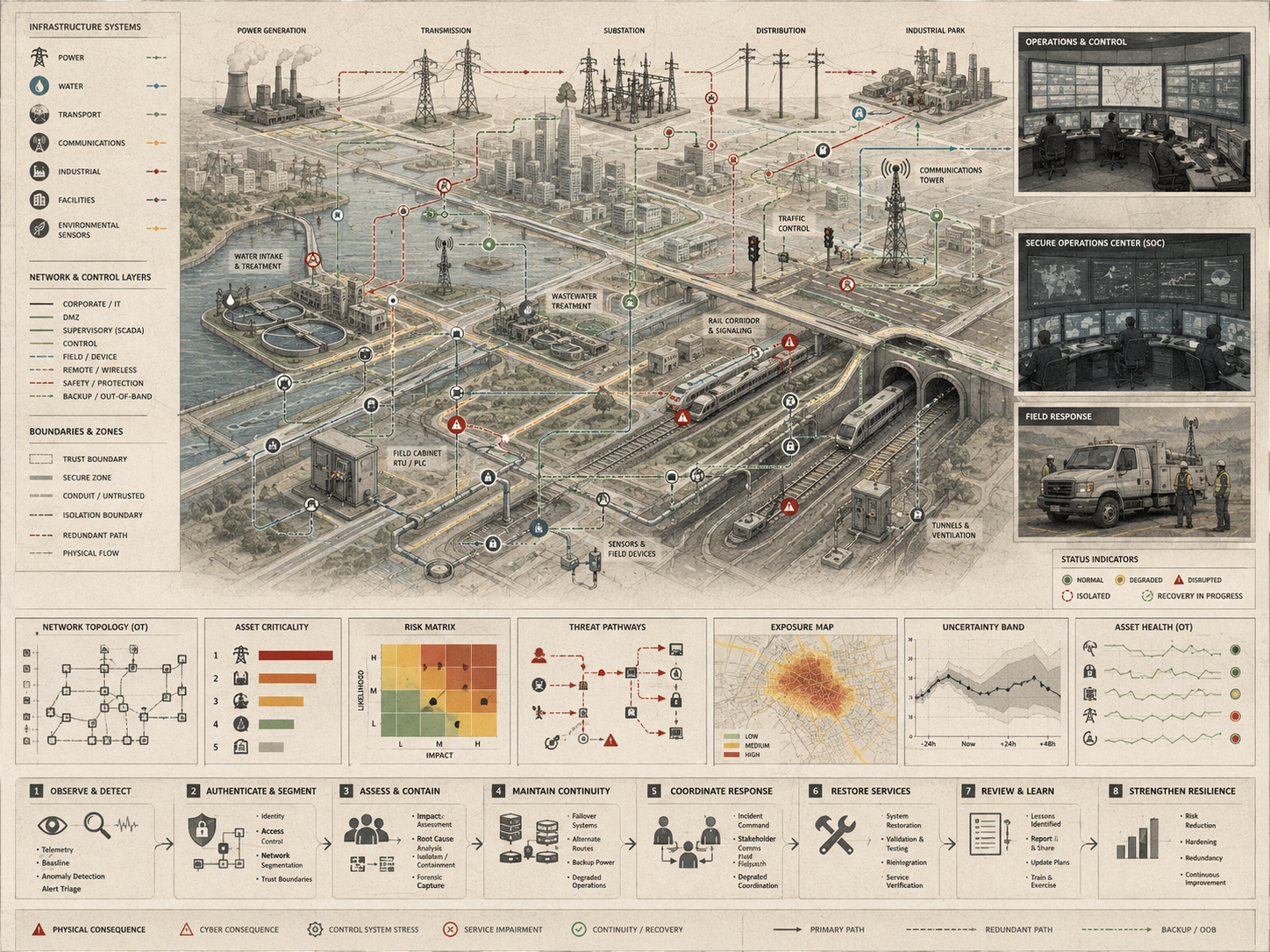
For that reason, infrastructure security should not be reduced to perimeter defense, compliance checklists, or the assumption that cyber risk is separate from operational continuity. A water utility does not experience a cyberattack merely as an IT outage if chemical dosing, telemetry, pumping, billing, regulatory reporting, or public communication are affected. A transport system does not experience compromise only as data loss if signaling, dispatch, ticketing, passenger information, or emergency coordination fail together. The key issue is not whether infrastructure has digital systems, but whether those digital systems have become inseparable from essential service delivery.
Infrastructure security and cyber resilience therefore sit at the intersection of critical infrastructure protection, digital governance, industrial operations, emergency preparedness, systems engineering, institutional trust, and public accountability. Where these layers remain fragmented, systems may appear digitally enabled while remaining operationally brittle. Where they are integrated thoughtfully, infrastructure becomes more capable of preventing compromise, containing disruption, preserving essential function, restoring service, and learning from attack.
Engineering Problem
The engineering problem is how to design infrastructure security and cyber-resilience systems that can prevent compromise where possible, detect compromise quickly when prevention fails, contain disruption before it propagates, maintain essential service under degraded conditions, restore trustworthy operations, and preserve public accountability across cyber-physical infrastructure. This is not a narrow problem of securing servers, networks, or applications. It is a systems problem involving physical processes, operational technology, safety constraints, public-service continuity, institutional authority, third-party dependence, communications, emergency coordination, and governance.
This problem is difficult because modern infrastructure combines long-lived physical assets with rapidly changing digital dependencies. Operational technology environments may include legacy controllers, proprietary protocols, unmanaged devices, vendor-maintained equipment, remote access channels, cloud-connected applications, field telemetry, engineering workstations, and control rooms that cannot be patched or rebooted like ordinary enterprise systems. Public institutions often face limited staffing, deferred modernization, fragmented ownership, and competing budget pressures. Meanwhile, attackers can exploit the gap between digital architecture and operational consequence.
Strong infrastructure security therefore requires more than technical controls. It requires a cyber-physical operating model that distinguishes enterprise IT, operational technology, industrial control systems, field devices, communications networks, public-facing platforms, digital service layers, and physical process environments. It must connect security controls to service continuity, incident response, operational fallback, public communication, recovery sequencing, and institutional learning.
| Engineering Tension | Why It Matters | Required Evidence |
|---|---|---|
| Enterprise IT security versus operational technology security | Infrastructure control environments often prioritize safety, availability, timing, and process integrity over ordinary enterprise security assumptions. | OT asset inventory, control-system boundary map, patch-window policy, operational risk review |
| Prevention versus resilience | Preventive controls reduce compromise, but resilience determines whether essential services continue when controls fail. | Incident scenarios, fallback modes, continuity plans, recovery exercises |
| Digital compromise versus physical consequence | Cyber incidents can affect pumping, treatment, dispatch, signaling, power quality, emergency communications, and service access. | Cyber-physical dependency map, process-impact analysis, safety review |
| Connectivity versus attack surface | Remote access, telemetry, analytics, vendors, and cloud platforms improve visibility while expanding exposure. | Remote-access register, segmentation architecture, vendor access log, zero-trust controls |
| Security tools versus institutional capacity | Controls fail when staff, governance, funding, response authority, and operational discipline are weak. | Governance charter, risk ownership matrix, training records, budget pathway |
| Recovery of systems versus recovery of service | Restoring applications is not the same as restoring trustworthy public function. | Service restoration sequence, recovery-time objectives, public communication plan |
| Compliance versus public trust | Formal compliance may not demonstrate the ability to withstand, contain, recover, and explain disruption. | Evidence package, tabletop exercises, control testing, after-action review |
The practical question is therefore: can infrastructure institutions protect and recover cyber-physical systems in ways that preserve essential public function, safety, trust, and accountability under hostile or degraded conditions?
Reference Architecture
A practical reference architecture for infrastructure security and cyber resilience links cybersecurity to operational continuity. The exact design varies across water, power, transportation, communications, buildings, ports, airports, public digital services, and emergency systems, but the responsibilities remain consistent: govern risk, know assets, control identities, segment networks, protect operations, monitor abnormal behavior, detect compromise, respond rapidly, recover safely, manage vendors, and learn after incidents.
| Layer | Engineering Role | Primary Risk | Evidence Artifact |
|---|---|---|---|
| Governance and risk layer | Defines risk ownership, policy, accountability, standards, funding, reporting, and decision rights. | Cybersecurity remains a technical silo without institutional authority. | Cyber governance charter, risk ownership matrix, policy register |
| Asset visibility layer | Documents IT, OT, field devices, software, data flows, identities, remote access, and third-party dependencies. | Unknown assets, unmanaged access paths, shadow systems, and legacy dependencies remain exposed. | Cyber asset register, OT inventory, software bill of materials, access register |
| Identity and access layer | Controls who and what can access systems, including privileged users, vendors, service accounts, and remote connections. | Weak authentication and excessive privileges enable compromise and lateral movement. | IAM policy, MFA coverage, privileged-access review, vendor-access log |
| Segmentation and protection layer | Separates trust zones, limits pathways between IT and OT, hardens systems, and reduces exposure. | Compromise spreads from enterprise systems into operational environments. | Network segmentation map, firewall rules, OT zone model, configuration baseline |
| Monitoring and detection layer | Observes security events, operational anomalies, network behavior, process deviations, and integrity signals. | Incidents remain undetected until service disruption occurs. | Logging plan, detection rules, OT monitoring coverage, alert triage record |
| Response and containment layer | Coordinates incident response, isolation, escalation, communications, containment, and safety review. | Delayed response allows compromise to propagate across systems and services. | Incident response plan, playbooks, escalation matrix, containment log |
| Recovery and continuity layer | Restores essential services, verifies operational integrity, supports degraded modes, and communicates with the public. | Systems are restored technically while public service remains unsafe, unreliable, or opaque. | Recovery plan, backup test, manual fallback procedure, continuity exercise |
| Vendor and supply-chain layer | Manages third-party software, contractors, integrators, remote support, managed services, and cloud dependence. | External dependencies become hidden infrastructure attack surfaces. | Vendor-risk register, contract controls, access review, dependency map |
This architecture makes clear that cyber resilience is not one control or one framework. It is a layered public-service protection system built across technology, operations, governance, and recovery.
Implementation Pattern
A rigorous implementation pattern begins with essential service continuity rather than tool selection. Infrastructure operators should define which public functions must be preserved, which cyber-physical systems support them, which dependencies could compromise them, and which controls and recovery procedures are required to maintain trustworthy service. Only after that should institutions choose specific tooling, monitoring platforms, identity systems, segmentation approaches, backup strategies, or compliance mappings.
| Artifact | Purpose | Suggested Format |
|---|---|---|
| Cyber resilience objective manifest | Defines scope, service purpose, system boundaries, decision use, and valid-use limits. | YAML, Markdown, architecture decision record |
| Cyber asset register | Documents IT assets, OT devices, field systems, software, firmware, identities, data flows, and dependencies. | CSV, SQL table, CMDB export, SBOM-linked register |
| OT zone and conduit map | Defines operational trust boundaries, network zones, conduits, segmentation rules, and remote-access pathways. | CSV, diagram, YAML, network model |
| Control baseline | Documents required controls for governance, asset visibility, identity, protection, detection, response, and recovery. | CSV, JSON, control matrix |
| Incident scenario manifest | Defines cyber-physical disruption scenarios, affected services, containment assumptions, and recovery priorities. | YAML, CSV, tabletop scenario table |
| Continuity and recovery log | Tracks backups, restoration tests, manual fallback, recovery-time objectives, public communication, and after-action review. | CSV, SQL table, incident-management record |
| Vendor-risk register | Tracks vendors, integrators, managed services, remote support, software dependencies, contract controls, and concentration risk. | CSV, SQL table, procurement-risk file |
| Cyber governance log | Documents risk acceptance, escalation, exception approval, funding, incident review, and public accountability. | CSV, SQL table, governance log |
| Public evidence package | Explains resilience posture, valid-use caveats, public-service priorities, and accountability without exposing sensitive details. | Markdown, HTML, PDF |
The implementation goal is to make cyber-resilience claims reconstructable. A user should be able to move from a readiness score, incident scenario, continuity claim, control exception, or public statement back to the asset evidence, segmentation logic, control baseline, test record, governance decision, and recovery plan that supports it.
Research-Grade Framing: Cyber Resilience as Public-Service Continuity
A research-grade account of infrastructure security begins by treating cyber resilience as public-service continuity rather than only digital protection. Security controls matter, but their purpose in infrastructure is not merely to protect information systems. Their purpose is to preserve the trustworthy functioning of essential services: water, electricity, mobility, emergency coordination, communications, sanitation, health-supporting facilities, digital public access, and other services on which people depend.
This framing matters because the cyber-physical boundary changes the meaning of compromise. In ordinary enterprise environments, cyber incidents may primarily involve confidentiality, business interruption, legal exposure, or data integrity. In infrastructure environments, compromise can also produce unsafe commands, process instability, service outage, public confusion, cascading failure, environmental harm, and loss of trust in public institutions. The question is not only “Was the system breached?” but “Can the physical and institutional service still be trusted?”
Infrastructure cyber resilience is therefore a systems discipline. It requires governance, asset visibility, segmentation, monitoring, incident response, recovery sequencing, operational fallback, public communication, and learning. It also requires humility: no organization can assume perfect prevention. Resilience begins with the recognition that prevention may fail and that essential public function must still be protected.
| Limited Pattern | Stronger Pattern | Why the Shift Matters |
|---|---|---|
| Protect networks | Protect public-service continuity across cyber-physical systems | Infrastructure compromise can produce physical and social consequences. |
| Inventory servers and endpoints | Inventory IT, OT, field devices, identities, remote access, vendors, software, and process dependencies | Unknown assets and dependencies create unmanaged exposure. |
| Segment networks | Design trust boundaries around operational consequence, safety, and recovery | Segmentation must reflect process risk, not only network topology. |
| Monitor cyber events | Monitor cyber behavior, operational anomalies, process deviation, and service continuity signals | Cyber incidents may appear first as operational abnormality. |
| Restore systems | Restore trustworthy service with sequencing, validation, fallback, and public communication | Technical recovery is not the same as safe public-service recovery. |
| Pass compliance checks | Build evidence that controls are implemented, tested, funded, governed, and improved | Compliance without operational readiness can create false confidence. |
The central research question is therefore: how can infrastructure institutions govern digital dependence so that cyber compromise does not become systemic public-service failure?
Formal Model: Exposure, Control, Detection, Recovery, and Continuity
A useful formal model separates cyber exposure, vulnerability, control effectiveness, detection capability, containment, recovery, service continuity, and governance readiness. Let \(E_i\) represent exposure for infrastructure system \(i\), \(V_i\) vulnerability, \(C_i\) control effectiveness, \(D_i\) detection capability, \(R_i\) recovery readiness, \(S_i\) service criticality, and \(G_i\) governance readiness.
X_i = E_i \times V_i
\]
Interpretation: Cyber exposure \(X_i\) increases when a system has both external or internal exposure pathways and exploitable vulnerabilities.
X^{\mathrm{residual}}_i = X_i(1 – C_i)
\]
Interpretation: Residual cyber exposure remains after controls are applied, where \(C_i\) represents the effectiveness of protection, segmentation, access control, and hardening.
T_{\mathrm{impact}} = T_{\mathrm{detect}} + T_{\mathrm{contain}} + T_{\mathrm{recover}}
\]
Interpretation: Impact duration depends on detection time, containment time, and recovery time. Resilience improves when all three are reduced.
Q_{\mathrm{resilience}} =
w_1A +
w_2I +
w_3P +
w_4D +
w_5C +
w_6R +
w_7G
\]
Interpretation: Cyber resilience quality combines asset visibility \(A\), identity governance \(I\), protection \(P\), detection \(D\), containment \(C\), recovery \(R\), and governance \(G\).
SC_i = \frac{P_{\mathrm{essential},i}}{T_{\mathrm{impact},i} + L_{\mathrm{degradation},i}}
\]
Interpretation: Service continuity improves when essential performance is preserved and the time and level of degradation are reduced.
Q_{\mathrm{public\ trust}} =
w_1SC +
w_2M +
w_3R +
w_4E +
w_5A_c
\]
Interpretation: Public trust after cyber disruption depends on service continuity, meaningful communication, recovery credibility, equity of consequence, and accountability.
This formal structure protects against a common mistake in infrastructure cybersecurity: treating control presence as resilience. True cyber resilience depends on whether controls, detection, containment, recovery, continuity, governance, and public trust work together under stress.
What Are Infrastructure Security and Cyber Resilience?
Infrastructure security and cyber resilience refer to the systems and practices through which critical services are protected against cyber compromise and operational disruption. This includes prevention, detection, containment, response, and recovery, but it also includes governance, staffing, asset inventories, segmentation, secure remote access, backup strategies, vendor oversight, and the institutional routines required to maintain essential services under attack or failure.
This is broader than traditional enterprise cybersecurity. In critical infrastructure, cyber resilience must account for physical consequences, service continuity, industrial process integrity, public safety, regulatory obligations, and public trust. A successful compromise may affect not only confidentiality or data availability, but operational visibility, mechanical control, treatment processes, dispatch decisions, power quality, timing, safety, or the ability to communicate with the public during stress.
Infrastructure security is therefore best understood as a public-service protection system rather than a narrow IT hygiene program. It creates the conditions under which digital dependence does not automatically become systemic fragility. NIST’s Cybersecurity Framework 2.0 is especially useful here because it places governance, risk management, organizational outcomes, and communication at the center rather than treating security as a purely technical checklist. CISA’s Cross-Sector Cybersecurity Performance Goals reinforce that same basic logic by defining a common practical baseline for critical infrastructure operators across sectors.
| Function | Primary Question | Evidence Needed |
|---|---|---|
| Governance | Who owns cyber risk, funds resilience, approves exceptions, and accepts residual exposure? | Governance charter, risk ownership matrix, exception log |
| Asset visibility | Which IT, OT, field, identity, software, vendor, and data-flow assets exist? | Asset register, OT inventory, SBOM records, access register |
| Protection | Which controls reduce exposure and limit compromise pathways? | Control baseline, segmentation map, MFA coverage, hardening record |
| Detection | Can abnormal cyber and operational behavior be detected in time to act? | Logging plan, alert rules, OT monitoring, anomaly detection |
| Response | Can the organization contain compromise safely and coordinate action? | Incident response plan, playbooks, escalation procedure |
| Recovery | Can essential services be restored safely, credibly, and in the right order? | Recovery tests, backup validation, restoration sequence |
| Continuity | Can essential public functions continue under degraded cyber-physical conditions? | Manual fallback, degraded-mode procedures, continuity exercise |
Infrastructure cyber resilience is strongest when these functions operate as one public-service protection system rather than as separate IT, OT, compliance, procurement, and emergency-management silos.
Why Critical Infrastructure Security Must Be Cyber-Physical
Critical infrastructure security must be cyber-physical because digital compromise increasingly affects physical service delivery. The traditional separation between information systems and operational systems has weakened as infrastructure operators adopt networked sensors, remote management, cloud-connected applications, industrial data platforms, and real-time analytics. This creates efficiencies and visibility, but it also expands the pathways through which disruption can propagate from networks into essential services.
This matters because cyber incidents in infrastructure rarely remain purely virtual. A compromise in a utility environment may interrupt pumping, telemetry, treatment, customer operations, regulatory reporting, or public communication. A compromise in transport systems may affect dispatch, signaling, route visibility, passenger information, fare systems, or emergency routing. A compromise in digital public infrastructure can ripple into payments, identification, social transfers, permits, emergency alerts, and access to government services.
Cyber resilience is therefore not an optional defensive layer added after modernization. It is a condition of whether modern infrastructure can remain governable under digital dependence. The most important analytic shift is from thinking about cyber incidents as losses of data toward thinking about them as threats to continuity of public function.
| Infrastructure Domain | Digital Dependency | Potential Service Consequence |
|---|---|---|
| Water systems | SCADA, telemetry, pumps, chemical dosing, metering, billing, public notification | Loss of visibility, disrupted treatment, pressure instability, delayed communication |
| Energy systems | Substation controls, grid monitoring, dispatch, remote access, demand forecasting | Operational instability, delayed restoration, cascading service impacts |
| Transportation | Signal systems, dispatch, passenger information, ticketing, fleet management | Mobility disruption, safety risk, emergency-route degradation |
| Communications | Network management, tower systems, routing, backup power, emergency channels | Loss of coordination, degraded emergency response, public alert failure |
| Public buildings | Building management systems, HVAC, access control, elevators, emergency systems | Health, safety, shelter, and continuity impacts during heat, outages, or emergencies |
| Digital public services | Identity, payments, benefits, portals, records, APIs, cloud services | Loss of civic access, delayed social support, weakened institutional trust |
The defining issue is not simply that infrastructure uses digital systems. It is that digital systems now mediate the visibility, coordination, control, communication, and recovery of essential physical services.
Core Architecture of Infrastructure Security and Cyber Resilience
Infrastructure security and cyber resilience can be understood through a layered architecture that links digital protection to operational continuity. Failure at any one layer can compromise the rest, which means a mature system cannot rely on a single defensive mechanism. It requires layered visibility, controlled trust boundaries, practiced response, and the capacity to sustain operations when prevention is incomplete.
Governance and Risk Layer
This layer includes cyber governance, risk ownership, policy frameworks, role clarity, investment prioritization, executive oversight, exception management, and public accountability. Cybersecurity becomes brittle when it is treated as a narrow technical function without clear institutional ownership, budget authority, and service-continuity responsibility.
Asset Visibility and Identity Layer
This layer includes inventories of devices, software, firmware, data flows, OT assets, user accounts, service accounts, and third-party access paths, as well as authentication and authorization controls. Organizations cannot secure systems they do not clearly identify, especially where legacy assets, unmanaged identities, undocumented dependencies, and temporary vendor access persist.
Protection and Segmentation Layer
This layer includes secure configuration, patching, segmentation, multi-factor authentication, remote-access controls, encryption where appropriate, and separation between enterprise IT and operational technology environments. It is where compromise pathways are reduced before incidents occur.
Detection and Monitoring Layer
This layer includes logging, anomaly detection, threat monitoring, industrial network visibility, alert triage, and process-state awareness. In critical infrastructure, monitoring is not only about suspicious digital behavior. It is also about identifying deviations that may indicate process disruption, unsafe commands, abnormal operational states, or compromised operator visibility.
Response, Recovery, and Continuity Layer
This layer includes incident response, backup and restoration, communications protocols, manual fallback procedures, service continuity planning, operational validation, and post-incident learning. Critical infrastructure security becomes meaningful only when essential services can be restored or maintained under disruption, not merely when attacks are identified.
| Layer | Core Capability | Maturity Question |
|---|---|---|
| Governance and risk | Authority, funding, policy, accountability, and risk ownership | Does cyber risk influence infrastructure decisions, budgets, and service-continuity plans? |
| Asset visibility and identity | Knowledge of assets, users, software, vendors, and access paths | Can the institution identify what must be protected and who can access it? |
| Protection and segmentation | Reduced exposure and controlled trust boundaries | Can compromise be slowed, isolated, or prevented from reaching critical operations? |
| Detection and monitoring | Timely recognition of cyber and operational abnormality | Can the institution detect compromise before public-service harm escalates? |
| Response and containment | Coordinated action under incident conditions | Can teams isolate, communicate, and decide under stress? |
| Recovery and continuity | Restoration of trustworthy public service | Can essential functions continue or recover safely when systems are degraded? |
This architecture is helpful because it connects cybersecurity to service performance. The goal is not only to reduce breach likelihood, but to preserve trustworthy infrastructure function before, during, and after disruption.
Industrial Control Systems, OT Security, and Operational Continuity
One of the most important distinctions in infrastructure security is the difference between enterprise IT security and industrial control or operational technology security. OT environments often involve legacy devices, proprietary protocols, long asset lifetimes, constrained patch windows, safety-critical processes, deterministic timing, engineering workstations, field devices, and very limited tolerance for downtime. Their purpose is not primarily information handling, but physical process control. That difference changes almost every security assumption.
This matters because security practices that work well in enterprise systems may not translate directly into operational environments. Broad vulnerability scanning, frequent reboots, aggressive patch cycles, or rapid configuration changes may be acceptable in office networks yet destabilizing in industrial environments. A water-treatment control system, substation controller, rail-signaling environment, port logistics control environment, or pipeline SCADA network must often be secured under conditions where availability, timing, safety, and process integrity are as important as confidentiality.
OT security is therefore not simply “IT plus industrial equipment.” It is a distinct security practice shaped by physics, safety, timing, and operational dependency. A compromise in an office network may cause inconvenience or business disruption. A compromise in an OT environment may alter flows, open or close valves, interrupt dispatch, destabilize power, change chemical dosing, disrupt alarms, or create unsafe conditions for operators and the public. The central question is not only whether systems are breached, but whether physical processes can still be trusted.
| Dimension | Enterprise IT Pattern | OT / ICS Pattern |
|---|---|---|
| Primary purpose | Information processing, communication, business operations | Physical process monitoring, control, safety, and service continuity |
| Dominant concern | Confidentiality, integrity, availability, compliance | Availability, safety, process integrity, timing, recoverability |
| Asset lifetime | Shorter replacement cycles | Long-lived equipment and legacy controllers |
| Patch strategy | Frequent patching and rebooting often feasible | Patch windows constrained by safety, downtime, vendor support, and process stability |
| Monitoring signal | Network, identity, endpoint, application, and data events | Network behavior plus process-state deviation, command anomalies, and engineering workstation activity |
| Recovery test | Systems and data restored | Physical process restored safely and operations verified |
Operational continuity is the core test. A mature infrastructure-security program must protect digital systems in a way that preserves process stability, manual fallback capability, operator visibility, and service restoration under degraded conditions. Cyber resilience in OT environments is therefore inseparable from engineering judgment, operational discipline, and an understanding of how digital compromise interacts with the physical world.
Threat Exposure, Interdependence, and Cascading Failure
Critical infrastructure security must also be understood systemically, because cyber compromise can cascade across sectors and dependencies. A digital incident in one infrastructure domain may propagate into others through shared communications systems, common vendors, electricity dependency, cloud services, managed-service providers, remote access channels, public platforms, or digital public infrastructure.
This matters because infrastructure incidents are rarely isolated. A communications outage may affect emergency coordination, payment systems, transport visibility, public alerts, and maintenance dispatch. A power disruption may degrade telecom availability, water pumping, building operations, and digital service delivery. A compromise in a shared software supplier or managed-service provider may affect multiple operators simultaneously. Threat exposure therefore has to be assessed not only asset by asset, but also across system interdependence and common dependencies.
Cyber resilience is strongest when it anticipates these chains of dependency rather than assuming that each operator can secure itself in isolation. In modern infrastructure environments, the system boundary is rarely identical to the organizational boundary.
| Dependency Pathway | Compromise Scenario | Potential Cascade | Resilience Need |
|---|---|---|---|
| Power → Water | Substation disruption affects pumping and telemetry. | Reduced pressure, treatment disruption, delayed response. | Backup power, manual procedures, alternate pressure zones. |
| Communications → Emergency services | Network compromise degrades dispatch or alerting. | Delayed emergency coordination and public warning. | Redundant channels, radio fallback, tested communication plans. |
| Cloud platform → Public services | Platform outage affects civic portals or benefit access. | Residents lose access to payments, forms, records, or support. | Offline alternatives, failover, public communication. |
| Vendor remote access → OT environment | Compromised vendor credential provides pathway into control systems. | Lateral movement into operational networks. | Privileged access management, session recording, time-bound access. |
| Transport systems → Repair operations | Signal, dispatch, or corridor disruption slows maintenance response. | Extended outage duration in other sectors. | Emergency routing, priority access, cross-sector coordination. |
The analytic boundary for infrastructure security should therefore follow service dependence, not only network topology or organizational ownership.
Governance, Standards, and Institutional Capacity
Infrastructure security is a governance problem as much as a technical one. Institutions must decide who owns cyber risk, how cyber resilience is funded, which standards apply, how compliance is assessed, how incidents are reported, how operators coordinate across public and private boundaries, and how residual risk is accepted or escalated.
Standards matter because critical infrastructure often spans entities with different maturities, incentives, resources, and operating models. Common frameworks help establish baseline expectations across sectors and organizations, even when implementation must remain context-specific. Without shared expectations, security performance becomes uneven, and weak links can persist across connected systems.
Institutional capacity matters just as much. A utility, agency, or ministry can recognize cyber risk and still remain weak if staffing is thin, incident-response capability is immature, procurement overlooks security, operational technology is poorly documented, or resilience investment is repeatedly deferred. Cyber resilience depends on governance systems able to convert awareness into sustained operational capability.
This is where current frameworks do their most useful work. NIST CSF 2.0 provides a common organizing structure for governance, assessment, target setting, and improvement, while CISA’s performance goals translate that governance logic into a more actionable baseline for operators. The key lesson is that resilience depends less on any single tool than on whether institutions can make cyber risk part of routine infrastructure governance.
| Governance Responsibility | Question | Evidence Needed |
|---|---|---|
| Risk ownership | Who owns cyber risk across IT, OT, vendors, public services, and recovery? | Risk ownership matrix, accountable owner, escalation rules |
| Control governance | Which controls are required, tested, funded, and maintained? | Control baseline, implementation status, test records |
| OT governance | How are operational constraints, patch windows, engineering changes, and safety concerns governed? | OT change policy, maintenance windows, safety review, engineering approval |
| Incident governance | Who can isolate systems, activate fallback, notify partners, and communicate publicly? | Incident command structure, playbooks, communication protocol |
| Vendor governance | How are remote access, software dependence, contract obligations, and third-party risk managed? | Vendor-risk register, access controls, contract clauses, supplier review |
| Public accountability | Can affected publics understand service impacts, recovery priorities, and institutional responsibility? | Public evidence package, plain-language incident updates, after-action review |
Cyber resilience therefore depends on institutional ability to turn frameworks into operating routines: inventories, controls, exercises, decisions, funding, and learning.
Detection, Response, Recovery, and Continuity
Infrastructure security is often judged by preventive controls, but operational resilience depends just as much on detection, response, recovery, and continuity. Preventive security aims to reduce the chance of compromise. Cyber resilience asks what happens when prevention is incomplete, delayed, bypassed, or overwhelmed.
This distinction matters because cyber resilience, business continuity, and disaster recovery are related but not identical. Cyber resilience is the broader capacity to anticipate, withstand, recover from, and adapt after cyber disruption. Business continuity focuses on sustaining essential functions during disruption, regardless of cause. Disaster recovery is narrower: it concerns restoring systems, data, and technical capability after failure. In critical infrastructure, these concepts overlap, but they should not be collapsed. An organization may have backups and disaster-recovery procedures yet still lack true resilience if essential services cannot continue under degraded conditions.
Recovery is especially important because essential services cannot be treated like ordinary digital workloads. Restoring water treatment, transport operations, energy service, emergency communications, or public-service access often requires careful sequencing, operational verification, safety checks, and public communication. The core challenge is not simply restoring servers or applications. It is restoring trustworthy public function.
| Function | Key Question | Operational Evidence |
|---|---|---|
| Detection | Can abnormal cyber and operational behavior be recognized quickly enough to act? | Logging coverage, OT monitoring, alert triage, anomaly baselines |
| Containment | Can compromise be isolated without creating unsafe process consequences? | Containment playbooks, segmentation rules, engineering review |
| Response coordination | Can IT, OT, operations, leadership, emergency management, vendors, and communications teams act together? | Incident command plan, tabletop exercises, escalation records |
| Recovery | Can systems and services be restored safely and credibly? | Backup validation, restore tests, operational verification, recovery sequence |
| Continuity | Can essential public functions continue while systems are degraded? | Manual fallback, degraded-mode operations, service-priority list |
| Learning | Do incidents and exercises change controls, standards, budgets, and operational routines? | After-action review, updated playbooks, control improvements |
This is one of the clearest places where critical-infrastructure security departs from ordinary enterprise security. Recovery is judged not by whether systems return, but by whether essential services return safely, credibly, and in an order consistent with public need.
Supply Chains, Vendors, and Third-Party Dependence
Modern infrastructure systems depend heavily on vendors, integrators, software suppliers, cloud providers, telecommunications carriers, managed-service providers, equipment manufacturers, consultants, and maintenance contractors. This means critical infrastructure security now extends beyond the boundary of the operator itself. Compromise, weakness, opacity, or overconcentration in these third-party relationships can become infrastructure risk.
This matters because outsourcing or digitization can improve capability while also creating concentration risk and dependency. Operators may have limited visibility into software components, patch cycles, remote-access arrangements, subcontracted services, or embedded support channels that nevertheless affect essential operations. A vendor relationship that looks efficient from a procurement perspective may look fragile from a resilience perspective.
Cyber resilience therefore requires stronger vendor governance, procurement discipline, contractual clarity, software transparency, concentration-risk analysis, and the ability to assess dependency before incidents occur. Supply-chain resilience is not separate from infrastructure security. It is one of the clearest ways in which critical infrastructure has become both networked and institutionally distributed.
| Dependency Type | Risk | Resilience Control |
|---|---|---|
| Remote support vendors | Compromised credentials or unmanaged access path into critical systems. | Time-bound access, MFA, privileged access management, session logging |
| Managed service providers | Provider compromise affects many systems or operators at once. | Contractual controls, segmentation, backup access, incident coordination |
| Cloud platforms | Platform outage or account compromise disrupts public services or analytics. | Failover design, offline alternatives, identity hardening, recovery tests |
| Software suppliers | Vulnerable or compromised components enter infrastructure systems. | SBOM practices, vulnerability monitoring, patch governance |
| Equipment manufacturers | Legacy firmware, unsupported devices, and proprietary systems limit security options. | Lifecycle planning, compensating controls, network isolation |
| Telecommunications providers | Communications failure affects telemetry, dispatch, emergency response, and public alerts. | Redundant channels, service-level agreements, emergency communication fallback |
Procurement and contract management have become part of the cybersecurity perimeter. A system can be technically well protected and still remain brittle if its supply relationships are opaque, overconcentrated, or poorly governed.
Public Trust, Essential Services, and Uneven Consequences
Cyber incidents in infrastructure also have uneven social consequences. Disruption to water, power, transport, payments, health-supporting systems, emergency communications, public buildings, or digital public services does not affect all populations equally. People with fewer alternatives, weaker digital access, medical dependence, mobility constraints, limited savings, language barriers, or greater reliance on public systems may bear the greatest burden.
This matters because infrastructure security is not only about technical hardening. It is also about maintaining trust that essential systems will remain reliable, recoverable, and governed in the public interest. A system may appear secure in technical terms while still being socially fragile if recovery is slow, communication is poor, public updates are inaccessible, or disruptions fall disproportionately on vulnerable users.
Cyber resilience should therefore be judged not only by whether attacks are blocked, but by whether essential services remain credible and recoverable for the people who depend on them most. This is especially important as more services move through digital public infrastructure and connected platforms, where outages may affect identity, payments, social benefits, civic access, emergency information, and conventional utilities at the same time.
| Dimension | Question | Evidence Needed |
|---|---|---|
| Service dependence | Which populations depend most directly on the affected infrastructure? | Vulnerability mapping, essential-service dependency analysis |
| Recovery equity | Are restoration priorities aligned with public need, health, safety, and vulnerability? | Service restoration policy, equity-weighted recovery plan |
| Communication access | Can affected publics receive clear, multilingual, accessible updates? | Public communication plan, accessibility review, alternate channels |
| Digital exclusion | Can people access services when digital platforms are down or inaccessible? | Offline fallback, physical service alternatives, assisted access |
| Trust repair | How will institutions explain impact, responsibility, recovery, and future prevention? | Public evidence package, after-action report, accountability record |
The social test of cyber resilience is not only whether infrastructure recovers, but whether recovery is credible, fairly prioritized, publicly understandable, and accountable to those most affected.
Measurement, Baselines, and Cyber Resilience Assessment
Infrastructure security is difficult to improve without baselines and measurement. Cyber resilience cannot be reduced to the absence of incidents, because quiet systems may still be weakly governed, poorly segmented, unmonitored, vendor-dependent, or operationally unprepared for disruption. Strong assessment distinguishes between organizations that accumulate security tools and organizations that can maintain essential services under pressure.
This matters because assessment needs to consider asset visibility, identity controls, detection capability, recovery readiness, segmentation, incident coordination, vendor dependence, operational continuity, and public communication. Indicators are most useful when they help institutions identify where the resilience chain is weak: governance, protection, monitoring, response, recovery, continuity, or learning.
CISA’s Cross-Sector Cybersecurity Performance Goals are especially useful because they define a practical baseline intended to be usable across critical infrastructure sectors. ENISA’s NIS2 technical guidance plays a related role by translating broader legal and policy expectations into implementable cybersecurity risk-management measures for covered sectors. The most useful metrics are the ones that make resilience gaps visible enough to govern, not the ones that merely reward formal compliance.
| Assessment Dimension | Example Metric | Interpretive Caveat |
|---|---|---|
| Asset visibility | Share of critical IT, OT, field, software, identity, and vendor assets inventoried. | Inventory must remain current and tied to service criticality. |
| Identity and access | MFA coverage, privileged-access review, inactive account removal, vendor-access controls. | Access control must include OT, remote support, and service accounts. |
| Segmentation | Share of critical systems protected by tested segmentation and controlled conduits. | Network diagrams are not enough; segmentation must be verified. |
| Detection | Logging coverage, alert quality, anomaly detection, OT monitoring, time to detect. | Detection must include operational consequences, not only digital events. |
| Response | Incident playbooks, tabletop exercises, escalation speed, containment readiness. | Response must be practiced across IT, OT, operations, vendors, and leadership. |
| Recovery | Backup validation, restore tests, recovery-time objectives, operational verification. | Technical recovery must be validated as safe service recovery. |
| Continuity | Manual fallback, degraded-mode operations, service-priority plans, alternate communications. | Continuity plans require exercises and resourcing. |
| Governance | Risk ownership, exception approval, budget linkage, public evidence, after-action review. | Documentation must affect decisions, not merely exist. |
Good assessment should strengthen actual service resilience rather than merely create another compliance score.
Deployment Readiness Gate
Before infrastructure security and cyber-resilience systems are used for public reporting, operational assurance, incident response, OT modernization, digital infrastructure procurement, critical-service continuity planning, or governance decisions, they should pass a readiness gate. This gate should test whether the institution can make defensible claims about asset visibility, identity, segmentation, monitoring, response, recovery, continuity, vendor risk, and governance.
| Readiness Area | Required Question | Pass Evidence |
|---|---|---|
| Purpose readiness | Does the system define public-service scope, cyber-physical boundary, owners, and valid-use limits? | Cyber resilience objective manifest |
| Asset readiness | Are IT, OT, field devices, software, identities, remote access, vendors, and data flows inventoried? | Cyber asset register, OT inventory, software and access records |
| Identity readiness | Are privileged users, service accounts, vendor access, and remote access governed? | MFA coverage, privileged-access review, vendor-access log |
| Segmentation readiness | Are IT, OT, public, vendor, and safety-relevant zones separated and tested? | Zone model, conduit map, segmentation test |
| Detection readiness | Can cyber and operational anomalies be detected and triaged? | Logging coverage, detection rules, OT monitoring, alert review |
| Incident readiness | Can teams contain compromise without creating unsafe process consequences? | Incident playbooks, tabletop exercise, escalation matrix |
| Recovery readiness | Can systems, data, operations, and public services be restored safely? | Backup tests, recovery sequence, operational verification record |
| Continuity readiness | Can essential functions continue under degraded cyber-physical conditions? | Manual fallback, degraded-mode procedure, service-priority plan |
| Vendor readiness | Are third-party access, software dependence, contracts, and concentration risk governed? | Vendor-risk register, contract controls, dependency map |
| Governance readiness | Are risk ownership, funding, public communication, exception approval, and after-action learning defined? | Governance log, public evidence package, review cycle |
This readiness gate prevents cyber resilience from being treated as a dashboard claim. The stronger standard is whether infrastructure institutions can preserve trustworthy service under cyber-physical stress.
Data and Configuration Artifacts
A reproducible infrastructure security workflow should include explicit artifacts for cyber objectives, asset visibility, OT zones, control baselines, incident scenarios, continuity, recovery, vendor dependence, governance, and public evidence. These artifacts make cyber-resilience claims auditable rather than hidden inside tools, diagrams, consultant reports, or informal operational routines.
| Artifact | Purpose | Suggested Path |
|---|---|---|
| Cyber resilience objective manifest | Defines system scope, service purpose, cyber-physical boundary, decision use, and valid-use limits. | config/cyber_resilience_objective.yml |
| Cyber asset register | Documents IT, OT, field devices, software, data flows, identities, remote access, and criticality. | data/cyber_asset_register.csv |
| OT zone and conduit map | Defines trust zones, conduits, segmentation status, and boundary controls. | data/ot_zone_conduit_map.csv |
| Control baseline | Tracks cybersecurity controls, implementation status, evidence, owners, and test frequency. | data/cyber_control_baseline.csv |
| Incident scenario manifest | Defines cyber-physical disruption scenarios, affected services, containment assumptions, and recovery objectives. | data/cyber_incident_scenario_manifest.csv |
| Continuity and recovery log | Tracks recovery-time objectives, backup tests, fallback modes, degraded operations, and service validation. | data/continuity_recovery_log.csv |
| Vendor-risk register | Documents suppliers, remote access, managed services, software dependence, concentration risk, and contract controls. | data/vendor_risk_register.csv |
| Governance review log | Documents exceptions, approvals, residual-risk acceptance, budget decisions, and after-action learning. | data/cyber_governance_log.csv |
| Public evidence package | Explains resilience posture, public-service priorities, recovery caveats, and accountability without exposing sensitive details. | docs/public_evidence_package.md |
These artifacts turn infrastructure cyber resilience into a reproducible governance and continuity workflow rather than a disconnected compliance exercise.
Mathematical Lens: Exposure, Control, Detection, Recovery, and Service Continuity
A mathematics-first view can help clarify why cyber resilience requires more than control checklists. The goal is not to reduce cybersecurity to a single score, but to expose the logic connecting exposure, control effectiveness, detection, containment, recovery, and public-service continuity.
X_i = E_i \times V_i
\]
Interpretation: Cyber exposure for system \(i\) increases when exposure pathways and vulnerabilities are both present.
X^{\mathrm{residual}}_i = X_i(1 – C_i)
\]
Interpretation: Residual exposure remains after controls are applied. No control environment eliminates exposure completely.
T_{\mathrm{impact}} = T_{\mathrm{detect}} + T_{\mathrm{contain}} + T_{\mathrm{recover}}
\]
Interpretation: Service impact duration is shaped by detection, containment, and recovery time.
Q_{\mathrm{resilience}} =
w_1A +
w_2I +
w_3P +
w_4D +
w_5C +
w_6R +
w_7G
\]
Interpretation: Cyber resilience quality combines asset visibility, identity governance, protection, detection, containment, recovery, and governance.
SC_i = \frac{P_{\mathrm{essential},i}}{T_{\mathrm{impact},i} + L_{\mathrm{degradation},i}}
\]
Interpretation: Service continuity improves when essential performance is preserved and impact duration and degradation level are reduced.
Q_{\mathrm{public\ trust}} =
w_1SC +
w_2M +
w_3R +
w_4E +
w_5A_c
\]
Interpretation: Public trust after cyber disruption depends on continuity, communication, recovery credibility, equity of consequence, and accountability.
These equations are scaffolds, not substitutes for engineering judgment. They make visible the chain from digital exposure to public-service consequence.
Python Workflow: Cyber Resilience Readiness and Continuity Review
Python is useful for building reproducible cyber-resilience workflows that combine asset criticality, exposure, vulnerability, control maturity, detection, recovery, continuity, and governance readiness. The following educational example creates a simplified cyber-resilience readiness table and flags systems requiring review.
"""
Infrastructure Security and Cyber Resilience Workflow

This educational workflow demonstrates:
1. cyber-physical asset readiness scoring
2. residual exposure after controls
3. detection, response, recovery, and continuity review
4. governance-priority classification

It uses synthetic data for article companion-code scaffolding.
"""

from __future__ import annotations

from dataclasses import dataclass
from typing import List
import pandas as pd


@dataclass
class CyberPhysicalSystem:
    system_id: str
    sector: str
    service_role: str
    exposure: float
    vulnerability: float
    control_effectiveness: float
    asset_visibility: float
    identity_governance: float
    detection_capability: float
    containment_readiness: float
    recovery_readiness: float
    continuity_readiness: float
    governance_readiness: float
    high_criticality: bool


def raw_exposure(system: CyberPhysicalSystem) -> float:
    return system.exposure * system.vulnerability


def residual_exposure(system: CyberPhysicalSystem) -> float:
    return raw_exposure(system) * (1 - system.control_effectiveness)


def resilience_quality(system: CyberPhysicalSystem) -> float:
    return (
        0.14 * system.asset_visibility
        + 0.14 * system.identity_governance
        + 0.15 * system.control_effectiveness
        + 0.14 * system.detection_capability
        + 0.13 * system.containment_readiness
        + 0.15 * system.recovery_readiness
        + 0.15 * system.governance_readiness
    )


def classify_review(system: CyberPhysicalSystem) -> str:
    if system.high_criticality and system.continuity_readiness < 0.65:
        return "urgent_continuity_review"
    if system.high_criticality and system.recovery_readiness < 0.65:
        return "urgent_recovery_review"
    if system.identity_governance < 0.65:
        return "identity_access_review"
    if system.detection_capability < 0.65: return "detection_monitoring_review" if residual_exposure(system) > 0.30:
        return "residual_exposure_review"
    if resilience_quality(system) < 0.70:
        return "cyber_resilience_review"
    return "routine_monitoring"


systems: List[CyberPhysicalSystem] = [
    CyberPhysicalSystem(
        "water-ot-environment",
        "water",
        "treatment_pumping_and_distribution",
        0.72,
        0.62,
        0.58,
        0.68,
        0.66,
        0.64,
        0.62,
        0.60,
        0.58,
        0.64,
        True,
    ),
    CyberPhysicalSystem(
        "grid-substation-control",
        "energy",
        "critical_distribution",
        0.68,
        0.58,
        0.64,
        0.72,
        0.70,
        0.68,
        0.66,
        0.62,
        0.64,
        0.68,
        True,
    ),
    CyberPhysicalSystem(
        "transport-dispatch-signaling",
        "transport",
        "signal_dispatch_and_emergency_access",
        0.64,
        0.55,
        0.62,
        0.70,
        0.67,
        0.66,
        0.63,
        0.66,
        0.68,
        0.69,
        True,
    ),
    CyberPhysicalSystem(
        "emergency-communications-node",
        "communications",
        "emergency_coordination",
        0.61,
        0.50,
        0.70,
        0.76,
        0.72,
        0.74,
        0.72,
        0.70,
        0.72,
        0.74,
        True,
    ),
    CyberPhysicalSystem(
        "civic-service-platform",
        "digital_public_infrastructure",
        "identity_payments_and_public_access",
        0.69,
        0.56,
        0.66,
        0.74,
        0.68,
        0.70,
        0.67,
        0.68,
        0.63,
        0.70,
        True,
    ),
]

records = []
for system in systems:
    records.append({
        "system_id": system.system_id,
        "sector": system.sector,
        "service_role": system.service_role,
        "raw_exposure": round(raw_exposure(system), 3),
        "residual_exposure": round(residual_exposure(system), 3),
        "asset_visibility": system.asset_visibility,
        "identity_governance": system.identity_governance,
        "control_effectiveness": system.control_effectiveness,
        "detection_capability": system.detection_capability,
        "containment_readiness": system.containment_readiness,
        "recovery_readiness": system.recovery_readiness,
        "continuity_readiness": system.continuity_readiness,
        "governance_readiness": system.governance_readiness,
        "resilience_quality": round(resilience_quality(system), 3),
        "review_priority": classify_review(system),
    })

readiness = pd.DataFrame(records).sort_values(
    ["review_priority", "residual_exposure"],
    ascending=[True, False],
)

print(readiness)
This workflow is deliberately simplified. Its purpose is to show how cyber resilience can be assessed as a service-continuity capability rather than only a control inventory.
R Workflow: Cyber Baselines, OT Risk, and Governance Reporting
R is useful for producing review-ready cyber-resilience summaries across sectors, systems, and governance priorities. The following workflow creates a simplified cyber-physical readiness dataset, calculates residual exposure and resilience quality, and summarizes review needs.
# Infrastructure Security and Cyber Resilience Reporting
#
# This educational workflow summarizes:
# - raw cyber exposure
# - residual exposure after controls
# - asset visibility, identity governance, detection, response, recovery, continuity
# - review priorities by sector

library(dplyr)
library(readr)

systems <- tibble::tribble(
  ~system_id, ~sector, ~service_role, ~exposure, ~vulnerability, ~control_effectiveness, ~asset_visibility, ~identity_governance, ~detection_capability, ~containment_readiness, ~recovery_readiness, ~continuity_readiness, ~governance_readiness, ~high_criticality,
  "water-ot-environment", "water", "treatment_pumping_and_distribution", 0.72, 0.62, 0.58, 0.68, 0.66, 0.64, 0.62, 0.60, 0.58, 0.64, TRUE,
  "grid-substation-control", "energy", "critical_distribution", 0.68, 0.58, 0.64, 0.72, 0.70, 0.68, 0.66, 0.62, 0.64, 0.68, TRUE,
  "transport-dispatch-signaling", "transport", "signal_dispatch_and_emergency_access", 0.64, 0.55, 0.62, 0.70, 0.67, 0.66, 0.63, 0.66, 0.68, 0.69, TRUE,
  "emergency-communications-node", "communications", "emergency_coordination", 0.61, 0.50, 0.70, 0.76, 0.72, 0.74, 0.72, 0.70, 0.72, 0.74, TRUE,
  "civic-service-platform", "digital_public_infrastructure", "identity_payments_and_public_access", 0.69, 0.56, 0.66, 0.74, 0.68, 0.70, 0.67, 0.68, 0.63, 0.70, TRUE
)

readiness <- systems %>%
  mutate(
    raw_exposure = exposure * vulnerability,
    residual_exposure = raw_exposure * (1 - control_effectiveness),
    resilience_quality = round(
      0.14 * asset_visibility +
      0.14 * identity_governance +
      0.15 * control_effectiveness +
      0.14 * detection_capability +
      0.13 * containment_readiness +
      0.15 * recovery_readiness +
      0.15 * governance_readiness,
      3
    ),
    review_priority = case_when(
      high_criticality & continuity_readiness < 0.65 ~ "urgent_continuity_review",
      high_criticality & recovery_readiness < 0.65 ~ "urgent_recovery_review",
      identity_governance < 0.65 ~ "identity_access_review",
      detection_capability < 0.65 ~ "detection_monitoring_review", residual_exposure > 0.30 ~ "residual_exposure_review",
      resilience_quality < 0.70 ~ "cyber_resilience_review", TRUE ~ "routine_monitoring" ) ) %>%
  arrange(review_priority, desc(residual_exposure))

sector_summary <- readiness %>%
  group_by(sector) %>%
  summarise(
    systems = n(),
    mean_residual_exposure = round(mean(residual_exposure), 3),
    mean_resilience_quality = round(mean(resilience_quality), 3),
    mean_continuity = round(mean(continuity_readiness), 3),
    mean_recovery = round(mean(recovery_readiness), 3),
    review_items = sum(review_priority != "routine_monitoring"),
    .groups = "drop"
  ) %>%
  arrange(desc(review_items), mean_resilience_quality)

dir.create("outputs", recursive = TRUE, showWarnings = FALSE)
write_csv(readiness, "outputs/cyber_resilience_readiness.csv")
write_csv(sector_summary, "outputs/cyber_resilience_sector_summary.csv")

print(readiness)
print(sector_summary)
This workflow supports governance reporting by making cyber-resilience gaps visible. It helps distinguish routine monitoring from continuity, recovery, identity, detection, and residual-exposure review.
Systems Code: Cyber Asset Registers, OT Zones, Incident Scenarios, and Governance Logs
Infrastructure security and cyber resilience depend on full-stack systems infrastructure. A serious companion repository should include cyber asset registers, OT zone models, control baselines, incident scenarios, continuity and recovery logs, vendor-risk records, governance reviews, SQL schemas, TypeScript types, Python/R workflows, validation scripts, and public evidence templates.
| Language / Tool | Role in Companion Repository | Example Use |
|---|---|---|
| Python | Cyber resilience scoring, residual exposure analysis, continuity review, and governance watchlists | Cyber-physical readiness workflow |
| R | Sector summaries, baseline reporting, cyber-resilience diagnostics, and governance-ready tables | Cyber resilience reporting workflow |
| SQL | Asset registers, OT zones, control baselines, incident scenarios, continuity logs, vendor risk, and governance records | Auditable cyber-resilience database |
| TypeScript | Dashboard, API, and public-evidence data types | Readiness cards, incident scenario panels, continuity views |
| Go | Lightweight cyber-resilience status endpoint | Expose asset visibility, control baseline, incident scenario, and recovery readiness |
| Rust | Safe validation CLI for cyber-asset and control records | Validate required fields, score ranges, status flags, and governance fields |
| C / C++ | Low-level telemetry and priority-queue examples | Embedded cyber signal records and incident review queues |
| Shell scripts | Reproducible setup, validation, and export workflows | One-command scaffold validation and output generation |
This breadth is appropriate because infrastructure security is not only a cybersecurity problem. It is a cyber-physical systems problem, an operational continuity problem, a public governance problem, and a trust problem.
GitHub Repository
The article body includes selected computational examples so the conceptual and governance argument remains readable. The full repository should contain expanded computational infrastructure: cyber resilience objective manifests, cyber asset registers, OT zone and conduit maps, control baselines, incident scenario manifests, continuity and recovery logs, vendor-risk records, governance documentation, SQL schemas, TypeScript data types, Python/R workflows, notebooks, validation scripts, and public evidence templates.
Testing and Validation
Testing infrastructure security and cyber resilience requires more than checking whether controls exist. It requires validating whether controls are implemented, tested, current, governed, and connected to service continuity. A system can appear compliant while remaining brittle if assets are unknown, segmentation is untested, detection is incomplete, backups are unverified, recovery sequencing is unclear, or manual fallback cannot be performed safely.
| Test Type | Purpose | Example Test |
|---|---|---|
| Asset inventory test | Ensure IT, OT, software, identities, vendor access, and data flows are known. | Compare asset register to network discovery, procurement records, and engineering documentation. |
| Identity and access test | Ensure accounts, privileges, service accounts, and remote access are controlled. | Run privileged-access review, MFA coverage check, and inactive-account audit. |
| Segmentation test | Ensure zones and conduits prevent unnecessary lateral movement. | Validate firewall rules, network paths, remote access, and IT/OT boundaries. |
| Control baseline test | Ensure required controls are implemented and evidenced. | Check baseline controls against CPG, CSF, or internal control mapping. |
| Detection test | Ensure cyber and operational anomalies can be observed and triaged. | Simulate suspicious activity and review alerting, escalation, and analyst response. |
| Incident response test | Ensure teams can coordinate containment without unsafe process effects. | Run tabletop exercise with IT, OT, operations, vendors, legal, and communications teams. |
| Recovery test | Ensure systems and services can be restored safely and in priority order. | Validate backups, restore procedures, operational verification, and recovery-time objectives. |
| Continuity test | Ensure essential services can continue under degraded conditions. | Exercise manual fallback, alternate communications, and degraded-mode operations. |
| Vendor-risk test | Ensure supplier and remote-access dependencies are governed. | Review contracts, access logs, support channels, software dependencies, and concentration risk. |
| Governance test | Ensure exceptions, residual risks, incidents, and after-action findings lead to decisions. | Review governance log, funding decisions, exception approvals, and remediation closure. |
Validation should test the full resilience chain. The decisive question is not whether the organization has security controls, but whether those controls support trustworthy public-service continuity under stress.
Operational Signals and Cyber Resilience Observability
Infrastructure cyber-resilience systems must observe themselves. A security program that cannot report whether inventories are current, controls are tested, alerts are triaged, backups are restorable, vendor access is controlled, continuity plans are exercised, and governance actions are closed is itself a source of risk.
| Signal | Why It Matters | Failure Indicator |
|---|---|---|
| Asset inventory currency | Determines whether protected systems match actual infrastructure conditions. | Unknown OT devices, stale software records, undocumented remote access. |
| Privileged access status | Determines whether high-risk access pathways are controlled. | Shared credentials, inactive accounts, unmanaged vendor access. |
| Segmentation health | Determines whether compromise pathways remain constrained. | Unverified firewall rules, unexpected pathways, flat networks. |
| Detection coverage | Determines whether compromise can be identified in time to respond. | Missing logs, unmonitored OT segments, alert fatigue, stale detection rules. |
| Backup and restore status | Determines whether recovery claims are credible. | Untested backups, failed restore tests, unclear recovery sequence. |
| Continuity readiness | Determines whether essential services can continue while digital systems are degraded. | No manual fallback, untested degraded-mode procedure, missing public communication channel. |
| Vendor exposure | Determines whether third-party dependence is becoming uncontrolled risk. | Unreviewed vendors, persistent remote access, unknown software dependencies. |
| Governance closure | Determines whether findings, exceptions, and incidents lead to accountable action. | Open high-risk exceptions, unfunded remediation, repeated after-action findings. |
Cyber resilience observability protects institutions from the illusion of security. It helps determine whether security governance is alive, stale, or merely decorative.
Engineer and Researcher Checklist
- Define infrastructure security by continuity of essential public function, not by perimeter defense or compliance evidence alone.
- Distinguish enterprise IT, operational technology, industrial control systems, field devices, cloud platforms, digital public services, and vendor-managed systems.
- Maintain current inventories of assets, software, identities, remote access, vendors, OT zones, and data flows.
- Design segmentation around cyber-physical consequence, not only network convenience.
- Govern privileged access, service accounts, vendor access, and remote support pathways.
- Monitor both cyber events and operational process deviations.
- Test incident response with IT, OT, operations, leadership, vendors, legal, communications, and emergency-management teams.
- Validate backups, restoration procedures, recovery sequencing, and operational integrity after restoration.
- Practice manual fallback, degraded-mode operations, alternate communications, and public-service continuity procedures.
- Review third-party risk, software dependence, managed services, contract controls, and concentration risk.
- Assess uneven public consequences, including vulnerable users and people dependent on digital public services.
- Convert after-action findings into revised controls, budgets, procurement rules, training, and governance decisions.
Where This Fits in the Series
This article sits at the cyber-physical resilience layer of the Intelligent Infrastructure Systems knowledge series. It connects digital infrastructure, infrastructure data platforms, urban sensor networks, risk management, governance, emergency preparedness, operational continuity, and public trust. Its role is to show how digital dependence can become either public-service intelligence or systemic fragility depending on whether security, recovery, and governance are integrated into infrastructure operations.
Within the broader series, infrastructure security and cyber resilience provide the discipline that protects intelligent infrastructure from becoming brittle. Sensors, platforms, dashboards, digital twins, AI, and remote operations all expand capability, but they also expand dependency. Cyber resilience asks whether those dependencies remain governable under hostile, degraded, or uncertain conditions.
Related Articles
- Intelligent Infrastructure Systems
- Digital Infrastructure Systems
- Infrastructure Governance and Policy Systems
- Infrastructure Data Platforms and Analytics
- Urban Sensor Networks and Infrastructure Monitoring
- Flood and Disaster Early Warning Infrastructure
- Infrastructure Systems for Urban Resilience
- Infrastructure Systems for Climate Adaptation
- Infrastructure Risk Management Systems
- The Future of Intelligent Infrastructure
These connections are substantive rather than decorative. Infrastructure security is not an isolated cyber topic, but a systems domain connecting digital dependence, physical continuity, governance, risk, resilience, and public trust.
Future Directions
The future of infrastructure security and cyber resilience will likely involve stronger baseline controls, wider adoption of structured governance frameworks, better visibility across OT environments, tighter vendor-risk management, stronger incident-response coordination, more rigorous recovery testing, and deeper integration of cybersecurity into critical-infrastructure planning from the outset. As infrastructure becomes more connected, cyber resilience will increasingly be understood as a condition of public-service reliability rather than an adjacent technology function.
Several directions are especially important. First, OT visibility will become more central as operators recognize that unknown control-system assets are unmanaged public-service risks. Second, identity and access management will expand beyond office systems to include vendors, engineering workstations, service accounts, field devices, and remote support. Third, cyber resilience will be measured increasingly through recovery and continuity tests, not only prevention controls. Fourth, supply-chain assurance will become part of infrastructure governance as software, cloud, telecom, and managed-service dependencies deepen. Fifth, public communication and trust repair will become more important as cyber incidents affect essential services directly.
The deeper challenge, however, is not simply securing more devices. It is ensuring that increasingly digital infrastructure remains governable, recoverable, and publicly reliable under stress. Infrastructure security and cyber resilience will matter most where they improve the continuity of essential services rather than merely expanding technical controls. The long-run goal is not cybersecurity as branding. It is infrastructure capable of withstanding compromise, containing disruption, and restoring public function before digital dependency becomes systemic failure.
Further Reading
- National Institute of Standards and Technology (2024) Cybersecurity Framework 2.0. Available at: https://www.nist.gov/cyberframework
- National Institute of Standards and Technology (2024) The Cybersecurity Framework 2.0. Available at: https://nvlpubs.nist.gov/nistpubs/CSWP/NIST.CSWP.29.pdf
- Cybersecurity and Infrastructure Security Agency (n.d.) Cybersecurity Performance Goals. Available at: https://www.cisa.gov/cybersecurity-performance-goals-cpgs
- Cybersecurity and Infrastructure Security Agency (n.d.) Cross-Sector Cybersecurity Performance Goals. Available at: https://www.cisa.gov/cross-sector-cybersecurity-performance-goals
- Cybersecurity and Infrastructure Security Agency (2025) CISA Releases the Cybersecurity Performance Goals Adoption Report. Available at: https://www.cisa.gov/news-events/alerts/2025/01/10/cisa-releases-cybersecurity-performance-goals-adoption-report
- European Union Agency for Cybersecurity (n.d.) Cybersecurity of Critical Sectors. Available at: https://www.enisa.europa.eu/topics/cybersecurity-of-critical-sectors
- European Union Agency for Cybersecurity (2025) NIS2 Technical Implementation Guidance. Available at: https://www.enisa.europa.eu/publications/nis2-technical-implementation-guidance
- World Bank (n.d.) Supporting Countries in Building Cybersecurity and Resilience of Critical Infrastructure. Available at: https://www.worldbank.org/en/programs/kodi/brief/supporting-countries-in-building-cybersecurity-and-resilience-of-critical-infrastructure
- World Bank (2025) Enhancing Cyber Resilience in Developing Countries. Available at: https://www.worldbank.org/en/results/2025/01/29/-enhancing-cyber-resilience-in-developing-countries
- World Bank (2025) Digital Safeguards. Available at: https://www.worldbank.org/en/topic/digital/brief/digital-safeguards
References
- Cybersecurity and Infrastructure Security Agency (n.d.) Cross-Sector Cybersecurity Performance Goals. Available at: https://www.cisa.gov/cross-sector-cybersecurity-performance-goals (Accessed: 14 May 2026).
- Cybersecurity and Infrastructure Security Agency (n.d.) Cybersecurity Performance Goals. Available at: https://www.cisa.gov/cybersecurity-performance-goals-cpgs (Accessed: 14 May 2026).
- Cybersecurity and Infrastructure Security Agency (2025) CISA Releases the Cybersecurity Performance Goals Adoption Report. Available at: https://www.cisa.gov/news-events/alerts/2025/01/10/cisa-releases-cybersecurity-performance-goals-adoption-report (Accessed: 14 May 2026).
- European Union Agency for Cybersecurity (n.d.) Cybersecurity of Critical Sectors. Available at: https://www.enisa.europa.eu/topics/cybersecurity-of-critical-sectors (Accessed: 14 May 2026).
- European Union Agency for Cybersecurity (2025) NIS2 Technical Implementation Guidance. Available at: https://www.enisa.europa.eu/publications/nis2-technical-implementation-guidance (Accessed: 14 May 2026).
- National Institute of Standards and Technology (2024) Cybersecurity Framework 2.0. Available at: https://www.nist.gov/cyberframework (Accessed: 14 May 2026).
- National Institute of Standards and Technology (2024) The Cybersecurity Framework 2.0. Available at: https://nvlpubs.nist.gov/nistpubs/CSWP/NIST.CSWP.29.pdf (Accessed: 14 May 2026).
- World Bank (n.d.) Supporting Countries in Building Cybersecurity and Resilience of Critical Infrastructure. Available at: https://www.worldbank.org/en/programs/kodi/brief/supporting-countries-in-building-cybersecurity-and-resilience-of-critical-infrastructure (Accessed: 14 May 2026).
- World Bank (2025) Enhancing Cyber Resilience in Developing Countries. Available at: https://www.worldbank.org/en/results/2025/01/29/-enhancing-cyber-resilience-in-developing-countries (Accessed: 14 May 2026).
- World Bank (2025) Digital Safeguards. Available at: https://www.worldbank.org/en/topic/digital/brief/digital-safeguards (Accessed: 14 May 2026).