Intelligent Infrastructure Systems

Intelligent infrastructure systems examine how technological, physical, and informational systems interact to support modern society. Energy grids, transportation networks, water systems, communications infrastructure, and urban systems provide the foundational structures that enable economic activity, public services, and everyday life.

These systems increasingly combine physical infrastructure with sensor networks, data platforms, artificial intelligence, and distributed computing. This integration enables real-time monitoring, predictive maintenance, adaptive resource management, and stronger resilience. Because infrastructure systems are deeply interconnected, studying them requires a systems perspective that connects engineering, data science, governance, economics, and sustainability.

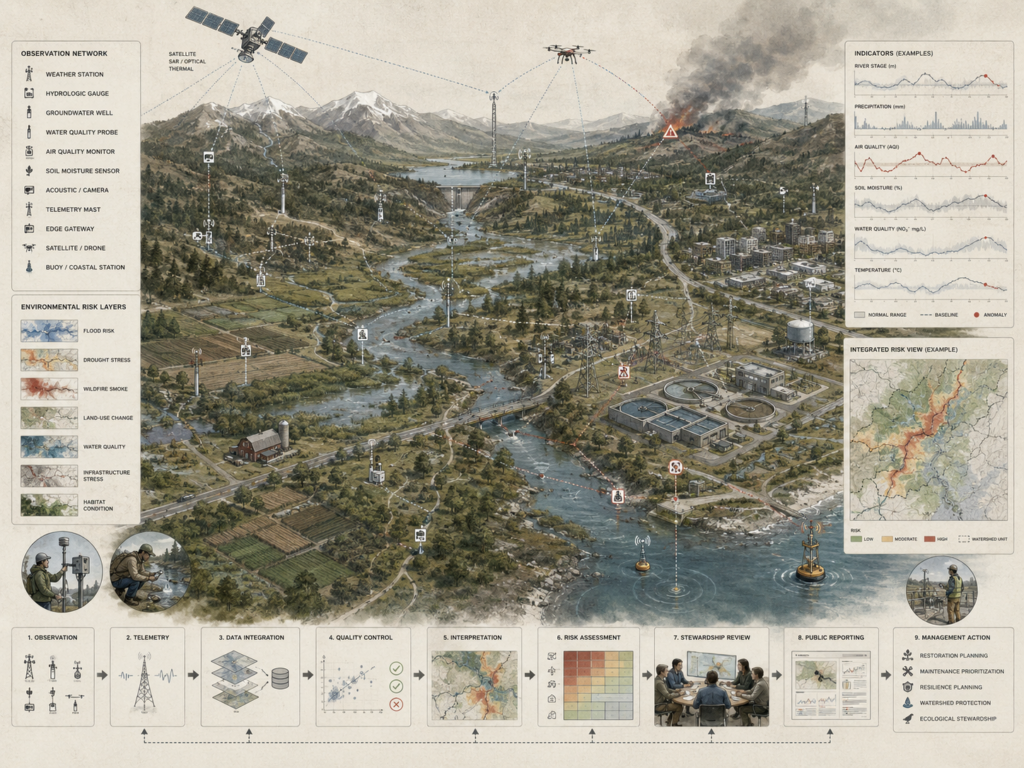
Restrained environmental monitoring infrastructure diagram showing watershed sensors, satellites, drones, telemetry, risk layers, water systems, air quality, soil monitoring, stewardship review, and management action.

Infrastructure for Environmental Monitoring Systems: Observation, Risk and Stewardship

Environmental monitoring infrastructure connects observation, risk interpretation, and stewardship across watersheds, ecosystems, and built systems. Weather stations, hydrologic gauges, groundwater wells, water-quality probes, air-quality monitors, soil-moisture sensors, acoustic and camera systems, telemetry masts, edge gateways, buoys, satellites, and drones help make environmental conditions visible across mountains, rivers, wetlands, farms, settlements, infrastructure, and coastal waters. This article examines how monitoring infrastructure supports data integration, quality control, risk assessment, indicator tracking, anomaly detection, public reporting, stewardship review, and management action. Its value is not measurement alone; it is the ability to connect environmental evidence to watershed protection, restoration planning, resilience priorities, maintenance decisions, and accountable governance. By linking observation networks to public responsibility, environmental monitoring infrastructure supports long-term ecological stewardship.
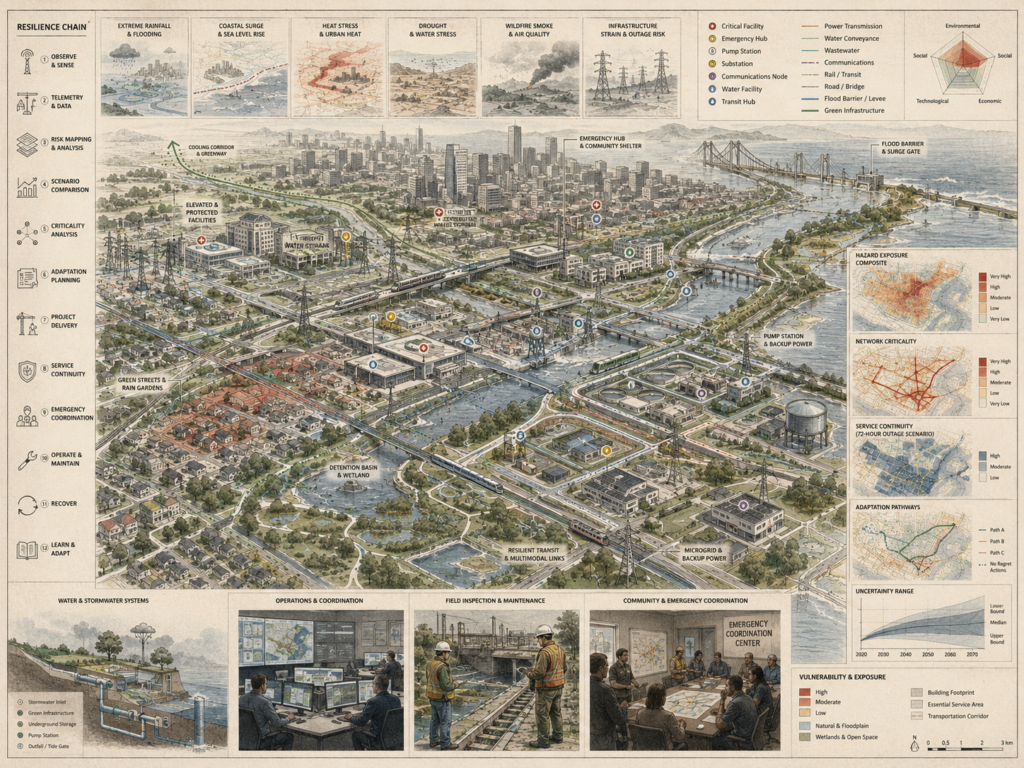
Restrained urban resilience infrastructure diagram showing flood barriers, pump stations, resilient transit, backup power, green infrastructure, hazard exposure, service continuity, and adaptation pathways.

Infrastructure Systems for Urban Resilience: Risk, Adaptation and Service Continuity

Urban resilience infrastructure protects essential services by connecting risk assessment, adaptation, and continuity planning across interdependent city systems. Transportation networks, water and stormwater systems, energy grids, communications nodes, emergency hubs, green infrastructure, flood barriers, pump stations, detention basins, cooling corridors, microgrids, and public facilities must function under pressure from extreme rainfall, coastal surge, heat, drought, wildfire smoke, and infrastructure strain. This article examines how urban resilience depends on hazard exposure mapping, network criticality, service-continuity planning, adaptation pathways, operations coordination, maintenance, emergency response, and long-term investment. Resilience is not only about hardening individual assets; it is about keeping communities connected, protected, and served when systems are stressed. By linking infrastructure planning to public stewardship, cities can reduce risk, adapt to changing conditions, and safeguard essential services.

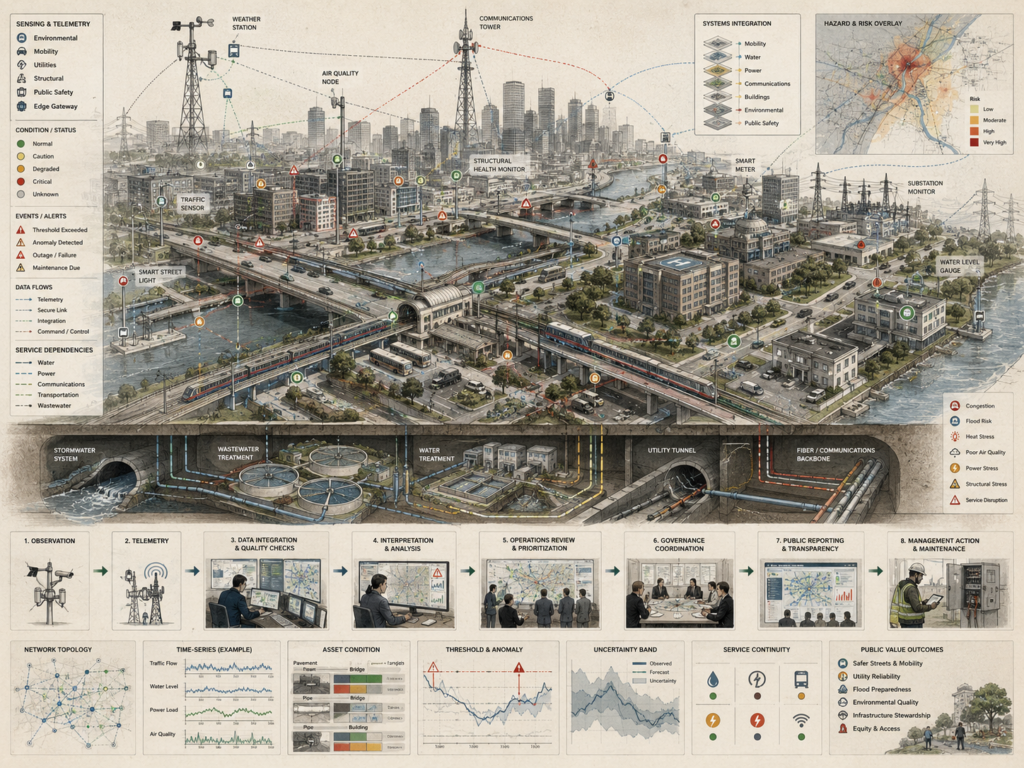
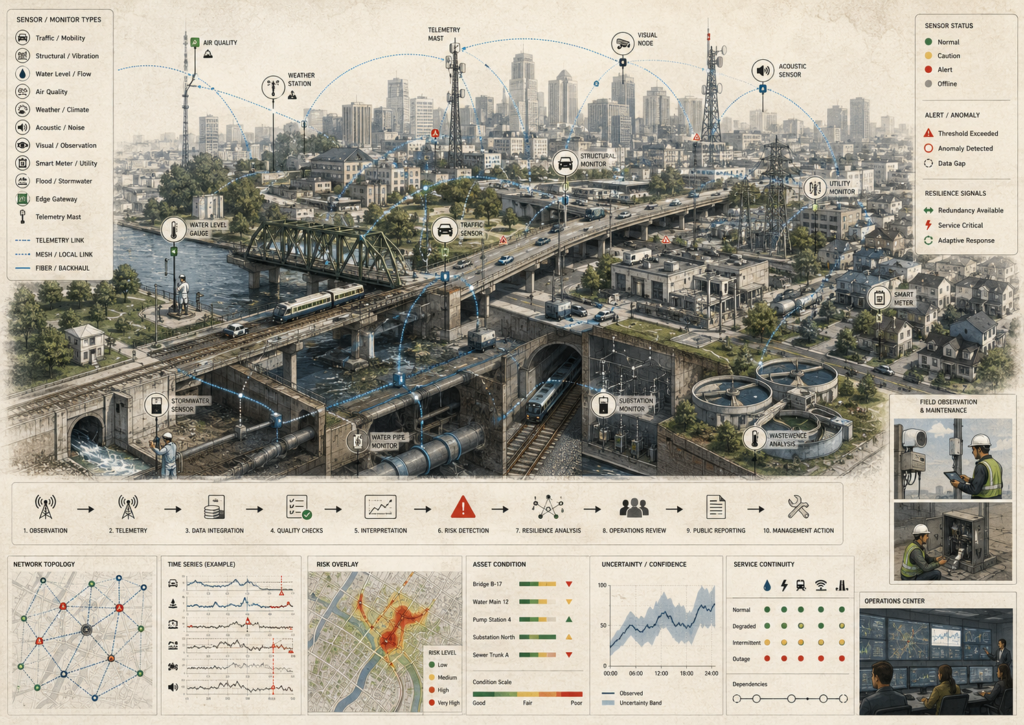
Restrained urban sensor network diagram showing bridges, rail, roads, stormwater systems, utilities, telemetry links, risk overlays, asset condition, service continuity, and operations review.

Urban Sensor Networks and Infrastructure Monitoring: Observability, Risk and Resilience

Urban sensor networks make infrastructure conditions observable across complex city systems. Traffic sensors, bridge monitors, water-level gauges, pipe sensors, air-quality nodes, weather stations, acoustic monitors, smart meters, flood sensors, utility monitors, edge gateways, and telemetry masts help reveal how roads, rail lines, tunnels, stormwater systems, water networks, substations, wastewater facilities, public buildings, and neighborhoods are performing in real time. This article examines how distributed sensing supports risk detection, asset condition monitoring, service continuity, maintenance prioritization, and resilience planning. Urban observability is valuable only when data quality, interpretation, operations review, public reporting, and management action are connected. By linking sensor networks to accountable infrastructure decisions, cities can detect disruption earlier, maintain essential services, reduce risk, and strengthen resilience across interconnected urban systems.

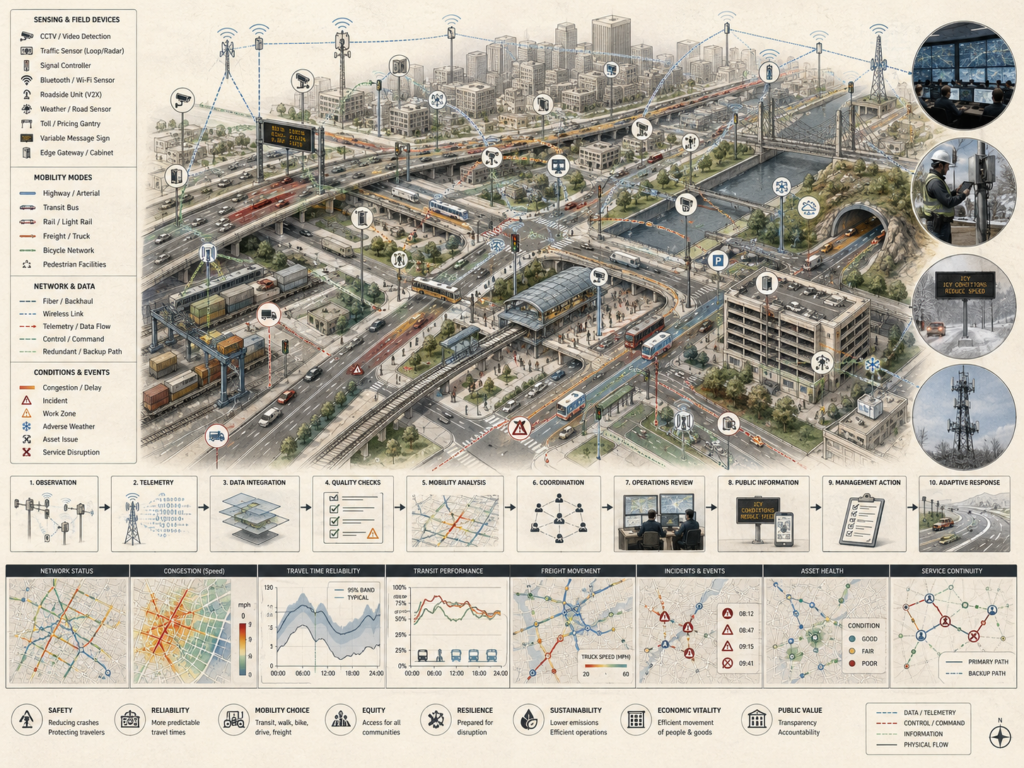
Restrained intelligent transportation network diagram showing roads, rail, buses, freight, traffic sensors, telemetry, congestion maps, operations centers, public information, and adaptive response pathways.

Intelligent Transportation Networks: Mobility, Data and Network Coordination

Intelligent transportation networks turn mobility data into coordinated public infrastructure. Roads, bridges, intersections, tunnels, rail lines, buses, freight corridors, bicycle networks, pedestrian systems, stations, and parking assets increasingly depend on sensors, telemetry, signal systems, operations centers, and public information channels. This article examines how transportation intelligence connects traffic detection, travel-time reliability, transit performance, freight movement, incidents, road weather, asset health, congestion, service continuity, and adaptive response. Intelligent transportation is not only about optimizing traffic flow; it is about improving safety, reliability, mobility choice, equity, resilience, sustainability, and public value. By linking data, infrastructure, operations, and governance, transportation networks can coordinate movement more effectively while supporting accountable, accessible, and resilient urban mobility.

Restrained smart city infrastructure diagram showing urban sensors, transportation, water, power, communications, stormwater, telemetry, risk overlays, governance review, and resilience pathways.

Smart City Infrastructure Systems: Urban Intelligence, Governance and Resilience

Smart city infrastructure systems connect urban intelligence, governance, and resilience across the essential systems that make cities function. Transportation networks, water systems, power infrastructure, communications backbones, stormwater systems, wastewater treatment, public buildings, utility tunnels, sensors, telemetry links, and operations centers increasingly form one interconnected urban platform. This article examines how smart city infrastructure becomes valuable when data integration, risk overlays, service-continuity monitoring, maintenance workflows, governance review, and public reporting are tied to accountable decision-making. Smart infrastructure is not simply a technology upgrade; it is a public systems challenge involving reliability, safety, environmental quality, equity, access, transparency, and resilience. By linking urban observation to governance and management action, smart city systems can help cities maintain essential services, reduce risk, and create durable public value.

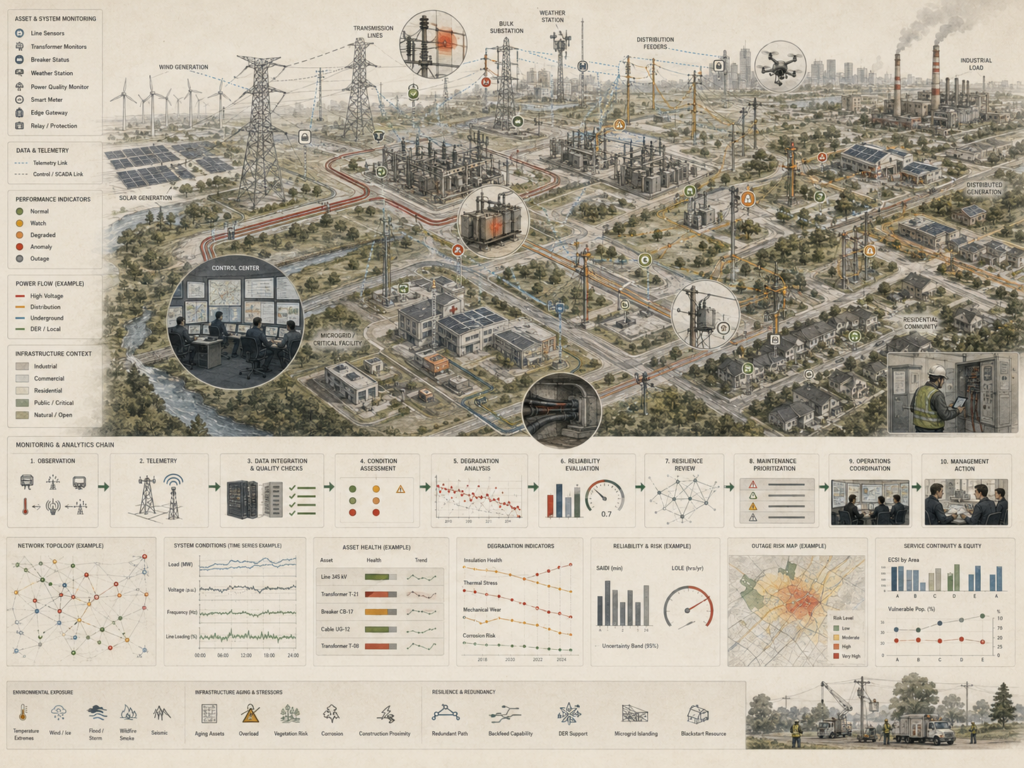
Restrained energy infrastructure monitoring diagram showing transmission lines, substations, distributed generation, sensors, telemetry, asset health, degradation analysis, reliability indicators, and resilience workflows.

Monitoring Energy Infrastructure Performance: Reliability, Degradation and Resilience

Energy infrastructure monitoring turns power-system performance into evidence for reliability, degradation management, and resilience. Transmission lines, substations, distribution feeders, transformers, breakers, smart meters, power-quality monitors, weather stations, edge gateways, drones, and control centers help reveal how energy systems are aging, stressed, and responding to changing demand and environmental exposure. This article examines how monitoring supports asset health assessment, degradation analysis, outage-risk mapping, maintenance prioritization, reliability evaluation, service continuity, and operations coordination. Reliable energy infrastructure depends not only on generation capacity, but on continuous observation, redundancy, field inspection, predictive maintenance, and accountable decision-making across interconnected networks. Energy monitoring helps protect essential services and long-term public value.

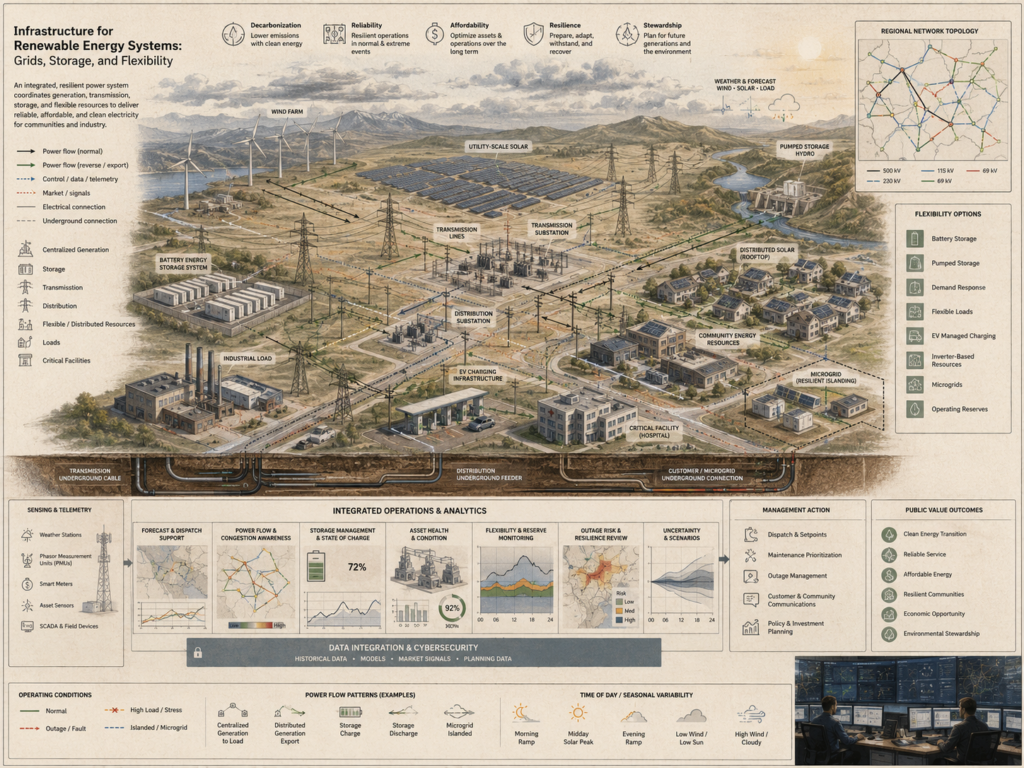
Restrained renewable energy infrastructure diagram showing wind farms, solar arrays, transmission lines, substations, battery storage, pumped hydro, distributed generation, microgrids, telemetry, and flexibility planning.

Infrastructure for Renewable Energy Systems: Grids, Storage and Flexibility

Renewable energy infrastructure connects clean generation to reliable, flexible, and accountable power systems. Wind farms, solar arrays, transmission lines, substations, distribution feeders, battery storage, pumped hydro, EV charging, distributed generation, microgrids, industrial loads, critical facilities, and residential communities must operate as coordinated networks rather than isolated assets. This article examines how renewable energy systems depend on forecasting, telemetry, dispatch planning, storage management, flexible demand, congestion awareness, asset health monitoring, cybersecurity, reserve capacity, and resilience planning. The challenge is not only producing low-carbon electricity; it is building infrastructure that can balance variability, reliability, affordability, decarbonization, and public value. By linking grids, storage, flexible resources, and accountable investment decisions, renewable energy infrastructure supports a cleaner, more resilient, and more adaptive energy future.

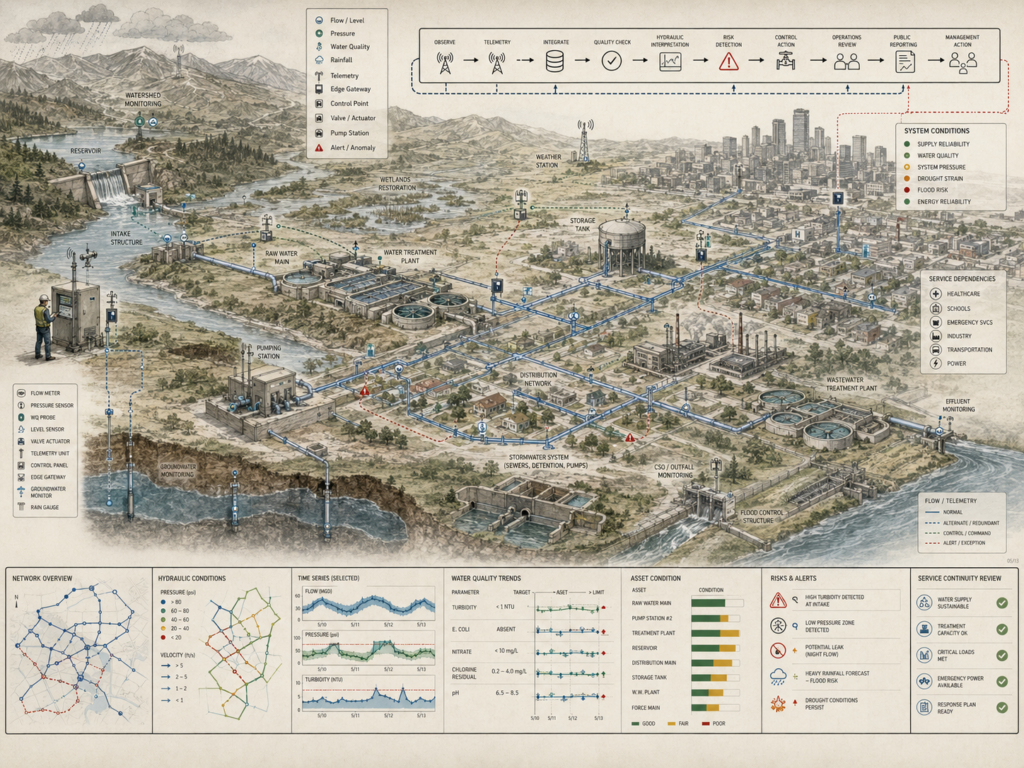
Restrained intelligent water infrastructure diagram showing reservoirs, treatment plants, distribution networks, groundwater monitoring, stormwater systems, wastewater facilities, sensors, telemetry, quality trends, risk alerts, and control pathways.

Intelligent Water Infrastructure Systems: Resilience, Quality and Control

Intelligent water infrastructure systems connect resilience, quality, and control across the full water cycle. Reservoirs, intake structures, treatment plants, pumping stations, storage tanks, distribution networks, groundwater wells, stormwater systems, flood-control structures, wastewater facilities, and restored wetlands increasingly depend on sensors, telemetry, hydraulic models, and operations platforms. This article examines how water systems use flow, pressure, rainfall, reservoir levels, groundwater signals, water-quality trends, asset condition, risk alerts, and service-dependency data to support reliable management. Intelligent water infrastructure is not only about automation; it is about protecting public health, maintaining supply reliability, managing drought and flood risk, detecting failures, coordinating response, and sustaining long-term stewardship. By linking monitoring, control, public reporting, and accountable decision-making, intelligent water systems help communities manage water as both infrastructure and shared environmental responsibility.

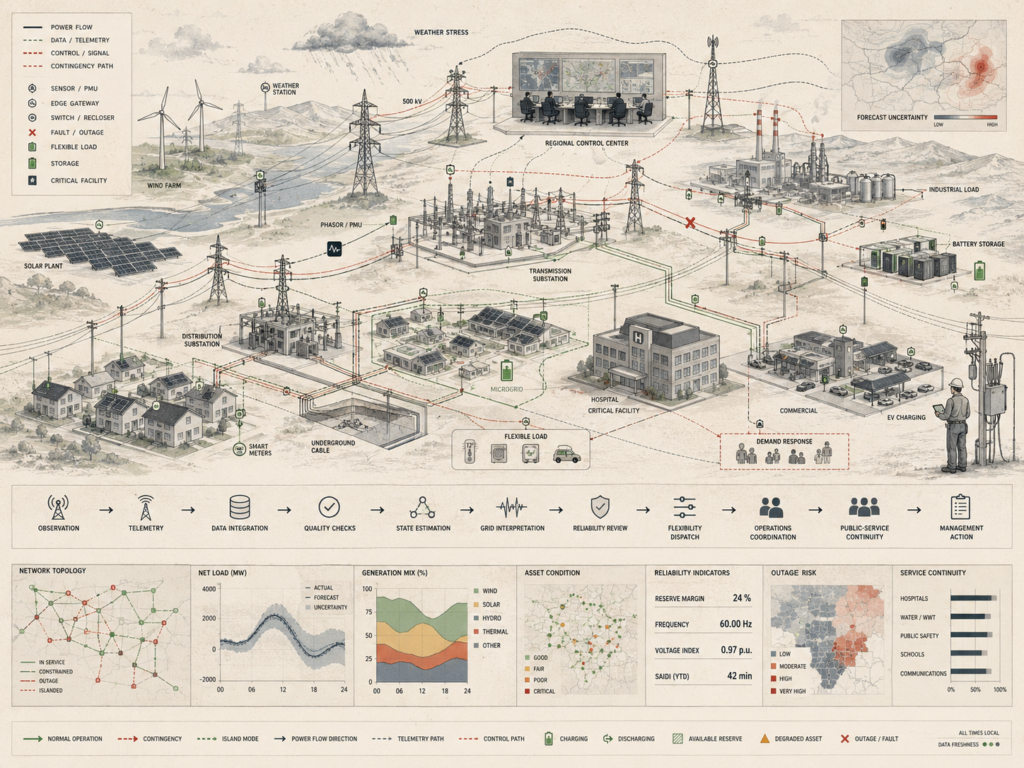
Restrained smart energy grid diagram showing wind and solar generation, transmission lines, substations, battery storage, microgrids, smart meters, telemetry, outage risk, reliability indicators, and control pathways.

Smart Energy Grids and Digital Power Systems: Resilience, Flexibility and Control

Smart energy grids and digital power systems connect resilience, flexibility, and control across modern electricity infrastructure. Wind farms, solar plants, transmission lines, substations, distribution networks, smart meters, phasor measurement units, battery storage, microgrids, flexible loads, EV charging, demand response, industrial facilities, and critical services increasingly operate through telemetry, state estimation, dispatch systems, and digital control pathways. This article examines how smart grids support reliability under changing demand, renewable variability, weather stress, outage risk, asset degradation, and service-continuity pressures. Their value is not automation alone; it is the ability to coordinate generation, storage, flexible demand, contingency response, and public-service reliability. By linking digital monitoring, power-system control, resilience planning, and accountable energy management, smart grids support cleaner, more adaptive, and more reliable energy systems.

Scroll to Top