Planetary Boundaries

The planetary boundaries framework identifies the ecological limits within which human societies can safely operate. Developed by Earth system scientists, the framework highlights critical thresholds in global environmental systems that regulate the stability of the planet.

These boundaries include processes such as climate change, biodiversity loss, land-system change, freshwater use, and biogeochemical cycles. When human activity pushes these systems beyond safe operating limits, the risk of irreversible environmental change increases significantly.

The planetary boundaries concept provides a scientific foundation for understanding the scale of environmental pressures generated by modern economic activity. It emphasizes that sustainable development must operate within ecological constraints that maintain the stability of Earth’s life-support systems.

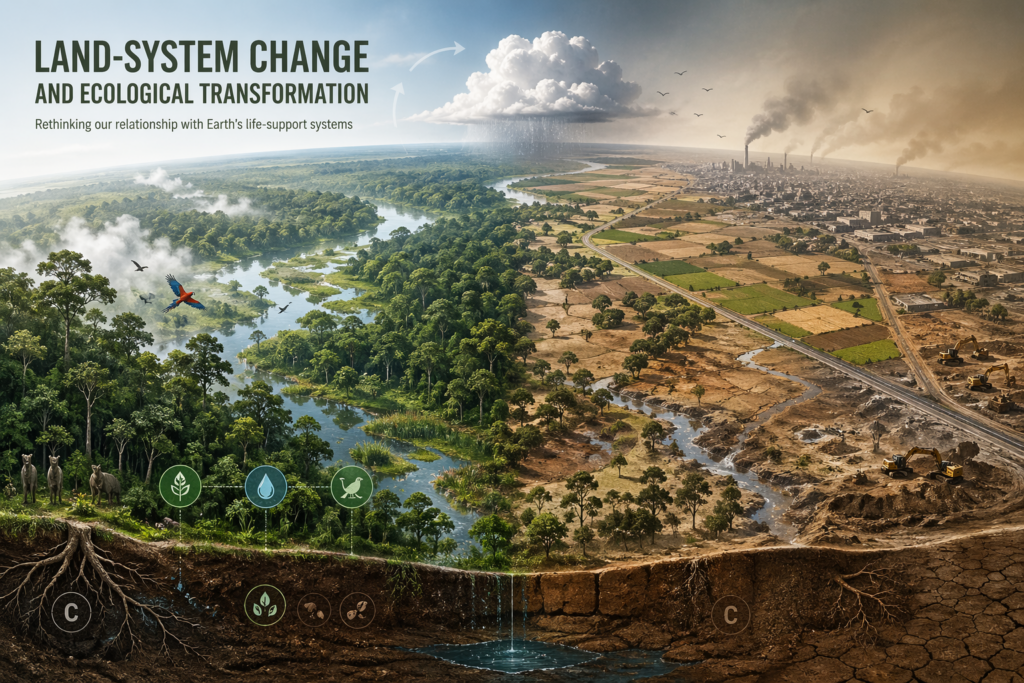
Editorial featured image showing a planetary landscape divided between an intact forest biome with wetlands, rivers, wildlife, soil roots, and moisture cycling, and a transformed human-dominated landscape with agriculture, roads, exposed soil, mining, urbanization, smoke, and ecological degradation.

Land-System Change and Ecological Transformation

Land-System Change and Ecological Transformation explains why large-scale transformation of forests, grasslands, wetlands, savannas, peatlands, and agricultural frontiers is a central planetary-boundary risk. The article shows how land conversion, deforestation, fragmentation, ecological simplification, soil degradation, and biome transformation weaken carbon storage, moisture recycling, biodiversity, hydrological regulation, climate stability, and Earth-system resilience. It examines the shift from land use as an economic category to land-system change as an Earth-system process, with attention to forests, biomes, justice, Indigenous stewardship, restoration, and governance. The article also includes mathematical, Python, and R workflows for modeling forest-cover thresholds, biome integrity, fragmentation, regulatory importance, land-system pressure, restoration potential, and governance capacity.
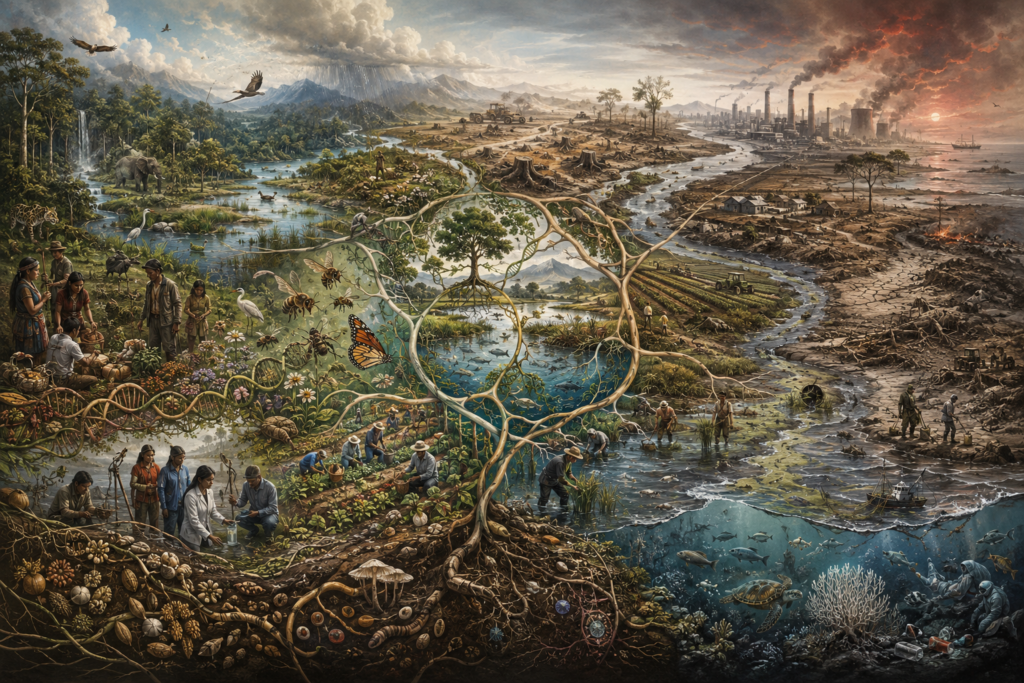
Editorial illustration showing biosphere integrity as a planetary boundary through interconnected ecosystems, genetic diversity, ecological function, stewardship, and contrasting zones of degradation.

Biosphere Integrity and the Stability of Life Systems

Biosphere Integrity and the Stability of Life Systems explains why the planetary boundaries framework treats the biosphere as one of the two core Earth-system boundaries alongside climate change. The article shows how genetic diversity, functional integrity, habitat intactness, ecological networks, soil systems, forests, wetlands, marine ecosystems, and food webs help regulate climate, water, carbon, nutrients, resilience, and long-term habitability. It examines the shift from biodiversity loss to biosphere integrity, the boundary’s current transgressed status, the drivers of ecological degradation, and the connections between biosphere decline, land-system change, freshwater change, biogeochemical flows, ocean acidification, and novel entities. It also includes mathematical, Python, and R workflows for modeling extinction pressure, functional-integrity deficits, habitat loss, fragmentation, appropriation pressure, cross-boundary stress, restoration potential, and governance capacity.
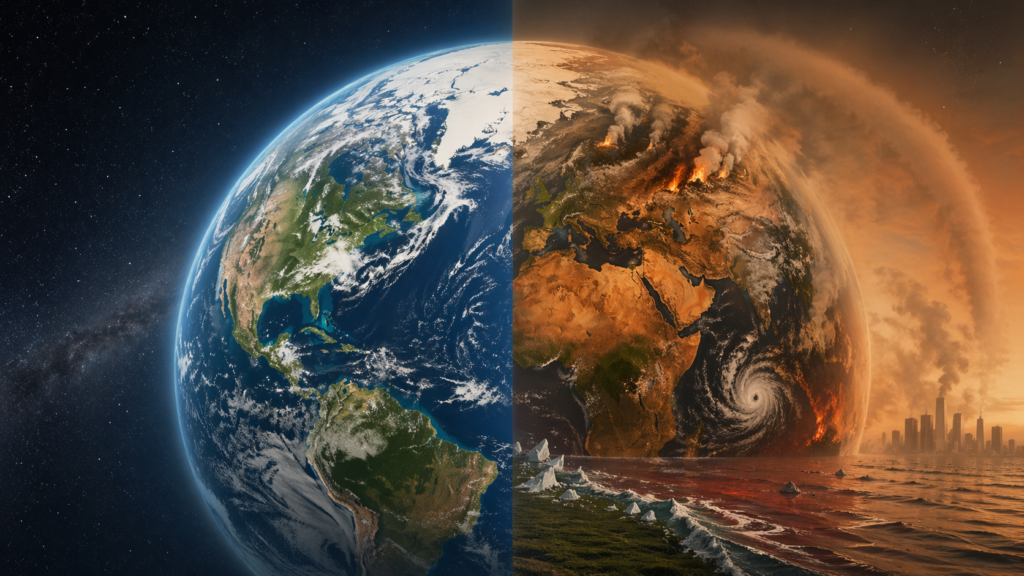
Editorial featured image showing Earth divided between a stable climate system with blue oceans, clouds, green land, and polar ice, and a destabilized climate system with warming atmosphere, wildfire smoke, storms, drought, melting ice, sea-level rise, and stressed landscapes.

Climate Change as a Planetary Boundary

Climate Change as a Planetary Boundary explains why climate change is one of the two core boundaries in the planetary boundaries framework alongside biosphere integrity. The article shows how atmospheric carbon dioxide, radiative forcing, cumulative emissions, carbon-sink resilience, feedbacks, tipping elements, hydrological change, sea-level rise, heat extremes, and cross-boundary interactions can destabilize Earth-system resilience. It examines the original climate boundary defined through carbon dioxide concentration and radiative forcing, the boundary’s current transgressed status, the difference between warming and systemic instability, and the justice implications of unequal exposure and responsibility. The article also includes mathematical, Python, and R workflows for modeling carbon dioxide boundary pressure, radiative forcing, emissions-transition gaps, cross-boundary stress, exposure, adaptation, monitoring, and governance capacity.

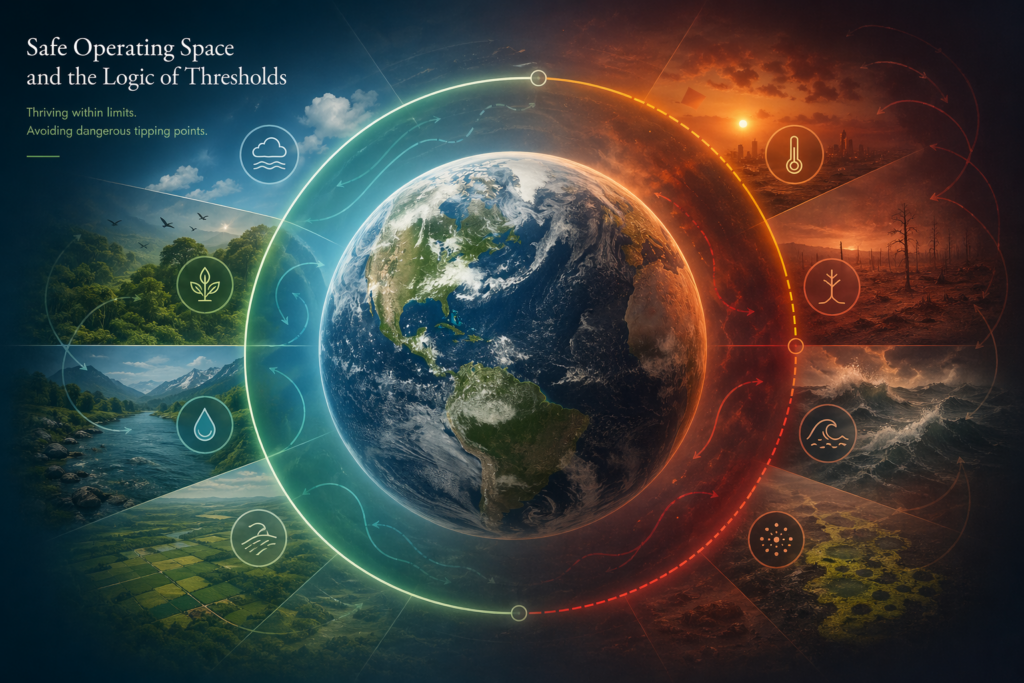
Editorial featured image showing Earth inside a circular safe operating zone, with stable forests, rivers, land systems, clouds, and atmospheric balance on one side, and rising threshold risk with heat, drought, damaged ecosystems, ocean stress, and feedback-loop patterns on the other.

Safe Operating Space and the Logic of Thresholds

Safe Operating Space and the Logic of Thresholds explains the conceptual foundation of the planetary boundaries framework: the idea that human societies should remain within biophysical conditions that reduce the risk of destabilizing the Earth system. The article shows why safe operating space is not a promise of perfect safety, but a precautionary risk zone shaped by thresholds, uncertainty, nonlinear dynamics, feedbacks, lag effects, and cascading change. It examines why boundaries are better understood as zones of rising risk rather than hard walls, how uncertainty strengthens rather than weakens the case for precaution, and why threshold logic matters for governance, engineering, finance, infrastructure, and long-term strategy. The article also includes mathematical, Python, and R workflows for modeling boundary pressure, uncertainty margins, risk zones, cross-boundary amplification, and governance capacity.

Infographic showing Earth at the center of a circular planetary boundaries framework, surrounded by nodes for Earth system science, Anthropocene awareness, resilience thinking, climate, biosphere integrity, freshwater, land-system change, ocean chemistry, biogeochemical flows, governance institutions, and safe operating space.

The Origins of the Planetary Boundaries Framework

The Origins of the Planetary Boundaries Framework explains how one of the most influential sustainability concepts of the twenty-first century emerged from Earth system science, resilience thinking, global change research, and Anthropocene debate. The article shows how the 2009 planetary boundaries papers synthesized evidence that human societies were altering climate, biodiversity, land systems, nutrient cycles, freshwater, ocean chemistry, and atmospheric processes at planetary scale. It examines the framework’s intellectual background, the idea of a safe operating space for humanity, the original nine boundaries, the 2015 refinement that identified climate change and biosphere integrity as core boundaries, and the framework’s later evolution into a research and governance architecture. It also includes mathematical, Python, and R workflows for analyzing framework evolution, influence, uncertainty, governance uptake, and justice integration.

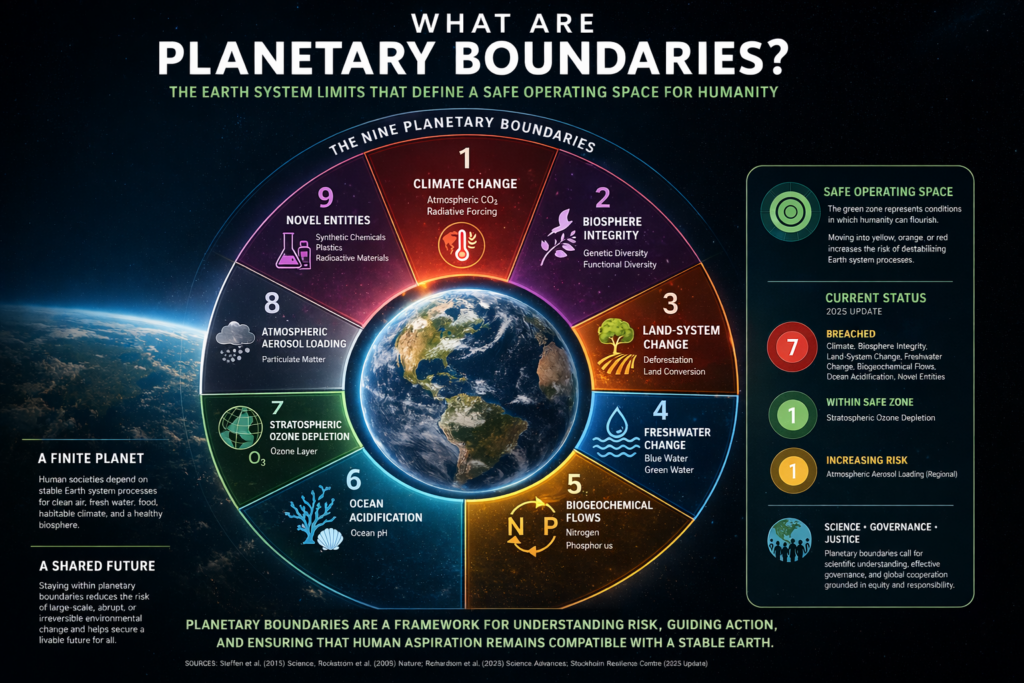
Infographic explaining planetary boundaries with Earth at the center and surrounding segments for climate change, biosphere integrity, land-system change, freshwater change, biogeochemical flows, ocean acidification, stratospheric ozone depletion, atmospheric aerosol loading, and novel entities.

What Are Planetary Boundaries? Earth System Limits Explained

What Are Planetary Boundaries? Earth System Limits Explained introduces the planetary boundaries framework as a way of understanding the biophysical conditions that help define a safe operating space for humanity. The article explains how the framework identifies nine critical Earth system processes—climate change, biosphere integrity, land-system change, freshwater change, biogeochemical flows, ocean acidification, stratospheric ozone depletion, atmospheric aerosol loading, and novel entities—and why these should be understood as interacting risk zones rather than isolated environmental issues. It covers the framework’s origins, current status, safe operating space, threshold logic, major debates, justice implications, and governance significance. It also includes mathematical, Python, and R workflows for modeling boundary pressure, uncertainty margins, risk zones, cross-boundary amplification, social exposure, and governance capacity.

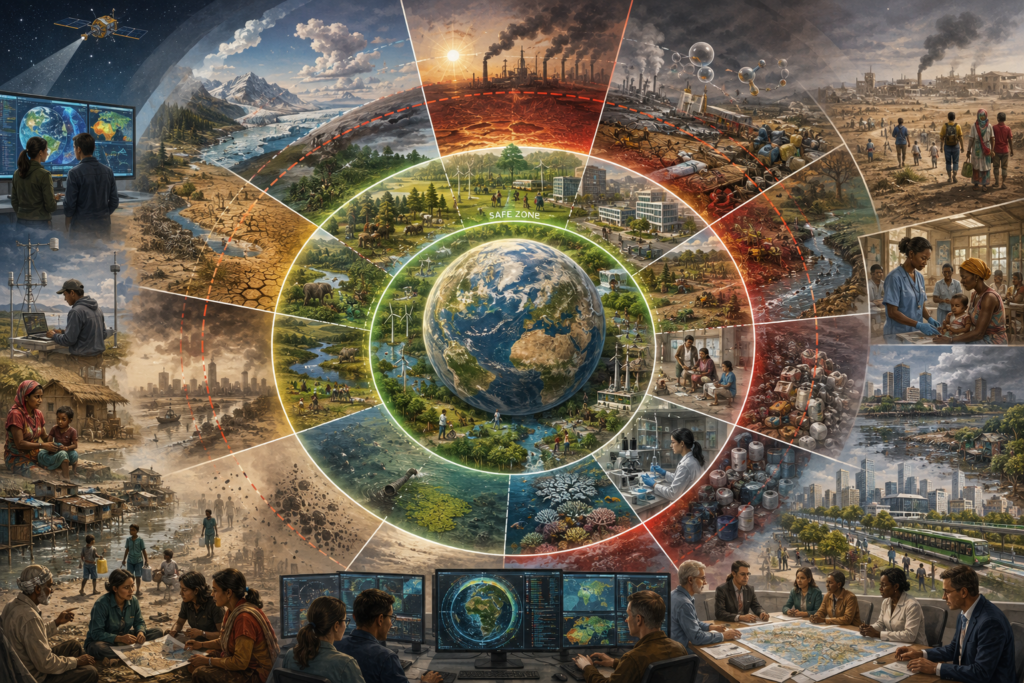
Editorial Earth-system illustration showing planetary boundaries, safe operating space, climate pressure, biosphere integrity, freshwater systems, land change, nutrient flows, ocean health, atmospheric change, novel entities, monitoring, governance, and stewardship.

Planetary Boundaries: Earth System Limits, Risk, and Governance

The Planetary Boundaries knowledge series examines the Earth system processes that define a safe operating space for humanity. It connects Holocene climate stability, the Great Acceleration, Anthropocene planetary risk, resilience thinking, and sustainable development with the nine planetary boundaries: climate change, biosphere integrity, land-system change, freshwater change, biogeochemical flows, ocean acidification, stratospheric ozone depletion, atmospheric aerosol loading, and novel entities. The series explains how these boundaries are measured, why thresholds and feedback loops matter, how boundary transgression affects development and governance, and why justice must be central to any serious account of planetary limits. It frames planetary boundaries not as isolated environmental indicators, but as a scientific and ethical architecture for understanding prosperity, resilience, and civilization on a finite planet.

Resilience Thinking in the Anthropocene

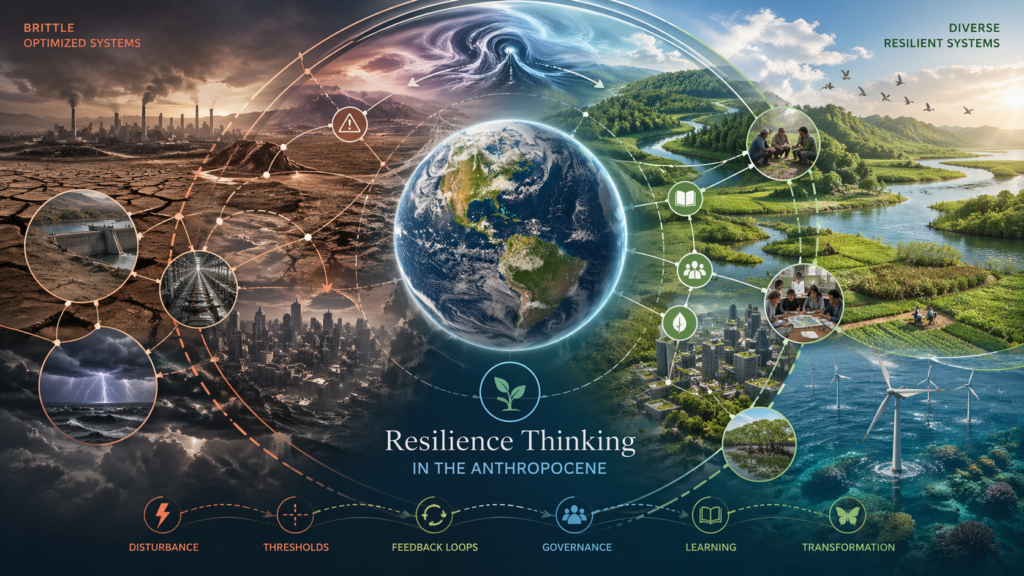
Resilience Thinking in the Anthropocene explains how resilience thinking helps societies manage uncertainty, thresholds, adaptation, and transformation under planetary pressure. The article connects social-ecological resilience to the planetary boundaries framework, showing why sustainability cannot rely only on optimization, prediction, and control. It examines the shift from stability to resilience, the dangers of brittle efficiency, nonlinear change, adaptive management, social learning, governance cooperation, surprise, transformation, trade-offs, justice, and maladaptive resilience. The article argues that resilience is not simply the ability to bounce back, but the capacity to sustain life-supporting functions, learn under uncertainty, and transform systems that drive ecological destabilization or social injustice. It also includes mathematical, Python, and R workflows for modeling boundary pressure, adaptive capacity, ecological buffering, lock-in pressure, and transformation need.

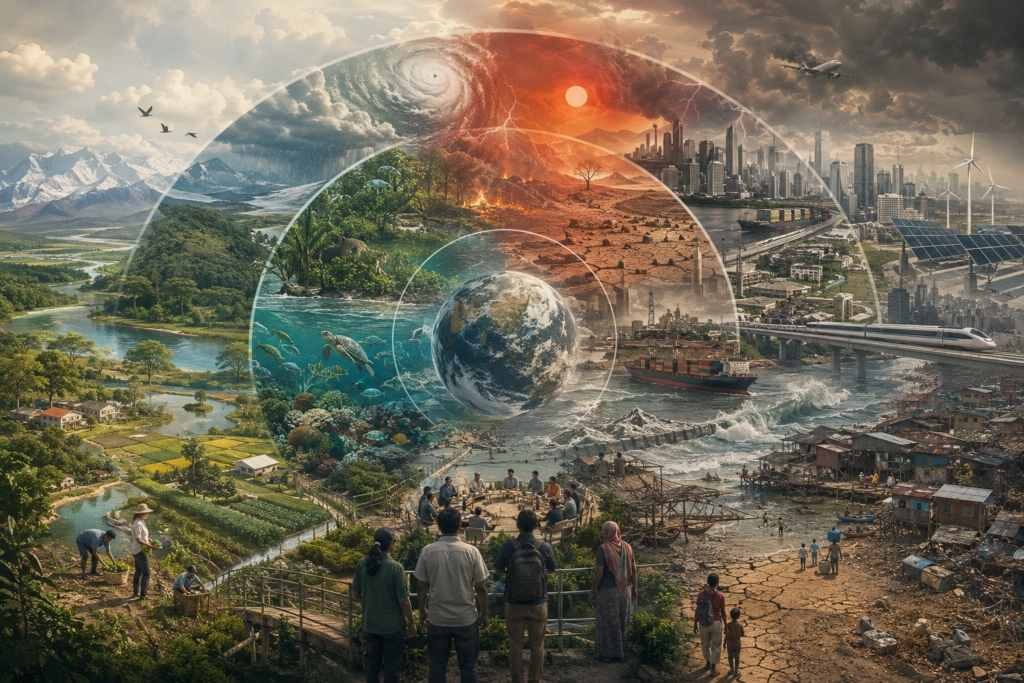
Editorial illustration of Anthropocene planetary risk showing climate warming, biodiversity loss, development demand, infrastructure, ecosystems, and unequal exposure within Earth-system limits.

Navigating the Anthropocene: Sustainable Development in a 3–6–9 World

Navigating the Anthropocene: Sustainable Development in a 3–6–9 World explains how sustainable development changes when human activity becomes a planetary force. The article uses the 3–6–9 framing—roughly 3°C warming risk under inadequate mitigation, the sixth mass extinction or broader biodiversity crisis, and the demographic-development scale of a world moving through 9 billion people—as a heuristic for understanding Anthropocene planetary risk. It connects this framing to Holocene stability, Earth system science, planetary boundaries, tipping points, resilience thinking, justice, and governance. The article argues that development can no longer be understood apart from climate stability, biosphere integrity, freshwater systems, land use, nutrient cycles, and ecological limits. It also includes mathematical, Python, and R workflows for modeling climate pressure, biosphere pressure, development demand, boundary transgression, governance capacity, and transformation urgency.

Scroll to Top