
Last Updated August 5, 2026
Biosphere integrity is one of the core boundaries within the planetary boundaries framework because life does not merely inhabit the Earth system. It helps regulate it. The biosphere is not a decorative layer resting on top of climate, water, soils, oceans, and biogeochemical cycles. It is an active, self-organizing, evolutionary, and ecological system that shapes the conditions under which the planet remains resilient and habitable. Forests recycle moisture and store carbon. Wetlands filter water and buffer floods. Soil communities support fertility and decomposition. Pollinators sustain food systems. Marine ecosystems shape carbon pathways and ocean productivity. Genetic diversity preserves adaptive potential. Ecological networks provide redundancy, resilience, and recovery capacity. When these living systems are degraded, the stability of the Earth system is weakened with them.
In the 2015 refinement of the planetary boundaries framework, biosphere integrity and climate change were identified as the two core boundaries, each capable on its own of contributing to a shift in the state of the Earth system if substantially and persistently transgressed. That framing marked an important conceptual advance. Biodiversity was no longer understood only as a matter of species conservation, ecological loss, or moral concern. It was understood as a planetary stabilizing force whose degradation threatens the resilience of the Earth system itself.
Main Library
Publications
Article Map
Planetary Boundaries
Related Article
Climate Change
Related Topic
Biology
Related Topic
Environmental Science
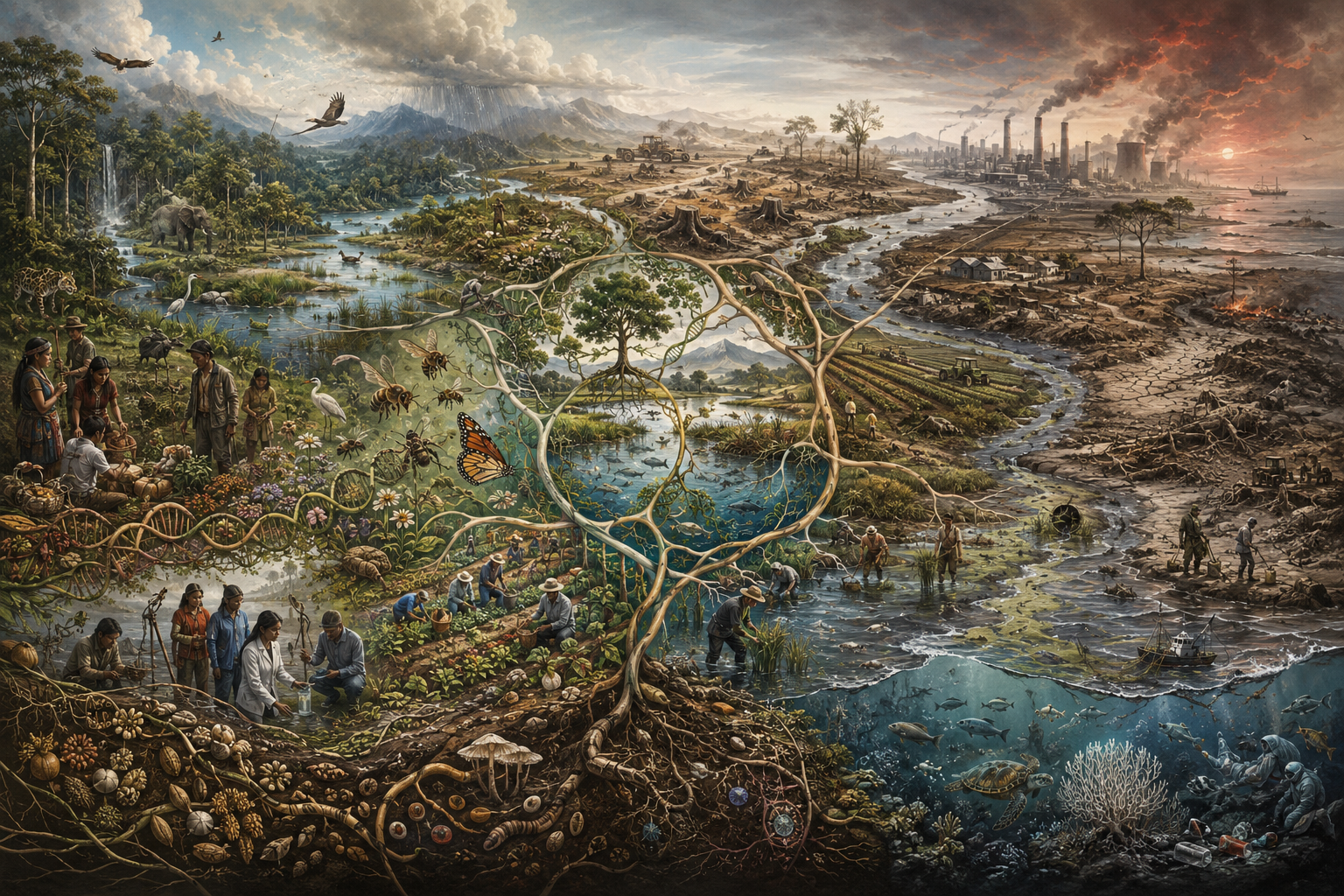
This shift matters because biosphere integrity is broader than conventional biodiversity accounting alone. It includes both the erosion of genetic diversity and the weakening of the functional integrity of ecosystems. In this view, the biosphere is not a passive backdrop to climate, hydrology, and biogeochemistry. The diversity, structure, interaction patterns, and vitality of living systems help regulate the conditions under which those wider planetary processes remain stable. When the fabric of life is degraded, the stability of the planet is degraded with it.
This article examines biosphere integrity as a planetary boundary by explaining why it is treated as a core Earth-system limit, how the concept evolved from earlier biodiversity-loss framing, what its two principal dimensions mean, why life systems are indispensable to planetary regulation, how the boundary interacts with climate change, land-system change, freshwater change, biogeochemical flows, ocean acidification, atmospheric aerosol loading, and novel entities, and why its transgression carries such serious implications for sustainability, governance, restoration, justice, and long-term civilizational stability.
Why Biosphere Integrity Is a Core Boundary
Biosphere integrity is a core boundary because the biosphere helps maintain the environmental conditions under which the Earth system remains resilient and habitable. The planetary boundaries framework does not treat life as a passive surface phenomenon. It treats living systems as active participants in the regulation of climate, nutrient flows, soils, hydrology, carbon exchange, food webs, and biogeochemical cycling. The degradation of the biosphere therefore weakens the systems that make long-term planetary stability possible.
This is why the 2015 update elevated biosphere integrity to the status of a core boundary alongside climate change. The argument was not simply that biodiversity is valuable, although it clearly is. The stronger claim was that substantial and persistent disruption of the biosphere could itself help drive the Earth system toward a different state. Once framed in that way, species loss, habitat degradation, ecological simplification, and functional decline become more than conservation concerns. They become matters of planetary risk.
The core-boundary designation also matters analytically. It means the biosphere is treated not only as something affected by environmental change, but as a regulating domain whose degradation alters the behavior of the wider Earth system. Climate change can damage the biosphere, but a degraded biosphere can also intensify climate instability by weakening carbon sinks, moisture recycling, albedo regulation, ecosystem resilience, and soil carbon storage. This mutual dependence is one reason biosphere integrity belongs at the center of Earth-system analysis.
That shift gives the concept its theoretical power. Biosphere integrity links biodiversity science, ecology, conservation biology, Earth-system science, climate research, food systems, water governance, land-use planning, and environmental justice. It asks whether the living systems that support planetary stability remain sufficiently diverse, functional, connected, and resilient to sustain the Holocene-like conditions under which complex human societies developed.
The biosphere is also a core boundary because ecological decline can narrow future possibility. A simplified landscape may continue to produce commodities for a time while losing pollinators, soil organisms, predator-prey relationships, seed dispersers, groundwater recharge capacity, flood-buffering wetlands, or climatic moisture recycling. A degraded ocean may continue to provide harvests for a time while losing coral reefs, nursery habitats, oxygen balance, carbonate-forming organisms, and food-web complexity. A biosphere can appear productive in the short term while becoming less resilient in the long term.
This is the danger the boundary identifies. Biosphere decline is often slow enough to be normalized, fragmented enough to be localized, and complex enough to be underestimated. The planetary-boundary framing refuses that underestimation. It treats the integrity of life systems as a condition of Earth-system stability, not as an optional environmental luxury.
From Biodiversity Loss to Biosphere Integrity
The earlier planetary boundaries literature often referred to this boundary as biodiversity loss. By 2015, however, the framework had evolved toward the broader concept of biosphere integrity. That shift reflected a more developed scientific understanding. Biodiversity loss remained crucial, but the boundary needed to capture more than extinction rates alone. It also needed to address whether ecosystems retained the functional capacity to reproduce, adapt, interact, recover, and regulate the processes on which planetary stability depends.
The conceptual change was significant because it moved the discussion beyond a narrower inventory of disappearing species and toward a systemic account of living organization. A planet may lose species and also lose ecological function, but the two are not identical. Some ecosystems may retain many species while losing key interactions. Others may retain vegetation cover while becoming simplified, fragmented, or dominated by species combinations that no longer perform the same regulatory functions. The biosphere boundary therefore had to include both genetic erosion and the weakening of ecosystem function.
This broader language also improves the framework’s usefulness for governance. It links conservation science to Earth-system stability, allowing questions of habitat loss, ecological simplification, wildlife decline, pollinator loss, soil degradation, invasive species, marine disruption, and resilience to be understood within a common planetary frame. The issue is not only whether individual species survive. It is whether life systems retain the structure and function required to stabilize climate, water, nutrients, soils, and ecological adaptation.
The term “biosphere integrity” therefore asks a deeper question than “How many species remain?” It asks whether the living fabric of the planet remains sufficiently intact to sustain the regulatory processes that make a stable Earth system possible.
This matters because biodiversity can be reduced to a counting exercise if it is not connected to ecological function. Species richness, abundance, genetic variation, population trends, trophic structure, soil biology, microbial communities, habitat connectivity, and primary productivity all matter in different ways. No single number can fully capture the biosphere. A serious boundary framework must therefore be plural without becoming incoherent: it must measure enough dimensions of life to understand risk, while keeping the central purpose clear.
| Concept | Narrow interpretation | Planetary-boundary interpretation |
|---|---|---|
| Biodiversity loss | Decline or disappearance of species and populations. | A major signal of ecological erosion and loss of evolutionary potential. |
| Biosphere integrity | Sometimes mistaken as a synonym for biodiversity loss. | The capacity of living systems to remain diverse, functional, connected, adaptive, and resilient. |
| Genetic diversity | Variation within and among species. | The evolutionary reservoir that allows populations and ecosystems to adapt to disturbance. |
| Functional integrity | Ecosystem condition or functioning. | The ability of ecosystems to sustain productivity, interactions, recovery, and Earth-system regulation. |
| Earth-system stability | Sometimes treated as separate from conservation. | Partly dependent on living systems that regulate carbon, water, nutrients, soils, and resilience. |
In this way, biosphere integrity turns conservation into Earth-system science without reducing life to a technical service category. Living systems matter because they are valuable in themselves, because they support human societies, and because they help regulate the planet. The concept is strongest when all three dimensions remain visible.
Genetic Diversity and Evolutionary Potential
Genetic diversity is one principal dimension of biosphere integrity. It concerns the variety of genetic information within and among populations, species, and lineages. Genetic diversity matters because it preserves evolutionary potential. Populations with greater genetic diversity are generally better able to adapt to disease, climate stress, environmental change, habitat disturbance, and shifting ecological interactions. When genetic diversity is lost, the biosphere becomes less capable of adaptation over time.
In the planetary boundaries framework, genetic diversity is often operationalized through extinction-rate logic because species extinction represents an irreversible loss of evolutionary history. Extinction is not merely a local population decline or temporary ecological disturbance. It is the permanent disappearance of a lineage and its genetic, ecological, evolutionary, and relational possibilities. At planetary scale, elevated extinction rates signal that humanity is accelerating biological loss far beyond background levels.
The importance of genetic diversity is not limited to wild species alone. Crop diversity, livestock diversity, wild relatives of domesticated species, microbial diversity, and genetic variation within food-system species all matter for resilience. Agriculture, medicine, biotechnology, restoration ecology, and adaptation to climate change depend on genetic reservoirs that are often poorly valued until they are lost. Genetic erosion therefore undermines both ecological resilience and future human options.
This is why biosphere integrity cannot be reduced to charismatic species protection. The loss of genetic variation across plants, animals, fungi, microbes, and ecological communities weakens the adaptive capacity of life itself. A planet with diminished genetic diversity has fewer pathways for recovery, fewer evolutionary options, and less resilience under accelerating change.
Genetic diversity also matters because ecological resilience is often hidden until stress arrives. A population may appear stable during ordinary conditions but collapse under disease, drought, heat, pollution, invasive species, or habitat fragmentation if its genetic base has narrowed. Genetic erosion can therefore function like a slow loss of insurance. The system may continue to operate, but its range of possible responses shrinks.
At planetary scale, this loss has deep temporal significance. Evolutionary lineages represent time: millions of years of adaptation, relationship, specialization, and ecological memory. When lineages disappear, the loss is not recoverable on human time scales. Restoration can repair habitats, rebuild populations, and recover functions, but extinction closes evolutionary possibilities permanently. That is why genetic diversity belongs inside a planetary-boundary framework rather than only a conservation ethics framework.
Functional Integrity and Ecosystem Capacity
Functional integrity is the second principal dimension of the biosphere boundary. It concerns whether ecosystems retain the structure, productivity, interaction patterns, and resilience necessary to perform key Earth-system roles. This includes primary production, decomposition, soil formation, pollination, nutrient cycling, carbon uptake, water regulation, habitat maintenance, food-web stability, and ecological recovery after disturbance.
This distinction matters because the biosphere is not only a collection of organisms. It is a network of relationships and processes through which life influences the wider planet. Functional integrity connects the biosphere boundary to the practical functioning of forests, grasslands, wetlands, coral reefs, rivers, soils, croplands, coastal systems, and oceans. When functional integrity declines, the Earth system loses living capacity for self-regulation.
Recent functional biosphere integrity research has strengthened this point by proposing spatially explicit control variables for ecosystem disruption and human appropriation of net primary production. These approaches extend the framework’s ability to identify ecological destabilization beyond extinction accounting alone. They ask how much biological productivity human systems appropriate, how strongly ecosystems are disrupted relative to safer operating conditions, and where functional losses are most severe.
Functional integrity is especially important for engineers, planners, data scientists, and sustainability analysts because it can be translated into monitoring systems. Remote sensing, land-cover data, ecosystem productivity metrics, habitat connectivity, biodiversity intactness indicators, ecological risk scores, species-interaction models, and restoration-performance dashboards can all help make functional biosphere change more visible. The challenge is not only to count life, but to understand whether life systems are still functioning.
Functional decline can be deceptive because systems may retain visual greenness while losing ecological depth. A plantation may look forested but lack the species diversity, soil complexity, canopy structure, animal interactions, microbial communities, and hydrological functions of a mature forest. A river may contain water but lose ecological integrity through dams, withdrawals, pollution, invasive species, thermal stress, and disrupted sediment flows. A field may be productive in crop terms while depending on external inputs because soil life, pollinators, and ecological pest regulation have been weakened.
This is why functional integrity should be interpreted as living capacity, not just surface condition. It asks whether ecosystems can continue to do the work of life: regenerate soils, cycle nutrients, store carbon, move water, support reproduction, sustain food webs, buffer disturbance, and recover after shocks. Where these capacities decline, the biosphere boundary is not merely being approached. It is being hollowed from within.
Why Life Systems Stabilize the Planet
Life systems stabilize the planet because ecosystems shape the circulation of energy and materials through the Earth system. Forests influence carbon storage, evapotranspiration, albedo, cloud formation, and regional rainfall. Wetlands regulate water, nutrients, sediments, carbon, and flood dynamics. Soil communities support fertility, decomposition, nutrient turnover, water retention, and carbon storage. Marine ecosystems shape carbon pathways, food webs, oxygen dynamics, and ocean productivity. Pollinators, seed dispersers, predators, herbivores, decomposers, and microbial communities sustain ecological processes that human societies often notice only after they begin to fail.
These are not secondary or ornamental contributions. They are part of how the Earth system remains livable. A degraded biosphere does not merely mean fewer species to value, study, or protect. It means weakened carbon sinks, disrupted nutrient cycles, less resilient food webs, reduced pollination, declining soil health, altered water dynamics, increased disease risks in some contexts, and reduced ecological capacity to buffer shocks. In planetary-boundary terms, biosphere decline erodes the living infrastructure of planetary stability.
This is one reason the biosphere boundary sits so close to the climate boundary conceptually. Climate shapes ecosystems, but ecosystems also shape climate. Forest loss, peatland degradation, soil carbon depletion, coral reef decline, and marine food-web disruption can all affect climate regulation or climate resilience. At the same time, warming, drought, ocean heat, acidification, fire, and extreme weather can push ecosystems toward degradation. The two core boundaries are analytically distinct yet functionally entangled.
The biosphere also stabilizes the planet through redundancy and diversity. In diverse ecosystems, multiple organisms may perform overlapping functions, allowing systems to absorb disturbance without complete collapse. When diversity declines and ecosystems become simplified, redundancy is reduced. Systems may remain productive for a time, but become more brittle under stress. This is one of the most important meanings of biosphere integrity: not just richness, but resilience.
Living systems also create feedbacks that are difficult to replace technologically. Forests recycle moisture across landscapes. Soil organisms build structure that holds water and nutrients. Wetlands absorb floods and filter pollutants. Coral reefs buffer coastlines and support fisheries. Mangroves store carbon while protecting shorelines. Grasslands support soil carbon and grazing systems when managed well. These functions are not easily substituted by engineered infrastructure at planetary scale.
The point is not that ecosystems are useful only because they provide services to humans. It is that life systems are part of the planet’s self-organizing stability. Human societies are embedded within that stability. When the biosphere is simplified, degraded, and fragmented, the planet becomes less able to regulate itself and human societies become more exposed to instability.
The Boundary and Its Current Status
Biosphere integrity is currently transgressed within the planetary boundaries framework. The 2015 update had already identified biosphere integrity as among the crossed boundaries, and the 2023 assessment concluded that Earth is beyond six of nine boundaries, including biosphere integrity. The 2025 Planetary Health Check continues to classify change in biosphere integrity as one of the breached planetary boundaries. Stockholm Resilience Centre’s planetary-boundaries overview states that both genetic diversity loss and the decline in functional integrity are outside safe levels.
This matters because the biosphere boundary is not being crossed in a narrow or symbolic sense. Its transgression reflects a widening pattern of ecological simplification, habitat disruption, fragmentation, genetic erosion, population decline, functional disruption, and ecosystem degradation. The problem is not only that particular species are disappearing. It is that the organizational capacity of living systems to support Earth-system resilience is being diminished across multiple scales at once.
The newer functional biosphere integrity literature sharpens this diagnosis by arguing that more than half of global land area suffers critical losses in functional biosphere integrity. That finding is important because it suggests that transgression is not merely a theoretical concern but spatially extensive. Functional decline is distributed across landscapes where human appropriation of biological productivity, land-use change, ecological disruption, fragmentation, and altered ecosystems weaken the regulatory power of life systems.
The boundary’s transgressed status should not be read as a declaration that recovery is impossible. It is a warning that the biosphere has moved outside safer operating conditions and that ecological recovery, habitat protection, restoration, reduced exploitation, pollution control, climate mitigation, and justice-centered governance are now urgent conditions of planetary resilience.
Current biosphere-risk language should also be interpreted with care. A breached boundary is not the same as total collapse. It means that humanity has moved into a region of higher risk where genetic loss, functional disruption, ecological simplification, and cross-boundary stress are no longer safely within the operating range associated with Earth-system resilience. The value of this diagnosis is that it clarifies urgency without denying agency. Restoration, protection, governance reform, pollution reduction, rights-based stewardship, and climate mitigation still matter greatly.
| Biosphere-integrity dimension | Current interpretation | Why it matters |
|---|---|---|
| Genetic diversity | Outside safe levels in planetary-boundary assessments. | Signals elevated loss of evolutionary history, adaptive potential, and species persistence. |
| Functional integrity | Outside safe levels and increasingly represented through spatial functional metrics. | Signals weakening ecosystem capacity to regulate carbon, water, nutrients, soils, and resilience. |
| Functional biosphere integrity on land | Recent research reports critical losses across more than half of global land area. | Shows that biosphere transgression is spatially extensive, not merely an abstract global concern. |
| Overall planetary-boundary status | Breached / transgressed. | Places life-system degradation among the major Earth-system risks requiring urgent response. |
Drivers of Biosphere Degradation
Biosphere degradation is driven by multiple interacting pressures. Land- and sea-use change remain among the most important direct drivers. Deforestation, wetland drainage, agricultural expansion, urbanization, mining, infrastructure development, bottom trawling, coastal transformation, river fragmentation, and habitat simplification reduce ecological space and disrupt the relationships that sustain living systems. Habitat loss is often the first visible layer of biosphere decline, but fragmentation and degradation can be just as consequential.
Direct exploitation is another major driver. Overharvesting, overfishing, hunting pressure, illegal wildlife trade, destructive logging, and unsustainable extraction can reduce populations, alter food webs, and push species toward collapse even where habitat remains. Invasive alien species can reorganize ecosystems, displace native species, alter fire regimes, spread disease, and change ecological interactions. Pollution adds chemical, plastic, nutrient, pharmaceutical, metal, pesticide, and atmospheric pressures that can weaken organisms and ecosystems already under stress.
Climate change now increasingly interacts with all of these drivers. Warming shifts species ranges, intensifies drought and fire, increases heat stress, alters phenology, changes ocean conditions, and creates new combinations of ecological pressure. Ocean acidification affects marine calcifiers and food webs. Freshwater change affects rivers, wetlands, soils, forests, and agricultural systems. Biogeochemical flows drive eutrophication and dead zones. Novel entities create synthetic burdens that ecosystems did not evolve to absorb at scale.
The key point is that biosphere degradation is not caused by one pressure alone. It is produced by the cumulative reorganization of land, water, climate, chemistry, extraction, and governance. That is why biosphere integrity is a boundary problem rather than a single conservation issue.
Food systems are especially central. Agriculture occupies vast areas of land, drives habitat conversion, uses freshwater, applies nitrogen and phosphorus, depends on pesticides and herbicides, influences soil carbon, and shapes global commodity flows. Yet food systems also depend on biosphere integrity: soil organisms, pollinators, water regulation, genetic crop diversity, pest control, climate stability, and resilient landscapes. The same systems that degrade the biosphere can become vulnerable when biosphere integrity declines.
Urbanization and infrastructure also matter. Roads, ports, pipelines, fences, dams, mines, energy corridors, and real-estate development fragment habitats and open previously connected systems to extraction and invasion. Infrastructure can be built in ways that reduce harm, but when ecological connectivity is ignored, it becomes a driver of long-term simplification.
Biosphere degradation is therefore both material and institutional. It is shaped by production systems, trade rules, land tenure, finance, property regimes, consumption patterns, weak enforcement, colonial histories, and the undervaluation of living systems. Governance does not merely respond to biosphere decline. Governance helps produce or prevent it.
Interactions with Other Boundaries
Biosphere integrity interacts closely with multiple other planetary boundaries. Land-system change destroys and fragments habitats while also weakening carbon sinks, moisture recycling, and ecological connectivity. Climate change shifts species ranges, intensifies heat and fire stress, alters ocean and freshwater conditions, and destabilizes ecosystems that might otherwise buffer warming. Freshwater disruption affects habitats, productivity, soil moisture, river systems, wetlands, and species persistence. Biogeochemical flows can drive eutrophication, toxicity, oxygen depletion, and ecosystem simplification. Novel entities add synthetic and chemical pressures that further degrade already vulnerable ecological systems.
Ocean acidification affects marine organisms, carbonate chemistry, coral reefs, shell-forming species, and food webs. Atmospheric aerosol loading can affect sunlight, cloud formation, monsoon dynamics, deposition, and regional ecological stress. Stratospheric ozone depletion, though stabilized through global governance, remains a reminder that atmospheric chemistry can affect life systems at planetary scale. These connections make clear that biosphere integrity is not a separate environmental category. It is interwoven with nearly every boundary in the framework.
These interactions help explain why biosphere integrity is a core boundary. A severely weakened biosphere reduces the Earth system’s capacity to absorb, moderate, and recover from stress generated elsewhere. At the same time, transgressions in other boundaries can further erode biosphere integrity. The result is not a series of isolated environmental failures, but a reinforcing pattern of destabilization.
Climate-biosphere interaction is especially important. Forests, wetlands, peatlands, grasslands, soils, mangroves, and oceans store carbon and influence energy, water, and atmospheric dynamics. When these systems degrade, climate mitigation becomes harder. When climate change intensifies, ecological recovery becomes harder. This feedback makes the two core boundaries mutually reinforcing. It also means that climate policy that ignores ecological integrity will be incomplete, and conservation policy that ignores climate pressure will be insufficient.
The same is true for land, water, and nutrient systems. Deforestation alters rainfall and soil moisture. Excess fertilizer drives freshwater and coastal ecosystem decline. Freshwater withdrawals and river fragmentation weaken wetlands and aquatic biodiversity. Chemical pollution affects organisms across food webs. Novel entities can interact with climate and nutrient stress in ways that are difficult to predict. The biosphere is where many boundary interactions become biologically visible.
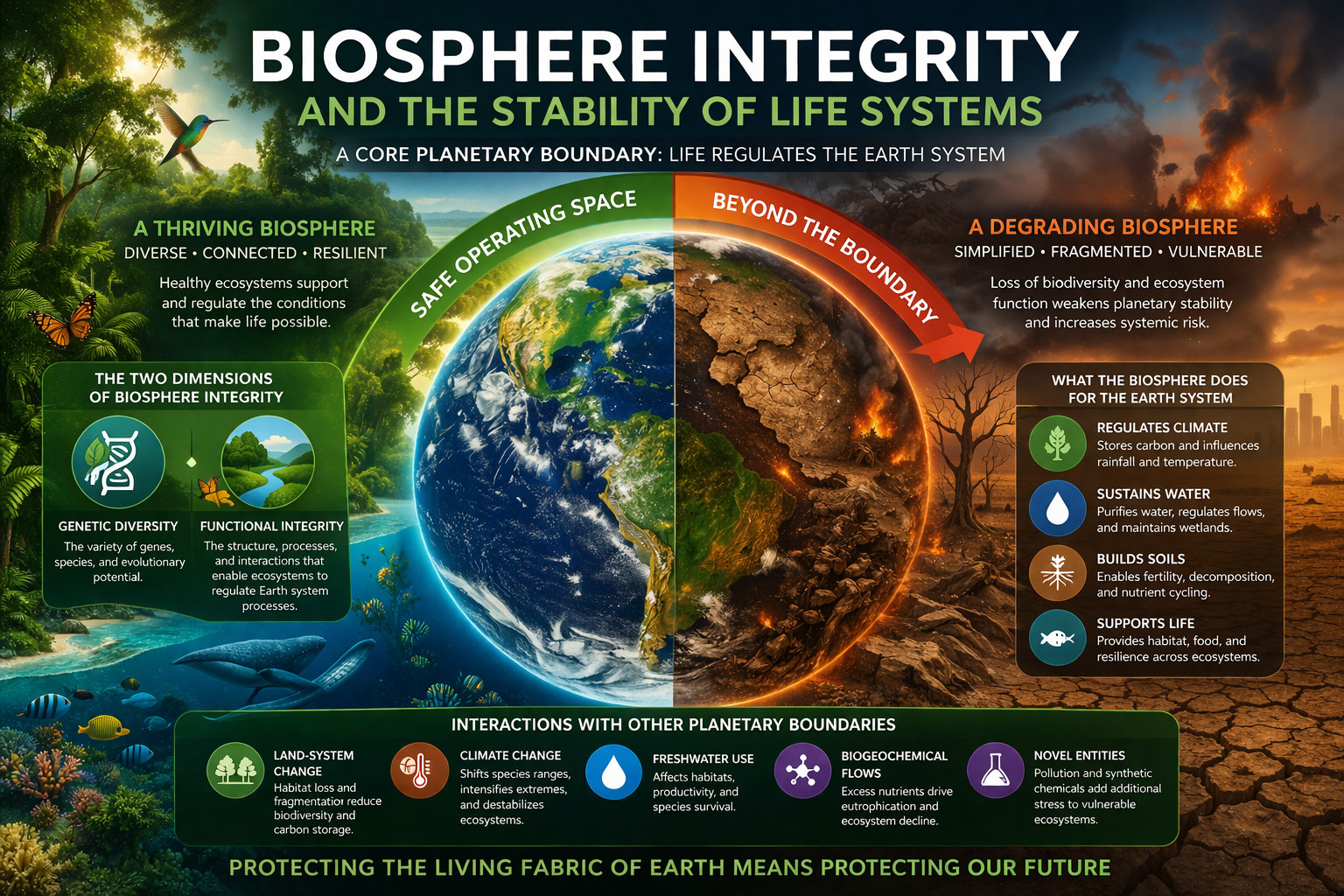
For companion essays, see Climate Change as a Planetary Boundary, Land-System Change and Ecological Transformation, Freshwater Change and Earth System Risk, Biogeochemical Flows: Nitrogen, Phosphorus, and Planetary Destabilization, Ocean Acidification and the Chemistry of Planetary Change, and Novel Entities and the Problem of Synthetic Overload.
Biosphere Integrity and Earth-System Risk
The planetary-boundary framing changes how biodiversity decline is understood. It is no longer enough to say that the loss of species is unfortunate, ethically troubling, or ecologically undesirable, though all of those claims remain true. The stronger claim is that biosphere degradation can undermine the stability of the Earth system itself. Once the issue is framed this way, ecological simplification becomes a matter of systemic risk with implications for food systems, freshwater systems, climate regulation, biogeochemical stability, disease ecology, coastal resilience, and the long-term viability of human civilization.
This broader framing is one reason the biosphere boundary has become so important in sustainability thinking. It reveals that environmental degradation is not confined to visible local loss. It can reduce the living resilience of the planetary system as a whole. The biosphere is not merely an object of protection. It is one of the active conditions of planetary order.
In this respect, the framework moves beyond conservation rhetoric toward an Earth-system understanding of life. Biosphere integrity matters not only because life has value, but because the organization of life helps stabilize the conditions under which complex societies persist. The disappearance of species, the erosion of genetic diversity, the collapse of ecological interactions, and the simplification of ecosystems all reduce the adaptive and regulatory capacity of the planet.
This is also why biosphere integrity is difficult to measure with a single metric. Species extinctions, population trends, genetic variation, ecosystem function, habitat intactness, primary productivity, human appropriation of biomass, trophic structure, and ecological connectivity each capture part of the problem. A serious biosphere-integrity approach must therefore be plural, multi-scale, and transparent about uncertainty.
Earth-system risk also clarifies why restoration is essential but not enough by itself. Some ecological systems recover slowly. Some require lost species, soil structures, hydrological patterns, fire regimes, or trophic relationships that cannot be recreated quickly. Some ecosystems, once pushed beyond thresholds, may reorganize into alternative states. Restoration can do remarkable work, but it should not become a license for continued destruction. Avoiding loss, protecting intact systems, restoring degraded systems, and reducing pressure must be pursued together.
The biosphere boundary therefore joins science, ethics, and strategy. It tells us that living systems are not peripheral to development. They are conditions of development. Food security, climate stability, water security, health, flood protection, cultural continuity, and future adaptation all depend on the biosphere remaining functional enough to support them.
Justice, Indigenous Stewardship, and Ecological Governance
Biosphere integrity is also a justice issue. The benefits of ecological exploitation are often captured by states, firms, investors, landowners, commodity systems, and distant consumers, while the costs fall disproportionately on Indigenous peoples, local communities, smallholders, pastoralists, fishers, forest-dependent populations, downstream communities, and future generations. Biodiversity loss is therefore not only a biological process. It is also a political and historical process shaped by power, extraction, land tenure, colonial histories, displacement, and uneven vulnerability.
Indigenous peoples and local communities are central to biosphere governance because many high-integrity ecosystems overlap with territories shaped by long-term stewardship, customary governance, and place-based ecological knowledge. Protecting biosphere integrity cannot be reduced to fortress conservation that removes people from land and seascapes. In many contexts, justice-based stewardship, land rights, community governance, and Indigenous sovereignty are part of ecological resilience rather than obstacles to it.
This matters for the planetary-boundary framework because Earth-system governance must not treat life systems only as technical objects to optimize. Ecosystems are lived, governed, contested, inherited, and culturally meaningful. Strategies that ignore rights and historical injustice may produce displacement, conflict, weak legitimacy, and ineffective conservation. Strategies that protect ecosystems while strengthening local and Indigenous governance can support both justice and resilience.
The biosphere boundary therefore forces a difficult but necessary synthesis. It asks how societies can protect planetary-scale ecological functions while respecting the people and communities most closely connected to those systems. A credible biosphere strategy must be scientifically grounded, politically legitimate, and socially just.
Justice also matters because conservation has its own history of exclusion. Protected areas have sometimes been created through displacement, coercion, criminalization of traditional livelihoods, or erasure of Indigenous governance. A serious biosphere-integrity framework must reject the false choice between ecological protection and human rights. Durable protection depends on legitimacy, stewardship, accountability, and recognition of communities whose knowledge and care have helped sustain ecosystems over long periods.
The justice dimension also extends to global consumption. Many wealthy consumers are insulated from the ecological damage embedded in food, timber, minerals, fisheries, energy, fashion, and land-intensive supply chains. The biosphere is degraded in one place to sustain consumption elsewhere. A planetary-boundary approach must make these relationships visible. Responsibility cannot stop at national borders or corporate reporting boundaries when ecological harm is organized through global commodity systems.
A just biosphere strategy must therefore include land rights, benefit sharing, restoration finance, ecological reparative investment, pollution accountability, supply-chain transparency, and protection for communities defending ecosystems. Biosphere integrity cannot be separated from the people who live with, depend on, and govern living systems.
Governance Implications
If biosphere integrity is a planetary boundary, then governance cannot treat biodiversity policy as a marginal or secondary concern. Protecting habitats, restoring degraded systems, limiting destructive land conversion, reducing fragmentation, governing pollution, restoring ecological connectivity, and preserving genetic diversity all become part of maintaining Earth-system stability. The framework does not prescribe a single institutional formula, but it does imply that societies must preserve the living systems that co-regulate planetary conditions.
The governance challenge is made harder by scale. Biosphere integrity is expressed through genes, organisms, populations, ecological interactions, local ecosystems, regional landscapes, seascapes, and global Earth-system processes at the same time. That means governance must connect conservation, agriculture, fisheries, forestry, land use, climate policy, water systems, pollution control, public health, and long-term resilience planning rather than treating them as separate domains. A narrowly bounded conservation frame is too small for the problem this boundary identifies.
The Kunming-Montreal Global Biodiversity Framework is important in this context because it organizes global biodiversity policy around 2050 goals and 2030 targets, including ecosystem integrity, restoration, protected and conserved areas, sustainable use, pollution reduction, invasive species management, finance, and integration of biodiversity across sectors. The planetary-boundary perspective strengthens the rationale for such integrated governance: protecting biodiversity is not only an environmental objective, but a condition of Earth-system resilience.
Governance must also become more measurable. Biosphere integrity requires transparent indicators for extinction risk, ecosystem condition, functional diversity, genetic diversity, habitat connectivity, primary productivity, restoration outcomes, land-use pressure, marine impacts, and pollution stress. Without monitoring and provenance, societies will undercount ecological degradation until recovery becomes more difficult and expensive.
Finance is another major governance domain. Capital flows shape land conversion, commodity expansion, mining, infrastructure, agriculture, fisheries, forestry, and restoration. A financial system that treats ecological degradation as an externality will continue funding biosphere decline while underpricing systemic risk. A better system would trace exposure to deforestation, habitat loss, water stress, biodiversity impacts, pollution, and rights violations, while supporting restoration, regenerative land use, ecological monitoring, and rights-based stewardship.
Governance must also distinguish between symbolic and structural action. Planting trees while allowing old-growth destruction is not ecological recovery. Creating protected areas without enforcement, funding, local legitimacy, or rights protections may fail. Publishing biodiversity disclosures without changing land-use or procurement practices can become performance rather than transformation. Biosphere governance requires enforceable land and water protections, credible restoration, pollution controls, transparent supply chains, ecological corridors, and institutions capable of responding to cumulative risk.
This is why the biosphere boundary increasingly appears in discussions of integrated land policy, resilience planning, climate mitigation, ecological restoration, nature-positive transition, financial disclosure, and Earth-system governance. For adjacent essays, see Earth System Governance in an Age of Limits, Business Strategy Within Planetary Boundaries, and Finance, Disclosure, and Systemic Environmental Risk.
Why This Matters for Planetary Boundaries
Biosphere integrity matters for planetary boundaries because it reveals that the Earth system is not regulated by physical and chemical processes alone. It is also regulated by life. Climate, water, soils, nutrients, oceans, and atmospheric dynamics are shaped by organisms, ecosystems, and ecological interactions. The planetary-boundary framework becomes far more powerful once life is understood as part of planetary regulation rather than as scenery surrounding human development.
The boundary also matters because it clarifies why biodiversity loss cannot be treated as a secondary environmental concern. A degraded biosphere weakens carbon sinks, soil fertility, food webs, pollination, water regulation, ecological recovery, disease regulation, coastal protection, and the adaptive capacity of life under climate change. Biosphere degradation therefore reduces the resilience of the Earth system and the resilience of human societies at the same time.
This matters for strategy because the biosphere boundary cannot be addressed through conservation areas alone. Protected and conserved areas are important, but biosphere integrity also depends on agriculture, fisheries, forestry, mining, infrastructure, climate mitigation, pollution control, finance, trade, food systems, restoration, and land rights. The boundary is crossed through ecological degradation across the real economy, and it must be repaired through governance that reaches the real economy.
Finally, the biosphere boundary matters because it connects ecological science to moral responsibility. The loss of living systems is not only a technical risk. It is a loss of evolutionary history, cultural relationship, beauty, knowledge, livelihood, and future possibility. A planetary-boundary framework that treats life systems seriously must therefore be both scientifically rigorous and ethically awake.
To understand biosphere integrity as a planetary boundary is to understand that the stability of civilization depends on the integrity of life. The biosphere is not outside the human story. It is the living condition that makes the human story possible.
Dimensions, Indicators, and the Danger of One Number
Biosphere integrity cannot be represented adequately by one indicator. Genetic diversity, population abundance, species composition, habitat extent, ecosystem condition, connectivity, functional traits, ecological interactions, primary productivity, trophic structure, soil biology, and evolutionary potential reveal different dimensions of living systems. Each has different spatial scales, response times, data requirements, and relationships to Earth-system regulation.
A single composite score may be useful for screening, but it can conceal irreversible loss. A region with high vegetation productivity can still experience extinction, trophic simplification, invasive dominance, genetic erosion, or the replacement of complex ecosystems by plantations. Conversely, low short-term productivity does not necessarily imply weak integrity in naturally sparse ecosystems.
Indicator design should therefore follow a nested structure. Headline indicators communicate broad status. Diagnostic indicators explain mechanisms. Safeguard indicators prevent severe losses from being averaged away. Provenance and uncertainty indicators disclose what is known and what remains poorly observed.
| Dimension | Example indicator family | Primary limitation |
|---|---|---|
| Genetic and evolutionary diversity | Extinction risk, genetic variation, population viability, crop and livestock diversity. | Genetic data remain sparse for most species and regions. |
| Population and community condition | Abundance, occupancy, community intactness, compositional change. | Trends depend strongly on baseline, sampling, and taxonomic coverage. |
| Functional integrity | Productivity, trophic structure, functional traits, ecological-process indicators. | High productivity can coexist with ecological simplification. |
| Landscape and seascape structure | Habitat extent, condition, fragmentation, connectivity, edge pressure. | Mapped cover does not always reveal ecological quality. |
| Governance and stewardship | Rights, management effectiveness, finance, monitoring, enforcement, participation. | Institutional presence does not guarantee ecological outcome. |
The purpose of plural measurement is not to create an endless list. It is to preserve the living mechanisms that a boundary assessment is meant to protect.
Population Abundance, Common Species, and Biotic Homogenization
Extinction is an irreversible endpoint, but ecological function can decline long before a species disappears. Population abundance, geographic occupancy, age structure, reproductive success, and migration determine whether organisms continue to perform their ecological roles. Formerly common species can become too rare to pollinate, disperse seeds, structure food webs, engineer habitat, or sustain cultural and livelihood relationships.
Biotic homogenization occurs when distinctive local communities are replaced by similar combinations of widespread generalists, domesticated organisms, or invasive species. Local species richness can remain stable or even rise while regional uniqueness and functional diversity decline. A count of species at one site can therefore miss the loss of ecological identity across a landscape.
Abundance monitoring should include common as well as threatened species, because the decline of common organisms can affect ecosystem function at large scale. It should also distinguish native recovery from increases driven by invasive dominance or human-subsidized species.
The boundary problem is not only how many lineages vanish. It is whether populations remain abundant, connected, and ecologically effective enough to sustain living systems.
Ecological Networks, Trophic Structure, and Interactions
Ecosystems are organized through interactions: predation, herbivory, pollination, seed dispersal, decomposition, symbiosis, competition, parasitism, disease, and nutrient exchange. Species lists do not show whether these relationships remain intact. A forest can retain trees while losing large seed dispersers. A reef can retain fish while losing herbivores that prevent algal dominance. A grassland can remain green while soil-food-web complexity declines.
Trophic structure matters because the removal of predators, large herbivores, ecosystem engineers, or decomposers can trigger cascading change. Interaction loss may precede species loss when populations become too sparse, phenologies diverge, or habitats fragment.
Network indicators can include interaction richness, connectance, modularity, functional redundancy, trophic balance, and the persistence of key mutualisms. These measures are difficult to collect at broad scale, but they are increasingly important for understanding resilience.
Functional integrity should therefore be interpreted as the persistence of relationships and processes, not only the presence of organisms or biomass.
Habitat Condition, Connectivity, and Edge Effects
Habitat extent is necessary but insufficient. Ecological condition depends on structure, species composition, hydrology, disturbance regime, pollution, extraction, invasive species, and the continuity of ecological processes. A mapped forest polygon can include intact forest, degraded secondary growth, plantation, logged forest, or fragmented remnants with very different ecological capacity.
Connectivity allows organisms, genes, water, sediment, nutrients, fire, and ecological processes to move across landscapes and seascapes. Fragmentation isolates populations, increases edge exposure, disrupts migration, and can prevent species from shifting range under climate change.
Edges alter temperature, light, wind, moisture, predation, invasion, and human access. A habitat patch can therefore lose effective interior area even when total mapped cover changes little.
Connectivity planning should include corridors, stepping stones, river continuity, coastal and marine linkages, vertical climate gradients, dark and quiet refuges, and the permeability of working landscapes. The objective is not a network of isolated reserves, but a connected living matrix.
Extinction Debt, Recovery Debt, and Ecological Memory
Ecological responses are often delayed. Extinction debt describes future species loss caused by earlier habitat destruction, fragmentation, or population decline. A remnant population may persist for decades while reproduction, genetic diversity, or habitat quality remain insufficient for long-term survival.
Recovery also has delays. Restored vegetation may return before soils, hydrology, genetic diversity, old-growth structure, trophic relationships, and ecological memory recover. A restored site can therefore show rapid cover gains while retaining a long recovery debt.
Ecological memory is stored in seed banks, soils, remnant populations, landscape structure, disturbance regimes, cultural practice, and species interactions. Protecting remnants can greatly improve restoration potential. Destroying the remaining source populations or reference ecosystems can make recovery slower, more uncertain, or impossible.
Delayed loss and delayed recovery create a governance challenge. Current conditions may reflect past decisions, while today’s decisions determine losses that will become visible later. Monitoring and liability must therefore extend beyond project completion and political cycles.
Regime Shifts, Tipping Dynamics, and Resilience
Ecosystems can reorganize into alternative states when reinforcing feedbacks overwhelm recovery processes. Clear lakes can become persistently turbid, coral reefs can shift toward algal dominance, forests can transition toward degraded woodland or grassland, peatlands can become net sources of carbon, and kelp forests can become urchin barrens.
These transitions may be nonlinear and hysteretic. Reversing the original pressure may not restore the earlier state because feedbacks, species loss, soil change, altered fire regimes, or food-web restructuring maintain the new condition.
Early-warning indicators can include rising variance, slower recovery after disturbance, spatial pattern change, loss of key functional groups, repeated recruitment failure, and increasing dependence on intervention. These signals are context-specific and should not be treated as universal proof of an approaching threshold.
Resilience management protects diversity, redundancy, connectivity, refugia, natural disturbance regimes, and the capacity for adaptation. It also reduces simultaneous pressures so that ecosystems retain room to recover.
Soil, Microbial, and Belowground Integrity
Much of the biosphere is below ground or invisible to conventional biodiversity surveys. Bacteria, archaea, fungi, protists, invertebrates, roots, and soil food webs regulate decomposition, nutrient cycling, aggregation, water retention, carbon storage, disease suppression, and plant productivity.
Soil degradation can involve erosion, compaction, salinization, acidification, contamination, organic-matter loss, disrupted fungal networks, reduced infiltration, and the simplification of microbial communities. Crop yield can be maintained temporarily through irrigation, fertilizer, pesticides, and mechanical intervention while the biological capacity of soil declines.
Microbial diversity also matters in oceans, freshwater systems, sediments, animals, and plants. Microbiomes mediate carbon, nitrogen, phosphorus, sulfur, health, and ecological interactions at scales that are difficult to observe directly.
Biosphere monitoring should therefore include soil condition, microbial function, decomposition, mycorrhizal relationships, and belowground carbon. Protecting visible species while degrading the biological substrate beneath them does not preserve integrity.
Freshwater and Marine Biosphere Integrity
Terrestrial indicators dominate many global assessments because land-cover and productivity data are comparatively available. Freshwater and marine systems require distinct attention. Rivers, lakes, wetlands, estuaries, coasts, reefs, seagrasses, kelp forests, deep-sea habitats, and open-ocean food webs experience different pressures and have different forms of connectivity.
Freshwater integrity depends on flow regime, water quality, sediment, temperature, channel structure, floodplain connection, groundwater interaction, and migration routes. Dams, withdrawals, pollution, invasive species, and catchment change can transform ecological function even when water remains present.
Marine integrity is shaped by fishing, warming, acidification, deoxygenation, pollution, seabed disturbance, coastal development, and altered food webs. Surface productivity alone cannot capture reef erosion, deep-sea damage, loss of large animals, or changes in plankton communities.
A planetary biosphere assessment should therefore avoid treating a land-based functional indicator as a complete measure of life-system condition across the whole Earth system.
Food Systems and the Biodiversity Nexus
Food systems are both a major pressure on biosphere integrity and a major beneficiary of it. Agricultural expansion, simplification, fertilizer, pesticides, irrigation, drainage, fishing, feed production, and commodity trade affect habitats, nutrients, water, climate, and genetic diversity. At the same time, food production depends on soils, pollination, pest regulation, water cycles, crop diversity, fisheries, and climate resilience.
The IPBES Nexus Assessment emphasizes that biodiversity, water, food, health, and climate are interdependent. Interventions in one domain can create benefits or trade-offs in another. Intensification may spare land under some conditions while increasing chemical and water pressure. Agroecological diversification may improve resilience but requires knowledge, labor, markets, land security, and transition support.
Diet, waste, procurement, trade, land tenure, subsidies, and concentration of market power shape the biosphere burden as much as farm-level technique. A food-system strategy should therefore combine demand, production, distribution, rights, and landscape governance.
Protecting biosphere integrity requires systems that provide adequate nutrition without treating living landscapes and seascapes as unlimited commodity inputs.
Monitoring: Remote Sensing, eDNA, Bioacoustics, and Field Evidence
Modern biosphere monitoring combines satellite imagery, airborne sensors, camera traps, acoustic recorders, environmental DNA, automated species recognition, field plots, museum collections, community observations, fisheries surveys, genetic data, and administrative records. Each method observes a different layer of life.
Remote sensing can map habitat, vegetation structure, productivity, disturbance, water, fire, and landscape change, but it cannot identify every species or ecological interaction. Environmental DNA can reveal organisms from genetic traces, but detection depends on sampling, transport, degradation, reference libraries, and contamination control. Acoustic and camera systems expand temporal coverage while introducing classification error and uneven detectability.
Monitoring design should integrate methods, maintain calibration and taxonomic expertise, document absence of evidence, and preserve raw data where ethically appropriate. Indigenous and local monitoring can provide long-term place-based knowledge unavailable to short projects.
Artificial intelligence can accelerate classification and anomaly detection, but models should be validated across habitats, species, seasons, devices, and communities. Automated confidence is not a substitute for ecological interpretation.
Restoration Hierarchy, Additionality, and Permanence
Restoration is essential, but it belongs within a mitigation hierarchy: avoid damage, minimize unavoidable impact, restore degraded systems, and address residual harm only under strict conditions. Avoidance receives priority because mature ecosystems, evolutionary history, and complex relationships cannot be recreated quickly or reliably.
Restoration claims should specify the reference ecosystem, causes of degradation, ecological trajectory, time horizon, additionality, permanence, leakage, climate suitability, rights, and monitoring. Tree cover alone is not proof of restored biosphere integrity. Plantations can increase biomass while reducing native diversity, water availability, fire resilience, or local access.
Restoration also requires maintenance and adaptive management. Early planting success can be followed by drought, invasive species, grazing, fire, altered hydrology, or loss of finance. Monitoring should include function, composition, connectivity, soils, and social outcomes over decades.
Offsets are especially risky when they imply equivalence between destruction and uncertain future recovery. Some habitats, species, cultural relationships, and ecological functions are irreplaceable and should be treated as no-go losses.
Protected Areas, OECMs, and Connected Conservation
Protected areas and other effective area-based conservation measures can support biosphere integrity when they are ecologically representative, connected, effectively governed, financed, monitored, and rights-respecting. Percentage coverage alone does not establish protection.
Effective systems include terrestrial, freshwater, coastal, and marine habitats; climate refugia; migration routes; ecological gradients; key biodiversity areas; and the working landscapes and seascapes between formal sites. Connectivity becomes increasingly important as species shift ranges under climate change.
Governance can include public, private, community, and Indigenous arrangements. Recognition of other effective area-based conservation measures can make long-standing stewardship visible, but it should not appropriate community governance or count areas without demonstrated conservation outcomes.
Area-based conservation must also address pressures beyond boundaries. Pollution, hydrological alteration, infrastructure, extraction, climate change, invasive species, and supply-chain demand can undermine protected ecosystems from outside.
Indigenous Territories, Rights, and Knowledge Sovereignty
Indigenous territories and community-governed lands and waters contain many ecosystems of high integrity, but their contribution cannot be reduced to an ecosystem-service statistic. Stewardship is connected to sovereignty, culture, law, language, identity, livelihood, and intergenerational responsibility.
Rights-based governance includes free, prior, and informed consent; secure tenure; protection of environmental defenders; equitable finance; benefit sharing; and authority over data and knowledge. Conservation that displaces communities or criminalizes customary practice can violate rights and undermine ecological legitimacy.
Knowledge sovereignty matters in digital biodiversity systems. Genetic information, species records, traditional knowledge, and ecological observations can be extracted without meaningful control or benefit. Governance should define consent, access, attribution, data storage, commercial use, and the right to refuse disclosure.
Partnership is strongest when Indigenous institutions shape goals, indicators, management, monitoring, and remedy rather than appearing as stakeholders within an externally designed program.
The Global Biodiversity Framework and the Implementation Gap
The Kunming-Montreal Global Biodiversity Framework establishes four goals for 2050 and twenty-three targets for 2030. Its scope includes spatial planning, restoration, protected and conserved areas, threatened species, sustainable use, invasive species, pollution, climate interactions, consumption, finance, business disclosure, participation, rights, and integration across government.
The framework is accompanied by a monitoring system of headline, binary, component, and complementary indicators. Parties were requested to align national biodiversity strategies and action plans and submit seventh national reports in 2026. The global review process is intended to assess collective progress and the means of implementation.
The central challenge is implementation. Targets require finance, technical capacity, land and resource rights, monitoring, enforcement, cross-sector coordination, and changes to the economic activities driving decline. Reporting can improve transparency, but it does not substitute for reduced pressure and ecological recovery.
A biosphere-integrity assessment should connect planetary-boundary science with the Framework’s policy architecture while keeping their purposes distinct. One diagnoses Earth-system risk; the other organizes international biodiversity commitments and implementation.
Finance, Disclosure, “Nature Positive,” and Greenwashing Risk
Finance shapes extraction, agriculture, infrastructure, fisheries, forestry, mining, real estate, and restoration. Biodiversity disclosure can make dependencies, impacts, risks, and opportunities more visible, but disclosure alone does not redirect capital or protect ecosystems.
“Nature positive” language is increasingly used to describe strategies intended to halt and reverse biodiversity loss. The phrase can support ambition, but it becomes vulnerable to greenwashing when baselines, scope, additionality, rights, ecological integrity, and absolute pressure are unclear.
A credible claim should identify which ecosystems and species are affected, what losses are avoided, what pressures decline, what recovery is measured, who verifies it, how leakage is handled, and whether results persist. Portfolio-level claims should not allow gains in one location to hide severe damage elsewhere.
Financial institutions also need to examine enabling activities such as lending, underwriting, ownership, and investment in sectors linked to deforestation, pollution, overexploitation, and land conversion. The relevant question is not only exposure to nature-related risk, but contribution to biosphere decline.
Climate–Nature Synergies and Maladaptation
Climate mitigation and biosphere protection can reinforce one another, but they are not automatically aligned. Protecting forests, peatlands, wetlands, mangroves, grasslands, and seagrasses can preserve carbon, water, habitat, and resilience. Ecological restoration can reduce climate vulnerability and support adaptation.
Maladaptation occurs when climate action damages living systems or vulnerable communities. Large monoculture plantations, poorly sited renewable infrastructure, mining for transition minerals, bioenergy expansion, river alteration, or seawalls can reduce one risk while increasing habitat loss, water pressure, or displacement.
Carbon accounting can also undervalue biodiversity. A high-carbon ecosystem and a plantation may appear similar under a narrow biomass metric while differing greatly in species, structure, soils, hydrology, resilience, and cultural meaning.
Integrated assessment should include climate benefit, biodiversity condition, water, materials, land, rights, connectivity, and long-term resilience. The two core planetary boundaries must be addressed together without treating one as a proxy for the other.
Adaptive Pathways, Thresholds, and Uncertainty
Biosphere decisions are made under uncertainty about species response, climate, ecological interactions, land use, governance, and recovery. Uncertainty is greatest where monitoring and taxonomic capacity are weak, which often overlaps with regions of high biodiversity and limited resources.
Adaptive pathways identify actions that are robust across plausible futures and define triggers for stronger protection, restoration, or pressure reduction. Triggers can include population decline, habitat fragmentation, loss of ecological function, repeated recruitment failure, invasive spread, fire-regime change, water-quality deterioration, or governance breakdown.
Precaution is appropriate when losses are irreversible or recovery is slow. Lack of complete data should not be interpreted as evidence of low risk. Safety margins, no-go areas, staged decisions, independent review, and long-term monitoring preserve options.
Scenario analysis should keep ecological thresholds, rights, and irreplaceable systems outside compensatory scoring. An uncertain restoration benefit cannot justify a known extinction or destruction of an intact ecosystem.
Worked Diagnostic: A Forest–River–Agriculture Landscape
Consider a regional landscape containing native forest, Indigenous territories, commercial agriculture, rivers, wetlands, towns, roads, and an expanding mining corridor. Forest cover remains substantial, but fragmentation, wildlife decline, water-quality deterioration, and fire risk are increasing.
Step 1: Define ecological and governance boundaries
The assessment includes habitats, watersheds, migration routes, land tenure, commodity supply chains, protected areas, customary territories, and institutions controlling development.
Step 2: Establish multiple baselines
Current condition is compared with historical ecosystem extent, reference sites, Indigenous knowledge, population records, and recent remote-sensing trends.
Step 3: Diagnose genetic and population integrity
Threatened and common species, population connectivity, genetic isolation, reproductive success, and extinction debt are assessed separately.
Step 4: Diagnose functional and network integrity
Pollination, seed dispersal, predation, soil function, river continuity, fire regulation, primary productivity, and trophic structure are examined.
Step 5: Map pressure and external demand
Roads, mining, agricultural expansion, chemicals, water extraction, fire, hunting, climate stress, finance, and imported consumption are linked to ecological change.
Step 6: Compare intervention pathways
Isolated offsets are compared with avoidance zones, tenure protection, connected conservation, regenerative production, river restoration, pollution control, and demand reduction.
Step 7: Apply rights and restoration safeguards
Free, prior, and informed consent, no-go losses, ecological reference conditions, additionality, permanence, leakage, and long-term stewardship are required.
Step 8: Establish triggers and learning
Population, connectivity, water, fire, habitat-condition, rights, and enforcement indicators activate pre-agreed responses and public review.
| Pathway | Visible result | Systems implication |
|---|---|---|
| Protect percentage targets only | Formal coverage rises. | Weak connectivity, rights, condition, enforcement, and outside pressure can preserve decline. |
| Restore while conversion continues | New vegetation and project credits. | Extinction debt and loss of mature ecological structure continue. |
| Integrated biosphere pathway | Avoidance, rights, connected protection, pressure reduction, restoration, and monitoring. | Protects irreplaceable systems while rebuilding landscape function and governance capacity. |
The diagnostic shows why cover, protected-area percentage, or restoration hectares cannot stand alone. Genetic, population, functional, network, rights, and governance conditions determine whether the living system remains resilient.
Mathematical Lens: Diversity, Function, and Biosphere Boundary Pressure
Biosphere integrity can be represented through genetic diversity, functional integrity, ecological pressure, and governance capacity. Let \(E_t\) represent an observed extinction-pressure indicator at time \(t\), and let \(E_b\) represent a safer reference extinction-rate or genetic-diversity boundary value. A genetic-diversity pressure ratio can be written as:
R_G = \frac{E_t}{E_b}
\]
Interpretation: The genetic-diversity pressure ratio compares observed extinction pressure with a safer boundary reference.
If \(R_G > 1\), extinction pressure exceeds the boundary reference. For functional integrity, let \(F_t\) represent a functional biosphere integrity index at time \(t\), and let \(F_b\) represent the safer boundary threshold. A functional integrity deficit can be written as:
D_F = \max(0, F_b – F_t)
\]
Interpretation: The functional integrity deficit measures how far observed ecosystem function falls below a safer reference threshold.
A combined biosphere pressure score can then include genetic pressure, functional deficit, habitat fragmentation, and human appropriation of biological productivity:
B_r = \alpha R_{G,r} + \beta D_{F,r} + \gamma H_r + \delta A_r
\]
Interpretation: Biosphere pressure rises with extinction pressure, functional decline, habitat fragmentation, and appropriation of biological productivity.
Here, \(H_r\) is habitat fragmentation pressure and \(A_r\) is appropriation pressure, such as human appropriation of net primary production. A resilience-adjusted biosphere risk score can include ecological sensitivity and governance capacity:
Q_r = B_r \times S_r \times (1 – G_r)
\]
Interpretation: Risk increases when biosphere pressure and ecological sensitivity are high, and when governance capacity is weak.
A restoration-adjusted formulation can include recovery potential:
L_r = Q_r – \lambda Rst_r
\]
Interpretation: Restoration potential can reduce long-term risk, but only when restoration is ecologically credible, governed well, and not used to justify ongoing destruction.
| Term | Meaning | Interpretive role |
|---|---|---|
| \(E_t\) | Observed extinction-pressure indicator | Represents pressure on genetic diversity and evolutionary potential. |
| \(E_b\) | Genetic-diversity boundary reference | Represents a safer reference value for extinction pressure. |
| \(R_G\) | Genetic-diversity pressure ratio | Shows whether extinction pressure exceeds the boundary reference. |
| \(F_t\) | Functional biosphere integrity index | Represents observed ecosystem function or integrity. |
| \(F_b\) | Functional integrity threshold | Represents the safer reference value for ecosystem function. |
| \(D_F\) | Functional integrity deficit | Shows how far ecosystem function falls below the threshold. |
| \(H_r\) | Habitat fragmentation pressure | Represents loss of ecological connectivity and landscape integrity. |
| \(A_r\) | Appropriation pressure | Represents human appropriation of biological productivity. |
| \(G_r\) | Governance capacity | Represents monitoring, protection, enforcement, rights, restoration, and adaptive governance. |
| \(Rst_r\) | Restoration potential | Represents credible ecological recovery potential under suitable governance conditions. |
This simplified formulation captures the boundary’s systems logic: biosphere risk rises when extinction pressure, functional disruption, fragmentation, appropriation, and ecological sensitivity increase, and falls when governance and restoration capacity are strong. It is not a substitute for ecology. It is a transparent way to connect biosphere-boundary thinking with reproducible diagnostics.
Advanced Python Workflow: Biosphere Integrity and Life-System Risk Diagnostics
The following Python workflow models biosphere integrity as a combined genetic-diversity and functional-integrity problem. It separates extinction pressure, functional integrity, habitat intactness, fragmentation, human appropriation of net primary production, ecological sensitivity, restoration potential, monitoring capacity, governance capacity, and interactions with other planetary pressures. The values are illustrative, but the structure can be adapted for biodiversity dashboards, conservation planning, remote-sensing pipelines, ecological-risk assessment, restoration prioritization, and reproducible reporting.
from __future__ import annotations

import csv
from collections import defaultdict
from pathlib import Path
from statistics import mean

ARTICLE_ROOT = Path(__file__).resolve().parents[1]
DATA_FILE = ARTICLE_ROOT / "data" / "biosphere_region_profiles.csv"
TABLES = ARTICLE_ROOT / "outputs" / "tables"

PRESSURE_COLUMNS = [
    "land_sea_use_pressure",
    "direct_exploitation_pressure",
    "climate_pressure",
    "pollution_nutrient_pressure",
    "invasive_species_pressure",
    "infrastructure_fragmentation_pressure",
]

INTEGRITY_COLUMNS = [
    "genetic_diversity_index",
    "population_abundance_index",
    "functional_integrity_index",
    "habitat_condition_index",
    "connectivity_index",
    "interaction_integrity_index",
    "soil_microbiome_integrity_index",
]

CAPACITY_COLUMNS = [
    "monitoring_capacity",
    "governance_capacity",
    "rights_stewardship_capacity",
    "restoration_capacity",
    "finance_capacity",
]

def clamp(value: float, low: float = 0.0, high: float = 1.0) -> float:
    return max(low, min(high, value))

def load_profiles(path: Path = DATA_FILE) -> list[dict[str, object]]:
    with path.open(newline="", encoding="utf-8") as handle:
        rows = list(csv.DictReader(handle))

    numeric = [
        "extinction_pressure_ratio",
        "ecological_sensitivity",
        "livelihood_cultural_dependence",
        "irreversibility_index",
        "data_completeness",
        *PRESSURE_COLUMNS,
        *INTEGRITY_COLUMNS,
        *CAPACITY_COLUMNS,
    ]
    for row in rows:
        for column in numeric:
            value = float(row[column])
            if column == "extinction_pressure_ratio":
                if value < 0:
                    raise ValueError("Extinction pressure cannot be negative.")
            elif not 0.0 <= value <= 1.0:
                raise ValueError(f"{column} outside [0, 1]: {value}")
            row[column] = value
    return rows

def weighted_average(row: dict[str, object], weights: dict[str, float]) -> float:
    total = sum(weights.values())
    return sum(float(row[key]) * weight for key, weight in weights.items()) / total

def score_profile(row: dict[str, object]) -> dict[str, object]:
    direct_pressure = weighted_average(
        row,
        {
            "land_sea_use_pressure": 0.23,
            "direct_exploitation_pressure": 0.16,
            "climate_pressure": 0.18,
            "pollution_nutrient_pressure": 0.15,
            "invasive_species_pressure": 0.11,
            "infrastructure_fragmentation_pressure": 0.17,
        },
    )
    ecological_integrity = weighted_average(
        row,
        {
            "genetic_diversity_index": 0.16,
            "population_abundance_index": 0.16,
            "functional_integrity_index": 0.20,
            "habitat_condition_index": 0.15,
            "connectivity_index": 0.13,
            "interaction_integrity_index": 0.12,
            "soil_microbiome_integrity_index": 0.08,
        },
    )
    integrity_deficit = 1.0 - ecological_integrity
    implementation_capacity = weighted_average(
        row,
        {
            "monitoring_capacity": 0.17,
            "governance_capacity": 0.23,
            "rights_stewardship_capacity": 0.22,
            "restoration_capacity": 0.18,
            "finance_capacity": 0.20,
        },
    )
    extinction_pressure = clamp(float(row["extinction_pressure_ratio"]) / 10.0)
    delayed_loss_risk = clamp(
        0.43 * integrity_deficit
        + 0.32 * float(row["infrastructure_fragmentation_pressure"])
        + 0.25 * float(row["irreversibility_index"])
    )
    social_ecological_burden = clamp(
        0.50 * float(row["livelihood_cultural_dependence"])
        + 0.30 * float(row["ecological_sensitivity"])
        + 0.20 * (1.0 - float(row["rights_stewardship_capacity"]))
    )
    restoration_credibility = clamp(
        float(row["restoration_capacity"])
        * float(row["governance_capacity"])
        * float(row["rights_stewardship_capacity"])
        * float(row["data_completeness"])
    )
    biosphere_risk = clamp(
        (
            0.25 * extinction_pressure
            + 0.27 * integrity_deficit
            + 0.19 * direct_pressure
            + 0.12 * delayed_loss_risk
            + 0.09 * social_ecological_burden
            + 0.08 * (1.0 - implementation_capacity)
        )
        * (1.12 - 0.18 * restoration_credibility)
    )

    if biosphere_risk >= 0.72:
        risk_band = "Severe synthetic risk"
    elif biosphere_risk >= 0.56:
        risk_band = "High synthetic risk"
    elif biosphere_risk >= 0.38:
        risk_band = "Moderate synthetic risk"
    else:
        risk_band = "Lower synthetic risk"

    priorities = {
        "genetic and population protection": 0.5 * extinction_pressure
        + 0.5 * (1.0 - float(row["population_abundance_index"])),
        "functional and interaction recovery": 0.5 * (
            1.0 - float(row["functional_integrity_index"])
        ) + 0.5 * (1.0 - float(row["interaction_integrity_index"])),
        "habitat and connectivity": 0.5 * (
            1.0 - float(row["habitat_condition_index"])
        ) + 0.5 * (1.0 - float(row["connectivity_index"])),
        "pressure reduction": direct_pressure,
        "rights and governance": 1.0 - (
            0.5 * float(row["rights_stewardship_capacity"])
            + 0.5 * float(row["governance_capacity"])
        ),
    }
    priority = max(priorities, key=priorities.get)

    return {
        **row,
        "direct_pressure_score": round(direct_pressure, 4),
        "ecological_integrity_score": round(ecological_integrity, 4),
        "integrity_deficit": round(integrity_deficit, 4),
        "implementation_capacity": round(implementation_capacity, 4),
        "extinction_pressure_normalized": round(extinction_pressure, 4),
        "delayed_loss_risk": round(delayed_loss_risk, 4),
        "social_ecological_burden": round(social_ecological_burden, 4),
        "restoration_credibility": round(restoration_credibility, 4),
        "biosphere_integrity_risk": round(biosphere_risk, 4),
        "risk_band": risk_band,
        "priority": priority,
    }

def system_summary(scored: list[dict[str, object]]) -> list[dict[str, object]]:
    groups: dict[str, list[dict[str, object]]] = defaultdict(list)
    for row in scored:
        groups[str(row["system_type"])].append(row)

    output = []
    for system_type, rows in sorted(groups.items()):
        output.append({
            "system_type": system_type,
            "regions": len(rows),
            "mean_biosphere_risk": round(mean(float(r["biosphere_integrity_risk"]) for r in rows), 4),
            "mean_integrity_deficit": round(mean(float(r["integrity_deficit"]) for r in rows), 4),
            "mean_direct_pressure": round(mean(float(r["direct_pressure_score"]) for r in rows), 4),
            "mean_implementation_capacity": round(mean(float(r["implementation_capacity"]) for r in rows), 4),
            "mean_restoration_credibility": round(mean(float(r["restoration_credibility"]) for r in rows), 4),
        })
    return output

def dimension_summary(rows: list[dict[str, object]]) -> list[dict[str, object]]:
    dimensions = PRESSURE_COLUMNS + INTEGRITY_COLUMNS + CAPACITY_COLUMNS
    output = []
    for column in dimensions:
        values = [float(row[column]) for row in rows]
        output.append({
            "dimension": column,
            "mean": round(mean(values), 4),
            "minimum": round(min(values), 4),
            "maximum": round(max(values), 4),
            "range": round(max(values) - min(values), 4),
        })
    return output

def policy_scenarios(profiles: list[dict[str, object]]) -> list[dict[str, object]]:
    scenarios = {
        "Baseline trajectory": {
            "pressure_reduction": 0.00,
            "integrity_gain": 0.00,
            "capacity_gain": 0.00,
            "extinction_multiplier": 1.00,
        },
        "Monitoring expansion": {
            "pressure_reduction": 0.01,
            "integrity_gain": 0.01,
            "capacity_gain": 0.12,
            "extinction_multiplier": 0.98,
        },
        "Protected-area expansion only": {
            "pressure_reduction": 0.05,
            "integrity_gain": 0.04,
            "capacity_gain": 0.05,
            "extinction_multiplier": 0.92,
        },
        "Restoration without full pressure reduction": {
            "pressure_reduction": 0.04,
            "integrity_gain": 0.10,
            "capacity_gain": 0.08,
            "extinction_multiplier": 0.90,
        },
        "Integrated rights-based biosphere pathway": {
            "pressure_reduction": 0.16,
            "integrity_gain": 0.14,
            "capacity_gain": 0.15,
            "extinction_multiplier": 0.72,
        },
    }

    records = []
    for scenario_name, settings in scenarios.items():
        for base in profiles:
            row = dict(base)
            for column in PRESSURE_COLUMNS:
                row[column] = clamp(
                    float(row[column]) - settings["pressure_reduction"]
                )
            for column in INTEGRITY_COLUMNS:
                row[column] = clamp(
                    float(row[column]) + settings["integrity_gain"]
                )
            for column in CAPACITY_COLUMNS:
                row[column] = clamp(
                    float(row[column]) + settings["capacity_gain"]
                )
            row["extinction_pressure_ratio"] = (
                float(row["extinction_pressure_ratio"])
                * settings["extinction_multiplier"]
            )
            scored = score_profile(row)
            records.append({
                "scenario": scenario_name,
                "region": scored["region"],
                "biosphere_integrity_risk": scored["biosphere_integrity_risk"],
                "integrity_deficit": scored["integrity_deficit"],
                "direct_pressure_score": scored["direct_pressure_score"],
                "implementation_capacity": scored["implementation_capacity"],
                "restoration_credibility": scored["restoration_credibility"],
                "risk_band": scored["risk_band"],
                "priority": scored["priority"],
            })
    return records

def write_csv(path: Path, rows: list[dict[str, object]]) -> None:
    path.parent.mkdir(parents=True, exist_ok=True)
    if not rows:
        raise ValueError(f"No rows for {path}")
    with path.open("w", newline="", encoding="utf-8") as handle:
        writer = csv.DictWriter(handle, fieldnames=list(rows[0].keys()))
        writer.writeheader()
        writer.writerows(rows)

def main() -> None:
    profiles = load_profiles()
    scored = [score_profile(row) for row in profiles]
    scored.sort(key=lambda row: float(row["biosphere_integrity_risk"]), reverse=True)

    write_csv(TABLES / "biosphere_region_diagnostics.csv", scored)
    write_csv(TABLES / "biosphere_system_summary.csv", system_summary(scored))
    write_csv(TABLES / "biosphere_dimension_summary.csv", dimension_summary(profiles))
    write_csv(TABLES / "biosphere_policy_scenarios.csv", policy_scenarios(profiles))

    print("Biosphere-integrity workflow complete.")
    print(TABLES / "biosphere_region_diagnostics.csv")

if __name__ == "__main__":
    main()
This workflow is useful because it separates biosphere integrity into interpretable components: genetic-diversity pressure, functional-integrity deficit, habitat intactness, fragmentation, appropriation pressure, cross-boundary stress, restoration potential, monitoring capacity, and governance capacity. That separation matters because biosphere governance is not one intervention everywhere. A tropical forest frontier, agricultural mosaic, wetland complex, coral reef system, boreal fire zone, and restored landscape each require different combinations of protection, restoration, connectivity, pollution reduction, climate mitigation, and governance.
The scenario section also makes the strategic logic visible. Improved monitoring helps, but monitoring alone does not restore life systems. Habitat protection and connectivity reduce fragmentation. Restoration and reduced appropriation address functional recovery and pressure from human biomass use. Integrated biosphere resilience combines protection, restoration, reduced pressure, monitoring, and governance capacity because the biosphere boundary is ecological, social, and institutional at the same time.
Advanced R Workflow: Biosphere Integrity Dashboarding
The following R workflow prepares dashboard-ready outputs for biosphere-integrity analysis. It is designed for researchers, engineers, sustainability analysts, conservation scientists, ecological modelers, restoration teams, biodiversity data analysts, remote-sensing teams, and governance practitioners who need to compare genetic pressure, functional integrity, habitat intactness, fragmentation, appropriation pressure, cross-boundary stress, and policy scenarios across regions.
# Base R biosphere-integrity diagnostics.
args <- commandArgs(trailingOnly = FALSE)
file_arg <- grep("^--file=", args, value = TRUE)

if (length(file_arg) > 0) {
  script_path <- normalizePath(sub("^--file=", "", file_arg[1]), mustWork = TRUE)
  article_root <- normalizePath(file.path(dirname(script_path), ".."), mustWork = TRUE)
} else {
  article_root <- getwd()
}

input_file <- file.path(article_root, "data", "biosphere_region_profiles.csv")
output_file <- file.path(article_root, "outputs", "tables", "biosphere_diagnostics_r.csv")

biosphere <- read.csv(input_file, stringsAsFactors = FALSE)

biosphere$direct_pressure_score <- rowMeans(
  biosphere[, c(
    "land_sea_use_pressure",
    "direct_exploitation_pressure",
    "climate_pressure",
    "pollution_nutrient_pressure",
    "invasive_species_pressure",
    "infrastructure_fragmentation_pressure"
  )]
)

biosphere$ecological_integrity_score <- rowMeans(
  biosphere[, c(
    "genetic_diversity_index",
    "population_abundance_index",
    "functional_integrity_index",
    "habitat_condition_index",
    "connectivity_index",
    "interaction_integrity_index",
    "soil_microbiome_integrity_index"
  )]
)

biosphere$integrity_deficit <- 1 - biosphere$ecological_integrity_score

biosphere$implementation_capacity <- rowMeans(
  biosphere[, c(
    "monitoring_capacity",
    "governance_capacity",
    "rights_stewardship_capacity",
    "restoration_capacity",
    "finance_capacity"
  )]
)

biosphere$biosphere_integrity_risk <- pmin(
  1,
  pmax(
    0,
    0.28 * pmin(1, biosphere$extinction_pressure_ratio / 10) +
    0.30 * biosphere$integrity_deficit +
    0.22 * biosphere$direct_pressure_score +
    0.10 * biosphere$ecological_sensitivity +
    0.10 * (1 - biosphere$implementation_capacity)
  )
)

dir.create(dirname(output_file), recursive = TRUE, showWarnings = FALSE)
write.csv(biosphere, output_file, row.names = FALSE)

cat("Base R biosphere diagnostics complete.\n")
cat(output_file, "\n")
This R workflow is designed for transparent interpretation rather than false precision. It separates extinction pressure, functional integrity, habitat intactness, fragmentation, appropriation pressure, cross-boundary stress, restoration potential, monitoring capacity, and governance capacity. That distinction matters because biosphere integrity is not one variable and biosphere governance is not one strategy. Protecting a coral reef, restoring a wetland, reconnecting a fragmented agricultural landscape, and reducing tropical forest conversion require different interventions, even though they belong to the same planetary boundary.
The scenario outputs are especially useful for governance because they show how different interventions affect different dimensions of risk. Habitat protection may reduce fragmentation more directly than pollution. Restoration may improve functional integrity but not replace the protection of intact systems. Reduced appropriation may require changes in agriculture, diets, commodity systems, and land-use policy. Integrated biosphere resilience is the only scenario that treats the boundary as an Earth-system problem rather than a single conservation program.
Advanced Go Workflow: Lightweight Biosphere-Integrity Scoring Service
The following Go workflow translates biosphere-integrity analysis into a lightweight scoring service. Go is useful for command-line tools, APIs, monitoring systems, and operational scoring engines. This example reads biosphere profiles from a CSV file and reports genetic-diversity pressure, functional-integrity deficit, habitat-loss pressure, cross-boundary stress, biosphere-integrity risk score, risk class, and priority.
package main

import (
	"encoding/csv"
	"fmt"
	"math"
	"os"
	"path/filepath"
	"strconv"
)

func parse(record map[string]string, key string) float64 {
	value, err := strconv.ParseFloat(record[key], 64)
	if err != nil {
		panic(fmt.Errorf("%s: %w", key, err))
	}
	return value
}

func clamp(value float64) float64 {
	return math.Max(0, math.Min(1, value))
}

func average(values ...float64) float64 {
	total := 0.0
	for _, value := range values {
		total += value
	}
	return total / float64(len(values))
}

func main() {
	input := filepath.Join("..", "data", "biosphere_region_profiles.csv")
	output := filepath.Join("..", "outputs", "tables", "biosphere_scores_go.csv")

	file, err := os.Open(input)
	if err != nil {
		panic(err)
	}
	defer file.Close()

	reader := csv.NewReader(file)
	rows, err := reader.ReadAll()
	if err != nil {
		panic(err)
	}
	headers := rows[0]

	out, err := os.Create(output)
	if err != nil {
		panic(err)
	}
	defer out.Close()

	writer := csv.NewWriter(out)
	defer writer.Flush()
	writer.Write([]string{
		"region",
		"direct_pressure",
		"integrity_deficit",
		"implementation_capacity",
		"biosphere_risk",
	})

	for _, row := range rows[1:] {
		record := map[string]string{}
		for index, header := range headers {
			record[header] = row[index]
		}

		directPressure := average(
			parse(record, "land_sea_use_pressure"),
			parse(record, "direct_exploitation_pressure"),
			parse(record, "climate_pressure"),
			parse(record, "pollution_nutrient_pressure"),
			parse(record, "invasive_species_pressure"),
			parse(record, "infrastructure_fragmentation_pressure"),
		)
		integrity := average(
			parse(record, "genetic_diversity_index"),
			parse(record, "population_abundance_index"),
			parse(record, "functional_integrity_index"),
			parse(record, "habitat_condition_index"),
			parse(record, "connectivity_index"),
			parse(record, "interaction_integrity_index"),
			parse(record, "soil_microbiome_integrity_index"),
		)
		deficit := 1 - integrity
		capacity := average(
			parse(record, "monitoring_capacity"),
			parse(record, "governance_capacity"),
			parse(record, "rights_stewardship_capacity"),
			parse(record, "restoration_capacity"),
			parse(record, "finance_capacity"),
		)
		extinction := clamp(parse(record, "extinction_pressure_ratio") / 10)
		risk := clamp(
			0.28*extinction +
				0.30*deficit +
				0.22*directPressure +
				0.10*parse(record, "ecological_sensitivity") +
				0.10*(1-capacity),
		)

		writer.Write([]string{
			record["region"],
			fmt.Sprintf("%.4f", directPressure),
			fmt.Sprintf("%.4f", deficit),
			fmt.Sprintf("%.4f", capacity),
			fmt.Sprintf("%.4f", risk),
		})
	}

	fmt.Println("Go biosphere scoring complete.")
	fmt.Println(output)
}
The Go workflow shows how biosphere-integrity diagnostics can move from article-level explanation into operational systems. A lightweight scoring service could support internal dashboards, biodiversity-risk registers, conservation planning tools, remote-sensing pipelines, restoration prioritization, or policy-support APIs.
A production implementation should include schema validation, unit checking, source metadata, uncertainty intervals, versioned boundary definitions, structured logging, test coverage, rights and stewardship fields, and audit trails. Biosphere-integrity scoring should not hide ecological complexity behind a single score. It should make extinction pressure, functional decline, habitat fragmentation, appropriation pressure, cross-boundary stress, restoration potential, and governance capacity visible enough to support better decisions.
Engineering Extensions in the GitHub Repository
The accompanying GitHub repository extends the article workflow beyond Python, R, and Go into a broader engineering scaffold. The article body keeps Python and R visible because they are accessible tools for analytics, dashboard preparation, scenario testing, and reproducible reporting. Go provides a compact service layer. The repository, however, is structured for readers who want to translate biosphere-integrity analysis into more technical systems: auditable databases, scoring engines, APIs, embedded monitoring, scenario simulation, remote-sensing pipelines, edge anomaly detection, and accelerator-aware ecological data workflows.
The SQL scaffold is intended for regions, extinction-pressure indicators, functional-integrity metrics, habitat intactness, fragmentation, appropriation pressure, cross-boundary stress, restoration potential, governance capacity, scenario runs, source provenance, and audit trails. Rust can support reliable scoring engines or command-line tools where type safety and reproducibility matter. Go can support lightweight diagnostic APIs. C and C++ can support embedded threshold monitoring, local sensor processing, or scenario simulation. TinyML can support low-power detection of ecological anomalies, while PYNQ-oriented scaffolding can support accelerated preprocessing of remote-sensing tiles, biodiversity sensor streams, acoustic data, camera-trap summaries, or vegetation-index workflows.
This engineering layer matters because biosphere integrity is fundamentally a measurement and integration problem as well as a governance problem. Species risk, ecosystem function, habitat continuity, genetic diversity, primary productivity, pollution pressure, restoration outcomes, and governance capacity all need to be made visible. A serious technical architecture should make biosphere degradation inspectable across that whole chain rather than hiding it behind a single aggregate score.
A mature implementation should also include documentation for indicator selection, unit conventions, uncertainty handling, spatial resolution, temporal resolution, data provenance, remote-sensing limitations, species-data gaps, restoration assumptions, Indigenous and local stewardship fields, and review workflows. Without that layer, biosphere analytics can become decorative. With it, the technical system becomes accountable ecological knowledge infrastructure.
GitHub Repository
The full code distribution for this article, including biosphere-integrity risk diagnostics, genetic-diversity pressure, functional-integrity modeling, habitat-fragmentation analysis, SQL materials, optional service tooling, and edge-side ecological monitoring scaffolds, is available on GitHub.
Common Misunderstandings
A common misunderstanding is that biosphere integrity is just another name for biodiversity loss. The literature is more demanding than that. Biodiversity loss remains central, but the boundary also concerns the functional capacity of ecosystems to regulate planetary processes.
Another misunderstanding is that this boundary is mainly about saving rare species. In the planetary boundaries framework, the issue is broader: the biosphere helps maintain the conditions under which all societies live. Rare species matter, but so do common species, microbes, soils, insects, fungi, food webs, ecosystem engineers, and ecological interactions.
A third misunderstanding is that biosphere degradation can be compartmentalized as a conservation issue apart from climate, land, water, agriculture, or industry. The framework argues the opposite. Biosphere integrity is intertwined with the other major Earth-system processes, which is precisely why its erosion is so dangerous. A degraded biosphere weakens planetary resilience while also becoming more vulnerable to climate disruption, hydrological change, nutrient overload, and chemical pollution.
A further misunderstanding is that species metrics alone capture the problem. Species extinction and extinction risk are essential indicators, but functional biosphere integrity also matters. Ecosystem disruption, human appropriation of biological productivity, habitat fragmentation, trophic simplification, genetic erosion, and the weakening of ecological interactions are crucial for understanding how life-system degradation scales into planetary risk.
Another misunderstanding is that restoration can simply offset continued destruction. Restoration is essential, but it does not make mature ecosystems, old-growth forests, coral reefs, wetlands, peatlands, Indigenous-managed landscapes, or complex food webs instantly replaceable. Avoiding further loss and restoring degraded systems must be pursued together.
A final misunderstanding is that biosphere protection is anti-development. The planetary-boundary argument is the opposite: durable human development depends on the integrity of life systems. Food security, water security, climate stability, disease regulation, flood protection, soil fertility, and cultural continuity all depend on the biosphere remaining functional.
A Practical Method for Assessing Biosphere Integrity
1. Define the ecological, social, and decision boundary
Specify ecosystems, species, watersheds, seascapes, communities, supply chains, institutions, and the decision the assessment must influence.
2. Establish multiple baselines
Document historical condition, reference ecosystems, recent trends, Indigenous and local knowledge, and uncertainty rather than selecting one convenient year.
3. Assess genetic diversity and population viability
Examine extinction risk, abundance, occupancy, connectivity, genetic variation, reproductive success, and delayed loss.
4. Assess functional and interaction integrity
Measure ecosystem processes, functional groups, trophic structure, mutualisms, soils, hydrology, productivity, and recovery capacity.
5. Assess habitat condition and connectivity
Separate mapped extent from ecological quality, effective interior area, fragmentation, corridors, migration routes, and climate refugia.
6. Map direct and indirect pressures
Connect land and sea use, exploitation, pollution, invasive species, climate, nutrients, water change, infrastructure, finance, and consumption.
7. Examine distribution, rights, and stewardship
Identify who benefits, who bears ecological and social costs, whose knowledge is used, and whether tenure, consent, and governance rights are protected.
8. Apply the mitigation and restoration hierarchy
Prioritize avoidance, then minimization, restoration, and tightly governed treatment of residual harm without assuming equivalence.
9. Test cross-boundary and future scenarios
Include climate, fire, drought, hydrology, nutrients, pollution, economic demand, delayed effects, and alternative ecological states.
10. Define non-negotiable safeguards
Protect irreplaceable habitats, threatened populations, critical ecological functions, rights, and no-go losses from compensatory scoring.
11. Connect indicators to accountable action
Assign thresholds, owners, finance, enforcement, public reporting, long-term monitoring, and response protocols.
12. Reassess, learn, and preserve ecological memory
Update evidence, compare intended with actual outcomes, retain decision history, and revise management as ecological conditions change.
Common Pitfalls in Biosphere-Integrity Assessment
- Using species richness as the whole diagnosis: abundance, composition, genetic variation, interactions, and function can decline while richness appears stable.
- Treating vegetation cover as ecological integrity: plantations, degraded forests, invasive dominance, and intact ecosystems are not equivalent.
- Ignoring common-species decline: formerly abundant organisms can lose ecological function long before extinction.
- Using one land indicator for the whole biosphere: freshwater, marine, soil, microbial, and deep-ocean systems require distinct evidence.
- Assuming protected-area percentage equals effective conservation: condition, representation, connectivity, rights, finance, and outside pressure determine outcomes.
- Counting restoration hectares without ecological trajectory: survival, composition, soils, hydrology, permanence, and recovery debt remain essential.
- Treating offsets as automatic equivalence: mature ecosystems, evolutionary lineages, and cultural relationships may be irreplaceable.
- Ignoring extinction debt and delayed response: current presence can conceal future loss caused by earlier degradation.
- Separating biodiversity from climate, water, food, and pollution: cross-boundary stress shapes both pressure and recovery.
- Extracting Indigenous and local knowledge without authority or benefit: data and monitoring require consent, governance, and knowledge sovereignty.
- Using AI classifications without ecological validation: model confidence can conceal detection bias, sparse reference data, and domain shift.
- Ending with disclosure: reports and dashboards do not protect ecosystems unless they change finance, land use, extraction, enforcement, and rights.
The central error is to treat life as a countable stock rather than a dynamic, connected, evolutionary, and governed system whose integrity depends on diversity, relationships, place, and time.
Related Articles
- What Are Planetary Boundaries?
- The Origins of the Planetary Boundaries Framework
- Safe Operating Space and the Logic of Thresholds
- How Planetary Boundaries Are Measured
- Uncertainty, Precaution, and Scientific Debate in Boundary Setting
- Climate Change as a Planetary Boundary
- Land-System Change and Ecological Transformation
- Freshwater Change and Earth System Risk
- Biogeochemical Flows: Nitrogen, Phosphorus, and Planetary Destabilization
- Ocean Acidification and the Chemistry of Planetary Change
- Stratospheric Ozone Depletion and Global Environmental Governance
- Atmospheric Aerosol Loading and Regional Planetary Risk
- Novel Entities and the Problem of Synthetic Overload
- Planetary Boundaries and Earth System Resilience
- Tipping Points, Feedback Loops, and Cascading Ecological Change
- Sustainable Development Goals Within Planetary Boundaries
- Planetary Boundaries, Justice, and Global Inequality
- Earth System Governance in an Age of Limits
- Business Strategy Within Planetary Boundaries
- Finance, Disclosure, and Systemic Environmental Risk
- Critiques of the Planetary Boundaries Framework
- Planetary Boundaries and Doughnut Economics
- The Future of Planetary Stewardship
Further Reading
- Convention on Biological Diversity (2026) Implementation and support mechanisms for the Global Biodiversity Framework. Available at: https://www.cbd.int/gbf/implementation
- IPBES (2024) Thematic Assessment Report on the Interlinkages among Biodiversity, Water, Food and Health. Available at: https://ict.ipbes.net/ipbes-ict-guide/data-and-knowledge-management/citations-of-ipbes-assessments/nexus-assessment
- Convention on Biological Diversity (2026) Seventh National Reports and the GBF monitoring framework. Available at: https://www.cbd.int/reports/nr7
- Convention on Biological Diversity (2026) Global review of collective progress in implementing the Kunming-Montreal Global Biodiversity Framework. Available at: https://www.cbd.int/gbf/implementation/globalreview
- Stenzel, F. et al. (2025) Breaching planetary boundaries: Over half of global land area suffers critical losses in functional biosphere integrity. Available at: https://www.stockholmresilience.org/publications/publications/2025-11-29-breaching-planetary-boundaries-over-half-of-global-land-area-suffers-critical-losses-in-functional-biosphere-integrity.html
- Planetary Boundaries
- Biology
- Environmental Science
- Ecology
- Restoration Ecology
- Earth Science
- Risk & Resilience
- Environmental Monitoring Systems
References
- Convention on Biological Diversity (2026) Implementation and support mechanisms for the Global Biodiversity Framework. Available at: https://www.cbd.int/gbf/implementation
- IPBES (2024) Thematic Assessment Report on the Interlinkages among Biodiversity, Water, Food and Health. Available at: https://ict.ipbes.net/ipbes-ict-guide/data-and-knowledge-management/citations-of-ipbes-assessments/nexus-assessment
- Convention on Biological Diversity (2026) Seventh National Reports and the GBF monitoring framework. Available at: https://www.cbd.int/reports/nr7
- Convention on Biological Diversity (2026) Global review of collective progress in implementing the Kunming-Montreal Global Biodiversity Framework. Available at: https://www.cbd.int/gbf/implementation/globalreview
- Convention on Biological Diversity (2022) Kunming-Montreal Global Biodiversity Framework. Montreal: Secretariat of the Convention on Biological Diversity. Available at: https://www.cbd.int/gbf.
- Convention on Biological Diversity (n.d.) 2030 Targets. Available at: https://www.cbd.int/gbf/targets.
- IPBES (2019) Global Assessment Report on Biodiversity and Ecosystem Services. Bonn: Intergovernmental Science-Policy Platform on Biodiversity and Ecosystem Services. Available at: https://www.ipbes.net/global-assessment.
- IPBES (2019) Summary for Policymakers of the Global Assessment Report on Biodiversity and Ecosystem Services. Available at: https://ipbes.net/sites/default/files/inline/files/ipbes_global_assessment_report_summary_for_policymakers.pdf.
- IUCN (n.d.) The IUCN Red List of Threatened Species. Available at: https://www.iucnredlist.org/.
- Kitzmann, N. et al. (2025) Planetary Health Check 2025: A Scientific Assessment of the State of the Planet. Potsdam: Potsdam Institute for Climate Impact Research. Available at: https://www.planetaryhealthcheck.org/.
- Mace, G.M. et al. (2014) ‘Approaches to defining a planetary boundary for biodiversity’, Global Environmental Change, 28, pp. 289–297. Available at: https://www.sciencedirect.com/science/article/abs/pii/S0959378014001364.
- Newbold, T. et al. (2015) ‘Global effects of land use on local terrestrial biodiversity’, Nature, 520, pp. 45–50. Available at: https://www.nature.com/articles/nature14324.
- Richardson, K., Steffen, W., Lucht, W., Bendtsen, J., Cornell, S.E., Donges, J.F., Drüke, M., Fetzer, I., Bala, G., von Bloh, W., Feulner, G., Fiedler, S., Gerten, D., Gleeson, T., Hofmann, M., Huiskamp, W., Jakobsson, C., Jürgensen, J.H., Kummu, M., Mohan, C., Nogués-Bravo, D., Petri, S., Porkka, M., Rahmstorf, S., Schaphoff, S., Schulte-Uebbing, L., Staal, A., Sun, Z., Sakschewski, B. and Wang-Erlandsson, L. (2023) ‘Earth beyond six of nine planetary boundaries’, Science Advances, 9(37), eadh2458. Available at: https://www.science.org/doi/10.1126/sciadv.adh2458.
- Rockström, J., Steffen, W., Noone, K., Persson, Å., Chapin, F.S. III, Lambin, E.F., Lenton, T.M., Scheffer, M., Folke, C., Schellnhuber, H.J., Nykvist, B., de Wit, C.A., Hughes, T., van der Leeuw, S., Rodhe, H., Sörlin, S., Snyder, P.K., Costanza, R., Svedin, U., Falkenmark, M., Karlberg, L., Corell, R.W., Fabry, V.J., Hansen, J., Walker, B., Liverman, D., Richardson, K., Crutzen, P. and Foley, J.A. (2009a) ‘A safe operating space for humanity’, Nature, 461, pp. 472–475. Available at: https://www.nature.com/articles/461472a.
- Rockström, J., Steffen, W., Noone, K., Persson, Å., Chapin, F.S. III, Lambin, E.F., Lenton, T.M., Scheffer, M., Folke, C., Schellnhuber, H.J., Nykvist, B., de Wit, C.A., Hughes, T., van der Leeuw, S., Rodhe, H., Sörlin, S., Snyder, P.K., Costanza, R., Svedin, U., Falkenmark, M., Karlberg, L., Corell, R.W., Fabry, V.J., Hansen, J., Walker, B., Liverman, D., Richardson, K., Crutzen, P. and Foley, J.A. (2009b) ‘Planetary boundaries: Exploring the safe operating space for humanity’, Ecology and Society, 14(2), 32. Available at: https://www.ecologyandsociety.org/vol14/iss2/art32/.
- Rockström, J. et al. (2024) ‘Planetary boundaries guide humanity’s future on Earth’, Nature Reviews Earth & Environment, 5, pp. 773–788. Available at: https://www.nature.com/articles/s43017-024-00597-z.
- Steffen, W., Richardson, K., Rockström, J., Cornell, S.E., Fetzer, I., Bennett, E.M., Biggs, R., Carpenter, S.R., de Vries, W., de Wit, C.A., Folke, C., Gerten, D., Heinke, J., Mace, G.M., Persson, L.M., Ramanathan, V., Reyers, B. and Sörlin, S. (2015) ‘Planetary boundaries: Guiding human development on a changing planet’, Science, 347(6223), 1259855. Available at: https://www.science.org/doi/10.1126/science.1259855.
- Stenzel, F., Ben Uri, L., Braun, J., Breier, J., Erb, K.-H., Gerten, D., Haberl, H., Matej, S., Milo, R., Ostberg, S., Rockström, J., Roux, N., Schaphoff, S. and Lucht, W. (2025) ‘Breaching planetary boundaries: Over half of global land area suffers critical losses in functional biosphere integrity’, One Earth, 8(8), 101393. Available at: https://www.cell.com/one-earth/fulltext/S2590-3322(25)00219-2.
- Stockholm Resilience Centre (n.d.) Biosphere integrity. Available at: https://www.stockholmresilience.org/research/planetary-boundaries/the-nine-planetary-boundaries/biosphere-integrity.html.
- Stockholm Resilience Centre (n.d.) Planetary boundaries. Available at: https://www.stockholmresilience.org/research/planetary-boundaries.html.
- WWF and Zoological Society of London (2024) Living Planet Report 2024. Available at: https://livingplanet.panda.org/.