
Last Updated May 7, 2026
Climate change is one of the two core boundaries within the planetary boundaries framework because it can, on its own, alter the operating state of the Earth system. The boundary does not treat climate change merely as an environmental issue, an energy issue, or a problem of atmospheric pollution. It treats climate stability as one of the foundational conditions that allowed complex ecosystems, agriculture, infrastructure, cities, institutions, and civilizations to develop during the Holocene. When greenhouse gas concentrations rise, radiative forcing increases, temperatures climb, ice systems destabilize, oceans absorb heat, hydrological patterns shift, and ecological systems reorganize, climate change becomes a systemic threat to the stability of the planet’s life-support systems.
In the planetary boundaries framework, climate change is treated as a core boundary alongside biosphere integrity. That designation is important. It means climate change is not simply one boundary among many, but one of the major Earth-system processes capable of pushing the planet toward a different state if substantially and persistently transgressed. The climate boundary is therefore not only about warmer average temperatures. It is about the possibility of destabilizing feedbacks, tipping elements, regional climate disruption, sea-level rise, ecosystem transformation, and cascading effects across the other planetary boundaries.
Main Library
Publications
Article Map
Planetary Boundaries
Related Article
Biosphere Integrity
Related Article
Earth-System Governance
Related Topic
Environmental Science
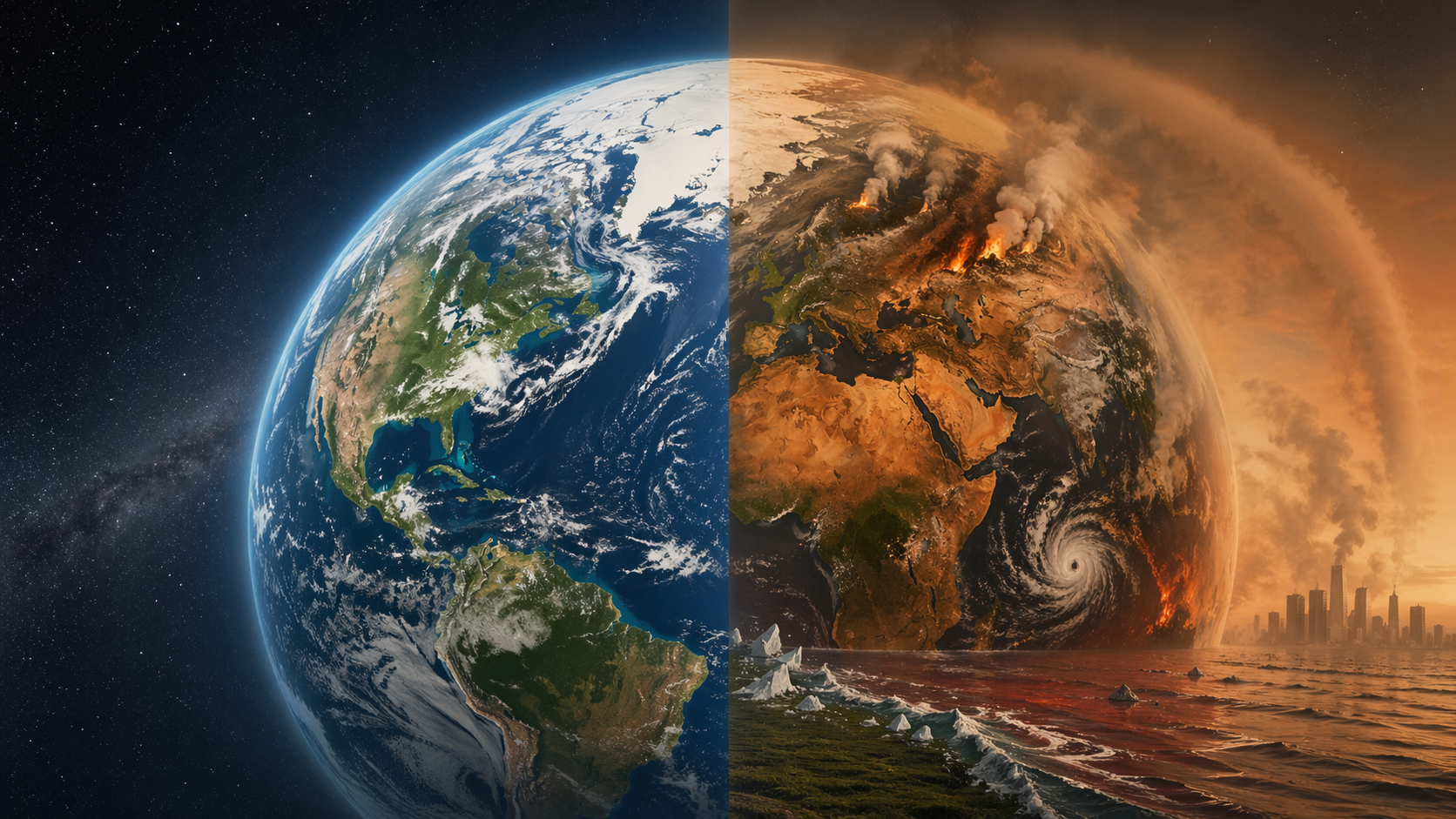
The original planetary boundaries framework proposed a dual approach to the climate boundary, using atmospheric carbon dioxide concentration and radiative forcing as control variables. This was scientifically and strategically important because it linked climate risk to both a measurable atmospheric concentration and the additional energy imbalance imposed on the Earth system. The framework’s original proposed boundary of 350 parts per million carbon dioxide has long been exceeded, and current atmospheric carbon dioxide concentrations are now far above that level. The boundary has therefore already been transgressed.
This article examines climate change as a planetary boundary by explaining why climate stability is central to Earth-system resilience, how the climate boundary is defined, why carbon dioxide and radiative forcing matter, how warming becomes Earth-system instability, how climate change interacts with biosphere integrity, land-system change, freshwater change, ocean acidification, biogeochemical flows, atmospheric aerosols, and novel entities, and why climate governance must be understood as Earth-system governance rather than emissions management alone.
Why Climate Change Is a Core Boundary
Climate change is a core boundary because climate regulates the background conditions under which ecosystems, agriculture, infrastructure, settlements, economies, and institutions function. Temperature, precipitation, snowpack, sea ice, glaciers, ocean circulation, storm behavior, drought frequency, flood risk, wildfire regimes, and seasonal expectations all shape the possibilities of organized life. When the climate system is destabilized, societies do not merely experience a warmer version of the same world. They confront changing baselines, shifting extremes, altered ecological interactions, and a growing risk that some Earth-system processes may reorganize in difficult-to-reverse ways.
The planetary boundaries framework identifies climate change as core because it is capable of driving systemic Earth-system change on its own. This does not mean climate change is separate from the other boundaries. It means climate is so deeply connected to the functioning of the planet that its destabilization can propagate across the rest of the Earth system. A warming climate affects forests, soils, freshwater systems, ice sheets, coral reefs, coastlines, nutrient cycling, oceans, atmospheric circulation, and the biosphere. Climate change is therefore both a direct planetary boundary and an amplifier of other boundary transgressions.
This core status also changes how climate policy should be understood. It is not only a matter of reducing emissions in order to satisfy a narrow atmospheric target. It is a matter of preserving the climate stability that supports planetary resilience. The goal is not merely to reduce pollution. The deeper goal is to avoid pushing the Earth system beyond safer operating conditions.
Climate stability also has historical significance. Human agriculture, settlement patterns, infrastructure systems, and political institutions emerged under relatively stable Holocene conditions. That stability was never perfectly uniform, and many societies experienced climatic disruption long before the industrial era. But the broad Holocene climate envelope provided a relatively stable background for long-term social complexity. The planetary-boundary perspective asks whether modern greenhouse gas accumulation is moving the Earth system outside that stabilizing envelope.
To call climate change a core boundary is therefore to make a claim about dependence. Human systems depend on a climate system that is not infinitely elastic. Food systems depend on temperature ranges, rainfall patterns, seasonal cycles, pollination, soils, and water availability. Infrastructure depends on design assumptions about heat, storm intensity, flood plains, coastlines, and fire risk. Public health depends on manageable heat exposure, disease ecology, air quality, and food and water security. When climate stability weakens, the risks do not stay in the atmosphere. They enter the entire architecture of society.
This is why the climate boundary should be read alongside Biosphere Integrity and the Stability of Life Systems, Planetary Boundaries and Earth System Resilience, and Tipping Points, Feedback Loops, and Cascading Ecological Change. Climate is not an isolated variable. It is a stabilizing condition for the wider Earth system.
How the Climate Boundary Is Defined
The original planetary boundaries framework proposed two control variables for climate change: atmospheric carbon dioxide concentration and radiative forcing. Atmospheric carbon dioxide concentration is measured in parts per million and reflects the amount of carbon dioxide in the atmosphere. Radiative forcing measures the change in the Earth’s energy balance caused by greenhouse gases and other forcing agents. Together, these variables connect climate risk to both the atmospheric stock of a major greenhouse gas and the additional heat-trapping effect imposed on the planet.
The original proposed boundary for atmospheric carbon dioxide was 350 parts per million. This value was not meant to imply that every climate risk begins precisely at that number or that climate safety can be reduced to one variable. It was a precautionary boundary designed to keep the Earth system away from dangerous climate feedbacks and thresholds. The companion radiative-forcing boundary was set at approximately 1 watt per square meter above preindustrial levels. Both variables were meant to signal when humanity was pushing climate conditions beyond the safer operating range associated with Holocene stability.
Later planetary-boundary assessments refined the climate boundary’s interpretation while retaining the importance of carbon dioxide and radiative forcing. The 2023 global assessment classified climate change as transgressed, and the 2025 Planetary Health Check continues to list climate change among the breached planetary boundaries. This status reflects the fact that atmospheric greenhouse gas concentrations and the resulting warming influence are now well beyond the framework’s safer operating space.
It is important to distinguish the planetary-boundary framing from the Paris Agreement temperature goal. The Paris Agreement focuses on holding global temperature increase well below 2°C and pursuing efforts to limit warming to 1.5°C above preindustrial levels. The planetary-boundary framing is related but distinct. It asks how far climate drivers can move before they create unacceptable risk of Earth-system destabilization. Temperature targets, carbon dioxide concentration, radiative forcing, cumulative emissions, and feedback risk are therefore connected but not interchangeable.
This distinction helps prevent a common confusion. The planetary boundary is not simply a policy target, and the Paris temperature goal is not simply a carbon concentration boundary. A temperature goal is a negotiated global objective tied to impacts, feasibility, equity, and diplomacy. A planetary boundary is a scientific guardrail tied to Earth-system stability, threshold risk, and safe operating space. The two should inform each other, but they should not be collapsed into one concept.
Defining the climate boundary through carbon dioxide and radiative forcing also makes the cumulative character of climate change visible. Carbon dioxide concentration reflects the stock of past emissions that remains in the atmosphere-ocean-land system. Radiative forcing reflects the imbalance that stock helps impose on the planet. Together, they show why climate change cannot be solved through short-term emissions accounting alone. The system responds to accumulated pressure.
| Climate-boundary element | What it measures | Why it matters |
|---|---|---|
| Atmospheric carbon dioxide concentration | The stock of CO₂ in the atmosphere, measured in parts per million. | Shows cumulative climate pressure from long-lived greenhouse gas accumulation. |
| Radiative forcing | The change in Earth’s energy balance caused by greenhouse gases and other forcing agents. | Connects atmospheric composition to warming pressure and Earth-system energy imbalance. |
| Temperature change | The resulting warming of the atmosphere, land, and ocean system. | Helps translate forcing into impacts, extremes, and system stress. |
| Feedback and tipping risk | The possibility that warming triggers self-reinforcing or difficult-to-reverse changes. | Explains why climate change is treated as an Earth-system boundary rather than only a pollution problem. |
| Governance and adaptive capacity | The ability to reduce emissions, protect sinks, adapt, monitor, and respond. | Shapes whether boundary pressure becomes manageable transition or deepening systemic risk. |
Carbon Dioxide and Radiative Forcing
Carbon dioxide matters because it is long-lived, cumulative, and central to the warming trajectory of the planet. Unlike some short-lived pollutants, carbon dioxide persists in the atmosphere-ocean-land system over long time scales, meaning that cumulative emissions shape long-term warming. This is why climate policy cannot focus only on annual emissions. The stock of greenhouse gases already accumulated in the atmosphere matters, and each additional unit of carbon dioxide adds to cumulative climate pressure.
Radiative forcing matters because climate change is ultimately an energy-balance problem. Greenhouse gases reduce the amount of heat that escapes to space, creating an imbalance between incoming solar energy and outgoing longwave radiation. The climate system responds through warming, ocean heat uptake, ice melt, atmospheric circulation changes, and a range of feedbacks. Radiative forcing therefore captures the physical mechanism through which greenhouse gases destabilize the climate system.
The relationship between carbon dioxide and radiative forcing is often approximated using a logarithmic formula:
\Delta F = 5.35 \ln\left(\frac{C}{C_0}\right)
\]
Interpretation: Radiative forcing from carbon dioxide rises with the logarithm of concentration relative to a baseline. The equation connects atmospheric concentration to Earth-system energy imbalance.
Here, \(\Delta F\) is radiative forcing in watts per square meter, \(C\) is the carbon dioxide concentration, and \(C_0\) is the reference concentration. This equation is useful because it shows that the climate effect of carbon dioxide depends on proportional change relative to a baseline rather than simply the absolute number of molecules added. It also provides a transparent way to connect atmospheric concentration with climate-system pressure.
Carbon dioxide is not the only greenhouse gas. Methane, nitrous oxide, fluorinated gases, and other climate forcers also matter. Aerosols can mask some warming while harming health and affecting precipitation. Land-use change alters carbon storage and albedo. The planetary-boundary framing emphasizes carbon dioxide and radiative forcing as control variables, but a serious climate strategy must address the full forcing system.
This broader forcing system is politically important. A society can reduce carbon dioxide emissions while allowing methane leakage, nitrous oxide from agriculture, black carbon, industrial gases, or land-use emissions to remain poorly governed. Conversely, rapid reductions in fossil fuel combustion can lower both greenhouse gases and air pollutants, but the temporary reduction of cooling aerosols may reveal warming that had been partially masked. Climate governance therefore must be honest about the whole atmospheric system, not only about one number.
Radiative forcing also clarifies why climate change is not simply a weather issue. Weather varies from day to day and year to year. Forcing changes the background energy condition of the planet. It loads the climate system with additional heat, shifts probabilities, intensifies extremes, warms oceans, melts ice, and alters hydrological and ecological patterns. The planetary boundary is concerned with that deeper change in operating conditions.
From Warming to Earth-System Instability
Climate change is often described in terms of average warming, but the planetary-boundary perspective is concerned with Earth-system instability. Average global temperature is a powerful indicator, but it does not fully capture the complexity of climate disruption. Warming changes the probability of extremes, the timing of seasons, the behavior of storms, the persistence of droughts, the frequency of heat waves, the stability of snow and ice, the distribution of species, and the resilience of ecosystems.
This is why climate change cannot be understood as a smooth and uniform increase in temperature. Different regions warm at different rates. Land warms faster than oceans. The Arctic warms especially rapidly. Extreme heat can rise more sharply than average warming. Precipitation can intensify in some places while drying increases elsewhere. Ocean heat uptake can continue even after surface conditions appear temporarily variable. Sea-level rise can continue long after emissions slow because ice sheets and oceans respond over long time scales.
Climate change therefore creates layered forms of risk. Some risks are gradual, such as long-term sea-level rise. Some are acute, such as extreme heat, wildfire, flood, and storm events. Some are ecological, such as coral bleaching, forest dieback, and species-range shifts. Some are infrastructural, such as stress on energy systems, transport networks, water systems, and coastal defenses. Some are institutional, such as the need to manage displacement, insurance stress, food-system volatility, and climate-driven conflict risks.
The planetary-boundary framing draws attention to the fact that these risks are not isolated outcomes. They are symptoms of a larger destabilization of the Earth system’s climate-regulating architecture. A heat wave is not only a local event. It is part of a shifting distribution of extremes. A drought is not only a temporary lack of rain. It may reflect altered hydrology, land-atmosphere feedbacks, snowpack loss, soil-moisture stress, and rising evaporative demand. A coastal flood is not only storm damage. It is shaped by sea-level rise, storm surge, land subsidence, infrastructure exposure, and governance decisions about where people and assets are placed.
Climate instability also changes baselines. Infrastructure built for twentieth-century climate conditions may fail under twenty-first-century heat, rainfall, fire, and flood regimes. Agricultural calendars may become less reliable. Public-health systems may face heat burdens and disease patterns they were not designed to manage. Insurance markets may withdraw from regions where risk becomes difficult to price. These are not marginal disruptions. They are signals that climate change enters the social foundations of organized life.
The planetary-boundary perspective therefore asks societies to move beyond the language of isolated impacts. The central issue is the stability of the climate system as a condition for adaptation, resilience, planning, and justice.
The Boundary and Its Current Status
Climate change is currently transgressed within the planetary boundaries framework. The 2023 global assessment concluded that Earth was beyond six of nine planetary boundaries, including climate change. The 2025 Planetary Health Check reports that seven of nine planetary boundaries are now breached, with climate change remaining among them. This means the climate boundary is not a future concern awaiting confirmation. It has already been crossed.
The status of the boundary is evident from atmospheric carbon dioxide concentrations and the wider warming influence of greenhouse gases. The original planetary-boundary proposal used 350 parts per million carbon dioxide as the atmospheric concentration boundary. Contemporary carbon dioxide levels are far above that level. NOAA’s May 2026 update reports an April 2026 Mauna Loa monthly average of 431.12 parts per million, and its global monthly mean for February 2026 is also far above the original boundary reference. Radiative forcing has likewise moved beyond the proposed safer range.
The issue is therefore not whether climate change has begun. The issue is how far and how fast the system is being pushed, and whether societies can reduce forcing before feedbacks, extremes, and long-lived impacts become more dangerous. Boundary transgression is a warning about risk, not a declaration that all outcomes are fixed. The difference between lower and higher levels of warming remains enormous for human societies, ecosystems, infrastructure, and future generations.
This boundary status matters because climate change interacts with nearly every other boundary. A transgressed climate boundary weakens the resilience of ecosystems, forests, water systems, soils, oceans, and food systems. At the same time, degradation in those systems can worsen climate risk by reducing carbon sinks, increasing emissions, weakening moisture recycling, and reducing ecological buffering capacity. Climate change is therefore both a boundary in itself and a stress multiplier across the planetary-boundary framework.
The boundary’s transgressed status should not be read as fatalism. It is a diagnostic warning. It means climate conditions are outside the safer operating space and that rapid mitigation, adaptation, restoration, and governance reform are necessary to reduce further destabilization. The practical question is not whether the world can return instantly to an untouched Holocene climate. It is whether societies can prevent deeper overshoot, preserve carbon sinks, reduce greenhouse gas forcing, protect vulnerable communities, and maintain enough resilience for just adaptation.
| Indicator | Status | Interpretive meaning |
|---|---|---|
| Original CO₂ boundary reference | 350 ppm | Precautionary concentration boundary proposed in the original planetary-boundaries framework. |
| NOAA Mauna Loa monthly average, April 2026 | 431.12 ppm | Shows contemporary atmospheric concentration far above the original boundary reference. |
| Climate boundary status | Transgressed | Climate change is outside the safer operating space in current planetary-boundary assessments. |
| Planetary Health Check 2025 | Seven of nine boundaries breached | Places climate change within a broader pattern of Earth-system destabilization. |
Feedbacks, Tipping Elements, and Nonlinear Risk
One of the most important reasons climate change is treated as a planetary boundary is the possibility of feedbacks and nonlinear change. A feedback occurs when a change in the climate system triggers processes that amplify or dampen further change. Ice-albedo feedback is a classic example: as reflective ice melts, darker surfaces absorb more heat, which can contribute to additional warming. Permafrost thaw can release greenhouse gases. Forest dieback can reduce carbon uptake and alter regional hydrology. Ocean changes can affect heat storage, circulation, and carbon absorption.
Tipping elements are components of the Earth system that may shift into a qualitatively different state when pushed beyond certain thresholds. These include ice sheets, major forest systems, ocean circulation patterns, coral reefs, permafrost regions, monsoon systems, and other large-scale climate-ecological systems. The precise thresholds remain uncertain, but uncertainty does not reduce the seriousness of the risk. In planetary-boundary logic, uncertainty around potentially irreversible or self-amplifying change strengthens the case for precaution.
Nonlinear risk is important because it means climate impacts may not increase in a simple straight line with warming. Some damages may accelerate as thresholds are approached. Some systems may appear resilient for a time and then shift rapidly. Some impacts may become difficult to reverse once they begin, even if emissions are later reduced. These dynamics are central to the planetary-boundary concept because the framework is designed to identify boundaries that help avoid large-scale, abrupt, or irreversible environmental change.
The implication is that climate governance must be risk-based, not merely trend-based. It should not assume that the future will be a smooth extrapolation of the past. It must account for thresholds, feedbacks, compounding extremes, cascading impacts, and the possibility that delays in mitigation can close options that remain available today.
Feedbacks also make boundary interaction unavoidable. A warming climate can weaken forests, wetlands, soils, oceans, and permafrost regions that currently help absorb carbon. If those sinks weaken, more greenhouse gases remain in the atmosphere, increasing forcing and raising further risk. A society that treats climate mitigation as only a smokestack problem misses this deeper Earth-system logic. Protecting carbon sinks and ecological resilience is part of protecting the climate boundary.
Nonlinear risk also has a justice dimension. The people most exposed to tipping-related harms are often not the people most responsible for the emissions that create them. If ice-sheet loss contributes to long-term sea-level rise, coastal and delta communities may face displacement. If heat extremes intensify, outdoor workers, elderly people, children, and low-income urban neighborhoods may suffer disproportionately. If monsoon or drought patterns shift, food security and livelihoods can be threatened in regions with limited adaptive capacity. The uncertainty around thresholds therefore does not make the issue less urgent. It makes precaution more ethically serious.
Climate Change and the Carbon Cycle
Climate change is inseparable from the carbon cycle. Fossil fuel combustion, cement production, deforestation, land degradation, peatland drainage, wildfire, and soil carbon loss move carbon from geological and biological stores into the atmosphere. Oceans and terrestrial ecosystems absorb a portion of those emissions, but they do not remove all of them. The remaining atmospheric accumulation drives additional radiative forcing and warming.
The carbon cycle matters because it links energy systems, land systems, oceans, soils, vegetation, and economic activity. A coal plant, a cleared forest, a degraded peatland, a burned landscape, a warming ocean, and a soil-carbon loss pathway all participate in the same planetary carbon accounting problem. Climate change is therefore not only an energy-transition issue. It is also a land, agriculture, forest, ocean, soil, and industrial-systems issue.
The stability of carbon sinks is especially important. Forests, soils, wetlands, peatlands, grasslands, coastal ecosystems, and oceans absorb carbon, but their capacity can be weakened by warming, drought, fire, acidification, nutrient imbalance, land conversion, and ecological degradation. If natural sinks weaken, more emitted carbon remains in the atmosphere, increasing pressure on the climate boundary.
This is why climate mitigation cannot be limited to replacing fossil fuels, although that is essential. It must also protect and restore carbon-rich ecosystems, reduce land-use emissions, prevent degradation of major sinks, improve soil management, reduce methane and nitrous oxide emissions, and build monitoring systems that can trace carbon flows with transparency and accountability.
The carbon cycle also reveals a fundamental asymmetry in climate governance. It is easier to emit carbon quickly than to remove it durably. A fossil-fuel system can release carbon accumulated over millions of years within a few centuries. Restoring that carbon to stable geological or biological storage is slower, more uncertain, and more limited. This is why carbon dioxide removal cannot be treated as a substitute for rapid emissions reduction. It may have a role, but it cannot erase the need to stop adding pressure to the climate boundary.
Carbon-cycle governance also requires honesty about land. Some mitigation pathways depend on forests, bioenergy, afforestation, soil carbon, or land-based removals. These strategies can produce benefits if designed carefully, but they can also create land conflicts, food-security pressures, biodiversity harms, or risks to Indigenous rights if pursued carelessly. The planetary-boundary perspective therefore requires climate strategies that protect multiple boundaries at once rather than solving the carbon problem by intensifying pressure elsewhere.
Interactions with Other Boundaries
Climate change interacts with every major boundary in the planetary-boundary framework. It is tightly linked to biosphere integrity because warming, extremes, ocean heat, drought, fire, and shifting climate zones alter habitats, species distributions, ecosystem function, and extinction risk. It interacts with land-system change because deforestation, peatland degradation, soil carbon loss, and fire emissions contribute to warming, while warming makes land systems more vulnerable to drought, fire, pests, and biome shifts.
Climate change also interacts with freshwater change. Warming alters precipitation, evaporation, snowpack, glacier melt, drought risk, flooding, soil moisture, and hydrological extremes. It intensifies water insecurity in some regions while increasing flood risk in others. It affects biogeochemical flows by changing runoff, nutrient transport, eutrophication dynamics, and oxygen depletion. It affects ocean acidification because carbon dioxide emissions drive both warming and changes in seawater carbonate chemistry.
Atmospheric aerosol loading interacts with climate by masking some warming, influencing clouds and precipitation, and creating major health burdens. Novel entities can affect climate through synthetic greenhouse gases, industrial pollutants, and ecosystem stress. Stratospheric ozone depletion, although governed more successfully than many other boundaries, remains linked to atmospheric chemistry and climate interactions. The climate boundary is therefore not an isolated atmospheric problem. It is deeply coupled to land, water, ocean, chemical, and biological systems.
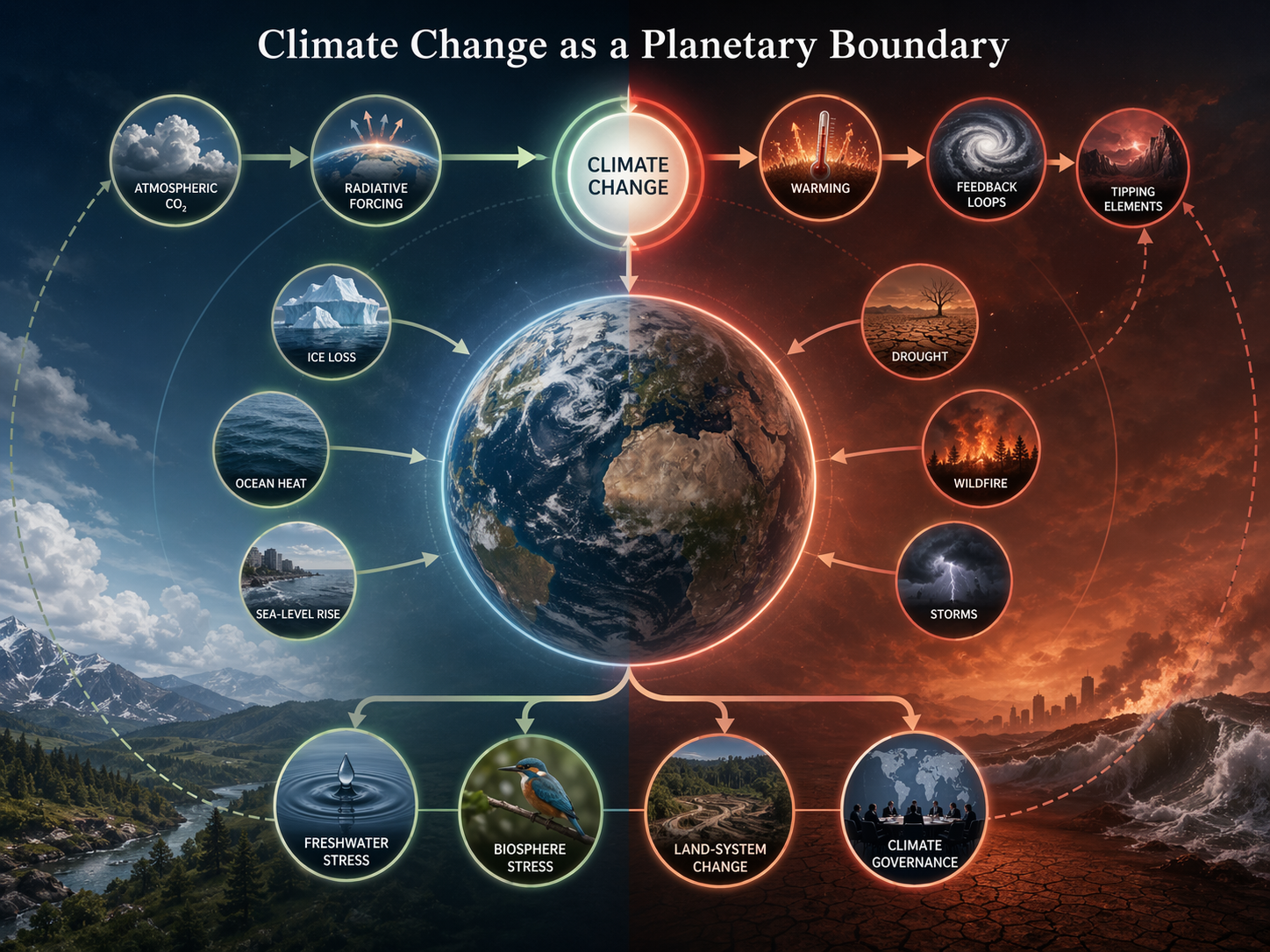
The cross-boundary character of climate risk has practical implications. A climate policy that accelerates clean energy but damages water systems, biodiversity, Indigenous land rights, or material supply chains may reduce one pressure while intensifying others. A land-based mitigation strategy that improves carbon storage but displaces food production or harms ecosystems may also fail the broader planetary-boundary test. Conversely, well-designed climate action can produce co-benefits: cleaner air, restored ecosystems, resilient water systems, improved soils, reduced health burdens, and more secure livelihoods.
This is why climate governance should be designed as integrated Earth-system governance. The goal is not only to decarbonize the economy, but to reduce climate forcing in ways that also protect biosphere integrity, land systems, freshwater, oceans, nutrient cycles, and human dignity. For companion essays, see Land-System Change and Ecological Transformation, Freshwater Change and Earth System Risk, Ocean Acidification and the Chemistry of Planetary Change, Biogeochemical Flows: Nitrogen, Phosphorus, and Planetary Destabilization, and Atmospheric Aerosol Loading and Regional Planetary Risk.
Climate Change and Earth-System Risk
The planetary-boundary framing changes the meaning of climate change. It is not only a problem of emissions, temperature, or weather impacts. It is a question of whether the Earth system remains in a state compatible with stable ecological and social development. The boundary asks how much additional forcing the planet can absorb before risks of large-scale, abrupt, or irreversible change become unacceptable.
This framing is useful because it avoids treating climate change as a single-sector problem. Climate destabilization affects agriculture, health, water systems, energy infrastructure, forests, oceans, finance, migration, insurance, disaster risk, military planning, and international law. The effects of warming propagate through systems that were not designed for the climate conditions now emerging. Climate change therefore becomes a risk multiplier across governance, economy, infrastructure, ecology, and human security.
Climate risk is also cumulative. Carbon dioxide emissions accumulate. Heat accumulates in the ocean. Sea-level rise accumulates. Infrastructure exposure accumulates as development continues in risky places. Ecological stress accumulates across repeated disturbances. Governance delays accumulate because long-lived infrastructure and slow policy transitions lock in future emissions. The planetary-boundary perspective makes this cumulative logic visible.
Most importantly, climate change is not only about avoiding catastrophe in the abstract. It is about preserving the operating conditions that make adaptation possible. The more the climate boundary is transgressed, the harder adaptation becomes, especially for ecosystems and communities with limited resources. Mitigation and adaptation are therefore not competing agendas. They are linked strategies for preserving Earth-system resilience.
Earth-system risk also forces a broader view of time. The effects of climate decisions unfold across decades and centuries. A power plant, highway system, building code, port facility, irrigation system, land-use plan, industrial process, or financial portfolio can lock in emissions and exposure long after a political cycle ends. Climate-boundary governance must therefore be able to think beyond short-term cost, short-term growth, and short-term electoral reward.
The planetary-boundary perspective also changes how “success” should be evaluated. Success is not only lower emissions intensity. It is reduced absolute pressure on the climate system, strengthened carbon sinks, lower exposure for vulnerable communities, improved resilience of infrastructure and ecosystems, and a credible pathway back toward safer operating conditions. A system can become more efficient while still increasing total pressure. Boundary thinking keeps the focus on total Earth-system load.
Justice, Adaptation, and Unequal Exposure
Climate change is also a justice issue. The communities, countries, and ecosystems most exposed to climate harms are often not the ones most responsible for historical greenhouse gas emissions. Low-income communities, small island states, Indigenous peoples, coastal populations, agricultural workers, urban heat-exposed neighborhoods, arid-region communities, and future generations face risks that are unevenly distributed. Climate change therefore exposes a profound mismatch between responsibility, capacity, vulnerability, and harm.
This justice dimension is essential to the planetary-boundary framework. A safe operating space for humanity cannot be defined only through global biophysical indicators. It must also be connected to fair access to energy, food, housing, water, adaptation finance, loss-and-damage support, and resilient infrastructure. Climate stabilization that ignores inequality risks reproducing the same systems of extraction and vulnerability that helped create the crisis.
Adaptation is necessary because some climate change is already unavoidable. Societies must prepare for heat, drought, flood, wildfire, sea-level rise, water stress, ecological disruption, and infrastructure strain. But adaptation has limits. Some ecosystems cannot adapt beyond certain thermal or hydrological thresholds. Some settlements may become increasingly costly or dangerous to protect. Some impacts can be reduced but not eliminated. This is why mitigation remains essential even as adaptation becomes more urgent.
Climate justice therefore requires both emissions reduction and resilience investment. It requires protecting people from immediate harm while reducing the future scale of harm. It also requires recognizing that climate governance is not only technical. It is moral, political, historical, and institutional.
Climate justice also requires distinguishing development from excess. Expanding clean energy access, cooling, resilient housing, public transit, health systems, sanitation, water security, and food security for deprived communities is not the same as preserving high-carbon luxury consumption. A fair climate transition must reduce the destructive emissions of high-pressure systems while expanding the basic capabilities of those historically excluded from development.
Unequal exposure also raises questions about voice and knowledge. Communities facing heat, flooding, drought, wildfire smoke, coastal erosion, crop failure, or water stress often understand risk before it is fully recognized in formal policy systems. A just climate-boundary framework should value community monitoring, Indigenous stewardship, local knowledge, and participatory planning alongside global models and national inventories.
Adaptation without justice can become a protection system for the already powerful. Mitigation without justice can become a new extraction frontier. A planetary-boundary approach must insist that climate stabilization, resilience, and human dignity belong together.
Governance Implications
If climate change is a planetary boundary, then climate governance cannot be limited to voluntary emissions targets or narrow carbon accounting. It must address the structure of energy systems, land systems, food systems, transport, industry, finance, infrastructure, and consumption. It must also protect carbon sinks, reduce methane and nitrous oxide emissions, strengthen adaptation, and build institutions capable of governing long-term risk under uncertainty.
The Paris Agreement provides the central global legal and diplomatic framework for climate cooperation, but the planetary-boundary perspective clarifies why implementation matters more than symbolic commitment. Long-term temperature goals require near-term emissions reductions, credible transition pathways, transparent accounting, finance, technology cooperation, and accountability. Climate stability depends on what societies build, retire, fund, regulate, and protect in the real economy.
Governance must also become more systems-aware. A policy that reduces fossil fuel emissions while accelerating biodiversity loss, land degradation, water stress, or mineral exploitation without safeguards can shift pressure from one boundary to another. Conversely, policies that restore forests, protect wetlands, improve soil carbon, reduce air pollution, and build clean energy can generate benefits across multiple boundaries. Climate governance should therefore be designed as Earth-system governance.
Monitoring and provenance are essential. Emissions inventories, atmospheric measurements, satellite data, energy statistics, land-use records, corporate disclosure, carbon-market verification, adaptation indicators, and climate-risk models all require transparency. Without reliable measurement, societies cannot distinguish real decarbonization from accounting artifacts. Without governance capacity, they cannot convert knowledge into action.
Climate governance also requires law and accountability. Fossil-fuel infrastructure, land-use decisions, financial flows, industrial permitting, building codes, disaster planning, insurance rules, public procurement, and trade policy all shape the climate boundary. A serious governance system must therefore move beyond aspirational targets toward enforceable transition, transparent disclosure, public investment, and protection for vulnerable communities.
Finance is especially important. Capital allocation can deepen climate-boundary pressure by funding fossil infrastructure, deforestation, high-emissions industry, and exposed real estate. It can also support transition through clean energy, resilient infrastructure, ecosystem restoration, adaptation finance, and public-interest investment. The planetary-boundary perspective asks whether finance is aligned with Earth-system stability or merely pricing instability after it has already been created.
For adjacent essays, see Earth System Governance in an Age of Limits, Business Strategy Within Planetary Boundaries, and Finance, Disclosure, and Systemic Environmental Risk.
Why This Matters for Planetary Boundaries
Climate change matters for planetary boundaries because it reveals the framework’s central insight: human development depends on Earth-system stability. The climate boundary is not merely an atmospheric statistic. It is a warning that the energy balance of the planet is being altered in ways that can destabilize ecosystems, water systems, food systems, infrastructure, public health, coastlines, oceans, and governance itself.
The boundary also matters because it shows why planetary risks cannot be governed in isolation. Climate change affects biosphere integrity, land systems, freshwater, nutrient flows, ocean chemistry, aerosols, and novel entities. Those systems in turn affect climate through carbon sinks, albedo, hydrology, ecosystem resilience, and pollution pathways. Climate is therefore both a boundary and an amplifier of boundary interaction.
This matters for strategy because the climate boundary cannot be addressed through narrow emissions accounting alone. Emissions reduction is essential, but the larger task is Earth-system stabilization: rapid fossil-fuel phase-down, clean energy transition, methane and nitrous oxide reduction, sink protection, land stewardship, adaptation, resilient infrastructure, climate finance, and justice-centered governance. The boundary is crossed in the atmosphere, but it must be repaired through energy, land, water, industry, finance, and public institutions.
Finally, the climate boundary matters because it keeps urgency and agency together. Transgression is serious, but it does not mean all outcomes are predetermined. The future still depends on how quickly societies reduce forcing, how well they protect carbon sinks, how justly they build resilience, and how seriously they treat climate stability as a condition of human dignity.
To understand climate change as a planetary boundary is to understand that the climate crisis is not only about temperature. It is about whether humanity can remain within the operating conditions of a living Earth system.
Mathematical Lens: Carbon Concentration, Radiative Forcing, and Boundary Pressure
Climate-boundary pressure can be represented through carbon dioxide concentration, radiative forcing, cumulative emissions, and cross-boundary vulnerability. Let \(C_t\) represent atmospheric carbon dioxide concentration at time \(t\), and let \(C_b\) represent the planetary-boundary reference concentration. A carbon dioxide boundary pressure ratio can be written as:
R_C = \frac{C_t}{C_b}
\]
Interpretation: The carbon dioxide pressure ratio compares observed atmospheric concentration with the planetary-boundary reference concentration.
If \(R_C > 1\), atmospheric carbon dioxide exceeds the boundary reference. Radiative forcing from carbon dioxide can be approximated as:
\Delta F = 5.35 \ln\left(\frac{C_t}{C_0}\right)
\]
Interpretation: This approximation connects atmospheric carbon dioxide concentration to additional radiative forcing relative to a baseline \(C_0\).
A radiative-forcing boundary pressure ratio can be represented as:
R_F = \frac{\Delta F_t}{F_b}
\]
Interpretation: The forcing pressure ratio compares calculated radiative forcing with the planetary-boundary reference for energy imbalance.
Because climate risk depends not only on carbon dioxide concentration but also on cross-boundary vulnerability, a systemic climate risk score can include biosphere stress, land-system pressure, freshwater stress, and governance or adaptive capacity:
Q_r = \alpha R_C + \beta R_F + \gamma B_r + \delta L_r + \eta W_r – \lambda G_r
\]
Interpretation: Systemic climate risk rises with carbon concentration, radiative forcing, biosphere stress, land-system pressure, and freshwater stress, and falls when governance and adaptive capacity are stronger.
A transition scenario can then compare gross emissions pressure with mitigation and durable removal or sink restoration:
S_t = E_t – M_t – R_t
\]
Interpretation: Net emissions pressure equals gross emissions pressure minus mitigation and durable removal or sink restoration.
| Term | Meaning | Interpretive role |
|---|---|---|
| \(C_t\) | Observed atmospheric CO₂ concentration | Represents the current atmospheric stock of carbon dioxide. |
| \(C_b\) | CO₂ boundary reference | Represents the planetary-boundary concentration reference. |
| \(R_C\) | CO₂ boundary pressure | Shows whether atmospheric CO₂ exceeds the boundary reference. |
| \(\Delta F\) | Radiative forcing | Represents additional Earth-system energy imbalance from CO₂ concentration. |
| \(R_F\) | Forcing boundary pressure | Shows whether radiative forcing exceeds the boundary reference. |
| \(B_r\) | Biosphere stress | Represents climate-related pressure on living systems. |
| \(L_r\) | Land-system pressure | Represents land-related stress linked to climate risk and carbon sinks. |
| \(W_r\) | Freshwater stress | Represents climate-related pressure on water systems. |
| \(G_r\) | Governance and adaptive capacity | Represents institutional ability to reduce emissions, adapt, monitor, and protect sinks. |
| \(S_t\) | Net emissions pressure | Represents remaining climate pressure after mitigation and durable removals or sink restoration. |
This simplified formulation captures the boundary’s systems logic: climate risk rises with atmospheric concentration, forcing, cross-boundary stress, and weak governance, and falls when mitigation, adaptation, and sink protection reduce systemic pressure. It is not a substitute for climate science. It is a transparent way to connect boundary thinking with reproducible diagnostics.
Advanced Python Workflow: Climate Boundary Risk Diagnostics
The following Python workflow models climate change as a planetary-boundary problem using carbon dioxide concentration, radiative forcing, emissions pressure, mitigation capacity, carbon-sink resilience, cross-boundary stress, adaptive capacity, monitoring capacity, and governance capacity. The values are illustrative, but the structure can be adapted for climate-risk dashboards, emissions scenario testing, Earth-system reporting, infrastructure planning, transition-risk analysis, and reproducible climate-boundary analytics.
"""
Climate change planetary-boundary diagnostics.

This workflow models climate boundary pressure using:
- atmospheric CO2 concentration
- CO2 boundary reference
- radiative forcing approximation
- forcing boundary reference
- gross emissions pressure
- mitigation capacity
- carbon sink resilience
- biosphere, land, freshwater, and ocean stress
- monitoring and governance capacity
- scenario testing

The values are illustrative. Replace them with documented atmospheric records,
emissions inventories, radiative forcing datasets, carbon-cycle estimates,
climate-risk indicators, and transparent assumptions before applied use.
"""

from __future__ import annotations

from dataclasses import dataclass
from pathlib import Path
from typing import Literal

import numpy as np
import pandas as pd


RiskClass = Literal[
    "lower_risk",
    "moderate_risk",
    "high_risk",
    "severe_risk",
]


@dataclass(frozen=True)
class ClimateRegionProfile:
    """Regional or portfolio-level climate-boundary profile."""

    region: str
    co2_concentration_ppm: float
    co2_boundary_ppm: float
    co2_baseline_ppm: float
    forcing_boundary_wm2: float
    gross_emissions_pressure: float
    mitigation_capacity: float
    carbon_sink_resilience: float
    biosphere_stress: float
    land_system_pressure: float
    freshwater_stress: float
    ocean_stress: float
    heat_extreme_exposure: float
    infrastructure_exposure: float
    adaptive_capacity: float
    monitoring_capacity: float
    governance_capacity: float


def build_climate_profiles() -> pd.DataFrame:
    """
    Create illustrative climate-boundary profiles.

    Values are normalized for demonstration except atmospheric CO2 and forcing.
    They are not official estimates.
    """
    profiles = [
        ClimateRegionProfile(
            region="high_emissions_industrial_system",
            co2_concentration_ppm=431.12,
            co2_boundary_ppm=350.0,
            co2_baseline_ppm=280.0,
            forcing_boundary_wm2=1.0,
            gross_emissions_pressure=0.92,
            mitigation_capacity=0.42,
            carbon_sink_resilience=0.48,
            biosphere_stress=0.66,
            land_system_pressure=0.58,
            freshwater_stress=0.54,
            ocean_stress=0.62,
            heat_extreme_exposure=0.72,
            infrastructure_exposure=0.78,
            adaptive_capacity=0.58,
            monitoring_capacity=0.74,
            governance_capacity=0.52,
        ),
        ClimateRegionProfile(
            region="rapid_transition_clean_energy_system",
            co2_concentration_ppm=431.12,
            co2_boundary_ppm=350.0,
            co2_baseline_ppm=280.0,
            forcing_boundary_wm2=1.0,
            gross_emissions_pressure=0.52,
            mitigation_capacity=0.76,
            carbon_sink_resilience=0.66,
            biosphere_stress=0.48,
            land_system_pressure=0.42,
            freshwater_stress=0.46,
            ocean_stress=0.54,
            heat_extreme_exposure=0.56,
            infrastructure_exposure=0.50,
            adaptive_capacity=0.70,
            monitoring_capacity=0.82,
            governance_capacity=0.74,
        ),
        ClimateRegionProfile(
            region="climate_vulnerable_coastal_delta",
            co2_concentration_ppm=431.12,
            co2_boundary_ppm=350.0,
            co2_baseline_ppm=280.0,
            forcing_boundary_wm2=1.0,
            gross_emissions_pressure=0.38,
            mitigation_capacity=0.36,
            carbon_sink_resilience=0.42,
            biosphere_stress=0.72,
            land_system_pressure=0.60,
            freshwater_stress=0.82,
            ocean_stress=0.78,
            heat_extreme_exposure=0.86,
            infrastructure_exposure=0.88,
            adaptive_capacity=0.34,
            monitoring_capacity=0.52,
            governance_capacity=0.38,
        ),
        ClimateRegionProfile(
            region="forest_carbon_sink_transition_zone",
            co2_concentration_ppm=431.12,
            co2_boundary_ppm=350.0,
            co2_baseline_ppm=280.0,
            forcing_boundary_wm2=1.0,
            gross_emissions_pressure=0.46,
            mitigation_capacity=0.58,
            carbon_sink_resilience=0.38,
            biosphere_stress=0.82,
            land_system_pressure=0.76,
            freshwater_stress=0.58,
            ocean_stress=0.42,
            heat_extreme_exposure=0.70,
            infrastructure_exposure=0.46,
            adaptive_capacity=0.48,
            monitoring_capacity=0.66,
            governance_capacity=0.44,
        ),
        ClimateRegionProfile(
            region="arid_heat_and_water_stress_region",
            co2_concentration_ppm=431.12,
            co2_boundary_ppm=350.0,
            co2_baseline_ppm=280.0,
            forcing_boundary_wm2=1.0,
            gross_emissions_pressure=0.44,
            mitigation_capacity=0.40,
            carbon_sink_resilience=0.36,
            biosphere_stress=0.64,
            land_system_pressure=0.52,
            freshwater_stress=0.88,
            ocean_stress=0.30,
            heat_extreme_exposure=0.92,
            infrastructure_exposure=0.72,
            adaptive_capacity=0.32,
            monitoring_capacity=0.50,
            governance_capacity=0.36,
        ),
        ClimateRegionProfile(
            region="resilient_low_carbon_region",
            co2_concentration_ppm=431.12,
            co2_boundary_ppm=350.0,
            co2_baseline_ppm=280.0,
            forcing_boundary_wm2=1.0,
            gross_emissions_pressure=0.28,
            mitigation_capacity=0.82,
            carbon_sink_resilience=0.78,
            biosphere_stress=0.36,
            land_system_pressure=0.30,
            freshwater_stress=0.34,
            ocean_stress=0.40,
            heat_extreme_exposure=0.42,
            infrastructure_exposure=0.38,
            adaptive_capacity=0.78,
            monitoring_capacity=0.84,
            governance_capacity=0.80,
        ),
    ]

    return pd.DataFrame([profile.__dict__ for profile in profiles])


def classify_risk(score: float) -> RiskClass:
    """Classify climate-boundary risk."""
    if score < 0.95:
        return "lower_risk"
    if score < 1.75:
        return "moderate_risk"
    if score < 2.75:
        return "high_risk"
    return "severe_risk"


def calculate_co2_forcing(co2_ppm: pd.Series, baseline_ppm: pd.Series) -> pd.Series:
    """Approximate radiative forcing from CO2 concentration."""
    return 5.35 * np.log(co2_ppm / baseline_ppm)


def score_climate_boundary(data: pd.DataFrame) -> pd.DataFrame:
    """Calculate climate-boundary and systems-risk diagnostics."""
    scored = data.copy()

    required_positive = [
        "co2_boundary_ppm",
        "co2_baseline_ppm",
        "forcing_boundary_wm2",
    ]

    for column in required_positive:
        if (scored[column] <= 0).any():
            raise ValueError(f"{column} must contain only positive values.")

    scored["co2_boundary_pressure"] = (
        scored["co2_concentration_ppm"] / scored["co2_boundary_ppm"]
    )

    scored["co2_radiative_forcing_wm2"] = calculate_co2_forcing(
        scored["co2_concentration_ppm"],
        scored["co2_baseline_ppm"],
    )

    scored["forcing_boundary_pressure"] = (
        scored["co2_radiative_forcing_wm2"] / scored["forcing_boundary_wm2"]
    )

    scored["cross_boundary_stress"] = (
        0.26 * scored["biosphere_stress"]
        + 0.24 * scored["land_system_pressure"]
        + 0.22 * scored["freshwater_stress"]
        + 0.18 * scored["ocean_stress"]
        + 0.10 * (1 - scored["carbon_sink_resilience"])
    )

    scored["exposure_pressure"] = (
        0.55 * scored["heat_extreme_exposure"]
        + 0.45 * scored["infrastructure_exposure"]
    )

    scored["transition_gap"] = (
        scored["gross_emissions_pressure"] * (1 - scored["mitigation_capacity"])
    )

    scored["adaptive_capacity_gap"] = 1 - scored["adaptive_capacity"]
    scored["monitoring_gap"] = 1 - scored["monitoring_capacity"]
    scored["governance_gap"] = 1 - scored["governance_capacity"]

    scored["climate_boundary_risk_score"] = (
        0.24 * scored["co2_boundary_pressure"]
        + 0.24 * scored["forcing_boundary_pressure"]
        + 0.18 * scored["cross_boundary_stress"]
        + 0.14 * scored["exposure_pressure"]
        + 0.12 * scored["transition_gap"]
        + 0.08 * (
            0.40 * scored["adaptive_capacity_gap"]
            + 0.25 * scored["monitoring_gap"]
            + 0.35 * scored["governance_gap"]
        )
    )

    scored["risk_class"] = scored["climate_boundary_risk_score"].apply(classify_risk)

    scored["priority"] = np.select(
        [
            scored["transition_gap"] >= 0.45,
            scored["carbon_sink_resilience"] <= 0.45,
            scored["freshwater_stress"] >= 0.80,
            scored["heat_extreme_exposure"] >= 0.80,
            scored["governance_capacity"] < 0.45,
            scored["mitigation_capacity"] >= 0.75,
        ],
        [
            "rapid_mitigation_priority",
            "carbon_sink_protection_priority",
            "water_climate_resilience_priority",
            "heat_adaptation_priority",
            "governance_capacity_priority",
            "transition_acceleration_priority",
        ],
        default="integrated_climate_resilience_priority",
    )

    return scored.sort_values(
        "climate_boundary_risk_score",
        ascending=False,
    ).reset_index(drop=True)


def run_policy_scenarios(data: pd.DataFrame) -> pd.DataFrame:
    """
    Test climate-boundary risk under policy scenarios.

    Scenarios represent:
    - improved monitoring
    - rapid mitigation
    - sink protection and restoration
    - integrated climate resilience
    """
    scenarios = {
        "baseline": {
            "emissions_multiplier": 1.00,
            "mitigation_gain": 0.00,
            "sink_gain": 0.00,
            "adaptive_gain": 0.00,
            "governance_gain": 0.00,
        },
        "improved_monitoring": {
            "emissions_multiplier": 0.96,
            "mitigation_gain": 0.06,
            "sink_gain": 0.03,
            "adaptive_gain": 0.05,
            "governance_gain": 0.10,
        },
        "rapid_mitigation": {
            "emissions_multiplier": 0.62,
            "mitigation_gain": 0.20,
            "sink_gain": 0.06,
            "adaptive_gain": 0.06,
            "governance_gain": 0.14,
        },
        "sink_protection_and_restoration": {
            "emissions_multiplier": 0.76,
            "mitigation_gain": 0.12,
            "sink_gain": 0.22,
            "adaptive_gain": 0.08,
            "governance_gain": 0.16,
        },
        "integrated_climate_resilience": {
            "emissions_multiplier": 0.50,
            "mitigation_gain": 0.26,
            "sink_gain": 0.26,
            "adaptive_gain": 0.20,
            "governance_gain": 0.24,
        },
    }

    frames = []

    for scenario_name, params in scenarios.items():
        scenario = data.copy()

        scenario["gross_emissions_pressure"] = (
            scenario["gross_emissions_pressure"] * params["emissions_multiplier"]
        )

        scenario["mitigation_capacity"] = np.minimum(
            1.0,
            scenario["mitigation_capacity"] + params["mitigation_gain"],
        )

        scenario["carbon_sink_resilience"] = np.minimum(
            1.0,
            scenario["carbon_sink_resilience"] + params["sink_gain"],
        )

        scenario["adaptive_capacity"] = np.minimum(
            1.0,
            scenario["adaptive_capacity"] + params["adaptive_gain"],
        )

        scenario["governance_capacity"] = np.minimum(
            1.0,
            scenario["governance_capacity"] + params["governance_gain"],
        )

        scenario["monitoring_capacity"] = np.minimum(
            1.0,
            scenario["monitoring_capacity"] + params["governance_gain"] * 0.75,
        )

        scored = score_climate_boundary(scenario)
        scored["scenario"] = scenario_name
        scored["rank"] = scored["climate_boundary_risk_score"].rank(
            ascending=False,
            method="dense",
        )
        frames.append(scored)

    return pd.concat(frames, ignore_index=True)


def main() -> None:
    """Run the climate boundary workflow."""
    output_dir = Path(
        "articles/climate-change-as-a-planetary-boundary/outputs"
    )
    output_dir.mkdir(parents=True, exist_ok=True)

    data = build_climate_profiles()
    scored = score_climate_boundary(data)
    scenarios = run_policy_scenarios(data)

    scored.to_csv(output_dir / "climate_boundary_risk_scores.csv", index=False)
    scenarios.to_csv(output_dir / "climate_boundary_policy_scenarios.csv", index=False)

    display_columns = [
        "region",
        "co2_boundary_pressure",
        "forcing_boundary_pressure",
        "cross_boundary_stress",
        "transition_gap",
        "climate_boundary_risk_score",
        "risk_class",
        "priority",
    ]

    print("\nClimate boundary risk diagnostics:")
    print(scored[display_columns].round(3).to_string(index=False))

    print("\nScenario comparison:")
    print(
        scenarios[
            [
                "scenario",
                "region",
                "co2_boundary_pressure",
                "forcing_boundary_pressure",
                "cross_boundary_stress",
                "transition_gap",
                "climate_boundary_risk_score",
                "risk_class",
                "priority",
                "rank",
            ]
        ].round(3).to_string(index=False)
    )


if __name__ == "__main__":
    main()
This workflow is useful because it separates planetary climate pressure from regional vulnerability and transition capacity. Carbon dioxide concentration and radiative forcing represent boundary pressure, while emissions pressure, mitigation capacity, sink resilience, biosphere stress, land-system pressure, freshwater stress, ocean stress, exposure, adaptive capacity, monitoring, and governance explain why risk differs across systems.
That distinction matters because climate governance is not one intervention everywhere. A high-emissions industrial system, a coastal delta, a forest carbon-sink region, an arid heat-stress region, and a resilient low-carbon region require different combinations of mitigation, adaptation, sink protection, monitoring, and governance. The purpose of the workflow is not to create false precision. It is to make assumptions visible and to show how climate-boundary risk can be decomposed into interpretable components.
Advanced R Workflow: Climate Boundary Dashboarding
The following R workflow prepares dashboard-ready outputs for climate-boundary analysis. It is designed for researchers, engineers, sustainability analysts, infrastructure planners, climate-risk teams, environmental monitoring groups, and governance practitioners who need to compare carbon dioxide pressure, radiative forcing, transition gaps, cross-boundary stress, exposure, and policy scenarios across systems.
# Climate change planetary-boundary dashboard
#
# This workflow scores climate-boundary risk across:
# - atmospheric CO2 concentration
# - CO2 boundary pressure
# - radiative forcing approximation
# - emissions pressure
# - mitigation capacity
# - carbon sink resilience
# - biosphere, land, freshwater, and ocean stress
# - heat and infrastructure exposure
# - adaptive, monitoring, and governance capacity
#
# Values are illustrative and should be replaced with documented atmospheric
# records, emissions inventories, climate-risk indicators, carbon-cycle data,
# and transparent assumptions before applied use.

library(readr)
library(dplyr)
library(tidyr)

climate_profiles <- tibble::tibble(
  region = c(
    "high_emissions_industrial_system",
    "rapid_transition_clean_energy_system",
    "climate_vulnerable_coastal_delta",
    "forest_carbon_sink_transition_zone",
    "arid_heat_and_water_stress_region",
    "resilient_low_carbon_region"
  ),
  co2_concentration_ppm = c(431.12, 431.12, 431.12, 431.12, 431.12, 431.12),
  co2_boundary_ppm = c(350, 350, 350, 350, 350, 350),
  co2_baseline_ppm = c(280, 280, 280, 280, 280, 280),
  forcing_boundary_wm2 = c(1, 1, 1, 1, 1, 1),
  gross_emissions_pressure = c(0.92, 0.52, 0.38, 0.46, 0.44, 0.28),
  mitigation_capacity = c(0.42, 0.76, 0.36, 0.58, 0.40, 0.82),
  carbon_sink_resilience = c(0.48, 0.66, 0.42, 0.38, 0.36, 0.78),
  biosphere_stress = c(0.66, 0.48, 0.72, 0.82, 0.64, 0.36),
  land_system_pressure = c(0.58, 0.42, 0.60, 0.76, 0.52, 0.30),
  freshwater_stress = c(0.54, 0.46, 0.82, 0.58, 0.88, 0.34),
  ocean_stress = c(0.62, 0.54, 0.78, 0.42, 0.30, 0.40),
  heat_extreme_exposure = c(0.72, 0.56, 0.86, 0.70, 0.92, 0.42),
  infrastructure_exposure = c(0.78, 0.50, 0.88, 0.46, 0.72, 0.38),
  adaptive_capacity = c(0.58, 0.70, 0.34, 0.48, 0.32, 0.78),
  monitoring_capacity = c(0.74, 0.82, 0.52, 0.66, 0.50, 0.84),
  governance_capacity = c(0.52, 0.74, 0.38, 0.44, 0.36, 0.80)
)

scored <- climate_profiles %>%
  mutate(
    co2_boundary_pressure = co2_concentration_ppm / co2_boundary_ppm,

    co2_radiative_forcing_wm2 =
      5.35 * log(co2_concentration_ppm / co2_baseline_ppm),

    forcing_boundary_pressure =
      co2_radiative_forcing_wm2 / forcing_boundary_wm2,

    cross_boundary_stress =
      0.26 * biosphere_stress +
      0.24 * land_system_pressure +
      0.22 * freshwater_stress +
      0.18 * ocean_stress +
      0.10 * (1 - carbon_sink_resilience),

    exposure_pressure =
      0.55 * heat_extreme_exposure +
      0.45 * infrastructure_exposure,

    transition_gap =
      gross_emissions_pressure * (1 - mitigation_capacity),

    adaptive_capacity_gap = 1 - adaptive_capacity,
    monitoring_gap = 1 - monitoring_capacity,
    governance_gap = 1 - governance_capacity,

    climate_boundary_risk_score =
      0.24 * co2_boundary_pressure +
      0.24 * forcing_boundary_pressure +
      0.18 * cross_boundary_stress +
      0.14 * exposure_pressure +
      0.12 * transition_gap +
      0.08 * (
        0.40 * adaptive_capacity_gap +
        0.25 * monitoring_gap +
        0.35 * governance_gap
      ),

    risk_class = case_when(
      climate_boundary_risk_score < 0.95 ~ "lower_risk",
      climate_boundary_risk_score < 1.75 ~ "moderate_risk",
      climate_boundary_risk_score < 2.75 ~ "high_risk",
      TRUE ~ "severe_risk"
    ),

    priority = case_when(
      transition_gap >= 0.45 ~ "rapid_mitigation_priority",
      carbon_sink_resilience <= 0.45 ~ "carbon_sink_protection_priority",
      freshwater_stress >= 0.80 ~ "water_climate_resilience_priority",
      heat_extreme_exposure >= 0.80 ~ "heat_adaptation_priority",
      governance_capacity < 0.45 ~ "governance_capacity_priority",
      mitigation_capacity >= 0.75 ~ "transition_acceleration_priority",
      TRUE ~ "integrated_climate_resilience_priority"
    )
  ) %>%
  arrange(desc(climate_boundary_risk_score))

dashboard_long <- scored %>%
  select(
    region,
    co2_boundary_pressure,
    forcing_boundary_pressure,
    cross_boundary_stress,
    exposure_pressure,
    transition_gap,
    climate_boundary_risk_score
  ) %>%
  pivot_longer(
    cols = -region,
    names_to = "metric",
    values_to = "value"
  )

scenario_grid <- tibble::tibble(
  scenario = c(
    "baseline",
    "improved_monitoring",
    "rapid_mitigation",
    "sink_protection_and_restoration",
    "integrated_climate_resilience"
  ),
  emissions_multiplier = c(1.00, 0.96, 0.62, 0.76, 0.50),
  mitigation_gain = c(0.00, 0.06, 0.20, 0.12, 0.26),
  sink_gain = c(0.00, 0.03, 0.06, 0.22, 0.26),
  adaptive_gain = c(0.00, 0.05, 0.06, 0.08, 0.20),
  governance_gain = c(0.00, 0.10, 0.14, 0.16, 0.24)
)

scenario_scores <- climate_profiles %>%
  crossing(scenario_grid) %>%
  mutate(
    gross_emissions_pressure =
      gross_emissions_pressure * emissions_multiplier,

    mitigation_capacity =
      pmin(1, mitigation_capacity + mitigation_gain),

    carbon_sink_resilience =
      pmin(1, carbon_sink_resilience + sink_gain),

    adaptive_capacity =
      pmin(1, adaptive_capacity + adaptive_gain),

    governance_capacity =
      pmin(1, governance_capacity + governance_gain),

    monitoring_capacity =
      pmin(1, monitoring_capacity + governance_gain * 0.75),

    co2_boundary_pressure = co2_concentration_ppm / co2_boundary_ppm,

    co2_radiative_forcing_wm2 =
      5.35 * log(co2_concentration_ppm / co2_baseline_ppm),

    forcing_boundary_pressure =
      co2_radiative_forcing_wm2 / forcing_boundary_wm2,

    cross_boundary_stress =
      0.26 * biosphere_stress +
      0.24 * land_system_pressure +
      0.22 * freshwater_stress +
      0.18 * ocean_stress +
      0.10 * (1 - carbon_sink_resilience),

    exposure_pressure =
      0.55 * heat_extreme_exposure +
      0.45 * infrastructure_exposure,

    transition_gap =
      gross_emissions_pressure * (1 - mitigation_capacity),

    adaptive_capacity_gap = 1 - adaptive_capacity,
    monitoring_gap = 1 - monitoring_capacity,
    governance_gap = 1 - governance_capacity,

    climate_boundary_risk_score =
      0.24 * co2_boundary_pressure +
      0.24 * forcing_boundary_pressure +
      0.18 * cross_boundary_stress +
      0.14 * exposure_pressure +
      0.12 * transition_gap +
      0.08 * (
        0.40 * adaptive_capacity_gap +
        0.25 * monitoring_gap +
        0.35 * governance_gap
      ),

    risk_class = case_when(
      climate_boundary_risk_score < 0.95 ~ "lower_risk",
      climate_boundary_risk_score < 1.75 ~ "moderate_risk",
      climate_boundary_risk_score < 2.75 ~ "high_risk",
      TRUE ~ "severe_risk"
    )
  ) %>%
  group_by(scenario) %>%
  mutate(rank = dense_rank(desc(climate_boundary_risk_score))) %>%
  ungroup()

risk_summary <- scored %>%
  group_by(risk_class) %>%
  summarise(
    regions = n(),
    mean_co2_boundary_pressure = mean(co2_boundary_pressure),
    mean_forcing_boundary_pressure = mean(forcing_boundary_pressure),
    mean_cross_boundary_stress = mean(cross_boundary_stress),
    mean_climate_boundary_risk_score = mean(climate_boundary_risk_score),
    .groups = "drop"
  )

output_dir <- "articles/climate-change-as-a-planetary-boundary/outputs"

dir.create(
  output_dir,
  recursive = TRUE,
  showWarnings = FALSE
)

write_csv(
  scored,
  file.path(output_dir, "r_climate_boundary_scores.csv")
)

write_csv(
  dashboard_long,
  file.path(output_dir, "r_dashboard_long.csv")
)

write_csv(
  scenario_scores,
  file.path(output_dir, "r_policy_scenarios.csv")
)

write_csv(
  risk_summary,
  file.path(output_dir, "r_risk_summary.csv")
)

print(scored)
print(risk_summary)
This R workflow is designed for transparent interpretation rather than false precision. It separates atmospheric boundary pressure, forcing pressure, emissions pressure, mitigation capacity, carbon-sink resilience, cross-boundary stress, heat exposure, infrastructure exposure, adaptive capacity, monitoring capacity, and governance capacity. That distinction matters because climate change is not only an atmospheric problem. It is an Earth-system, infrastructure, social, ecological, and governance problem at the same time.
The scenario section also makes the strategic logic visible. Improved monitoring alone helps, but it does not replace mitigation. Rapid mitigation lowers emissions pressure, but sink protection and adaptation still matter. Integrated climate resilience combines emissions reduction, sink protection, adaptive capacity, and governance improvement because the climate boundary is embedded in a wider Earth-system context.
Advanced Go Workflow: Lightweight Climate-Boundary Scoring Service
The following Go workflow translates climate-boundary analysis into a lightweight scoring service. Go is useful for command-line tools, APIs, monitoring systems, and operational scoring engines. This example reads climate profiles from a CSV file and reports carbon dioxide boundary pressure, radiative forcing pressure, cross-boundary stress, transition gap, climate-boundary risk score, risk class, and priority.
package main

import (
	"encoding/csv"
	"errors"
	"fmt"
	"math"
	"os"
	"strconv"
)

type ClimateProfile struct {
	Region                 string
	CO2ConcentrationPPM     float64
	CO2BoundaryPPM          float64
	CO2BaselinePPM          float64
	ForcingBoundaryWM2      float64
	GrossEmissionsPressure  float64
	MitigationCapacity      float64
	CarbonSinkResilience   float64
	BiosphereStress         float64
	LandSystemPressure      float64
	FreshwaterStress        float64
	OceanStress             float64
	HeatExtremeExposure     float64
	InfrastructureExposure  float64
	AdaptiveCapacity        float64
	MonitoringCapacity      float64
	GovernanceCapacity      float64
}

func parseFloat(value string) (float64, error) {
	parsed, err := strconv.ParseFloat(value, 64)
	if err != nil {
		return 0, fmt.Errorf("invalid numeric value %q: %w", value, err)
	}
	return parsed, nil
}

func parseProfile(row []string) (ClimateProfile, error) {
	if len(row) < 16 {
		return ClimateProfile{}, errors.New("expected at least 16 columns")
	}

	values := make([]float64, 15)
	for i := 1; i < 16; i++ {
		parsed, err := parseFloat(row[i])
		if err != nil {
			return ClimateProfile{}, err
		}
		values[i-1] = parsed
	}

	return ClimateProfile{
		Region:                row[0],
		CO2ConcentrationPPM:   values[0],
		CO2BoundaryPPM:        values[1],
		CO2BaselinePPM:        values[2],
		ForcingBoundaryWM2:    values[3],
		GrossEmissionsPressure: values[4],
		MitigationCapacity:    values[5],
		CarbonSinkResilience:  values[6],
		BiosphereStress:       values[7],
		LandSystemPressure:    values[8],
		FreshwaterStress:      values[9],
		OceanStress:           values[10],
		HeatExtremeExposure:   values[11],
		InfrastructureExposure: values[12],
		AdaptiveCapacity:      values[13],
		MonitoringCapacity:    values[14],
		GovernanceCapacity:    values[15],
	}, nil
}

func co2BoundaryPressure(profile ClimateProfile) float64 {
	if profile.CO2BoundaryPPM <= 0 {
		return 0
	}
	return profile.CO2ConcentrationPPM / profile.CO2BoundaryPPM
}

func co2RadiativeForcing(profile ClimateProfile) float64 {
	if profile.CO2BaselinePPM <= 0 {
		return 0
	}
	return 5.35 * math.Log(profile.CO2ConcentrationPPM/profile.CO2BaselinePPM)
}

func forcingBoundaryPressure(profile ClimateProfile) float64 {
	if profile.ForcingBoundaryWM2 <= 0 {
		return 0
	}
	return co2RadiativeForcing(profile) / profile.ForcingBoundaryWM2
}

func crossBoundaryStress(profile ClimateProfile) float64 {
	return 0.26*profile.BiosphereStress +
		0.24*profile.LandSystemPressure +
		0.22*profile.FreshwaterStress +
		0.18*profile.OceanStress +
		0.10*(1-profile.CarbonSinkResilience)
}

func exposurePressure(profile ClimateProfile) float64 {
	return 0.55*profile.HeatExtremeExposure +
		0.45*profile.InfrastructureExposure
}

func transitionGap(profile ClimateProfile) float64 {
	return profile.GrossEmissionsPressure * (1 - profile.MitigationCapacity)
}

func climateBoundaryRiskScore(profile ClimateProfile) float64 {
	adaptiveGap := 1 - profile.AdaptiveCapacity
	monitoringGap := 1 - profile.MonitoringCapacity
	governanceGap := 1 - profile.GovernanceCapacity

	return 0.24*co2BoundaryPressure(profile) +
		0.24*forcingBoundaryPressure(profile) +
		0.18*crossBoundaryStress(profile) +
		0.14*exposurePressure(profile) +
		0.12*transitionGap(profile) +
		0.08*(0.40*adaptiveGap+0.25*monitoringGap+0.35*governanceGap)
}

func riskClass(score float64) string {
	switch {
	case score < 0.95:
		return "lower_risk"
	case score < 1.75:
		return "moderate_risk"
	case score < 2.75:
		return "high_risk"
	default:
		return "severe_risk"
	}
}

func priority(profile ClimateProfile) string {
	switch {
	case transitionGap(profile) >= 0.45:
		return "rapid_mitigation_priority"
	case profile.CarbonSinkResilience <= 0.45:
		return "carbon_sink_protection_priority"
	case profile.FreshwaterStress >= 0.80:
		return "water_climate_resilience_priority"
	case profile.HeatExtremeExposure >= 0.80:
		return "heat_adaptation_priority"
	case profile.GovernanceCapacity < 0.45:
		return "governance_capacity_priority"
	case profile.MitigationCapacity >= 0.75:
		return "transition_acceleration_priority"
	default:
		return "integrated_climate_resilience_priority"
	}
}

func main() {
	if len(os.Args) < 2 {
		fmt.Println("usage: climate-boundary-score climate_profiles.csv")
		os.Exit(1)
	}

	file, err := os.Open(os.Args[1])
	if err != nil {
		fmt.Println("error opening file:", err)
		os.Exit(1)
	}
	defer file.Close()

	reader := csv.NewReader(file)
	rows, err := reader.ReadAll()
	if err != nil {
		fmt.Println("error reading CSV:", err)
		os.Exit(1)
	}

	for i, row := range rows {
		if i == 0 {
			continue
		}

		profile, err := parseProfile(row)
		if err != nil {
			fmt.Println("parse error:", err)
			continue
		}

		score := climateBoundaryRiskScore(profile)

		fmt.Printf(
			"region=%s co2_pressure=%.3f forcing_pressure=%.3f cross_boundary_stress=%.3f transition_gap=%.3f risk_score=%.3f class=%s priority=%s\n",
			profile.Region,
			co2BoundaryPressure(profile),
			forcingBoundaryPressure(profile),
			crossBoundaryStress(profile),
			transitionGap(profile),
			score,
			riskClass(score),
			priority(profile),
		)
	}
}
The Go workflow shows how climate-boundary diagnostics can move from article-level explanation into operational systems. A lightweight scoring service could support internal dashboards, API endpoints, emissions-transition monitoring, infrastructure risk registers, environmental data pipelines, or policy-support tools.
A production implementation should include schema validation, unit checking, source metadata, uncertainty intervals, versioned boundary definitions, structured logging, test coverage, and audit trails. Climate-boundary scoring should not hide complexity behind a single score. It should make atmospheric pressure, cross-boundary stress, transition capacity, and governance capacity visible enough to support better decisions.
Engineering Extensions in the GitHub Repository
The accompanying GitHub repository extends the article workflow beyond Python, R, and Go into a broader engineering scaffold. The article body keeps Python and R visible because they are accessible tools for analytics, dashboard preparation, scenario testing, and reproducible reporting. Go provides a compact service layer. The repository, however, is structured for readers who want to translate climate-boundary analysis into more technical systems: auditable databases, scoring engines, APIs, embedded monitoring, scenario simulation, energy-transition diagnostics, edge anomaly detection, and accelerator-aware environmental data workflows.
The SQL scaffold is intended for atmospheric observations, emissions indicators, forcing estimates, mitigation capacity, carbon-sink resilience, exposure indicators, cross-boundary stress, governance capacity, scenario runs, source provenance, and audit trails. Rust can support reliable scoring engines or command-line tools where type safety and reproducibility matter. Go can support lightweight diagnostic APIs. C and C++ can support embedded threshold monitoring, local sensor processing, or scenario simulation. TinyML can support low-power climate-signal anomaly detection, while PYNQ-oriented scaffolding can support accelerated preprocessing of environmental telemetry, satellite-derived indicators, or climate-monitoring streams.
This engineering layer matters because climate governance is fundamentally a measurement and integration problem as well as a policy problem. Atmospheric concentrations, emissions inventories, carbon sinks, temperature extremes, infrastructure exposure, financial risk, adaptation capacity, and governance performance all need to be made visible. A serious technical architecture should make climate-boundary pressure inspectable across that whole chain rather than hiding it behind a single aggregate score.
A mature implementation should also include documentation for indicator selection, unit conventions, uncertainty handling, scenario assumptions, spatial scale, carbon-sink accounting, adaptation metrics, justice and exposure fields, and review workflows. Without that layer, climate-boundary analytics can become decorative. With it, the technical system becomes accountable knowledge infrastructure.
GitHub Repository
Complete Code Repository
The full code distribution for this article, including climate-boundary risk diagnostics, carbon dioxide and radiative-forcing modeling, emissions-transition analysis, SQL materials, optional service tooling, and edge-side engineering scaffolds, is available on GitHub.
Common Misunderstandings
A common misunderstanding is that climate change is only about average temperature. Average warming is central, but the planetary-boundary concern is broader: radiative forcing, feedbacks, tipping risks, extremes, sea-level rise, hydrological shifts, ecosystem disruption, and cross-boundary destabilization. Climate change is not only a warming trend. It is a systemic change in the operating conditions of the Earth system.
Another misunderstanding is that carbon dioxide is the only climate problem. Carbon dioxide is central because it is cumulative and long-lived, but methane, nitrous oxide, fluorinated gases, land-use change, aerosols, black carbon, and carbon-sink disruption also matter. The climate boundary uses carbon dioxide and radiative forcing as control variables, but climate governance must address the full forcing system.
A third misunderstanding is that adaptation can replace mitigation. Adaptation is essential, but it has limits. Some ecosystems, communities, and infrastructure systems cannot adapt indefinitely to rising heat, sea-level rise, drought, flood, fire, and compounding extremes. Mitigation reduces the scale of future adaptation burdens. Adaptation reduces harm under the warming already occurring. They are complementary, not substitutes.
A further misunderstanding is that climate change can be solved independently of land, water, biodiversity, and ocean systems. The planetary boundaries framework argues the opposite. Climate stability depends on energy transition, but also on forests, soils, wetlands, oceans, freshwater systems, food systems, and the biosphere. A narrow decarbonization strategy that ignores other boundaries is incomplete.
Another misunderstanding is that carbon dioxide removal can substitute for rapid emissions reduction. Durable removal and sink restoration may be necessary, but they are limited, uncertain, and often land- or energy-intensive. Reducing emissions at the source remains essential because it prevents additional pressure from being added to the climate boundary.
A final misunderstanding is that crossing the climate boundary means all outcomes are predetermined. Boundary transgression is serious, but it is not the same as inevitability. The level of future warming, the strength of feedbacks, the scale of harm, and the resilience of societies and ecosystems still depend heavily on present decisions.
Related Articles
- What Are Planetary Boundaries?
- The Origins of the Planetary Boundaries Framework
- Safe Operating Space and the Logic of Thresholds
- How Planetary Boundaries Are Measured
- Uncertainty, Precaution, and Scientific Debate in Boundary Setting
- Biosphere Integrity and the Stability of Life Systems
- Land-System Change and Ecological Transformation
- Freshwater Change and Earth System Risk
- Biogeochemical Flows: Nitrogen, Phosphorus, and Planetary Destabilization
- Ocean Acidification and the Chemistry of Planetary Change
- Stratospheric Ozone Depletion and Global Environmental Governance
- Atmospheric Aerosol Loading and Regional Planetary Risk
- Novel Entities and the Problem of Synthetic Overload
- Planetary Boundaries and Earth System Resilience
- Tipping Points, Feedback Loops, and Cascading Ecological Change
- Sustainable Development Goals Within Planetary Boundaries
- Planetary Boundaries, Justice, and Global Inequality
- Earth System Governance in an Age of Limits
- Business Strategy Within Planetary Boundaries
- Finance, Disclosure, and Systemic Environmental Risk
- Critiques of the Planetary Boundaries Framework
- Planetary Boundaries and Doughnut Economics
- The Future of Planetary Stewardship
Further Reading
- Planetary Boundaries
- Climate Change
- Environmental Science
- Earth Science
- Risk & Resilience
- Earth-System Governance
- Environmental Monitoring Systems
References
- Forster, P.M., Smith, C., Walsh, T., Lamb, W.F., Lamboll, R., Hauser, M., Ribes, A., Rosen, D., Gillett, N.P., Palmer, M.D., Rogelj, J., von Schuckmann, K., Seneviratne, S.I., Trewin, B., Zhang, X., Allen, M., Andrew, R., Birt, A., Borger, A., Boyer, T., Broersma, J.A., Buontempo, C., Burgess, S., Cassou, C., Cheng, L., Ciais, P., Clemenzi, I., Dentener, F., Friedlingstein, P., Gutiérrez, J.M., Gütschow, J., Hall, B., Ishii, M., Jenkins, S., Lan, X., Leach, N., Loh, Z., Luijkx, I.T., Marotzke, J., McBride, L., Minx, J.C., Morice, C., Morimoto, S., Naik, V., Nicholls, Z., O’Rourke, P., Perugini, L., Peters, G.P., Pongratz, J., Regnier, P., Resplandy, L., Schumacher, D., Szopa, S., Thorne, P., Tsutsumida, N., Vose, R., Zickfeld, K., Zoltan, B., Masson-Delmotte, V. and Zhai, P. (2024) ‘Indicators of Global Climate Change 2023: annual update of key indicators of the state of the climate system and human influence’, Earth System Science Data, 16, pp. 2625–2658. Available at: https://essd.copernicus.org/articles/16/2625/2024/.
- IPCC (2021) Climate Change 2021: The Physical Science Basis. Cambridge: Cambridge University Press. Available at: https://www.ipcc.ch/report/ar6/wg1/.
- IPCC (2023) Climate Change 2023: Synthesis Report. Geneva: Intergovernmental Panel on Climate Change. Available at: https://www.ipcc.ch/report/ar6/syr/.
- Kitzmann, N. et al. (2025) Planetary Health Check 2025: A Scientific Assessment of the State of the Planet. Potsdam: Potsdam Institute for Climate Impact Research. Available at: https://www.planetaryhealthcheck.org/.
- NASA (n.d.) Carbon Dioxide: Earth Indicator. Available at: https://science.nasa.gov/earth/explore/earth-indicators/carbon-dioxide/.
- NOAA Global Monitoring Laboratory (2026) Trends in Atmospheric Carbon Dioxide. Available at: https://gml.noaa.gov/ccgg/trends/.
- NOAA Global Monitoring Laboratory (2026) Global Monthly Mean CO₂. Available at: https://gml.noaa.gov/ccgg/trends/global.html.
- Richardson, K., Steffen, W., Lucht, W., Bendtsen, J., Cornell, S.E., Donges, J.F., Drüke, M., Fetzer, I., Bala, G., von Bloh, W., Feulner, G., Fiedler, S., Gerten, D., Gleeson, T., Hofmann, M., Huiskamp, W., Jakobsson, C., Jürgensen, J.H., Kummu, M., Mohan, C., Nogués-Bravo, D., Petri, S., Porkka, M., Rahmstorf, S., Schaphoff, S., Schulte-Uebbing, L., Staal, A., Sun, Z., Sakschewski, B. and Wang-Erlandsson, L. (2023) ‘Earth beyond six of nine planetary boundaries’, Science Advances, 9(37), eadh2458. Available at: https://www.science.org/doi/10.1126/sciadv.adh2458.
- Rockström, J., Steffen, W., Noone, K., Persson, Å., Chapin, F.S. III, Lambin, E.F., Lenton, T.M., Scheffer, M., Folke, C., Schellnhuber, H.J., Nykvist, B., de Wit, C.A., Hughes, T., van der Leeuw, S., Rodhe, H., Sörlin, S., Snyder, P.K., Costanza, R., Svedin, U., Falkenmark, M., Karlberg, L., Corell, R.W., Fabry, V.J., Hansen, J., Walker, B., Liverman, D., Richardson, K., Crutzen, P. and Foley, J.A. (2009a) ‘A safe operating space for humanity’, Nature, 461, pp. 472–475. Available at: https://www.nature.com/articles/461472a.
- Rockström, J., Steffen, W., Noone, K., Persson, Å., Chapin, F.S. III, Lambin, E.F., Lenton, T.M., Scheffer, M., Folke, C., Schellnhuber, H.J., Nykvist, B., de Wit, C.A., Hughes, T., van der Leeuw, S., Rodhe, H., Sörlin, S., Snyder, P.K., Costanza, R., Svedin, U., Falkenmark, M., Karlberg, L., Corell, R.W., Fabry, V.J., Hansen, J., Walker, B., Liverman, D., Richardson, K., Crutzen, P. and Foley, J.A. (2009b) ‘Planetary boundaries: Exploring the safe operating space for humanity’, Ecology and Society, 14(2), 32. Available at: https://www.ecologyandsociety.org/vol14/iss2/art32/.
- Steffen, W., Richardson, K., Rockström, J., Cornell, S.E., Fetzer, I., Bennett, E.M., Biggs, R., Carpenter, S.R., de Vries, W., de Wit, C.A., Folke, C., Gerten, D., Heinke, J., Mace, G.M., Persson, L.M., Ramanathan, V., Reyers, B. and Sörlin, S. (2015) ‘Planetary boundaries: Guiding human development on a changing planet’, Science, 347(6223), 1259855. Available at: https://www.science.org/doi/10.1126/science.1259855.
- Stockholm Resilience Centre (n.d.) Planetary boundaries. Available at: https://www.stockholmresilience.org/research/planetary-boundaries.html.
- UNFCCC (2015) The Paris Agreement. Bonn: United Nations Framework Convention on Climate Change. Available at: https://unfccc.int/process-and-meetings/the-paris-agreement.
- UNEP (2025) Emissions Gap Report. Nairobi: United Nations Environment Programme. Available at: https://www.unep.org/resources/emissions-gap-report.