Planetary Boundaries

The planetary boundaries framework identifies the ecological limits within which human societies can safely operate. Developed by Earth system scientists, the framework highlights critical thresholds in global environmental systems that regulate the stability of the planet.

These boundaries include processes such as climate change, biodiversity loss, land-system change, freshwater use, and biogeochemical cycles. When human activity pushes these systems beyond safe operating limits, the risk of irreversible environmental change increases significantly.

The planetary boundaries concept provides a scientific foundation for understanding the scale of environmental pressures generated by modern economic activity. It emphasizes that sustainable development must operate within ecological constraints that maintain the stability of Earth’s life-support systems.

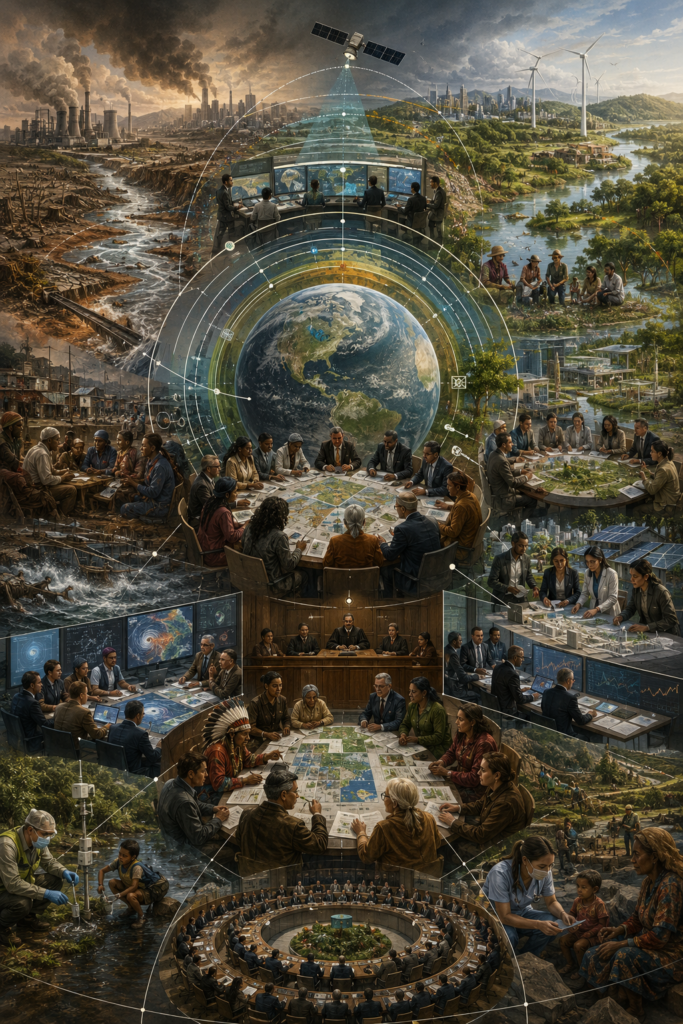
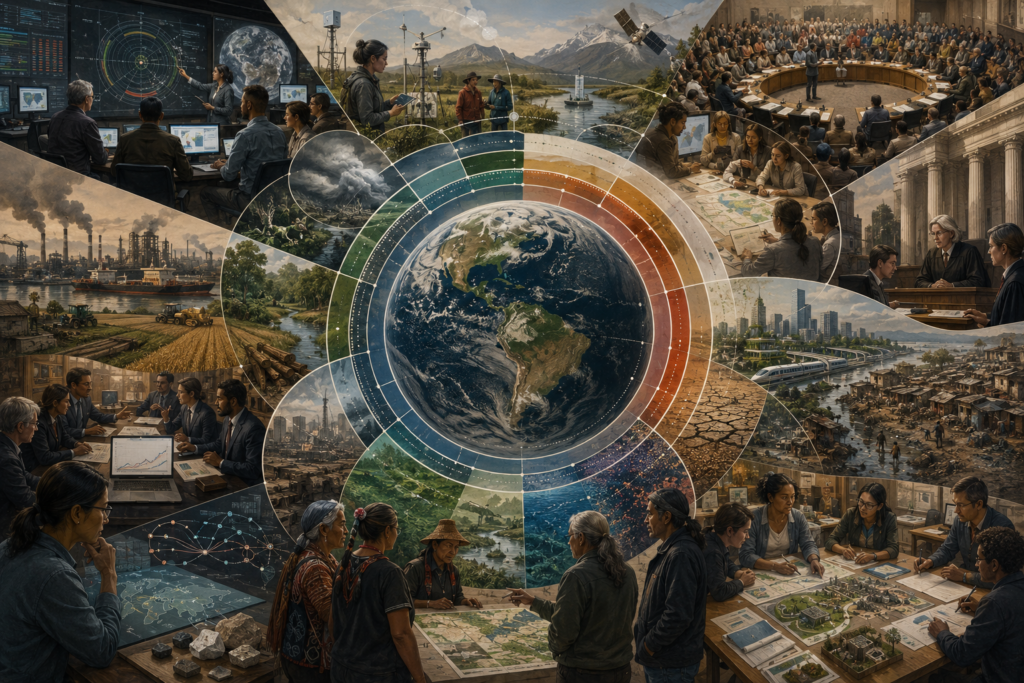
Editorial illustration showing Earth within planetary stewardship systems, with restoration, multilevel governance, ecological repair, justice, cities, communities, and future generations.

The Future of Planetary Stewardship

The future of planetary stewardship will be defined by whether human societies can learn to govern themselves as participants in, rather than masters of, a finite and interdependent Earth system. More than a narrow form of environmental management, planetary stewardship asks what kinds of institutions, values, responsibilities, and forms of coordination are needed to preserve the ecological conditions that make long-term collective flourishing possible. This article examines why stewardship is becoming a defining concept in an age of ecological limits, how it connects planetary boundaries to governance and justice, and why the future of stewardship depends on whether societies can turn ecological knowledge into credible forms of care, repair, restraint, and transformation.
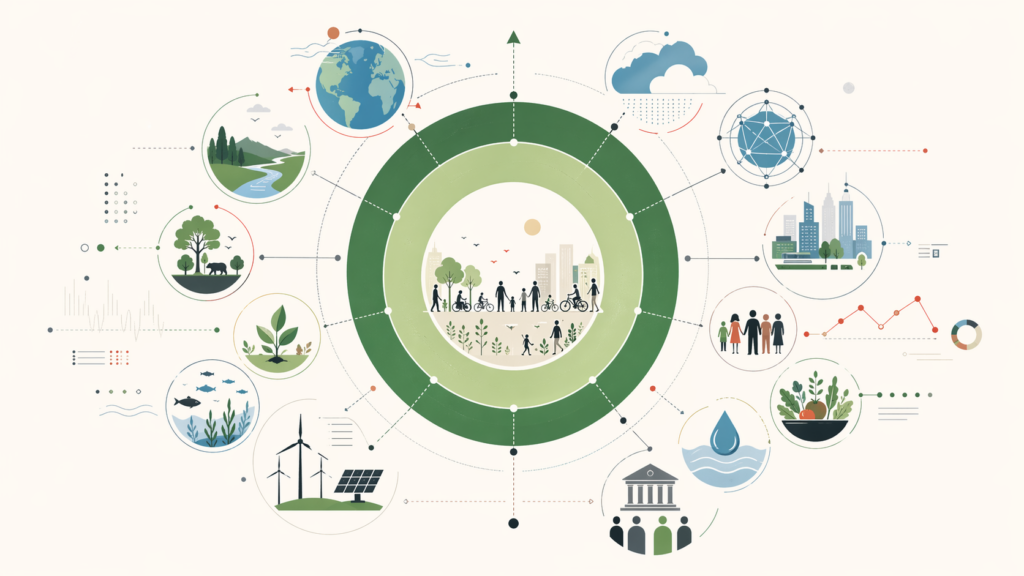
Editorial illustration showing a large green doughnut-shaped systems diagram with people, city life, ecosystems, water, food, energy, governance, climate, and biodiversity icons connected around a central safe and just space.

Planetary Boundaries and Doughnut Economics

Planetary boundaries and Doughnut Economics are best understood as complementary frameworks for thinking about sustainability, development, and human flourishing on a finite planet. The planetary boundaries framework identifies the ecological ceiling required to protect Earth system stability and resilience, while Doughnut Economics adds a social foundation below which no one should fall. This article examines how Doughnut Economics extends the logic of planetary boundaries, why the safe and just space for humanity has become such an influential idea, and how the synthesis of ecological limits and social wellbeing is reshaping debates over development, governance, and economic redesign.

Editorial illustration showing Earth within planetary-boundary bands, surrounded by debates over technocracy, justice, democracy, political economy, local translation, and responsible governance.

Critiques of the Planetary Boundaries Framework

Critiques of the Planetary Boundaries Framework examines why one of sustainability science’s most influential models has also become the subject of serious scholarly debate. The article argues that the major critiques do not reject ecological limits; they challenge how those limits are framed, governed, measured, downscaled, and distributed across unequal societies. It explores technocracy, democratic legitimacy, justice, political economy, scale, anthropocentrism, operationalization, and the safe-versus-just boundaries debate. The article also adds a mathematical lens for modeling critique-aware governance risk, along with Python and R workflows for scoring biophysical, justice, legitimacy, political-economy, and operationalization risks. The result is a more reflective framework for using planetary boundaries critically, transparently, and responsibly.

Editorial illustration showing finance, disclosure, portfolio risk, capital allocation, climate pressure, nature loss, supply chains, and systemic environmental risk within planetary boundaries.

Finance, Disclosure, and Systemic Environmental Risk

Finance, Disclosure, and Systemic Environmental Risk examines why environmental disruption has become a financial stability issue rather than a peripheral sustainability concern. The article explains how planetary-boundary pressures can affect asset values, credit quality, insurance markets, supply chains, infrastructure, regulation, and long-term growth. It evaluates the role of IFRS S1, IFRS S2, TNFD, nature-related disclosure, transition credibility, cumulative impacts, and the gap between firm-level materiality and Earth system risk. The article also includes a mathematical lens for modeling portfolio exposure, boundary pressure, and disclosure adequacy, along with Python and R workflows for portfolio-level systemic environmental risk scoring. The central argument is that disclosure must evolve from firm-level transparency toward decision-grade infrastructure for managing cumulative planetary risk.

Editorial illustration showing business strategy within planetary boundaries, with Earth-system limits, supply-chain risk, corporate governance, capital allocation, innovation, and ecological overshoot.

Business Strategy Within Planetary Boundaries

Business Strategy Within Planetary Boundaries argues that firms can no longer treat the natural world as a passive backdrop to competition, growth, and shareholder return. The planetary boundaries framework changes strategy by reframing climate, water, land, biodiversity, nutrient flows, and novel entities as constraints on long-term business viability. The article explains why companies must move from narrow ESG materiality to Earth system materiality, from relative efficiency gains to absolute sustainability, and from operational improvement to business model redesign. It also explores supply-chain exposure, innovation under limits, capital allocation, governance, competitive advantage, and strategic fragility. Python and R workflows model business-unit alignment, overshoot dependency, transition capability, and revenue-weighted strategic risk.

Editorial illustration showing Earth system governance through planetary boundaries, institutional coordination, law, science, justice, monitoring, and communities responding to ecological risk.

Earth System Governance in an Age of Limits

Planetary Boundaries, Justice, and Global Inequality examines why a safe operating space for humanity cannot be understood apart from unequal histories, unequal ecological use, unequal vulnerability, and unequal capacity to respond. The article argues that justice is not an optional moral supplement to planetary-boundary science, but part of how boundaries must be interpreted if they are to guide real-world governance. It explores safe-and-just Earth system boundaries, minimum access, differentiated responsibility, leave-no-one-behind principles, procedural justice, intergenerational justice, and the politics of ecological room. The article also includes a mathematical lens and Python/R workflows for modeling ecological overuse, minimum-access shortfall, vulnerability, historical contribution, and responsibility-adjusted justice gaps.

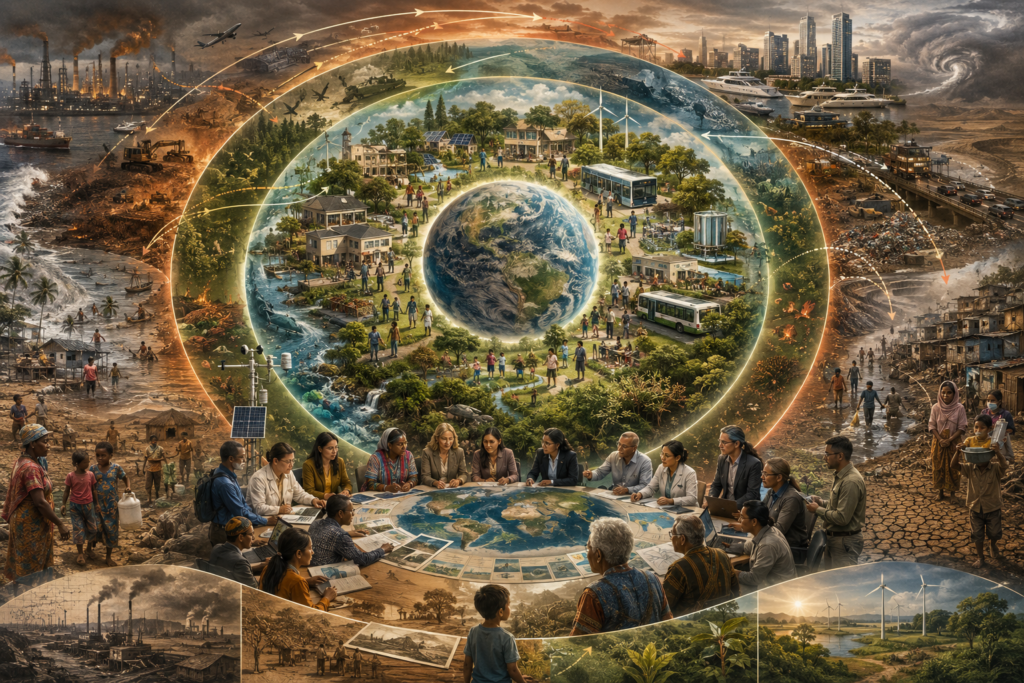
Editorial illustration showing planetary boundaries, unequal ecological use, climate vulnerability, governance, and human dignity within a safe and just Earth system.

Planetary Boundaries, Justice, and Global Inequality

Planetary Boundaries, Justice, and Global Inequality examines why a safe operating space for humanity cannot be understood apart from unequal histories, unequal ecological use, unequal vulnerability, and unequal capacity to respond. The article argues that justice is not an optional moral supplement to planetary-boundary science, but part of how boundaries must be interpreted if they are to guide real-world governance. It explores safe-and-just Earth system boundaries, minimum access, differentiated responsibility, leave-no-one-behind principles, procedural justice, intergenerational justice, and the politics of ecological room. The article also includes a mathematical lens and Python/R workflows for modeling ecological overuse, minimum-access shortfall, vulnerability, historical contribution, and responsibility-adjusted justice gaps.

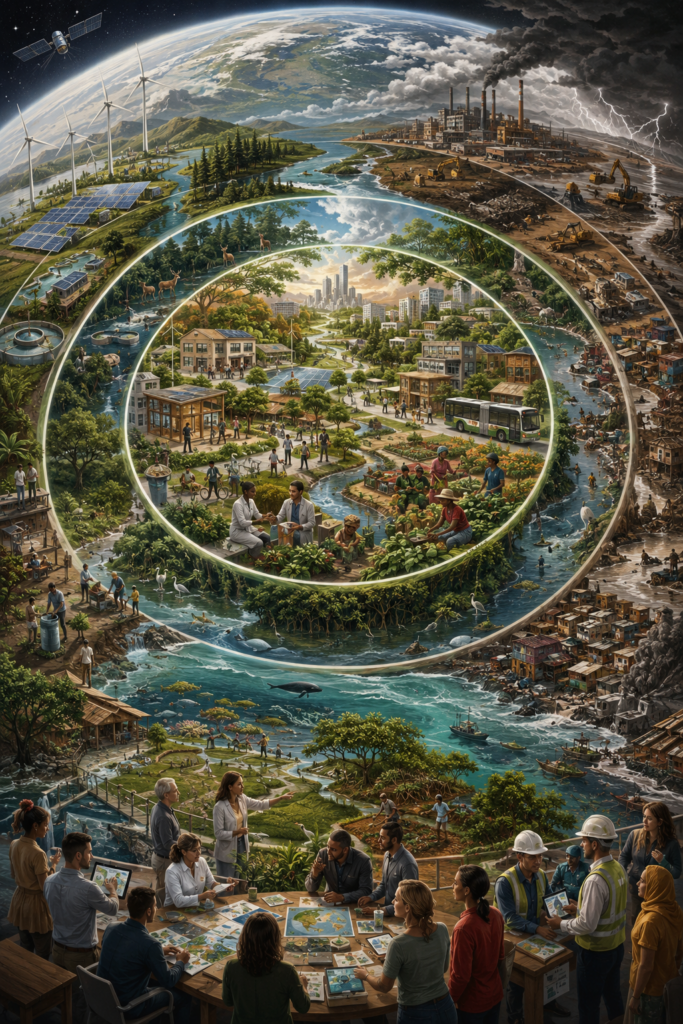
Editorial sustainability illustration showing human development nested within planetary boundaries, with resilient communities, ecosystems, inequality, industrial pressure, and collaborative governance.

Sustainable Development Goals Within Planetary Boundaries

Sustainable Development Goals Within Planetary Boundaries examines why the SDGs cannot be pursued credibly apart from Earth system stability. The article argues that poverty reduction, health, education, energy access, food security, water systems, resilient infrastructure, and inclusive prosperity all depend on climate stability, freshwater availability, biosphere integrity, land-system resilience, nutrient balance, and safe material systems. It explores SDG synergies and trade-offs, development within limits, equity, differentiated responsibility, monitoring, and policy coherence. The article also includes a mathematical lens for modeling SDG achievement under boundary constraint, along with Python and R workflows for scoring social shortfall, ecological overshoot, vulnerability, capacity, and justice-adjusted SDG-boundary alignment.

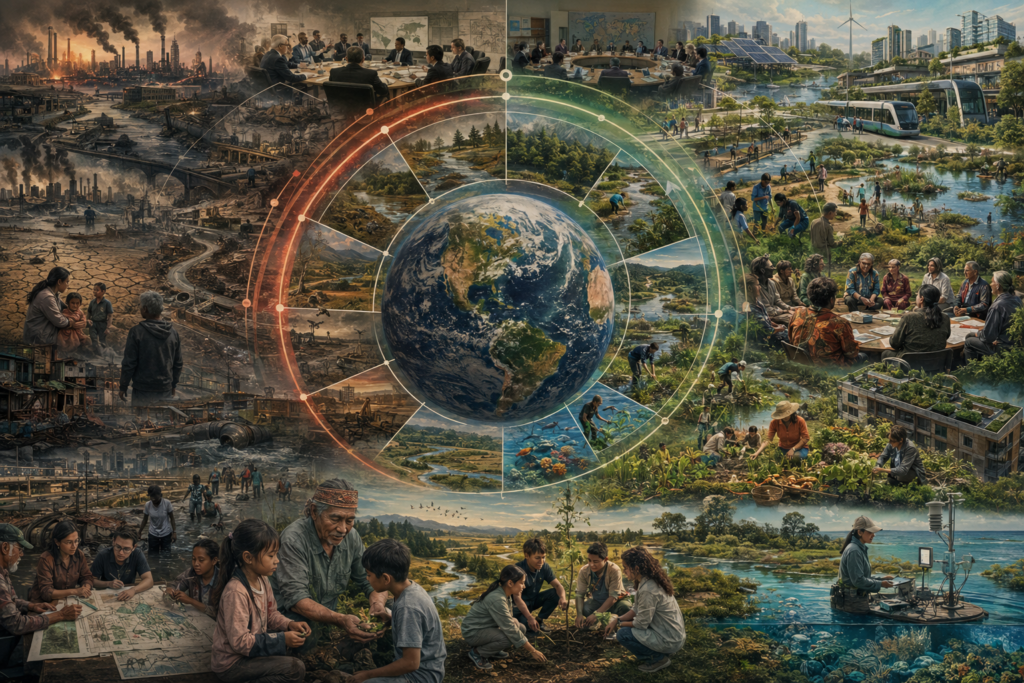
Editorial illustration showing Earth surrounded by layered risk zones, uncertainty bands, scientific monitoring, and a collaborative group assessing planetary-boundary risks.

Uncertainty, Precaution, and Scientific Debate in Boundary Setting

Uncertainty, Precaution, and Scientific Debate in Boundary Setting explains why uncertainty is not a weakness external to the planetary boundaries framework but one of the reasons the framework exists. The article argues that boundary setting is best understood as a precautionary practice of defining resilience guardrails under incomplete but meaningful knowledge. It examines threshold uncertainty, zones of risk, scientific debate, boundary revision, control-variable disputes, cross-boundary interactions, and the logic of early action. The article also includes a mathematical lens for modeling precautionary margins and uncertainty-adjusted risk, along with Python and R workflows for scoring observed pressure, estimated thresholds, uncertainty, governance capacity, and risk-zone classification.

Scroll to Top