Planetary Boundaries

The planetary boundaries framework identifies the ecological limits within which human societies can safely operate. Developed by Earth system scientists, the framework highlights critical thresholds in global environmental systems that regulate the stability of the planet.

These boundaries include processes such as climate change, biodiversity loss, land-system change, freshwater use, and biogeochemical cycles. When human activity pushes these systems beyond safe operating limits, the risk of irreversible environmental change increases significantly.

The planetary boundaries concept provides a scientific foundation for understanding the scale of environmental pressures generated by modern economic activity. It emphasizes that sustainable development must operate within ecological constraints that maintain the stability of Earth’s life-support systems.

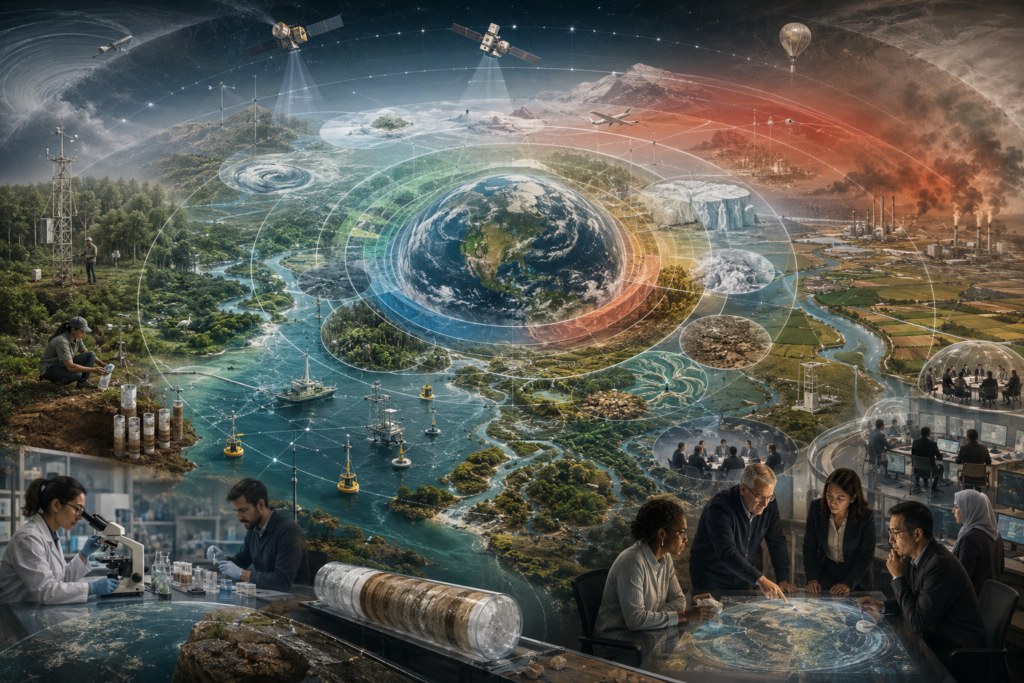
Editorial illustration showing planetary-boundary measurement through control variables, thresholds, uncertainty zones, monitoring systems, and collaborative Earth-system assessment.

How Planetary Boundaries Are Measured

How Planetary Boundaries Are Measured explains why the planetary boundaries framework depends on scientifically chosen control variables rather than one universal environmental metric. The article distinguishes boundary processes from their measurements, showing how climate change, biosphere integrity, freshwater change, land-system change, biogeochemical flows, ocean acidification, ozone depletion, aerosol loading, and novel entities each require different measurement strategies. It explores thresholds, risk zones, regional aggregation, uncertainty, revision, observation systems, models, and governance implications. The article also includes a mathematical lens for modeling control variables, boundary values, uncertainty-adjusted pressure, and risk-zone classification, along with Python and R workflows for reproducible boundary-measurement scoring and dashboard preparation.
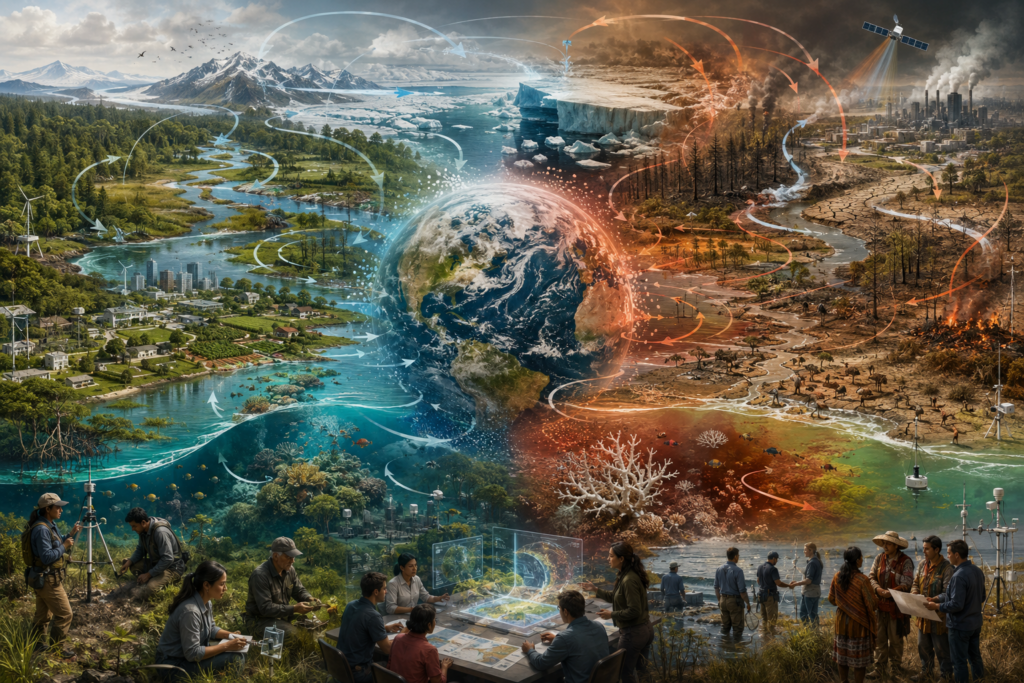
Editorial illustration showing Earth divided between resilient and stressed systems, with feedback loops, threshold pressures, ecosystem tipping dynamics, monitoring, and collaborative governance.

Tipping Points, Feedback Loops, and Cascading Ecological Change

Tipping Points, Feedback Loops, and Cascading Ecological Change explains why planetary risk is not merely a matter of gradual environmental deterioration. The article shows how complex Earth system and ecological processes can absorb stress for long periods before crossing thresholds that trigger self-reinforcing change. It examines tipping elements, positive and negative feedbacks, ecological regime shifts, slow variables, fast shocks, critical slowing down, early-warning signals, cascading regime shifts, and cross-boundary interactions. It also includes a mathematical lens for modeling thresholds, precautionary margins, feedback strength, and cascade pressure, along with Python and R workflows for simulating tipping probability, interaction networks, scenario sensitivity, and dashboard-ready nonlinear risk diagnostics.

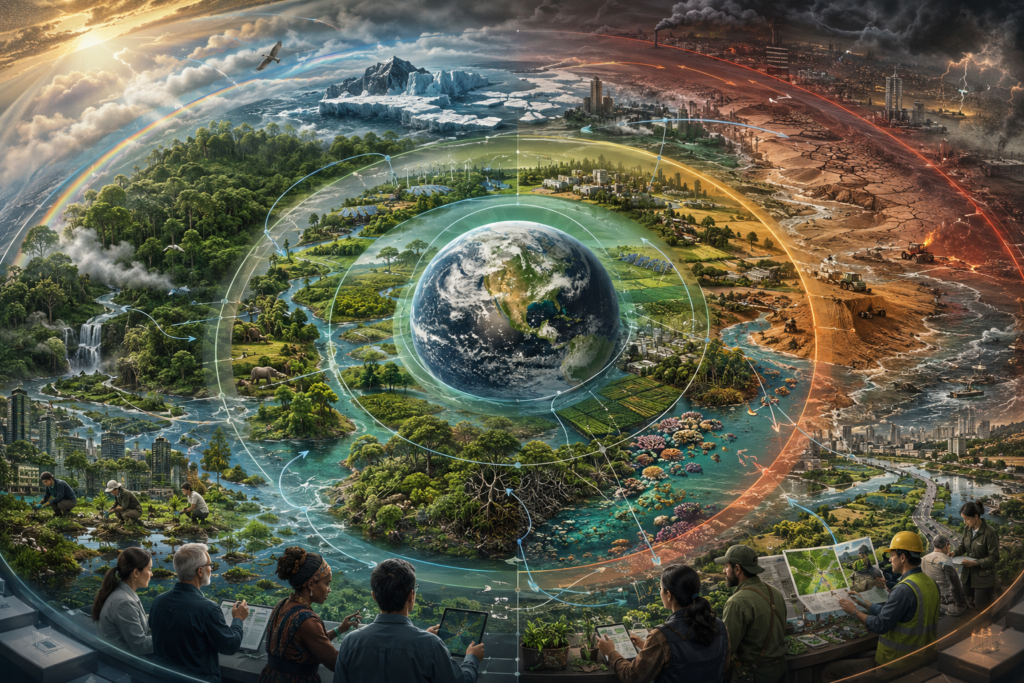
Editorial illustration showing Earth within layered resilience zones, interconnected ecosystems, climate and environmental pressures, and people collaborating to preserve planetary stability.

Planetary Boundaries and Earth System Resilience

Planetary Boundaries and Earth System Resilience explains why the planetary boundaries framework is best understood not only as a map of environmental limits, but as a resilience architecture for the Earth system. The article shows how safe operating space, thresholds, feedbacks, core boundaries, cross-boundary interactions, diversity, redundancy, adaptive capacity, and monitoring systems all relate to the preservation of planetary stability. It argues that boundary transgression matters because it can weaken the Earth system’s capacity to absorb disturbance, recover from shocks, and avoid state shifts. The article also includes a mathematical lens and Python/R workflows for modeling boundary pressure, resilience capacity, resilience gaps, interaction pressure, and resilience-adjusted risk.

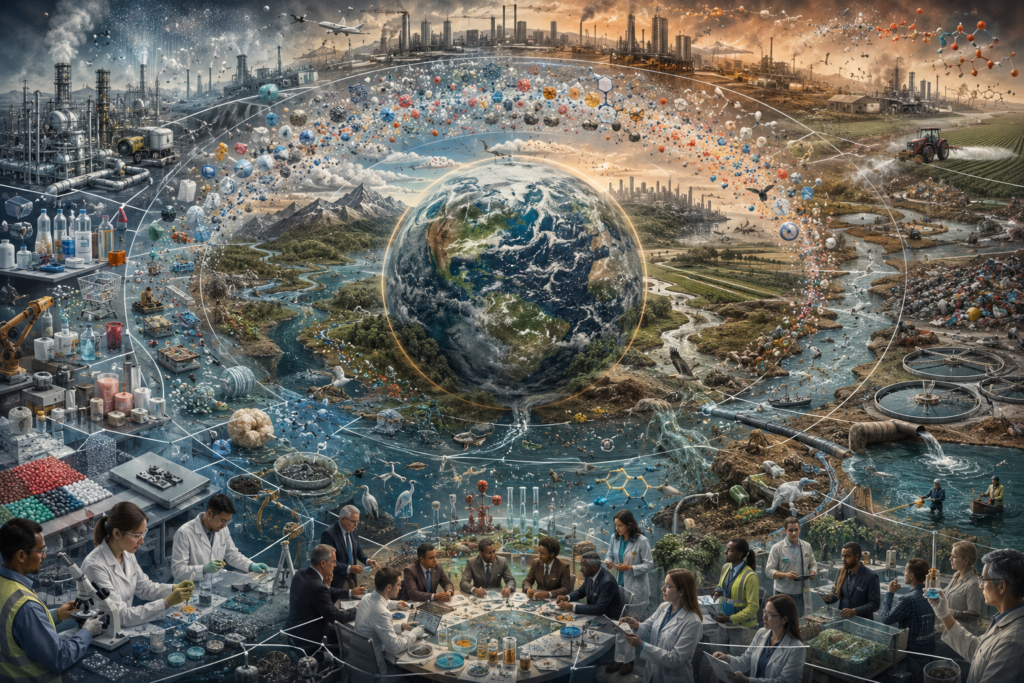
Editorial illustration showing Earth surrounded by synthetic chemicals, plastics, industrial materials, laboratories, polluted waterways, and governance efforts to manage novel-entities risk.

Novel Entities and the Problem of Synthetic Overload

Novel entities occupy one of the most conceptually revealing positions in the planetary boundaries framework because they expose a defining feature of industrial modernity: human societies are creating substances and materials faster than they can adequately assess, monitor, or govern their long-term effects. More than a conventional pollution issue, this boundary concerns the widening gap between technological production and the capacities of science, regulation, and ecosystems to absorb what is being introduced. This article examines synthetic overload as an Earth system problem, explains why novel entities are now treated as a transgressed planetary boundary, and explores what this reveals about the relationship between innovation, governance, and planetary stability.

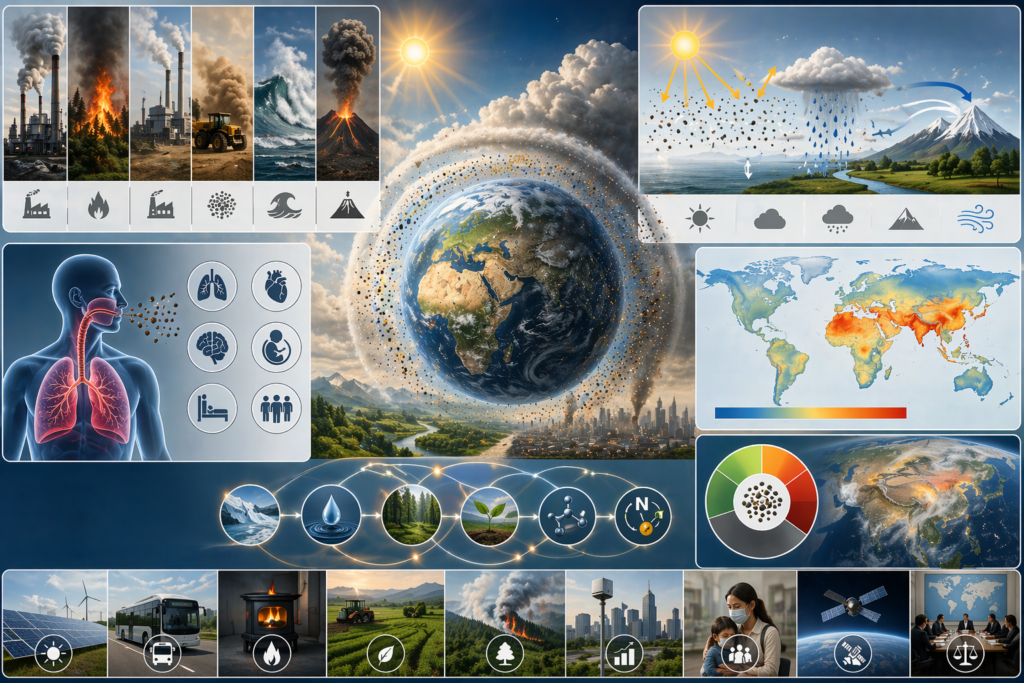
Editorial image showing Earth surrounded by atmospheric particle pollution, with visual references to industrial emissions, wildfire smoke, dust, clouds, rainfall disruption, human health, satellite monitoring, clean energy, transport, and regional climate risk.

Atmospheric Aerosol Loading and Regional Planetary Risk

Atmospheric Aerosol Loading and Regional Planetary Risk explains why aerosols are one of the most complex boundary processes in the planetary boundaries framework. Unlike globally mixed greenhouse gases, aerosols are spatially uneven, compositionally diverse, short-lived, and strongly regional in their effects. The article examines aerosol optical depth, PM2.5 exposure, black carbon, sulfates, dust, cloud interactions, monsoon disruption, hydrological sensitivity, public-health burdens, and the difficulty of defining a single global threshold. It argues that aerosol loading remains planetary in significance because regional atmospheric disturbances can affect rainfall, food systems, cryosphere change, human health, and Earth-system resilience. The article also includes mathematical, Python, and R workflows for regional aerosol-risk diagnostics.

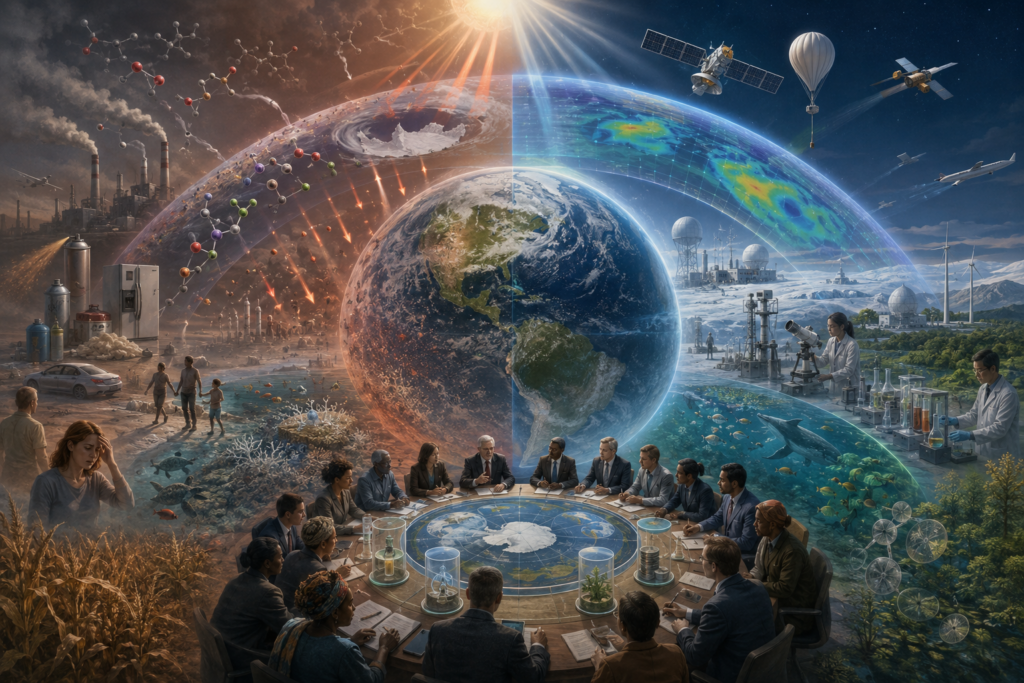
Editorial illustration showing Earth’s ozone layer under stress and recovery, with atmospheric chemistry, ultraviolet radiation, scientific monitoring, and international governance.

Stratospheric Ozone Depletion and Global Environmental Governance

Stratospheric Ozone Depletion and Global Environmental Governance explains why the ozone layer is one of the most important recovery cases in the planetary boundaries framework. The article examines how ozone-depleting substances damaged a vital atmospheric shield, how the Antarctic ozone hole transformed environmental politics, and how the Montreal Protocol created a durable governance regime based on science, treaty commitments, industrial substitution, monitoring, finance, and compliance. It also explores why the ozone boundary is now within the safe operating space, why recovery remains incomplete, how the Kigali Amendment links ozone governance to climate mitigation, and what the ozone case teaches about planetary governance.

Infographic explaining ocean acidification as a planetary-boundary process, showing Earth and the ocean, seawater chemistry changes, lower pH, reduced carbonate availability, coral stress, shell formation pressure, food web effects, monitoring systems, governance responses, and interactions with climate change, deoxygenation, nutrient pollution, and ecosystem vulnerability.

Ocean Acidification and the Chemistry of Planetary Change

Ocean Acidification and the Chemistry of Planetary Change explains why ocean acidification is one of the clearest chemical expressions of planetary change. The article shows how rising atmospheric carbon dioxide dissolves into seawater, lowers pH, reduces carbonate ion availability, and weakens aragonite saturation states needed by many marine organisms. It examines carbonate chemistry, calcification, coral reefs, planktonic organisms, shellfish coasts, polar waters, upwelling systems, ecosystem vulnerability, and the boundary’s updated status as a transgressed planetary boundary in the 2025 Planetary Health Check. It also connects acidification to climate change, biosphere integrity, nutrient pollution, freshwater change, and coastal governance, with mathematical, Python, and R workflows for carbonate-risk diagnostics.

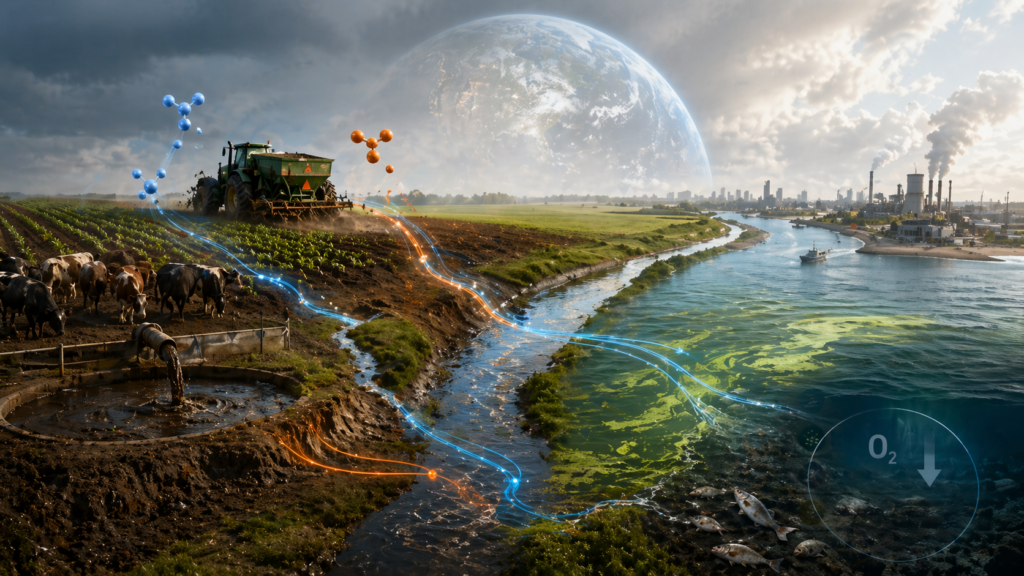
Editorial featured image showing farmland, livestock waste, nutrient runoff flowing into a river and polluted waterway, algal growth, fish mortality, and a planetary-scale environmental backdrop representing nitrogen and phosphorus destabilization.

Biogeochemical Flows: Nitrogen, Phosphorus, and Planetary Destabilization

Biogeochemical Flows: Nitrogen, Phosphorus, and Planetary Destabilization explains why altered nitrogen and phosphorus cycles are among the most severely transgressed planetary boundaries. The article shows how industrial nitrogen fixation, phosphate mining, fertilizer use, livestock concentration, wastewater systems, runoff, erosion, and legacy nutrients have transformed life-supporting nutrient cycles into drivers of eutrophication, dead zones, biodiversity loss, soil imbalance, air pollution, nitrous oxide emissions, and Earth-system risk. It connects nutrient overload to freshwater change, biosphere integrity, land-system change, climate, ocean acidification, and food-system governance. The article also includes mathematical, Python, and R workflows for modeling nutrient surplus, nutrient-use efficiency, boundary pressure, eutrophication risk, watershed connectivity, legacy nutrient pressure, and governance capacity.

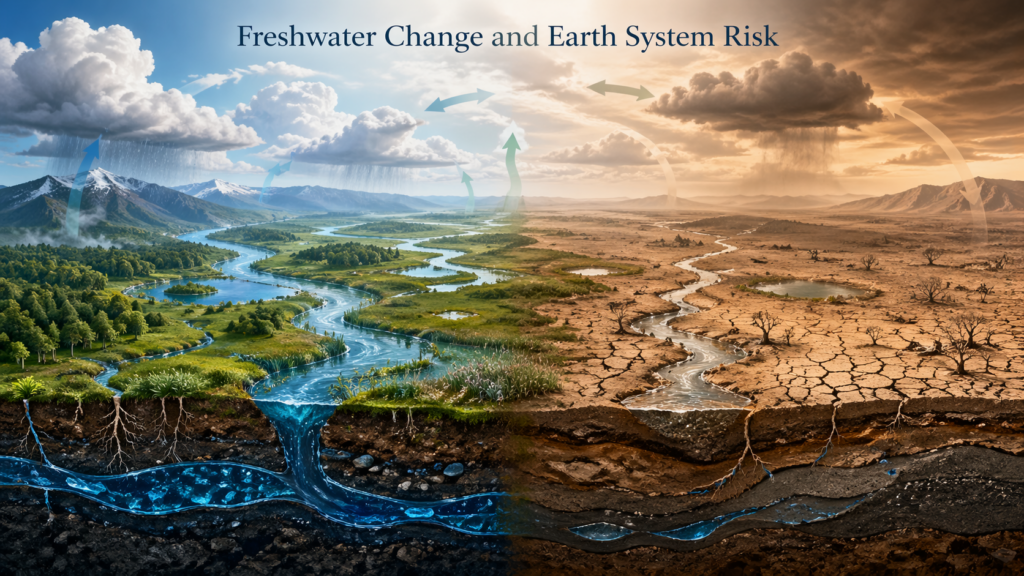
Editorial image showing a planetary freshwater landscape divided between a resilient water-rich ecosystem with rivers, wetlands, groundwater, vegetation, rain clouds, and a stressed dry landscape with drought, cracked soils, fragmented rivers, depleted groundwater, and sparse vegetation.

Freshwater Change and Earth System Risk

Freshwater Change and Earth System Risk explains why the planetary boundaries framework moved beyond a narrow focus on freshwater use toward a broader understanding of hydrological disruption. The article shows how blue water in rivers, lakes, wetlands, reservoirs, and aquifers interacts with green water in soils and vegetation to regulate ecosystems, agriculture, climate feedbacks, nutrient transport, and planetary resilience. It examines streamflow deviation, root-zone soil-moisture change, groundwater depletion, wetland loss, hydrological extremes, shifting baselines, and the boundary’s current transgressed status. It also connects freshwater change to climate change, land-system change, biosphere integrity, biogeochemical flows, atmospheric aerosols, food systems, and governance. Mathematical, Python, and R workflows model hydrological boundary pressure, exposure, sensitivity, buffers, monitoring capacity, and governance risk.

Scroll to Top