
Last Updated May 7, 2026
The planetary boundaries framework did not emerge as a narrow environmental slogan, a single-issue intervention, or a simple warning about “limits.” It arose from a broader intellectual shift in Earth-system science, resilience thinking, sustainability research, global-change science, and Anthropocene debate during the late twentieth and early twenty-first centuries. By the time the framework was formally introduced in 2009, a growing body of scientific work had already established that human societies were no longer merely affecting local ecosystems. They were altering the functioning of the Earth system itself.
The question, then, was no longer only how to measure environmental damage in separate domains. It was how to understand whether cumulative human pressures were pushing the planet beyond conditions compatible with long-term social and ecological stability. The planetary boundaries framework answered that question by translating Earth-system science into a precautionary architecture of risk: a way of identifying critical planetary processes and asking how far humanity could push them before entering zones of increasing instability.
Main Library
Publications
Article Map
Planetary Boundaries
Related Topic
Sustainable Development
Related Topic
Risk & Resilience

The significance of the planetary boundaries framework lies partly in this moment of conceptual synthesis. It gave scientific expression to an emerging realization that humanity had entered a new historical condition in which climate, biosphere integrity, land systems, nutrient cycles, freshwater, ocean chemistry, atmospheric processes, and synthetic chemical burdens could no longer be treated as isolated problems. They had to be understood as interconnected components of a single planetary system.
The framework also emerged from a practical governance problem. Environmental policy had long been organized around sectors, pollutants, species, resources, jurisdictions, and discrete regulatory problems. But Earth-system science increasingly showed that the planet’s life-support processes are cumulative, interacting, nonlinear, and transboundary. Climate change interacts with land systems and the biosphere. Nutrient flows reshape freshwater and marine systems. Land conversion alters carbon storage, hydrology, and biodiversity. Novel entities accumulate across ecosystems. Sustainability needed more than a list of environmental issues. It needed a systems framework for planetary-scale risk.
The Scientific Background
The origins of the planetary boundaries framework lie in a convergence of scientific traditions rather than in a single disciplinary breakthrough. By the early 2000s, researchers in climatology, ecology, hydrology, biogeochemistry, ocean science, biodiversity science, atmospheric chemistry, and global-change research had accumulated extensive evidence that human activity was altering the planet at large scales. Climate warming, nitrogen and phosphorus loading, biodiversity loss, deforestation, freshwater depletion, ocean acidification, and atmospheric change were increasingly understood not as separate disturbances but as interacting pressures with planetary implications.
This wider scientific context mattered because it changed the scale of environmental thought. Earlier environmental policy often focused on pollution control, conservation, or resource management within relatively bounded domains. What Earth-system science increasingly showed, however, was that the planet behaves as an interconnected whole. Human activity was becoming powerful enough to disturb the processes that stabilize climate, regulate nutrient cycles, support the biosphere, maintain freshwater flows, buffer ocean chemistry, and sustain the habitability of the Earth system over long time horizons.
The framework can therefore be understood as a response to a mounting problem of intellectual fragmentation. Scientific knowledge about the environment was becoming deeper, but also more specialized. Climate scientists, ecologists, hydrologists, atmospheric chemists, oceanographers, soil scientists, and biogeochemists were producing increasingly detailed knowledge, yet policy systems often lacked an integrating architecture capable of translating those findings into planetary-scale judgment. The planetary boundaries framework helped integrate specialized findings into a single architecture of planetary risk.
This made the framework both a scientific synthesis and a conceptual intervention. It did not merely summarize existing environmental problems. It reorganized them around a sharper question: which Earth-system processes regulate the conditions that make the planet stable and habitable, and how far can human societies push those processes before the risk of systemic destabilization becomes unacceptable?
That question was not purely academic. It emerged at the intersection of science and governance. If the Earth system is being altered at planetary scale, then environmental policy cannot remain limited to cleaning up discrete pollutants after the fact. It must become capable of identifying systemic risk before critical processes are pushed beyond safer operating ranges. The planetary boundaries framework gave that problem a language, a diagram, and an evolving scientific architecture.
Earth-System Science and the Anthropocene
One of the key intellectual conditions for the emergence of the framework was the rise of Earth-system science. This field emphasized that the atmosphere, oceans, cryosphere, biosphere, lithosphere, freshwater systems, and land surface form an interacting system rather than a loose collection of independent environments. That perspective made it easier to see why disturbances in one domain could reverberate across others, producing cascading effects that conventional sectoral analysis often missed.
Earth-system science also made the Holocene more visible as a condition of development. The relatively stable climate and ecological conditions of the Holocene did not guarantee peace, justice, or prosperity, but they provided a broad biophysical envelope within which agriculture, settlement, infrastructure, institutions, and complex economies expanded. The planetary boundaries framework emerged from the recognition that this envelope could no longer be assumed as a passive background. It had to be protected as an operating condition of long-term development.
The framework also drew energy from debates around the Anthropocene. Although the term has been used in different ways, the core idea was clear enough: human societies had become a geological-scale force. Industrialization, fossil-fuel combustion, synthetic chemistry, intensive agriculture, land conversion, freshwater engineering, and globalized extraction were no longer simply changing landscapes. They were reshaping planetary processes. The framework emerged in part as an attempt to make that reality scientifically legible and politically actionable.
The Anthropocene discussion contributed a distinctive historical consciousness. It suggested that humanity had entered an era in which development and Earth-system change were inseparable. Once that recognition entered sustainability thinking, the need for a framework capable of distinguishing safer from more dangerous zones of planetary change became intellectually urgent. For adjacent context, see Climate Change as a Planetary Boundary and Land-System Change and Ecological Transformation.
Even if the Anthropocene remains debated in formal geological classification, its conceptual significance remains central to planetary-boundary thinking. The issue is not only what to call the epoch. The issue is that human activity now operates at a scale large enough to alter the Earth-system conditions on which human societies depend.
Resilience Thinking and Thresholds
Another major source of the framework was resilience thinking. Researchers associated with social-ecological systems and resilience science had already emphasized that complex systems can absorb shocks only up to a point. Beyond certain thresholds, they may reorganize abruptly into different states with new structures, feedbacks, and consequences. These changes are often nonlinear and may be difficult or impossible to reverse on human timescales.
This mattered enormously for the planetary boundaries framework. The key question was not only whether environmental change was occurring, but whether the Earth system was being pushed toward thresholds beyond which relatively stable Holocene-like conditions could no longer be assumed. In that respect, the framework was never simply about measuring environmental harm. It was about identifying zones of rising systemic danger before irreversible or cascading change became entrenched.
Resilience thinking also shaped the framework’s resistance to false precision. The planetary boundaries approach did not claim to predict the exact moment of collapse. It proposed a precautionary architecture for dealing with thresholds, uncertainty, feedbacks, and nonlinear risk. This is why the framework could be both scientific and strategic. It acknowledged uncertainty while still insisting that uncertainty is not a reason for delay when systems may be approaching dangerous thresholds.
The influence of resilience thinking remains indispensable for understanding later articles in this knowledge series, especially Safe Operating Space and the Logic of Thresholds, Tipping Points, Feedback Loops, and Cascading Ecological Change, and Uncertainty, Precaution, and Scientific Debate in Boundary Setting.
Resilience also helped shift the framework away from a simplistic “balance of nature” model. The Earth system is not a static equilibrium that can be preserved by minor adjustment. It is dynamic, adaptive, and capable of regime shifts. The planetary boundaries framework grew out of that insight: the point is not to freeze the planet in place, but to preserve the conditions under which human societies and the biosphere can continue to adapt without crossing into dangerous instability.
The 2009 Breakthrough
The decisive breakthrough came in 2009, when Johan Rockström and colleagues published “A safe operating space for humanity” in Nature and the longer companion article “Planetary boundaries: Exploring the safe operating space for humanity” in Ecology and Society. These publications brought together an unusually broad interdisciplinary group of researchers and proposed that humanity should remain within a safe operating space defined by planetary boundaries. The basic argument was that there are identifiable Earth-system processes whose destabilization would raise the risk of large-scale environmental change incompatible with continued human development.
The power of the 2009 formulation lay in its balance of ambition and restraint. It did not claim that science could identify every precise tipping point in advance, nor that each process could be reduced to a single universal number without uncertainty. Instead, it proposed boundary zones that could serve as precautionary markers. The aim was to define a margin of safety before humanity pushed the planet into domains of heightened instability.
This was a conceptual innovation of lasting consequence. The framework neither repeated older “limits to growth” arguments in a simple form nor reduced the environment to a list of policy targets. It offered a systems-based and scientifically grounded way of thinking about planetary risk. In doing so, it changed the terms of debate from isolated environmental degradation to the maintenance of Earth-system stability itself.
The 2009 papers also gave the framework its durable structure. They identified critical Earth-system processes, proposed control variables where possible, recognized uncertainty where quantification was incomplete, and argued that crossing multiple boundaries could produce interacting risks. The companion opener, What Are Planetary Boundaries?, explains how this foundational move structured the framework’s later uptake.
The breakthrough was also rhetorical in the best sense: it made a complex scientific argument legible without flattening it. “Safe operating space” gave scientists, institutions, policymakers, educators, civil-society groups, and sustainability practitioners a shared phrase for a difficult idea: the Earth system has operating conditions, and human development must remain within them.
Why Safe Operating Space Mattered
The phrase “safe operating space for humanity” became one of the framework’s defining contributions. Its importance lay partly in its flexibility. The phrase avoided the false certainty of hard mechanical limits while still conveying the seriousness of crossing into zones of danger. The Earth system was not presented as static, perfectly predictable, or reducible to engineering tolerances. But neither was uncertainty treated as a reason for inaction. The concept of a safe operating space made precaution central to planetary governance.
This language also marked a subtle but important shift in sustainability thinking. Instead of asking only how much environmental damage a society could tolerate, the framework asked what conditions were necessary to preserve the relatively stable planetary context in which societies could continue to develop. It therefore linked environmental science to long-term civilizational questions: habitability, resilience, development, and the durability of organized human life.
Conceptually, this was one of the framework’s most elegant achievements. It translated abstract systemic complexity into a morally and politically resonant formulation without sacrificing scientific seriousness. It gave researchers, institutions, and practitioners a way to speak about planetary limits without reducing those limits to either fatalistic collapse narratives or simplistic policy slogans.
The safe-operating-space concept also made the framework useful beyond environmental science. Engineers could recognize it as a safety-margin problem. Public-health professionals could recognize its precautionary logic. Financial analysts could connect it to systemic risk. Governance scholars could see it as a problem of institutional design under uncertainty. For the dedicated treatment, see Safe Operating Space and the Logic of Thresholds.
The phrase also created a bridge between ecological ceilings and social foundations. A safe operating space is not meaningful if large populations remain excluded from basic dignity. But development without ecological ceilings is unstable. The later connection between planetary boundaries and Doughnut Economics reflects this deeper implication: human societies need both a floor of social protection and a ceiling of ecological responsibility.
The Original Nine Boundaries
The original framework identified nine planetary boundaries: climate change, rate of biodiversity loss, interference with the nitrogen and phosphorus cycles, stratospheric ozone depletion, ocean acidification, global freshwater use, land-system change, atmospheric aerosol loading, and chemical pollution. Not all of these boundaries were equally well quantified in 2009, and the authors were explicit about uneven levels of certainty. Even so, the structure of the framework was already clear. It sought to identify the core planetary processes whose destabilization would carry especially serious implications for Earth-system functioning.
This mattered because it transformed environmental analysis into a more coherent architecture. The boundaries were not intended to function as isolated dashboards. They were conceptually linked, and the framework recognized that transgressing several at once could be more dangerous than the sum of individual pressures. In other words, the framework’s originality was not only in the list of boundaries themselves, but in the relational logic that connected them.
The original list also revealed how ambitious the framework was. It did not focus only on climate change, despite climate change being central. It placed climate within a wider Earth-system context that included biodiversity, water, land, nutrients, ocean chemistry, atmospheric chemistry, aerosols, and synthetic chemical pollution. This made the framework broader than carbon accounting and more systemic than conventional environmental management.
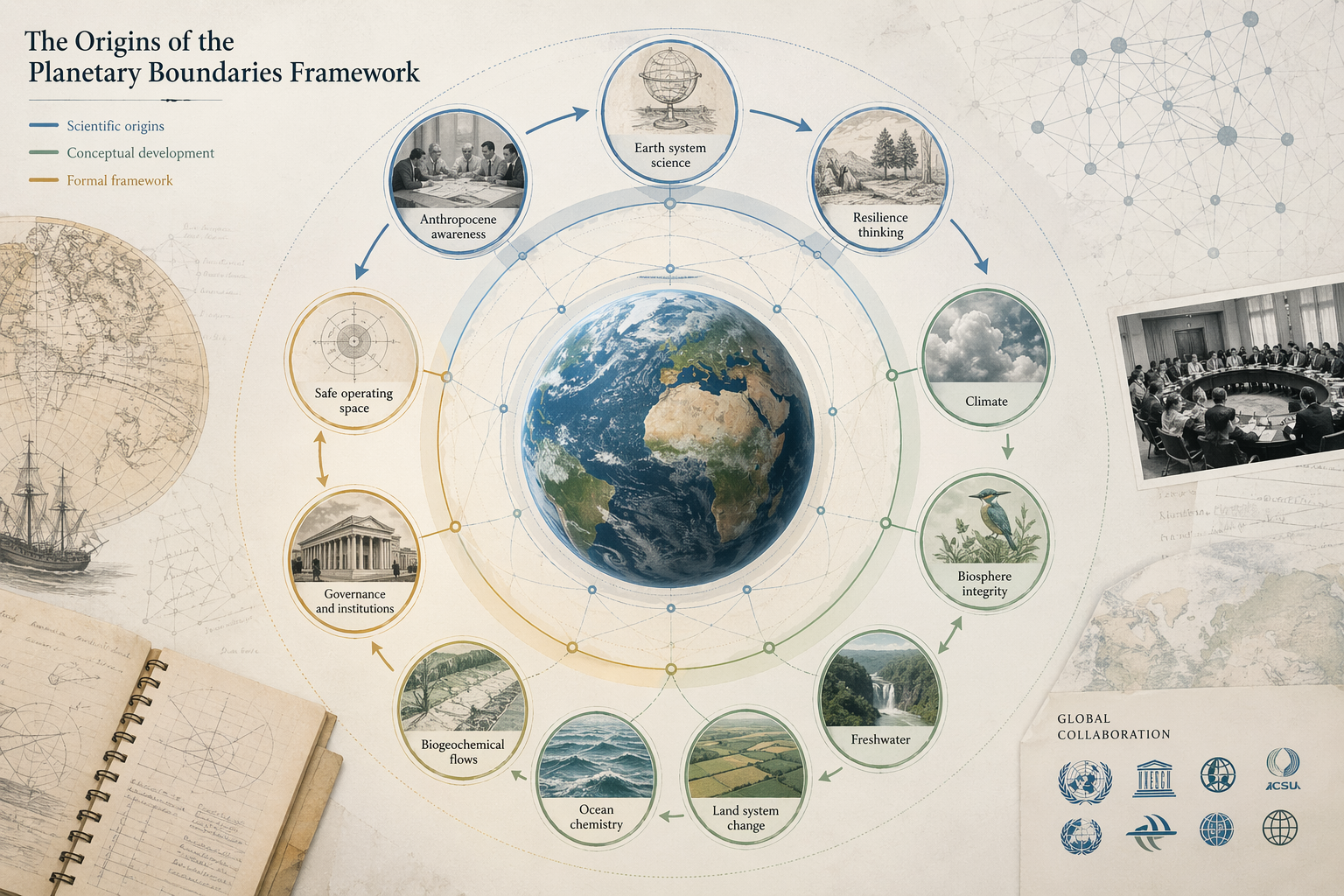
The later evolution of the framework retained this basic structure while refining terminology, control variables, and evidentiary support. Readers can follow that progression through the linked articles on Freshwater Change and Earth System Risk, Biogeochemical Flows: Nitrogen, Phosphorus, and Planetary Destabilization, Ocean Acidification and the Chemistry of Planetary Change, and Novel Entities and the Problem of Synthetic Overload.
The original boundaries also showed that planetary risk has multiple temporalities. Climate change unfolds over decades and centuries. Biodiversity loss can be gradual before becoming abrupt. Novel entities may accumulate faster than monitoring systems can evaluate them. Nutrient flows can transform watersheds and coastal systems over years. Ozone depletion showed both danger and the possibility of coordinated repair. The framework gave these different forms of risk a shared analytical home.
The 2015 Refinement
The planetary boundaries framework did not remain frozen in its original form. In 2015, Will Steffen and colleagues published a major update in Science that revised and strengthened the framework. This refinement clarified the underlying biophysical logic, updated the evidence base, and introduced a more developed treatment of uncertainty, regional heterogeneity, and interaction. It also emphasized two “core boundaries” in particular: climate change and biosphere integrity. These were singled out because severe disruption in either could, on their own, drive the Earth system toward a new state.
The 2015 update also reflected the framework’s maturation as a scientific program. It was no longer simply a provocative synthesis. It had become a living research agenda, capable of revision, critique, and elaboration. This adaptability is one reason the framework endured. It could absorb new data, refine its control variables, and evolve without abandoning its foundational insight.
This is also where the framework gained greater analytical precision. It increasingly became a platform for integrating measurement, uncertainty, and interaction, rather than simply naming limits. The 2015 paper’s distinction between safe zones, zones of increasing risk, and high-risk zones helped clarify that boundaries should not be interpreted as rigid natural walls. They are risk thresholds designed to support precautionary governance.
The 2015 refinement also reframed biodiversity loss as biosphere integrity, expanded the conceptual importance of ecosystem function, and clarified the distinction between global and regional processes. These shifts mattered because they made the framework more scientifically robust and more useful for governance. A global boundary may need regional implementation, and a single indicator may need to be interpreted through ecological function, uncertainty, and cross-scale interaction.
The refinement also strengthened the framework’s relevance for social-ecological analysis. A planetary boundary is not just a number. It is a way of asking whether human pressures are eroding resilience in systems that support agriculture, water, health, infrastructure, biodiversity, climate regulation, and long-term development. That made the framework more useful for thinking about governance, not only diagnosis.
From Framework to Research Program
After 2015, the planetary boundaries framework continued to evolve into a larger research program. The 2023 assessment quantified all nine boundaries and concluded that six of nine had been transgressed. The 2025 Planetary Health Check reported that seven of nine planetary boundaries were breached, reflecting the addition of ocean acidification to the set of breached boundaries. These developments show that the framework is no longer only an origin story from 2009. It has become an ongoing scientific assessment architecture.
The framework’s evolution has also involved methodological refinement. Researchers have continued to debate control variables, boundary values, uncertainty ranges, interactions among boundaries, regional downscaling, justice implications, and governance applications. This debate is not a weakness. It is part of how the framework becomes more useful. A serious planetary-risk framework must be able to absorb criticism, revise indicators, and clarify assumptions without collapsing into either rigid certainty or vague rhetoric.
The planetary boundaries framework has also influenced newer efforts to connect biophysical limits with social foundations, most notably Doughnut Economics. This matters because the original planetary-boundaries framework focused primarily on the ecological ceiling, while justice-centered and development-centered adaptations ask how humanity can remain within planetary limits while meeting basic human needs. For that bridge, see Planetary Boundaries and Doughnut Economics and Planetary Boundaries, Justice, and Global Inequality.
In this sense, the framework has become more than a diagram or a set of thresholds. It is a research platform for thinking about how Earth-system stability, human development, justice, governance, and long-term responsibility fit together under real conditions of risk and uncertainty.
The framework has also become a knowledge-infrastructure problem. As it grows, the sources, definitions, revisions, boundary values, interpretations, critiques, applications, and governance translations must remain traceable. Without that traceability, the framework risks becoming a visual shorthand detached from its scientific and ethical complexity. With traceability, it can become a durable platform for responsible decision-making.
Why the Framework Spread
The planetary boundaries framework spread so widely because it answered several needs at once. Scientifically, it offered a compelling synthesis of disparate findings across Earth-system science. Politically, it provided a language for discussing environmental risk at planetary scale without depending on a single issue such as climate alone. Institutionally, it gave policymakers, foundations, universities, businesses, sustainability practitioners, and civil-society organizations a way to think about multiple ecological pressures within a common conceptual structure.
Its visual and conceptual clarity also mattered. The idea of boundaries was easy to communicate, but it retained enough scientific depth to support serious research and debate. That combination is rare. Many frameworks are either analytically rich but publicly inaccessible, or widely legible but conceptually thin. Planetary boundaries achieved unusual influence because the framework managed to do both.
The framework’s spread also reflects a deeper institutional vacuum. Modern governance systems are often organized by sector, jurisdiction, election cycle, asset class, or short time horizon, whereas planetary change is cumulative, transboundary, interacting, and nonlinear. The planetary boundaries framework gave institutions a way to name that mismatch. It made visible the gap between the scale of Earth-system risk and the structure of decision-making systems.
This is one reason the framework now appears in discussions of Earth System Governance in an Age of Limits, Business Strategy Within Planetary Boundaries, and Finance, Disclosure, and Systemic Environmental Risk.
Its influence also grew because it could be translated across domains. Scientists could use it to discuss Earth-system processes. Educators could use it to explain ecological limits. Policymakers could use it to frame precaution. Businesses could use it to think about material risk and supply chains. Finance could use it to consider systemic environmental exposure. Critics could use it to ask whether global environmental metrics obscure inequality, power, and historical responsibility. A framework capable of supporting both adoption and critique has unusual durability.
The Framework’s Intellectual Significance
The deeper significance of the framework lies in what it changed intellectually. It helped normalize the idea that human development must be understood within a finite and dynamically changing Earth system. It challenged the assumption that economic and technological expansion can be treated as independent of planetary regulation. It also gave new force to the claim that environmental questions are inseparable from questions of risk, governance, justice, and long-term civilizational viability.
Before the framework, environmental issues were often discussed as external costs, local damages, conservation concerns, or pollution-control problems. The planetary boundaries framework made a stronger claim. It argued that some forms of environmental pressure can undermine the operating conditions of the Earth system itself. That is why its importance cannot be measured only by citation counts, policy uptake, or visual popularity. Its deeper significance is that it changed the unit of analysis from isolated environmental harm to planetary stability.
At the same time, the framework opened productive debate. Critics questioned its treatment of uncertainty, its use of global thresholds, its governance implications, its possible technocratic interpretations, and the risk that global aggregate metrics could obscure inequality, responsibility, colonial histories, and uneven exposure. Those criticisms mattered, but they also clarified the framework’s importance. Planetary boundaries were most powerful not as a final formula, but as a rigorous starting point for thinking about how humanity might live within biophysical limits without sacrificing dignity, development, or political legitimacy.
That is why the framework continues to matter well beyond its original disciplinary setting. It has become a meeting ground for Earth-system science, ecological economics, sustainability governance, resilience studies, political theory, environmental justice, corporate accountability, and ethical debate. See, in particular, Planetary Boundaries, Justice, and Global Inequality, Critiques of the Planetary Boundaries Framework, and Planetary Boundaries and Doughnut Economics.
The framework’s intellectual importance also lies in its refusal to separate knowledge from responsibility. To identify planetary boundaries is to imply that societies can no longer claim ignorance about the scale of risk. The question becomes whether institutions can act on that knowledge in ways that are scientifically grounded, publicly accountable, and morally serious.
Justice, Critique, and Political Interpretation
The origins of the planetary boundaries framework also raise important questions about justice. A global safe operating space is scientifically useful, but the pressures that drive boundary transgression are not evenly produced, and the harms of transgression are not evenly distributed. High-consuming societies, fossil-fuel-intensive economies, extractive industries, industrial agriculture, and historically wealthy states have contributed disproportionately to many forms of planetary pressure. Meanwhile, poorer communities, Indigenous peoples, small island states, climate-vulnerable regions, subsistence farmers, coastal populations, and future generations often face the highest exposure to resulting harm.
This means that the framework must be interpreted politically as well as scientifically. The boundary concept can identify ecological ceilings, but it does not by itself determine how responsibility, burden-sharing, development rights, adaptation finance, land rights, or technological transition should be governed. Those questions require ethics, law, political economy, and institutional design. The framework becomes stronger when these justice questions are treated as central rather than peripheral.
Critiques of the framework have also warned against technocratic interpretation. If planetary boundaries are treated as numbers to be optimized by experts alone, the framework can lose democratic legitimacy. But if they are treated as scientifically grounded risk thresholds that inform public reasoning, institutional accountability, and justice-centered governance, the framework becomes a powerful tool for long-term responsibility. The issue is not whether science matters. It is how scientific knowledge is translated into decisions that are legitimate, fair, and accountable.
The framework’s origin story should therefore be read in two ways. It is a scientific achievement in Earth-system synthesis. It is also an invitation to build governance systems capable of connecting planetary stability with human dignity, historical responsibility, and equitable development.
A justice-centered reading also helps prevent a dangerous misuse of planetary limits. Boundaries should not become a language for denying development to those still deprived of basic capabilities. They should become a language for reducing destructive excess, repairing ecological systems, holding high-pressure actors accountable, and expanding dignified life within ecological ceilings. The framework’s future depends on that distinction.
Why This Matters for Planetary Boundaries
The origins of the planetary boundaries framework matter because they show that the framework was never just a diagram. It was a response to a deep scientific and governance problem: modern societies had become powerful enough to alter the Earth system, but institutions were still organized as though environmental problems were separate, local, and manageable after the fact.
Understanding the origins also helps interpret the framework correctly. Planetary boundaries are not hard walls, moral slogans, or deterministic collapse predictions. They are scientifically informed risk zones rooted in Earth-system science, resilience thinking, uncertainty, and precaution. They are designed to help societies preserve safe operating space before critical thresholds, feedbacks, and cascading harms become harder to avoid.
The origin story also reveals why the framework must remain open to revision. Its strength lies not in pretending to have finished planetary science in 2009, but in creating a structure that can absorb new evidence, refine indicators, incorporate justice, and translate scientific insight into governance. The 2015 refinement, the 2023 assessment, and later planetary health check work all show that the framework is a living research architecture.
Finally, the origins of the framework matter because they clarify its moral stakes. A planetary boundary is not only a scientific line. It is a warning about the conditions of collective life. It asks whether societies can organize development, technology, finance, law, land use, food systems, and infrastructure in ways that protect the Earth-system foundations of human dignity.
To understand where the framework came from is to understand why it remains central: it gives twenty-first-century sustainability a language for risk, limits, resilience, justice, and responsibility at planetary scale.
Mathematical Lens: From Boundary Concepts to Risk Architecture
The origins of the planetary boundaries framework can be represented mathematically as a shift from isolated environmental indicators to a coupled risk architecture. Let \(X_i(t)\) represent the observed pressure on Earth-system process \(i\) at time \(t\), and let \(B_i\) represent the proposed boundary value for that process. A simple pressure ratio can be written as:
P_i(t) = \frac{X_i(t)}{B_i}
\]
Interpretation: The pressure ratio compares observed Earth-system pressure to a proposed boundary reference value.
If \(P_i(t) < 1\), the process remains within the boundary reference. If \(P_i(t) > 1\), the process is beyond the proposed boundary. But the framework’s conceptual originality lies in recognizing that Earth-system processes interact. Let \(W_{ij}\) represent the interaction weight between boundary process \(i\) and boundary process \(j\). A simplified interaction-adjusted pressure score can be written as:
A_i(t) = P_i(t) + \sum_{j \neq i} W_{ij}P_j(t)
\]
Interpretation: Interaction-adjusted pressure represents how risk in one boundary domain may be amplified by pressure in others.
This captures the idea that risk in one boundary may be amplified by pressure in others. Climate change can intensify biosphere stress, land-system degradation can weaken carbon sinks, and nutrient loading can destabilize freshwater and coastal systems.
The framework also depends on uncertainty. Let \(\sigma_i\) represent uncertainty around the boundary estimate. A precautionary margin can be written as:
M_i(t) = \frac{B_i – X_i(t)}{\sigma_i}
\]
Interpretation: A smaller or negative value indicates shrinking buffer or boundary transgression relative to uncertainty.
A framework influence score can also be modeled for historical analysis. Let \(C_t\) represent citation or policy uptake at time \(t\), \(R_t\) represent research refinement, and \(G_t\) represent governance adoption. A simplified framework diffusion score can be written as:
D_t = \alpha C_t + \beta R_t + \gamma G_t
\]
Interpretation: Framework diffusion can be represented as a weighted combination of scholarly uptake, research refinement, and governance adoption.
| Term | Meaning | Interpretive role |
|---|---|---|
| \(X_i(t)\) | Observed Earth-system pressure | Represents pressure on process \(i\), such as climate, biosphere integrity, freshwater, or nutrient flows. |
| \(B_i\) | Boundary value | Represents the proposed boundary reference for an Earth-system process. |
| \(P_i(t)\) | Pressure ratio | Shows whether pressure is below or beyond the boundary reference. |
| \(W_{ij}\) | Interaction weight | Represents how pressure in one boundary domain can amplify pressure in another. |
| \(A_i(t)\) | Interaction-adjusted pressure | Represents pressure after cross-boundary amplification is considered. |
| \(\sigma_i\) | Uncertainty band | Represents measurement, threshold, proxy, or model uncertainty. |
| \(M_i(t)\) | Precautionary margin | Shows whether safety buffer remains relative to uncertainty. |
| \(D_t\) | Framework diffusion score | Represents the spread and operational maturity of the framework over time. |
This is not a claim that intellectual history can be reduced to a formula. It is a way to show how the planetary boundaries framework can be analyzed as both a scientific risk architecture and a knowledge-diffusion process. The framework’s origin story is therefore not only about the 2009 papers. It is about the emergence, refinement, adoption, critique, and operationalization of a planetary-risk model.
Advanced Python Workflow: Origins, Influence, and Framework Evolution Diagnostics
The following Python workflow models the planetary boundaries framework as an evolving research and governance architecture. It tracks conceptual sources, framework milestones, research refinement, policy influence, public legibility, uncertainty treatment, justice integration, governance uptake, and cross-boundary logic. The values are illustrative, but the structure can be adapted for bibliometric analysis, policy-diffusion tracking, research-program mapping, governance dashboards, or documentation systems that trace how planetary-boundary concepts evolve over time.
"""
Planetary boundaries framework origins and evolution diagnostics.

This workflow models the framework as a historical, scientific, and governance
architecture using:
- conceptual integration
- measurement refinement
- governance relevance
- policy visibility
- public legibility
- justice integration
- uncertainty treatment
- cross-boundary logic

The values are illustrative. Replace them with bibliometric records, policy
documents, citation data, structured literature reviews, and transparent
coding assumptions before applied use.
"""

from __future__ import annotations

from dataclasses import dataclass
from pathlib import Path
from typing import Literal

import numpy as np
import pandas as pd


InfluenceClass = Literal[
    "emerging",
    "consolidating",
    "institutionalizing",
    "mainstreaming",
]


@dataclass(frozen=True)
class FrameworkMilestone:
    """Historical milestone in the evolution of the planetary boundaries framework."""

    year: int
    milestone: str
    domain: str
    conceptual_integration: float
    measurement_refinement: float
    governance_relevance: float
    policy_visibility: float
    public_legibility: float
    justice_integration: float
    uncertainty_treatment: float
    cross_boundary_logic: float


def build_framework_milestones() -> pd.DataFrame:
    """Create illustrative milestones for framework-evolution analysis."""
    milestones = [
        FrameworkMilestone(
            year=2000,
            milestone="anthropocene_and_global_change_context",
            domain="earth_system_science",
            conceptual_integration=0.58,
            measurement_refinement=0.42,
            governance_relevance=0.36,
            policy_visibility=0.28,
            public_legibility=0.34,
            justice_integration=0.20,
            uncertainty_treatment=0.44,
            cross_boundary_logic=0.46,
        ),
        FrameworkMilestone(
            year=2005,
            milestone="resilience_and_social_ecological_systems_influence",
            domain="resilience_science",
            conceptual_integration=0.66,
            measurement_refinement=0.46,
            governance_relevance=0.44,
            policy_visibility=0.34,
            public_legibility=0.38,
            justice_integration=0.24,
            uncertainty_treatment=0.58,
            cross_boundary_logic=0.54,
        ),
        FrameworkMilestone(
            year=2009,
            milestone="safe_operating_space_formalization",
            domain="planetary_boundaries",
            conceptual_integration=0.88,
            measurement_refinement=0.62,
            governance_relevance=0.72,
            policy_visibility=0.64,
            public_legibility=0.82,
            justice_integration=0.32,
            uncertainty_treatment=0.68,
            cross_boundary_logic=0.78,
        ),
        FrameworkMilestone(
            year=2015,
            milestone="science_refinement_and_core_boundaries",
            domain="framework_refinement",
            conceptual_integration=0.92,
            measurement_refinement=0.78,
            governance_relevance=0.78,
            policy_visibility=0.72,
            public_legibility=0.84,
            justice_integration=0.38,
            uncertainty_treatment=0.76,
            cross_boundary_logic=0.86,
        ),
        FrameworkMilestone(
            year=2023,
            milestone="all_nine_boundaries_quantified",
            domain="earth_system_assessment",
            conceptual_integration=0.94,
            measurement_refinement=0.88,
            governance_relevance=0.84,
            policy_visibility=0.80,
            public_legibility=0.86,
            justice_integration=0.48,
            uncertainty_treatment=0.82,
            cross_boundary_logic=0.90,
        ),
        FrameworkMilestone(
            year=2024,
            milestone="fifteen_year_framework_review",
            domain="knowledge_diffusion",
            conceptual_integration=0.92,
            measurement_refinement=0.84,
            governance_relevance=0.88,
            policy_visibility=0.86,
            public_legibility=0.88,
            justice_integration=0.56,
            uncertainty_treatment=0.84,
            cross_boundary_logic=0.88,
        ),
        FrameworkMilestone(
            year=2025,
            milestone="planetary_health_check_seven_boundaries_breached",
            domain="assessment_and_governance",
            conceptual_integration=0.94,
            measurement_refinement=0.90,
            governance_relevance=0.90,
            policy_visibility=0.88,
            public_legibility=0.90,
            justice_integration=0.60,
            uncertainty_treatment=0.86,
            cross_boundary_logic=0.92,
        ),
    ]

    return pd.DataFrame([milestone.__dict__ for milestone in milestones])


def classify_influence(score: float) -> InfluenceClass:
    """Classify framework influence and maturity."""
    if score < 0.45:
        return "emerging"
    if score < 0.65:
        return "consolidating"
    if score < 0.82:
        return "institutionalizing"
    return "mainstreaming"


def score_framework_evolution(data: pd.DataFrame) -> pd.DataFrame:
    """Score framework maturity, influence, and operational readiness."""
    scored = data.copy()

    scored["scientific_maturity"] = (
        0.45 * scored["conceptual_integration"]
        + 0.35 * scored["measurement_refinement"]
        + 0.20 * scored["uncertainty_treatment"]
    )

    scored["governance_influence"] = (
        0.40 * scored["governance_relevance"]
        + 0.35 * scored["policy_visibility"]
        + 0.25 * scored["public_legibility"]
    )

    scored["systems_depth"] = (
        0.60 * scored["cross_boundary_logic"]
        + 0.25 * scored["uncertainty_treatment"]
        + 0.15 * scored["conceptual_integration"]
    )

    scored["justice_gap"] = 1 - scored["justice_integration"]

    scored["operational_readiness"] = (
        0.35 * scored["measurement_refinement"]
        + 0.25 * scored["governance_relevance"]
        + 0.20 * scored["uncertainty_treatment"]
        + 0.20 * scored["cross_boundary_logic"]
    )

    scored["framework_influence_score"] = (
        0.30 * scored["scientific_maturity"]
        + 0.28 * scored["governance_influence"]
        + 0.22 * scored["systems_depth"]
        + 0.12 * scored["operational_readiness"]
        + 0.08 * scored["justice_integration"]
    )

    scored["influence_class"] = scored["framework_influence_score"].apply(
        classify_influence
    )

    scored["interpretive_priority"] = np.select(
        [
            scored["measurement_refinement"] < 0.50,
            scored["justice_integration"] < 0.40,
            scored["governance_relevance"] >= 0.80,
            scored["cross_boundary_logic"] >= 0.85,
            scored["operational_readiness"] >= 0.82,
        ],
        [
            "conceptual_foundation_priority",
            "justice_and_distribution_priority",
            "governance_translation_priority",
            "systems_interaction_priority",
            "operationalization_priority",
        ],
        default="framework_integration_priority",
    )

    return scored.sort_values(
        "year",
        ascending=True,
    ).reset_index(drop=True)


def main() -> None:
    """Run planetary boundaries framework evolution diagnostics."""
    output_dir = Path(
        "articles/the-origins-of-the-planetary-boundaries-framework/outputs"
    )
    output_dir.mkdir(parents=True, exist_ok=True)

    data = build_framework_milestones()
    scored = score_framework_evolution(data)

    scored.to_csv(output_dir / "framework_evolution_scores.csv", index=False)

    display_columns = [
        "year",
        "milestone",
        "scientific_maturity",
        "governance_influence",
        "systems_depth",
        "justice_gap",
        "operational_readiness",
        "framework_influence_score",
        "influence_class",
        "interpretive_priority",
    ]

    print(scored[display_columns].round(3).to_string(index=False))
    print(f"\nSaved diagnostics to: {output_dir / 'framework_evolution_scores.csv'}")


if __name__ == "__main__":
    main()
This workflow is useful because it treats the planetary boundaries framework as both a scientific model and a knowledge-diffusion process. It separates conceptual integration, measurement refinement, governance relevance, policy visibility, public legibility, justice integration, uncertainty treatment, and cross-boundary logic. That separation matters because the framework’s influence did not come from one factor alone. It came from the unusual combination of scientific synthesis, visual clarity, policy relevance, and adaptability under critique.
A mature version of this workflow should include actual bibliometric records, policy citations, institutional adoption data, structured literature review tags, uncertainty notes, and qualitative coding. The purpose is not to quantify intellectual history mechanically. It is to make the framework’s evolution inspectable, traceable, and open to revision.
Advanced R Workflow: Framework Evolution Dashboarding
The following R workflow prepares dashboard-ready outputs for analyzing the emergence and evolution of the planetary boundaries framework. It is designed for researchers, sustainability analysts, policy teams, institutional strategists, literature-review workflows, and knowledge-architecture systems that need to track how a scientific framework becomes a research program and governance tool over time.
# Planetary boundaries framework evolution dashboard
#
# This workflow scores the framework's historical evolution across:
# - conceptual integration
# - measurement refinement
# - governance relevance
# - policy visibility
# - public legibility
# - justice integration
# - uncertainty treatment
# - cross-boundary logic
#
# Values are illustrative and should be replaced with bibliometric records,
# policy documents, citation data, structured literature reviews, and
# transparent coding assumptions before applied use.

library(readr)
library(dplyr)
library(tidyr)

framework_milestones <- tibble::tibble(
  year = c(2000, 2005, 2009, 2015, 2023, 2024, 2025),
  milestone = c(
    "anthropocene_and_global_change_context",
    "resilience_and_social_ecological_systems_influence",
    "safe_operating_space_formalization",
    "science_refinement_and_core_boundaries",
    "all_nine_boundaries_quantified",
    "fifteen_year_framework_review",
    "planetary_health_check_seven_boundaries_breached"
  ),
  domain = c(
    "earth_system_science",
    "resilience_science",
    "planetary_boundaries",
    "framework_refinement",
    "earth_system_assessment",
    "knowledge_diffusion",
    "assessment_and_governance"
  ),
  conceptual_integration = c(0.58, 0.66, 0.88, 0.92, 0.94, 0.92, 0.94),
  measurement_refinement = c(0.42, 0.46, 0.62, 0.78, 0.88, 0.84, 0.90),
  governance_relevance = c(0.36, 0.44, 0.72, 0.78, 0.84, 0.88, 0.90),
  policy_visibility = c(0.28, 0.34, 0.64, 0.72, 0.80, 0.86, 0.88),
  public_legibility = c(0.34, 0.38, 0.82, 0.84, 0.86, 0.88, 0.90),
  justice_integration = c(0.20, 0.24, 0.32, 0.38, 0.48, 0.56, 0.60),
  uncertainty_treatment = c(0.44, 0.58, 0.68, 0.76, 0.82, 0.84, 0.86),
  cross_boundary_logic = c(0.46, 0.54, 0.78, 0.86, 0.90, 0.88, 0.92)
)

scored <- framework_milestones %>%
  mutate(
    scientific_maturity =
      0.45 * conceptual_integration +
      0.35 * measurement_refinement +
      0.20 * uncertainty_treatment,

    governance_influence =
      0.40 * governance_relevance +
      0.35 * policy_visibility +
      0.25 * public_legibility,

    systems_depth =
      0.60 * cross_boundary_logic +
      0.25 * uncertainty_treatment +
      0.15 * conceptual_integration,

    justice_gap = 1 - justice_integration,

    operational_readiness =
      0.35 * measurement_refinement +
      0.25 * governance_relevance +
      0.20 * uncertainty_treatment +
      0.20 * cross_boundary_logic,

    framework_influence_score =
      0.30 * scientific_maturity +
      0.28 * governance_influence +
      0.22 * systems_depth +
      0.12 * operational_readiness +
      0.08 * justice_integration,

    influence_class = case_when(
      framework_influence_score < 0.45 ~ "emerging",
      framework_influence_score < 0.65 ~ "consolidating",
      framework_influence_score < 0.82 ~ "institutionalizing",
      TRUE ~ "mainstreaming"
    ),

    interpretive_priority = case_when(
      measurement_refinement < 0.50 ~ "conceptual_foundation_priority",
      justice_integration < 0.40 ~ "justice_and_distribution_priority",
      governance_relevance >= 0.80 ~ "governance_translation_priority",
      cross_boundary_logic >= 0.85 ~ "systems_interaction_priority",
      operational_readiness >= 0.82 ~ "operationalization_priority",
      TRUE ~ "framework_integration_priority"
    )
  ) %>%
  arrange(year)

dashboard_long <- scored %>%
  select(
    year,
    milestone,
    scientific_maturity,
    governance_influence,
    systems_depth,
    justice_gap,
    operational_readiness,
    framework_influence_score
  ) %>%
  pivot_longer(
    cols = -c(year, milestone),
    names_to = "metric",
    values_to = "value"
  )

summary_by_period <- scored %>%
  mutate(
    period = case_when(
      year < 2009 ~ "pre_formalization",
      year == 2009 ~ "formalization",
      year <= 2015 ~ "refinement",
      TRUE ~ "assessment_and_diffusion"
    )
  ) %>%
  group_by(period) %>%
  summarise(
    milestones = n(),
    mean_scientific_maturity = mean(scientific_maturity),
    mean_governance_influence = mean(governance_influence),
    mean_systems_depth = mean(systems_depth),
    mean_framework_influence_score = mean(framework_influence_score),
    .groups = "drop"
  )

output_dir <- "articles/the-origins-of-the-planetary-boundaries-framework/outputs"

dir.create(
  output_dir,
  recursive = TRUE,
  showWarnings = FALSE
)

write_csv(
  scored,
  file.path(output_dir, "r_framework_evolution_scores.csv")
)

write_csv(
  dashboard_long,
  file.path(output_dir, "r_dashboard_long.csv")
)

write_csv(
  summary_by_period,
  file.path(output_dir, "r_period_summary.csv")
)

print(scored)
print(summary_by_period)
This R workflow is designed for transparent interpretation rather than false precision. It shows how the framework’s origins can be represented as a sequence of scientific, conceptual, governance, and public-legibility developments. It also makes visible where the framework has been strongest and where it has required further development: measurement refinement, cross-boundary logic, uncertainty treatment, justice integration, and policy translation.
Because it outputs both wide and long data structures, the workflow can support a dashboard, timeline, period summary, or literature-review tracking system. It can also be extended with source IDs, DOI fields, citation counts, policy-document references, institutional uptake categories, and qualitative review notes.
Advanced Go Workflow: Lightweight Framework Evolution Scoring Service
The following Go workflow translates the same framework-evolution logic into a lightweight scoring service. Go is useful for command-line tools, metadata APIs, knowledge-graph services, and reproducible scoring engines. This example reads framework milestones from a CSV file and reports scientific maturity, governance influence, systems depth, justice gap, operational readiness, framework influence score, and influence class.
package main

import (
	"encoding/csv"
	"errors"
	"fmt"
	"os"
	"strconv"
)

type Milestone struct {
	Year                  int
	Milestone             string
	Domain                string
	ConceptualIntegration float64
	MeasurementRefinement float64
	GovernanceRelevance   float64
	PolicyVisibility      float64
	PublicLegibility      float64
	JusticeIntegration    float64
	UncertaintyTreatment  float64
	CrossBoundaryLogic    float64
}

func parseFloat(value string) (float64, error) {
	parsed, err := strconv.ParseFloat(value, 64)
	if err != nil {
		return 0, fmt.Errorf("invalid numeric value %q: %w", value, err)
	}
	return parsed, nil
}

func parseMilestone(row []string) (Milestone, error) {
	if len(row) < 11 {
		return Milestone{}, errors.New("expected 11 columns")
	}

	year, err := strconv.Atoi(row[0])
	if err != nil {
		return Milestone{}, fmt.Errorf("invalid year %q: %w", row[0], err)
	}

	values := make([]float64, 8)
	for i := 3; i < 11; i++ {
		parsed, err := parseFloat(row[i])
		if err != nil {
			return Milestone{}, err
		}
		values[i-3] = parsed
	}

	return Milestone{
		Year:                  year,
		Milestone:             row[1],
		Domain:                row[2],
		ConceptualIntegration: values[0],
		MeasurementRefinement: values[1],
		GovernanceRelevance:   values[2],
		PolicyVisibility:      values[3],
		PublicLegibility:      values[4],
		JusticeIntegration:    values[5],
		UncertaintyTreatment:  values[6],
		CrossBoundaryLogic:    values[7],
	}, nil
}

func scientificMaturity(m Milestone) float64 {
	return 0.45*m.ConceptualIntegration +
		0.35*m.MeasurementRefinement +
		0.20*m.UncertaintyTreatment
}

func governanceInfluence(m Milestone) float64 {
	return 0.40*m.GovernanceRelevance +
		0.35*m.PolicyVisibility +
		0.25*m.PublicLegibility
}

func systemsDepth(m Milestone) float64 {
	return 0.60*m.CrossBoundaryLogic +
		0.25*m.UncertaintyTreatment +
		0.15*m.ConceptualIntegration
}

func justiceGap(m Milestone) float64 {
	return 1 - m.JusticeIntegration
}

func operationalReadiness(m Milestone) float64 {
	return 0.35*m.MeasurementRefinement +
		0.25*m.GovernanceRelevance +
		0.20*m.UncertaintyTreatment +
		0.20*m.CrossBoundaryLogic
}

func frameworkInfluenceScore(m Milestone) float64 {
	return 0.30*scientificMaturity(m) +
		0.28*governanceInfluence(m) +
		0.22*systemsDepth(m) +
		0.12*operationalReadiness(m) +
		0.08*m.JusticeIntegration
}

func influenceClass(score float64) string {
	switch {
	case score < 0.45:
		return "emerging"
	case score < 0.65:
		return "consolidating"
	case score < 0.82:
		return "institutionalizing"
	default:
		return "mainstreaming"
	}
}

func main() {
	if len(os.Args) < 2 {
		fmt.Println("usage: framework-evolution-score milestones.csv")
		os.Exit(1)
	}

	file, err := os.Open(os.Args[1])
	if err != nil {
		fmt.Println("error opening file:", err)
		os.Exit(1)
	}
	defer file.Close()

	reader := csv.NewReader(file)
	rows, err := reader.ReadAll()
	if err != nil {
		fmt.Println("error reading CSV:", err)
		os.Exit(1)
	}

	for i, row := range rows {
		if i == 0 {
			continue
		}

		milestone, err := parseMilestone(row)
		if err != nil {
			fmt.Println("parse error:", err)
			continue
		}

		score := frameworkInfluenceScore(milestone)

		fmt.Printf(
			"year=%d milestone=%s science=%.3f governance=%.3f systems=%.3f justice_gap=%.3f operational=%.3f influence=%.3f class=%s\n",
			milestone.Year,
			milestone.Milestone,
			scientificMaturity(milestone),
			governanceInfluence(milestone),
			systemsDepth(milestone),
			justiceGap(milestone),
			operationalReadiness(milestone),
			score,
			influenceClass(score),
		)
	}
}
The Go workflow shows how conceptual history can be translated into operational metadata. A lightweight service could support a knowledge graph, research dashboard, source-tracking API, citation-review pipeline, or institutional memory system for planetary-boundary scholarship.
The important point is that framework history should remain auditable. If planetary-boundary analysis is used to support real decisions, then its sources, revisions, critiques, and governance translations should be traceable. A scoring service should not replace scholarly judgment. It should help organize the evidence that scholarly judgment requires.
Engineering Extensions in the GitHub Repository
The accompanying GitHub repository extends the article workflow beyond Python, R, and Go into a broader engineering scaffold. The article body keeps Python and R visible because they are accessible tools for analytics, dashboard preparation, scenario testing, and reproducible reporting. Go provides a compact service layer. The repository, however, is structured for readers who want to translate framework-origin analysis into more technical systems: auditable knowledge graphs, bibliometric databases, scoring engines, APIs, structured literature review workflows, policy-diffusion dashboards, and provenance-aware research maps.
The SQL scaffold is intended for framework milestones, source documents, conceptual lineages, boundary definitions, revisions, citation records, policy uptake, governance references, justice critiques, uncertainty notes, and audit trails. Rust can support reliable scoring engines or command-line tools where type safety and reproducibility matter. Go can support lightweight diagnostic APIs for framework-evolution metadata. C and C++ can support embedded or high-performance simulation examples where conceptual diffusion or threshold logic is modeled formally. TinyML and PYNQ are less central for this historical article than for monitoring-focused boundary articles, but optional scaffolds can still show how historical and conceptual metadata might connect to automated classification, source triage, or accelerated document-processing workflows.
This engineering layer matters because the history of the planetary boundaries framework is also a knowledge-architecture problem. If the framework is to support serious decision-making, its sources, revisions, assumptions, critiques, control variables, and governance translations should be traceable. A technical architecture can help make the framework’s evolution inspectable rather than treating it as a static diagram detached from its intellectual history.
A mature implementation should include source metadata, DOI fields, author fields, publication types, milestone categories, critique categories, justice-integration tags, boundary-definition versioning, and review notes. This would allow the framework’s intellectual development to be represented as a living knowledge system rather than a frozen graphic.
GitHub Repository
Complete Code Repository
The full code distribution for this article, including framework-evolution diagnostics, historical milestone scoring, knowledge-diffusion analysis, SQL materials, optional service tooling, and engineering scaffolds, is available on GitHub.
Common Misunderstandings
A common misunderstanding is that the planetary boundaries framework appeared suddenly as a finished model in 2009. In reality, it emerged from decades of scientific development in Earth-system science, resilience thinking, global-change research, ecology, climatology, biogeochemistry, and sustainability science. The 2009 papers were a breakthrough because they synthesized these streams into a usable planetary-risk architecture.
Another misunderstanding is that the framework was simply a new version of older limits-to-growth arguments. It shares a concern with biophysical limits, but its distinctive contribution is different. It identifies Earth-system processes, proposes boundary conditions, emphasizes safe operating space, and treats environmental change as a problem of planetary stability, feedback, and systemic risk.
A third misunderstanding is that the original nine boundaries were all equally certain and fully quantified from the beginning. The authors were explicit about uneven certainty. Some boundaries were better quantified than others, and later updates refined indicators, terminology, and evidence. The framework’s strength lies partly in its capacity for revision.
A further misunderstanding is that the framework is purely scientific and therefore politically neutral. The biophysical science is essential, but translating boundaries into governance raises questions of justice, responsibility, development, inequality, land rights, finance, and institutional legitimacy. The framework becomes more useful when those questions are acknowledged rather than hidden.
A fifth misunderstanding is that criticism weakens the framework. Serious critique has often strengthened it by clarifying uncertainty, improving indicators, exposing governance risks, and pushing the framework toward more justice-aware interpretation. The planetary boundaries framework is best understood not as a closed doctrine, but as a living research and governance architecture.
A final misunderstanding is that the framework’s origin story belongs only to environmental science. The framework emerged from science, but its significance now extends into law, economics, infrastructure, finance, ethics, Indigenous rights, public health, and global governance. Its origin story is therefore also a story about how scientific knowledge enters public responsibility.
Related Articles
- What Are Planetary Boundaries?
- Safe Operating Space and the Logic of Thresholds
- Climate Change as a Planetary Boundary
- Biosphere Integrity and the Stability of Life Systems
- Land-System Change and Ecological Transformation
- Freshwater Change and Earth System Risk
- Biogeochemical Flows: Nitrogen, Phosphorus, and Planetary Destabilization
- Ocean Acidification and the Chemistry of Planetary Change
- Stratospheric Ozone Depletion and Global Environmental Governance
- Atmospheric Aerosol Loading and Regional Planetary Risk
- Novel Entities and the Problem of Synthetic Overload
- Planetary Boundaries and Earth System Resilience
- Tipping Points, Feedback Loops, and Cascading Ecological Change
- How Planetary Boundaries Are Measured
- Uncertainty, Precaution, and Scientific Debate in Boundary Setting
- Sustainable Development Goals Within Planetary Boundaries
- Planetary Boundaries, Justice, and Global Inequality
- Earth System Governance in an Age of Limits
- Business Strategy Within Planetary Boundaries
- Finance, Disclosure, and Systemic Environmental Risk
- Critiques of the Planetary Boundaries Framework
- Planetary Boundaries and Doughnut Economics
- The Future of Planetary Stewardship
Further Reading
- Planetary Boundaries
- Sustainable Development
- Risk & Resilience
- Environmental Science
- Earth Science
- Systems Thinking
- Stewardship & Ethics
References
- Crutzen, P.J. (2002) ‘Geology of mankind’, Nature, 415, p. 23. Available at: https://www.nature.com/articles/415023a.
- Folke, C., Carpenter, S.R., Walker, B., Scheffer, M., Chapin, T. and Rockström, J. (2010) ‘Resilience thinking: Integrating resilience, adaptability and transformability’, Ecology and Society, 15(4), 20. Available at: https://www.ecologyandsociety.org/vol15/iss4/art20/.
- Kitzmann, N. et al. (2025) Planetary Health Check 2025: A Scientific Assessment of the State of the Planet. Potsdam: Potsdam Institute for Climate Impact Research. Available at: https://www.planetaryhealthcheck.org/.
- Richardson, K., Steffen, W., Lucht, W., Bendtsen, J., Cornell, S.E., Donges, J.F., Drüke, M., Fetzer, I., Bala, G., von Bloh, W., Feulner, G., Fiedler, S., Gerten, D., Gleeson, T., Hofmann, M., Huiskamp, W., Jakobsson, C., Jürgensen, J.H., Kummu, M., Mohan, C., Nogués-Bravo, D., Petri, S., Porkka, M., Rahmstorf, S., Schaphoff, S., Schulte-Uebbing, L., Staal, A., Sun, Z., Sakschewski, B. and Wang-Erlandsson, L. (2023) ‘Earth beyond six of nine planetary boundaries’, Science Advances, 9(37), eadh2458. Available at: https://www.science.org/doi/10.1126/sciadv.adh2458.
- Rockström, J., Steffen, W., Noone, K., Persson, Å., Chapin, F.S. III, Lambin, E.F., Lenton, T.M., Scheffer, M., Folke, C., Schellnhuber, H.J., Nykvist, B., de Wit, C.A., Hughes, T., van der Leeuw, S., Rodhe, H., Sörlin, S., Snyder, P.K., Costanza, R., Svedin, U., Falkenmark, M., Karlberg, L., Corell, R.W., Fabry, V.J., Hansen, J., Walker, B., Liverman, D., Richardson, K., Crutzen, P. and Foley, J.A. (2009a) ‘A safe operating space for humanity’, Nature, 461, pp. 472–475. Available at: https://www.nature.com/articles/461472a.
- Rockström, J., Steffen, W., Noone, K., Persson, Å., Chapin, F.S. III, Lambin, E.F., Lenton, T.M., Scheffer, M., Folke, C., Schellnhuber, H.J., Nykvist, B., de Wit, C.A., Hughes, T., van der Leeuw, S., Rodhe, H., Sörlin, S., Snyder, P.K., Costanza, R., Svedin, U., Falkenmark, M., Karlberg, L., Corell, R.W., Fabry, V.J., Hansen, J., Walker, B., Liverman, D., Richardson, K., Crutzen, P. and Foley, J.A. (2009b) ‘Planetary boundaries: Exploring the safe operating space for humanity’, Ecology and Society, 14(2), 32. Available at: https://www.ecologyandsociety.org/vol14/iss2/art32/.
- Rockström, J. et al. (2024) ‘Planetary boundaries guide humanity’s future on Earth’, Nature Reviews Earth & Environment, 5, pp. 773–788. Available at: https://www.nature.com/articles/s43017-024-00597-z.
- Steffen, W., Broadgate, W., Deutsch, L., Gaffney, O. and Ludwig, C. (2015) ‘The trajectory of the Anthropocene: The Great Acceleration’, The Anthropocene Review, 2(1), pp. 81–98. Available at: https://journals.sagepub.com/doi/10.1177/2053019614564785.
- Steffen, W., Richardson, K., Rockström, J., Cornell, S.E., Fetzer, I., Bennett, E.M., Biggs, R., Carpenter, S.R., de Vries, W., de Wit, C.A., Folke, C., Gerten, D., Heinke, J., Mace, G.M., Persson, L.M., Ramanathan, V., Reyers, B. and Sörlin, S. (2015) ‘Planetary boundaries: Guiding human development on a changing planet’, Science, 347(6223), 1259855. Available at: https://www.science.org/doi/10.1126/science.1259855.
- Stockholm Resilience Centre (2024) ‘Review: The emergence of the Planetary Boundaries framework and its impact on society and policy’. Available at: https://www.stockholmresilience.org/research/research-stories/2024-11-21-review-the-emergence-of-the-planetary-boundaries-framework-and-its-impact-on-society-and-policy.html.
- Stockholm Resilience Centre (n.d.) Planetary boundaries. Available at: https://www.stockholmresilience.org/research/planetary-boundaries.html.