Sustainable Systems

Sustainable systems examine how social, economic, and environmental processes can be organized to support long-term stability and human well-being. Rather than treating environmental protection, economic development, and social equity as separate challenges, sustainable systems research emphasizes their deep interdependence.

The field integrates insights from sustainability science, systems theory, ecological economics, and public policy. Researchers analyze how resource use, technological development, governance structures, and social behavior interact within complex systems.

Designing sustainable systems requires understanding feedback loops, institutional incentives, and long-term environmental constraints. Effective systems must balance efficiency with resilience, innovation with stewardship, and economic opportunity with ecological limits.

By integrating interdisciplinary knowledge, sustainable systems approaches aim to create development pathways that maintain ecological integrity while supporting inclusive and resilient societies.

Abstract sustainability illustration of biosphere integrity and human development, showing biodiversity, ecosystem function, food and water systems, pollination, soil fertility, ecological resilience, planetary boundaries, restoration, justice, and long-run wellbeing.

Biosphere Integrity and Human Development

Biosphere Integrity and Human Development examines why human development depends not only on institutions, infrastructure, and economic output, but on the integrity of the living systems that sustain food, water, health, livelihoods, and ecological resilience. The article argues that biosphere integrity is not an external environmental concern but part of the material basis of long-run human wellbeing, because biodiversity loss, fragmentation, and ecosystem degradation weaken the ecological functions on which human capability and social stability depend. It explores habitability, ecosystem services, food and water systems, justice, and planetary boundaries, showing how ecological decline becomes a direct development constraint. The core claim is that sustainable development requires not only social progress and economic inclusion, but also the maintenance and restoration of viable living systems capable of supporting human life across time.
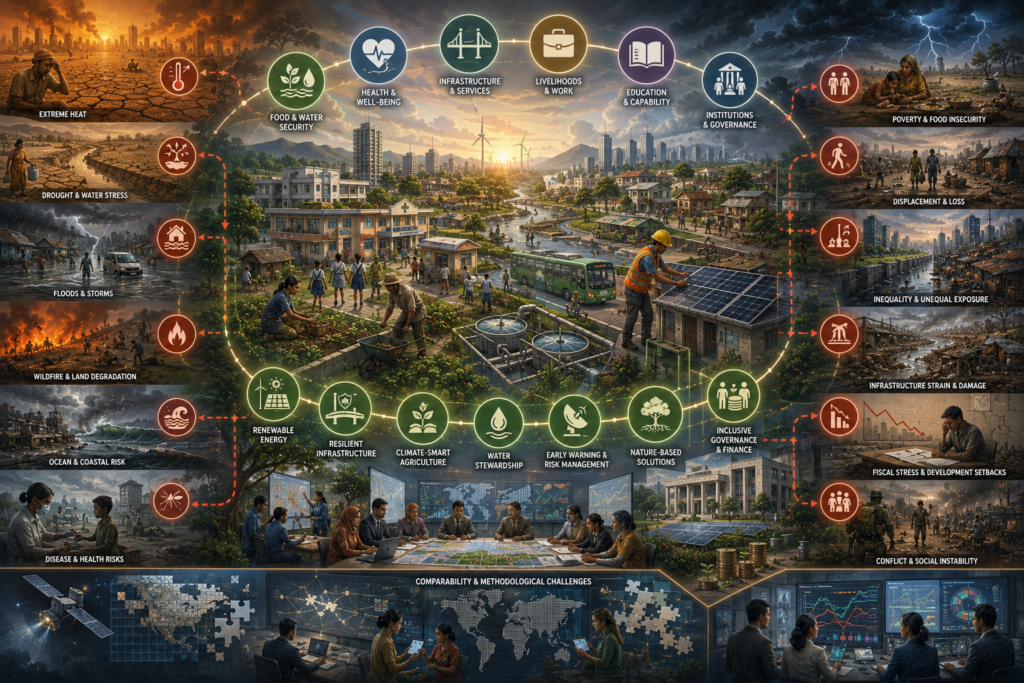
Abstract sustainability illustration of climate change as a development constraint, showing habitability, food and water stress, health risks, infrastructure strain, poverty, unequal exposure, adaptation, mitigation, governance, and climate-resilient development.

Climate Change as a Development Constraint

Climate Change as a Development Constraint examines why climate change must be understood not only as an environmental problem but as a structural condition shaping whether societies can reduce poverty, protect health, secure food and water, sustain livelihoods, build resilient infrastructure, and govern long-run change under increasingly unstable conditions. The article argues that development does not occur outside climate but within climatic systems that shape agriculture, disease burdens, settlement patterns, productivity, public finance, and social stability. It explores habitability, human capability, poverty and vulnerability, food and water stress, health burdens, infrastructure strain, justice, and long-horizon planning, showing how climate disruption turns into a direct constraint on durable development. The core claim is that sustainable development depends not only on expanding wellbeing today, but on preserving and widening human possibility under the changing conditions of a warming world.

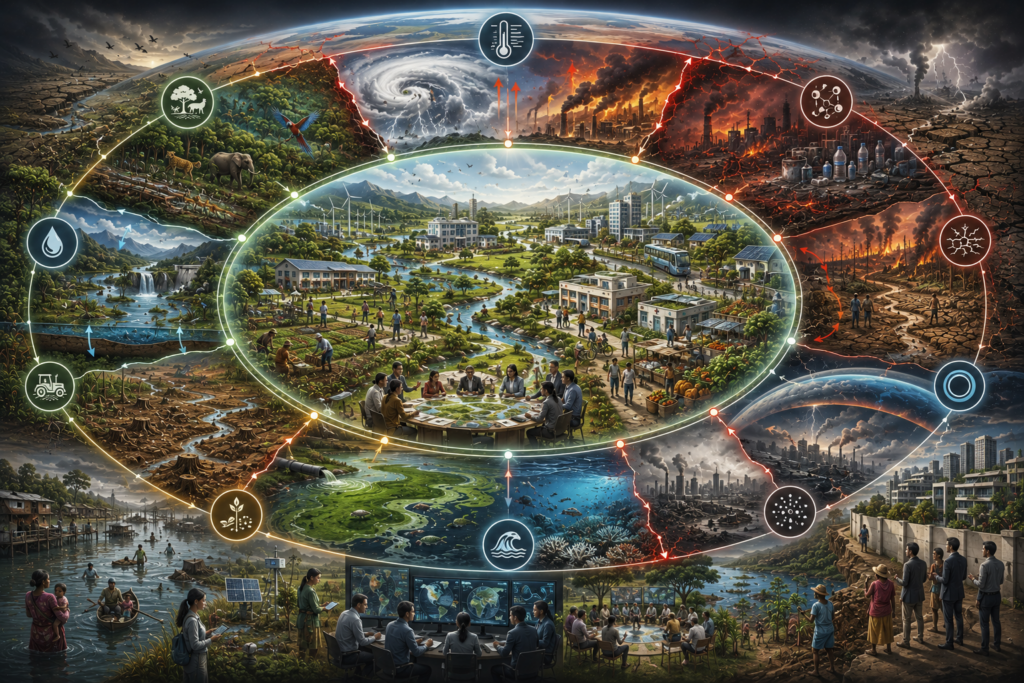
Abstract sustainability illustration of planetary boundaries and sustainable development, showing safe operating space, Earth-system stability, climate change, biosphere integrity, freshwater change, land systems, nutrient flows, ocean stress, pollution, governance, justice, and long-run human viability.

Planetary Boundaries and Sustainable Development

Planetary Boundaries and Sustainable Development examines why development must be understood as unfolding within an Earth system whose stability, resilience, and biophysical integrity shape whether human societies can thrive over the long run. The article argues that planetary boundaries are not a peripheral environmental warning but a framework for identifying the ecological conditions of durable development, because growth, infrastructure, and welfare gains become self-undermining when they destabilize the systems on which future life depends. It explores habitability, safe operating space, boundary transgression, overshoot, justice, and governance, showing how Earth-system pressures translate into developmental risk. The core claim is that sustainable development must be judged not only by present gains in output or wellbeing, but by whether those gains are being pursued within conditions compatible with planetary stability, social resilience, and future human possibility.

Abstract sustainability illustration of human development indicators and their limits, showing composite metrics, HDI-style measurement, hidden inequality, gender gaps, poverty, planetary pressure, data quality, rankings, and lived realities beyond averages.

Human Development Indicators and Their Limits

Human Development Indicators and Their Limits examines why development cannot be governed, compared, or improved without measurement, yet also cannot be reduced to the metrics used to represent it. The article argues that indicators such as the Human Development Index are indispensable because they make social conditions visible across time and place, but they remain selective approximations shaped by methodological choices about what counts, what can be measured, and what forms of human flourishing can be translated into data. It explores the HDI, inequality, gender, multidimensional poverty, planetary pressure, data quality, rankings, and hidden heterogeneity, showing how indicators both clarify and distort development realities. The core claim is that sustainable development requires indicators as essential tools of governance, but also the interpretive judgment to understand what they reveal, what they suppress, and what remains beyond numerical summary.

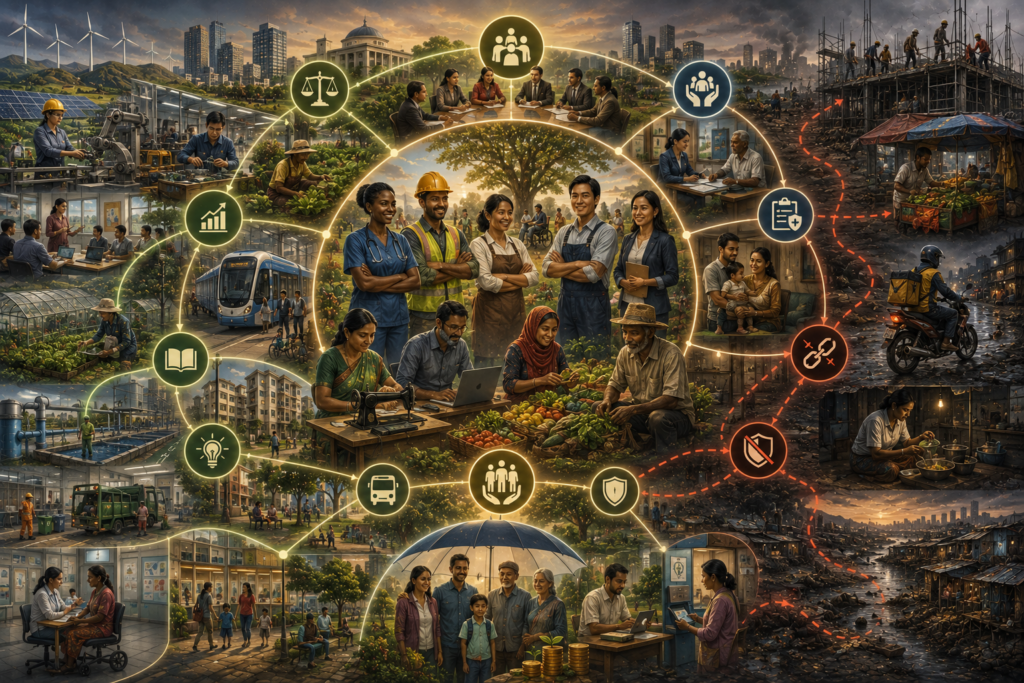
Abstract sustainability illustration of work, livelihoods, and decent employment, showing diverse workers, income security, labor rights, social protection, informal work, precarious work, care work, platform work, youth opportunity, and sustainable development.

Work, Livelihoods, and Decent Employment

Work, Livelihoods, and Decent Employment examines why work must be understood not only as labor-market participation but as one of the main institutions through which people secure income, dignity, social membership, agency, and protection against vulnerability over time. The article argues that development cannot be judged by employment quantity alone, because livelihoods become developmentally meaningful only when work is reasonably secure, rights-protecting, productive, and compatible with human dignity. It explores livelihoods, social recognition, decent work, informality, precarity, labour rights, social protection, youth exclusion, gender inequality, and technological change, showing how labor systems can either widen or narrow human capability. The core claim is that sustainable development requires not just jobs, but labor systems that create fair, stable, and decent livelihood pathways through which people can live and flourish with dignity

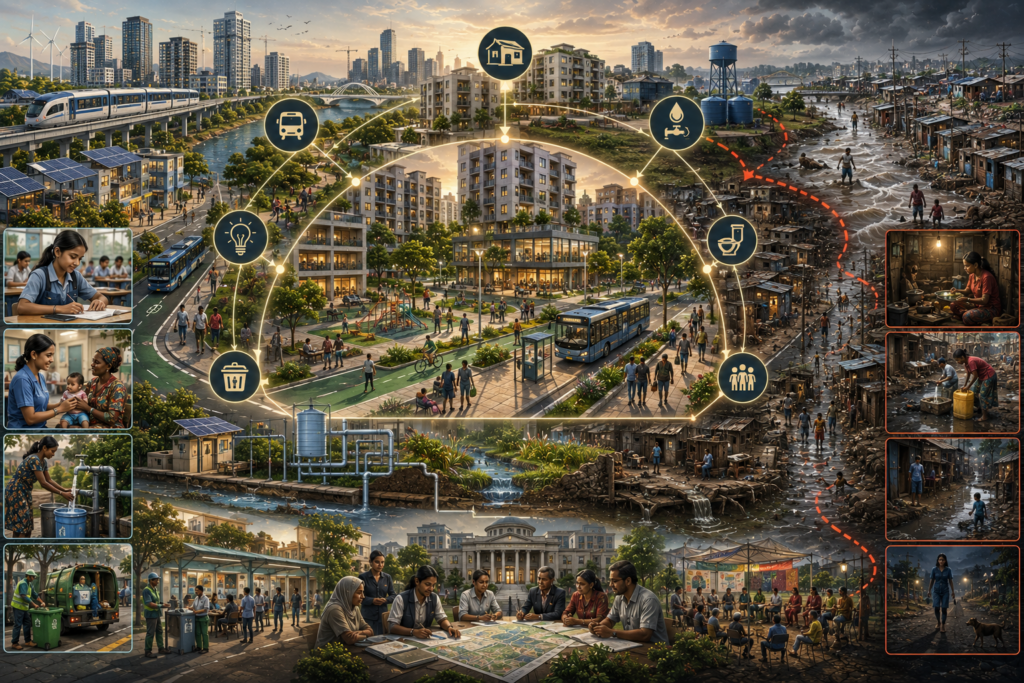
Editorial sustainability illustration showing inclusive urban development through housing, public transit, water, sanitation, energy, schools, clinics, civic institutions, informal settlements, service inequality, and climate-related urban risk.

Urbanization, Housing, and Basic Services

Urbanization, Housing, and Basic Services examines why cities and human settlements must be understood not only as sites of population concentration and economic activity, but as developmental environments that shape access to housing, water, sanitation, energy, mobility, safety, and institutional inclusion. The article argues that urbanization is not successful simply because cities grow, but only when housing and services are organized in ways that widen human capability, urban citizenship, and long-run governability. It explores housing adequacy, affordability, real access, informality, service interdependence, inequality, resilience, and urban governance, showing how unequal settlement conditions can convert urban growth into precarity and exclusion. The core claim is that sustainable development requires cities that are not only productive, but materially habitable, institutionally inclusive, and supported by housing and service systems that make urban life genuinely livable for all.

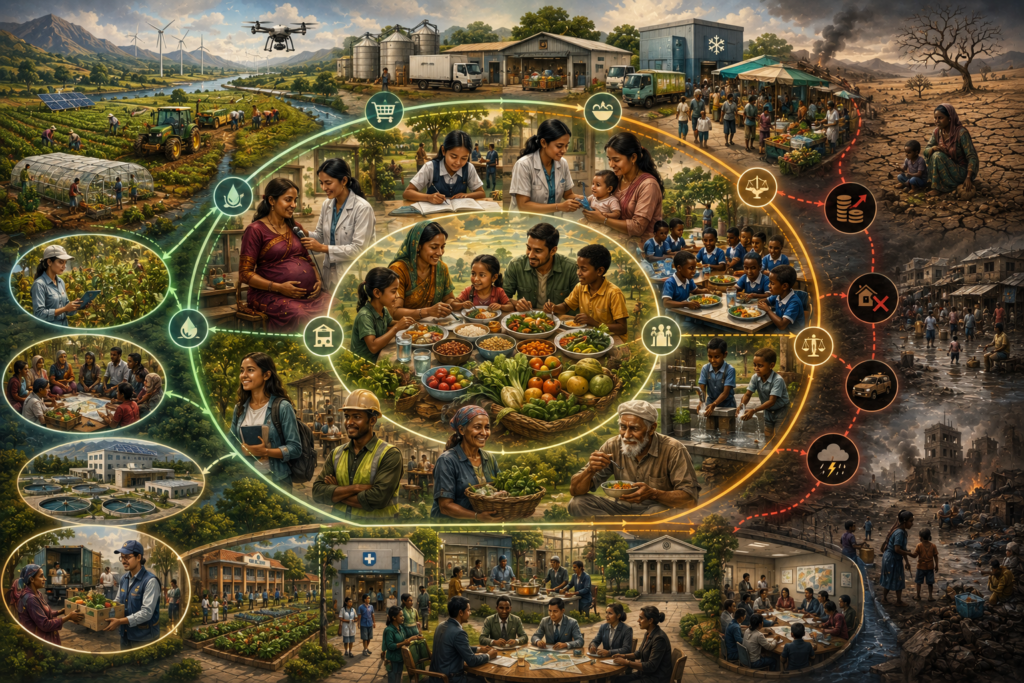
Editorial sustainability illustration showing food security, nutrition, and human development through healthy meals, farms, markets, water systems, schools, clinics, public institutions, food access, affordability, resilience, and climate-related food-system stress.

Food Security, Nutrition, and Human Development

Food Security, Nutrition, and Human Development examines why food must be understood not only as a matter of commodity supply or calories, but as a condition of bodily capability, cognitive development, public health, and long-run human resilience. The article argues that food security is broader than aggregate availability because development depends on whether people can reliably access safe, nutritious, and affordable diets under real social and economic conditions. It explores access, affordability, utilization, nutrition across the life course, food-system resilience, poverty, inequality, and governance, showing how food insecurity becomes a direct constraint on human capability expansion. The core claim is that sustainable development requires food systems that are not only productive, but equitable, resilient, and capable of supporting healthy lives and meaningful human flourishing over time.

Cinematic sustainability illustration of gender exclusion and development justice, showing unequal access to education, health, bodily autonomy, care support, work, safety, institutional power, public voice, mobility, and substantive freedom.

Gender, Exclusion, and Development Justice

Gender, Exclusion, and Development Justice examines why gender must be understood not as a secondary social variable but as one of the ways development itself is organized, distributed, and experienced. The article argues that development cannot be considered inclusive or just when access to education, health, bodily autonomy, work, property, time, safety, and political voice remains structured by gendered exclusion. It explores capability formation, reproductive justice, unpaid care burdens, institutional power, violence, and intersectionality, showing how formal equality can coexist with deeply unequal substantive freedom. The core claim is that sustainable development requires more than incorporating women and girls into an unchanged system; it requires changing the social and institutional terms on which freedom, protection, and participation are shared across gendered lines.

Editorial sustainability illustration showing inequality and inclusive development through unequal access to schools, clinics, public transit, housing, institutions, opportunity, environmental protection, and civic participation.

Inequality and Inclusive Development

Inequality and Inclusive Development examines why development cannot be judged by growth or average progress alone when access to health, education, income security, public goods, and institutional voice remains distributed unequally. The article argues that inequality is not only a matter of uneven outcomes, but a structural problem of unequal capability formation, unequal exposure to risk, and unequal power over the systems that shape life chances. It explores opportunity, public institutions, human development, social cohesion, and inequality within and among countries, showing how development can appear successful in the aggregate while remaining exclusionary in substance. The core claim is that sustainable development requires more than raising averages: it requires widening the real terms of participation, protection, mobility, and human possibility so that development is broadly shared rather than concentrated among the already advantaged.

Scroll to Top