
Last Updated May 7, 2026
Planetary boundaries matter for sustainable development because development does not take place on a neutral backdrop. It unfolds within an Earth system whose stability, resilience, and biophysical integrity condition whether human societies can thrive over the long run. If development expands output, infrastructure, welfare, and consumption while destabilizing the ecological systems on which future life depends, then it becomes self-undermining. The planetary-boundaries framework addresses this problem by identifying critical Earth-system processes whose disruption increases the risk that human development will proceed outside a safe operating space.
In that sense, planetary boundaries are not a peripheral environmental warning. They are one of the strongest efforts to define the ecological conditions of durable development. They ask whether prosperity, poverty reduction, health, food security, infrastructure, urbanization, industry, and human capability are being pursued in ways that preserve the planetary stability on which those very gains depend.
Main Library
Publications
Article Map
Sustainable Development
Related Topic
Planetary Boundaries
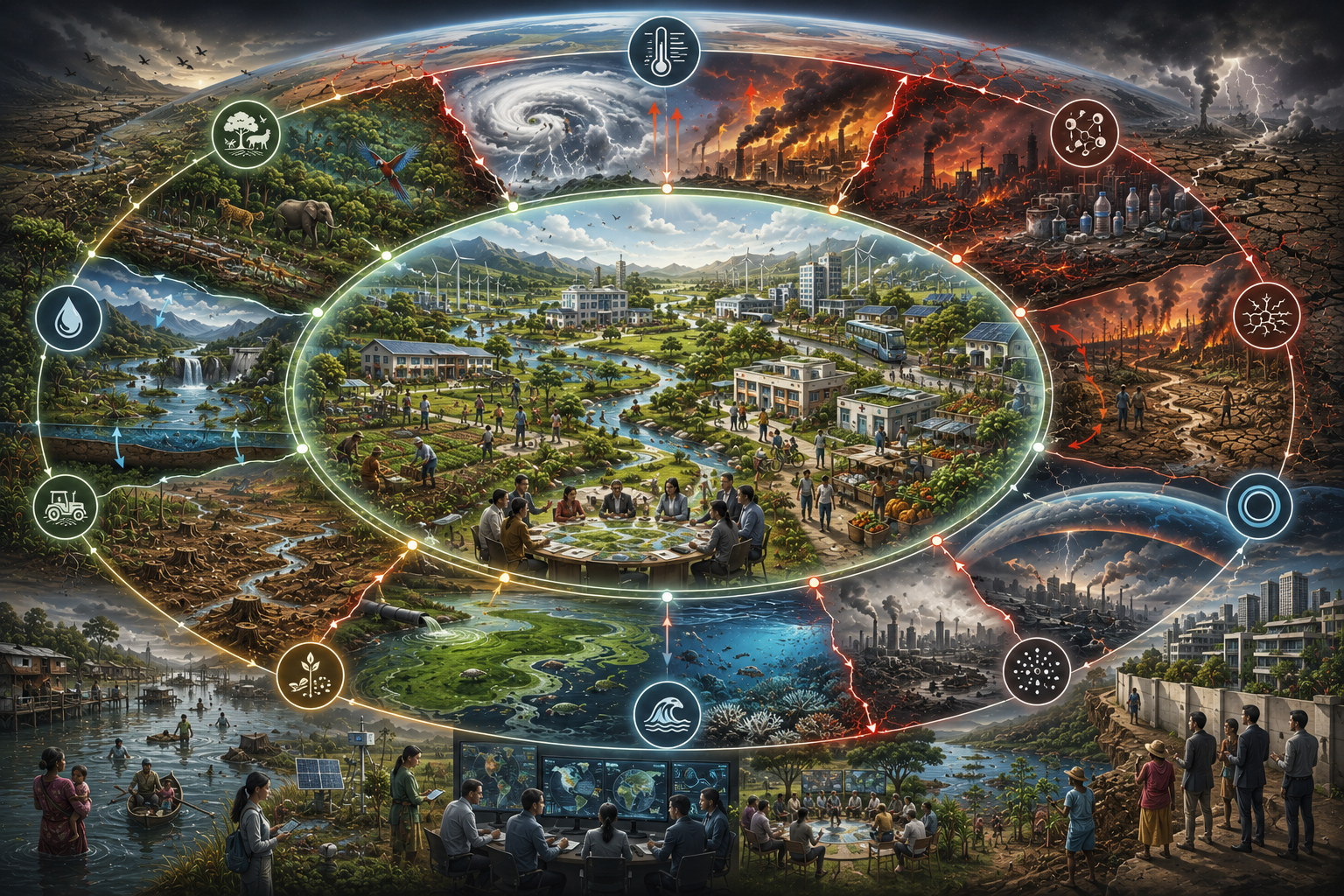
The 2030 Agenda describes itself as a plan of action for people, planet, and prosperity, and states that eradicating poverty is an indispensable requirement for sustainable development. That triad matters because it rejects the idea that ecological systems can be treated as external to development while prosperity advances independently. The Agenda presents poverty eradication as indispensable, but it also frames planetary protection as integral to the same project. This is precisely where the planetary-boundaries framework becomes developmentally important: it gives biophysical structure to the question of what “planet” means in practical terms.
The 2015 update to the framework made this connection explicit in its title, Planetary Boundaries: Guiding Human Development on a Changing Planet. That wording is conceptually important because it situates Earth-system thresholds within a development framework rather than outside it. Later assessments sharpened the force of the argument. The 2023 update concluded that six of the nine boundaries were transgressed, while current Stockholm Resilience Centre materials report that seven of nine are now breached, with ocean acidification newly crossing the boundary. Planetary boundaries are therefore no longer only a forward-looking warning about future excess. They are increasingly a way of describing the unstable environmental conditions within which development is already unfolding.
What Planetary Boundaries Are
The planetary-boundaries framework identifies critical Earth-system processes that regulate the stability and resilience of the planet and asks whether human activity is pushing them beyond relatively safe operating conditions. Its central claim is that Earth-system stability is not something that can simply be assumed while development proceeds. It depends on underlying biophysical processes that can be pressured, destabilized, and, in some cases, pushed into more hazardous ranges.
Stockholm Resilience Centre describes the framework as quantitative assessments of the safe limits for human pressure on nine critical global processes that regulate the stability and resilience of Earth. That phrasing matters because the framework does not treat environmental degradation as a loose collection of separate harms. It treats the Earth system as a set of interacting processes whose stability is central to human possibility.
This is important because the framework shifts sustainability away from vague appeals to environmental concern and toward a more structured account of systemic conditions. The question is no longer only whether environmental harm exists in general, but whether core Earth-system processes are being pushed into ranges that increase the risk of destabilization, nonlinearity, and cascading effects. Planetary boundaries therefore bring system behavior to the center of sustainability analysis.
In development terms, this means that ecological limits are not best understood as external constraints imposed on otherwise autonomous economies. They are part of the enabling conditions of long-run human development itself. Food systems, public health, infrastructure, cities, water systems, energy systems, and livelihoods all depend on planetary processes that remain stable enough to support social coordination across time.
This places the article in direct continuity with Safe Operating Space and the Conditions of Long-Run Development, where the broader idea of operating conditions is treated as central to development.
Why the Framework Matters for Sustainable Development
The framework matters because sustainable development is concerned not only with improvement in the present, but with whether improvement can endure without undermining its own future conditions. The 2030 Agenda’s framing of people, planet, and prosperity implies that development is internally linked to ecological integrity rather than merely balanced against it. Planetary boundaries sharpen that implication by specifying the Earth-system conditions within which human societies can continue to develop with lower risk of destabilization.
This is why the language of guiding human development is so important. It rejects the idea that planetary boundaries are relevant only to environmental management. The framework instead insists that ecological conditions are part of the developmental question itself. Once that move is made, the meaning of sustainable development becomes more demanding. Development is no longer simply about adding environmental considerations to social and economic goals. It becomes a question of whether those goals are being pursued within the conditions that make their long-run continuation possible.
Put differently, planetary boundaries matter for sustainable development because they ask whether development is occurring within conditions that preserve the possibility of continued development for future generations rather than quietly eroding it. This is especially important because many development gains are visible in the short term, while ecological degradation often produces delayed, cumulative, and unevenly distributed harms. The political economy of development can therefore reward present expansion while discounting future instability.
The framework also clarifies why sustainability cannot be reduced to environmental clean-up after growth has occurred. If the mode of growth itself pushes Earth systems toward instability, then environmental protection cannot remain a secondary repair function. It must become part of the logic of development planning, public investment, industrial strategy, agriculture, infrastructure, and urbanization.
This also aligns naturally with The Brundtland Definition and Its Legacy, because the Brundtland formulation already centered the relationship between present needs and future generations. Planetary boundaries give that intergenerational concern a sharper Earth-system structure.
Habitability and the Conditions of Human Development
One of the strongest ways to understand planetary boundaries is through the idea of habitability. Human development depends on more than institutions, income, and technology. It also depends on whether the world remains materially inhabitable in the first place. Climatic stability, functioning water systems, biosphere integrity, fertile land systems, ocean chemistry, and relatively predictable environmental conditions are not optional advantages. They are part of the background structure that makes health, settlement, food production, and social coordination possible.
This matters because development discourse often focuses on visible social outputs while taking Earth-system conditions for granted. But if those conditions are destabilized, then the field within which development occurs becomes more volatile, less predictable, and harder to govern. Agricultural systems become more fragile, public-health burdens intensify, infrastructure becomes harder to maintain, insurance and adaptation costs rise, and vulnerable communities face repeated shocks before they have time to recover.
Habitability also connects ecological stability to human dignity. A society cannot meaningfully expand capability if people face worsening heat exposure, water insecurity, crop failure, toxic pollution, coastal loss, ecosystem collapse, and repeated disaster displacement. These are not merely environmental harms; they become development constraints because they narrow the real possibilities available to human beings.
Planetary boundaries help make this clearer by shifting attention from environmental degradation in the abstract to the stability conditions of human life itself. They ask whether the world being produced through development remains livable enough for development to continue. This turns ecological integrity into a foundational development concern rather than a specialized environmental topic.
Habitability therefore belongs inside development analysis. It is one of the conditions under which health, education, work, housing, food security, infrastructure, social trust, and institutional resilience can be maintained across generations.
Safe Operating Space and Human Development
One of the framework’s most influential concepts is the idea of a safe operating space for humanity. This concept matters because it reframes development as a question of operating conditions rather than simply aggregate achievement. Human societies do not develop in the abstract. They develop within climatic, hydrological, ecological, geochemical, and biological systems whose stability shapes whether long-run wellbeing remains possible. Stockholm Resilience Centre states that only by respecting all nine boundaries can humanity maintain a safe operating space.
This has major consequences for development thinking. A society may expand income, infrastructure, and consumption in the short run while simultaneously weakening the larger system conditions that support health, agriculture, water security, settlement stability, and resilience. The safe-operating-space concept reveals that such a development path may be materially impressive yet structurally unstable.
Safe operating space should therefore be understood not as an environmental luxury threshold, but as one of the background conditions of durable human development. It identifies the zone within which development can proceed with lower risk of becoming self-subverting. When societies move outside that zone, they do not instantly collapse, but they enter more uncertain and potentially hazardous operating conditions.
This distinction matters because boundary transgression is not a simple cliff-edge metaphor. It is a risk framework. It warns that human pressures may move Earth-system processes into ranges where feedbacks, nonlinearity, cascading effects, and regional shocks become more likely. Development policy must therefore treat safe operating space as a risk-management concept as well as an ethical and ecological one.
This section also connects directly to Intergenerational Justice and Long-Term Stewardship, since the future depends on what operating conditions are being passed forward. A generation does not only leave behind wealth, infrastructure, knowledge, and institutions. It also leaves behind a planetary condition.
From Growth Metrics to Earth-System Conditions
Traditional development analysis often privileges output, income growth, or sectoral expansion. Those remain important, especially where poverty and deprivation remain acute. But planetary boundaries reveal that development cannot be judged by growth indicators alone. A growth path may raise output while destabilizing climate, degrading biosphere integrity, altering freshwater systems, intensifying biogeochemical disruption, or spreading novel entities that are difficult to monitor, control, or reverse. In such cases, development is occurring through the erosion of its own ecological preconditions.
This is why planetary boundaries help move sustainable development away from a purely additive model in which societies simply pursue more growth plus some environmental management. Instead, the framework asks whether the mode of development itself remains compatible with Earth-system stability. That is a much more demanding standard because it evaluates growth not only by what it produces, but by the conditions through which it produces it.
In this sense, the framework does not reject development. It redefines what counts as developmentally viable. It asks whether gains are being achieved in ways that preserve continuity rather than convert present expansion into future fragility. A development path that improves present indicators while weakening future habitability has not solved the development problem. It has displaced part of the cost into the future and onto those least able to absorb it.
This is especially important for infrastructure, industry, energy, agriculture, housing, and transport. These systems shape human wellbeing, but they also shape material throughput, emissions, land use, water use, chemical flows, and ecological fragmentation. The planetary-boundaries framework therefore pushes development analysis toward systems thinking: how are social benefits being produced, what pressures do they create, and can those pressures remain within safe operating conditions?
This section complements Growth, Limits, and the Problem of Overshoot, because overshoot is not only about too much consumption in the abstract. It is about development systems exceeding the conditions that make development durable.
The Nine Boundaries and Their Developmental Meaning
The framework covers nine major Earth-system processes. Stockholm Resilience Centre’s current table and overview identify climate change, ocean acidification, stratospheric ozone depletion, atmospheric aerosol loading, biogeochemical flows, freshwater change, land-system change, biosphere integrity, and novel entities as the nine boundaries. What matters developmentally is not only the scientific classification of each boundary, but what kinds of human systems depend on them.
Climate change affects infrastructure, heat exposure, health, agriculture, settlement patterns, disaster risk, water availability, labor productivity, public finance, and adaptation burdens. Biosphere integrity affects ecological resilience, pollination, pest regulation, genetic diversity, food webs, and life-support functions that are difficult to replace technologically. Freshwater change shapes agriculture, sanitation, industry, health, settlement, conflict risk, and urban resilience.
Biogeochemical flows influence soils, water quality, eutrophication, dead zones, ecosystem stability, and agricultural sustainability. Land-system change affects forests, carbon storage, biodiversity, hydrology, livelihoods, and Indigenous and local communities. Ocean acidification affects marine ecosystems, fisheries, coral systems, and coastal livelihoods. Atmospheric aerosol loading affects health, monsoon systems, climate dynamics, and regional environmental quality. Stratospheric ozone depletion shows how human chemicals can disrupt planetary-scale protective systems, while also showing that coordinated global governance can reduce certain risks. Novel entities raise questions about cumulative chemical, plastic, radioactive, industrial, and synthetic-material disruption whose long-term interactions are often difficult to fully assess.
These are not separate environmental sectors in any narrow sense. They are conditions of human social and economic life. That is precisely why the framework belongs inside sustainable development rather than alongside it. Food systems depend on climate, freshwater, biodiversity, land, soils, and nutrients. Cities depend on climate stability, water security, air quality, land systems, and resilience. Health systems depend on environmental conditions that shape disease, nutrition, heat stress, and exposure. Economic systems depend on stable material and ecological foundations.
Seen in this way, each boundary is developmentally meaningful because each marks part of the environmental architecture that makes continued human settlement, health, and productive activity possible. This section also aligns with Freshwater Change and Development Risk and Food Security, Nutrition, and Human Development.
Boundary Transgression, Overshoot, and Developmental Risk
Boundary transgression matters because it signals rising developmental risk, not just ecological deterioration in the abstract. The significance of overshoot is that human societies can continue to generate output and even visible welfare gains while the underlying resilience of Earth systems is being eroded. That delay between appearance and consequence is precisely what makes overshoot politically dangerous. Development can look successful while silently becoming more brittle.
This is a core challenge for sustainable development because many of its failures are delayed failures. Systems may continue to function well enough in the present even as the background conditions supporting them are weakened. The visible gains of today may therefore be financed by the less visible instability of tomorrow. The 2023 update found six boundaries transgressed, and current Stockholm Resilience Centre materials report seven breached, underscoring that this risk is not merely hypothetical.
Overshoot also becomes harder to govern because ecological systems are interconnected. Pressure in one boundary area may increase vulnerability in another. Climate change can intensify biosphere loss, freshwater stress, land-system pressure, and food-system fragility. Biodiversity loss can weaken resilience to climate and nutrient disruption. Land-system change can affect carbon cycles, hydrology, local climate, and species integrity. Development risk therefore emerges not only from individual boundary breaches, but from the interactions among them.
For sustainable development, this means that present success cannot be judged independently of future system viability. Boundary transgression is a warning that the background conditions of development are being pushed into less stable ranges. It is therefore a warning about the durability of development itself.
This section pairs directly with Boundary Transgression and Development Fragility. Fragility does not arise only from weak states, conflict, or economic shocks. It can also arise from biophysical instability that makes food systems, water systems, health systems, and infrastructure more difficult to sustain.
Justice, Uneven Responsibility, and Uneven Exposure
Planetary boundaries raise profound justice questions. Responsibility for transgressing Earth-system boundaries is not equally distributed, nor are the burdens of destabilization. High-consuming populations, historically carbon-intensive development paths, and ecologically extractive economic systems have contributed disproportionately to many of the pressures now threatening planetary stability. Meanwhile, many lower-income societies remain more vulnerable to the consequences and still have urgent unmet development needs.
This tension sits at the heart of sustainable development’s moral difficulty. The framework cannot be read as a simple call for universal restraint detached from history, inequality, and differentiated responsibility. Development still requires poverty reduction, food security, housing, health, education, infrastructure, energy access, and public capacity. The harder question is how those aims can be pursued within planetary limits without reproducing the same high-throughput and highly unequal models that helped destabilize the Earth system in the first place.
Planetary boundaries therefore intensify, rather than replace, the need for justice-centered development thinking. They reveal that sustainability cannot be separated from distribution, historical responsibility, and uneven vulnerability. The communities least responsible for planetary stress may face disproportionate exposure to heat, flooding, crop failure, water insecurity, disease risk, and displacement. At the same time, poorer societies may be told to constrain development pathways after wealthier societies have already used a large share of ecological space.
This creates a double obligation. High-pressure economies must reduce material and ecological pressure rapidly, while global development systems must support the expansion of basic human capability where deprivation remains severe. The point is not to freeze inequality in the name of planetary stability. It is to make development compatible with planetary stability through fairer distribution, technology access, public finance, repair, adaptation, and more responsible consumption and production systems.
This aligns closely with Inequality and Inclusive Development. A safe operating space cannot be legitimate if it is imagined without justice, and justice cannot be durable if it ignores the ecological conditions of future life.
Governance, Policy, and Development Within Planetary Limits
If planetary boundaries matter for development, then governance becomes the practical question of how societies respond to that knowledge. The challenge is not only to recognize that boundaries exist, but to build institutions capable of governing economic and social development with regard to long-range Earth-system conditions. Stockholm Resilience Centre emphasizes that the boundaries are interdependent and that action affecting one process affects the risks faced by others.
This is difficult because most political and administrative systems are organized sectorally and short-term, while the processes captured by planetary boundaries are cumulative, interconnected, and often delayed in their visible consequences. That creates a mismatch between ecological reality and governance structure. Development within planetary limits therefore requires more than environmental regulation alone. It requires rethinking energy, agriculture, urbanization, infrastructure, production, consumption, trade, finance, and industrial strategy in relation to Earth-system resilience.
Governance also has to work across scales. Planetary boundaries are global in their Earth-system significance, but pressures and impacts are produced and experienced through national economies, cities, watersheds, landscapes, supply chains, firms, communities, and households. Effective governance must therefore connect global science with local conditions, national policy, international cooperation, and community-level adaptation. A purely global framing can miss local justice, while a purely local framing can miss planetary interaction.
Development within planetary limits also requires policy coherence. Climate mitigation cannot ignore biodiversity. Agricultural productivity cannot ignore nutrient flows, soil health, and freshwater systems. Urbanization cannot ignore land-system change, heat, water, and infrastructure resilience. Industrial policy cannot ignore material throughput and novel entities. A boundary-aware development strategy must therefore move beyond single-sector optimization.
In this sense, the framework is best understood not as a standalone scientific model, but as a challenge to the institutional imagination of development itself. It asks whether governance can become capable of acting on conditions that are planetary in scale, long-term in effect, and deeply entangled with present social justice. This section also connects clearly to Trade-Offs, Synergies, and Policy Coherence.
Strengths, Critiques, and Open Questions
The planetary-boundaries framework is powerful because it provides a structured Earth-system account of development limits, but it is not without controversy. Critics sometimes argue that global thresholds can obscure regional variation, distributional inequality, political economy, or the lived differences between high-consumption and low-consumption societies. Others worry that limits language can be appropriated in ways that underplay the development claims of poorer populations. These concerns are serious and should be treated seriously because sustainable development cannot be reduced to biophysical management alone.
Another concern is that boundaries are not all equally measurable, equally certain, or equally applicable at the same scale. Some boundaries have clearer global control variables than others. Some pressures are strongly regional but globally consequential. Some are easier to communicate than to govern. The framework’s authority therefore depends partly on how carefully it distinguishes between scientific confidence, policy relevance, and governance interpretation.
At the same time, the framework’s value does not depend on perfect precision. Its strength lies in clarifying that human development is embedded in a finite and dynamic Earth system whose stability cannot be assumed indefinitely. Even when specific boundaries or control variables remain scientifically debated, the larger insight remains intact: development must be assessed against biophysical conditions, not only economic ambition.
The framework is also valuable because it changes the burden of proof. It asks development systems to justify not only what they produce, but what they destabilize. It places long-run system integrity inside the evaluation of progress. That is a major conceptual contribution, especially in a world where short-term growth can be politically rewarded even when it increases long-term fragility.
The open question is therefore not whether development needs ecological conditions. It clearly does. The harder question is how to build just, inclusive, and politically feasible development pathways within those conditions. That is where the real work of sustainable development begins.
Why This Matters for Sustainable Development
Planetary boundaries matter for sustainable development because they make the ecological conditions of human progress explicit. They show that development cannot be judged only by current gains in income, infrastructure, consumption, or welfare. It must also be judged by whether those gains are being secured within Earth-system conditions that allow human societies to continue flourishing over time.
This matters because the modern development challenge is not simply how to grow, industrialize, urbanize, and expand services. It is how to do so without destabilizing climate, biosphere integrity, freshwater systems, land systems, oceans, nutrient cycles, and the chemical-material conditions of planetary life. The framework forces development thought to confront the possibility that some forms of apparent progress may be structurally self-defeating.
The planetary-boundaries lens also strengthens the justice agenda. It does not erase poverty eradication, human capability, housing, food security, health, or infrastructure. It makes their durability harder to ignore. Development that reduces poverty today while increasing climate disruption, water stress, biosphere loss, and future vulnerability is not fully successful. Development that protects planetary systems while denying basic needs is not just either. Sustainable development must hold both sides together.
The central claim is therefore demanding but unavoidable: long-run human development requires a safe and just operating space. It requires reducing ecological pressure where it is excessive, expanding basic capabilities where deprivation remains severe, and building institutions capable of governing systems whose consequences extend across sectors, borders, and generations.
Development becomes credible when it can advance human wellbeing without destroying the Earth-system conditions that make wellbeing possible.
Mathematical Lens
Planetary-boundaries-related development burden can be clarified by thinking in terms of Earth-system pressure, transgression intensity, social exposure, and governance capacity rather than output growth alone. Let \(D_p\) represent long-run planetary-development risk, \(P\) cumulative planetary pressure, \(T\) transgression intensity, \(E\) human exposure and dependence, and \(G\) governance and transition capacity:
D_p = \alpha P + \beta T + \gamma E – \delta G
\]
Interpretation: Planetary-development risk rises when ecological pressure, boundary transgression, and human exposure intensify, and falls when governance and transition capacity improve.
This captures the article’s core point: the danger comes not only from environmental pressure itself, but from how ecological overshoot interacts with unequal dependence, delayed response, and weak institutional capacity.
We can also express systemic fragility as a weighted function of breached boundaries, interdependence, and trend deterioration:
R_p = w_1 B + w_2 I + w_3 Z
\]
Interpretation: Systemic fragility rises when boundary breaches become more severe, interdependencies strengthen, and trends continue to deteriorate.
Here, \(B\) is the number or severity of breached boundaries, \(I\) is interdependence across Earth-system processes, and \(Z\) is worsening trend intensity. Higher \(R_p\) means societies face a more structurally unstable ecological operating space.
Finally, pathway resilience can be represented as a function of mitigation, restoration, and institutional coordination:
P_r = \lambda M + \mu R_s + \nu C
\]
Interpretation: Pathway resilience improves when pressure reduction, ecosystem restoration, and coherent governance strengthen together.
Here, \(M\) is mitigation and pressure reduction, \(R_s\) is restoration and system repair, and \(C\) is governance coherence across sectors and scales. This helps show why similar global conditions can produce very different developmental outcomes across places.
| Term | Meaning | Interpretive role |
|---|---|---|
| \(D_p\) | Planetary-development risk | Represents long-run development risk created by Earth-system pressure and weak response capacity. |
| \(P\) | Cumulative planetary pressure | Represents total human pressure on Earth-system processes. |
| \(T\) | Transgression intensity | Represents the severity with which boundaries are breached or approached. |
| \(E\) | Human exposure and dependence | Represents the degree to which societies depend on vulnerable ecological systems and face exposure to destabilization. |
| \(G\) | Governance and transition capacity | Represents institutional ability to reduce pressure, coordinate policy, adapt, and support just transition pathways. |
| \(R_p\) | Systemic fragility | Represents interacting ecological fragility across breached boundaries, interdependence, and worsening trends. |
| \(P_r\) | Pathway resilience | Represents the strength of mitigation, restoration, and governance coherence in reducing long-run risk. |
The equations are conceptual rather than predictive. Their value is to make visible the structure of the problem: planetary-development risk depends on ecological pressure, boundary transgression, human exposure, governance capacity, restoration, and policy coherence working together.
Advanced Python Workflow: Planetary Boundaries and Development Risk Scoring
This Python workflow translates the article’s core argument into a structured planetary-boundaries development model. Rather than treating overshoot as a single abstract warning, it scores territories across climate stress, biosphere degradation, freshwater stress, land-system stress, biogeochemical pressure, novel-entities burden, justice exposure, governance capacity, restoration capacity, and transition readiness. That makes it possible to compare not only where ecological pressure is high, but where boundary transgression is becoming most developmentally consequential.
from __future__ import annotations

import pandas as pd
import numpy as np

INPUT_FILE = "planetary_boundaries_panel.csv"
OUTPUT_FILE = "planetary_boundaries_development_scores.csv"


def load_data(path: str) -> pd.DataFrame:
    """
    Load a territory-level planetary boundaries and development risk dataset.

    All *_index columns should be normalized to [0, 1].
    Higher values should mean more of the named property.

    Examples:
      - climate_stress_index: higher = greater climate-related stress
      - biosphere_integrity_loss_index: higher = greater biosphere degradation
      - justice_exposure_index: higher = greater exposure among vulnerable communities
      - governance_capacity_index: higher = stronger public governance capacity
    """
    df = pd.read_csv(path)

    required_columns = [
        "territory_name",
        "country_or_region",
        "territory_type",
        "climate_stress_index",
        "biosphere_integrity_loss_index",
        "freshwater_change_index",
        "land_system_change_index",
        "biogeochemical_pressure_index",
        "novel_entities_burden_index",
        "ocean_acidification_exposure_index",
        "atmospheric_aerosol_exposure_index",
        "justice_exposure_index",
        "governance_capacity_index",
        "transition_readiness_index",
        "restoration_capacity_index",
        "policy_coherence_index",
    ]

    missing = [col for col in required_columns if col not in df.columns]

    if missing:
        raise ValueError(f"Missing required columns: {missing}")

    return df


def validate_indices(df: pd.DataFrame) -> pd.DataFrame:
    """Validate that all *_index fields are complete and normalized to [0, 1]."""
    index_columns = [col for col in df.columns if col.endswith("_index")]

    for col in index_columns:
        if df[col].isna().any():
            raise ValueError(f"Column '{col}' contains missing values.")

        if ((df[col] < 0) | (df[col] > 1)).any():
            raise ValueError(f"Column '{col}' contains values outside [0, 1].")

    return df


def compute_scores(df: pd.DataFrame) -> pd.DataFrame:
    """
    Compute Earth-system stress, development exposure,
    governance readiness, and constrained planetary development risk.

    Earth-system stress rises with climate stress, biosphere integrity loss,
    freshwater change, land-system change, biogeochemical pressure,
    novel entities burden, ocean acidification, and aerosol exposure.

    Governance readiness rises with governance capacity, transition readiness,
    restoration capacity, and policy coherence.
    """
    df = df.copy()

    df["earth_system_stress_score"] = (
        0.16 * df["climate_stress_index"] +
        0.16 * df["biosphere_integrity_loss_index"] +
        0.14 * df["freshwater_change_index"] +
        0.13 * df["land_system_change_index"] +
        0.13 * df["biogeochemical_pressure_index"] +
        0.12 * df["novel_entities_burden_index"] +
        0.09 * df["ocean_acidification_exposure_index"] +
        0.07 * df["atmospheric_aerosol_exposure_index"]
    ).clip(lower=0, upper=1)

    df["development_exposure_score"] = (
        0.34 * df["justice_exposure_index"] +
        0.18 * df["biosphere_integrity_loss_index"] +
        0.17 * df["freshwater_change_index"] +
        0.13 * df["climate_stress_index"] +
        0.10 * df["land_system_change_index"] +
        0.08 * df["ocean_acidification_exposure_index"]
    ).clip(lower=0, upper=1)

    df["governance_readiness_score"] = (
        0.30 * df["governance_capacity_index"] +
        0.26 * df["transition_readiness_index"] +
        0.22 * df["restoration_capacity_index"] +
        0.22 * df["policy_coherence_index"]
    ).clip(lower=0, upper=1)

    df["constrained_planetary_development_score"] = (
        0.40 * df["earth_system_stress_score"] +
        0.25 * df["development_exposure_score"] +
        0.15 * df["justice_exposure_index"] +
        0.12 * (1 - df["governance_readiness_score"]) +
        0.08 * (1 - df["restoration_capacity_index"])
    ).clip(lower=0, upper=1)

    df["risk_band"] = np.select(
        [
            df["constrained_planetary_development_score"] >= 0.80,
            df["constrained_planetary_development_score"] >= 0.60,
            df["constrained_planetary_development_score"] >= 0.40,
        ],
        [
            "Extreme planetary-development risk",
            "High planetary-development risk",
            "Moderate planetary-development risk",
        ],
        default="Lower planetary-development risk",
    )

    df["planetary_governance_gap"] = (
        df["earth_system_stress_score"] -
        df["governance_readiness_score"]
    )

    df["planetary_warning"] = np.select(
        [
            df["planetary_governance_gap"] >= 0.35,
            df["planetary_governance_gap"] >= 0.20,
            df["planetary_governance_gap"] >= 0.05,
        ],
        [
            "Severe planetary governance gap",
            "High planetary governance gap",
            "Moderate planetary governance gap",
        ],
        default="Lower governance gap or stronger transition capacity",
    )

    return df


def build_summary(df: pd.DataFrame) -> pd.DataFrame:
    """Return a ranked summary table for review or reporting."""
    columns = [
        "territory_name",
        "country_or_region",
        "territory_type",
        "earth_system_stress_score",
        "development_exposure_score",
        "governance_readiness_score",
        "constrained_planetary_development_score",
        "risk_band",
        "planetary_governance_gap",
        "planetary_warning",
    ]

    summary = df[columns].copy()

    summary = summary.sort_values(
        by=[
            "constrained_planetary_development_score",
            "earth_system_stress_score",
            "development_exposure_score",
        ],
        ascending=[False, False, False],
    ).reset_index(drop=True)

    return summary


def main() -> None:
    df = load_data(INPUT_FILE)
    df = validate_indices(df)
    scored = compute_scores(df)
    summary = build_summary(scored)

    summary.to_csv(OUTPUT_FILE, index=False)

    print("Planetary boundaries and development risk scoring complete.")
    print(summary.to_string(index=False))


if __name__ == "__main__":
    main()
This workflow is intentionally transparent. It does not claim that planetary-development risk can be reduced to one objective score. Instead, it makes assumptions visible: climate stress, biosphere integrity loss, freshwater change, land-system change, nutrient pressure, novel entities, ocean acidification, aerosol exposure, justice exposure, governance capacity, transition readiness, restoration capacity, and policy coherence are treated as distinct components. The value of the model is diagnostic. It helps identify where ecological overshoot is most likely to become a development constraint.
Advanced R Workflow: Boundary Burden, Exposure, and Governance Gap Analysis
This R workflow is designed for the part of the article that emphasizes variation across territories, exposure patterns, and governance capacity. It compares settings across climate, biosphere, freshwater, land, nutrients, novel entities, ocean acidification, aerosol exposure, justice exposure, restoration capacity, and policy coherence, then builds grouped summaries that help show where planetary-boundaries stress is strongest and where unequal developmental burden remains most severe.
library(readr)
library(dplyr)

input_file <- "planetary_boundaries_country_panel.csv"
region_output_file <- "cross_region_planetary_summary.csv"
territory_output_file <- "cross_territory_planetary_summary.csv"

pb_df <- read_csv(input_file, show_col_types = FALSE)

required_cols <- c(
  "territory_name",
  "country_or_region",
  "territory_type",
  "climate_stress_index",
  "biosphere_integrity_loss_index",
  "freshwater_change_index",
  "land_system_change_index",
  "biogeochemical_pressure_index",
  "novel_entities_burden_index",
  "ocean_acidification_exposure_index",
  "atmospheric_aerosol_exposure_index",
  "justice_exposure_index",
  "governance_capacity_index",
  "transition_readiness_index",
  "restoration_capacity_index",
  "policy_coherence_index"
)

missing_cols <- setdiff(required_cols, names(pb_df))

if (length(missing_cols) > 0) {
  stop(paste("Missing required columns:", paste(missing_cols, collapse = ", ")))
}

index_cols <- names(pb_df)[grepl("_index$", names(pb_df))]

invalid_index_cols <- index_cols[
  vapply(
    pb_df[index_cols],
    function(x) any(is.na(x) | x < 0 | x > 1),
    logical(1)
  )
]

if (length(invalid_index_cols) > 0) {
  stop(
    paste(
      "Index columns must be complete and normalized to [0, 1]:",
      paste(invalid_index_cols, collapse = ", ")
    )
  )
}

pb_df <- pb_df %>%
  mutate(
    earth_system_stress_proxy = (
      climate_stress_index +
      biosphere_integrity_loss_index +
      freshwater_change_index +
      land_system_change_index +
      biogeochemical_pressure_index +
      novel_entities_burden_index +
      ocean_acidification_exposure_index +
      atmospheric_aerosol_exposure_index
    ) / 8,
    governance_readiness_proxy = (
      governance_capacity_index +
      transition_readiness_index +
      restoration_capacity_index +
      policy_coherence_index
    ) / 4,
    planetary_development_risk_proxy = (
      earth_system_stress_proxy +
      justice_exposure_index +
      (1 - governance_readiness_proxy) +
      (1 - restoration_capacity_index) +
      (1 - policy_coherence_index)
    ) / 5,
    planetary_governance_gap = earth_system_stress_proxy - governance_readiness_proxy,
    risk_band = case_when(
      planetary_development_risk_proxy >= 0.75 ~ "Extreme planetary-development risk",
      planetary_development_risk_proxy >= 0.55 ~ "High planetary-development risk",
      planetary_development_risk_proxy >= 0.35 ~ "Moderate planetary-development risk",
      TRUE ~ "Lower planetary-development risk"
    )
  )

region_summary <- pb_df %>%
  group_by(country_or_region) %>%
  summarise(
    avg_planetary_development_risk_proxy = mean(planetary_development_risk_proxy, na.rm = TRUE),
    avg_earth_system_stress_proxy = mean(earth_system_stress_proxy, na.rm = TRUE),
    avg_governance_readiness_proxy = mean(governance_readiness_proxy, na.rm = TRUE),
    avg_climate_stress = mean(climate_stress_index, na.rm = TRUE),
    avg_biosphere_integrity_loss = mean(biosphere_integrity_loss_index, na.rm = TRUE),
    avg_freshwater_change = mean(freshwater_change_index, na.rm = TRUE),
    avg_land_system_change = mean(land_system_change_index, na.rm = TRUE),
    avg_biogeochemical_pressure = mean(biogeochemical_pressure_index, na.rm = TRUE),
    avg_novel_entities_burden = mean(novel_entities_burden_index, na.rm = TRUE),
    avg_ocean_acidification_exposure = mean(ocean_acidification_exposure_index, na.rm = TRUE),
    avg_justice_exposure = mean(justice_exposure_index, na.rm = TRUE),
    avg_governance_capacity = mean(governance_capacity_index, na.rm = TRUE),
    avg_restoration_capacity = mean(restoration_capacity_index, na.rm = TRUE),
    avg_policy_coherence = mean(policy_coherence_index, na.rm = TRUE),
    avg_planetary_governance_gap = mean(planetary_governance_gap, na.rm = TRUE),
    observations = n(),
    .groups = "drop"
  ) %>%
  mutate(
    regional_risk_band = case_when(
      avg_planetary_development_risk_proxy >= 0.75 ~ "Extreme planetary-development risk",
      avg_planetary_development_risk_proxy >= 0.55 ~ "High planetary-development risk",
      avg_planetary_development_risk_proxy >= 0.35 ~ "Moderate planetary-development risk",
      TRUE ~ "Lower planetary-development risk"
    )
  ) %>%
  arrange(desc(avg_planetary_development_risk_proxy))

territory_summary <- pb_df %>%
  group_by(territory_type) %>%
  summarise(
    avg_planetary_development_risk_proxy = mean(planetary_development_risk_proxy, na.rm = TRUE),
    avg_earth_system_stress_proxy = mean(earth_system_stress_proxy, na.rm = TRUE),
    avg_governance_readiness_proxy = mean(governance_readiness_proxy, na.rm = TRUE),
    avg_climate_stress = mean(climate_stress_index, na.rm = TRUE),
    avg_biosphere_integrity_loss = mean(biosphere_integrity_loss_index, na.rm = TRUE),
    avg_freshwater_change = mean(freshwater_change_index, na.rm = TRUE),
    avg_land_system_change = mean(land_system_change_index, na.rm = TRUE),
    avg_biogeochemical_pressure = mean(biogeochemical_pressure_index, na.rm = TRUE),
    avg_novel_entities_burden = mean(novel_entities_burden_index, na.rm = TRUE),
    avg_ocean_acidification_exposure = mean(ocean_acidification_exposure_index, na.rm = TRUE),
    avg_justice_exposure = mean(justice_exposure_index, na.rm = TRUE),
    avg_governance_capacity = mean(governance_capacity_index, na.rm = TRUE),
    avg_restoration_capacity = mean(restoration_capacity_index, na.rm = TRUE),
    avg_policy_coherence = mean(policy_coherence_index, na.rm = TRUE),
    avg_planetary_governance_gap = mean(planetary_governance_gap, na.rm = TRUE),
    observations = n(),
    .groups = "drop"
  ) %>%
  arrange(desc(avg_planetary_development_risk_proxy))

write_csv(region_summary, region_output_file)
write_csv(territory_summary, territory_output_file)

cat("Cross-region planetary summary exported to:", region_output_file, "\n")
print(region_summary)

cat("\nCross-territory planetary summary exported to:", territory_output_file, "\n")
print(territory_summary)
This workflow helps distinguish ecological pressure from developmentally consequential planetary risk. A territory may face high Earth-system stress but stronger governance capacity, restoration capacity, and policy coherence. Another may face moderate ecological stress but high exposure and weak transition readiness. The workflow therefore treats planetary boundaries as development conditions, not as isolated environmental indicators.
GitHub Repository
Complete Code Repository
The full code distribution for this article, including planetary-risk scoring workflows, exposure diagnostics, SQL materials, optional monitoring support tooling, supporting documentation, and repository structure, is available on GitHub.
Related Articles
- Safe Operating Space and the Conditions of Long-Run Development
- The Brundtland Definition and Its Legacy
- Growth, Limits, and the Problem of Overshoot
- Boundary Transgression and Development Fragility
- Freshwater Change and Development Risk
- Food Security, Nutrition, and Human Development
- Inequality and Inclusive Development
- Trade-Offs, Synergies, and Policy Coherence
- Risk, Shock, and Fragility in Development Systems
- Planetary Boundaries and Sustainable Development
Further Reading
- United Nations (2015) Transforming our world: the 2030 Agenda for Sustainable Development. New York: United Nations. Available at: https://sdgs.un.org/2030agenda
- Steffen, W. et al. (2015) Planetary Boundaries: Guiding Human Development on a Changing Planet. Science, 347(6223). Available at: https://www.science.org/doi/10.1126/science.1259855
- Richardson, K. et al. (2023) Earth beyond six of nine planetary boundaries. Science Advances, 9(37). Available at: https://www.science.org/doi/10.1126/sciadv.adh2458
- Stockholm Resilience Centre (n.d.) Planetary boundaries. Stockholm: Stockholm Resilience Centre. Available at: https://www.stockholmresilience.org/research/planetary-boundaries.html
- Stockholm Resilience Centre (n.d.) Table of the nine planetary boundaries. Stockholm: Stockholm Resilience Centre. Available at: https://www.stockholmresilience.org/research/planetary-boundaries/quantitative-evolution-of-boundaries.html
- Stockholm Resilience Centre (2025) Seven of nine planetary boundaries now breached. Stockholm: Stockholm Resilience Centre. Available at: https://www.stockholmresilience.org/news–events/general-news/2025-09-24-seven-of-nine-planetary-boundaries-now-breached.html
- Rockström, J. et al. (2009) A safe operating space for humanity. Nature, 461, pp. 472–475. Available at: https://www.nature.com/articles/461472a
- Persson, L. et al. (2022) Outside the safe operating space of the planetary boundary for novel entities. Environmental Science & Technology, 56(3), pp. 1510–1521. Available at: https://pubs.acs.org/doi/10.1021/acs.est.1c04158
References
- United Nations (2015) Transforming our world: the 2030 Agenda for Sustainable Development. New York: United Nations. Available at: https://sdgs.un.org/2030agenda
- Rockström, J., Steffen, W., Noone, K., Persson, Å., Chapin, F.S. III, Lambin, E.F., Lenton, T.M., Scheffer, M., Folke, C., Schellnhuber, H.J., Nykvist, B., de Wit, C.A., Hughes, T., van der Leeuw, S., Rodhe, H., Sörlin, S., Snyder, P.K., Costanza, R., Svedin, U., Falkenmark, M., Karlberg, L., Corell, R.W., Fabry, V.J., Hansen, J., Walker, B., Liverman, D., Richardson, K., Crutzen, P. and Foley, J.A. (2009) A safe operating space for humanity. Nature, 461, pp. 472–475. Available at: https://www.nature.com/articles/461472a
- Steffen, W., Richardson, K., Rockström, J., Cornell, S.E., Fetzer, I., Bennett, E.M., Biggs, R., Carpenter, S.R., de Vries, W., de Wit, C.A., Folke, C., Gerten, D., Heinke, J., Mace, G.M., Persson, L.M., Ramanathan, V., Reyers, B. and Sörlin, S. (2015) Planetary Boundaries: Guiding Human Development on a Changing Planet. Science, 347(6223). Available at: https://www.science.org/doi/10.1126/science.1259855
- Richardson, K., Steffen, W., Lucht, W., Bendtsen, J., Cornell, S.E., Donges, J.F., Drüke, M., Fetzer, I., Bala, G., von Bloh, W., Feulner, G., Fiedler, S., Gerten, D., Gleeson, T., Hofmann, M., Huiskamp, W., Kummu, M., Mohan, C., Nogués-Bravo, D., Petri, S., Porkka, M., Rahmstorf, S., Schaphoff, S., Thonicke, K., Tobian, A., Virkki, V., Wang-Erlandsson, L., Weber, L. and Rockström, J. (2023) Earth beyond six of nine planetary boundaries. Science Advances, 9(37). Available at: https://www.science.org/doi/10.1126/sciadv.adh2458
- Persson, L., Carney Almroth, B.M., Collins, C.D., Cornell, S., de Wit, C.A., Diamond, M.L., Fantke, P., Hassellöv, M., MacLeod, M., Ryberg, M.W., Søgaard Jørgensen, P., Villarrubia-Gómez, P., Wang, Z. and Hauschild, M.Z. (2022) Outside the safe operating space of the planetary boundary for novel entities. Environmental Science & Technology, 56(3), pp. 1510–1521. Available at: https://pubs.acs.org/doi/10.1021/acs.est.1c04158
- Stockholm Resilience Centre (n.d.) Planetary boundaries. Stockholm: Stockholm Resilience Centre. Available at: https://www.stockholmresilience.org/research/planetary-boundaries.html
- Stockholm Resilience Centre (n.d.) Table of the nine planetary boundaries. Stockholm: Stockholm Resilience Centre. Available at: https://www.stockholmresilience.org/research/planetary-boundaries/quantitative-evolution-of-boundaries.html
- Stockholm Resilience Centre (2025) Seven of nine planetary boundaries now breached. Stockholm: Stockholm Resilience Centre. Available at: https://www.stockholmresilience.org/news–events/general-news/2025-09-24-seven-of-nine-planetary-boundaries-now-breached.html