
Last Updated August 4, 2026
Food security, nutrition, and human development belong together because food is not only a commodity, a household expense, or an agricultural output; it is one of the material foundations of human capability. People require reliable access to safe, nutritious, affordable, culturally appropriate, and sustaining diets in order to grow, learn, work, care, recover from illness, participate in society, and live with dignity. A society may produce enough food in aggregate while still failing developmentally if people cannot obtain healthy diets under the actual conditions of poverty, inequality, conflict, market volatility, climate stress, or weak public systems.
Food security is therefore not only about calories or supply. It is about whether human beings can translate food systems into bodily capability, child development, public health, household stability, resilience, and long-run human flourishing. Nutrition is not a narrow biological input added after development has occurred. It is one of the ways development becomes possible in the body, across the life course, and across generations.
Main Library
Publications
Article Map
Sustainable Development
Related Topic
Planetary Boundaries
Related Topic
Risk & Resilience
Related Topic
Economic Systems
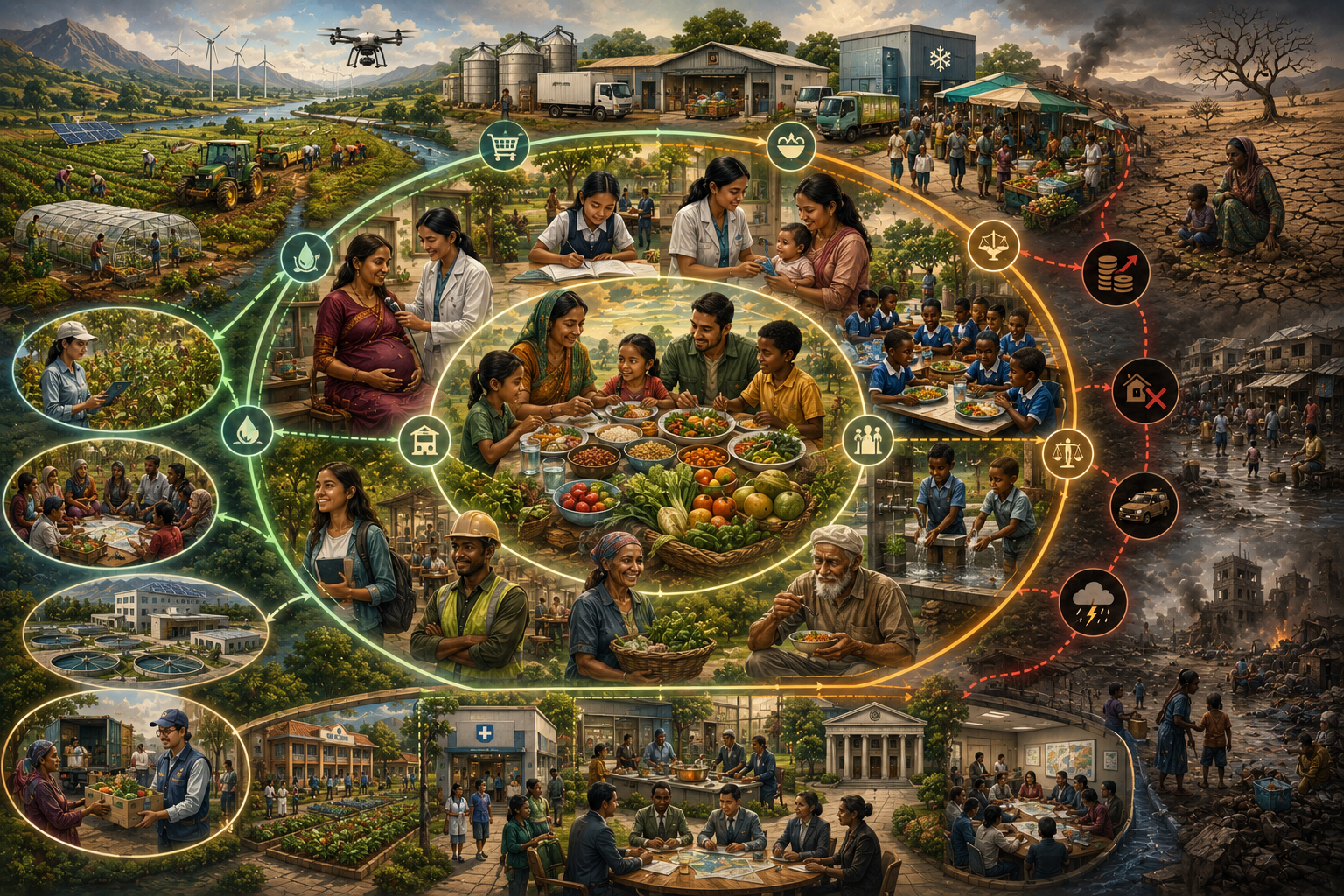
SDG 2 defines the development challenge as ending hunger, achieving food security and improved nutrition, and promoting sustainable agriculture. That wording matters because it connects food availability, nutrition quality, human capability, and the ecological foundations of production within one developmental frame. A food system cannot be judged only by how much it produces. It must also be judged by whether people can access food, whether diets support health, whether children can develop, whether workers and producers possess agency, and whether agriculture remains viable over time.
The 2026 edition of The State of Food Security and Nutrition in the World provides the most current global context. It estimates that 7.8 percent of the world’s population—about 645 million people—faced hunger in 2025. Approximately 2.1 billion people experienced moderate or severe food insecurity. The report also finds that the average global cost of a healthy diet rose to 4.28 purchasing-power-parity dollars per person per day in 2025 and that 2.69 billion people were unable to afford one. Global improvement is real but fragile, uneven, and far too slow for the 2030 targets.
| Current global signal | 2025 estimate reported in SOFI 2026 | Development meaning |
|---|---|---|
| Hunger | About 645 million people; 7.8 percent of the global population. | Progress has resumed globally, but hundreds of millions remain unable to meet basic dietary energy needs. |
| Moderate or severe food insecurity | About 2.1 billion people. | Food-related uncertainty, compromised diet quality, and reduced access extend far beyond chronic hunger. |
| Cost of a healthy diet | 4.28 PPP dollars per person per day on average. | Diet quality is constrained not only by supply, but by the structural cost of nutritious foods. |
| Unable to afford a healthy diet | About 2.69 billion people; 32.7 percent of the global population. | Nearly one-third of humanity remains economically excluded from the least-cost healthy diet. |
The 2026 Global Report on Food Crises adds a different but complementary view. It documents acute food insecurity in crisis-affected countries and confirms that conflict, economic shocks, climate extremes, displacement, and weakened humanitarian capacity can push food systems from chronic stress into catastrophic failure. Chronic food insecurity and acute crisis should not be collapsed into one category, but they often share structural drivers.
This article therefore treats food security as a six-dimensional systems condition: availability, access, utilization, stability, agency, and sustainability. Nutrition is not a narrow biological input added after development has occurred. It is one of the ways development becomes possible in the body, across the life course, and across generations.
What Food Security Means
Food security means more than the physical presence of food in markets, warehouses, farms, or national supply statistics. It refers to the condition in which people have reliable physical, social, and economic access to sufficient, safe, nutritious, and culturally appropriate food that supports an active and healthy life. This definition matters because it shifts the discussion away from aggregate production alone and toward the lived conditions under which households actually obtain and use food.
A country may produce enough food in aggregate and still contain food-insecure households. Food may exist, but be unaffordable. Markets may function, but remain distant. Diets may provide calories, but lack nutritional diversity. A household may eat enough to avoid immediate hunger while still experiencing micronutrient deficiency, poor dietary quality, or diet-related disease. Food security therefore requires attention to availability, access, affordability, utilization, stability, quality, and resilience.
This broader understanding is essential for sustainable development. If food security is reduced to supply alone, policy may focus mainly on production while neglecting poverty, inequality, food prices, transport, storage, school meals, public health, water and sanitation, social protection, and the ecological conditions of agriculture. A developmentally serious food-security framework must ask whether people can obtain diets that sustain health, learning, work, care, and dignity over time.
Food security is also relational. It depends on food systems, income systems, care systems, health systems, water systems, land systems, trade systems, and public institutions. It is shaped by household resources, market prices, social protection, gendered care burdens, local food environments, climate risk, conflict, and infrastructure. In this sense, food security is not a single-sector problem. It is a systems condition.
This places the article in direct continuity with Poverty, Deprivation, and Multidimensional Development, because food insecurity is one of the clearest ways overlapping deprivation becomes embodied in everyday life.
The expanded six-dimensional framework adds agency and sustainability to the familiar four pillars. That addition matters because food security is incomplete when people lack voice, rights, cultural choice, or the ecological foundations required to nourish future generations.
The Right to Food, Entitlements, Agency, and Dignity
A rights-based approach changes the meaning of food security. It treats adequate food not as charity delivered when convenient, but as a human right connected to public obligation, accountability, and remedy. The right to adequate food does not require governments to distribute every meal directly. It requires conditions in which people can feed themselves and their families with dignity, while ensuring protection and assistance when they cannot.
This distinction matters because hunger is not always caused by the absence of food. Amartya Sen’s entitlement approach showed that people can starve in the presence of food when they lose the legal, economic, social, or political means of commanding it. Wages can collapse. Prices can rise. Land can be lost. Public benefits can fail. Conflict can block markets. Discrimination can restrict access. A supply-centered analysis sees food in the market; an entitlement-centered analysis sees whether people possess enforceable access to it.
Food entitlements include more than income. They can arise from employment, land, fishing access, common resources, public transfers, school meals, family and community support, social insurance, humanitarian assistance, or legally protected claims. Each entitlement pathway can fail differently. A household may lose work, face administrative exclusion from benefits, experience displacement from land, or encounter food prices that rise faster than income. Understanding food insecurity requires tracing which entitlement failed and why.
Agency extends the analysis beyond access. It concerns whether people can make choices about what they eat, how food is produced, how work is organized, and how food-system rules are made. Agency is constrained when workers cannot bargain, farmers are locked into unequal contracts, communities are displaced from land or water, women lack control over income, or public participation is symbolic. It is also constrained when the only affordable foods are nutritionally poor or culturally inappropriate.
Cultural acceptability is therefore not decorative. Food carries identity, memory, spirituality, social connection, and belonging. A technically sufficient ration can still undermine dignity when it ignores culture, preparation practices, religious requirements, disability needs, or the food knowledge of communities. Food-security policy should support nutritional adequacy while respecting plural dietary traditions and locally meaningful forms of nourishment.
A rights-based approach asks who is accountable when food security fails. It requires clear duties, accessible information, non-discrimination, participation, grievance mechanisms, and the ability to correct harm. A benefit program that exists on paper but is inaccessible through complex documentation does not fully realize the right. A food-safety system without enforcement does not fully protect it. A nutrition strategy that excludes affected communities may improve delivery while weakening agency.
The practical test is whether people can secure adequate food without humiliation, coercion, preventable exclusion, or destruction of their future livelihoods. Food security becomes a development achievement when people are not merely fed, but recognized as rights-holders capable of shaping the systems on which their lives depend.
Nutrition and Human Capability
Nutrition is one of the most basic foundations of human capability. It shapes physical growth, immune function, cognitive development, pregnancy outcomes, school readiness, work capacity, recovery from illness, aging, and resilience to stress. To be nourished is not merely to consume energy. It is to possess the bodily conditions required to learn, act, care, participate, and flourish.
This is why nutrition belongs at the center of human development. A person who is chronically undernourished may face constraints on learning, strength, health, concentration, mobility, and long-run opportunity. A child who lacks dietary diversity in early life may experience consequences that extend into schooling, cognitive development, and adult capability. An adult who lacks affordable access to healthy food may face both immediate insecurity and long-run risks from diet-related disease. Nutrition is therefore both an immediate welfare issue and a long-horizon development issue.
Healthy diets matter because human beings require more than calories. Diet quality, micronutrients, protein, fiber, healthy fats, fruits, vegetables, legumes, whole grains, and safe food environments all shape health outcomes. WHO’s healthy-diet guidance emphasizes dietary patterns that protect against malnutrition in all its forms and reduce risk of noncommunicable diseases. This means that food security must include nutrition quality, not simply food quantity.
Nutrition also connects the biological and social dimensions of development. Malnutrition is embodied, but its causes are deeply social: poverty, gender inequality, food prices, poor water and sanitation, weak health systems, limited education, aggressive marketing of unhealthy foods, unstable livelihoods, climate shocks, conflict, and weak public capacity. A nutrition problem is rarely only a nutrition problem. It is usually a systems problem expressed through the body.
Human development becomes credible only when nutrition is treated as a capability foundation rather than as a residual welfare issue. Food sustains life, but nutrition widens the real possibilities of that life.
The Six Dimensions of Food Security and Nutrition
Food security has often been organized around four dimensions: availability, access, utilization, and stability. That framework remains essential, but the High Level Panel of Experts on Food Security and Nutrition has argued that two additional dimensions—agency and sustainability—are necessary for a complete account. Together, the six dimensions explain not only whether food is present and obtainable, but whether people can shape food systems with dignity and whether those systems can continue supporting nourishment across generations.
| Dimension | Central question | Typical evidence | Failure mode |
|---|---|---|---|
| Availability | Is sufficient and appropriate food physically present? | Production, imports, stocks, storage, distribution, market supply. | Shortage, disrupted supply, post-harvest loss, depleted production base. |
| Access | Can people obtain food physically, socially, and economically? | Income, prices, transport, market distance, public provision, entitlements. | Food exists but households are priced out, excluded, or geographically isolated. |
| Utilization | Can available food become safe and adequate nutrition? | Diet quality, food safety, water, sanitation, health, care, cooking and storage. | Calories are available while dietary diversity, absorption, safety, or care remain weak. |
| Stability | Are availability, access, and utilization reliable through time? | Seasonality, price volatility, conflict, climate exposure, livelihood stability. | Households move repeatedly into crisis when shocks or lean seasons occur. |
| Agency | Can people make meaningful choices and participate in shaping food systems? | Rights, voice, land and labour power, cultural acceptability, participation, remedy. | People receive food but lack autonomy, influence, dignity, or protection from exploitation. |
| Sustainability | Can food security be maintained without degrading its ecological, social, and economic foundations? | Soil, water, biodiversity, emissions, livelihoods, resilience, intergenerational effects. | Present production depletes the conditions required for future nourishment. |
The dimensions are interdependent rather than interchangeable. Strong production cannot compensate indefinitely for unaffordable diets. High income cannot fully compensate for unsafe water, poor food quality, or weak health systems. Stable supply does not establish justice if workers are exploited or communities cannot influence land and food policy. A nutritious diet today does not establish sustainability if it depends on depleted aquifers, eroding soils, destroyed fisheries, or unaffordable energy.
This has an important methodological implication: food security should not be calculated only as a weighted average in which very strong performance in one dimension hides collapse in another. A system with excellent availability but almost no access is not moderately food secure. It is failing at the point where food becomes human capability. Analysis should therefore report both an overall profile and the weakest dimensions.
The six-dimensional framework also makes visible the distinction between stability and sustainability. Stability concerns whether people can maintain food security through short-term variation and shock. Sustainability concerns whether the underlying ecological, social, and economic bases of food security can endure and regenerate over the long term. A food system may be stable for several years while quietly exhausting groundwater or concentrating control in ways that make later failure more likely.
Agency changes the analysis just as profoundly. People are not merely consumers at the end of a supply chain. Farmers, workers, caregivers, Indigenous peoples, fishers, vendors, children, and communities possess knowledge, rights, preferences, and claims over the systems that feed them. Food security is stronger when people can participate in decisions, defend their livelihoods, obtain remedy, preserve culturally meaningful diets, and exercise real choice rather than accept whatever deprivation permits.
A complete assessment therefore asks six linked questions: Is food present? Can people obtain it? Can they use it for health? Will access persist through shocks? Can people shape the system? Can the system endure without destroying its own foundations?
Malnutrition in All Its Forms
Food-security analysis must account for malnutrition in all its forms: undernourishment, wasting, stunting, micronutrient deficiencies, overweight, obesity, and diet-related noncommunicable disease. These conditions are often discussed separately, but they can coexist within the same country, community, household, or person across the life course. This is sometimes described as the double or triple burden of malnutrition.
Undernourishment reflects insufficient dietary energy over time. Wasting indicates low weight for height and can signal acute nutritional deprivation or illness. Stunting reflects impaired growth associated with chronic deprivation, repeated infection, poor maternal nutrition, and weak care or sanitation environments. Micronutrient deficiencies can persist even where calorie intake appears sufficient because diets lack iron, vitamin A, zinc, iodine, folate, or other essential nutrients.
At the same time, food environments can produce overweight and obesity through cheap, convenient, heavily marketed foods high in unhealthy fats, free sugars, or sodium and low in dietary quality. The resulting pattern is not a contradiction. It reflects food systems that make energy available while making healthy diets difficult to afford, access, prepare, or sustain. A household can experience hunger at one point in the month and rely on low-cost ultra-processed foods at another. A child can experience poor linear growth while also facing later risk of obesity and metabolic disease.
The burden is developmental because nutritional deprivation and excess alter capability. They affect immunity, cognition, school participation, pregnancy outcomes, physical strength, mental wellbeing, healthcare costs, work capacity, and healthy aging. The consequences accumulate across time and can reinforce poverty. Illness reduces income. Reduced income worsens diet. Poor diet increases illness. Households may then face a reinforcing loop of nutritional, financial, and health vulnerability.
This broader view prevents a policy error: solving hunger by maximizing inexpensive calories without protecting diet quality. Energy adequacy is necessary, but a food-security strategy that ignores diversity, safety, moderation, and nutrient density may reduce one form of malnutrition while intensifying another. Similarly, obesity policy that relies only on individual education ignores the prices, marketing, work schedules, transport, school environments, and corporate practices that shape what people can realistically eat.
Nutrition policy must therefore combine protection against deprivation with transformation of food environments. It may include maternal and child nutrition, breastfeeding support, complementary feeding, treatment of wasting, micronutrient fortification where appropriate, school meals, healthy public procurement, food-safety enforcement, fiscal and regulatory measures, protection from harmful marketing, and improved access to minimally processed foods.
The unifying principle is that people need diets that are adequate, balanced, diverse, moderate, safe, and culturally meaningful. Food security is not achieved when people receive enough energy but remain exposed to preventable nutritional harm.
Healthy Diets and Affordability
One of the most important shifts in food-security analysis is the recognition that diet affordability matters as much as food availability. A household may be able to purchase enough calories but not afford a healthy diet. This distinction is essential because cheap calories are not the same as nutrition. Diets dominated by refined starches, ultra-processed foods, sugar, salt, unhealthy fats, or low-diversity staples can coexist with food insecurity, micronutrient deficiency, obesity, diabetes, cardiovascular disease, and poor child development.
SOFI 2026 places special emphasis on the high cost of a healthy diet and the structural forces that keep nutritious foods out of reach. This is a crucial development issue. Inflation does not affect all households equally. Low-income households spend a larger share of income on food, have fewer savings, and have less ability to absorb price increases without reducing diet quality, skipping meals, shifting to cheaper staples, or cutting other essentials such as healthcare, schooling, transport, or rent.
Affordability also shapes dignity. Food insecurity is not only the absence of food. It is the anxiety of not knowing whether food will be available tomorrow, the humiliation of being unable to feed children well, the trade-off between medicine and meals, and the shrinking of household choice under pressure. A development framework that treats food only as supply misses this lived reality.
Healthy diets are also shaped by food environments. Even where income exists, people may live in places dominated by low-quality, highly processed, heavily marketed, or inaccessible food options. Urban food deserts, rural market isolation, unsafe transport, lack of refrigeration, weak cooking infrastructure, and limited time can all influence diet quality. Food affordability is therefore not only a price issue. It is a food-system issue.
To make healthy diets affordable, development policy must connect agriculture, markets, public procurement, school feeding, social protection, nutrition education, food regulation, public health, and local food systems. The goal is not simply to make food cheaper in general, but to make nourishing diets reachable for all.
Food Poverty, Inequality, and Household Vulnerability
Food poverty occurs when households cannot reliably access nutritious and diverse diets under real social and economic conditions. It is one of the most visible and painful forms of multidimensional deprivation because it affects the body immediately while also shaping long-run development. Food poverty can appear as hunger, meal skipping, low dietary diversity, reliance on cheap staples, child undernutrition, maternal depletion, diet-related illness, or household anxiety over food access.
UNICEF’s child food poverty framework is especially important because it focuses on children’s inability to access and consume a nutritious and diverse diet in early childhood. This matters because early childhood is a critical period for growth, immunity, brain development, and learning. Food poverty during this period is not only a present hardship. It can shape future capability, school readiness, health, and intergenerational opportunity.
Inequality strongly shapes food vulnerability. Low-income households face price pressure more intensely. Rural households may face market distance, seasonal hunger, weak storage, climate-sensitive livelihoods, or limited cash income. Informal workers may lose food security when work is irregular. Women and girls may eat last or least in some household contexts. Displaced people and conflict-affected communities may face acute disruption. Urban poor households may live near markets but remain priced out of healthy diets.
Food poverty is therefore not only about individual household choices. It is produced through wages, prices, markets, care burdens, social protection, land access, water systems, education, health, gender relations, and public institutions. A household’s diet is shaped by the whole development system surrounding it.
This section links directly to Inequality and Inclusive Development, because food insecurity is one of the clearest ways inequality becomes embodied. A society may generate wealth while leaving many people unable to eat well. That is a development failure, not only a food-system failure.
Nutrition Across the Life Course
Nutrition matters across the life course, but its effects are especially powerful during pregnancy, infancy, early childhood, adolescence, illness, and aging. Maternal nutrition shapes pregnancy outcomes, birthweight, maternal health, and infant development. Infant and young-child feeding shapes immunity, growth, cognitive development, and survival. Childhood nutrition affects learning, attention, physical development, and future productivity. Adolescent nutrition influences growth, reproductive health, and lifelong wellbeing. Adult nutrition shapes work capacity, disease risk, mental health, and household stability. Nutrition in older age affects mobility, immunity, dignity, and care needs.
This life-course view matters because food security is not a single household condition at one point in time. It is a continuing foundation of development. A household may recover from short-term food insecurity, but repeated nutritional stress can leave long-term effects. A child who experiences dietary deprivation in early years may carry consequences into school and adulthood. A worker who faces chronic poor nutrition may lose health, productivity, and resilience. An older person who lacks adequate food may experience frailty, isolation, and preventable health decline.
Life-course nutrition also reveals the importance of care. Food must be produced, purchased, stored, prepared, shared, and consumed under conditions shaped by time, gender, knowledge, health, sanitation, energy, and household power. A household may have food available but lack clean water, cooking fuel, storage, caregiving support, or health services needed to turn food into nutrition. Utilization therefore depends on the care systems and public systems surrounding food.
This is why school meals, maternal health services, breastfeeding support, child nutrition programs, public health, sanitation, social protection, and elder nutrition support belong within the food-security agenda. Nutrition is not merely a private household responsibility. It is a public development concern.
Human development requires that food systems support people through the whole arc of life, not only at the point of market exchange.
Children, Learning, and Human Development
Food security is closely connected to childhood learning and human development. Children who are hungry, undernourished, micronutrient deficient, or repeatedly ill are less able to concentrate, attend school, participate fully, and benefit from learning opportunities. Nutrition therefore affects education not only indirectly through household poverty, but directly through the body’s capacity to grow, focus, remember, and sustain effort.
School meals illustrate the developmental connection between food, learning, and public institutions. A school meal can support nutrition, improve attendance, reduce household pressure, create incentives for schooling, and provide a platform for wider health and social protection interventions. In some contexts, school feeding also supports local agriculture through public procurement and strengthens community trust in public systems. Food policy, education policy, and local development policy can therefore reinforce one another.
Child food poverty is especially damaging because early-life nutrition shapes later capability. UNICEF’s framing emphasizes that inadequate dietary diversity in early childhood can harm child survival, growth, and development. This means that nutrition deprivation is not simply a food issue. It is an educational issue, a health issue, a poverty issue, and an intergenerational development issue.
The relationship also runs in the other direction. Education can improve nutrition through health knowledge, literacy, income opportunity, women’s empowerment, food choices, and the ability to navigate institutions. A parent’s education can influence child feeding, healthcare use, hygiene, and household resilience. Learning and nutrition therefore form a feedback loop.
This section pairs naturally with Health, Education, and Human Capability Expansion. Food security helps make learning possible, and learning helps make food security more durable.
Gender, Care, and Intra-Household Power
Households are often treated as if food is pooled and distributed equally. In practice, food security is shaped by bargaining power, care responsibilities, gender norms, age, disability, health, and control over income. A household-level indicator can therefore conceal deprivation experienced by particular members.
Women and girls frequently carry substantial responsibility for food production, purchasing, preparation, water collection, feeding, and care while having less control over land, credit, wages, assets, or public decisions. When food becomes scarce, they may reduce their own intake, eat less preferred foods, or absorb additional unpaid labour to protect children and other household members. These coping strategies can hide the severity of the crisis from conventional measurement.
Maternal nutrition illustrates how care and inequality become intergenerational. A pregnant or breastfeeding woman requires adequate nutrition, rest, healthcare, water, sanitation, and social support. When her diet is depleted, consequences can extend to maternal health, birth outcomes, infant growth, and household resilience. Treating maternal nutrition as an individual behavior problem misses the workload, income, service, and power conditions that shape it.
Time poverty is also a nutrition variable. Healthy food may be available and nominally affordable, yet impossible to use when households lack cooking fuel, refrigeration, safe water, transport, childcare, or time. Long work hours, irregular schedules, unsafe kitchens, and distant markets can shift diets toward convenient but lower-quality options. Care infrastructure and labour policy therefore belong within nutrition policy.
Intra-household power affects children as well. Feeding practices depend on caregiver knowledge and preferences, but also on income, stress, food environments, social support, and the influence of commercial marketing. Caregivers cannot consistently provide diverse diets when nutritious foods are unaffordable, public services are weak, or unhealthy products are cheaper and aggressively promoted.
Gender-sensitive food policy should therefore do more than target women as implementers of household nutrition. It should strengthen their rights and agency: equal access to land and finance, safe and fairly paid work, social protection, maternity protection, public childcare, water and energy infrastructure, healthcare, education, and meaningful participation in food-system governance.
The central analytical question is not merely whether a household has food. It is who controls resources, who performs the labour of nourishment, who eats last, whose preferences count, and who bears the health consequences when the system fails.
Food Environments and Commercial Determinants
People make food choices inside environments structured by price, availability, convenience, transport, retail, advertising, product formulation, school and workplace rules, cultural expectations, and time. A food environment can support healthy diets or make them unusually difficult. This is why nutrition cannot be explained solely through personal preference.
A healthy choice is not meaningful when it is physically absent, financially unreachable, unsafe, culturally unsuitable, or incompatible with household time and infrastructure. The same applies in the other direction: products high in unhealthy fats, free sugars, or sodium can become the default when they are cheap, shelf-stable, highly promoted, available everywhere, and designed for convenience.
Commercial power shapes these environments. Firms influence product portfolios, pricing, marketing, retail placement, public debate, lobbying, research agendas, and the political feasibility of regulation. Corporate activity can contribute to food safety, logistics, innovation, employment, and access. It can also intensify nutritional harm when business models depend on expanding consumption of unhealthy products or resisting effective public-health rules.
Children require particular protection because they are less able to recognize persuasive intent and because dietary habits formed early can persist. Digital marketing, sponsorship, packaging, characters, influencer promotion, and placement in schools or child-oriented spaces can normalize products that displace more nutritious foods. WHO guidance therefore emphasizes comprehensive policies to protect children from harmful food marketing rather than relying only on voluntary commitments.
Food-environment policy can operate through multiple levers: nutrition standards for schools and public institutions; restrictions on harmful marketing; clear front-of-pack labeling; food-safety regulation; reformulation requirements; taxes or subsidy reform; support for fruit, vegetables, pulses, and other nutritious foods; zoning and retail policy; healthy workplace standards; and procurement that creates stable demand for nourishing food.
These measures should be evaluated distributionally. A tax may reduce consumption but create hardship if healthy substitutes are inaccessible. A labeling policy may help informed consumers while doing little for households constrained mainly by price. Retail incentives may improve availability but fail if transport, storage, or trust remain weak. Effective intervention therefore combines information, affordability, access, and regulation.
The key question is not whether individuals possess nutrition knowledge. It is whether the surrounding environment converts that knowledge into a realistic, affordable, and dignified possibility.
Food Systems, Markets, and Public Institutions
A food system includes far more than farms. It includes seeds, soil, water, fisheries, livestock, labour, storage, processing, transport, markets, retail, cooking, waste, public procurement, trade, finance, land tenure, health systems, social protection, food safety regulation, and consumer environments. Food security emerges from this entire system. When any part of it fails, households may experience higher prices, lower quality, unsafe food, poor access, or unstable diets.
Markets are important because they distribute food, coordinate prices, signal scarcity, and connect producers with consumers. But markets alone do not guarantee nutrition security. Poor households can be priced out of healthy food. Remote communities can be underserved. Food companies may market unhealthy products aggressively. Farmers may lack bargaining power. Informal workers may lack stable income. Public institutions are needed to regulate, support, stabilize, and correct food systems in the direction of health and justice.
Public action matters at multiple points. Agricultural extension can support farmers. Food safety systems can protect consumers. Public procurement can support school meals and local producers. Social protection can protect purchasing power. Nutrition standards can guide public programs. Water and sanitation systems can improve food utilization. Health services can identify and treat malnutrition. Infrastructure can reduce loss and improve market access.
Food systems are also political. Land rights, trade rules, subsidies, corporate concentration, labour conditions, public budgets, food prices, and environmental regulation all shape whose interests the system serves. A food system can produce abundance while leaving farmers poor, workers exploited, consumers unhealthy, and ecosystems degraded. Development analysis must therefore ask how food systems distribute power as well as food.
Food security requires governance because food is too central to human life to be left only to private purchasing power. The right to nourishment is lived through markets, but it is secured through public capacity, social protection, ecological stewardship, and institutional accountability.
Urban, Peri-Urban, and Territorial Food Systems
Urbanization changes how food is produced, moved, sold, prepared, and consumed. Most urban residents depend on complex chains that connect rural production, wholesale markets, transport corridors, processing, cold storage, retail, informal vendors, public institutions, and household infrastructure. Food security in cities therefore depends on territorial relationships rather than on urban boundaries alone.
Urban households may live close to abundant food while remaining food insecure because rent, transport, energy, childcare, healthcare, and debt compress the food budget. Informal settlements may lack safe storage, refrigeration, water, sanitation, or cooking space. Healthy foods may be available in one part of a city but inaccessible through time, cost, disability, safety, or transport barriers in another.
Informal food vendors often provide essential affordability and proximity, yet may be treated mainly as regulatory problems. A more productive approach combines food safety with secure vending space, water, sanitation, waste collection, storage, credit, and protection from arbitrary displacement. Formalization that raises costs without improving infrastructure can reduce access for both vendors and low-income consumers.
Peri-urban agriculture, local processing, wholesale-market modernization, public markets, community food hubs, and regional procurement can strengthen resilience. They can shorten some supply chains, diversify sources, reduce loss, and support local livelihoods. But localization is not automatically sustainable or equitable. It must be assessed against land pressure, water use, labour conditions, cost, and the value of wider trade networks.
Infrastructure is central. Roads, ports, rail, electricity, cold chains, digital market information, warehouses, drainage, and emergency logistics determine whether nutritious foods reach people reliably. Infrastructure choices also shape market concentration. Systems built only for large firms may exclude smaller producers and vendors. Systems without redundancy may be efficient in normal periods but brittle under disruption.
Territorial food planning links cities with the regions that feed them. It asks where food comes from, which communities bear ecological costs, how shocks propagate through transport and markets, and whether public procurement can support resilient production. It also connects food policy to housing, climate adaptation, land use, mobility, public health, and waste management.
Urban food security is therefore not a matter of placing more supermarkets on a map. It requires understanding the whole chain through which food becomes accessible, affordable, safe, and usable in daily life.
Sustainable Agriculture and Ecological Resilience
Sustainable agriculture is central to food security because food systems depend on ecological conditions: soil fertility, freshwater, pollinators, biodiversity, climate stability, fisheries, forests, nutrient cycles, and healthy landscapes. Agriculture can nourish people, support livelihoods, and sustain communities. But it can also contribute to deforestation, soil degradation, water depletion, nutrient pollution, biodiversity loss, greenhouse gas emissions, and vulnerability to climate shocks if organized unsustainably.
SDG 2 explicitly links food security and improved nutrition with sustainable agriculture. This is important because food-system success cannot be judged only by short-term output. A farming system that produces more today by degrading soils, depleting aquifers, narrowing crop diversity, polluting waterways, or increasing climate vulnerability may undermine future food security. Sustainable agriculture asks whether food production can remain viable across generations.
Agroecology, diversified cropping, soil restoration, water stewardship, integrated pest management, resilient seed systems, sustainable fisheries, climate-adaptive farming, local knowledge, and reduced food loss all matter to long-run resilience. So do farmer livelihoods. A food system cannot be sustainable if those who produce food remain poor, indebted, insecure, or excluded from decision-making.
Nutrition and sustainability must also be connected. A food system that produces calories but not diverse, healthy diets remains incomplete. A system that produces healthy food but makes it unaffordable also remains incomplete. A sustainable food system must support ecological resilience, farmer dignity, nutritional quality, affordability, and public health together.
This section connects the article to Safe Operating Space and the Conditions of Long-Run Development. Food security depends on whether agriculture remains within ecological conditions that support future life, health, and livelihoods.
Climate, Conflict, Price Shocks, and Food-System Fragility
Food systems are increasingly exposed to interacting shocks. Climate change can reduce yields, disrupt seasons, intensify droughts and floods, damage fisheries, increase heat stress, and raise food-price volatility. Conflict can destroy crops, block supply routes, displace households, disrupt markets, and make humanitarian access dangerous. Economic shocks can reduce incomes, raise food prices, and weaken social protection. These shocks often interact, producing food insecurity that is both ecological and political.
Price shocks are especially important because they reveal how food insecurity can intensify even when food remains physically present. When prices rise faster than incomes, households may reduce meal quality, shift to cheaper foods, borrow, sell assets, or cut spending on health and education. SOFI 2026’s analysis of healthy-diet costs highlights this problem clearly: food insecurity is shaped by purchasing power as much as by production.
Climate and conflict also distribute harm unevenly. Low-income households, smallholder farmers, pastoralists, fishers, informal workers, displaced people, children, women, older people, and marginalized communities often face greater exposure and weaker protection. A drought, flood, war, or price spike does not fall on an equal social field. It lands inside existing inequalities.
Food-system fragility therefore cannot be addressed only through emergency response. Humanitarian support is essential in crisis, but sustainable development requires resilience before crisis: diversified livelihoods, social protection, climate adaptation, water systems, storage, early warning, local markets, public procurement, nutrition programs, and peacebuilding. Food security depends on the ability of systems to absorb shock without transferring the burden entirely onto vulnerable households.
This section pairs directly with Risk, Shock, and Fragility in Development Systems. Food insecurity is one of the clearest ways systemic shocks become immediate human harm.
Governance, Concentration, Trade, and Policy Coherence
Food systems are governed through laws, budgets, trade rules, subsidies, procurement, land rights, labour standards, safety regulation, competition policy, environmental rules, and institutional mandates. These arrangements distribute power and risk. They determine who can produce, enter markets, influence prices, absorb shocks, and shape policy.
Concentration can create scale, logistics capacity, and investment, but it can also reduce bargaining power, narrow supply options, increase dependency, and allow private decisions to influence public nutrition outcomes. Farmers may face concentrated input or purchasing markets. Workers may have limited alternatives. Small retailers may struggle against dominant chains. Governments may become dependent on a small number of suppliers for critical foods.
Trade is similarly neither inherently protective nor inherently harmful. Imports can diversify diets, stabilize supply, and buffer domestic shocks. They can also expose countries to currency risk, geopolitical disruption, export restrictions, or volatile international prices. Export agriculture can support income while competing for land, water, or food-system investment. The relevant question is how trade interacts with domestic capability, resilience, and distribution.
Policy incoherence is common because different ministries optimize different goals. Agriculture may pursue yield or exports. Finance may reduce spending. Health may seek better diets. Trade may reduce barriers. Education may manage school meals. Environment may protect water and biodiversity. Without coordination, one policy can undermine another. Subsidies may lower production costs for commodities that do little for dietary diversity. Procurement rules may prioritize lowest price while ignoring nutrition, labour, and ecological outcomes.
Coherence does not mean eliminating disagreement. It means making trade-offs visible and establishing processes capable of resolving them. A coherent food strategy defines shared outcomes, clarifies authority, aligns incentives, tracks distributional effects, and creates feedback from affected communities.
Public procurement is a particularly strong governance lever because it can connect nutrition, local economic development, labour standards, and sustainability. School meals, hospitals, care institutions, and public workplaces can create predictable demand for healthy food. Procurement can support smaller producers when contract size, payment terms, and logistics are designed for participation rather than only for administrative convenience.
Effective governance also requires safeguards against capture. Transparency, conflict-of-interest rules, competition enforcement, public data, independent evaluation, and accessible participation help ensure that policy serves food security rather than only organized interests.
Food policy becomes credible when the institutions that govern production, markets, health, environment, and social protection can act together while remaining accountable to the people most affected.
Public Action, Social Protection, and Nutrition Security
Food security requires public action because markets alone cannot guarantee that everyone can obtain nutritious food under conditions of poverty, crisis, or unequal power. Public systems help protect access, stabilize livelihoods, support vulnerable households, regulate food safety, improve nutrition, and build resilience. Social protection, school feeding, food assistance, cash transfers, public procurement, maternal and child nutrition programs, water and sanitation, agricultural extension, and health systems all contribute to nutrition security.
Social protection is especially important during price shocks. When food prices rise, households need purchasing power to protect diet quality. Cash transfers, food vouchers, school meals, nutrition-sensitive assistance, unemployment protection, child benefits, and emergency support can prevent temporary shocks from becoming long-term developmental losses. Without support, households may cope in ways that harm future capability: pulling children from school, delaying healthcare, selling productive assets, or reducing diet diversity.
Public action also matters because nutrition is a public-health issue. Food safety, breastfeeding support, maternal care, micronutrient programs, treatment for wasting, obesity prevention, school nutrition, food labeling, regulation of unhealthy food marketing, and healthy public procurement all shape diets. Food environments do not arise naturally. They are governed, regulated, subsidized, marketed, and planned.
Institutions must also support producers. Smallholder farmers, fishers, pastoralists, agricultural workers, market vendors, food processors, and transport workers are part of food security. Policies that improve storage, credit, extension, land rights, climate adaptation, labour rights, and market access can strengthen food systems while protecting livelihoods.
A developmentally serious food-security strategy therefore integrates agriculture, nutrition, public health, social protection, infrastructure, climate adaptation, and economic justice. Food security is achieved not by one program, but by a public system that protects nourishment as a condition of human freedom.
Intervention Portfolios: Relief, Structural Reform, and Transformation
Food insecurity is rarely solved by a single intervention because it is produced by interacting constraints. Emergency food assistance may save lives but cannot by itself repair wages, markets, conflict, land systems, or ecological decline. Agricultural investment may increase supply but leave healthy diets unaffordable. Nutrition education may improve knowledge but not alter prices or food environments. Effective strategies therefore operate as portfolios.
| Intervention horizon | Primary purpose | Examples | Failure if used alone |
|---|---|---|---|
| Immediate protection | Prevent hunger, wasting, distress sales, and irreversible harm. | Food assistance, cash transfers, therapeutic nutrition, school meals, emergency logistics. | Crisis recurs because structural drivers remain. |
| Stabilization | Protect access through seasonal and economic volatility. | Index-linked benefits, price monitoring, grain reserves, insurance, early action, livelihood support. | May preserve an inequitable or ecologically fragile system. |
| Structural reform | Change the rules and capacities that reproduce insecurity. | Living incomes, land and labour rights, public procurement, competition policy, WASH, market infrastructure. | Benefits may arrive too slowly for people facing immediate deprivation. |
| Food-environment transformation | Make healthy diets normal, affordable, and accessible. | Marketing regulation, nutrition standards, subsidy reform, healthy retail, public meal standards. | Can fail without income, cultural legitimacy, and supply capacity. |
| Long-run regeneration | Protect the ecological and social bases of future food security. | Soil and water restoration, agroecology, biodiversity, climate adaptation, livelihood renewal. | May not protect current households unless paired with social support and just transition. |
Portfolio design requires sequencing. A government may first protect purchasing power during a price shock, then reduce administrative barriers to benefits, support market supply, and invest in resilient value chains. Attempting deep reform without immediate protection can impose transition costs on those least able to bear them. Providing relief without a path to reform can normalize permanent emergency.
Interventions should also be evaluated for interaction. School meals can improve child nutrition, reduce household pressure, support attendance, and create demand for local producers. But those benefits depend on meal quality, procurement design, payment reliability, kitchen infrastructure, food safety, and inclusion. A strong intervention in theory may become weak through implementation.
The portfolio should identify reinforcing combinations. Cash support is stronger when healthy foods are available. Nutrition standards are stronger when procurement can source compliant products. Agricultural diversification is stronger when markets and storage exist. Early warning is stronger when institutions possess funds and authority to act before crisis.
It should also identify harmful compensation. A subsidy may lower consumer prices while encouraging ecologically damaging production. A market modernization program may improve safety while displacing informal vendors. A fortification program may address micronutrients while leaving dietary diversity unchanged. Monitoring must therefore track both intended outcomes and burden shifting.
The best portfolio is not the one with the largest number of programs. It is the one that protects people now, changes the structures producing insecurity, and preserves the conditions of nourishment for the future.
A Practical Method for Food-Security and Nutrition Analysis
A disciplined analysis can move from a broad concern such as “food insecurity is rising” to a specific account of mechanisms, affected groups, intervention points, and evidence needs.
1. Define the outcome and population
Specify whether the concern is chronic hunger, acute food insecurity, child food poverty, diet affordability, dietary diversity, wasting, obesity, or another outcome. Define the population, geography, and time period.
2. Separate chronic, seasonal, and acute conditions
A long-term affordability problem requires different action from a sudden conflict disruption or annual lean season. Determine how the pattern changes through time.
3. Profile all six dimensions
Assess availability, access, utilization, stability, agency, and sustainability. Report the weakest dimension rather than relying only on an average.
4. Trace entitlement pathways
Identify how people normally obtain food: wages, farming, fishing, markets, transfers, school meals, common resources, family support, or humanitarian assistance. Locate the point of failure.
5. Map the food environment
Document what foods are sold, where, at what price, with what marketing, and under what transport, storage, cooking, and time conditions.
6. Examine nutrition across the life course
Identify specific risks for pregnancy, infancy, childhood, adolescence, adulthood, illness, disability, and older age rather than treating the population as nutritionally uniform.
7. Analyze household power and care
Ask who controls income, who purchases and prepares food, who absorbs scarcity, and whose dietary needs are hidden by household averages.
8. Map shocks and feedback loops
Trace climate, conflict, disease, price, income, and infrastructure shocks. Identify reinforcing loops such as price rise → diet deterioration → illness → income loss → deeper insecurity.
9. Assess institutions and political economy
Examine rules, budgets, market concentration, trade dependence, labour conditions, land and water rights, regulatory capacity, and policy coherence.
10. Build an intervention portfolio
Combine immediate protection, stabilization, structural reform, food-environment change, and long-run regeneration. Specify sequencing and implementation requirements.
11. Define indicators and uncertainty
Choose indicators that match the mechanism. Document missing data, measurement error, assumptions, and plausible alternative explanations.
12. Establish participation, accountability, and revision
Include affected communities in problem definition and evaluation. Define who can act, who is accountable, how people can challenge harm, and how the strategy will adapt.
The output should be more than a risk score. It should include a six-dimensional profile, an entitlement map, a causal account, a distributional analysis, an intervention portfolio, an uncertainty statement, and an accountability plan.
Worked Diagnostic: A Healthy-Diet Affordability Crisis
Consider a metropolitan region in which food remains widely available, supermarket shelves are stocked, and aggregate supply is stable. Yet household surveys show declining dietary diversity, rising use of food banks, increased child food poverty, and growing diet-related illness. Treating this only as a supply problem would misdiagnose the system.
The six-dimensional profile might show high availability, moderate physical access, weak economic access, mixed utilization, moderate stability, low agency among affected households, and weak sustainability because affordable fresh food depends on fragile transport and low-paid labour. The weakest dimension is access, but utilization, agency, and sustainability reinforce the problem.
The entitlement map identifies the mechanism. Low-wage and irregular workers obtain food mainly through earnings. Rent, energy, transport, and healthcare costs have risen faster than wages. Food benefits are not indexed quickly enough to prices, and application burden excludes eligible households. Families therefore protect calories by shifting toward cheaper, less diverse foods. The problem is not that food disappeared. Purchasing power and public entitlements weakened.
The food-environment map adds a second mechanism. Nutritious foods are present but cost more per usable meal, require more preparation time, and are less available near late-shift workplaces. Highly processed foods are heavily promoted and sold in convenient formats. Some households lack adequate kitchens or refrigeration. Information campaigns alone would therefore have little leverage.
A feedback loop begins to appear:
\text{High living costs} \rightarrow \text{diet compromise} \rightarrow \text{illness and stress} \rightarrow \text{income loss} \rightarrow \text{deeper food insecurity}
\]
Interpretation: Food insecurity is reinforced when poor diet and stress reduce the health and income needed to recover purchasing power.
A credible portfolio would begin with immediate protection: expanded meal access, simplified enrollment, emergency cash, and protection for children and medically vulnerable people. Stabilization would index benefits to current diet costs and create rapid-response triggers for food-price spikes. Structural reform would address wages, housing pressure, work schedules, transit, and benefit administration. Food-environment measures would improve public procurement, workplace and school food, healthy retail, and protection from harmful marketing.
Evaluation would track more than food-bank use. It would monitor healthy-diet affordability, dietary diversity, benefit take-up, household coping, child food poverty, health outcomes, time burden, and differences by neighbourhood, race, disability, gender, and household type. It would also test whether increased demand raises prices or strains local supply.
This example shows why a systems diagnosis matters. The visible symptom is food hardship. The deeper system combines income, housing, public administration, retail, health, transport, labour, and care. The intervention must act across those relationships rather than simply urging households to make better choices.
Measurement, Indicators, and Visibility
Food security and nutrition measurement shape what policy can see. Hunger prevalence, food insecurity experience scales, child wasting, child stunting, anemia, obesity, dietary diversity, cost and affordability of healthy diets, food-price inflation, household consumption, agricultural productivity, food loss, and access to social protection each reveal different dimensions of the problem. No single indicator can capture the whole food-security landscape.
This matters because narrow measurement can produce narrow policy. If food security is measured only by supply, affordability may disappear. If nutrition is measured only by calories, diet quality may disappear. If hunger is measured only nationally, local crisis zones may disappear. If child malnutrition is measured without attention to poverty, water, sanitation, gender, and health systems, the causes remain under-governed.
Good measurement must therefore be multidimensional and disaggregated. It should show who is hungry, who cannot afford healthy diets, which children face poor dietary diversity, which regions face repeated shocks, which households are exposed to price inflation, and which groups lack public support. It should also track the ecological conditions of food production, because future food security depends on soil, water, biodiversity, fisheries, and climate resilience.
Measurement should not reduce people to statistics. But it should make deprivation visible enough that institutions cannot deny it. Food insecurity is often hidden inside households: skipped meals, smaller portions, cheaper foods, maternal sacrifice, child dietary monotony, debt, anxiety, and quiet hunger. Indicators must help public systems see what private suffering conceals.
A strong food-security evidence system therefore supports accountability. It asks whether food systems are nourishing people, whether healthy diets are affordable, whether public programs are reaching vulnerable households, and whether agriculture remains viable under ecological stress.
Uncertainty, Scenario Testing, and Causal Evaluation
Food-security evidence is often incomplete. Household surveys may be infrequent. Price data may miss informal markets. National averages may conceal local crisis. Anthropometric indicators capture consequences after harm has occurred. Remote-sensing and market data can improve timeliness but may not reveal agency, dietary quality, or intra-household distribution.
Analysis should therefore distinguish observed data, modeled estimates, assumptions, and judgment. A composite score can organize evidence, but it should not create false precision. Weight choices matter. Missing values matter. A territory’s result may change when affordability or agency receives greater emphasis. Reporting a single number without uncertainty can make a fragile model look authoritative.
Scenario testing asks how conclusions change under plausible conditions. What happens if food prices rise 15 percent? If a drought reduces local production? If cash transfers increase but benefit take-up remains low? If public procurement expands? If a conflict closes a transport corridor? Scenarios reveal whether an intervention is robust across different futures.
Sensitivity analysis asks which assumptions drive the result. If risk classification changes mainly with one uncertain variable, that variable deserves better measurement. If several reasonable weighting schemes produce the same weakest dimension, the diagnosis is more robust. If conclusions vary widely, decision-makers should avoid overconfidence and favor reversible or adaptive action.
Causal evaluation asks whether an intervention produced the observed change. Before-and-after comparison is often insufficient because food prices, climate, employment, migration, conflict, and other programs change simultaneously. Stronger designs may use phased implementation, matched comparison areas, interrupted time series, regression discontinuities, or randomized allocation where ethical and feasible. Qualitative evidence remains essential for understanding implementation and unintended effects.
Distributional evaluation is equally important. An intervention can improve the average while excluding remote households, migrants, disabled people, informal workers, or those unable to navigate digital systems. Results should therefore be disaggregated and paired with evidence about burden, dignity, participation, and remedy.
The purpose of uncertainty analysis is not paralysis. It is disciplined action under incomplete knowledge. A responsible strategy protects people against severe harm, states what is unknown, monitors leading indicators, and revises intervention as evidence changes.
Why This Matters for Sustainable Development
Food security, nutrition, and human development matter for sustainable development because food is one of the most direct tests of whether development is real. A society can expand output, build infrastructure, and modernize markets, but if people cannot reliably obtain nourishing diets, development remains incomplete. Hunger, poor diet quality, child food poverty, malnutrition, and food-price vulnerability reveal whether human capability is being supported at the most basic level.
Food security also connects human development to ecological limits. Agriculture depends on climate stability, water, soil, biodiversity, pollinators, fisheries, and resilient landscapes. If food systems undermine these foundations, future food security weakens. Sustainable development must therefore join nutrition and ecology: people must be nourished today without degrading the systems that future nourishment requires.
The issue is also one of justice. Food insecurity is not evenly distributed. It follows poverty, inequality, conflict, climate exposure, gendered care burdens, weak public systems, and market vulnerability. Those least able to absorb shocks are often those most exposed to them. A food system that produces abundance while leaving people hungry or undernourished is not only inefficient. It is unjust.
The central claim is therefore simple but demanding: food security is not only about feeding populations. It is about sustaining human capability under real social, economic, and ecological conditions. It requires healthy diets, affordability, public action, resilient food systems, sustainable agriculture, and institutions capable of protecting nourishment as a foundation of life.
Sustainable development becomes credible when food systems do more than produce. They must nourish, protect, stabilize, and support human freedom across the life course.
Mathematical Lens: Non-Compensatory Strength, Nutrition Capability, and Risk
Food security can be represented as a six-dimensional condition rather than a supply index. Let the normalized dimension scores be availability \(A_v\), access \(A_c\), utilization \(U\), stability \(S_t\), agency \(A_g\), and sustainability \(S_u\). A simple weighted average is easy to interpret but can conceal a near-collapse in one dimension. A weighted geometric mean reduces that problem because a very low component pulls the whole score downward:
F_{6} =
\exp\left(
\frac{
w_v\ln A_v +
w_c\ln A_c +
w_u\ln U +
w_t\ln S_t +
w_g\ln A_g +
w_s\ln S_u
}{
w_v+w_c+w_u+w_t+w_g+w_s
}
\right)
\]
Interpretation: Six-dimensional food-security strength is high only when the dimensions reinforce one another. Very weak access, agency, or sustainability cannot be completely hidden by abundant supply.
A minimum-dimension penalty can make the model more explicitly non-compensatory:
F^{*}_{6} = \max\left(0,\;F_{6}-\lambda\left(1-\min(A_v,A_c,U,S_t,A_g,S_u)\right)\right)
\]
Interpretation: The penalty \(\lambda\) lowers the overall score when one dimension is especially weak. This reflects the reality that food security can fail at its weakest link.
Access can be decomposed into physical and economic access:
A_c = \eta P_h + (1-\eta)D_a
\]
Interpretation: \(P_h\) represents household purchasing power relative to the cost of a healthy diet, while \(D_a\) represents physical and social access through markets, transport, public provision, and non-discrimination.
Nutrition capability depends on more than the presence of food. Let \(D\) represent dietary diversity and quality, \(H\) the health, water, and sanitation environment, \(C\) care capacity, \(B\) public nutrition support, and \(A_g\) agency:
N_c = \alpha D + \beta H + \gamma C + \delta B + \epsilon A_g
\]
Interpretation: Food becomes human capability when diet quality is supported by health, sanitation, care, public systems, and the ability to act with dignity.
Acute shock pressure can be represented as a combined exposure:
Q = \theta_p P_s + \theta_c C_f + \theta_k K + \theta_i I_v
\]
Interpretation: \(P_s\) is food-price shock exposure, \(C_f\) climate stress, \(K\) conflict or supply disruption, and \(I_v\) household income vulnerability.
Protective capacity reduces the conversion of exposure into harm:
P_c = \phi_1 G + \phi_2 R + \phi_3 B + \phi_4 A_g + \phi_5 S_u
\]
Interpretation: Governance, resilience, public support, agency, and sustainability determine whether a shock becomes temporary stress or a food-security crisis.
A human-development risk score can then combine structural weakness, nutrition capability, shock pressure, child food poverty, and protective capacity:
R_h =
\rho_1(1-F^{*}_{6})
+\rho_2(1-N_c)
+\rho_3Q
+\rho_4C_p
+\rho_5(1-P_c)
\]
Interpretation: Risk rises when food-security dimensions are weak, nutrition capability is low, shocks are strong, child food poverty is high, and protective institutions are limited.
The model should also represent affordability directly. Let the affordability burden be the ratio of the cost of a least-cost healthy diet to disposable resources available for food:
B_a = \frac{C_{hd}}{Y_f}
\]
Interpretation: \(C_{hd}\) is the cost of a healthy diet and \(Y_f\) is the household resource envelope realistically available for food after unavoidable expenses. A burden above one indicates that the modeled healthy diet is unaffordable.
Affordability is not fully captured by income because households face different housing, energy, transport, care, disability, and healthcare costs. A stronger implementation therefore estimates \(Y_f\) after essential non-food expenditures rather than using total income alone.
| Model component | Purpose | Important limitation |
|---|---|---|
| Six-dimensional strength | Profiles availability, access, utilization, stability, agency, and sustainability. | Weights and normalization remain normative choices. |
| Weakest-dimension penalty | Prevents strong supply from concealing collapse elsewhere. | The penalty parameter must be tested through sensitivity analysis. |
| Nutrition capability | Links diet, health environment, care, support, and agency. | Composite scores cannot replace clinical or dietary assessment. |
| Shock pressure | Combines price, conflict, climate, and income exposure. | Shocks interact nonlinearly and may be poorly measured. |
| Protective capacity | Represents the ability of institutions and communities to absorb stress. | Formal policy capacity may differ from actual implementation. |
| Affordability burden | Compares diet cost with realistic household resources. | Household needs and unavoidable expenses vary substantially. |
These equations are conceptual and diagnostic. They do not establish universal causal weights or objective rankings. Their value is to make assumptions visible, expose weak dimensions, compare scenarios, and support discussion about what evidence and intervention are needed.
Advanced Python Workflow: Six-Dimensional Food-Security Diagnostics
This dependency-light Python workflow operationalizes the expanded framework. It scores availability, access, utilization, stability, agency, and sustainability; uses a weighted geometric mean and weakest-dimension penalty; calculates nutrition capability, shock pressure, protective capacity, and human-development risk; and ranks the three dimensions requiring the most attention. It reads a normalized territory-level CSV when one is present and otherwise runs with clearly labeled synthetic demonstration data.
from __future__ import annotations

from dataclasses import dataclass, asdict
from pathlib import Path
from statistics import geometric_mean
import csv
import math

ARTICLE_ROOT = Path(__file__).resolve().parents[1]
DATA_DIR = ARTICLE_ROOT / "data"
TABLES_DIR = ARTICLE_ROOT / "outputs" / "tables"
INPUT_FILE = DATA_DIR / "food_security_territories.csv"


DIMENSION_WEIGHTS = {
    "availability": 0.16,
    "access": 0.19,
    "utilization": 0.18,
    "stability": 0.16,
    "agency": 0.15,
    "sustainability": 0.16,
}


@dataclass(frozen=True)
class Territory:
    territory_name: str
    country_or_region: str
    territory_type: str
    availability: float
    physical_access: float
    healthy_diet_affordability: float
    dietary_diversity: float
    health_wash_environment: float
    stability: float
    agency: float
    sustainability: float
    child_food_poverty: float
    price_shock_exposure: float
    conflict_disruption: float
    climate_stress: float
    income_vulnerability: float
    public_support: float
    governance_capacity: float


def clamp(value: float, low: float = 0.0, high: float = 1.0) -> float:
    return max(low, min(high, value))


def validate_index(name: str, value: float) -> float:
    if not 0.0 <= value <= 1.0:
        raise ValueError(f"{name} must be normalized to [0, 1], got {value}")
    return value


def demo_territories() -> list[Territory]:
    return [
        Territory("River Delta District", "Illustrative Region A", "rural", 0.68, 0.52, 0.41, 0.46, 0.55, 0.44, 0.38, 0.49, 0.54, 0.64, 0.08, 0.72, 0.59, 0.43, 0.48),
        Territory("Metro East", "Illustrative Region A", "urban", 0.82, 0.76, 0.48, 0.51, 0.72, 0.57, 0.46, 0.42, 0.39, 0.71, 0.05, 0.33, 0.62, 0.58, 0.61),
        Territory("Highland Corridor", "Illustrative Region B", "remote rural", 0.47, 0.34, 0.29, 0.38, 0.41, 0.31, 0.44, 0.62, 0.66, 0.58, 0.14, 0.81, 0.73, 0.36, 0.39),
        Territory("Coastal Market City", "Illustrative Region B", "coastal urban", 0.74, 0.71, 0.56, 0.62, 0.67, 0.48, 0.51, 0.38, 0.31, 0.69, 0.11, 0.77, 0.51, 0.52, 0.55),
    ]


def load_territories(path: Path = INPUT_FILE) -> list[Territory]:
    if not path.exists():
        return demo_territories()

    territories: list[Territory] = []
    with path.open(newline="", encoding="utf-8") as handle:
        reader = csv.DictReader(handle)
        expected = set(Territory.__dataclass_fields__)
        missing = expected - set(reader.fieldnames or [])
        if missing:
            raise ValueError(f"Missing required columns: {sorted(missing)}")

        for row in reader:
            values: dict[str, object] = {}
            for field_name in Territory.__dataclass_fields__:
                if field_name in {"territory_name", "country_or_region", "territory_type"}:
                    values[field_name] = row[field_name].strip()
                else:
                    values[field_name] = validate_index(field_name, float(row[field_name]))
            territories.append(Territory(**values))

    if not territories:
        raise ValueError("Input file contains no territories.")
    return territories


def weighted_geometric_score(values: dict[str, float], weights: dict[str, float]) -> float:
    epsilon = 1e-9
    weighted_log = sum(weights[key] * math.log(max(values[key], epsilon)) for key in weights)
    return math.exp(weighted_log / sum(weights.values()))


def dimension_scores(t: Territory) -> dict[str, float]:
    access = clamp(0.45 * t.physical_access + 0.55 * t.healthy_diet_affordability)
    utilization = clamp(0.55 * t.dietary_diversity + 0.45 * t.health_wash_environment)
    return {
        "availability": t.availability,
        "access": access,
        "utilization": utilization,
        "stability": t.stability,
        "agency": t.agency,
        "sustainability": t.sustainability,
    }


def score_territory(t: Territory) -> dict[str, object]:
    dimensions = dimension_scores(t)
    geometric_core = weighted_geometric_score(dimensions, DIMENSION_WEIGHTS)
    weakest_dimension = min(dimensions, key=dimensions.get)
    minimum_penalty = 0.18 * (1.0 - dimensions[weakest_dimension])
    six_dimension_strength = clamp(geometric_core - minimum_penalty)

    nutrition_capability = clamp(
        0.27 * t.dietary_diversity
        + 0.20 * t.health_wash_environment
        + 0.18 * t.healthy_diet_affordability
        + 0.14 * t.public_support
        + 0.11 * (1.0 - t.child_food_poverty)
        + 0.10 * t.agency
    )

    acute_shock_pressure = clamp(
        0.27 * t.price_shock_exposure
        + 0.24 * t.conflict_disruption
        + 0.25 * t.climate_stress
        + 0.24 * t.income_vulnerability
    )

    protective_capacity = clamp(
        0.28 * t.public_support
        + 0.24 * t.governance_capacity
        + 0.18 * t.stability
        + 0.16 * t.agency
        + 0.14 * t.sustainability
    )

    human_development_risk = clamp(
        0.34 * (1.0 - six_dimension_strength)
        + 0.22 * (1.0 - nutrition_capability)
        + 0.23 * acute_shock_pressure
        + 0.12 * t.child_food_poverty
        + 0.09 * (1.0 - protective_capacity)
    )

    if human_development_risk >= 0.75:
        risk_band = "extreme"
    elif human_development_risk >= 0.58:
        risk_band = "high"
    elif human_development_risk >= 0.40:
        risk_band = "moderate"
    else:
        risk_band = "lower"

    intervention_priorities = sorted(dimensions.items(), key=lambda item: item[1])[:3]

    return {
        "territory_name": t.territory_name,
        "country_or_region": t.country_or_region,
        "territory_type": t.territory_type,
        **{f"{name}_score": round(value, 4) for name, value in dimensions.items()},
        "six_dimension_food_security_strength": round(six_dimension_strength, 4),
        "nutrition_capability_score": round(nutrition_capability, 4),
        "acute_shock_pressure_score": round(acute_shock_pressure, 4),
        "protective_capacity_score": round(protective_capacity, 4),
        "human_development_risk_score": round(human_development_risk, 4),
        "risk_band": risk_band,
        "weakest_dimension": weakest_dimension,
        "priority_1": intervention_priorities[0][0],
        "priority_2": intervention_priorities[1][0],
        "priority_3": intervention_priorities[2][0],
    }


def write_csv(path: Path, rows: list[dict[str, object]]) -> None:
    path.parent.mkdir(parents=True, exist_ok=True)
    if not rows:
        raise ValueError(f"No rows to write: {path}")
    with path.open("w", newline="", encoding="utf-8") as handle:
        writer = csv.DictWriter(handle, fieldnames=list(rows[0]))
        writer.writeheader()
        writer.writerows(rows)


def main() -> None:
    territories = load_territories()
    rows = [score_territory(territory) for territory in territories]
    rows.sort(key=lambda row: float(row["human_development_risk_score"]), reverse=True)

    write_csv(TABLES_DIR / "food_security_six_dimension_scores.csv", rows)

    print("Six-dimensional food-security analysis complete.")
    for row in rows:
        print(
            f'{row["territory_name"]}: risk={row["human_development_risk_score"]:.3f} '
            f'({row["risk_band"]}), weakest={row["weakest_dimension"]}'
        )


if __name__ == "__main__":
    main()
The companion uncertainty workflow perturbs every normalized input across 500 reproducible trials per territory. It reports the mean, fifth, fiftieth, and ninety-fifth percentiles of risk; the probability of high or extreme modeled risk; and the dimension most frequently identified as weakest. This prevents the deterministic score from appearing more certain than the underlying evidence.
The workflow is intentionally transparent. It does not claim that food security can be reduced to a universal objective score. Instead, it shows exactly how dimensions are combined, penalizes severe weakness, preserves the six-dimensional profile, and creates outputs suitable for review, sensitivity testing, and revision.
Advanced R Workflow: Dimension Profiles, Regional Summaries, and Uncertainty
The base R workflow reads the Python outputs, produces regional summaries, counts the dimensions most often identified as weakest, and exports visual diagnostics for dimension profiles, risk versus food-security strength, and uncertainty intervals. It uses base R so the workflow remains portable.
# food_security_six_dimension_diagnostics.R
# Base R workflow for food-security, nutrition, resilience, and uncertainty diagnostics.

args <- commandArgs(trailingOnly = FALSE)
file_arg <- grep("^--file=", args, value = TRUE)

if (length(file_arg) > 0) {
  script_path <- normalizePath(sub("^--file=", "", file_arg[1]), mustWork = TRUE)
  article_root <- normalizePath(file.path(dirname(script_path), ".."), mustWork = TRUE)
} else {
  article_root <- getwd()
}

tables_dir <- file.path(article_root, "outputs", "tables")
figures_dir <- file.path(article_root, "outputs", "figures")

if (!dir.exists(tables_dir)) {
  dir.create(tables_dir, recursive = TRUE)
}

if (!dir.exists(figures_dir)) {
  dir.create(figures_dir, recursive = TRUE)
}

scores_path <- file.path(tables_dir, "food_security_six_dimension_scores.csv")
uncertainty_path <- file.path(tables_dir, "food_security_uncertainty_ensemble.csv")

if (!file.exists(scores_path)) {
  stop(paste("Missing", scores_path, "Run the Python scoring workflow first."))
}

scores <- read.csv(scores_path, stringsAsFactors = FALSE)

required_fields <- c(
  "territory_name",
  "country_or_region",
  "territory_type",
  "availability_score",
  "access_score",
  "utilization_score",
  "stability_score",
  "agency_score",
  "sustainability_score",
  "six_dimension_food_security_strength",
  "nutrition_capability_score",
  "acute_shock_pressure_score",
  "protective_capacity_score",
  "human_development_risk_score",
  "risk_band",
  "weakest_dimension"
)

missing_fields <- setdiff(required_fields, names(scores))
if (length(missing_fields) > 0) {
  stop(paste("Missing required fields:", paste(missing_fields, collapse = ", ")))
}

dimension_fields <- c(
  "availability_score",
  "access_score",
  "utilization_score",
  "stability_score",
  "agency_score",
  "sustainability_score"
)

regional_summary <- aggregate(
  scores[, c(
    "six_dimension_food_security_strength",
    "nutrition_capability_score",
    "acute_shock_pressure_score",
    "protective_capacity_score",
    "human_development_risk_score"
  )],
  by = list(country_or_region = scores$country_or_region),
  FUN = mean
)

regional_summary <- regional_summary[
  order(regional_summary$human_development_risk_score, decreasing = TRUE),
]

write.csv(
  regional_summary,
  file.path(tables_dir, "food_security_regional_summary_r.csv"),
  row.names = FALSE
)

weakest_table <- as.data.frame(table(scores$weakest_dimension), stringsAsFactors = FALSE)
names(weakest_table) <- c("weakest_dimension", "territories")
weakest_table <- weakest_table[order(weakest_table$territories, decreasing = TRUE), ]

write.csv(
  weakest_table,
  file.path(tables_dir, "food_security_weakest_dimensions_r.csv"),
  row.names = FALSE
)

png(file.path(figures_dir, "food_security_dimension_profiles.png"), width = 1400, height = 800)
matplot(
  t(as.matrix(scores[, dimension_fields])),
  type = "l",
  lty = 1,
  lwd = 2,
  xaxt = "n",
  xlab = "Food-security dimension",
  ylab = "Normalized score",
  main = "Six-Dimensional Food-Security Profiles"
)
axis(
  1,
  at = seq_along(dimension_fields),
  labels = sub("_score$", "", dimension_fields),
  las = 2
)
legend(
  "bottomleft",
  legend = scores$territory_name,
  lty = 1,
  lwd = 2,
  cex = 0.75,
  bty = "n"
)
grid()
dev.off()

png(file.path(figures_dir, "food_security_risk_and_capacity.png"), width = 1400, height = 800)
plot(
  scores$six_dimension_food_security_strength,
  scores$human_development_risk_score,
  pch = 19,
  cex = 1.5,
  xlab = "Six-dimensional food-security strength",
  ylab = "Human-development risk",
  main = "Food-Security Strength and Human-Development Risk"
)
text(
  scores$six_dimension_food_security_strength,
  scores$human_development_risk_score,
  labels = scores$territory_name,
  pos = 3,
  cex = 0.75
)
grid()
dev.off()

if (file.exists(uncertainty_path)) {
  uncertainty <- read.csv(uncertainty_path, stringsAsFactors = FALSE)
  uncertainty <- uncertainty[
    order(uncertainty$probability_high_or_extreme_risk, decreasing = TRUE),
  ]

  write.csv(
    uncertainty,
    file.path(tables_dir, "food_security_uncertainty_ranked_r.csv"),
    row.names = FALSE
  )

  png(file.path(figures_dir, "food_security_uncertainty_intervals.png"), width = 1400, height = 800)
  x <- seq_len(nrow(uncertainty))
  plot(
    x,
    uncertainty$risk_p50,
    ylim = range(c(uncertainty$risk_p05, uncertainty$risk_p95)),
    pch = 19,
    xaxt = "n",
    xlab = "Territory",
    ylab = "Human-development risk",
    main = "Uncertainty Intervals for Food-Security Risk"
  )
  arrows(
    x,
    uncertainty$risk_p05,
    x,
    uncertainty$risk_p95,
    angle = 90,
    code = 3,
    length = 0.05
  )
  axis(1, at = x, labels = uncertainty$territory_name, las = 2)
  grid()
  dev.off()
}

print(regional_summary)
print(weakest_table)
The R outputs are diagnostic rather than decorative. A dimension-profile chart can reveal whether territories share a common access problem or face different combinations of utilization, agency, stability, and sustainability constraints. The uncertainty chart shows whether risk rankings are robust or overlap substantially. Regional aggregation supports comparison, but the territory-level output remains necessary because averages can conceal localized deprivation.
GitHub Repository
The companion repository should make the article reproducible rather than treating the code blocks as isolated examples. It should include the six-dimensional scoring model, uncertainty ensemble, synthetic demonstration data, base R diagnostics, schemas, methodological documentation, and validation outputs.
Complete Code Repository
Companion repository for the article, including food-security profiles, nutrition-capability diagnostics, affordability analysis, shock and resilience scenarios, child food-poverty indicators, intervention portfolios, uncertainty analysis, documentation, and reproducible outputs.
articles/food-security-nutrition-and-human-development/
├── python/
│   ├── food_security_six_dimension_workflow.py
│   ├── food_security_uncertainty_ensemble.py
│   ├── healthy_diet_affordability.py
│   ├── child_food_poverty_diagnostics.py
│   ├── shock_response_scenarios.py
│   ├── intervention_portfolio_comparison.py
│   └── run_all_food_security_workflows.py
├── r/
│   ├── food_security_six_dimension_diagnostics.R
│   ├── diet_affordability_visualization.R
│   ├── regional_nutrition_summary.R
│   └── run_all_food_security_workflows.R
├── data/
│   ├── food_security_territories.csv
│   ├── healthy_diet_costs.csv
│   ├── food_price_shocks.csv
│   ├── child_dietary_diversity.csv
│   └── README.md
├── sql/
│   ├── schema_food_security_dimensions.sql
│   ├── schema_diet_affordability.sql
│   ├── schema_nutrition_outcomes.sql
│   ├── schema_shock_events.sql
│   └── schema_interventions.sql
├── docs/
│   ├── six_dimension_framework.md
│   ├── data_dictionary.md
│   ├── assumptions_and_limitations.md
│   ├── ethical_and_rights_considerations.md
│   ├── intervention_portfolio_method.md
│   └── responsible_use.md
├── notebooks/
│   ├── python_food_security_walkthrough.ipynb
│   └── r_dimension_profiles_walkthrough.ipynb
├── outputs/
│   ├── tables/
│   ├── figures/
│   └── README.md
├── tests/
│   ├── test_food_security_scoring.py
│   ├── test_uncertainty_ensemble.py
│   └── test_input_contract.py
└── README.md
The repository structure separates data, modeling, uncertainty, visualization, documentation, and testing. The main workflow preserves the full six-dimensional profile rather than reporting only a final score. The uncertainty workflow makes sensitivity visible. Documentation records normative choices, limitations, rights considerations, and appropriate uses. Tests verify data contracts, normalized inputs, deterministic seeds, and output structure.
Related Articles
- Poverty, Deprivation, and Multidimensional Development
- Health, Education, and Human Capability Expansion
- Inequality and Inclusive Development
- Gender, Exclusion, and Development Justice
- Risk, Shock, and Fragility in Development Systems
- Climate Change as a Development Constraint
- Freshwater Change and Development Risk
- Trade-Offs, Synergies, and Policy Coherence
- Safe Operating Space and the Conditions of Long-Run Development
- The 2030 Agenda and the Logic of the SDGs
Further Reading
- FAO, IFAD, UNICEF, WFP and WHO (2026) The State of Food Security and Nutrition in the World 2026: Understanding and Addressing the High Cost of a Healthy Diet. Rome: FAO. Available at: https://doi.org/10.4060/cd8306en
- FAO, WFP and Global Network Against Food Crises (2026) Global Report on Food Crises 2026. Rome: FAO and WFP. Available at: https://www.wfp.org/publications/global-report-food-crises-grfc
- High Level Panel of Experts on Food Security and Nutrition (2025) Building Resilient Food Systems. Rome: Committee on World Food Security. Available at: https://www.fao.org/cfs/cfs-hlpe/publications/hlpe-20/en
- High Level Panel of Experts on Food Security and Nutrition (2024) Strengthening Urban and Peri-Urban Food Systems to Achieve Food Security and Nutrition. Rome: Committee on World Food Security. Available at: https://www.fao.org/cfs/cfs-hlpe/publications/en
- High Level Panel of Experts on Food Security and Nutrition (2023) Reducing Inequalities for Food Security and Nutrition. Rome: Committee on World Food Security. Available at: https://www.fao.org/cfs/cfs-hlpe/publications/hlpe-18
- High Level Panel of Experts on Food Security and Nutrition (2020) Food Security and Nutrition: Building a Global Narrative Towards 2030. Rome: Committee on World Food Security. Available at: https://www.fao.org/cfs/cfs-hlpe/publications/hlpe-15/en
- Committee on World Food Security (2021) Voluntary Guidelines on Food Systems and Nutrition. Rome: FAO. Available at: https://www.fao.org/cfs/workstreams/past-workstreams/nutrition-workstream/en/
- World Health Organization and Food and Agriculture Organization of the United Nations (2024) What Are Healthy Diets? Geneva: WHO. Available at: https://www.who.int/publications/i/item/9789240101876
- United Nations Children’s Fund (2024) Child Food Poverty: Nutrition Deprivation in Early Childhood. New York: UNICEF. Available at: https://data.unicef.org/resources/child-food-poverty-report-2024/
- OHCHR and FAO (2010) The Right to Adequate Food: Fact Sheet No. 34. Geneva: United Nations.
- Sen, A. (1981) Poverty and Famines: An Essay on Entitlement and Deprivation. Oxford: Clarendon Press.
- Sen, A. (1999) Development as Freedom. Oxford: Oxford University Press.
References
- Committee on World Food Security (2021) Voluntary Guidelines on Food Systems and Nutrition. Rome: Food and Agriculture Organization of the United Nations. Available at: https://www.fao.org/cfs/workstreams/past-workstreams/nutrition-workstream/en/
- Food and Agriculture Organization of the United Nations (2004) Voluntary Guidelines to Support the Progressive Realization of the Right to Adequate Food in the Context of National Food Security. Rome: FAO.
- Food and Agriculture Organization of the United Nations (n.d.) Right to Food. Rome: FAO. Available at: https://www.fao.org/policy-support/policy-themes/right-to-food/en/
- FAO, IFAD, UNICEF, WFP and WHO (2026) The State of Food Security and Nutrition in the World 2026: Understanding and Addressing the High Cost of a Healthy Diet. Rome: FAO. DOI: https://doi.org/10.4060/cd8306en
- FAO, WFP and Global Network Against Food Crises (2026) Global Report on Food Crises 2026: Joint Analysis for Better Decisions. Rome: FAO and WFP. Available at: https://www.wfp.org/publications/global-report-food-crises-grfc
- High Level Panel of Experts on Food Security and Nutrition (2017) Nutrition and Food Systems. Rome: Committee on World Food Security. Available at: https://www.fao.org/cfs/cfs-hlpe/publications/hlpe-12
- High Level Panel of Experts on Food Security and Nutrition (2020) Food Security and Nutrition: Building a Global Narrative Towards 2030. Rome: Committee on World Food Security. Available at: https://www.fao.org/cfs/cfs-hlpe/publications/hlpe-15/en
- High Level Panel of Experts on Food Security and Nutrition (2022) Data Collection and Analysis Tools for Food Security and Nutrition. Rome: Committee on World Food Security. Available at: https://www.fao.org/cfs/cfs-hlpe/publications/hlpe-17/en
- High Level Panel of Experts on Food Security and Nutrition (2023) Reducing Inequalities for Food Security and Nutrition. Rome: Committee on World Food Security. Available at: https://www.fao.org/cfs/cfs-hlpe/publications/hlpe-18
- High Level Panel of Experts on Food Security and Nutrition (2025) Building Resilient Food Systems. Rome: Committee on World Food Security. Available at: https://www.fao.org/cfs/cfs-hlpe/publications/hlpe-20/en
- Office of the United Nations High Commissioner for Human Rights and Food and Agriculture Organization of the United Nations (2010) The Right to Adequate Food: Fact Sheet No. 34. Geneva: United Nations.
- Sen, A. (1981) Poverty and Famines: An Essay on Entitlement and Deprivation. Oxford: Clarendon Press.
- Sen, A. (1999) Development as Freedom. Oxford: Oxford University Press.
- United Nations (2015) Transforming Our World: The 2030 Agenda for Sustainable Development. New York: United Nations. Available at: https://sdgs.un.org/2030agenda
- United Nations (n.d.) Goal 2: Zero Hunger. New York: United Nations. Available at: https://sdgs.un.org/goals/goal2
- United Nations Children’s Fund (2024) Child Food Poverty: Nutrition Deprivation in Early Childhood. New York: UNICEF. Available at: https://data.unicef.org/resources/child-food-poverty-report-2024/
- World Health Organization (2023) Policies to Protect Children from the Harmful Impact of Food Marketing: WHO Guideline. Geneva: WHO. Available at: https://www.who.int/publications/i/item/9789240075412
- World Health Organization (2026) Healthy Diet. Geneva: WHO. Available at: https://www.who.int/news-room/fact-sheets/detail/healthy-diet
- World Health Organization and Food and Agriculture Organization of the United Nations (2024) What Are Healthy Diets? Geneva: WHO. Available at: https://www.who.int/publications/i/item/9789240101876